Search Results: "ads"

23 March 2021

Jonathan Dowland: The Cure: 40 Live

Back in 2019, The Cure released a double-video-album featuring two live shows from 2018, their 40th anniversary concert at Hyde Park (which I attended) and their experimental "Curaetion" show from the Meltdown festival a few weeks earier. Rumours that there would be a release had been circulating since the gig itself, where video director Tim Pope was spotted filming the gig (sporting a tee shirt reading "Yes I'm Filming. No I don't know when you'll see it."). Earlier in 2019 the "Anniversary" half had a limited run in cinemas, but the home video release was not officially revealed until much later, and the inclusion of Curaetion an unexpected bonus. 'deluxe' releases The release is available in several configurations. The "standard" issue is a two-DVD (or Blu Ray) set in a hard-book case, with some liner notes in the middle. A "deluxe" issue is a roughly twice-as-large boxed set containing the two video discs and two CD-audio discs of the shows. When it comes to deluxe editions, I would historically have been the perfect "mark", but I've had some bad experiences with other releases (this is a story for another blog post), so for this release I pre-ordered the standard BR edition. Right up until release, I wondered whether I should have made the other choice. Eventually, pictures of other people's Deluxe Editions started to circulate, and I was re-assured that I made the right call. The larger box is just something harder to store, the larger booklet is an exact reproduction of the smaller, standard edition liner notes, which are not really notable. The shows I think the shows are great. The Hyde Park show is a fairly standard "best of" setlist, and my enjoyment of it might be coloured by having been at the show and having fond memories of it. But it's a great performance and very well captured, so I think there's something for people who like the Cure but weren't there to enjoy too. I wasn't at the Meltdown show. The setlist for that one is much more esoteric, and it's lovely to have renditions of songs that are rarely performed live (And: across the two sets you get If Only Tonight We Could Sleep twice). Getting the audio I knew in advance that I would likely listen to the shows more often than watch them, so the CDs in the Deluxe set would have been useful for that, but I was fairly sure the audio mix would be the same as on the video discs, so I could just extract that. I was half-right: the BR set (at least) has 5.1 surround and separate lossless stereo mixes, but they have been mastered quite differently to the CD audio, which appears to be brick-wall mastered, to such an extent that the audio distorts quite noticeably in a few places. The BR audio does not seem to suffer from the same problems. Getting the audio off the discs was interesting. On Linux, the tool of choice for decoding encrypted Blu Rays is libaacs, which requires a list of Blu Ray keys which you must source separately. With my BR drive I was not able to decode the discs using the keys I could find online. However, the separate tool MakeMKV was able to decode them. I don't know exactly how but I speculate that MakeMKV contains some leaked hardware player keys that are not in more general circulation. Once I had decoded copies of the two videos, the trusty tool ffmpeg is able to easily extract the PCM stereo audio track. Unfortunately it cannot, in one go, split the audio track at the chapter boundary points. This is easy to script around: one ffmpeg invocation to get the chapter offsets, then some scripting to turn that into seek and duration command-line arguments for further ffmpeg invocations. For space reasons, I opted to transcode to FLAC at the same time as extracting each track. I hit an interesting (although not fatal) problem: the time taken to extract each track got progressively slower, almost as if ffmpeg was transcoding the entire audio track up to the point specified as the offset to start extracting from. If I wanted to answer categorically whether the BR audio was preferable, I would need to perform a double-blind listening test, using a tool such as squishyball. I certainly can't be bothered: the BR audio is fine for me.

Bits from Debian: New Debian Developers and Maintainers (January and February 2021)

The following contributors got their Debian Developer accounts in the last two months: The following contributors were added as Debian Maintainers in the last two months: Congratulations!

Thomas Lange: More than 10.000 customized ISO image created by FAIme

The FAIme service was started in November 2017. After 3,5 years it created more than 10.000 customized installation and cloud images. And we still have enough CPU power and disk space for more users. FAIme

22 March 2021

Raphaël Hertzog: Freexian s report about Debian Long Term Support, February 2020

A Debian LTS logo
Like each month, have a look at the work funded by Freexian s Debian LTS offering. Debian project funding In February, we put aside 5475 EUR to fund Debian projects. The first project from this initiative was finished and thus Carles Pina was able to issue the first invoice! We are looking forward to receive more projects from various Debian teams and contributors. Learn more about the rationale behind this initiative in this article. Debian LTS contributors In February, 12 contributors have been paid to work on Debian LTS, their reports are available: Evolution of the situation In February we released 28 DLAs (including one regression update) and we held an internal team meeting using video chat.
Finally, as every month we would like to remark once again that we are constantly looking for new contributors. Please contact Holger if you are interested! The security tracker currently lists 46 packages with a known CVE and the dla-needed.txt file has 34 packages needing an update. Thanks to our sponsors Sponsors that joined recently are in bold.

Wouter Verhelst: Twenty years of Debian

Ten years ago, I reflected on the fact that -- by that time -- I had been in Debian for just over ten years. This year, in early February, I've passed the twenty year milestone. As I'm turning 43 this year, I will have been in Debian for half my life in about three years. Scary thought, that. In the past ten years, not much has changed, and yet at the same time, much has. I became involved in the Debian video team; I stepped down from the m68k port; and my organizing of the Debian devroom at FOSDEM resulted in me eventually joining the FOSDEM orga team, where I eventually ended up also doing video. As part of my video work, I wrote SReview, for which in these COVID-19 times in much of my spare time I have had to write new code and/or fix bugs. I was a candidate for the position of DPL one more time, without being elected. I was also a candidate for the technical committee a few times, also without success. I also added a few packages to the list of packages that I maintain for Debian; most obviously this includes SReview, but there's also things like extrepo and policy-rcd-declarative, both fairly recent packages that I hope will improve Debian as a whole in the longer term. On a more personal level, at one debconf I met a wonderful girl that I now have just celebrated my first wedding anniversary with. Before that could happen, I have had to move to South Africa two years ago. Moving is an involved process at any one time; moving to a different continent altogether is even more so. As it would have been complicated and involved to remain a business owner of a Belgian business while living 9500km away from the country, I sold my shares to my (now ex) business partner; it turned the page of a 15-year chapter of my life, something I could not do without feelings one way or the other. The things I do in Debian has changed over the past twenty years. I've been the maintainer of the second-highest number of packages in the project when I maintained the Linux Gazette packages; I've been an m68k porter; I've been an AM, and briefly even an NM frontdesk member; I've been a DPL candidate three times, and a TC candidate twice. At the turn of my first decade of being a Debian Developer, I noted that people started to recognize my name, and that I started to be one of the Debian Developers who had been with the project longer than most. This has, obviously, not changed. New in the "I'm getting old" department is the fact that during the last Debconf, I noticed for the first time that there was a speaker who had been alive for less long than I had been a Debian Developer. I'm assuming these types of things will continue happening in the next decade, and that the future will bring more of these kinds of changes that will make me feel older as I and the project mature more. I'm looking forward to it. Here's to you, Debian; may you continue to influence my life, in good ways and in bad (but hopefully mostly good), as well as continue to inspire me to improve the world, as you have over the past twenty years!

20 March 2021

Dirk Eddelbuettel: An Ode to Stable Interfaces: R and R Core Deserve So Much Praise

A few days ago, a friend and I were riffing about the wonderful stability of R and (subsets of) R packages. The rigorous ASAN/UBSAN/Valgrind/ checks, while at times frustrating for us package maintainers when we do not have easily replicable setups [1], really help in ensuring code quality. As do of course all other layers of quality control at CRAN, and for R. In passing, I mentioned there was an older blog post demonstrating a little power-law-alike behaviour between the most frequent R Core committer and everybody else. So I was intrigued. Could we just pick up a blog post I had written in August of 2007, or almost fourteen years ago, and run it as is? [2] Yes, we can. Which is truly, truly awesome. Back then I must have taken a minor shortcut and analysed just one calendar year of SVN that was pre-extracted (and a few more still exists here if one scrolls down). Maybe then I might not have had the r-devel SVN repo checkout. But these days (and for probably a decade now) I do, and just a few lines of bash get us a full log:
#!/bin/bash

## adjust as needed
svn=$ HOME /svn/r-devel

rev=$(cd $ svn  && svn info --show-item revision)
today=$(date +%Y-%m-%d)

echo -n "Extracting $ rev  revisions at $ today  ... "
(cd $ svn  && svn log --limit $ rev  )   gzip -9 > svn-log-$ today .txt.gz
echo "done"
So that leads to one code adjustments given the different input source. But otherwise the first paragraph runs as is (and now gives us 49.2% for the amazing Prof Ripley):
logfile <- "svn-log-2021-03-20.txt.gz"

## cf http://dirk.eddelbuettel.com/blog/2007/08/11/
x <- readLines(logfile)
rx <- x[grep("^r",x)]
who <- gsub(" ","",sapply(strsplit(rx,"\\ "),"[",2))
twho <- table(who)
twho["ripley"]/sum(twho)
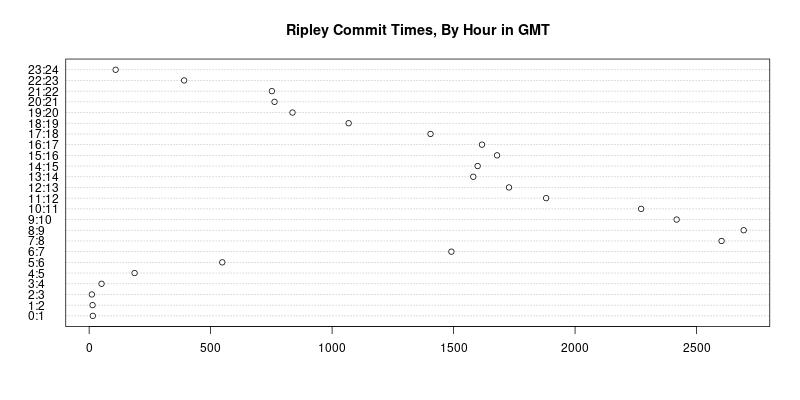
That is what one gets by trusting stable interfaces: code untouched for fourteen years runs unchanged. R itself has had well over sixty releases since then, including two major and eighteen minor releases. Yet the code just runs, including the code for two graphs one can reproduce with the exact same code as we show next.
tod <- unlist(sapply(rx,function(x)strsplit(x,split=" ")[[1]][6]))
tod <- tod[who=="ripley"]

tz <- sub(pattern=".*(-[0-9] 4 ).*",replacement="\\1",x=rx)
tz <- tz[who=="ripley"]
tz <- as.numeric(tz)/100
offset <- 3600*tz

z <- strptime(tod,format="%H:%M:%S")
hist(z,"hours",main="Ripley Commit Times in SVN TZ")

h <- z - offset
h <- format(h,format="%H")
h <- factor(as.numeric(h), levels=0:23)
## added as.vector() here to suppress a warning
dotchart(as.vector(table(h)), main="Ripley Commit Times, By Hour in GMT",
         labels=paste(0:23,1:24,sep=":"))
The code reproduces the chart from 2008, but this time uses the full twenty plus years of SVN history. I added just one as.vector() to suppress one new warning which appears under current R and which was presumably added in the fourteen years since (at the chart is produces without it too). The remainder of the code also runs. I just added one library(zoo) my blog post had omitted. No other changes.
## rather extract both  date and time
dat <- unlist(sapply(rx, function(x)  
  txt <- strsplit(x,split=" ")[[1]]
  paste(txt[5], txt[6])
 ))
## subset on Prof Ripley
dat <- dat[who == "ripley"]
## and convert to POSIXct, correcting by tz as well
datpt <- as.POSIXct(strptime(dat,format="%Y-%m-%d %H:%M:%S")) - offset

## turn into zoo -- we use a constant series of ones as each
## committ is taken as a timestamped event
library(zoo)
datzoo <- zoo(1, order.by=datpt)
## and use zoo to aggregate into commits per date
daily <- aggregate(datzoo, as.Date(index(datzoo)), sum)

## now plot as grey bars
plot(daily, col='darkgrey', type='h', lwd=2,
     ylab="Nb of SVN commits, three-week median",
     xlab="R release dates 2.5.0 and 2.5.1 shown in orange",
     main="The amazing Prof. Ripley")
## mark the two R releases of 2007
abline(v=c(as.Date("2007-04-24"),as.Date("2007-06-28")),col='orange',lwd=1.5)
## and do a quick centered rolling median
lines(rollmedian(daily, 21, align="center"), lwd=3)
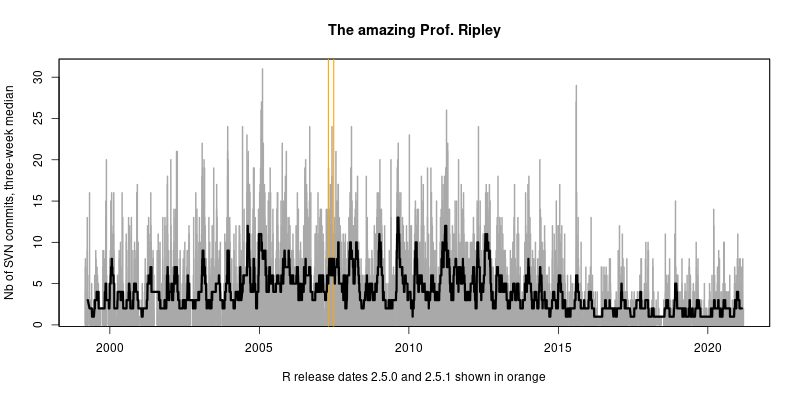
It produces this chart spanning two decades of commits. [3] The subtitle highlighting the then-most-recent releases is a little quaint now given that R has had eighten major.minor releases, and over sixty total releases, since then. Stable and rigourously maintained interfaces are a fantastic resource that is dramatically under-appreciated. Efforts such as the ten-year reproduction challenge demonstrate that this really is not a given. Maybe instead of celebrating band aides ( look, I reproduce via code I have frozen in a virtual environment / container / machine / ) we should celebrate languages, ecosystems, packages, that allow us to rely on just the code itself. Because we can. And we should strengthen and reinforce that ability. And discourage rapid changes just for changes sake. Code running for a decade, or even longer, is a huge boon to everybody relying on it. Three cheers to R Core. [1] Docker containers would be really good, and a step above the specs in the README. Winston s nice r-debug sumo container comes closest and helps a lot, and is updated regularly (which my earlier r-devel-san container is not). [2] The post owes some of its code ideas to Ben Bolker and Simon Jackman, but links to now-stale prior affiliations of theirs. [3] And the singularly impressive contributions charted remain unparalled, but were already the focus of the previous post. Yet over three times as a long period, they remain even more stunning. Edit 2021-03-21: Two minor fixes for grammar and typing.

Kentaro Hayashi: fabre.debian.net is now IPv6 ready

Today, we are pleased to announce that fabre.debian.net is now IPv6 ready. FOSSHOST provides us already a VPS instance which is located at OSU Open Source Lab and then also IPv6 capability to us! About fabre.debian.net fabre.debian.net is a experimental service to demonstrate how to improve user experience with finding and fixing Debian unstable related bugs for making "unstable life" comfortable. Thank FOSSHOST for kindly support.

17 March 2021

Jonathan Carter: Free Software Activities 2021-02

The last few weeks was really tough time-wise due to a whole bunch of personal things requiring attention. At least that is cooling down now, in the meantime, here s last monght s uploads (16 days late, yikes!). Hope everyone is doing well out there. 2021-02-02: Upload package python-strictyaml (1.1.1-2) to Debian unstable (Initial source-only upload). 2021-02-03: Upload package bundlewrap (4.4.2-1) to Debian unstable. 2021-02-03: Upload package python-aniso8601 (8.1.1-1) to Debian unstable. 2021-02-15: Upload package desktop-base (11.0.1-1) to Debian unstable. 2021-02-15: Upload package rootskel-gtk (11.0.1) to Debian unstable. 2021-02-16: Upload package btfs (2.24-1) to Debian unstable. 2021-02-16: Upload package gnome-shell-extension-multi-monitors (23-1) to Debian unstable. 2021-02-16: Upload package xabacus (8.3.4-1) to Debian unstable. 2021-02-19: Upload package bundlewrap (4.5.0-1) to Debian unstable. 2021-02-19: Upload package calamares (3.2.36-1) to Debian unstable. 2021-02-19: Upload package calamares (3.2.36-1~bpo10+1) to Debian buster-backports. 2021-02-19: Upload package bundlewrap (4.5.1-1) to Debian unstable.

15 March 2021

Matthew Garrett: Exploring my doorbell

I've talked about my doorbell before, but started looking at it again this week because sometimes it simply doesn't send notifications to my Home Assistant setup - the push notifications appear on my phone, but the doorbell simply doesn't trigger the HTTP callback it's meant to[1]. This is obviously suboptimal, but it's also tricky to debug a device when you have no access to it.

Normally I'd just head straight in with a screwdriver, but the doorbell is shared with the other units in this building and it seemed a little anti-social to interfere with a shared resource. So I bought some broken units from ebay and pulled one of them apart. There's several boards inside, but one of them had a conveniently empty connector at the top with "TX", "RX" and "GND" labelled. Sticking a USB-serial converter on this gave me output from U-Boot, and then kernel output. Confirmation that my doorbell runs Linux, but unfortunately it didn't give me a shell prompt. My next approach would often me to just dump the flash and look for vulnerabilities that way, but this device uses TSOP-48 packaged NAND flash rather than the more convenient SPI NOR flash that I already have adapters to access. Dumping this sort of NAND isn't terribly hard, but the easiest way to do it involves desoldering it from the board and plugging it into something like a Flashcat USB adapter, and my soldering's not good enough to put it back on the board afterwards. So I wanted another approach.

U-Boot gave a short countdown to hit a key before continuing with boot, and for once hitting a key actually did something. Unfortunately it then prompted for a password, and giving the wrong one resulted in boot continuing[2]. In the past I've had good luck forcing U-Boot to drop to a prompt by simply connecting one of the data lines on SPI flash to ground while it's trying to read the kernel - the failed read causes U-Boot to error out. It turns out the same works fine on raw NAND, so I just edited the kernel boot arguments to append "init=/bin/sh" and soon I had a shell.

From here on, things were made easier by virtue of the device using the YAFFS filesystem. Unlike many flash filesystems, it's read/write, so I could make changes that would persist through to the running system. There was a convenient copy of telnetd included, but it segfaulted on startup, which reduced its usefulness. Fortunately there was also a copy of Netcat[3]. If you make a fifo somewhere on the filesystem, you can cat the fifo to a shell, pipe the shell to a netcat listener, and then pipe netcat's output back to the fifo. The shell's output all gets passed to whatever connects to netcat, and whatever's sent to netcat gets passed through the fifo back to the shell. This is, obviously, horribly insecure, but it was enough to get a root shell over the network on the running device.

The doorbell runs various bits of software, one of which is Lighttpd to provide a local API and access to the device. Another component ("nxp-client") connects to the vendor's cloud infrastructure and passes cloud commands back to the local webserver. This is where I found something strange. Lighttpd was refusing to start because its modules wanted library symbols that simply weren't present on the device. My best guess is that a firmware update went wrong and left the device in a partially upgraded state - and without a working local webserver, there was no way to perform any further updates. This may explain why this doorbell was sitting on ebay.

Anyway. Now that I had shell, I could simply dump the flash by copying it directly off the /dev/mtdblock devices - since I had netcat, I could just pipe stuff through that back to my actual computer. Now I had access to the filesystem I could extract that locally and start digging into it more deeply. One incredibly useful tool for this is qemu-user. qemu is a general purpose hardware emulation platform, usually used to emulate entire systems. But in qemu-user mode, it instead only emulates the CPU. When a piece of code tries to make a system call to access the kernel, qemu-user translates that to the appropriate calling convention for the host kernel and makes that call instead. Combined with binfmt_misc, you can configure a Linux system to be able to run Linux binaries from other architectures. One of the best things about this is that, because they're still using the host convention for making syscalls, you can run the host strace on them and see what they're doing.

What I found was that nxp-client was calling back to the cloud platform, setting up an encrypted communication channel (using ChaCha20 and a bunch of key setup stuff I couldn't be bothered picking apart) and then waiting for commands from the cloud. It would then proxy those through to the local webserver. Since I couldn't run the local lighttpd, I just wrote a trivial Python app using http.server and waited to see what requests I got. The first was a GET to a CGI script called editcgi.cgi, along with a path name. I mocked up the GET request to respond with what was on the actual filesystem. The cloud then proceeded to POST to editcgi.cgi, with the same pathname and with new file contents. editcgi.cgi is apparently able to read and write to files on the filesystem.

But this is on the interface that's exposed to the cloud client, so this didn't appear immediately useful - and, indeed, trying to hit the same CGI binary over the local network gave me a 401 unauthorized error. There's a local API spec for these doorbells, but they all refer to scripts in the bha-api namespace, and this script was in the plain cgi-bin namespace. But then I noticed that the bha-api namespace didn't actually exist in the filesystem - instead, lighttpd's mod_alias was configured to rewrite requests to bha-api through to files in cgi-bin. And by using the documented API to get a session token, I could call editcgi.cgi to read and write arbitrary files on the doorbell. Which means I can drop an extra script in /etc/rc.d/rc3.d and get a shell on my doorbell.

This all requires the ability to have local authentication credentials, so it's not a big security deal other than it allowing you to retain access to a monitoring device even after you've moved out and had your credentials revoked. I'm sure it's all fine.

[1] I can ping the doorbell from the Home Assistant machine, so it's not that the network is flaky
[2] The password appears to be hy9$gnhw0z6@ if anyone else ends up in this situation
[3] https://twitter.com/mjg59/status/654578208545751040

comment count unavailable comments

13 March 2021

Sean Whitton: lisp-use-for-transpose-chars

I had thought that Emacs C-t was mainly about correcting typos. It turns out to be extremely useful when working on Lisp macros which themselves write macros. This typically involves nested quasiquotation, where you can have multiple alternating sequences of open parentheses and backticks, or of commas, quotation marks and ampersats. While you re working on it you often need to reorder these character sequences and C-t does a great job.

Jonathan Dowland: Internal Gotek

This is the eleventh part in a series of blog posts. The previous post was FlashFloppy OLED display. The whole series is available here: Amiga.
It's still mostly all quiet on the Amiga project front. The last few months with both my kids at home have been too difficult and busy with no time for side projects. Primary Schools in the UK went back this week, and I've finally got around to installing the Gotek floppy emulator inside the Amiga A500's chassis. I followed A short "Internal Gotek Floppy" Installation Guide , which explains that you don't need to print (or buy) a special mount for it: Simply removing the Gotek's top plastic case is enough for it to fit inside, and you can support it with some nuts and bolts.
Gotek bolted into place Gotek bolted into place
Easy in theory, but it still took me a while, with plenty of trial and error to line it up just right. I ended up using some M4 bolts and smaller (the kind that you use in electrical sockets) to support the bottom part of the Gotek case in three places: one, at the front, re-using an original vertical support for the old floppy drive; and two at the back, screwing through two holes in the A500's outer case and mainboard. If I'd chosen short enough bolts, the back of the Gotek case could have probably just rested on the ends of those bolts, but the ones I had were another few cm longer, so I drilled holes in the Gotek case to run the bolts through, and secured it with nuts.
Knob, display and mount, external Knob, display and mount, external
In that guide, the author has an OLED display for their Gotek that they wanted on the top of the Amiga case, so they fed the four tiny wires through the grill. I had a go at that, but I've got the OLED display and a rotary encoder, so that's 8 wires total, and damn fiddly. Instead for now I've just routed them all out through the hole left behind by the floppy drive's Button. I'm going to try and tidy it up with some heat shrink or similar. So finally, my Amiga is one "unit" again, without dangly bits hanging off it (if you ignore those 8 tiny wires for now) that I can move around to store or use much more easily.

Louis-Philippe V ronneau: Preventing an OpenPGP Smartcard from caching the PIN eternally

While I'm overall very happy about my migration to an OpenPGP hardware token, the process wasn't entirely seamless and I had to hack around some issues, for example the PIN caching behavior in GnuPG. As described in this bug the cache-ttl parameter in GnuPG is not implemented and thus does nothing. This means once you type in your PIN, it is cached for as long as the token is plugged. Security-wise, this is not great. Instead of manually disconnecting the token frequently, I've come up with a script that restarts scdameon if the token hasn't been used during the last X minutes. It seems to work well and I call it using this cron entry: */5 * * * * my_user /usr/local/bin/restart-scdaemon To get a log from scdaemon, you'll need a ~/.gnupg/scdaemon.conf file that looks like this:
debug-level basic
log-file /var/log/scdaemon.log
Hopefully it can be useful to others!
 #!/usr/bin/python3
# Copyright 2021, Louis-Philippe V ronneau <pollo@debian.org>
#
# This script is free software: you can redistribute it and/or modify it under
# the terms of the GNU General Public License as published by the Free Software
# Foundation, either version 3 of the License, or (at your option) any later
# version.
# 
# This script is distributed in the hope that it will be useful, but WITHOUT
# ANY WARRANTY; without even the implied warranty of MERCHANTABILITY or FITNESS
# FOR A PARTICULAR PURPOSE. See the GNU General Public License for more
# details.
# 
# You should have received a copy of the GNU General Public License along with
# this script. If not, see <http://www.gnu.org/licenses/>.
"""
This script restarts scdaemon after X minutes of inactivity to reset the PIN
cache. It is meant to be ran by cron each X/2 minutes.
This is needed because there is currently no way to set a cache time for
smartcards. See https://dev.gnupg.org/T3362#137811 for more details.
"""
import os
import sys
import subprocess
from datetime import datetime, timedelta
from argparse import ArgumentParser
p = ArgumentParser(description=__doc__)
p.add_argument('-l', '--log', default="/var/log/scdaemon.log",
               help='Path to the scdaemon log file.')
p.add_argument('-t', '--timeout', type=int, default="10",
               help=("Desired cache time in minutes."))
args = p.parse_args()
def get_last_line(scdaemon_log):
    """Returns the last line of the scdameon log file."""
    with open(scdaemon_log, 'rb') as f:
        f.seek(-2, os.SEEK_END)
        while f.read(1) != b'\n':
            f.seek(-2, os.SEEK_CUR)
        last_line = f.readline().decode()
    return last_line
def check_time(last_line, timeout):
    """Returns True if scdaemon hasn't been called since the defined timeout."""
    # We don't need to restart scdaemon if no gpg command has been run since
    # the last time it was restarted.
    should_restart = True
    if "OK closing connection" in last_line:
        should_restart = False
    else:
        last_time = datetime.strptime(last_line[:19], '%Y-%m-%d %H:%M:%S')
        now = datetime.now()
        delta = now - last_time
        if delta <= timedelta(minutes = timeout):
            should_restart = False
    return should_restart
def restart_scdaemon(scdaemon_log):
    """Restart scdaemon and verify the restart process was successful."""
    subprocess.run(['gpgconf', '--reload', 'scdaemon'], check=True)
    last_line = get_last_line(scdaemon_log)
    if "OK closing connection" not in last_line:
        sys.exit("Restarting scdameon has failed.")
def main():
    """Main function."""
    last_line = get_last_line(args.log)
    should_restart = check_time(last_line, args.timeout)
    if should_restart:
        restart_scdaemon(args.log)
if __name__ == "__main__":
    main()

11 March 2021

Vincent Fourmond: All tips and tricks about QSoas

I've decided to post regular summaries of all the articles written here about QSoas; this is the first post of this kind. All the articles related to QSoas can be found here also. The articles written here can be separated into several categories. Tutorials to analyze real data These are posts about how to reproduce the data analysis of published articles, including links to the original data so you can fully reproduce our results. These posts all have the label tutorial. All about fits QSoas has a particularly powerful interface for non-linear least square minimisations (fits): Meta-data Meta data describe the conditions in which experiments were performed. Quiz and their solutions Quiz are small problems that take some skill to solve; they can teach you a lot about how to work with QSoas. Other tips and tricks Release annoucements These have generally lot of general information about the possibilities in QSoas:
About QSoas QSoas is a powerful open source data analysis program that focuses on flexibility and powerful fitting capacities. It is released under the GNU General Public License. It is described in Fourmond, Anal. Chem., 2016, 88 (10), pp 5050 5052. Current version is 3.0. You can download its source code there (or clone from the GitHub repository) and compile it yourself, or buy precompiled versions for MacOS and Windows there.

10 March 2021

Sean Whitton: consfigurator 0.3.1

I d like to briefly introduce my new project, Consfigurator:
Consfigurator is a system for declarative configuration management using Common Lisp. You can use it to configure hosts as root, deploy services as unprivileged users, build and deploy containers, and produce disc images. [not all of these are implemented yet, but the design permits them to be] Consfigurator s design gives you a great deal of flexibility about how to control the hosts you want to configure. If there is a command you can run which will obtain input and output streams attached to an interactive POSIX sh running on the target host/container, then with a little glue code, you can use much of Consfigurator s functionality to configure that host/container. But if it is possible to get an implementation of Common Lisp started up on the host, then Configurator can transparently execute your deployment code over on the remote side, rather than exchanging information via POSIX sh. This lets you use the full power of Common Lisp to deploy your configuration. Configurator has convenient abstractions for combining these different ways to execute your configuration on hosts with different ways of connecting to them. Connections can be arbitrarily nested. For example, to combine SSHing to a Debian machine as an unprivileged user, using sudo to become root, and then starting up a Lisp image to execute your deployment code, you would evaluate
    (deploy ((:ssh (:sudo :as "spwhitton@athena.example.com") :debian-sbcl)) athena.example.com)
Declarative configuration management systems like Consfigurator and Propellor share a number of goals with projects like the GNU Guix System and NixOS. However, tools like Consfigurator and Propellor try to layer the power of declarative and reproducible configuration on top of traditional, battle-tested unix system administration infrastructure like apt, dpkg, yum, and distro package archives, rather than seeking to replace any of those. Let s get as much as we can out of all that existing distro policy-compliant work!
Please check out the user s manual, which includes a tutorial/quick start guide, and come join us in #consfigurator on irc.oftc.net. It s early days but you can already do a fair few things with Consfigurator. It s a good time to come help get all the basic properties defined!

Mike Hommey: 5 years ago, Firefox (re)entered Debian

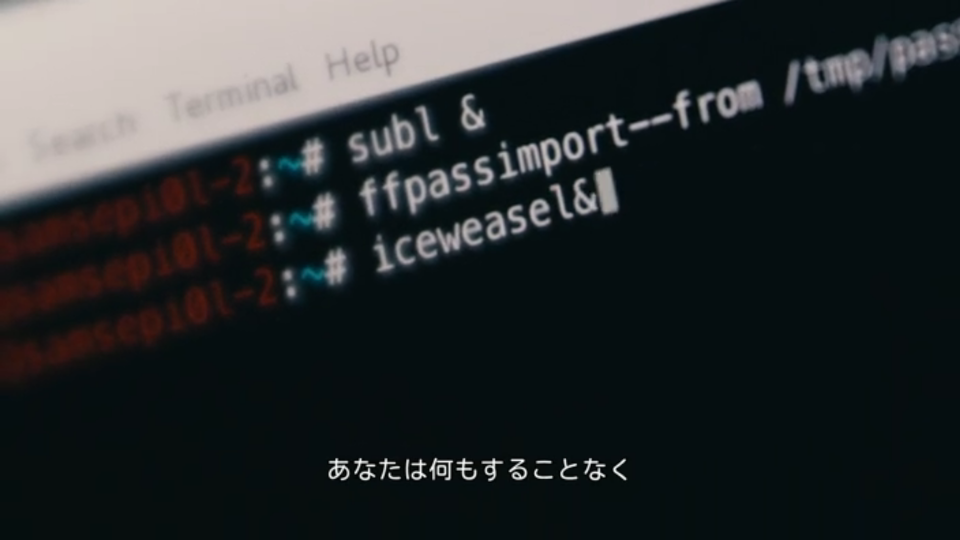
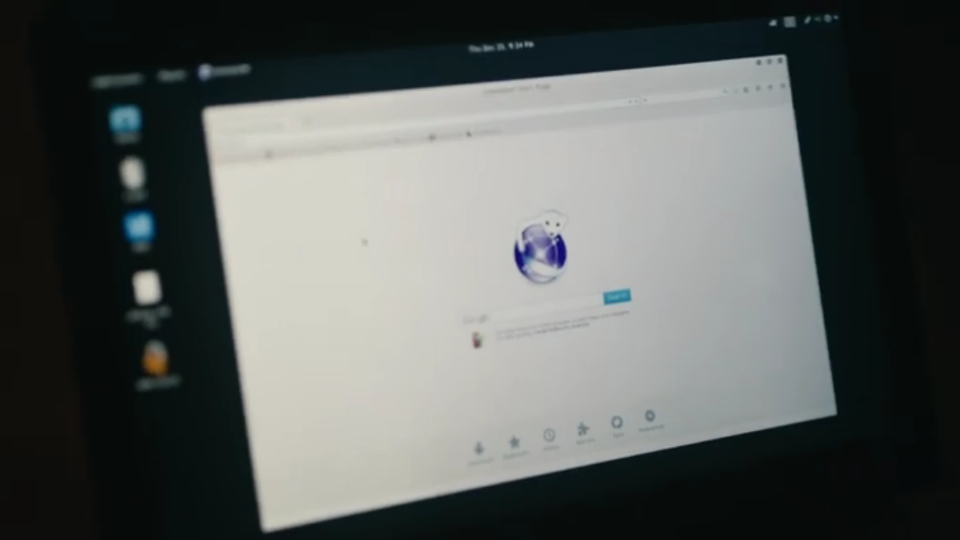
5 years ago today, I was declaring Iceweasel dead, and Firefox was making a come back in Debian. I hadn t planned to make this post, and in fact, I thought it had been much longer. But coincidentally, I was binge-watching Mr. Robot recently, which prominently featured Iceweasel. iceweasel command in a terminal Mr. Robot is set in the year 2015, and I was surprised that Iceweasel was being used, which led me to search for that post where I announced Firefox was back and realizing that we were close to the 5 years mark. Well, we are at the 5 years mark now. iceweasel start page I d normally say time flies, but it turns out it hasn t flown as much as I thought it did. I wonder if the interminable pandemic is to blame for that.
Dirk Eddelbuettel: RcppArmadillo 0.10.2.2.0 on CRAN: New Upstream Patch Release

armadillo image Armadillo is a powerful and expressive C++ template library for linear algebra aiming towards a good balance between speed and ease of use with a syntax deliberately close to a Matlab. RcppArmadillo integrates this library with the R environment and language and is widely used by (currently) 841 other packages on CRAN. This release brings us a second update within the Armadillo 10.2 series, one month after the initial release. Upstream work has commenced at a 10.3 series with first pre-releases which we are currently testing. If possible, CRAN release will continue to be at least one month apart (such as this time) but we continue to make interim releases available on the Rcpp drat repo repo. The full set of changes follows.

Changes in RcppArmadillo version 0.10.2.2.0 (2021-03-09)
  • Upgraded to Armadillo release 10.2.2 (Cicada Swarm)
    • faster handling of subcubes
    • added tgamma()
    • added .brief_print() for abridged printing of matrices & cubes
    • expanded forms of trimatu() and trimatl() with diagonal specification to handle sparse matrices
    • expanded eigs_sym() and eigs_gen() with optional shift-invert mode
  • Removed debian/ directory from repository as packaging is on salsa.debian.org.
  • Relaxed tolerance on two cube tests on Windows to accomodate new 'gcc10-UCRT' builder.

Courtesy of my CRANberries, there is a diffstat report relative to previous release. More detailed information is on the RcppArmadillo page. Questions, comments etc should go to the rcpp-devel mailing list off the R-Forge page. If you like this or other open-source work I do, you can sponsor me at GitHub.

This post by Dirk Eddelbuettel originated on his Thinking inside the box blog. Please report excessive re-aggregation in third-party for-profit settings.

9 March 2021

Matthew Garrett: Unauthenticated MQTT endpoints on Linksys Velop routers enable local DoS

(Edit: this is CVE-2021-1000002)

Linksys produces a series of wifi mesh routers under the Velop line. These routers use MQTT to send messages to each other for coordination purposes. In the version I tested against, there was zero authentication on this - anyone on the local network is able to connect to the MQTT interface on a router and send commands. As an example:
mosquitto_pub -h 192.168.1.1 -t "network/master/cmd/nodes_temporary_blacklist" -m ' "data": "client": "f8:16:54:43:e2:0c", "duration": "3600", "action": "start" '
will ask the router to block the client with MAC address f8:16:54:43:e2:0c from the network for an hour. Various other MQTT topics pass parameters to shell scripts without quoting them or escaping metacharacters, so more serious outcomes may be possible.

The vendor has released two firmware updates since report - I have not verified whether either fixes this, but the changelog does not indicate any security issues were addressed.

Timeline:

2020-07-30: Submitted through the vendor's security vulnerability report form, indicating that I plan to disclose in either 90 days or after a fix is released. The form turns out to file a Bugcrowd submission.
2020-07-30: I claim the Bugcrowd submission.
2020-08-19: Vendor acknowledges the issue, is able to reproduce and assigns it a P3 priority.
2020-12-15: I ask if there's an update.
2021-02-02: I ask if there's an update.
2021-02-03: Bugcrowd raise a blocker on the issue, asking the vendor to respond.
2021-02-17: I ask for permission to disclose.
2021-03-09: In the absence of any response from the vendor since 2020-08-19, I violate Bugcrowd disclosure policies and unilaterally disclose.

comment count unavailable comments

Emmanuel Kasper: Displaying CSV files in a readable way on the terminal

Until this week I did not know about the column command.

$ head -5 zillow.csv
"Index", "Living Space (sq ft)", "Beds", "Baths", "Zip", "Year", "List Price ($)"
1, 2222, 3, 3.5, 32312, 1981, 250000
2, 1628, 3, 2, 32308, 2009, 185000
3, 3824, 5, 4, 32312, 1954, 399000
4, 1137, 3, 2, 32309, 1993, 150000

Turned out this file is much more readable with a good pipe (and a large screen)
$ head -5 zillow.csv column --table --separator ,
"Index" "Living Space (sq ft)" "Beds" "Baths" "Zip" "Year" "List Price ($)"
1 2222 3 3.5 32312 1981 250000
2 1628 3 2 32308 2009 185000
3 3824 5 4 32312 1954 399000
4 1137 3 2 32309 1993 150000

column is part of util-linux and is thus available in all distributions.
Example file taken from this example list.

7 March 2021

Thorsten Alteholz: My Debian Activities in February 2021

FTP master This month I accepted 162 and rejected 28 packages, which is again a small increase compared to last month. The overall number of packages that got accepted was 291. Debian LTS This was my eightieth month that I did some work for the Debian LTS initiative, started by Raphael Hertzog at Freexian. This month my all in all workload has been 30h. During that time I did LTS and normal security uploads of: I also prepared debdiffs for golang-github-appc-cni, wpa and libbsd, which for one reason or another did not result in a DLA yet. Moreover I did some NEW processing and other stuff on security-master. Last but not least I did some days of frontdesk duties. Debian ELTS This month was the thirty-second ELTS month. During my allocated time I uploaded: Last but not least I did some days of frontdesk duties. Other stuff This month I uploaded new upstream versions of:

Shirish Agarwal: Task-based menus for a file

XDG Just throwing this out for wider talk perhaps. I have been silently watching a list called xdg@lists.freedesktop.org. Now the list talks about freedesktop standards which basically is trying to have some sort of standards that all desktop environments can follow. One of the discussions on the specific list shared above is and was about New MimeType fields in .desktop . It is a fascinating thread with many people giving loads of interesting view points. If you are into desktops even casually, you would enjoy the discussions thoroughly. Seriously thinking, I shared the below on the list Hi all, I read quite a bit of the fascinating thread. As a user I have often had to fix the same at my end and at times had to re-fix it again. For me it s the mkv and related media file types. Now I have different applications which are for different things, For e.g. mpv is exclusively the player (followed at times by vlc) for playing the content. Mediainfo to have technical knowledge/bits about the content. ffmpeg for doing some basic stuff (extracting subtitles or adding subtitles etc.) to the content, re-encoding into smaller resolution etc etc. Sadly, none of the solutions as of date tell me if I hover or even go into properties of a mkv file which application does what. I do know this is perhaps a bit outside the discussion having, but does anybody have any ideas? At the very least, it should make the user more aware of what he can do with particular applications perhaps. One way is to perhaps have a database so if I ask in a way that the system understands which are the editors which can be used to manipulate or edit mkv files, it should give me a list available from debian database. I do know that apt, aptitude etc. do try to do something on those lines but it has many shortcomings. And as somebody else mentioned, don t think the solution would be done tomorrow but at least sometime in future. While I stopped at the above on the list, allow me to extrapolate or share a bit more where I am coming from. Somebody did share that this should be actually done by the desktop provider, and GNOME 1 did provide a solution in the early days, now then they have moved to being a more dumb desktop or in their words simplifying. In any case, while I haven t hadn t had the opportunity to see the new MAC desktop, Windows 10 desktop interface is nothing to write home about. All our DE s starting from GNOME, MATE, XFCE, could and should be giving us much more than it has, making users having richer and better experiences than they have today. And while I shared about .mkv (the Matroska Multimedia Container), the above applies and can apply to any file format which can be manipulated in different ways using different tools. I just shared the one I use most often as a use-case scenario. And this should be made easier now that we have processors have multiple cores (for e.g. Intel and AMD quad cores are now there at decent prices) . So would it be too much of an ask to have something which helps people be more productive. As of today, for anybody who is new to either Debian or any X desktop, there is still such a substantial learning curve and more so applications and how they fit in the puzzle and what can be done and what cannot be done. A much screwy thing to add to the mix is file format and which file format version can a particular app. read. The biggest and the most common culprit here is pdf. A good webpage which shares the versions and the comments which tell how people are still having issues with various versions of pdf. Most of the foss tools I use top out at pdf 1.4 which is quite an old format  . I am open to testing and debugging if somebody does try decoding the new versions. For me, this is also an issue as most I.T. notices and what not we get, at times I have to try and figure out things, at times go to MS and use an acrobat reader and that is dumb.

Banking There are also lot of banking stuff that we cannot do on free software, especially in India as lot of powerful proprietary interests are there which make sure that no public API s are available, or even if there is, it would be something half-done or after back and forth, they say, this is just for show, as had shared last year. I would probably add another section later to talk about it. From what little I know, in Europe the law mandates that there are public API s not only for banking but wherever public money (read taxpayer money) is involved. Again, not all countries, but some more than others. At least, that is what I had seen over the years. Till later.

Next.

Previous.