Julien Danjou: DPL 2007: Raphael Hertzog
 At least, someone is going to be dumped.
Information about this post.
At least, someone is going to be dumped.
Information about this post.


"Dear Mister(!) Reichle.And now, guess how I got it. Ripped, in a transparent plastic bag.
The investigation can not be carried out at the moment, since the information you provided is not complete. Please complete and correct the information according the missing item ..."
 Several grml developers will be there and I’m looking forward to meet formorer for the first time in RL.
 Hope to see you there!

$f=new Foobar();

$a=$f;

$a->do_something();

if ( $a->fetch() != $f->fetch() )

     echo “they differ\n”;
class Foobar
var $myvar = 1;
function Foobar()

function printit()
    echo "var is " . $this->myvar . "\n";

function incr()
    $this->myvar += 1;


$f = new Foobar();
$a = $f;
$b = $f;
$a->printit();
$a->incr();
$b->printit();
davidw@byron:/tmp$ php4 foobar.php
var is 1
var is 1
davidw@byron:/tmp$ php5 foobar.php
var is 1
var is 2
clone function to do what we want with PHP5, but... that means we have to track down every single place in the code where there is something like $foo = $bar. And hope that we got them all, because otherwise subtle bad things might happen. The codebase I've inherited isn't great to begin with, and hunting down every object copy is bound to be torture. Ouch.
Update
It's been pointed out that my description of exactly what's happening internally isn't correct. However, from my point of view, the end result is the same: a massive search and replace operation in order to obtain the "old" behavior by using clone. Most likely, this means that we won't be able to upgrade soon, which means that we won't be able to take advantage of some of the nice new PHP5 features, which will slow down other works in progress. For want of a nail...
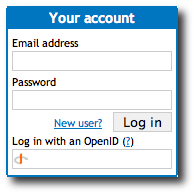 Users can now create their accounts using an OpenID, or associate an OpenID with an existing account. A single-sign on solution like OpenID solves an important problem for us, as most people tend to interact with our conference web sites in only one or two time periods each year. While we've gone to the trouble of making retrieving a password easy, there's still the mental burden on the user of setting up the account and noting it down somewhere. As a measure of the impact of this on me personally: I habitually save registration confirmation emails in a certain mail folder. Since 1997 I have collected no fewer than 572 of these, and I'm sure some have been missed! One other cool thing about OpenID is that finally I can get the identity I wish to have. No longer do I have to be a compulsive early adopter of every service just to get the name edd. (Well, as long as said service integrates OpenID of course!) Personal branding is an important attractive aspect of OpenID.ImplementationImplementing OpenID using the Ruby ruby-openid gem was quite straightforward, as was the logical integration into our user models. I've not been the only one following this path recently, as illustrated by this post on Rails OpenID integration from Dan Webb.The harder problem of deploying OpenID lies in making the user interface work well: ultimately that will have a huge influence over its uptake. We've made a decent first go of it in Expectnation, but I'm sure we'll evolve and improve it over time. The main puzzling thing is how obvious to make the OpenID facility, given its relatively small take-up right now. We don't want to confuse normal users too much by using it. Microformats When I did my behind-the-scenes piece on the building of the XTech schedule last week, one feature I didn't discuss was the support for microformats we have in the schedule and on the session pages. If you use a tool such as Operator, you can easily save talk times to your calendar while reading the schedule.
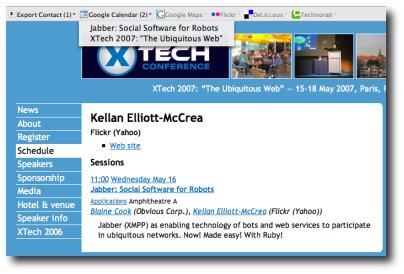 I'm personally a little late to the microformats party. Being a fan of pragmatic RDF, I didn't see much need for microformats right away. However, with tools like Operator I can honestly say that the use of microformats does enhance the XTech schedule.My impressions of microformats (in particular hCalendar and hCard) from using them are mixed. One the plus side, it was very easy to do. On the negative side, I found them restrictive in the sense that for the metadata to be present in the hCalendar object, it needs to be part of the HTML presentation.So, while microformats are meant to be about making human readable data useful for computers, they can have a tail-wagging effect on the human markup. Let me elaborate. In the conference schedule there is a grid overview. For readability here we want to keep the details down to a minimum in each box. There is definitely no need to repeat the date of each presentation when you can see there's a grid per day.But also we want to have microformats available in the page so users can use the grid to pick off talks to add to their calendar. The only details you currently get from the microformat are those you physically include inside the div marked as vevent. This means we can't embed the full details, such as the talk description. It also means I indulge in some dubious markup practices (an empty abbr element) in order to get the date and time into each hCalendar object.It seems to me that this could be ameliorated by more intelligent user agent behaviour. Each of my hCalendar events is given a URL. At the end of that URL is a full description of the event, using microformats. So, as long as I reference the URL in a summary page, the user agent can beetle off and pull down the full information, in much the same sort of way that FOAF uses the rdfs:seeAlso property.So, remove the expectation that microformats provide complete data, and I'm sold.Other schedule features: iCal, Upcoming.org
TKIP: ICV error detected: STA=...
N/A: Michael MIC verification failed for MSDU from ... keyidx=0
wifi0: MSDU decryption/MIC verification failed (SA=... keyidx=0)
TKIP: received packet without ExtIV flag from ...
Upgrading to Kernel 2.6.20 turned these errors into something like Firmware bug detected; reconnect already was a bit faster. Upgrading the firmware past the Debian-packaged (in non-free) version to a newer one change them again (I think the ICV error remained) and made the reconnects even faster; still large transfers don't work reliably with WPA. Another reason I upgraded to 2.6.20 was that the microphone didn't work on my Dell 640m. The upgrade helped here, I now can record from my microphone. Every now and then, my system kind of freezes on resume; it seems that some interrupts (especially the keyboard interrupt) remain disabled... I also tried the newer i810-modesetting driver, that should be able to handle the 1440x900 resolution without the aid of i915resolution (which basically overwrites part of the video BIOS to add the resolution to the supported resolutions list). The screen remained black (with both unstable and experimental versions of the driver). Another reason why I was trying this driver is that the current driver has like a default gamma 1.5 for XV, apparently - all XV using apps playback videos way too bright. Even if they don't have an XV gamma control. Well, on the other hand, thats what Windows users might be exposed to every day. 99% of the time, everything works fine for me, too. It just remains open whether 2.6.18 is actually the right kernel to use for the upcoming release... 2.6.20 improved on some of my issues. On the other hand, yaird failed to make a proper initrd for my computer, because CBC (cipher block chaining, a common choice if you encrypt your harddisk) became a module and wasn't added. There are just so many details to iron out when upgrading the kernel... that would pretty much mean an unfreeze, I guess. :-( If we would release more often, that wouldn't be as essential, but for a release interval of two years, we really should have a kernel with few driver issues. And even if we're going to ship newer kernels with "dot releases" of etch, we'll have to avoid issues such as the CBC-module being unknown to yaird.
Next.