Search Results: "ag"

1 March 2007

Ross Burton: Tasks Translations (part 2)

I may give up actually coding in the future and just ask for things to be done on my blog.

Erich Schubert: Pyroman update

I just uploaded a minor update of Pyroman to unstable and the pyroman download page on alioth. I added support for a complete interface wildcard, and added example configuration files for a single-host setup. Pyroman is a firewall configuration tool I wrote for managing the firewall of a small network consisting of four zones and servers with a dozen different tasks. It plays very well in setups with DMZ, wireless networks, intranet etc. and all kinds of different services. Key benefits are the very simple syntax, safeguards (extensive syntax checks, rollback on failure, safety timeout option for remote administration), scriptability in python and high performance, since it does not run dozens of iptables commands, but generates a script file for iptables-restore. For more benefits, see the pyroman homepage. The next version will probably feature an XML syntax additionally; while the current Python syntax is very powerful and readable, it's pretty much impossible to write a GUI for editing the policy when written this way. That's why I'd like to add an XML syntax (that can be intermixed with Python statements, but only the XML-defined parts will be editable in the GUI) that supports the key parts of configuration (if you want the rules to be generated on the fly from some database or whatever, you'll still be able to do that in Python!): making it easier to write a GUI for it.

Julien Danjou: DPL 2007: Anthony Towns

Raphael Hertzog as DPL The first sentence was taken from his platform. Information about this post.

Kartik Mistry: ldtp-doc

* I Did ITP for ldtp-doc yesterday. And the great thing is that nags changed its licence from GFDL to LGPL, making things easy for Debian packaging for me (& world). Thanks nags for that. I have not seen such co-operative upstream yet!! LDTP-doc will contain html documentation for LDTP (Linux Desktop Testing Project) package.

MJ Ray: OpenWRT (2)

OK, it's taking longer to find time to do this. The network is holding up this week and customers have work that needs doing urgently, so I've not risked bricking the router. sdf commented:
"i would try dd-wrt (dd-wrt.de) instead..."
Mark commented:
"Install OpenWRT 0.9 (not "Kamikaze", which is a ground-up rewrite in pre-alpha). Install X-WRT to get webinf^2 (better web interface for configuration). Read the OpenWRT documentation on how to backup/restore your firmware. Make a backup once after you get everything configured, again before installing any major new packages, and again just before a firmware upgrade. The IRC channel is hit-or-miss but the forums are well-attended by knowledgeable people. Hope this helps."
Thanks. That's a great help. sebastian commented:
"Just saw your blog entry, you could have a look at X-WRT, which is an enhanced web configuration frontend to OpenWRT. ( http://x-wrt.org/ ) otherwise, they just plain rock (my opinion) ;-)"
Ben Finney commented:
"One warning I'd give is to make clear that OpenWRT happily sets up a 'non-free' repository source for its 'ipkg' package manager. This is necessary to get the Linux 2.4.3x module for most Broadcom wireless chips, and for 'nas' which is apparently needed for WPA encryption. I vaguely recall someone announcing recently that free-software drivers were now available for most Broadcom chipsets, but that's likely only in Linux 2.6.x and may take quite some time to appear in OpenWRT."
I'm aware that I'm pretty screwed by the Broadcom chipset, but it's a step forwards from where I am. The reply:
"I'm not sure whether to hope for an improvement. Do you know if the Broadcom chipset on these devices is one that now has free drivers available? If so, possibly we could agitate for those drivers to be backported to the kernel used in OpenWRT."
I don't know, but I guess I'll find out soon. Thanks for all the great comments so far, but now I'm not sure whether I want OpenWRT, X-WRT or dd-wrt!

Enrico Zini: suggestions-gz

Package suggestions I tried generating a list of 10 suggested packages for every package in the archive. You cat get it at http://people.debian.org/~enrico/Suggestions.gz and build nice things with it. Generation took two hours of a nice 18 process on the busy gluck, but it can be run in any faster/less busy machine that has a local copy of the unaggregated popcon data. This is (roughly) the generating algorithm:
  1. Take a package P.
  2. Query P on a Xapian index that indexes popcon submissions as documents and their packages as words.
  3. Get the first 20 resulting popcon votes.
  4. Score each package mentioned in those 20 results by a combination of how many votes mention it, its TFIDF scores in the various votes and the Xapian relevance score of the resulting votes.
  5. Take the top 10 packages as suggestions for P.
The code can be fetched with:
bzr branch http://people.debian.org/~enrico/2007-01/popcon/
Lars Wirzenius: Debian: Automatic testing wishlist

Joey Hess writes about automated system testing in his anti-platform. That's one of the things that I'd like to work on, some day, when I have some free time again. There's two things I would like to do next in this area. First are improvements to piuparts so divide the tests it does into smaller bits, and to add a plugin framework so that it becomes easy to write new tests. The current piuparts code isn't really well suited for this, but the whole program is only a few hundred lines of code, so even if it had to be rewritten completely from scratch, it shouldn't take more than a couple of weeks of full time work (piuparts development is often slow because you need to run tests on large parts of the archive). The other thing would be to test upgrades not of individual packages, which piuparts does now, but of entire systems, preferably in emulated machines instead of chroots. This would probably need a new tool. The third of these two things would be to start adding automatic tests to packages so that we can test whether they work when they're installed. Ian Jackson did some work on a tool for this, but we need to use the tool. Ideally, we would have a setup where packages get tested automatically, continuously (daily, if possible) and results are reported instantly. At the moment, piuparts results need to be filtered manually, and that's a pain. Adding a "package health indicator" the PTS based on these automatic tests would be cool. We could even have a "Debian big board" web page, with a small square for each package, colored green if it's bug free and passes automatic tests; colored cyan if there's only bugs of severity normal or below, or a problem with some of the automatic tests; colored pink if there's a bug of severity important, or all automatic tests fail; and colored red if there's bugs of severity higher than important. This would give an overview to the health of Debian with a glance.

Andrew Stribblehill: Airport security

I have long felt that many airport security measures are just for show — “security theatre”, as Bruce Schneier puts it — but I now have some anecdotal evidence to back it up. I fly frequently: from Dublin to my family in Durham, and I make the occasional transatlantic flight too. Before I realised it last week, I had taken a travel sewing kit in my hand luggage on seven flights, both short-haul and long. In Chicago, I even had my luggage hand-checked; they still didn’t notice it. Maybe they’d have been more thorough if I’d been wearing a turban.

Mike Hommey: Google Keywords - Feb 2007

I think I’m going to make a tradition of this google keywords list that I reinitiated last month. Anyways, here’s the list for February 2007: “google keywords” - waw, already on the first page for this
“i am a dumb ass” - me too
“blackout in europe” - that happened
“firefox 2 debian package” - you’re looking for iceweasel
“mozilla firefox japanese symbols” - it’s called characters, not symbols
“rebrand firefox as iceweasel” - not even done yet :(
“debian iceweasel replaces firefox” - surprised ?
“fucked up resizing partition” - welcome to the club
“hobbit debian” - I’m not a hobbit !
“how can i change firefox to iceweasel on kubuntu” - waw, I’m impressed
“web 2.0 vs. web 1.0″ - not here
“bugzilla bts (hate or sucks)” - bts sucks less
“cmd to download firefox on ubuntu” - apt-get install ?
“i need firefox with debian” - not happening
“what is a esx flat file” - basically, a raw disk image
“linux ext3 noload option” - does not work as expected
“fact about a horse” - persistant…

Benjamin Mako Hill: The Revolution Will Be Colorful

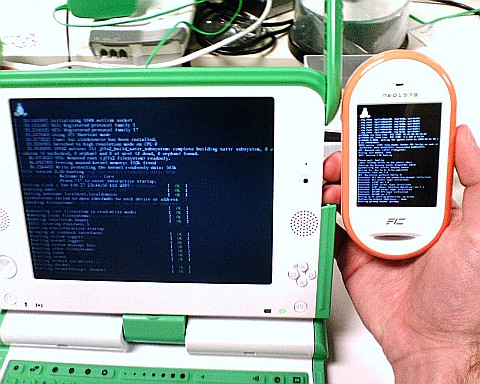
I forgot to mention the coolest thing about the last Ubucon in my summary. I heard that my friend Sean Moss-Pultz (the person who started the OpenMoko project) would be in New York the week of Ubucon so I managed to contact him and get him to drop by on his way to the airport so we could have lunch. To my surprise, he had one of the early versions of the free-phone for me (I wasn't expecting one for several weeks). I had brought my OLPC XO so, for the first time ever (as far as we know) we managed to get the two coolest, and most important, technology platform projects in the world together. While the XO and OpenMoko share a commitment to freedom, the similarities between the projects are, in fact, also skin deep. If we all work hard, we can look forward to a future that is free. Apparently, it's also white with bright trim.
/copyrighteous/images/xo_plus_openmoko-03-boot.jpg
/copyrighteous/images/xo_plus_openmoko-01.jpg
Apologies for the pictures taken from my current inferior, both ethically and technically, mobile phone.

Benjamin Mako Hill: Ubucon NYC

I had a great time at Ubucon a couple of weeks ago. I ended up running two sessions. After an initial opening, I opened the conference with a talk on how folks can participate in Ubuntu. The talk was roughly based on Andreas Lloyd's absolutely wonderful Contribute To Ubuntu page in the Ubuntu wiki. His page was, in turn, based on my own Participate In Ubuntu page. The talk tried to provide a solution to the common question of, "I love Ubuntu and want to give back! How can I?" -- when I was answering info@ubuntu.com (for my sins), I would get this question several times each day. The talk was a relatively straight forward walk through the different teams and group working in Ubuntu along with examples of their projects and fun anecdotes from my experience in the community along the way. I worked in a bit of talking about different community governance structures and issues and the membership process. Trying to cram an overview of the community and its different subsections into an hour is a pretty sobering experience. There's a lot going on and I barely had a chance to give a poor description of the most visible things going on. In the afternoon, I reminded folks (and myself) that I know a little of this tech stuff too by walking folks through a quick introduction to building and modifying Debian or Ubuntu packages. It was a quick variant on the "Debian Packaging for Sysadmins" talks that I've given in the past. Of course, the best part was getting to hang out with some folks I know from the community and to meet a bunch of new people. It was a blast and I'm definitely looking forward to the next one.

28 February 2007

Joey Hess: my anti-platform

Why you won't be voting for me for DPL this year. Or, my plans for Debian stuff over the next year (or three). Most of these plans embody larger themes and directions that I feel Debian should take. I am a strong beliver that working code and getting stuff done is the best way to work toward larger goals, so I won't bother to try to explain the larger goals.
constantly usable testing This is so important that it has its own page. This is my first public posting of that proposal, and it should not be considered finished. I plan to finish it, and get to work on it. website www.debian.org is deprecated, but this is not obvious to either users or developers. That's because it's not formally deprecated, we just treat it like it is: We don't use it for anything new. Instead we have wikis, planet, times.debian.net, etc, etc, etc, etc. Unfortunatly that has created a bit of a mess for users, who are still often stuck trying to use www.debian.org, or who can't find new stuff that is on other sites. A solution could be creating an alternate starting point for users, to help them learn about Debian, install it, and point them to docs and all the other useful sites once they're more involved and using Debian. I hope to find time to work on and promote such a thing. I plan to continue moving stuff that needs to be maintained actively and grow off of www.debian.org to the wiki (as I've done with some of d-i stuff, for example), and encourage others to do so as well. Anything under /devel/ on www.debian.org is an especially good candidate for the wiki. double the archive sync frequency again Now that we've switched to updating the archive twice a day, and dealt with the (minor) issues caused by it, it should be easier to increase it to a frequency that is more likely to cause noticible turnaround time improvements and thus speed up some development. As it is, many people sleep through one or the other archive update. So I support doubling it to four times a day, or more (six seems better). automated whole system testing Automated whole system testing is important because Debian needs to keep working in so many obscure and annoying to test situations. Does d-i work on m68k? Does the desktop task install properly and work? Does debootstrap install a usable system on every architecture? If we rely on user reports, things can fall through the cracks entirely or not be noticed for too long. I've been running a d-i lab for a few years, which tries to automatically test installs on 6 architectures. However, between the current kernel not supporting several of my test machines due to hardware and software bugs, and the general time sync of keeping a rack of aging and obscure test boxes working, this has not been very useful lately. I feel that the solution is emulation: It should be possible to run Debian under emulation for most architectures. I hope to get an absurdly powerful server donated, and switch my test lab over to running in emulation on it. developer (virtual) machines The other benefit of emulation is that everything needed for testing stuff under emulation can be easily distributed to others. Getting developer accessible machines for certian architectures has been a problem in Debian. Emulated systems can sidestep this problem. All that's needed is a collection of documents and/or bootable images that developers can use to set up virtual machines for as many architectures as possible. We have steps in this direction. Hercules contains documentation for how to install in it using d-i. There is a kernel flavor and d-i boot images for mips on qemu. Having to ssh out to a DSA adminned box to deal with a buld failure on $ARCH, and having to wait for build deps to be installed should begin to feel antequated and quaint. It is. find the next nslu2 Debian's support for the nslu2 is an excellent development. It opens up using Debian for a whole new set of tasks, that need low-powered, semi-embedded, commodity hardware, that before were the province of special-purpose embedded distros. It also blew the popcon numbers for arm through the roof. We need to find the next nslu2-like target and get to work on it. I'm hoping that it will be a wireless router, because that's the only thing I'm not running Debian on now. :-) But it could also be a cell phone, or PDA..

Jordi Mallach: Tasques, per en catal

So Ross was offering fame and glory to whoever would add i18n support to his nice little Tasks program. Tasks seems like something I've been looking for (there's gToDo, but Tasks is simple and clean), and I haven't done much for GNOME in a looong time, and I was bored, and hey, I can use some fame and glory, so...


Tasks, in a language Jose Mar a Aznar can read I need to note that it took quite a lot more time to create this screenshot than writing the patch. Go my GIMP skillz! And by the way, Ross, what does Paris Hilton say about applications with their main function in a file named test.c?

Michael Koch: Spam protection considered harmful?

I wanted to read some blog entry today I got a lot of 403 errors. I thought this is strange that bloggers deny access to their readers. So I wanted to blog about this. So I wanted to access my own blog but got a lot of 403 errors again. After some digging into the issue I found out that I had the BadBehavior plugin for Wordpress enabled and my IP was listed in three different RBLs. I really wonder how it got into them all. What do others do about this? Disabling comments or just live with this? Or use a different way to fight against spam in your blogs?

David Welton: Ruby's Mysql interface

I just like open source too much to not be constantly bumping into things that I would love to improve or fix... I have way too much fun getting my hands dirty with something new. Today's adventure regards my need to stream large quantities of data from a ruby on rails installation, covered previously here: http://journal.dedasys.com/articles/2006/06/08/streaming-programmatically-generated-content-from-rails The current block is that ActiveRecord doesn't deal with a "stream" of results, but rather, fetches everything into one big, fat array and then deals with that. Luckily, I'm not the only person to have found this suboptimal: http://dev.rubyonrails.org/ticket/6921 However, as I comment there, to truly make things work, some low level coding is required. For mysql, since it doesn't seem to support cursors to the degree that something more standards-compliant like Postgresql does, the answer lies in the C library and language interfaces built on top of it: http://dev.mysql.com/doc/refman/5.0/en/mysql-use-result.html Unfortunately, Ruby's C API, or at least the versions that I downloaded, don't properly support fetching things one record at a time. It didn't take more than a few minutes to whip this up: http://dedasys.com/freesoftware/patches/mysql-ruby.patch (although there's a good possibility it could be improved...) However, according to this posting, the upstream maintainer may not be terribly responsive, and the project isn't really run as much of an open source project, with a public mailing list, bug tracker, version control, and so forth. Perhaps it's time to create that infrastructure?

Evan Prodromou: 9 Vent se CCXV

Lots of short, sharp items today that I want to get down.

LinuxQuestions.org supports OpenID First, I'm psyched to see that LinuxQuestions Wiki now supports OpenID. Jeremy gave the scoop in The LQ Wiki Now Supports OpenID. I was glad to see that LQ's on the OpenID path. It's a really strong community site, and I think it'll benefit greatly from opening up the authentication process. tags:

Wikia and OpenID Angela Beesley had some comments on my Journal/7 Vent se CCXV posting about wikiHow's support of OpenID. In that posting, I said that I thought companies with lots of wikis, like Wikia or wiki farms, might have a disincentive to participate in the OpenID network. Angela put me straight on the issue in a post on WikiAngela about OpenID. I'm glad to hear that Wikia is considering supporting the protocol. Then again, it's hard to believe that an Open Content, Open Source company is really going to go out of its way to avoid open standards and open login. tags:

DemoCampMontreal1 I had a good time last night at DemoCampMontreal1. I gave the first demo -- on, of course, the MediaWiki OpenID extension -- and I had some technical difficulties that didn't let me show off all the functionality. Which was kind of a bummer, but there were lots of questions about it from the audience, so that kind of made up my time. The room was packed, by the way -- pretty much anyone who's anyone in Montreal tech was there. I'm looking forward to DemoCampMontreal2 on 29 March! tags:

certifi.ca One of the best ways to establish credentials on the Web is to use a signed SSL certificate in your browser. It's fast, incredibly secure, and once you get it set up you can just forget it. They're also practically immune to phishing. Unfortunately, most people don't even know what browser certificates are, how they work, or what to do with them. Consequently, most Web sites don't support browser certificate authentication. Vicious cycle. But, one of the cool things about OpenID is that you can disconnect the authentication method from the Web site you're using. Most OpenID identity providers still use username/password combos for authentication, which is why critics have said that the standard is vulnerable to phishing attacks. I wanted to see if it were possible to set up an OpenID identity provider that used browser certificates as the only authentication system. So, in my copious free time, I've hacked up certifi.ca. It's based on the cool PHP OpenID Server that JanRain made, but I've ripped out all the password stuff, and now it runs on luscious certificatey goodness. I'm going to be enhancing the service in the near future, but I wanted to get feedback from folks interested in OpenID as soon as possible. I'm using it for my primary OpenID delegate, and it seems to be working great. Please give it a try and let me know what you think (admin@certifi.ca). tags:

DemoCampMontreal1 on Montreal Poutine There's an article on DemoCampMontreal1 on Midnight Poutine. That's me up on the stage, in the photo! tags:

Nepean Hotspurs Selects win On Saturday, a Muslim girl named "Azzy" Mansour, from Ontario playing in a soccer tournament in Laval was ejected from the tournament (by a Muslim referee, notably) for wearing a hijab -- reportedly because it was a safety hazard. (Montreal Gazette story, registration required.) Admirably, her entire team forfeited the tournament in protest. I'm not excited about Quebec's reactionary activity around Muslim, Sikh, and other religious community's different clothing rules. However, I understand that Quebecois -- and French people -- have a different idea of personal freedom than Americans. I try to be understanding and put myself in the Quebec headspace for this kind of stuff. Mostly, though: I admire the soccer team, the Nepean Hotspurs Selects, for standing up for their teammate and their friend. A lot of teams might have gone ahead and played without her, and it took some courage to drop out of a tournament they'd had high hopes for. They're sixth-grade girls, but they've learned something about integrity that most adults never learn. Kudos to them. tags:

Ross Burton: Tasks 0.2

Tasks 0.2 is ready to roll. Tasks is a simple To Do manager, using GTK+ and libecal (part of Evolution Data Server). No great new features over 0.1, but several bug fixes. Now that I've been putting off categories by fixing up code, I'll have to them. Tasks For 0.3 I invite a dedicated member of gnome-i18n to be the first person to send a patch to i18n the source and provide a translation. Fame and glory can be yours!

Alexander Schmehl: The emanzipation of men - or: How to get your boyfriend to go shopping with you

Dear Ladies, if you'd like your husband / boyfriend to go shopping with you, get your shop to be at least a bit friendly to him. There is nothing wrong, if you need two hours to buy a new blouse. (Actually, I heard some men need some time for shopping, too, so that doesn't even count as "typical feemale".) There is nothing wrong, when your man has nothing to do... beside trying to find your clothes in an other size... or trying to figure out, if that color is apricot or peach, and if it would look good to something of the color pumpkin. What makes such trips horrible is that boutiques are often overheated (Well, that might be a must; they must not be too cold for a women to take her clothes of), narrow (How many clothes stands can you squeeze into a 10m2 shop?) and loud. If you want us to go shopping with you, go to a boutique, where a men can at least have a seat. Possibly with a water cooler nearby. That would make it a lot easier for us. A positive example is Eierund. They have some kind of "men and children area". Children will find comics and can watch movies, and men can read car and computer magazines (or steal the comics from the children). They even have sweet apples and a really comfortable couch. That's how you make your man enjoy going shopping with you! PS: Having a nice girlfriend, who doesn't take that long shopping helps a lot, too.

Gon ri Le Bouder: Another great idea by Jamendo

Jamendo is a CreativeCommon/Free sharing music plateform more and more famous. Yesterday they released a new tool to discover artist that is quite impressive. It’s called Spiral. Spiral screenshot

Ian Murdock: How about a Gmail Contacts API?

Since I’m on a Google kick these last few days, let me ask a question I’ve been kicking around in my head for a long time: When are we going to get an API for our Gmail contacts? Like scads of other people, I use Gmail as my primary mail “client” these days, and that means I want things like email autocomplete to work, which means Gmail has to know about my contacts (or at least their email addresses). Gmail actually has a really slick interface to contact management that I’d happily use as my main address book. Trouble is, it’s not synchronized with anything, most importantly my cell phone, where I also want that address book to be available. So, for now, I have to maintain two address books—one in Gmail (with just the email addresses), and one in my phone (with everything else). Invariably, it takes effort to keep them “synchronized”, and I’m not always successful at doing so. I was hopeful that the new “APIs to integrate with existing infrastructure” introduced in Google Apps Premier would finally address this shortcoming—after all, integration with corporate directories would seem to be a feature high on the “must have” list for any enterprise looking at Google. Alas, the APIs appear to only deal with single sign on and account provisioning, and do not appear to do any sort of deeper directory integration. With an API, Plaxo could presumably synchronize contacts between Gmail and phones (and Outlook etc.), or even better, someone could do over the air synchronization. There have certainly been a wave of interesting products doing similar things using the Google Calendar API. I’ve thought about doing a synchronizer with libgmail, by I’m not sure what would happen (e.g., would I somehow trip the “lockdown in sector 4” alarm, which given my reliance on Gmail, would be pretty darned disruptive). Thoughts? Anyone else in a similar situation?

Next.

Previous.