Search Results: "tb"

6 June 2012

Tanguy Ortolo: Beware of the newest Intel Atom GPU

Do you remember how Intel used to be the white knight of graphic card manufacturers, the one from which you could buy hardware without looking, being sure that it would be supported by GNU/Linux directly? Do you remember how they broke that by releasing the infamous Poulsbo card? Well, they did it again. The newest Intel Atom D2500, D2550, D2700, N2600 and N2800 processors, codenamed CedarView and Cedar Trail , include a graphic core that is only supported by a proprietary driver only available on Meego (read: unusable on regular GNU/Linux.So, if you plan to buy a netbook, beware! Intel is not a manufacturer you can trust to provide freely usable hardware. Just like other manufacturers, check that the hardware you are planning to buy is supported, by asking on #intel-gfx on Freenode. The most relevant course of action probably consists in buying a previous model or waiting for the next models.

4 June 2012

Steve McIntyre: Linaro Connect in Hong Kong, 2012: Ruby bug squashed!

Connect logoSometimes conferences can be dull and boring, but sometimes they can be just awesome in terms of finding the right people to collaborate with. Linaro Connect in Hong Kong last week was definitely one of the great ones! I chaired my my usual sessions (armhf status and cross-distro ARM) and we had some lively discussion in both. We're probably just about done with the armhf sessions, as most distros have accepted a hard-float ARMv7 port now and there's not so much specific work left there now that future sessions will be necessary. The cross-distro work for ARM ports is likely to continue into the future, but we're going to be concentrating on bootstrapping work for ARMv8 soon. Talking v8, there were a lot of meetings discussing the various work topics for this new 64-bit ARM architecture: kernel, toolchains, bootstrapping etc. More to come on that soon! On top of all this useful discussion and planning, we also found time during the week for some hacking. This was the highlight of the week for me, as I found some expert help to solve my long-standing Ruby on ARM bug (Debian bug #652674, ruby1.9.1: FTBFS on armhf: test suite segfaults). Ulrich Weigand (an IBM toolchain wizard seconded into the Linaro team) sat with me for a couple of hours while we worked through reproducing the problem, only to find that he could not reproduce it! The crash had looked very much like a pthreads locking bug, which was scaring me. After some digging, we worked out where the problem was, and how it was now fixed. For a long time on ARM, the Linux getcontext/setcontext system calls have never been implemented; apparently nobody really missed them, so they have never been a priority. In Ruby 1.9.x, the implementation of the new "fiber" primitive wanted to use getcontext/setcontext to control stack state etc. in different threads of control. In cases where they are not available or known not to work well, Ruby has fallback code to implement similar functionality. It seems that fallback code is buggy. Maybe it was correct at some point and has bit-rotted due to not being exercised, or maybe it was buggy as written, but it clearly does not work correctly for us now. In the last few months, getcontext/setcontext have finally been implemented for ARM in glibc trunk (by Michael Hope, also in the Linaro toolchain team!) and backported into current Debian and Ubuntu eglibc versions. Re-running configure and rebuilding Ruby against the most recent code in both Sid and Precise fixed the test suite crash we were seeing earlier. Yay! We could also provoke the bug again at will by quickly hacking around the Ruby source to force it to switch back to the fallback code, thereby verifying the fix. Why does this matter? As we're expecting ARM servers to enter the market soon, web apps written in Ruby on Rails are going to be an important part of the software stack that customers will want to run. Broken fibers and threading would not help here! It's great to meet up and work with talented folks like this; Linaro Connect is an excellent event for getting stuff done!

John Sullivan: To nook

My curiosity was definitely nookd by this story. While this doesn't seem to have been an act of censorship or anything nefarious by Barnes and Noble itself, this does point to just how terrifying ebooks can be if we aren't careful. In the future, when we are dealing with the entirety of human knowledge, we better be careful with the find and replace function. And we better make sure we control our computer systems so that other people can't nook us without our permission. See also: As someone who read War and Peace in paper form, much of it in bed, I definitely empathized with this:
Some weeks ago I decided that I wanted to read Tolstoy's War and Peace. Lou Ann loaned me her copy. At more than 1100 pages, reading it in bed required as much strength as balancing a box of bricks in my hands. In my senior years I have developed arthritis in my thumbs, which made the effort not only difficult, but painful.

3 June 2012

Gregor Herrmann: RC bugs 2012/22

since most of the gcc 4.7 bugs are fixed by now, I looked again at the general RC bugs too this week. here's the usual short report:

Jose Luis Rivas Contreras: Little CoffeeScript to resize images

I needed to resize about 300 images and couldn t find an easier way to do this than with help of node + CoffeeScript. So here s my script, it requires you to install (via npm) imagemagick and underscore: <script src="https://gist.github.com/2862235.js?file=resize.coffee"></script> Grab it if you want, is under Do Whatever You Want license. As you can see from the shebang (that s the first line of the script, with the #!) I ran it from my command-line, this was not used in a website, although it could without too much modifications (the magic of JavaScript).

1 June 2012

Alexander Reichle-Schmehl: Release Critical Bug report for Week 22

The bug webinterface of the Ultimate Debian Database currently knows about the following release critical bugs:
In Total:1412
Affecting Wheezy:977
Wheezy only:272
Remaining to be fixed in Wheezy:705
Of these 705 bugs, the following tags are set:
Pending in Wheezy:51
Patched in Wheezy:118
Duplicates in Wheezy:57
Can be fixed in a security Update:24
Contrib or non-free in Wheezy:9
Claimed in Wheezy:2
Delayed in Wheezy:4
Otherwise fixed in Wheezy:99
Ignoring all the above (multiple tags possible) 427 bugs need to be fixed by Debian Contributors to get Debian 7.0 Wheezy released. However, with the view of the Release Managers, 867 need to be dealt with for the release to happen. Please see Interpreting the release critical bug statistics for an explanation of the different numbers.

31 May 2012

Russell Coker: Links May 2012

Vijay Kumar gave an interesting TED talk about autonomous UAVs [1]. His research is based on helicopters with 4 sets of blades and his group has developed software to allow them to develop maps, fly in formation, and more. Hadiyah wrote an interesting post about networking at TED 2012 [2]. It seems that giving every delegate the opportunity to have their bio posted is a good conference feature that others could copy. Bruce Schneier wrote a good summary of the harm that post-911 airport security has caused [3]. Chris Neugebauer wrote an insightful post about the drinking culture in conferences, how it excludes people and distracts everyone from the educational purpose of the conference [4]. Matthew Wright wrote an informative article for Beyond Zero Emissions comparing current options for renewable power with the unproven plans for new nuclear and fossil fuel power plants [5]. The Free Universal Construction Kit is a set of design files to allow 3D printing of connectors between different types of construction kits (Lego, Fischer Technic, etc) [6]. Jay Bradner gave an interesting TED talk about the use of Open Source principles in cancer research [7]. He described his research into drugs which block cancer by converting certain types of cancer cell into normal cells and how he shared that research to allow the drugs to be developed for clinical use as fast as possible. Christopher Priest wrote an epic blog post roasting everyone currently associated with the Arthur C. Clarke awards, he took particular care to flame Charles Stross who celebrated The Prestige of such a great flaming by releasing a t-shirt [8]. For a while I ve been hoping that an author like Charles Stross would manage to make more money from t-shirt sales than from book sales, Charles is already publishing some of his work for free on the Internet and it would be good if he could publish it all for free. Erich Schubert wrote an interesting post about the utility and evolution of Favebook likes [9]. Richard Hartmann wrote an interesting summary of the problems with Google products that annoy him the most [10]. Sam Varghese wrote an insightful article about the political situation in China [11]. The part about the downside of allowing poorly educated people to vote seems to apply to the US as well. Sociological Images has an article about the increased rate of Autism diagnosis as social contagion [12]. People who get their children diagnosed encourage others with similar children to do the same. Vivek wrote a great little post about setting up WPA on Debian [13]. It was much easier than expected once I followed that post. Of course I probably could have read the documentation for ifupdown, but who reads docs when Google is available? Related posts:
  1. Links March 2012 Washington s Blog has an informative summary of recent articles about...
  2. Links April 2012 Karen Tse gave an interesting TED talk about how to...
  3. Links February 2012 Sociological Images has an interesting article about the attempts to...

30 May 2012

Lucas Nussbaum: Debian archive rebuilds on Amazon Web Services

I like to think that archive rebuilds play an important role in Debian Quality Assurance and Release Management efforts. By trying to rebuild every Debian package from source, one can identify packages that do not build anymore due to changes in other packages (compilers, interpreters, libraries, ). It is also a good way to stress-test all packages that are involved in building other packages. Since 2007, I had been running Debian archive rebuilds on the Grid 5000 testbed, a research infrastructure for performing experiments on distributed systems HPC/Grid/Cloud/P2P. I filed more than 6000 release-critical bugs in the process. Late last year, Amazon kindly offered us a grant to allow us to run such QA tests on Amazon Web Services. With S bastien Badia, we ported the rebuild infrastructure to AWS (scripts), and several rebuilds have already been carried out on AWS. On the technical level, 50 to 100 EC2 spot instances are started, and then controlled from a master instance using SSH. On build instances, a classic sbuild setup is used. Logs are retrieved to the master node after rebuilds, and build instances are simply shut down when there are no more tasks to process. Several tasks are processed simultaneously on each instance, and when they fail, they are retried again with no other concurrent build on the same instance, to eliminate random failures caused by load or timing issues. All the scripts are designed to support other kind of QA tests, not just rebuilds. Moving to Amazon Web Services will facilitate sharing the human workload of doing those tests. It is now possible for developers interested in custom tests to do them themselves (hint hint).

29 May 2012

Niels Thykier: Lintian 2.5.7 and 2.5.8

The new version of Lintian (2.5.8) can pretty much be summed up as:
Its like 2.5.7, only with less false positives and no FTBFS.
Especially people annoyed by the hardening flags will hopefully find that 2.5.8 greatly reduces the number of false positives. I believe this is best demonstrated with an example:
$ lintian --print-version && lintian -q -C binaries amarok_2.5.0-1_i386.deb   wc -l 
2.5.7
94
[...]
$ lintian --print-version && lintian -q -C binaries amarok_2.5.0-1_i386.deb   wc -l
2.5.8
4
However, nothing comes for free. We dropped hardening-no-stackprotector from the default profile (and demoted it to an I tag). For hardening-no-fortify-functions we made a false positive -> false negative trade-off by ignoring binaries if their only unprotected function is memcpy. For more information, please refer to #673112. hardening-no-stackprotector is still available and can be used via the debian/extra-hardening profile (or via the tags argument). For the 2.5.7 behaviour of hardening-no-fortify-functions, you have to use hardening-check directly. But 2.5.7 had other changes besides the myriad of false-positives: A consequence of this is that we no longer warn if you use things like dpkg assert-working-epoch or your postinst creates a usr/doc transition symlink . With all the Lintian modules under the Lintian namespace, we can install them in the standard perl @INC path. Admittedly, I am not certain we are ready to commit to the current API in these modules, which is one of the reasons why they are still installed in /usr/share/lintian. But in a couple of releases things may look differently. :) Lintain 2.5.7 ships over 50 data files of various kinds (usually white- or blacklists of some kind). Before 2.5.7, all data files with a few exceptions would be loaded eagerly (i.e. as soon as the check was run for the first time). A few data files had been special cased with manual laziness . In 2.5.7, Lintian::Data was updated to lazily load the data. So depending on the packages being checked, Lintian may now load fewer data files. While this is not something exclusive to 2.5.7, we have separated quite a few checks from their data tables by now. My personal favorites are the table of known interpreters and (from 2.5.8) the table of known versioned interpreters. I am certainly biased here. But this is probably the most awesome feature in Lintian 2.5.7. It is now possible for vendors to extend or simply shadow the core Lintian data files. Allow me to demonstrate how this can be used:
$ lintian --tags build-depends-on-obsolete-package a2ps_4.14-1.1.dsc 
E: a2ps source: build-depends-on-obsolete-package build-depends: dpatch
$ cat ~/.lintian/profiles/local/main.profile 
Profile: local/main
Extends: debian/main
$ cat  ~/.lintian/vendors/local/main/data/fields/obsolete-packages 
@include-parent
@delete dpatch
bison
$ lintian --profile local/main --tags build-depends-on-obsolete-package a2ps_4.14-1.1.dsc
E: a2ps source: build-depends-on-obsolete-package build-depends: bison
$
It is a toy example, but I believe it is a good demonstration of the feature. The full documentation of Vendor specific data files can be found in the Lintian User manual (in lintian/2.5.7 or newer). It will also be on lintian.debian.org when we find time to update lintian there. :)

28 May 2012

Vincent Bernat: Integration of NetSNMP into an event loop

NetSNMP comes with its own event loop based on the select() system call. While you can build your program around it, you may prefer to use an existing event loop, either a custom one or something like libevent, libev or Twisted.

Own custom event loop Let s start with the easiest case: you have written your own event loop. This means you make a call to select(), poll(), epoll(), kqueue() or something similar. All those functions take a set of file descriptors and wait for any of them to become available in a specified time frame. Here is a typical use of select() (adapted from Quagga)
readfd = m->readfd;
writefd = m->writefd;
exceptfd = m->exceptfd;
timer_wait = thread_timer_wait (&m->timer);
num = select (FD_SETSIZE,
              &readfd, &writefd, &exceptfd,
              timer_wait);
if (num < 0)
   
    if (errno == EINTR)
      continue; /* signal received - process it */
    zlog_warn ("select() error: %s",
               safe_strerror (errno));
    return NULL;
   
if (num == 0)
   
    /* Timeout handling */
    thread_timer_process (&m->timer);
   
if (num > 0)
   
    thread_process_fd (&readfd);
    thread_process_fd (&writefd);
   
thread_process_fd (fds) function iterates on each file descriptor fd and executes the appropriate action if FD_ISSET (fds, fd) is true. Integrating NetSNMP into such an event loop is easy: NetSNMP provides the snmp_select_info() function which alters a set of file descriptors to insert its own. Here is the new code:
#if defined HAVE_SNMP
struct timeval snmp_timer_wait;
int snmpblock = 0;
int fdsetsize;
#endif
/* ... */
#if defined HAVE_SNMP
fdsetsize = FD_SETSIZE;
snmpblock = 1;
if (timer_wait)
   
    snmpblock = 0;
    memcpy(&snmp_timer_wait, timer_wait,
           sizeof(struct timeval));
   
snmp_select_info(&fdsetsize, &readfd,
                 &snmp_timer_wait, &snmpblock);
if (snmpblock == 0)
  timer_wait = &snmp_timer_wait;
#endif
num = select (FD_SETSIZE,
              &readfd, &writefd, &exceptfd,
              timer_wait);
if (num < 0)   /* ... */  
#if defined HAVE_SNMP
if (num > 0)
  snmp_read(&readfd);
else if (num == 0)
   
    snmp_timeout();
    run_alarms();
   
netsnmp_check_outstanding_agent_requests();
#endif
/* ... */
snmp_select_info() may modify the provided set of file descriptors (and therefore, its size). It may also modify the provided timer in case it needs to schedule an action before the original timeout. snmpblock is a tricky variable. While select() can be called with a timeout set to NULL, this is not the case of snmp_select_info(): you have to pass a valid pointer. snmpblock is set to 0 if the provided timeout must be considered or to 1 otherwise. snmp_select_info() will set snmpblock to 0 if and only if it alters the timeout. Here are a two examples of integration. Both are for a subagent but the code for a manager is the same:

Third-party event loop With a third party event loop, you don t have access to the select() system call anymore. Therefore, you cannot alter it with snmp_select_info(). Instead, at each iteration of the loop, a list of SNMP related file descriptors is kept up-to-date with the help of snmp_select_info(): new ones are added and old ones are removed.

libevent Let s assume that snmp_fds is the list of current SNMP related events1. A function levent_snmp_update() calls snmp_select_info() to update this list. Here is a partial implementation (error handling removed and some declarations omitted, look at the complete version from lldpd):
static void
levent_snmp_update()
 
    int maxfd = 0;
    int block = 1;
    FD_ZERO(&fdset);
    snmp_select_info(&maxfd, &fdset, &timeout, &block);
    /* We need to untrack any event whose FD is not in  fdset 
       anymore */
    for (snmpfd = TAILQ_FIRST(snmp_fds);
         snmpfd;
         snmpfd = snmpfd_next)  
        snmpfd_next = TAILQ_NEXT(snmpfd, next);
        if (event_get_fd(snmpfd->ev) >= maxfd  
            (!FD_ISSET(event_get_fd(snmpfd->ev), &fdset)))  
            event_free(snmpfd->ev);
            TAILQ_REMOVE(snmp_fds, snmpfd, next);
            free(snmpfd);
          else
            FD_CLR(event_get_fd(snmpfd->ev), &fdset);
     
    /* Invariant: FD in  fdset  are not in list of FD */
    for (int fd = 0; fd < maxfd; fd++)
        if (FD_ISSET(fd, &fdset))  
            snmpfd->ev = event_new(base, fd,
                EV_READ   EV_PERSIST,
                levent_snmp_read,
                NULL);
            event_add(snmpfd->ev, NULL);
            TAILQ_INSERT_TAIL(snmp_fds, snmpfd, next);
         
    /* If needed, handle timeout */
    evtimer_add(snmp_timeout, block?NULL:&timeout);
 
Then, replace the main loop (usually, a call to event_base_dispatch()) with this:
do  
    if (event_base_got_break(base)  
        event_base_got_exit(base))
        break;
    netsnmp_check_outstanding_agent_requests();
    levent_snmp_update();
  while (event_base_loop(base, EVLOOP_ONCE) == 0);
Here is how are defined the two callbacks:
static void
levent_snmp_read(evutil_socket_t fd, short what, void *arg)
 
    FD_ZERO(&fdset);
    FD_SET(fd, &fdset);
    snmp_read(&fdset);
    levent_snmp_update();
 
static void
levent_snmp_timeout(evutil_socket_t fd, short what, void *arg)
 
    snmp_timeout();
    run_alarms();
    levent_snmp_update();
 

Twisted reactor As a second example, here is how to integrate NetSNMP into Twisted reactor. Twisted is an event-driven network programming framework written in Python. It does not come with support for SNMP2. Because of the language mismatch, the integration of NetSNMP in Twisted needs to be done using a C extension or the ctypes module. Twisted event loop is called a reactor. Like for libevent, events need to be registered. It is possible to register file descriptor-like objects using a class implementing a handful of methods. Here is the implementation of such a class (adapted from PyNetSNMP, a subproject of Zenoss using the ctypes module):
class SnmpReader:
    "Respond to input events"
    implements(IReadDescriptor)
    def __init__(self, fd):
        self.fd = fd
    def doRead(self):
        netsnmp.snmp_read(self.fd)
    def fileno(self):
        return self.fd
Like for libevent, we have a function to update the list of SNMP related events (stored as a mapping between file descriptors and SnmpReader instances):
class Timer(object):
    callLater = None
timer = Timer()
fdMap =  
def updateReactor():
    "Add/remove event handlers for SNMP file descriptors and timers"
    fds, t = netsnmp.snmp_select_info()
    for fd in fds:
        if fd not in fdMap:
            reader = SnmpReader(fd)
            fdMap[fd] = reader
            reactor.addReader(reader)
    current = Set(fdMap.keys())
    need = Set(fds)
    doomed = current - need
    for d in doomed:
        reactor.removeReader(fdMap[d])
        del fdMap[d]
    if timer.callLater:
        timer.callLater.cancel()
        timer.callLater = None
    if t is not None:
        timer.callLater = reactor.callLater(t, checkTimeouts)
Contrary to libevent, we cannot alter the main loop to call updateReactor() at each iteration. Therefore, it must be called after each SNMP related function. For another example, have a look at my equivalent implementation as a C extension.

Miscellaneous

Lack of asynchronicity Integrating NetSNMP into an event-based program is not risk-free. I have written a fairly comprehensive article on the lack of asynchronicity in NetSNMP AgentX protocol implementation. I urge you to read it if you want to integrate a SNMP subagent into an existing program. On the manager side, you will get similar drawbacks when using SNMPv3. To retrieve or manipulate management information using SNMPv3, it is necessary to know the identifier of the remote SNMP protocol engine. This identifier can be configured directly on each manager but it is usually discovered by querying SNMP-FRAMEWORK-MIB:: snmpEngineID, as described in RFC 5343. Unfortunately, this discovery is done synchronously by NetSNMP. There is a bug report for this issue but it seems difficult to fix. I have not been able to come up with a proper patch but I have described a workaround around snmp_sess_async_send(). There is no such problem with SNMPv2.

Limitation of file descriptor sets snmp_select_info() and snmp_read() uses the fd_set type to handle a set of file descriptors. This type should be manipulated with FD_CLR(), FD_ISSET(), FD_SET() and FD_ZERO(). Those may be defined as functions but they usually are macros. Moreover, no file descriptor greater than FD_SETSIZE (which is usually set to 1024) can be handled with the fd_set type. This means that if you have a file descriptor greater than 1024, you won t be able to use snmp_select_info() with it. Starting from NetSNMP 5.5, you can use snmp_select_info2() and snmp_read2() instead of snmp_select_info() and snmp_read(). They use the netsnmp_large_fd_set. If you want to keep compatibility with NetSNMP 5.4, here is another twist. The fd_set type is usually a fixed-size array of long integers. FD_CLR(), FD_ISSET() and FD_SET() are size-independant. The size only matters for FD_ZERO() which is not used by either snmp_select_info() or snmp_read(). You can therefore allocate a larger fd_set. A common way is to compile your program with -D__FD_SETSIZE=4096. You can still use FD_ZERO() yourself. However, this is not portable (GNU C Library only). Another way is to allocate your own array of long integers and cast it to fd_set. You ll have to redefine FD_ZERO():
typedef struct  
   long int fds_bits[4096/sizeof(long int)];
  my_fdset;
#undef FD_ZERO
#define FD_ZERO(fdset) memset((fdset), 0, sizeof(my_fdset))
 
   /* ... */
   my_fdset fdset;
   FD_ZERO(&fdset);
   /* ... */
   rc = snmp_select_info(&n, (fd_set *)&fdset, &timeout, &block);
   /* ... */
 

Threads NetSNMP provides two API:
  • the traditional session API which is not thread-safe and
  • the single session API.
In the above examples, I have used the traditional session API. If you are using threads, you need to ensure that all SNMP operations are done in a single thread. Otherwise, you need to adapt the examples to use the single session API. snmp_select_info() is part of the traditional session API. You should replace it with snmp_sess_select_info() and keep a list of SNMP sessions. This API is not available for the agent side of NetSNMP.

  1. The event list is global but some code could be added to bind a different list for each base in case you use different bases. This is not needed in the case of lldpd which uses only one event base.
  2. TwistedSNMP is an SNMP protocol implementation for Twisted based on PySNMP but is not maintained anymore. PySNMP comes with examples on how to integrate with Twisted.

27 May 2012

Gregor Herrmann: RC bugs 2012/21

new week, new report about my work on RC bugs. again, mostly gcc 4.7 related, & again, mostly using patches prepared by others.

26 May 2012

Vincent Sanders: Each morning sees some task begun, each evening sees it close; Something attempted, something done, has earned a night's repose.

Thursday saw all the Collabora employees at Cambridge office go out and socialise at the beer festival. They seemed to have selected a wonderful day for it, the sun was shining and it was warm and blue sky day.

Alas, I had to attend some customer conference calls and work on some time sensitive research so I could not go to the ball as it were. At about eight my brain had run out of steam so I decided to call it a day and go and meetup with people at the festival for an hour or two.

The queue when I arrived dissuaded me from that notion. I asked one of the stewards and they indicated it would take at least an hour from where the queue finished.

So I decided to wend my way home along the bank of the Cam. I proceeded slowly along and to my utter surprise bumped into Ben Hutchings and his Solarflare work colleagues having their own soiree. I was immediately invited to sit and converse. Pretty quickly I was inveigled into accepting a glass of wine by John Aspden from his floating bar (AKA houseboat).

From here on my evening was a pleasant one of amusing new people, easy conversation and a definite pondering if the host would be discovering the delights of Cam swimming as he became progressively inebriated!

So although I missed the festival I did manage to have an enjoyable time. A big thanks to the solarflare guys and especially John who was the consummate host and provided me with far too much alcohol.

25 May 2012

Alexander Reichle-Schmehl: Release Critical Bug report for Week 21

The bug webinterface of the Ultimate Debian Database currently knows about the following release critical bugs:
In Total:1534
Affecting Wheezy:1095
Wheezy only:238
Remaining to be fixed in Wheezy:857
Of these 857 bugs, the following tags are set:
Pending in Wheezy:82
Patched in Wheezy:175
Duplicates in Wheezy:62
Can be fixed in a security Update:27
Contrib or non-free in Wheezy:11
Claimed in Wheezy:2
Delayed in Wheezy:18
Otherwise fixed in Wheezy:86
Ignoring all the above (multiple tags possible) 500 bugs need to be fixed by Debian Contributors to get Debian 7.0 Wheezy released. However, with the view of the Release Managers, 975 need to be dealt with for the release to happen. Please see Interpreting the release critical bug statistics for an explanation of the different numbers.

24 May 2012

Vincent Sanders: Linux kernel presentation

Recently I was asked to present a short introduction to the Linux kernel for our project managers. I put together a short slide deck for the presentation which I have decided to share.
I feel its important to note that I had a lot more to say about each section and the slides were more an aid for my memory to cover the important points. Of special note would be the diagram showing the "hierarchy" of contributors, this is of course nowhere near as well stratified as portrayed.

22 May 2012

Gunnar Wolf: e-voting: Bad when it's near, worse when it's far.

Note: All of the information linked to from this post is in Spanish and related to Mexico Part of it will be translatable via automated means, some will not. Sorry, that's what I have, and it's too much text to invest the effort to hand-translate
I have been following the development of the different e-vote modalities in Mexico for several years already, although I have only managed to do so methodically in the last half year or so. If you are interested in my line of reasoning as to why I completely oppose e-voting, you can look at the short article I published in 2010 or the slightly longer and more updated version published in our book in 2011. Currently, in Mexico there are two different venues of e-vote that are being pushed: Bad and worse. The bad one will be carried out for about 10% of the population of the state of Jalisco and somewhat less for the state of Coahuila (Distrito Federal was also to be in this list, but the contract was cancelled due to the provider company delivering booths with too many problems and unable to deliver in the due time). The worse one is, fortunately, likely to have the least impact. Why? Because it regards votes cast by Distrito Federal residents (the capital entity, where part of Mexico City is located) living abroad. And it will have less impact because of the amount of the population registered for it: We are about 9 million residents in DF, and in the last election (first time IIRC there was the right to vote from abroad) there were only about 10,000 people registered for casting a (enveloped and sent by post) vote. Even if this year we the campaign for this was better (and I'm not yet sure about it), the number of voters will not be enough to make a dent on the results. I'm not going into details as to why it is bad in this post I requested information from the DF Electoral Institute (IEDF) with academic interest, to try to find more information about it, and I want to share my results with you and, of course, to request for your input on how to continue with this. On May 3rd, I sent the following request (this I am translating to English :) You can look at the receipt for the request for the original redaction) to the official contact address, oficinadeinformacionpublica@iedf.org.mx: Of course, I wasn't very optimistic when receiving this information. Still, I have to share my results: My information request was largely denied:
( )
III. The divulgation of this information harms the interest it protects
Given that, were it to be divulged it would affect the informatic security of the refered system. Anyway, we have to point out that said systems have enough measures and security provisions, so that the citizen can emit his vote in a universal, free, secret and direct way.
IV. The damage that can be produced by making this information public is larger than the public interest to know it
This is so because making this information public puts at risk the correct development of the Internet-based voting, because were the technical, purpose-specific information be made public, it could be misused to carry out informatic attacks.
It is also important to mention that a confidentiality agreement was signed with the company that developed said systems.
( )
VI. The time for the information to be reserved
It will be seven years starting at the present resolution, this information will be made public when the reserve period is over or when the target is reached, except for the confidemtial information that it could contain. ( )
In case some other person is interested in following this information, the other two points were answered, and I'll try to get some relevant information from it: So, I don't have any real conclusions yet. I'm just reporting how work is unfolding. Tomorrow evening (Wednesday May 23) I'll give a talk on the "e-voting in Mexico 2012" subject in Congreso Internacional de Software Libre in Zacatecas, Mexico. I'll talk on the situation on this and the other topics I have been able to work on.
AttachmentSize
Receipt of my information request11.64 KB
Transparency Committee resolution354.66 KB
Information request answered by UTCSTyPDP (IEDF)85.75 KB

Russell Coker: Another USB Flash Failure

I previously wrote about a failure of a USB flash device in my Internet gateway [1]. I have since had another failure in the same system, so both the original 4G devices are now dead. That s two dead devices in 10 weeks. It could be that the USB devices that I got for free at an exhibition were just really cheap, I m sure that they weren t expecting them to be used in that way. The devices from the same batch which are used for their intended purpose (sneaker-net file sharing) are still working well. But in any case I m not going to resume this experiment until warmer weather. At this time of year some extra heat dissipation from computer gear in my home is more like a feature and less like a bug. The second USB device to fail appeared to have it s failure in the Ext4 journal (the errors were reported at around sector 2000), I didn t keep a record of the problem with the first device, but from memory I think it was much the same. Rumor has it that cheap flash storage devices don t implement wear-levelling to avoid patent infringement. If that rumor is correct then any filesystem that uses a fixed journal in the same way as Ext3/4 is probably unsuitable for any serious use on such devices, while a filesystem based on Copy On Write will probably perform better. In Spring I ll try using BTRFS on cheap USB flash devices and see if that works better. I have another spare device from the same batch to test so I can eliminate hardware differences. I can t do enough tests to be a good statistical sample, but if a device lasts from Spring to Autumn using BTRFS with the same use that caused failures with Ext4 in a few weeks then I will consider it a strong indication that BTRFS is better than Ext3/4 for such uses. For the next 5 months or so I ll be using a hard drive in my Internet gateway system again. Related posts:
  1. Flash Storage Update Last month I wrote about using USB flash storage devices...
  2. flash for main storage I was in a discussion about flash on a closed...
  3. USB Flash Storage For some years I have had my Internet gateway/firewall system...

21 May 2012

Johannes Schauer: sisyphus wins ICRA 2012 VMAC

Sisyphus is a piece of software that I wrote as a member of a team from Jacobs University led by Prof. Dr. Andreas N chter. It managed to place our team first in this year's IEEE ICRA 2012 Virtual Manufacturing Automation Competition in all three rounds. The goal was, to stack a given set of boxes of different length, height and width on a pallet in a way that achieved optimal volume utilization, center of mass and interlock of the boxes. Besides the cartesian placement of a box on the pallet, the only other degree of freedom was a 90 rotation of the box around a vertical axis. Since the arrangement of boxes into a three dimensional container is NP hard (three dimensional orthogonal knapsack), I decided for a heuristic for an approximate solution. The premise is, that there are many boxes of equal height which was the case in the test cases that were available from the 2011 VMAC. Given this premise, my heuristic was, to arrange the boxes into layers of equal height and then stack these layers on top of each other. A set of boxes that would be left over or too little from the start to form its own full layer, would then be stacked on the top of the completed layers. There is a video of how this looked like. My code is now online on github and it even documented for everybody who is not me (or a potential future me of course). This blog post is about the "interesting" parts of sisyphus. You can read about the overall workings of it in the project's README. Python dict to XML and XML to Python dict The evaluation program for the challenge is reading XML files and the pallet size and the list of articles with their sizes are also given in XML format. So I had to have a way to easily read article information from XML and to easily dump my data into XML format. Luckily, all the XML involved was not making use of XML attributes at all, so the only children a node had, where other nodes. Thus, the whole XML file could be represented as an XML dictionary with keys being tagnames and the values being other dictionaries or lists or strings or integers. The code doing that uses xml.etree.ElementTree and turns out to be very simple:
from xml.etree import ElementTree

def xmltodict(element):
def xmltodict_handler(parent_element):
result = dict()
for element in parent_element:
if len(element):
obj = xmltodict_handler(element)
else:
obj = element.text
if result.get(element.tag):
if hasattr(result[element.tag], "append"):
result[element.tag].append(obj)
else:
result[element.tag] = [result[element.tag], obj]
else:
result[element.tag] = obj
return result
return element.tag: xmltodict_handler(element)

def dicttoxml(element):
def dicttoxml_handler(result, key, value):
if isinstance(value, list):
for e in value:
dicttoxml_handler(result, key, e)
elif isinstance(value, basestring):
elem = ElementTree.Element(key)
elem.text = value
result.append(elem)
elif isinstance(value, int) or isinstance(value, float):
elem = ElementTree.Element(key)
elem.text = str(value)
result.append(elem)
elif value is None:
result.append(ElementTree.Element(key))
else:
res = ElementTree.Element(key)
for k, v in value.items():
dicttoxml_handler(res, k, v)
result.append(res)
result = ElementTree.Element(element.keys()[0])
for key, value in element[element.keys()[0]].items():
dicttoxml_handler(result, key, value)
return result

def xmlfiletodict(filename):
return xmltodict(ElementTree.parse(filename).getroot())

def dicttoxmlfile(element, filename):
ElementTree.ElementTree(dicttoxml(element)).write(filename)

def xmlstringtodict(xmlstring):
return xmltodict(ElementTree.fromstring(xmlstring))

def dicttoxmlstring(element):
return ElementTree.tostring(dicttoxml(element))
Lets try this out:
>>> from util import xmlstringtodict, dicttoxmlstring
>>> xmlstring = "<foo><bar>foobar</bar><baz><a>1</a><a>2</a></baz></foo>"
>>> xmldict = xmlstringtodict(xmlstring)
>>> print xmldict
 'foo':  'baz':  'a': ['1', '2'] , 'bar': 'foobar' 
>>> dicttoxmlstring(xmldict)
'<foo><baz><a>1</a><a>2</a></baz><bar>foobar</bar></foo>'
The dict container doesnt preserve order, but as XML doesnt require that, this is also not an issue. Arranging items in layers When it was decided, that I wanted to take the layered approach, it boiled down the 3D knapsack problem to a 2D knapsack problem. The problem statement now was: how to best fit small rectangles into a big rectangle? I decided for a simple and fast approach as it is explained in Jake Gordon's blog article. There is a demo of his code and should the site vanish from the net, the code is on github. This solution seemed to generate results that were "good enough" while simple to implement and fast to execute. If you look very hard, you can still see some design similarities between my arrange_spread.py and his packer.js code. Jake Gordon got his idea from Jim Scott who wrote an article of arranging randomly sized lightmaps into a bigger texture. There is also an ActiveState Code recipe from 2005 which looks very similar to the code by Jake Gordon. The posts of Jake Gordon and Jim Scott explain the solution well, so that I dont have to repeat it. Should the above resources go offline, I made backups of them here and here. There is also a backup of the ActiveState piece here. Spreading items out The algorithm above would cram all rectangles into a top-left position. As a result, there would mostly be space at the bottom and left edge of the available pallet surface. This is bad for two reasons:
  1. the mass is distributed unequally
  2. articles on the layer above at the bottom or left edge, are prone to overhang too much so that they tumble down
Instead all articles should be spread over the available pallet area, creating small gaps between them instead big spaces at the pallet borders. Since articles were of different size, it was not clear to me from the start what "equal distribution" would even mean because it was obvious that it was not as simple as making the space between all rectangles equal. The spacing had to be different between them to accommodate for differently sized boxes. The solution I came up with, made use of the tree structure, that was built by the algorithm that arranged the rectangles in the first place. The idea is, to spread articles vertically first, recursively starting with the deepest nodes and spreading them out in their parent rectangle. And then spreading them horizontally, spreading the upper nodes first, recursively resizing and spreading child nodes. The whole recursion idea created problems of its own. One of the nicest recursive beauty is the following function:
def get_max_horiz_nodes(node):
if node is None or not node['article']:
return [], []
elif node['down'] and node['down']['article']:
rightbranch, sr = get_max_horiz_nodes(node['right'])
rightbranch = [node] + rightbranch
downbranch, sd = get_max_horiz_nodes(node['down'])
ar = rightbranch[len(rightbranch)-1]['article']
ad = downbranch[len(downbranch)-1]['article']
if ar['x']+ar['width'] > ad['x']+ad['width']:
return rightbranch, sr+[downbranch[0]]
else:
return downbranch, sd+[rightbranch[0]]
else:
rightbranch, short = get_max_horiz_nodes(node['right'])
return [node] + rightbranch, short
get_max_horiz_nodes() traverses all branches of the tree that node has below itself and returns a tuple containing the list of nodes that form the branch that stretches out widest plus the list of nodes that are in the other branches (which are shorter than the widest). Another interesting problem was, how to decide on the gap between articles. This was interesting because the number resulting of the subtraction of the available length (or width) and the sum of the articles lengths (or widths), was mostly not divisible by the amount of gaps without leaving a rest. So there had to be an algorithm that gives me a list of integers, neither of them differing by more than one to any other, that when summed up, would give me the total amount of empty space. Or in other words: how to divide a number m into n integer pieces such that each of those integers doesnt differ more than 1 from any other. Surprisingly, generating this list doesnt contain any complex loop constructs:
>>> m = 108 # total amount
>>> n = 7 # number of pieces
>>> d,e = divmod(m, n)
>>> pieces = (e)*[(d+1)]+(n-e)*[d]
>>> print pieces
[16, 16, 16, 15, 15, 15, 15]
>>> sum(pieces) == m
True
>>> len(pieces) == n
True
You can test out the algorithms that arrange rectangles and spread them out by cloning the git and then running:
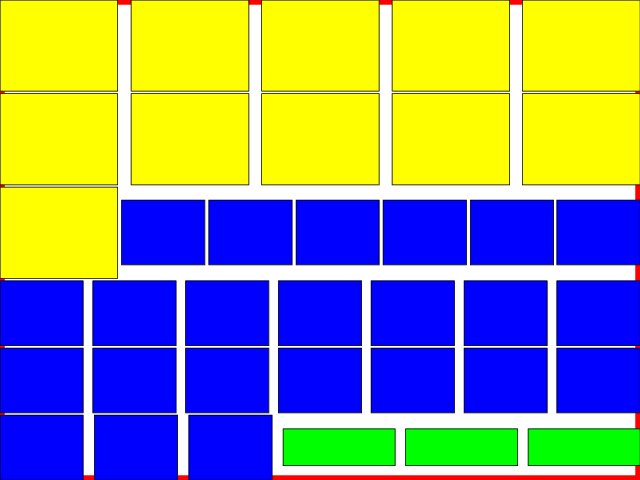
PYTHONPATH=. python legacy/arrange_spread.py
The results will be svg files test1.svg and test2.svg, the latter showing the spread-out result. Here is an example how the output looks like (without the red border which is drawn to mark the pallet border): arrange_spread2.py contains an adaption of arrange_spread.py for the actual problem. Permutations without known length When creating a layer out of articles of same height, then there are four strategies that I can choose from. It is four because there are two methods that I can either use or not. I can rotate the article by 90 per default or not and I can rotate the pallet or not. So every time that I build a new layer, there are those four options. Depending on which strategy I choose, there is a different amount of possible leftover articles that did not fit into any layer. The amount is different because each strategy is more or less efficient. To try out all combinations of possible layer arrangements, I have to walk through a tree where at each node I branch four times for each individual strategy. Individual neighboring nodes might be the same but this outcome is unlikely due to the path leading to those neighboring nodes being different. To simplify, lets name the four possible strategies for each layers 0, 1, 2 and 3. I now want an algorithm that enumerates through all possible permutations of those four numbers for "some" length. This is similar to counting. And the itertools module comes with the product() method that nearly does what I want. For example, should I know that my tree does not become deeper than 8 (read: no more than eight layers will be built), then I can just run:
>>> for i in itertools.product([0,1,2,3], repeat=8):
...     print i
...
(0,0,0,0,0,0,0,0)
(0,0,0,0,0,0,0,1)
(0,0,0,0,0,0,0,2)
(0,0,0,0,0,0,0,3)
(0,0,0,0,0,0,1,0)
(0,0,0,0,0,0,1,1)
(0,0,0,0,0,0,1,2)
(0,0,0,0,0,0,1,3)
This would work if the number of layers created with each strategy was the same. But as each strategy behaves differently depending on the input, it cannot be known before actually trying out a sequence of strategies, how many layers it will yield. The strategy (0,0,0,0,0,0,0,0) might create 7 layers, resulting in (0,0,0,0,0,0,0,1), (0,0,0,0,0,0,0,2) and (0,0,0,0,0,0,0,3) yielding the same output as only the first 7 strategies count. This would create duplicates which I should not waste cpu cycles on later. It might also be that (0,0,0,0,0,0,1,0) turns out to be a combination of strategies that creates more than 8 layers in which case the whole thing fails. So what I need is a generator, that gives me a new strategy depending on how often it is asked for one. It should dynamically extend the tree of possible permutations to accommodate for any size. Since the tree will become humongous (4^11 = 4194304), already traversed nodes should automatically be cleaned so that only the nodes that make the current list of strategies stays in memory at any point in time. This sounded all complicated which made me even more surprised by how simple the solution was in the end. Here a version of the algorithm that could easily be ported to C:
class Tree:
def __init__(self, branch_factor):
self.branch_factor = branch_factor
self.root = "value": None, "parent": None, "children": []
self.current = self.root

def next(self):
if not self.current["children"]:
self.current["children"] = [ "value":val, "parent":self.current, "children":[] for val in range(self.branch_factor)]
self.current = self.current["children"][0]
return self.current["value"]

def reset(self):
if self.current["parent"]:
self.current["parent"]["children"].pop(0)
else:
return False
if self.current["parent"]["children"]:
self.current = self.root
return True
else:
self.current = self.current["parent"]
return self.reset()

def __str__(self):
return str(self.root)
It would be used like this:
>>> tree = Tree(4)
>>> print tree.next(), tree.next(), tree.next()
>>> while tree.reset():
...     print tree.next(), tree.next(), tree.next()
Which would be equivalent to calling itertools.product([1,2,3,4], 3). The special part is, that in each iteration of the loop I can call tree.next() an arbitrary amount of times, just how much it is needed. Whenever I cannot generate an additional layer anymore, I can call tree.reset() to start a new permutation. For my code I used a python specific version which is a generator:
def product_varlength(branch_factor):
root = "value": None, "parent": None, "children": []
current = root
while True:
if not current["children"]:
current["children"] = [ "value":val, "parent":current, "children":[] for val in range(branch_factor)]
current = current["children"][0]
if (yield current["value"]):
while True:
if current["parent"]:
current["parent"]["children"].pop(0)
else:
return
if current["parent"]["children"]:
current = root
break
else:
current = current["parent"]
It is used like this:
it = product_varlength(4)
print it.next(), it.send(False), it.send(False)
while True:
    print it.send(True), it.send(False), it.send(False)
Again, the expression in the loop can have any number of it.send(False). The first it.send(True) tells the generator to do a reset.

Cyril Brulebois: Fun with ints, longs, and pointers!

While investigating the case of some packages responsible for uninstallability on the s390x architecture, I stumbled upon one FTBFS on a single architecture, reported as #673590 (<insert some nice words about software shipping with a decent testsuite>). Given the int versus size_t question was asked, I grabbed this old (it s UNIX!) reference: 64-bit and Data Size Neutrality. Among other things, it describes the everything is 32-bit to 64-bit is becoming the new standard slow conversion process, where keeping compatibility with existing applications was a high priority. It has a nice description of so-called C data models, making it possible to refer to them quickly: LP32 and ILP32 in the 32-bit world; ILP64, LLP64, and LP64 in the 64-bit world. I won t go into detail here, this page has a nice table and lots of explanations about pros and cons for those. (On a personal note, I discovered those on xorg-devel@ when I saw patches floating around, which were about optimizing data sizes for this or that data model, by picking the right types.) While standards may be boring, this page makes it really easy to understand which data types to use, to ensure the best 32/64-bit compatibility possible. It s even full of dos and don ts. See the second half (Porting Issues) for details.

20 May 2012

Gregor Herrmann: RC bugs 2012/20

I was on vacations for a few days last week, therefor my list of RC bugs is a bit shorter this time. thanks again to everyone who sent patches to the BTS that I could just use.

19 May 2012

Paul Tagliamonte: introducing... po to

Firstly, please excuse the ugly formatting of this ultra-wide image on my blog, and I m sure the respective planets that I m on. po to is my first real node project, and I m planning to get it to a point where it makes email less painful then it otherwise is. The code s on my github, and I d like to thank Rick Waldron for his work in helping me, as well as Scott Wells for the name. For those wondering, po to is an Esperanto word meaning (according to wiktionary):
  1. a public institution (usually government-run) to deliver mail, post
  2. mail distribution in general
  3. one s mail, collectively
The front-end s name is po tilo the suffix denotes tool such that po tilo means something like mail tool fitting! More to come

Next.

Previous.