Search Results: "sto"

2 July 2017

Ritesh Raj Sarraf: apt-offline 1.8.1 released

apt-offline 1.8.1 released. This is a bug fix release fixing some python3 glitches related to module imports. Recommended for all users. apt-offline (1.8.1) unstable; urgency=medium * Switch setuptools to invoke py3
* No more argparse needed on py3
* Fix genui.sh based on comments from pyqt mailing list
* Bump version number to 1.8.1 -- Ritesh Raj Sarraf <rrs@debian.org> Sat, 01 Jul 2017 21:39:24 +0545
What is apt-offline
Description: offline APT package manager
 apt-offline is an Offline APT Package Manager.
 .
 apt-offline can fully update and upgrade an APT based distribution without
 connecting to the network, all of it transparent to APT.
 .
 apt-offline can be used to generate a signature on a machine (with no network).
 This signature contains all download information required for the APT database
 system. This signature file can be used on another machine connected to the
 internet (which need not be a Debian box and can even be running windows) to
 download the updates.
 The downloaded data will contain all updates in a format understood by APT and
 this data can be used by apt-offline to update the non-networked machine.
 .
 apt-offline can also fetch bug reports and make them available offline.

Categories:

Keywords:

Like:

1 July 2017

Daniel Silverstone: F/LOSS activity, June 2017

It seems to be becoming popular to send a mail each month detailing your free software work for that month. I have been slowly ramping my F/LOSS activity back up, after years away where I worked on completing my degree. My final exam for that was in June 2017 and as such I am now in a position to try and get on with more F/LOSS work. My focus, as you might expect, has been on Gitano which reached 1.0 in time for Stretch's release and which is now heading gently toward a 1.1 release which we have timed for Debconf 2017. My friend a colleague Richard has been working hard on Gitano and related components during this time too, and I hope that Debconf will be an opportunity for him to meet many of my Debian friends too. But enough of that, back to the F/LOSS. We've been running Gitano developer days roughly monthly since March of 2017, and the June developer day was attended by myself, Richard Maw, and Richard Ipsum. You are invited to read the wiki page for the developer day if you want to know exactly what we got up to, but a summary of my involvement that day is: Other than that, related to Gitano during June I: My non-Gitano F/LOSS related work in June has been entirely centred around the support I provide to the Lua community in the form of the Lua mailing list and website. The host on which it's run is ailing, and I've had to spend time trying to improve and replace that. Hopefully I'll have more to say next month. Perhaps by doing this reporting I'll get more F/LOSS done. Of course, July's report will be sent out while I'm in Montr al for debconf 2017 (or at least for debcamp at that point) so hopefully more to say anyway.

Russ Allbery: End of month haul

For some reason, June is always incredibly busy for me. It's historically the most likely month in which I don't post anything here at all except reviews (and sometimes not even that). But I'm going to tell you about what books I bought (or were given to me) on the very last day of the month to break the pattern of no journal postings in June. Ted Chiang Arrival (Stories of Your Life) (sff collection)
Eoin Colfer Artemis Fowl (sff)
Philip K. Dick The Man Who Japed (sff)
Yoon Ha Lee Raven Strategem (sff)
Paul K. Longmore Why I Burned My Book (nonfiction)
Melina Marchetta The Piper's Son (mainstream)
Jules Verne For the Flag (sff, sort of) This is a more than usually eclectic mix. The Chiang is his Stories of Your Life collection reissued under the title of Arrival to cash in on the huge success of the movie based on one of his short stories. I'm not much of a short fiction reader, but I've heard so many good things about Chiang that I'm going to give it a try. The Longmore is a set of essays about disability rights that has been on my radar for a while. I finally got pushed into buying it (plus the first Artemis Fowl book and the Marchetta) because I've been reading back through every review Light has written. (I wish I were even close to that amusingly snarky in reviews, and she manages to say in a few paragraphs what usually takes me a whole essay.) Finally, the Dick and the Verne were gifts from a co-worker from a used book store in Ireland. Minor works by both authors, but nice, old copies of the books.

Russ Allbery: Review: Make It Stick

Review: Make It Stick, by Peter C. Brown, et al.
Author: Peter C. Brown
Author: Henry L. Roediger III
Author: Mark A. McDaniel
Publisher: Belknap Press
Copyright: 2014
ISBN: 0-674-72901-3
Format: Kindle
Pages: 255
Another read for the work book club. "People generally are going about learning in the wrong ways." This is the first sentence of the preface of this book by two scientists (Roediger and McDaniel are both psychology researchers specializing in memory) and a novelist and former management consultant (Brown). The goal of Make It Stick is to apply empirical scientific research to the problem of learning, specifically retention of information for long-term use. The authors aim to convince the reader that subjective impressions of the effectiveness of study habits are highly deceptive, and that scientific evidence points strongly towards mildly counter-intuitive learning methods that don't feel like they're producing as good of results. I have such profound mixed feelings about this book. Let's start with the good. Make It Stick is a book containing actual science. The authors quote the studies, results, and scientific argument at length. There are copious footnotes and an index, as well as recommended reading. And the science is concrete and believable, as is the overlaid interpretation based on cognitive and memory research. The book's primary argument is that short-term and long-term memory are very different things, that what we're trying to achieve when we say "learning" is based heavily on long-term memory and recall of facts for an extended time after study, and that building this type of recall requires not letting our short-term memory do all the work. We tend towards study patterns that show obvious short-term improvement and that produce an increased feeling of effortless recall of the material, but those study patterns are training short-term memory and mean the knowledge slips away quickly. Choosing learning methods that instead make us struggle a little with what we're learning are significantly better. It's that struggle that leads to committing the material to long-term memory and building good recall pathways for it. On top of this convincingly-presented foundation, the authors walk through learning methods that feel worse in the moment but have better long-term effects: mixing practice of different related things (different types of solids when doing geometry problems, different pitches in batting practice) and switching types before you've mastered the one you're working on, forcing yourself to interpret and analyze material (such as writing a few paragraphs of summary in your own words) instead of re-reading it, and practicing material at spaced intervals far enough apart that you've forgotten some of the material and have to struggle to recall it. Possibly the most useful insight here (at least for me) was the role of testing in learning, not as just a way of measuring progress, but as a learning tool. Frequent, spaced, cumulative testing forces exactly the type of recall that builds long-term memory. The tests themselves help improve our retention of what we're learning. It's bad news for people like me who were delighted to leave school and not have to take a test again, but viewing tests as a more effective learning tool than re-reading and review (which they are) does cast them in a far more positive light. This is all solid stuff, and I'm very glad the research underlying this book exists and that I now know about it. But there are some significant problems with its presentation. The first is that there just isn't much here. The two long paragraphs above summarize nearly all of the useful content of this book. The authors certainly provide more elaboration, and I haven't talked about all of the study methods they mention or some of the useful examples of their application. But 80% of it is there, and the book is intentionally repetitive (because it tries to follow the authors' advice on learning theory). Make It Stick therefore becomes tedious and boring, particularly in the first four chapters. I was saying a lot of "yes, yes, you said that already" and falling asleep while trying to read it. The summaries at the end of the book are a bit better, but you will probably not need most of this book to get the core ideas. And then there's chapter five, which ends in a train wreck. Chapter five is on cognitive biases, and I see why the authors wanted to include it. The Dunning-Kruger effect is directly relevant to their topic. It undermines our ability to learn, and is yet another thing that testing helps avoid. Their discussion of Daniel Kahneman's two system theory (your fast, automatic, subconscious reactions and your slow, thoughtful, conscious processing) is somewhat less directly relevant, but it's interesting stuff, and it's at least somewhat related to the short-term and long-term memory dichotomy. But some of the stories they choose to use to illustrate this are... deeply unfortunate. Specifically, the authors decided to use US police work in multiple places as their example of choice for two-system thinking, and treat it completely uncritically. Some of you are probably already wincing because you can see where this is going. They interview a cop who, during scenario training for traffic stops, was surprised by the car trunk popping open and a man armed with a shotgun popping out of it. To this day, he still presses down on the trunk of the car as he walks up; it's become part of his checklist for every traffic stop. This would be a good example if the authors realized how badly his training has failed and deconstructed it, but they're apparently oblivious. I wanted to reach into the book and shake them. People have a limited number of things they can track and follow as part of a procedure, and some bad trainer has completely wasted part of this cop's attention in every traffic stop and thereby made him less safe! Just calculate the chances that someone would be curled up in an unlocked trunk with a shotgun and a cop would just happen to stop that car for some random reason, compared to any other threat the cop could use that same attention to watch for. This is exactly the type of scenario that's highly memorable but extremely improbable and therefore badly breaks human risk analysis. It's what Bruce Schneier calls a movie plot threat. The correct reaction to movie plot threats is to ignore them; wasting effort on mitigating them means not having that effort to spend on mitigating some other less memorable but more likely threat. This isn't the worst, though. The worst is the very next paragraph, also from police training, of showing up at a domestic call, seeing an armed person on the porch who stands up and walks away when ordered to drop their weapon, and not being sure how to react, resulting in that person (in the simulated exercise) killing the cop before they did anything. The authors actually use this as an example of how the cop was using system two and needed to train to use system one in that situation to react faster, and that this is part of the point of the training. Those of us who have been paying attention to the real world know what using system one here means: the person on the porch gets shot if they're black and doesn't get shot if they're white. The authors studiously refuse to even hint at this problem. I would have been perfectly happy if this book avoided the unconscious bias aspect of system one thinking. It's a bit far afield of the point of the book, and the authors are doubtless trying to stay apolitical. But that's why you pick some other example. You cannot just drop this kind of thing on the page and then refuse to even comment on it! It's like writing a chapter about the effect of mass transit on economic development, choosing Atlanta as one of your case studies, and then never mentioning race. Also, some editor seriously should have taken an ax to the sentence where the authors (for no justified reason) elaborate a story to describe a cop maiming a person, solely to make a cliched joke about how masculinity is defined by testicles and how people who lose body parts are less human. Thanks, book. This was bad enough that it dominated my memory of this chapter, but, reviewing the book for this review, I see it was just a few badly chosen examples at the end of the chapter and one pointless story at the start. The rest of the chapter is okay, although it largely summarizes things covered better in other books. The most useful part that's relevant to the topic of the book is probably the discussion of peer instruction. Just skip over all the police bits; you won't be missing anything. Thankfully, the rest of the book mostly avoids failing quite this hard. Chapter six does open with the authors obliviously falling for a string of textbook examples of survivorship bias (immediately after the chapter on cognitive biases!), but they shortly thereafter settle down to the accurate and satisfying work of critiquing theories of learning methods and types of intelligence. And by critiquing, I mean pointing out that they're mostly unscientific bullshit, which is fighting the good fight as far as I'm concerned. So, mixed feelings. The science seems solid, and is practical and directly applicable to my life. Make It Stick does an okay job at presenting it, but gets tedious and boring in places, particularly near the beginning. And there are a few train-wreck examples that had me yelling at the book and scribbling notes, which wasn't really the cure for boredom I was looking for. I recommend being aware of this research, and I'm glad the authors wrote this book, but I can't really recommend the book itself as a reading experience. Rating: 6 out of 10

30 June 2017

Chris Lamb: Free software activities in June 2017

Here is my monthly update covering what I have been doing in the free software world (previous month):
Reproducible builds

Whilst anyone can inspect the source code of free software for malicious flaws, most software is distributed pre-compiled to end users. The motivation behind the Reproducible Builds effort is to allow verification that no flaws have been introduced either maliciously or accidentally during this compilation process by promising identical results are always generated from a given source. Multiple third-parties then can come to a consensus on whether a build was compromised or not. I have generously been awarded a grant from the Core Infrastructure Initiative to fund my work in this area. This month I:
  • Chaired our monthly IRC meeting. (Summary, logs, etc.)
  • Presented at Hong Kong Open Source Conference 2017.
  • Presented at LinuxCon China.
  • Submitted the following patches to fix reproducibility-related toolchain issues within Debian:
    • cracklib2: Ensuring /var/cache/cracklib/src-dicts are reproducible. (#865623)
    • fontconfig: Ensuring the cache files are reproducible. (#864082)
    • nfstrace: Make the PDF footers reproducible. (#865751)
  • Submitted 6 patches to fix specific reproducibility issues in cd-hit, janus, qmidinet, singularity-container, tigervnc & xabacus.
  • Submitted a wishlist request to the TeX mailing list to ensure that PDF files are reproducible even if generated from a difficult path after identifying underlying cause. (Thread)
  • Categorised a large number of packages and issues in the Reproducible Builds notes.git repository.
  • Worked on publishing our weekly reports. (#110, #111, #112 & #113)
  • Updated our website with 13 missing talks (e291180), updated the metadata for some existing talks (650a201) and added OpenEmbedded to the projects page (12dfcf0).

I also made the following changes to our tooling:
diffoscope

diffoscope is our in-depth and content-aware diff utility that can locate and diagnose reproducibility issues.


strip-nondeterminism

strip-nondeterminism is our tool to remove specific non-deterministic results from a completed build.

  • Add libarchive-cpio-perl with the !nocheck build profile. (01e408e)
  • Add dpkg-dev dependency build profile. (f998bbe)


Debian My activities as the current Debian Project Leader are covered in my "Bits from the DPL" email to the debian-devel-announce mailing list. However, I:
Debian LTS

This month I have been paid to work 16 hours hours on Debian Long Term Support (LTS). In that time I did the following:
  • "Frontdesk" duties, triaging CVEs, etc.
  • Issued DLA 974-1 fixing a command injection vulnerability in picocom, a dumb-terminal emulation program.
  • Issued DLA 972-1 which patches a double-free vulnerability in the openldap LDAP server.
  • Issued DLA 976-1 which corrects a buffer over-read vulnerability in the yodl ("Your Own Document Language") document processor.
  • Issued DLA 985-1 to address a vulnerability in libsndfile (a library for reading/writing audio files) where a specially-crafted AIFF file could result in an out-of-bounds memory read.
  • Issued DLA 990-1 to fix an infinite loop vulnerability in the expat, an XML parsing library.
  • Issued DLA 999-1 for the openvpn VPN server if clients used a HTTP proxy with NTLM authentication, a man-in-the-middle attacker could cause the client to crash or disclose stack memory that was likely to contain the proxy password.

Uploads
  • bfs (1.0.2-1) New upstream release, add basic/smoke autopkgtests.
  • installation-birthday (5) Add some basic autopkgtest smoke tests and correct the Vcs- Git,Browser headers.
  • python-django:
    • 1:1.11.2-1 New upstream minor release & backport an upstream patch to prevent a test failure if the source is not writable. (#816435)
    • 1:1.11.2-2 Upload to unstable, use !nocheck profile for build dependencies that are only required for tests and various packaging updates.

I also made the following non-maintainer uploads (NMUs):
  • kluppe (0.6.20-1.1) Fix segmentation fault caused by passing a truncated pointer instead of a GtkType. (#863421)
  • porg (2:0.10-1.1) Fix broken LD_PRELOAD path for libporg-log.so. (#863495)
  • ganeti-instance-debootstrap (0.16-2.1) Fix "illegal option for fgrep" error by using "--" to escape the search needle. (#864025)
  • pavuk (0.9.35-6.1) Fix segmentation fault when opening the "Limitations" window due to pointer truncation in src/gtkmulticol.[ch]. (#863492)
  • timemachine (0.3.3-2.1) Fix two segmentation faults in src/gtkmeter.c and gtkmeterscale.c caused by passing a truncated pointers using guint instead of a GtkType. (#863420)
  • jackeq (0.5.9-2.1) Fix another segmentation fault caused by passing a truncated pointer instead of a GtkType. (#863416)

Debian bugs filed
  • debhelper: Don't run dh_installdocs if nodoc is specified in DEB_BUILD_PROFILES? (#865869)
  • python-blessed: Non-determistically FTBFS due to unreliable timing in tests. (#864337)
  • apt: Please print a better error message if zero certificates are loaded from the system CA store. (#866377)

Arturo Borrero Gonz lez: About the OutlawCountry Linux malware

netfilter_predator Today I noticed the internet buzz about a new alleged Linux malware called OutlawCountry by the CIA, and leaked by Wikileaks. The malware redirects traffic from the victim to a control server in order to spy or whatever. To redirect this traffic, they use simple Netfilter NAT rules injected in the kernel. According to many sites commenting on the issue, is seems that there is something wrong with the Linux kernel Netfilter subsystem, but I read the leaked docs, and what they do is to load a custom kernel module in order to be able to load Netfilter NAT table/rules with more priority than the default ones (overriding any config the system may have). Isn t that clear? The attacker is loading a custom kernel module as root in your machine. They don t use Netfilter to break into your system. The problem is not Netfilter, the problem is your whole machine being under their control. With root control of the machine, they could simply use any mechanism, like kpatch or whatever, to replace your whole running kernel with a new one, with full access to memory, networking, file system et al. They probably use a rootkit or the like to take over the system.

Michal &#268;iha&#345;: Weblate 2.15

Weblate 2.15 has been released today. It is slightly behind schedule what was mostly caused by my vacation. As with 2.14, there are quite a lot of security improvements based on reports we got from HackerOne program and various new features. Full list of changes: If you are upgrading from older version, please follow our upgrading instructions. You can find more information about Weblate on https://weblate.org, the code is hosted on Github. If you are curious how it looks, you can try it out on demo server. You can login there with demo account using demo password or register your own user. Weblate is also being used on https://hosted.weblate.org/ as official translating service for phpMyAdmin, OsmAnd, Turris, FreedomBox, Weblate itself and many other projects. Should you be looking for hosting of translations for your project, I'm happy to host them for you or help with setting it up on your infrastructure. Further development of Weblate would not be possible without people providing donations, thanks to everybody who have helped so far! The roadmap for next release is just being prepared, you can influence this by expressing support for individual issues either by comments or by providing bounty for them.

Filed under: Debian English SUSE Weblate

28 June 2017

Steve Kemp: Yet more linux security module craziness ..

I've recently been looking at linux security modules. My first two experiments helped me learn:
My First module - whitelist_lsm.c
This looked for the presence of an xattr, and if present allowed execution of binaries. I learned about the Kernel build-system, and how to write a simple LSM.
My second module - hashcheck_lsm.c
This looked for the presence of a "known-good" SHA1 hash xattr, and if it matched the actual hash of the file on-disk allowed execution. I learned how to hash the contents of a file, from kernel-space.
Both allowed me to learn things, but both were a little pointless. They were not fine-grained enough to allow different things to be done by different users. (i.e. If you allowed "alice" to run "wget" you'd also allow www-data to do the same.) So, assuming you wanted to do your security job more neatly what would you want? You'd want to allow/deny execution of commands based upon: So your local users could run "bad" commands, but "www-data" (post-compromise) couldn't. Obviously you don't want to have to recompile your kernel to change the rules of who can execute what. So you think to yourself "I'll write those rules down in a file". But of course reading a file from kernel-space is tricky. And parsing any list of rules, in a file, from kernel-space would prone to buffer-related problems. So I had a crazy idea: Calling userspace? Every time a command is to be executed? Crazy. But it just might work. One problem I had with this approach is that userspace might not even be available, when you're booting. So I setup a flag to enable this stuff:
# echo 1 >/proc/sys/kernel/can-exec/enabled
Now the kernel will invoke the following on every command:
/sbin/can-exec $UID $PATH
Because the kernel waits for this command to complete - as it reads the exit-code - you cannot execute any child-processes from it as you'd end up in recursive hell, but you can certainly read files, write to syslog, etc. My initial implementionation was as basic as this:
int main( int argc, char *argv[] )
 
...
  // Get the UID + Program
  int uid = atoi( argv[1] );
  char *prg = argv[2];
  // syslog
  openlog ("can-exec", LOG_CONS   LOG_PID   LOG_NDELAY, LOG_LOCAL1);
  syslog (LOG_NOTICE, "UID:%d CMD:%s", uid, prg );
  // root can do all.
  if ( uid == 0 )
    return 0;
  // nobody
  if ( uid == 65534 )  
    if ( ( strcmp( prg , "/bin/sh" ) == 0 )  
         ( strcmp( prg , "/usr/bin/id" ) == 0 ) )  
      fprintf(stderr, "Allowing 'nobody' access to shell/id\n" );
      return 0;
     
   
  fprintf(stderr, "Denied\n" );
  return -1;
 
Although the UIDs are hard-code it actually worked! Yay! I updated the code to convert the UID to a username, then check executables via the file /etc/can-exec/$USERNAME.conf, and this also worked. I don't expect anybody to actually use this code, but I do think I've reached a point where I can pretend I've written a useful (or non-pointless) LSM at last. That means I can stop.

27 June 2017

Daniel Pocock: How did the world ever work without Facebook?

Almost every day, somebody tells me there is no way they can survive without some social media like Facebook or Twitter. Otherwise mature adults fearful that without these dubious services, they would have no human contact ever again, they would die of hunger and the sky would come crashing down too. It is particularly disturbing for me to hear this attitude from community activists and campaigners. These are people who aspire to change the world, but can you really change the system using the tools the system gives you? Revolutionaries like Gandhi and the Bolsheviks don't have a lot in common: but both of them changed the world and both of them did so by going against the system. Gandhi, of course, relied on non-violence while the Bolsheviks continued to rely on violence long after taking power. Neither of them needed social media but both are likely to be remembered far longer than any viral video clip you have seen recently. With US border guards asking visitors for their Facebook profiles and Mark Zuckerberg being a regular participant at secretive Bilderberg meetings, it should be clear that Facebook and conventional social media is not on your side, it's on theirs. Kettling has never been easier When street protests erupt in major cities such as London, the police build fences around the protesters, cutting them off from the rest of the world. They become an island in the middle of the city, like a construction site or broken down bus that everybody else goes around. The police then set about arresting one person at a time, taking their name and photograph and then slowly letting them leave in different directions. This strategy is called kettling. Facebook helps kettle activists in their arm chair. The police state can gather far more data about them, while their impact is even more muted than if they ventured out of their home. You are more likely to win the lottery than make a viral campaign Every week there is news about some social media campaign that has gone viral. Every day, marketing professionals, professional campaigners and motivated activists sit at their computer spending hours trying to replicate this phenomenon. Do the math: how many of these campaigns can really be viral success stories? Society can only absorb a small number of these campaigns at any one time. For most of the people trying to ignite such campaigns, their time and energy is wasted, much like money spent buying lottery tickets and with odds that are just as bad. It is far better to focus on the quality of your work in other ways than to waste any time on social media. If you do something that is truly extraordinary, then other people will pick it up and share it for you and that is how a viral campaign really begins. The time and effort you put into trying to force something to become viral is wasting the energy and concentration you need to make something that is worthy of really being viral. An earthquake and an escaped lion never needed to announce themselves on social media to become an instant hit. If your news isn't extraordinary enough for random people to spontaneously post, share and tweet it in the first place, how can it ever go far? The news media deliberately over-rates social media News media outlets, including TV, radio and print, gain a significant benefit crowd-sourcing live information, free of charge, from the public on social media. It is only logical that they will cheer on social media sites and give them regular attention. Have you noticed that whenever Facebook's publicity department makes an announcement, the media are quick to publish it ahead of more significant stories about social or economic issues that impact our lives? Why do you think the media puts Facebook up on a podium like this, ahead of all other industries, if the media aren't getting something out of it too? The tail doesn't wag the dog One particular example is the news media's fascination with Donald Trump's Twitter account. Some people have gone as far as suggesting that this billionaire could have simply parked his jet and spent the whole of 2016 at one of his golf courses sending tweets and he would have won the presidency anyway. Suggesting that Trump's campaign revolved entirely around Twitter is like suggesting the tail wags the dog. The reality is different: Trump has been a prominent public figure for decades, both in the business and entertainment world. During his presidential campaign, he had at least 220 major campaign rallies attended by over 1.2 million people in the real world. Without this real-world organization and history, the Twitter account would have been largely ignored like the majority of Twitter accounts. On the left of politics, the media have been just as quick to suggest that Bernie Sanders and Jeremy Corbyn have been supported by the "Facebook generation". This label is superficial and deceiving. The reality, again, is a grass roots movement that has attracted young people to attend local campaign meetings in pubs up and down the country. Getting people to get out and be active is key. Social media is incidental to their campaign, not indispensible. Real-world meetings, big or small, are immensely more powerful than a social media presence. Consider the Trump example again: if 100,000 people receive one of his tweets, how many even notice it in the non-stop stream of information we are bombarded with today? On the other hand, if 100,000 bellow out a racist slogan at one of his rallies, is there any doubt whether each and every one of those people is engaged with the campaign at that moment? If you could choose between 100 extra Twitter followers or 10 extra activists attending a meeting every month, which would you prefer? Do we need this new definition of a Friend? Facebook is redefining what it means to be a friend. Is somebody who takes pictures of you and insists on sharing them with hundreds of people, tagging your face for the benefit of biometric profiling systems, really a friend? If you want to find out what a real friend is and who your real friends really are, there is no better way to do so then blowing away your Facebook and Twitter account and waiting to see who contacts you personally about meeting up in the real world. If you look at a profile on Facebook or Twitter, one of the most prominent features is the number of friends or followers they have. Research suggests that humans can realistically cope with no more than about 150 stable relationships. Facebook, however, has turned Friending people into something like a computer game. This research is also given far more attention then it deserves though: the number of really meaningful friendships that one person can maintain is far smaller. Think about how many birthdays and spouse's names you can remember and those may be the number of real friendships you can manage well. In his book Busy, Tony Crabbe suggests between 10-20 friendships are in this category and you should spend all your time with these people rather than letting your time be spread thinly across superficial Facebook "friends". This same logic can be extrapolated to activism and marketing in its many forms: is it better for a campaigner or publicist to have fifty journalists following him on Twitter (where tweets are often lost in the blink of an eye) or three journalists who he meets for drinks from time to time? Facebook alternatives: the ultimate trap? Numerous free, open source projects have tried to offer an equivalent to Facebook and Twitter. GNU social, Diaspora and identi.ca are some of the more well known examples. Trying to persuade people to move from Facebook to one of these platforms rarely works. In most cases, Metcalfe's law suggests the size of Facebook will suck them back in like the gravity of a black hole. To help people really beat these monstrosities, the most effective strategy is to help them live without social media, whether it is proprietary or not. The best way to convince them may be to give it up yourself and let them see how much you enjoy life without it. Share your thoughts The FSFE community has recently been debating the use of propriety software and services. Please feel free to join the list and click here to reply on the thread.

Reproducible builds folks: Reproducible Builds: week 113 in Stretch cycle

Here's what happened in the Reproducible Builds effort between Sunday June 18 and Saturday June 24 2017: Upcoming and Past events Our next IRC meeting is scheduled for the 6th of July at 17:00 UTC with this agenda currently:
  1. Introductions
  2. Reproducible Builds Summit update
  3. NMU campaign for buster
  4. Press release: Debian is doing Reproducible Builds for Buster
  5. Reproducible Builds Branding & Logo
  6. should we become an SPI member
  7. Next meeting
  8. Any other business
On June 19th, Chris Lamb presented at LinuxCon China 2017 on Reproducible Builds. On June 23rd, Vagrant Cascadian held a Reproducible Builds question and answer session at Open Source Bridge. Reproducible work in other projects LEDE: firmware-utils and mtd-utils/mkfs.jffs2 now honor SOURCE_DATE_EPOCH. Toolchain development and fixes There was discussion on #782654 about packaging bazel for Debian. Dan Kegel wrote a patch to use ar determinitiscally for Homebrew, a package manager for MacOS. Dan Kegel worked on using SOURCE_DATE_EPOCH and other reproduciblity fixes in fpm, a multi plattform package builder. The Fedora Haskell team disabled parallel builds to achieve reproducible builds. Bernhard M. Wiedemann submitted many patches upstream: Packages fixed and bugs filed Patches submitted upstream: Other patches filed in Debian: Reviews of unreproducible packages 573 package reviews have been added, 154 have been updated and 9 have been removed in this week, adding to our knowledge about identified issues. 1 issue type has been updated: Weekly QA work During our reproducibility testing, FTBFS bugs have been detected and reported by: diffoscope development Version 83 was uploaded to unstable by Chris Lamb. It also moved the previous changes from experimental (to where they were uploaded) to unstable. It included contributions from previous weeks. You can read about these changes in our previous weeks' posts, or view the changelog directly (raw form). We plan to maintain a backport of this and future versions in stretch-backports. Ximin Luo also worked on better html-dir output for very very large diffs such as those for GCC. So far, this includes unreleased work on a PartialString data structure which will form a core part of a new and more intelligent recursive display algorithm. strip-nondeterminism development Versions 0.035-1 was uploaded to unstable from experimental by Chris Lamb. It included contributions from: Later in the week Mattia Rizzolo uploaded 0.035-2 with some improvements to the autopkgtest and to the general packaging. We currently don't plan to maintain a backport in stretch-backports like we did for jessie-backports. Please speak up if you think otherwise. reproducible-website development tests.reproducible-builds.org Misc. This week's edition was written by Ximin Luo, Holger Levsen, Bernhard M. Wiedemann, Mattia Rizzolo, Chris Lamb & reviewed by a bunch of Reproducible Builds folks on IRC & the mailing lists.

Colin Watson: New address book

I ve had a kludgy mess of electronic address books for most of two decades, and have got rather fed up with it. My stack consisted of: The biggest practical problem with this was that I had the address book that was most convenient for me to add things to (Google Contacts) and the one I used when sending email, and no sensible way to merge them or move things between them. I also wasn t especially comfortable with having all my contact information in a proprietary web service. My goals for a replacement address book system were: I think I have all this now! New stack The obvious basic technology to use is CardDAV: it s fairly complex, admittedly, but lots of software supports it and one of my goals was not having to write my own thing. This meant I needed a CardDAV server, some way to sync the database to and from both Android and the system where I run mutt, and whatever query glue was necessary to get mutt to understand vCards. There are lots of different alternatives here, and if anything the problem was an embarrassment of choice. In the end I just decided to go for things that looked roughly the right shape for me and tried not to spend too much time in analysis paralysis. CardDAV server I went with Xandikos for the server, largely because I know Jelmer and have generally had pretty good experiences with their software, but also because using Git for history of the backend storage seems like something my future self will thank me for. It isn t packaged in stretch, but it s in Debian unstable, so I installed it from there. Rather than the standalone mode suggested on the web page, I decided to set it up in what felt like a more robust way using WSGI. I installed uwsgi, uwsgi-plugin-python3, and libapache2-mod-proxy-uwsgi, and created the following file in /etc/uwsgi/apps-available/xandikos.ini which I then symlinked into /etc/uwsgi/apps-enabled/xandikos.ini:
[uwsgi]
socket = 127.0.0.1:8801
uid = xandikos
gid = xandikos
umask = 022
master = true
cheaper = 2
processes = 4
plugin = python3
module = xandikos.wsgi:app
env = XANDIKOSPATH=/srv/xandikos/collections
The port number was arbitrary, as was the path. You need to create the xandikos user and group first (adduser --system --group --no-create-home --disabled-login xandikos). I created /srv/xandikos owned by xandikos:xandikos and mode 0700, and I recommend setting a umask as shown above since uwsgi s default umask is 000 (!). You should also run sudo -u xandikos xandikos -d /srv/xandikos/collections --autocreate and then Ctrl-c it after a short time (I think it would be nicer if there were a way to ask the WSGI wrapper to do this). For Apache setup, I kept it reasonably simple: I ran a2enmod proxy_uwsgi, used htpasswd to create /etc/apache2/xandikos.passwd with a username and password for myself, added a virtual host in /etc/apache2/sites-available/xandikos.conf, and enabled it with a2ensite xandikos:
<VirtualHost *:443>
        ServerName xandikos.example.org
        ServerAdmin me@example.org
        ErrorLog /var/log/apache2/xandikos-error.log
        TransferLog /var/log/apache2/xandikos-access.log
        <Location />
                ProxyPass "uwsgi://127.0.0.1:8801/"
                AuthType Basic
                AuthName "Xandikos"
                AuthBasicProvider file
                AuthUserFile "/etc/apache2/xandikos.passwd"
                Require valid-user
        </Location>
</VirtualHost>
Then service apache2 reload, set the new virtual host up with Let s Encrypt, reloaded again, and off we go. Android integration I installed DAVdroid from the Play Store: it cost a few pounds, but I was OK with that since it s GPLv3 and I m happy to help fund free software. I created two accounts, one for my existing Google Contacts database (and in fact calendaring as well, although I don t intend to switch over to self-hosting that just yet), and one for the new Xandikos instance. The Google setup was a bit fiddly because I have two-step verification turned on so I had to create an app-specific password. The Xandikos setup was straightforward: base URL, username, password, and done. Since I didn t completely trust the new setup yet, I followed what seemed like the most robust option from the DAVdroid contacts syncing documentation, and used the stock contacts app to export my Google Contacts account to a .vcf file and then import that into the appropriate DAVdroid account (which showed up automatically). This seemed straightforward and everything got pushed to Xandikos. There are some weird delays in syncing contacts that I don t entirely understand, but it all seems to get there in the end. mutt integration First off I needed to sync the contacts. (In fact I happen to run mutt on the same system where I run Xandikos at the moment, but I don t want to rely on that, and going through the CardDAV server means that I don t have to poke holes for myself using filesystem permissions.) I used vdirsyncer for this. In ~/.vdirsyncer/config:
[general]
status_path = "~/.vdirsyncer/status/"
[pair contacts]
a = "contacts_local"
b = "contacts_remote"
collections = ["from a", "from b"]
[storage contacts_local]
type = "filesystem"
path = "~/.contacts/"
fileext = ".vcf"
[storage contacts_remote]
type = "carddav"
url = "<Xandikos base URL>"
username = "<my username>"
password = "<my password>"
Running vdirsyncer discover and vdirsyncer sync then synced everything into ~/.contacts/. I added an hourly crontab entry to run vdirsyncer -v WARNING sync. Next, I needed a command-line address book tool based on this. khard looked about right and is in stretch, so I installed that. In ~/.config/khard/khard.conf (this is mostly just the example configuration, but I preferred to sort by first name since not all my contacts have neat first/last names):
[addressbooks]
[[contacts]]
path = ~/.contacts/<UUID of my contacts collection>/
[general]
debug = no
default_action = list
editor = vim
merge_editor = vimdiff
[contact table]
# display names by first or last name: first_name / last_name
display = first_name
# group by address book: yes / no
group_by_addressbook = no
# reverse table ordering: yes / no
reverse = no
# append nicknames to name column: yes / no
show_nicknames = no
# show uid table column: yes / no
show_uids = yes
# sort by first or last name: first_name / last_name
sort = first_name
[vcard]
# extend contacts with your own private objects
# these objects are stored with a leading "X-" before the object name in the vcard files
# every object label may only contain letters, digits and the - character
# example:
#   private_objects = Jabber, Skype, Twitter
private_objects = Jabber, Skype, Twitter
# preferred vcard version: 3.0 / 4.0
preferred_version = 3.0
# Look into source vcf files to speed up search queries: yes / no
search_in_source_files = no
# skip unparsable vcard files: yes / no
skip_unparsable = no
Now khard list shows all my contacts. So far so good. Apparently there are some awkward vCard compatibility issues with creating or modifying contacts from the khard end. I ve tried adding one address from ~/.mutt/aliases using khard and it seems to at least minimally work for me, but I haven t explored this very much yet. I had to install python3-vobject 0.9.4.1-1 from experimental to fix eventable/vobject#39 saving certain vCard files. Finally, mutt integration. I already had set query_command="lbdbq '%s'" in ~/.muttrc, and I wanted to keep that in place since I still wanted to use LDAP querying as well. I had to write a very small amount of code for this (perhaps I should contribute this to lbdb upstream?), in ~/.lbdb/modules/m_khard:
#! /bin/sh
m_khard_query ()  
    khard email --parsable --remove-first-line --search-in-source-files "$1"
 
My full ~/.lbdb/rc now reads as follows (you probably won t want the LDAP stuff, but I ve included it here for completeness):
MODULES_PATH="$MODULES_PATH $HOME/.lbdb/modules"
METHODS='m_muttalias m_khard m_ldap'
LDAP_NICKS='debian canonical'
Next steps I ve deleted one account from Google Contacts just to make sure that everything still works (e.g. I can still search for it when composing a new message), but I haven t yet deleted everything. I won t be adding anything new there though. I need to push everything from ~/.mutt/aliases into the new system. This is only about 30 contacts so shouldn t take too long. Overall this feels like a big improvement! It wasn t a trivial amount of setup for just me, but it means I have both better usability for myself and more independence from proprietary services, and I think I can add extra users with much less effort if I need to. Postscript A day later and I ve consolidated all my accounts from Google Contacts and ~/.mutt/aliases into the new system, with the exception of one group that I had defined as a mutt alias and need to work out what to do with. This all went smoothly. I ve filed the new lbdb module as #866178, and the python3-vobject bug as #866181.

Joey Hess: 12 to 24 volt house conversion

Upgrading my solar panels involved switching the house from 12 volts to 24 volts. No reasonably priced charge controllers can handle 1 KW of PV at 12 volts. There might not be a lot of people who need to do this; entirely 12 volt offgrid houses are not super common, and most upgrades these days probably involve rooftop microinverters and so would involve a switch from DC to AC. I did not find a lot of references online for converting a whole house's voltage from 12V to 24V. To prepare, I first checked that all the fuses and breakers were rated for > 24 volts. (Actually, > 30 volts because it will be 26 volts or so when charging.) Also, I checked for any shady wiring, and verified that all the wires I could see in the attic and wiring closet were reasonably sized (10AWG) and in good shape. Then I:
  1. Turned off every light, unplugged every plug, pulled every fuse and flipped every breaker.
  2. Rewired the battery bank from 12V to 24V.
  3. Connected the battery bank to the new charge controller.
  4. Engaged the main breaker, and waited for anything strange.
  5. Screwed in one fuse at a time.
lighting The house used all fluorescent lights, and they have ballasts rated for only 12V. While they work at 24V, they might blow out sooner or overheat. In fact one died this evening, and while it was flickering before, I suspect the 24V did it in. It makes sense to replace them with more efficient LED lights anyway. I found some 12-24V DC LED lights for regular screw-in (edison) light fixtures. Does not seem very common; Amazon only had a few models and they shipped from China. Also, I ordered a 15 foot long, 300 LED strip light, which runs on 24V DC and has an adhesive backing. Great stuff -- it can be cut to different lengths and stuck anywhere. I installed some underneath the cook stove hood and the kitchen cabinets, which didn't have lights before. Similar LED strips are used in some desktop lamps. My lamp was 12V only (barely lit at 24V), but I was able to replace its LED strip, upgrading it to 24V and three times as bright. (Christmas lights are another option; many LED christmas lights run on 24V.) appliances My Lenovo laptop's power supply that I use in the house is a vehicle DC-DC converter, and is rated for 12-24V. It seems to be running fine at 26V, did not get warm even when charging the laptop up from empty. I'm using buck converters to run various USB powered (5V) ARM boxes such as my sheevaplug. They're quarter sized, so fit anywhere, and are very efficient. My satellite internet receiver is running with a large buck converter, feeding 12V to an inverter, feeding to a 30V DC power supply. That triple conversion is inneficient, but it works for now. The ceiling fan runs on 24V, and does not seem to run much faster than on 12V. It may be rated for 12-24V. Can't seem to find any info about it. The radio is a 12V car radio. I used a LM317 to run it on 24V, to avoid the RF interference a buck converter would have produced. This is a very inneficient conversion; half of the power is wasted as heat. But since I can stream internet radio all day now via satellite, I'll not use the FM radio very often. Fridge... still running on propane for now, but I have an idea for a way to build a cold storage battery that will use excess power from the PV array, and keep a fridge at a constant 34 degrees F. Next home improvement project in the queue.

25 June 2017

Andreas Bombe: PDP-8/e Replicated Introduction

I am creating a replica of the DEC PDP-8/e architecture in an FPGA from schematics of the original hardware. So how did I end up with a project like this? The story begins with me wanting to have a computer with one of those front panels that have many, many lights where you can really see, in real time, what the computer is doing while it is executing code. Not because I am nostalgic for a prior experience with any of those I was born a bit too late for that and my first computer as a kid was a Commodore 64. Now, the front panel era ended around 40 years ago with the advent of microprocessors and computers of that age and older that are complete and working are hard to find and not cheap. And even if you do, there s the issue of weight, size (complete systems with peripherals fill at least a rack) and power consumption. So what to do build myself a small one with modern technology of course. While there s many computer architectures of that era to choose from, the various PDP machines by DEC are significant and well known (and documented) due to their large numbers. The most important are probably the 12 bit PDP-8, the 16 bit PDP-11 and the 36 bit PDP-10. While the PDP-11 is enticing because of the possibility to run UNIX I wanted to start with something simpler, so I chose the PDP-8.
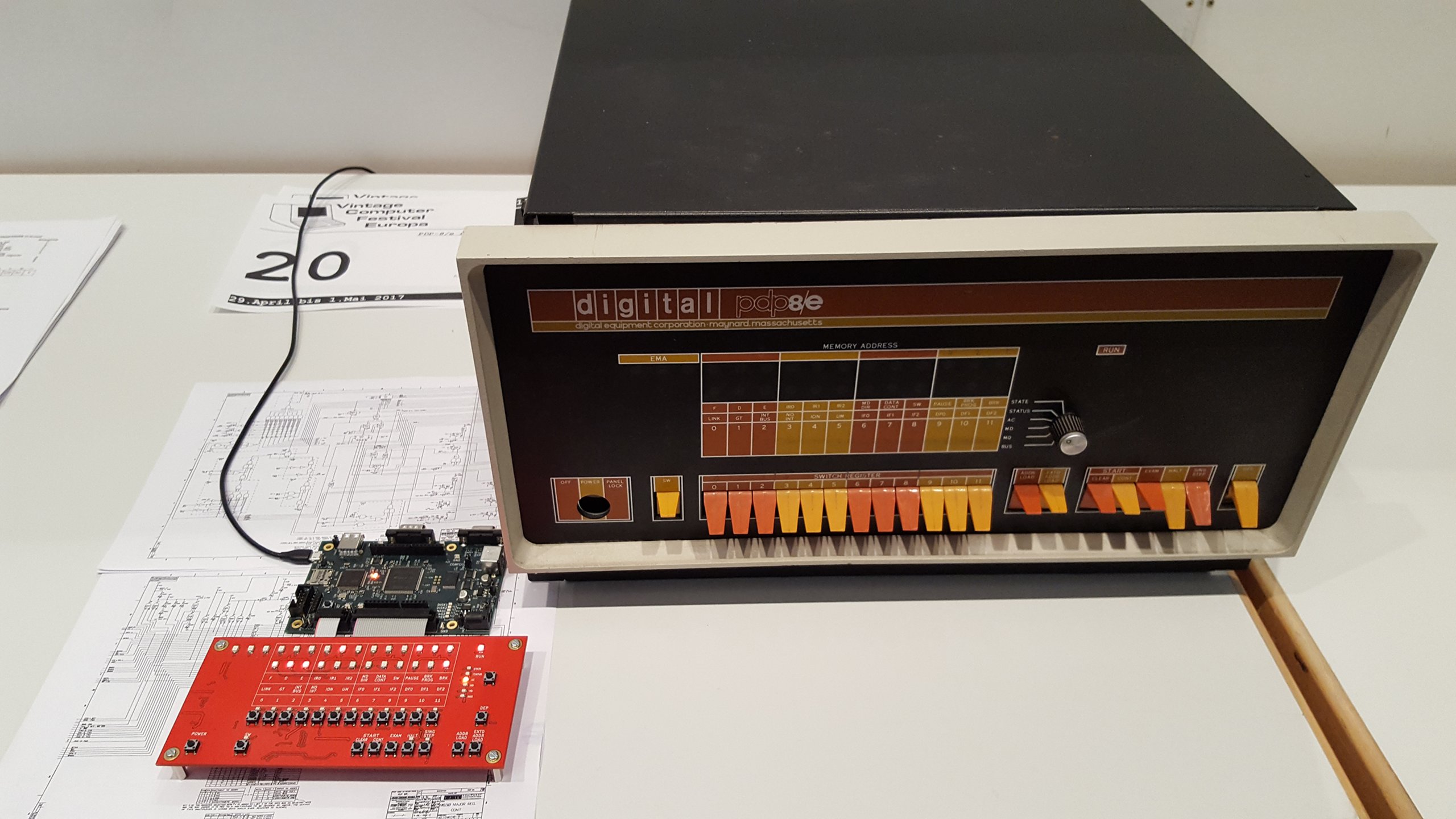
My implementation on display next to a real PDP-8/e at VCFe 18.0

The Original DEC started the PDP-8 line of computers programmed data processors designed as low cost machines in 1965. It is a quite minimalist 12 bit architecture based on the earlier PDP-5, and by minimalist I mean seriously minimal. If you are familiar with early 8 bit microprocessors like the 6502 or 8080 you will find them luxuriously equipped in comparison. The PDP-8 base architecture has a program counter (PC) and an accumulator (AC)1. That s it. There are no pointer or index registers2. There is no stack. It has addition and AND instructions but subtractions and OR operations have to be manually coded. The optional Extended Arithmetic Element adds the MQ register but that s really it for visible registers. The Wikipedia page on the PDP-8 has a good detailed description. Regarding technology, the PDP-8 series has been in production long enough to get the whole range of implementations from discrete transistor logic to microprocessors. The 8/e which I target was right in the middle, implemented in TTL logic where each IC contains multiple logic elements. This allowed the CPU itself (including timing generator) to fit on three large circuit boards plugged into a backplane. Complete systems would have at least another board for the front panel and multiple boards for the core memory, then additional boards for whatever options and peripherals were desired.

Design Choices and Comparisons I m not the only one who had the idea to build something like that, of course. Among the other modern PDP-8 implementations with a front panel, probably the most prominent project is the Spare Time Gizmos SBC6120 which is a PDP-8 single board computer built around the Harris/Intersil HD-6120 microprocessor, which implementes the PDP-8 architecture, combined with a nice front panel. Another is the PiDP-8/I, which is another nice front panel (modeled after the 8/i which has even more lights) driven by the simh simulator running under Linux on a Raspberry Pi. My goal is to get front panel lights that appear exactly like the real ones in operation. This necessitates driving the lights at full speed as they change with every instruction or even within instructions for some display selections. For example, if you run a tight loop that does nothing but increment AC while displaying that register, it would appear that all lights are lit at equal but less than full brightness. The reason is that the loop runs at such a high speed that even the most significant bit, which is blinking the slowest, is too fast to see flicker. Hence they are all effectively 50% on, just at different frequencies, and appear to be constantly light at the same brightness. This is where the other projects lack what I am looking for. The PiDP-8/I is a multiplexed display which updates at something like 30 Hz or 60 Hz, taking whatever value is current in the simulation software at the time. All the states the lights took inbetween are lost and consequently there is flickering where there shouldn t be. On the SBC6120 at least the address lines appear to update at full speed as these are the actual RAM address lines. However the used 6120 microprocessor does not have required data for the indicator display externally available. Instead, the SBC6120 runs an interrupt at 30 Hz to trap into its firmware/monitor program which then reads the current state and writes it to the front panel display, which is essentially just another peripheral. A different considerable problem with the SBC6120 is its use of the 6100 microprocessor family ICs, which are themselves long out of production and not trivial (or cheaply) to come by. Given that the way to go is to drive all lights in step with every cycle3, this can be done by a software running on a dedicated microcontroller which is how I started or by implementing a real CPU with all the needed outputs in an FPGA which is the project I am writing about. In the next post I give an overview of the hardware I built so far and some of the features that are yet to be implemented.

  1. With an associated link bit which is a little different from a carry bit in that it is treated as a thirteenth bit, i.e. it will be flipped rather than set when a carry occurs. [return]
  2. Although there are 8 specially treated memory addresses that will pre-increment when used in indirect addressing. [return]
  3. Basic cycles on the PDP-8/e are 1.4 s for memory modifying cycles and fast cycles of 1.2 s for everything else. Instructions can be one to three cycles long. [return]

Steinar H. Gunderson: Frame queue management in Nageru 1.6.1

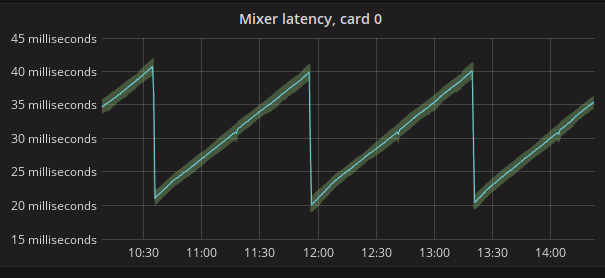
Nageru 1.6.1 is on its way, and what was intended to only be a release centered around monitoring improvements (more specifically a full set of native Prometheus] metrics) actually ended up getting a fairly substantial change to how Nageru manages its frame queues. To understand what's changing and why, it's useful to first understand the history of Nageru's queue management. Nageru 1.0.0 started out with a fairly simple scheme, but with some basics that are still relevant today: One of the input cards was deemed the master card, and whenever it delivers a frame, the master clock ticks and an output frame is produced. (There are some subtleties about dropped frames and/or the master card changing frame rates, but I'm going to ignore them, since they're not important to the discussion.) To this end, every card keeps a preallocated frame queue; when a card delivers a frame, it's put into the queue, and when the master clock ticks, it tries picking out one frame from each of the other card's queues to mix together. Note that mix here could be as simple as picking one input and throwing all the other ones away; the queueing algorithm doesn't care, it just feeds all of them to the theme and lets that run whatever GPU code it needs to match the user's preferences. The only thing that really keeps the queues bounded is that the frames in them are preallocated (in GPU memory), so if one queue gets longer than 16 frames, Nageru starts dropping it. But is 16 the right number? There are two conflicting demands here, ignoring memory usage: The 1.0.0 scheme does about as well as one could possibly hope in never dropping frames, but unfortunately, it can be pretty poor at latency. For instance, if your master card runs at 50 Hz and you have a 60 Hz card, the latter will eventually build up a delay of 16 * 16.7 ms = 266.7 ms clearly unacceptable, and rather unneeded. You could ask the user to specify a queue length, but the user probably doesn't know, and also shouldn't really have to care more knobs to twiddle are a bad thing, and even more so knobs the user is expected to twiddle. Thus, Nageru 1.2.0 introduced queue autotuning; it keeps a running estimate on how big the queue needs to be to avoid underruns, simply based on experience. If we've been dropping frames on a queue and then there's an underrun, the safe queue length is increased by one, and if the queue has been having excess frames for more than a thousand successive master clock ticks, we reduce it by one again. Whenever the queue has more than this safe number, we drop frames. This was simple, effective and largely fixed the problem. However, when adding metrics, I noticed a peculiar effect: Not all of my devices have equally good clocks. In particular, when setting up for 1080p50, my output card's internal clock (which assumes the role of the master clock when using HDMI/SDI output) seems to tick at about 49.9998 Hz, and my simple home camcorder delivers frames at about 49.9995 Hz. Over the course of an hour, this means it produces one more frame than you should have which should of course be dropped. Having an SDI setup with synchronized clocks (blackburst/tri-level) would of course fix this problem, but most people are not so lucky with their cameras, not to mention the price of PC graphics cards with SDI outputs! However, this happens very slowly, which means that for a significant amount of time, the two clocks will very nearly be in sync, and thus racing. Who ticks first is determined largely by luck in the jitter (normal is maybe 1ms, but occasionally, you'll see delayed delivery of as much as 10 ms), and this means that the 1000 frames estimate is likely to be thrown off, and the result is hundreds of dropped frames and underruns in that period. Once the clocks have diverged enough again, you're off the hook, but again, this isn't a good place to be. Thus, Nageru 1.6.1 change the algorithm around yet again, by incorporating more data to build an explicit jitter model. 1.5.0 was already timestamping each frame to be able to measure end-to-end latency precisely (now also exposed in Prometheus metrics), but from 1.6.1, they are actually used in the queueing algorithm. I ran several eight- to twelve-hour tests and simply stored all the event arrivals to a file, and then simulated a few different algorithms (including the old algorithm) to see how they fared in measures such as latency and number of drops/underruns. I won't go into the full details of the new queueing algorithm (see the commit if you're interested), but the gist is: Based on the last 5000 frames, it tries to estimate the maximum possible jitter for each input (ie., how late the frame could possibly be). Based on this as well as clock offsets, it determines whether it's really sure that there will be an input frame available on the next master tick even if it drops the queue, and then trims the queue to fit. The result is pretty satisfying; here's the end-to-end latency of my camera being sent through to the SDI output: As you can see, the latency goes up, up, up until Nageru figures it's now safe to drop a frame, and then does it in one clean drop event; no more hundreds on drops involved. There are very late frame arrivals involved in this run two extra frame drops, to be precise but the algorithm simply determines immediately that they are outliers, and drops them without letting them linger in the queue. (Immediate dropping is usually preferred to sticking around for a bit and then dropping it later, as it means you only get one disturbance event in your stream as opposed to two. Of course, you can only do it if you're reasonably sure it won't lead to more underruns later.) Nageru 1.6.1 will ship before Solskogen, as I intend to run it there :-) And there will probably be lovely premade Grafana dashboards from the Prometheus data. Although it would have been a lot nicer if Grafana were more packaging-friendly, so I could pick it up from stock Debian and run it on armhf. Hrmf. :-)

Lars Wirzenius: Obnam 1.22 released (backup application)

I've just released version 1.22 of Obnam, my backup application. It is the first release for this year. Packages are available on code.liw.fi/debian and in Debian unstable, and source is in git. A summary of the user-visible changes is below. For those interested in living dangerously and accidentally on purpose deleting all their data, the link below shows that status and roadmap for FORMAT GREEN ALBATROSS. http://distix.obnam.org/obnam-dev/182bd772889544d5867e1a0ce4e76652.html Version 1.22, released 2017-06-25

24 June 2017

Steve Kemp: Linux security modules, round two.

So recently I wrote a Linux Security Module (LSM) which would deny execution of commands, unless an extended attribute existed upon the filesystem belonging to the executables. The whitelist-LSM worked well, but it soon became apparent that it was a little pointless. Most security changes are pointless unless you define what you're defending against - your "threat model". In my case it was written largely as a learning experience, but also because I figured it seemed like it could be useful. However it wasn't actually as useful because you soon realize that you have to whitelist too much: In short there comes a point where user alice must run executable blah. If alice can run it, then so can mallory. At which point you realize the exercise is not so useful. Taking a step back I realized that what I wanted to to prevent was the execution of unknown/unexpected, and malicious binaries How do you identify known-good binaries? Well hashes & checksums are good. So for my second attempt I figured I'd not look for a mere "flag" on a binary, instead look for a valid hash. Now my second LSM is invoked for every binary that is executed by a user: In practice this is the same behaviour as the previous LSM - a binary is either executable, because there is a good hash, or it is not, because it is missing or bogus. If somebody deploys a binary rootkit this will definitely stop it from executing, but of course there is a huge hole - scripting-languages: Despite that the project was worthwhile, I can clearly describe what it is designed to achieve ("Deny the execution of unknown binaries", and "Deny binaries that have been modified"), and I learned how to hash a file from kernel-space - which was surprisingly simple.
(Yes I know about IMA and EVM - this was a simple project for learning purposes. Public-key signatures will be something I'll look at next/soon/later. :)
Perhaps the only other thing to explore is the complexity in allowing/denying actions based on the user - in a human-readable fashion, not via UIDs. So www-data can execute some programs, alice can run a different set of binaries, and git can only run /usr/bin/git. Of course down that path lies apparmour, selinux, and madness..

Ingo Juergensmann: Upgrade to Debian Stretch - GlusterFS fails to mount

Before I upgrade from Jessie to Stretch everything worked as a charme with glusterfs in Debian. But after I upgraded the first VM to Debian Stretch I discovered that glusterfs-client was unable to mount the storage on Jessie servers. I got this in glusterfs log:
[2017-06-24 12:51:53.240389] I [MSGID: 100030] [glusterfsd.c:2454:main] 0-/usr/sbin/glusterfs: Started running /usr/sbin/glusterfs version 3.8.8 (args: /usr/sbin/glusterfs --read-only --fuse-mountopts=nodev,noexec --volfile-server=192.168.254.254 --volfile-id=/le --fuse-mountopts=nodev,noexec /etc/letsencrypt.sh/certs)
[2017-06-24 12:51:54.534826] E [mount.c:318:fuse_mount_sys] 0-glusterfs-fuse: ret = -1

[2017-06-24 12:51:54.534896] I [mount.c:365:gf_fuse_mount] 0-glusterfs-fuse: direct mount failed (Invalid argument) errno 22, retry to mount via fusermount
[2017-06-24 12:51:56.668254] I [MSGID: 101190] [event-epoll.c:628:event_dispatch_epoll_worker] 0-epoll: Started thread with index 1
[2017-06-24 12:51:56.671649] E [glusterfsd-mgmt.c:1590:mgmt_getspec_cbk] 0-glusterfs: failed to get the 'volume file' from server
[2017-06-24 12:51:56.671669] E [glusterfsd-mgmt.c:1690:mgmt_getspec_cbk] 0-mgmt: failed to fetch volume file (key:/le)
[2017-06-24 12:51:57.014502] W [glusterfsd.c:1327:cleanup_and_exit] (-->/usr/lib/x86_64-linux-gnu/libgfrpc.so.0(rpc_clnt_handle_reply+0x90) [0x7fbea36c4a20] -->/usr/sbin/glusterfs(mgmt_getspec_cbk+0x494) [0x55fbbaed06f4] -->/usr/sbin/glusterfs(cleanup_and_exit+0x54) [0x55fbbaeca444] ) 0-: received signum (0), shutting down
[2017-06-24 12:51:57.014564] I [fuse-bridge.c:5794:fini] 0-fuse: Unmounting '/etc/letsencrypt.sh/certs'.
[2017-06-24 16:44:45.501056] I [MSGID: 100030] [glusterfsd.c:2454:main] 0-/usr/sbin/glusterfs: Started running /usr/sbin/glusterfs version 3.8.8 (args: /usr/sbin/glusterfs --read-only --fuse-mountopts=nodev,noexec --volfile-server=192.168.254.254 --volfile-id=/le --fuse-mountopts=nodev,noexec /etc/letsencrypt.sh/certs)
[2017-06-24 16:44:45.504038] E [mount.c:318:fuse_mount_sys] 0-glusterfs-fuse: ret = -1

[2017-06-24 16:44:45.504084] I [mount.c:365:gf_fuse_mount] 0-glusterfs-fuse: direct mount failed (Invalid argument) errno 22, retry to mount via fusermount
After some searches on the Internet I found Debian #858495, but no solution for my problem. Some search results recommended to set "option rpc-auth-allow-insecure on", but this didn't help. In the end I joined #gluster on Freenode and got some hints there:
JoeJulian ij__: debian breaks apart ipv4 and ipv6. You'll need to remove the ipv6 ::1 address from localhost in /etc/hosts or recombine your ip stack (it's a sysctl thing)
JoeJulian It has to do with the decisions made by the debian distro designers. All debian versions should have that problem. (yes, server side).
Removing ::1 from /etc/hosts and from lo interface did the trick and I could mount glusterfs storage from Jessie servers in my Stretch VMs again. However, when I upgraded the glusterfs storages to Stretch as well, this "workaround" didn't work anymore. Some more searching on the Internet made me found this posting on glusterfs mailing list:
We had seen a similar issue and Rajesh has provided a detailed explanation on why at [1]. I'd suggest you to not to change glusterd.vol but execute "gluster volume set <volname> transport.address-family inet" to allow Gluster to listen on IPv4 by default.
Setting this option instantly fixed my issues with mounting glusterfs storages. So, whatever is wrong with glusterfs in Debian, it seems to have something to do with IPv4 and IPv6. When disabling IPv6 in glusterfs, it works. I added information to #858495.
Kategorie:

23 June 2017

Jonathan Dowland: WD drive head parking update

An update for my post on Western Digital Hard Drive head parking: disabling the head-parking completely stopped the Load_Cycle_Count S.M.A.R.T. attribute from incrementing. This is probably at the cost of power usage, but I am not able to assess the impact of that as I'm not currently monitoring the power draw of the NAS (Although that's on my TODO list).

Bits from Debian: Hewlett Packard Enterprise Platinum Sponsor of DebConf17

HPElogo We are very pleased to announce that Hewlett Packard Enterprise (HPE) has committed support to DebConf17 as a Platinum sponsor. "Hewlett Packard Enterprise is excited to support Debian's annual developer conference again this year", said Steve Geary, Senior Director R&D at Hewlett Packard Enterprise. "As Platinum sponsors and member of the Debian community, HPE is committed to supporting Debconf. The conference, community and open distribution are foundational to the development of The Machine research program and will our bring our Memory Driven Computing agenda to life." HPE is one of the largest computer companies in the world, providing a wide range of products and services, such as servers, storage, networking, consulting and support, software, and financial services. HPE is also a development partner of Debian, and provides hardware for port development, Debian mirrors, and other Debian services (hardware donations are listed in the Debian machines page). With this additional commitment as Platinum Sponsor, HPE contributes to make possible our annual conference, and directly supports the progress of Debian and Free Software helping to strengthen the community that continues to collaborate on Debian projects throughout the rest of the year. Thank you very much Hewlett Packard Enterprise, for your support of DebConf17! Become a sponsor too! DebConf17 is still accepting sponsors. Interested companies and organizations may contact the DebConf team through sponsors@debconf.org, and visit the DebConf17 website at https://debconf17.debconf.org.

Arturo Borrero Gonz lez: Backup router/switch configuration to a git repository

git Most routers/switches out there store their configuration in plain text, which is nice for backups. I m talking about Cisco, Juniper, HPE, etc. The configuration of our routers are being changed several times a day by the operators, and in this case we lacked some proper way of tracking these changes. Some of these routers come with their own mechanisms for doing backups, and depending on the model and version perhaps they include changes-tracking mechanisms as well. However, they mostly don t integrate well into our preferred version control system, which is git. After some internet searching, I found rancid, which is a suite for doing tasks like this. But it seemed rather complex and feature-full for what we required: simply fetch the plain text config and put it into a git repo. Worth noting that the most important drawback of not triggering the change-tracking from the router/switch is that we have to follow a polling approach: loggin into each device, get the plain text and the commit it to the repo (if changes detected). This can be hooked in cron, but as I said, we lost the sync behaviour and won t see any changes until the next cron is run. In most cases, we lost authorship information as well. But it was not important for us right now. In the future this is something that we will have to solve. Also, some routers/switches lack some basic SSH security improvements, like public-key authentication, so we end having to hard-code user/pass in our worker script. Since we have several devices of the same type, we just iterate over their names. For example, this is what we use for hp comware devices:
#!/bin/bash
# run this script by cron
USER="git"
PASSWORD="readonlyuser"
DEVICES="device1 device2 device3 device4"
FILE="flash:/startup.cfg"
GIT_DIR="myrepo"
GIT="/srv/git/$ GIT_DIR .git"
TMP_DIR="$(mktemp -d)"
if [ -z "$TMP_DIR" ] ; then
	echo "E: no temp dir created" >&2
	exit 1
fi
GIT_BIN="$(which git)"
if [ ! -x "$GIT_BIN" ] ; then
	echo "E: no git binary" >&2
	exit 1
fi
SCP_BIN="$(which scp)"
if [ ! -x "$SCP_BIN" ] ; then
	echo "E: no scp binary" >&2
	exit 1
fi
SSHPASS_BIN="$(which sshpass)"
if [ ! -x "$SSHPASS_BIN" ] ; then
	echo "E: no sshpass binary" >&2
	exit 1
fi
# clone git repo
cd $TMP_DIR
$GIT_BIN clone $GIT
cd $GIT_DIR
for device in $DEVICES; do
	mkdir -p $device
	cd $device
	# fetch cfg
	CONN="$ USER @$ device "
	$SSHPASS_BIN -p "$PASSWORD" $SCP_BIN $ CONN :$ FILE  .
	# commit
	$GIT_BIN add -A .
	$GIT_BIN commit -m "$ device : configuration change" \
		-m "A configuration change was detected" \
		--author="cron <cron@example.com>"
	$GIT_BIN push -f
	cd ..
done
# cleanup
rm -rf $TMP_DIR
You should create a read-only user git in the devices. And beware that each device model has the config file stored in a different place. For reference, in HP comware, the file to scp is flash:/startup.cfg. And you might try creating the user like this:
local-user git class manage
 password hash xxxxx
 service-type ssh
 authorization-attribute user-role security-audit
#
In Junos/Juniper, the file you should scp is /config/juniper.conf.gz and the script should gunzip the data before committing. For the read-only user, try is something like this:
system  
	[...]
	login  
		[...]
		class git  
			permissions maintenance;
			allow-commands scp.*;
		 
		user git  
			uid xxx;
			class git;
			authentication  
				encrypted-password "xxx";


The file to scp in HP procurve is /cfg/startup-config. And for the read-only user, try something like this:
aaa authorization group "git user" 1 match-command "scp.*" permit
aaa authentication local-user "git" group "git user" password sha1 "xxxxx"
What would be the ideal situation? Get the device controlled directly by git (i.e. commit > git hook > device update) or at least have the device to commit the changes by itself to git. I m open to suggestions :-)

Next.

Previous.