While SPF seems to be among the currently used technologies for spam protection, SRS looks rather dead. But forwarding mail breaks SPF without workarounds. So what is the best current practice?
- Completly ignore the existence of SPF
- Implement SPF but just implement forwarding “the old way”
- Inform you users that forwarding breaks SPF and they have to whitelist you mail server
- Implement SRS (but keep it a secret)
The forwarding part of SRS is rather simple, but I havn’t found any clear way to implement the actual handling of bounces. It wouldn’t be hard to hack some usage of Mail::SRS onto postfix but there doesn’t seem to be an off the shelves solution?
A new version of
PerlConsole is available. As you can see in the
changelog, lots of goodness with this release comes to you (~/.perlconsolerc rules, thanks to S. Zachariah Sprackett for his patch).
After reading the source code of Devel::REPL and learning from it (this is really a great library, congrats to
mst) I decided not to orphan Perl Console. Yes, that was a possibility as Devel::REPL provides anything you need to build a console (and comes with “re.pl” which actually is a console itself). I decided not to give it up for one reason: Devel::REPL is great, and better written than Perl Console (it supports plugins and profiles and is Moose-based) but, it’s slow.
When you launch it, you have to wait a couple of seconds before the console prompts you. This is because of Moose I suppose. I know that’s not blocker as a console is a development tool, but I feel like some of PerlConsole’s users would like to have the choice between a full featured, extensible and Moose-base console that’s slow, and a light one that is basic in design and implementation.
I backported one of the most interesting plugin of Devel::REPL to PerlConsole, being the console’s lexical environement.
Devel::REPL did a great thing there, using Lexical::Persistence to simulate a namespace in the console.
Feel free to give your feedback about this, I wonder if there’s still an audience for PerlConsole when Devel::REPL is in the town. I think so, maybe I’m wrong, then tell me.
Dell just sent me a letter advertising their new Vostro line “especially for small business“. They say “we listened, then we listened some more” and explain that it’s based on feedback from people in small companies. The problem (which should be familiar to everyone who has ever done any consulting work) is that people don’t ask for what they need! Ask someone what they want in a computer system and the first thing that they will ask for is a fast CPU and a low price, the colour of the box will probably be higher on their priority list than the option of a backup.
Dell have proved this by advertising their small business machines by advertising cheap desktop machines for small business use.
Here is a list of the features that I consider essential in small business systems (based on my experience working for dozens of small companies):
Reliable operation. Using a relatively inexpensive machine as both a desktop machine and a server for the company network is very common in companies with less than 10 people. The Dell PowerEdge Tower systems are reasonably cheap (as little as $800AU - $100 more than a low-end Vostro in the base configuration, although the Vostro includes a bundled monitor). The PowerEdge machines have ECC RAM as a standard feature (avoids data loss due to memory errors) and can be delivered with hardware RAID support (SATA-2 or SAS) and a variety of backup options. A low-end tower PowerEdge server with 250G of hardware SATA RAID-1, a 160G removable disk for backup, and an extra gigabit-ethernet port costs $2015. Such a machine would do really well as a server for a small company while also being quite good as a desk-side workstation (the cooling fans would probably be louder than on most workstations but the money saved would be worth-while for most small businesses). If Dell was to promote PowerEdge tower machines (maybe under the label “Vostro Servers”) it would be good for customers and should be profitable for them.
The next thing that Dell should consider is a laptop with ECC RAM. Many small businesses start out as a sole trader with a laptop. Data loss on such a machine would be catastrophic. At the design stage ECC RAM would not be difficult to add - if there was a company that produced such RAM (I expect that Dell could purchase enough volume to drive the creation of new memory modules).
Another laptop issue is the reliability of mass storage. Laptops tend to get dropped and hard drives tend to break when dropped. Lenovo sells a “ThinkPad Serial ATA Hard Drive Bay Adapter” which allows two hard drives in a Thinkpad which could be used for RAID-1 (if you don’t want a built-in DVD drive). I chose to use regular backups instead of buying the extra hardware for RAID-1 but it would be good if other companies offered such options - especially when promoting their products to small businesses (who often don’t do regular backups). Even Lenovo could improve things in regard to their potential RAID-1 support in Thinkpads by promoting this feature (instead of just having the hardware listed as an optional extra with no mention of why you would want it) and offering a default install with RAID-1. Better still would be hot-swap RAID-1 in a laptop (which would be quite easy to do if the expansion bay was changed to use USB as it’s method of connection). Of course RAID-1 only covers you in the case where the drop is only enough to destroy one disk or if it causes partial damage to both disks but doesn’t destroy the same section of data on both disks.
The next big thing for laptops will be flash storage. One of the major advantages of flash is that it’s almost impossible to destroy it by dropping it. I would rather have my important data on a flash storage than a hard drive (it also saves electricity and therefore makes the battery last longer). The option of having flash as the primary storage device and a hard drive for files that are larger and less important would be useful to most small businesses. Of course hardly any small business owners will ask for this, they will probably ask for a machine that has a fast CPU.
Sometimes when developing a product you have to design something with the features that customers need and get the sales and marketting people to convince the customer of the benefits of the features. Even though the number of people who understand the technology and will jump at the opportunity to buy good things (such as me) is rather small, the number of people who can understand once it’s explained to them is quite significant. I’m sure that if Dell released a new line of computers with the slogan “reliable machines that don’t lose your data” instead of “good-looking new machines” then they would get some interest.
After writing this post but before publication time I happened to be speaking to the owner of a small business on the topic of choice of computers for a company such as his. He seemed convinced of the benefits of a better machine to replace his current desktop PC that is running as a server (it’s yet to be seen whether he considers the benefit to be worth the cost).
I wonder if Matt Domsch reads my blog…
Share This
This is the first post of a series on componentization, starting with a brief explanation of the problem(s) we are trying to solve. I expect some familiarity with programming in general, but no specific knowledge of any particular system; the terms "DLL" and "shared library" are used interchangeably.
When you are writing a DLL, you are essentially committing to support whatever interface you are exporting forever. So it better be good on the first try. DLL hell is what happens if it was not good, and you end up making an incompatible change.
The obvious way an interface can be "not good" is when you need to touch the header files that define it in order to implement some new functionality. You can get away with a few things, like the addition of new functions, if you can somehow make sure that users will always have a recent enough version of your DLL around, but in general any change to the interface is going to be incompatible.
The traditional Unix way of solving the issue has been renaming the library. When you link a program against a shared library on a system that uses the ELF format, the linker looks inside the library for the SONAME field, which tells it what name the library wants to be known under, and the program will then attempt to load this file at startup (which usually is a symlink to the latest compatible version). This "official" name of the library usually contains a number (sometimes more than one), and when there is an incompatible change, you simply change that number, and the new version of the library can be installed in parallel with the old. There are additional mechanisms, like symbol versioning support, that allow a single library to provide different "versions" of exported functions, and have the program specify the desired version for each symbol.
To run a system like this, one generally needs to keep track of programs' dependencies; this generally happens in the package manager with more (Debian) or less (Red Hat) support from package build scripts. If you built your system from scratch, you end up doing this work yourself. That's why you had highly paid system administrators in the old days, and very short shell scripts to replace them (with various degrees of success) in the current age.
In the Windows world, things have been a bit different, because except in large installations, you generally do not have a clueful, benevolent system administrator who will take care of these things; rather, you have users that expect your software to work without having an insight into the inner workings. In general, software developers have not been taking chances and simply shipped all the DLLs they needed along with the main program. When they installed these DLLs into the same directory as the program, things were fine, if they installed them into the WINDOWS directory, not so much, because when you had two conflicting versions of the same DLL, you had to decide which one to keep, and a program that would only work with the one that you threw away would simply fail in curious and interesting ways. This is the original definition of DLL hell — you cannot do it right.
To make matters worse, this is not the only way an interface could change. When you define a platform, you write up an "Application Binary Interface" (ABI) document that details conventions that should be followed; for example, the ARM processor does not have a dedicated stack pointer register, so the ABI document for Linux on ARM says that R13 is to be used as a stack pointer, functions may thus expect it to point to memory that is readable and writeable, and memory with an address lower than the stack pointer is considered "free". When the function is done, it is supposed to jump to the address in R14, which happens to be the register the ARM's "Branch with Link" instruction sets to the address of the instruction following it. If the function takes arguments, the ABI says where to find them, and if it returns a value, it also tells where to place that.
For everything not in the ABI document, the compiler author gets to choose. The ABI document usually attempts to be rather minimal, so it defines how C functions are to be called, and calls it a day. Anything not in the C standard is not guaranteed to work between different compilers (or even different versions of the same compiler). That includes C language extensions such as the "long double" data type, language features in C++ and Java such as namespaces, nested types and exceptions, and the data structures used by the C library's malloc() function. The latter makes life difficult even for pure C programmers, as it disallows releasing memory from a different module than the one it was allocated in, because the different modules may link to different C libraries.
In essence, this means you are not supposed to export anything from a DLL that is not a C function, and even then, there are additional requirements. You could in theory export data objects, but that is discouraged, as it exposes an implementation detail.
Now, we're in a bit of a dilemma here. There is lots of interesting code out there that is not necessarily written in C, we'd like to reuse it and we don't want stuff to break.
The Linux approach so far has been "we simply pretend the problem does not exist", and this has been working to a large extent, simply because everyone uses gcc, and when the ABI extensions the gcc people had made changed, recompiling everything that uses these extensions makes the problem go away.
This has several drawbacks. For one, it mandates that the tools used to rebuild everything and keep the installation consistent be written in C or handle the transition gracefully (for the curious who have a Debian system handy: look at libapt-pkg's SONAME), and it also requires that we have the full source code for everything not just available but buildable in an automated way. Within the context of a Linux distribution, both of these are true, so we have survived the last major ABI transitions without too many losses.
So we need an extension of the ABI document that specifies how modules written by different people and compiled with different compilers can interact. These are commonly called component models, and, to quote Andrew Tanenbaum, "[t]he good thing about standards is that there are so many to choose from".
Next: "componentization tutorial #2: CORBA and COM"
There's this Brit named Steve. Steve loves strip clubs. Now, being
a Londoner, he has the requisite interest in talk of sex, boozing,
and sport, three topics that bore me numb, but I have only ever seen
Steve get truly excited about two things in life. The first is the
culture of strip clubs, best exemplified by a sex act Steve calls
(complete with pantomime) feeding the pony . The other has to do
with Ali G. Steve (remember Steve?) is tickled pink that people
wanted to sue Sacha Baron Cohen for racism but could not, for since
he is a Jew, he is incapable of bigotry. This made no sense to me,
but after witnessing the insanity of the UK legal system, I see no
reason to doubt it.
I am standing up to my nipples in salt water.
I saw someone who looked remarkably like Steve yelling
with a mildly impressive accent but poor grammar.
I knew it wasn't Steve because he wasn't being tailed by
an Eastender shouting blimey .
I am standing up to my neck in salt water.
J rg points out the reasoning for why normal peon developers
don't have access to NEW. This makes perfect sense once you
realize that each member of the ftp team is both a citizen
and resident of the United States of America.
The sea is rough. It is difficult to keep the laptop dry, and,
well, the Piers Anthony book in my other hand is going to smell
like ocean for weeks. That's precisely why I brought it, though;
it would take extreme effort to keep it from getting wet.
As it stands, or as I stand, there are three options available
to me. I can retreat to the beach, where I will be mostly safe
from the water. You could call this turning tail and running,
or you could call it mastering my environment. It's all in the
marketing. I'm going to succumb to this option anyway, and now
is not the time for it. So I could also keep doing what I'm
doing, keeping my head and laptop and book above water by
expending near-constant effort. It's a little easier than
in Puerto Rico at the place some random passerby kindly
informed me that i was going to die a horrible death just like
the 12 other people who had died in that spot that year.
In essence though, it's like the futility of continuing living
when you're surrounded by INTPs. Then there's the most appealing
option: to be as the reed in some Taoist metaphor. I can just let
go, and let the tides have their way with me, coolly caressing my
face, washing over me, drenching my book, short-circuiting my
keyboard, and filling my lungs with plant matter and some kind of
0.479M NaCl solution. My lungs see a problem with this
otherwise-logically-sound philosophy.
There's an old Middle Eastern proverb that goes something like
Be as the date palm, above the spites. When she is hit with
a rock, she strikes back with her sweetest fruits. Disthrust!
Dilute! Disthrust!
There may have been some corruption in the intermediate
language.
A question that is often asked is whether to use SE Linux or a chroot to restrict a program.
In Unix chroot is a way of running a program with a restricted set of directories available (it used to be merely a sub-tree but with bind mounts it can be any arbitrary set of directory trees). A chroot can be implemented in a daemon (it can call the chroot(2) system call before it drops it’s privileges) or by a shell script (through the chroot(8) utility). The disadvantages of a chroot are that root can escape from it, a chroot process can see the existence of non-chroot processes (ps and similar programs work in the same way in all chroot environments), and inter-process communication is not prevented. One solution to this is to have an enhanced chroot environment (which typically requires a kernel patch) where the chrooted processes can not run ps without restriction and have other limits applied to what they are permitted to do (there are several kernel patches that implement such restrictions). In the early days of SE Linux development I implemented similar functionality in SE Linux policy (
here is the paper I presented at Linux Kongress 2002).
Configuring a chroot environment is inconvenient. If it is configured in the traditional manner (copying files to the chroot instead of bind mounting the directories) then old versions may exist in the chroot after new versions with security fixes have been installed in the main environment.
SE Linux provides better security than a typical chroot environment by controlling all interaction between processes. It provides more flexibility than an enhanced chroot environment by being configured entirely by policy and not requiring a kernel recompile to change the way it works.
I believe that the correct thing to do is to cease using chroot entirely and use SE Linux instead.
Share This
The
next release of
DebTorrent is now available. This
release includes new functionality for communicating with APT using
a new transport method specifically designed for debtorrent, and
many bug fixes.
The major changes in this release are all in the communication
between APT and DebTorrent. The HTTP server in DebTorrent that
listens for APT requests has been upgraded to support HTTP/1.1
persistent connections and pipelining, which allows APT to have
multiple outstanding requests for files. This is useful as
DebTorrent suffers from the typical bittorrent slow start, so
requesting multiple files at a time helps to speed up the download
considerably.
Though better, HTTP/1.1 is not ideal for DebTorrent however, as a
maximum of 10 outstanding requests is maintained by APT's http
method, and files must still be returned in the order they were
requested (which is not ideal for bittorrent-type downloading since
downloads occur randomly).
To further improve the APT communication I have modified APT's http
method to create a debtorrent method. This new debtorrent transport
for APT is packaged separately as apt-transport-debtorrent, and once
installed APT can be told to use it by replacing "http://" with
"debtorrent://" in your sources.list file. This method sends all
requests it receives immediately to DebTorrent, and will receive
responses from DebTorrent in any order. You can find this new method
on the
Alioth project, or in my
personal repository
(only amd64 and i386 versions are currently available).
Unfortunately, the story doesn't end here. The APT code responsible
for sending requests to the method also limits the maximum number of
outstanding requests that it will send to the method to 10, which is
not really necessary since all existing methods limit the requests
they send out themselves. I have therefore patched the current APT
code to increase this limit to 1000 (a one line change), and
released this patched version as 0.7.6-0.1. You can find this
patched version in my
personal repository (again, only for
i386 and amd64). I have tested it with the other methods available
and it causes no problems, and I hope to get the change included in
the regular APT code soon.
To sum up:
- new DebTorrent over HTTP = fast
- new DebTorrent with new apt-transport-debtorrent = faster
- new DebTorrent with new apt-transport-debtorrent and a patched
APT = fastest
The last DebTorrent version (0.1.3.1) is currently in the
NEW
queue, and judging by the length of it, will be there for about
another week. After DebTorrent is added to the archive, I will be
upgrading it to this new version. I also hope to get the new
apt-transport-debtorrent package into the NEW queue soon.
This brings to an end the Google
Summer of Code (which this
project was
created as a part of), but development of
DebTorrent will of course continue (probably a little slower). The
next major change will be the addition of
unique piece
numbers, which is almost complete but needs to be extensively
tested. I'd like to thank Anthony Towns, Steve McIntyre, and Michael
Vogt for their help over the last 4 months, and also the many others
who sent me encouraging emails or engaged in interesting discussions
about this project. It's the people who make a project like this a
fun and memorable thing to do.
Here's the changelog for the new DebTorrent release:
- APT communication supports HTTP/1.1 connections, including
persistent connections and pipelining
- Add support for the new debtorrent APT transport method
(see the new apt-transport-debtorrent package)
- Make the Packages decompression and torrent creation threaded
- Improve the startup initialization of files
- Add init and configuration files for the tracker
- bug fixes:
- restarts would fail when downloaded files have been modified
- deleting old cached data would fail
- small tracker bug causing exceptions
- prevent enabling files before the initialization is complete
- only connect to unique peers from the tracker that are not
already connected
- tracker would return all torrents' peers for every request
One situation that you will occasionally encounter when running a
Heartbeat cluster is a need to prevent a STONITH of a node. As documented in
my previous post about testing STONITH the ability to STONITH nodes is very important in an operating cluster. However when the sys-admin is performing maintenance on the system or programmers are working on a development or test system it can be rather annoying.
One example of where STONITH is undesired is when upgrading packages of software related to the cluster services. If during a package upgrade the data files and programs related to the
OCF script are not synchronised (EG you have two programs that interact and upgrading one requires upgrading the other) at the moment that the status operation is run then an error may occur which may trigger a STONITH. Another possibility is that if using small systems for testing or development (EG running a cluster under Xen with minimal RAM assigned to each node) then a package upgrade may cause the system to thrash which might then cause a timeout of the status scripts (a problem I encounter when upgrading my Xen test instances that have 64M of RAM).
If a STONITH occurs during the process of a package upgrade then you are likely to have consistency problems with the OS due to
RPM and DPKG not correctly calling fsync(), this can cause the OCF scripts to always fail to run the status command which can cause an infinite loop of the cluster nodes in question being STONITHed. Incidentally the best way to test for this (given the problems of a STONITH sometimes losing log data) is to boot the node in question without Heartbeat running and then run the OCF status commands manually (
I previously documented three ways of doing this).
Of course the ideal (and recommended) way of solving this problem is to migrate all services from a node using the crm_resource program. But in a test or development situation you may forget to migrate all services or simply forget to run the migration before the package upgrade starts. In that case the best thing to do is to be able to remove the ability to call STONITH . For my testing I use Xen and have the nodes
ssh to the Dom0 to call STONITH, so all I have to do to remove the STONITH ability is to stop the ssh daemon on the Dom0. For a more serious test network (EG using IPMI or an equivalent technology to perform a hardware STONITH as well as ssh for OS level STONITH on a private network) a viable option might be to shut down the switch port used for such operations - shutting down switch ports is not a nice thing to do, but to allow you to continue work on a development environment without hassle it’s a reasonable hack.
When choosing your method of STONITH it’s probably worth considering what the possibilities are for temporarily disabling it - preferably without having to walk to the server room.
Share This
Ok, I have the
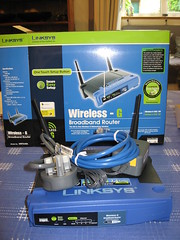
slug. It’s great because it allows me to easily & reliably share my multimedia collection.
So I’ve moved my multimedia collection to a massive hard drive attached to the slug and now that hard drive is full. I could buy an even bigger
NAS, though wait a minute…
I have GIGs of (wasted) free space across my (flat mate’s) machines.
Wtf happened to
P2P? I need something like what Google has.
- A distributed file system.
- With search.
- It doesn’t have to work across on the Internet, though listening to some remote friend’s music would be nice.
- Any level of data redundancy would be awesome. (I despise RAID)
- I want direct access from the FS. No odd interfaces. (something with fuse?)
I distantly recall mounting
NFS shares of each of my (friend’s) machines and then mounting them on the central slug and trying to re-share them. I don’t think that works.
I remember in University dorms (I’m not telling where!), students had a massive multimedia share with Windows file sharing. It actually worked quite well, including search.
Any tips lazyweb? Or are centralised services really the future?
How to get rid of most spam on
Alioth mailing lists.
Until some
Debian developer implements
this idea in the
BTS, the mailing list and in
PTS, the quantities of spam that people get on the mail addresses they expose in the Debian world, the spam will keep on coming in huge quantities. I don't care that there will always be spam, I care that the
amount of spam would be lower or probably
nonexistent for one time sending (I sent just one mail to the
BTS from two
different mail addresses and it was enough to get huge amounts of spam on them).
The Debian Games Team's ML has suffered for a while, back in 2006, from spam bombing.
We thought that the easiest method to get rid of spam is to requires registration in order to be able to send mails to the list.
That was a big mistake because, as some people suspect, mails from the
BTS needed to be allowed in and the reporters got an automated reply saying that the mail is waiting for
approval, etc, etc - plain rude, people send you bug reports and you say "You are not listed,
bla,
bla bla". We changed the setting not to send any automatic reply and people were more content.
But still, we had to hand approve or white list valid mails/addresses. That worked for a while, but once the mail ended up on
spammer lists, the thing blew out of proportions. We were desperate. We tweaked the settings of the lists in
different ways, but in the end we ended up in having such a broken setup that we had to approve white listed addresses.
That did for me. I had to do something. So I started working on the ML setup and basically I did
the following things to get rid of spam:
- anything coming from white listed mail addresses was approved
- black listed mails (bellsouth is one of those) is rejected (or should be)
- anything that came from the BTS (there are some nice headers that the BTS puts) and was evaluated as ham with a score of 0 (there is a field for that, too - some field has Spam=No, Score=...) was allowed
- anything that came from the BTS that was Spam=No with a score above 0 was held for moderation
- anything else is held for moderation
This solution allowed us to lighten the burden of manually white listing every email address that ever sent valid mails to the
BTS and to focus only on real spam.
Try it your self on your lists, you'll be
pleasantly surprised.
Now that CUPS 1.3 has built in
zeroconf support, it is easier than ever to provide print service to Windows machines. You don’t even need
Samba anymore.
Here’s a quick way to setup a CUPS print server and a Windows client:
On the server side
First you need to install CUPS 1.3 or higher on your print server and setup the printer (the web interface makes this task dead easy).
Zeroconf isn’t enabled by default so you have to browse the CUPS admin page (http://localhost:631/admin if you’re running it on localhost) and enable the “Share published printers connected to this system” option. “Change Settings” will restart CUPS and your printer should be instantly visible to zeroconf-aware applications in the local network.
If you can’t or don’t want to use the web interface (which is the easiest way though), you can edit
/etc/cups/cupsd.conf and replace the line
Listen localhost:631
with
Port 631
and add the line
BrowseAddress @LOCAL
Now save the changes and restart CUPS and you’re done.
On the client side
Since most Linux distributions and MacOS support zeroconf out of the box, I’ll just explain how to setup the Windows client.
On the Windows side you’ll need to install
Bonjour for Windows which is freely available on
apple.com.
Bonjour for Windows will enable Multicast DNS (mDNS) and DNS based Service Discovery (DNS-SD) on your Windows machine. Once it is installed, you can start the printer helper application provided by bonjour which will guide you through the process of installing the network printer. The only problem here was that although it correctly identified my printer, it only let me chose between a generic postscript and a PCL driver. Both were not working correctly so I had to manually change the driver for this printer to HP LaserJet 4 Plus (which is my printer) after the setup via the printer properties, where all other printer drivers where available again.
That’s it! Now you should be able to print on every zeroconf aware operating system connected to your network. Oh, one final warning: With this setup,
everybody in the LAN will be able to print without prior authentication. This should be what you want in most cases when running a home LAN or a small business LAN anyways, but it’s certainly not so cool when strangers have access to your network.
The whole setup process took like 15 minutes today. I remember me a few years ago, not being very experienced with Samba and CUPS wasting a whole weekend to achieve the same result. Thanks apple for making life a bit easier again!
One situation that you will occasionally encounter when running a
Heartbeat cluster is a need to prevent a STONITH of a node. As documented in
my previous post about testing STONITH the ability to STONITH nodes is very important in an operating cluster. However when the sys-admin is performing maintenance on the system or programmers are working on a development or test system it can be rather annoying.
One example of where STONITH is undesired is when upgrading packages of software related to the cluster services. If during a package upgrade the data files and programs related to the
OCF script are not synchronised (EG you have two programs that interact and upgrading one requires upgrading the other) at the moment that the status operation is run then an error may occur which may trigger a STONITH. Another possibility is that if using small systems for testing or development (EG running a cluster under Xen with minimal RAM assigned to each node) then a package upgrade may cause the system to thrash which might then cause a timeout of the status scripts (a problem I encounter when upgrading my Xen test instances that have 64M of RAM).
If a STONITH occurs during the process of a package upgrade then you are likely to have consistency problems with the OS due to
RPM and DPKG not correctly calling fsync(), this can cause the OCF scripts to always fail to run the status command which can cause an infinite loop of the cluster nodes in question being STONITHed. Incidentally the best way to test for this (given the problems of a STONITH sometimes losing log data) is to boot the node in question without Heartbeat running and then run the OCF status commands manually (
I previously documented three ways of doing this).
Of course the ideal (and recommended) way of solving this problem is to migrate all services from a node using the crm_resource program. But in a test or development situation you may forget to migrate all services or simply forget to run the migration before the package upgrade starts. In that case the best thing to do is to be able to remove the ability to call STONITH . For my testing I use Xen and have the nodes
ssh to the Dom0 to call STONITH, so all I have to do to remove the STONITH ability is to stop the ssh daemon on the Dom0. For a more serious test network (EG using IPMI or an equivalent technology to perform a hardware STONITH as well as ssh for OS level STONITH on a private network) a viable option might be to shut down the switch port used for such operations - shutting down switch ports is not a nice thing to do, but to allow you to continue work on a development environment without hassle it’s a reasonable hack.
When choosing your method of STONITH it’s probably worth considering what the possibilities are for temporarily disabling it - preferably without having to walk to the server room.
Share This
The availability of IPv6 worldwide is surprisingly extensive, nowadays, but over the past years as it has slowly filtered around, people have had bad experiences with it because of poor routing. It seems that, as always, a bad rep travels about 20 times further than a good one, so an automatic response to casual problems that people see when using IPv6 is to blacklist it, without actually investigating the problem.
Take today, for an example. Someone said to me "I disabled IPv6 in Firefox because it was slow for one of my favourite sites". OK, so show me this favourite site. Show me the traceroute. Give me some
facts!
Further investigation showed that although there is an AAAA record for
www.crooksandliars.com, there is nothing listening on the other end! Looking at the AAAA record returned, we see that it is an autoconfigured IPv6 address of the form xxxx:xxxx:xxxx:xxxx:xxxx:xxFF:FExx:xxxx and can conjecture that the likely problem is that someone has done a hardware upgrade on their server, so they now have a different MAC, and consequently the autoconfigured IPv6 address has changed. Other scenarios are entirely possible, of course, but this is a likely one.
This is the second case I have seen where someone was running publicly available services on IPv6 using a
manual DNS record pointing at an
automatic IPv6 address, but I doubt that it will be the last. Unless there is infrastructure in place to automatically update your DNS when your address is autoconfigured, you are going to get bitten by this problem at some point if people remotely connect to your system for some service.
In the IP protocol stack the lowest level protocol is
ARP (the Address Resolution Protocol). ARP is used to request the
Ethernet hardware (MAC) address of the host which owns a particular IP address.
# arping 192.168.0.43
ARPING 192.168.0.43
60 bytes from 00:60:b0:3c:62:6b (192.168.0.43): index=0 time=339.031 usec
60 bytes from 00:60:b0:3c:62:6b (192.168.0.43): index=1 time=12.967 msec
60 bytes from 00:60:b0:3c:62:6b (192.168.0.43): index=2 time=168.800 usec
— 192.168.0.43 statistics —
3 packets transmitted, 3 packets received, 0% unanswered
One creative use of this is the program arping which will send regular ARP request packets for an IP address and give statistics on the success of getting responses. The above is the result of an arping command which shows that the machine in question can respond in 12.9msec or less. One of the features of arping (when compared to the regular ping which uses an ICMP echo) is that it will operate when the interface has no IP address assigned or when the IP address does not match the netmask for the network in question.
This means that if you have a network which lacks DHCP and you want to find a spare IP address in the range that is used then you can use arping without assigning yourself an IP address first. If you wanted to use ping in that situation then you would have to first assign an IP address in which case you may have already broken the network!
Another useful utility is arpwatch. This program listens to ARP traffic and will notify the sys-admin when new machines appear. The notification message will include the Ethernet hardware address and the name of the manufacturer of the device (if it’s known). When you use arpwatch you can say “who added the device with the Intel Ethernet card to the network at lunch time?” instead of “who did something recently to the network that made it break?”. The more specific question is more likely to get an accurate answer.
Share This
When debugging window managers or testing your X applications in
other window managers, running them in an dedicated fake X server can be
quite nice. While every reasonable complete window manager (even the old twm
and vtwm can, and of course all of fvwm, qvwm, wmaker, ratpoison, ...)
can replace itself with any other, running a window manager in a window of
its own makes many things easier: single-stepping a window manager within
a debugger when that debugger runs in an Xterm on the same server is no
fun. And if some testing needs a more complicated setting, switching may
destroy that. And it is just more comfortable to have the editor handled
by your favorite WM, while you need another WM to test some aspects of
an program. (It&aposs hard to see if inital sizes and layouts work well, when
your WM does allow windows to choose their size. And if your WM does not
have a bug another has, it&aposs easier to test a work around in the other
than trying to port the bug ;-> )
So, here is some example invocation I use:
     #!/bin/sh
     Xephyr :2 -reset -terminate -screen 580x724 -nolisten tcp -xkbmap ../../../../../home/brl/.mystuff/dekeymap -auth ~/.Xauthority &
     export DISPLAY=:2
     icewm
Which Options are useful depends on what to use it for:
-reset -terminate means to terminate when the last child exited.
This is usefull if you want it go away fast. Not usefull if you
want to switch window managers without other clients running.
-screen 580x724 tells how big the window should be. This is just the
size of one of my working frames, so it integrates well into my workspace.
(It would be nice if Xephyr could change its resolution uppon resize
of the window, though i fear programs will either be confused when the
size of their X server changes unadvertised or because of too many
advertisements of its changing).
-nolisten tcp as there i no need to let the world speak to your X server
-xkbmap ../../../../../home/brl/.mystuff/dekeymap
I gave up figuring out how to select a German keyboard, so it justs gets
8 lines of fake description only specifing German keyboard.
-auth ~/.Xauthority tells Xephyr to require authentication. Without this
everyone is allowed to control your sub X-server and all programs within
it. Don&apost forget to create an token before with xauth add, though.
I'm running Network Manager on my Ubuntu laptop. It's a really neat tool when it comes to selecting an open wireless network when traveling, but it has one major flaw: you cannot tell it to prefer some "homebase" among a swarm of available Access Points; it insists upon using the first AP it finds, regardless. Has anyone figured out a solution to this common situation?
Meanwhile, the OpenVPN front-end that Network Manager offers only covers a fraction of available parameters, which means that I cannot use it to connect to my dayjob's LAN from outside the company, because the few Windows clients we have connecting to it expect a VPN to work in a specific way and cannot adapt to non-Microsoft approaches to VPN concept, which means that we Ubuntu users are the ones who have to adapt. Thus, the OpenVPN front-end would need to be able to configure MTU, MSS and other arbitrary parameters supported by OpenVPN. Looking at various BTS, I notice that I'm not the only one who needs this. Are Network Manager developers listening? :-)
My systems run cron-apt with an hourly rhythm, running off ftp2.de.d.o. Once in a while, some of them complain about
invalid signatures on release files:
CRON-APT LINE: /usr/bin/apt-get update -o quiet=2
W: GPG error: http://debian.debian.zugschlus.de lenny Release: The following signatures were invalid: BADSIG
A70DAF536070D3A1 Debian Archive Automatic Signing Key (4.0/etch)
W: GPG error: http://debian.debian.zugschlus.de sid Release: The following signatures were invalid: BADSIG
A70DAF536070D3A1 Debian Archive Automatic Signing Key (4.0/etch)
W: You may want to run apt-get update to correct these problems
This usually happens in the late evening CEST. In the next cron-apt run, things are fine again. What’s going on
here? Is this part of a mirror update process where the Release and Release.gpg files are inconsistent?
Any idea how to get rid of these error messages?