Search Results: "reg"

9 November 2015

Lunar: Reproducible builds: week 28 in Stretch cycle

What happened in the reproducible builds effort this week: Toolchain fixes Chris Lamb filled a bug on python-setuptools with a patch to make the generated requires.txt files reproducible. The patch has been forwarded upstream. Chris also understood why the she-bang in some Python scripts kept being undeterministic: setuptools as called by dh-python could skip re-installing the scripts if the build had been too fast (under one second). #804339 offers a patch fixing the issue by passing --force to setup.py install. #804141 reported on gettext asks for support of SOURCE_DATE_EPOCH in gettextize. Santiago Vila pointed out that it doesn't felt appropriate as gettextize is supposed to be an interactive tool. The problem reported seems to be in avahi build system instead. Packages fixed The following packages became reproducible due to changes in their build dependencies: celestia, dsdo, fonts-taml-tscu, fte, hkgerman, ifrench-gut, ispell-czech, maven-assembly-plugin, maven-project-info-reports-plugin, python-avro, ruby-compass, signond, thepeg, wagon2, xjdic. The following packages became reproducible after getting fixed: Some uploads fixed some reproducibility issues but not all of them: Patches submitted which have not made their way to the archive yet: Chris Lamb closed a wrongly reopened bug against haskell-devscripts that was actually a problem in haddock. reproducible.debian.net FreeBSD tests are now run for three branches: master, stable/10, release/10.2.0. (h01ger) diffoscope development Support has been added for Free Pascal unit files (.ppc). (Paul Gevers) The homepage is now available using HTTPS, thanks to Let's Encrypt!. Work has been done to be able to publish diffoscope on the Python Package Index (also known as PyPI): the tlsh module is now optional, compatibility with python-magic has been added, and the fallback code to handle RPM has been fixed. Documentation update Reiner Herrmann, Paul Gevers, Niko Tyni, opi, and Dhole offered various fixes and wording improvements to the reproducible-builds.org. A mailing-list is now available to receive change notifications. NixOS, Guix, and Baserock are featured as projects working on reproducible builds. Package reviews 70 reviews have been removed, 74 added and 17 updated this week. Chris Lamb opened 22 new fail to build from source bugs. New issues this week: randomness_in_ocaml_provides, randomness_in_qdoc_page_id, randomness_in_python_setuptools_requires_txt, gettext_creates_ChangeLog_files_and_entries_with_current_date. Misc. h01ger and Chris Lamb presented Beyond reproducible builds at the MiniDebConf in Cambridge on November 8th. They gave an overview of where we stand and the changes in user tools, infrastructure, and development practices that we might want to see happening. Feedback on these thoughts are welcome. Slides are already available, and the video should be online soon. At the same event, a meeting happened with some members of the release team to discuss the best strategy regarding releases and reproducibility. Minutes have been posted on the Debian reproducible-builds mailing-list.

Ben Hutchings: Debian LTS work, October 2015

For my 11th month working on Debian LTS, I carried over 5.5 hours from September and was assigned another 13.5 hours of work by Freexian's Debian LTS initiative. I worked 14 of a possible 19 hours. As I mentioned in the report for September, I uploaded binutils and issued DLA-324-1 early in October. I fixed a few security issues in the kernel, uploaded and issued DLA-325-1. I had some email discussions about long-term support of the Linux kernel with Willy Tarreau (Linux 2.6.32 maintainer) and Greg Kroah-Hartman (overall stable maintainer). Greg normally selects one version per year to maintain as a 'longterm' branch for 2 years, after which he may hand it over to another maintainer. A few upstream versions have received long-term support entirely from another developer. We were in agreement that it's desirable to have fewer of these branches with more developers and distributions contributing to each, but didn't come to a conclusion about how to coordinate this. The topic came up again at the Kernel Summit, and Greg then agreed to select the first kernel version of each calendar year, starting with Linux 4.4 (expected in January). This doesn't fit well with Debian's current release schedule, but I mean to discuss with the release team whether the freeze date can be set to allow inclusion of 2017's LTS kernel. I spent another week in the 'front desk' role, where I triaged new security issues for squeeze. There was a mixture of serious and trivial, old and new (not affecting squeeze) issues. The many ntp issues announced in October were fixed in unstable by a new upstream release. I spent a long time digging out the specific commits that fixed them and comparing with the older version in squeeze. Several of the issues had been introduced in ntp 4.2.7 or 4.2.8 and therefore didn't affect squeeze (or the newer stable releases). Of the fixes that were needed, most applied with minimal changes. Having prepared an update, I asked the ntp maintainer, Kurt Roeckx, to review my work. (The package has a limited test suite and none of the fixes added new tests.) Following this review he added a few more patches, uploaded and issued DLA-335-1. MySQL 5.1, as shipped in squeeze, no longer receives security support from upstream, and the security fixes they do issue are mixed with other changes that make it impractical to backport them. The LTS team is planning to backport the mysql-5.5 package to squeeze while avoiding conflicts with the binaries built from mysql-5.1. Santiago Ruano Rinc n has prepared a backport and I spent some time reviewing this, but haven't yet sent my review comments.

8 November 2015

Daniel Pocock: Problems observed during Cambridge mini-DebConf RTC demo

A few problems were observed during the demo of RTC services at the Cambridge mini-DebConf yesterday. As it turns out, many of them are already documented and solutions are available for some of them. Multiple concurrent SIP registrations I had made some test calls on Friday using rtc.debian.org and I still had the site open in another tab in another browser window. When people tried to call me during the demo, both tabs were actually ringing but only one was visible. When a SIP client registers, the SIP registration server sends it a list of all other concurrent registrations in the response message. We simply need to extend JSCommunicator to inspect the response message and give some visual feedback about other concurrent registrations. Issue #69. SIP also provides a mechanism to clear concurrent registrations and that could be made available with a button or configuration option too (Issue #9). Callee hears ringing before connectivity checks completed The second issue during the WebRTC demo was that the callee (myself) was alerted about the call before the ICE checks had been performed. The optimal procedure to provide a slick user experience is to run the connectivity checks before alerting the callee. If the connectivity checks fail, the callee should never be alerted with a ringing sound and would never know somebody had tried to call. The caller would be told that the call was unable to be attempted and encouraged to consider trying again on another wifi network. RFC 5245 recommends that connectivity checks should be done first but it is not mandatory. One reason this is problematic with WebRTC is the need to display the pop-up asking the user for permission to share their microphone and webcam: the popup must appear before connectivity checks can commence. This has been discussed in the JsSIP issue tracker. Non-WebRTC softphones, such as Lumicall, do the connectivity checks before alerting the callee. Dealing with UDP blocking It appears the corporate wifi network in the venue was blocking the UDP packets so the connectivity checks could never complete, not even using a TURN server to relay the packets. People trying to use the service on home wifi networks, in small offices and mobile tethering should not have this problem as these services generally permit UDP by default. Some corporate networks, student accommodation and wifi networks in some larger hotels have blocked UDP and in these cases, additional effort must be made to get through the firewall. The TURN server we are running for rtc.debian.org also supports a TLS transport but it simply isn't configured yet. At the time we originally launched the WebRTC service in 2013, the browsers didn't support TURN over TLS at all but now they do. This is probably the biggest problem encountered during the demo but it does not require any code change to resolve this, just configuration, so a solution is well within reach. During the demo, we worked around the issue by turning off the wifi on my laptop and using tethering with a 4G mobile network. All the calls made successfully during the demo used the tethering solution. Add a connectivity check timeout The ICE connectivity checks appeared to keep running for a long time. Usually, if UDP is not blocked, the ICE checks would complete in less than two seconds. Therefore, the JavaScript needs to set a timeout between two and five seconds when it starts the checks and give the user a helpful warning about their network problems if the timeout is exceeded. Issue #73 in JSCommunicator. While these lengthy connectivity checks appear disappointing, it is worth remembering that this is an improvement over the first generation of softphones: none of them made these checks at all, they would simply tell the user the call had been answered but audio and video would only be working in one direction or not at all. Microphone issues One of the users calling into the demo, Juliana, was visible on the screen but we couldn't hear her. This was a local audio hardware issue with her laptop or headset. It would be useful if the JavaScript could provide visual feedback when it detects a voice (issue #74) and even better, integrating with the sound settings so that the user can see if the microphone is muted or the gain is very low (issue #75). Thanks to participants in the demo I'd like to thank all the participants in the demo, including Juliana Louback who called us from New York, Laura Arjona who called us from Madrid, Daniel Silverstone who called from about three meters away in the front row and Iain Learmonth who helped co-ordinate the test calls over IRC. Thanks are also due to Steve McIntyre, the local Debian community, ARM and the other sponsors for making another mini-DebConf in the UK this year.

7 November 2015

Stig Sandbeck Mathisen: Let's Encrypt with Hitch and Varnish

Let's Encrypt is now in beta. Here's how to use the automated CA with Hitch TLS proxy, and Varnish HTTP accelerator as a backend for Hitch.
Let's Encrypt Let's Encrypt is a free, automated and open Certificate Authority (CA), run for the public's benefit.
Varnish Varnish is a HTTP accelerator. I use it as a web server, and it serves content from various backends. Varnish is used on a lot of high-traffic web servers, and supports simple and complex web site configurations.
Hitch Hitch is a TLS proxy, by Varnish Software. It terminates TLS connections, and forwards them to a backend, unencrypted. The TLS proxy is simple to configure, and handles many thousands of requests per second on commodity hardware. Hitch was originally called stud and was written by Jamie Turner at Bump.com.
Varnish plugin for Let's Encrypt Let's Encrypt Varnish Plugin is needed for the Let's Encrypt client to authenticate against their service, for getting the certificates. You can skip this if you have the option of temporarily disabling your web service, when registering and renewing your certificates.
Hitch TLS proxy Hitch must be configured to listen on the https port (TCP/443), with a list of strong ciphers. To get Forward Secrecy, we need ciphers with EECDH or EDH. To use these, we need to generate a set of DH Parameters. In /etc/hitch/hitch.conf:
      
# Listening
frontend = "[*]:443"
ciphers  = "EECDH+AESGCM:EDH+AESGCM:AES256+EECDH:AES256+EDH"
      
    
Varnish as backend for Hitch Hitch will forward traffic to Varnish on localhost:6082, using the PROXY protocol. Here's a snippet for /etc/hitch/hitch.conf to do this:
      
# Send traffic to the varnish backend
backend        = "[::1]:6086"
write-proxy-v2 = on
      
    
For varnish, I've added a separate port for the "PROXY" protocol, by adding an extra "-a" argument for port 6086. The -a :80 handles the existing http traffic, while the -a '[::1]:6086,PROXY' adds a listener on localhost, which will be used by hitch.
      
/usr/sbin/varnishd -j unix,user=vcache -a :80 -a '[::1]:6086,PROXY' ...
      
    
Let's Encrypt install letsencrypt First, install the letsencrypt client. The beta program sends you a mail with instructions. When it is generally available, I suspect it'll be something like:
      
apt install letsencrypt
      
    
install varnish plugin Then, get the let's encrypt varnish plugin. The plugin will extend the letsencrypt software to be able to rewrite the VCL and reload Varnish to satisfy the authentication challenge of the Let's Encrypt server.
      
cd /usr/local/src
git clone http://git.sesse.net/letsencrypt-varnish-plugin
. ~/.local/share/letsencrypt/bin/activate
pip install -e /usr/local/src/letsencrypt-varnish-plugin
      
    
get certificate Get certificates. Let's Encrypt is still in beta, so I had to add a few more command line arguments than the documentation specifies:
      
~/.local/share/letsencrypt/bin/letsencrypt --agree-dev-preview \
    --server https://acme-v01.api.letsencrypt.org/directory \
    -a letsencrypt-varnish-plugin:varnish -d example.org certonly
      
    
Adding certificates to Hitch Hitch requires one PEM file per domain we serve. Each .pem file contains the private key, the signed certificate and any required intermediates. Create a file with DH parameters:
      
openssl dhparam -out /etc/hitch/dhparam.pem 2048
      
    
This file may take a long while to generate. Combine the key, the signed certificate, and the dhparam file to something hitch can use:
      
cat \
    /etc/letsencrypt/live/example.org/privkey.pem \
    /etc/letsencrypt/live/example.org/fullchain.pem \
    /etc/hitch/dhparam.pem \
    > /etc/hitch/example.org.pem
chmod 0600 /etc/hitch/example.org.pem
      
    
and configure hitch to use the file, by adding it to /etc/hitch/hitch.conf:
      
# List of PEM files, each with key, certificates and dhparams
pem-file = "/etc/hitch/example.org.pem"
pem-file = "/etc/hitch/www.example.org.pem"
pem-file = "/etc/hitch/example.com.pem"
pem-file = "/etc/hitch/www.example.com.pem"


6 November 2015

Ian Campbell: Cambridge mini-Debconf

I am currently attending the mini-Debconf being held in space generously provided by ARM's offices in Cambridge, UK. Thanks to ARM and the other sponsors for making this possible. Yesterday I made a pass through the bug list for the Xen packages. According to the replies I have received from the BTS I looked at and acted on: Phew! Today I expect more of the same, starting with seeing where the new information in #799122 takes me.

5 November 2015

Gunnar Wolf: WTF @omarfayad Should *all* computer activity be illegal now? #LeyFayad

Last week, Senator Omar Fayad presented one of the prime examples of a poorly redacted law that, if enacted, will make basically any way of computer use illegal. And yes, even if he states this is merely a draft, it has so many factual and conceptual errors that there is no way to trust sanity can be regained at any point. Oh, and before I continue with this rant: If the topic interests you, I suggest you to read the 10 key points about Ley Fayad, the worst Internet initiative in history, published by r3d.mx. [update] An English equivalent of the work at r3d, at revolution-news.com: #LeyFayad: The Worst Bill in Internet History The full text (in Spanish, of course) for the law initiative is available at the Senate webpage; the law will be called Ley Federal para Prevenir y Sancionar los Delitos Inform ticos (Federal law to prevent and punish informatic felonies<) A bad name to start with, as there are many laws already in that contested area. I started reading with the preamble (Exposici n de motivos), which already shows bad signs of imprecise redaction and is plagued with factual errors (i.e. asserting that the real danger stems from the Web migrating to the Web 2.0, from which stems that this migration and not any previous one. Or by stating that (quoting+translating a full paragraph):
Activities such as electronic commerce, digital periodism, publicity and the opinions, messages or elements written in social networks can lead to patrimonial, reputation, honor or professional activity losses for people.
He continues by stating that only 16% of the countries have some kind of cybersecurity strategy (and, of course, Mexico doesn't). That... Well, is very hard to believe, as Mexico has two separate policial groups devoted to cybersecurity, and laws regulating from electronic signatures, commerce, identity, privacy, use and abuse, and a long list. Of course, as most law proposals go, it quickly decays into a dry, boring document... And I must admit I didn't fully read it, but picked here and there. I won't copy in full the note I mentioned at the beginning at r3d.mx, but will continue with some strange points, such as:
Article 16
Every person that, without the corresponding authorization or exceeding the authorization confered, accesses, intercepts, interfers or uses an information system, will be punished by one to eight years of prision and fined by 800 to 1000 days of minimum wage
So, yes, borrowing your computer without getting explicit permission, or playing around with the options in kiosks, or tons of whatever we curious people do with systems we encounter are basis for jail. (And yes, fines in this country are expressed in "days of minimum wage", which goes at ~MX$70 per day, which is ~US$4). But it gets funkier quickly:
Article 17
Whoever fraudulently destroys, disables, damages or in any way alters the working of an informatic system or any of its components, will be punished by fice to fifteen years of jail and fined by up to a thousand minimum wage days The same punishment will be given to whoever, without authorization, destroys, damages, modifies, divulges, transfers or disables information contained in any Informatic System or any of its components. The punishment will be ten to twenty years in prision and a fine of up to a thousand days of minimum wage if the effects here mentioned are done by the creation, introduction or fraudulent transmission, by any means, of an informatic weapon or malicious code
This law is meant to protect against cyberfelonies, if such a thing exists. However, here we are putting at risk people even for accidental equipment destructions. I dropped your portable hard disk with my elbow off the table? Accuse me of acting fraudulently, and I'm up for a serious jail time. And yes, laws are meant to be interpreted... And I don't want to be at the receiving end of this one! In this last article, Fayad mentions informatic weapons, which are defined in the preamble as any informatic program, informatic system, or in general, any device or material created or designed with the purpose of committing an informatic crime. So the very next article makes me, as it should make all of my fellow students and researchers, very uneasy:
Article 18
Whoever uses informatic weapons or malicious code will be imprisioned by two to six years, and fined with 200 to 500 days of minimum wage.
Article 19
Whoever builds, distributes, commerces with informatic weapons or malicious codes will be punished by three to seven years of prision and 200 to 500 days of minimum wage.
If we need to analyze malware for our classes (or for paid work, or as a hobby), we clearly fall in article 18. If we write something that can be classified as malware (without even releasing it, as an academic excercise only!), we are covered by article 19. If I give my students code that's known to be malicious (which could be as inofensive as linking to a well-known Web comic), I'm also covered by article 19. I'll jump all the way to article 31 (reproduced only partially):
Article 31
Whoever, by any means, creates, captures, records, copies, alters, duplicates, clones or deletes the information contained in a credit or debit card (...) will be punished by 8 to 14 years of prision and 300 to 500 days of minimum wage. (...)
This clearly disincentivates any way of e-commerce. When I try to buy anything online, I have to capture+copy my (rightfully owned) credit card data. The services provider has to copy, process and then delete said information. Any e-transaction is punished by jail! Well... But thinking about this again, maybe I shouldn't be so worried about the malware distribution issue at my classes. There are clearer and more contundent articles. Say...
Article 35
Whoever convenes, organizes, is part of, or executes a cibernetic attack, will be punished by 20 to 30 years of prision and fined with 100 to 1000 days of minimum wage
Of course we have convened, organized, been part of and executed cibernetic attacks at the computer security lab at ESIME. Why would there be such a lab otherwise? Then, there are clear indications that the Senator didn't understand the topic his team was working on:
Article 37
Who manipulates the digital seals used by command of the public authority will be punished with 240 days of community work
Now... What is a digital seal? It's not a phisical one that does not allow opening the doors to a business found at fault, but something that just proves a document is legitimate and pristine. How can I manipulate them? Of course, if the seals are MD5-based, I can easily forge them (and SHA1-based, it seems they will be broken enough soon to be considered no longer trustable)... But that's about it! And there is more, lots more. I'm swamped with work, and have to get back to it. But chapters the following chapters have a lot of potential for finding holes. PS - And yes, the only use I do of Twitter is via the headlines in my blog ;-) [update] Ley Fayad is dead, yay! \o/ The senator withdrew the proposal.

Sven Hoexter: dh, dpkg-buildflags, LDFLAGS and the ugly way to stop overlinking

I just got asked by someone I help out with sponsoring uploads from time to time how to get rid of overlinking. Since wheezy or maybe even earlier dpkg-shlipdeps will complain with a warning like this:
dpkg-shlibdeps: warning: package could avoid a useless dependency if debian/
foobar/usr/bin/foobar was not linked against libatk-1.0.so.0 (it uses none of the
library's symbols)
That usually requires some build system fixes, or pkg-config fixes or something else. This one should provide a starting point if you'd like to read a bit more. But in case you're lucky, and you use debhelper, and the buildsystem is sane enough to read the LDCONFIG environment variable
export DEB_LDFLAGS_MAINT_PREPEND := -Wl,-z,defs -Wl,--as-needed
in your debian/rules can be enough. I admit that's still a bit of a hack that requires some luck to work out and can break in strange and nasty ways. But if it work's I'm fine with it. man 1 dpkg-buildflags hold the details to the mechanics in use here regarding the environment variables.

4 November 2015

Arturo Borrero Gonz lez: Rant: Software Engineering in the University of Seville


I'm an IT engineering student at the University of Seville, where there are 3 flavours to choose:
* Computers engineering: mostly focused on hardware
* Software engineering: focused on software
* IT engineering: a mixture of things, including subjects dedicated to security and virtualization

Each of these last a total amount of 4 years (better said: courses).

Software Engineering is mostly the traditional IT engineering and it's what I'm doing.

The first course is almost common to all engineering: algebra, calculus, phyisics, electronics and so on.
You may find these subjects in all IT engineering flavours and also in other traditional engineering
like telecommunications, mechanical, industrial or aeronautics.

In the second year, the subjects tend to be specific for IT engineering: networking, databases, algorithms and so on.
The third and fourth courses are almost fully specific for each flavour of IT engineering.

The problem I've found is in the third year of Software engineering.
We have here subjects like the following:
* requirements engineering
* design and testing
* software process management

All of these are focused in what they consider our biggest possibility in our professional career: the regional government.

It turns out this is not Silicon Valley, and the regional government (Junta de Andaluc a) is in fact the biggest IT player in our region.
They run thousands of servers, networks and digital services both for the public and for internal administrative usage.
The government is known for massively running concrete technologies: Oracle and java. Almost all of the biggest applications are running these technologies.

The problem here is that our subjects are fully headed towards these technologies, also using methodologies
that I consider outdated. They think you are going to work in a classical software factory on the classical software consulting business.
And they do this explicitly: the first day in the 'design & testing' subject we were told by the professor that we are likely going to work in the 'local industry', so we need to learn these technologies and no others.

An example: last week I was given by a professor a VirtualBox (sic) virtual machine running Windows XP (yeah...) just to run Eclipse (for java development) in a controlled environment. They expect the host OS to be Windows as well.
Other example: to this day, no subject which requires the usage of a VCS is using git. They stick to svn.

This is very sad!

The other day, it felt event worse because a RedHat internship was announce in a college mailing list, which explicitly excluded students from Software Engineering.... because all the reasons above. How is this possible? RedHat is a software company!

Let's be constructive. These are some things I would like to see in Software Engineering:
* other software workflows (for example, the linux kernel development model or debian package lifecycle)
* modern free libre open source technologies! python! golang!
* packaging (for example: debian, rpm, docker...)
* new database systems (nosql) or at least no more Oracle (please switch to PostgreSQL or whatever)
* no more java! enough of java!

BTW some time ago I read somewhere that no student should graduate without contributing to a major open source project. I can't agree more.

Rapha&#235;l Hertzog: My Free Software Activities in October 2015

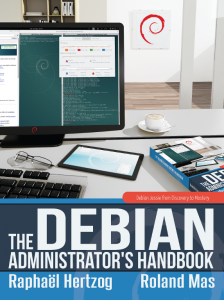
My monthly report covers a large part of what I have been doing in the free software world. I write it for my donators (thanks to them!) but also for the wider Debian community because it can give ideas to newcomers and it s one of the best ways to find volunteers to work with me on projects that matter to me. Debian LTS This month I have been paid to work 13.25 hours on Debian LTS. During this time I worked on the following things: I also started a conversation about what paid contributors could work on if they have some spare cycle as the current funding level might allow us to invest some time on work outside of just plain security updates. The Debian Administrator s Handbook I spent quite some time finalizing the Jessie book update, both for the content and for the layout of the printed book. Debian Handbook: cover of the jessie edition Misc Debian work GNOME 3.18. I uploaded a new gnome-shell-timer working with GNOME Shell 3.18 and I filed bugs #800660 and #802480 about an annoying gnome-keyring regression I did multiple test rounds with the Debian maintainers (Dmitry Shachnev, kudos to him!) and the upstream developers (see here and here). Apart from those regressions, I like GNOME 3.18! Python-modules team migration to Git. After the Git migration, and since the team policy now imposes usage of git-dpm on all members, I made some tries with it on the python-django package while pushing version 1.8.5 to experimental. And the least I can say is that I m not pleased with the result. I thus filed 3 bugs summarizing the problems I have with git-dpm: #801666 (no way to set the upstream branch names from within the repository), #801667 (no clean way to merge between packaging branches), #801668 (does not create upstream tag immediately on tarball import). That is on top of other randomly stupid bugs that were already reported like #801548 (does not work with perfectly valid pre-existing upstream tags). Django packaging. I filed bugs on all packages build-depending on python-django that fail to build with Django 1.8 and informed them that I would upload Django 1.8 to unstable in early November (it s done already). Then I fixed python-django-jsonfield myself since Distro Tracker relies on this package. Following this small mass-bug filing, I filed a wishlist bug on devscripts to improve the mass-bug helper script (see #801926). And since I used ratt to rebuild the packages, I filed a wishlist issue on this new tool as well. Tryton 3.6 upgrade. I upgraded my own Tryton installation to version 3.6 and filed bug #803066 because the SysV init script was not working properly. That also reminded me that the DD process of Matthias Behrle (the tryton package maintainer) was stalled due to a bug in the NM infrastructure so I pinged the NM team and we sorted out a way for me to advocate him and get his process going Distro Tracker. I continued my work to refactor the way we handle incoming mail processing (branch people/hertzog/mailprocessing). It s now mostly finished and I need to deploy it in a test environment before being able to roll it out on tracker.debian.org. Thanks See you next month for a new summary of my activities.

No comment Liked this article? Click here. My blog is Flattr-enabled.

Vincent Sanders: I am not a number I am a free man

Once more the NetSurf developers tried to escape from a mysterious village by writing web browser code.

Michael Drake, Daniel Silverstone, Dave Higton and Vincent Sanders at NetSurf Developer workshop
The sixth developer workshop was an opportunity for us to gather together in person to contribute to NetSurf.

We were hosted by Codethink in their Manchester offices which provided a comfortable and pleasant space to work in.

Four developers managed to attend in person from around the UK: Michael Drake, Daniel Silverstone, Dave Higton and Vincent Sanders.

The main focus of the weekends activities was to work on improving our JavaScript implementation. At the previous workshop we had laid the groundwork for a shift to the Duktape JavaScript engine and since then put several hundred hours of time into completing this transition.

During this weekend Daniel built upon this previous work and managed to get DOM events working. This was a major missing piece of implementation which will mean NetSurf will be capable of interpreting JavaScript based web content in a more complete fashion. This work revealed several issues with our DOM library which were also resolved.

We were also able to merge several improvements provided by the Duktape upstream maintainer Sami Vaarala which addressed performance problems with regular expressions which were causing reports of "hangs" on slow processors.

The responsiveness of Sami and the Ducktape project has been a pleasant surprise making our switch to the library look like an increasingly worthwhile effort.

Overall some good solid progress was made on JavaScript support. Around half of the DOM interfaces in the specifications have now been implemented leaving around fifteen hundred methods and properties remaining. There is an aim to have this under the thousand mark before the new year which should result in a generally useful implementation of the basic interfaces.

Once the DOM interfaces have been addressed our focus will move onto the dynamic layout engine necessary to allow rendering of the changing content.

The 3.4 release is proposed to occur sometime early in the new year and depends on getting the JavaScript work to a suitable stable state.

Dave joined us for the first time, he was principally concerned with dealing with bugs and the bug tracker. It was agreeable to have a new face at the meeting and some enthusiasm for the RISC OS port which has been lacking an active maintainer for some time.

The turnout for this workshop was the same as the previous one and the issues raised then are still true. We still have a very small active core team who can commit only limited time which is making progress very slow and are lacking significant maintenance for several frontends.

Overall we managed to pack 16 hours of work into the weekend and addressed several significant problems.

Johannes Schauer: Let's Encrypt with Pound on Debian

TLDR: mister-muffin.de (and all its subdomains), bootstrap.debian.net and binarycontrol.debian.net are now finally signed by "Let's Encrypt Authority X1" \o/ I just tried out the letsencrypt client Debian packages prepared by Harlan Lieberman-Berg which can be found here: My server setup uses Pound as a reverse proxy in front of a number of LXC based containers running the actual services. Furthermore, letsencrypt only supports Nginx and Apache for now, so I had to manually setup things anyways. Here is how. After installing the Debian packages I built from above git repositories, I ran the following commands:
$ mkdir -p letsencrypt/etc letsencrypt/lib letsencrypt/log
$ letsencrypt certonly --authenticator manual --agree-dev-preview \
    --server https://acme-v01.api.letsencrypt.org/directory --text \
    --config-dir letsencrypt/etc --logs-dir letsencrypt/log \
    --work-dir letsencrypt/lib --email josch@mister-muffin.de \
    --domains mister-muffin.de --domains blog.mister-muffin.de \
    --domains [...]
I created the letsencrypt directory structure to be able to run letsencrypt as a normal user. Otherwise, running this command would require access to /etc/letsencrypt and others. Having to set this up and pass all these parameters is a bit bothersome but there is an upstream issue about making this easier when using the "certonly" option which in princible should not require superuser privileges. The --server option is necessary for now because "Let's Encrypt" is still in beta and one needs to register for it. Without the --server option one will get an untrusted certificate from the "happy hacker fake CA". The letsencrypt program will then ask me for my agreement to the Terms of Service and then, for each domain I specified with the --domains option present me the token content and the location under each domain where it expects to find this content, respectively. This looks like this each time:
-------------------------------------------------------------------------------
NOTE: The IP of this machine will be publicly logged as having requested this
certificate. If you're running letsencrypt in manual mode on a machine that is
not your server, please ensure you're okay with that.
Are you OK with your IP being logged?
-------------------------------------------------------------------------------
(Y)es/(N)o: Y
Make sure your web server displays the following content at
http://mister-muffin.de/.well-known/acme-challenge/XXXX before continuing:
 "header":  "alg": "RS256", "jwk":  "e": "AQAB", "kty": "RSA", "n": "YYYY" , "payload": "ZZZZ", "signature": "QQQQ" 
Content-Type header MUST be set to application/jose+json.
If you don't have HTTP server configured, you can run the following
command on the target server (as root):
mkdir -p /tmp/letsencrypt/public_html/.well-known/acme-challenge
cd /tmp/letsencrypt/public_html
echo -n ' "header":  "alg": "RS256", "jwk":  "e": "AQAB", "kty": "RSA", "n": "YYYY" , "payload": "ZZZZ", "signature": "QQQQ" ' > .well-known/acme-challenge/XXXX
# run only once per server:
$(command -v python2   command -v python2.7   command -v python2.6) -c \
"import BaseHTTPServer, SimpleHTTPServer; \
SimpleHTTPServer.SimpleHTTPRequestHandler.extensions_map =  '': 'application/jose+json' ; \
s = BaseHTTPServer.HTTPServer(('', 80), SimpleHTTPServer.SimpleHTTPRequestHandler); \
s.serve_forever()" 
Press ENTER to continue
For brevity I replaced any large base64 encoded chunks of the messages with YYYY, ZZZZ and QQQQ. The token location is abbreviated with XXXX. After temporarily stopping Pound on my webserver I created the directory /tmp/letsencrypt/public_html/.well-known/acme-challenge and then opened two shells on my server, both at /tmp/letsencrypt/public_html. In one, I kept a tiny HTTP server running (like the suggested Python SimpleHTTPServer which will also work if one has Python installed). In the other I copy pasted the echo line that the letsencrypt program suggested me to run. I had to copypaste that echo command for each domain I wanted to verify. This could easily be automated, so I filed an issue about this with upstream. It seems that the letsencrypt servers query each of these tokens twice: once directly each time after having hit enter after seeing the message above and another time once all tokens are in place. At the end of this ordeal I get:
2015-11-04 11:12:18,409:WARNING:letsencrypt.client:Non-standard path(s), might not work with crontab installed by your operating system package manager
IMPORTANT NOTES:
 - If you lose your account credentials, you can recover through
   e-mails sent to josch@mister-muffin.de.
 - Congratulations! Your certificate and chain have been saved at
   letsencrypt/etc/live/mister-muffin.de/fullchain.pem. Your cert will
   expire on 2016-02-02. To obtain a new version of the certificate in
   the future, simply run Let's Encrypt again.
 - Your account credentials have been saved in your Let's Encrypt
   configuration directory at letsencrypt/etc. You should make a
   secure backup of this folder now. This configuration directory will
   also contain certificates and private keys obtained by Let's
   Encrypt so making regular backups of this folder is ideal.
I can now scp the content of letsencrypt/etc/live/mister-muffin.de/* to my server. Unfortunately, Pound (and also my ejabberd XMPP server) requires the private key to be in the same file as the certificate and the chain, so on the server I also had to do:
cat /etc/ssl/private/privkey.pem /etc/ssl/private/fullchain.pem > /etc/ssl/private/private_fullchain.pem
And edit the Pound config to use /etc/ssl/private/private_fullchain.pem. But that's all, folks! EDIT It seems that manually copying over the echo commands as I described above is not necessary. Instead of using the certonly plugin, I can use the webroot plugin. That plugin takes the --webroot-path option and will copy the tokens to there. Since my webroot is on a remote machine, I could just mount it locally via sshfs and pass the mountpoint as --webroot-path. That I didn't realize that the webroot plugin does what I want (and not the certonly plugin) can easily be explained by the only documentation of the webroot plugin in the help output and the man page generated from it being "Webroot Authenticator" which is not very helpful. Another user seems to have run into similar problems. Better documenting the plugins so that these situations can be prevented in the future is tracked in this upstream bug.

3 November 2015

Joey Hess: STM Region contents

concurrent-output released yesterday got a lot of fun features. It now does full curses-style minimization of the output, to redraw updated lines with optimal efficiency. And supports multiline regions/wrapping too long lines. And allows the user to embed ANSI colors in a region. 3 features that are in some tension and were fun to implement all together. But I have a more interesting feature to blog about... I've added the ability for the content of a Region to be determined by a (STM transaction). Here, for example, is a region that's a clock:
timeDisplay :: TVar UTCTime -> STM Text
timeDisplay tv = T.pack . show <$> readTVar tv
clockRegion :: IO ConsoleRegionHandle
clockRegion = do
    tv <- atomically . newTVar =<< getCurrentTime
    r <- openConsoleRegion Linear
    setConsoleRegion r (timeDisplay tv)
    async $ forever $ do
        threadDelay 1000000 -- 1 sec
        atomically . (writeTVar tv) =<< getCurrentTime
    return r
There's something magical about this. Whenever a new value is written into the TVar, concurrent-output automatically knows that this region needs to be updated. How does it know how to do that? Magic of STM. Basically, concurrent-output composes all the STM transactions of Regions, and asks STM to wait until there's something new to display. STM keeps track of whatever TVars might be looked at, and so can put the display thread to sleep until there's a change to display. Using STM I've gotten extensability for free, due to the nice ways that STM transactions compose. A few other obvious things to do with this: Compose 2 regions with padding so they display on the same line, left and right aligned. Trim a region's content to the display width. (Handily exported by concurrent-output in a TVar for this kind of thing.)
I'm tempted to write a console spreadsheet using this. Each visible cell of the spreadsheet would have its own region, that uses a STM transaction to display. Plain data Cells would just display their current value. Cells that contain a function would read the current values of other Cells, and use that to calculate what to display. Which means that a Cell containing a function would automatically update whenever any of the Cells that it depends on were updated! Do you think that a simple interactive spreadsheet built this way would be more than 100 lines of code?

Petter Reinholdtsen: Is Pentagon deciding the Norwegian negotiating position on Internet governance?

In Norway, all government offices are required by law to keep a list of every document or letter arriving and leaving their offices. Internal notes should also be documented. The document list (called a mail journal - "postjournal" in Norwegian) is public information and thanks to the Norwegian Freedom of Information Act (Offentleglova) the mail journal is available for everyone. Most offices even publish the mail journal on their web pages, as PDFs or tables in web pages. The state-level offices even have a shared web based search service (called Offentlig Elektronisk Postjournal - OEP) to make it possible to search the entries in the list. Not all journal entries show up on OEP, and the search service is hard to use, but OEP does make it easier to find at least some interesting journal entries . In 2012 I came across a document in the mail journal for the Norwegian Ministry of Transport and Communications on OEP that piqued my interest. The title of the document was "Internet Governance and how it affects national security" (Norwegian: "Internet Governance og p virkning p nasjonal sikkerhet"). The document date was 2012-05-22, and it was said to be sent from the "Permanent Mission of Norway to the United Nations". I asked for a copy, but my request was rejected with a reference to a legal clause said to authorize them to reject it (offentleglova 20, letter c) and an explanation that the document was exempt because of foreign policy interests as it contained information related to the Norwegian negotiating position, negotiating strategies or similar. I was told the information in the document related to the ongoing negotiation in the International Telecommunications Union (ITU). The explanation made sense to me in early January 2013, as a ITU conference in Dubay discussing Internet Governance (World Conference on International Telecommunications - WCIT-12) had just ended, reportedly in chaos when USA walked out of the negotiations and 25 countries including Norway refused to sign the new treaty. It seemed reasonable to believe talks were still going on a few weeks later. Norway was represented at the ITU meeting by two authorities, the Norwegian Communications Authority and the Ministry of Transport and Communications. This might be the reason the letter was sent to the ministry. As I was unable to find the document in the mail journal of any Norwegian UN mission, I asked the ministry who had sent the document to the ministry, and was told that it was the Deputy Permanent Representative with the Permanent Mission of Norway in Geneva. Three years later, I was still curious about the content of that document, and again asked for a copy, believing the negotiation was over now. This time I asked both the Ministry of Transport and Communications as the receiver and asked the Permanent Mission of Norway in Geneva as the sender for a copy, to see if they both agreed that it should be withheld from the public. The ministry upheld its rejection quoting the same law reference as before, while the permanent mission rejected it quoting a different clause (offentleglova 20 letter b), claiming that they were required to keep the content of the document from the public because it contained information given to Norway with the expressed or implied expectation that the information should not be made public. I asked the permanent mission for an explanation, and was told that the document contained an account from a meeting held in the Pentagon for a limited group of NATO nations where the organiser of the meeting did not intend the content of the meeting to be publicly known. They explained that giving me a copy might cause Norway to not get access to similar information in the future and thus hurt the future foreign interests of Norway. They also explained that the Permanent Mission of Norway in Geneva was not the author of the document, they only got a copy of it, and because of this had not listed it in their mail journal. Armed with this knowledge I asked the Ministry to reconsider and asked who was the author of the document, now realising that it was not same as the "sender" according to Ministry of Transport and Communications. The ministry upheld its rejection but told me the name of the author of the document. According to a government report the author was with the Permanent Mission of Norway in New York a bit more than a year later (2014-09-22), so I guessed that might be the office responsible for writing and sending the report initially and asked them for a copy but I was obviously wrong as I was told that the document was unknown to them and that the author did not work there when the document was written. Next, I asked the Permanent Mission of Norway in Geneva and the Foreign Ministry to reconsider and at least tell me who sent the document to Deputy Permanent Representative with the Permanent Mission of Norway in Geneva. The Foreign Ministry also upheld its rejection, but told me that the person sending the document to Permanent Mission of Norway in Geneva was the defence attach with the Norwegian Embassy in Washington. I do not know if this is the same person as the author of the document. If I understand the situation correctly, someone capable of inviting selected NATO nations to a meeting in Pentagon organised a meeting where someone representing the Norwegian defence attach in Washington attended, and the account from this meeting is interpreted by the Ministry of Transport and Communications to expose Norways negotiating position, negotiating strategies and similar regarding the ITU negotiations on Internet Governance. It is truly amazing what can be derived from mere meta-data. I wonder which NATO countries besides Norway attended this meeting? And what exactly was said and done at the meeting? Anyone know?

2 November 2015

Lunar: Reproducible builds: week 27 in Stretch cycle

What happened in the reproducible builds effort this week: Toolchain fixes Packages fixed The following packages became reproducible due to changes in their build dependencies: maven-plugin-tools, norwegian, ocaml-melt, python-biom-format, rivet. The following packages became reproducible after getting fixed: Some uploads fixed some reproducibility issues but not all of them: The following package is currently failing to build from source but should now be reproducible: Patches submitted which have not made their way to the archive yet: reproducible.debian.net A quick update on current statistics: testing is at 85% of packages tested reproducible with our modified packages, unstable on armhf caught up with amd64 with 80%. The schroot name used for running diffoscope when testing OpenWrt, NetBSD, Coreboot, and Arch Linux has been fixed. (h01ger, Mattia Rizzolo) Documentation update Paul Gevers documented timestamps in unit files created by the Free Pascal Compiler. reproducible-builds.org is now live. It contains a comprehensive documentation on all aspects that have been identified so far of what we call reproducible builds . It makes room for pointers to projects working on reproducible builds, news, dedicated tools, and community events. Package reviews 206 reviews have been removed, 171 added and 196 updated this week. Chris Lamb reported 28 failing to build from source issues. New issues identified this week: timestamps_in_pdf_content, different_encoding_in_html_by_docbook_xsl, timestamps_in_ppu_generated_by_fpc, method_may_never_be_called_in_documentation_generated_by_javadoc. Misc. Andrei Borzenkov has proposed a fix for uninitialized memory in GRUB's mkimage. Uninitialized memory is one source of hard to track down reproducibility errors. Holger Levsen presented the efforts on reproduible builds at Festival de Software Libre in Puerto Vallarta, Mexico.

Daniel Pocock: FOSDEM 2016 Real-Time Communications dev-room and lounge

FOSDEM is one of the world's premier meetings of free software developers, with over five thousand people attending each year. FOSDEM 2016 takes place 30-31 January 2016 in Brussels, Belgium. This call-for-participation contains information about:
  • Real-Time communications dev-room and lounge,
  • speaking opportunities,
  • volunteering in the dev-room and lounge,
  • related events around FOSDEM, including the XMPP summit,
  • social events (including the Saturday night dinner),
  • the Planet aggregation sites for RTC blogs
Call for participation - Real Time Communications (RTC) The Real-Time dev-room and Real-Time lounge is about all things involving real-time communication, including: XMPP, SIP, WebRTC, telephony, mobile VoIP, codecs, privacy and encryption. The dev-room is a successor to the previous XMPP and telephony dev-rooms. We are looking for speakers for the dev-room and volunteers and participants for the tables in the Real-Time lounge. The dev-room is only on Saturday, 30 January 2016 in room K.3.401. The lounge will be present for both days in building K. To discuss the dev-room and lounge, please join the FSFE-sponsored Free RTC mailing list. Speaking opportunities Note: if you used Pentabarf before, please use the same account/username Main track: the deadline for main track presentations was midnight on 30 October. Leading developers in the Real-Time Communications field are encouraged to consider submitting a presentation to the main track. Real-Time Communications dev-room: deadline 27 November. Please also use the Pentabarf system to submit a talk proposal for the dev-room. On the "General" tab, please look for the "Track" option and choose "Real-Time devroom". Other dev-rooms: some speakers may find their topic is in the scope of more than one dev-room. It is permitted to apply to more than one dev-room but please be kind enough to tell us if you do this. See the full list of dev-rooms. Lightning talks: deadline 27 November. The lightning talks are an excellent opportunity to introduce a wider audience to your project. Given that dev-rooms are becoming increasingly busy, all speakers are encouraged to consider applying for a lightning talk as well as a slot in the dev-room. Pentabarf system to submit a lightning talk proposal. On the "General" tab, please look for the "Track" option and choose "Lightning Talks". First-time speaking? FOSDEM dev-rooms are a welcoming environment for people who have never given a talk before. Please feel free to contact the dev-room administrators personally if you would like to ask any questions about it. Submission guidelines The Pentabarf system will ask for many of the essential details. Please remember to re-use your account from previous years if you have one. In the "Submission notes", please tell us about:
  • the purpose of your talk
  • any other talk applications (dev-rooms, lightning talks, main track)
  • availability constraints and special needs
You can use HTML in your bio, abstract and description. If you maintain a blog, please consider providing us with the URL of a feed with posts tagged for your RTC-related work. We will be looking for relevance to the conference and dev-room themes, presentations aimed at developers of free and open source software about RTC-related topics. Please feel free to suggest a duration between 20 minutes and 55 minutes but note that the final decision on talk durations will be made by the dev-room administrators. As the two previous dev-rooms have been combined into one, we may decide to give shorter slots than in previous years so that more speakers can participate. Please note FOSDEM aims to record and live-stream all talks. The CC-BY license is used. For any questions, please join the FSFE-sponsored Free RTC mailing list. Volunteers needed To make the dev-room and lounge run successfully, we are looking for volunteers:
  • FOSDEM provides video recording equipment and live streaming, volunteers are needed to assist in this
  • organizing one or more restaurant bookings (dependending upon number of participants) for the evening of Saturday, 30 January
  • participation in the Real-Time lounge
  • helping attract sponsorship funds for the dev-room to pay for the Saturday night dinner and any other expenses
  • circulating this Call for Participation to other mailing lists
FOSDEM is made possible by volunteers and if you have time to contribute, please feel free to get involved. Related events - XMPP and RTC summits The XMPP Standards Foundation (XSF) has traditionally held a summit in the days before FOSDEM. There is discussion about a similar summit taking place on 28 and 29 January 2016. Please see the XSF Summit 19 wiki and join the mailing list to discuss. We are also considering a more general RTC or telephony summit, potentially on 29 January. Please join the Free-RTC mailing list and send an email if you would be interested in participating, sponsoring or hosting such an event. Social events and dinners The traditional FOSDEM beer night occurs on Friday, 29 January On Saturday night, there are usually dinners associated with each of the dev-rooms. Most restaurants in Brussels are not so large so these dinners have space constraints. Please subscribe to the Free-RTC mailing list for further details about the Saturday night dinner options and how you can register for a seat. Spread the word and discuss If you know of any mailing lists where this CfP would be relevant, please forward this email. If this dev-room excites you, please blog or microblog about it, especially if you are submitting a talk. If you regularly blog about RTC topics, please send details about your blog to the planet site administrators:
http://planet.jabber.org ralphm@ik.nu
http://planet.sip5060.net daniel@pocock.pro
http://planet.opentelecoms.org daniel@pocock.pro
Please also link to the Planet sites from your own blog or web site. Contact For discussion and queries, please subscribe to the Free-RTC mailing list. The dev-room administration team:

1 November 2015

Thorsten Alteholz: My Debian Activities in October 2015

FTP assistant This month I marked 492 packages for accept and rejected 50 of them. I had to send only 11 emails to maintainers. Up to now I accepted about 6000 packages, my first one was pexpect_3.0-1 on 20131211.
date package
1 20131211 pexpect_3.0-1
1111 20140506 dochelp_0.1
2121 20140825 cl-parse-number_1.3-1
2222 20140903 node-websocket-driver_0.3.5-1
3333 20150303 libparse-keyword-perl_0.08-1
4242 20150625 python-monotonic_0.2-1
4444 20150708 libmusicbrainz5_5.1.0+git20150707-1
5555 20150928 golang-github-yosssi-ace_0.0.4+git20150515.41.78e48a2-3
So, when do you expect accepted package number 6666, 7777, 8888 and 9999? Squeeze LTS This was my sixteenth month that I did some work for the Squeeze LTS initiative, started by Raphael Hertzog at Freexian. This month I only got a workload of 13.25h. Altogether I uploaded those DLAs: While preparing the libxml2 upload, I mixed up things for the i386 build and so [DLA 334-2] had to follow shortly after [DLA 334-1].
I also prepared a new upload of PHP5 with nine CVEs fixed. I put the i386 and amd64 versions at people.d.o and invite everybody to test them and give positive or negative feedback. The real upload to the archive will happen next week. This month I also had another term of doing frontdesk work and looked for CVEs that are important for Squeeze LTS or could be ignored. Other stuff This month I only polished some packages and uploaded: I also manually closed #711329 and #352421. After adopting package chktex I inherited #352421, which was one of my oldest bugs. It was about emacs longlines-mode support and I could close it without actually fixing something. The longlines-mode vanished from emacs. So, sorry for that

31 October 2015

Dirk Eddelbuettel: RcppArmadillo 0.6.200.2.0

armadillo image Yet another monthly upstream Armadillo update gets us the first changes to the new the 6.* series. This was preceded by two uploads of test released to GitHub-only. These two were tested both against all reverse-dependencies as usual. A matching upload to Debian will follow shortly. Armadillo is a powerful and expressive C++ template library for linear algebra aiming towards a good balance between speed and ease of use with a syntax deliberately close to a Matlab. This release is fairly straightforward with few changes:
Changes in RcppArmadillo version 0.6.200.2.0 (2015-10-31)
  • Upgraded to Armadillo 6.200.0 ("Midnight Blue Deluxe")
    • expanded diagmat() to handle non-square matrices and arbitrary diagonals
    • expanded trace() to handle non-square matrices
Courtesy of CRANberries, there is also a diffstat report for the most recent CRAN release. As always, more detailed information is on the RcppArmadillo page. Questions, comments etc should go to the rcpp-devel mailing list off the R-Forge page.

This post by Dirk Eddelbuettel originated on his Thinking inside the box blog. Please report excessive re-aggregation in third-party for-profit settings.

Chris Lamb: Free software activities in October 2015

Here is my monthly update covering a large part of what I have been doing in the free software world (previously):
Debian My work in the Reproducible Builds project was also covered in more depth in Lunar's weekly reports (#23, #24, #25, #26).
LTS

This month I have been paid to work 11 hours on Debian Long Term Support (LTS). In that time I did the following:
  • DLA 326-1 for zendframework fixing an SQL injection vulnerability.
  • DLA 332-1 for optipng correcting a use-after-free issue.
  • DLA 333-1 for cakephp preventing a remote Denial of Service attack.
  • DLA 337-1 for busybox fixing a vulnerability when unzipping a specially crafted zip file/
  • DLA 338-1 for xscreensaver preventing a crash when hot-swapping monitors.

Uploads
  • redis New upstream release as well as changing the default UNIX socket location and correctly supporting "cluster" mode config file hardening and redis-sentinel's runtime directory handling under systemd. An update for jessie was also uploaded.
  • python-redis Attempting to get the autopkgtest tests to finally pass.
  • debian-timeline Making the build reproducible.
  • gunicorn New upstream release.


Andrew Cater

Ken Starks (Helios) of Reglue could use your help

I'm not normally one to respond to online appeals for money: there are often far too many of them. Ken Starks is a well known Linux personality who set up a charity to provide needy local people with Linux and recycled machines. He's also a good guy who works hard for this as something he believes in: this is no scam. The Helios Project (from before his own charity merged with another known as Reglue) is also still an SPI project as far as I know

Ken is currently holding a fund raising drive to replace his vehicle used for the Reglue project on Indiegogo. This is probably most of interest to US readers who may be able to treat this as charitable donation - the things he's offering in return for donations are most readily shipped within the US and Canada.

Any and all help would be greatly appreciated.


Joey Hess: a tiling region manager for the console

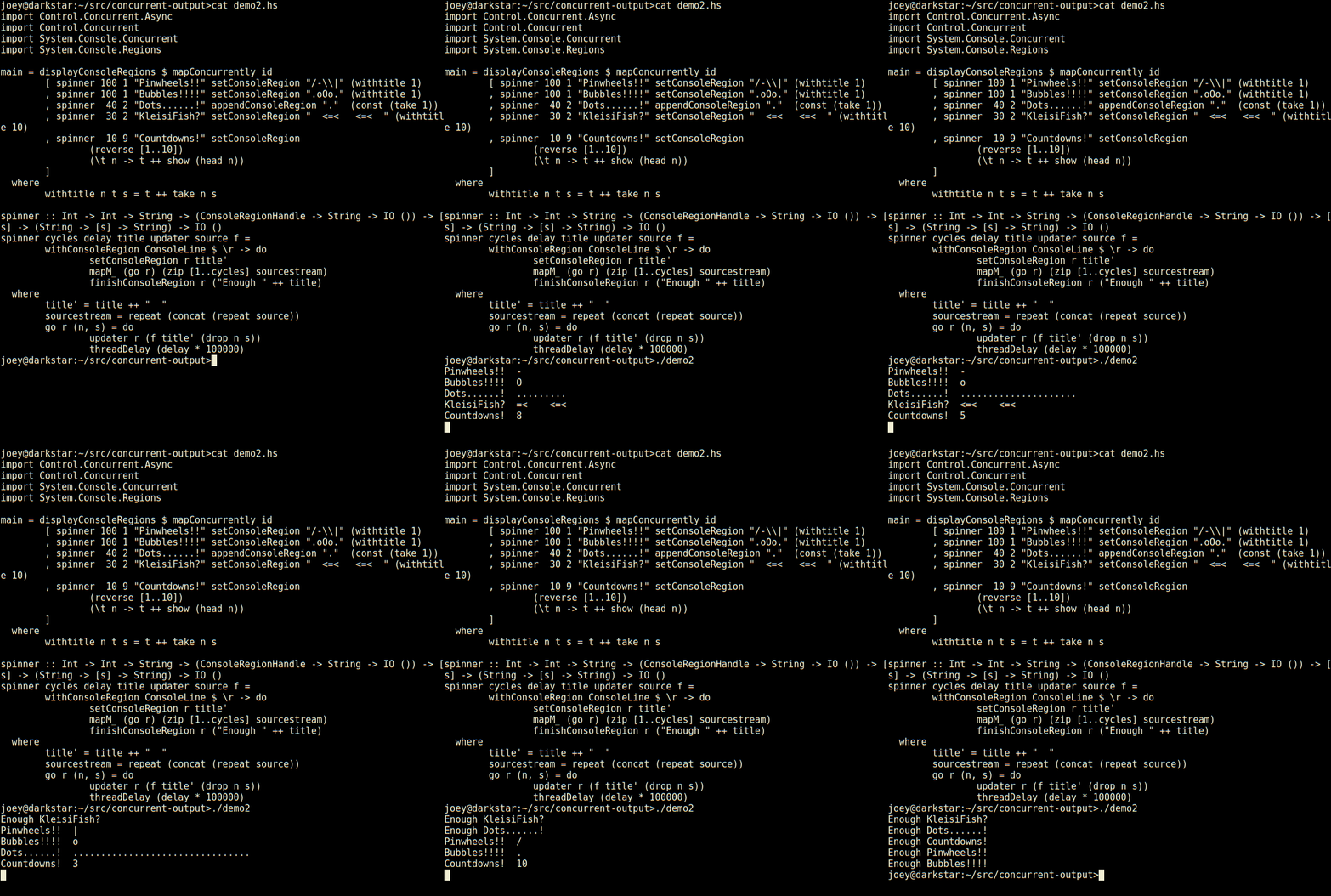
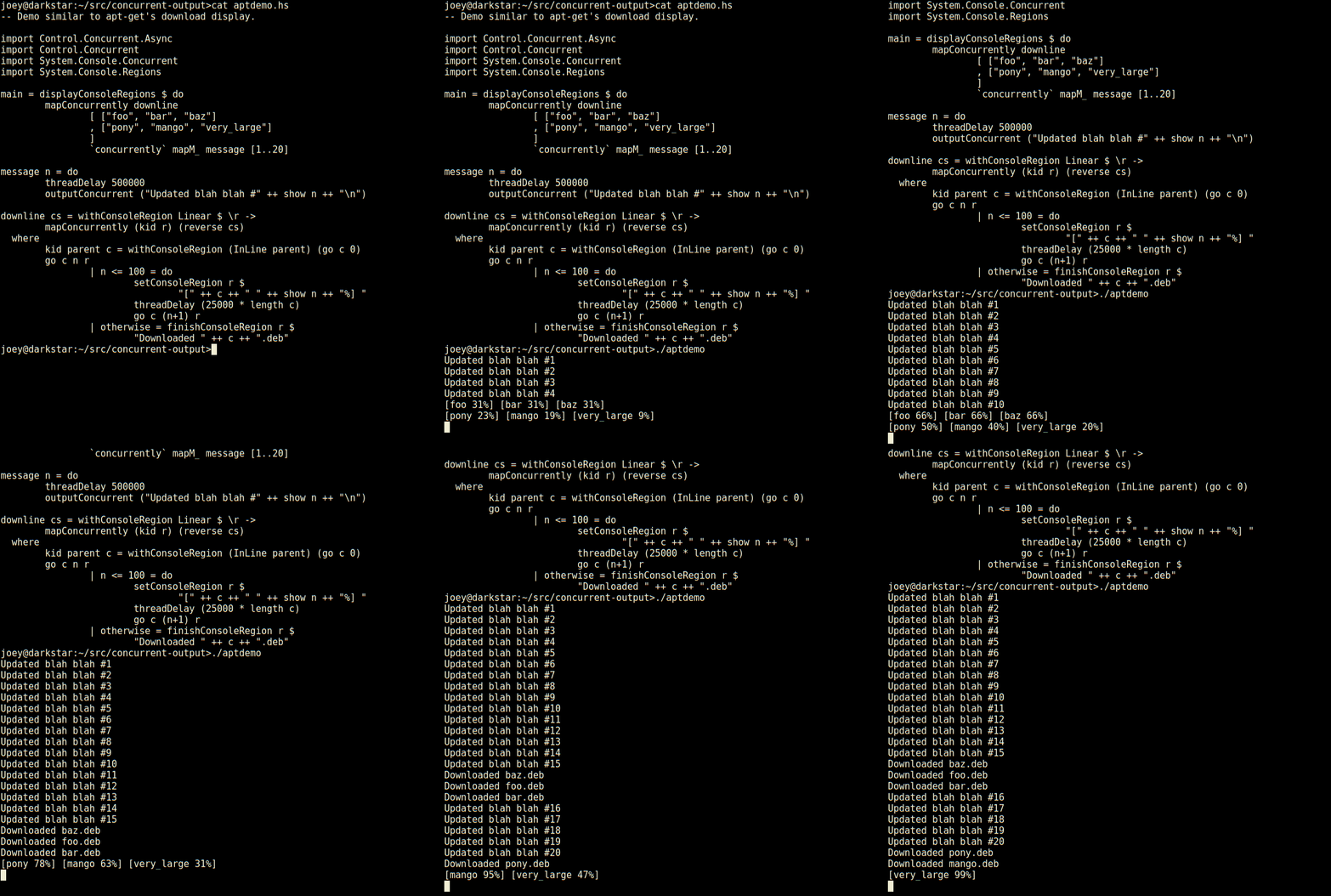
Building on top of concurrent-output, and some related work Joachim Breitner did earlier, I now have a kind of equivilant to a tiling window manager, except it's managing regions of the console for different parts of a single program. Here's a really silly demo, in an animated gif: demo2.gif Not bad for 23 lines of code, is that? Seems much less tedious to do things this way than using ncurses. Even with its panels, ncurses requires you to think about layout of various things on the screen, and many low-level details. This, by contrast, is compositional, just add another region and a thread to update it, and away it goes. So, here's an apt-like download progress display, in 30 lines of code. aptdemo.gif Not only does it have regions which are individual lines of the screen, but those can have sub-regions within them as seen here (and so on). And, log-type messages automatically scroll up above the regions. External programs run by createProcessConcurrent will automatically get their output/errors displayed there, too. What I'm working on now is support for multiline regions, which automatically grow/shrink to fit what's placed in them. The hard part, which I'm putting the finishing touches on, is to accurately work out how large a region is before displaying it, in order to lay it out. Requires parsing ANSI codes amoung other things. STM rules There's so much concurrency, with complicated interrelated data being updated by different threads, that I couldn't have possibly built this without Software Transactional Memory. Rather than a nightmare of locks behind locks behind locks, the result is so well behaved that I'm confident that anyone who needs more control over the region layout, or wants to do funky things can dive into to the STM interface and update the data structures, and nothing will ever deadlock or be inconsistent, and as soon as an update completes, it'll display on-screen. An example of how powerful and beuatiful STM is, here's how the main display thread determines when it needs to refresh the display:
data DisplayChange
        = BufferChange [(StdHandle, OutputBuffer)]
          RegionChange RegionSnapshot
          TerminalResize (Maybe Width)
          EndSignal ()
    ...
                change <- atomically $
                        (RegionChange <$> regionWaiter origsnapshot)
                                 orElse 
                        (RegionChange <$> regionListWaiter origsnapshot)
                                 orElse 
                        (BufferChange <$> outputBufferWaiterSTM waitCompleteLines)
                                 orElse 
                        (TerminalResize <$> waitwidthchange)
                                 orElse 
                        (EndSignal <$> waitTSem endsignal)
                case change of
                        RegionChange snapshot -> do
                ...
                        BufferChange buffers -> do
                ...
                        TerminalResize width -> do
                ...
So, it composes all these STM actions that can wait on various kinds of changes, to get one big action, that waits for all of the above, and builds up a nice sum type to represent what's changed. Another example is that the whole support for sub-regions only involved adding 30 lines of code, all of it using STM, and it worked 100% the first time.
Available in concurrent-output 1.1.0.

Next.

Previous.