Search Results: "ah"

15 April 2009

Stefano Zacchiroli: xmonad + gnome on Debian

... finally I'm tiling too! Short story: I've just switched to xmonad as my window manager of choice within a Gnome desktop environment; I give some tips on how to achieve that quickly on a current Debian/unstable machine. /me and tiling window managers I switched to Gnome a long time ago. The benefit of that over good old window managers is enjoying an integrated environment and a workplace that you can find on other machines (e.g., the netbook you installed for your mother, the office desktop, the student lab machines, ...). Still, I've never been particularly happy about Gnome's default window manager: metacity. The feature I was missing the most is the ability to configure windows programmatically so that they appear where and how I want by default; sadly enough, the Gnome session mechanism is not yet able to do that properly. Hence, I've tried various time switching to a tiling window manager, imposing the extra requirement that it should integrate with Gnome. The coolest guy on the block of that area seems to be awesome and I gave it a try some months ago. I liked most of its (sometime revolutionary) principles, like window tagging, but I equally hated various aspects of it: People nowadays tell me that awesome works fine with Gnome, so maybe I've just been unlucky back then, but sometime the first impression does count. I've never considered seriously xmonad, thinking (with no sound reason, apparently) that it was a project of the series: "I'm a fan of programming language $LANG, all my apps should be written in $LANG, my window manager is no exception", with LANG=haskell. Then two things happened:
  1. a couple of weeks ago I stumbled upon the xmonad wiki and documentation, and I was impressed by the average quality of the information shipped there. It is not something you usually find in "language showcase" projects.
  2. Patrick blogged about its switch to xmonad + Gnome, with enthusiastic feedback. If that's not a sign I don't know what it can be :-)
Getting started with xmonad + Gnome on Debian There is a page explaining how to use xmonad with Gnome in the xmonad wiki, but a handful of additional tips will help you get started in Debian, even if you know (almost) nothing about Haskell (yet). The (crazy) way in which xmonad works is that you create your config file as ~/.xmonad/xmonad.hs. That file is a full fledged Haskell program, which gets compiled to obtain your own xmonad executable which you run as your own window manager. /usr/bin/xmonad is the executable you initially run, but is just a wrapper around the compilation + run mechanism The modMask setting means that ALT will get delivered to applications, while all xmonad commands are delivered via the infamous windows key: no more conflicts between apps and WM \o/. The default Gnome configuration is quite nice: you can retain your Nautilus desktop (in spite of what is written on the wiki), mod-p will get you a gnome-run dialog box, and appropriate padding for the (upper!) Gnome panel. The only glitch is that you will get 9 desktops which can clutter your workspace switched. My solution is to have the appler show workspaces on 2 rows but beware of bug 524065, which is really annoying. The above example will make the pidgin buddy list and run application dialog box float by default. The commented line is an example of how to deliver specific windows to arbitrary workspaces. To find out window properties on which match in your xmonad.hs, my magic command is xprop egrep "CLASS NAME". Note that you don't need to care about panel placement because it is already taken care of by the default gnome config. Still beware of not using myManageHook as your only management hook, you should update the default one using the <+> monad as I did above. xmonad rant So, what's wrong with xmonad + Gnome in Debian? Well, the fact that it will take about 200 Mb of disk space on amd64 by default. o_O Why so? Because xmonad is affected by the static linking hell which seems to be shared by modern statically typed functional languages, including in the category both Haskell and my beloved OCaml. In short, applications written for those language link statically code written in the implementation language in most cases; they rely on legacy shared libraries only for bindings to C libraries. For xmonad that means that if you are fine with the default configuration you will get a cheap 2 Mb binary package. If you are not, you will need to write your conffile ... which is a Haskell program ... using several contrib libraries ... and needing ghc6 to be compiled and run as your own window manager executable. This is plainly dumb and induces all the usual problems of static linking, like disk consumption due to non-shared (Haskell) code, and worries about staying up to date with the latest library release in case of fixes (including security fixes) need to be propagated to user executables. Truth to be said, /usr/bin/xmonad does a wonderful job in hiding all this to the final user, but still the design choice is an unpleasant one.

14 April 2009

Michael Schutte: Chain of unfortunate events

I did some work on kbd today. I basically took an old Debian patch, the only significant divergence from the original tarball, and altered it in a way that I can read and understand it more easily (so I can send it upstream in good conscience). This process naturally involved a lot of errors. As I m talking about loadkeys here, they became unpleasantly obvious whenever I tested my code: First I messed up everything but plain printable ASCII characters (so the return key was mapped to Unicode U+0201 instead of the correct K(0x02, 0x01)), then I managed to completely freeze everything. In both cases, Alt+F7 was affected by the damage. Just like Ctrl+Alt+Del. Time for the good old boring elephants. I learn from mistakes when I make them twice, so a while sleep 60; do chvt 7; done loop saved me from further reboots. I nuked /dev/tty1 once more (in the really cool, irreversible way that disables all keypresses), but I could move on to the next VT. After a final adjustment, my modified patch finally worked. I sent it upstream, forgot about the troublesome debugging and went on to something else. Later in the evening, I decided to end the last school holidays in my life with a bit of instant messaging. BitlBee, a Jabber IRC gateway, is running on my virtual private server for this purpose. Being the occasional chatter that I am, I haven t touched it since the recent upgrade to Lenny. The format of its account configuration files has apparently changed, so I started to set up BitlBee anew. It kept telling me that there is an Authentication failure ; given the peculiar setup of the XMPP server I use, this didn t really surprise me. But still, this thing had worked before. Perhaps I really got my password wrong? I haven t typed it for ages, BitlBee stored it for me. As the administrator of my Jabber server, I could easily reset my password to what I thought it was. BitlBee still refused to get past the identification stage. I decided to install Gajim, entered my account information and told it to connect. Gnah. One or the other Python exception caused an eternal stream of error dialogue boxes to appear simultaneously and steal my focus. I don t have a keyboard shortcut for xkill and I couldn t type anything in a Urxvt (error message #54321 would receive the keystrokes). Ctrl+Alt+F1, get me out of here! Oh, right, I broke that one! At that point, I burst into a laugh. Somewhere in this post, there are a few bugs to report.

Neil Williams: Experimenting with TDebs

This is a short summary of how I'm currently experimenting with dpkg to generate, check and install TDebs in a pbuilder chroot. Do NOT use my modified version of dpkg outside a chroot!. Also, I don't expect any of this to be useful or usable by anyone not running Debian sid. If you're reading this via an aggregator other than planet.debian.org, please don't try this on your own systems. (Comments complaining that it breaks Ubuntu will be deleted - I'll have good fun laughing at you but the comments will still be deleted.)


The code (such as it is) lives at git.debian.org and it's safe to build the package on the normal system, as long as you install it in the chroot. I actually use a --prefix to allow
sudo make install
to copy the executables into the right places in the chroot. I find that quite simple to do via the terminal plugin in Anjuta.

Building a TDeb for the first time:
I expect lots of comments here, this probably won't be entirely workable initially, but the idea is to get the source for a package that has translations, that is easy and quick to build, few build dependencies and one with which you are already familiar. Adapt that package to support a TDeb by adding the relevant Package: to debian/control. All you need to include is: XC-Package-Type: tdeb and ensure that the new package is Architecture: all. Current convention is to call it $sourcepkg-tdeb. (Yes, although TDebs are initially going to be for debconf support in Squeeze+1, initial experimentation is with program translations because it's easier.)

/usr/share/emdebian-tools/dh_gentdeb (from the emdebian-tdeb package in Debian) can help prepare the translation files by creating the debian/$sourcepkg-tdeb/ directory hierarchy but you could also do the same by installing all /usr/share/locale/ content in the tdeb package in debian/rules or debian/foo.install. Remember to remove the translation files from any other package.

Building the TDeb should be as simple as:

dpkg-deb --tdeb -b debian/pilot-qof-tdeb ../pilot-qof-tdeb_0.1.7-1_all.tdeb


You do not need to build the source itself but you may want to do that for other reasons. You can then view the contents using:

dpkg-deb -c ../pilot-qof-locale_0.1.7-1_all.tdeb

or

ar -t ../pilot-qof-locale_0.1.7-1_all.tdeb

Install (dpkg -i ../pilot-qof-locale_0.1.7-1_all.tdeb --lang vi) used to work but I've messed up something there, so any ideas on what I've done wrong would be appreciated. :-)

Subverting git with subversion

Yes, I'm a git phobe. Don't flame me and any comments about my git foo by the git fanboy contingent will also be deleted.

I have to use git for this because the dpkg maintainers like git. That doesn't mean I have to like it or even use it. So, I use a local SVN repository. I do all my development work against that (because it's more friendly) and make local commits to it. Then, when I'm reasonably happy with the results, I copy the files across into git, fake a git commit message that more or less covers the real changes and use a script to "push" git to do what I intended. If (more likely, when) git decides to be all unfriendly and throw a completely unintelligible error message, I simply rm -rf git/path/, check out a fresh git, copy the real stuff from SVN and send the lot back as a single commit to git. Hah!

(For those who are not so blinded by their git obsession that they may actually care about my process, I can only say that local SVN is blisteringly fast and never, ever, fails.)

John Goerzen: Two Things I Don t Understand About Facebook

Item #1 Say you want to do something like take a quiz to tell you what Star Wars character you are, and have to result posted to your wall. It would make sense for Facebook to prompt you for authorization for the app to make a one-time post to your wall. But instead, they ask you for permission to pull your profile information, photos, your friends info, and other content that it requires to work. And we have no idea what this other content is. So yes, in order to be told that you most closely resemble Storm Trooper Extra #3, you must let the app developer have access to all your updates, your list of friends, your hometown, email address, whatever else only your close friends can see. Why can t Facebook make this a tad less invasive? Item #2 I also don t understand why people click Allow to these apps, having no idea just who is getting access to their information or what information they re getting. And Terah thinks I m being paranoid because I said that criminals probably are writing cute facebook apps ah well.

13 April 2009

Ingo Juergensmann: Debian/m68k's future

Stephen Marenka wrote to the debian-68k list lately:

So you may have noticed the following in your buildd logs for python-
depending packages.

dpkg: regarding .../python-docutils_0.5-3_all.deb containing python-docutils:
package uses Breaks; not supported in this dpkg
dpkg: error processing /srv/chroot/sid/var/cache/apt/archives/python-docutils_0.
+5-3_all.deb (--unpack):
unsupported dependency problem - not installing python-docutils

That's right, our old etch-m68k dpkg doesn't support Breaks.

The options I can think of are.

Option 1: backport dpkg to etch-m68k
Yuck. etch-m68k is old and likely insecure. Who knows what
back-porting dpkg would look like.

Option 2: lenny-lite
Build lenny with base, build-essential, and buildd-required
packages. I can probably do this one myself if there's
interest. I'll probably include anything required for d-i
too.

Option 3: lenny
Go ahead and try to do a lenny release. I think we have
nearly all the binary packages, but how to shove them into
an archive intelligently? I'm willing to help if anyone
knows how and can direct or is otherwise willing to lead.

Option 4: throw in the towel
Say it's time to retire m68k on debian. We have an ancient
glibc with borked threads. gcc-4.3 is fairly broken. A
number of packages need some bugs fixed, others need some
porting. Not so many helpers these days. Funny thing is with
aranym we have plenty of horsepower (although we need to fix
the fpu emulation) and with d-ports our buildds won't get
locked out of wanna-build. Kernel's probably in the best
shape it's been in a long time.

peace,

stephen

--
Stephen R. Marenka If life's not fun, you're not doing it right!


Yes, it's true... the Vancouver proposal seems to be a true success in killing the m68k port. Stephens mail is just a written example of what I've been thinking about for several weeks as well: does it still make sense to run my Amigas after being kicked out by Debian?

Luckily there were some new users appearing on the list asking for how to install Debian on their m68k machines, which shows that there's still interest in the port and need for a Debian on m68k. This makes me more confident in still supporting the m68k port for me by running several buildds 24/7. But as Stephens mail shows the m68k port is in trouble. It would be nice if there were more porters helping in actually porting software or fixing bugs. There are some open issues like NPTL support and such. See the list archive or the Debian wiki for more information.

Despite all the bad luck with being kicked off by Debian, the port did made some progress in the past: we're not bound by real m68k hardware anymore. Thanks to Aranym every interested developer can now contribute by running the emulator on his/her fast i386 machine. There are crosscompilers available as well.

But there's still work to do. For example to Coldfire inclusion seems to got stuck somehow. And I don't think that it makes much sense to try to build all of Debian >>6000 packages for m68k, but to concentrate on maybe below 2000 packages. So if you want to help to m68k port staying alive, please join us at debian-68k mailing list! :-)

12 April 2009

John Goerzen: Flowers, Music, and Grandparents

Flowers I ve written a lot lately about my Grandma Klassen, who passed away this week. But I m going to start this post about my Grandma Goerzen. She died when I was just an infant. I never knew her, but as the years pass, it seems that I remember her better and better. After we moved out to the farm where she and Grandpa Goerzen lived for decades, we noticed some flowers she had planted 30 years ago were still coming up, having withstood hail, hot summers, frost, construction equipment, and neglect all that time. Terah said, It s like your grandma left us a housewarming gift. Some of these flowers had never bloomed. Until this week. One bloomed for the first time the day Grandma Klassen died. A second bloom appeared the day of her funeral. Music #1 My jr. high and high school band teacher loves music (and old engines, but that s another story). You couldn t sign up for band at my high school; you d sign up for the class called LIFE. To him, music and life are indistinguishable. He says that anybody can speak to somebody, but music is the best way to speak to the heart. My Grandpa Klassen died when I was 11. Grandma Klassen, before her health declined, loved to tell me the story of the music at his funeral. At his funeral, my mom and I played a piano duet of Nearer, My God to Thee which we had already learned for a different event. When we were done, Rev. Epp went to the pulpit and said something along the lines of, If the music in heaven is as good as that, it ll be a great place indeed. I was just 11, and though music did speak to me at that age already, I don t think I understood how it moved people, such as my grandma, until many years later. Music #2 Grandma Klassen loved music, too, and that s reflected in each of her children all of them play trumpet, for instance. So it s no surprise that there was a lot of music this week. She died as two of her children were singing hymns to her at her room in the nursing home. Two of her grandchildren played trumpet for her at her burial. And my brother and his wife played trumpet and piano at her funeral. It was all beautiful, and like my band teacher said, it spoke to my heart. Music #3 I knew about gradma s love of music for quite awhile. When she was in better health, I took her to concerts sometimes. One of her favorite hymns was Joyful, Joyful, but she hadn t known it was based on Beethoven s 9th Symphony. I learned that the Wichita Symphony Orchestra was performing the 9th, and took her to the performance. She loved it, and I seem to recall that she kept talking about it for a few years afterwards. It certainly didn t hurt that the singing on the 4th movement was in German. I burned her a new-fangled CD of it, which I frequently saw in or near her CD player. The Kansas Mennonite Men s Chorus is an all-volunteer choir with about 300 members. They give a couple of concerts a year, and occasionally tour throughout North America and Europe. Their motto is we sing that others may live because 100% of money collected at their concerts goes directly to charity. Attending one of their concerts is a powerful experience not easily forgotten. I think the only time I ve heard a choir come close to being as amazing as that was when I had the opportunity to attend a Robert Shaw concert a few years ago. I went with grandma to one of the Kansas Mennonite Men s Chorus performances a few years ago. As you might expect, she loved it I think she called it powerfully good. This year, I finally joined the choir. I still remember that first practice. We warmed up by singing Holy God, We Praise Thy Name a song that has opened every KMMC concert for years. These people hadn t sung together for almost a year, and there were plenty of new people like me there too. But it only took a few bars of singing before I realized just what it was I had joined. The choir started out with the quietest, but most powerful singing you can imagine: Holy God, we praise thy name. By the time we got to the end of the page, the building was ringing from 300 men singing Infinite thy vast domain, everlasting is thy reign! at the top of their voices, in perfect harmony. We got to the end. The director said. . . Wow. I don t think a first practice ever spoke to my heart before that day. Music #4 Nearly 20 years ago, Grandma Klassen bought me a new bible. After she gave it to me, I asked her what some of her favorite passages were. She took me straight to the blessing in Numbers 6, and made sure I underlined it and bookmarked it. It goes like this:
The Lord bless you,
The Lord keep you,
Make his face to shine upon you and be gracious unto you,
The Lord life up his countenance upon you and give you peace.
My uncle had read this blessing to her the last time he talked to her. And the KMMC for years has ended their concerts with a beautiful benediction based on this passage. Grandma heard it at the concert I attended with her. It has been a favorite of my mom for years, too. So I had the thought: we really ought to sing it as a benediction at her funeral. It was hard to find the right mix of people on short notice, but we wound up with me singing baritone, my brother singing 2nd tenor (we both normally sing bass), and his wife both playing piano and singing 1st tenor, and relying on the piano to fill in the bass part. We had a little chance to practice before the funeral, but not a lot. The two of them have done a lot musically, but I haven t nearly as much, so I got in some extra practice at home, too. When it came time to sing, it was an emotional moment for sure more than a bit hard to focus, knowing the history and meaning of these words. When we got to and give you peace , and moved into the chorus of amen that finishes the song, I almost broke down right there, but didn t quite. We didn t give a perfect performance, for sure, on such short notice. (And they had me singing with them, so we wouldn t have been perfect even with plenty of notice!) But it didn t have to be perfect. After we ended the last, quiet amen , I think I heard about a half-dozen noses blowing all at once. My band teacher was right about music speaking to the heart. Later, during lunch, my aunt said to me, Wow, John, I ve never heard you sing before! That s right, and this may be the last time you hear me sing, too! I don t normally sing in a small group like this. A few minutes later, my uncle that gave the message came over and talked to the three of us. John, today you three brainwashed me. Oh? Yes. For years, I thought that there was no music as beautiful as the trumpet. After hearing you three sing, I have to reconsider. And so my band teacher was also right: music is life. My grandma was a person that could hardly speak without touching the heart. That beautiful melody of her life didn t stop when she died Tuesday afternoon. I ve been hearing it all week.

Andrew Pollock: [debian] Grappling with Git, episode 1

At work, we have a bit of a vested interest in the Puppet and Facter packages that are in Debian, because we ultimately consume them in Ubuntu. We noticed that what was in Debian unstable was lagging a bit behind what was released upstream, and when one of my co-workers tried getting in contact with the Debian developers that were maintaining the Puppet package and got no response, I got involved. I got in touch with Micah Anderson and got myself and Nigel Kersten added to the Alioth project for Puppet. Despite Jamie Wilkinson being listed as the maintainer of the facter package in Debian, he claimed this was news to him, and Matt Palmer, who was listed as an uploader, didn't really claim much knowledge of maintaining the package either, so we took that as blessing to take over that package as well. This is where the fun begins. I've been meaning to try out Git ever since Debconf 7, where all the cool kids were using it and raving about it. I've been meaning to make the Debian DHCP package collaboratively-maintained, and use Git for the revision control, but I haven't quite gotten off my good intentions and done it yet. Part of the problem is not knowing exactly what workflow I should use, and suffering from paralysis by analysis, reluctant to experiment, because I don't want to go down the wrong path. Anyway, this is about Puppet, not DHCP. The Puppet package, as it turns out, is already maintained in Git on Alioth, so the problem here was more one of figuring out what the current workflow was, and trying to follow it. This is where Nigel came in. Conveniently, the upstream Puppet development is done in Git also, and Nigel is a contributor to Puppet upstream, so he had some Git-fu. So between the instructions on how to get started with Git on Alioth and what he knew, we could start fumbling around. It seems like the Alioth Git repository was also tracking the upstream Puppet repository, as there were commits in the Alioth one by Luke Kanies, and we didn't really imagine that he was doing Debian-specific stuff. Here's what we ended up doing to try and get what was in the Alioth repository up to the upstream version 0.24.8 of Puppet:

git clone ssh://apollock@git.debian.org/git/pkg-puppet/puppet.git
This part was fairly straight forward. Clone what's in Alioth locally.
git remote add reductive git://reductivelabs.com/puppet
git remote update
git fetch --tags reductive
Next, we added a remote branch that tracked upstream. We called it "reductive", and we updated it. The bit that took some fiddling with was fetching the tags. Nigel later figured out that tags are inherently private to a repository, and normally stay that way. So if I have a local clone of say the upstream Puppet repository, I can tag it to my heart's content, and normally those tags would stay in my local repository, because they're probably only meaningful to me.
git checkout -b upstream/0.24.8 0.24.8
This bit took a bit of work to arrive at as well. What we wanted to do was create a new branch called upstream/0.24.8, which was at what was tagged 0.24.8 in the reductive repository. Nigel pondered what would happen if you already had a tag or a branch called "0.24.8" before you added the remote repository. This is also why we had to fetch the tags from the remote repository, so we had something to check out.
git checkout master
git merge upstream/0.24.8
Next, we switched back to the master branch and merged the contents of our local upstream/0.24.8 branch that we just created. This now got the Puppet source in the master branch up to what was released as version 0.24.8. (and this is better than just running uupdate?) We did some fiddling with the debian/control file and debian/changelog and fixed up a few things that Lintian was bitching about, and were done. I'd set up a sid chroot with cowdancer previously, and had to do some faffing around with git-buildpackage to convince it to use pbuilder. I ended up using
git-buildpackage --git-builder="pdebuild --debbuildopts '-i\.git -I.git' --basepath /var/cache/pbuilder/base-unstable.cow"
So now we've got most of what we want to ship checked into Git on Alioth. I have no idea if we've done it "right", I suspect we may have done something wrong by operating on the master branch. Looking at the revision history in the Git repository on Alioth, it looks like previously things have been done a few different ways. I certainly want to write up a definitive workflow once we've figured one out. We haven't uploaded the new package to unstable yet, because we're still trying to give it a modicum of testing, and we'd like to sort out the Facter package as well. The Facter package was a more greenfield exercise, as while there was already a Git repository on Alioth for it, it was empty. So Nigel had to do some futzing around to get it checked in the right way to make git-buildpackage want to build it. He did this by himself, so I'm not sure exactly what he did. I've since discovered that it's probably lacking some dependencies it needs, so that'll need to get fixed before it gets uploaded. I look forward to reading blog posts from the smart people who actually know how to use Git properly, telling me how we should have done it. I'm still very interested in coming up with a proper workflow for preparing packages and committing the changes, and for doing code review.

11 April 2009

Neil Williams: Thanks, Debian.

Hmm, this is a little story of how to break Xorg in Sid and then use Squeeze to fix it. :-)

I never liked having extraneous packages, so I don't like xserver-xorg-video-all - I just want xserver-xorg-video-foo (nv in the case of the laptop in question). So the latest upgrade from Sid wanted to bring in all the video (and input) packages and I tried to work around it. Hmm. Turns out, I could use -o Apt::Get::Download-Only=true and dpkg --force-depends -i to get the packages I wanted. The thing is, one of the modules needs to be installed for the dependency on xserver-xorg-video-all to be met by a Provides. It's the Provides that has changed. So I installed xserver-xorg-video-nv by force and logged out. Oops. No X.

Various other hacks later, I tried to build xserver-xorg-video-vga (which I thought was probably the missing one) only for the build to fail on amd64. Brokenness. Hmm. (it doesn't build in a pbuilder chroot either, bug filed.)

I've always run a pure Sid install but I know people who mix Sid and Squeeze, so I added a Squeeze source and started doing a lot of apt-get install xserver-xorg-video-foo/testing - again concentrating on just the video packages I need. Aha! X restarted - umm, but the mouse didn't move and the keyboard did nothing in X, only in the existing terminal. Repeat process with xserver-xorg-input-all/testing and I'm back in a working X. Phew.

My own fault, I know (I shouldn't have forced the package installations, should have just waited for the complete dependency chain to be available), but it's nice to get out of this mess so easily.

Chris Lamb: Installing FogBugz the Debian way

Yeah, proprietary software is bad, but let's at least install it the Debian way. The following walkthrough assumes Debian lenny.

#!/bin/sh
set -e
for PEAR_PKG in Auth_SASL HTTP_Client Mail_Mime XML_Tree
do
        PKG_TEMP=$(mktemp -d)
        cd $ PKG_TEMP 
        pear download $ PEAR_PKG 
        dh-make-pear $ PEAR_PKG *.tgz
        cd $(find -mindepth 1 -type d   head -n1)
        dpkg-buildpackage -uc -us -rfakeroot
        sudo dpkg -i ../*.deb
        rm -rf $ PKG_TEMP 
done
$ sudo ./install.sh
/***************************************\
*            FogBugz 6 Setup
\***************************************/
--    Checking for required tools
 +      found mono 1.9.1
[..]

Christian Perrier: First KDE4 impressions

I finally more or less completed my switch to KDE4. Thanks the great great KDE maintenance team we have. Simultaneously, X.org packages were updated so possible problems may have ben triggerred by it more than KDE, though. At first glance, this new KDE is nice and has great improvements but generally speaking painfully slow..:-) So, I began deactivating again all visual effects so that my poor old Dell X1 survives the upgrade. I was also greatly annoyed by losing the "Terminal sessions" which I was very actively using with Konsole. No more "Terminal Sessions" menu in my task bar to connect to various hosts over the network. Bleh. I have to redo everything with Konsole's "profiles". Also sucking a lot is the default setting for fonts in Konsole (antialiased fonts). It makes scrolling painfully slooooooow. I just deactivated this and it's much much much better. I also lost my old mail notification utility (Korn). It is still working but having it running leaves a kio_mbox process eating all my CPU. Actually, korn is still something from KDE3, so I might expect it to be rebuilt for KDE4, hopefully. I never found anything as good as it in the gazillion of mail notification utilities we have. Maybe my dear Lazyweb will help. I'm still left with weird keyboard behaviour which is hard to identify. Apparently the delay before key repetition starts when one leaves a finger on a key has changed in some way and despite my attempts to restore this in the adequate KDE thing, it doesn't change that much. I suspect some weird interaction with X.org stuff. Such "minor" details are very annoying as they interfere with year of (bad) typing habits. In general, as a very old KDE user (I adopted it back in 2001 or so because of Kbabel), I'm somewhat happy with that upgrade but it will take time to be used to all the new concepts (ah, these "Plasmoids" thing...) and also restore the overall speed of my machine...:-)

10 April 2009

Kapil Paranjape: Controvertialism

Rahul Basu pointed out an article by the eminent scientist Freeman Dyson. In the past Dyson has raised a number of interesting questions and has been thought-provoking, but it is difficult to read him when he writes like this. I have re-phrased what he has said (debunking climatologists) and turned it into an argument against the Large Hadron Collider so that we can see how obnoxious it sounds.1
My first heresy says that all the fuss about the Higgs particle is grossly exaggerated. Here I am opposing the holy brotherhood of high energy physicists and the crowd of deluded citizens who believe that the world is predicted by the standard model. Of course, they say, I have no degree in physics and I am therefore not qualified to speak. But I have studied the standard model and I know what it can do. The model solves the equations of gauge theory in the simplest cases, and it does a very good job of describing the interactions of the known particles. It does a very poor job of describing how mass arises and the chemistry and the biology of phenomena we see everyday. It does not begin to describe the real world that we live in. The real world is muddy and messy and full of things that we do not yet understand. It is much easier for a scientist to sit in an air-conditioned building and run computer models, than to put on a lab coat and measure what is really happening in the complex phenomena of compounds and materials. That is why the high enery physicists end up believing their own models.
The rest of the article can then be similarly re-phrased but I will just summarise it as:
There is no reason for the rest of the world to believe the high energy physicists and squander billions of dollars into following their proposed unique solution to the questions of physics.
Of course, there is a good chance that Dyson will agree with the above point of view as well! The problem with controversialists'' like Dyson is that they believe that taking extreme positions helps clarify issues. Unfortunately, extremists are a-dime-a-dozen in today's world. I suppose I should clarify that I accept neither the extreme position on climatology nor the one on the LHC!

  1. My friend is a high energy physics theorist!

8 April 2009

David Welton: New LangPop.com stats, open source bits and pieces

I released some new statistics on LangPop.com. There are some new things:
  • The normalized results are now user configurable - you can put in your own weights for the various data sources (such as Amazon, Craigslist, and so on), and see how the results change.
  • Freshmeat.net fiddled with their web site, and statistics are not going to be available this month. Hopefully they will be able to correct the problem soon.
  • On the other hand, I wrote some code to grab the data from Ohloh, so there's something new to look at while we wait for Freshmeat to come back on line.
So there is a fair amount going on. Hopefully Freshmeat will come back soon, and I can also add a few fixes to the IRC statistics which I've been thinking about. In the process of doing the above, I also managed to do some open source work, albeit of a minor nature:
  • I updated LangPop.com to use the Flotr Javascript chart library instead of Plotr. So I also updated my Ruby code to integrate it. It's a fairly thin layer at this point, but it does what I need. It's available here: http://github.com/davidw/chartr/tree/master
  • I did some hacking on the Simile Timeline code, (used here on LangPop.com), correcting a bug, and also creating a system to install the whole thing with a simple command. Normally, it's kind of difficult to just use the Simile code on your own site, so I created an (admittedly hacky) way of making it easier to install. That code is here: http://github.com/davidw/standalone-timeplot/tree/master
Oh, yeah, and we moved from Innsbruck, Austria back to Padova, Italy!

Bastian Venthur: Migrating a project from one SVN repository to another using git-svn

sounds probably like a stupid idea since you could just copy the repository from the old to the new location, but in this case we don t have direct access to the repositories, only accounts with commit-access. Ahh, and we want to preserve the complete history, of course. Ok, the plan is to use git-svn to get a copy of the old SVN repository, complete with history and then apply each commit to the new location: Getting the old repository git svn clone http://old/repo/
cd repo
Removing the traces of the old repository Now we have a git repository containing the complete history of the old SVN repository. That git repository is connected to the old SVN repository via git-svn. In order to commit it to the new repository we have to remove the traces of git-svn: # Remove the remote branch
git branch -rD git-svn
# Remove the rest
rm -rf .git/svn/

Edit .git/config and remove the svn-remote stanza Commiting into the new repository Now that we can connect our git repository to the new SVN location and commit all the stuff: # Create the new repository directory if necessary
svn mkdir http://new/repo/
# Init, fetch, rebase and commit:
git svn init http://new/repo
git svn fetch
git rebase git-svn
git svn dcommit
Maybe not the most elegant solution but it works. The new repository contains everything from the old one, only the commit dates are messed up.

John Goerzen: Goodbye

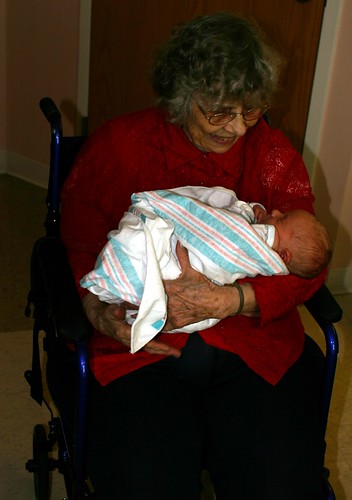
Jacob has lately been telling us gate gamma kassen so sick (Great Grandma Klassen is so sick), after his visit to the hospital, and it s true. Today started normal enough, but by 2:45 I got an email from my mom, saying that grandma had taken yet another turn for the worse; her pulse was racing, her temperature feverish, and her breathing shallow and difficult. The last grandchild that was going to be there made it, and got the last flicker of recognition from grandma. I wrapped some things up at work. Then I made the short drive from work to the nursing home, and got there just after 4. I went in to her room there, and it was full of family. Two of her children were singing her favorite hymns. I can never forget my uncle s deep bass voice as he stood at her bedside, holding her arm, while my aunt patted her head, both of them singing. Grandma s only remaining sibling, her younger brother Melvin, sat on the other side of the bed, looking on. Grandma s white table and chairs, which were in grandma and grandpa s house as long as I can remember, and followed grandma through all of the four other places she lived in the last years of her life, were in her room at the nursing home too. It always felt like home to be with grandma and those familiar things that she always took with her. Despite what was happening, I was glad she was back at home. My uncle motioned me over to her bedside, and I took her hand for a few minutes. It felt cold and weak; for the first time, she didn t grab my hand at all. A nurse came in to check oxygen saturation, but the machine wasn t able to get a reading due to poor circulation to her hand. She wasn t able to get a heart rate either because the heart was racing so fast. She discussed briefly whether the family wanted them to continue giving her oxygen, and they decided that they would, for her comfort. My uncle and aunt kept singing. I blew my nose and dabbed at my eyes, and there were hugs all around. And just a few minutes later, grandma peacefully stopped breathing, maybe 20 minutes after I had arrived. They went to get the nurse, who came back to listen to grandma s heart again, though we knew what she would find. She took the stethoscope off, and she almost lost her composure, but managed to say you can turn the oxygen off now. Several people gave grandma a last hug. After a few minutes with just the family, they told the nurses to go ahead and call the funeral home. That set off a lot of activity making arrangements for the next few days, funeral plans, and the like. I stepped back into grandma s room a few times, while the family was in the sitting area right outside it discussing. I looked around at the family photos on the wall, the old table and chairs, the recliner. Now, these are the things that were grandma s. It didn t feel like home anymore. Terah and Jacob were stuck at home Terah s car was at the mechanic for repair today. I called to give her the news. She wanted to come to be with the family, but I didn t really want to leave. She tried calling some friends to see if they could give her a lift to the mechanic, but not one of them was available. I talked to her again and suggested she just call the mechanic. She wasn t even halfway through describing the situation when he interrupted with, We ll have it at your place right away! Well, I don t expect you to have to do that, or you could certainly wait until you close. Nope, this isn t your average community, we ll bring it right over. You should be there. Grandma has enjoyed a simple life and had requested a simple death: no extraordinary measures at the end of life, no embalming either. So, by law, the burial must happen within 24 hours of death, and will be tomorrow. After all the arrangements, people realized nobody had supper yet. We went to the quickest available option pizza and ate there. It was paid for out of grandma s remaining money the last meal of so many that she provided for her family over the years. It was a happy meal. As I drove home, NPR news was on the radio. There were the same stories we hear all the time: the economy, the mideast, the president. Normally I m interested, but today I shut it off. Today is different. Tomorrow, for the second time in four years, I will help carry a grandparent s casket a few days before Easter. I ll end tonight with this photo. It was taken soon after Jacob was born. Grandma came to the hospital and held him. That smile sums her up perfectly. img_4965r.jpg

7 April 2009

Clint Adams: Too bad that part is single-threaded

As far as I am aware (and I am unanimous in this), ZOMG is the only released software that can scrobble tracks to both libre.fm and last.fm near-simultaneously.

Gunnar Wolf: Leo Masliah, here!

I have been waiting for next-Thursday for many years, and I just found out - by mere chance. In 2001, Leo Masliah came to Mexico City and performed a couple of shows. I don't remember the reason... But I missed it. Who is Leo? An Uruguayan artist, living AFAIK in Argentina. Maybe he could be described as a humorous musician and writer... After all, I first met his music, and by far, it is what I know best. However, many (sad and simple) people would fail to see him as humorous, and would think he is just a sad, sick person with sick taste. About his writing? Well, I guess music is the first step, something like to get sickos like myself hooked. His writing is even sicker. Anyway - Leo Masliah is one of my favorite artists. And he is coming to Mexico! This Thursday, April 9, in the Teatro Bar el Vicio, Coyoac n, 21:30, MX$250. VERY MUCH worth it.

6 April 2009

John Goerzen: Lucky Squares

Terah and Jacob were shopping in the cereal aisle the other day. Jacob saw a box of Lucky Charms (not one of the more nutritive cereals). He pointed to it and really wanted it. Terah pointed to a better choice, and asked him, Shall we get that one instead? Jacob looked at the other cereal dubiously, unconvinced. Terah added, It is SQUARES! That was all it took now Jacob wanted that cereal. Terah told me this story, and added this won t work for long. She s right, of course. I guess we ll hope that they ll come out with octagonal cereal one of these days.

Biella Coleman: Does the patent system make you queasy?

Great research opportunity for PhD Students out there.
Peer to Patent Summer Research Fellowship
New York Law School
Summer 2009 Background
Peer to Patent is the groundbreaking program developed by New York Law School and run in cooperation with the U.S. Patent and Trademark Office and the United Kingdom Intellectual Property Office, along with the assistance of a number of private stakeholders. It harnesses the power of citizen-experts to assist patent examiners by searching for, identifying, and annotating prior art relevant to pending patent applications. A first Peer to Patent pilot was launched in June 2007. During the first year the project participants (peer reviewers) assisted in the prior art searches on 40 patent applications, generating 173 items of prior art. These items of prior art were the basis of rejection in over ten of the patent applications considered. In June 2008 the pilot was continued for a second year, and was recently extended to encompass a pilot program in the United Kingdom. Research Issue
Although Peer to Patent has attracted over 350 active peer reviewers, the project team has little or no idea as to the motivations that cause these individuals voluntarily to contribute their substantial time to the project. The average reviewer spent approximately six hours searching and annotating individual patent applications. The project team also does not fully understand the best means for attracting additional peer reviewers to the project. In order for the project to scale to larger volumes of applications, both of these points need to be understood and addressed. More generally and theoretically, the motivations of citizens in producing material for governmental use are not well-understood. This fellowship seeks to provide an account of this sort of activity, as well as generate a design for a controlled study of incentive mechanisms for these sorts of activities. Research Activity
The selected fellow will conduct interviews among a meaningful number of currently active peer reviewers to elicit their motivations for participating in the project and contributing their time. The fellow will review the non-profit motivation literature to provide a number of alternative methods of reward to determine whether any or all of them would induce the participants to continue their participation, increase their participation, encourage others to participate, or cease their participation altogether. Potential rewards may include: (a) basic recognition; (b) monetary interest; (c) cash awards; (d) prominent public recognition; (e) some other form of reward; or (f) no reward whatsoever. The fellow will develop a survey to be conducted among a wider segment of active and potential peer reviewers to test for validation of the data gathered in the initial sampling. From the results of the initial sampling, literature review, and survey, the fellow will develop findings on which to base an incentive program to attract and retain peer reviewers. The fellow will develop an experimental design to test the efficacy of each of these incentive possibilities. Term
The fellowship will commence on or about June 1, 2009 and will continue until on or about August 31, 2009. The fellowship is a full time position for the three months stipulated; but this is open to negotiation for an exceptional candidate.
Compensation The fellow will receive a monthly stipend of $3,000 (based on full time work status). Job Qualification
It is expected that the fellow will be pursuing (ABD) or have completed a PhD in psychology, economics, policy, or communications; or some other relevant field involving the motivation of content producers. Application Deadline April 30, 2009. Application Procedure
Applicants should send (1) a letter of application detailing their qualification for the position, (2) a resum , and (3) a list of three referees, to: Ms Naomi Allen Administrator, Institute for Information Law & Policy New York Law School 57 Worth Street New York NY 10013 Naomi.Allen@nyls.edu Questions relating to the scope and nature of the fellowship can be directed to: Prof. Mark Webbink,
Director, Center for Patent Innovations
New York Law School
mhwebbink@yahoo.com Prof. Dan Hunter
Director, Institute for Information Law & Policy
New York Law School
dhunter@nyls.edu New York Law School is an equal opportunity employer that encourages excellence through diversity. Women and minority candidates are encouraged to apply.

John Goerzen: Today

This morning started with a call from my mom. She was calling to let us know that my grandmother had apparently taken a turn for the worse, and we didn t know how much time was left. Terah, Jacob, and I got dressed and went to the hospital to visit. Grandma had been in a partial coma that left her able to hear, nod, and hold hands, but unable to speak. Apparently she came out of it overnight, and was talking and even singing with my mom and aunt some. She seemed happy, loved to hear the old German prayers she grew up with. She said some memorable things I ll have to write about later too. By the time we got there, she wasn t that active anymore, and was about like she was yesterday. She could see us, and give our hands a squeeze, maybe nod occasionally. She drifted asleep often. One time when I saw she was awake with her eyes open, I lifted up Jacob to where she could see him. Immediately her face brightened, and I saw the biggest smile on her face that I d seen in days! She smiled and waved to him, and with a small bit of coaxing, he waved back. Then she wiggled her foot, and when Jacob noticed, he wiggled his foot back at her. He s 92 years younger than her, and they still managed to communicate just fine. Grandma held my hand for awhile this morning; she loves to have a hand or two to hold. My cousin showed up for a visit, and I was going to get up to let her sit down, and when grandma felt my hand leaving, she grabbed on tighter. I went around to the other side of the bed and held the other hand. In the last couple of days, grandma s hearing has become much sharper than before, and I m pretty sure her memory has too. When it was time for us to leave and go to church, I was holding her hand, looking into her eyes, saying goodbye, and how much I loved her. I got a hand squeeze, and saw a few tears at her eyes the first I can remember seeing that. As I pulled my hand away to leave, she once again grabbed tighter and was still looking at me. I think she thought this was the last time she d see me, and didn t want the moment to pass too quickly. But that also guaranteed that I d be back in the afternoon. It was Palm Sunday in church today, and as every year, the Palm Sunday celebration ends with Bill singing I walked today where Jesus walked while Dale carries in a heavy cross. Right when Bill is singing I climbed the hill on Calvary, where on the cross He died! , Dale is climbing the steps to the stage and laying the cross there. Hardly a dry eye in the room at that. For lunch, my parents were still hosting their monthly college student get-together/home cooking event which we usually attend too. After that, I dropped off Terah and Jacob at home, and went back to the hospital. By the time I had left, grandma had 27 visitors just today. When I arrived, my great uncle (her brother) and aunt were there, along with her pastor and a deacon from her church, plus my mom and my aunt. More people came and went throughout the afternoon, and I enjoyed visiting and hearing stories about the family and grandma all afternoon. She was sometimes awake and able to look at people, and sometimes deeply asleep. I heard her say God bless you to several people. It was awhile before I had a chance to go be with her, and when I did, she was asleep, so I sat beside her bed and held her hand for quite awhile, maybe an hour, while visiting with family in the room. At one point, a nurse came in to give her some more morphine by IV. I got up to get our of her way, but the nurse said, Don t think of it; I can work around you, and what you re doing is more important than what I m doing anyway. Some of her old friends from church came by, and prayed with her in German, and recited the words to some German hymns and poems, which I think she really enjoyed. Her eyes were closed through most of it, but when they got to the end of each item, they opened, saying thank you, I believe. Eventually things calmed down, and it was time for me to head home. Grandma was awake by then, and I looked at her and said goodbye, and that I was glad I got to see her again. We gave each other a final hand squeeze, and then she let go of my hand this time. I m glad I came back for sure. They say sometimes that people that are dying feel like they need permission to die, before they will let themselves go. I wondered if grandma was feeling that way today. But then I hear that my uncle, who is driving in from 8 hours away through wintry weather, called and ask that she be given this message: Tell mom that I m coming, but if Jesus gets there first, she should go with him. That might not work on everybody, but for her, it s the best way I could think of to give her permission.

Next.

Previous.
