Search Results: "zed"

23 April 2009

Biella Coleman: Viral Videos

I am sure many have seen this video pirates. drugs. gay marriage and I think it speaks for itself. But I have to say, this video caught be off guard early this morning when I am first exposed to the day s viral videos, memes, and other savory and unsavory delights. Though I have been consuming and digesting this stuff for awhile now, I am still amazed by the craziness, creativity, outrageousness (often offense) that circulates every day, without fail, on the internets. Most of the stuff, even if pretty low brow can be said to be artistic in one classical sense of art: l art pour l art , with the aesthetics being focused on some combination of shock, irony, and humor. But how about the political activists? They are not dipping into this genre enough and it s high time they use start using these tactics/viral videos to shock/shame their opponents, using the sugar coating of humor and raw audacity to spread their message.

Romain Beauxis: Lastfm no longer free as in free beer (and some bits about xml in OCaml)

Lastfm no longer free as in free beer As I was trying move the code of ocaml-lastfm [1] from the unmaintained xml-light [2] to xmlm [3], I discovered that it now fails to request track in anonymous mode. Then, I went on the lastfm [4] site, and discovered that now I cannot find any full content available for anonymous users. Some more researches and I found this [5]:
Today we are making the changes to the radio that were previously announced here. This means that from today, listeners to Last.fm Radio outside of the USA, UK and Germany will be asked to subscribe for 3.00 per month, after a 30 track free trial period. In the USA, UK and Germany, where it's feasible to run an ad-supported radio service, there won't be any changes. Everything else on Last.fm (scrobbling, recommendations, charts, biographies, events, videos etc.) will remain free in all countries, like it is now.
JPEG - 42.5 kb
Alcool ! Voil l'ennemi.
Poster by French painter and missionary Fr d ric Christol (1850-1933) warning of the dangers of absinthe and other alcoholic drinks.
Although I will not comment this with the same violence as in the comments of the above message, this is not a good news at all. I totally understand how it can be difficult to find financial resources for this kind of business, and how complicated it can be after few years to maintain an activity that initially was breaking new and attracting investors. However, given the current global [6] propaganda [7] campaign [8] that is organized [9] by the major music companies, I do not believe this decision has only to do with lastfm's financial resources. In particular, also the legality of Deezer [10] was challenged by universal [11] such that they had to require registration [12] and also limit drastically the available titles. The current situation is now really becoming worse and worse. Not only the music companies are trying to push for dangerous laws for the civil rights while pretending to fight against illegal music sharing, but also they are trying to shutdown all the new competitors that were successful in doing exactly what they refused to do during the same time. All of this is just simply pathetic, and I strongly hope there will soon be an end to this, which will surely mean for these companies adapt or perish.. Or perhaps they plan to impose their restricting and dangerous laws in any country in the world ? Another remark about all this is that it clearly demonstrate the importance of having the right to copy and store for your own usage any copyrighted material. Indeed, these are not only products but also artistic productions, and for this reason it is important to be able to save them in some place in order to not loose track of it if the streaming company was to be shutdown, as it seems to be the trend now.
JPEG - 71 kb
Viktor Oliva: The Absinthe Drinker.
The original painting can be found in the Caf Slavia in Prague.

Moving from xml-light to Xmlm The other part of this post is about moving from xml-light to xmlm. This is in fact very easy, and should only be a matter of adding a piece of code like this:
type xml =
Element of (string * (string * string) list * xml list)
PCData of string

let parse_string s =
let source = String (0,s) in
let input = Xmlm.make_input source in
(* Map a tag representation in xmlm to
* (name, attributes list) where attribute = string*string. *)
let make_tag (x,l) =
(* Forget about the uri attribute *)
let l =
List.map (fun ((_,y),z) -> (y,z)) l
in
snd x,l
in
let rec get_elems l =
if Xmlm.eoi input then
l
else
match Xmlm.input input with
El_start tag ->
let elem = get_elems [] in
let (name,attributes) = make_tag tag in
get_elems ((Element (name, attributes, List.rev elem)) :: l)
El_end -> l
Data s ->
get_elems ((PCData s) :: l)
Dtd _ -> get_elems l
in
let elems = get_elems [] in
Element ("", [], List.rev elems)
This is a very simple code that surely needs more fixes, but starting from that, you can parse a string into an equivalent representation of the xml data, and then use it as before in your code..


[1] Ocaml-lastfm: http://www.rastageeks.org/lastfm.html [2] Xml-light: http://tech.motion-twin.com/xmlligh... [3] Xmlm: http://erratique.ch/software/xmlm [4] Lastfm: http://www.last.fm/ [5] "Radio Subscriptions": http://blog.last.fm/2009/04/22/radi... [6] "New Zealand: safe from Big Music. Or is it?": http://www.p2pnet.net/story/19074 [7] " La Quadrature du Net discr dit e aupr s des d put s anti-Hadopi": http://www.numerama.com/magazine/12.... Link is in french. It explains how, after filling a so-called petition with hundreds of signatures from employees presented as artists, or artists abused by the presentation of the content, these companies complain about the "totalitarian methods" used to verify the validity of the signature, which were simply based on the public available information on these names on the web, while they propose a system that would automatically cut the internet access to probably 1.000 people a day in France... [8] "Faux proc s : Les pirates paient": http://www.ecrans.fr/Faux-proces-Le.... again, in french, the article reports a Danish study that prove once again that people who tend to download a lot of music are also much more likely to spend their money in the music business, being concert, records or else.. [9] ""Three strikes" for Ireland - Eircom, music industry settle filtering case": http://tjmcintyre.com/2009/01/three... [10] Deezer: http://www.deezer.com/ [11] "Universal Music challenges the legality of Deezer, a free streaming website": http://french-law.net/universal-mus... [12] "Now Deezer Required Registration": http://forums.techarena.in/technolo...

Manoj Srivastava: Manoj: Ontologies: Towards a generic, distribution agnostic tool for building packages from a VCS

This is a continuation from before. I am digressing a little in this post. One of the things I want to get out of this exercise is to learn more about Ontologies and Ontology editors, and on the principle that you can never learn something unless you build something with it (aka bone knowledge), so this is gathering my thoughts to get started on creating an Ontology for package building. Perhaps this has been done before, and better, but I ll probably learn more trying to create my own. Also, I am playing around with code, an odd melange of my package building porcelain, and gitpkg, and other ideas bruited on IRC, and I don t want to blog about something that would be embarrassing in the long run if some of the concepts I have milling around turn out to not meet the challenge of first contact with reality. I want to create a ontology related to packaging software. It should be general enough to cater to the needs any packaging effort in a distribution agnostic and version control agnostic manner. It should enable us to talk about packaging schemes and mechanisms, compare different methods, and perhaps to work towards a common interchange mechanism good enough for people to share the efforts spent in packaging software. The ontology should be able to describe common practices in packaging, concepts of upstream sources, versioning, commits, package versions, and other meta-data related to packages. vcs-pkg concept diagram I am doing this ontology primarily for myself, but I hope this might be useful for other folks involved in packaging software. So, here follow a set of concepts related to packaging software, people who like pretty pictures can click on the thumbnail on the right:

22 April 2009

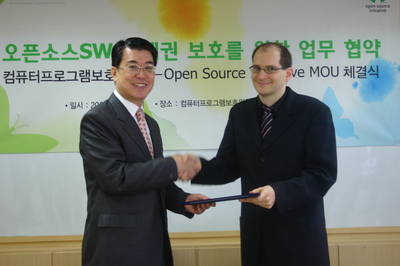
Martin Michlmayr: OSI signs an MOU with the Korea Software Copyright Committee

I visited Seoul last week to represent the Open Source Initiative (OSI) at an open source conference and to sign a Memorandum of Understanding (MOU) with the Korea Software Copyright Committee (SOCOP). SOCOP organized a conference with the title "Free Open Source Software License Insight Conference", and the international speakers included Brett Smith of the FSF, Brendan Scott of Open Source Law, Michael Cot of RedMonk and myself. From the questions we received, it seems that there is a lot of interest in legal questions related to open source. There were a number of folks from hardware companies that asked specific questions what they could do and couldn't do (e.g. related to including sources for GPL code and properly giving credit for BSD code). I think the conference was a great success. The talks were of high value and we got good questions. The audience was quite mixed, ranging from managers to developers. Even though they had simultaneous translation of the talks, the majority of the people listened in English... this gives me hope that some of these folks will end up becoming involved in the international open source community. Mr Koo and Dr Michlmayr signing MOU SOCOP is working on a number of activities related to open source, including: The day after the conference, I went to the SOCOP office to sign the MOU between SOCOP and OSI with Mr Yung Bo Koo, the chairman of SOCOP. The MOU says that we'll share knowledge and expertise, help with promotional activities and support each other's activities in other ways. I was delighted to sign the MOU between SOCOP and OSI, and I look forward to a fruitful cooperation between our organizations in the future. It's great to see so much interest and so many activities around open source in the Republic of Korea.

20 April 2009

Bernd Zeimetz: package build time: cdbs vs dh

Most people (at least those who hear me shouting on irc) probably know that I'm not a fan of cdbs. While working on geoclue, which builds a lot of binary packages I realized, that cdbs wastes an insane amount of time by calling dh_* for every single package. One of the reasons geoclue uses cdbs is that the maintainer likes the short debian/rules file. We'll, compare yourself: cdbs:
#!/usr/bin/make -f
# -*- makefile -*-
# Uncomment this to turn on verbose mode.
#export DH_VERBOSE=1
include /usr/share/cdbs/1/rules/patchsys-quilt.mk
include /usr/share/cdbs/1/rules/debhelper.mk
include /usr/share/cdbs/1/class/autotools.mk
include /usr/share/cdbs/1/rules/utils.mk
common-binary-predeb-arch:: list-missing
clean::
    rm -f providers/gypsy/Makefile
    rm -rf debian/tmp
Build time: dpkg-buildpackage -B 132.20s user 41.52s system 90% cpu 3:11.13 total dh(1):
#!/usr/bin/make -f
# -*- makefile -*-
include /usr/share/quilt/quilt.make
build: $(QUILT_STAMPFN) build-stamp
build-stamp:
    dh build
    touch $@
%:
    dh $@
clean: clean-patched unpatch
clean-patched:
    dh clean
    rm -f providers/gypsy/Makefile
    rm -f build-stamp
.PHONY: patch unpatch clean clean-patched build 
Build time: dpkg-buildpackage -B 85.63s user 32.91s system 91% cpu 2:08.91 total So cdbs wasted about one minute of time using a 2.4 GHz Intel Core2Duo. I'm wondering how much more time it takes on slow architectures like mips(el) and arm(el). One more argument against the unmaintaible mess of makefiles called cdbs.

19 April 2009

Bernd Zeimetz: gimp-plugin-registry updated

Somehow I managed to forget to blog about this for some time - version 2.1-1 of gimp-plugin-registry is available in testing since several days. For detailed changes please have a look in the changelog, for the impatient - here is the summary: As usual let me know if there's a nice plugin you'd like to see in the package.

Biella Coleman: Paris in June (and better with hackers)

/tmp/lab announces the second Hacker Space Festival
(Paris, 26-30 June 2009) Hacker Space Festival 2009 Call For Proposals HSF2009 In 2008, we organized HSF[1] on the spot, as an ad-hoc meeting for
hackerspaces-related networks, technical and artistic research emerging
from them and social questionning arising from them. This sudden
experiment proved to be a huge success, as much as on the
self-organizing level as on the participants and meetings quality, as
well as the emotionally-charged ambient, the kind of which you make
fond memories. The 2008 edition generated a strong emulation in France, from its
historical role as the first official hack meeting there, and in Europe
with the subsequent creation of the Hacker Space Brussels[2], the
rapprochement with The Fiber in Amsterdam and the hackerspaces.org[3]
network. Initiatives of hackerspace openings in Grenoble or Lille, or
the upcoming FrHack[4] conference show an actual enthusiasm in the
French hackers community that was doomed to the underground not so
long ago. We salute these initiatives and their diversity! Soon enough, we wanted to reiterate the HSF experience : however, it
was out of the question to institutionalize this temporary autonomous
zone, nor make it an ersatz of the previous edition, nor even to wrap
it into an elite or underground aura. On the opposite, we ardently
desire; and especially to explore further, in all directions some
lesser known domains (see below) et foster meeting and sharing around
experiences at the confluence of art, technology and politics. The world financial crisis, the decay of democracy in Europe, the
obscurantism, paranoia and lack of culture presiding over legislation
(Internet and Reaction Err Creation Law[5][6]) seem a fertile
environment for the sensible development of new (social ) life forms.
Quick! Let s rest for a few days in jubilation and ecstasy to take a
deep breathe of freedom under the indelicate smells of the medicine
factory nearby! For if the public space is shrinking to oblivion, where any side-step
becomes suspect, and that, from an early age (deviant behavior
detection in nursery school), where moving without a mobile phone
becomes suspect (hello you Julien Coupat[7], a French political
prisoner in France!), there s a domain that the Leviathan would have a
lot of trouble to contain, and for a reason: that of sensitivity. Even
the desperate attempts of the State to block the free and premonitory
expression of sense (hello you Demeure du Chaos![8]) cannot do anything
against a loud laughter or a knowing glance, a sensual kiss or an
explosion of colors. Sensitivity, we could say, is what is left to a human being when she
has nothing anymore, and differenciates her from the body corporate or
the institution, that are, in essence, devoid of it. Therefore, Art
definitely remains the public space to share between humans, and only
between us. And if it the last one to share, we propose to explore it
and take it over during the upcoming edition of the Hacker Space
Festival, from the 26th to 30th of June, 2009 at Vitry sur Seine[9]. ========================================================================
Keynote Speakers: Sergey Grim and Larry Fake with Eric Schmoudt
Groogle Summer of Crode, Survivor style
VLC, I vote against you because you really fucked up when ========================================================================
== W A N T E D ========================================================= Focus on solutions rather than problems. * The Final (Hardware) Frontier: Open FPGA Cores, Reverse Engineering
* Designer Religions and Creative Beliefs Systems
* WiFiDoors & WiFi System-on-Chip controllers firmware hacking,
infection & backdooring
* Telecom Core Network Equipment Reverse Engineering: MSC, STP,
Switches,
* Algebraic Attacks and Modern Cryptography Attacks
* Autonomous, Parasitic and Viral Drones
* Enhanced or Infected Reality Swarms
* Auto-Builders / Self-Fabrication
* Embedded OS breakins stories & recipes
* Actualization rather than mere concepts
* FPGA & ASIC hacking / backdooring
* Cloud+Privacy+Open Source: O Brave New World?
* Explosion-Proof clothing
* Radio Appz & Hackz: Mesh @ RF Layer 1-3
* Database & Privacy
* Problematic & Ethical Open Source/Content Licenses
* Institutional Relationships: Lobbying or Licking?
* Non Lethal Protection (anti-taser vests?)
* Survival in the Age of the Ministry of Immigration and National
Identity
* Mental asylum improvised visit
* Open Source Legacy Media(TM) Production Solutions (TV, Radio, Press,
DRM)
* Gas Sensors & Environmental Benchmarking
* Building Hackerspaces Without Money
* Milsatcomm hacking: Military satellites shots, broken birds in the
sky
* Other research topics on security and insecurity
* Academics and Hackers
* Organics and Fermentation
* Clean Food in Tainted Environment
* Low Impact Energy & Recycling
* Media Sandwich: layers of crap makes good food?
* Deconstructing Carla Sarkozy
* Knitting DIY Factory (jazzy, eh?)
* Signs of life among industrial wasteland
* Hallucinogenic & Computing: Can you Code on Acid?
* Mesh Networking (Wireless BattleMesh Royal!)
* Legal Sabotage: When Democracy Needs You And anything that does not fit. ========================================================================
== P R O P O S E ======================================================= Send you contributions to HSF2009-CFP@lists.tmplab.org + Type of the proposal: 1. conference (45min. presentation + 10min. for questions)
2. workshop / demo (30min. 2 heures)
3. installation / performance (music, plastic, sound, video) Lightning talks can be proposed and organized until the last moment,
according to available space and schedule, in the form of BarCamps or
Blitz Conferences. + Required Information: * Title of the presentation
* Type (see above)
* Language : French or English
* Name of speaker(s)
* Affiliation (organization / company)
* Short biography
* Abstract (5 to 10 lines)
* Topics / Keywords
* Includes a demo? YES NO
* Release during the festival? YES NO
* Internet connection required? YES NO + Acceptable Formats * Open Document
* PDF
* Plain Text
* RTF + Agenda * beginning of proposals : now
* end of proposals : 01 May 2009
* selection notification : 07 May 2009
* publication of program : 15 May 2009 + Evaluation criteria for proposals: 1. Innovating Topic
2. Open Technology
3. Demonstration / Live Act
4. DIY Reproducibility
5. Fun Potential The Programming Committee resembles that of last year
See : http://hackerspace.net/committee ========================================================================
== V E N U E =========================================================== /tmp/lab
6 Bis rue Leon Geffroy
94400 Vitry sur Seine
France http://hackerspace.net/directions ========================================================================
== P A R T I C I P A T E =============================================== Email : http://lists.tmplab.org/listinfo.cgi/hsf2009-talk-tmplab.org
CFPmail: HSF2009-CFP@lists.tmplab.org
IRC : irc://irc.freenode.net/frlab
Jabber : xmpp:hsf2009@space.cepheide.org?join
Wiki : http://hackerspace.net/hsf2009 ========================================================================
== L I N K S =========================================================== The CFP is available online at http://hackerspace.net/cfp [1] http://hackerspace.net/hsf2008
[2] http://hsb.wikidot.com/
[3] http://hackerspaces.org/
[4] http://www.frhack.org/
[5] http://jaimelesautistes.fr/
[6] http://laquadrature.net/
[7] http://fr.wikipedia.org/wiki/Julien_Coupat
[8] http://www.demeureduchaos.org/
[9] http://hackerspace.net/
Philippe Langlois
Email: philippelanglois@free.fr
PGP Key: 8DAEE244

17 April 2009

Jorge Salamero Sanz: New jabberd2 packages, the Debian XMPP team blooms

I ve just uploaded new gsasl, jabberd2 and jabber-muc packages to ftp-master. This is the first release since we moved to git for packging and means a big step for the new Debian XMPP team. I hope this way we can welcome more developers to join the team and improve the Jabber/XMPP status in Debian. This work has been sponsored by my employer in order to improve the jabber module of eBox Platform. BTW, we ll try to release not only Ubuntu packages but also Debian very soon :-).

Erich Schubert: Web data time series

For a research project, I'm looking for some real-world time series data. Time-series are an interesting thing to study, however it is hard to get access to interesting non-trivial real-world data.I was wondering if some people could contribute me some summarized web access data; no URLs or IP addresses.The data I'd like to get can best be explained by the preprocessing step:
...   perl -ne '/\[(\d+\/\w+\/\d 4 :\d\d):\d\d/
&& print $1."\n";'   sort   uniq -c
(Sorry if you aren't fluent in regexp - it extracts the date and hour out of an Apache default log file, nothing else. These lines are then summarized by counting their unique appearances.)That should produce 24 lines per day (one per hour), looking like this:
  count day-of-month/month/year:hour
It would be cool if you could send me some series for a couple of sites, if you happen to be in the position to provide this data. The data should cover at least a few weeks, the longer the better even up to a few years.Too small sites are however not very useful but might be too noisy (so probably not the personal home page of your mom). If you are providing a larger number of series, you are of course free to include them.I don't care much about what the site actually contains, I'd just ask you to give a tiny amount of meta information:Data use:The main project idea is to evaluate different distance metrics in their capability of separting the different data sources, assuming that there is some difference in the shape in these curves. A different problem can be constructed by breaking the series into chunks covering approximately a day and then trying do separate different days, starting hours of the series (or offset server timezone vs. user timezone) and/or weekdays from weekends.In our experiments, we've come to the conclusion that the experimental results are most interesting when there is a sufficient number of classes; so I'd like to get like 20 different interesting data series. At the same time, the series should be long enough, so I can break them into multiple chunks to have a reasonable number of 'sub-series' per class. If I have really long series, or e.g. series covering the same site but from multiple servers, I could even experiment with taking sample of different length from these sets.(Say I have series covering 2 years, that is ~17k samples, from 3 servers, then I can take 51 disjoint sub-series of length 1000, or 102 of length 500, ...)But it's obviously not possible for me to collect this data myself - I don't operate two dozen of such sites myself ...An extra project I've been considering some time is some peak prediction for web accesses. Say you're running some fast growing site, wouldn't it be useful to have a prediction when the number of accesses will likely hit some magical limit (and e.g. overload your server) so you can increase your capacity on time? Of course it would be more sensible to apply this prediction e.g. onto CPU usage, e.g. predicting when your system might hit 90% load average over a 5 minute window in regular operation. Network bandwidth and disk IO also come into mind. You get the idea.Please send them via email to erich.schubert AT gmail comThank you.[P.S. Already recieved the first series, thank you! I can take care of sorting myself, no need to worry about that. And yes, I'm aware that the series will probably all be quite similar - common computer usage patterns such as work hours - but that is common in real world data and part of the challenge. Separting apples from dinosaurs is not a challenge.]

15 April 2009

Pablo Lorenzzoni: rsync logs with restricted ssh

SSH is really the Swiss Army pocket knife of sysadmin tools. When I needed to periodically synchronize log files from an old server (old as in customer-would-never-update-it-or-install-anything-new), I built a simple and secure solution using rsync and ssh. This is what I did: (I will call remote the system where the logs I want to retrieve are, and local system where I want them to be copied to) First I created an account with a restricted shell (ideally this should be a system account, but we ll get there!):

remote# adduser --ingroup nogroup --shell /bin/rbash rlogs
Then locally, I created a new, password-less ssh key pair, copying it to my remote system:

local$ ssh-keygen
>>> When asked where to save it, I chose a different name, like .ssh/rlogs
local$ ssh-copy-id -i .ssh/rlogs.pub rlogs@remote
...
>>> You can delete the password of user rlogs, so it, effectively,
>>> cannot log-in with it (almost like a system user).
remote# passwd -d rlogs
Now you should be able to run password-less rsync already (note that I use -e option to point to a different key):

local$ mkdir logs
local$ rsync -av -e "ssh -i $HOME/.ssh/rlogs" rlogs@remote:"logs/" logs/
receiving file list ... done
./
file1
file2
...
fileN
But even with a restricted shell, I wanted even less possible things to happen. That s what command= directive is for It will only allow that command to be run in a session started by that key. Since rsync translates a lot of its command-line options, I run it again with a dirty ps-in-a-loop in the remote host, just to see what running rsync locally causes remotely:

remote$ while 1; do ps wp $(pgrep rsync); sleep 1; done
...
local$ rsync -av -e "ssh -i $HOME/.ssh/rlogs" rlogs@remote:"logs/" logs/
>>> in the remote loop you should be able to get the command:
  PID TTY      STAT   TIME COMMAND
 6183 ?        Ss     0:00 /usr/bin/rsync --server --sender -vlogDtpre.i . logs/
Here comes the authorized_keys magic. At the remote host I edited .ssh/authorized_keys to add a command= line with what I found out in my dirty loop. Also, I added a couple of directives to restrict it even further (they are pretty self-explanatory):

rlogs@remote$ cat .ssh/authorized_keys
command="rsync --server --sender -vlogDtpre.i . logs/",no-port-forwarding,no-agent-forwarding,no-X11-forwarding,no-pty ssh-rsa (...) myuser@local
Now everything is set. I just added the rsync command to the local crontab and it s done.

Uwe Hermann: Resolving mysterious kernel/firmware problems via apt-get install firmware-linux

If you recently upgraded your kernel to the 2.6.29 Debian package, you might have noticed some (e.g. graphics) drivers stopped working or are working slower. In my case, this was the radeon driver, which inexplicably seemed to cause lots of slowdowns in some applications and games. A quick look into dmesg revealed the reason:
  [drm] Initialized radeon 1.29.0 20080528 on minor 0
  agpgart-intel 0000:00:00.0: AGP 2.0 bridge
  agpgart-intel 0000:00:00.0: putting AGP V2 device into 4x mode
  pci 0000:01:00.0: putting AGP V2 device into 4x mode
  [drm] Setting GART location based on new memory map
  [drm] Loading R200 Microcode
  platform radeon_cp.0: firmware: requesting radeon/R200_cp.bin
  radeon_cp: Failed to load firmware "radeon/R200_cp.bin"
  [drm:radeon_do_init_cp] *ERROR* Failed to load firmware!
As noted in the changelog file, the radeon firmware R200_cp.bin has been removed from the kernel, and is now available in the separate firmware-linux Debian package. So the simple fix for this issues is:
  $ apt-get install firmware-linux
  $ dpkg -L firmware-linux   grep R200_cp.bin
  /lib/firmware/radeon/R200_cp.bin
After restarting X, the dmesg output looks more sane again:
  agpgart-intel 0000:00:00.0: AGP 2.0 bridge
  agpgart-intel 0000:00:00.0: putting AGP V2 device into 4x mode
  pci 0000:01:00.0: putting AGP V2 device into 4x mode
  [drm] Setting GART location based on new memory map
  [drm] Loading R200 Microcode
  platform radeon_cp.0: firmware: requesting radeon/R200_cp.bin
  [drm] writeback test succeeded in 2 usecs

14 April 2009

Biella Coleman: Paris in June (and better with hackers)

========================================================================
/tmp/lab announces the second Hacker Space Festival
(Paris, 26-30 June 2009)
======================================================================== Hacker Space Festival 2009 Call For Proposals HSF2009 In 2008, we organized HSF[1] on the spot, as an ad-hoc meeting for
hackerspaces-related networks, technical and artistic research emerging
from them and social questionning arising from them. This sudden
experiment proved to be a huge success, as much as on the
self-organizing level as on the participants and meetings quality, as
well as the emotionally-charged ambient, the kind of which you make
fond memories. The 2008 edition generated a strong emulation in France, from its
historical role as the first official hack meeting there, and in Europe
with the subsequent creation of the Hacker Space Brussels[2], the
rapprochement with The Fiber in Amsterdam and the hackerspaces.org[3]
network. Initiatives of hackerspace openings in Grenoble or Lille, or
the upcoming FrHack[4] conference show an actual enthusiasm in the
French hackers community that was doomed to the underground not so
long ago. We salute these initiatives and their diversity! Soon enough, we wanted to reiterate the HSF experience : however, it
was out of the question to institutionalize this temporary autonomous
zone, nor make it an ersatz of the previous edition, nor even to wrap
it into an elite or underground aura. On the opposite, we ardently
desire; and especially to explore further, in all directions some
lesser known domains (see below) et foster meeting and sharing around
experiences at the confluence of art, technology and politics. The world financial crisis, the decay of democracy in Europe, the
obscurantism, paranoia and lack of culture presiding over legislation
(Internet and Reaction Err Creation Law[5][6]) seem a fertile
environment for the sensible development of new (social ) life forms.
Quick! Let s rest for a few days in jubilation and ecstasy to take a
deep breathe of freedom under the indelicate smells of the medicine
factory nearby! For if the public space is shrinking to oblivion, where any side-step
becomes suspect, and that, from an early age (deviant behavior
detection in nursery school), where moving without a mobile phone
becomes suspect (hello you Julien Coupat[7], a French political
prisoner in France!), there s a domain that the Leviathan would have a
lot of trouble to contain, and for a reason: that of sensitivity. Even
the desperate attempts of the State to block the free and premonitory
expression of sense (hello you Demeure du Chaos![8]) cannot do anything
against a loud laughter or a knowing glance, a sensual kiss or an
explosion of colors. Sensitivity, we could say, is what is left to a human being when she
has nothing anymore, and differenciates her from the body corporate or
the institution, that are, in essence, devoid of it. Therefore, Art
definitely remains the public space to share between humans, and only
between us. And if it the last one to share, we propose to explore it
and take it over during the upcoming edition of the Hacker Space
Festival, from the 26th to 30th of June, 2009 at Vitry sur Seine[9]. ========================================================================
Keynote Speakers: Sergey Grim and Larry Fake with Eric Schmoudt
Groogle Summer of Crode, Survivor style
VLC, I vote against you because you really fucked up when ========================================================================
== W A N T E D ========================================================= Focus on solutions rather than problems. * The Final (Hardware) Frontier: Open FPGA Cores, Reverse Engineering
* Designer Religions and Creative Beliefs Systems
* WiFiDoors & WiFi System-on-Chip controllers firmware hacking,
infection & backdooring
* Telecom Core Network Equipment Reverse Engineering: MSC, STP,
Switches,
* Algebraic Attacks and Modern Cryptography Attacks
* Autonomous, Parasitic and Viral Drones
* Enhanced or Infected Reality Swarms
* Auto-Builders / Self-Fabrication
* Embedded OS breakins stories & recipes
* Actualization rather than mere concepts
* FPGA & ASIC hacking / backdooring
* Cloud+Privacy+Open Source: O Brave New World?
* Explosion-Proof clothing
* Radio Appz & Hackz: Mesh @ RF Layer 1-3
* Database & Privacy
* Problematic & Ethical Open Source/Content Licenses
* Institutional Relationships: Lobbying or Licking?
* Non Lethal Protection (anti-taser vests?)
* Survival in the Age of the Ministry of Immigration and National
Identity
* Mental asylum improvised visit
* Open Source Legacy Media(TM) Production Solutions (TV, Radio, Press,
DRM)
* Gas Sensors & Environmental Benchmarking
* Building Hackerspaces Without Money
* Milsatcomm hacking: Military satellites shots, broken birds in the
sky
* Other research topics on security and insecurity
* Academics and Hackers
* Organics and Fermentation
* Clean Food in Tainted Environment
* Low Impact Energy & Recycling
* Media Sandwich: layers of crap makes good food?
* Deconstructing Carla Sarkozy
* Knitting DIY Factory (jazzy, eh?)
* Signs of life among industrial wasteland
* Hallucinogenic & Computing: Can you Code on Acid?
* Mesh Networking (Wireless BattleMesh Royal!)
* Legal Sabotage: When Democracy Needs You And anything that does not fit. ========================================================================
== P R O P O S E ======================================================= Send you contributions to HSF2009-CFP@lists.tmplab.org + Type of the proposal: 1. conference (45min. presentation + 10min. for questions)
2. workshop / demo (30min. 2 heures)
3. installation / performance (music, plastic, sound, video) Lightning talks can be proposed and organized until the last moment,
according to available space and schedule, in the form of BarCamps or
Blitz Conferences. + Required Information: * Title of the presentation
* Type (see above)
* Language : French or English
* Name of speaker(s)
* Affiliation (organization / company)
* Short biography
* Abstract (5 to 10 lines)
* Topics / Keywords
* Includes a demo? YES NO
* Release during the festival? YES NO
* Internet connection required? YES NO + Acceptable Formats * Open Document
* PDF
* Plain Text
* RTF + Agenda * beginning of proposals : now
* end of proposals : 01 May 2009
* selection notification : 07 May 2009
* publication of program : 15 May 2009 + Evaluation criteria for proposals: 1. Innovating Topic
2. Open Technology
3. Demonstration / Live Act
4. DIY Reproducibility
5. Fun Potential The Programming Committee resembles that of last year
See : http://hackerspace.net/committee ========================================================================
== V E N U E =========================================================== /tmp/lab
6 Bis rue Leon Geffroy
94400 Vitry sur Seine
France http://hackerspace.net/directions ========================================================================
== P A R T I C I P A T E =============================================== Email : http://lists.tmplab.org/listinfo.cgi/hsf2009-talk-tmplab.org
CFPmail: HSF2009-CFP@lists.tmplab.org
IRC : irc://irc.freenode.net/frlab
Jabber : xmpp:hsf2009@space.cepheide.org?join
Wiki : http://hackerspace.net/hsf2009 ========================================================================
== L I N K S =========================================================== The CFP is available online at http://hackerspace.net/cfp [1] http://hackerspace.net/hsf2008
[2] http://hsb.wikidot.com/
[3] http://hackerspaces.org/
[4] http://www.frhack.org/
[5] http://jaimelesautistes.fr/
[6] http://laquadrature.net/
[7] http://fr.wikipedia.org/wiki/Julien_Coupat
[8] http://www.demeureduchaos.org/
[9] http://hackerspace.net/
Philippe Langlois
Email: philippelanglois@free.fr
PGP Key: 8DAEE244

12 April 2009

John Goerzen: Flowers, Music, and Grandparents

Flowers I ve written a lot lately about my Grandma Klassen, who passed away this week. But I m going to start this post about my Grandma Goerzen. She died when I was just an infant. I never knew her, but as the years pass, it seems that I remember her better and better. After we moved out to the farm where she and Grandpa Goerzen lived for decades, we noticed some flowers she had planted 30 years ago were still coming up, having withstood hail, hot summers, frost, construction equipment, and neglect all that time. Terah said, It s like your grandma left us a housewarming gift. Some of these flowers had never bloomed. Until this week. One bloomed for the first time the day Grandma Klassen died. A second bloom appeared the day of her funeral. Music #1 My jr. high and high school band teacher loves music (and old engines, but that s another story). You couldn t sign up for band at my high school; you d sign up for the class called LIFE. To him, music and life are indistinguishable. He says that anybody can speak to somebody, but music is the best way to speak to the heart. My Grandpa Klassen died when I was 11. Grandma Klassen, before her health declined, loved to tell me the story of the music at his funeral. At his funeral, my mom and I played a piano duet of Nearer, My God to Thee which we had already learned for a different event. When we were done, Rev. Epp went to the pulpit and said something along the lines of, If the music in heaven is as good as that, it ll be a great place indeed. I was just 11, and though music did speak to me at that age already, I don t think I understood how it moved people, such as my grandma, until many years later. Music #2 Grandma Klassen loved music, too, and that s reflected in each of her children all of them play trumpet, for instance. So it s no surprise that there was a lot of music this week. She died as two of her children were singing hymns to her at her room in the nursing home. Two of her grandchildren played trumpet for her at her burial. And my brother and his wife played trumpet and piano at her funeral. It was all beautiful, and like my band teacher said, it spoke to my heart. Music #3 I knew about gradma s love of music for quite awhile. When she was in better health, I took her to concerts sometimes. One of her favorite hymns was Joyful, Joyful, but she hadn t known it was based on Beethoven s 9th Symphony. I learned that the Wichita Symphony Orchestra was performing the 9th, and took her to the performance. She loved it, and I seem to recall that she kept talking about it for a few years afterwards. It certainly didn t hurt that the singing on the 4th movement was in German. I burned her a new-fangled CD of it, which I frequently saw in or near her CD player. The Kansas Mennonite Men s Chorus is an all-volunteer choir with about 300 members. They give a couple of concerts a year, and occasionally tour throughout North America and Europe. Their motto is we sing that others may live because 100% of money collected at their concerts goes directly to charity. Attending one of their concerts is a powerful experience not easily forgotten. I think the only time I ve heard a choir come close to being as amazing as that was when I had the opportunity to attend a Robert Shaw concert a few years ago. I went with grandma to one of the Kansas Mennonite Men s Chorus performances a few years ago. As you might expect, she loved it I think she called it powerfully good. This year, I finally joined the choir. I still remember that first practice. We warmed up by singing Holy God, We Praise Thy Name a song that has opened every KMMC concert for years. These people hadn t sung together for almost a year, and there were plenty of new people like me there too. But it only took a few bars of singing before I realized just what it was I had joined. The choir started out with the quietest, but most powerful singing you can imagine: Holy God, we praise thy name. By the time we got to the end of the page, the building was ringing from 300 men singing Infinite thy vast domain, everlasting is thy reign! at the top of their voices, in perfect harmony. We got to the end. The director said. . . Wow. I don t think a first practice ever spoke to my heart before that day. Music #4 Nearly 20 years ago, Grandma Klassen bought me a new bible. After she gave it to me, I asked her what some of her favorite passages were. She took me straight to the blessing in Numbers 6, and made sure I underlined it and bookmarked it. It goes like this:
The Lord bless you,
The Lord keep you,
Make his face to shine upon you and be gracious unto you,
The Lord life up his countenance upon you and give you peace.
My uncle had read this blessing to her the last time he talked to her. And the KMMC for years has ended their concerts with a beautiful benediction based on this passage. Grandma heard it at the concert I attended with her. It has been a favorite of my mom for years, too. So I had the thought: we really ought to sing it as a benediction at her funeral. It was hard to find the right mix of people on short notice, but we wound up with me singing baritone, my brother singing 2nd tenor (we both normally sing bass), and his wife both playing piano and singing 1st tenor, and relying on the piano to fill in the bass part. We had a little chance to practice before the funeral, but not a lot. The two of them have done a lot musically, but I haven t nearly as much, so I got in some extra practice at home, too. When it came time to sing, it was an emotional moment for sure more than a bit hard to focus, knowing the history and meaning of these words. When we got to and give you peace , and moved into the chorus of amen that finishes the song, I almost broke down right there, but didn t quite. We didn t give a perfect performance, for sure, on such short notice. (And they had me singing with them, so we wouldn t have been perfect even with plenty of notice!) But it didn t have to be perfect. After we ended the last, quiet amen , I think I heard about a half-dozen noses blowing all at once. My band teacher was right about music speaking to the heart. Later, during lunch, my aunt said to me, Wow, John, I ve never heard you sing before! That s right, and this may be the last time you hear me sing, too! I don t normally sing in a small group like this. A few minutes later, my uncle that gave the message came over and talked to the three of us. John, today you three brainwashed me. Oh? Yes. For years, I thought that there was no music as beautiful as the trumpet. After hearing you three sing, I have to reconsider. And so my band teacher was also right: music is life. My grandma was a person that could hardly speak without touching the heart. That beautiful melody of her life didn t stop when she died Tuesday afternoon. I ve been hearing it all week.

10 April 2009

Eddy Petrișor: Is Romania part of the European Union?

This is a really slim and really incomplete description of the events turning really bad for Romania and severely bad for Moldavian civilians.
Are we living in a parallel world? What interests would Romania have to ever consider that it would be involved in this? Moldavia is the poorest country in Europe, has huge problems with justice, corruption, criminal activity, social security, border security (Transdnistria) and other issues which Romania does NOT want to import since we're already in a bad position by ourselves!


WHAT THE HELL IS EU DOING? Romania is a member of the EU and it seems all the attacks against Romania are not addressed in any way by the EU, on the contrary, EU members either assist passively, look the other way or even allow us to understand that indeed they think Romania is involved.

Obey Arthur Liu: Google Summer of Code 2009: Debian s Shortlist

Copy of http://lists.debian.org/debian-devel/2009/04/msg00421.html. Hi folks, We have been pretty busy these past few weeks with the whole Google Summer of Code 2009 student application process.
I can say that we have this year a very good set of proposals and I d like to thank all the students and mentors for this. I am going to present to you our shortlist of projects that we would like to be funded and believe we can reasonably manage to get funded. As always, remember that the number of slots is not final yet at this point so we can t promise anything. The first preliminary slot count given today was *10* (same as last year) and we hope to get *2* more (as we did last year). This shortlist is alphabetically ordered because we don t want to reveal the current internal rankings. I am inviting you to debate what you think is cool, what is useful, what is important to Debian, maybe give us pointers to resources or people that could be helpful for the projects. We will try to alter our current rankings to reflect the zeitgeist in Debian, while taking into account the personal information that we have about each student involved. The deadline for any modification is on the 15th, so get everything in by the 14th. The final selected projects will be announced by Google April 20th, ~12 noon PDT / 19:00 UTC. We ll have another announcement then. Three proposals need or may need a mentor, I indicated it. For more information about the projects or mentoring and how to talk to us directly, scroll down past the list. Debian s Shortlist : - Aptitude Package Management History Tracking
- Automatic Debug Packages Creation and Handling
- Debbugs Web UI: Amancay Strikes Back
- Control Files Parsing/Editing Library/Qt4-Debconf Qt4-Perl bindings
- Debian-Installer Support for GNU/kFreeBSD
- KDE/Qt4 Adept 3.0 Package Manager
- Large Scientific Dataset Package Management
- MIPS N32 ABI Port
- MTD Embedded Onboard flash Partitioning and Installation
- On-demand Cloud Computing with Amazon EC2 and Eucalyptus Integration
- Port back update-manager to Debian and all Derivatives
- Debian Autobuilding Infrastructure Rewrite And the details: Aptitude Package Management History Tracking Student: Cristian Mauricio Porras Duarte, Mentor: Daniel Burrows Aptitude currently does not track actions that the user has performed beyond a single session of the program. One of the most frequent requests from users is to find out when they made a change to a package, or why a package was changed; we want to store this information and expose it in the UI in convenient locations. As a side effect, this might also provide some ability to revert past changes. Automatic Debug Packages Creation and Handling Student: Emilio Pozuelo Monfort, Mentor: Marc Brockschmidt This proposal aims at providing debug binary packages for the packages in the Debian archive in an automatic manner, moving them away from the official Debian archive to an special one. This has the benefits of providing thousands of debug packages without any work needed from the developers, for all the architectures, without bloating
the archive. Debbugs Web UI: Amancay Strikes Back Student: Diego Escalante Urrelo, Mentor: Margarita Manterola The Amancay project aims to be a new read/write web frontend to Debian s BTS; allowing DDs and contributors to easily interact with bugs via an intuitive yet powerful interface, enabling new workflows and creating new contribution opportunities like triaging while upholding reporting quality. Control Files Parsing/Editing Library/Qt4-Debconf Qt4-Perl bindings Student: Jonathan Yu, Mentor: (probably) Dominique Dumont see below This project proposes a common library for parsing and manipulating Debian Control files, including control, copyright and changelog. Main ideas include validating and parsing of these files, with both Strict and Quirks modes for the parser. The second idea is a new frontend for Debconf using Qt4 (for which Perl bindings will be written). Debian-Installer Support for GNU/kFreeBSD Student: Luca Favatella, Mentor: Aurelien Jarno GNU/kFreeBSD is currently using a hacked version of the FreeBSD installer combined with crosshurd as its own installer. While this works more or less correctly for standard installations (read: the exact same installation as in the documentation), it does not allow any changes in the installation process except the hard disk partitioning. This project is about porting debian-installer on GNU/kFreeBSD, and to a bigger extent, make debian-installer less Linux dependant. KDE/Qt4 Adept 3.0 Package Manager Student: Mateusz Marek, Mentor: NEEDS MENTOR, see below. Finish Adept 3.0, a fully integrated package manager for Qt4/KDE4. Adept is currently the only viable path to a Debian native package manager on KDE that would support modern features such as tags, indexed search or good conflict resolving. With Aptitude-gtk still in development and only available for GTK+ and (K)PackageKit having fundamental problems, Debian needs this project to stay in control of its package management on KDE after much neglect in the recent years. Large Scientific Dataset Package Management Student: Roy Flemming Hvaara, Mentor: Charles Plessy Large public datasets, like databases for bioinformatics are typically too big and too volatile to fit the traditional source/binary packaging scheme of Debian. There are some programs that are distributed in Debian, like blast and emboss, that can index specialised databases, but Debian lacks a tool to install or update the datasets they need and keep their indexing in sync. MIPS N32 ABI Port Student: Sha Liu, Mentor: Anthony Fok This project first focuses on creating a new MIPS N32 ABI port for Debian. Different from O32 and N64, N32 is an address model which has most 64-bit capabilities but using 32-bit data structures to save space and process time. A second focus will be given on making such a mipsn32el arch fully optimized for the Loongson 2F CPU which gains more and more popularity in subnotebooks/netbooks in many countries. MTD Embedded Onboard flash Partitioning and Installation Student: Per Andersson, Mentor: Wookey Many embedded devices have MTD onboard flash as persistent storage like the Kurobox Pro NAS, the Neo Freerunner, the Sheeva Plug or the OLPC. With MTD flash being so popular and with increases in capacity, support for MTD partition/installation would make Debian even more interesting to a wide range of of devices, making it one step closer to being universal. On-demand Cloud Computing with Amazon EC2 and Eucalyptus Integration Student: David Wendt Jr, Mentor: (probably) Steffen Moeller see below In many academic fields, as well as commercial industries, people use clusters to distribute tasks among multiple machines. Many times this is done by packaging a whole operating system disk image, uploading it onto the cluster, and having the cluster run it in a VM. This project intends to make it easier for Debian to distribute prepared disk images templates like they distribute CD images now, for the users to recreate or customise these templates with Debian packages and for administrators to host such clusters with Debian. Port back update-manager to Debian and all Derivatives Student: Stephan Peijnik, Mentor: Michael Vogt The project would involve taking the distribution-(Ubuntu-)specific update-manager code, analyzing it, and creating a package with just its core functionality, decoupling the distribution-specific parts and thus making the core code extensible by distribution-specific add-ons. This in turn would remove the need of porting update-manager to Debian with every upstream release. An additional optional goal would be replacing the synaptics-backend with a python-apt based one. Debian Autobuilding Infrastructure Rewrite Student: Philipp Kern, Mentor: Luk Claes Rewrite the software that currently runs the Debian autobuilding infrastructure in a way that makes it more maintainable and robust. It will use Python as its programming language and PostgreSQL for the database backend. By harmonizing buildds, many build failures can be prevented and wasteful workload on buildd volunteers can be reduced. On mentoring: Petr Rockai, the original developer of Adept has offered help to anyone willing to adopt Adept. Sune Vuorela has offered help for any Qt4 and KDE related issues. *We really need a mentor here*. The student is quite competent but Google dictates that we provide a mentor to handle student management. Dominique Dumont, although not DD, has signaled interest in mentoring this, although it hasn t been confirmed yet. Sune Vuorela has offered to help co-mentor for the Qt4-Debconf and Qt4-Perl bindings part. Steffen Moeller has signaled interest in mentoring this, although it hasn t been formally confirmed yet. Charles Plessy of the Debian Med team will provide help for use cases related issues. Eric Hammond, developer of the original vmbuilder image creation tool and maintainer of a set of Debian and Ubuntu images will provide help for Amazon EC2 and image creation issues. Chris Grzegorczyk from the Eucalyptus team will provide help for Eucalyptus and Eucalyptus/Debian integration issues. Contacting us: Considering the tight schedule, most stuff happens live on IRC: #debian-soc on irc.debian.org You can also consult our wiki page for some additional information:
<http://wiki.debian.org/SummerOfCode2009> We have a mailing-list at:
<http://lists.alioth.debian.org/mailman/listinfo/soc-coordination> Keep this discussion on debian-devel@lists.debian.org while cc-ing soc-coordination@lists.alioth.debian.org. This thread is for debian-devel primarily.

8 April 2009

Marc 'Zugschlus' Haber: partition table gone, data still present

I just wanted to make an USB stick bootable and wondered why mkdiskimage -4 /dev/sda 0 32 64 complained about the disk having too many cylinders. After a few moments, it ocurred to me that since libata, the system hard disk has become sda and that the stick was sdb or sdc. One ctrl-C later, fdisk confirmed both counts: That I accidentally started mkdiskimaging my main system hard disk and that the partition table was already gone. A few hours later, the notebook is back in business without too much data loss. Lucky me. My notebook has an alibi installation of Windows XP in its first primary partition sized 4 GB. Since I aborted the mkdiskimage process early enough, I hoped that only the windows installation was hosed. The Linux system is entirely in LVM (with crypted LVs), and LVM hadn t noticed yet that its PV was gone. I reckoned that I still had a chance to rescue my data if I didn t reboot. So I hastily commandeered an USB hard disk (thanks, $CUSTOMER, for quickly supplying one), fdisked, pvcreated and vgextended it and started the pvmove. While this was happening, I theoretically was able to continue working, which I didn t because I was afraid of losing. About half an hour into the copy process, the USB disk chose to deregister itself and the pvmove aborted. Rebooting the disk made it reappear as sde (it was sdd before), and miraculously, a new pvmove call just worked. However, a good fraction of actions on the shell resulted in a lot of input/output errors on the screen. I guessed that this was the first sign of my data finally dying, but I let the pvmove continue. After the pvmove was finished (which was rather fast since the move of the crypted LV means that the crypted data is moved and not de- and recrypted), I had to recreate a /dev/sda2 partition with type 8e before the LVM tools allowed me to vgreduce the VG. I then zeroed out the first 10 GB of the internal disk and spent a few hours reinstalling and patching XP from scratch before I finally went through the pvcreate, vgextend, pvmove routine in the other direction. Then the big moment arrived: fsck of all LVs. I guess that the reason for the input/output errors was that /usr was completely hosed (no single file outside lost+found), but /home and all other file systems holding data where the way back to the (a week old) backup would have been quite painful were ok. I pulled /, /usr and /var from the backup to be consistent again, updated to current sid (avoiding KDE 4 for the time being) and could start working again. The only real loss was a few hours of work that were stored in /usr/local which died along with /usr, so the result of my stupidity was not very catastrophic but still a good lesson. And I have learned that LVM is a robust and resilient beast. Good work. Now I d like to know what happened to my /usr - I always had the impression that pvmove should not break data even when the target disk suddenly goes away...
Mike Hommey: Detecting per-process namespaces

Back with per-process namespaces. This time, I will give several methods to more or less reliably detect their use, some requiring root access, some not. We will, though, limit ourselves to mount namespaces , that is, not PID, UTS or network namespaces. The first method, which is based on the contents of /proc/pid/mounts should work on any kernel supporting namespaces (since 2.4.19):
$ md5sum /proc/[0-9]*/mounts awk -F [ /]* ns[$1] = ns[$1] ? ns[$1] , $3 : $3 END for (n in ns) print n, ns[n]
/proc/[0-9]* is used instead of /proc/* to avoid listing self, too. The awk script displays a summary : a md5 sum followed by the PID of all processes which /proc/self/mounts file has this md5 sum.
This method relies on the fact that the /proc/pid/mounts files may be different between namespaces, even when the same mount points are used because the ordering may differ. This method is obviously unreliable, except when all namespaces have different mount points. During my tests, it has been reliable to detect whether a process uses the same namespace as the init process, but different processes with different namespaces were reliably listed together as having the same namespace. The next method, based on the contents of /proc/pid/mountinfo will work on any kernel implementing this file (since 2.6.26):
$ md5sum /proc/[0-9]*/mountinfo awk -F [ /]* ns[$1] = ns[$1] ? ns[$1] , $3 : $3 END for (n in ns) print n, ns[n]
The script is essentially the same, only pointing at mountinfo instead of mounts.
This method is quite reliable, as /proc/pid/mountinfo does contain different information even when no mount point was changed within a namespace. Unfortunately, chrooted processes can have a different content while not being in a separate namespace. I ve not investigated further, but you may be able to spot chrooted processes by comparing /proc/pid/mountinfo and /proc/pid/mounts. Both the above methods can be executed as unprivileged user, which alleviates the fact they are not totally reliable. The last method, on the other hand, is reliable, but requires root privileges, and cgroup filesystem support in the kernel (since 2.6.24).
$ mkdir -p /dev/cgroup/ns
$ mount -t cgroup -o ns /dev/cgroup/ns
$ find /dev/cgroup/ns -name tasks xargs -l1 sed ':a;N;s/\n/,/g;ta'
The output here is a group of PID on separate lines for separate namespaces. The sed one-liner replaces all carriage returns in the tasks files with a comma.
You don t actually need root privileges for the last command, if the cgroup filesystem is already mounted. But there has been no normalization as to where the cgroup filesystems should be mounted yet, and they aren t mounted by default on most GNU/Linux distributions, I believe. Cgroups (Control groups) allow to put sets of processes together to give them special behaviour (cpu provisioning, memory limitations, namespaces, etc.). They also allow to do so in a hierarchical way, such that a cgroup can inherit the properties of its parent cgroup. As its name and the way it is mounted indicates, our /dev/cgroup/ns is specialized for namespaces cgroups. The directory itself contains a few files, most notably a tasks file containing a list of processes in the current set/cgroup (in our case, namespace). It also contains a subdirectory for each child namespace. Each of these subdirectories is similarly structured, so that it also contains a tasks list and possible subdirectories for its own children. This means that not only can you spot different namespaces, but you can also spot how they relate to each other. There are a few glitches, though. As with other cgroups subsystems, you can create new cgroups by creating a directory in the cgroup filesystem, but it happens not to create a new namespace in the case of the namespace subsystem. With all the kind of namespaces that now exist in Linux, this is not a big surprise, but there doesn t seem to be neither a feedback in the cgroup filesystem to know what kind of namespace is involved, nor a control to force creation of a really separate namespace. You also can t move processes from one mount namespace into another by writing a PID in the tasks file in a given namespace ; that just gives an Operation not permitted error. On the other hand, contrary to the second method, chrooted processes are not separated out. I will investigate further cgroups with PID, UTS and network namespaces and will post my findings.

David Welton: New LangPop.com stats, open source bits and pieces

I released some new statistics on LangPop.com. There are some new things:
  • The normalized results are now user configurable - you can put in your own weights for the various data sources (such as Amazon, Craigslist, and so on), and see how the results change.
  • Freshmeat.net fiddled with their web site, and statistics are not going to be available this month. Hopefully they will be able to correct the problem soon.
  • On the other hand, I wrote some code to grab the data from Ohloh, so there's something new to look at while we wait for Freshmeat to come back on line.
So there is a fair amount going on. Hopefully Freshmeat will come back soon, and I can also add a few fixes to the IRC statistics which I've been thinking about. In the process of doing the above, I also managed to do some open source work, albeit of a minor nature:
  • I updated LangPop.com to use the Flotr Javascript chart library instead of Plotr. So I also updated my Ruby code to integrate it. It's a fairly thin layer at this point, but it does what I need. It's available here: http://github.com/davidw/chartr/tree/master
  • I did some hacking on the Simile Timeline code, (used here on LangPop.com), correcting a bug, and also creating a system to install the whole thing with a simple command. Normally, it's kind of difficult to just use the Simile code on your own site, so I created an (admittedly hacky) way of making it easier to install. That code is here: http://github.com/davidw/standalone-timeplot/tree/master
Oh, yeah, and we moved from Innsbruck, Austria back to Padova, Italy!

John Goerzen: Goodbye

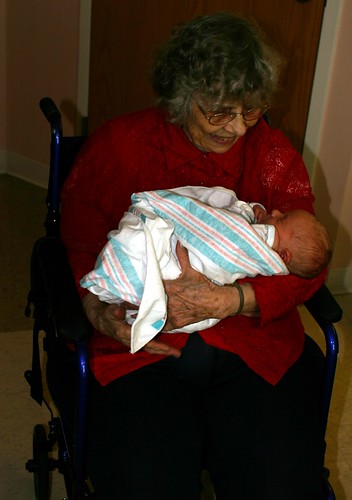
Jacob has lately been telling us gate gamma kassen so sick (Great Grandma Klassen is so sick), after his visit to the hospital, and it s true. Today started normal enough, but by 2:45 I got an email from my mom, saying that grandma had taken yet another turn for the worse; her pulse was racing, her temperature feverish, and her breathing shallow and difficult. The last grandchild that was going to be there made it, and got the last flicker of recognition from grandma. I wrapped some things up at work. Then I made the short drive from work to the nursing home, and got there just after 4. I went in to her room there, and it was full of family. Two of her children were singing her favorite hymns. I can never forget my uncle s deep bass voice as he stood at her bedside, holding her arm, while my aunt patted her head, both of them singing. Grandma s only remaining sibling, her younger brother Melvin, sat on the other side of the bed, looking on. Grandma s white table and chairs, which were in grandma and grandpa s house as long as I can remember, and followed grandma through all of the four other places she lived in the last years of her life, were in her room at the nursing home too. It always felt like home to be with grandma and those familiar things that she always took with her. Despite what was happening, I was glad she was back at home. My uncle motioned me over to her bedside, and I took her hand for a few minutes. It felt cold and weak; for the first time, she didn t grab my hand at all. A nurse came in to check oxygen saturation, but the machine wasn t able to get a reading due to poor circulation to her hand. She wasn t able to get a heart rate either because the heart was racing so fast. She discussed briefly whether the family wanted them to continue giving her oxygen, and they decided that they would, for her comfort. My uncle and aunt kept singing. I blew my nose and dabbed at my eyes, and there were hugs all around. And just a few minutes later, grandma peacefully stopped breathing, maybe 20 minutes after I had arrived. They went to get the nurse, who came back to listen to grandma s heart again, though we knew what she would find. She took the stethoscope off, and she almost lost her composure, but managed to say you can turn the oxygen off now. Several people gave grandma a last hug. After a few minutes with just the family, they told the nurses to go ahead and call the funeral home. That set off a lot of activity making arrangements for the next few days, funeral plans, and the like. I stepped back into grandma s room a few times, while the family was in the sitting area right outside it discussing. I looked around at the family photos on the wall, the old table and chairs, the recliner. Now, these are the things that were grandma s. It didn t feel like home anymore. Terah and Jacob were stuck at home Terah s car was at the mechanic for repair today. I called to give her the news. She wanted to come to be with the family, but I didn t really want to leave. She tried calling some friends to see if they could give her a lift to the mechanic, but not one of them was available. I talked to her again and suggested she just call the mechanic. She wasn t even halfway through describing the situation when he interrupted with, We ll have it at your place right away! Well, I don t expect you to have to do that, or you could certainly wait until you close. Nope, this isn t your average community, we ll bring it right over. You should be there. Grandma has enjoyed a simple life and had requested a simple death: no extraordinary measures at the end of life, no embalming either. So, by law, the burial must happen within 24 hours of death, and will be tomorrow. After all the arrangements, people realized nobody had supper yet. We went to the quickest available option pizza and ate there. It was paid for out of grandma s remaining money the last meal of so many that she provided for her family over the years. It was a happy meal. As I drove home, NPR news was on the radio. There were the same stories we hear all the time: the economy, the mideast, the president. Normally I m interested, but today I shut it off. Today is different. Tomorrow, for the second time in four years, I will help carry a grandparent s casket a few days before Easter. I ll end tonight with this photo. It was taken soon after Jacob was born. Grandma came to the hospital and held him. That smile sums her up perfectly. img_4965r.jpg

Next.

Previous.