Search Results: "xam"

29 September 2013

Dirk Eddelbuettel: Rcpp 0.10.5

A new version of Rcpp is now on the CRAN network for GNU R; binaries for Debian have been uploaded as well. Once more, this release brings a large number of exciting changes to Rcpp. Some concern usability, some bring new features, some increase performance; see below for the detailed list. We have now released three updates on a quarterly cycle; if we keep this up the next version ought to be ready at the end of December. As in the past, we tested the release rather rigorously by checking against all packages I could (relatively easily) built on my server: this time it successfully passed \code R CMD check for all 107 packages I can build locally out of a total of 136 packages. (Two failed: one for an error in \code Makevars , and one for the need of an X11 server during tests; this may get addressed in the in test script next time). As all of these 107 packages passed, we do not expect any issues with dependent packages. Should there be issues we would appreciate a note, preferably with reproducible code, to the rcpp-devel mailing list. The complete NEWS entry for 0.10.4 is below; more details are in the ChangeLog file in the package and on the Rcpp Changelog page.
Changes in Rcpp version 0.10.5 (2013-09-28)
  • Changes in R code:
    • New R function demangle that calls the DEMANGLE macro.
    • New R function sizeof to query the byte size of a type. This returns an object of S3 class bytes that has a print method showing bytes and bits.
  • Changes in Rcpp API:
    • Add defined(__sun) to lists of operating systems to test for when checking for lack of backtrace() needed for stack traces.
    • as<T*>, as<const T*>, as<T&> and as<const T&> are now supported, when T is a class exposed by modules, i.e. with RCPP_EXPOSED_CLASS
    • DoubleVector as been added as an alias to NumericVector
    • New template function is<T> to identify if an R object can be seen as a T. For example is<DataFrame>(x). This is a building block for more expressive dispatch in various places (modules and attributes functions).
    • wrap can now handle more types, i.e. types that iterate over std::pair<const KEY, VALUE> where KEY can be converted to a String and VALUE is either a primitive type (int, double) or a type that wraps. Examples :
      • std::map<int, double> : we can make a String from an int, and double is primitive
      • boost::unordered_map<double, std::vector<double> >: we can make a String from a double and std::vector<double> can wrap itself
      Other examples of this are included at the end of the wrap unit test file (runit.wrap.R and wrap.cpp).
    • wrap now handles containers of classes handled by modules. e.g. if you expose a class Foo via modules, then you can wrap vector<Foo>, ... An example is included in the wrap unit test file.
    • RcppLdFlags(), often used in Makevars files of packages using Rcpp, is now exported from the package namespace.
  • Changes in Attributes:
    • Objects exported by a module (i.e. by a RCPP_MODULE call in a file that is processed by sourceCpp) are now directly available in the environment. We used to make the module object available, which was less useful.
    • A plugin for openmp has been added to support use of OpenMP.
    • Rcpp::export now takes advantage of the more flexible as<>, handling constness and referenceness of the input types. For users, it means that for the parameters of function exported by modules, we can now use references, pointers and const versions of them. The file Module.cpp file has an example.
    • No longer call non-exported functions from the tools package
    • No longer search the inline package as a fallback when loading plugins for the the Rcpp::plugins attribute.
  • Changes in Modules:
    • We can now expose functions and methods that take T& or const T& as arguments. In these situations objects are no longer copied as they used to be.
  • Changes in sugar:
    • is_na supports classes DatetimeVector and DateVector
  • Changes in Rcpp documentation:
    • The vignettes have been moved from inst/doc/ to the vignettes directory which is now preferred.
    • The appearance of the vignettes has been refreshed by switching to the Bistream Charter font, and microtype package.
  • Deprecation of RCPP_FUNCTION_*:
    • The macros from the preprocessor_generated.h file have been deprecated. They are still available, but they print a message in addition to their expected behavior.
    • The macros will be permanently removed in the first Rcpp release after July 2014.
    • Users of these macros should start replacing them with more up-to-date code, such as using 'Rcpp attributes' or 'Rcpp modules'.
Thanks to CRANberries, you can also look at a diff to the previous release 0.10.4. As always, even fuller details are on the Rcpp Changelog page and the Rcpp page which also leads to the downloads, the browseable doxygen docs and zip files of doxygen output for the standard formats. A local directory has source and documentation too. Questions, comments etc should go to the rcpp-devel mailing list off the R-Forge page

27 September 2013

Erich Schubert: Big Data madness and reality

"Big Data" has been hyped a lot, and due to this now is burning down to get some reality checking. It's been already overdue, but it is now happening.
I have seen a lot of people be very excited about NoSQL databases; and these databases do have their use cases. However, you just cannot put everything into NoSQL mode and expect it to just work. That is why we have recently seen NewSQL databases, query languages for NoSQL databases etc. - and in fact, they all move towards relational database management again.
Sound new database systems seem to be mostly made up of three aspects: in-memory optimization instead of optimizing for on-disk operation (memory just has become a lot cheaper the last 10 years), the execution of queries on the servers that store the actual data (you may want to call this "stored procedures" if you like SQL, or "map-reduce" if you like buzzwords), and optimized memory layouts (many of the benefits of "colum store" databases come from having a single, often primitive, datatype for the full column to scan, instead of alternating datatypes in records.

However, here is one point you need to consider:
is your data actually this "big"? Big as in: Google scale.
I see people use big data and Hadoop a lot when they just shouldn't. I see a lot of people run Hadoop in a VM on their laptop. Ouch.
The big data technologies are not a one-size-fits-all solution. They are the supersize-me solution, and supersize just does not fit every task.
When you look at the cases where Hadoop is really successful, it is mostly in keeping the original raw data, and enabling people to re-scan the full data again when e.g. their requirements changed. This is where Hadoop is really good at: managing 100 TB of data, and allowing you to quickly filter out the few GB that you really need for your current task.
For the actual analysis - or when you don't have 100 TB, and a large cluster anyway - then just don't try to hadoopify everything.
Here is a raw number from a current experiment. I have a student work on indexing image data; he is implementing some state of the art techniques. For these, a large number of image features are extracted, and then clustering is used to find "typical" features to improve image search.
The benchmarking image set is 56 GB (I have others with 2 TB to use next). The subset the student is currently processing is 13 GB. Extracting 2.3 million 128 dimensional feature vectors reduces this to about 1.4 GB. As you can see, the numbers drop quickly.
State of the art seems to be to load the data into Hadoop, and run clustering (actually, this is more of a vector quantization than clustering) into 1000 groups. Mahout is the obvious candidate to run this on Hadoop.
However, as I've put a lot of effort into the data mining software ELKI, I considered also to try processing it in ELKI.
By cutting the data into 10 MB blocks, Mahout/Hadoop can run the clustering in 52x parallel mappers. k-Means is an iterative algorithm, so it needs multiple processes. I have fixed the number of iterations to 10, which should produce a good enough approximation for my use cases.
K-means is embarrassingly parallel, so one would expect the cluster to really shine at this task. Well, here are some numbers:

So what is happening? Why is ELKI beating Mahout by a factor of 10x?
It's (as always) a mixture of a number of things:
Let me emphasize this: I'm not saying, Hadoop/Mahout is bad. I'm saying: this data set is not big enough to make Mahout beneficial.

Conclusions: As long as your data fits into your main memory and takes just a few hours to compute, don't go for Hadoop.
It will likely be faster on a single node by avoiding the overhead associated with (current) distributed implementations.
Sometimes, it may also be a solution to use the cluster only for preparing the data, then get it to a powerful workstation, and analyze it there. We did do this with the images: for extracting the image features, we used a distributed implementation (not on Hadoop, but on a dozen PCs).
I'm not saying it will stay that way. I have plans for starting "Project HELKI", aka "ELKI on Hadoop". Because I do sometimes hit the barrier of what I can compute on my 8 core CPU in an "reasonable" amount of time. And of course, Mahout will improve over time, and hopefully lose some of its "Java boxing" weight.
But before trying to run everything on a cluster, always try to run it on a single node first. You can still figure out how to scale up later, once you really know what you need.
And last but not least, consider whether scaling up really makes sense. K-means results don't really get better with a larger data set. They are averages, and adding more data will likely only change the last few digits. Now if you have an implementation that doesn't pay attention to numerical issues, you might end up with more numerical error than you gained from that extra data.
In fact, k-means can effectively be accelerated by processing a sample first, and only refining this on the full data set then. And: sampling is the most important "big data" approach. In particular when using statistical methods, consider whether more data can really be expected to improve your quality.
Better algorithms: K-means is a very crude heuristic. It optimizes the sum of squared deviations, which may be not too meaningful for your problem. It is not very noise tolerant, either. And there are thousands of variants. For example bisecting k-means, which no longer is embarrassingly parallel (i.e. it is not as easy to implement on MapReduce), but took just 7 minutes doing 20 iterations for each split. The algorithm can be summarized as starting with k=2, then always splitting the largest cluster in two until you have the desired k. For many use cases, this result will be just as good as the full k-means result.
Don't get me wrong. There are true big data problems. Web scale search, for example. Or product and friend recommendations at Facebook scale. But chances are that you don't have this amount of data. Google probably doesn't employ k-means at that scale either. (actually, Google runs k-means on 5 mio keypoints for vector quantization; which, judging my experience here, can still be done one a single host; in particular with hierarchical approaches such as bisecting k-means)
Don't choose the wrong tool for the wrong problem!

25 September 2013

Gunnar Wolf: Is there some old-school programmer available around here?

Is there some old-school programmer available around here?
Just saw this ad today at my Institute's door. Rough translation: Interim programmer sought Requisites: [Yes, this is a joke post. I don't know how anybody is using such an obsolete job description. A job description at least three decades out of date] [Well, yes, I understand it, because I knowhow that particular union works. But I cannot accept it is for real] [...And no, please don't apply for the job. You will be miserable in the unlikely event you are chosen]

Daniel Kahn Gillmor: half a minute for science!

A friend is teaching a class on data analysis. She is building a simple and rough data set for the class to examine, and to spur discussion. You can contribute in half a minute! Here's how:
  1. get a stopwatch or other sort of timer (whatever device you're reading this on probably has such a thing).
  2. start the timer, but don't look at it.
  3. wait for what you think is 30 seconds, and then look at the timer
  4. how many actual seconds elapsed?
The data doesn't need to be particularly high-precision (whole second values are fine). The other data points my friend is looking for are age (in years, again, whole numbers are fine) and gender. You can send me your results by e-mail, (i suspect you can find my address if you're reading this blog). Please put "half a minute for science" in the subject line, and make sure you include: Science thanks you!Tags: science

Raphael Geissert: A bashism a week: aliases

In a response to my blogpost about bashisms in function names, reader Detlef L pointed out in a comment that aliases allow non-standard characters in their names, contrary to functions. They could then be used to, for example, set an alias of the run-parts(1) command (cf. the blog post).

Aliases indeed allow characters such as commas ( , ) to be used in the alias name. However, aliases are an extension to the POSIX:2001 specification and are therefore bashisms. Moreover, the characters set defined by POSIX does not include dashes.

Last but not least, aliases belong to the list of shell features that are usually "disabled" when the shell is run in non-interactive mode. I.e.


$ bash <<EOF
alias true=false;
if true; then echo alias disabled; else echo alias enabled; fi
EOF

alias disabled
$ bash -i <<EOF # force interactive mode
alias true=false;
if true; then echo alias disabled; else echo alias enabled; fi
EOF

$ alias true=false;
$ if true; then echo alias disabled; else echo alias enabled; fi
alias enabled
$ exit


To add to the fun of different behaviours, other shells always expand aliases.

If you decide to play with aliases you should note one thing: they are only enabled from the line after the definition. E.g. note the difference below

$ dash -c 'alias foo="echo foo"; foo'
dash: foo: not found
$ dash -c 'alias foo="echo foo";
foo'
foo

24 September 2013

Simon Josefsson: BLURB: Software repository metadata convention

As a maintainer of several software packages I often find myself copying text snippets from the README file into different places (savannah, github, freecode, emails, etc). Recently I had a need to generate a list of software packages that included every project s name, brief summary, license and URL. I could have generated that list manually by copying the text from every project s README and COPYING files. However then I would have to maintain my list manually to keep it in sync with all the projects. This easily leads to stale information, so I thought a better approach would be to put the information I needed into each projects source code version control system. The advantage is that the manual work to extract the information may be automated by a script, since the data is in a usable format. I ll explain here how my solution works. To be able to find the information using only the URL to the repository, I needed a filename convention. The filename I chose was BLURB; for the etymology, see Wikipedia s page about Blurb. The data format in the file is similar to normal email headers. An example illustrate the principles well. Below is the BLURB file for one of my projects.
Author: Yubico
Basename: libyubikey
Homepage: http://opensource.yubico.com/yubico-c/
License: BSD-2-Clause
Name: Yubico C low-level Library
Project: yubico-c
Summary: C library for manipulating Yubico YubiKey One-Time Passwords (OTPs)
The format is simple: UTF-8 text with each line starting with a header followed by a colon ( : ), some whitespace, and some content. If a line starts with whitespace, it is a continuation of the previous line s content (trim leading whitespace). The following table describes the fields that I use. I may update this blog post in the future with new fields or improved explanations (for reference, current date is 2013-09-24).
Header Meaning
Project Short identifier for the project (e.g., gcc , emacs )
Name Official name of the project in English
Summary Brief one-line summary of the project s purpose in English
Author Origin of the project
Homepage URL to the project s website
License License keyword, preferrably using one of the SPDX license identifiers
Basename The tarball basename, if different from the project name
Finally some reflection of the solution. After quick design, I thought that I couldn t be the first one with this problem, and I tried to find other similar efforts. I haven t been able to find any standardization effort that have the following properties: The related efforts that I found were SPDX which at first look seemed to offer what I wanted. However on closer examination it failed to deliver on all the requirements above, and appeared to have somewhat different goals. However I found the SPDX license list useful and refer to it. Another effort is Eric S. Raymond s freecode-submit and shipper but its primary focus is to encode information about each release. The design of the BLURB file is clearly influenced by these tools. Another influence has been Debian s specification for machine-readable copyright information. The Free Software Foundation s list of software projects seemed like another candidate, but it doesn t suggest any way to store the information in the upstream project itself. flattr this!

Tanguy Ortolo: Working with XML using standard Unix tools

Like it or not, XML has been used everywhere, even in cases where text-based formats would have been sufficient. Unfortunately, standard tools such as grep, sed or awk are not really adapted to work with XML. Let us take the following example:
<chapter
    xmlns="http://docbook.org/ns/docbook" version="5.0">
    <title>The Debian distribution</title>
    <para>Debian is a free operating system, describing itself as  the
    universal operating system . It is mostly known as a GNU/Linux
    distribution, but it also exist in other variants such as GNU/Hurd
    and GNU/kFreeBSD </para>
</chapter>
PYX and xml2 There are at least two line-oriented alternative formats for XML: This is what our example would like in PYX:
(chapter
Aversion 5.0
-\n
(title
-The Debian distribution
)title
-\n\n
(para
-Debian is a free operating system, describing itself as
- the\n    universal operating system . It is mostly known as a GNU/Linux\n    distribution, but it also exist in other variants such as GNU/Hurd\n    and GNU/kFreeBSD 
)para
-\n
)chapter
And in the xml2 format:
/chapter/@xmlns=http://docbook.org/ns/docbook
/chapter/@version=5.0
/chapter/title=The Debian distribution
/chapter/para=Debian is a free operating system, describing itself as  the
/chapter/para=    universal operating system . It is mostly known as a GNU/Linux
/chapter/para=    distribution, but it also exist in other variants such as GNU/Hurd
/chapter/para=    and GNU/kFreeBSD 
Examples of use We want to extract the DocBook version number. This is not easy to do in a reliable way using the XML directly, but it appears directly with xml2:
$ xml2 < chapter.xml   grep '^/chapter/@version=' \
      cut -d= -f2
5.0
We want to move the title into an info tag, using PYX:
$ xmlstarlet pyx chapter.xml   sed -e '/^(title$/i\
(info
/^)title$/a\
)info'   xmlstarlet p2x
<chapter version="5.0">
    <info><title>The Debian distribution</title></info>
    [ ]
We could go further, adding a keywords entry in that info tag for instance, but you get the idea: when you want to work with XML in a reliable way, try xmlstarlet pyx or xml2.

22 September 2013

Matthew Garrett: Implementing UEFI Boot to Zork

One of the earlier examples of students using MIT computer resources to lay the groundwork for a later commercial endeavour, Zork was originally written in a LISP derivative called MDL. This was later tuned into the Zork Implementation Language, a domain specific language that was compiled to target the Z-machine rather than a specific piece of hardware. Combined with machine-specific Z-machine interpreters, this allowed rapid porting of games to a wide range of platforms - the only thing that needed to be rewritten was the interpreter, and that could be reused for any future games running on the same hardware. Infocom were eventually acquired and killed off, but fan interest in their games continued. New Z-machine interpreters were written in order to allow their games (including Zork) to be run on platforms that Infocom had never targetted. One of the best known is Frotz. This has the advantage of being (a) portable and (b) including a "dumb" UI that makes no assumptions about the availablity of any vaguely useful functionality. Like, say, a Curses library. So, Frotz seemed like the natural choice when this happened. But despite having a set of functionality that makes it look much more like an OS than a boot environment, UEFI doesn't actually expose a standard C library. The EFI Application Development Kit solves this particular design decision. Porting Frotz ended up involving far more fixing up of Frotz bugs that tripped up -Werror than anything else. One note, though - make sure you include DevShell in the list of required packages at build time, otherwise file i/o will mysteriously fail. The tying of file i/o to the shell protocol unfortunately means that Frotz can't be directly launched by the firmware. The Boot to Zork images therefore contain a UEFI shell in the standard boot location (\EFI\BOOT\BOOTX64.EFI) which is executed when the firmware attempts to boot the device. The shell then looks for a file called "startup.nsh" in the root directory of the boot device and executes it. Unfortunately this doesn't actually set the shell equivalent of the current device, and so just launching Frotz from startup.nsh fails when Frotz can't open the Zork data file. The solution for this is simple, if ugly - the script walks through the list of devices, looking for one that contains ZORK1.DAT in the root directory. It then changes to that device and launches Frotz. If Frotz exits, it then resets the system. This could be avoided by doing some more work and turning Frotz into a more UEFI-native application. Teaching Frotz to make native UEFI calls would avoid the requirement for the shell protocols, and the firmware provides a mechanism to obtain the path of the currently running executable which would avoid the need to explicitly locate the device. But I'm lazy and this was a "I'm spending the day on a plane" project initially inspired by a Sazerac-fuelled conversation during the UEFI plugfest, not a demonstration of UEFI best practices. UEFI Boot To Zork and the source code to the modified Frotz can be downloaded here.

comment count unavailable comments

Russ Allbery: Review: Throne of the Crescent Moon

Review: Throne of the Crescent Moon, by Saladin Ahmed
Series: Crescent Moon Kingdoms #1
Publisher: DAW
Copyright: January 2013
ISBN: 0-7564-0778-8
Format: Mass market
Pages: 367
Doctor Adoulla Makhslood is the last ghul hunter in Dhamsawaat. He's an old man, and tired, and increasingly uncertain whether he wants to continue putting his life in danger to fight one more fight. But there are no replacements; his young and idealistic dervish apprentice, despite obvious skill, is too inexperienced and uninterested in the knowledge and investigation that makes Adoulla so good at what he does. So, when a young boy shows up on his doorstep, a survivor of a vicious ghul attack, he goes hunting once again. And both finds something much darker and stronger than he expected and meets an unexpected ally: a shape-shifting girl who is herself a survivor of something far worse than ghuls. Throne of the Crescent Moon is a first-novel fantasy that has made quite a splash, including a Hugo nomination (although I thought a win was unlikely, and I was right). One of the more interesting comments I've read about it was the observation by Jo Walton that if it had come out in 1980, it would have been an amazing, unusually wonderful, non-normative book. That it isn't is evidence of the changes in fantasy since then. The field has grown. As you might guess from the publisher's insistence on comparing it with The Arabian Nights, and from the names mentioned above, this book is set in an unspecified Middle Eastern culture and draws heavily from its mythology. It does not contain any western characters; the entire story is native to its region. The same is true of the mythology, which gave it a refreshing originality for me. And while I'm not the best one to judge, the presentation of that setting seemed free of the tint of the exotic. People live here, there are factions and multiple cultures, and the supernatural is a backdrop to most of the city. This would be very unusual decades ago. It's a bit less unusual now, and the story itself is a familiar ensemble fantasy, if refreshingly free of extended map exploration journeys. Ahmed brings together five characters with very different backgrounds and throws their varying talents at a problem. A few of those elements are a bit too familiar: female sexuality as a threat to male power is a world-building element that I could do without, for example. I also found the villain completely inadequate in its unidimensional evil (reinforced with a few more torture scenes than I needed to read), and even the attempted complication felt too predictable to me. Except for one touch of perspective, I'd call Throne of the Crescent Moon a competent, enjoyable, but somewhat forgettable fantasy novel, albeit one that's refreshingly concerned with a city instead of countrysides and travel. That touch is in the age of several of the protagonists. We get sections following several of the main characters in tight third person, but Adoulla is the first protagonist and the focus of much of the book. And Adoulla is neither young nor inexperienced, and is not going through the typical fantasy bildungsroman. He's old, experienced, a bit set in his ways, cranky, cantankerous, and deeply in love with his city. In tone, this shifts the story towards Star Wars as seen through the eyes of Obi-Wan Kenobi instead of Luke Skywalker. And that change I really liked, and would be happy to see become more common in fantasy. There was a bit of a downside for me in three of the five main characters being older. At times, Throne of the Crescent Moon has an elegiac tone, a feeling of life, power, and time slipping away and cultures and ways of life being lost. That's not my favorite thematic element. I tend to find it more depressing than I really want in my reading. But, here, the mature perspective more than makes up for some occasional negativity. I particularly liked how the older characters treated the likely budding young romance, which would have been the center of many books in this genre, with bemused detachment and playful encouragement without giving it more significance than it deserves. There's another romance that ends up being more significant, and which needs the weight of time and well-lived lives to become so. I don't think this book deserves a Hugo, but it is an enjoyable fantasy with some interesting characters and a refreshing perspective and setting. The villain really isn't adequate to the story, there's a bit too much torture for my liking, and I could have done without a few of the tropes, but it's a solid entry in its genre and a pleasant few hours of reading. And despite being advertised as the first of a series, it comes to a satisfying conclusion. Rating: 7 out of 10

20 September 2013

Vincent Sanders: Man is fully responsible for his nature and his choices.

Well at least he should be according to Sartre though I am not entirely convinced the repercussions of my choice to manufacture another folding chair were entirely thought through.

After my most recent posting the urge to do "just one more iteration" became too great and I succumbed. I therefore present version 4 of my folding chair which corrects all the previously discovered issues.

The popliteal height (420mm) and buttock popliteal length (400mm) are both comfortable for a wide selection of people. The seat slopes a few degrees front to back and the back rest no longer comes further forward than the rear of the seat.

There is a small gap above where the seat folds in when flat but that is only an aesthetic issue when being stored.

Manufacture wise the design is simple to produce although I really will have to teach our CNC router how to use the round over bit to reduce the finishing steps as currently that takes longer than the CNC operation.

In future if I make more of these I will use this design and, once she is less annoyed at me for making another chair, I am going to consult with my wife on adding some cushioning material to the seat and backrest.

And of course that concludes my furniture making for a while...yeah, right!

there have been comments which have complained about my usage of space on sheets and suggested I waste too much material. That is probably true and in my own defence I have not been working with this machine for very long and am not quite used to what I can "get away with" yet.

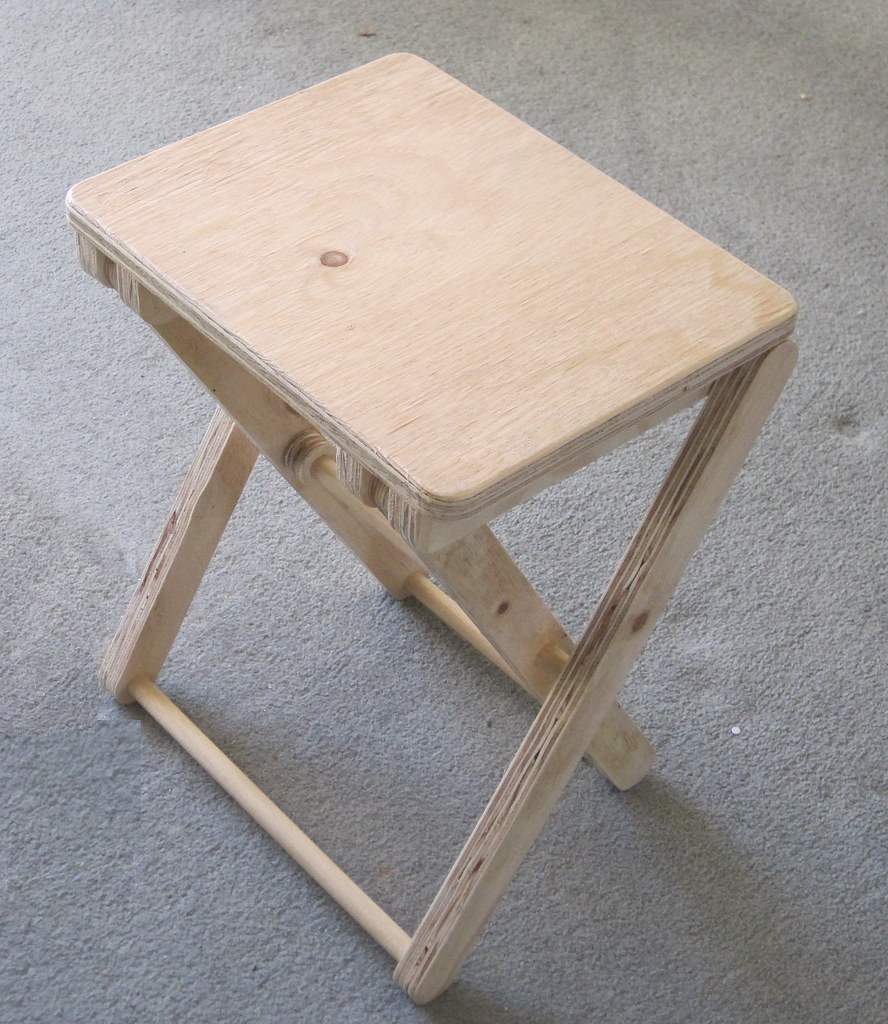
Side X folding stool
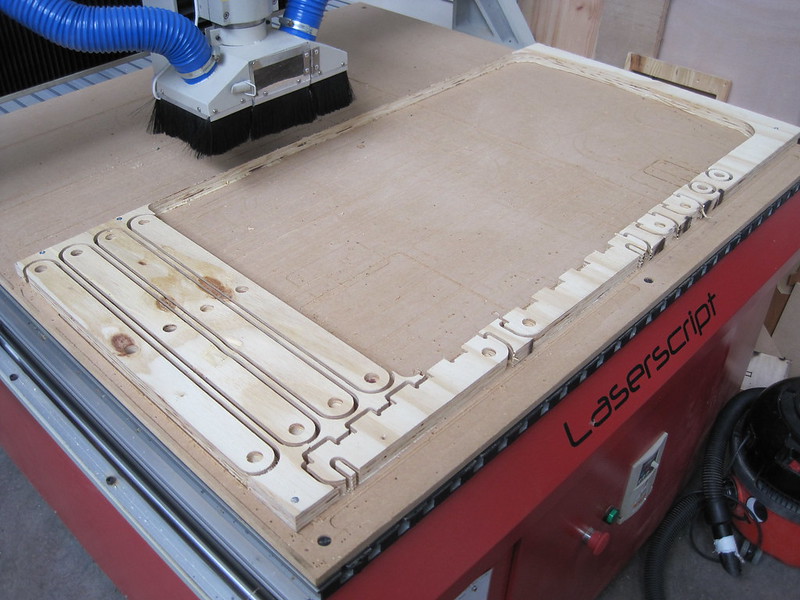
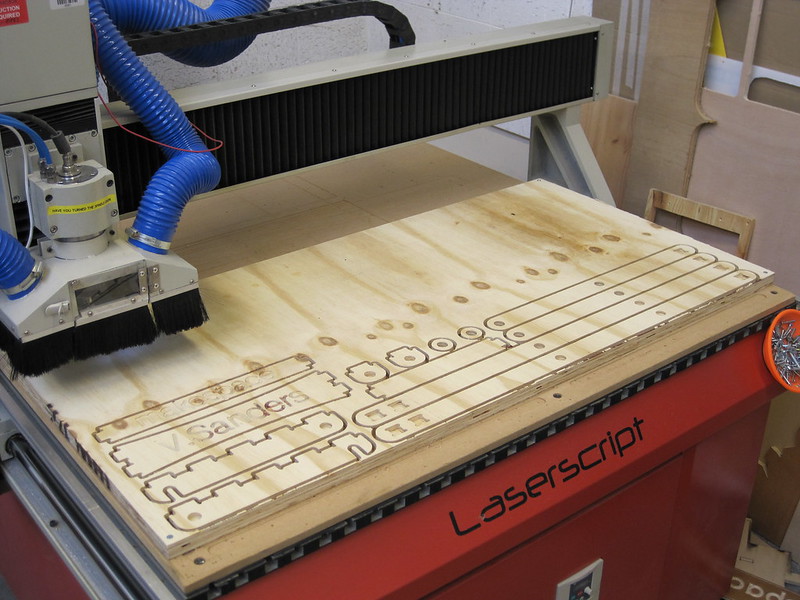
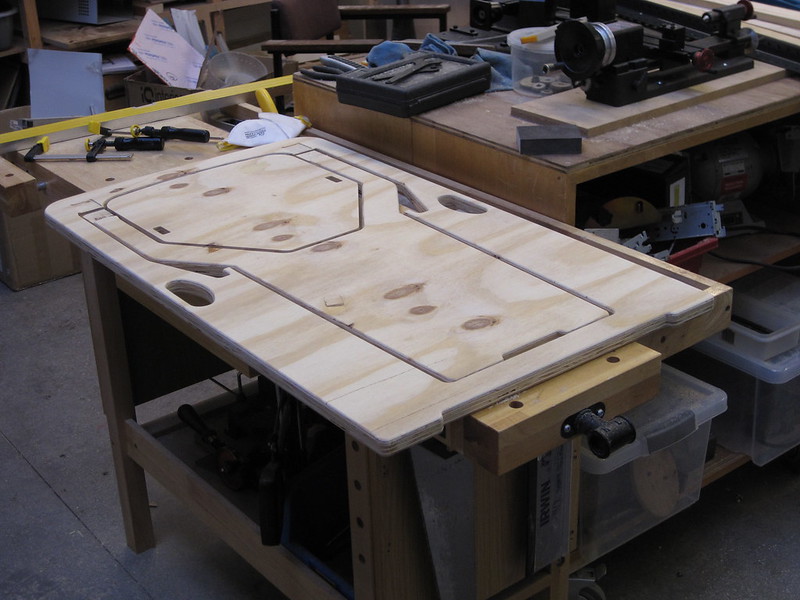
I was looking at the sheet after removing the last chair design and had a thought, I had not attempted a side X type folding design and perhaps I could squeeze one into the offcuts? I kinda got carried away, it roughly went:


Side X folding stool cut from sheet offcut
If all of that sounds like and utterly mad way to design a size X stool, you are of course correct, but it worked, and it was a very fast process taking less than four hours from idea to stool.

Paul testing the dry fit side X stool
There are a couple of issues:

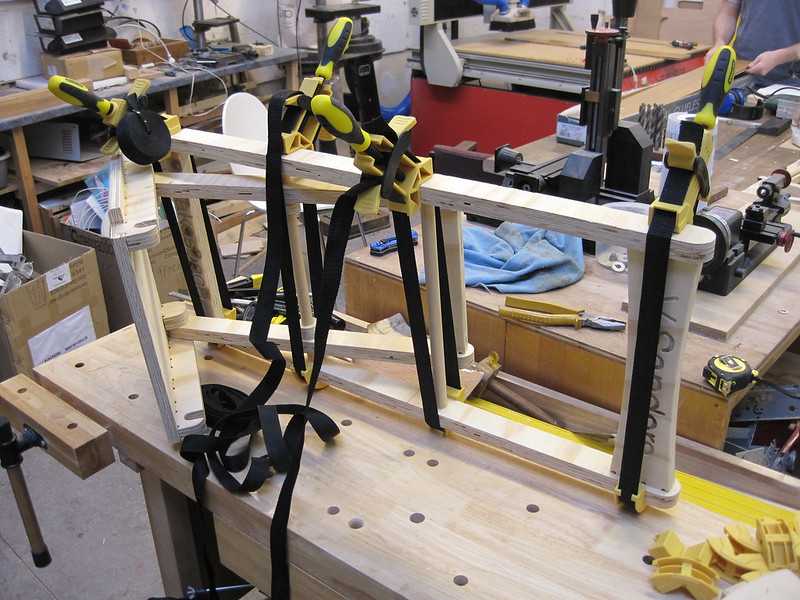
Clamping stool why the glue drys
The seat went together dry fit and Paul tested it for me, however that last issue soon made me realise that this time I was going to have to resort to glue. Yes, sorry, this design needs to be glued to remain stable (I know plywood contains glue...please stop telling me that).


It is pretty simple to put together and aside from needing half the clamps in makespace to hold it in place while the glue dried, I had no trouble.

Though this is definitely not a case of use glue "sparingly" I put generous amounts in all the dowel joints and all the seat slots and got very little ooze so I guess it could have used more.

The final varnished stool is pretty robust but folds up nicely the concept of hooking to its own pivot dowel means it stays closed when flat which makes it very portable.

Total cost was an estimated 10.00 ( 4.25 dowel, 2.50 of 24mm ply, 1.75 for 18mm ply, 0.50 tool wear, 1.00 varnish) though the materials in my case could be argued to have cost nothing.

It has been suggested that I could make an entire picnic table and chairs set this way but if I did I would reduce the stool height by 50mm and examine ways to use less dowel.

This is usually the bit where I point you all at the freely usable design files on github and all the photos on flikr and wrap up.

But you know what the Monty Python boys say? "Nobody Expects the Spanish inquisition"

Or in this case my final (and yes I am going to do something else next) chair design. It is based on the stool, in fact it is the stool design with the outer legs extended and a back rest added.

The modified design reduces the dowel requirements to 775mm but requires a bit more sheet material (cannot get this one entirely from offcuts).

Total cost was an estimated 10.50 ( 2.50 dowel, 4.50 of 24mm ply, 1.75 for 18mm ply, 0.50 tool wear, 1.25 varnish).
Because it is based on the stool design it suffers from the height issue and in addition the back rest is a bit far back to be completely comfortable.

Neither of the side X designs have flaws that interest me enough to follow the iterative approach again to solve them. Both the designs work well enough and rounded out my adventures with folding chairs and indeed furniture for now.

As always the design files are on github and the images are on flikr.


Enrico Zini: Explanation of umarell

Explanation of umarell
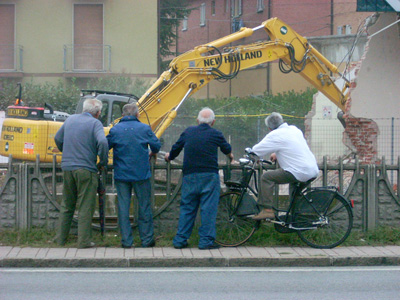
Umarell /uma'r l/ (oo-mah-rell), n; pl. Umarells. People in a community who offer all sorts of comments to those who are trying to get some work done, but who are not doing any work themselves.
Etymology and further details Umarell is a word that entered Italian slang in Bologna and is spreading to nearby towns, occasionally even across Italy. It comes from the Bolognese for "cute/odd little man". "Umarells" are those people, usually retired men, who spend time watching construction works, often holding their hands behind their back, occasionally commenting on what is going on, sometimes trying to tell the workers what to do. It's easy to find examples on the internet; the word was popularised by a blog collecting photos, which has even been published into a book. With some Italian Debian friends, we realised that umarell is the perfect word to describe those people in a community, who offer all sorts of comments to those who are trying to get some work done, but who are not doing any work themselves. I think that it is a word that fits perfectly, and since I'm likely going to use it blissfully anywhere, here is a page that temporarily explains what it means until the Oxford English Dictionary picks it up.

Russell Coker: Qi Phone Charging

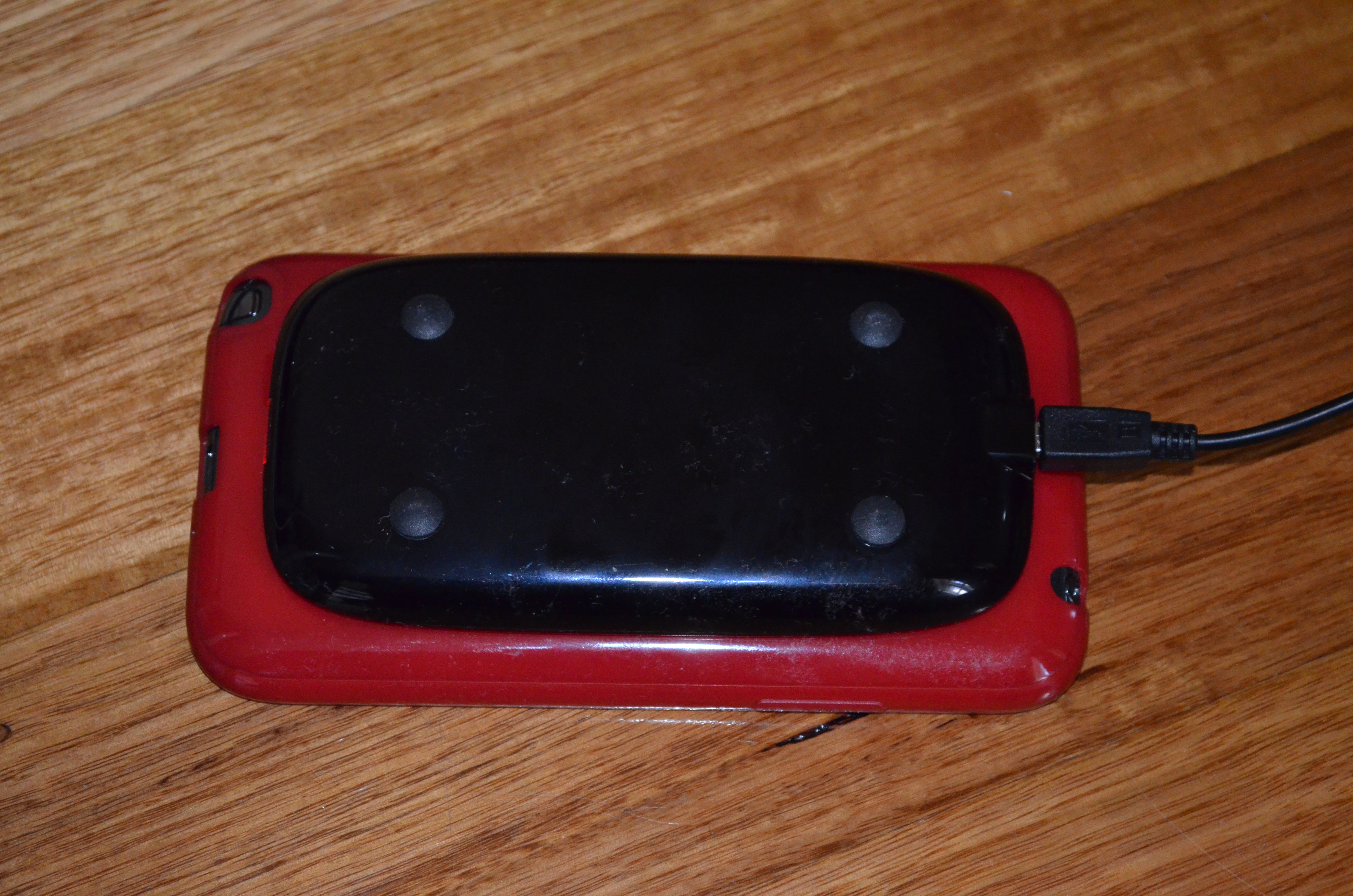
I have just bought a wireless phone charging system based on the Qi Inductive Power Standard. I bought a charging device which connects to a standard micro-USB cable and receivers for the Samsung Galaxy Note 2 and Samsung Galaxy S3 phones I own. Both those phones have contacts in the back of their case that are designed for wireless charging so you can install a charging device inside them. The charging devices make the case fit a little tight, and the charging device is stuck to the phone battery with contact adhesive, this makes it impractical to change the battery on a phone with such a device and makes it a little more difficult to swap out a battery case. One nice feature of the Nexus 4 is that it has Qi charging built in, that saved me $19 and was also more convenient. I believe that the main advantage of a wireless charger is to avoid the risk of damage to the phone if it s dropped while connected to a USB charger. This allows the phone to be charged in situations where you might need to quickly or regularly unplug it to go somewhere. One example of how I might use it is when working at an office so I could charge my phone while at my desk and then quickly take it with me if I had to go to a meeting (sadly I have worked in many offices where they have so many meetings). Another example is for sysadmin work where I have to frequently visit devices to fix them. The wireless charging mat that I bought from Kogan connects to a standard micro-USB plug, the good thing about this is that it s easy to find cables and it can take power from any PC. The bad thing about this is that the resistance of the USB cable is a factor that limits the power that a phone can receive, when using wireless charging you have the limit of the cable resistance as well as some power loss from the wireless transmission. After any extended period of charging the charging mat feels warm to the touch and the phone that s been resting on it feels warmer than usual. The warmth is an indication of energy loss which means longer charging times, a longer charging time isn t necessarily a problem as the convenience of wireless charging can allow longer charging times, but if you want to charge your phone in a hurry before you go somewhere then wireless isn t a good choice. In the past I ve discovered that the battery in a Samsung Galaxy S3 can t be charged if the phone is at 46C [1]. 46C might seem extremely hot to people in some parts of the world (EG northern Europe and Canada) but the temperature in even southern parts of mainland Australia can get that hot and it can be hotter in central and northern parts, so phone temperature can be a real issue. Currently my house is at 21C according to a digital thermometer, the Galaxy S3 and the Note 2 are being charged from USB and report temperatures of 27C and 23C respectively. While the thermometer in my house and those in the phones probably aren t really accurate it seems reasonable to assume that the battery of a relatively idle smart-phone that s being charged will be a few degrees warmer than the ambient temperature. The Qi charger makes things a lot worse as it even feels warm to the touch. So maybe a phone on a Qi charger would be 8 degrees warmer than the ambient temperature or more. That implies that in Australian summer weather a Qi charger won t be useful outside or in any building that lacks air-conditioning. So I think we can give up on the idea of using Qi devices to charge phones at a BBQ. Picture of Qi charger on top of Samsung Galaxy Note 2 The final problem I have is that the Qi device is quite small, I took the above picture with my phone face-down because no part of the charger is visible in normal use. With that size I can t just dump a phone like a Note 2 on top of the charging mat and expect it to work. I have to carefully place it so that it balances and so that the wireless receptor inside the phone matches the transmitter in the mat, if the phone isn t placed correctly then the Qi mat won t detect it and won t supply full power to the transmitter. Conclusion I m fairly disappointed in this device. The waste heat makes it unsuitable for Australian summer conditions and slows charging. The difficulty of correctly placing the phone reduces the convenience which is one of the major features. The price was $19 for each charging card for the Note 2 and the S3 and $29 for the charging mat to give a total of $67. I think it s worth the money for me to cover the risk of one of my phones having it s USB port damaged. Using a Qi charger on occasion will decrease the probability of such damage and allow the phone to be used after receiving certain types of damage. The prices of those phones nowadays are $389 for a Galaxy S3 (Kogan price), $250 for a Nexus 4 (when it was on sale in the Google store), and probably about $500 for a Galaxy Note 2 (last time Kogan offered them). So by paying $67 for Qi charging I believe that I m getting some degree of damage insurance for just over $1100 worth of phones. It seems likely that the Nexus 5 will ship with Qi charging support and that the Galaxy Note 3 will also support an optional Qi charging card (which will probably also be $19 or some similar price) so the charging mat should be useful for a long time. While I m disappointed I don t regret buying the device. But I would be hesitant to recommend it to other people and definitely wouldn t recommend it to someone who doesn t have a significant interest and investment in smart phones.

18 September 2013

Francois Marier: Presenting from a separate user account

While I suspect that professional speakers have separate presentation laptops that they use only to give talks, I don't do this often enough to justify the hassle and cost of a separate machine. However, I do use a separate user account to present from. It allows me to focus on my presentation and not stress out about running into configuration problems or exposing private information. But mostly, I think it's about removing anything that could be distracting for the audience. The great thing of having a separate user for this is that you can do whatever you want in your normal account and still know that the other account is ready to go and configured for presenting on a big screen.

Basics The user account I use when giving talks is called presenter and it has the same password as my main user account, just to keep things simple. However, it doesn't need to belong to any of the UNIX groups that my main user account belongs to. In terms of configuration, it looks like this:
  • power management and screen saver are turned off
  • all sound effects are turned off
  • window manager set to the default one (as opposed to a weird tiling one)
  • desktop notifications are turned off
Of course, this user account only has the software I need while presenting. You won't find an instant messaging, IRC or Twitter client running on there. The desktop only has the icons I need for the presentation: slides and backup videos (in case the network is down and/or prevents me from doing a live demo).

Web browsers While I usually have my presentations in PDF format (for maximum compatibility, you never know when you'll have to borrow someone else's laptop), I use web browsers (different ones to show that my demos work with all of them) all the time for demos. Each browser:
  • clears everything (cookies, history, cache, etc.) at the end of the session
  • has the site I want to demo as the homepage
  • only contains add-ons or extensions I need for the demos
  • has the minimal number of toolbars and doesn't have any bookmarks
  • has search suggestions turned off
  • never asks to remember passwords

Terminal and editors Some of my demos may feature coding demos and running scripts, which is why I have my terminal and editor set to:
  • a large font size
  • a color scheme with lots of contrast
It's all about making sure that the audience can see everything and follow along easily. Also, if you have the sl package installed system-wide, you'll probably want to put the following in your ~/.bashrc:
alias sl="ls"
alias LS="ls"

Rehearsal It's very important to rehearse the whole presentation using this account to make sure that you have everything you need and that you are comfortable with the configuration (for example, the large font size). If you have access to a projector or a digital TV, try connecting your laptop to it. This will ensure that you know how to change the resolution of the external monitor and to turn mirroring ON and OFF ahead of time (especially important if you never use the default window manager or desktop environment). I keep a shortcut to the display settings in the sidebar.

Localization Another thing I like to do is to set my operating system and browser locales to the one where I am giving a talk, assuming that it is a western language I can understand to some extent. It probably doesn't make a big difference, but I think it's a nice touch and a few people have commented on this in the past. My theory is that it might be less distracting to the audience if they are shown the browser UI and menus they see every day. I'd love to have other people's thoughts on this point though. Also, pay attention to the timezone since it could be another source of distraction as audience members try to guess what timezone your computer is set to.

Anything else? If you also use a separate account for your presentations, I'd be curious to know whether there are other things you've customised. If there's anything I missed, please leave a comment!

17 September 2013

Julien Danjou: Python 3.4 single dispatch, a step into generic functions

I love to say that Python is a nice subset of Lisp, and I discover that it's getting even more true as time passes. Recently, I've stumbled upon the PEP 443 that describes a way to dispatch generic functions, in a way that looks like what CLOS, the Common Lisp Object System, provides. What are generic functions If you come from the Lisp world, this won't be something new to you. The Lisp object system provides a really good way to define and handle method dispatching. It's a base of the Common Lisp object system. For my own pleasure to see Lisp code in a Python post, I'll show you how generic methods work in Lisp first. To begin, let's define a few very simple classes.
(defclass snare-drum ()
())

(defclass cymbal ()
())

(defclass stick ()
())

(defclass brushes ()
())

This defines a few classes: snare-drum, symbal, stick and brushes, without any parent class nor attribute. These classes compose a drum kit, and we can combine them to play sound. So we define a play method that takes two arguments, and returns a sound (as a string).
(defgeneric play (instrument accessory)
(:documentation "Play sound with instrument and accessory."))

This only defines a generic method: it has no body, and cannot be called with any instance yet. At this stage, we only inform the object system that the method is generic and can be then implemented with various type of arguments. We'll start by implementing versions of this method that knows how to play with the snare-drum.
(defmethod play ((instrument snare-drum) (accessory stick))
"POC!")

(defmethod play ((instrument snare-drum) (accessory brushes))
"SHHHH!")

Now we just defined concrete methods with code. They also takes two arguments: instrument which is an instance of snare-drum and accessory that is an instance of stick or brushes. At this stage, you should note the first difference with object system as built into language like Python: the method isn't tied to any class in particular. The methods are generic, and any class can implement them, or not. Let's try it.
* (play (make-instance 'snare-drum) (make-instance 'stick))
"POC!"

* (play (make-instance 'snare-drum) (make-instance 'brushes))
"SHHHH!"

* (play (make-instance 'cymbal) (make-instance 'stick))
debugger invoked on a SIMPLE-ERROR in thread
#<THREAD "main thread" RUNNING 1002ADAF23 >:
There is no applicable method for the generic function
#<STANDARD-GENERIC-FUNCTION PLAY (2)>
when called with arguments
(#<CYMBAL 1002B801D3 > #<STICK 1002B82763 >).

Type HELP for debugger help, or (SB-EXT:EXIT) to exit from SBCL.

restarts (invokable by number or by possibly-abbreviated name):
0: [RETRY] Retry calling the generic function.
1: [ABORT] Exit debugger, returning to top level.

((:METHOD NO-APPLICABLE-METHOD (T)) #<STANDARD-GENERIC-FUNCTION PLAY (2)> #<CYMBAL 1002B801D3 > #<STICK 1002B82763 >) [fast-method]

As you see, the function called depends on the class of the arguments. The object systems dispatch the function calls to the right function for us, depending on the arguments classes. If we call play with instances that are not know to the object system, an error will be thrown. Inheritance is also supported and the equivalent (but more powerful and less error prone) equivalent of Python's super() is available via (call-next-method).
(defclass snare-drum () ())
(defclass cymbal () ())

(defclass accessory () ())
(defclass stick (accessory) ())
(defclass brushes (accessory) ())

(defmethod play ((c cymbal) (a accessory))
"BIIING!")

(defmethod play ((c cymbal) (b brushes))
(concatenate 'string "SSHHHH!" (call-next-method)))

In this example, we define the stick and brushes classes as subclass of the accessory class. The play method defined will return the sound BIIING! regardless of the accessory instance that is used to play the cymbal. Except in the case where it's a brushes instance; only the most precise method is always called. The (call-next-method) function is used to call the closest parent method, in this case that would be the method returning _"BIIING!".
* (play (make-instance 'cymbal) (make-instance 'stick))
"BIIING!"

* (play (make-instance 'cymbal) (make-instance 'brushes))
"SSHHHH!BIIING!"

Note that CLOS is also able to dispatch on object instances themself by using the eql specializer. But if you're really curious about all features CLOS provides, I suggest you read the brief guide to CLOS by Jeff Dalton as a starter. Python implementation Python implements a simpler equivalence of this workflow with the singledispatch function. It will be provided with Python 3.4 as part of the functools module. Here's a rough equivalence of the above Lisp program.
import functools

class SnareDrum(object): pass
class Cymbal(object): pass
class Stick(object): pass
class Brushes(object): pass

@functools.singledispatch
def play(instrument, accessory):
raise NotImplementedError("Cannot play these")

@play.register(SnareDrum)
def _(instrument, accessory):
if isinstance(accessory, Stick):
return "POC!"
if isinstance(accessory, Brushes):
return "SHHHH!"
raise NotImplementedError("Cannot play these")

We define our four classes, and a base play function that raises NotImplementedError, indicating that by default we don't know what to do. We can then write specialized version of this function with a first instrument, the SnareDrum. We then check for the accessory type that we get, and return the appropriate sound or raise NotImplementedError again if we don't know what to do with it. If we run it, it works as expected:
>>> play(SnareDrum(), Stick())
'POC!'
>>> play(SnareDrum(), Brushes())
'SHHHH!'
>>> play(Cymbal(), Brushes())
Traceback (most recent call last):
File "<stdin>", line 1, in <module>
File "/home/jd/Source/cpython/Lib/functools.py", line 562, in wrapper
return dispatch(args[0].__class__)(*args, **kw)
File "/home/jd/sd.py", line 10, in play
raise NotImplementedError("Cannot play these")
NotImplementedError: Cannot play these
>>> play(SnareDrum(), Cymbal())
Traceback (most recent call last):
File "<stdin>", line 1, in <module>
File "/home/jd/Source/cpython/Lib/functools.py", line 562, in wrapper
return dispatch(args[0].__class__)(*args, **kw)
File "/home/jd/sd.py", line 18, in _
raise NotImplementedError("Cannot play these")
NotImplementedError: Cannot play these

The singledispatch module looks through the classes of the first argument passed to the play function, and calls the right version of it. The first defined version of the play function is always run for the object class, so if our instrument is a class that we did not register for, this base function will be called. For whose eager to try and use it, the singledispatch function is provided Python 2.6 to 3.3 through the Python Package Index. Limitations First, as you noticed in the Lisp version, CLOS provides a multiple dispatcher that can dispatch on the type of any of the argument defined in the method prototype, not only the first one. Unfortunately, Python dispatcher is named singledispatch for this good reason: it only knows to dispatch on the first argument. Guido van Rossum wrote a short article about the subject that he called multimethod a few years ago. Then, there's no way to call the parent function directly. There's no equivalent of the (call-next-method) from Lisp nor the super() function that allows to do that in Python class system. This means you will have to use various trick to bypass this limitation. So while I am really glad that Python is going toward that direction, as it's a really powerful way to enhance an object system, it really lacks a lot of more advanced features that CLOS provides out of the box. Though, improving this could be an interesting challenge. Especially to bring more CLOS power to Hy. :-)
The Hacker Guide to Python
A book I'm writing that will be launched soon, talking about designing Python applications, state of the art, and various Python tips. If you want to be the first to hear about the launch, subscribe now.

Craig Small: jqGrid in TurboGears2 Admin Screens

I wanted to use the jqGrid for my admin pages as I liked that look and it matches some of the other screens outside the admin controller. The admin controller, or rather the CrudRestController out of tgext.crud, has a way of exporting results in json format. So surely its a matter of changing the TableBase to use jqGrid in the admin controller and we re done? Well, no. First you need to adjust the jsonReader options so that it lines up to the field names that the controller sends and this was one of the first (or last snags). The json output looks like:
 
  "value_list":  
    "total": 20,
    "items_per_page": 7,
    "page": 1,
    "entries": [(lots of entries)...]
   
 
Now this is a little odd because of the top-level dictionary that is being used here. Most of the examples have everything that is inside the value_list being returned. In fact adjusting the controller to return only those items in the value_list values works. To look inside this structure we need to adjust the jsonReader options. jqGrid documentation uses the format toptier>subtier for the XML reader so that was the intial attempt. It was also an intial fail, it doesn t work and you get your very familiar empty grid. The trick is close to this format, but slightly different for json. You change the options to toptier.subtier . In other words change the greater than symbol to a full stop for json access. The jqGridWidget now has the following options (amongst others):
options =  
  'datatype': 'json',
  'jsonReader':  
    'repeatitems': False,
    'root': 'value_list.entries',
    'total': 'value_list.total',
    'page': 'value_list.page',
   
 
There might be a way of saying all entries sit under value_list inside jqGrid, but I couldn t find it. Those options given above do give a working jqGrid on the admin screens.

Tanguy Ortolo: Google, your IPv6-related email restrictions suck

After years of waiting, Google has finally enabled IPv6 for their email service Gmail. And a few weeks ago, they updated their policy, adding one specific rule: reject email from IP addresses with no reverse name:
% nc -Cv gmail-smtp-in.l.google.com. smtp
Connection to gmail-smtp-in.l.google.com. 25 port [tcp/smtp] succeeded!
220 mx.google.com ESMTP bz2si13656083wjc.108 - gsmtp
HELO boo.example.com
250 mx.google.com at your service
MAIL FROM: <me@example.com>
250 2.1.0 OK bz2si13656083wjc.108 - gsmtp
RCPT TO: <you@gmail.com>
250 2.1.5 OK bz2si13656083wjc.108 - gsmtp
DATA
354  Go ahead bz2si13656083wjc.108 - gsmtp
Subject: Test
From: Me <me@example.com>
To: You <you@gmail.com>
Test.
.
550-5.7.1 [2001:db8:8e3f:43c7::12      16] Our system has detected that this
550-5.7.1 message does not meet IPv6 sending guidelines regarding PTR records
550-5.7.1 and authentication. Please review
550-5.7.1 https://support.google.com/mail/?p=ipv6_authentication_error for more
550 5.7.1 information. bz2si13656083wjc.108 - gsmtp
That sucks By the way, I would love to have a perfect Internet access provider, but that does not exist where I live, and I do not think it exists at all anywhere. Google, instead of complaining about lame access providers, you are welcome to offer me a fibre service with decent upload rate, static IPv4, static IPv6 /64, customizable reverse DNS for IPv4 and IPv6, and full respect of the network neutrality. Until then, I am doing the best I can with the least bad provider available. Workaround As I said, their is an easy workaround. Google does not accept my mail on IPv6? Fine, I will keep using IPv4. Only for Google of course, no need to punish the whole Internet for Google's damn restrictions. With Postfix, you can do that this way (thanks to Christian Skala for his blog post about this problem). In /etc/postfix/master.fr, enable an IPv4-only SMTP client service:
smtp4     unix  -       -       -       -       -       smtp -o inet_protocols=ipv4
Then, in /etc/postfix/main.cf, define a transport map if you do not already use one:
transport_maps = hash:/etc/postfix/transport
Create that transport map /etc/postfix/transport or complete it:
gmail.com smtp4:
Finally, hash that transport map and have Postfix reload its configuration:
# postmap /etc/postfix/transport
# service postfix reload

Vincent Sanders: Ever tried. Ever failed. No matter. Try Again. Fail again. Fail better.


I seem to be adhering to Beckett's approach recently but for some reason, after my previous stool attempts, despite having a functioning design I felt I had to do just one more iteration.

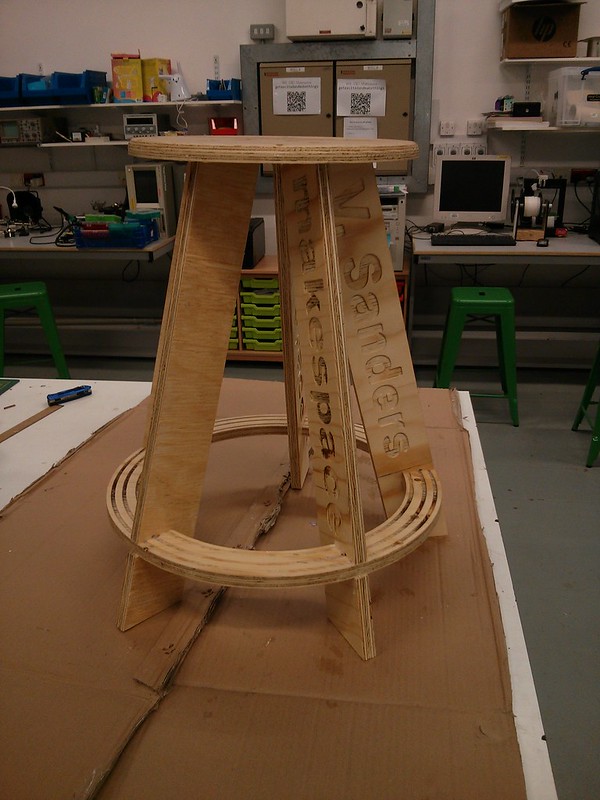
Five legged stoolGoing back to a previous concept of having five legs instead of three while this did not improve the rotational problems with the 12mm thick material, it did make the design more stable overall and less prone to tipping.

The five legged solution realised in 18mm plywood resulted in my final design for this concept. As my friend Stephen demonstrates the design is pretty solid even for those of us with a more ample frame. There are now a couple of them in use at the space alongside the three legged earlier versions.

I was finally satisfied with the result and thought I was done with furniture making for a while. My adorable wife then came up with a challenge, she wanted a practical foldable chair her requirements were:
A frame folding chair, image from wikimedia
Things for individual humans to sit on raised off the floor, or chairs as we call them, have been around for a long time. My previous research for the stool indicated that chairs have a long history with examples still surviving from the ancient egyptians. From this I assumed there would be nothing novel in this project and to quote the song it's all been done before
Foldingchairs
Given this perspective my research started with an image search for "folding chair". The results immediately showed there were two common shapes. Either the chair base was formed with a pair of linked X shapes with the seat across the top, or an A frame style where the seat is across the centre.

My initial thoughts were to replicate the IKEA style A frame design until I noticed that some designs were made from a single sheet of timber with a small number of profile cuts. I searched for pre-existing design files but found none, perhaps I had found something novel to do after all.

A frame chair  1 - Front  2 - Rear  3- seat
Some quick measurements of chairs in shops (and more weird looks, mainly from my family) suggested 900mm is generally the highest a chair ought to stand. I selected a popliteal height of 420mm as a general use compromise which is a bit less than the 430mm of most mass produced chairs. I also decided there should be a front to rear drop across the seat which ought to improve comfort a little.

Material selection was based upon what I had to hand which consisted of a couple of sheets of structural plywood (1220x606x18mm temperate softwood - probably spruce although not specified) which had not become stools yet. Allowing for edge wastage and tool width this gave me a working area from a sheet of 1196x582mm.

I sketched the side view of the chair numbering the three parts. I decided part 1 would be 1000mm total height with top and bottom cross braces 80mm high, assuming the 900mm tall target, the A frame apex would be at 820mm height.

If we assert that the apex is immediately below the top cross brace on part 1 this gives 920mm at which point we have two sides of a right angled triangle (820 and 920) from which we can calculate the top angle is 26 . This also means part 2 will be 840mm long with the same 820 height this gives an angle of 10 .

I did the maths for the seat triangle using the 36 angle and 420mm popliteal height. Having experienced how flexible 18mm plywood was in the face dimension I decided to make the frame sides 50mm wide leaving, after 6mm tool path widths, enough space for a 358mm wide seat .

Once the dimensions were decided the design went pretty quickly producing something that looked similar to the designs I had seen earlier.

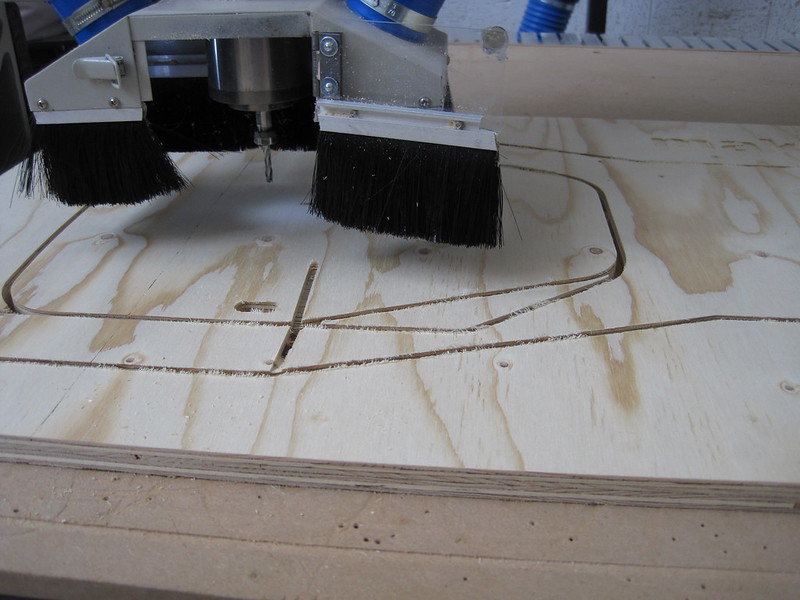
CNC routers can go wrong, spot the fail
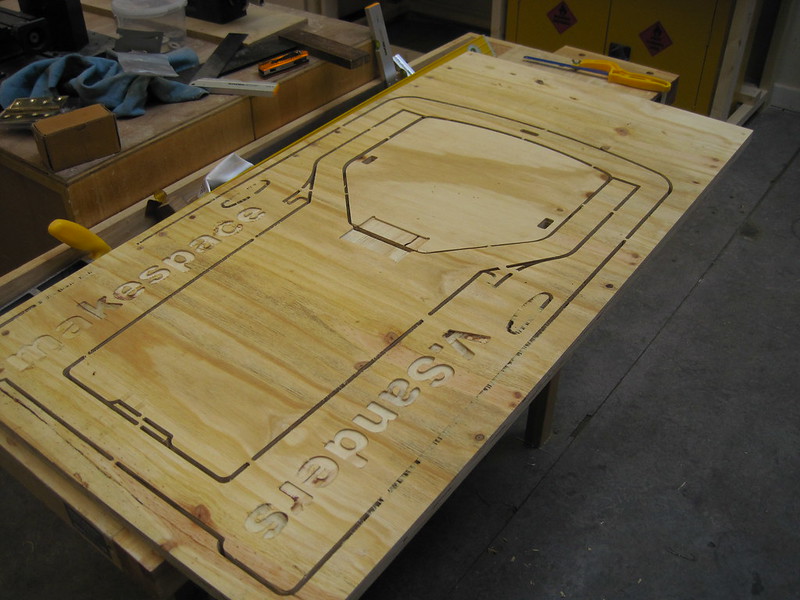
Generating toolpaths for this design proved challenging with the CAM software we had available, mainly because arranging multiple "inner" and "outer" cuts along the same path and having the tabs line up was obviously not an anticipated feature.

Things had been going far too well for me and during the routing operation our machine decided to follow an uncommanded toolpath excursion mid job (it cut a dirty great hole through the middle of my workpiece where I did not want it) ruining the sheet of material.

Fortunately, once factory reset and reconfigured, the machine ran the job correctly the second time although we still do not know why it went wrong. The parts were cut free of their tabs and hinges fitted.

The resulting design worked with a couple of problems:
Folding chair in 24mm plywood with edges rounded off
So time for a second iteration, this time I selected a thicker plywood to reduce the bend under large loads (OK already, I mean me). After shopping around for several days I discovered that unlike 12mm and 18mm thick plywood 24mm thick is much harder to find at a sensible price especially if you want it cut into 1220x606 sheets from the full 1220x2440.

I eventually physically went to Ridgeons and looked at what they actually had in the warehouse and got a price on a sheet of brazilian elliotis pine structural plywood for 43.96 which they cut for me while I waited. Being physically present also gave me the opportunity to pick a "less bad" sheet from the stack much to the annoyance of the Ridgeons employee for not just taking the top one.

This time I reduced the apex height by 30mm, the length of part 1 by 80mm. I also reduced the frame width by 10mm relying on the increased thickness of the plywood to maintain the strength. In area terms it is actually an increase in material (50mm*17.7mm = 885 against 40mm*22.80 = 912). I also included rebates for the top hinges within the design allowing them to be mounted flush within the sheet width.

The new design was cut (without incident this time) and the edges rounded off. I also added some simple catches to keep the seat and back inline while being transported.

While this version worked I had made a couple of mistakes again. The first was simply a radius versus diameter error on the handles which meant too much material was removed from a high stress area causing increased bending.

Third version of folding chair ready for finishing
The second error was a stupid mistake that where I had worked the latch holes in the seat to the wrong side of my measure line meaning the apex angle was 35.5 not the expected 33.6 which meant the backrest felt "too far forward"

The third version rectified those two errors and improved the seat front curve a little to further reduce the unneeded material in the back rest.

The fabrication of this design was double sided allowing for the seat hinge to be fully rebated and become flush and also adding some text similar to the stools.

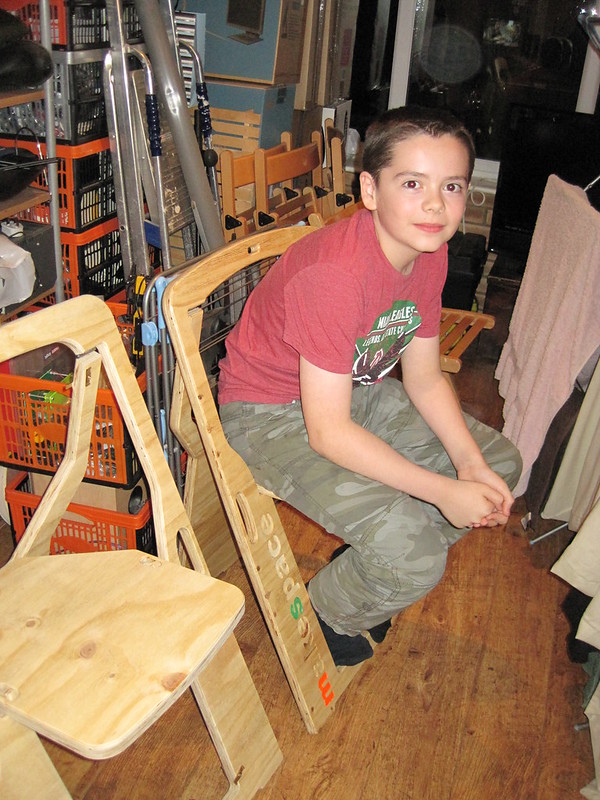
Alex sat on version 3 folding chair
This version still suffers from a backrest that is a bit too far forward and my sons complain it makes them sit up too straight. The problem is that the angle of the front face (23.6 ) means that to move the rest back 20mm means the piece needs to extend another 50mm beyond the frame apex which would probably make the chair feel tall again.

I guess this is a compromise that would take another iteration or two to solve, alas my wife has declared a moratorium on more chairs unless I find somewhere to put the failed prototypes other than her conservatory.

One other addition would be a better form of catch for transport. The ones in version 2 work but are ugly, magnets inset into the frame have been suggested but not actually implemented yet.

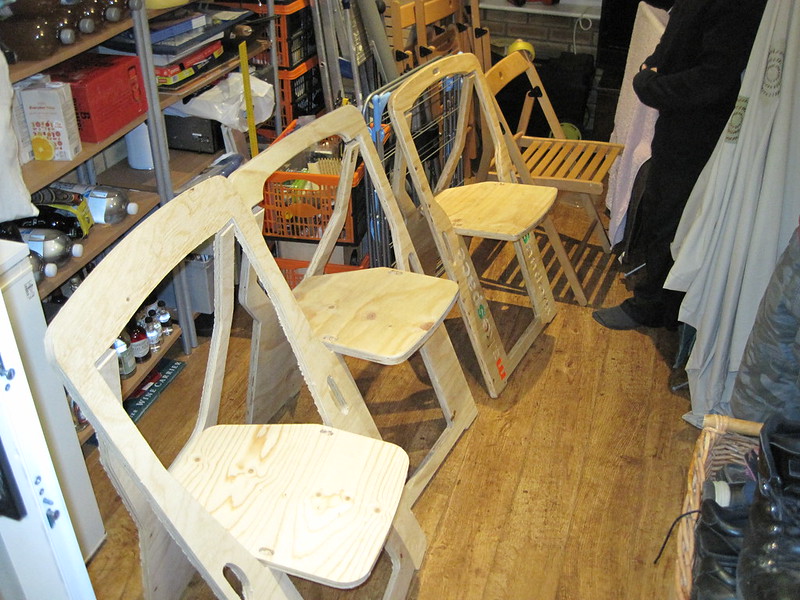
Folding chairs versions 1 to 3 and TERJE for comparison
In conclusion I think I succeeded with the original brief and am pretty pleased with the result. A neatly folding chair that can be stacked simply by having a pile of them and are easy to move and setup.

The price per chair is a little higher than I would like at 22 ( 11 for timber, 5 for hinges and screws , 5 for varnish and 1 for tool wear) plus about 2 hours labour (two sided routing plus roundover takes ages)

As previously the design files are available on github and there are plenty more images in the flikr set.

Cyril Brulebois: Fixing bugs

It s a somewhat strange feeling to spend time fixing things that broke instead of implementing new things, but it s not like I m a creative guy anyway For those last two points, the long term plan is: Hopefully getting this done this week (famous last words, eh?).

16 September 2013

Russ Allbery: pam-webauth-otp 1.0

One of the things that was added to WebAuth when we added support for multifactor authentication was the ability to talk to an external user information service. We wanted to keep the details of the multifactor authentication implementation out of WebAuth itself and encapsulate them in a service that WebAuth calls so that we could replace it with something else later and so that each site could do multifactor authentication in their own way. (It looks like we're going to be using that capability, so I'm very glad we designed it that way.) That, however, also means that the same interface used by WebAuth could be used for other things. This PAM module is the first non-WebAuth use of that API. It provides the ability to prompt for an OTP code as part of the PAM authentication stack and then verify that code against the WebAuth user information service. This is only the bare beginnings of a full PAM integration with the user information service, and it doesn't do lots of things that it could. (For example, do anything with the list of configured factors, show reasonable error messages if a user doesn't have the right things configured, or even support the SMS multifactor method that requires a callout to send the SMS message in advance of the authentication.) But it works, and for any multifactor method that doesn't require a user interaction beyond a code entry, it's fairly clean. This is the first public release, with documentation and a test suite. (There was an earlier, undocumented internal 0.1 release.) It's too soon to say whether we'll keep using this in the long run, but we're using it right now in production and will continue to do so for a little bit at least. I suspect this will prove a viable long-term approach, with some possible changes to the way the user information service abstraction layer works. You can get the latest version from the pam-webauth-otp distribution page.

Gunnar Wolf: My favorite (or rather, one among my favorite) non-original work Leo Masliah #encirc13

It seems I'm catching up with the pace of this course I'm following and that is compelling me to go back to posting on my blog, Arte y cultura en circulaci n: crear y compartir en tiempos digitales . This week's lesson is (again, in Spanish) Las fronteras del remix (the boundaries of remixes). An interesting text, open to everybody (regardless of whether you are signed up for the course or, I hope, whether time has passed since the course took place). And this week's homework is to find "our favorite" non-original work (I picked one among my favorite works And, yes, this is partly because I am part of the "club" of deniers of true originality: We cannot create anything without being part of a surrounding culture, without a common heritage and language with which we speak to our audience) and to find something about it, anything considered important or significative as to its antecedents. What do I like about this work, what grabs my attention. Do I consider it to be a true new creative work? Why? I am taking as an example Leo Masliah, an Uruguayan writer and musician (writer and interpreter). I have followed and enjoyed Masliah's work since 1996, and although by far I'm most familiar with his musical works, I have two books (a novel and a series of short stories). Among his facets, I most enjoy the acid, nihilistic/dadaistic streaks. I chose three of his songs to talk about I am linking to anonline resource where possible, but uploading the three songs to this blog to make his work better known, so that people understand what I talk about, and with my best intentions. Of course, if there is any request to remove the material, I will do it right away. I hope this can be seen as fair/academic use, although this blog is somewhat widely read.
La recuperaci n del unicornio
This song was in the first Masliah cassette I came across, Although musically it is an original work, the lyrics are a clear, almost line-by-line reply to the ever-repeated Unicornio song, by Silvio Rodr guez. This song (which I'm sure that every Spanish speaker reading this lines knows, like it or not It defines for me a good deal of Rodr guez hyper-sweetness and clicheness) has been analyzed over and over looking for a meaning. Silvio recorded this song in 1981, and by 1987 Masliah published this answer, mocking each of the lines.
So, this song can be seen as an original creation, as it contains no literal copy neither of the music nor of the lyrics of the original, but it cannot be understood without being familiar with Silvio's lost unicornio. It would just be an almost-dadaistic rant. But every person that has tasted Silvio Rodr guez cloying song will surely laugh with this one.
No necesitamos otro h roe Balderrama
I find this to be a very unique piece. It bonds together Argentinian folklore and USA pop.
Masliah sings the famous Argentinian song Zamba de Balderrama, (Castilla / Leguizam n), a song lamenting that the very popular bar and artist stage Balderrama, in Salta (North-Western corner of Argentina), seemed to be on the brink of closing. Of course, when Mart n, Constanza, Regina and me went to Balderrama in July 2010, the danger of closing this place had long been averted. And basically every Argentinian knows this song by heart.
The interesting part is that Masliah sings this song (as he presents it as the closing piece for one of his concerts) being short on time, and decides to present two acts together: Zamba de Balderrama and We don't need another hero, by Tina Turner, from the Mad Max soundtrack. So, of course, even if it's obvious that Masliah had to stretch bits to make them fit together, he achieved a very funny, interesting and unique blend of two completely unrelated works. He derives from one as well as from the other, but creates something unique and new.
Donna Lee
I was thinking what to write for this assignment , and had already chosen the two other songs. Yesterday, we were visiting our friends Octavio and Claudia, in Guanajuato, and I heard for the first time the original(?) version of Donna Lee, by Miles Davis (although often credited to Charlie Parker). That led me to remember Masliah's interpretation, in his Cl sicos album. This album is basically made up with similar excercises: Taking an instrumental piece, with Masliah singing over it. Some of the lyrics follow the story (i.e. the children stories), others just talk nonsense to illustrate a point (i.e. "La voz del medio", "the middle voice") follows the non-protagonist score trying not to grab much attention to the lyrics but to highlight the often ignored melody)... Donna Lee is just a fun excercise on following the melody asking what was in the head of the author that led him to invent such a strange, hard music.
Masliah is a great music performer, although often it seems he tries to hide it (i.e. by abusing the dissonances, ex-profeso singing off-key, etc), and a very funny and crazy author. Most of his works have a deep satirical tone, and it's common to find either simple winks or complete "borrowings" in a clear remix fashion, but nobody will doubt on the originality of his works.
AttachmentSize
07-Donna Lee.MP31.79 MB
16 No necesitamos otro h roe - Balderrama.mp33.49 MB
Leo Masl ah-La Recuperaci n Del Unicornio.mp31.87 MB

Next.

Previous.