Search Results: "will"

1 April 2020

Ben Hutchings: Debian LTS work, March 2020

I was assigned 20 hours of work by Freexian's Debian LTS initiative, and carried over 0.75 hours from February. I only worked 12.25 hours this month, so I will carry over 8.5 hours to April. I issued DLA 2114-1 for the update to linux-4.9. I continued preparing and testing the next update to Linux 3.16. This includes a number of filesystem fixes that require running the "xfstests" test suite. I also replied to questions from LTS contributors and users, sent to me personally or on the public mailing list.

Sylvain Beucler: Debian LTS and ELTS - March 2020

Debian LTS Logo Here is my transparent report for my work on the Debian Long Term Support (LTS) and Debian Extended Long Term Support (ELTS), which extend the security support for past Debian releases, as a paid contributor. In March, the monthly sponsored hours were split evenly among contributors depending on their max availability - I was assigned 30h for LTS (out of 30 max; all done) and 20h for ELTS (out of 20 max; I did 0). Most contributors claimed vulnerabilities by performing early CVE monitoring/triaging on their own, making me question the relevance of the Front-Desk role. It could be due to a transient combination of higher hours volume and lower open vulnerabilities. Working as a collective of hourly paid freelancers makes it more likely to work in silos, resulting in little interaction when raising workflow topics on the mailing list. Maybe we're reaching a point where regular team meetings will be benefical. As previously mentioned, I structure my work keeping the global Debian security in mind. It can be stressful though, and I believe current communication practices may deter such initiatives. ELTS - Wheezy LTS - Jessie Documentation/Scripts

Mike Gabriel: My Work on Debian LTS (March 2020)

In March 2020, I have worked on the Debian LTS project for 10.25 hours (of 10.25 hours planned). LTS Work Other security related work for Debian Credits A very big thanks goes to Utkarsh Gupta, a colleague from the Debian LTS team, who sponsored all my uploads and who sent the DLA mails on my behalf, while I was (and still am) in self-induced GPG lockdown (I forgot to update my GPG public key in Debian's GPG keyring). Thanks, Utkarsh! References

Russ Allbery: Review: A Grand and Bold Thing

Review: A Grand and Bold Thing, by Ann Finkbeiner
Publisher: Free Press
Copyright: August 2010
ISBN: 1-4391-9647-8
Format: Kindle
Pages: 200
With the (somewhat excessively long) subtitle of An Extraordinary New Map of the Universe Ushering In a New Era of Discovery, this is a history of the Sloan Digital Sky Survey. It's structured as a mostly chronological history of the project with background profiles on key project members, particularly James Gunn. Those who follow my blog will know that I recently started a new job at Vera C. Rubin Observatory (formerly the Large Synoptic Survey Telescope). Our goal is to take a complete survey of the night sky several times a week for ten years. That project is the direct successor of the Sloan Digital Sky Survey, and its project team includes many people who formerly worked on Sloan. This book (and another one, Giant Telescopes) was recommended to me as a way to come up to speed on the history of this branch of astronomy. Before reading this book, I hadn't understood how deeply the ready availability of the Sloan sky survey data had changed astronomy. Prior to the availability of that survey data, astronomers would develop theories and then try to book telescope time to make observations to test those theories. That telescope time was precious and in high demand, so was not readily available, and was vulnerable to poor weather conditions (like overcast skies) once the allocated time finally arrived. The Sloan project changed all of that. Its output was a comprehensive sky survey available digitally whenever and wherever an astronomer needed it. One could develop a theory and then search the Sloan Digital Sky Survey for relevant data and, for at least some types of theories, test that theory against the data without needing precious telescope time or new observations. It was a transformational change in astronomy, made possible by the radical decision, early in the project, to release all of the data instead of keeping it private to a specific research project. The shape of that change is one takeaway from this book. The other is how many problems the project ran into trying to achieve that goal. About a third of the way into this book, I started wondering if the project was cursed. So many things went wrong, from institutional politics through equipment failures to software bugs and manufacturing problems with the telescope mirror. That makes it all the more impressive how much impact the project eventually had. It's also remarkable just how many bad things can happen to a telescope mirror without making the telescope unusable. Finkbeiner provides the most relevant astronomical background as she tells the story so that the unfamiliar reader can get an idea of what questions the Sloan survey originally set out to answer (particularly about quasars), but this is more of a project history than a popular astronomy book. There's enough astronomy here for context, but not enough to satisfy curiosity. If you're like me, expect to have your curiosity piqued, possibly resulting in buying popular surveys of current astronomy research. (At least one review is coming soon.) Obviously this book is of special interest to me because of my new field of work, my background at a research university, and because it features some of my co-workers. I'm not sure how interesting it will be to someone without that background and personal connection. But if you've ever been adjacent to or curious about how large-scale science projects are done, this is a fascinating story. Both the failures and problems and the way they were eventually solved is different than how the more common stories of successful or failed companies are told. (It helps, at least for me, that the shared goal was to do science, rather than to make money for a corporation whose fortunes are loosely connected to those of the people doing the work.) Recommended if this topic sounds at all interesting. Rating: 7 out of 10

Jonathan Wiltshire: neuraldak

We are proud to announce that dak, the Debian Archive Kit, has been replaced by a neural network for processing package uploads and other archive maintenance. All FTP masters and assistants have been re-deployed to concentrate on managing neuraldak. neuraldak is an advanced machine learning algorithm which has been taught about appropriate uploads, can write to maintainers about their bugs and can automatically make an evaluation about suitable licenses and code quality. Any uploads which do not meet its standards will be rejected with prejudice. We anticipate that neuraldak will also monitor social media for discontent about package uploads, and train itself to do better with its decisions. In terms of licensing , neuraldak has been seeded only with the GPL license. This we consider the gold standard of licenses, and its clauses will be the basis for neuraldak evaluating other licenses as it is exposed to them. Over the course of the next few weeks, neuraldak will also learn to manage the testing suite. Once it is established, we expect to be able to make a full stable release of Debian approximately every six weeks. We have therefore also re-purposed Janelle Shane s cat name algorithm to invent suitable release names, since the list of Toy Story names is likely to be exhausted before 2021. neuraldak is an independent software project. Rumours of it being derived from Skynet are entirely unfounded. The post neuraldak appeared first on jwiltshire.org.uk.

31 March 2020

Pau Garcia i Quiles: Uyuni 2020.03 released with enhanced Debian support!

Uyuni is a configuration and infrastructure management tool that saves you time and headaches when you have to manage and update tens, hundreds or even thousands of machines. Uyuni is a fork of Spacewalk that leverages Salt, Cobbler and containers to modernize it. Uyuni is the upstream for SUSE Manager (the main difference is support: with SUSE Manager you get it from SUSE; with Uyuni you get it from the community) and our development and feature discussion is done in the open. Last week we released Uyuni 2020.03, with much improved Debian support, coming from the community: we have got client tools (both the Salt stack and the traditional stack) for Debian 9 and 10, and bootstrapping support! In addition to that, Uyuni 2020.03 brings many other new features: While this version of Uyuni provides a much better experience for Debian sysadmins, we still have a lot of room for improvement: Do you want to help us with development, or just with feedback? Join our community on IRC, Gitter or the mailing lists. And check our user documentation, developer documentation and presentations. We are also participating in Google Summer of Code 2020. Hurry up and submit a proposal to provide Uyuni for Debian, and/or enhance Debian support!

Chris Lamb: Free software activities in March 2020

Here is my monthly update covering what I have been doing in the free software world during March 2020 (previous month): In addition, I did even more hacking on the Lintian static analysis tool for Debian packages, including:
Reproducible builds One of the original promises of open source software is that distributed peer review and transparency of process results in enhanced end-user security. However, whilst anyone may inspect the source code of free and open source software for malicious flaws, almost all software today is distributed as pre-compiled binaries. This allows nefarious third-parties to compromise systems by injecting malicious code into ostensibly secure software during the various compilation and distribution processes. The motivation behind the Reproducible Builds effort is to ensure no flaws have been introduced during this compilation process by promising identical results are always generated from a given source, thus allowing multiple third-parties to come to a consensus on whether a build was compromised. The initiative is proud to be a member project of the Software Freedom Conservancy, a not-for-profit 501(c)(3) charity focused on ethical technology and user freedom. Conservancy acts as a corporate umbrella allowing projects to operate as non-profit initiatives without managing their own corporate structure. If you like the work of the Conservancy or the Reproducible Builds project, please consider becoming an official supporter. This month, I: In our tooling, I also made the following changes to diffoscope, our in-depth and content-aware diff utility that can locate and diagnose reproducibility issues, including preparing and uploading version 138 to Debian: The Reproducible Builds project also operates a fully-featured and comprehensive Jenkins-based testing framework that powers tests.reproducible-builds.org. This month, I reworked the web-based package rescheduling tool to:
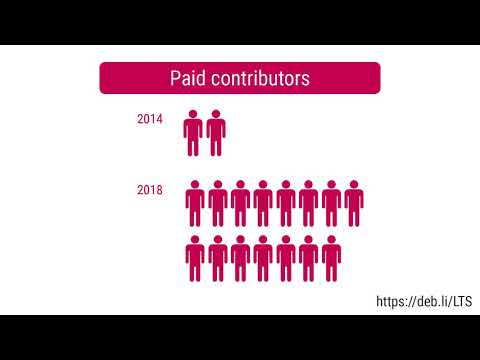
Debian LTS This month I have worked 18 hours on Debian Long Term Support (LTS) and 8 hours on its sister Extended LTS project. You can find out more about the Debian LTS project via the following video:
Debian Uploads For the Debian Privacy Maintainers team I requested that the pyptlib package be removed from the archive (#953429) as well as uploading onionbalance (0.1.8-6) to fix test failures under Pytest 3.x (#953535) and a new upstream release of nautilus-wipe. Finally, I sponsored an upload of bilibop (0.6.1) on behalf of Yann Amar.

Norbert Preining: Fixing the Breeze Dark theme for gtk3 apps

It has been now about two weeks that I switched to KDE/Plasma on all my desktops, and to my big surprise, that went much more smooth than I thought. There are only a few glitches with respect to the gtk3 part of the Breeze Dark theme I am using, which needed fixup.
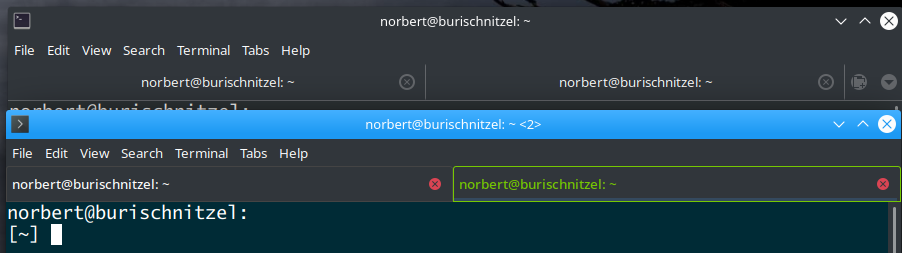
Tab distinction As I wrote already in a previous blog, the active tab in all kinds of terminal emulators, but in fact everything that uses the gtk3 notebook widget, is not distinguishable from other tabs. It turned out that this fix is a bit convoluted, but still possible, see the linked blog. Just for completeness, here is the CSS code I use in ~/.config/gtk-3.0/gtk.css:
notebook tab  
    /* background-color: #222; */
    padding: 0.4em;
    border: 0;
    border-color: #444;
    border-style: solid;
    border-width: 1px;
 
 
notebook tab:checked  
    /* background-color: #000; */
    background-image: none;
    border-color: #76C802;
 
 
notebook tab:checked label  
    color: #76C802;
    font-weight: 500;
 
 
notebook tab button  
    padding: 0;
    background-color: transparent;
    color: #ccc;
 
 
notebook tab button:hover  
  border: 0;
  background-image: none;
  border-color: #444;
  border-style: solid;
  border-width: 1px;
 
Scroll bars Another of the disturbing properties of the Breeze theme is the width-changing scroll bar. While not hovered upon, it is rather small, but when the mouse moves over it it expands its width. Now that might sound like a flashy cool idea, but in fact it is nothing but a PITA: When used with a terminal emulator, the result is that the line length changes when the mouse moves over the vertical scroll bar, and thus suddenly the layout (line break) changes for instant, which is really really disturbing. I can t imagine why developers ever come up with such a stupid idea. Anyway, the fix is not that difficult again, simply put the following into your ~/.config/gtk-3.0/gtk.css (adjusting the width to your liking) and all will be fine:
.scrollbar.vertical slider, scrollbar.vertical slider  
        min-width: 10px;
 
Not that bad, right? Other than this I haven t found any disturbing issue with using the Breeze theme with gtk3 (and gtk2) apps! Hope that helps

Russell Coker: Links March 2020

Rolling Stone has an insightful article about why the Christian Right supports Trump and won t stop supporting him no matter what he does [1]. Interesting article about Data Oriented Architecture [2]. Quarantine Will normalise WFH and Recession will Denormalise Jobs [3]. I guess we can always hope that after a disaster we can learn to do things better than before. Tyre wear is worse than exhaust for small particulate matter [4]. We need better tyres and legal controls over such things. Scott Santens wrote an insightful article about the need for democracy and unconditional basic income [5]. In ancient Greece, work was regarded as a curse is an extreme position but strongly supported by evidence. In his essay In Praise of Idleness, Bertrand Russell wrote Modern methods of production have given us the possibility of ease and security for all; we have chosen, instead, to have overwork for some and starvation for others. Hitherto we have continued to be as energetic as we were before there were machines; in this we have been foolish, but there is no reason to go on being foolish forever. Cory Doctorow wrote an insightful article for Locus titled A Lever Without a Fulcrum Is Just a Stick about expansions to copyright laws [6]. One of his analogies is that giving a bullied kid more lunch money just allows the bullies to steal more money, with artists being bullied kids and lunch money being the rights that are granted under copyright law. The proposed solution includes changes to labor and contract law, presumably Cory will write other articles in future giving the details of his ideas in this regard. The Register has an amusing article about the trial of a former CIA employee on trial for being the alleged vault 7 leaker [7]. Both the prosecution and the defence are building their cases around the defendent being a jerk. The article exposes poor security and poor hiring practices in the CIA. CNN has an informative article about Finland s war on fake news [8]. As Finland has long standing disputes with Russia they have had more practice at dealing with fake news than most countries. The Times of Israel has an interesting article about how the UK used German Jews to spy on German prisoners of war [9]. Cory Doctorow wrote an insightful article Data is the New Toxic Waste about how collecting personal data isn t an asset, it s a liability [10]. Ulrike Uhlig wrote an insightful article about Control Freaks , analysing the different meanings of control, both positive and negative [11]. 538 has an informative article about the value of statistical life [12]. It s about $9M per person in the US, which means a mind-boggling amount of money should be spent to save the millions of lives that will be potentially lost in a natural disaster (like Coronavirus). NPR has an interesting interview about Crypto AG, the Swiss crypto company owned by the CIA [13]. I first learned of this years ago, it s not new, but I still learned a lot from this interview.

Russ Allbery: pam-krb5 4.9

This is a security release fixing a one-byte buffer overflow when relaying prompts from the underlying Kerberos library. All users of my pam-krb5 module should upgrade as soon as possible. See the security advisory for more information. There are also a couple more minor security improvements in this release: The module now rejects passwords as long or longer than PAM_MAX_RESP_SIZE (normally 512 octets) since they can be a denial of service attack via the Kerberos string-to-key function, and uses explicit_bzero where available to clear passwords before releasing memory. Also in this release, use_pkinit is now supported with MIT Kerberos, the Kerberos prompter function returns more accurate error messages, I fixed an edge-case memory leak in pam_chauthtok, and the module/basic test will run properly with a system krb5.conf file that doesn't specify a realm. You can get the latest release from the pam-krb5 distribution page. I've also uploaded the new version to Debian unstable and patched security releases with only the security fix to Debian stable and oldstable.

30 March 2020

Mike Gabriel: UBports: Packaging of Lomiri Operating Environment for Debian (part 02)

Before and during FOSDEM 2020, I agreed with the people (developers, supporters, managers) of the UBports Foundation to package the Unity8 Operating Environment for Debian. Since 27th Feb 2020, Unity8 has now become Lomiri. Recent Uploads to Debian related to Lomiri Over the past 7-8 weeks the packaging progress has been slowed down due to other projects I am working on in parallel. However, quite a few things have been achieved: The packages qtsystems, qtfeedback, and qtpim are no official Qt5 components, and so I had to package Git snapshots of them; with all implicit consequences regarding ABI and API compatibilities, possibly Debian-internal library transitions, etc. Esp. packaging qtsystems was pretty tricky due to a number of failing unit tests when the package had been built in a clean chroot (like it is the case on Debian's buildd infrastructure). I learned a lot about DBus and DBus mocking while working on all those unit tests to finally pass in chrooted builds. Unfortunately, the Lomiri App Launch component still needs more work due to (finally only) one unit test (jobs-systemd) not always passing. Sometimes, the test gets stucks and then fails after having reached a time out. I'll add it to my list of those unreproducible build failures I have recently seen in several GTest related unit test scenarios. Sigh... Credits A great thanks goes to Lisandro Perez Meyer from the Debian KDE/Qt Team for providing an intro and help on Qt Debian packaging and an intro on symbols handling with C++ projects. Another big thanks goes to Dmitry Shachnev from the Debian KDE/Qt Team for doing a sponsored upload [1] of qtpim (and also a nice package review). Also a big thanks goes to Marius Gripsgard for his work on forking the first Lomiri components on the UBports upstream side. Previous Posts about my Debian UBports Team Efforts References

Jonathan Dowland: ephemeral note-taking wins

Some further thoughts on ephemeral versus preserve-everything note-taking. Note-taking is about capturing ideas, thoughts, and processes. You want as little friction as possible when doing so: you don't want to be thinking the page is too small, or the paper drying up the ink too quickly so the pen doesn't move smoothly, or similar such things distracting from capturing what you are trying to capture. I used my PhD notebook as an example of a preserve-everything approach. A serious drawback of the notebook as the sole place to capture work is the risk that it will be damaged or lost. I periodically photograph all the pages and store those photos digitally, alongside other things relating to the work. Those other things include two different private wiki instances that I use to capture notes when I'm working at the computer, as well as several Git repositories (some public, some private) for source code, experiments, drafts of papers, etc. There's also a not-insignificant amount of email correspondence. There have been several train journeys and several meetings where I've grabbed a cheap, larger-format pad of paper and a box of Pound-shop felt-tip pens to sketch ideas, whiteboard-style. At the time it just seemed easier to capture what we were doing in that way, rather than try to do so into the notebook. So the notebook is neither canonical nor comprehensive. Ultimately it's really another example of ephemeral note-taking, and so I think the Ephemeral model wins out. Use whatever notebook or paper or envelope or window pane that is convenient and feels attractive at the time you need to capture something with the least amount of friction. Digitise that and store, catalogue, adjust, derive, etc. from that in the digital domain.

Axel Beckert: How do you type on a keyboard with only 46 or even 28 keys?

Some of you might have noticed that I m into keyboards since a few years ago into mechanical keyboards to be precise. Preface It basically started with the Swiss Mechanical Keyboard Meetup (whose website I started later on) was held in the hackerspace of the CCCZH. I mostly used TKL keyboards (i.e. keyboards with just the for me useless number block missing) and tried to get my hands on more keyboards with Trackpoints (but failed so far). At some point a year or two ago, I looking into smaller keyboards for having a mechanical keyboard with me when travelling. I first bought a Vortex Core at Candykeys. The size was nice and especially having all layers labelled on the keys was helpful, but nevertheless I soon noticed that the smaller the keyboards get, the more important is, that they re properly programmable. The Vortex Core is programmable, but not the keys in the bottom right corner which are exactly the keys I wanted to change to get a cursor block down there. (Later I found out that there are possibilities to get this done, either with an alternative firmware and a hack of it or desoldering all switches and mounting an alternative PCB called Atom47.) 40% Keyboards So at some point I ordered a MiniVan keyboard from The Van Keyboards (MiniVan keyboards will soon be available again at The Key Dot Company), here shown with GMK Paperwork (also bought from and designed by The Van Keyboards):
The MiniVan PCBs are fully programmable with the free and open source firmware QMK and started to use that more and more instead of bigger keyboards. Layers With the MiniVan I learned the concepts of layers. Layers are similar to what many laptop keyboards do with the Fn key and to some extent also what the German standard layout does with the AltGr key: Layers are basically alternative key maps you can switch with a special key (often called Fn , Fn1 , Fn2 , etc., or especially if there are two additional layers Raise and Lower ). There are several concepts how these layers can be reached with these keys: My MiniVan Layout For the MiniVan, two additional layers suffice easily, but since I have a few characters on multiple layers and also have mouse control and media keys crammed in there, I have three additional layers on my MiniVan keyboards:

TRNS means transparent, i.e. use the settings from lower layers.
I also use a feature that allows me to mind different actions to a key depending if I just tap the key or if I hold it. Some also call this tap dance . This is especially very popular on the usually rather huge spacebar. There, the term SpaceFn has been coined, probably after this discussion on Geekhack. I use this for all my layer switching keys: With this layout I can type English texts as fast as I can type them on a standard or TKL layout. German umlauts are a bit more difficult because it requires 4 to 6 key presses per umlaut as I use the Compose key functionality (mapped to the Menu key between the spacebars and the cursor block. So to type an on my MiniVan, I have to:
  1. press and release Menu (i.e. Compose); then
  2. press and hold either Shift-Spacebar (i.e. Shift-Fn1) or Slash (i.e. Fn2), then
  3. press N for a double quote (i.e. Shift-Fn1-N or Fn2-N) and then release all keys, and finally
  4. press and release the base character for the umlaut, in this case Shift-A.
And now just use these concepts and reduce the amount of keys to 28: 30% and Sub-30% Keyboards In late 2019 I stumbled upon a nice little keyboard kit shop on Etsy which I (and probably most other people in the mechanical keyboard scene) didn t take into account for looking for keyboards called WorldspawnsKeebs. They offer mostly kits for keyboards of 40% size and below, most of them rather simple and not expensive. For about 30 you get a complete sub-30% keyboard kit (without switches and keycaps though, but that very common for keyboard kits as it leaves the choice of switches and key caps to you) named Alpha28 consisting of a minimal Acrylic case and a PCB and electronics set. This Alpha28 keyboard is btw. fully open source as the source code, (i.e. design files) for the hardware are published under a free license (MIT license) on GitHub. And here s how my Alpha28 looks like with GMK Mitolet (part of the GMK Pulse group-buy) key caps:
So we only have character keys, Enter (labelled Data as there was no 1u Enter key with that row profile in that key cap set; I ll also call it Data for the rest of this posting) and a small spacebar, not even modifier keys. The Default Alpha28 Layout The original key layout by the developer of the Alpha28 used the spacbar as Shift on hold and as space if just tapped, and the Data key switches always to the next layer, i.e. it switches the layer permanently on tap and not just on hold. This way that key rotates through all layers. In all other layers, V switches back to the default layer. I assume that the modifiers on the second layer are also on tap and apply to the next other normal key. This has the advantage that you don t have to bend your fingers for some key combos, but you have to remember on which layer you are at the moment. (IIRC QMK allows you to show that via LEDs or similar.) Kinda just like vi. My Alpha28 Layout But maybe because I m more an Emacs person, I dislike remembering states myself and don t bind bending my fingers. So I decided to develop my own layout using tap-or-hold and only doing layer switches by holding down keys:

A triangle means that the settings from lower layers are used, N/A means the key does nothing.
It might not be very obvious, but on the default layer, all keys in the bottom row and most keys on the row ends have tap-or-hold configurations. Basic ideasBottom row if holdOther rows if holdHow the keys are divided into layersUsing the Alpha28 This layout works surprisingly well for me. Only for Minus, Equal, Single Quote and Semicolon I still often have to think or try if they re on Layer 1 or 2 as on my 40%s (MiniVan, Zlant, etc.) I have them all on layer 1 (and in general one layer less over all). And for really seldom used keys like Insert, PrintScreen, ScrollLock or Pause, I might have to consult my own documentation. They re somewhere in the middle of the keyboard, either on layer 1, 2, or 3. ;-) And of course, typing umlauts takes even two keys more per umlaut as on the MiniVan since on the one hand Menu is not on the default layer and on the other hand, I don t have this nice shifted number row and actually have to also press Shift to get a double quote. So to type an on my Alpha, I have to:
  1. press and release Space-F (i.e. Fn1-F) for Menu (i.e. Compose); then
  2. press and hold A-Spacebar-L (i.e. Shift-Fn1-L) for getting a double quote, then
  3. press and release the base character for the umlaut, in this case L-A for Shift-A (because we can t use A for Shift as I can t hold a key and then press it again :-).
Conclusion If the characters on upper layers are not labelled like on the Vortex Core, i.e. especially on all self-made layouts, typing is a bit like playing that old children s game Memory: as soon as you remember (or your muscle memory knows) where some special characters are, typing gets faster. Otherwise, you start with trial and error or look the documentation. Or give up. ;-) Nevertheless, typing on a sub-30% keyboard like the Alpha28 is much more difficult and slower than on a 40% keyboard like the MiniVan. So the Alpha28 very likely won t become my daily driver while the MiniVan defacto is my already my daily driver. But I like these kind of challenges as others like the game Memory . So I ordered three more 30% and sub-30% keyboard kits and WorldspawnsKeebs for soldering on the upcoming weekend during the COVID19 lockdown: And if I at some point want to try to type with even fewer keys, I ll try a Butterstick keyboard with just 20 keys. It s a chorded keyboard where you have to press multiple keys at the same time to get one charcter: So to get an A from the missing middle row, you have to press Q and Z simultaneously, to get Escape, press Q and W simultaneously, to get Control, press Q, W, Z and X simultaneously, etc. And if that s not even enough, I already bought a keyboard kit named Ginny (or Ginni, the developer can t seem to decide) with just 10 keys from an acquaintance. Couldn t resist when offered his surplus kits. :-) It uses the ASETNIOP layout which was initially developed for on-screen keyboards on tablets.

Louis-Philippe V ronneau: Using Zoom's web client on Linux

TL;DR: The zoom meeting link you have probably look like this:
https://zoom.us/j/123456789
To use the web client, use this instead:
https://zoom.us/wc/join/123456789
Avant-propos Like too many institutions, the school where I teach chose to partner up with Zoom. I wasn't expecting anything else, as my school's IT department is a Windows shop. Well, I guess I'm still a little disappointed. Although I had vaguely heard of Zoom before, I had never thought I'd be forced to use it. Lucky for me, my employer decided not to force us to use it. To finish the semester, I plan to record myself and talk with my students on a Jitsi Meet instance. I will still have to attend meetings on Zoom though. I'm well aware of Zoom's bad privacy record and I will not install their desktop application. Zoom does offer a web client. Sadly, on Linux you need to jump through hoops to be able to use it. Using Zoom's web client on Linux Zoom's web client apparently works better on Chrome, so I decided to use Chromium. Without already having the desktop client installed on your machine, the standard procedure to use the web client would be:
  1. Open the link to the meeting in Chromium
  2. Click on the "download & run Zoom" link showed on the page
  3. Click on the "join from your browser" link that then shows up
Sadly, that's not what happens on Linux. When you click on the "download & run Zoom" link, it brings you to a page with instructions on how to install the desktop client on Linux. You can thwart that stupid behavior by changing your browser's user agent to make it look like you are using Windows. This is the UA string I've been using:
Mozilla/5.0 (Windows NT 10.0; Win64; x64) AppleWebKit/537.36 (KHTML, like Gecko) Chrome/80.0.3987.149 Safari/537.36
With that, when you click on the "download & run Zoom" link, it will try to download a .exe file. Cancel the download and you should now see the infamous "join from your browser" link. Upon closer inspection, it seem you can get to the web client by changing the meeting's URL. The zoom meeting link you have probably look like this:
https://zoom.us/j/123456789
To use the web client, use this instead:
https://zoom.us/wc/join/123456789
Jitsi Meet Puppet Module I've been playing around with Jitsi Meet quite a bit recently and I've written a Puppet module to install and configure an instance! The module certainly isn't perfect, but should wield a working Jitsi instance. If you already have a Puppet setup, please give it a go! I'm looking forward receiving feedback (and patches) to improve it.

Shirish Agarwal: Covid 19 and the Indian response.

There have been lot of stories about Coronavirus and with it a lot of political blame-game has been happening. The first step that India took of a lockdown is and was a good step but without having a plan as to how especially the poor and the needy and especially the huge migrant population that India has (internal migration) be affected by it. A 2019 World Economic Forum shares the stats. as 139 million people. That is a huge amount of people and there are a variety of both push and pull factors which has displaced these huge number of people. While there have been attempts in the past and probably will continue in future they will be hampered unless we have trust-worthy data which is where there is lots that need to be done. In the recent few years, both the primary and secondary data has generated lot of controversies within India as well as abroad so no point in rehashing all of that. Even the definition of who is a migrant needs to be well-established just as who is a farmer . The simplest lucanae in the later is those who have land are known as farmers but the tenant farmers and their wives are not added as farmers hence the true numbers are never known. Is this an India-specific problem or similar definition issues are there in the rest of the world I don t know.
How our Policies fail to reach the poor and the vulnerable The sad part is most policies in India are made in castles in the air . An interview by the wire shares the conundrum of those who are affected and the policies which are enacted for them (it s a youtube video, sorry)
If one with an open and fresh mind sees the interview it is clear that why there was a huge reverse migration from Indian cities to villages. The poor and marginalized has always seen the Indian state as an extortive force so it doesn t make sense for them to be in the cities. The Prime Minister s annoucement of food for 3 months was a clear indication for the migrant population that for 3 months they will have no work. Faced with such a scenario, the best option for them was to return to their native places. While videos of huge number of migrants were shown of Delhi, this was the scenario of most states and cities, including Pune, my own city . Another interesting point which was made is most of the policies will need the migrants to be back in the villages. Most of these are tied to the accounts which are opened in villages, so even if they want to have the benefits they will have to migrate to villages in order to use them. Of course, everybody in India knows how leaky the administration is. The late Shri Rajiv Gandhi had famously and infamously remarked once how leaky the Public Distribution system and such systems are. It s only 10 paise out of rupee which reaches the poor. And he said this about 30 years ago. There have been numerous reports of both IPS (Indian Police Services) reforms and IAS (Indian Administrative Services) reforms over the years, many of the committee reports have been in public domain and in fact was part of the election manifesto of the ruling party in 2014 but no movement has happened on that part. The only thing which has happened is people from the ruling party have been appointed on various posts which is same as earlier governments. I was discussing with a friend who is a contractor and builder about the construction labour issues which were pointed in the report and if it is true that many a times the migrant labour is not counted. While he shared a number of cases where he knew, a more recent case in public memory was when some labourers died while building Amanora mall which is perhaps one of largest malls in India. There were few accidents while constructing the mall. Apparently, the insurance money which should have gone to the migrant laborer was taken by somebody close to the developers who were building the mall. I have a friend in who lives in Jharkhand who is a labour officer. She has shared with me so many stories of how the labourers are exploited. Keep in mind she has been a labor officer appointed by the state and her salary is paid by the state. So she always has to maintain a balance of ensuring worker s rights and the interests of the state, private entities etc. which are usually in cahoots with the state and it is possible that lot of times the State wins over the worker s rights. Again, as a labour officer, she doesn t have that much power and when she was new to the work, she was often frustrated but as she remarked few months back, she has started taking it easy (routinized) as anyways it wasn t helping her in any good way. Also there have been plenty of cases of labor officers being murdered so its easier to understand why one tries to retain some sanity while doing their job.

The Indian response and the World Response The Indian response has been the lockdown and very limited testing. We seem to be following the pattern of UK and U.S. which had been slow to respond and slow to testing. In the past Kerala showed the way but this time even that is not enough. At the end of the day we need to test, test and test just as shared by the WHO chairman. India is trying to create its own cheap test kits with ICMR approval, for e.g. a firm from my own city Pune MyLab has been given approval. We will know how good or bad they are only after they have been field-tested. For ventilators we have asked Mahindra and Mahindra even though there are companies like Allied Medical and others who have exported to EU and others which the Govt. is still taking time to think through. This is similar to how in UK some companies who are with the Govt. but who have no experience in making ventilators are been given orders while those who have experience and were exporting to Germany and other countries are not been given orders. The playbook is errily similar. In India, we don t have the infrastructure for any new patients, period. Heck only a couple of states have done something proper for the anganwadi workers. In fact, last year there were massive strikes by anganwadi workers all over India but only NDTV showed a bit of it along with some of the news channels from South India. Most mainstream channels chose to ignore it. On the world stage, some of the other countries and how they have responded perhaps need sharing. For e.g. I didn t know that Cuba had so many doctors and the politics between it and Brazil. Or the interesting stats. shared by Andreas Backhaus which seems to show how distributed the issue (age-wise) is rather than just a few groups as has been told in Indian media. What was surprising for me is the 20-29 age group which has not been shared so much in the Indian media which is the bulk of our population. The HBR article also makes a few key points which I hope both the general public and policymakers both in India as well as elsewhere take note of. What is worrying though that people can be infected twice or more as seems to be from Singapore or China and elsewhere. I have read enough of Robin Cook and Michael Crichton books to be aware that viruses can do whatever. They will over time mutate, how things will happen then is anybody s guess. What I found interesting is the world economic forum article which hypothesis that it may be two viruses which got together as well as research paper from journal from poteome research which has recently been published. The biggest myth flying around is that summer will halt or kill the spread which even some of my friends have been victim of . While a part of me wants to believe them, a simple scientific fact has been viruses have probably been around us and evolved over time, just like we have. In fact, there have been cases of people dying due to common cold and other things. Viruses are so prevalent it s unbelivable. What is and was interesting to note is that bat-borne viruses as well as pangolin viruses had been theorized and shared by Chinese researchers going all the way back to 90 s . The problem is even if we killed all the bats in the world, some other virus will take its place for sure. One of the ideas I had, dunno if it s feasible or not that at least in places like Airports, we should have some sort of screenings and a labs working on virology. Of course, this will mean more expenses for flying passengers but for public health and safety maybe it would worth doing so. In any case, virologists should have a field day cataloging various viruses and would make it harder for viruses to spread as fast as this one has. The virus spread also showed a lack of leadership in most of our leaders who didn t react fast enough. While one hopes people do learn from this, I am afraid the whole thing is far from over. These are unprecedented times and hope that all are maintaining social distancing and going out only when needed.

29 March 2020

Enrico Zini: Politics links

How tech's richest plan to save themselves after the apocalypse
politics privilege archive.org
Silicon Valley s elite are hatching plans to escape disaster and when it comes, they ll leave the rest of us behind
Heteronomy refers to action that is influenced by a force outside the individual, in other words the state or condition of being ruled, governed, or under the sway of another, as in a military occupation.
Poster P590CW $9.00 Early Warning Signs Of Fascism Laurence W. Britt wrote about the common signs of fascism in April, 2003, after researching seven fascist regimes: Hitler's Nazi Germany; Mussolini's Italy; Franco's Spain; Salazar's Portugal; Papadopoulos' Greece; Pinochet's Chile; Suharto's Indonesia. Get involved! Text: Early Warning Signs of Fascism Powerful and Continuing Nationalism Disdain For Human Rights Identification of Enemies As a unifying cause Supremacy of the military Rampant Sexism Controlled Mass Media Obsession With National Security
Political and social scientist Stefania Milan writes about social movements, mobilization and organized collective action. On the one hand, interactions and networks achieve more visibility and become a proxy for a collective we . On the other hand: Law enforcement can exercise preemptive monitorin
How new technologies and techniques pioneered by dictators will shape the 2020 election
A regional election offers lessons on combatting the rise of the far right, both across the Continent and in the United States.
The Italian diaspora is the large-scale emigration of Italians from Italy. There are two major Italian diasporas in Italian history. The first diaspora began more or less around 1880, a decade or so after the Unification of Italy (with most leaving after 1880), and ended in the 1920s to early-1940s with the rise of Fascism in Italy. The second diaspora started after the end of World War II and roughly concluded in the 1970s. These together constituted the largest voluntary emigration period in documented history. Between 1880-1980, about 15,000,000 Italians left the country permanently. By 1980, it was estimated that about 25,000,000 Italians were residing outside Italy. A third wave is being reported in present times, due to the socio-economic problems caused by the financial crisis of the early twenty-first century, especially amongst the youth. According to the Public Register of Italian Residents Abroad (AIRE), figures of Italians abroad rose from 3,106,251 in 2006 to 4,636,647 in 2015, growing by 49.3% in just ten years.

Sven Hoexter: Looking into Envertech Enverbridge EVB 202 SetID tool

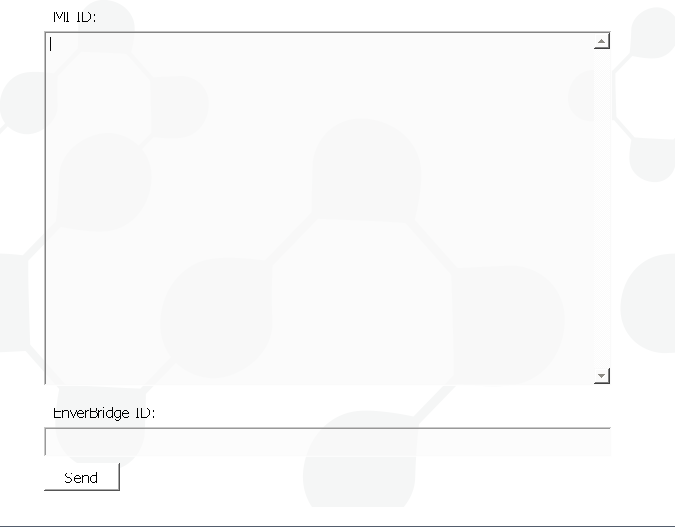
Disclaimer: I'm neither an experienced programmer nor proficient in reverse engineering, but I like at least to try to figure out how things work. Sometimes the solution is so easy, that even I manage to find it, still take this with a grain of salt. I lately witnessed the setup of an Envertech EnverBridge ENB-202 which is kind of a classic Chinese IoT device. Buy it, plug it in, use some strange setup software, and it will report your PV statistics to a web portal. The setup involved downloading a PE32 Windows executable, with an UI that basically has two input boxes and a sent button. You've to input the serial number(s) of your inverter boxes and the ID of your EnverBridge. That made me interested in what this setup process really looks like. The EnverBridge device itself has on one end a power plug, which is also used to communicate with the inverter via some Powerline protocol, and a network plug with a classic RJ45 end you plug into your network. If you power it up it will request an IPv4 address via DHCP. That brings us to the first oddity, the MAC address is in the BC:20:90 prefix which I could not find in the IEEE lists. Setting Up the SetID Software You can download the Windows software in a Zipfile, once you unpack it you end up with a Nullsoft installer .exe. Since this is a PE32 executable we've to add i386 as foreign architecture to install the wine32 package.
dpkg --add-architecture i386
apt update
apt install wine32:i386
wget http://www.envertec.com/uploads/bigfiles/Set%20ID.zip
unzip Set\ ID.zip
wine Set\ ID.exe
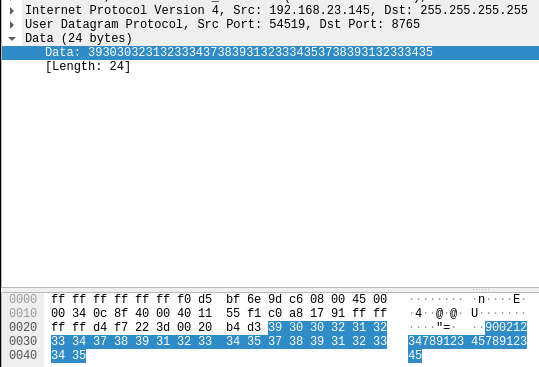
The end result is an installation in ~/.wine/drive_c/Program Files/SetID which reveals that this software is build with Qt5 according to the shipped dll's. The tool itself is in udpCilentNow.exe, and looks like this: Envertech SetID software The Network Communication To my own surprise, the communication is straight forward. A single UDP paket is sent to the broadcast address (255.255.255.255) on port 8765. Envertech SetID udp paket in wireshark I expected some strange binary protocol, but the payload is just simple numbers. They're a combination of the serial numbers of the inverter and the ID of the Enverbridge device. One thing I'm not 100% sure about are the inverter serial numbers, there are two of them, but on the inverter I've seen the serial numbers are always the same. So the payload is assembled like this: If you've more inverter the serials are just appended in the same way. Another strange thing is that the software does close to no input validation, they only check that the inverter serials start with CN and then just extract char 9 to 16. The response from the EnverBridge is also a single UDP paket to the broadcast address on port 8764, with exactly the same content we've sent. Writing a Replacement My result is probably an insult for all proficient Python coders, but based on a bit of research and some cut&paste programming I could assemble a small script to replicate the function of the Windows binary. I guess the usefulness of this exercise was mostly my personal entertainment, though it might help some none Windows users to setup this device. Usage is also very simple:
./enverbridge.py -h
Usage: enverbridge.py [options] MIIDs
Options:
  -h, --help         show this help message and exit
  -b BID, --bid=BID  Serial Number of your EnverBridge
./enverbridge.py -b 90087654 CN19100912345678 CN19100912345679
This is basically 1:1 the behaviour of the Windows binary, though I tried to add a bit more validation then the original binary and some more error messages. I also assume the serial numbers are also always the same so I take only one as the input, and duplicate it for the paket data.

28 March 2020

Fran ois Marier: How to get a direct WebRTC connections between two computers

WebRTC is a standard real-time communication protocol built directly into modern web browsers. It enables the creation of video conferencing services which do not require participants to download additional software. Many services make use of it and it almost always works out of the box. The reason it just works is that it uses a protocol called ICE to establish a connection regardless of the network environment. What that means however is that in some cases, your video/audio connection will need to be relayed (using end-to-end encryption) to the other person via third-party TURN server. In addition to adding extra network latency to your call that relay server might overloaded at some point and drop or delay packets coming through. Here's how to tell whether or not your WebRTC calls are being relayed, and how to ensure you get a direct connection to the other host.

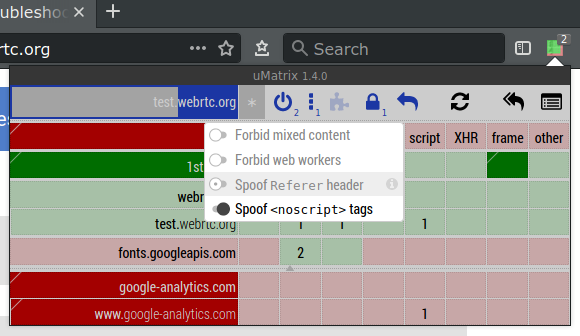
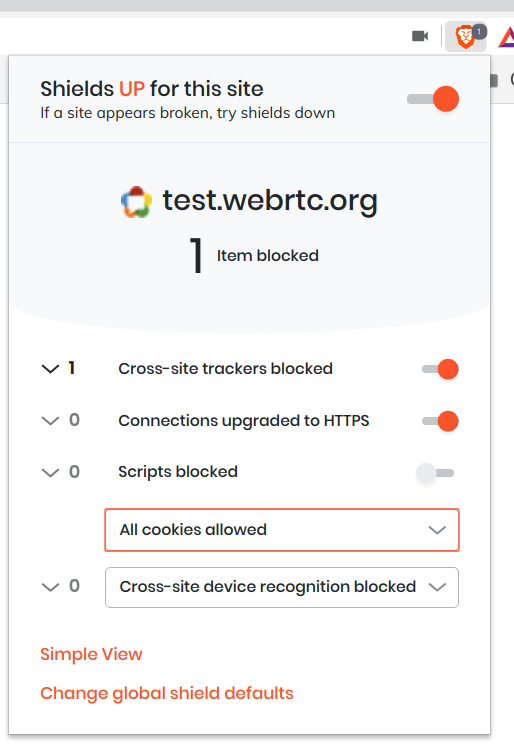
Testing basic WebRTC functionality Before you place a real call, I suggest using the official test page which will test your camera, microphone and network connectivity. Note that this test page makes use of a Google TURN server which is locked to particular HTTP referrers and so you'll need to disable privacy features that might interfere with this:
  • Brave: Disable Shields entirely for that page (Simple view) or allow all cookies for that page (Advanced view).
  • Firefox: Ensure that http.network.referer.spoofSource is set to false in about:config, which it is by default.
  • uMatrix: The "Spoof Referer header" option needs to be turned off for that site.

Checking the type of peer connection you have Once you know that WebRTC is working in your browser, it's time to establish a connection and look at the network configuration that the two peers agreed on. My favorite service at the moment is Whereby (formerly Appear.in), so I'm going to use that to connect from two different computers:
  • canada is a laptop behind a regular home router without any port forwarding.
  • siberia is a desktop computer in a remote location that is also behind a home router, but in this case its internal IP address (192.168.1.2) is set as the DMZ host.

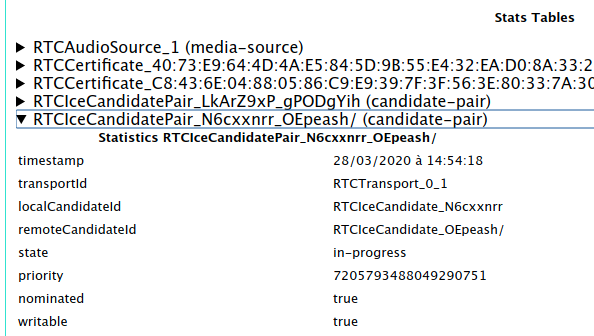
Chromium For all Chromium-based browsers, such as Brave, Chrome, Edge, Opera and Vivaldi, the debugging page you'll need to open is called chrome://webrtc-internals. Look for RTCIceCandidatePair lines and expand them one at a time until you find the one which says:
  • state: succeeded (or state: in-progress)
  • nominated: true
  • writable: true
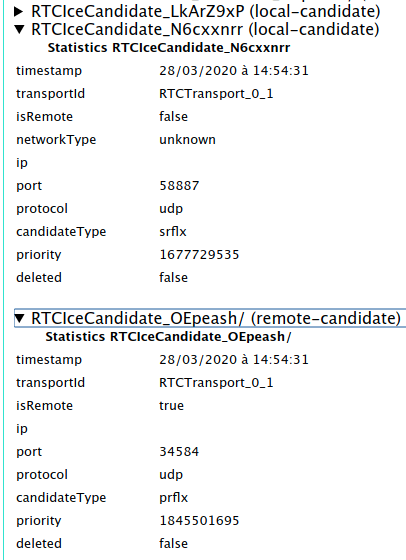
Then from the name of that pair (N6cxxnrr_OEpeash in the above example) find the two matching RTCIceCandidate lines (one local-candidate and one remote-candidate) and expand them. In the case of a direct connection, I saw the following on the remote-candidate:
  • ip shows the external IP address of siberia
  • port shows a random number between 1024 and 65535
  • candidateType: srflx
and the following on local-candidate:
  • ip shows the external IP address of canada
  • port shows a random number between 1024 and 65535
  • candidateType: prflx
These candidate types indicate that a STUN server was used to determine the public-facing IP address and port for each computer, but the actual connection between the peers is direct. On the other hand, for a relayed/proxied connection, I saw the following on the remote-candidate side:
  • ip shows an IP address belonging to the TURN server
  • candidateType: relay
and the same information as before on the local-candidate.

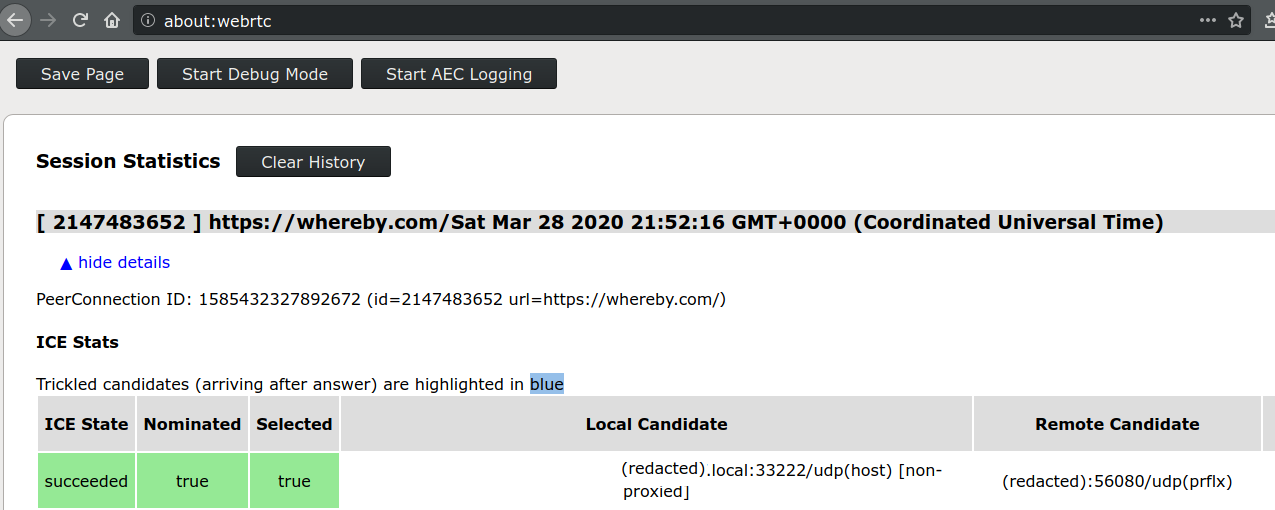
Firefox If you are using Firefox, the debugging page you want to look at is about:webrtc. Expand the top entry under "Session Statistics" and look for the line (should be the first one) which says the following in green:
  • ICE State: succeeded
  • Nominated: true
  • Selected: true
then look in the "Local Candidate" and "Remote Candidate" sections to find the candidate type in brackets.

Firewall ports to open to avoid using a relay In order to get a direct connection to the other WebRTC peer, one of the two computers (in my case, siberia) needs to open all inbound UDP ports since there doesn't appear to be a way to restrict Chromium or Firefox to a smaller port range for incoming WebRTC connections. This isn't great and so I decided to tighten that up in two ways by:
  • restricting incoming UDP traffic to the IP range of siberia's ISP, and
  • explicitly denying incoming to the UDP ports I know are open on siberia.
To get the IP range, start with the external IP address of the machine (I'll use the IP address of my blog in this example: 66.228.46.55) and pass it to the whois command:
$ whois 66.228.46.55   grep CIDR
CIDR:           66.228.32.0/19
To get the list of open UDP ports on siberia, I sshed into it and ran nmap:
$ sudo nmap -sU localhost
Starting Nmap 7.60 ( https://nmap.org ) at 2020-03-28 15:55 PDT
Nmap scan report for localhost (127.0.0.1)
Host is up (0.000015s latency).
Not shown: 994 closed ports
PORT      STATE         SERVICE
631/udp   open filtered ipp
5060/udp  open filtered sip
5353/udp  open          zeroconf
Nmap done: 1 IP address (1 host up) scanned in 190.25 seconds
I ended up with the following in my /etc/network/iptables.up.rules (ports below 1024 are denied by the default rule and don't need to be included here):
# Deny all known-open high UDP ports before enabling WebRTC for canada
-A INPUT -p udp --dport 5060 -j DROP
-A INPUT -p udp --dport 5353 -j DROP
-A INPUT -s 66.228.32.0/19 -p udp --dport 1024:65535 -j ACCEPT

Dirk Eddelbuettel: RProtoBuf 0.4.17: Robustified

A new release 0.4.17 of RProtoBuf is now on CRAN. RProtoBuf provides R with bindings for the Google Protocol Buffers ( ProtoBuf ) data encoding and serialization library used and released by Google, and deployed very widely in numerous projects as a language and operating-system agnostic protocol. This release contains small polishes related to the release 0.4.16 which added JSON support for messages, and switched to ByteSizeLong. This release now makes sure JSON functionality is only tested where available (on version 3 of the Protocol Buffers library), and that ByteSizeLong is only called where available (version 3.6.0 or later). Of course, older versions build as before and remain fully supported.

Changes in RProtoBuf version 0.4.17 (2020-03-xx)
  • Condition use of ByteSizeLong() on building with ProtoBuf 3.6.0 or later (Dirk in #71 fixing #70).
  • The JSON unit tests are skipped if ProtoBuf 2.* is used (Dirk, also #71).
  • The configure script now extracts the version from the DESCRIPTION file ( (Dirk, also #71).

CRANberries provides the usual diff to the previous release. The RProtoBuf page has copies of the (older) package vignette, the quick overview vignette, and the pre-print of our JSS paper. Questions, comments etc should go to the GitHub issue tracker off the GitHub repo. If you like this or other open-source work I do, you can now sponsor me at GitHub. For the first year, GitHub will match your contributions.

This post by Dirk Eddelbuettel originated on his Thinking inside the box blog. Please report excessive re-aggregation in third-party for-profit settings.

26 March 2020

Jonathan Carter: Lockdown

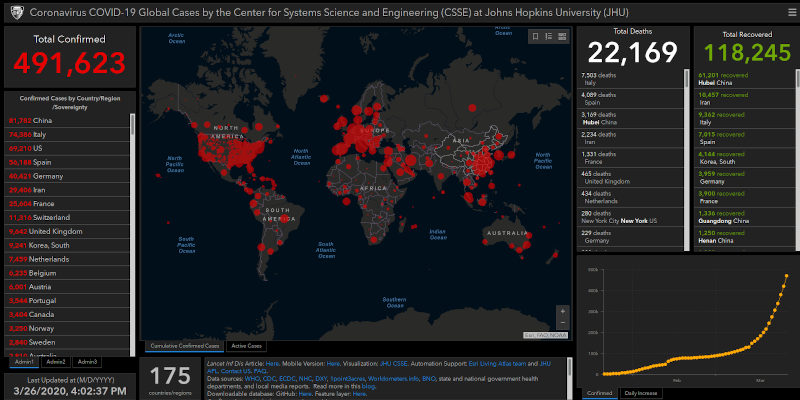
I just took my dog for a nice long walk. It s the last walk we ll be taking for the next 3 weeks, he already starts moping around if we just skip one day of walking, so I m going to have to get creative keeping him entertained. My entire country is going on lockdown starting at midnight. People won t be allowed to leave their homes unless it s for medical emergencies, to buy food or if their work has been deemed essential. Due to the Covid-19 epidemic nearing half a million confirmed infections, this has become quite common in the world right now, with about a quarter of the world s population currently under lockdown and confined to their homes.

Some people may have noticed I ve been a bit absent recently, I ve been going through some really rough personal stuff. I m dealing with it and I ll be ok, but please practice some patience with me in the immediate future if you re waiting on anything. I have a lot of things going on in Debian right now. It helps keeping me busy through all the turmoil and gives me something positive to focus on. I m running for Debian Project Leader (DPL), I haven t been able to put in quite the energy into my campaign that I would have liked, but I think it s going ok under the circumstances. I think because of everything happening in the world it s been more difficult for other Debianites to participate in debian-vote discussions as well. Recently we also announced Debian Social, a project that s still in its early phases, but we ve been trying to get it going for about 2 years, so it s nice to finally see it shaping up. There s also plans to put Debian Social and some additional tooling to the test, with the idea to host a MiniDebConf entirely online. No dates have been confirmed yet, we still have a lot of crucial bits to figure out, but you can subscribe to debian-devel-announce and Debian micronews for updates as soon as more information is available. To everyone out there, stay safe, keep your physical distance for now and don t lose hope, things will get better again.

Next.

Previous.