Search Results: "sf"

21 November 2011

Petter Reinholdtsen: Automatically upgrading server firmware on Dell PowerEdge

At work we have heaps of servers. I believe the total count is around 1000 at the moment. To be able to get help from the vendors when something go wrong, we want to keep the firmware on the servers up to date. If the firmware isn't the latest and greatest, the vendors typically refuse to start debugging any problems until the firmware is upgraded. So before every reboot, we want to upgrade the firmware, and we would really like everyone handling servers at the university to do this themselves when they plan to reboot a machine. For that to happen we at the unix server admin group need to provide the tools to do so. To make firmware upgrading easier, I am working on a script to fetch and install the latest firmware for the servers we got. Most of our hardware are from Dell and HP, so I have focused on these servers so far. This blog post is about the Dell part. On the Dell FTP site I was lucky enough to find an XML file with firmware information for all 11th generation servers, listing which firmware should be used on a given model and where on the FTP site I can find it. Using a simple perl XML parser I can then download the shell scripts Dell provides to do firmware upgrades from within Linux and reboot when all the firmware is primed and ready to be activated on the first reboot. This is the Dell related fragment of the perl code I am working on. Are there anyone working on similar tools for firmware upgrading all servers at a site? Please get in touch and lets share resources.
#!/usr/bin/perl
use strict;
use warnings;
use File::Temp qw(tempdir);
BEGIN  
    # Install needed RHEL packages if missing
    my %rhelmodules = (
        'XML::Simple' => 'perl-XML-Simple',
        );
    for my $module (keys %rhelmodules)  
        eval "use $module;";
        if ($@)  
            my $pkg = $rhelmodules $module ;
            system("yum install -y $pkg");
            eval "use $module;";


my $errorsto = 'pere@hungry.com';
upgrade_dell();
exit 0;
sub run_firmware_script  
    my ($opts, $script) = @_;
    unless ($script)  
        print STDERR "fail: missing script name\n";
        exit 1
     
    print STDERR "Running $script\n\n";
    if (0 == system("sh $script $opts"))   # FIXME correct exit code handling
        print STDERR "success: firmware script ran succcessfully\n";
      else  
        print STDERR "fail: firmware script returned error\n";
     
 
sub run_firmware_scripts  
    my ($opts, @dirs) = @_;
    # Run firmware packages
    for my $dir (@dirs)  
        print STDERR "info: Running scripts in $dir\n";
        opendir(my $dh, $dir) or die "Unable to open directory $dir: $!";
        while (my $s = readdir $dh)  
            next if $s =~ m/^\.\.?/;
            run_firmware_script($opts, "$dir/$s");
         
        closedir $dh;
     
 
sub download  
    my $url = shift;
    print STDERR "info: Downloading $url\n";
    system("wget --quiet \"$url\"");
 
sub upgrade_dell  
    my @dirs;
    my $product =  dmidecode -s system-product-name ;
    chomp $product;
    if ($product =~ m/PowerEdge/)  
        # on RHEL, these pacakges are needed by the firwmare upgrade scripts
        system('yum install -y compat-libstdc++-33.i686 libstdc++.i686 libxml2.i686 procmail');
        my $tmpdir = tempdir(
            CLEANUP => 1
            );
        chdir($tmpdir);
        fetch_dell_fw('catalog/Catalog.xml.gz');
        system('gunzip Catalog.xml.gz');
        my @paths = fetch_dell_fw_list('Catalog.xml');
        # -q is quiet, disabling interactivity and reducing console output
        my $fwopts = "-q";
        if (@paths)  
            for my $url (@paths)  
                fetch_dell_fw($url);
             
            run_firmware_scripts($fwopts, $tmpdir);
          else  
            print STDERR "error: Unsupported Dell model '$product'.\n";
            print STDERR "error: Please report to $errorsto.\n";
         
        chdir('/');
      else  
        print STDERR "error: Unsupported Dell model '$product'.\n";
        print STDERR "error: Please report to $errorsto.\n";
     
 
sub fetch_dell_fw  
    my $path = shift;
    my $url = "ftp://ftp.us.dell.com/$path";
    download($url);
 
# Using ftp://ftp.us.dell.com/catalog/Catalog.xml.gz, figure out which
# firmware packages to download from Dell.  Only work for Linux
# machines and 11th generation Dell servers.
sub fetch_dell_fw_list  
    my $filename = shift;
    my $product =  dmidecode -s system-product-name ;
    chomp $product;
    my ($mybrand, $mymodel) = split(/\s+/, $product);
    print STDERR "Finding firmware bundles for $mybrand $mymodel\n";
    my $xml = XMLin($filename);
    my @paths;
    for my $bundle (@ $xml-> SoftwareBundle )  
        my $brand = $bundle-> TargetSystems -> Brand -> Display -> content ;
        my $model = $bundle-> TargetSystems -> Brand -> Model -> Display -> content ;
        my $oscode;
        if ("ARRAY" eq ref $bundle-> TargetOSes -> OperatingSystem )  
            $oscode = $bundle-> TargetOSes -> OperatingSystem [0]-> osCode ;
          else  
            $oscode = $bundle-> TargetOSes -> OperatingSystem -> osCode ;
         
        if ($mybrand eq $brand && $mymodel eq $model && "LIN" eq $oscode)
         
            @paths = map   $_-> path    @ $bundle-> Contents -> Package ;
         
     
    for my $component (@ $xml-> SoftwareComponent )  
        my $componenttype = $component-> ComponentType -> value ;
        # Drop application packages, only firmware and BIOS
        next if 'APAC' eq $componenttype;
        my $cpath = $component-> path ;
        for my $path (@paths)  
            if ($cpath =~ m%/$path$%)  
                push(@paths, $cpath);


    return @paths;
 
The code is only tested on RedHat Enterprise Linux, but I suspect it could work on other platforms with some tweaking. Anyone know a index like Catalog.xml is available from HP for HP servers? At the moment I maintain a similar list manually and it is quickly getting outdated.

Russell Coker: Galaxy S vs Xperia X10 and Android Network Access

Galaxy S Review I ve just been given an indefinite loan of a Samsung Galaxy S which is more useful than the Sony Ericsson Xperia X10 that I own. I think that the main benefit is that it runs Android 2.2 instead of Android 2.1 on the Xperia. 2.2 is what gives it USB tethering support without extra software (something I haven t tested yet but will use a lot if it works correctly) and Wifi AP support. Both phones are about the same size, the Galaxy S has slightly more RAM (reported as 304M vs 280M which doesn t really matter) and a lot more main storage (1.87G vs 465M usable after the OS is loaded). The main down-sides of the Galaxy S is that it lacks a flash . I m not aware of any phone camera having a proper flash, but the limited LED flash is useful for taking pictures at times and there are a variety of programs that can turn it on for use as a torch. Also I wonder whether the Samsung people actually test their phones in real use or whether they just build them to spec. When you read the specs it sounds nice to have a phone that s only 9.9mm thick (apart from the bulge at the bottom), but that makes it really difficult to hold. The Xperia X10 is 13mm thick and isn t as slick so you are much less likely to drop it. I sometimes wonder whether phone companies are designing their products to be broken so that they can sell replacements. Three Networking Sucks My parents use 3G broadband from Three as their only connection to the Internet, this is fast enough for viewing Youtube on occasion and generally works well for them. However whenever I try to transfer any data to their system which has integrity checks it turns out to be corrupted. About every megabyte of data transferred has a corrupt packet that has a matching checksum presumably it s a bug in Three s network. Because Three are desperate for customers they have given me a free 6 month subscription to a data SIM [1]. I ve been using that SIM with my Galaxy S and found the same data corruption problem and I ve reproduced it in many places around Melbourne so this isn t just one unreliable cell tower, it s something broken in the core of the Three network. The obvious solution to this is to use a VPN so the corrupt packets will be dropped. So I set up a PPTP VPN only to discover that it seems impossible to make the default route be via the VPN, there has been a bug report about this since 2009 the iPhone allows configuring whether Internet traffic should go via the VPN, it can t be that hard [2]. There is an option to use a proxy for web access, but when I tried that on Android 2.1 it only worked for the system web browser not for things like the Android Market. But there is no option for configuring a proxy for use when the VPN is active, so it doesn t seem likely that I could run a proxy on the VPN network and direct all traffic to it. Due to corruption on the Three network and the inability to get a VPN working correctly it seems that I can t use the Three SIM. Android isn t Really Free Software While Android implementations generally stick to the GPL and other free software licenses that are involved they seem to be a poor example of providing freedom to users. My Xperia X10 is running Android 2.1 because Sony-Ericsson has locked the boot loader so I can t install a newer kernel. They don t care enough to release a new version this is stupid of them because it means that I am much less likely to recommend their products. If Sony-Ericsson releases a newer Android release then it will be a total OS reinstall, unlike the way I can upgrade a Debian system an application at a time. I can t install new packages that replace system packages, so the Email and SMS programs that I ve installed sit along side the ones that came with the system. Periodically the unwanted SMS and Email programs show up. I can t make my Android phones perform basic networking tasks that I ve done on Linux systems since the early 90 s. Hiding the complexity from the newbies is OK, but they need to make the full capabilities of the system available to experts. It seems to me that Android effectively gives the majority of users no more freedom than the iPhone does. Even for the small minority of us who are technically capable of rooting phones and installing CyanogenMod etc it s often limited by technical measures and the amount of time required. Update: Philipp Kern pointed out that his Galaxy S has a front facing camera. I have checked my phone and discovered that it has one too. When I published this post I criticised the Galaxy S for not having a front facing camera for video-calls based on a misunderstanding of the Wikipedia page (which says that SOME models lack it) and not testing it. Thanks for the correction Philipp and sorry for publishing wrong data.

17 November 2011

Timo Jyrinki: On discussing free software mobile phones

Since I think I just summarized a few thoughts of mine well at LWN, I'll copy-paste it here:
I can grumble about Android from time to time, but I do not say that it sucks. Extreme views are what are annoying. Android is what it is and it's great as it is, even though it could be different as well.

When it comes to discussing about free software and mobile phones, I'm especially annoyed by two types of comments:

1. People essentially saying that there is no value in an open project, ie. free software code dumps should be enough for everybody. I'm interested in the long term viability of free software projects, and it is hard to have successful projects without there being all sorts of factors that make up a good project - like transparency, inclusion, meritocracy. Even though the mobile projects have had little resources and a hard road, it's not useful to forget about these goal in the longer term. For example Debian, Mer, SHR, KDE Plasma Active have some of these in the mobile sector. I hope the best for them (and participate).

2. People complaining about something being not 100% free software, while not themselves actually even interested in it for other sake than complaining. When I've been talking about free software mobile phones, from time to time there is someone complaining about eg. not open GSM stack, wlan firmwares etc.. and to put it sharply probably writing the message from iPhone, while I'm reading it on Neo FreeRunner. If the complainer would be Harald Welte, I'd probably listen and agree with him.

So there. For more civilized discussion.

16 November 2011

Bastian Venthur: No sound with Gnome 3 and pulseaudio?

Dear Lazyweb, I recently switched from KDE to Gnome 3 and I am so far very happy with the decision. One thing that bothers me since then is that the sound does not work when restarting the computer or waking it up from suspend. After a while I figured that a simple sudo killall pulseaudio fixes the problem but only until the next reboot. Has anyone a hint what the problem could be/ I found quite a few similar problem descriptions on the internet but with no satisfying solutions so far.

15 November 2011

Michael Casadevall: Secure Boot - its here and been here for quite awhile ...

There's been a lot of noise with Microsoft requiring Secure Boot for Windows 8 OEMs. For those of you unfamiliar with it, Secure Boot requires that the boot chain is signed, and this 'feature' must be enabled by default. Although I have been unable to find specific details, it appears that the chain of trust needs to extend from BIOS/UEFI all the way down to the kernel. Obviously, requiring a signed boot chain makes using FOSS platforms like Ubuntu or Debian an impossibility short of having the UEFI Platform Key and resigning the entire chain.

Steven Sinofsky's MSDN blog has a fairly good overview how it works. Canonical and Red Hat also have a good white paper on why secure boot is a serious problem for Linux distributions. Even if secure boot itself can be disabled, it *greatly* rises the bar for general end-users to successfully install Ubuntu on their machine. In addition, it is the responsibility of OEM and BIOS manufacturers to provide the option to disable it.

There already has been a long history of OEMs removing BIOS options or introducing DRM; for instance, locking out VTx on Sony laptops, or restricting laptops to only accept 'branded' wifi and 3G cards. Given this track record, can OEMs realistically be trusted to have this option available?

What most people don't realize is that secure boot itself is not a new concept; its simply part of the Trusted Computing initiative, and has been implemented on embedded platforms for many years. If you own any iPhone, or one of the vast majority of Android devices, you are using a device that either has the secure boot feature, or something very close. This especially painful in Android as Google's security system restricts users to a *very* limited shell and subset of utilities which can be used on non-rooted devices. WebOS, Maemo, and to my knowledge Meego give the end-user full unrestricted access to the boot chain and you can swap kernels and even the entire OS out if one was so motivated.

Although it is still an ongoing problem, several vendors such as HTC, Samsung, Motorola (kinda), and even Sony. In the Android community, having unlockable bootloaders has been a welcome middle ground in the traditionally restrictive and locked-down world of cellular devices.

While some may argue that such locks are necessary to protect consumers, it is perfectly feasible to create devices with unlocked bootloaders that are still secure. The Nook Color's is an Android powered eReader. It's stock firmware doesn't allow sideloaded applications or even access to a user shell via adb, but the BootROM on the device attempts to boot from the microSD card before eMMC, making it possible for enterprising users to easily modify the underlying OS (as well as making it physically impossible to brick the device due to a bad flash). Barnes and Nobles even sells a book on rooting the Nook Color; it was right next to the devices on display at the time. In addition, they've continued the tradition of easily modifiable devices with both the Nook Simple Touch, and the Nook Tablet.

One of the most impressive attributes is the possibility of running Ubuntu on it. The absolute poster child for this is the Toshiba AC100. For those of you unfamiliar, it ultralight netbook that shipped with Android 2.1/2.2 with easy access to the built in flash via the mini-USB port on the side of the device. Due to the valiant efforts of the AC100 community, Ubuntu was ported to this device, and became a supported platform with images available on cdimages.ubuntu.com. If you were an attendee at UDS, you likely saw several AC100s all running Ubuntu.

This brings me to the point that motivated me to write this post in the first place. One of the most impressive tablets I've seen to date is the ASUS eeePad Transformer, an Android tablet with fully dockable keyboard. I have one of these devices, and its one of the most impressive and usable Android tablets I own. Sadly, such a powerful device was hobbled from its true potential due to ASUS's decision to ship the device with a locked and encrypted bootloader. Surprisingly, the Secure Boot Key (SBK) was acquired and released to the wild, making it possible to reflash the device. Sadly, even with the SBK, the device's bootloader is still extremely hobbled compared to the AC100 making flashing a slow and difficult process.

In response, ASUS refreshed the eeePad's hardware to the new B70 SKU, which has a new Secure Boot. Despite this, a root exploit was recently found to allow people to circumvent these restrictions and install customs ROMs. It is however only a manor of time before ASUS responds and releases a new update that fixes this bug.

Steven Barker (lilstevie) on xda-developers successfully created a port of Ubuntu to the Transformer. Currently, installing Ubuntu on the Transformer requires nvflash access, so its not possible to use his image on the newly liberated B70 devices. I am certain that a new method of installing via an update.zip will be developed for those of us with hobbled devices.

It is a showcase of what is possible when you have open hardware, and also proves one indisputable point: any 'trusted boot' or DRM scheme can and will be defeated; at best you piss off your userbase, and at worst, you force users to exploit bugs to gain control of their device. As it is impossible to reflash these devices from the bootloader, a failed kernel flash WILL brick these devices, increasing warranty and support costs as users try to return their now broken devices.

In closing, while there have been some victories in ongoing war of open hardware vs. trusted comptuing, the road ahead still remains very murky. Victories in the mobile market have shown that there is a market for open devices. Google's own Nexus One was sold as a developers phone and as a way to encourage manufacturers to raise the bar. It sold well enough to recoup its development costs.. While there is no official statements, the Nokia N900 is suspected to have broken all sales expectations, backed up by the fact that Angry Birds sold extremely well on the Ovi Store for the N900.

From the article in question:
What reaction have you had in terms of sales and customer feedback?

Angry Birds had already been launched on App Store before it came out on Ovi Store, and it had a great review average from iPhone reviewers and users alike, so we expected a good reception from N900 users as well.

Even so, we were quite surprised by just how the N900 community immediately took the game to heart. The game obviously made many people very happy, and that is really the greatest achievement that anyone who creates entertainment for a living can hope for. Well, maybe the greatest achievement is huge bundles of cash, but making people happy comes a close second.

In the first week that Angry Birds has been on the Ovi Store, it has been downloaded almost as many times as the iPhone version in six weeks. Given that most N900 users have not even used Ovi Store yet, we are confident that there will be many more downloads in the months to come, and are sure that the N900 version will be very profitable.

That being said, with Microsoft pushing secure boot and trusted computing down everyone's throats with Windows 8, it is hard to say what the future might hold for those of us who want to own our devices.

14 November 2011

MJ Ray: Growing Your Co-operative, Bristol

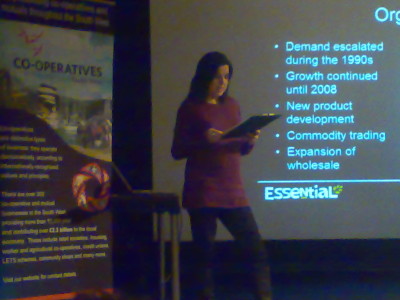
Photo of Eli Sarre

Eli Sarre from Essential Trading speaking at C-SW Annual Conference

Last Friday (11 November 2011), I was at the Cooperatives-SW annual conference at the Cube Cinema in Bristol, titled Growing Your Co-operative and sponsored by the Co-operative Membership South and West. It was another sold-out event, featuring headline talks from Co-op Party member and Labour MP Kerry McCarthy, Eli Sarre of Essential Trading worker co-op (pictured), Carole Theyer of Sparks Inc and Jim Pettipher from Co-operative Futures. There were also some great workshops I went to a finance workshop led by Ian Rothwell from Co-operative and Community Finance and a regulations one with Paul Martin of Kabin (details may appear on their event page) and a brilliant lunch from Runcible Spoon (and those of you who know me will know I have been livid with some co-op event lunches!) with some time to chat and network, although I also went to a fringe meeting about the RISE problems. The event concluded with the formal AGM of Co-operatives SW (electing a new chairperson and approving transfer to a new co-op corporation) as well as a bit more chat afterwards. I felt it was a great event and well worth my time being there. I m glad that some people from outside the co-op movement, from community businesses like the Strawberry Line Cafe and a few people considering joining or forming co-ops, were there and I hope it was good for them too.

Vincent Bernat: A quick look at Typekit

Back in the dark ages of the web, before the introduction of CSS 3, browsers could only display fonts available on the client system. Thanks to the introduction of @font-face and its now widespread support, this is over. Now, Web designers have access to a large selection of fonts and most users will be able to appreciate them. Typekit provides a subscription-based library of hosted, high-quality fonts to use on websites. I expose here my own, mostly uneducated1 on the typographic side, look on this service.

Fonts embedding 101 There are several ways to embed fonts for the Web. Let s have a look at the most common ones.

Self-hosting and @font-face A first possibility is to host fonts yourself and provide a CSS file with the appropriate @font-face declarations. There are five important things to know:
  1. There is no common format. You will need to host different versions of the same font to support most browsers.
  2. Of course, Internet Explorer comes with its own quirks that you need to work around.
  3. Most browsers enforce a same origin policy. You need to serve your fonts from the same domain as the requesting page. You can circumvent such a limitation by enabling cross-origin resource sharing: add an Access-Control-Allow-Origin header when serving fonts.
  4. Fonts are unlikely to change. To leverage caching, configure an explicit expiration date far in the future. Something like 30 days.
  5. There is no MIME types registered for fonts. Don t bother setting one, even if Google Chrome likes to complain about them in the console.
One great resource is Font Squirrel which provides kits with fonts and the appropriate CSS declarations. You choose your font family (or upload one of your own), the formats that you want to use (check them all) and you will get a ZIP archive with all fonts and a CSS file. You may want to tweak it a bit to enable automatic use of the bold variant when needed and to use a local copy if available. For example, if you choose Crimson, an oldstyle typeface, you may want to declare the bold version with font-weight: bold and add local names:
@font-face  
    font-family: 'Crimson';
    src: url('Crimson-Bold-webfont.eot');
    src: local('Crimson Bold'), local('Crimson Text Bold'),
         url('Crimson-Bold-webfont.eot?#iefix') format('embedded-opentype'),
         url('Crimson-Bold-webfont.woff') format('woff'),
         url('Crimson-Bold-webfont.ttf') format('truetype'),
         url('Crimson-Bold-webfont.svg#CrimsonBold') format('svg');
    font-weight: bold;
    font-style: normal;
 

Google Web Fonts For open-source fonts, you can also use Google Web Fonts instead of hosting the files yourself. Build a collection of fonts and choose the variants that you want to use for each of them. You will then be provided with a code snippet to paste in the <head> element of your page. For example, for Crimson:
<link href='http://fonts.googleapis.com/css?family=Crimson+Text:400,700,400italic'
      rel='stylesheet' type='text/css'>
Why choose this solution over self-hosting?
  1. You don t use your own bandwith to serve fonts. This may be important if you pay for it.
  2. Google uses its own CDN to serve fonts. If you don t use a CDN yourself, this can be a major performance improvement.
  3. Caching is more efficient since many sites will use the same font.
  4. It s easier to do it right.
Unless you are concerned about Google tracking your users2, I think this is a better solution than self-hosting. Quick delivery of fonts is pretty important since content rendering can be delayed by them.

Typekit: the good parts So, why choose Typekit? First, there is the very large choice of fonts. The first paid plan comes with more than 500 fonts from about 80 foundries. There are about a hundred serif fonts and a couple hundred sans serif ones. Typekit provides a convenient interface to browse fonts. You can either search fonts by name or by characteristics. In the last case, you can filter on properties like the classification (serif, sans serif, decorative, etc.), weight, width, contrast, x-height, recommended use or language support. Once a font is selected and added to your kit, you can easily choose what variants you want. The kit total size is displayed. If you happen to meet any problem or have some questions, Typekit support is very responsive. I got clear and crisp answers in less than a few hours in the week-end.

and the bad ones Unfortunately, Typekit has also some shortcomings. One of the most commonly cited is that Javascript is mandatory. No Javascript, no fonts. If you want to display the appropriate fonts for users without Javascript, you should just not use Typekit.

Not free, nor free While Typekit offers some open-source fonts, most of them are not. Moreover, only a few of them are available in the free plan. While I would prefer to use open-source fonts, I don t consider this a strong requirement: if you are dissatisfied for some reason, switching back to open-source fonts (or another service) is fast and easy. I like serif fonts a lot and they get less attention from the FLOSS world: it is difficult to find one whose readability on screen is excellent. Droid Serif is a nice font but is a bit too black for me. Maybe Cardo would be a good match. You may disagree and in this case, Google Web Fonts or self-hosting seem the perfect match.

Difficulty to choose and test fonts While browsing fonts is easy and smooth, choosing and testing them is another matter. For example, Typekit is missing some interface to compare font rendering for whole paragraphs at a given size. It also misses a way to check how two fonts render together, one for headings and one for paragraphs. Here, Google Web Fonts is more versatile. Things become really difficult when you want to test your selected fonts for real. Except if you have invested into one of the expensive plans, you can only include a limited number of fonts in your kit. Each time you want to try another set of fonts, you need to modify your kit and wait for it to be distributed across Typekit network. You may have to wait five or ten minutes between each change! Another inconvenient thing is that once you publish your site, any change to the kit will affect the published version. Therefore, you need to use a second kit for development and play back and forth with those two kits. What would be convenient here is a special kit with all fonts from the library with restricted access to some IP to avoid abuse. This is something done by Fontdeck, a competitor.

Poor subset support Because you want to keep the font size small (about 30 kB for each variant), Typekit usually proposes two subsets: the default one contains only latin characters and the complete one with all glyphs. If some glyph is absent from the default subset, you need to use the complete one which is roughly two to four times the size of the default one. This is a bit huge for only one character. What would be nice is to have subsets for each language. In my case, I would take a French subset because I need the glyph which appears in French in words like c ur (heart or core) or il (eye). I don t want to select the complete subset just for this character. When a glyph is absent, the next font in the CSS stack is used. For example, if the selected font is FF Tisa Web Pro and the next font in the stack is Droid Serif, here is how the word c ur may be rendered. On the first line, FF Tisa Web Pro contains the appropriate glyph. On the second line, the glyph is absent and taken from Droid Serif. Since x-height and contrast are a bit different, the replaced glyph seems out of tone. At small sizes, the difference accounts for more than 10%. Various rendering of word "c ur" I have also added a third line where the ligature is built from o and e and the following style is applied to e :
.lf-ligature  
    margin-left: -0.172em;
    zoom: 1; /* Here to trigger hasLayout on IE7 */
 
As you can see, the result seems good. I have a piece of Javascript turning a ligature into the appropriate markup. It can be extended to handle more ligatures and could be adapted to handle other composed characters (like the ones in Anton n Dvo k ).

Defective caching Because a document can only be rendered after the fonts have been loaded3, it is pretty important to deliver fonts as fast as possible. Typekit uses Edgecast as a CDN and DynECT for DNS hosting. Two files are downloaded. Both of them are hosted on use.typekit.com. The first one is a script that will act as a loader. Based on the characteristics of your browser, it will choose how to download the requested fonts for best rendering. The second file is generally a big CSS file containing the fonts. Here are the headers returned for the first file:
HTTP/1.1 200 OK
Accept-Ranges: bytes
Cache-Control: max-age=300
Content-Encoding: gzip
Content-Type: text/javascript
Date: Tue, 08 Nov 2011 18:34:16 GMT
ETag: "388467610+gzip"
Expires: Tue, 08 Nov 2011 18:39:16 GMT
Last-Modified: Sat, 05 Nov 2011 09:31:57 GMT
Server: ECS (cdg/D624)
Vary: Accept-Encoding
X-Cache: HIT
Content-Length: 7440
First, notice that the content is served compressed. Good point. The next headers to look at are Cache-Control, Date, ETag and Expires: the server requests the content to be cached for 5 minutes. When the browser notices that its copy is out-of-date, it will issue a new request including a If-None-Match: 388467610+gzip header. Unless the kit has been modified, the server will answer with 304 Not Modified and no content. The copy of the browser will be valid for another 5 minutes. This means that after 5 minutes, at least 3 round-trips are needed to check if our fonts are up-to-date. Worse, sometimes, Typekit servers may be just slow. They can wait one second before answering, just to send a 304. Since the first file is a script embedded in <head>, the whole page is blocked until you get the answer. Here is an illustrative example with Chromium 14 where a page using Typekit is loaded while all static assets are in the navigator cache and things have gone wrong (which is pretty rare): Screenshot of Chromium Inspector Since fonts are needed, the rendering has been paused for 3.5 seconds until Typekit was fully loaded. If we look more closely, we may also notice we got a status 200 from the server instead of 304. Here is an excerpt of the browser request:
GET /tyt0atd.js HTTP/1.1
Host: use.typekit.com
Connection: keep-alive
Accept-Encoding: gzip,deflate,sdch
If-None-Match: "2200251225+gzip"
If-Modified-Since: Thu, 10 Nov 2011 11:38:11 GMT
And here is an excerpt of the answer headers:
HTTP/1.1 200 OK
Accept-Ranges: bytes
Cache-Control: max-age=300
Content-Type: text/javascript
Date: Fri, 11 Nov 2011 17:10:03 GMT
ETag: "2200251225"
Expires: Fri, 11 Nov 2011 17:15:03 GMT
Last-Modified: Thu, 10 Nov 2011 11:38:11 GMT
Server: EOS (lax001/54E5)
Content-Length: 25755
What happened? For some unknown reason, the server denied the access to the compressed version of the resource: there is no Content-Encoding: gzip while the browser did send Accept-Encoding: gzip. The tag provided by the browser (2200251225+gzip) came obviously from the compressed resource and therefore does not match. RFC 2616 requests If-Modified-Since header to be ignored if the tag does not match. Consequently, the server answers with 200 OK and resend the whole file. The same problem happened with the CSS file. Let me stress again how important the problem is: we had to download again the two files but we also downloaded the non-compressed version. Now, let s suppose that we did not run into this problem and the server answered with 304 Not Modified. The result is still not satisfactory: we would have waited 1.3 seconds to get both answers from the server. Keep in mind that most of the time, Typekit is pretty fast. Here is how I think this should have been done: each time you modify your font kit, you get a new URL to use (containing the version of the font kit for example). This resource and the associated fonts (whose URL is also versioned) are requested to be cached for several days. As a sidenote, this also enables to modify a kit for your development environment without modifying the kit for your production site. I suspect that Typekit did not go this way to track kit usage more accurately and enforce the appropriate pricing. Having multiple versions of the same kit would also allow us to use more fonts that we are paying for. UPDATED: Typekit support knows the problem and is working on it:
You ve identified a small bug in our CDN provider that we re working with them to fix. Hopefully I can give an explanation of what s happening. The CDN edge servers have a cache of recently served kits on them. Any request that is served from that cache will be correctly Gzipped and handle ETags. Unfortunately, if the content isn t already in cache and needs to be fetched from the master origin server then the request won t be gzipped correctly which has the side effect of breaking ETags. [ ] We are working to on getting this bug fixed, but any change to a globally distributed CDN will take some time. We re also working on having our content cached longer than 5 minutes whilst still allowing people to quickly update their site.

Conclusion I have mixed feelings about Typekit. While the difficulty to test fonts and the lack of language-related subsets are annoying, I have been able to work around them. However, the caching problem is more annoying. I am still considering going back to Google Web Fonts just because of this.

  1. While I have a high interest in typography, have my own copy of The Elements of Typographic Style by Robert Bringhurst and have throughly read The Elements of Typographic Style Applied to the Web , I am still fairly novice on this matter.
  2. Google serves fonts from a cookie-less domain. Technically, they could still do some kind of tracking but I believe they don t.
  3. In fact, browsers have different strategies on how to render before fonts availability. Paul Irish wrote a comprehensive article on FOUT. One common strategy is to render a blank space until downloaded fonts are available. If this takes too much time, fallback fonts may be used.

13 November 2011

Gregor Herrmann: RC bugs 2011/45

& another mix of various RC bug fixes: applying patches from others, fixing stuff myself, closing obsolete bugs: in somehow related news: the perl 5.14 transition has begun. that also means that the severity of some bug reports was raised, & maybe we'll see some new ones. but it also means these bugs are easier to fix now that perl 5.14 is in unstable.

10 November 2011

Adnan Hodzic: Linux power regression + overheating problem on ThinkPad [fixed?]

This blog post isn t only directed to ThinkPad owners as most notebook Linux users with Intel Core Duo 1/2 and i3/i5/i7 processors have been affected by this bug if not all. And yes, this problem is present on latest Debian Unstable and Ubuntu 11.10. Prelude I m owner of Thinkpad X300, great machine except the fact that just recently I replaced its 3rd cooling fan! Yea, I do a lot of compiling and it s on all the time, but still this kind of things shouldn t happen. I first linked this problem to the fact that Thinkpad fan on Linux (as of 2.6.22) always works at what s its basically maximum RPM, thus the reason there are numerous fan control scripts. My favorite one is Thinkfan, but controlling fan doesn t really help if you have a overheating problem. For matter of a fact it working on its maximum speed might only help, with its own toll. As of kernel 2.6.38 up until 3.1 (still present) there has been a problem of power regression but besides this I had slight problem with overheating. Regarding overheating in beginning I tried reporting bugs, tried different Thinkfan configurations, blamed proprietary software such as Adobe Flash for spiking up CPU temperature, however this problem was somewhat solved. After numerous battery calibrations and as these didn t work in the end for battery life getting poorer with each day, I just blamed the factor that notebook was getting pretty old (~3 years). Then the consumer woke up inside of me and I thought it was time to get new notebook. I laid my eyes upon ThinkPad X1 thing of beauty except one mayor drawback, its price. I did some reading on X1 and interesting enough, X300 comes with Core Duo 2 L7100 but overheating + power regression was still present even on latest Intel Core I* series. Reading this killed the consumer and woke up the hacker side. Solution Initial workaround to the problems of power regression is to add pcie_aspm=force besides existing GRUB boot arguments, this did help to some point but what really helped in both cases was also adding i915.i915_enable_rc6=1 or at least I thought so since this line only applies to Sandy Bridge (i3/i5/i7) and latter. In the end my /etc/default/grub looks like:
GRUB_CMDLINE_LINUX_DEFAULT="quiet splash pcie_aspm=force i915.i915_enable_rc6=1"
and make sure you run update-grub after making these changes. Besides the arguments I used there are other ones you can use and for more info please head to Tweaks To Extend The Battery Life Of Intel Linux Notebooks . Results I ended up with such simple tweak are more then satisfactory as I got some ~45 extra minutes of battery life besides the fact that it lowered temperature by some ~10 C. Guess this also gives me extra time until I get a chance to lay my hands on X1 Smile P.S: After I posted this some argued that this is a workaround rather then a fix and folks at [Phoronix] just posted what they call a proper solution to this problem. Also please note although Sandy Bridge users that enable this might sometimes get a video corruption bug, i915_enable_rc6 is still supposed to get enabled by default in 3.2. So logical conclusion you can come up with is unless you re troubled by this problem, you might not want to use this work around/fix at this point. And hope it ll be fixed in future releases of your favorite Linux distribution.

6 November 2011

Gregor Herrmann: RC bugs 2011/44

this week showed an interesting mixture of RC bug fixes: applying patches from others, writing one on my one, adjusting build dependencies, & also closing some bugs that did not occur anymore during the last Grid'5000 run & are also unreproducible locally (thanks to Lucas for the hint).

Uwe Hermann: Downloading non-DRM Amazon MP3s on Linux using clamz

I recently wanted to buy some MP3 files from Amazon (a whole album in my case, but you can also just buy single MP3 files if you want). Digital music downloads from Amazon are often much cheaper than buying the physical CD (from Amazon), and you can also instantly get the stuff within seconds, without having to wait for the physical CD to be shipped to your place. The good thing about Amazon's MP3 downloads is that the files are not infested with any DRM-crap (if that were the case I wouldn't spend a single penny on such useless junk, of course). This allows you to burn the MP3 files on CDs and/or play them on any device you like (MP3 player of choice, laptop, hifi-system, car, e-book reader with MP3 playback support, etc. etc). Granted, you can not re-sell the digital files on eBay later, this is the one little drawback you have when compared to physical CDs, but I guess most people can usually live with that. Also, it would be great if Amazon would provide Ogg Vorbis files instead (or in addition to) MP3 files, of course. Anyway, in order to download the MP3 files you buy from Amazon, they suggest to install the Amazon MP3 Downloader, which (surprisingly) is even available in a Mac and Linux version (only 32-bit though), but is (unsurprisingly) closed-source. This is no-go, of course, but luckily there is an alternative. The clamz tool (GPL, version 3 or later) allows you to easily download single Amazon MP3 files, or whole albums. First, you need to login to your Amazon account and then visit a certain Amazon page (which sets a special "congratulations, the Amazon MP3 Downloader has been successfully installed" cookie in your browser). See the clamz website for the respective URL for your country. For Germany, use this URL. The clamz installation is easy enough on Debian:
  $ apt-get install clamz
IMPORTANT: It seems you need at least version 0.5 for recent Amazon files as they apparently changed something, see #647043. Current Debian unstable as of today already has 0.5, though. After that is done, the rest is easy: In Amazon, click on "Buy MP3" or "Buy MP3 album", which will download a special AmazonMP3-1234567890.amz file. You can then let clamz download all the MP3s by typing:
  $ clamz AmazonMP3-1234567890.amz
Wait a few minutes, and you'll have a bunch of non-DRM MP3 files in your current directory. Easy. See the manpage for a bunch of options which let you configure clamz to your preferences.

5 November 2011

Christian Perrier: People behind Debian: Rapha l Hertzog, dpkg maintainer, book author

It's about time that Rapha l is interviewed in the "People behind Debian" series he initiated on his blog. Indeed, when he interviews people, Rapha l asks about other people they could suggest for next interviews. So, during mine, I suggested him to be a next "victim". As he couldn't interview himself, I volunteered for this. As you'll see below, Rapha l (who's a friend of mine as I'm a friend of his) likes to speak and that shows in the length of his answers :-) but you always know more about Debian when reading his blog posts, books, mails, etc. I personnally think that he is among the best promoters of the project for years and it was a pleasure for me to conduct this interview. My questions are in bold, the rest is by Rapha l. Who are you? Hi, Rapha l Hertzog, I'm a 32 years old French Debian developer who is married and who has a 2-year old son. I'm running my own company (Freexian) since 2005, I started it 3 years after the end of my computer science studies. I'm also a very proud author of the Cahier de l'Admin Debian, a French book about Debian. You often wrote about your attempts to make your living partly, if not completely, out of your Debian work. Can you describe the way you're trying to do this? My first try has been with Freexian. I always advertised this company as being specialized in Debian GNU/Linux. While Freexian is successful enough to provide me a decent income, I'm not really satisfied with the result because very few of my contracts are about improving Debian. I use Debian daily for the benefit of my customers, writing new customer specific (embedded) software, deploying a service on Debian servers, etc. But except for the occasional bugfix, all this work does not improve Debian (the only exception has been the dpkg multiarch implementation work sponsored by Linaro). The positive side is that I don't need to fill my entire schedule to earn enough money to live. So I'm regularly taking some days off work to be able to contribute to Debian. This is a freedom that I enjoy... My French book has also been a bestseller and depending on the years the royalties represented between 1 and 2 months of supplementary time that I can spend on Debian (that is between 2000 and 4000 EUR of income). Now since last year, I decided to actively work towards my goal of making a living out of my Debian work. I want to build on what has been most successful for me up to now, that is my book. My strategy has been to build an audience around my blog: with a direct contact with my readers I have the opportunity to sell e-books, and without any intermediary taking the biggest part of the price, I don't need a very large audience to be successful. I have also been experiencing micro-donations with Flattr, people who are enjoying my articles on my blog can use it to give a few cents for each article they find useful. With a large enough userbase, this could fund free documentation and would avoid the need for commercial e-books but we're not there currently and I don't know if it will ever reach the critical mass. Last but not least, I'm soliciting donations for my Debian work on the sidebar of my blog, and I have the chance to a have a few (regular) donators. You're a proud father since last year. How do you manage your commitment to the project with your family life? There are few things that I put above Debian in my life, but my family certainly is. I try to handle most of my Debian duties during work hours so that I can spend time with my family on evenings and during week-ends but in truth I never really disconnect from Debian. It happens quite often that I say to my wife I'll come in a few minutes, let me finish this and then I end up responding to a Debian mail, or an IRC query and take 30 minutes instead of the 5 expected ones. I try hard to avoid this but it's difficult. Luckily for me, my wife is very supportive of my Debian involvement and knows me well... By the way my wife is using Debian on her computer, and my son has already played with DoudouLinux (a Debian derivative!). Have you already been accused of self-promotion in your writings? If that would ever happen, what would you answer to that? Yes, more than once. I am proud of what I do for Debian, I enjoy sharing the result of my work. Because of this, some people believe that I'm selfish and egocentric. And this has somewhat increased since I have been soliciting donations: for me it's important to be transparent towards donators so that they see what I really do for Debian. But some people have the feeling that I'm getting undeserved attention and that I bring everything towards my own person. On the other side, as an author, I'm a public figure who is definitely seeking some attention... I don't have any miraculous answer, we are a large and diverse community, it's next to impossible to please everybody. I listen to all the concerns that people bring forward, I take them into account as much as possible, in particular when I believe they are reasonable/well justified, or when they come from people that I highly respect. But sometimes I have to plainly ignore them too... in particular when they are trying to impose their own political view on a topic that's not directly related to the only value that we all share: the social contract. Contributing to Debian is a challenge, we all have to make efforts to put aside our differences and to concentrate on the work that brings us closer to the best free software operating system ever built. You recently launched a campaign to free out the soon-to-be-published "Debian Administrator Handbook", an English version of your well-known book about Debian in French. Can you tell us more about this project? My French book has been very successful at helping people to get started with Debian, and like I already explained, it was also effective to fund a part of my Debian work. So I wanted to make it available world-wide by publishing an English translation of it. I tried to find an English-speaking editor willing to take on the challenge but I found none interested. Not put off by a setback, Roland (my co-author) and I decided to negotiate with our French editor Eyrolles to recuperate the necessary rights to translate the book into English. Handling everything ourselves represents a lot of work, but it also means that we have the freedom required to decide of the license of the resulting book. We would love to see it under a license compatible with the Debian Free Software Guidelines. But at the same time we firmly believe that we deserve a reasonable monetary compensation for the work on the book, so we conditioned its liberation to a predefined amount of money (25 K ) in what we call the "liberation fund". And since we wanted to be sure that we would have the required means to complete the translation, we used a crowfunding platform to seek support of people interested by the book. With such a platform you're only debited if the minimal requested amount is reached. Anyone can participate, pre-order the book and/or put some money in the liberation fund. As of today, we already reached the minimal funding goal (15 K ) so the book translation will happen. But the liberation target has not yet been reached so we don't know yet if the book will be free from the start... you can follow the progress right on the fundraising page or on the website dedicated to the book. PS: If you want to contribute to this project and also make a donation to Debian at the same time, you should check out this page. You're one of the main developers of dpkg, a critical tool for Debian systems. Can you tell us more about the current development challenges it is facing? What will be the new dpkg features for wheezy? The current challenges are not really technical. dpkg is a relatively mature piece of software and it will continue to work for the foreseeable future without needing much maintenance work. The real challenge is trying to setup a healthy developement community around it so that we can keep tackling new interesting problems (there are many listed in the roadmap and in the 225 wishlist bugs). There is a real problem of leadership and communication in the current team. We used to be three, and we're only two nowadays. Guillem is the legitimate leader since he's involved in dpkg's developement since early 2006 while I joined only in late 2007. But in the last 4 years, we did not manage to recruit anyone else on the team. Some persons tried to contribute significant new features (like Sean Finney with a rework of the way we handle configuration files) but they gave up frustrated after a while because we did not manage to review their work (and discuss the design) in any reasonable timeframe. Another famous case is Ian Jackson with his trigger work. His work got merged, but so late that in the mean time he blew up while trying to hijack the maintenance of dpkg. For a long time I was concentrating my work on the Perl part of dpkg (aka dpkg-dev mainly), so I did not feel qualified to review and merge work related to the C part and I was just a worried observator of this situation. I tried to improve it by setting up some basic review infrastructure, it should have brought some lisibility to the status of each change left to be reviewed... but it has not been used and it changed nothing. Over the years, I became much more interested in the C part. My first big contribution in C has been the rewrite of update-alternatives (from Perl to C). I made other small changes in between, but at the start of this year I had this great opportunity to work on the multiarch implementation (FYI, multiarch is the possibility to mix packages from several architectures on a single system). This really forced me to jump into the C codebase and learn a lot about how dpkg is implemented. Thanks to this I have been able to tackle other small projects (like the improved triggers). This would be all great if my multiarch work was already merged, but it's not. It's a large work, I do not mind waiting a bit in particular since Guillem is a highly skilled C programmer. His sharp analysis of new designs are invaluable, when he reviews code he always finds something to improve. I learnt a lot just by reviewing the code he wrote over the years. That said I have been waiting since April without almost no updates from him. With the release team asking us to hurry up, the situation is getting somewhat strained as I really want to see multiarch in Wheezy and I do not really want to short-circuit Guillem. Hum, I may have drifted a bit from your original question... what great new features can people expect? Well multiarch is supposed to be the big new feature, apart from that there aren't many things that matter to the end users. But there are already quite a few changes that are of interest to package maintainers (like hardened build flags, source package improvements, improved triggers, ). What's the biggest problem of Debian? Manicheism and a tendency to quickly polarize the discussions. In reality, there are very few situations where everything is all good or all bad. Ever since I have read The 7 Habits of Highly Effective People I try hard to put into practice the habits of interdependence . Instead of having only my point of view in mind, I try to understand the motivations from the other party ( Seek First to Understand, Then to be Understood ) in order to be able to put forward solutions acceptable to both parties ( Think Win-Win ). I highly recommend this book to anyone. And I invite everybody to at least try to follow those simple advices. Is there someone in Debian you admire for their contributions? There are many and I can't give an exhaustive list... here are some that I would like to highlight (in no particular order): Most of those people are working on improving Debian's infrastructure so that we can all be more effective and do an even better work. This kind of work is not always very visible but it's crucial to Debian's future. Thank you to Rapha l for the time spent answering my questions. I hope you enjoyed reading his answers as I did. And, anyway, it was fun to just play the game "the other way".

3 November 2011

Philipp Kern: PAV on Linux on System z

There are various presentations that state the goodness of PAV on Linux. Most revolve around using multipath-tools to assemble a volume if you don't have HyperPAV. But it turns out that the DASD device driver does multipathing for them internally in current kernels (which includes the squeeze kernel).

So all you need to do is setting those alias devices online. When you do that the kernel will log that it detected a new device, but you'll find that it won't create any dasd* device nodes for them, nor will it list partitions. lsdasd will only show you "alias" without mentioning the base volume, but you can fetch that information easily from the uid sysfs entry.

1 November 2011

Sylvain Beucler: Build a SFML project with CMake

[Latest version of these instructions can be found at the SFML Wiki] CMake allows your project to be built in various environments, including command-line make, Code::Blocks project files, Eclipse project files, etc. It's used in SFML 2.0. In this tutorial we'll write a simple CMake configuration file with centralized version numbering, and see how to integrate SFML in it. The source files First, create a cmake_modules directory and copy FindSFML.cmake in it. FindXXXX is automatically searched by CMake's find_package command. Then create a main.cpp, for instance:
#include "config.h"
#include <iostream>
#include <SFML/Window.hpp>
using namespace std;
int main(int argc, char* argv[])  
  cout << "Version " << myproject_VERSION_MAJOR << "." << myproject_VERSION_MINOR << endl;
  sf::Window screen(sf::VideoMode(800, 600), "myproject");
  bool running = true;
  while (running)  
    screen.Display();
   
 
We use a config.h file that is built by CMake, let's also create a config.h.in file:
#define myproject_VERSION_MAJOR @myproject_VERSION_MAJOR@
#define myproject_VERSION_MINOR @myproject_VERSION_MINOR@
And place your project license (such as the GNU GPL) in a file named COPYING. CMake configuration Let's describe our project configuration in the CMakeLists.txt file:
cmake_minimum_required(VERSION 2.6)
project(myproject)
# Set version information in a config.h file
set(myproject_VERSION_MAJOR 1)
set(myproject_VERSION_MINOR 0)
configure_file(
  "$ PROJECT_SOURCE_DIR /config.h.in"
  "$ PROJECT_BINARY_DIR /config.h"
  )
include_directories("$ PROJECT_BINARY_DIR ")
# Define sources and executable
set(EXECUTABLE_NAME "myproject")
add_executable($ EXECUTABLE_NAME  main.cpp)
# Detect and add SFML
set(CMAKE_MODULE_PATH "$ CMAKE_SOURCE_DIR /cmake_modules" $ CMAKE_MODULE_PATH )
find_package(SFML 1.6 REQUIRED system window graphics network audio)
target_link_libraries($ EXECUTABLE_NAME  $ SFML_LIBRARIES )
# Install target
install(TARGETS $ EXECUTABLE_NAME  DESTINATION bin)
# CPack packaging
include(InstallRequiredSystemLibraries)
set(CPACK_RESOURCE_FILE_LICENSE "$ CMAKE_SOURCE_DIR /COPYING")
set(CPACK_PACKAGE_VERSION_MAJOR "$ myproject_VERSION_MAJOR ")
set(CPACK_PACKAGE_VERSION_MINOR "$ myproject_VERSION_MINOR ")
include(CPack)
The interesting part is:
# Detect and add SFML
set(CMAKE_MODULE_PATH "$ CMAKE_SOURCE_DIR /cmake_modules" $ CMAKE_MODULE_PATH )
find_package(SFML 1.6 REQUIRED system window graphics network audio)
target_link_libraries($ EXECUTABLE_NAME  $ SFML_LIBRARIES )
Compilation To build with Make and the GCC compiler on the command-line:
cd build/  # a separate directory so we can easily remove all the CMake work files
cmake ..  # generate Makefile's
make
To create Code::Blocks project files:
cmake .. -G "CodeBlocks - Unix Makefiles"
and open project.cbp with Code::Blocks. Installation CMake supports the classic:
make install
It also supports DESTDIR, useful in packaging:
make install DESTDIR= pwd /myworkdir
You can also define CMAKE_INSTALL_PREFIX when invoking cmake to change the default install path (/usr/local under Unix). DESTDIR would still override this setting. Packaging You then can use cpack to make a project release:
# Binary package:
cpack -C CPackConfig.cmake
# Source package:
cpack -C CPackSourceConfig.cmake
You will get a nice myproject-1.0.tar.gz, among others. Further information
$ cmake --help-variable CMAKE_SOURCE_DIR
cmake version 2.8.5
  CMAKE_SOURCE_DIR
       The path to the top level of the source tree.
       This is the full path to the top level of the current CMake source
       tree.  For an in-source build, this would be the same as
       CMAKE_BINARY_DIR.

28 October 2011

Kai Wasserb ch: Google recommends using OpenStreetMaps/OpenLayers

Maybe you've already heard, that Google is starting to charge a fee for using the Maps API (Google may decide you're an non-profit organization and waive the fees). That is, in my opinion, Google telling you to look for better alternatives. And thanks to the awesome effort of the OpenStreetMaps community, there is such an alternative. Thus today's addition to the mini-tips series will tell you, how you get an OpenStreetMaps-powered map on your website.
  1. First you need to determine the coordinates, where you want to center, the map. You can do this with OpenRouteService.org. Just search for the address, right-click on the marker highlighting the result, and set it as e.g. your start point, that'll give you the coordinates in the start field on the left. Alternatively you can just move your pointer over a place on the map and have a look at the lower right corner, where the current coordinates for the pointer position are displayed.
  2. Then you need to add a few things to the website, where the card is to be shown:
    • Include the OpenLayers script in the <head> of your webpage:
      <script src="http://www.openlayers.org/api/OpenLayers.js" type="text/javascript" />
      
    • Add a short ECMAScript snippet right after that, which will initialize your map:
      function osmInit()  
        document.getElementById("ol_map").style.display = 'block';
        var lonLat = new OpenLayers.LonLat(13.376096, 52.518598) // Center of the map
        .transform(
          new OpenLayers.Projection("EPSG:4326"),   // transform from WGS 1984
          new OpenLayers.Projection("EPSG:900913")  // to Spherical Mercator Projection
        );
        var map = new OpenLayers.Map("ol_map");
        var osmlayer = new OpenLayers.Layer.OSM();
        map.addLayer(osmlayer);
        map.setCenter(lonLat,
          16 // Zoom level
        );
       
      
      The first line is not needed, but I find it nice to hide the map on default, in case the user has disabled ECMAScript they haven't a large empty area somewhere on the website. The first line changes then the display value from "none" to "block". The rest is, I hope, already explained by the code itself.
    • Now only two more changes are needed, first you need to add onload="osmInit();" to your <body> tag. And afterwards an element (say a <p>) with the ID ol_map somewhere in the website <body>. You should set a width and height for that tag (style is your friend), otherwise the map might be bigger than you like.
  3. Done. Enjoy your free (not just as in free beer) map!
You can, of course, customize your map further by adding additional layers and changing the available options (e.g. the zoom level). If you would want to mark a location on your map, you'd need to add something like
var markers = new OpenLayers.Layer.Markers("POI1");
map.addLayer(markers);
markers.addMarker(new OpenLayers.Marker(lonLat));
to your ECMAScript snipped after you added the OpenStreetMaps layer. These three lines would mark the location given by the variable lonLat. For further information, you can check out the OpenStreetMaps wiki and the OpenLayers documentation. In case you wonder, where my coordinates from this example point, you can check. Oh, and don't forget to consider a donation to OpenStreetMaps, so the project can pay the bills for its servers.

Matthew Palmer: rsync for LVM-managed block devices

If you ve ever had to migrate a service to a new machine, you ve probably found rsync to be a godsend. It s ability to pre-sync most data while the service is still running, then perform the much quicker sync the new changes action after the service has been taken down is fantastic. For a long time, I ve wanted a similar tool for block devices. I ve managed ridiculous numbers of VMs in my time, almost all stored in LVM logical volumes, and migrating them between machines is a downtime hassle. You need to shutdown the VM, do a massive dd netcat, and then bring the machine back up. For a large disk, even over a fast local network, this can be quite an extended period of downtime. The naive implementation of a tool that was capable of doing a block-device rsync would be to checksum the contents of the device, possibly in blocks, and transfer only the blocks that have changed. Unfortunately, as network speeds approach disk I/O speeds, this becomes a pointless operation. Scanning 200GB of data and checksumming it still takes a fair amount of time in fact, it s often nearly as quick to just send all the data as it is to checksum it and then send the differences.1 No, a different approach is needed for block devices. We need something that keeps track of the blocks on disk that have changed since our initial sync, so that we can just transfer those changed blocks. As it turns out, keeping track of changed blocks is exactly what LVM snapshots do. They actually keep a copy of what was in the blocks before it changed, but we re not interested in that so much. No, what we want is the list of changed blocks, which is stored in a hash table on disk. All that was missing was a tool that read this hash table to get the list of blocks that had changed, then sent them over a network to another program that was listening for the changes and could write them into the right places on the destination. That tool now exists, and is called lvmsync. It is a slightly crufty chunk of ruby that, when given a local LV and a remote machine and block device, reads the snapshot metadata and transfers the changed blocks over an SSH connection it sets up. Be warned: at present, it s a pretty raw piece of code. It does nothing but the send updated blocks over the network , so you have to deal with the snapshot creation, initial sync, and so on. As time goes on, I m hoping to polish it and turn it into something Very Awesome. Patches Accepted , as the saying goes.

  1. rsync avoids a full-disk checksum because it cheats and uses file metadata (the last-modified time, or mtime of a file) to choose which files can be ignored. No such metadata is available for block devices (in the general case).

27 October 2011

MJ Ray: RISE Faces Demutualisation Threat at EGM

Photo of UWE Bristol

UWE Frenchay, Bristol: Venue of the RISE EGM

The RISE co-op is the sole shareholder in the Social Enterprise Mark CIC and its members have been called to an Extraordinary General Meeting during the lunch break of next Tuesday s Knowing and Growing conference at UWE Bristol. The RISE board has proposed Four Special Resolutions that would dissolve the co-op and transfer all assets as windfalls to the SEM CIC and a trust, ignoring RISE Ltd s Memorandum of Association. software.coop is calling on other RISE members to attend the EGM and oppose this demutualisation attempt. Update: dissolved but not demutualised (see below) RISE is constituted as a common ownership co-op and its Memorandum of Association contains a clause that directs the assets to be transferred to another common ownership social enterprise organisation if the co-operative is dissolved. However, unlike the CIC asset lock, there is no independent regulator enforcing it and, unlike in many co-ops, there has been no requirement for new members to pledge to obey the RISE common ownership clause at an individual level and there has been no member education about common ownership in the last three years. This demutualisation is the wrong solution for RISE because: software.coop will vote against the demutualisation, in favour of social enterprise, and calls on other RISE members to show solidarity with the co-operative and common ownership social enterprise movements. Update 2 November: rise has announced its dissolution but they ve got to give further consideration to where the assets go because the demutualisation resolutions were defeated. I fear that they ll still try some way to bail out the Social Enterprise Mark despite the rejection, but I hope they ll do the right thing and give the assets to good common ownership social enterprise like the RISE Memorandum of Association requires.

Russell Coker: Dual SIM Phones vs Amaysim vs Contract for Mobile Phones

Currently Dick Smith is offering two dual-SIM mobile phones for sale in Australia. One is the LG T510 for $99, but it only supports GSM on each SIM. This might be a good phone for someone who needs to receive both work and personal calls and doesn t want to carry two phones, but the lack of 3G support is a major limit on what can be done with the phone. The other phone is the Huawei U8520 which supports 3G on one SIM and GSM on the other. It costs $249, runs Android 2.2, has a 320*480 display, and a 3.2 megapixel camera. For comparison the LG Optimus One is a single-SIM phone with similar specs that only costs $179 from TeleChoice, so there is a 40% price premium to pay for a dual-SIM phone. When I first heard about dual-SIM phones (before they were commonly and cheaply available in Australia) I had thought that it would be a good option for using a cheap 3G broadband SIM along with a SIM for voice calls from one of the cheaper pre-paid mobile companies. But the helpful guy at Dick Smith informed me that Amaysim offers good pre-paid deals for voice and data [1]. With 10G of data quota to be used in one year for $100 and reasonable rates on voice calls it should be easy to keep under $200 per annum if you don t use many calls. Rene Cunningham has described how to use a pre-paid data-only plan on the Optus network with VOIP for most outbound calls [2]. To do that he is paying $30 every 6 months to keep his old number for inbound calls for which he gets $30 of credit, with Amaysim you can pay $10 every 3 months to get the same result with $40 per annum call cost instead of $60. As Amaysim are on the Optus network the result should be the same as long as Amaysim have enough capacity for IP data transfer. Rene uses an iPhone but the same result can be achieved with an Android phone. If by using VOIP the cost of running a phone on Amaysim was reduced to something like $160 per annum (with a possibly optimistic aim of $20 per annum for outbound VOIP calls) then over two years that could save $376 over a $29 per month contract. A Virgin $29 contract includes a Sony Ericsson Xperia X10 which is a fairly nice phone if you can deal with the short battery life and the fact that it s locked to Android 2.1. An Xperia X10 can be bought on Ebay for less than $376 but the hassle of setting up VOIP and Amaysim will be more effort than it s worth to save $100 over two years. A couple of my relatives have phone contracts that are about to expire. I m not going to set them up on VOIP as it s too much effort for too little benefit and the dual-SIM phone really isn t an option. I will recommend Virgin contracts with Xperia X10 phones or Amaysim with their existing phones (2yo smart phones that are still quite usable).

26 October 2011

Gunnar Wolf: Construcci n Colaborativa del Conocimiento , the book: Finally!

Finally! Last Friday, after two years worth of work, I finally got the first box of books for the Construcci n Colaborativa del Conocimiento (Collaborative Knowledge Construction) project I worked on as a coordinator together with Alejandro Miranda (pooka), and together with a large group of 11 authors: Translating over from the back cover text (and this is just a quick translation from me It reads better in Spanish ;-) ):

What defines us as humans is our ability, on one side, to
create knowledge, and on the other, to share or communicate it with our neighbors. Both features have worked together over tens of thousands of years, and, working together, have led the knowledge to transcend the individual, avoiding the need to rediscovery or reinvention of is already known. Sharing knowledge is what has taken our species to the dominant role it occupies today. But knowledge creation and sharing has seen a deep transformation in recent decades, thanks to the quick evolution of telecommunications, specially the massification of Internet and cellular telephony. We are transiting towards the so desired and at the same time so feared knowledge society. In this book, eleven authors from very different disciplinary backgrounds and geographic origins ellaborate on how a hyper-connected world has modified the basic rules of interaction in areas as diverse as artistic creation, social organizations, computer code development, education or the productive sector. This book is the result of a year worth of work for in the "Collaborative Construction of Knowledge" seminar, during which we
used the same new forms of knowledge production we have studied. The videos of the sessions, electronic participations and the full contents of this book are available under a permisive license at
http://seminario.edusol.info/seco3/
We will soon have the book ready in IIEc's e-store (which is mostly meant for national requests). I am also uploading the book to the lulu.com self-publishing service, and we are working on a epub-like edition. Right now it is still not available, but it should be there in some days. I will keep you posted. Meanwhile, the full contents can be read online at http://seminario.edusol.info/seco3

24 October 2011

MJ Ray: Stand up for your freedom to install free software

It s been busy at our co-op but I m never too busy to support calls for the freedom to install debian (or any other Free and Open Source Software Operating System) so I ve signed the FSF-led public statement on so-called Secure Boot .
This could be a feature deserving of the name, as long as the user is able to authorize the programs she wants to use, so she can run free software written and modified by herself or people she trusts. However, we are concerned that Microsoft and hardware manufacturers will implement these boot restrictions in a way that will prevent users from booting anything other than Windows.
So please, read the full thing and consider signing it yourself. If you want to watch for further news on this topic, Matthew Garrett s Journal seems to be the bomb. Right, well, it s another busy week this week, so it might be the weekend before I find time to blog again, but posts will be a bit more frequent next week: watch this space!

Next.

Previous.