I (grudgingly) use the Calibre e-book management software to handle my collection of books, and copy them over to my kindle-toy.
One thing that has always bothered me was the fact that when books are imported their ratings are too. If I receive a small sample of ebooks from a friend their ratings are added to my collections.
I've always regarded ratings as things personal to me, rather than attributes of a book itself; as my tastes might not match yours, and vice-versa.
On that basis the last time I was importing a small number of books and getting annoyed at having to manually reset all the imported ratings I decided to do something about it. I started hacking and put together a simple Calibre plugin to automatically zero ratings when books are imported to the collection (i.e. set the rating to be zero).
Sadly this work wasn't painless, despite the small size, as an unfortunate bug in Calibre meant my plugin method wasn't called. Happily Kovid Goyal helped me work through the problem, and he committed a fix that will be in the next Calibre release. For the moment I'm using today's git-snapshot and it works well.
Similarly I've recently started using extended file attributes to store metadata on my desktop system. Unfortunately the GNU findutils package doesn't allow you to do the obvious thing:
There are several xattr patches floating around, but I had to bundle my own in debian/patches to get support for finding files that have particular attribute names.
Maybe one day extended attributes will be taken seriously. (rsync, cp, etc will preserve them. I'm hazy on the compatibility with tar, but most things seem to be working.)
Dear lazyweb,
I am tired of finding how to get my users to happily print again. Please help.
Details follow.
Several years ago, I configured our Institute's server to provide easy, nifty printing support for all of our users. Using Samba+CUPS, I automatically provided drivers to Windows client machines, integration with our network user scheme (allowing for groups authorization That means, you can only print in your designated printer), flexible printer management (i.e. I can change printers on the server side without the users even noticing Great when we get new hardware or printers get sent to repairs!)...
Then, this year the people in charge of client machines in the institute decided to finally ditch WinXP licenses and migrate to Windows 7. Sweet! How can it hurt?
Oh, it can hurt. Terribly.
Windows 7 uses a different driver model, and after quite a bit of hair loss, I was not able to convince Samba to deliver drivers to Win7 (FWIW, I think we are mostly using 64 bit versions). Not only that, it also barfs when we try to install drivers manually and print to a share. And of course, it barfs in the least useful way, so it took me quite a bit of debugging and Web reading to find out it was not only my fault.
So, many people have told me that Samba (or rather, Windows-type networking) is no longer regarded as a good idea for printing. The future is here, and it's called IPP. And it is simpler, because Windows can talk directly with CUPS! Not only that, CUPS allows me to set valid users+groups to each printer. So, what's there to lose?
Besides time, that is. It took me some more hair pulling to find out that Windows 7 is shipped by default (at least in the version I'm using) with the Internet Printing Server feature disabled. Duh. OK, enable it, and... Ta-da! It works with CUPS! Joy, happiness!
Only that... It works only when I use it with no authentication.
Windows has an open issue, with its corresponding hotfix even, because Win7 and 2008 fail to provide user credentials to print servers...
So, yes, I can provide site-wide printing capabilities, but I still cannot provide per-user or per-group authorization and accounting, which are needed here.
I cannot believe this issue cannot be solved under Windows 7, several years after it hit the market. Or am I just too blunt and cannot find an obvious solution?
Dear lazyweb, I did my homework. Please help me!
Continuing with his standard pace of approximately one new version per month, Conrad released a new minor release of Armadillo a few days ago. As before, I had created a GitHub-only pre-release which was tested against all eighty-seven (!!) CRAN dependents of our RcppArmadillo package and then uploaded RcppArmadillo 0.4.450.0 to CRAN.
The CRAN maintainers pointed out that under the R-development release, a NOTE was issued concerning the C-library's rand() call. This is a pretty new NOTE, but it means using the (sometimes poor quality) rand() generator is now a no-no. Now, Armadillo being as robustly engineered as it is offers a new random number generator based on C++11 as well as a fallback generator for those unfortunate enough to live with an older C++98 compiler. (I would like to note here that I find Conrad's continued support for both C++11, offering very useful modern language idioms, as well as the fallback code for continued deployment and usage by those constrained in their choice of compilers rather exemplary --- because contrary to what some people may claim, it is not a matter of one or the other. C++ always was, and continues to be, a multi-paradigm language which can be supported easily by several standard. But I digress...)
In any event, one cannot argue with CRAN about their prescription of a C++98 compiler. So Conrad and I discussed this over email, and came up with a scheme where a user-package (such as RcppArmadillo) can provide an alternate generator which Armadillo then deploys. I implemented a first solution which was then altered / reflected by Conrad in a revised version 4.450.1 of Armadillo. I packaged, and now uploaded, that version as RcppArmadillo 0.4.450.1.0 to both CRAN and into Debian.
Besides the RNG change already discussed, this release brings a few smaller changes from the Armadillo side. These are detailed below in the extract from the NEWS file. On the RcppArmadillo side, we now have support for pkgKitten which is both very exciting and likely the topic of another blog post with an example of creating an RcppArmadillo package that purrs. In the process, I overhauled and polished how new packages are created by RcppArmadillo.package.skeleton(). An upcoming blog post may provide an example.
Changes in RcppArmadillo version 0.4.450.1.0 (2014-09-21)
Upgraded to Armadillo release Version 4.450.1 (Spring Hill Fort)
faster handling of matrix transposes within compound expressions
expanded symmatu()/symmatl() to optionally disable taking the complex conjugate of elements
expanded sort_index() to handle complex vectors
expanded the gmm_diag class with functions to generate random samples
A new random-number implementation for Armadillo uses the RNG from R as a fallback (when C++11 is not selected so the C++11-based RNG is unavailable) which avoids using the older C++98-based std::rand
The RcppArmadillo.package.skeleton() function was updated to only set an "Imports:" for Rcpp, but not RcppArmadillo which (as a template library) needs only LinkingTo:
The RcppArmadillo.package.skeleton() function will now prefer pkgKitten::kitten() over package.skeleton() in order to create a working package which passes R CMD check.
I have an office with a nice large window, but more often than not I have to close the shades to be able to see something on my screen. Even worse: There were so many nice and sunny days where I would have loved to take my laptop outside and work there, but it (a Thinkpad T430s) is simply not usable in bright sun. I have seen those nice eInk based eBook readers, who are clearer the brighter they are. That s what I want for my laptop, and I am willing to sacrifice color and a bit of usability due to latency for being able to work in the bright daylight!
So while I was in Portland for DebConf14 (where I guess I felt a bit more like tinkering than otherwise) I bought a Kobo Aura HD. I chose this device because it has a resolution similar to my laptop (1440 1080) and I have seen reports from people running their own software on it, including completely separate systems such as Debian or Android.
This week, I was able to play around with it. It was indeed simple to tinker with: You can simply copy a tarball to it which is then extracted over the root file system. There are plenty of instructions online, but I found it easier to take them as inspiration and do it my way with basic Linux knowledge that s possible. This way, I extended the system boot script with a hook to a file on the internal SD card, and this file then runs the telnetd daemon that comes with the device s busybox installation. Then I just have to make the device go online and telnet onto it. From there it is a pretty normal Linux system, albeit without an X server, using the framebuffer directly.
I even found an existing project providing a VNC client implementation for this and other devices, and pretty soon I could see my laptop screen on the Kobo. Black and white worked fine, but colors and greyscales, including all anti-aliased fonts, were quite broken. After some analysis I concluded that it was confusing the bit pattern of the pixels. Luckily kvncclient shares that code with koreader, which worked fine on my device, so I could copy some files and settings from there et voil : I now have an eInk monitor for my laptop. As a matter of fact, I am writing this text with my Kobo sitting on top of the folded-back laptop screen!
I did some minor adjustments to my laptop:
I changed the screen size to match the Kobo s resolution. Using xrandr s --panning option this is possible even though my real screen is only 900 pixels high.
I disabled the cursor-blink where possible. In general, screen updates should be avoided, so I hide my taffybar (which has a CPU usage monitor) and text is best written at the very end of the line (and not before a, say, </p>).
My terminal windows are now black-on-white.
I had to increase my font-size a bit (the kobo has quite a high DPI), and color is not helpful (so :set syntax=off in vim).
All this is still very manual (going online with the kobo, finding its IP address, logging in via telnet, killing the Kobo's normal main program, starting x11vnc, finding my ip address, starting the vnc client, doing the adjustments mentioned above), so I need to automate it a bit. Unfortunately, there is no canonical way to extend the Kobo by your own application: The Kobo developers made their device quite open, but stopped short from actually encouraging extensions, so people have created many weird ways to start programs on the Kobo dedicated start menus, background programs observing when the regular Kobo app opens a specific file, complete replacements for the system. I am considering to simply run an SSH server on the device and drive the whole process from the laptop. I ll keep you up-to-date.
A dream for the future would be to turn the kobo into a USB monitor and simply connect it to any computer, where it then shows up as a new external monitor. I wonder if there is a standard for USB monitors, and if it is simple enough (but I doubt it).
A word about the kobo development scene: It seems to be quite active and healthy, and a number of interesting applications are provided for it. But unfortunately it all happens on a web forum, and they use it not only for discussion, but also as a wiki, a release page, a bug tracker, a feature request list and as a support line often on one single thread with dozens of posts. This makes it quite hard to find relevant information and decide whether it is still up-to-date. Unfortunately, you cannot really do without it. The PDF viewer that comes with the kobo is barely okish (e.g. no crop functionality), so installing, say, koreader is a must if you read more PDFs than actual ebooks. And then you have to deal with the how-to-start-it problem.
That reminds me: I need to find a decent RSS reader for the kobo, or possibly a good RSS-to-epub converter that I can run automatically. Any suggestions?
PS and related to this project: Thanks to Kathey!
"I have seen a picture," Havzhiva went on.
The Chosen was impassive; he might or might not know the word. "Lines and colors made with
earth on earth may hold knowledge in them. All knowledge is local, all truth is partial," Havzhiva said
with an easy, colloquial dignity that he knew was an imitation of his mother, the Heir of the Sun, talking
to foreign merchants. "No truth can make another truth untrue. All knowledge is a part of the whole
knowledge. A true line, a true color. Once you have seen the larger patttern, you cannot go back
to seeing the part as the whole.
I've just finished to read "Four Ways to Forgiveness" by U.K Le Guin.
It deeply resonated within me, it's still there doing its magic in my brain, lingering in the corners of my mind, tickling my view of reality, humming with the beauty of ideas you didn't knew were inside you till you've seen them written on paper.
And then, you know they were there all along, you just didn't know how to make them into words.
Le Guin knows how to do it, wonderfully.
I loved the whole book, but the last two stories were eye-openers.
Thanks Enrico for suggesting me this one, thanks dkg for having introduced me to Le Guin's books (with another fantastic book: The Left Hand of Darkness).
As I wrote in my last post currently, SOAP
interface, nor Ultimate Debian Database do not provide a date when a given bug was closed (done
date). It is quite hard to calculate statistics on a bug tracker when you do not know when a bug was
closed (!!).
Done date of bug can be found in its log. The log itself can be downloaded by SOAP method
get_bug_log but the processing of it is quite complicated. The same comes to web scrapping of a
BTS's web interface. Fortunatelly the web interface gives a possibility to download a log in an mbox
format.
Below is a script that extracts the done date of a bug from its log in mbox format. It uses requests
to download the mbox and caches the result in ~/.cache/rfs_bugs, which you need to create. It performs
different checks:
Check existence of a header e.g. Received: (at 657783-done) by bugs.debian.org; 29 Jan 2012
13:27:42 +0000
For the tl;dr: Docker FDW is a thing.
Star it, hack it, try it out. File bugs, be happy. If you want to see what it's
like to read, there's some example SQL down below.
The question is first, what the heck is a PostgreSQL Foreign Data Wrapper?
PostgreSQL Foreign Data Wrappers are plugins that allow C libraries
to provide an adaptor for PostgreSQL to talk to an external database.
Some folks have used this to wrap stuff like
MongoDB, which I always found
to be hilarous (and an epic hack).
Enter Multicorn
During my time at PyGotham, I saw a talk from
Wes Chow about something called
Multicorn. He was showing off some really neat
plugins, such as the git revision history of CPython, and parsed logfiles
from some stuff over at Chartbeat. This basically blew my mind.
All throughout the talk I was coming up with all sorts of things that I wanted
to do -- this whole library is basically exactly what I've been dreaming
about for years. I've always wanted to provide a SQL-like interface
into querying API data, joining data cross-API using common crosswalks,
such as using Capitol Words to query for
Legislators, and use the
bioguide ids
to JOIN against the congress api
to get their Twitter account names.
My first shot was to Multicorn the new
Open Civic Data API I was working on, chuckled
and put it aside as a really awesome hack.
Enter Docker
It wasn't until tianon connected the dots for me
and suggested a Docker FDW did I get really excited.
Cue a few hours of hacking, and I'm proud to say -- here's
Docker FDW.
This lets us ask all sorts of really interesting questions out of the API,
and might even help folks writing webapps avoid adding too much Docker-aware
logic. Abstractions can be fun!
Setting it up
I'm going to assume you have a working Multicorn, PostgreSQL and Docker setup
(including adding the postgres user to the docker group)
So, now let's pop open a psql session. Create a database (I called mine
dockerfdw, but it can be anything), and let's create some tables.
Before we create the tables, we need to let PostgreSQL know where our
objects are. This takes a name for the server, and the Python importable
path to our FDW.
Now that we have the server in place, we can tell PostgreSQL to create a table
backed by the FDW by creating a foreign table. I won't go too much into the
syntax here, but you might also note that we pass in some options - these are
passed to the constructor of the FDW, letting us set stuff like the Docker
host.
And, now that we have tables in place, we can try to learn something about the
Docker containers. Let's start with something fun - a join from containers
to images, showing all image tag names, the container names and the ip of the
container (if it has one!).
OK, let's see if we can bring this to the next level now. I finally got around
to implementing INSERT and DELETE operations, which turned out to be
pretty simple to do. Check this out:
DELETEFROMdocker_containers;
DELETE1
This will do a stop + kill after a 10 second hang behind the scenes. It's
actually a lot of fun to spawn up a container and terminate it from
PostgreSQL.
                                id
------------------------------------------------------------------
 0a903dcf5ae10ee1923064e25ab0f46e0debd513f54860beb44b2a187643ff05
INSERT 0 1
(1 row)
Spawning containers works too - this is still very immature and not super
practical, but I figure while I'm showing off, I might as well go all the way.
Success! This is just a taste of what's to come, so please feel free to hack on
Docker FDW,
tweet me @paultag, file bugs / feature requests.
It's currently a bit of a hack, and it's something that I think has
long-term potential after some work goes into making sure that this is a rock
solid interface to the Docker API.
I am working on a small project to create WNPP like statistics for open RFS bugs. I think this could
improve a little bit effectiveness of sponsoring new packages by giving insight into bugs that are on
their way to being starved (i.e. not ever sponsored, or rotting in a queue).
The script attached in this post is written in Python and uses Debbugs SOAP
interface to get currently open RFS bugs and
calculates their dust and age.
The dust factor is calculated as an absolute value of a difference between bugs's age and
log_modified.
Later I would like to create fully blown stats for an RFS queue, taking into account
the whole history (i.e. 2012-1-1 until now), and check its health, calculate MTTGS (mean time to get sponsored).
The list looks more or less like this:
Assuming this post shows up then I'll have successfully migrated from Chronicle to a temporary replacement.
Chronicle is awesome, and despite a lack of activity recently it is not dead. (No activity because it continued to do everything I needed for my blog.)
Unfortunately though there is a problem with chronicle, it suffers from a bit of a performance problem which has gradually become more and more vexing as the nubmer of entries I have has grown.
When chronicle runs it :
It reads each post into a complex data-structure.
Then it walks this multiple times.
Finally it outputs a whole bunch of posts.
In the general case you rebuild a blog because you've made a entry, or received a new comment. There is some code which tries to use memcached for caching, but in general chronicle just isn't fast and it is certainly memory-bound if you have a couple of thousand entries.
Currently my test data-set contains 2000 entries and to rebuild that from a clean start takes around 4 minutes, which is pretty horrific.
So what is the alternative? What if you could parse each post once, add it to an SQLite database, and then use that for writing your output pages? Instead of the complex data-structure in-RAM and the need to parse a zillion files you'd have a standard/simple SQL structure you could use to build a tag-cloud, an archive, & etc. If you store the contents of the parsed-blog, along with the mtime of the source file you can update it if the entry is changed in the future, as I sometimes make typos which I only spot once Ive run make steve on my blog sources.
Not surprisingly the newer code is significantly faster if you have 2000+ posts. If you've imported the posts into SQLite the most recent entries are updated in 3 seconds. If you're starting cold, parsing each entry, inserting it into SQLite, and then generating the blog from scratch the build time is still less than 10 seconds.
The downside is that I've removed features, obviously nothing that I use myself. Most notably the calendar view is gone, as is the ability to use date-based URLs. Less seriously there is only a single theme, which is what is used upon this site.
In conclusion I've written something last night which is a stepping stone between the current chronicle and chronicle2 which will appear in due course.
PS. This entry was written in markdown, just because I wanted to be sure it worked.
Last weekend, I (knok), Hideki (henrich) and Yutaka (gniibe) met with John Paul Adrian Glaubitz (glaubitz).
In the past, I had met with another Germany developer Jens Schmalzing (jensen) in Japan. He was a good guy, but unfortunately he gone in 2005.
I had an old OpenPGP key with his sign. It is a record of his activity, but the key is weak nowaday (1024D), so I stop to use the key but don t issue revoke.
Anyway glaubitz is also a good guy, and he loves old videogame console. gniibe gave him five DreamCast consoles. I bring him to SUPER POTATO, a old videogame shop. He bought some software for Virtual Boy.
DebConf 2015 will hold in Germany, I want to go for it if I can.
We recently released a new version of NetSurf this was largely to address numerous small bugs but did also include the persistent caching implementation I have written about previously. A release used to require the release manager (usually me) to perform a lot of manual processes and while we had a checklist it was far too easy to miss things.
The Continuous Integration (CI) system combined with signed release tags in git has resulted in a greatly simplified process indeed it has become almost completely automated. The majority of the manual work is now confined to doing the tasks that require actual decision making and checking we are releasing what was intended.
By having the CI system build release binaries the project now has a much clearer and importantly traceable process, I can recommend such a system to any project that produces releases especially if they release binaries for any of their targets.
I have also managed to package and upload this version of NetSurf ready for the Debian Jessie release. I would like to thank Jonathan Wiltshire for his assistance in ensuring this was a good quality package.
The release incorporates the successfully merged work of Rupinder Singh who was our our GSoc 2014 student. Rupinder mainly made improvements to our core DOM implementation and was very responsive and enthusiastic throughout his time despite the mentor team sometimes not being available.
This work goes towards improving NetSurf in the future by ensuring the underlying features are present in our core libraries. The GSoc mentors and all project developers are all pleased with the results of this years GSoc participation and would like to thank everyone involved in making our participation possible.
Along with the good news comes a little bad:
PowerPC Mac OS X
Despite repeated calls for assistance with new hardware and Java builds none has been forthcoming meaning that from this release we ware no longer able to ship PowerPC builds for MAC OS X.
The main issue is the last version of MAC OS X that runs on PPC is Leopard and there is no viable Java 1.6 port necessary for our CI system to run. Additionally the fully loaded PPC Mac mini (kindly donated to us by Mythic Beasts) had become far too slow to keep up with our builds and was causing long delays.
Bugs
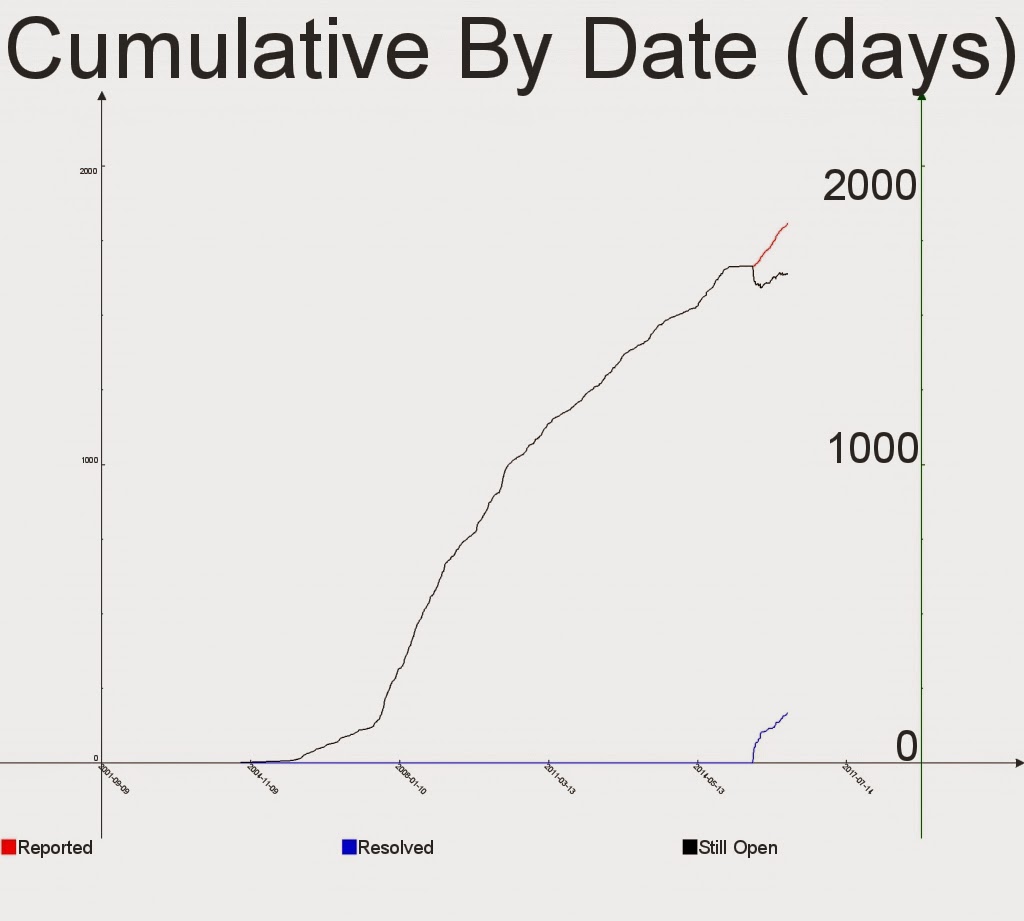
We have a lot of bugs, in fact just during this release cycle we have 30 more bugs reported than we closed.So while the new bug reporting system has been a success and our users are reporting issues when they find them the development team is not keeping up..
The failure to keep up stems from the underlying issue of lack of manpower. We have relatively few active developers which is especially problematic when there are many users for a platform, such as RISCOS, but the maintainer is unable to commit enough time to fixing issues.
If you would like to help making NetSurf a better browser we are always happy to work with new contributors.
profanity is a great console based XMPP client written in ncurses and C
by James Booth. The code has a great quality, upstream is super collaborative, and willing, so packaging should be pretty straightforward. This
post will show that this was not the case here.
First obstacle was that profanity depended on libstrophe, an XMPP library, which
was not in Debian. As it occurred libstrophe's upstream was not responsive, so any changes that were
needed to prepare libstrophe for high quality packaging could not be met.
First of all libstrophe's build system (automake and friends) built only a static library.
The second problem was that libstrophe did not tag releases on github, this was needed to make Debian watch file work.
A third, smaller problem was the presence of debian/ directory in upstream's source. It can be neglected
most of the time, since you can tell git-import-orig to delete it.
To solve those 3 problems I created a pull request fixing the
build system to build also a shared library, deleting debian/ directory and politely asking for
tagging releases. You can see my pull request here dated on April 26th.
There was no answer for the libstrophe's upstream but I has some support from profanity's developers
and other users wanting to make those changes. Finally metajack (libstrophe upstream) gave us right
to the repo and we could merge the pull request on August 6th. The lesson learned - be patient and
know autotools (a great tutorial is here).
With profanity there were less changes to do. The most important one was that it linked to OpenSSL
and due to the license incompatibility with GPL it could not go into Debian. Fortunately upstream
added the OpenSSL exception, and profanity could be finally packaged.
Now both profanity and libstrophe are in NEW queue and hopefully they will be accepted by ftp
masters. When they are, there is plenty to do with them in the future, upstream closed some bugs,
new upstream versions are tagged.
A brown bag release 0.1.2 of pkgKitten is now on CRAN, following yesterday's 0.1.1 upload
Next time I'll try to remember that when I have parameters name and path, it won't work so well to call them as path and name ...
Changes in version 0.1.2 (2014-09-11)
Brown-bag fix of calling the new helper function with then correct order of arguments.
A maintenance release 0.1.1 of pkgKitten is now on CRAN.
It has only one small change: the function playWithPerPackageHelpPage() was factored out of the main function kitten() as I happened to be needing something just like playWithPerPackageHelpPage() to make packages created by the Rcpp function Rcpp.package.skeleton() a little nicer.
We also added a NEWS.Rd file which restates major release features. As it is so short, we include it in its entirety.
Changes in version 0.1.1 (2014-09-09)
New (exported) function playWithPerPackageHelpPage() which lets other packages create a non-complaint-generating package help page
Seven years ago I wanted to move on from the small virtual machine I had to a larger one. Looking at the the options available it seemed the best approach was to rent a big host, and divide it up into virtual machines myself.
Renting a machine with 8Gb of RAM and 500Gb of disk-space, then dividing that into eights would give a decent spec and assuming that I found enough users to pay for the other slots/shares it would be economically viable too.
After a few weeks I took the plunge, advertised here, and found users.
I had six users:
1/8th for me.
1/8th left empty/idle for the host machine.
6/8th for other users.
There were some niggles, one user seemed to suffer from connectivity problems more than the others, but on the whole the experiment worked out well.
These days, thanks to BigV, Digital Ocean, and all the new-comers there is less need for this kind of thing so last December I announced that the service would cease - and gave all current users 1 year of free service to give them time to migrate away.
The service was due to terminate in December, but triggered by some upcoming downtime where our host would have been moved, in the back of a van, from Manchester to York, I've taken the decision to stop it early.
It was a fun experiment, it provided me with low cost hosting (subsidized by the other paying users), and provided some other people with hosting of their own that was setup nicely.
The only outstanding question is what to do with the domain-names? I could let them expire, I could try to sell them, or I could donate them to other people running hosting setups.
If anybody reading this has a use for kvm-hosting.org, kvm-hosting.net, or kvm-hosting.com, then do feel free to get in touch. No promises, obviously, but it'd be a shame for them to end up hosting adverts in a year or twos time..
Unfortunately I was not able to attend debconf this year but thanks to the
awesome video team the all the talks are available for your viewing pleasure.
In order to recreate an authentic Portland experience, I took my laptop into the shower along with a vegan donut and had my children stand outside yelling excerpts from salon.com in whiny Canadianesque accents. Here are
some notes I took as I watched the talks.
Welcome Talk
Why is everyone on stage wearing shorts? Is this a thing now?
Langasek is pronounced with a 'sh' I did not know that.
Kees is pronounced 'case' I also did not know that.
Steve missed a good opportunity for a "Who moved my cheese?" joke. (Hey its
not any more obscure than the "white Chevy Nova" joke.)
A well-deserved award to Russ Allbery from some of the UK people for being
the voice of reason on the mailing lists. See Vincent Sanders blog for details.
Debian in the Dark Ages of Free software - Stefan Zacchiroli
More shorts. I am starting to feel overdressed.
Stefan reminisces about how he got involved in Free Software and
his philosophy of the same. A good introduction for anyone wondering what
makes a Debian hacker tick.
We should be concerned about software freedom in the new "cloud" environments.
Debian can play an important role in this by making it really simple for
users to set up their own cloud environments. My take: the focus should
be on free standards and protocols. The power that Google, Facebook etc.
have is drastically reduced if it is easy to jump ship.
Weapons of the Geek - Gabriella Coleman
pro: no shorts con: womens slacks
Intriguing anthropological investigation into Anonymous and how it/they relate
to Free Software.
Coc acknowledged then ignored. Why do we need it again?
"Anonymous has cabals ... [that] make the cabals within Debian look like childs play."
bugs.debian.org -- Database Ho! - Don Armstrong
I would settle for a lungi at this point but noooo shorts again. (plaid to boot.)
The return of my yearly guilt about undertaking to Don to add RSS support to
debbugs way back at debconf 10 and not following up on it. Damn it, I am going to get this done now.
Sadly, the initial part of the stream is missing and it begans right in the
middle of Don saying something interesting.
"I have to admit my primary motivation for giving a talk was to try to force
myself into actually doing the work I'm talking about."
Stats porn. The BTS is growing at a phenomenal rate. bugs opened 142/day. But only 95/day closed.
Grub Ancient and Modern - Colin and Watson
pro: no shorts con: kilt
I was interested in this talk because one of these days I want to get GRUB 2
running on Debian Minix but a lot went over my head so I'll have to do some
more research first.
One year of fedmsg in Debian - Nicolas Dandrimont
trouser status: undetermined
Problem: There are many different services providing information in Debian
but they do not interop very well.
fedmsg is a unified message bus originally developed by Fedora who were
facing a similar problem.
It has now been implemented in Debian.
Coming of Age: My Life with Debian - Christine Spang
trouser sta- oh the hell with this.
Another talk which is more biographical than technical. Again, useful to
help understand the motivations of hackers.
What interests me is that for younger generations it was open source which
was a novel idea whereas for those of who grew up in the 8-bit era, having
to hack on a computer was expected (whether you wanted to or not and it was
proprietary software you couldn't share which was considered new and strange.
Status report of the Debian Printing Team - Didier Raboud
Ou est les pantalons? Je ne sais pas. (Apologies to Mme Terzini.)
Kudos to Didier for taking up this augean task mostly on his own. Despite
the long-promised "paperless" office I need to be able to print and I was
pleasantly surprised that my new xerox all-in-one worked under Debian with
very little hassle.
Brother sucks. Don't buy their printers. Ditto for Epson and Samsung.
Another on-my-the-journey-back blog post; this time from the Frankfurt Airport Train Station my flight was delayed (if I knew that I could have watched the remaining Lightning Talks), and so was my train, but despite 5min of running through the Airport just not enough. And now that the free 30 Minutes of Railway Station Internet are used up, I have nothing else to do but blog...
Last week I was attending ICFP 2014 in Gothenburg, followed by the Haskell Symposium and the Haskell Implementors Workshop. The justification to attend was the paper on Safe Coercions (joint work with Richard Eisenberg, Simon Peyton Jones and Stephanie Weirich), although Richard got to hold the talk, and did so quite well. So I got to leisurely attend the talks, while fighting the jet-lag that I brought from Portland.
There were as expected quite a few interesting talks. Among them the first keynote, Kathleen Fisher on the need for formal methods in cars and toy-quadcopters and unmanned battle helicopters, which made me conclude that my Isabelle skills might eventually become relevant in practical applications. And did you know that if someone gains access to your car s electronics, they can make the seat belt pull you back hard?
Stefanie Weirich s keynote (and the subsequent related talks by Jan Stolarek and Richard Eisenberg) on what a dependently typed Haskell would look like and what we could use it for was mouth-watering. I am a bit worried that Haskell will be become a bit obscure for newcomers and people that simply don t want to think about types too much, on the other hand it seems that Haskell as we know it will always stay there, just as a subset of the language.
Similarly interesting were refinement types for Haskell (talks by Niki Vazou and by Eric Seidel), in the form of LiquidTypes, something that I have not paid attention to yet. It seems to be a good way for more high assurance in Haskell code.
Finally, the Haskell Implementors Workshop had a truckload of exciting developments in and around Haskell: More on GHCJS, Partial type signatures, interactive type-driven development like we know it from Agda, the new Haskell module system and amazing user-defined error messages the latter unfortunately only in Helium, at least for now.
But it s not the case that I only sat and listened. During the Haskell Implementors Workshop I held a talk Contributing to GHC with a live demo of me fixing a (tiny) bug in GHC, with the aim of getting more people to hack on GHC (slides, video). The main message here is that it is not that big of deal. And despite me not actually saying much interesting in the talk, I got good feedback afterwards. So if it now actually motivates someone to contribute to GHC, I m even more happier.
And then there is of course the Hallway Track. I discussed the issues with fusing a left fold (unfortunately, without a great solution). In order to tackle this problem more systematically, John Wiegley and I created the beginning of a List Fusion Lab , i.e. a bunch of list benchmark and the possibility to compare various implementations (e.g. with different RULES) and various compilers. With that we can hopefully better assess the effect of a change to the list functions.
PS: The next train is now also delayed, so I ll likely miss my tram and arrive home even later...
PPS: I really have to update my 10 year old picture on my homepage (or redesign it completely). Quite a few people knew my name, but expected someone with shoulder-long hair...
PPPS: Haskell is really becoming mainstream: I just talked to a randomly chosen person (the boy sitting next to me in the train), and he is a Haskell enthusiast, building a structured editor for Haskell together with his brother. And all that as a 12th-grader...
Back in January I changed jobs. This took me longer to decide to do than it should have. My US visa (an L-1B) was tied to the old job, and not transferable, so leaving the old job also meant leaving the US. That was hard to do; I'd had a mostly fun 3 and a half years in the SF Bay Area.
The new job had an office in Belfast, and HQ in the Bay Area. I went to work in Belfast, and got sent out to the US to meet coworkers and generally get up to speed. During that visit the company applied for an H-1B visa for me. This would have let me return to the US in October 2014 and start working in the US office; up until that point I'd have continued to work from Belfast. Unfortunately there were 172,500 applications for 85,000 available visas and mine was not selected for processing.
I'm disappointed by this. I've enjoyed my time in the US. I had a green card application in process, but after nearly 2 years it still hadn't completed the initial hurdle of the labor certification stage (a combination of a number of factors, human, organizational and governmental). However the effort of returning to live here seems too great for the benefits gained. I can work for a US company with a non-US office and return on an L-1B after a year. And once again have to leave should I grow out of the job, or the job change in some way that doesn't suit me, or the company hit problems and have to lay me off. Or I can try again for an H-1B next year, aiming for an October 2015 return, and hope that this time my application gets selected for processing.
Neither really appeals. Both involve putting things on hold in the hope longer terms pans out as I hope. And to be honest I'm bored of that. I've loved living in America, but I ended up spending at least 6 months longer in the job I left in January than I'd have done if I'd been freely able to change employer without having to change continent. So it seems the time has come to accept that America and I must part ways, sad as that is. Which is why I'm currently sitting in SFO waiting for a flight back to Belfast and for the first time in 5 years not having any idea when I might be back in the US.
With yesterday's announcement of littler 0.2.0, I kept thinking about a few not-so-frequently-asked but recurring questions about littler. And an obvious one if of course the relationship to Rscript.
As we have pointed out before, littler preceded Rscript. Now, with Rscript being present in every R installation, it is of course by now more widely known.
But there is one important aspect which I stressed once or twice in the past and which bears repeating. Due to the lean and mean way in which littler is designed and set-up, it actually starts a lot faster than either Rscript or R. How, you ask? Well we actually query the environement at build time and hardcode a number of settings which R and Rscript re-acquire and learn each time they start. Which is more flexible. But slower.
So consider the following, really simple example. In it, we create a simple worker function f which launches the given (and simplest possible) R command of just quitting 250 times (by launching a shell command which loops). We then let littler, Rscript and R (in its just execute this expression mode) run this, and time it via one of the common benchmarking packages.
R>library(rbenchmark)
R>f <-function(cmd) system(paste0("bash -c \"for i in \\$(seq 1 250); do ", cmd, " -e 'q()'; done\""));
R>res <-benchmark(f("r"), f("Rscript"), f("R --slave"), replications=5, order="relative")
R>res
test replications elapsed relative user.self sys.self user.child sys.child
1f("r") 532.2561.0000.0010.00426.5385.7062f("Rscript") 5180.1545.5850.0010.004152.75128.5223f("R --slave") 5302.7149.3850.0010.004270.56933.098
R>
So there: littler does "nothing" about five times as fast as Rscript, and about nine times as fast as R. Not that this matters greatly -- but when you design something for repeated (unsupervised) execution, say in a cronjob, it might as well be lightweight.
This is my monthly summary of my free software related activities. If you re among the people who made a donation to support my work (65.55 , thanks everybody!), then you can learn how I spent your money. Otherwise it s just an interesting status update on my various projects.
Distro Tracker
Even though I was officially in vacation during 3 of the 4 weeks of August, I spent many nights working on Distro Tracker. I m pleased to have managed to bring back Python 3 compatibility over all the (tested) code base. The full test suite now passes with Python 3.4 and Django 1.6 (or 1.7).
From now on, I ll run tox on all code submitted to make sure that we won t regress on this point. tox also runs flake8 for me so that I can easily detect when the submitted code doesn t respect the PEP8 coding style. It also catches other interesting mistakes (like unused variable or too complex functions).
Getting the code to pass flake8 was also a major effort, it resulted in a huge commit (89 files changed, 1763 insertions, 1176 deletions).
Thanks to the extensive test suite, all those refactoring only resulted in two regressions that I fixed rather quickly.
Some statistics: 51 commits over the last month, 41 by me, 3 by Andrew Starr-Bochicchio, 3 by Christophe Siraut, 3 by Joseph Herlant and 1 by Simon Kainz. Thanks to all of them! Their contributions ported some features that were already available on the old PTS. The new PTS is now warning of upcoming auto-removals, is displaying problems with uptream URLs, includes a short package description in the page title, and provides a link to screenshots (if they exist on screenshots.debian.net).
We still have plenty of bugs to handle, so you can help too: check out https://tracker.debian.org/docs/contributing.html. I always leave easy bugs for others to handle, so grab one and get started! I ll review your patch with pleasure.
Tryton
After my last batch of contributions to Tryton s French Chart of Accounts (#4108, #4109, #4110, #4111) C dric Krier granted me commit rights to the account_fr mercurial module.
Debconf 14
I wasn t able to attend this year but thanks to awesome work of the video team, I watched some videos (and I still have a bunch that I want to see). Some of them were put online the day after they had been recorded. Really amazing work!
Django 1.7
After the initial bug reports, I got some feedback of maintainers who feared that it would be difficult to get their packages working with Django 1.7. I helped them as best as I can by providing some patches (for horizon, for django-restricted-resource, for django-testscenarios).
Since I expected many maintainers to be not very pro-active, I rebuilt all packages with Django 1.7 to detect at least those that would fail to build. I tagged as confirmed all the corresponding bug reports.
Looking at https://bugs.debian.org/cgi-bin/pkgreport.cgi?users=python-django@packages.debian.org;tag=django17, one can see that some progress has been made with 25 packages fixed. Still there are at least 25 others that are still problematic in sid and 35 that have not been investigated at all (except for the automatic rebuild that passed). Again your help is more than welcome!
It s easy to install python-django 1.7 from experimental and they try to use/rebuild the packages from the above list.
Dpkg translation
With the freeze approaching, I wanted to ensure that dpkg was fully translated in French. I thus pinged debian-l10n-french@lists.debian.org and merged some translations that were done by volunteers. Unfortunately it looks like nobody really stepped up to maintain it in the long run so I did myself the required update when dpkg 1.17.12 got uploaded.
Is there anyone willing to manage dpkg s French translation? With the latest changes in 1.17.13, we have again a few untranslated strings: $ for i in $(find . -name fr.po); do echo $i; msgfmt -c -o /dev/null --statistics $i; done
./po/fr.po
1083 translated messages, 4 fuzzy translations, 1 untranslated message.
./dselect/po/fr.po
268 translated messages, 3 fuzzy translations.
./scripts/po/fr.po
545 translated messages.
./man/po/fr.po
2277 translated messages, 8 fuzzy translations, 3 untranslated messages.
Misc stuff
I made an xsane QA upload (it s currently orphaned) to drop the (build-)dependency on liblcms1 and avoid getting it removed from Debian testing (see #745524). For the record, how-can-i-help warned me of this after one dist-upgrade.
With the Django 1.7 work and the need to open up an experimental branch, I decided to switch python-django s packaging to git even though the current team policy is to use subversion. This triggered (once more) the discussion about a possible switch to git and I was pleased to see more enthusiasm this time around. Barry Warsaw tested a few workflows, shared his feeling and pushed toward a live discussion of the switch during Debconf. It looks like it might happen for good this time. I contributed my share in the discussions on the mailing list.
Thanks
See you next month for a new summary of my activities.
 I (grudgingly) use the Calibre e-book management software to handle my collection of books, and copy them over to my kindle-toy.
One thing that has always bothered me was the fact that when books are imported their ratings are too. If I receive a small sample of ebooks from a friend their ratings are added to my collections.
I've always regarded ratings as things personal to me, rather than attributes of a book itself; as my tastes might not match yours, and vice-versa.
On that basis the last time I was importing a small number of books and getting annoyed at having to manually reset all the imported ratings I decided to do something about it. I started hacking and put together a simple Calibre plugin to automatically zero ratings when books are imported to the collection (i.e. set the rating to be zero).
Sadly this work wasn't painless, despite the small size, as an unfortunate bug in Calibre meant my plugin method wasn't called. Happily Kovid Goyal helped me work through the problem, and he committed a fix that will be in the next Calibre release. For the moment I'm using today's git-snapshot and it works well.
Similarly I've recently started using extended file attributes to store metadata on my desktop system. Unfortunately the GNU
 Dear lazyweb,
I am tired of finding how to get my users to happily print again. Please help.
Details follow.
Several years ago, I configured our Institute's server to provide easy, nifty printing support for all of our users. Using Samba+CUPS, I automatically provided drivers to Windows client machines, integration with our network user scheme (allowing for groups authorization That means, you can only print in your designated printer), flexible printer management (i.e. I can change printers on the server side without the users even noticing Great when we get new hardware or printers get sent to repairs!)...
Then, this year the people in charge of client machines in the institute decided to finally ditch WinXP licenses and migrate to Windows 7. Sweet! How can it hurt?
Oh, it can hurt. Terribly.
Windows 7 uses a different driver model, and after quite a bit of hair loss, I was not able to convince Samba to deliver drivers to Win7 (FWIW, I think we are mostly using 64 bit versions). Not only that, it also barfs when we try to install drivers manually and print to a share. And of course, it barfs in the least useful way, so it took me quite a bit of debugging and Web reading to find out it was not only my fault.
So, many people have told me that Samba (or rather, Windows-type networking) is no longer regarded as a good idea for printing. The future is here, and it's called IPP. And it is simpler, because Windows can talk directly with CUPS! Not only that, CUPS allows me to set valid users+groups to each printer. So, what's there to lose?
Besides time, that is. It took me some more hair pulling to find out that Windows 7 is shipped by default (at least in the version I'm using) with the Internet Printing Server feature disabled. Duh. OK, enable it, and... Ta-da! It works with CUPS! Joy, happiness!
Only that... It works only when I use it with no authentication.
Windows has an open issue,
 Continuing with his standard pace of approximately one new version per month,
 I have an office with a nice large window, but more often than not I have to close the shades to be able to see something on my screen. Even worse: There were so many nice and sunny days where I would have loved to take my laptop outside and work there, but it (a Thinkpad T430s) is simply not usable in bright sun. I have seen those nice eInk based eBook readers, who are clearer the brighter they are. That s what I want for my laptop, and I am willing to sacrifice color and a bit of usability due to latency for being able to work in the bright daylight!
So while I was in Portland for DebConf14 (where I guess I felt a bit more like tinkering than otherwise) I bought a
 For the tl;dr:

 First obstacle was that profanity depended on
 Unfortunately I was not able to attend debconf this year but thanks to the
awesome video team the all the talks
 Back in January I changed jobs. This took me longer to decide to do than it should have. My US visa (an

 This is my monthly summary of my free software related activities. If you re among the people who
 Tryton
After my last batch of contributions to Tryton s French Chart of Accounts (