Search Results: "don"

16 November 2017

Colin Watson: Kitten Block equivalent for Firefox 57

I ve been using Kitten Block for years, since I don t really need the blood pressure spike caused by accidentally following links to certain UK newspapers. Unfortunately it hasn t been ported to Firefox 57. I tried emailing the author a couple of months ago, but my email bounced. However, if your primary goal is just to block the websites in question rather than seeing kitten pictures as such (let s face it, the internet is not short of alternative sources of kitten pictures), then it s easy to do with uBlock Origin. After installing the extension if necessary, go to Tools Add-ons Extensions uBlock Origin Preferences My filters, and add www.dailymail.co.uk and www.express.co.uk, each on its own line. (Of course you can easily add more if you like.) Voil : instant tranquility. Incidentally, this also works fine on Android. The fact that it was easy to install a good ad blocker without having to mess about with a rooted device or strange proxy settings was the main reason I switched to Firefox on my phone.

15 November 2017

Steinar H. Gunderson: Introducing Narabu, part 6: Performance

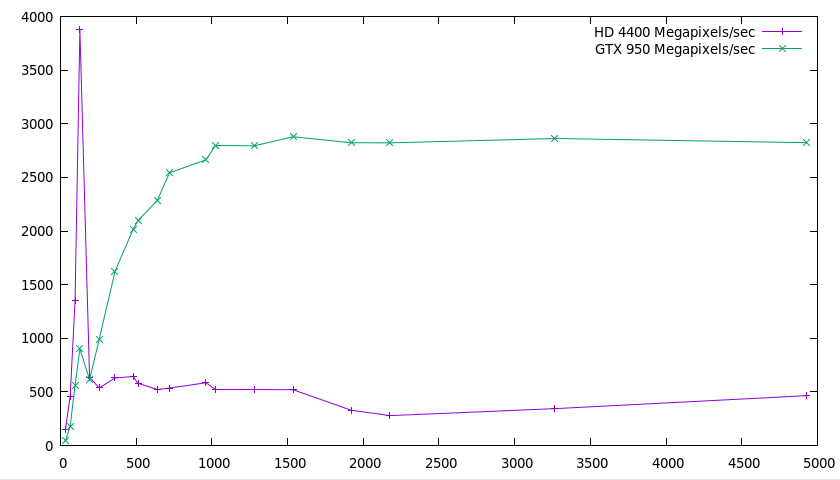
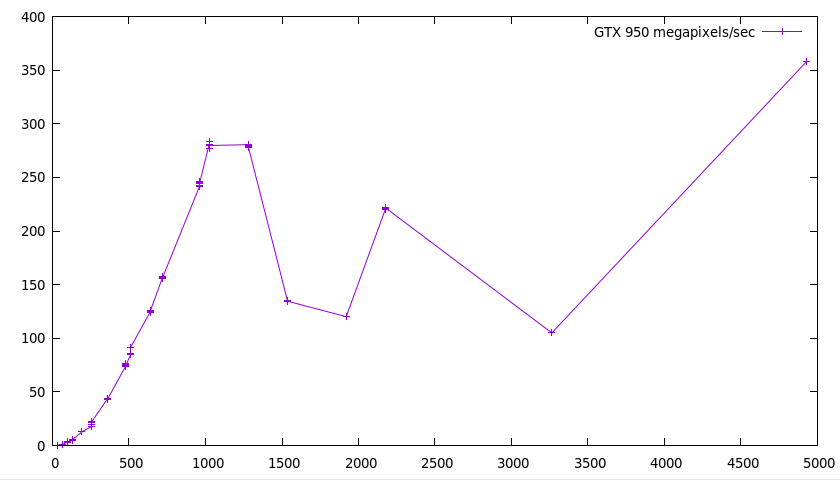
Narabu is a new intraframe video codec. You probably want to read part 1, part 2, part 3, part 4 and part 5 first. Like I wrote in part 5, there basically isn't a big splashy ending where everything is resolved here; you're basically getting some graphs with some open questions and some interesting observations. First of all, though, I'll need to make a correction: In the last part, I wrote that encoding takes 1.2 ms for 720p luma-only on my GTX 950, which isn't correct I remembered the wrong number. The right number is 2.3 ms, which I guess explains even more why I don't think it's acceptable at the current stage. (I'm also pretty sure it's possible to rearchitect the encoder so that it's much better, but I am moving on to other video-related things for the time being.) I encoded a picture straight off my DSLR (luma-only) at various resolutions, keeping the aspect. Then I decoded it a bunch of times on my GTX 950 (low-end last-generation NVIDIA) and on my HD 4400 (ultraportable Haswell laptop) and measured the times. They're normalized for megapixels per second decoded; remember that doubling width (x axis) means quadruple the pixels. Here it is: Narabu decoding performance graph I'm not going to comment much beyond two observations: Encoding only contains the GTX 950 because I didn't finish the work to get that single int64 divide off: Narabu encoding performance graph This is interesting. I have few explanations. Probably more benchmarking and profiling would be needed to make sense of any of it. In fact, it's so strange that I would suspect a bug, but it does indeed seem to create a valid bitstream that is decoded by the decoder. Do note, however, that seemingly even on the smallest resolutions, there's a 1.7 ms base cost (you can't see it on the picture, but you'd see it in an unnormalized graph). I don't have a very good explanation for this either (even though there are some costs that are dependent on the alphabet size instead of the number of pixels), but figuring it out would probably be a great start for getting the performance up. So that concludes the series, on a cliffhanger. :-) Even though it's not in a situation where you can just take it and put it into something useful, I hope it was an interesting introduction to the GPU! And in the meantime, I've released version 1.6.3 of Nageru, my live video mixer (also heavily GPU-based) with various small adjustments and bug fixes found before and during Tr ndisk. And Movit is getting compute shaders for that extra speed boost, although parts of it is bending my head. Exciting times in GPU land :-)

Kees Cook: security things in Linux v4.14

Previously: v4.13. Linux kernel v4.14 was released this last Sunday, and there s a bunch of security things I think are interesting: vmapped kernel stack on arm64
Similar to the same feature on x86, Mark Rutland and Ard Biesheuvel implemented CONFIG_VMAP_STACK for arm64, which moves the kernel stack to an isolated and guard-paged vmap area. With traditional stacks, there were two major risks when exhausting the stack: overwriting the thread_info structure (which contained the addr_limit field which is checked during copy_to/from_user()), and overwriting neighboring stacks (or other things allocated next to the stack). While arm64 previously moved its thread_info off the stack to deal with the former issue, this vmap change adds the last bit of protection by nature of the vmap guard pages. If the kernel tries to write past the end of the stack, it will hit the guard page and fault. (Testing for this is now possible via LKDTM s STACK_GUARD_PAGE_LEADING/TRAILING tests.) One aspect of the guard page protection that will need further attention (on all architectures) is that if the stack grew because of a giant Variable Length Array on the stack (effectively an implicit alloca() call), it might be possible to jump over the guard page entirely (as seen in the userspace Stack Clash attacks). Thankfully the use of VLAs is rare in the kernel. In the future, hopefully we ll see the addition of PaX/grsecurity s STACKLEAK plugin which, in addition to its primary purpose of clearing the kernel stack on return to userspace, makes sure stack expansion cannot skip over guard pages. This stack probing ability will likely also become directly available from the compiler as well. set_fs() balance checking
Related to the addr_limit field mentioned above, another class of bug is finding a way to force the kernel into accidentally leaving addr_limit open to kernel memory through an unbalanced call to set_fs(). In some areas of the kernel, in order to reuse userspace routines (usually VFS or compat related), code will do something like: set_fs(KERNEL_DS); ...some code here...; set_fs(USER_DS);. When the USER_DS call goes missing (usually due to a buggy error path or exception), subsequent system calls can suddenly start writing into kernel memory via copy_to_user (where the to user really means within the addr_limit range ). Thomas Garnier implemented USER_DS checking at syscall exit time for x86, arm, and arm64. This means that a broken set_fs() setting will not extend beyond the buggy syscall that fails to set it back to USER_DS. Additionally, as part of the discussion on the best way to deal with this feature, Christoph Hellwig and Al Viro (and others) have been making extensive changes to avoid the need for set_fs() being used at all, which should greatly reduce the number of places where it might be possible to introduce such a bug in the future. SLUB freelist hardening
A common class of heap attacks is overwriting the freelist pointers stored inline in the unallocated SLUB cache objects. PaX/grsecurity developed an inexpensive defense that XORs the freelist pointer with a global random value (and the storage address). Daniel Micay improved on this by using a per-cache random value, and I refactored the code a bit more. The resulting feature, enabled with CONFIG_SLAB_FREELIST_HARDENED, makes freelist pointer overwrites very hard to exploit unless an attacker has found a way to expose both the random value and the pointer location. This should render blind heap overflow bugs much more difficult to exploit. Additionally, Alexander Popov implemented a simple double-free defense, similar to the fasttop check in the GNU C library, which will catch sequential free()s of the same pointer. (And has already uncovered a bug.) Future work would be to provide similar metadata protections to the SLAB allocator (though SLAB doesn t store its freelist within the individual unused objects, so it has a different set of exposures compared to SLUB). setuid-exec stack limitation
Continuing the various additional defenses to protect against future problems related to userspace memory layout manipulation (as shown most recently in the Stack Clash attacks), I implemented an 8MiB stack limit for privileged (i.e. setuid) execs, inspired by a similar protection in grsecurity, after reworking the secureexec handling by LSMs. This complements the unconditional limit to the size of exec arguments that landed in v4.13. randstruct automatic struct selection
While the bulk of the port of the randstruct gcc plugin from grsecurity landed in v4.13, the last of the work needed to enable automatic struct selection landed in v4.14. This means that the coverage of randomized structures, via CONFIG_GCC_PLUGIN_RANDSTRUCT, now includes one of the major targets of exploits: function pointer structures. Without knowing the build-randomized location of a callback pointer an attacker needs to overwrite in a structure, exploits become much less reliable. structleak passed-by-reference variable initialization
Ard Biesheuvel enhanced the structleak gcc plugin to initialize all variables on the stack that are passed by reference when built with CONFIG_GCC_PLUGIN_STRUCTLEAK_BYREF_ALL. Normally the compiler will yell if a variable is used before being initialized, but it silences this warning if the variable s address is passed into a function call first, as it has no way to tell if the function did actually initialize the contents. So the plugin now zero-initializes such variables (if they hadn t already been initialized) before the function call that takes their address. Enabling this feature has a small performance impact, but solves many stack content exposure flaws. (In fact at least one such flaw reported during the v4.15 development cycle was mitigated by this plugin.) improved boot entropy
Laura Abbott and Daniel Micay improved early boot entropy available to the stack protector by both moving the stack protector setup later in the boot, and including the kernel command line in boot entropy collection (since with some devices it changes on each boot). eBPF JIT for 32-bit ARM
The ARM BPF JIT had been around a while, but it didn t support eBPF (and, as a result, did not provide constant value blinding, which meant it was exposed to being used by an attacker to build arbitrary machine code with BPF constant values). Shubham Bansal spent a bunch of time building a full eBPF JIT for 32-bit ARM which both speeds up eBPF and brings it up to date on JIT exploit defenses in the kernel. seccomp improvements
Tyler Hicks addressed a long-standing deficiency in how seccomp could log action results. In addition to creating a way to mark a specific seccomp filter as needing to be logged with SECCOMP_FILTER_FLAG_LOG, he added a new action result, SECCOMP_RET_LOG. With these changes in place, it should be much easier for developers to inspect the results of seccomp filters, and for process launchers to generate logs for their child processes operating under a seccomp filter. Additionally, I finally found a way to implement an often-requested feature for seccomp, which was to kill an entire process instead of just the offending thread. This was done by creating the SECCOMP_RET_ACTION_FULL mask (n e SECCOMP_RET_ACTION) and implementing SECCOMP_RET_KILL_PROCESS. That s it for now; please let me know if I missed anything. The v4.15 merge window is now open!

2017, Kees Cook. This work is licensed under a Creative Commons Attribution-ShareAlike 3.0 License.
Creative Commons License

Russ Allbery: Review: The Piper's Son

Review: The Piper's Son, by Melina Marchetta
Series: Francesca #2
Publisher: Candlewick Press
Copyright: 2010
Printing: 2011
ISBN: 0-7636-5458-2
Format: Kindle
Pages: 330
Tom Mackee's family has fallen apart. The impetus was the death of his uncle Joe in the London tube terrorist bombings, but that was only the start. He destroyed his chances with the only woman he really loved. His father's drinking got out of control, his mother left with his younger sister to live in a different city, and he refused to go with them and abandon his father. But then, six months later, his father abandoned him anyway. As this novel opens, Tom collapses while performing a music set, high on drugs and no sleep, and wakes up to discover his roommates have been fired from their jobs for stealing, and in turn have thrown him out of their apartment. He's at rock bottom. The one place he can turn for a place to stay is his aunt Georgie, the second (although less frequent) viewpoint character of this book. She was the one who took the trip to the UK to try to find out what happened and retrieve her brother's body, and the one who had to return to Australia with nothing. Her life isn't in much better shape than Tom's. She's kept her job, but she's pregnant by her ex-boyfriend but barely talking to him, since he now has a son by another woman he met during their separation. And she's not even remotely over her grief. The whole Finch/Mackee family is, in short, a disaster. But they have a few family relationships left that haven't broken, some underlying basic decency, and some patient and determined friends. I should warn up-front, despite having read this book without knowing this, that this is a sequel to Saving Francesca, set five years later and focusing on secondary characters from the original novel. I've subsequently read that book as well, though, and I don't think reading it first is necessary. This is one of the rare books where being a sequel made it a better stand-alone novel. I never felt a gap of missing story, just a rich and deep background of friendships and previous relationships that felt realistic. People are embedded in networks of relationships even when they feel the most alone, and I really enjoyed seeing that surface in this book. All those patterns from Tom's past didn't feel like information I was missing. They felt like glimpses of what you'd see if you looked into any other person's life. The plot summary above might make The Piper's Son sound like a depressing drama fest, but Marchetta made an excellent writing decision: the worst of this has already happened before the start of the book, and the rest is in the first chapter. This is not at all a book about horrible things happening to people. It's a book about healing. An authentic, prickly, angry healing that doesn't forget and doesn't turn into simple happily-ever-after stories, but does involve a lot of recognition that one has been an ass, and that it's possible to be less of an ass in the future, and maybe some things can be fixed. A plot summary might fool you into thinking that this is a book about a boy and his father, or about dealing with a drunk you still love. It's not. The bright current under this whole story is not father-son bonding. It's female friendships. Marchetta pulls off a beautiful double-story, writing a book that's about Tom, and Georgie, and the layered guilt and tragedy of the Finch/Mackee family, but whose emotional heart is their friends. Francesca, Justine, absent Siobhan. Georgie's friend Lucia. Ned, the cook, and his interactions with Tom's friends. And Tara Finke, also mostly absent, but perfectly written into the story in letters and phone calls. Marchetta never calls unnecessary attention to this, keeping the camera on Tom and Georgie, but the process of reading this book is a dawning realization of just how much work friendship is doing under the surface, how much back-channel conversation is happening off the page, and how much careful and thoughtful and determined work went into providing Tom a floor, a place to get his feet under him, and enough of a shove for him to pull himself together. Pulling that off requires a deft and subtle authorial touch, and I'm in awe at how well it worked. This is a beautifully written novel. Marchetta never belabors an emotional point, sticking with a clear and spare description of actions and thoughts, with just the right sentences scattered here and there to expose the character's emotions. Tom's family is awful at communication, which is much of the reason why they start the book in the situation they're in, but Marchetta somehow manages to write that in a way that didn't just frustrate me or make me want to start banging their heads together. She somehow conveys the extent to which they're trying, even when they're failing, and adds just the right descriptions so that the reader can follow the wordless messages they send each other even when they can't manage to talk directly. I usually find it very hard to connect with people who can only communicate by doing things rather than saying them. It's a high compliment to the author that I felt I understood Tom and his family as well as I did. One bit of warning: while this is not a story of a grand reunion with an alcoholic father where all is forgiven because family, thank heavens, there is an occasional wiggle in that direction. There is also a steady background assumption that one should always try to repair family relationships, and a few tangential notes about the Finches and Mackees that made me think there was a bit more abuse here than anyone involved wants to admit. I don't think the book is trying to make apologies for this, and instead is trying to walk the fine line of talking about realistically messed up families, but I also don't have a strong personal reaction to that type of story. If you have an aversion to "we should all get along because faaaaamily" stories, you may want to skip this book, or at least go in pre-warned. That aside, the biggest challenge I had in reading this book was not breaking into tears. The emotional arc is just about perfect. Tom and Georgie never stay stuck in the same emotional cycle for too long, Marchetta does a wonderful job showing irritating characters from a slightly different angle and having them become much less irritating, and the interactions between Tom, Tara, and Francesca are just perfect. I don't remember reading another book that so beautifully captures that sensation of knowing that you've been a total ass, knowing that you need to stop, but realizing just how much work you're going to have to do, and how hard that work will be, once you own up to how much you fucked up. That point where you keep being an ass for a few moments longer, because stopping is going to hurt so much, but end up stopping anyway because you can't stand yourself any more. And stopping and making amends is hard and hurts badly, and yet somehow isn't quite as bad as you thought it was going to be. This is really great stuff. One final complaint, though: what is it with mainstream fiction and the total lack of denouement? I don't read very much mainstream fiction, but this is the second really good mainstream book I've read (after The Death of Bees) that hits its climax and then unceremoniously dumps the reader on the ground and disappears. Come back here! I wasn't done with these people! I don't need a long happily-ever-after story, but give me at least a handful of pages to be happy with the characters after crying with them for hours! ARGH. But, that aside, the reader does get that climax, and it's note-perfect to the rest of the book. Everyone is still themselves, no one gets suddenly transformed, and yet everything is... better. It's the kind of book you can trust. Highly, highly recommended. Rating: 9 out of 10

13 November 2017

Steve Kemp: Paternity-leave is half-over

I'm taking the month of November off work, so that I can exclusively take care of our child. Despite it being a difficult time, with him teething, it has been a great half-month so far. During the course of the month I've found my interest in a lot of technological things waning, so I've killed my account(s) on a few platforms, and scaled back others - if I could exclusively do child-care for the next 20 years I'd be very happy, but sadly I don't think that is terribly realistic. My interest in things hasn't entirely vanished though, to the extent that I found the time to replace my use of etcd with consul yesterday, and I'm trying to work out how to simplify my hosting setup. Right now I have a bunch of servers doing two kinds of web-hosting: Hosting static-sites is trivial, whether with a virtual machine, via Amazons' S3-service, or some other static-host such as netlify. Hosting for "dynamic stuff" is harder. These days a trend for "serverless" deployments allows you to react to events and be dynamic, but not everything can be a short-lived piece of ruby/javascript/lambda. It feels like I could setup a generic platform for launching containers, or otherwise modernising FastCGI, etc, but I'm not sure what the point would be. (I'd still be the person maintaining it, and it'd still be a hassle. I've zero interest in selling things to people, as that only means more support.) In short I have a bunch of servers, they mostly tick over unattended, but I'm not really sure I want to keep them running for the next 10+ years. Over time our child will deserve, demand, and require more attention which means time for personal stuff is only going to diminish. Simplify things now wouldn't be a bad thing to do, before it is too late.

Markus Koschany: My Free Software Activities in October 2017

Welcome to gambaru.de. Here is my monthly report that covers what I have been doing for Debian. If you re interested in Java, Games and LTS topics, this might be interesting for you. Debian Games Debian Java Debian LTS This was my twentieth month as a paid contributor and I have been paid to work 19 hours on Debian LTS, a project started by Rapha l Hertzog. I will catch up with the remaining 1,75 hours in November. In that time I did the following: Misc Thanks for reading and see you next time.

Fran ois Marier: Test mail server on Ubuntu and Debian

I wanted to setup a mail service on a staging server that would send all outgoing emails to a local mailbox. This avoids sending emails out to real users when running the staging server using production data. First, install the postfix mail server:
apt install postfix
and choose the "Local only" mail server configuration type. Then change the following in /etc/postfix/main.cf:
default_transport = error
to:
default_transport = local:root
and restart postfix:
systemctl restart postfix.service
Once that's done, you can find all of the emails in /var/mail/root. So you can install mutt:
apt install mutt
and then view the mailbox like this:
mutt -f /var/mail/root

12 November 2017

Ben Armstrong: The Joy of Cat Intelligence

As a cat owner, being surprised by cat intelligence delights me. They re not exactly smart like a human, but they are smart in cattish ways. The more I watch them and try to sort out what they re thinking, the more it pleases me to discover they can solve problems and adapt in recognizably intelligent ways, sometimes unique to each individual cat. Each time that happens, it evokes in me affectionate wonder. Today, I had one of those joyful moments. First, you need to understand that some months ago, I thought I had my male cat all figured out with respect to mealtimes. I had been cleaning up after my oafish boy who made a watery mess on the floor from his mother s bowl each morning. I was slightly annoyed, but was mostly curious, and had a hunch. A quick search of the web confirmed it: my cat was left-handed. Not only that, but I learned this is typical for males, whereas females tend to be right-handed. Right away, I knew what I had to do: I adjusted the position of their water bowls relative to their food, swapping them from right to left; the messy morning feedings ceased. I congratulated myself for my cleverness. You see, after the swap, as he hooked the kibbles with his left paw out of the right-hand bowl, they would land immediately on the floor where he could give them chase. The swap caused the messes to cease because before, his left-handed scoops would land the kibbles in the water to the right; he would then have to scoop the kibble out onto the floor, sprinkling water everywhere! Furthermore, the sodden kibble tended to not skitter so much, decreasing his fun. Or so I thought. Clearly, I reasoned, having sated himself on the entire contents of his own bowl, he turned to pilfering his mother s leftovers for some exciting kittenish play. I had evidence to back it up, too: he and his mother both seem to enjoy this game, a regular fixture of their mealtime routines. She, too, is adept at hooking out the kibbles, though mysteriously, without making a mess in her water, whichever way the bowls are oriented. I chalked this up to his general clumsiness of movement vs. her daintiness and precision, something I had observed many times before. Come to think of it, lately, I ve been seeing more mess around his mother s bowl again. Hmm. I don t know why I didn t stop to consider why And then my cat surprised me again. This morning, with Shadow behind my back as I sat at my computer, finishing up his morning meal at his mother s bowl, I thought I heard something odd. Or rather, I didn t hear something. The familiar skitter-skitter sound of kibbles evading capture was missing. So I turned and looked. My dear, devious boy had squished his overgrown body behind his mother s bowls, nudging them ever so slightly askew to fit the small space. Now the bowl orientation was swapped back again. Stunned, I watched him carefully flip out a kibble with his left paw. Plop! Into the water on the right. Concentrating, he fished for it. A miss! He casually licked the water from his paw. Another try. Swoop! Plop, onto the floor. No chase now, just satisfied munching of his somewhat mushy kibble. And then it dawned on me that I had got it somewhat wrong. Yes, he enjoyed Chase the Kibble, like his mom, but I never recognized he had been indulging in a favourite pastime, peculiarly his own I had judged his mealtime messes as accidents, a very human way of thinking about my problem. Little did I know, it was deliberate! His private game was Bobbing for Kibbles. I don t know if it s the altered texture, or dabbling in the bowl, but whatever the reason, due to my meddling, he had been deprived of this pleasure. No worries, a thwarted cat will find a way. And that is the joy of cat intelligence.

Russ Allbery: Review: Night Moves

Review: Night Moves, by Pat Green
Publisher: Aquarius
Copyright: 2014
ISBN: 0-9909741-1-1
Format: Kindle
Pages: 159
In the fall of 2012, Pat Green was a preacher of a failing church, out of a job, divorced for six months, and feeling like a failure at every part of his life. He was living in a relative's house and desperately needed work and his father had been a taxi driver. So he got a job as a 6pm to 6am taxi driver in his home town of Joliet, Illinois. That job fundamentally changed his understanding of the people who live in the night, how their lives work, and what it means to try to help them. This is nonfiction: a collection of short anecdotes about life as a cab driver and the people who have gotten a ride in Green's cab. They're mostly five or six pages long, just a short story or window into someone's life. I ran across Pat Green's writing by following a sidebar link from a post on Patheos (probably from Love, Joy, Feminism, although I no longer remember). Green has an ongoing blog on Patheos about raising his transgender son (who appears in this collection as a lesbian daughter; he wasn't out yet as transgender when this was published), which is both a good sample of his writing and occasionally has excerpts from this book. Green's previous writing experience, as mentioned at several points in this collection, was newspaper columns in the local paper. It shows: these essays have the succinct, focused, and bite-sized property of a good newspaper article (or blog post). The writing is a little rough, particularly the remembered dialogue that occasionally falls into the awkward valley between dramatic, constructed fictional dialogue and realistic, in-the-moment speech. But the stories are honest and heartfelt and have the self-reflective genuineness of good preaching paired with a solid sense of narrative. Green tries to observe and report first, both the other person and his own reactions, and only then try to draw more general conclusions. This book is also very hard to read. It's not a sugar-coated view of people who live in the night of a city, nor is it constructed to produce happy endings. The people who Green primarily writes about are poor, or alone, or struggling. The story that got me to buy this book, about taking a teenage girl to a secret liaison that turned out to be secret because her liaison was another girl, is heartwarming but also one of the most optimistic stories here. A lot of people die or just disappear after being regular riders for some time. A lot of people are desperate and don't have any realistic way out. Some people, quite memorably, think they have a way out, and that way out closes on them. The subtitle of this book is "An Ex-Preacher's Journey to Hell in a Taxi" and (if you followed the link above) you'll see that Green is writing in the Patheos nonreligious section. The other theme of this collection is the church and its effect on the lives of people who are trying to make a life on the outskirts of society. That effect is either complete obliviousness or an active attempt to make their lives even worse. Green lays out the optimism that he felt early in the job, the hope that he could help someone the way a pastor would, guide her to resources, and how it went horribly wrong when those resources turned out to not be interested in helping her at all. And those stories repeat, and repeat. It's a book that makes it very clear that the actual practice of Christianity in the United States is not about helping poor or marginalized people, but there are certainly plenty of Christian resources for judging, hurting people, closing doors, and forcing abused people back into abusive situations, all in the name of God. I do hope some Christians read this and wince very hard. (And lest the progressive Christians get too smug, one of the stories says almost as brutal things about liberal ministries as the stories of conservative ones.) I came away feeling even more convinced by the merits of charities that just give money directly to poor people. No paternalism, no assuming that rich people know what they need, no well-meaning intermediary organizations with endless rules, just resources delivered directly to the people who most need resources. Ideally done by the government and called universal basic income. Short of constructing a functional government that builds working public infrastructure, and as a supplement even if one has such a government (since infrastructure can't provide everything), it feels like the most moral choice. Individual people may still stay mired in awful situations, but at least that isn't compounded by other people taking their autonomy away and dictating life to them in complete ignorance. This is a fairly short and inexpensive book. I found it very much worth reading, and may end up following Green's blog as well. There are moments of joy and moments of human connection, and the details of the day-to-day worries and work style of a taxi driver (in this case, one who drives a company car) are pretty interesting. (Green does skip over some parts for various reasons, such as a lot of the routine fares and most of the stories of violence, but does mention what he's skipping over.) But it's also a brutal book, because so many people are hurting and there isn't much Green can do about it except bear witness and respect them as people in a way that religion doesn't. Recommended, but brace yourself. Rating: 8 out of 10

10 November 2017

Wouter Verhelst: SReview 0.1

This morning I uploaded version 0.1 of SReview, my video review and transcoding system, to Debian experimental. There's still some work to be done before it'll be perfectly easy to use by anyone, but I do think I've reached the point by now where it should have basic usability by now. Quick HOWTO for how to use it: There's still some bits of the above list that I want to make easier to do, and there's still some things that shouldn't be strictly necessary, but all in all, I think SReview has now reached a certain level of maturity that means I felt confident doing its first upload to Debian. Did you try it out? Let me know what you think!

Thadeu Lima de Souza Cascardo: Software Freedom Strategy with Community Projects

It's been some time since I last wrote. Life and work have been busy. At the same time, the world has been busy, and as I would love to write a larger post, I will try to be short here. I would love to touch on the Librem 5 and postmarketOS. In fact, I had, in a podcast in Portuguese, Papo Livre. Maybe, I'll touch a little on the latter. Some of the inspiration for this post include: All of those led me to understand how software freedom is under attack, in particular how copyleft in under attack. And, as I talked during FISL, though many might say that "Open Source has won", end users software freedom has not. Lots of companies have co-opted "free software" but give no software freedom to their users. They seem friends with free software, and they are. Because they want software to be free. But freedom should not be a value for software itself, it needs to be a value for people, not only companies or people who are labeled software developers, but all people. That's why I want to stop talking about free software, and talk more about software freedom. Because I believe the latter is more clear about what we are talking about. I don't mind that we use whatever label, as long as we stablish its meaning during conversations, and set the tone to distinguish them. The thing is: free software does not software freedom make. Not by itself. As Bradley Kuhn puts it: it's not magic pixie dust. Those who have known me for years might remember me as a person who studied free software licenses and how I valued copyleft, the GPL specifically, and how I concerned myself with topics like license compatibility and other licensing matters. Others might remember me as a person who valued a lot about upstreaming code. Not carrying changes to software openly developed that you had not made an effort to put upstream. I can't say I was wrong on both accounts. I still believe in those things. I still believe in the importance of copyleft and the GPL. I still value sharing your code in the commons by going upstream. But I was certaily wrong in valuing them too much. Or not giving as much or even more value to distribution efforts of getting software freedom to the users. And it took me a while in seeing how many people also saw the GPL as a tool to get code upstream. You see that a lot in Linus' discourse about the GPL. And that is on the minds of a lot of people, who I have seen argue that copyleft is not necessary for companies to contribute code back. But that's the problem. The point is not about getting code upstream. But about assuring people have the freedom to run a modified version of the software they received on their computers. It turns out that many examples of companies who had contributed code upstream, have not delivered that freedom to their end-users, who had received a modified version of that same software, which is not free. Bradley Kuhn also alerts us that many companies have been replacing copyleft software with non-copyleft software. And I completely agree with him that we should be writing more copyleft software that we hold copyright for, so we can enforce it. But looking at what has been happening recently in the Linux community about enforcement, even thought I still believe in enforcement as an strategy, I think we need much more than that. And one of those strategies is delivering more free software that users may be able to install on their own computers. It's building those replacements for software that people have been using for any reason. Be it the OS they get when they buy a device, or the application they use for communication. It's not like the community is not doing it, it's just that we need to acknowledge that this is a necessary strategy to guarantee software freedom. That distribution of software that users may easily install on their computers is as much or even more valuable than developing software closer to the hacker/developer community. That doing downstream changes to free software in the effort of getting them to users is worth it. That maintaining that software stable and secure for users is a very important task. I may be biased when talking about that, as I have been shifting from doing upstream work to downstream work and both on the recent years. But maybe that's what I needed to realize that upstreaming does not necessarily guarantees that users will get software freedom. I believe we need to talk more about that. I have seen many people dear to me disregard that difference between the freedom of the user and the freedom of software. There is much more to talk about that, go into detail about some of those points, and I think we need to debate more. I am subscribed to the libreplanet-discuss mailing list. Come join us in discussing about software freedom there, if you want to comment on anything I brought up here. As I promised I would, I would like to mention about postmarketOS, which is an option users have now to get some software freedom on some mobile devices. It's an effort I wanted to build myself, and I applaud the community that has developed around it and has been moving forward so quickly. And it's a good example of a balance between upstream and dowstream code that gets to deliver a better level of software freedom to users than the vendor ever would. I wanted to write about much of the topics I brought up today, but postponed that for some time. I was motivated by recent events in the community, and I am really disappointed at some the free software players and some of the events that happened in the last few years. That got me into thinking in how we need to manifest ourselves about those issues, so people know how we feel. So here it is: I am disappointed at how the Linux Foundation handled the situation about Software Freedom Conversancy taking a case against VMWare; I am disappointed about how Software Freedom Law Center handled a trademark issue against the Software Freedom Conservancy; and I really appreciate all the work the Software Freedom Conservancy has been doing. I have supported them for the last two years, and I urge you to become a supporter too.

8 November 2017

Jonathan Dowland: Christmas

Every year, family members ask me to produce a list of gift suggestions for them to buy for me for Christmas. An enviable position for many, I'm sure, but combined with trying to come up with gift ideas for them, this can sometimes be a stressful situation, with a risk of either giving or receiving gifts that are really nothing more than tat, fluff or kipple. I've started to feel that this is detracting from the spirit of the season. I also don't really want much "stuff". When I am interested in something, it's not something that is convenient for others to buy, either because it's hard to describe, or has limited availability, or is only available at particular times of the year, etc. I'd rather focus on spending time with friends and family. Starting this year, I'm asking that people who wish to do so donate to a charity on my behalf instead. The charity I have chosen for this year is St. Oswald's Hospice.

7 November 2017

Reproducible builds folks: Reproducible Builds: Weekly report #132

Here's what happened in the Reproducible Builds effort between Sunday October 29 and Saturday November 4 2017: Past events Upcoming events Reproducible work in other projects Packages reviewed and fixed, and bugs filed Reviews of unreproducible packages 7 package reviews have been added, 43 have been updated and 47 have been removed in this week, adding to our knowledge about identified issues. Weekly QA work During our reproducibility testing, FTBFS bugs have been detected and reported by: Documentation updates diffoscope development Version 88 was uploaded to unstable by Mattia Rizzolo. It included contributions (already covered by posts of the previous weeks) from: strip-nondeterminism development Version 0.040-1 was uploaded to unstable by Mattia Rizzolo. It included contributions already covered by posts of the previous weeks, as well as new ones from:
Version 0.5.2-2 was uploaded to unstable by Holger Levsen. It included contributions already covered by posts of the previous weeks, as well as new ones from: reprotest development buildinfo.debian.net development tests.reproducible-builds.org Misc. This week's edition was written by Bernhard M. Wiedemann, Chris Lamb, Mattia Rizzolo & reviewed by a bunch of Reproducible Builds folks on IRC & the mailing lists.

Lucas Kanashiro: My Debian LTS work on October

In this post I describe the work that I ve done until the end of October in the context of the Debian LTS team. This month I was allocated 5h and spent just 2h of them because I have written my master s qualification text (I am almost on my deadline to finish it). During November I intend to finish these 3h pending, so I did not request more hours. I basically worked with CVE-2017-0903 which is an issue related to YAML deserialization of gem specifications that could allow one execute remote code. Two packages in wheezy could be affected by this security vulnerability, rubygems and ruby1.9.1. The issue affects just RubyGems source code, but before Ruby version 1.9.1 it was maintained in a separated package, after that it was incorporated by ruby interpreter source package. After carefully read the upstream blogpost and reviewed the commit that intruduced this vulnerability, I was able to figure out whether the mentioned packages were affected or not. The modification was not present in both of them, and after some tests I did confirm that those versions of rubygems were not affected. The two packages were marked as not affected by CVE-2017-0903 in wheezy. Well, this was the summary of my activities in the Debian LTS team in October. See you next month :)

Don Armstrong: Autorandr: automatically adjust screen layout

Like many laptop users, I often plug my laptop into different monitor setups (multiple monitors at my desk, projector when presenting, etc.) Running xrandr commands or clicking through interfaces gets tedious, and writing scripts isn't much better. Recently, I ran across autorandr, which detects attached monitors using EDID (and other settings), saves xrandr configurations, and restores them. It can also run arbitrary scripts when a particular configuration is loaded. I've packed it, and it is currently waiting in NEW. If you can't wait, the deb is here and the git repo is here. To use it, simply install the package, and create your initial configuration (in my case, undocked):
 autorandr --save undocked
then, dock your laptop (or plug in your external monitor(s)), change the configuration using xrandr (or whatever you use), and save your new configuration (in my case, workstation):
autorandr --save workstation
repeat for any additional configurations you have (or as you find new configurations). Autorandr has udev, systemd, and pm-utils hooks, and autorandr --change should be run any time that new displays appear. You can also run autorandr --change or autorandr --load workstation manually too if you need to. You can also add your own ~/.config/autorandr/$PROFILE/postswitch script to run after a configuration is loaded. Since I run i3, my workstation configuration looks like this:
 #!/bin/bash
 xrandr --dpi 92
 xrandr --output DP2-2 --primary
 i3-msg '[workspace="^(1 4 6)"] move workspace to output DP2-2;'
 i3-msg '[workspace="^(2 5 9)"] move workspace to output DP2-3;'
 i3-msg '[workspace="^(3 8)"] move workspace to output DP2-1;'
which fixes the dpi appropriately, sets the primary screen (possibly not needed?), and moves the i3 workspaces about. You can also arrange for configurations to never be run by adding a block hook in the profile directory. Check it out if you change your monitor configuration regularly!

Rog rio Brito: Some activities of the day

Yesterday, I printed the first draft of the first chapter when my little boy was here and he was impressed with this strange object called a "printer". Before I printed what I needed, I fired up LibreOffice and chose the biggest font size that was available and let him type his first name by himself. He was quicker than I thought with a keyboard. After seeing me print his first name, he was jumping up and down with joy of having created something and even showed grandma and grandpa what he had done. He, then, wanted more and I taught him how to use that backspace key, what it meant and he wanted to type his full name. I let him and taught him that there is a key called space that he should type every time he wants to start a new word and, in the end, he typed his first two names. To my surprise, he memorized the icon with the printer (which I must say that I have to hunt every time, since it seems so similar to the adjacent ones!) and pressed this new key called "Enter". When he pressed, he wasn't expecting the printer on his right to start making noises and printing his name. He was so excited and it was so nice to see his reaction full of joy to get a job done! I am thinking of getting a spare computer, building it with him and for him, so that he can call it his computer every time he comes to see daddy. As a serendipitous situation, Packt Publishing offered yesterday their title "Python Projects for Kids". Unfortunately, he does not yet know how to read, but I guess that the right age is coming soon, which is a good thing to make him be educated "the right way" (that is, with the best support, teaching and patience that I can give him). Anyway, I printed the first draft of the first chapter and today I have to turn it in. As I write this, I am downloading a virtual machine from Microsoft to try to install Java on it. Let me see if it works. I have none of the virtualization options used, tough the closest seems to be virtualbox. Let me cross my fingers. In other news, I updated some of the tags of very old posts of this blog, and I am seriously thinking about switching from [ikiwiki][0] to another blog platform. It is slow, very slow on my system with the repositories that I have, especially on my armel system. Some non-interpreted system would be best, but I don't know if such a thing even exists. But the killer problem is that it doesn't support easily the typing of Mathematics (even though a 3rd party plugin for MathJax exists). On the other hand, I just received an answer on twitter from @telegram and it was nice:
Hello, Telegram supports bold and italic. You can type **bold** and __italic__. On mobile, you can also highlight text for this as well.
It is nice that this works with telegram-desktop too. Besides that, I filed some bugs on Debian's BTS, responded to some issues on my projects on GitHub (I'm slowly getting back on maintaining things) and file wishlist bugs on some other projects. Oh, and I grabbed a copy of "Wonder woman" ("Mulher Maravilha") and "Despicable Me 3" ("Meu Malvado Favorito 3") dubbed in Brazilian Portuguese for my son. I have to convert the audio from AAC-LC in 6 channels to AC3 or to stereo. Otherwise, my TVs have problem with the videos (one refuses to play the entire file and another plays the audio with sounds of hiccups). Edit: After converting the VirtualBox image taken from Microsoft, I could easily use qemu/kvm to create screenshots of the installation of Java. The command that I used (for future reference) is: qemu-system-x86_64 -enable-kvm -m 4096 -smp 2 -net nic,model=e1000 -net user -soundhw ac97 -drive index=0,media=disk,cache=unsafe,file=win7.qcow2 Edit: Fixed some typos.

6 November 2017

Jonathan Dowland: Coil

Peter Christopherson and Jhonn Balance, from [Santa Sangre](https://santasangremagazine.wordpress.com/2014/11/16/the-angelic-conversation-in-remembrance-of-coil/) Peter Christopherson and Jhonn Balance, from Santa Sangre
A friend asked me to suggest five tracks by Coil that gave an introduction to their work. Trying to summarize Coil in 5 tracks is tough. I think it's probably impossible to fairly summarize Coil with any subset of their music, for two reasons. Firstly, their music was the output of their work but I don't think is really the whole of the work itself. There's a real mystique around them. They were deeply interested in arcania, old magic, Aleister Crowley, scatology; they were both openly and happily gay and their work sometimes explored their experiences in various related underground scenes and sub-cultures; they lost friends to HIV/AIDS and that had a profound impact on them. They had a big influence on some people who discovered them who were exploring their own sexualities at the time and might have felt excluded from mainstream society. They frequently explored drugs, meditation and other ways to try to expand and open their minds; occultism. They were also fiercely anti-commercial, their stuff was released in limited quantities across a multitude of different music labels, often under different names, and often paired with odd physical objects, runes, vials of blood, etc. Later fascinations included paganism and moon worship. I read somewhere that they literally cursed one of their albums. Secondly, part of their "signature" was the lack of any consistency in their work, or to put it another way, their style over time varied enormously. I'm also not necessarily well-versed in all their stuff, I'm part way on this journey myself... but these are tracks which stand out at least from the subset I've listened to. Both original/core members of Coil have passed away and the legal status of their catalogue is in a state of limbo. Some of these songs are available on currently-in-print releases, but all such releases are under dispute by some associate or other.

1. Heaven's Blade Like (probably) a lot of Coil songs, this one exists in multiple forms, with some dispute about which are canonical, which are officially sanctioned, etc. the video linked above actually contains 5 different versions, but I've linked to a time offset to the 4th: "Heaven's Blade (Backwards)". This version was the last to come to light with the recent release of "Backwards", an album originally prepared in the 90s at Trent Reznor's Nothing Studios in New Orleans, but not finished or released. The circumstances around its present-day release, as well as who did what to it and what manipulation may have been performed to the audio a long time after the two core members had passed, is a current topic in fan circles. Despite that, this is my preferred version. You can choose to investigate the others, or not, at your own discretion.

2. how to destroy angels (ritual music for the accumulation of male sexual energy) A few years ago, "guidopaparazzi", a user at the Echoing the Sound music message board attempted to listen to every Coil release ever made and document the process. He didn't do it chronologically, leaving the EPs until near the end, which is when he tackled this one (which was the first release by Coil, and was the inspiration behind the naming of Trent Reznor's one-time side project "How To Destroy Angels"). Guido seemed to think this was some kind of elaborate joke. Personally I think it's a serious piece and there's something to it but this just goes to show, different people can take things in entirely different ways. Here's Guido's review, and you can find the rest of his reviews linked from that one if you wish. https://archive.org/details/Coil-HowToDestroyAngels1984

3. Red Birds Will Fly Out Of The East And Destroy Paris In A Night Both "Musick To Play In The Dark" volumes (one and two) are generally regarded as amongst the most accessible entry points to the Coil discography. This is my choice of cut from volume 1. For some reason this reminds me a little of some of the background music from the game "Unreal Tournament". I haven't played that in at least 15 years. I should go back and see if I can figure out why it does. The whole EP is worth a listen, especially at night. https://archive.org/details/CoilMusickToPlayInTheDarkVol1/Coil+-+Musick+To+Play+In+The+Dark+Vol+1+-+2+Red+Birds+Will+Fly+Out+Of+The+East+And+Destroy+Paris+In+A+Night.flac

4. Things Happen It's tricky to pick a track from either "Love's Secret Domain" or "Horse Rotorvator"; there are other choices which I think are better known and loved than this one but it's one that haunted me after I first heard it for one reason or another, so here it is.

5. The Anal Staircase Track 1 from Horse Rotorvator. What the heck is a Horse Rotorvator anyway? I think it was supposed to have been a lucid nightmare experienced by the vocalist Jhonn Balance. So here they wrote a song about anal sex. No messing about, no allusion particularly, but why should there be? https://archive.org/details/CoilHorseRotorvator2001Remaster/Coil+-+Horse+Rotorvator+%5B2001+remaster%5D+-+01+The+Anal+Staircase.flac

Bonus 6th: 7-Methoxy-B-Carboline (Telepathine) From the drone album "Time Machines", which has just been re-issued by DIAS records, who describe it as "authorized". Each track is titled by the specific combination of compounds that inspired its composition, supposedly. Or, perhaps it's a "recommended dosing" for listening along. https://archive.org/details/TimeMachines-TimeMachines

Post-script If those piqued your interest, there's some decent words and a list of album suggestions in this Vinyl Factory article. Finally, if you can track them down, Stuart Maconie had two radio shows about Coil on his "Freak Zone" programme. The main show discusses the release of "Backwards", including an interview with collaborator Danny Hyde, who was the main person behind the recent re-issue. The shorter show is entitled John Doran uncoils Coil. Guest John Doran from The Quietus discusses the group and their history interspersed with Coil tracks and tracks from their contemporaries. Interestingly they chose a completely different set of 5 tracks to me.

5 November 2017

Thorsten Alteholz: My Debian Activities in October 2017

FTP assistant Again, this month almost the same numbers as last month appeared in the statistics. I accepted 214 packages and rejected 22 uploads. The overall number of packages that got accepted this month was only 339. Debian LTS This was my fortieth month that I did some work for the Debian LTS initiative, started by Raphael Hertzog at Freexian. This month my all in all workload has been 20.75h. During that time I did LTS uploads of: I also took care of radare2 twice and marked all four CVEs as not-affected for Wheezy and Jessie. As nobody else wanted to address the issues in wireshark yet, I now started to work on this package. Last but not least I did one week of frontdesk duties. Other stuff During October I took care of some bugs and at one go uploaded new upstream versions of hoel and duktape (this had to be done twice as I introduced an new bug with the first upload :-(). I only fixed bugs in glewlwyd and smstools. This month I also sponsored an upload of printrun. After about ten years of living without any power outage, some construction worker decided to cut a cable near my place. Unfortunately one of my computers used for recording TV shows did not boot after the cable had been repaired and I had to switch some timers to other boxes. All in all this was too much stress and I purchased some USVs from APC. As apcupsd was orphaned, I took the opportunity to adopt it as DOPOM for this month. My license pasting project now contains 31 license templates for your debian/copyright. The list of available texts can be obtained with:

curl http://licapi.debian.net/template

The license text itself is available under the given links, for example with

curl http://licapi.debian.net/template/Apache-2

4 November 2017

Steinar H. Gunderson: Tr ndisk 2017 live stream

We're streaming live from Tr ndisk 2017, first round of the Norwegian ultimate frisbee series, today from 0945 CET and throughout the day/weekend. It's an interesting first for Nageru in that it's sports, where everything happens much faster and there are more demands for overlay graphics (I've made a bunch of CasparCG templates). I had hoped to get to use Narabu in this, but as the (unfinished) post series indicates, I simply had to prioritize other things. There's plenty of new things for us anyway, not the least that I'll be playing and not operating. :-) Feel free to tune in to the live stream, although we don't have international stream reflectors. It's a fun sport with many nice properties. :-) There will be YouTube not too long after the day is over, too. Edit: All games from Saturday and Sunday are now online; see this YouTube list. Most commentary is in Norwegian, although some games are in English. I was happy everything worked well, and the production crew did a great job (I was busy playing), but of course there's tons of small things we want to improve for next time.

Louis-Philippe V ronneau: Migrating my website to Pelican

After too much time lying to myself, telling myself things like "I'll just add this neat feature I want on my blog next week", I've finally made the big jump, ditched django and migrated my website to Pelican. I'm going to the Cambridge Mini-Debconf at the end of the month for the Debconf Videoteam Autumn sprint and I've taken the task of making daily sprint reports for the team. That in return means I have to publish my blog on Planet Debian. My old website not having feeds made this a little hard and this perfect storm gave me the energy to make the migration happen. Anyway, django was fun. Building a (crappy) custom blogging engine with it taught me some rough basics, but honestly I don't know why I ever thought it was a good idea. Don't get me wrong: django is great and should definitely be used for large and complicated websites. My blog just ain't one. Migrating to Pelican was pretty easy since it also uses Jinja2 templates and generates content from Mardown. The hardest part was actually bending it to replicate the weird and specific behavior I wanted it to have. So yeah, woooo, I migrated to Pelican. Who cares, right? Well, if you are amongst the very, very few people who read the blog posts I mainly write for myself, you'll be please to know that: Here's a bonus picture of a Pelican from Wikimedia, just for the sake of it: A pelican

Next.

Previous.