Search Results: "bod"

29 April 2011

Ian Wienand: Toolchains, libc and interesting interactions

When building a user space binary, the -lc that gcc inserts into the final link seems pretty straight forward link the C library. As with all things system-library related there is more to investigate. If you look at /usr/lib/libc.so; the "library" that gets linked when you specify -lc, it is not a library as such, but a link script which specifies the libraries to link, which also includes the dynamic linker itself:
$ cat /usr/lib/libc.so
/* GNU ld script
   Use the shared library, but some functions are only in
   the static library, so try that secondarily.  */
OUTPUT_FORMAT(elf64-x86-64)
GROUP ( /lib/libc.so.6 /usr/lib/libc_nonshared.a  AS_NEEDED ( /lib/ld-linux-x86-64.so.2 ) )
On very old glibc's the AS_NEEDED didn't appear; so every binary really did have a DT_NEEDED entry for the dynamic linker itself. This can be somewhat confusing if you're ever doing forensics on an old binary which seems to have these entries for not apparent reason. However, we can see that that /lib/libc.so itself does actually require symbols from the dynamic linker:
$ readelf --dynamic /lib/libc.so.6   grep NEEDED
 0x0000000000000001 (NEEDED)             Shared library: [ld-linux-x86-64.so.2]
Although you're unlikely to encounter it, a broken toolchain can cause havoc if it gets the link order wrong here, because the glibc dynamic linker defines minimal versions of malloc and friends -- you've got a chicken-and-egg problem using libc's malloc before you've loaded it! You can simulate this havoc with something like:
$ cat foo.c
#include <stdio.h>
#include <syslog.h>
int main(void)
 
   syslog(LOG_DEBUG, "hello, world!");
   return 0;
 
$ cat libbroken.so
GROUP ( /lib/ld-linux-x86-64.so.2 )
$ gcc -o -Wall -Wl,-rpath=. -L. -lbroken -g -o foo foo.c
$ ./foo
Inconsistency detected by ld.so: dl-minimal.c: 138: realloc: Assertion  ptr == alloc_last_block' failed!
Depending on various versions of things, you might see that assert or possibly just strange, corrupt output in your logs as syslog calls the wrong malloc. You could debug something like this by asking the dynamic linker to show you its bindings as it resolves them:
$ LD_DEBUG_OUTPUT=foo.txt LD_DEBUG=bindings ./foo
Inconsistency detected by ld.so: dl-minimal.c: 138: realloc: Assertion  ptr == alloc_last_block' failed!
$ cat foo.txt.11360   grep "\ malloc'"
     11360:	binding file /lib/libc.so.6 [0] to /lib64/ld-linux-x86-64.so.2 [0]: normal symbol  malloc' [GLIBC_2.2.5]
     11360:	binding file /lib64/ld-linux-x86-64.so.2 [0] to /lib64/ld-linux-x86-64.so.2 [0]: normal symbol  malloc' [GLIBC_2.2.5]
     11360:	binding file /lib/libc.so.6 [0] to /lib64/ld-linux-x86-64.so.2 [0]: normal symbol  malloc' [GLIBC_2.2.5]
Above, because the dynamic loader comes first in the link order, libc.so.6's malloc has bound to the minimal implementation it provides, rather the full-featured one it provides internally. As an aside, AFAICT, there is really only one reason why a normal library will link against the dynamic loader -- for the thread-local storage support function __tls_get_addr. You can try this yourself:
$ cat tls.c
char __thread *foo;
char* moo(void)  
	return foo;
 
$ gcc -fPIC -o libtls.so -shared tls.c
$ readelf -d ./libtls.so    grep NEED
 0x00000001 (NEEDED)                     Shared library: [libc.so.6]
 0x00000001 (NEEDED)                     Shared library: [ld-linux.so.2]
 0x6ffffffe (VERNEED)                    0x314
 0x6fffffff (VERNEEDNUM)                 2
Thread-local storage is worthy of a book of its own, but the gist is that this support function says "hey, give me an address of foo in libtls.so", the magic being that if the current thread has never accessed foo then it may not actually have any storage for foo yet, so the dynamic linker can allocate some memory for it lazily and then return the right thing. Otherwise, every thread that started would need to reserve room for foo "just in case", even if it never cares about moo. But looking a little closer at the symbols of libc.so is also interesting. libc.so doesn't actually have many functions you can override. You can see what it is possible to override by checking the relocations against the procdure-lookup table (PLT).
Relocation section '.rela.plt' at offset 0x1e770 contains 8 entries:
  Offset          Info           Type           Sym. Value    Sym. Name + Addend
00000035b000  084600000007 R_X86_64_JUMP_SLO 00000000000a2100 sysconf + 0
00000035b008  02e000000007 R_X86_64_JUMP_SLO 0000000000075e50 calloc + 0
00000035b010  01dd00000007 R_X86_64_JUMP_SLO 0000000000077910 realloc + 0
00000035b018  029300000007 R_X86_64_JUMP_SLO 00000000000661c0 feof + 0
00000035b020  046f00000007 R_X86_64_JUMP_SLO 00000000000768c0 malloc + 0
00000035b028  000400000007 R_X86_64_JUMP_SLO 0000000000000000 __tls_get_addr + 0
00000035b030  01b400000007 R_X86_64_JUMP_SLO 0000000000076dd0 memalign + 0
00000035b038  086000000007 R_X86_64_JUMP_SLO 00000000000767e0 free + 0
i.e. instead of jumping directly to the malloc defined in the libc code section, any internal calls will jump to this stub which, the first time, asks the dynamic linker to go out and find the address of malloc (it then saves it, so the second time the stub just jumps to the saved location). This is an interesting list, seemingly without much order. feof, for example, stands out as worth checking out a bit closer why would that be there when fopen isn't, say? We can track down where it comes from with a bit of detective work; knowing that the value of the symbol feof will be placed into 0x35b018 we can disassemble libc.so to see that this address is used by the feof PLT stub at 0x1e870 (luckily, objdump has done the math to offest from the rip for us; i.e. 0x1e876 + 0x33c7a2 = 0x35b018)
000000000001e870 <feof@plt>:
   1e870:       ff 25 a2 c7 33 00       jmpq   *0x33c7a2(%rip)        # 35b018 <_IO_file_jumps+0xb18>
   1e876:       68 03 00 00 00          pushq  $0x3
   1e87b:       e9 b0 ff ff ff          jmpq   1e830 <h_errno+0x1e7dc>
From there we can search for anyone jumping to that address, and find out the caller:
$ objdump --disassemble-all /lib/libc.so.6   grep 1e870
000000000001e870 <feof@plt>:
   1e870:	ff 25 a2 c7 33 00    	jmpq   *0x33c7a2(%rip)        # 35b018 <_IO_file_jumps+0xb18>
   f19f7:	e8 74 ce f2 ff       	callq  1e870 <feof@plt>
$ addr2line -e /lib/libc.so.6 f19f7
/home/aurel32/eglibc/eglibc-2.11.2/sunrpc/bindrsvprt.c:70

Which turns out to be part of a local patch which probably gets things a little wrong, as described below. The sysconf relocation is from a similar add-on patch (being used to find the page size, it seems). libc, like all sensible libraries, uses the hidden attribute on symbols to restrict what is exported by the library. The benefit of this is that when the linker knows you are referencing a hidden symbol it knows that the value can never be overridden, and thus does not need to emit extra code to do indirection just in case you ever wish to redirect the symbols. In the above, it appears that feof has never been marked as hidden, probably because no internal glibc functions used it until that add-on patch, and since it is not considered an internal function the linker must allow for the possibility that it will be overridden at run time and provide a PLT slot for it. There are consequences; if this was on a fast-path then the extra jumps required to go via the PLT may matter for performance and it may also cause strange behaviour if somebody had preloaded something that took over feof. Note, this is different from saying that your library can override symbols provided by libc.so; such as when you LD_PRELOAD a library to wrap an open call. What you can not override is the open call that say, the internal libc.so function getusershell does to read /etc/shells. Having the malloc related calls as preemptable seems intentional and sane; although I can not find a comment to the effect of "we deliberately leave these like this so that users may use alternative malloc implementations", it makes sense so that libc.so is internally using the same malloc as everything else if you choose to use something such as tc-malloc. tl;dr? Digging into your system libraries is always interesting. Be careful with your link order when creating toolchains, and be careful about symbol visibility when you're working with libraries.

27 April 2011

Matthew Garrett: On platforms

At some stage the seminal KDE vs Gnome paper vanished from its original home, and while it's still available in a few places (such as here) it set me thinking. What are the fundamental differences between Gnome and KDE development? There's lots of little differences (2006: Gnome parties on a beach. Akademy has melted ice cream in the rain) but they're both basically communities made up of people who are interested in developing a functional and interesting desktop experience. So why do the end results have so little in common?

Then I read this and something that had been floating around in my mind began to solidify. KDE assumes a platform and attempts to work around its shortcomings. Gnome helps define the platform and works on fixing its shortcomings.

It's pretty easy to see this across the platform. The developer of the Gnome Bluetooth support has multiple commits to the underlying Bluetooth stack, while nobody who's committed to bluedevil appears to. The main developer of the Gnome Networkmanager support is Networkmanager upstream, with the same applying to the Gnome power management infrastructure. And when Gnome developers find limitations in graphics drivers, those tend to be fixed in the graphics drivers rather than worked around in the UI code. KDE builds on top of what's already there, while Gnome is happy to flatten some mountains first.

I should emphasise that I'm not criticising KDE here[1]. These are both rational development models. One optimises for making things work and will compromise on functionality in order to be more portable to different underlying operating systems. The other optimises for additional functionality at the cost of being tied to a much smaller number of underlying operating systems that have to be completely up to date. But understanding that this distinction exists is key to understanding fundamental differences between the projects, and any argument about which is better or about how there should be more collaboration has to take these fundamentally different approaches into consideration. My personal belief is that a tightly integrated platform is going to produce a more compelling product in the long run than one built on top a series of abstraction layers, but we'll see what happens in the long run.

And then, of course, there's Unity and Canonical's gradual effort to turn Ubuntu into a platform distinct from either Gnome or KDE. But that's a separate post.

[1] Well, except for the melted ice cream at Akademy 2006. But I think that's fair.

(comment count unavailable Comments Comment on this)

24 April 2011

Ben Hutchings: Upcoming changes in Debian Linux packages for i386

The major upcoming configuration change in Linux 2.6.39 is to get rid of the '686' flavour. This may be surprising, because it's the most widely used flavour of the 4 we have a present:
Name Minimum CPU features Maximum total CPU threads Physical address space
486 486-class 1 4 GiB
686 686-class; CMOV instruction 32 4 GiB
686-bigmem 686-class; PAE 32 64 GiB
amd64 x86-64 512 64 TiB
However, the physical address limitation means that an increasing proportion of new PCs and the majority of PC servers need the '686-bigmem' flavour. Even those that have less than 4 GiB RAM do support PAE and can run the '686-bigmem' flavour. There is a small cost (up to about 0.1% of RAM) in the use of larger hardware page tables. There is also an important benefit on recent processors: the larger page table entries include an NX bit (also known as XD) which provides protection against some buffer overflow attacks, both in the kernel and in user-space.. Q: What about 686 processors without PAE? There are only a few 686-class processors that support CMOV but not PAE: most Intel Pentium M models, the VIA C3 'Nehemiah' and the AMD Geode LX. These also all lack SMP support, which means the '486' flavour is suitable for them. Some benchmarking on two of those - a Pentium M model 745 and a C3 'Nehemiah' - indicated that they run the '486' flavour slightly faster than the '686' flavour. It appears that the performance gain from using plain uniprocessor code (rather than SMP-alternatives, which are patched with NOPs on uniprocessor systems) outweighs the performance loss from avoiding use of some newer instructions. Q: Why get rid of '686' but keep the 'amd64' flavour? We intend to get rid of 'amd64' too, but we need to ensure that upgrades from linux-image-2.6-amd64:i386 to linux-image-2.6-amd64:amd64 work properly. Q: If '686-bigmem' will be the default, isn't 'bigmem' redundant? Yes, it is. Therefore '686-bigmem' will be renamed to '686-pae'.

21 April 2011

Joey Hess: USB powered Sheevaplug

I was given this Sheevaplug. The idea with plug computers is they look like just a wall wart, but are a whole computer. Ideally, a FreedomBox. The wall wart computer concept doesn't entirely work for me because first, I don't like socket blocking wall warts, and secondly, I'm living in the island of Offgridistan with its weird 12 volt wall sockets. Solution was to convert it to be USB powered. This is easy because the Sheevaplug's built-in power supply runs it at 5 volts.
my Sheevaplug, powered by my laptop, with serial console also hooked up to show boot.
The USB power cable was conveniently routed in through a clip that holds the power socket in place. Bonus: The clip lets the cable be pushed in, but not pulled out, which avoids strain on the connection.
Then it's just a matter of connecting the obvious wires. (I couldn't find a 4 pin connector on short notice so I reluctantly cut the short cord from the AC power supply.) I'd probably not want to fly with the result (want to install a proper USB socket for power to avoid the dangling exposed wire effect), but it's otherwise pretty perfect. I've replaced my nslu2 wifi/dialup/cache/mpd box with the Sheevaplug, and the massively increased memory and speed, at nearly the same power, is a nice improvement.
I did run into two weird issues. I have to use a USB stick for storage, since both SDHC cards I tried, a 16 gb Transcend and a 1 gb no-name had lots of IO errors (error -110). I don't seem to be the first to encounter that, but there is not a sure workaround, although recompiling the kernel wirth high speed SD disabled might fix it. Also, u-boot refused to boot from my USB stick when I used one USB hub; with a different hub it worked ok.

20 April 2011

Steve Kemp: So I finally succumbed and joined twitter.

So I've succumbed and joined twitter. I'm pretending I'm a photographer, rather than a techie/geeky/random person, whether that persists is anybodys guess. At the very least I don't feel any real need to write/post/ask about Linux, development, or similar. I can do that here or elsewhere. (Not least because length-restrictions are annoying; yes it is true. Size is important.) So far I've been posting semi-random pictures, I guess that is one way to pass the time, while I play with my camera. ObQuote: "Please, please, please drive faster!" - Wanted.

Joey Hess: the popcon problem

I have noticed some problems with how Debian is using the popularity-contest data.

19 April 2011

Christian Perrier: [life] [running] Boston marathon 2011

For marathon freaks, Boston marathon is a mythical one. Probably more than New York marathon, because this is the world's oldest annual marathon. Also because is is quite difficult to register for it (this year, the 20,000 seats reserved for qualifiers were distributed in....8 hours). In order to qualify, runners must have a previous mark that depends on their age and gender. For instance, in my age category (50-54), the required mark for men is 3h30, something I never achieved yet. This is what's required for the 2013 race. For 2012, it will be still 3h35, but a rolling process will be held to give best runners priority. So, in short, it will probably stay among my dream marathons forever..:-) The 2011 race happened yesterday and was a great event. Kenyan runners Geoffrey Mutai and Moses Mosop even broke Haile Gebresselassie's world record, set in Berlin, back in 2008. The ran in 2h03'02" while Gebresselassie's mark is 2h03'59". However, this record will not become official because Boston's race is one-way (thus with a possibility of consistent tailwind) and has a too big altitude difference between start and finish. However, many consider that hills on the race compensate this quite strongly, so this year's time is a really great time. And, really, from all reports I read and all images I saw, the level of support you get from the crowd is incredible there, with world famous moments like Wellesley College "scream tunnel", or Kenmore Square where, traditionnaly, the Red Sox have a game prior to marathon and the crowd then goes from Fenway Park to Kenmore Square to cheer the runners for their final mile (I have no idea how they can manage the unpredictable length of a base-ball game). And I can't even mention the final mile on Commonwealth Av., then Bolston St. Everybody who ran this once says this is something you have to do once in your life. So, well, I'm still crossing fingers..:-)...Maybe, one day a miracle happens, I can qualify *and* I get a seat and I fly to Boston...

18 April 2011

Rapha&#235;l Hertzog: Status update of GNOME 3 in Debian experimental

Last week s post generated a lot of interest so I will make a small update to keep you posted on the status of GNOME 3 in Debian experimental. Experimental is not for everybody But first let me reiterate this: GNOME 3 is in Debian experimental because it s a work in progress. You should not install it if you can t live with problems and glitches. Beware: once you upgraded to GNOME 3 it will be next to impossible to go back to GNOME 2.32 (you can try it, but it s not officially supported by Debian). Even with the fallback mode, you won t get the same experience than what you had with GNOME 2.32. Many applets are not yet ported to the newest gnome-panel API. So do not upgrade to it if you re not ready to deal with the consequences. It will come to Debian unstable and to Debian testing over time and it should be in a better shape at this point. Good progress made Most of the important modules have been updated to 3.0. You can see the progress here. The exception is gdm, it still needs to be updated, the login screen looks quite ugly right now when using GNOME 3. Frequently Asked Questions and Common Problems Why do links always open in epiphany instead of iceweasel? You need to upgrade to the latest version on libglib2.0-0, gvfs and gnome-control-center in experimental. Then you can customize the default application used in the control center (under System Information > Default applications ). You might need to switch to iceweasel 4.0 in experimental to have iceweasel appear in the list of browsers. Or you can edit ~/.local/share/applications/mimeapps.list and put x-scheme-handler/http=iceweasel.desktop;epiphany.desktop; in the Added Associations section (replace the corresponding line if it already exists and lists epiphany only). The theme looks ugly, and various icons are missing. Ensure that you have installed the latest version of gnome-themes-standard, gnome-icon-theme and gnome-icon-theme-symbolic. The network icon in the Shell does not work. Ensure you have upgraded both network-manager-gnome and network-manager to the experimental version. Some applications do not start at all. If an application loads GTK2 and GTK3, it exits immediately with a clear message on the standard error output (Gtk-ERROR **: GTK+ 2.x symbols detected. Using GTK+ 2.x and GTK+ 3 in the same process is not supported.). It usually means that one of the library used by that application uses a different version of GTK+ than the application itself. You should report those problems to the Debian bug tracking system if you find any. Some people also reported failures of all GTK+ applications while using the Oxygen themes. Switching to another theme should help. BTW, the default theme in GNOME 3 is called Adwaita. Where are my icons on the desktop? They are gone, it s by design. But you can reenable them with gsettings set org.gnome.desktop.background show-desktop-icons true and starting nautilus (if it s not already running). (Thanks to bronte for the information) Why do I see all applications twice in the shell? The package menu-xdg generates a desktop file from the Debian menu information, those are in a menu entry that is hidden by default in the old GNOME menu. Gnome Shell doesn t respect those settings and displays all .desktop files. Remove menu-xdg and you will get a cleaner list of applications. APT pinning file for the brave Since last week, we got APT 0.8.14 in unstable and it supports pattern matching for package name in pinning files. So I can give you a shorter and more complete pinning file thanks to this:
Package: *gnome* libglib2.0* *vte* *pulse* *peas* libgtk* *gjs* *gconf* *gstreamer* alacarte *brasero* cheese ekiga empathy* gdm3 gcalctool baobab *gucharmap* gvfs* hamster-applet *nautilus* seahorse* sound-juicer *totem* remmina vino gksu xdg-user-dirs-gtk dmz-cursor-theme eog epiphany* evince* evolution* file-roller gedit* metacity *mutter* yelp* rhythmbox* banshee* system-config-printer transmission-* tomboy network-manager* libnm-* update-notifier shotwell liferea *software-properties* libunique-3.0-0 libseed-gtk3-0 libnotify* libpanel-applet-4-0 libgdata11 libcamel* libcanberra* libchamplain* libebackend* libebook* libecal* libedata* libegroupwise* libevent* gir1.2-*
Pin: release experimental
Pin-Priority: 500
Package: *
Pin: release experimental
Pin-Priority: 150
Putting the file above in /etc/apt/preferences.d/gnome and having experimental enabled in /etc/apt/sources.list should be enough to enable apt-get dist-upgrade to upgrade to GNOME 3 in experimental. But if you have packages depending on libimobiledevice1, you might have to wait until #620065 is properly fixed so that libimobiledevice2 is co-installable with libimobiledevice1. Update: integrated the explanation to reenable the desktop icons thanks to bronte s comment.

15 comments Liked this article? Click here. My blog is Flattr-enabled.

16 April 2011

Wouter Verhelst: Loadays 2011

Went to loadays, where I did a talk on "Single sign-on with Kerberos and LDAP". Or, at least, that was the intention when I found out that there was going to be a tutorial on LDAP the next day, I decided to focus my talk mostly on kerberos, only lightly touching LDAP. As it turned out, that was a great decision I could easily fill a whole hour on Kerberos, anyway, and though doing a kerberos setup without doing ldap too is fairly silly, doing it properly would have required more time than was assigned to me. Instead, I managed to talk the audience through most of the important theory about kerberos (things like "what is a principal", "what is a ticket", etc), and did a live demo in which I configured a kerberos realm on a virtual machine, and then used SSH to connect passwordless to that machine from a second virtual machine on the same virtual network. While I would've loved to make it even better by throwing in a kerberized HTTP configuration, I couldn't do much more than just mention the fact that it can be done as is the case for sasl-enabled protocols (imap, ldap, smtp, etc) and some other things. The talk seems to have been a success with the audience, too; the room itself was full, nobody actually left (which usually is a good sign in and of itself), and I got only positive feedback from the people who were there; one person even went so far as to say that he considerd it the best talk he'd seen thus far, today. Which I think is pretty high praise, considering how my talk was in the penultimate time slot. All in all, a good day.

Andreas Metzler: balance sheet snowboarding season 2010/11

This year we had very little snow again. Although winter started (too) early (first snow on October 16th) we topped out at little over 50cm in Au (in December). In a normal winter we should have 1m at least temporarily, and 2m is not a rare. Temperatures were high, too. I was usually wearing a layer less than normally. All this had me riding in Dam ls most of time, Diedamskopf only saw me in December, since they have little artificial snow, and natural one was missing. Summer temperatures (20 C) at start of April cut the season very short. My last snow day was on April 3rd. On the upside I did not hurt myself this year (knock, knock) and the weather was good often. Here is the balance sheet:
2005/06 2006/07 2007/08 2008/09 2009/10 2010/11
number of (partial) days251729373030
Dam ls10105101623
Diedamskopf1542423134
Warth/Schr cken030413
total meters of altitude12463474096219936226774202089203918
highscore10247m8321m12108m11272m11888m10976m
# of runs309189503551462449

14 April 2011

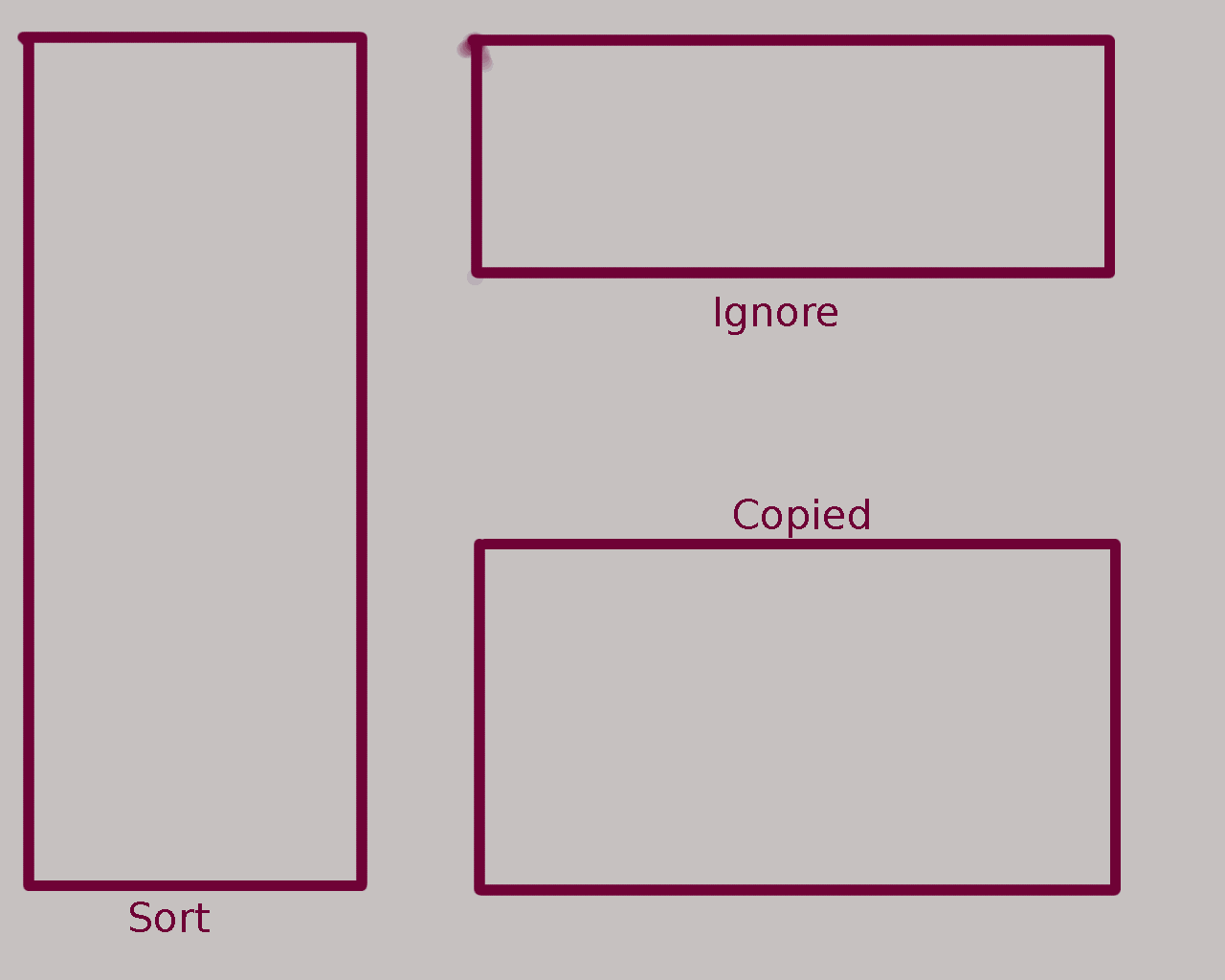
Jon Dowland: sortpaper

sortpaper
I stumbled across this file whilst sorting through some old backups. It's a "sortpaper": a wallpaper designed to aid people with sorting out files on their desktops. I thought I would share it in case anybody thought the concept was interesting: The size/aspect of the picture probably make it less practically useful today than whenever I first made it.

12 April 2011

Dirk Eddelbuettel: The new R compiler package in R 2.13.0: Some first experiments

R 2.13.0 will be released tomorrow. It contains a new package by R Core member Luke Tierney: compiler. What a simple and straightforward name, and something that Luke has been working on for several years. The NEWS file says
    o Package compiler is now provided as a standard package.  See
      ?compiler::compile for information on how to use the compiler.
      This package implements a byte code compiler for R: by default
      the compiler is not used in this release.  See the 'R
      Installation and Administration Manual' for how to compile the
      base and recommended packages.
so the compiler is not yet used for R's own base and recommended packages. While working on my slides for the upcoming Rcpp workshop preceding R/Finance 2011, I thought of a nice test example to illustrate the compiler. Last summer and fall, Radford Neal had sent a very nice, long and detailed list of possible patches for R performance improvements to the development list. Some patches were integrated and some more discussion ensued. One strand was on the difference in parsing between normal parens and curly braces. In isolation, these seem too large, but (as I recall) this is due some things 'deep down' in the parser. However, some folks really harped on this topic. And it just doesn't die as a post from last week demonstrated once more. Last year, Christian Robert had whittled it down to a set of functions, and I made a somewhat sarcastic post argueing that I'd rather use Rcpp to get 80-fold speed increase than spend my time argueing over ten percent changes in code that could be made faster so easily. So let us now examine what the compiler package can do for us. The starting point is the same as last year: five variants of computing 1/(1+x) for a scalar x inside an explicit for loop. Real code would never do it this way as vectorisation comes to the rescue. But for (Christian's) argument's sake, it is useful to highlight differences in the parser. We once again use the nice rbenchmark package to run, time and summarise alternatives:
> ## cf http://dirk.eddelbuettel.com/blog/2010/09/07#straight_curly_or_compiled
> f <- function(n, x=1) for (i in 1:n) x=1/(1+x)
> g <- function(n, x=1) for (i in 1:n) x=(1/(1+x))
> h <- function(n, x=1) for (i in 1:n) x=(1+x)^(-1)
> j <- function(n, x=1) for (i in 1:n) x= 1/ 1+x 
> k <- function(n, x=1) for (i in 1:n) x=1/ 1+x 
> ## now load some tools
> library(rbenchmark)
> ## now run the benchmark
> N <- 1e6
> benchmark(f(N,1), g(N,1), h(N,1), j(N,1), k(N,1),
+           columns=c("test", "replications",
+           "elapsed", "relative"),
+           order="relative", replications=10)
     test replications elapsed relative
5 k(N, 1)           10   9.764  1.00000
1 f(N, 1)           10   9.998  1.02397
4 j(N, 1)           10  11.019  1.12853
2 g(N, 1)           10  11.822  1.21077
3 h(N, 1)           10  14.560  1.49119
This replicates Christian's result. We find that function k() is the fastest using curlies, and that explicit exponentiation in function h() is the slowest with a relative penalty of 49%, or an absolute difference of almost five seconds between the 9.7 for the winner and 14.6 for the worst variant. On the other hand, function f(), the normal way of writing things, does pretty well. So what happens when we throw the compiler into the mix? Let's first create compiled variants using the new cmpfun() function and then try again:
> ## R 2.13.0 brings this toy
> library(compiler)
> lf <- cmpfun(f)
> lg <- cmpfun(g)
> lh <- cmpfun(h)
> lj <- cmpfun(j)
> lk <- cmpfun(k)
> # now run the benchmark
> N <- 1e6
> benchmark(f(N,1), g(N,1), h(N,1), j(N,1), k(N,1),
+           lf(N,1), lg(N,1), lh(N,1), lj(N,1), lk(N,1),
+           columns=c("test", "replications",
+           "elapsed", "relative"),
+           order="relative", replications=10)
       test replications elapsed relative
9  lj(N, 1)           10   2.971  1.00000
10 lk(N, 1)           10   2.980  1.00303
6  lf(N, 1)           10   2.998  1.00909
7  lg(N, 1)           10   3.007  1.01212
8  lh(N, 1)           10   4.024  1.35443
1   f(N, 1)           10   9.479  3.19051
5   k(N, 1)           10   9.526  3.20633
4   j(N, 1)           10  10.775  3.62673
2   g(N, 1)           10  11.299  3.80310
3   h(N, 1)           10  14.049  4.72871
Now things have gotten interesting and substantially faster, for very little cost. Usage is straightforward: take your function and compile it, and reap more than a threefold speed gain. Not bad at all. Also of note, the difference between the different expressions essentially vanishes. The explicit exponentiation is still the loser, but there may be an additional explicit function call involved. So we do see the new compiler as a potentially very useful addition. I am sure more folks will jump on this and run more tests to find clearer corner cases. To finish, we have to of course once more go back to Rcpp for some <emph>real</emph> gains, and some comparison between compiled and byte code compiled code.
> ## now with Rcpp and C++
> library(inline)
> ## and define our version in C++
> src <- 'int n = as<int>(ns);
+         double x = as<double>(xs);
+         for (int i=0; i<n; i++) x=1/(1+x);
+         return wrap(x); '
> l <- cxxfunction(signature(ns="integer",
+                            xs="numeric"),
+                  body=src, plugin="Rcpp")
> ## now run the benchmark again
> benchmark(f(N,1), g(N,1), h(N,1), j(N,1), k(N,1),
+           l(N,1),
+           lf(N,1), lg(N,1), lh(N,1), lj(N,1), lk(N,1),
+           columns=c("test", "replications",
+           "elapsed", "relative"),
+           order="relative", replications=10)
       test replications elapsed relative
6   l(N, 1)           10   0.120   1.0000
11 lk(N, 1)           10   2.961  24.6750
7  lf(N, 1)           10   3.128  26.0667
8  lg(N, 1)           10   3.140  26.1667
10 lj(N, 1)           10   3.161  26.3417
9  lh(N, 1)           10   4.212  35.1000
5   k(N, 1)           10   9.500  79.1667
1   f(N, 1)           10   9.621  80.1750
4   j(N, 1)           10  10.868  90.5667
2   g(N, 1)           10  11.409  95.0750
3   h(N, 1)           10  14.077 117.3083
Rcpp still shoots the lights out by a factor of 80 (or even almost 120 to the worst manual implementation) relative to interpreted code. Relative to the compiled byte code, the speed difference is about 25-fold. Now, these are of course entirely unrealistic code examples that are in no way, shape or form representative of real R work. Effective speed gains will be smaller for both the (pretty exciting new) compiler package and also for our C++ integration package Rcpp. Before I close, two more public service announcements. First, if you use Ubuntu see this post by Michael on r-sig-debian announcing his implementation of a suggestion of mine: we now have R alpha/beta/rc builds via his Launchpad PPA. Last Friday, I had the current R-rc snapshot of R 2.13.0 on my Ubuntu box only about six hours after I (as Debian maintainer for R) uploaded the underlying new R-rc package build to Debian unstable. This will be nice for testing of upcoming releases. Second, as I mentioned, the Rcpp workshop on April 28 preceding R/Finance 2011 on April 29 and 30 still has a few slots available, as has the conference itself.

10 April 2011

Christian Perrier: [life] [running] 2nd step of my wspring challenge done

At about 12:45 today, I completed my third Paris Marathon and my 7th marathon overall (incl. 2 unofficial ones, ran alone). As I wrote earlier, the challenge this year was not breaking a record. I wanted to complete two long races in only two week, as a gift for my birthday that happened between both. So, after Paris Paris Ecotrail 55km race, I ran my beloved Paris Marathon. So, I ended up in 3h54'37", 5 minutes more than last year and 14 minutes more than my personal best The heat was the ennemy, today. A wonderful sun was shining over Paris, which is nice....but brings the temperature up to 23 C. So, the solution had to be "drink, drink, drink". I think I drank something like 4 liters, today. I was planning to start around 5'25/km but finally ended up with about 5'20", which I sustained up to km 25 and the terrible Louvre tunnel (1km in a tunnel on the right bank speedway, under Quai du Louvre). That one was a killer this year and many runners blew up in it. I then decided to use the opportunity to walk a little bit, eat my mid-marathon glucides and slow down slightly later on for the upcoming tunnels (two more...though less long). That was in some way the famous 30km wall, which, for me, was moved to km28..:-) Later on, as usual, courage enters the game and I roughly managed to keep a 5'30"-5'45" pace up to the end of the race. Cramps signs appeared around km 35 but, here again, a wise slowdown and some walking, a lot of drinking helped me in controlling them. Finally, the result is about what I intended to do. Over 4h, I would have been disappointed even if happy to finish (as everybody tells me that my challenge was kinda crazy). Abandoning would have been the real defeat. I did not..:-) And, thanks, of course, to my beloved Elizabeth who again managed to deal with his "Kiki" logistics, includiung waking up at 6am on a Sunday. Now, my running schedule will slow down a little with only training for 5 weeks. Next race: Trail des Cerfs, a 35km trail in Rambouillet Forest close to home. I may again schedule a solo marathon, at training pace, end of May, in Versailles Castle park. Next marathon: Berlin, Sept 25th. Here, the goal is breaking the personal best and head up to 3h35.

John Goerzen: The Mennonite Mecca

I d like to paint you a picture of the sorts of things that have been going on around here the past few months, and with growing fervor the past few days. I ll start with church basements. Possibly a little chilly, but with a bunch of women getting together to make some quilts along with some conversation, maybe some snacks. Or perhaps about hundreds of kitchens throughout Kansas, warm with baking pies, cookies, breads, and all sorts of items. Then there are a bunch of wood shops, turning up sawdust, building things from toys to furniture. Or even a body shop donating its time and materials to put some finishing touches on a classic car. I ve also seen around 300 men getting together to practice for a men s chorus concert. I know there was large crowd of people gathering to make verenike. People always wind up running 5km on a particular Saturday morning, rain or shine. Or ride 35 miles on a bicycle on a different Saturday. Or even help build a house using as much volunteer labor and donated materials as possible. And then, of course, comes this week, where Mennonites from all over Kansas start to converge on Hutchinson, KS. I can imagine you might see some odd sights rolling down the road: a vehicle called the borscht buggy for preparing large quantities of the delicious soup. Several old tractors being hauled down the road on trailers. Semi loads of food. Vanloads of pie and cookies. Plants, trees, rugs, quilts, even a lawn mower. And then, yesterday and today, excited people ready to buy all of these things. Families with children excited to get a ride on the largest slide they ve ever seen. And, of course, so many people wanting to eat the famous food that, despite the many parallel serving areas, lines still can extend for blocks. It s all because people are hungry. Not these Kansans with pie-laden kitchens, though it s to help those in need. It s all part of the annual Kansas MCC Relief Sale. The idea is that people make, bake, build, sing, or give things to the sale. The items are then sold, and the proceeds go to Mennonite Central Committee, one of the world s most efficient charities. MCC not only helps with directly bringing people out of hunger, but also supports sustainable projects, such as building hand-operated wells to give those in need a safe source of drinking water. Virtually all of the money you spend on those pies winds up helping someone in poverty. Each year, the relief sale and related events raise around half a million dollars for charity. It s not unusual to see a quilt sell for thousands of dollars. Most of the things sell at more normal prices, but last year someone decided to add a loaf of bread to an auction and it sold for $100. And so it was this that we took the boys to today. We started with the Feeding the Multitude a wonderful meal with some traditional Kansas Mennonite food. Here s a photo: That bread is zwieback, then there is cherry moos, bohne berrogi, verenike, and of course, sausage. Here are Jacob and Oliver enjoying their food: IMG_5548.JPG After that, we went over to the giant slide. I m not sure how many stories tall it is, but it s big enough that they have a strip of carpet there at the bottom to slow people down at the end. Here s a photo of Jacob on my lap after going down the slide. If you zoom in, you can see the giant smile on his face. IMG_5562.JPG After that, we hopped on the mass transit at the sale: a wagon being pulled by a tractor. We checked out the general auction, with Jacob wanting to be sure to peer under the hood of each car present. Then after a stop to buy some kettle corn for Jacob, we checked out the plants, quilt auction, and then on to buy cheese curds. After another stop at the slide, it was time to head home. And then tomorrow is a concert of the Kansas Mennonite Men s Chorus (motto: We Sing That Others May Live). You get around 300 men on a stage signing together and wow no recording can do it justice. It s amazing to hear the power of the choir at the loud parts, but still more amazing to listen to 300 men signing as softly as they possibly can. I ve been singing with that choir for 3 years, and we ve been practicing for a few months now. If you ever hear some Mennonites boasting about something, it s probably going to be about how much money they ve raised for charity. And on that note, I ll nudge those Indiana folks reading this and point out that you have some catching up to do with the Kansas sale

8 April 2011

Dominique Dumont: Configuration doc generation with Config::Model

Hello When a project comes with configuration files, project developers have to write configuration doc. Be it as man pages or as comments in configuration files. This is a boring, but necessary task to provide documentation to users. There s a way to get more with a similar effort. By writing this doc as models (i.e. in a format usable by Config::Model), you will get:
- generated man pages
- configuration GUIs
- configuration command line And with a little extra effort, you will also get:
- immediate validation data entered by user
- configuration upgrade tools But let s focus on generating documentation. A configuration model is more or less a list of configuration parameters with their constraints and description. In previous versions of Config::Model, the parameter description was used to generate online help in the GUI. Parameter description is now also used to generate configuration documentation. The constraints which are used to validate user input, are also used to provide more details to the documentation of the parameters. The help text in the model that will be used to generate doc can be plain text or contain pod markups to enhance the look of the doc (be it generated or displayed in the GUI). Here are some links to some example of models and the corresponding generated documents:
Debian::Dpkg::Source model generated doc
Debian::Dpkg::Copyright model generated doc
Sshd model generated doc
To generate these doc, a command like this one was added to the build process: config-edit -model Sshd -model_dir lib/Config/Model/models -gen_pod lib The generated pod files can then be converted to man pages, plain text, html depending on your needs. Feel free to send a mail on config-model users list (config-model-users at lists.sourceforge.net) if you need help. All the best

5 April 2011

Gunnar Wolf: Saving your back and hands from RSI and similar pain

I took part in a occupational-health-related thread recently, and wrote a bit of my experience which might be helpful for my readers, many of them avid keyboard users, with usually 8hr of typing per day. ( ) I suffered not from RSI but from painful back aches. I started using standard keyboards in a different fashion, not putting so much stress on my wrists (and on the muscles connecting them to the rest of the body, of course): I exclusively use US keymaps (with some modifications to allow for proper Spanish input and characters), but instead of making the middle row my fingers' home row, I type with the base position of my fingers in a V shape Fingers resting on (approx.) w-e-f-v-spacebar and spacebar-m-l-;-]; the fingers doing most of the travelling are the index and middle, and with no straining for the little fingers to reach or backspace. On the other side, the most straining keys become Control and Shift, which requires closing the hands a bit too much, but are not that bad. My way does induce some new kind of stress, as my arms also have to move to reach 6 and 7, but it... Works for me . It looks weird and is somewhat strange to get used to, but I must say it has worked great for me. I work this way on regular and laptop keyboards, even on my netbook's noticeably smaller one.

4 April 2011

Riku Voipio: Getting replaced by scripts - and it feels good!

As mentioned on Phils blog, Debian buildd's have now capability of autosigning builds. Today when arriving home I was greeted by an empty feeling - There was no builds to sign. The long standing routine had come to an end.

Good system administrators constantly look how to replace themselves with scripts and automation. Bad ones build job security by owning manual processes than nobody else can master.

With signing now done by some code instead of us, I (and other buildd admins) have more time and energy to work on irregular tasks - upgrading chroots, helping developers with porting problems etc. Not to mention blogging and updating ones own packages to sid..

Meanwhile, there are still some issues needing solving - $HOME isn't available on all buildds, -volatile and binNMU's need still manual signing. Certainly not the smoothest update, but it is already making life easier.

Christoph G hre: 4th Debian Groupware meeting

We celebrate the 4th edition of Debian Groupware meeting last weekend at Linuxhotel in Essen. A weekend with 'full-time-hacking' on Groupware related stuff. So now we have Icedove 3.1 and translation packages for Iceowl in Sid. Another task was bugfixing and try to solve license/trademark problems with z-push.
Due to the lovely weather on Saturday, we have BBQ together with some people from FROSCON. And these people carried unwittingly Debian swirled sweets.

Just in one phrase: I'm looking forward to the 5th Groupware meeting in 2012.
debian sweets

3 April 2011

Steve Kemp: A couple of small tweaks

Today I made a couple of small tweaks to my systems. First of all I updated my email handling to allow further restrictions to be applied to incoming mail. Generally the way I handle incoming mail is to first of all test the recipient, then apply spam checks. To allow mail for a new localpart to be received I'll run this:
cd /srv/example.com/users/valid
touch localpart
The result of the file /srv/example.com/users/valid/localpart existing is that mail is accepted for localpart@example.com. As of today that still works - any file beneath users/valid allows the appropriate localpart to receive email. But now a directory indicates an ACL. So I can create:
rm    /srv/example.com/users/valid/root
mkdir /srv/example.com/users/valid/root/
touch /srv/example.com/users/valid/root/1.2.3.4
touch /srv/example.com/users/valid/root/2.3.4.5
Now only the named IP addresses may mail root@example.com. Finally I updated the proxy which is handling incoming access to my websites, so that I actually take advantage of the regular expression support.
    '(xen-hosting.net www.xen-hosting.net)':  
        'rules':  
            '^/': 'http://kvm-hosting.org/'
         ,
     ,
    '(xen-hosting.org www.xen-hosting.org)':  
        'rules':  
            '^/': 'http://kvm-hosting.org/'
         ,
     ,
Using regular expressions meant that I didn't have seperate matches for xen-hosting.org and www.xen-hosting.org. (Obviously I could have combined all four hosts into one regexp, but it looks cleaner this way.) ObQuote: "Nobody likes a perky goth" - Blood Ties.

Rapha&#235;l Hertzog: March 2011 wrap up

Since I m soliciting donations to support my Debian work, the least I can do is explain what I do. You can thus expect to see an article like this one every month. Multi-Arch work I updated the code to use another layout for the control files stored in /var/lib/dpkg/info/. Instead of using a sub-directory per architecture (arch/package.type), we decided to use package:arch.type but only for packages which are Multi-Arch: same. dpkg is taking care to rename the files the first time it is executed with write rights and then updates /var/lib/dpkg/info/format to remember that the upgrade has been done and that we can rely on the new structure. I filed a few bugs on packages that are improperly accessing those internal files instead of using the appropriate dpkg-query interface. I sent a heads-up mail on -devel to make other people aware of those problems in the hope to discover most of them as early as possible. After that, the work stalled because Guillem went away for 2 weeks and thus stopped his review of my work. I hope he will quickly resume the review and that we will get something final this month. With the arrival of dpkg 1.16.0, it s now possible to start converting libraries to multi-arch even if full multi-arch support has not yet landed in dpkg proper. See http://wiki.debian.org/Multiarch/Bootstrapping for the detailed plan. If you re curious about Multi-Arch, you might want to read this article of Steve Langasek as well. Bug triage for dpkg in launchpad At the start of the month, there was close to 500 bugs reported against the dpkg package in Launchpad. Unfortunately most of it is noise many of the reported bugs are misfiled, they show an upgrade problem of a random package and that upgrade problem confuses update-manager which tries to configure an already configured package. This generates a second error that apport attributes to dpkg and the resulting bug report is thus filed on dpkg. There are literally hundreds of those that have to be reclassified. Michael Vogt and Brian Murray did some triaging, and I also spend quite some hours on this task. It s a bit frustrating as I tend to mark many reports Incomplete because there s no way they can be acted upon and many of them are so old that the reporter is unlikely to be able to provide supplementary information. But in the middle of this noise, there are some useful bug reports, like LP#739179 which enabled me to fix a regression even before it reached Debian Unstable (because Ubuntu runs a snapshot of dpkg with multiarch support). I subscribed to the Launchpad bugs for dpkg via the Debian Package Tracking System (thanks to the derivatives-bugs keyword) and will try to keep up with the incoming reports. Misc dpkg work The ftpmasters came up with a request for a new field (see 619131) in source packages. After a quick discussion and a round of review on debian-policy@l.d.o, I implemented the new Package-List field. This should allow the ftpmasters to save some time in NEW processing, but we deferred the change for the next dpkg version (1.16.1) to ponder a bit more on the design of the field. I also fixed a bunch of bugs (#619541, #605719, #598922, #616096) and merged a patch of Mark Hymers to recognize the new Built-Using field. Developers-reference work The review process for changes to the developers-reference is not working as it should. And I suffered from it while trying to integrate the patch I wrote for the Developer duties chapter (see #548867). We purposely changed the maintainer field from debian-doc to debian-policy in the hope to have more reviews of suggested changes and to seek some sort of consensus before committing anything. But we don t get more reviews and deciding to commit a patch is now even harder than it was (except for trivial stuff where personal opinions can t interfere). In my case, I only got the feedback of Charles Plessy which was very mixed to say the least. I tried to improve my patch based on what he expressed but I also clearly disagreed with some of his assertions and was convinced that my wording was in line with the dominant point of view within Debian. We tried to involve the release team in the discussion because most of what I documented was about helping making stable release happen, but nobody of the team answered. Instead of letting the situation (and my patch) rot, I solicited feedback from the DPL and from another developers-reference editor to see whether my patch was an improvement or not. After some more time, I went ahead and committed it. It was not pleasant for anyone. I don t know how we can improve this. Contrary to the policy, the developers-reference is a document that is not normative, I believe the result is better when we put some soul into it. But it s a real challenge when you seek a consensus and that the interest in reviewing changes is so low. DVD shop listed on debian.org In February, I launched a DVD shop whose benefits are used to fund my Debian work. Shortly after the launch I used the official form to be added to the official listing of Debian CD vendors and offered a few suggestions to deal with vendors who are selling unofficial images (with firmware in my case). A few weeks later, I got no answers: neither for my request nor for my suggestions, I mailed the cdvendors@debian.org team directly asking for a status update and quickly got an answer suggesting that Simon Paillard usually does the work and can t process the backlog due to some injury. At this point no concerns had been raised about adding me to the list. To save some time and some work for the team, I added myself to the list since I had commit rights and I informed them that I did it, so that they can review it. Shortly after I did that, Martin Zobel Helas objected to my addition. I cleared some misunderstandings but the discussion also lead to some changes to please everybody: the listing now indicates that some images are unofficial and I have prepared a special landing page for people coming from the Debian website through this listing. Debian column on OMG! Ubuntu I have always been a firm believer that it s important for Debian to reach out to the widest public with its message of freedom. Thus when Benjamin Humphrey contacted the debian-publicity team to find volunteers to write a Debian column on OMG! Ubuntu, I immediately jumped in. I wrote 4 articles over there. The tone is very different from my articles on my blog and I like that duality. Check out Debian is dying! Oh my word!, Debian or Ubuntu, which is the best place to contribute?, Are you contributing your share? and Ubuntu s CTO reveals DEX: an effort to close the gap with Debian. It s a great win-win situation, OMG! Ubuntu benefits from my articles, Debian s values are relayed further, and OMG! Ubuntu s large audience also helps me develop my own blog. Work on my book I had lots of paperwork to do this month (annual accounting stuff for my company) and I did not have as much time as I hoped for my book. Still I have a updated a few more chapters of my French book and I certainly hope to complete the update during April. This means that the work on the English translation could start in may. Work on my blog Just like for my book, it has been relatively difficult for me to cope with my policy of two articles every week. But I still managed to get quite some good stuff out. I interviewed Christian Perrier (Debian s translation coordinator) and also Bdale Garbee (chair of Debian s technical committee). I finished my series of Debian Cleanup Tips with 2 supplementary articles: The removal of firmware is causing troubles to quite some users so I wrote an article explaining how to deal with the problem. A regular reader also asked me to write an article about Jigdo, I executed myself because it was a good idea and that he has been very nice with me: Download ISO images of Debian CD/DVD at light speed with Jigdo. Last but not least, I shared my package maintainer pledge which inspired my developers-reference patch (see discussion above). Thanks Many thanks to all the people who showed their appreciation of my work. The 324.37 EUR that you gave me in February represented 2 days and a half of my time that I have spent working on the above projects. See you next month for a new summary of my activities.

2 comments Liked this article? Click here. My blog is Flattr-enabled.

Next.

Previous.