Search Results: "tim"

31 March 2021

Chris Lamb: Free software activities in March 2021

Here is my monthly update covering what I have been doing in the free software world during March 2021 (previous month): Reproducible Builds One of the original promises of open source software is that distributed peer review and transparency of process results in enhanced end-user security. However, whilst anyone may inspect the source code of free and open source software for malicious flaws, almost all software today is distributed as pre-compiled binaries. This allows nefarious third-parties to compromise systems by injecting malicious code into ostensibly secure software during the various compilation and distribution processes. The motivation behind the Reproducible Builds effort is to ensure no flaws have been introduced during this compilation process by promising identical results are always generated from a given source, thus allowing multiple third-parties to come to a consensus on whether a build was compromised. The project is proud to be a member project of the Software Freedom Conservancy. Conservancy acts as a corporate umbrella allowing projects to operate as non-profit initiatives without managing their own corporate structure. If you like the work of the Conservancy or the Reproducible Builds project, please consider becoming an official supporter. This month, I:
I also made the following changes to diffoscope, including uploading versions 169, 170 and 171 to Debian: Debian Uploads
Debian LTS This month I worked 18 hours on Debian Long Term Support (LTS) and 12 hours on its sister Extended LTS project. You can find out more about the Debian LTS via the following video:

Raphaël Hertzog: Challenging times for Freexian (2/4)

Note: This is the continuation of part 1 where I presented Freexian and its purpose. Going forward: growing Freexian Part 1: From Debian LTS to Debian for the Enterprise Freexian s Debian LTS service has so far been entirely successful, with a steady growth over the years. Thanks to this, and even if there are always new challenges, it is fair to say that the Debian LTS team has met its goal in the last few years. While this started from the desire to make LTS a reality, many sponsors are only looking for a way to give back to Debian through their company, and to make sure that Debian fits their needs. But if you look at the bigger picture outside of this small LTS area, you will easily find many issues that need to be addressed if we want Debian to meet the needs of corporate users. Those issues can have widely different types and complexity. They can be as simple as missing the latest upstream version for an important package because the maintainer disappeared and nobody noticed before it was too late (i.e. the release was frozen); or a somewhat basic piece of software not yet packaged at all; or a release critical bug that was left unattended. On the other end of the spectrum, some corporate requirements will prove tougher to solve, for instance for large software suites that are complex to package, or could potentially have an impact elsewhere in Debian. Bringing those facts together, we would like to have Freexian s Debian LTS/ELTS offering evolve into a more general Debian Software Assurance offering, where you commit to a yearly budget for Debian sponsorship in the larger sense. That budget would fund different projects and the allocation between those projects would vary over time depending on the desires and needs of the sponsors/customers: This major shift in our offering would also be an ideal opportunity to build a professional, free-software based infrastructure aimed at sustaining this business, making it easier to administer the various aspects of this work, and easily allowing many more sponsors to join (individuals included!). On a more pragmatic/operational note, this shift will bring a lot of challenges to the table, and those can hardly be handled with the current resources of Freexian: if we hope to properly implement this new strategy, we ll need some additional help. This article is to be continued in an upcoming post. Stay tuned!

Timo Jyrinki: MotionPhoto / MicroVideo File Formats on Pixel Phones

Google Pixel phones support what they call Motion Photo which is essentially a photo with a short video clip attached to it. They are quite nice since they bring the moment alive, especially as the capturing of the video starts a small moment before the shutter button is pressed. For most viewing programs they simply show as static JPEG photos, but there is more to the files.
I d really love proper Shotwell support for these file formats, so I posted a longish explanation with many of the details in this blog post to a ticket there too. Examples of the newer format are linked there too.
Info posted to Shotwell ticket

There are actually two different formats, an old one that is already obsolete, and a newer current format. The older ones are those that your Pixel phone recorded as MVIMG_[datetime].jpg", and they have the following meta-data:
Xmp.GCamera.MicroVideo                       XmpText     1  1
Xmp.GCamera.MicroVideoVersion XmpText 1 1
Xmp.GCamera.MicroVideoOffset XmpText 7 4022143
Xmp.GCamera.MicroVideoPresentationTimestampUs XmpText 7 1331607
The offset is actually from the end of the file, so one needs to calculate accordingly. But it is exact otherwise, so one simply extract a file with that meta-data information:
#!/bin/bash
#
# Extracts the microvideo from a MVIMG_*.jpg file

# The offset is from the ending of the file, so calculate accordingly
offset=$(exiv2 -p X "$1" grep MicroVideoOffset sed 's/.*\"\(.*\)"/\1/')
filesize=$(du --apparent-size --block=1 "$1" sed 's/^\([0-9]*\).*/\1/')
extractposition=$(expr $filesize - $offset)
echo offset: $offset
echo filesize: $filesize
echo extractposition=$extractposition
dd if="$1" skip=1 bs=$extractposition of="$(basename -s .jpg $1).mp4"
The newer format is recorded in filenames called PXL_[datetime].MP.jpg , and they have a _lot_ of additional metadata:
Xmp.GCamera.MotionPhoto                      XmpText     1  1
Xmp.GCamera.MotionPhotoVersion XmpText 1 1
Xmp.GCamera.MotionPhotoPresentationTimestampUs XmpText 6 233320
Xmp.xmpNote.HasExtendedXMP XmpText 32 E1F7505D2DD64EA6948D2047449F0FFA
Xmp.Container.Directory XmpText 0 type="Seq"
Xmp.Container.Directory[1] XmpText 0 type="Struct"
Xmp.Container.Directory[1]/Container:Item XmpText 0 type="Struct"
Xmp.Container.Directory[1]/Container:Item/Item:Mime XmpText 10 image/jpeg
Xmp.Container.Directory[1]/Container:Item/Item:Semantic XmpText 7 Primary
Xmp.Container.Directory[1]/Container:Item/Item:Length XmpText 1 0
Xmp.Container.Directory[1]/Container:Item/Item:Padding XmpText 1 0
Xmp.Container.Directory[2] XmpText 0 type="Struct"
Xmp.Container.Directory[2]/Container:Item XmpText 0 type="Struct"
Xmp.Container.Directory[2]/Container:Item/Item:Mime XmpText 9 video/mp4
Xmp.Container.Directory[2]/Container:Item/Item:Semantic XmpText 11 MotionPhoto
Xmp.Container.Directory[2]/Container:Item/Item:Length XmpText 7 1679555
Xmp.Container.Directory[2]/Container:Item/Item:Padding XmpText 1 0
Sounds like fun and lots of information. However I didn t see why the length in first item is 0 and I didn t see how to use the latter Length info. But I can use the mp4 headers to extract it:
#!/bin/bash
#
# Extracts the motion part of a MotionPhoto file PXL_*.MP.mp4

extractposition=$(grep --binary --byte-offset --only-matching --text \
-P "\x00\x00\x00\x18\x66\x74\x79\x70\x6d\x70\x34\x32" $1 sed 's/^\([0-9]*\).*/\1/')

dd if="$1" skip=1 bs=$extractposition of="$(basename -s .jpg $1).mp4"
UPDATE: I wrote most of this blog post earlier. When now actually getting to publishing it a week later, I see the obvious ie the Length is again simply the offset from the end of the file so one could do the same less brute force approach as for MVIMG. I ll leave the above as is however for the of binary grepping.(cross-posted to my other blog)

Russ Allbery: Review: Paladin's Strength

Review: Paladin's Strength, by T. Kingfisher
Series: The Saint of Steel #2
Publisher: Red Wombat Studio
Copyright: 2021
ASIN: B08WWKXXVY
Format: Kindle
Pages: 474
Paladin's Strength is a sequel of sorts to Paladin's Grace, but it has different protagonists. It picks up a subplot from that novel with another former follower of the Saint of Steel. You can safely read the books in any order; there are some minor spoilers for the Paladin's Grace subplot in this book, but nothing that would matter for the enjoyment of the story. Istvhan and his fellow brother Galen are acting as the head of a mercenary band, which has hired on to escort Master Distiller Brant and his collection of Emperor Oak barrels. In truth, they have another mission from the Temple of the White Rat: to track down a disturbing monster that leaves a trail of beheaded bodies. Clara is a lay sister of St. Ursa, a convent that was raided by slavers who hauled away the nuns. She was left for dead in Arral territory when she fell sick, and was taken as a house slave after they nursed her back to life. The story opens with her holding a sword in front of Istvhan's tent, part of the fallout of Istvhan killing a young Arral in self-defense. The politics of that fallout are not at all what Istvhan expects. They end with Clara traveling with Istvhan's company, at least for a while. Both Istvhan and Clara are telling the truth: Istvhan is escorting a merchant, and Clara is hoping to rescue her sisters. Both of them are also hiding a great deal. Istvhan's quiet investigation of the trail of a monster is easy enough to reveal once he knows Clara well enough. That he's a berserker who no longer has a god in control of his battle rage is another matter; the reader knows that, and of course so does Galen, but Istvhan has no intention of telling anyone else. Clara has her own secrets about herself and the sisters of St. Ursa, ones that neither the reader nor Istvhan knows. This is a T. Kingfisher novel about paladins, so of course it's also a romance. If you've read Kingfisher's other books, you know she writes slow burn romances, but Paladin's Strength is next level. Istvhan and Clara have good reasons to not want to get involved and to doubt the other person's attraction or willingness, but this goes far beyond the obvious to become faintly absurd. If you like the sort of romance where both leads generate endless reasons to not pursue the relationship (some legitimate, some not) while steadfastly refusing to talk to each other about them and endlessly rehashing hints and interpretations, you're in for a treat. For me, it was too much and crossed over into irritation. By the two-thirds point, Kingfisher was gleefully throwing obstacles in their way to drag out the suspense, and I just wanted everyone to shut up about having sex and get on with the rest of the story. That's unfortunate because I really liked Clara. She isn't the same type as Grace, Halla from Swordheart, or even Slate from Clockwork Boys and The Wonder Engine, the other novels set in this universe. She's self-contained, physically intimidating, cautious, deliberate, and very good at keeping her own counsel. I won't spoil her secret, since it's fun to work it out at the start of the book, but it's a lovely bit of characterization and world-building that Kingfisher handles with a thoughtful eye for its ramifications and effect on Clara's psychology. I would happily read more books about Clara. I liked Istvhan well enough when he was doing anything other than mooning over Clara. As with all of Kingfisher's paladins, he's not a very subtle person, but he's a good straight man for Clara's quiet bemusement. He fills the paladin slot in this story, which is all he needs to do. There's enough else going on with Clara and with the plot two separate major plotlines, plus a few subplots that Paladin's Strength can use a protagonist who heads straight forward and hits things until they fall down. The mooning, though... this is going to be a matter of personal taste. I think the intent was to contrast Istvhan's rather straightforward lustful appreciation with Clara's nuanced and trauma-laced reservations, and to play Istvhan's reactions in part for humor. I'm sure it works for some people, but I found Istvhan juvenile and puerile (albeit, to be clear, in a respectful and entirely consensual way), which didn't help me invest in a romance plot that I already thought dragged on too long. Thankfully the characters finally get past this in time for a dramatic and satisfying conclusion to the plot. The joy of Paladin's Grace (and Swordheart for that matter) was the character dynamics and quirky female lead, which made the romance work even when Stephen was being dense. The joy of Paladin's Strength for me was primarily Clara's matter-of-fact calm bemusement and secondarily the plot and the world-building. (Kingfisher's gnoles continue to be the best thing about this setting.) None of that helps the romance as much, and the slow burn was far, far too slow for me, which lowers this one a notch. Still, this was fun, and I'll keep reading books about the Temple of the White Rat and their various friends and encounters for as long as Kingfisher keeps writing them. Rating: 7 out of 10

30 March 2021

Raphaël Hertzog: Challenging times for Freexian (1/4)

TLDR: Freexian s success means that we have resources to invest into Debian projects. Plainly offering money has not worked so far, so I am looking to hire a project manager whose work would be to help spend that money in useful ways. At the same time, Freexian needs to adapt to cope with the growth: with new employees, with new infrastructure and a new offering. I want to give an idea of where we are headed, to try to inspire persons that share our values and our desire to improve Debian. Read on if you are interested. Note: The original text has been split into 4 blog posts that will be published over a few days. Introduction
Freexian is an IT service company specialized in Debian. We provide technical support by email on Debian, we create and maintain Debian packages requested by our customers, we also help organizations run an entire Debian derivative (Kali Linux being the most notable one).
On top of this, it runs the commercial part of the Debian LTS service : Freexian invoices many sponsors that need long term support, and uses the money to pay Debian contributors (about 12 currently) to make sure that Debian releases are supported for 5 years instead of 3. With the Extended LTS service, we push that further to 7 years, however only for a smaller subset of packages and in a repository that is hosted outside of debian.org. Freexian s purpose When I created Freexian, it was out of a desire to be paid to work on Debian, and to be able to contribute during work time to the project that was so important to me. That goal has been met a long time ago. But ultimately what I strive to achieve for Debian is not entirely aligned with the work that Freexian s customers are requesting. That s why, in the long term projects of Freexian, I always kept find a business model that can fund the Debian projects that I would like to do , as well as if that model works for me, build something so that other can benefit from it too . The first occasion to experiment something appeared when Debian discussed Long Term Support and when I stepped up to setup a commercial offer to pay Debian contributors. Step 1: Paying Debian contributors for LTS work When we started the Debian LTS service, I voluntarily opted to use an hourly rate that was rather high so that any Debian developer regardless of their geographical location, could participate and not earn (much) less than what they would have from working on other tasks. This choice did imply paying a very high rate for some countries, but I didn t see that as a problem, quite the contrary: if a Debian developer can earn enough money to cover their cost of living with 15h of Debian LTS, and then spend the rest of their month contributing on Debian, all the better! I m not sure if anyone made this choice, but that was a dream of my younger self From a personal standpoint, the launch of Debian LTS has meant less free time, more administrative work, new duties to coordinate a team of paid contributors, more communication with many Debian-using companies, and many new opportunities too! This ultimately resulted in the launch of Extended LTS and PHP LTS, both of which have been rather successful so far. Step 2: Funding Debian projects With the growth of the Debian LTS service, and given that we have reached the required funding level, we decided to put a small share of the revenues aside and use that to fund useful Debian projects, typically in areas that were affected by our Debian LTS work. This effort was fully formalized in the project-funding git repository. We announced this process in November 2020, and we have kept mentioning it in our monthly LTS reports ever since, but so far only a single project has benefited from this. This is really the dream offer that I wish had existed when I was younger and was still struggling to get enough customers: hence I don t really understand this lack of interest. You can find some discussions over the reasons why this offer has not (yet) found its target audience in this debian-vote thread. I was hoping that spending money would be easy, but I now realize I was wrong! I m positive that I could find dozens of useful projects to fund, but I just don t have the time for this extra effort on top of my regular Freexian duties. I still really want to put this money to good use, which is why I m looking into some solutions. This article is to be continued in another upcoming post, stay tuned!

Emmanuel Kasper: Playing with cri-o, a container runtime built for Kubernetes

Kubernetes is moving aways from docker to alternative container engines presenting a smaller core having just the functionality needed. The two most populars alternatives are:These alternatives are meant to be used programatically via a unix domain socket, and therefore have a limited command line interface.Let's play around in a VM.Install a throwaway VM with Vagrant
apt install vagrant vagrant-libvirt
vagrant init debian/testing64
Start the VM, install dependencies
vagrant up
vagrant ssh
sudo apt update
sudo apt install --yes curl gnupg jq
Install cri-o the container engine
sudo bash
export OS=Debian_Testing VERSION=1.20

echo "deb https://download.opensuse.org/repositories/devel:/kubic:/libcontainers:/stable/$OS/ /" > /etc/apt/sources.list.d/libcontainers.list
echo "deb https://download.opensuse.org/repositories/devel:/kubic:/libcontainers:/stable:/cri-o:/$VERSION/$OS/ /" > /etc/apt/sources.list.d/cri-o:$VERSION.list
curl -L https://download.opensuse.org/repositories/devel:kubic:libcontainers:stable:cri-o:$VERSION/$OS/Release.key apt-key add -
curl -L https://download.opensuse.org/repositories/devel:/kubic:/libcontainers:/stable/$OS/Release.key apt-key add -
apt install cri-o cri-o-runc containernetworking-plugins conntrack
Verify it is running properly
systemctl restart cri-o
systemctl status cri-o
...
Started Container Runtime Interface for OCI (CRI-O).
Say hello to cri-o via its unix domain socket
curl --silent  --unix-socket /var/run/crio/crio.sock http://localhost/info   jq 

"storage_driver": "overlay",
"storage_root": "/var/lib/containers/storage",
"cgroup_driver": "systemd",
"default_id_mappings":
"uids": [

"container_id": 0,
"host_id": 0,
"size": 4294967295

],
"gids": [

"container_id": 0,
"host_id": 0,
"size": 4294967295

]


Install crictl, a Kubernetes debugging tool for containers
wget --directory-prefix=/tmp https://github.com/kubernetes-sigs/cri-tools/releases/download/v1.20.0/crictl-v1.20.0-linux-amd64.tar.gz
tar -xaf /tmp/crictl-v1.20.0-linux-amd64.tar.gz -C /usr/local/sbin/
chmod +x /usr/local/sbin/crictl

crictl info

"status":
"conditions": [

"type": "RuntimeReady",
"status": true,
"reason": "",
"message": ""
,

"type": "NetworkReady",
"status": true,
"reason": "",
"message": ""

]


From there on you can create a container following the examples in https://github.com/kubernetes-sigs/cri-tools/blob/master/docs/crictl.md

Molly de Blanc: Helping

How can you help free software? Aside from donating to the excellent free software nonprofits out there, and contributing to a project by building software or other resources, there are things you can do to help the free software cause. The two biggest things I think are providing mentorship and gently normalizing free software.

Providing Mentorship Allison Randal introduced me to the idea that mentorship doesn t have to be an ongoing process. This is to say, you don t have to sign up to be someone s best friend and advisor for life (though you certainly can). Providing short term, project or skill based, or one off mentorship is useful for building community because it makes people feel welcome and cared for and helps build skills that benefit free software. I do a lot of proofreading and editing of people s writing especially people with minimal writing experience and/or non-native English speakers who are writing important documents in English. If the person is interested, I try to talk to them about their writing and why I m making these particular suggestions. I hope this helps them with their writing in the future. Other examples are working on a particular project or skill, this can be helping them develop a particular skill (e.g. git outside of the command line), or giving advice on a project with a level of specificity and detail you re both comfortable with. These can, again, be one off things or things that require minimal effort/occasional conversation. I have some friends who I consider my Debian mentors who just answer functional questions whenever I have trouble doing something. I also love love love talking with people about their free software trajectories, their goals and desires and dreams for their involvement in free software, whether that s finding a place in a community, developing a skill set, or other things about their future (like job hopes, schooling, etc). These conversations have been so helpful for me personally, and I like to think they help others.

Gently Normalizing Free Software I think normalizing free software is very important to its success and adoption. It s not helpful to insist someone who has never done so before to create a Debian boot disk and install it. It is helpful to suggest using Big Blue Button or jitsi. If a friend wants help finding audio editing software, suggest they try audacity. I d go as far as to suggest doing this without explaining that it s free software, and instead focus on why it ll work and that it s available at no cost. If they like it, then it s a great time to talk about rights and freedoms. Of course if they already care about these sorts of things, if you re discussing privacy software, if anti-surveillance is an issue, or any number of other things, software freedom is a great thing to bring up!

Above all, just be nice. Be nice. It s basically the best thing you can do for free software.

29 March 2021

Benjamin Mako Hill: Identifying Underproduced Software

I wrote this blog post with Kaylea Champion and a version of this post was originally posted on the Community Data Science Collective blog. Critical software we all rely on can silently crumble away beneath us. Unfortunately, we often don t find out software infrastructure is in poor condition until it is too late. Over the last year or so, I have been supporting Kaylea Champion on a project my group announced earlier to measure software underproduction a term we use to describe software that is low in quality but high in importance. Underproduction reflects an important type of risk in widely used free/libre open source software (FLOSS) because participants often choose their own projects and tasks. Because FLOSS contributors work as volunteers and choose what they work on, important projects aren t always the ones to which FLOSS developers devote the most attention. Even when developers want to work on important projects, relative neglect among important projects is often difficult for FLOSS contributors to see. Given all this, what can we do to detect problems in FLOSS infrastructure before major failures occur? Kaylea Champion and I recently published a paper laying out our new method for measuring underproduction at the IEEE International Conference on Software Analysis, Evolution and Reengineering (SANER) 2021 that we believe provides one important answer to this question.

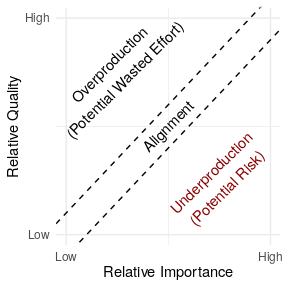
A conceptual diagram of underproduction. The x-axis shows relative importance, the y-axis relative quality. The top left area of the graph described by these axes is 'overproduction' -- high quality, low importance. The diagonal is Alignment: quality and importance are approximately the same. The lower right depicts underproduction -- high importance, low quality -- the area of potential risk.Conceptual diagram showing how our conception of underproduction relates to quality and importance of software.
In the paper, we describe a general approach for detecting underproduced software infrastructure that consists of five steps: (1) identifying a body of digital infrastructure (like a code repository); (2) identifying a measure of quality (like the time to takes to fix bugs); (3) identifying a measure of importance (like install base); (4) specifying a hypothesized relationship linking quality and importance if quality and importance are in perfect alignment; and (5) quantifying deviation from this theoretical baseline to find relative underproduction. To show how our method works in practice, we applied the technique to an important collection of FLOSS infrastructure: 21,902 packages in the Debian GNU/Linux distribution. Although there are many ways to measure quality, we used a measure of how quickly Debian maintainers have historically dealt with 461,656 bugs that have been filed over the last three decades. To measure importance, we used data from Debian s Popularity Contest opt-in survey. After some statistical machinations that are documented in our paper, the result was an estimate of relative underproduction for the 21,902 packages in Debian we looked at. One of our key findings is that underproduction is very common in Debian. By our estimates, at least 4,327 packages in Debian are underproduced. As you can see in the list of the most underproduced packages again, as estimated using just one more measure many of the most at risk packages are associated with the desktop and windowing environments where there are many users but also many extremely tricky integration-related bugs.
This table shows the 30 packages with the most severe underproduction problem in Debian, shown as a series of boxplots.These 30 packages have the highest level of underproduction in Debian according to our analysis.
We hope these results are useful to folks at Debian and the Debian QA team. We also hope that the basic method we ve laid out is something that others will build off in other contexts and apply to other software repositories.
In addition to the paper itself and the video of the conference presentation on Youtube by Kaylea, we ve put a repository with all our code and data in an archival repository Harvard Dataverse and we d love to work with others interested in applying our approach in other software ecosytems.

For more details, check out the full paper which is available as a freely accessible preprint.

This project was supported by the Ford/Sloan Digital Infrastructure Initiative. Wm Salt Hale of the Community Data Science Collective and Debian Developers Paul Wise and Don Armstrong provided valuable assistance in accessing and interpreting Debian bug data. Ren Just generously provided insight and feedback on the manuscript.

Paper Citation: Kaylea Champion and Benjamin Mako Hill. 2021. Underproduction: An Approach for Measuring Risk in Open Source Software. In Proceedings of the IEEE International Conference on Software Analysis, Evolution and Reengineering (SANER 2021). IEEE.

Contact Kaylea Champion (kaylea@uw.edu) with any questions or if you are interested in following up.

Anton Gladky: 2021/03, FLOSS activity

LTS This is my first (beside test time last year) official month of working for LTS. I was assigned 12 hrs and worked all of them. I could relatively easy set up the development environment for Debian Stretch and managed to release several DLAs.

Released DLAs
  1. DLA-2588-1 zeromq3_4.2.1-4+deb9u4
    • CVE-2021-20234
    • CVE-2021-20235
  2. DLA-2594-1 tomcat8_8.5.54-0+deb9u6
    • CVE-2021-24122
    • CVE-2021-25122
    • CVE-2021-25329.
  3. DLA-2605-1 mariadb-10.1_10.1.48-0+deb9u2
    • CVE-2021-27928

CVE-2020-119977 I investigated CVE-2020-119977, which was marked as guacamole-server issue. There were not so much information about this CVE. I was trying to analyze git log and git diff between affected and fixed versions without any visible success. After that I contacted upstream and they were very responsive! This CVE affects guacamole-client only and the ancient versions in the archive is very difficult to fix. So I decided to mark this CVE as NOT-FOR-US.

Repositories with pipelines For most of packages, which I touched due to LTS work the new repositories were created in LTS packages group on salsa.d.o with enabled CI-pipelines. It really helps to test updates though some tests needs to be disabled for passing pipelines.

LTS-Meeting I attended the Debian LTS team IRC-meeting.

Debian Science Team I have prepared and uploaded following packages, which are maintained under the umbrella of Debian Science Team:
  • gmsh_4.7.1+ds1-5
  • vtk7_7.1.1+dfsg2-10
  • gl2ps_1.4.2+dfsg1-1~bpo10+1
  • vtk9_9.0.1+dfsg1-8~bpo10+2
  • sundials_5.7.0+dfsg-1~exp1

Jamie McClelland: The problem with Richard Stallman is not about free speech

Free speech and censorship are critically important issues. And, using them to defend Richard Stallman's return to the Free Software Foundation (FSF) board is just plain wrong. Richard Stallman resigned from the Board in 2019 after he sent an email in defense of Marvin Minsky (Minsky is accused of raping one of Jeffreys Epstein's victims). Stallman's fateful email, however, is just one piece of the reason for why he should not be on the board. The full story is about his history of abuse toward women and is extensive. On March 21st, 2021, Stallman announced he is back on the board. There are profound reasons why any movement interested in equitable and open participation would want to publicly distance themselves from Stallman. However, the long form defenses of Stallman, including a note from Nadine Strossen, the former executive director of the ACLU, quoted in this defense, persist. Many of the arguments defending Richard Stallman (including the one from Strossen) are grounded in a belief that Stallman is being punished for his unpopular political views, which deserve to be defended on the grounds of freedom of expression. That's wrong. Stallman should be kicked off the board because he has a long history of abusing his position to hit on women, which, when combined with his public opinions on under-age sex and his defense of Minsky, send a strong signal that the FSF does not care about the participation of women. Being on a board of directors is a privilege, not a right. Being removed from a board is not a punnishment. And being criticized and removed from a board because your behavior and public statements are an obstacle to building an inclusive and equitable movement is what every board should strive to do. If we are going to make this an issue about free expression, it should be about all the political expression lost to the free software movement because Stallman's unequal behavior toward women excluded an enormous number of talented individuals.

Louis-Philippe V ronneau: Montreal 2021 BSP

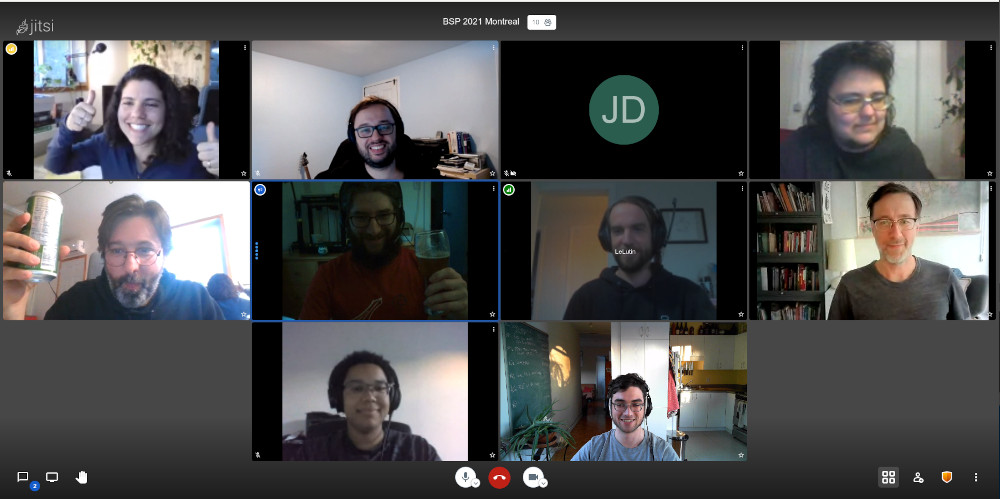
Last weekend Debian Quebec held a Bug Squashing Party to try to fix some bugs in the upcoming Debian Bullseye. I wasn't convinced at first, but Tassia's contagious energy and willingness to help organise the event eventually won me over. And shockers! it was really fun. Group picture of the BSP attendees on Jitsi Meet We fixed a couple of RC bugs, held lightning talks and had a virtual pizza party! My lightning talk on autopkgtests was well received and a few people decided to migrate to sbuild and enable autopkgtests by default. Sergio's talk on debuginfod was incredibly interesting. I'm not a C programmer and the live demo made me understand how this service can help making debugging C easier. Jerome's talk on using Yubikeys to unlock LUKS encrypted drives was also very good! It also served as a reminder that Yubico's product are much more featureful and convenient to use than other Open Hardware/ Free Software hardware tokens. Hopefully that will change as enterprises like Nitrokey and Solokey mature. This was my third BSP, crazy how time flies... With the Bullseye release closing in, you should try to join or organise one!

28 March 2021

Russ Allbery: Pod::Thread 2.00

I am slowly working towards collecting twenty years of static web site generation and release management tools into DocKnot. Pod::Thread is the component that turns POD documentation into HTML by converting it to thread, the macro language that is the backbone of my static site generator, and then letting spin turn the results into HTML. I wrote this module years ago and have had it around as a private Perl module, but since the version of DocKnot that incorporates spin will have it as a dependency, it seemed time to publicly release it. Compared to the last released version in 2013, it also has a few bug fixes and improvements. The module now internally handles the navbar and table of contents generation (by deferring output) rather than using a pre-scanning pass in the driver script, and fixes the title casing of DB_CONFIG in the output from one INN manual page. I also did a lot of modernization and improvements to the test suite. You can get the latest version from CPAN or the Pod::Thread distribution page.

Norbert Preining: RMS, Debian, and the world

Too much has been written, a war of support letters is going on, Debian is heading head first like Lemmings into the same war. And then, there is this by the first female President of the American Civil Liberties Union (ACLU): Civil Rights Activist Nadine Strossen s Response To #CancelStallman:
I find it so odd that the strong zeal for revenge and punishment if someone says anything that is perceived to be sexist or racist or discriminatory comes from liberals and progressives. There are so many violations [in cases like Stallman s] of such fundamental principles to which progressives and liberals cling in general as to what is justice, what is fairness, what is due process.
One is proportionality: that the punishment should be proportional to the offense. Another one is restorative justice: that rather than retribution and punishment, we should seek to have the person constructively come to understand, repent, and make amends for an infraction. Liberals generally believe society to be too punitive, too harsh, not forgiving enough. They are certainly against the death penalty and other harsh punishments even for the most violent, the mass murderers. Progressives are right now advocating for the release of criminals, even murderers. To then have exactly the opposite attitude towards something that certainly is not committing physical violence against somebody, I don t understand the double standard!
Another cardinal principle is we shouldn t have any guilt by association. [To hold culpable] these board members who were affiliated with him and ostensibly didn t do enough to punish him for things that he said which by the way were completely separate from the Free Software Foundation is multiplying the problems of unwarranted punishment. It extends the punishment where the argument for responsibility and culpability becomes thinner and thinner to the vanishing point. That is also going to have an enormous adverse impact on the freedom of association, which is an important right protected in the U.S. by the First Amendment.
The Supreme Court has upheld freedom of association in cases involving organizations that were at the time highly controversial. It started with NAACP (National Association for the Advancement of Colored People) during the civil rights movement in the 1950s and 60s, but we have a case that s going to the Supreme Court right now regarding Black Lives Matter. The Supreme Court says even if one member of the group does commit a crime in both of those cases physical violence and assault that is not a justification for punishing other members of the group unless they specifically intended to participate in the particular punishable conduct.
Now, let s assume for the sake of argument, Stallman had an attitude that was objectively described as discriminatory on the basis on race and gender (and by the way I have seen nothing to indicate that), that he s an unrepentant misogynist, who really believes women are inferior. We are not going to correct those ideas, to enlighten him towards rejecting them and deciding to treat women as equals through a punitive approach! The only approach that could possibly work is an educational one! Engaging in speech, dialogue, discussion and leading him to re-examine his own ideas.
Even if I strongly disagree with a position or an idea, an expression of an idea, advocacy of an idea, and even if the vast majority of the public disagrees with the idea and finds it offensive, that is not a justification for suppressing the idea. And it s not a justification for taking away the equal rights of the person who espouses that idea including the right to continue holding a tenured position or other prominent position for which that person is qualified.
But a number of the ideas for which Richard Stallman has been attacked and punished are ideas that I as a feminist advocate of human rights find completely correct and positive from the perspective of women s equality and dignity! So for example, when he talks about the misuse and over use and flawed use of the term sexual assault, I completely agree with that critique! People are indiscriminantly using that term or synonyms to describe everything from the most appaulling violent abuse of helpless vulnerable victims (such as a rape of a minor) to any conduct or expression in the realm of gender or sexuality that they find unpleasant or disagreeable.
So we see the term sexual assault and sexual harrassment used for example, when a guy asks a woman out on a date and she doesn t find that an appealing invitation. Maybe he used poor judgement in asking her out, maybe he didn t, but in any case that is NOT sexual assault or harassment. To call it that is to really demean the huge horror and violence and predation that does exist when you are talking about violent sexual assault. People use the term sexual assault/ sexual harassment to refer to any comment about gender or sexuality issues that they disagree with or a joke that might not be in the best taste, again is that to be commended? No! But to condemn it and equate it with a violent sexual assault again is really denying and demeaning the actual suffering that people who are victims of sexual assault endure. It trivializes the serious infractions that are committed by people like Jeffrey Epstein and Harvey Weinstein. So that is one point that he made that I think is very important that I strongly agree with.
Secondly and relatedly, [Richard Stallman] never said that he endorse child pornography, which by definition the United States Supreme Court has defined it multiple times is the sexual exploitation of an actual minor. Coerced, forced, sexual activity by that minor, with that minor that happens to be filmed or photographed. That is the definition of child pornography. He never defends that! What the point he makes, a very important one, which the U.S. Supreme Court has also made, is mainly that we overuse and distort the term child pornography to refer to any depiction of any minor in any context that is even vaguely sexual.
So some people have not only denounced as child pornography but prosecuted and jailed loving devoted parents who committed the crime of taking a nude or semi-nude picture of their own child in a bathtub or their own child in a bathing suit. Again it is the hysteria that has totally refused to draw an absolutely critical distinction between actual violence and abuse, which is criminal and should be criminal, to any potentially sexual depiction of a minor. And I say potentially because I think if you look at a picture a parent has taken of a child in a bathtub and you see that as sexual, then I d say there s something in your perspective that might be questioned or challenged! But don t foist that upon the parent who is lovingly documenting their beloved child s life and activities without seeing anything sexual in that image.
This is a decision that involves line drawing. We tend to have this hysteria where once we hear terms like pedophilia of course you are going to condemn anything that could possibly have that label. Of course you would. But societies around the world throughout history various cultures and various religions and moral positions have disagreed about at what age do you respect the autonomy and individuality and freedom of choice of a young person around sexuality. And the U.S. Supreme Court held that in a case involving minors right to choose to have an abortion.
By the way, [contraception and abortion] is a realm of sexuality where liberals and progressives and feminists have been saying, Yes! If you re old enough to have sex. You should have the right to contraception and access to it. You should have the right to have an abortion. You shouldn t have to consult with your parents and have their permission or a judge s permission because you re sufficiently mature. And the Supreme Court sided in accord of that position. The U.S. Supreme Court said constitutional rights do not magically mature and spring into being only when someone happens to attain the state defined age of majority.
In other words the constitution doesn t prevent anyone from exercising rights, including Rights and sexual freedoms, freedom of choice and autonomy at a certain age! And so you can t have it both ways. You can t say well we re strongly in favor of minors having the right to decide what to do with their own bodies, to have an abortion what is in some people s minds murder but we re not going to trust them to decide to have sex with somewhat older than they are.
And I say somewhat older than they are because that s something where the law has also been subject to change. On all issues of when you obtain the age of majority, states differ on that widely and they choose different ages for different activities. When you re old enough to drive, to have sex with someone around your age, to have sex with someone much older than you. There is no magic objective answer to these questions. I think people need to take seriously the importance of sexual freedom and autonomy and that certainly includes women, feminists. They have to take seriously the question of respecting a young person s autonomy in that area.
There have been famous cases of 18 year olds who have gone to prison because they had consensual sex with their girlfriends who were a couple of years younger. A lot of people would not consider that pedophilia and yet under some strict laws and some absolute definitions it is. Romeo and Juliet laws make an exception to pedophilia laws when there is only a relatively small age difference. But what is relatively small? So to me, especially when he says he is re-examining his position, Stallman is just thinking through the very serious debate of how to be protective and respectful of young people. He is not being disrespectful, much less wishing harm upon young people, which seems to be what his detractors think he s doing.
Unfortunately, I don t think the Anti-Harassment Team of Debian and others of the usual group of warriors will ever read less understand what is written there. So sad.

27 March 2021

Andrew Cater: Debian 10.9 release - 202103271900UTC - pushing through live image testing

So we're a fair way through the release, then. Testing of almost all the standard images has finished. Pretty much all of the disk images are now complete and in place.People are working their way through the tests of the debian-live images in the various desktop flavours. These have to be done on real hardware - so it does take time. A new tester - peylight - has dropped in to help for the first time. Sqrt not has also joined us from the other end of the timezone scale - we have somebody at UTC-0700 and somebody at UTC+0430 today. [I can't remember where Linux-fan is timezone wise] All of the help from all the testers is very welcome, as ever.
A slight pause - a couple of us have a meal to eat - but it looks as if we've done well on timings. The original estimate was for 2000UTC - maybe a little after that and we'll be finished and the images release can be published - there were a couple of minor hiccups but we've done well so far.
Thanks, as always, to the people behind the scenes doing all the work, to DSA and admins providing large machines for us to do the builds on and to the people who drop in and spend a few hours of their time on a working day/weekend to help out.

Antonio Terceiro: Migrating from Chef to itamae

The Debian CI platform is comprised of 30+ (virtual) machines. Maintaining this many machines, and being able to add new ones with some degree of reliability requires one to use some sort of configuration management. Until about a week ago, we were using Chef for our configuration management. I was, for several years, the main maintainer of Chef in Debian, so using it was natural to me, as I had used it before for personal and work projects. But last year I decided to request the removal of Chef from Debian, so that it won't be shipped with Debian 11 (bullseye). After evaluating a few options, I believed that the path of least resistance was to migrate to itamae. itamae was inspired by chef, and uses a DSL that is very similar to the Chef one. Even though the itamae team claim it's not compatible with Chef, the changes that I needed to do were relatively limited. The necessary code changes might look like a lot, but a large part of them could be automated or done in bulk, like doing simple search and replace operations, and moving entire directories around. In the rest of this post, I will describe the migration process, starting with the infrastructure changes, the types of changes I needed to make to the configuration management code, and my conclusions about the process. Infrastructure changes The first step was to add support for itamae to chake, a configuration management wrapper tool that I wrote. chake was originally written as a serverless remote executor for Chef, so this involved a bit of a redesign. I thought it was worth it to do, because at that point chake had gained several interesting managements features that we no directly tied to Chef. This work was done a bit slowly over the course of the several months, starting almost exactly one year ago, and was completed 3 months ago. I wasn't in a hurry and knew I had time before Debian 11 is released and I had to upgrade the platform. After this was done, I started the work of migrating the then Chef cookbooks to itamae, and the next sections present the main types of changes that were necessary. During the entire process, I sent a few patches out: Code changes These are the main types of changes that were necessary in the configuration code to accomplish the migration to itamae. Replace cookbook_file with remote_file. The resource known as cookbook_file in Chef is called remote_file in itamae. Fixing this is just a matter of search and replace, e.g.:
-cookbook_file '/etc/apt/apt.conf.d/00updates' do
+remote_file '/etc/apt/apt.conf.d/00updates' do
Changed file locations The file structure assumed by itamae is a lot simpler than the one in Chef. The needed changes were: Explicit file ownership and mode Chef is usually design to run as root on the nodes, and files created are owned by root and have move 0644 by default. With itamae, files are by default owned by the user that was used to SSH into the machine. Because of this, I had to review all file creation resources and add owner, group and mode explicitly:
-cookbook_file '/etc/apt/apt.conf.d/00updates' do
-  source 'apt.conf'
+remote_file '/etc/apt/apt.conf.d/00updates' do
+  source 'files/apt.conf'
+  owner   'root'
+  group   'root'
+  mode    "0644"
 end
In the end, I guess being explicit make the configuration code more understandable, so I take that as a win. Different execution context One of the major differences between Chef itamae comes down the execution context of the recipes. In both Chef and itamae, the configuration is written in DSL embedded in Ruby. This means that the recipes are just Ruby code, and difference here has to do with where that code is executed. With Chef, the recipes are always execute on the machine you are configuring, while with itamae the recipe is executed on the workstation where you run itamae, and that gets translated to commands that need to be executed on the machine being configured. For example, if you need to configure a service based on how much RAM the machine has, with Chef you could do something like this:
total_ram = File.readlines("/proc/meminfo").find do  l 
  l.split.first == "MemTotal:"
end.split[1]
file "/etc/service.conf" do
  # use 20% of the total RAM
  content "cache_size = # ram / 5 KB"
end
With itamae, all that Ruby code will run on the client, so total_ram will contain the wrong number. In the Debian CI case, I worked around that by explicitly declaring the amount of RAM in the static host configuration, and the above construct ended up as something like this:
file "/etc/service.conf" do
  # use 20% of the total RAM
  content "cache_size = # node['total_ram'] / 5 KB"
end
Lessons learned This migration is now complete, and there are a few points that I take away from it: All in all, the system is working just fine, and I consider this to have been a successful migration. I'm happy it worked out.

Andrew Cater: Debian 10.9 release - well underway 202103271600 UTC

And so I'm rather late: Sledge, RattusRattus and Isy and I have all been busy chasing down bits and pieces for images release today. We're well underway through the normal images: live images are still ongoing. We've had help from Schweer and Linux-fan as last time - a couple of other folk have had chats to us. So far, it seems relatively straightforward - we're all experienced at this by now.As ever, it's a joy to be doing this with a smart set of colleagues. We can now catch our mistakes _just_ after we make them, so it's really getting sorted: the next stage is for me to realise _before_ I make them.

Neil Williams: Free and Open

A long time, no blog entries. What's prompted a new missive? Two things: All the time I've worked with software and computers, the lack of diversity in the contributors has irked me. I started my career in pharmaceutical sciences where the mix of people, at university, would appear to be genuinely diverse. It was in the workplace that the problems started, especially in the retail portion of community pharmacy with a particular gender imbalance between management and counter staff. Then I started to pick up programming. I gravitated to free software for the simple reason that I could tinker with the source code. To do a career change and learn how to program with a background in a completely alien branch of science, the only realistic route into the field is to have access to the raw material - source code. Without that, I would have been seeking a sponsor, in much the same way as other branches of science need grants or sponsors to purchase the equipment and facilities to get a foot in the door. All it took from me was some time, a willingness to learn and a means to work alongside those already involved. That's it. No complex titration equipment, flasks, centrifuges, pipettes, spectrographs, or petri dishes. It's hard to do pharmaceutical science from home. Software is so much more accessible - but only if the software itself is free. Software freedom removes the main barrier to entry. Software freedom enables the removal of other barriers too. Once the software is free, it becomes obvious that the compiler (indeed the entire toolchain) needs to be free, to turn the software into something other people can use. The same applies to interpreters, editors, kernels and the entire stack. I was in a different branch of science whilst all that was being created and I am very glad that Debian Woody was available as a free cover disc on a software magazine just at the time I was looking to pick up software programming. That should be that. The only next step to be good enough to write free software was the "means to work alongside those already involved". That, it turns out, is much more than just a machine running Debian. It's more than just having an ISP account and working email (not commonplace in 2003). It's working alongside the people - all the people. It was my first real exposure to the toxicity of some parts of many scientific and technical arenas. Where was the diversity? OK, maybe it was just early days and the other barriers (like an account with an ISP) were prohibitive for many parts of the world outside Europe & USA in 2003, so there were few people from other countries but the software world was massively dominated by the white Caucasian male. I'd been insulated by my degree course, and to a large extent by my university which also had courses which already had much more diverse intakes - optics and pharmacy, business and human resources. Relocating from the insular world of a little town in Wales to Birmingham was also key. Maybe things would improve as the technical barriers to internet connectivity were lowered. Sadly, no. The echo chamber of white Caucasian input has become more and more diluted as other countries have built the infrastructure to get the populace online. Debian has helped in this area, principally via DebConf. Yet only the ethnicity seemed to change, not the diversity. Recently, more is being done to at least make Debian more welcoming to those who are brave enough to increase the mix. Progress is much slower than the gains seen in the ethnicity mix, probably because that was a benefit of a technological change, not a societal change. The attitudes so prevalent in the late 20th century are becoming less prevalent amongst, and increasingly abhorrent to, the next generation of potential community members. Diversity must come or the pool of contributors will shrink to nil. Community members who cling to these attitudes are already dinosaurs and increasingly unwelcome. This is a necessary step to retain access to new contributors as existing contributors age. To be able to increase the number of contributors, the community cannot afford to be dragged backwards by anyone, no matter how important or (previously) respected. Debian, or even free software overall, cannot change all the problems with diversity in STEM but we must not perpetuate the problems either. Those people involved in free software need to be open to change, to input from all portions of society and welcoming. Puerile jokes and disrespectful attitudes must be a thing of the past. The technical contributions do not excuse behaviours that act to prevent new people joining the community. Debian is getting older, the community and the people. The presence of spouses at Debian social events does not fix the problem of the lack of diversity at Debian technical events. As contributors age, Debian must welcome new, younger, people to continue the work. All the technical contributions from the people during the 20th century will not sustain Debian in the 21st century. Bit rot affects us all. If the people who provided those contributions are not encouraging a more diverse mix to sustain free software into the future then all their contributions will be for nought and free software will die. So it comes to the FSF and RMS. I did hear Richard speak at an event in Bristol many years ago. I haven't personally witnessed the behavioural patterns that have been described by others but my memories of that event only add to the reality of those accounts. No attempts to be inclusive, jokes that focused on division and perpetuating the white male echo chamber. I'm not perfect, I struggle with some of this at times. Personally, I find the FSFE and Red Hat statements much more in line with my feelings on the matter than the open letter which is the basis of the GR. I deplore the preliminary FSF statement on governance as closed-minded, opaque and archaic. It only adds to my concerns that the FSF is not fit for the 21st century. The open letter has the advantage that it is a common text which has the backing of many in the community, individuals and groups, who are fit for purpose and whom I have respected for a long time. Free software must be open to contributions from all who are technically capable of doing the technical work required. Free software must equally require respect for all contributors and technical excellence is not an excuse for disrespect. Diversity is the life blood of all social groups and without social cohesion, technical contributions alone do not support a community. People can change and apologies are welcome when accompanied by modified behaviour. The issues causing a lack of diversity in Debian are complex and mostly reflective of a wider problem with STEM. Debian can only survive by working to change those parts of the wider problem which come within our influence. Influence is key here, this is a soft issue, replete with unreliable emotions, unhelpful polemic and complexity. Reputations are hard won and easily blemished. The problems are all about how Debian looks to those who are thinking about where to focus in the years to come. It looks like the FSFE should be the ones to take the baton from the FSF - unless the FSF can adopt a truly inclusive and open governance. My problem is not with RMS himself, what he has or has not done, which apologies are deemed sincere and whether behaviour has changed. He is one man and his contributions can be respected even as his behaviour is criticised. My problem is with the FSF for behaving in a closed, opaque and divisive manner and then making a governance statement that makes things worse, whilst purporting to be transparent. Institutions lay the foundations for the future of the community and must be expected to hold individuals to account. Free and open have been contentious concepts for the FSF, with all the arguments about Open Source which is not Free Software. It is clear that the FSF do understand the implications of freedom and openness. It is absurd to then adopt a closed and archaic governance. A valid governance model for the FSF would never have allowed RMS back onto the board, instead the FSF should be the primary institution to hold him, and others like him, to account for their actions. The FSF needs to be front and centre in promoting diversity and openness. The FSF could learn from the FSFE. The calls for the FSF to adopt a more diverse, inclusive, board membership are not new. I can only echo the Red Hat statement:
in order to regain the confidence of the broader free software community, the FSF should make fundamental and lasting changes to its governance.
...
[There is] no reason to believe that the most recent FSF board statement signals any meaningful commitment to positive change.
And the FSFE statement:
The goal of the software freedom movement is to empower all people to control technology and thereby create a better society for everyone. Free Software is meant to serve everyone regardless of their age, ability or disability, gender identity, sex, ethnicity, nationality, religion or sexual orientation. This requires an inclusive and diverse environment that welcomes all contributors equally.
The FSF has not demonstrated the behaviour I expect from a free software institution and I cannot respect an institution which proclaims a mantra of freedom and openness that is not reflected in the governance of that institution. The preliminary statement by the FSF board is abhorrent. The FSF must now take up the offers from those institutions within the community who retain the respect of that community. I'm only one voice, but I would implore the FSF to make substantive, positive and permanent change to the governance, practices and future of the FSF or face irrelevance.

Jonathan Wiltshire: Census stupidity, 2021 edition

Dear Office for National Statistics, Next time you sit down to design the UK census question flow, please ensure it does not go like this: 1. What is the date of birth for G [our young daughter]? Answer: late 2020 2. This date of birth makes G four months old. Is this correct? Answer: yes 3. With which of the following nationalities does G identify English, British or [list of others]? Answer: I have no idea, but I m happy to send you the recording of her response when I asked her, and you can see if you can make more sense of it than I did. I am reassured to see that you did skip questions about her employment status (always busy, never paid) and education (intensive), so perhaps there is some hope yet. No love,
jmw

Charles Plessy: GR toxique

Many quickly reacted to the return of rms to the FSF and asked that he leaves again; some also asked for the whole board of directors to resign and some not. Meanwhile, Debian discusses a general resolution on that matter. Maybe it was not the original intent, but in practice the object of the GR is about FSF's board of directors. Perhaps we will have the result after rms resigns? Like many GRs, it will divide Debian and leave scars, at least a tally sheet of who voted what, and who voted like whom. I think that most other organisations did not go through a process as plenary and collegial, but also heavy and cleaving, to decide which way to go. What if our two DPL candidates would issue a statement that, if elected, they would refuse to fund events linked to the FSF until rms quits again (and also the directors, if that is what the DPL candidate wishes to propose). This would let Debian be part of the wave of reaction on time, and maybe allow us to cancel this GR?

26 March 2021

Benjamin Mako Hill: The Free Software Foundation and Richard Stallman

I served as a director and as a voting member of the Free Software Foundation for more than a decade. I left both positions over the last 18 months and currently have no formal authority in the organization. So although it is now just my personal opinion, I will publicly add my voice to the chorus of people who are expressing their strong opposition to Richard Stallman s return to leadership in the FSF and to his continued leadership in the free software movement. The current situation makes me unbelievably sad. I stuck around the FSF for a long time (maybe too long) and worked hard (I regret I didn t accomplish more) to try and make the FSF better because I believe that it is important to have voices advocating for social justice inside our movement s most important institutions. I believe this is especially true when one is unhappy with the existing state of affairs. I am frustrated and sad that I concluded that I could no longer be part of any process of organizational growth and transformation at FSF. I have nothing but compassion, empathy, and gratitude for those who are still at the FSF especially the staff who are continuing to work silently toward making the FSF better under intense public pressure. I still hope that the FSF will emerge from this as a better organization.

Next.

Previous.