Search Results: "sten"

14 October 2007

Dirk Eddelbuettel: Tunes

Following Adam's suggestion about Pandora, I spent a the rest of the afternoon, evening and this morning listening to music old and new. Pandora's suggestions around Madeleine Peyroux were particularly nice as they lead for example to Sam Philipps which was new to me. I can already see this leading to increased spending on new cds... Recommended.

Martin F. Krafft: Converting a package to Git

Previously, I demonstrated a Debian packaging workflow using Git and I mentioned the possibility of a follow-up post; well, here it is: you want to use my workflow (or one that's related) for a package that is currently maintained with Subversion on svn.debian.org and you'd like to keep the history during the conversion. Make sure to read the previous post before this one. I am again using the example of mdadm since its Git packaging repository is in a state of shambles and I want to restart to get it right and import the history from the previous Subversion repository. What better way than to write a blog post as I do so? Well, plenty actually. This kind of post isn't really made for a blog, and I have started work on setting up ikiwiki on madduck.net, but it's not yet ready, so I'll stick with the blog for now. I will make sure that links don't break as I move content over, so feel free to bookmark this
Importing the package into Git Thanks to git-svn, the initial step of getting your package imported into Git is a breeze:
$ git-svn clone --stdlayout --no-metadata \
    svn+ssh://svn.debian.org/svn/pkg-mdadm/mdadm mdadm
Sit back and enjoy. If that command exits prematurely with an error such as the following:
Malformed network data: Malformed network data at /usr/local/bin/git-svn line 1029
then you should upgrade to a newer Git version, or have a look here. If your Git does not know --stdlayout then upgrade as well (or use -T trunk -t tags -b branches instead). Sam Vilain notes that it is important to "get the attribution right with the final SVN import - getting the authors map right. I didn't do that. If you look at the repository resulting from the above command, you'll notice strange commit authors, such as madduck@some-unique-uuid-from-svn . git-svn allows you to map these to real names with real email addresses, which ensures that the attributions are good for the whole world to see. When done, switch to the repository and run git-branch -r. As you'll see, git-svn imported all SVN branches and tags as remote branches. You need those if you want to bidirectionally track the Subversion repository, but we are converting, as you may have guessed by the --no-metadata switch above. Therefore, we resort to the Dinosaur method of converting branches to tags, which I'll simplify for mdadm. We also just delete all remote branches after tagging, since mdadm never used branches in the SVN repository. Your mileage may vary.
git branch -r   sed -rne 's, *tags/([^@]+)$,\1,p'   while read tag; do
  echo "git tag debian/$tag tags/$ tag ^; git branch -r -d tags/$tag"
done
git branch -r   while read tag; do
  echo "git branch -r -d $tag"
done
If that seems to work alright, then you can execute the commands. Sam Vilain (again) hints me at git-pack-refs and then to edit .git/packed-refs with an editor. This certainly leaves more room for errors but might be significantly faster.
Cleaning up the SVN references Even though we passed --no-metadata to git-svn, it did leave some traces in .git/, which we can now safely remove:
$ git config --remove-section svn-remote.svn
$ rm -r .git/svn
Setting things straight You can skip this section unless you want to know a bit about how to fix up stuff with Git. There was actually some nasty tagging errors leading up to the 2.5.6-9 release for etch and I could never be bothered to fix those in SVN, but now I can (I love Git!):
$ git tag -d debian/2.5.6-10            # never existed
$ git tag -f debian/2.5.6-8 2.5.6-8~2   # mistagged
$ git checkout -b maint/etch 2.5.6-8    # this is when we diverged
$ git apply < /tmp/mdadm-2.5.6-8..2.5.6-9.diff
$ git add debian/po/gl.po debian/po/pt.po debian/changelog
$ git commit -s
$ git tag debian/2.5.6-9
Now that that's fixed, there is one other thing to worry about, namely the very last commit to SVN, which obsoletes the repository and points to the Git repository. But that's not all of it. I was also silly enough to include a fix in the same commit. Let's see what Git can do. Since the process of obsoletion involves all but adding a file, we can simply --amend the last commit and provide a new log message:
$ git checkout master
$ git rm OBSOLETE debian/OBSOLETE
$ git commit --amend
Now the repository is in an acceptable state.
Making ends meet The pkg-mdadm effort on svn.debian.org only maintained the ./debian/ directory, separate from the upstream code, and boy was that a bad idea. Just to give one example: think about what's involved in preparing a Debian-specific patch against the upstream code this has to end, and we can make it end right here; let's import upstream's code (again not using his ADSL line, but the upstream branch of the pkg-mdadm Git repository; see the previous post for details):
$ git remote add upstream-repo git://git.debian.org/git/pkg-mdadm/mdadm
$ git config remote.upstream-repo.fetch \
    +refs/heads/upstream:refs/remotes/upstream-repo/upstream
$ git fetch upstream-repo
$ git checkout -b upstream upstream-repo/master
Now we have two unconnected ancestries in our repository, and it's time to join them together. The most logical way seems to be to use the last upstream tag for which we have a Debian tag: 2.6.2. For this, we branch off the corresponding Debian tag (2.6.2-1) and merge upstream's 2.6.2 tag into the new branch. This will be a temporary branch Then, we rebase (remember, nothing has been published yet) the master branch on top of this temporary branch, before we end that branch's short life. The Debian tag stays where it is since it describes the state of the repository at time of the release of 2.6.2-1.
$ git checkout -b tmp/join debian/2.6.2-1
$ git merge mdadm-2.6.2
$ git rebase tmp/join master
$ git branch -d tmp/join
It just so happens that the head of the SVN repository, which is identical to the tip of our master branch, corresponds to Debian release 2.6.2-2, so we tag it:
$ git tag debian/2.6.2-2
We are now also "born" in the sense that maintenance in Git has started. Let's mark that point in history. There is no real reason I can foresee for this yet, but nonetheless:
$ git tag -s git-birth
Turning dpatch files into feature branches We want to turn dpatch files into feature branches and we somehow make it "proper". We could branch, apply the patch, delete the patch file, checkout master and delete the patch file there as well, but that appears "improper" to me at least; so instead, we'll cherry-pick:
$ git checkout -b deb/conffile-location
$ debian/patches/01-mdadm.conf-location.dpatch -apply
$ git rm debian/patches/01-mdadm.conf-location.dpatch
$ git commit -s
$ git commit -s $(git ls-files --others --modified)
I should quickly intervene to make sure you are following. I am making use of Git's index here. Applying the patch makes the changes in the working tree, but we did not tell Git that we want those to be part of the commit just yet. Instead, we delete the dpatch with git-rm, which automatically registers the deletion with the index. Thus, the first git-commit creates a commit which deletes the dpatch, while the second git-commit creates a commit with all the changes from the dpatch, using git-ls-files to identify new and modified files. But for now, let's move on. We have two commits in the deb/conffile-location branch, and one of those is relevant to the master branch, we cherry-pick it:
$ git cherry-pick deb/conffile-location^
If you're confused, let me explain: our goal is to have a number of feature branches, of which master is the one in which most of ./debian/ is maintained. All the branches later come together in the long-living build branch, so deb/conffile-location will never be merged back into master. However, once we applied the dpatch to the feature branch, we can delete it from there and the master branch. By cherry-picking, we "import" the deletion to the master branch. I repeat the same procedure for deb/docs, merging all the documentation-related dpatches, but I'll spare you the details.
and then Git let me down In the next step, I found I had misunderstood Git merging: I thought Git was smart, but Linus had his reasons for calling Git the "stupid content tracker" (more on that later). Read on as I am obsoleting dpatch files that upstream had merged: 99-*-FIX.dpatch. For consistency, I wanted to cherry-pick each of the appropriate upstream commits into the master branch along with deleting the corresponding dpatch file. Here is one example: 99-monitor-6+10-FIX.dpatch was obsoleted by upstream's commit 66f8bbb; the -x records the original commit ID in the log:
$ git cherry-pick -x 66f8bbb
$ git rm debian/patches/99-monitor-6+10-FIX.dpatch
$ git commit -s -m"remove dpatch obsoleted by $(git rev-parse --short HEAD)"
I repeated the procedure for the other dpatch files, removed the dpatch infrastructure, and then went on to merge it all into build to build the package. The build branch is a long-living branch off upstream, but which upstream? I'll fast-forward you past a segfault problem with mdadm, which upstream (thought to have) resolved with commit 23dc1ae after 2.6.3, but he had not yet released 2.6.4. Looking at the commits between 23dc1ae and upstream's HEAD at the time, I decided to include them all and snapshot 4450e59:
$ git fetch upstream-repo
$ git checkout upstream
$ git merge upstream-repo
$ git tag mdadm-2.6.3+200709292116+4450e59 4450e59
$ git checkout master
$ git merge --no-commit mdadm-2.6.3+200709292116+4450e59
$ dch -v mdadm-2.6.3+200709292116+4450e59-1
$ git add debian/changelog
$ git commit -s
And then I called poor-mans-gitbuild, which merges master and then deb/* into build. Here is when stuff blew up. I'll make a long story short (read my description of the problem and Linus' answer if you want to know more): I thought Git was smart to identify merges common to both branches and do the right thing, but it turn out that Git does not care at all about commits, it only worries about content and the end result. In our case, unfortunately (or fortunately), the outcome meant a conflict because the upstream branch introduced a simple change (last hunk) in the lines surrounding the patch we cherry-picked, and Git can't handle it. The solution is not to cherry-pick, to cherry-pick all commits touching the context of the dpatch, or to simply merge upstream into all out feature branches. In our case, the first is the easiest solution and since importing dpatch files is a one-time thing (thank $DEITY), I'll leave it at that. Almost. I have spent two days thinking about this more than I should have. And it was this point Linus made which made me appreciate Git even more:
Conflicts aren't bad - they're good. Trying to aggressively resolve them automatically when two branches have done slightly different things in the same area is stupid and just results in more problems. Instead, git tries to do what I don't think anybody else has done: make the conflicts easy to resolve, by allowing you to work with them in your normal working tree, and still giving you a lot of tools to help you see what's going on.
The end This concludes today's report. Importing the changes from the old Git repo, tagging and merging the branches is all covered in my previous post, or at least you'll find enough information there to complete the exercise. I would like to specifically thank Sam Vilain and Linus Torvalds for their help in preparing this post, as well as the #git/freenode inhabitants, as always. If you are interested in the topic of using version control for distro packaging, I invite you to join the vcs-pkg mailing list and/or the #vcs-pkg/irc.oftc.net IRC channel. Also, if you are interested in Git in general, you can find a list of blog posts on the Git wiki. NP: The Police: Zenyatta Mondatta

13 October 2007

Adam Rosi-Kessel: Opened Pandora

Via Eric Goldman’s recent recommendation, I decided to give Pandora another shot. The short version: Pandora is an intelligent predictive personalized Internet radio service with an arguably sustainable and protectable business model. And by “intelligent,” I mean there are real human brains at work. As Eric explains:
Pandora’s main competitive differentiator is its “Music Genome Project.” 50 trained musicians with at least a college degree in music (called “music analysts”) listen to songs all day long and rate each song on 400 different musical attributes. See the 2005 WSJ article discussing them. By profiling songs this way, the system can predict that a person who likes an artist’s song might like other songs with similar musical attributes. From listening to Pandora for many, many hours, IMO the system isn’t perfect, but it does a pretty good job, and it has definitely hooked me on music that I wouldn’t have listened to otherwise.
They have apparently cataloged approximately half a million songs and the database continues to grow apace. There is also a collaborative-filtering aspect, similar to Netflix and Amazon. I suspect this hybrid between the “wisdom of crowds” and the “wisdom of experts” will be the future of most large content projects (including wikipedia). My first few hours have returned excellent results. I created a for-working “station” called, lazily, “The Bad Plus Radio” (described as “Avant garde and angular funk/jazz, but not so dissonant that you can’t do mind-taxing work while listening”). You are welcome to listen as well. (See also my Pandora Profile.) The “artist seeds” for the channel include the following: Pandora has played several tracks by these artists, but is increasingly mixing in other artists that match up on some axis of preference. I’ve thumbed-up and thumbed-down several tracks from beyond the “seed” set (and will continue to do so), thus driving the predictive engine. I look forward to creating some entirely different channels and publishing the URLs here. Although supposedly the “free” version is ad-supported, I haven’t heard any ads yet. Maybe that is still to come. In any case, it is probably worth the $36/year subscription cost. Beyond the specific content I’m enjoying here, it is nice to see a Web 2.0 (or pick your favorite version) business model that doesn’t require a leap of faith to see how it can work. Of course, they have a Facebook app as well.

12 October 2007

Andrea Veri: iBluepaper: My new home .

Having a new home on the web is alwais something really special for me and installing wordpress listening to some good music make me feel quite happy and ready to write a new chapter of my web-life on a new home. I’ve decided to start up a new blog to share my thoughts and opinions on a bigger area of users with the idea to link it to the existing italian one on blogspot (http://andreaveri.blogspot.com), maybe subscribing my feed to community planets such as Ubuntu and Debian one respectively at http://planet.ubuntu.com and http://planet.debian.org. I’m currently trying to install a new bittorrent client called linkage… ….but something is going wrong making it, seems something like the use of a bad syntax or even an ABI breakage on compiling it with the new libtorrent-rasterbar 0.12, I hope to find out a workaround for this; I would like to use linkage again hoping to have it fixed upstream in the near future……and I suggest everyone to browse linkage’s homepage at http://zeflunk.googlepages.com/ and maybe try it out, every istruction on having it installed on Ubuntu can be found at http://code.google.com/p/linkage/wiki/Installation, and yeah…it looks too nice to avoid his use as your main bit-torrent application… What to say….try it out!

Eddy Petri&#537;or: SELinux: unusable from a newbie perspective

Thanks Russell for the explanations on the execmem bits.

Now I am trying to go further and set up my system to really work with SELinux enabled because, although the promise of the targeted policy is to allow you to do your job mostly as you did before, that "mostly" has a really wide meaning, more than you'd think you bargained for.

Examples from my laptop: hald does not start by default (various denials), resolvconf is denied some getattr operations on tmpfs, hald-addon-dell-backlight is denied access to some character device I just know it should have access to, etc. Of course, this means that automatic mounting does not work anymore and there is a decrease in usability just because of the "mostly" part.

I am sure that some of the denials are correct (see the execstack stuff or the memexec), but there are cases where this "mostly" is stretched way too much. IMHO, desktop installs should suffer no restrictions when using the targeted policy (and I mean "no restrictions that would make my system less than it was before enabling and enforcing SELinux").


But let me tell a reason why SELinux sucks without any help from others:

The interface sucks big time.

Probably there is are good reasons, but if you need to create and use a new policy based on the denials found in the logs, you need to use no less than 4 (four) different tools with the right incantation (although you can use just 2, if you don't want to customize the rules[1]):
In the end, you still hit the bad interface:

bounty:~# semodule -i local.pp
libsepol.check_assertion_helper: assertion on line 0 violated by allow hald_t memory_device_t:chr_file read ;
libsepol.check_assertions: 1 assertion violations occured
libsemanage.semanage_expand_sandbox: Expand module failed
semodule: Failed!

Now what? That error message doesn't tell me much, except that some assertion failed. But where does the assertion come from? Why is it an assertion? What is bad about that line?
To me that really looks like an internal error or an inconsistency in what the SELinux tools generate.


[1] still, why advertise the longer path as the Fedora FAQ does? I would have done it the other way around.

11 October 2007

Russell Coker: Getting People into IT

Pia writes about the difficulty in getting young women and young people in general into the computer industry [1]. While I agree that having more women in the computer industry would be a good thing, I have difficulty believing some of the claims that Pia makes. For example the claim that “[girls] are more career focused earlier in their school life“. I chose my career when I was about 11 years old [2] and several of my friends made similar decisions at similar ages. I would be interested to read anecdotal evidence from women in the computer industry about how old they were when they decided on their career and if their friends did the same, a reference to any research on this topic would also be useful. I tend to believe that boys are more career focussed at all stages of their life but have little evidence to support this idea. One fact that seems obvious is that the idea that “if you don’t succeed in your career then you can always marry someone who does” is almost non-existent among boys. It seems likely that such ideas have a statistically relevant affect on the focus on career of boys vs girls. Also the Australian Bureau of Statistics reports that the MEDIAN income for women is significantly lower than for men [4], I find it difficult to imagine that girls could be more career focussed from a younger age and yet get significantly lower pay (note the fact that it’s median not mean income is very significant as it removes the “glass ceiling” effect). Phillip Greenspun writes about why there are so few women doing scientific research [6] and makes some good points about why scientific research is generally not well paid and therefore a university student would choose a career in some other area and suggests that it’s a macho thing that guys enter such competitive fields for relatively low wages. Maybe some women correctly assess the costs and benefits of a career in scientific research and then make the mistake of equating Computer Science to other branches of science. But the median income suggests that although there may be some valid reasons for avoiding science that would only cover a small portion of the problem (the difference in median income can not be explained by misplaced attempts to maximise income). One problem that is significant is the quality of school education for girls. Not only is there the issue that boys may crowd-out girls for some subjects that are supposedly traditionally for boys (such as all science) but even girls schools aren’t as good as they should be. Some time ago I was talking to a teacher at an all-girls school, the school was moderately expensive and parents were paying the extra money presumably to give their daughters educational opportunities that they might miss in a co-ed school. However the school did not teach hard maths (”Maths B” was the official name at the time) and only taught the easy maths (official name “Maths A” and unofficial name “Vegie Maths“) because they didn’t have many girls demanding it (which is probably difficult to measure if you don’t offer it as a reasonable option) and the girls who wanted to study it could always move to a different school. So the choice facing girls at the exclusive school in question was “skip the subject that is most useful for further studies in most science subjects” or “go to a different school and miss most of your friends“, this sort of decision would surely discourage some potential female computer programemers. Also I think that the difference between boys and girls in regard to studying computer science has a lot to do with the fact that given a choice between missing most of their friends and missing out on something related to computers would be a no-brainer for most boys. Paul Graham’s article about Nerds has some interesting points to make in this regard - maybe the problem is that girls aren’t Nerdish enough [5]. Pia also writes about parents and teachers advising children not do study IT because of a perceived lack of jobs. I think that the problem here is not just bad advice, but also a bad tendency to take advice. Someone who wants to study in an established field which changes little over time (law and accounting spring to mind) probably should take careful note of the advice that they are given - things haven’t changed much in the last few decades. But someone who wants to study in a field that changes rapidly and where every year has new and significant developments (of which the best example is the computer industry) should probably be quite skeptical of all advice - most advice about the computer industry concerns how things used to be not how things are. Finally when considering whether to accept advice you should consider who is offering it. For example advice from a hiring manager should be carefully noted (as the manager will tell you precisely what factors influence their own decisions on hiring). Advice from people who are successful in the industry should also be noted. Advice from a school career advisor who gets paid about 1/3 what any 25yo can earn in the computer industry should be entirely ignored. I wonder whether being hesitant to ignore advice is a problem for girls in this regard. When I was in year 11 I had to take a subject related to career planning. It covered some things that were of minor use (such as writing CVs) and had an assignment of writing a fictional CV for yourself a few years after leaving university. I received bad marks for preparing a CV that involved changing jobs as companies went bankrupt or projects failed due to bad management, I was told that if your employer fails in the market it makes you look bad! However my fictional CV did bear some resemblance to what really happened… In terms of what industries have jobs available, the best advice I can give students is to actively do some research of their own. It’s not difficult to get the jobs sections of some newspapers and do a quick scan to see how many positions are open in a field, and it’s even easier to do some searches on online jobs sites (which usually tell you how many positions posted in the last X days match your criteria). For example I just visited jobserve.com.au and found 1724 Engineering jobs and 5622 IT jobs advertised. If you compare this to the university intake (I visited the Swinburne university courses list [3] and found 25 IT courses vs 29 Engineering course) it seems that the ratio of Engineering graduates to jobs is not likely to be as good as that for CS graduates. Of course it may be that all the other universities have hardly any Engineering courses and balance the ratio out (but I doubt it). In any case this would be a good way of injecting some facts into a discussion of the relative merits of different career choices and avoiding it being an issue of parents/teachers not liking computers vs children liking them. Determining the relative pay rates of different industries is a lot more difficult (and requires a significant amount of work), some recruiting agencies publish statistics - but those stats only apply to the positions that they fill (which is a sub-set of the actual positions). Finally as a piece of advice for children, try and find a job that you enjoy. If you earn $30K doing something you enjoy then you’ll probably be happier than if you earn $100K doing something you hate. Also if you enjoy your work then you will probably be able to take the extra steps needed to become successful - often it’s not a choice between having fun or making good money but a choice between fun and good money or the absence of both. If someone tells you to avoid doing what you love and instead do something boring for some unsubstantiated belief that there would be more money in it then be a nerd and tell them that their opinion is not relevant (it does tend to make teachers angry though).

9 October 2007

Ross Burton: Experiments with GUPnP

Now that through black magic, voodoo, and a working network driver I have Avahi working on my NAS and UPnP working on my SoundBridge, I can get back to the task of learning a bit about GUPnP, a GObject-based library for UPnP. My first hack is a simple tool that pops up notification bubbles when the currently playing track changes, and it was surprisingly easy. First, wecreate a Control Point for the service we want to control. This object will emit signals when devices on the network are discovered which provide this service, so by connecting to that signal all of the discovery is handled for us.
GUPnPContext *context = gupnp_context_new (NULL, NULL, 0, &error);
GUPnPControlPoint *cp = gupnp_control_point_new (context, "urn:schemas-upnp-org:service:AVTransport:1");
g_signal_connect (cp, "service-proxy-available",
                  G_CALLBACK (service_proxy_available_cb), NULL);
gssdp_resource_browser_set_active (GSSDP_RESOURCE_BROWSER (cp), TRUE);
Now in service_proxy_available_cb we are passed a Service Proxy object to which represents a device providing the service we asked for. Service proxies can have actions invoked on them, or we can be notified when a State Variable change. There is a state variable in AVTransport called CurrentTrackMetaData but don't let that fool you: for reasons too boring to detail that doesn't cause notifications. The only interesting state variable in AVTransport is LastChange, which is basically a meta-variable which contains the name and value of the last variable which changed. Madness, I agree. This is where we come to the problem with GUPnP: it makes the protocol seem so clean and simple that when warts like this become obvious, they stand out. Anyway, we want to listen for changes to the LastChange state variable. This involves adding a notify and then subscribing to the proxy. Luckily state variables emit their current value when we subscribe to them, so we never need to fetch the current value.
static void
service_proxy_available_cb (GUPnPControlPoint *cp, GUPnPServiceProxy *proxy)
 
    gupnp_service_proxy_add_notify (proxy, "LastChange",
                                    G_TYPE_STRING, notify_cb, NULL);
    gupnp_service_proxy_set_subscribed (proxy, TRUE);
 
Believe it or not, we're actually nearly finished. Now to implement notify_cb. This is passed the variable name and a GValue containing the new value. A basic implementation is pretty simple.
static void
notify_cb (GUPnPServiceProxy *proxy,
           const char        *variable,
           GValue            *value,
           gpointer           user_data)
 
    g_print ("%s changed to %s\n", variable, g_value_get_string (value));
 
And we're done! When the program starts it discovers any devices on the network, creates proxies and watches the variables, printing them as they change. Devices can come and go, GUPnP handles that automatically. Easy as pie. Well, sort of. The string is an XML document which could contain any variable, so we need to parse it looking for a CurrentTrackMetaData node. On that node the val attribute contains an escaped XML document describing the metadata in the (and I kid you not) DIDL-Lite format. The saving grace here is that at least its partially Dublin Core, but that needs to be parsed for the title and artist information. This is all standard XML mojo, and quite boring. The end result is that my first hack application is 150 lines long, the first 100 of which are entirely devoted to XML parsing. The next step is to write a convenience library around DIDL to avoid having to parse it manually. It's not exactly a complicated task, but quite tiresome. For the curious, the full source is in this Bazaar branch. NP: Directions EP, Variou (from Acroplane I think)

7 October 2007

Jeff Bailey: Life, laptops, and happy T-day!

Hmm. Quick update of life: Last weekend Leif pushed out a third tooth. This weekend, I fed him for the first time. So far it's been Angie actually putting things in his mouth, but on a visit to Cha Ya, I fed him some miso soup. Totally fun. Our current experiment with him is to get him to sleep at night without nursing to sleep. It used to be that I could get him to sleep just by lying next to him in a dark room, and lately I haven't been able to. So, he's now nursing just before and then switching to cuddling to sleep. It's not ideal but it at least moves us from something only Angie can do to something both of us or a babysitter can do.

That's right, we're starting to think about babysitters. We don't know people here well enough that we can leave him with, but when we do, baby, there's a bottle of port with our name on it. (Yes, it's the same bottle of port I got for my 30th birthday. I didn't want to pass a sip for each of the 100 people that were there at the time, and the next major event that came along was Angie getting pregnant)

A quick geek moment: current Ubuntu Gutsy now suspends and resumes on both of my laptops with reasonable consistency. For a long time, I could suspend my Toshiba once, and the second time, it would lose keyboard but that seems to be fixed. My work laptop has suspended and resumed generally fine all along, but Network Manager still occasionally forgets the settings. This is really annoying when there's a pile of 802.1x stuff to key in. I can't reliably reproduce it, but maybe during the next Gnome cycle, I'll try to figure out why it does that. Other than that it's working really well. The wine that's in Gutsy claims to support iTunes, but it doesn't. Even if it did, it probably wouldn't work with the iPhone, but I'm sure that'll get fixed sometime. Or perhaps the lawsuit will yield something useful and make hacking it safe. Given that it's pretty trivial to get the browser into a state where it's worth power cycling the phone, I'm not willing to forgo updates in the meantime. Assuming I could do one, that is.

Lastly a happy Thanksgiving to everyone! We were attempting to meet a pile of people this weekend, but amazingly enough 4 different people ran into trouble getting here. It'll be a cozy event then.

6 October 2007

Russell Coker: Reducing Automated Attacks

I read the logs from my servers. The amount of time I spend reading log summaries is determined by how important the server is. On the machines that are most important to me I carefully read log summaries and periodically scan the logs for anything that looks unusual. The amount of time taken is obviously determined by the amount of data in the logs, so it is a benefit to me (in terms of spending less time) to have smaller logs. It’s also a benefit for me (and the other people who depend on those servers) that I spend my time on things that might be important instead of mindless failed attacks. One thing that I do to reduce the size of my logs is to run sshd on a non-standard port. This requires using a Port directive in the file /etc/ssh/sshd_config and on the client machines I edit /etc/ssh/ssh_config to include a section such as the following to avoid the need to use the “-p” option for ssh (or the “-P” option for scp):
Host some_server
ForwardX11 no
Protocol 2
HostKeyAlgorithms ssh-rsa
Port 1234 Incidentally I disable X11 forwarding explicitly because it’s a dangerous option which usually isn’t needed, and I specify the ssh-rsa algorithm not because it’s any better than the other option of ssh-dsa but because the possibility of having a secondary option that is normally used adds the possibility that a MITM [1] attack can be performed by an attacker who forces the client to use the non-default protocol (thus giving an unknown host key message instead of a message about an invalid key). Note that these settings can go in /etc/ssh/ssh_config to apply to all users or in ~/.ssh/config to apply to only one user (IE if you aren’t root on the machine in question). The practice of avoiding attacks by using non-standard ports is not Security by Obscurity in that the security of my systems does not rely on attackers not knowing the port. Attackers can easily scan all ports and discover which one I use. The fact is that any attacker who does so is a more serious threat than all the attackers who scan port 22 and bother someone else when they discover that nothing is listening, such an attacker deserves to have some of my time used to read the log files related to their attempt.

5 October 2007

Biella Coleman: On Traveling, Airports, and Thinking

After 6 weeks of teaching and over 2 months in my new apartment, I am making a short escape from NYC to visit my mom and sister in PR. In my Impacts of Technology class, we just finished a week on large-scale and complex technological systems, with a focus on industrial farming. We read a few sections of Micahel Pollan’s fanstastic book, The Ominvore’s Dilemma, which combines the odd qualities of being seductively alluring (thanks to his exquisite writing) and repulsive (thanks to the content, well at least the part on factory animal “farming”). I can’t recommend it enough and look forward to reading the rest, when I find the (magical) time to do so. Now that I am at the airport, I am struck at how little I know about this place, which is also a large and complex technological system and I bet revealing its technological and cultural innards would provide as fascinating (although not quite as gross) of a story as that of factory animal farming. There are many questions I would love answered: How exactly is coordination secured and what are the toughest elements to airport coordination? Where are the lines of cooperation and those of competition between airlines? What factors and values go into the design of the airport? (I know that for one thing, in American airports, there rarely seems to be enough electrical jacks; I am now sitting under the telephones, the only place with jacks in terminal 8 at JFK, and the funny thing is that there are a row of 7 unused phones and only one jack and I am sure it would be more useful to have 1 pay phone and a row of 7 jacks, instead). What sorts of airport technologies have put people out of jobs? What technologies have created new job opportunities? What sorts of social hierarchies are there in airports? Like who runs the big show? Is it a CEO? Or is something more like a university provost? What is standardized by the FAA, and what elements are more flexible, and thus different airport to airport? Is there a sense of camaraderie among airport employees, or are loyalties built primarily among employees of one airline or among the classes of workers? Given that unions are quite strong among airport employees and from the top (pilots) down (food workers), what is the political culture of airports/employees like? (I remember once overhearing a group of machinist and ground crew talking about the ugly face of globalization and NAFTA over coffee and I was dumbfounded and pretty psyched too). Are airports one of the few last remaining places in th US that provides for decent job security? Why do so many of the ground crew have such athletic, bulging calves? :-) Is it a result of the physical demands of the job? Or is it that the type of job ( outdoors with lots of heavy lifting), attract the athletic types? Do they have to pass certain physical standards as to pilots? Was there always first class seats? Or did that come about when flying became cheaper? Are employees trained to deal with irate passengers? In what ways do pilots bitch about the long waits/delays they also have to endure? What can they do when they are waiting, as we did for an hour last night, during the massive traffic jams that are especially noxious in NYC-area airports? Do pilots have any say in the way airports are run? Why do they consistently provide less chairs than are needed in lounges, even in new terminals, as the one I was in tonight? Do air traffic controllers ever meet face-to-face with pilots or do they largely have a virtual relationship? Are programmers who patch, improve, and build traffic control systems housed in the airports, or elsewhere? Airports are not only fascinating for technological and sociological reasons but I reckon there is a lot of interesting psychological work that must happen in airports. I imagine that during those long, endless waits in the lounge, on the security lines, on the tarmac, people must often take the time to reflect, on where am I going, where am I coming from, and not in the literal sense but the metaphorical one. I know that I have spent many hours in airports letting my mind wander to places and thoughts in ways that don’t happen as easily or often elsewhere. And in many instances, I don’t think that this propensity to indulge in some reflective thinking, is a matter of time, that is waiting. For me at least, it is the fact that many times when I fly, I am moving between worlds. While I have flown hundreds of times, I never have been shed of the sense of awe I feel about planes and their ability to shrink space and time so quickly. For me, it is less the act of flying itself (that feels boring, tiring, annoying, mostly because of the insane waits and delays and I never seem to get the right amount of sleep the night before) but the visceral contrast it brings. In the morning my life is of a particular tone and rhythm, currently situated in NYC and by evening, I am back at home in PR, surrounded by thick humidity and the loud sound of coquis. Once there, my as currently configured in NYC, has little direct bearing to those around me. Planes don’t just transport, they shift and convert your inner and outer world… So, if anyone (who got this far) knows of a good social history of the airport, do tell. I would love to read it.

3 October 2007

Ross Burton: Roku SoundBridge

Yesterday my new NAS arrived, to replace my aging and failing hacked Linkstation. As part of the bundle I also received a Roku SoundBridge, which was a nice surprise. Basically, it's a consumer-orientated device which plays music from iTunes or Internet radio, which you would plug into a hifi or powered speakers. I'd heard of these before but I've been using my old ThinkPad X22 for this duty for a while now, and MPD has served me well. I thought I'd give it a go, and I'm actually really impressed with it. Physically the SoundBridge is pretty good looking: a sliver and black ten inch cylinder about two inches in diameter, with a large LCD panel on the front. When turned on it found my wireless network, asked for the WEP key, and promptly upgraded its firmware. Once all that was done, it let me select from two libraries: Vicky's Music or Internet Radio. Vicky was running iTunes on her laptop which exports the library over DAAP, so I listened to Tori Amos whilst I explored the Internet Radio options. Then I listened to the most excellent Groove Salad on SomaFM (apparently the #4 station on the Roku Radio charts). At this point I discovered that there was a SoundBridge link in Epiphany, the SoundBridge uses mDNS to publish the web control panel: a useful application of clue from Roku. Then it just got better. The SoundBridge will stream from DAAP and UPnP servers (they pimp mt-daapd and SlimServer), and announces the web interface over mDNS and UPnP. There is a web site which indexes Internet radio streams, currently it has over 5000 entries. This site uses a Java applet (currently only tested in Windows though, I haven't installed Java yet) to talk to your SoundBridge so it can show the currently playing station and tell it to play another station. Then I discovered this in the manual.
Geeks - read this. The M-bridge has a command line interface that you can telnet to for piddling abut. You will need to telnet to port 4444. Type "?" at the command prompt to see a list of commands. ... M-bridge has a built-in UPnP AV "media renderer". This protocol can be used to control the M-bridge from your own software.
The SoundBridge supports both a custom protocol (documented in a 200-page PDF) and the standard UPnP protocol for controlling it. They even documented the signals the remote control uses. This is probably one of the most hackable "consumer" devices I've seen for a long time, short of the N800. Well done Roku, you've created a damn neat product which actually does just work out of the box. NP: theJazz, Internet radio

Russell Coker: Xen Memory Use and Zope

I am currently considering what to do regarding a Zope server that I have converted to Xen. To best manage the servers I want to split the Zope instances into different DomU’s based on organisational boundaries. One reason for doing this is so that each sys-admin will only be granted access to the Zope instance that they run so that they can’t accidentally break anyone else’s configuration. Another reason is to give the same benefit in the situation where one sys-admin runs multiple instances, if a sys-admin is asked to do some work by user A and breaks something else running for user A then I think that user A will understand that when you request changes there is a small risk of things going wrong. If a sys-admin is doing work for user A and accidentally breaks something for user B then they won’t expect any great understanding because user B wanted nothing to be touched! Some people who are involved with the server are hesitant about my ideas because the machine has limited RAM (12G maximum for the server before memory upgrades become unreasonably expensive) and they believe that Zope needs a lot of RAM and will run inefficiently without it. Currently it seems that every Zope instance has 100M of memory allocated by a parent process running as root (of which 5.5M is resident) and ~500M allocated by a child process running as user “zope” (of which ~250M is resident). So it seems that each DomU would need a minimum of 255M of RAM plus the memory required for Apache and other system services with the ideal being about 600M. This means that I could (in theory at least) have something like 18 DomU’s for running Zope instances with Squid running as a front-end cache for all of them in Dom0. What I am wondering about is how much memory Zope really needs, could I get better performance out of Zope if I allowed it to use more RAM? The next issue is regarding Squid. I need to have multiple IP addresses used for the services due to administrative issues (each group wants to have their own IP), having Squid listen on multiple addresses should not be a big deal (but I’ve never set up Squid in a front-end proxy manner so there may be hidden problems). I also need to have some https operations on the same IP addresses. I am considering giving none of the Xen DomU’s public IP addresses and just using Net Filter to DNAT the connections to the right machines (a quick test indicates that if the DomU in question has no publicly visible IP address and routes the packets to the Dom0 then a simple DNAT in the PREROUTING table does the job). Is there anything else I should be considering when dividing a server for running Zope under Xen? Is it worth considering a single Apache instance that talks to multiple Zope instances in different DomU’s?

2 October 2007

Frans Pop: debtree 0.7.0

Another nice new feature with debtree 0.7.0. The new version supports an option max-depth that can be used to limit the depth of a graph. I think debtree now supports all the ways to reduce the complexity of dependency graphs that can realistically be implemented in shell. A nice side-effect of this change is that it made it possible to also render other nodes in the graphs more consistently. Suggested packages now also have the diamond shape. And in sets of alternative dependencies "end" packages and unknown packages are now always marked as such. I also moved the previously hardcoded lists of "end" and "skip" packages to configuration files. These are managed using ucf which means that merging local changes with "upstream" updates in new releases will hopefully be relatively painless. If you have suggestions of packages to add to these lists, feel free to submit them. Please mail me both the command for the graph you'd like to reduce and the packages you're proposing to add to the lists. I have one issue left I'd like to implement: displaying alternative "Provides". And then I think its time to try to get debtree ported to C++.
P.S. You may encounter #443179 when using ucf. I've submitted a patch (several actually; the first two had a high "brown paper bag" ratio) that makes use of debconf's Choices-C feature, which should avoid this particular issue for future releases. Besides the mentioned advantage for substitution in templates of variables that need to be translated, Choices-C also allows developers to define a set of short aliases for choices that make the values used in a configuration script independent of the actual strings that are displayed to users. I doubt this feature is well known outside the D-I team. It was implemented in both debconf and cdebconf.

26 September 2007

MJ Ray: New to the Forum? Say hello! / Re: Hello, how do we keep this running?

"We got a few more members now. The forum platform is now Simple Machines instead of Invision, I should have listened to Slef!"
Well, I have been doing this a long time... unfortunately, that means I also sound bitter and should be ignored sometimes ;-)

We're still not exactly in danger of filling up the new WSMForum yet.  How should we promote this?  Door-to-door cards?  Flame-bait the letters pages of the newspapers?

Also, how do we ensure the forum survives in the long term?  Could we try a web-co-op-2.0 idea to reward the community?
http://tom.acrewoods.net/blog/2007/apr/enclosure-co-operative-2-0

Scott James Remnant: Why I choose Bazaar (a history of revision control)

Like any sensible software developer, I have a close relationship with revision control systems. In my previous job, I was an SCM Engineer (see Software configuration management) which meant I had an even closer relationship than most, since we were running the CVS servers and actively using them to track changes and deployments. We all know, deep down, that revision control systems shouldn’t exist. This kind of thing should be inherent in the design of the operating system, through standard file and filesystem formats. The OLPC interface is making some headway towards that, but for the rest of us, it means using a revision control tool throughout the development process. Unfortunately, even though the tool is expected to be the most-used command on your system, very few of them are particularly easy to use. Thus there’s a large learning curve, and people become religious about their choice since they have invested significant time in using it. Just to spice the mix up, not only will people religiously defend their choice of revision control system, but they’ll do so while actively hating it. In the beginning there was CVS and we all thought that it was pretty good. It was based on the simpler RCS and shared a file-format with it, but introduced control of directory trees and remote operation. Actually, in reality, CVS wasn’t that good. Its command set could be a little strange and inconsistent (e.g. it’s not possible to diff between two dates on a branch); the support for branching assumed that all branches would be merged into the mainline, and only once; and nobody ever really knew how to create a new project in a repository (tip. cvs import is wrong). But we all used it anyway, and we muddled through. It did have some good features; it was simple, fast and pretty reliable–when it did break, you could usually fix the repository yourself. And most importantly of all, we understood how to drive it. And so it was for many years, until Subversion (SVN) came along. Subversion intended to be “a better CVS”, perhaps this goal should have made us suspicious at the time since CVS was already being a pretty good CVS by itself; unfortunately we hated CVS so much we flocked to the new system in hope. In hindsight, Subversion didn’t really improve on CVS much at all. In fact, arguably, the only real improvement was the addition of atomic commits (in CVS, each commit is per-file, so it’s manual labour to work out which change was made to two files at the same time). (Its support for branching, tagging, copying, renaming, etc. were no better than CVS’s when done in the repository by hand.) The cost of this single new feature was a much more complicated interface (with two separate commands), a backend that tended to break down weekly and a lethargic slowness to its operation. Most people I know now justify their use of Subversion instead of CVS by “Subversion is maintained, CVS isn’t” which is a somewhat self-fulfilling justification. While the mass conversion to Subversion, and ensuing disappointment and frustration, was going on; something new appeared on the horizon: Arch. Arch was different, it broke one of the core assumptions of revision control, that of the repository as a cathedral. In CVS, and Subversion like it, if somebody wants to modify your code (even if on a branch) you need to give them access to your own repository. In some cases (especially with CVS), vast access control and permission structures would be in place to ensure proper behaviour. With Arch, you don’t; all you need to give to anyone is read access. Anybody can make their own branch by copying yours and committing to their own copy. This model also necessitated fixing a long standing problem that CVS had; Arch has repeatable (smart) merging. If you merge from a branch, you can merge again later, and again, and again. Arch made this possible through each commit (changeset) having a globally unique identifier; made from the branch’s own globally unique identifier and the changeset number in the branch. Unfortunately while this was a massive step in a new direction, Arch had an absolutely terrible user interface. Its command list was terrifying with over 100 commands, many of which had multiple word names (tla set-tree-version). It exposed too many of its own innards, and expected you to learn them. It also forced baroque file naming semantics on its users and strange policy (though shalt not commit without first running “make clean”). Efforts were made to improve Arch’s user interface through projects such as baz, but they were always to be doomed from the start. We’ve since seen an explosion of new revision control systems; Monotone, Darcs, Git and Bazaar. What’s especially interesting is the commonality between these systems. They are all “distributed” like Arch, though they also all discard the strange “unique branch identifier” convention and instead simply assign a unique identifier to each file or commit. This means that they all support personal branches, and by necessity all support repeatable (smart) merging. So how do they differ, what are their killer features and killer problems? Monotone is all about repository integrity, ensuring that every commit is both authorised and intact. It pays for this with a severe lack of speed. Darcs is based around a “theory of patches”, a branch is not made up of its history but by the collection of patches in it. Unfortunately this often breaks down, and darcs frequently gets stuck calculating even trial and commonplace branch models. Git is very strange to me; its killer feature appears to be the speed at which it can handle very large trees, but the interface is as insane as Arch’s was. It is heavily optimised for the “I only apply patches” development model, at the expense of ordinary development models (it shares an issue with Arch where calculating annotations on an individual file is an expensive operation). What about Bazaar? Its killer feature is that it is designed to work the way you do. The command set is relatively small, and each of them works in the most obvious manner. It also supports plugins so that you can always implement your own workflow. Of all the revision control systems, it’s the only one (that I’m aware of) that supports both distributed and centralised workflows (and lets you go distributed when you need to, e.g. when you’re on a plane). Here’s a few examples of how Bazaar’s command set works the way you do. To start managing some code in bzr:

$ cd myproject
$ bzr init
To add the files, copy in your usual .bzrignore file and just add everything:
$ cp ~/bzrignore .bzrignore
$ bzr add
added foo.c
added bar.c
Check the output for mistakenly added files, adjust .bzrignore and remove the file with bzr rm. A common operation is realising that the commit you’re about to make should really go on a new branch for now:
$ cd ..
$ cp -a myproject myproject-foo
$ cd myproject-foo
$ bzr commit
A copy of a Bazaar branch is a different branch, you can commit to it separately. There’s a bzr branch command for it too (which deals with issues such as bound branches, checkouts, etc.) but it’s nice to demonstrate that Bazaar does what you’d expect even when you don’t use its own commands. Pulling changes from another branch (where you haven’t made any modifications yet) is easy:
$ bzr pull ../myproject
As is merging (when your branches have diverged):
$ bzr merge ../myproject
One particularly nice feature is that after a merge, you see the merge as a single commit and it can be treated as such; but it also has the set of merged commits indented under it–you can examine these as individual commits as well! What’s the downside of Bazaar? Well, it’s not the fastest system (but by no means the slowest), for small to medium sized projects this is never an issue but may be for extremely large projects–fortunately the developers are improving its performance all the time! But that doesn’t matter; it is, honestly, the first revision control system that I don’t hate.

Eddy Petri&#537;or: svn-buildpackage pending changes

Just a few snippets:

Author: eddyp-guest
Date: Wed Sep 26 02:14:15 2007
New Revision: 4959

URL: http://svn.debian.org/wsvn/collab-maint/?sc=1&rev=4959
Log:
create a special branch for the svn "mkdir -p" like functionality until all scripts are converted to use this function and more tests are done

Added:
deb-maint/svn-buildpackage/branches/svnmkdir-p/
- copied from r4958, deb-maint/svn-buildpackage/trunk/

0 eddy@bounty ~/usr/src/svn-buildpackage/svnmkdir-p $ dpkg-parsechangelog
Source: svn-buildpackage
Version: 0.6.22
Distribution: UNRELEASED
Urgency: low
Maintainer: Eddy Petri or
Date: Wed, 26 Sep 2007 05:24:59 +0300
Closes: 408690 411666 414581 419996 423487 428225 428689 433404 433536 434932 435746 436133
Changes:
svn-buildpackage (0.6.22) UNRELEASED; urgency=low
.
[ Eddy Petri or ]
* IMPORTANT: changed default behaviour of saving the configuration in
.svn/deb-layout by default to avoid stale data to override the
configuration options that were updated in the repository.
(Closes: #414581)
As a consequence, a new option --svn-savecfg was added to allow a
mechanism for easily overriding options locally
.
[ Gon ri Le Bouder ]
* SDCommon::sd_exit: read the parameter correctly is SDCommon::nosave=1
(Closes: #428225)
.
[ Eddy Petri or ]
* s-u: when importing options from ~/.svn-buildpackage.conf, filter in
only the valid options (Closes: #428689)
* s-u: replace retcode with retval for consistency with svn-bp
* s-i: manpage still claimed layout 2 was not implmented (Closes: #433404)
* s-i: now really supports injects for layout 2 (with the disadvantage of
not creating the tag directory)
* s-i: no longer fails on initial checkout (Closes: 411666)
* when using origUrl, make sure the origDir exists before downloading
in it
* s-i: man page: document the missing -o option (Closes: 419996, 435746)
* s-u: complete the man page synopsis section (Closes: 436133)
* s-b: do not require the build deps to be present when exporting
(Closes: 423487); thanks Stefano Zacchiroli for the patch
* SDcommon.pm: enhance the guessing algo of the layout to make svn-upgrade
guess correctly on layout 2 repos; thanks Gregor Herrmann for the patch
(Closes: 434932)
* Makefile: the version of the package is placed quoted in "SDCommon.pm" so
that versions like "0.6.22~bpo40+1" don't cause s-b to barf
* SDCommon.pm: implemented a function that emulates a 'mkdir -p'
functionality for svn; this will allow a fix for #434932
* s-i: based on the mkdir-p functionality create missing directories on
inject (Closes: 433536, 408690)


24 September 2007

Romain Francoise: Echoes and other releases

PopMatters reviews the new Foo Fighters album:
This leads, inevitably, to the question I ve persistently pondered while listening to Echoes. Who exactly is this record for? Who does Grohl expect to buy and/or like the thing?
Hmm. One for the fans?

In unrelated news, Vic Chesnutt's North Star Deserter (reviewed here) is a jewel, and Gravenhurst's The Western Lands is refreshingly rockier than its predecessors. Get them both.

22 September 2007

Clint Adams: And I answer quite frankly, when they stop building roads

This one is long and boring. You'll want to skip it entirely. A while ago, Ulrich Drepper made getaddrinfo() in GNU libc behave according to an IETF RFC. Sounds sane, right? Well, not entirely. The way RFC 3484 rules work for IPv4 is less than ideal. On the other hand, returning network address query results unsorted is also less than ideal. Imagine if getent passwd returned lines in a randomized order. It would be perfectly functional, but piss me off to no end until I conditioned myself to always sort them the way I wanted them. I digress. So, we shipped a stable release that behaved this new way. Nobody objected. I don't know if Ubuntu did or not. It would amuse me if they did, but I don't much care. Then all of a sudden, along comes bug #438179. The gist is that Kurt thinks that trying to make intelligent decisions based on network topology is a bad idea because it defeats the point of having multiple A-records in the first place. We'll come back to that in two minutes. James filed the analogous bug in Ubuntu. I keep mentioning Ubuntu for a reason. I'm not going to tell you what that reason is. The GNU libc maintainers were reluctant to change the default (which is how most other modern operating systems behave; MacOS X being a notable exception, though I heard that they were working on it), so Kurt escalated to the Technical Committee. Now nothing in our lovely and flawed Constitution says that the tech-ctte should be a technically-capable bastion of wisdom and patience; I just think it does because I don't waste my time reading Foundation Documents that don't accurately describe our governance structure. Now for a brief interlude while I vamp incoherently for some of my less technical readers who are not implementors of a DNS resolver libraries, past IETF participants, DNS administrators, someones who've followed some of the IPv6 transition work, or have invented the Internet lately: Round-robin DNS is a giant hack, a poor man's loadbalancer, as it were, something that only works due to a de facto standard that no standards bodies seem to have thought worth preserving. gethostbyname() has been marked obsolescent in POSIX and deprecate in GNU libc for what seems like forever, and the GNU libc implementation of it suffers from bugs that probably no one should ever fix, and as such, no one should ever use it. getaddrinfo() is not a drop-in replacement for gethostbyname(), and expecting it to behave the same is daft. If it were meant to behave the same, I would expect that it using it would be simply a matter of changing calls to gethostbyname() to getaddrinfo(), rather than the amount of code rewriting you need to do now to change the same effect. Furthermore, nothing guarantees the behavior of gethostbyname() except for years of observed consistent behavior and the expectation that should anyone implement a C or resolver library that sorted gethostbyname() results, there would be much loud screaming that it was the library that's broken, and not the applications or programmers for being na ve. I hope that was less than helpful. Let's move on with the plot. While the Technical Committee deliberated , and I use the quotation marks because several -ctte members don't seem to have participated at all, Ian Jackson jumped up and down like some kind of Rumpelstiltskin, screaming that he is Der Komissar and that voting is in order, and a few other things I won't mention. On the 20th of September, Ian Jackson called for a vote. On the 20th of September, Ian Jackson uploaded an Ubuntu version of glibc with the default changed. On the 20th of September, my mother had trouble sleeping, though I suspect she has no idea it was because of this debacle. This story has no ending. Let the rain come down.

20 September 2007

Michael Prokop: grml-live - mach dir deine eigene Live-CD

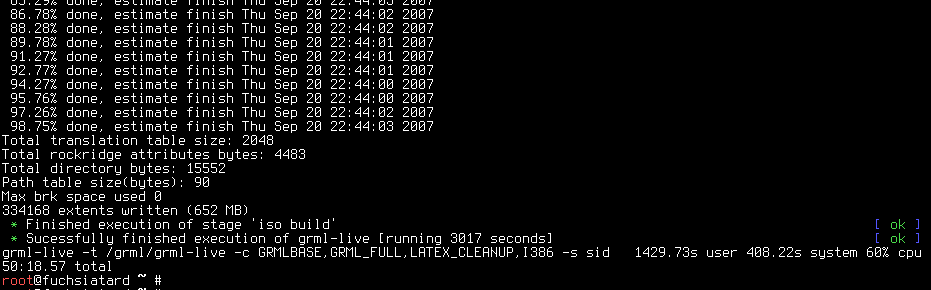
grml-live ist ein Framework, mit dessen Hilfe man mit nur 1 Kommando eine auf grml/Debian basierende Linux Live-CD bauen kann. grml-live baut auf FAI (Fully Automatic Installation) auf und nutzt dessen klassenbasiertes Konzept: Screenshot: grml-live In diesem Beispiel habe ich gerade ein gro es grml-ISO gebaut. Dabei habe ich einfach nur den Debian-Mirror in /etc/grml/grml-live.conf auf meinen lokalen Mirror gedreht (um Traffic und Zeit zu sparen) und dann folgendes Kommando aufgerufen:
# grml-live -t /grml/grml-live -c GRMLBASE,GRML_FULL,LATEX_CLEANUP,I386 -s sid
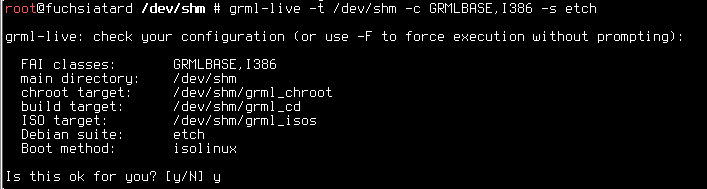
Ca. 50 Minuten sp ter habe ich im Ordner grml_isos unter /grml/grml-live/ (-t …) ein fertiges grml-ISO. Dieses wurde auf Basis der Klassen (-c …) GRMLBASE (da steckt alles essenzielle drin), GRML_FULL (Software-Auswahl wie auf der offiziellen gro en grml), LATEX_CLEANUP (ein paar sehr gro e LaTeX-Verzeichnisse aufr umen) und I386 (x86-spezifische Pakete wie z.B. der Kernel) gebaut. Als Debian-Suite (-s) wurde sid (unstable) ausgew hlt. Und das war es auch schon. Ein kleinere grml-Version auf Basis von Debian/stable gef llig? Kein Problem, machen wir es doch einfach mal im Shared-Memory (superschnell und mit genug RAM und den Mountoptionen rw,suid,dev auch kein Problem): Screenshot grml-live: der Start Ein ‘grml-live -t /dev/shm -c GRMLBASE,I386 -s etch’ und keine 5(!) Minuten sp ter hab ich dann mein 135MB kleines grml: Screenshot grml-live: done Mit grml-live kann man sich somit seine pers nlich angepasste Linux Live-CD erstellen, ohne sich erst mit Remastering im Detail besch ftigen zu m ssen. Auch muss man dabei nicht zwingend Debian/unstable nehmen, sondern kann auch Debian/stable als Basis ausw hlen. Durch das Erstellen einer neuen Klasse oder das Anpassen einer existierenden kann man auch spezielle Software-W nsche ganz einfach erf llen. Wird damit das offizielle grml-ISO etwa obsolet? Nein, auf keinen Fall. grml-live soll dem grml-Team als Buildsystem dienen (automatisierte Snapshots auf regelm iger Basis z.B. sind schon in Planung) und die langweilige Arbeit abnehmen, damit wir uns auf die wirklich wichtigen Sachen konzentrieren k nnen: Testen, Bugfixing, Implementieren von neuen Features, Arbeit am Kernel, Qualit tssicherung, Dokumentation,… grml-live hat den Anspruch, auf jedem Debian-basierten System zu funktionieren und wer Interesse daran gefunden hat, kann sich das Debian-Pakete aus dem grml-Repository holen. Den Quellcode gibt es nat rlich auf unserer Mercurial-Webseite. Wer jetzt noch Fragen hat oder mehr Details zu grml-live erfahren m chte, der m ge einfach auf die grml-live-Homepage schauen. Falls dort eine Frage noch nicht beantwortet sein sollte, jemand Feature-Requests, Bugreports oder Patches hat: meine Inbox freut sich ber Post! :-)

Adrian von Bidder: Who'd have thought it?

Who'd have thought it ... Dan Lyons (one of the louder SCO backers) actually published a May Culpa, admitting that he was wrong all the time. A respectful nod in his direction from me, I'd not have expected this. Remains to be said that covering a lawsuit by (judging by the description of what he did before publishing the first article) more or less only talking to one party and, probably, not actually knowing much about the actual topic under discussion still seems to be very bad journalism, but at least he doesn't try to wriggle out of it now. And, IIRC, IBM did not talk much about this lawsuit, while SCO talked to everybody who might listen at length, so you might call that mitigating circumstances. Hmm. Completely unrelated, but ... Konqueror crashes when I try to leave the Forbes web page. Somehow I don't think I'm all too interested in this particular bug being fixed. I still like what the Canberra Times wrote about Forbes Magazine in August 2004:
[Forbes Magazine] looks ... like corporate pornography, giving middle-management dreamers fodder for their fantasies, and this sort of exercise, basically meaningless, hardly seems useful or instructive.

Next.

Previous.