Search Results: "pm"

5 August 2012

Stefano Zacchiroli: bits from the DPL for July 2012

Monthly DPL bits, fresh from the oven.
Tip to feel good about the release #476: before reading this, grab and fix one of the RC bugs affecting Wheezy. Done? Now you're ready for a slightly less exciting report of DPL activities. Highlights Assets Logo & trademark Note that the actual logo relicensing should be done by SPI, via their board, upon request of mine (as Debian Project liaison). We won't make it for the next SPI board meeting, as it is on 4 days away. But we can aim for the subsequent meeting, on September 13th. If all goes well (big "if"), we will enjoy a DFSG-free logo after that date. Internal organization Recent flurry of re-organization in the tech-ctte --- which I somewhat triggered pushing for periodic meetings --- seems to be proceeding well. I'm very happy about it, as we all need to trust that tech-ctte decisions will be not only sound, but also prompt. If you're interested into this topic, some recent evidence of the ongoing reorganization and its result can be found in their DebConf12 BoF, minutes of the last meeting, a set of forthcoming GRs, and the recent great decision of posting decisions results to d-d-a (as it happened for node/nodejs). Kudos to tech-ctte members for the recent activism! I haven't worked on it myself directly, but I highlight Enrico's work on server side archival of NM conversations. It has the potential of enabling automatic detection of stuck NM processes. I'm a bit rusty as AM now, but I think missing that ability is one of the main remaining causes of frustration when joining Debian. So, if you are an AM, please opt-in and use this feature with your appicants. If you are not an AM why not? :-) Miscellanea Some misc legal stuff: and some misc "political" stuff: Happy RC bug squashing,
Cheers.
PS the boring day-to-day activity log for July 2012 is available at master:/srv/leader/news/bits-from-the-DPL.txt.201207

Craig Small: Context sensitive menus with GtkTreeView

A project I now maintain called GJay uses the GTK+ toolkit and has a GtkTreeView that shows the directories and the songs in them. I was wanting to add a context sensitive menu on that view so that you could do things to the item you have right-clicked on; generally file specific things like give me information about this song or queue it to play. My only problem was, how to do it? A few Google searches showed things that were almost, but not quite, what I was after. The main problem being either the documentation was incomplete or it assumed I was after the selected field (the row I may of left-clicked on) and not the one I right-clicked on to get this event. This GtkTreeView uses a store where NAME_COLUMN is defined at 0, meaning it is the first column. The program uses this column to store the filename of the song. So first I needed to create an event to kick things off, we need to connect the button-press-event to our tree_view, which calls a function in this case view_on_button_pressed.
 g_signal_connect(tree_view, "button-press-event", 
   G_CALLBACK(view_on_button_pressed), NULL);
gboolean view_on_button_pressed(GtkWidget *tree_view, 
                                GdkEventButton *event, 
                                gpointer user_data)  
  GtkTreeSelection *selection;
  GtkTreePath *tree_path;
  GtkTreeModel *tree_model;
  GtkTreeIter tree_iter;
  gchar *name;
 
  if (event->type == GDK_BUTTON_PRESS && event->button == 3)  
    tree_model = gtk_tree_view_get_model(GTK_TREE_VIEW(tree_view));
    if (gtk_tree_view_get_path_at_pos(GTK_TREE_VIEW(tree_view),
          (int)event->x, (int)event->y,
          &tree_path, NULL, NULL, NULL))  
      if (gtk_tree_model_get_iter(tree_model, &tree_iter, tree_path))  
        gtk_tree_model_get(tree_model, &tree_iter, NAME_COLUMN, &name, -1);
        g_print("rc name is %s\n", name);


So a breakdown of what my callback is doing: The program, now that it knows the song title, can then go off and generate a menu for that song.

31 July 2012

Christian Perrier: Discovering a new package: HotelDruid

What is good in "my" job in Debian are opportunities to discover new interesting packages. While surveying the completion of debconf translations in unstable, I thus noticed a new package named "hoteldruid", that has a few questions and interaction with users. After my usual mumble because French and a few other languages were *finally* virtually 100% in unstable for a few days...... I went on my usual task in such cases: propose a review of debconf templates and package description to my fellow debian-l10n-english co-workers (/me bends to Justin B. Rye, our tireless, picky, efficient and very clever Master Reviewer for over 5 years now). Then I discovered what HotelDruid is about: this is a piece of PHP-based software meant to manage....an hotel or bed and breakfast...or any kind of such facility. Real end-user software. Really useful software. For real people...:-) Not the gazillionth obscure development language, or yet another encryption library, or yet another mysterious virtualization thing used by 10 people in the world (even if they host thousands of machines). These are the free software pieces I like the most. Probably Marco Maria Francesco De Santis (the upstream author and Debian package maintainer) somewhere in, I guess, Italy is running a small B&B (or maybe his parents, or his wife/cousin/whatever) *and* is a free software addict. And he wanted to run his business with free software. Same for this French genealogist who once wanted to display his data over the web (and make a real use of that obscure Ocaml language.....yes, pun itended to my friends, here). Of the person who wrote LedgerSMB to manage his business. Or those who use free software to manage hospitals (hi Andreas) or schools (hi DebianEdu folks...and special hi to Petter). Real software for real people. Of course, developed with obscure geeky things used only by those weird geeks who like to sometimes travel half a planet to just gather together and develop the best free operating system ever. Guess what? I like this! And guess what? I proposed the HotelDruid author to check whether we could imrove....translation, of course..:-)

29 July 2012

Joey Hess: build a dynamic webapp in Yesod in just three days

This screencast shows what I built. Scroll down for my Yesod braindump. <video controls="controls" src="http://joeyh.name/screencasts/git-annex-webapp.ogg"></video> video link I've been astonished how quickly this went together. This is my first time using any sort of web framework, and I used a still unusual one, Yesod. It's my first time using Bootstrap too. It's also the first time I've done any AJAX programming! Bootstrap was something I'd heard of and seen some suspiciously similar looking sites built with, but it was really a pleasant surprise. Being able to make things that work and look good on the web without struggling with CSS is such a nice change. For the first time, it makes the web feel like a UI toolkit to me. As I've learned Yesod, I kept seeing problems the web framework solves that I either solved in an ad-hoc basis in Ikiwiki, or didn't realize were problems. In the former group are things like having a consistent way to store a URL to redirect to after an action (such as logging in) finishes, and generating urls programmatically in ways that avoid broken links. In the latter group are things like exploiting types to guarantee mistakes can't be made. And also the abstraction of widgets, which combine html, css, and javascript, in a way that can be composed with other widgets. Overall, I'm really enjoying Yesod, and it's making me productive in new ways. I also see a lot of potential in Yesod to improve from where it is.
    webpage = bootstrap Dynamic $ do
        setTitle "FooCorp"
        login <- getLogin
        navbar [FixedTop] $ do
            brand "FooCorp"
            link AboutR
            link BlogR
            nav [PullRight] $
                link . maybe LoginR ProfileR login
        div [ContainerFluid] $ content login
        where
            content Nothing = heroUnit $ do
                para $ "We're the FooCorp for you."
                button "Register Today" [Primary, Large] SignUpR
                carousel
                    [ amazingFeatures
                    , aboutFooCorp
                    , pricing
                    ]
            content (Just user)  = do
                para $ "Welcome back " ++ name user ++ "!"
                showProfile user

28 July 2012

Vincent Bernat: Switching to the awesome window manager

I have happily used FVWM as my window manager for more than 10 years. However, I recently got tired of manually arranging windows and using the mouse so much. A window manager is one of the handful pieces of software getting in your way at every moment which explains why there are so many of them and why we might put so much time in it. I decided to try a tiling window manager. While i3 seemed pretty hot and powerful (watch the screencast!), I really wanted something configurable and extensible with some language. So far, the common choices are: I chose awesome, despite the fact that StumpWM vote for Lisp seemed a better fit (but it is more minimalist). I hope there is some parallel universe where I enjoy StumpWM. Visually, here is what I got so far: awesome dual screen setup

Awesome configuration Without a configuration file, awesome does nothing. It does not come with any hard-coded behavior: everything needs to be configured through its Lua configuration file. Of course, a default one is provided but you can also start from scratch. If you like to control your window manager, this is somewhat wonderful. awesome is well documented. The wiki provides a FAQ, a good introduction and the API reference is concise enough to be read from the top to the bottom. Knowing Lua is not mandatory since it is quite easy to dive into such a language. I have posted my configuration on GitHub. It should not be used as is but some snippets may be worth to be stolen and adapted into your own configuration. The following sections put light on some notable points.

Keybindings Ten years ago was the epoch of scavanger hunts to recover IBM Model M keyboards from waste containers. They were great to type on and they did not feature the infamous Windows keys. Nowadays, this is harder to get such a keyboard. All my keyboards now have Windows keys. This is a major change with respect to configure a window manager: the left Windows key is mapped to Mod4 and is usually unused by most applications and can therefore be dedicated to the window manager. The main problem with the ability to define many keybindings is to remember the less frequently used one. I have monkey-patched awful.key module to be able to attach a documentation string to a keybinding. I have documented the whole process on the awesome wiki. awesome online help

Quake console A Quake console is a drop-down terminal which can be toggled with some key. I was heavily relying on it in FVWM. I think this is still a useful addition to any awesome configuration. There are several possible solutions documented in the awesome wiki. I have added my own1 which works great for me. Quake console

XRandR XRandR is an extension which allows to dynamically reconfigure outputs: you plug an external screen to your laptop and you issue some command to enable it:
$ xrandr --output VGA-1 --auto --left-of LVDS-1
awesome detects the change and will restart automatically. Laptops usually come with a special key to enable/disable an external screen. Nowadays, this key does nothing unless configured appropriately. Out of the box, it is mapped to XF86Display symbol. I have associated this key to a function that will cycle through possible configurations depending on the plugged screens. For example, if I plug an external screen to my laptop, I can cycle through the following configurations:
  • only the internal screen,
  • only the external screen,
  • internal screen on the left, external screen on the right,
  • external screen on the left, internal screen on the right,
  • no change.
The proposed configuration is displayed using naughty, the notification system integrated in awesome. Notification of screen reconfiguration

Widgets I was previously using Conky to display various system-related information, like free space, CPU usage and network usage. awesome comes with widgets that can fit the same use. I am relying on vicious, a contributed widget manager, to manage most of them. It allows one to attach a function whose task is to fetch values to be displayed. This is quite powerful. Here is an example with a volume widget:
local volwidget = widget(  type = "textbox"  )
vicious.register(volwidget, vicious.widgets.volume,
         '<span font="Terminus 8">$2 $1%</span>',
        2, "Master")
volwidget:buttons(awful.util.table.join(
             awful.button(   , 1, volume.mixer),
             awful.button(   , 3, volume.toggle),
             awful.button(   , 4, volume.increase),
             awful.button(   , 5, volume.decrease)))
You can also use a function to format the text as you wish. For example, you can display a value in red if it is too low. Have a look at my battery widget for an example. Various widgets

Miscellaneous While I was working on my awesome configuration, I also changed some other desktop-related bits.

Keyboard configuration I happen to setup all my keyboards to use the QWERTY layout. I use a compose key to input special characters like . I have also recently use Caps Lock as a Control key. All this is perfectly supported since ages by X11 I am also mapping the Pause key to XF86ScreenSaver key symbol which will in turn be bound to a function that will trigger xautolock to lock the screen. Thanks to a great article about extending the X keyboard map with xkb, I discovered that X was able to switch from one layout to another using groups2. I finally opted for this simple configuration:
$ setxkbmap us,fr '' compose:rwin ctrl:nocaps grp:rctrl_rshift_toggle
$ xmodmap -e 'keysym Pause = XF86ScreenSaver'
I switch from us to fr by pressing both left Control and left Shift keys.

Getting rid of most GNOME stuff Less than one year ago, to take a step forward to the future, I started to heavily rely on some GNOME components like GNOME Display Manager, GNOME Power Manager, the screen saver, gnome-session, gnome-settings-daemon and others. I had numerous problems when I tried to setup everything without pulling the whole GNOME stack. At each GNOME update, something was broken: the screensaver didn t start automatically anymore until a full session restart or some keybindings were randomly hijacked by gnome-settings-daemon. Therefore, I have decided to get rid of most of those components. I have replaced GNOME Power Manager with system-level tools like sleepd and the PM utilities. I replaced the GNOME screensaver with i3lock and xautolock. GDM has been replaced by SLiM which now features ConsoleKit support3. I use ~/.gtkrc-2.0 and ~/.config/gtk-3.0/settings.ini to configure GTK+. The future will wait.

Terminal color scheme I am using rxvt-unicode as my terminal with a black background (and some light transparency). The default color scheme is suboptimal on the readability front. Sharing terminal color schemes seems a popular activity. I finally opted for the derp color scheme which brings a major improvement over the default configuration. Comparison of terminal color schemes I have also switched to Xft for font rendering using DejaVu Sans Mono as my default font (instead of fixed) with the following configuration in ~/.Xresources:
Xft.antialias: true
Xft.hinting: true
Xft.hintstyle: hintlight
Xft.rgba: rgb
URxvt.font: xft:DejaVu Sans Mono-8
URxvt.letterSpace: -1
The result is less crisp but seems a bit more readable. I may switch back in the future. Comparison of terminal fonts

Next steps My reliance to the mouse has been greatly reduced. However, I still need it for casual browsing. I am looking at luakit a WebKit-based browser extensible with Lua for this purpose.

  1. The console gets its own unique name. This allows awesome to reliably detect when it is spawned, even on restart. It is how the Quake console works in the mod of FVWM I was using.
  2. However, the layout is global, not per-window. If you are interested by a per-window layout, take a look at kbdd.
  3. Nowadays, you cannot really survive without ConsoleKit. Many PolicyKit policies do not rely on groups any more to grant access to your devices.

Luke Faraone: Google Cr-48 first impressions

On a lark, I signed up for the pilot program of the Google Cr-48 about a week ago. To my surprise, I found the distinctive box on my doorstep a week later. After initially mistaking it for an overpacked, late-model OLPC XO-1 I would have to repair, I sort of did a double-take as I realized what I had received.
Using Chrome OS


Wow, they weren't kidding about the boot time. Chrome OS responds (to suspend / resume and boot / power-off) very quickly. Responsiveness elsewhere in the OS of course varies on system load and other factors. On the "terms" page, there is a "system security setting" which tells me I have a Trusted Platform Module, and that my TPM has a randomly generated password. The dialog could use some rewording; I'm pretty familiar with the idea of a TPM, but I'm still not sure what I'm to do with that information.

Cloud print is really a problem for me, right now. I use school printers for the majority of my work, which I was previously able to use by adding them by IP address. Unless there's some magic I'm missing here, I can't do that with Chrome OS, and such a feature will not be supported. (except by "connectors" on Windows and Mac computers)
General thoughts
I can't imagine using a system running Chrome OS as a primary computer. The biggest missing feature is PGP (or any sort of encryption) support for email. This is probably not terribly difficult to implement as an extension, but the idea of my cryptographic software being automatically updated is rather unsettling. I think I'll have to agree with Paul Buchheit that ChromeOS will have to merge with Android; there is a utility for local apps, even if they're becoming less and less critical.

27 July 2012

C.J. Adams-Collier: The blog was down yesterday

The brief outage was due to a scheduled move of the servers to a separate rack and subnet dedicated to our work with the Center for Information Assurance & Cybersecurity (ciac) at the University of Washington Bothell (uwb), and a11y.com I am currently exercising the new (to us) equipment and hope to winnow the less than awesome equipment over the next quarter. I spent the last six months finding the best in breed of the surplussed DL385 and DL380 chassis we (work) were going to have recycled. The team and I were able to find enough equipment to bring up one of each with eight and six gigs of memory, respectively. These will make excellent hypervisors for provisioning embedded instances of Slackware, Fedora, RHEL, CentOS, Debian, FreeBSD, OpenSolaris, OpenIndiana, FreeDOS, etc. When I initially configured this xen paravirt environment, I failed to plan for integration with libvirt, so I am now re-jiggering the software bridges so that they are managed using virt-manager. My experience doing this in the Eastsound lab has proved to be quite rewarding. Once network, storage and memory allocation are handled by libvirt, it will be trivial to automate the process of deploying, reclaiming, and managing these Telecommunications Resources efficiently and effectively using Perl. The new equipment we racked over the last weekend all has hardware assisted virtualization and is capable of hosting operating systems which have not been patched to communicate with the host hypervisor. This provides a higher level of assurance that guests will receive the full amount of provisioned resources and reduces the likelihood of resource conflicts, should the cluster operations team mistakenly over-commit. It also makes it possible for these nodes to host Windows-based operating systems. Oh, and they will also host these not insignificant things called BIG-IP Local Traffic Manager Virtual Edition (VE) and BIG-IP GTM Virtual Edition.

26 July 2012

Benjamin Mako Hill: User Innovation on NPR Radio

I was invited onto NPR in Boston this week for a segment on user innovation alongside Eric von Hippel (my advisor at MIT) and Carliss Baldwin from Harvard Business School. I talked about innovation that has happened on the CHDK platform -- a cool firmware hack for Canon cameras example I use in some of my teaching -- plus a little bit about free software, the democratization of development and design tools, and a little bit about user communities that LEGO has cultivated. I would have liked the conversation and terminology to do more to emphasize user freedom and free software, but I'm otherwise pretty happy with the result. The segment will be aired again on NPR in Boston this weekend and is available on the WGBH website.

25 July 2012

Diego Escalante Urrelo: A Coru a, d a uno

You can follow the latest GUADEC updates from @guadec and @diegoe.

Isa, Alejo, Laura, and Germ n stealing a mug.

GUADEC just started. Or at least, the arrangements for GUADEC.

The local team is hard at work at the GUADEC HQ of the Facultade de Inform tica, they are really working really hard to make sure that there is a proper wired network setup (yes, you read that right!), a great video setup to record all the talks and publish them as soon as possible and setting up the final details of rooms, info desk, accommodation

If you are staying at the Rialta, you can take the hourly bus to the Facultade (just ask the driver). The bus departs from the frontis of Block 3. Ask the driver to let you know when to get off the bus. He is aware of GUADEC so your gringo-spanish should suffice.

We will be holding a pre-registration party tonight at 21:00 (9pm) just outside the Rialta cafeteria. If you are already here drop by for the Queimada by Alejo, our galician wizard.

24 July 2012

Julien Danjou: Emacs configuration published

I've finally published my Emacs configuration. This took me a while, since I had personal information inside (like passwords). Recently, I've been able to move them away and can now publish everything in my Git repository. It's probably not yet usable from scratch, since I didn't include the bootstrap code for el-get. But you can at least lurk and grab some ideas or lines of code. And do not hesitate to ask me anything about it! Note that I'm using Emacs development version (trunk), so it's possible that some things do not work with (old) released Emacs versions.

Sylvestre Ledru: News on Debian & clang

A couple week ago, during the last debconf (Debian Conference) in Managua/Nicaragua, I presented the latest developments about the inclusion of clang in the Debian architecture. To sum up (details are available in the slides and the video), the rebuild of the Debian archive with Clang 3.1 increased the number of failures from 8.8 to 12.1%. The main reason is that further checks have been added to clang. With Paul Tagliamonte as co-mentor and Alexander Pashaliyski as a GSoC student, we made great progress in bringing Clang as A new compiler in the Debian infrastructure. The various feedbacks that I had during Debconf were pretty good. It interests many people for reasons like Quality Assurance (more checks), performances, hackability or to decorrelate Debian and GCC. Build Debian with another compiler - Slides
Build Debian with another compiler - Video A nice resume of my talk has been made by Michael Larabel on Phoronix:
Decoupling GCC From Debian By Using LLVM/Clang

Sylvestre Ledru: News on Debian & clang

A couple week ago, during the last debconf (Debian Conference) in Managua/Nicaragua, I presented the latest developments about the inclusion of clang in the Debian architecture. To sum up (details are available in the slides and the video), the rebuild of the Debian archive with Clang 3.1 increased the number of failures from 8.8 to 12.1%. The main reason is that further checks have been added to clang. With Paul Tagliamonte as co-mentor and Alexander Pashaliyski as a GSoC student, we made great progress in bringing Clang as A new compiler in the Debian infrastructure. The various feedback that I had during Debconf were pretty good. It interests many people for reasons like Quality Assurance (more checks), performances, hackability or to decorrelate Debian and GCC. Build Debian with another compiler - Slides
Build Debian with another compiler - Video A nice resume of my talk has been made by Michael Larabel on Phoronix:
Decoupling GCC From Debian By Using LLVM/Clang

22 July 2012

Evgeni Golov: RC bugs 2012/29

RCBW report for 2012/29 (16.7.-22.7.) The motto for this week was:
shut up and take my patches!
(Don t take it personally, it s just a meme :P)

Sylvestre Ledru: Who is in control of LLVM/Clang ?

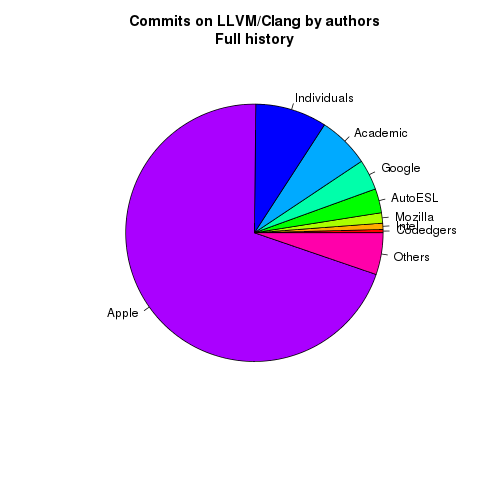
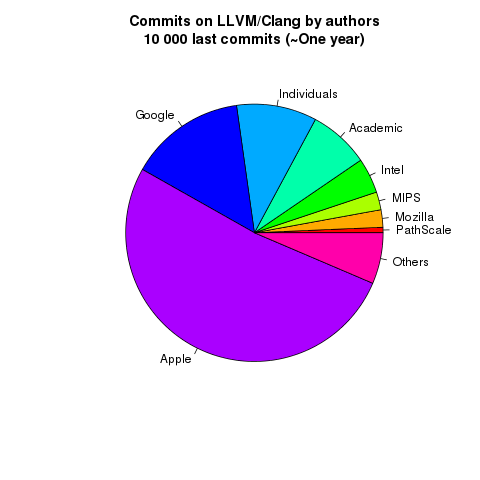
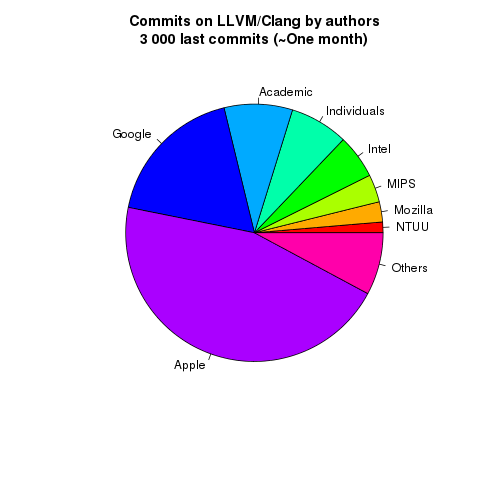
During my various chats and presentations on LLVM/Clang, one of the common criticism on LLVM/Clang is about the Apple's (supposed?) control on the platform. Even if I am not concerned by this concern, here are some statistics about the development. Basically, I used the git history to build a list of all the author. If domain names were clear (ex: @google.com, @apple.com, etc), I used them for the paternity of the commit. If there were not clear (ex: @gmail.com, @me.com), I dig on the web to find the employer (Linkedin was my friend). Of course, identifying individuals are pretty tough. Their percentages can be considered as a minimal figure. Full history 10 000 commits (about a year)
3 000 commits (~a month)
To sum up, we can easily see that the percentage of contributions of Apple is decreasing over the time.
However, we all know that the number of commits is not the best metric to measure the control of one on a project. Source: Processed data (please contact me in case of mistake)

Vasudev Kamath: Compiling Harfbuzz on Debian

Harfbuzz (more correctly harfbuzz-ng) is a Text Layout/shaping engine. Mostly supporting rendering of Text including complex scripts. A quote taken from Wikipedia which describes harfbuzz
HarfBuzz (in Persian: ) is a layout/shaping engine for OpenType fonts. Its purpose is to standardize text layout in FOSS; its code originally started as part of the FreeType project, was then developed separately in Qt and Pango, and finally merged back into a common repository. Both Qt and Pango currently use HarfBuzz; other standalone users include Firefox and Chromium, the open source project behind Google Chrome.
Coming directly to the point. You can get Harfbuzz from its Git repository hosted on Freedesktop. It requires following library and binary compilation
    1. ragel: Finite state machine code compiler
    2. libglib2.0-dev: Glib Development files
    3. libcairo2-dev : Cairo 2D graphics library development files
    4. libicu-dev: Development components for International components for Unicode
    5. libgraphite2-dev: Development files for libgraphite2
    6. libfreetype6-dev: Freetype 2 library development files
Once you install all the above package. Follow following commands to build the harfbuzz.
./autogen.sh
./configure --prefix=/usr
make
sudo make install
You can skip make install if you don't like it to be installed on system.I actually wanted to work on the Debian package of Harfbuzz but since there is some one already working on it. Probably I will wait till the guy completes package. I will write on testing the text rendering of your language using harfbuzz in my next post. Till then Cya.

21 July 2012

Enrico Zini: Giving away distromatch

Giving away distromatch at last year's Fosdem I tried to inject a lot of energy into distromatch but shortly afterwards I've had to urgently rewrite the nm.debian.org website. After Lars Wirzenius GTDFH talks in Bologna and Varese I wrote a tool which, among other things, is able to scan my home dir and list how many projects I'm working on. The output was scary. Like, they are too many. Like, I couldn't even recite the list out of memory. And since I couldn't do that, I had no idea there were so many. And I kept being stressful because I couldn't manage to take care of them all properly. Now that I became conscious of the situation, it's time to deal with it like a grown up, and politely back off from some of my irresponsible responsibilities. Distromatch is one of them. It had just started as a proof of concept prototype, and I had the vision that it could be the basis for a fantastic culture of sharing and exchange of information across distributions. I need to distinguish the vision from the responsibility. I still have that vision for distromatch, but I cannot take responsibility for making it happen. So I am giving it up to anyone who has the time and resources to pick up that responsibility. Current status It works well enough as a prototype. I believe it can successfully map a large enough slice of packages, that one can prototype stuff based on it. I have for example used it to export the Debtags categories for other distros, and the resulting file looked big enough to be used for prototyping category-based features on distributions that don't have them yet. I think it also works well enough to support a few common use cases, like sharing screenshots, or doing most of the work of converting dependency lists from a distro to another. And finally, anyone can deploy it, and work on it. Existing data sources Everything I index in the Debian distromatch deployment is available at http://dde.debian.net/exports/distromatch/. The rpm-based data in there comes from an export script I wrote that runs on Sophie, but which I cannot maintain properly. This is an experimental export of Fedora and OpenSUSE data: http://tmp.vuntz.net/misc/distromatch/distromatch-opensuse-fedora.tar All existing export scripts are found in distromatch git repo on gitorious. Contacts I gathered at Fosdem At Fosdem I devoted quite some work to get contacts from all possible distributions and software repositories, so that distromatch could be hooked into them. Here is a dump of what I have collected: Some of those contacts may have "expired" in the meantime: I wouldn't assume all of them still remember talking with me, although most probably still do. My commitment for the time being I am happy to commit, at the moment, to maintaining a working data export for Debian data. I can take responsibility for making it so that the Debian data for it stays up to date, and to fix it asap if it isn't the case. I hope that now someone can take distromatch over from me, and make it grow to achieve its great potential.

Siegfried Gevatter: A gentle introduction to Zeitgeist s Python API

In this post I ll make a quick introduction by example on how to use Zeitgeist s Python API for good and profit. If you re interested in using Zeitgeist from C instead, see the libzeitgeist examples; to use it with C++/Qt, Trever s a web browser in 4 steps may be of interest. First things first In case you re not familiar with Zeitgeist, it may prove helpful to first read Mikkel s introduction to Zeitgeist post. If that s too much to read, just should know that Zeitgeist is an event log. Like the history in your browser, it keeps track of what websites you open at which point in time. It also keeps track of when you close them, and of what browser you used, since it s a system-wide service. Furthermore, it does the same for files, conversations, e-mails, and anything else you want to insert into it. So Zeitgeist is a database of events, and an event can be pretty much anything. But what does it look like? It s main attributes are the following: Additionally, each event has one or more subjects, which have the following attributes: Retrieving recent data Okay, so let s say you want to know the last song you ve listened to (if you have a Zeitgeist-enabled music player). It s a simple as:
from zeitgeist.client import ZeitgeistClient
from zeitgeist.datamodel import *
 
zeitgeist = ZeitgeistClient()
 
def on_events_received(events):
    if events:
        song = events[0]
        print "Last song: %s" % song.subjects[0].uri
    else:
        print "You haven't listened to any songs."
 
template = Event.new_for_values(subject_interpretation=Interpretation.AUDIO)
zeitgeist.find_events_for_template(template, on_events_received, num_events=1)
 
# Start a mainloop - note: the Qt mainloop also works
from gi.repository import GLib
GLib.MainLoop().run()
This may need some explaining. We start by importing the Zeitgeist client and some associated data structures (such as Event and Interpretation), and create an instance of the client. The ZeitgeistClient class is a wrapper around Zeitgeist s D-Bus API which not only makes it much nicer to use, but also makes it easy to install monitors (as we will see later) and provides convenient functionality such as automatic reconnection if the connection to the engine is lost. To query for the most recent song, we just need to create a template with the restrictions we want to impose and submit it to Zeitgeist using the find_events_for_template call. If you haven t read Mikkel s post yet, please do so, as it introduces the structure of events and subjects (in short: an event has a timestamp, some other properties, and one or more subjects representing the resources -files, websites, people - involved in the event). The Python API is inherently asynchronous (if for some reason you need a synchronous API, you may still use the lower level ZeitgeistDBusInterface class), so we need to define a callback function to handle the results we receive from the Zeitgeist engine. Finally, we need to create a main loop so the asynchronous functions can run.
Now this was a pretty simple example. Let s make it more interesting. One song isn t much, so let s get the 5 most recent songs. Also, now we want both songs and videos. The first part is pretty easy, we just need to change the num_events parameter. For the second extension, we have to change the event template. In fact, now we need two different event templates and the find_events_for_templates function, which takes an arbitrary number of event templates and ORs them. The result is as follows:
from zeitgeist.client import ZeitgeistClient
from zeitgeist.datamodel import *
 
zeitgeist = ZeitgeistClient()
 
def on_events_received(events):
    for event in events:
        print "- %s" % event.subjects[0].uri
 
tmpl1 = Event.new_for_values(subject_interpretation=Interpretation.AUDIO)
tmpl2 = Event.new_for_values(subject_interpretation=Interpretation.VIDEO)
zeitgeist.find_events_for_templates([tmpl1, tmpl2],
                                    on_events_received, num_events=5)
 
# Start a mainloop
from gi.repository import GLib
GLib.MainLoop().run()
This will work, but unless you re lucky you re likely to get some duplicate line. Why is this? Well, other than that you may have used the same file twice, don t forget that what you are requesting are actually events. If you ve started playing a given song, you probably also stopped playing it, so that s actually two of them (an AccessEvent and a LeaveEvent). Since this isn t what we want, we ll change the query a bit:
zeitgeist.find_events_for_templates(
    [tmpl1, tmpl2],
    on_events_received,
    num_events=5,
    result_type=ResultType.MostRecentSubjects,
    storage_state=StorageState.Available)
By requesting the most recent subjects, vs. the most recent events, we can filter out events with duplicate URI. See the ResultType documentation for other modes you can use. Note particularly the MostPopularSubjects result type. I also used the chance to introduce the storage_state parameter. This one will filter out events for files Zeitgeist knows aren t available (this mostly means online resources won t be shown if you don t have a network connnection; there s also support for handling external storage media, but because of problems with GIO this is currently disabled). Last but not least, the find_events_for_* methods also accept a timerange parameter. It defaults to TimeRange.until_now(), but you may change it to TimeRange.always() (if for some reason you re working with events in the future) or to any other time range of your choice. Here it s important to note that Zeitgeist s timestamps use millisecond precision.
For more advanced queries, you can use more complex combinations of events and subject templates. The rule to keep in mind here is that events are OR d and subjects are ANDed. Additionally, some field (actor, origin, mimetype, uri and current_uri) may be prefixed with an exclamation mark ( ! ) for NOT, or you may append an asterisc ( * ) to them for prefix search. You can even combine the two operators together. Here s an example of a template you could build:
subj1 = Subject.new_for_values(interpretation=Interpretation.SOURCE_CODE,
                               uri="file:///home/rainct/Development/*")
subj2 = Subject.new_for_values(uri="!file:///home/rainct/Development/zeitgeist/*")
tmpl1 = Event.new_for_values(interpretation=Interpretation.MODIFY_EVENT,
                             subjects=[subj1, subj2])
templates = [tmpl1]
In my case, this template would fetch a list of the source code files I modified most recently but excluding those related to the Zeitgeist project. Working with big sets of data In case you re trying to do something crazy, you may end up with a Zeitgeist query complaining that it exceeded the memory limit. You re not supposed to do that. Instead, we provide some methods for working with large collections of events.
from zeitgeist.client import ZeitgeistClient
from zeitgeist.datamodel import *
 
zeitgeist = ZeitgeistClient()
 
def on_events_received(events):
    for event in events:
        print '- %s' % event.subjects[0].uri
 
def on_ids_received(event_ids):
    print 'A total of %d source code files were found.' % len(event_ids)
    print 'Fetching the first 100...'
    zeitgeist.get_events(event_ids[:100], on_events_received)
 
tmpl = Event.new_for_values(subject_interpretation=Interpretation.SOURCE_CODE)
zeitgeist.find_event_ids_for_templates(
    [tmpl],
    on_ids_received,
    num_events=10000, # you can use 0 for "all events", but do you really need to?
    timerange=TimeRange.from_seconds_ago(3600*24*30*3),
    result_type=ResultType.MostPopularSubjects)
 
# Start a mainloop
from gi.repository import GLib
GLib.MainLoop().run()
And there you have the source code files you worked with during the last 3 months, ordered from most to least popular (popularity is measured counting the number of events; for more precision, maybe you could limit the results to events with interpretation AccessEvent). Why do we provide this mechanism instead of querying with a simple offset? Well, this avoids problems when the log changes (events are inserted or deleted). Have you ever been exploring the latest posts in some website, and as you change to the next page some of the results from the previous page show up again (because new posts have been added in the meantime)? With Zeitgeist this won t happen. Receiving information in real time At this point you re an expert at requesting all sorts of data from Zeitgeist, but now you want to show a list of the last kitten images you ve viewed, updated in real time. Don t worry, Zeitgeist can provide for this:
from zeitgeist.client import ZeitgeistClient
from zeitgeist.datamodel import *
 
zeitgeist = ZeitgeistClient()
 
def on_insert(time_range, events):
    # do awesome stuff with the events here
    print events
 
def on_delete(time_range, event_ids):
    # a previously inserted event was deleted
    print event_ids
 
templates = [Event.new_for_values(subject_uri='file:///home/user/kittens/*',
                                  subject_interpretation=Interpretation.IMAGE)]
zeitgeist.install_monitor(TimeRange.always(), templates, on_insert, on_delete)
 
# Start a mainloop
from gi.repository import GLib
GLib.MainLoop().run()
It s important to note that on_delete won t be called when an image is deleted (that d be a newly inserted event with interpretation=DELETE_EVENT); rather, it s called when a previously inserted event is deleted (for example, using the forget recent history option in Activity Log Manager). In case you re curious: for best performance, this doesn t actually use D-Bus signals. Instead, this little call will setup a D-Bus object behind the scenes and register it with the Zeitgeist engine, so it can notify said object when (and only when) an event of its interest is registered. To stop receiving notifications for a template, you ll need the save the object returned by the install_monitor call:
m = zeitgeist.install_monitor(TimeRange.always(), templates, on_insert, on_delete)
zeitgeist.remove_monitor(m)
Pro Tip: You can use the Zeitgeist Explorer GUI to quickly try out different queries (note: it s still work in progress, so much funcionality is missing, but it does work somewhat). Contextual awesomeness: finding related events By now you re familiar with retrieving events and keeping them up to date. Now it s time for a little secret:
import time
from zeitgeist.client import ZeitgeistClient
from zeitgeist.datamodel import *
 
zeitgeist = ZeitgeistClient()
 
def on_related_received(uris):
    print 'Related URIs:'
    for uri in uris:
        print ' - %s' % uri
 
query_templates = [Event.new_for_values(
    subject_interpretation=Interpretation.SOURCE_CODE,
    subject_uri='file:///home/rainct/Development/zeitgeist/*',
    subject_mimetype="text/x-vala")]
 
result_templates = [Event.new_for_values(
    subject_interpretation=Interpretation.WEBSITE,
    subject_manifestation=Manifestation.WEB_DATA_OBJECT)]
 
now = time.time()*1000
zeitgeist.find_related_uris_for_events(
    query_templates,
    on_related_received,
    time_range=TimeRange(now - 1000*3600*24*30*6, now),
    result_event_templates=result_templates,
    num_events=10)
 
# Start a mainloop
from gi.repository import GLib
GLib.MainLoop().run()
This little query example will return up to 10 websites I used at the same time as the Vala files inside my Zeitgeist directory, considering only data from the last 6 months. Nice, huh? This is an experimental feature, and it doesn t work well when operating on big inputs, so it s usually better to use the find_related_uris_for_uris variant (which replaces the first query_templates parameter with a list of URIs). Advanced searching: the FTS extension Some people think prefix searches aren t good enough for them, and this is why the Zeitgeist engine ships by default with a FTS (Full Text Search) extension. Using the methods provided by this extension you can perform more advanced queries against subjects current_uri and text properties (unlike the name may suggest, the FTS extension doesn t index the content of the files, but just the information in the event). This is exposed as zeitgeist_index_search in libzeitgeist (the C library), but unfortunately isn t currently available in the Python API. If you still need it, you ll have to fallback to pretty much using the D-Bus interface (you still get reconnection support, though). Here s an example:
from zeitgeist.client import ZeitgeistClient
from zeitgeist.datamodel import *
 
zeitgeist = ZeitgeistClient()
index = zeitgeist._iface.get_extension('Index', 'index/activity')
 
query            = 'hello' # search query
time_range       = TimeRange.always()
event_templates  = []
offset           = 0
num_events       = 10
result_type      = 100 # magic number for "relevancy" (ResultType.* also work)
 
def on_reply(events, num_estimated_matches):
    print 'Got %d out of ~%d results.' % (len(events), num_estimated_matches)
    events = map(Event, events)
    for event in events:
        print ' - %s' % event.subjects[0].uri
 
def on_error(exception):
    print 'Error from FTS:', exception
 
index.Search(query, time_range, event_templates,
             offset, num_events, result_type,
             reply_handler=on_reply, error_handler=on_error)
 
# Start a mainloop
from gi.repository import GLib
GLib.MainLoop().run()
The most interesting thing here is the query parameter. Quoting from the C documentation:
The default boolean operator is AND. Thus the query foo bar will
be interpreted as foo AND bar. To exclude a term from the result
set prepend it with a minus sign - eg foo -bar. Phrase queries
can be done by double quoting the string "foo is a bar". You can
truncate terms by appending a *.
There are a few keys you can prefix to a term or phrase to search
within a specific set of metadata. They are used like key:value.
The keys name and title search strictly within the text field of
the event subjects. The key app searches within the application
name or description that is found in the actor attribute of the
events. Lastly you can use the site key to search within the
domain name of the subject URIs.
You can also control the results with the boolean operators AND
and OR and you may use brackets, ( and ), to control the operator
precedence.
Modifying the log So far we ve only queried Zeitgeist for information, let s get a bit more active. You can delete events from Zeitgeist with the following query:
from zeitgeist.client import ZeitgeistClient
 
zeitgeist = ZeitgeistClient()
 
def on_deleted(timerange):
    print 'Deleted events going from %s to %s' % (timerange[0], timerange[1])
 
event_ids = [50] # put the IDs of the events you want to delete here
 
zeitgeist.delete_events(event_ids, on_deleted)
 
# Start a mainloop
from gi.repository import GLib
GLib.MainLoop().run()
The confirmation callback will receive a timerange going from the first to the last event. If no events were deleted (because they didn t exist), you ll get (-1, -1).
And now for the interesting part. If your application involves resources (files, websites, contacts, etc.) of any sort, you ll probably want to let Zeitgeist know that you re using them. It s time that you write a data-source! We start by registering the data-source. Here we go:
import time
from gi.repository import GLib
from zeitgeist.client import ZeitgeistClient
from zeitgeist.datamodel import *
 
zeitgeist = ZeitgeistClient()
 
def on_status_changed_callback(enabled):
    """ This method will be called whenever someone enables or disables
        the data-source. """
    if enabled:
        print 'Data-source enabled and ready to send events!'
    else:
        print 'Data-source disabled; don\'t send event, they\'ll be ignored.'
 
def register():
    # Always use the same unique_id. Name and description can change
    # freely.
    unique_id = 'com.example.your.data.source'
    name = 'user visible name (may be translated)'
    description = 'user visible description (may be translated)'
 
    # Describe what sort of events will be inserted (optional)
    subject_template = Subject()
    subject_template.interpretation = Interpretation.PLAIN_TEXT_DOCUMENT
    subject_template.manifestation = Manifestation.FILE_DATA_OBJECT
    templates = []
    for interp in (Interpretation.ACCESS_EVENT, Interpretation.LEAVE_EVENT):
        event_template = Event()
        event_template.interpretation = interp
        event_template.manifestation = Manifestation.USER_ACTIVITY
        event_template.append_subject(subject_template)
        templates.append(event_template)
 
    zeitgeist.register_data_source(unique_id, name, description, templates,
                                   on_status_changed_callback)
Once that s done (and if it is enabled), we are free to send our events:
def log(title, uri, opened):
    subject = Subject.new_for_values(
        uri=uri,
        interpretation=Interpretation.PLAIN_TEXT_DOCUMENT,
        manifestation=Manifestation.FILE_DATA_OBJECT,
        origin=GLib.path_get_dirname(uri),
        mimetype='text/plain',
        text=title)
    event = Event.new_for_values(
        timestamp=time.time()*1000,
        manifestation=Manifestation.USER_ACTIVITY,
        actor='application://your_application_name.desktop',
        subjects=[subject])
    if opened:
        event.interpretation = Interpretation.ACCESS_EVENT
    else:
        event.interpretation = Interpretation.LEAVE_EVENT
 
    def on_id_received(event_ids):
        print 'Logged %s (%d) with event id %d.' % (title, opened, event_ids[0])
 
    zeitgeist.insert_events([event], on_id_received)
 
if __name__ == '__main__':
    register()
 
    log('test.txt', 'file:///tmp/test.txt', opened=True)
    log('another_file.txt', 'file:///tmp/another_file.txt', opened=True)
    log('another_file.txt', 'file:///tmp/another_file.txt', opened=False)
    log('test.txt', 'file:///tmp/test.txt', opened=False)
 
    # Start a mainloop
    GLib.MainLoop().run()
If you don t know what interpretation and manifestation your subject should have, you can use the following utility methods:
from zeitgeist.mimetypes import *
 
print get_interpretation_for_mimetype('text/plain')
print get_manifestation_for_uri('file:///tmp/test.txt')
Event better, with Zeitgeist 0.9 you can just leave the subject (but not event!) interpretation and manifestation fields empty, and they ll be guessed the same way as if you used those utility methods. Pro Tip: You can examine all registered data-sources and toggle whether they are enabled or not using the zeitgeist-data-sources-gtk.py tool. Conclusion Wow, I m impressed if you ve got this far. By now you should have quite a good idea on how to use the Zeitgeist API, and I m looking forward to seeing what you do with it in your next awesome project. If you have any problem with Zeitgeist, feel free to visit us on IRC (#zeitgeist on irc.freenode.net), or join our mailing list. We ll also be at GUADEC next week, so if you re there make sure to say hi! In case you missed them, here are some useful links:
No comments
Siegfried-Angel Gevatter Pujals, 2012. Permalink License Post tags: ,
flattr this!

19 July 2012

Michal &#268;iha&#345;: Sponsoring phpMyAdmin

We've decided to accept sponsorships of phpMyAdmin in more official way. So if you or your company want to financially support this software, you now have great chance to do that. Time to time we've received offers for sponsoring, but we never got to point where we could easily handle these. In the past we were limited by sf.net requirements for no advertisement on website, but it got leveraged over the time and we did not change our policy much. For now the only benefit we are providing to our sponsors (besides good feeling that they are supporting good project) is logo and link on our website. In the future we might add some more, but at first we want to see how it works in this scale. Anyway if you are interested in sponsoring phpMyAdmin, you can do that on our website.

Filed under: English Phpmyadmin 0 comments Flattr this!

18 July 2012

Michal &#268;iha&#345;: Triggering Jenkins from GitHub

For some time I thought it is not effective to use polling to get latest changes from GitHub into Jenkins, which we use for continuous integration, but II was always too lazy to investigate. Today I finally took a look at it and it turns out to be quite easy:
  1. Enable Github plugin in Jenkins.
  2. Enable "Build when a change is pushed to GitHub" in project configuration in Jenkins
  3. Disable "Prevent Cross Site Request Forgery exploits" in Jenkins configuration (to prevent bug JENKINS-10263).
  4. Configure Jenkins service hook in GitHub to trigger your server (the URL is http://<jenkins>/github-webhook/.
Try testing the hook and check "GitHub Hook Log" in Jenkins if it really works and you're done. So now, phpMyAdmin's tests should start as soon as somebody pushes changes to GitHub.

Filed under: English Phpmyadmin 0 comments Flattr this!

Next.

Previous.