Search Results: "agi"

20 April 2013

Paul Tagliamonte: Fixing the theme situation in Jessie

Hello, World, As many of you know, I fell into helping get the artwork for Wheezy into place. While I don t want to do this (in the long run), I feel the urge to get it into shape for Jessie. I d like to do a small request for methods to improve the theme packaging. I ve posted a suggestion, but I never really got happy with it. The problem is basically the deb makes no sense because making thee deb make sense would result in insanity ;) stuff like proper dependencies to allow the Plymouth theme to work can t be done, since it d require a dep on Plymouth, which means it requires all installs with desktop-base to have it installed. Thanks, lazyblog!

Rog rio Brito: Lack of cooperation from Ubuntu?

I posted the following on Google+, but it is important enough to be reproduced on Planet. I'm editing it a bit, as it is a followup to my previous post. While improving the packaging of MongoDB, there was one thing that caught my attention: that Ubuntu had already done some of the embedded/convenience libraries work, but they had not pushed that work to Debian. Of course, discovered this only after I started working on the improvements of the package. What gives, Ubuntu people? Another thing that I saw is that they have patches enabling mongodb working on armhf. Again, they did not push those to Debian. Why this lack of cooperation? Another thing that I saw is that they had packages for version 2.2 (more precisely, raring has 1:2.2.4-0ubuntu1), while Debian sid just had 2.0 until very recently. Why not push this work and avoid duplication of work? By being a good downstream, I intend to push some of the patches to MongoDB upstream (if they want it), so that we (Debian) have a smaller delta. This will benefit you Ubuntu guys. Why not join forces and help have a world-class set of packages? Please, be good netizens and share the work that you have. I firmly believe that the armhf people will be happy to have one of the fancy "cloud" software available on ARM, especially since the prospects of having ARM machines on datacenters. Oh, just for the record, the kFreeBSD people have sent their contribution and I would love to see (if possible) this running on the HURD.

19 April 2013

Rog rio Brito: Some recent Debian activities

I have been occasionally working on some Debian-related tasks. Chrony One of those was to get chrony is a slightly better shape, by using, at least, a patch system (indeed, I "modernized" its packaging with the format "3.0 (quilt)"), put it in a git repository and would like to receive some comments on what I have so far. The bug Debian bug #694690 contains a very brief description of my intentions and of the problems that I see in the current package. IMVHO, it is a very nice NTP client and server and it could even be used as the default for Debian, once it gets in shape. There is at least another high-profile distribution, namely Fedora, that switched to chrony as its default NTP software. We can certainly take a look at what they are doing and join forces here. MongoDB Another package where I spent some time was with mongodb: MongoDB is a tricky package that is only built for 2 arches: amd64 and i386. The version in unstable for i386 was 2.0.x (roughly the same as for wheezy), which the version in unstable for amd64 was 2.4.1, which has many features that 2.0 lacks. The packaging of it is a bit tricky, since the source tree has bazillion embedded/convenience libraries (e.g., Google's v8, Mozilla's spidermonkey, BOOST, Google's Snappy, PCRE 3 etc.). Up to version 2.4.1-2, it used all these convenience copies, which is of course, a problem for a distribution like Debian. I changed part of the build process to use the libraries that we already have in Debian and, as Antonin Kral uploaded this newer version, unsurprisingly the binary packages are smaller (especially if you take into account that a handful of the libraries may already be installed on the system). A few hours later, Antonin uploaded a new upstream version, which means that we now have better MongoDB packages to play with. I am, in fact, really playing with MongoDB as my first NoSQL database, since 10gen is giving an introductory course on how it works and my motivation was to get what we have in Debian in shape for the course. You can say that I am a firm believer of the "eat your own dogfood" principle. Regarding MongoDB only being built for i386 and amd64, the BTS has a patch to enable building for kFreeBSD, but the patch is for the 2.0 series and the code has changed so drastically in relation to the 2.4 series that there is no hope of it applying. It would be super nice to have MongoDB working on kFreeBSD and on HURD also, though. nocache There is a very nice command line program called nocache that was packaged by Dmitry Smirnov (and just approved by the FTP masters!) whose packaging I briefly reviewed per Dmitry's request and this is an amazing utility whose purpose is to bypass/minimize file system caching for a program. This is especially useful when you are making backups (reading lots of files that would, otherwise, fill the filesystem cache, even if they are not used frequently) or if you are just streaming one file (possibly larger than the system's RAM) to another computer and you have no need to use the file immediately after that. It performs its job by using the LD_PRELOAD mechanism and using posix_fadvise's flag POSIX_FADV_DONTNEED for the files that will be touched. Post note Oh, just one aside: for the readers of Debian Planet and other aggregation services which are not Debian Developers/Maintainers, I contributed to these packages without being the maintainer of them, just scratching some itches and contributing back what I produced.

18 April 2013

Daniel Pocock: Getting to Switzerland, travel costs

With so many people contemplating the cost of travel to Switzerland this summer, I thought I would share some eye-opening insights into how to get a better deal. Let's look at some costs for a hypothetical DebConf13 visitor coming from New York. Flight prices taken today from a comparison site for 8 - 18 August, car hire prices from Europcar and rail prices from SBB (regular tickets) and Swiss Travel System (tourist rail passes):
Departure airport Arrival airport Flight cost Bus to Swiss border Rail pass Total (Flight+bus/train) Airport car hire, 10 days Total (Flight+car)
New York Geneva $1,153 n/a CHF 82
Return ticket
$1,235 CHF 668 $1,823
New York Milan $990 $20 CHF 315
Flexi pass
$1,350 EUR 413
CHF 496
$1,490
Warning: car rental prices based on advance booking - if you just arrive at a Swiss airport and hire a car on the spot, it is likely to be much more expensive, maybe CHF 200 per day For a single traveler, it is slightly cheaper to fly into Geneva (closest airport) and buy a return train ticket, as long as no other travel in Switzerland is desired and sleeping on-site at Vaumarcus, not using a bus every day. If traveling in Switzerland to see the mountains, then it works out cheaper to fly into Milan, Italy, which is very close to the Swiss border. Most of the journey from Milan to Vaumarcus can be covered using one of the Swiss railway travel passes, with stops for sight-seeing on the way, and the other days on the pass used for sight-seeing. Now imagine people arriving in a group: the rail ticket prices quickly add up. For a family of four, 4 * 315 = CHF 1,260. Car rental may be a better option. Hiring a car in Switzerland is expensive, hiring in Italy is much cheaper, the plane tickets to Italy are cheaper too, so there is a lot of money to be saved. But who wants the hassle of travelling to Switzerland via Italy? Of course that is the silliest rhetorical question you are going to see this week: visiting Italy is not a hassle at all. Even the Swiss enjoy going there so much that they just built the world's longest rail tunnel under the Alps to bring Como and Milan that little bit closer, the Gotthard Base Tunnel. The Italian connection could involve a few days in Como or Brunate. If designer fashion labels are appealing to you (or as a gift), Vertemate has one well known outlet for a major brand and the prices really are much cheaper than any of the cities. If you want a laugh, it's worth comparing the hotel prices in Lugano on the Swiss side of the border against prices in nearby Como. Traveling north from Como, taking a train to Luzern (and a connection to Vaumarcus), it is possible to stop in Goschenen and go up into the mountains to experience the Glacier Express featured in my earlier video or get off the train at Arth-Goldau to cross Rigi on the Rigi Bahn (from my other video), take a boat across the lake to Luzern and then continue to Vaumarcus. The Italian entry point isn't just an option for those coming from the US. Even a traveler from London will find that the budget airlines have largely snubbed the Swiss airports with their high operating costs. Easyjet offers a limited number of flights to Geneva and Zurich, but the prices are always higher than their other destinations. Ryanair offers flight's to Milan's Bergamo airport and Easyjet flies to Milan Malpensa.

17 April 2013

Daniel Pocock: Bitcoin grabbing headlines

Seeking Alpha has published my contribution rebutting Paul Krugman's recent comments on Bitcoin. While there is no prediction what the future holds for Bitcoin prices (and no investment advice), the compelling message here is that Bitcoin does have technical value as a distributed messaging system for electronic payment. This may be compared to the value of other intangible services like a mobile phone contract that provides communications service. There are still risks: a better solution (faster, with backwards compatibility) could be developed by a powerful company like Google and Bitcoins would become redundant. Or somebody could crack the algorithm. However, crypto-currency, as a concept, deserves a much deeper analysis into how it could be useful to society.

Joey Hess: Template Haskell on impossible architectures

Imagine you had an excellent successful Kickstarter campaign, and during it a lot of people asked for an Android port to be made of the software. Which is written in Haskell. No problem, you'd think -- the user interface can be written as a local webapp, which will be nicely platform agnostic and so make it easy to port. Also, it's easy to promise a lot of stuff during a Kickstarter campaign. Keeps the graph going up. What could go wrong? So, rather later you realize there is no Haskell compiler for Android. At all. But surely there will be eventually. And so you go off and build the webapp. Since Yesod seems to be the pinnacle of type-safe Haskell web frameworks, you use it. Hmm, there's this Template Haskell stuff that it uses a lot, but it only makes compiles a little slow, and the result is cool, so why not. Then, about half-way through the project, it seems time to get around to this Android port. And, amazingly, a Haskell compiler for Android has appeared in the meantime. Like the Haskell community has your back. (Which they generally seem to.) It's early days and rough, lots of libraries need to be hacked to work, but it only takes around 2 weeks to get a port of your program that basically works. But, no webapp. Cause nobody seems to know how to make a cross-compiling Haskell compiler do Template Haskell. (Even building a fully native compiler on Android doesn't do the trick. Perhaps you missed something though.) At this point you can give up and write a separate Android UI (perhaps using these new Android JNI bindings for Haskell that have also appeared in the meantime). Or you can procrastinate for a while, and mull it over; consider rewriting the webapp to not use Yesod but some other framework that doesn't need Template Haskell. Eventually you might think this: If I run ghc -ddump-splices when I'm building my Yesod code, I can see all the thousands of lines of delicious machine generated Haskell code. I just have to paste that in, in place of the Template Haskell that generated it, and I'll get a program I can build on Android! What could go wrong? And you even try it, and yeah, it seems to work. For small amounts of code that you paste in and carefully modify and get working. Not a whole big, constantly improving webapp where every single line of html gets converted to types and lambdas that are somehow screamingly fast. So then, let's automate this pasting. And so the EvilSplicer is born! That's a fairly general-purpose Template Haskell splicer. First do a native build with -ddump-splices output redirected to a log file. Run the EvilSplicer to fix up the code. Then run an Android cross-compile. But oh, the caveats. There are so many ways this can go wrong.. Anyway, if you struggle with it, or pay me vast quantities of money, your program will, eventually, link. And that's all I can promise for now.
PS, I hope nobody will ever find this blog post useful in their work. PPS, Also, if you let this put you off Haskell in any way .. well, don't. You just might want to wait a year or so before doing Haskell on Android.

16 April 2013

Wouter Verhelst: The devops "installer"

puppet and similar things are very nice tools for managing your systems. Rather than doing the same thing 100 times, it's much more interesting to spend some time describing how to do something, and then have it done hundreds of times automatically. However, I'm starting to see a distressing trend lately. I'd like to say that puppet is not an installer, nor is it a replacement for one. Here's why: Please, pretty please, with sugar on top: just provide packages. If that can't be done, just provide clear installation instructions and/or a puppet module that I can include or something. Don't assume I'm a system administrator not worth his paycheck. Thanks. note: the gitorious example above is just that, an example. I've seen more cases of people doing similar things, not just gitorious. Surprisingly, it's mostly from people who're on the ruby kool-aid. I hope that's not related... Update: (2013-04-18) despite my usage of buzzwords in the title of this post, I did not mean to imply that any of the above has anything to do with devops. Instead, what the post is supposed to say is that you should not fall into the trap of believing that devops methods, which may work wonderfully internal to your organization, will therefore also work wonderfully for processes outside your organization.

14 April 2013

Vasudev Kamath: Handling C++ symbols that vary across architectures

Disclaimer I'm no symbol expert and dealing with symbol files for first time from the time I started packaging. What I did here is depending on some suggestions I got in #debian-mentors. If you think what I did was wrong please enlighten me :-). Problem Recently 2 of my library packages pugixml and ctpp2 got accepted into Debian archive and when buildd tried to build them on remaining architectures other than one for which I uploaded (amd64) builds failed. This was expected as symbols file which I generated was for amd64. As usual I got 2 serious bug reports #704718 and #705135. Solution First I was not sure how to handle this. I read article on symbols files handling by rra [1] and tried to use pkgkde-symbolshelper tool only to quickly figure out that I need to use pkgkde_symbolshelper addon for dh sequencer. But this was not possible for me as I was using CDBS for packaging. I did a quick chat on #debian-mentors and some one suggested me to tag symbols which vary across architecture with (c++) tag. First I was not sure but after reading dpkg-gensymbols man page understood that I need to replace the entire mangled symbols lines with de-mangled version tagged with (c++) in the beginning. But this was hectic job searching for each deleted symbols and replacing it. So I thought of writing a script to do the job and after struggling for 3 days (yeah I was bit dumb that I didn't read manual date: "2013-04-14 18:39:20 +0530" pugixml and ctpp2 package using it, which is now waiting for Jonas for uploading it. Here is the script
#!/bin/bash
set +x
if [ $# -lt 3 ]; then
    echo "Usage: $0 failed_buildlogs_directory symbols_file package_version"
    exit 2
fi
    
BUILD_LOG_DIRECTORY=$1
SYMBOLS_FILE=$2
PACKAGE_VERSION=$3
VERSION_TO_REPLACE=" $PACKAGE_VERSION\""
for LOGFILE in $(ls $BUILD_LOG_DIRECTORY/*.build); do
    for i in $(grep '^-\s_Z' $LOGFILE   perl -pe 's/-//g;'); do
        if [ $i = $PACKAGE_VERSION ];then
            continue
        fi
        demangled_version="\""$(echo $i" "$PACKAGE_VERSION   c++filt)"\""
        tagged_version="(c++)"$ demangled_version%$VERSION_TO_REPLACE "\" "$PACKAGE_VERSION
        escaped_tagged_version=$(echo $tagged_version   sed 's/\&/\\\&/')
        sed -i "s#$i $PACKAGE_VERSION#$escaped_tagged_version#" $SYMBOLS_FILE
   done
done
So basically to make this work we need all buildlogs to be downloaded from buildd's again this was easy thanks to rra for developing pkgkde-getbuildlogs :-). Once you have build logs directory run the above script as follows
cppsymbol_replace.sh path_to_buildlogs path_to_symbol_file upstream_version
After replacing symbols I tried to build package on i386 chroot and build passed successfully but lintian told me that there are symbols which have Debian version appended to it and this might lead to date: "2013-04-14 18:42:42 +0530" back to mentors :-). It is this time I really understood concept of mangled names generated by compiler and why it vary across the architecture ;-). This time some one by nick pochu suggested me to pass option -v with package version to dpkg-gensymbols to make it generate symbols with package version and not Debian version. The following probably needs to be done if package uses dh sequencer but I'm not sure as I've not tested it. If wrong please correct me.
override_dh_makeshlibs:
    dh_makeshlibs -- -v$PACKAGEVERION #package version needs to be either extracted using parsechangelog or manually fed
If you are using CDBS this is pretty simple. Just add following to rules
DEB_DH_MAKESHLIBS_ARGS_$(pkgname) += -- -v$(DEB_UPSTREAM_VERSION)
I noticed that when I provide (c++) tagged de-mangled name dpkg-gensymbols simply replaces it with proper mangled name but the deletion doesn't trigger an error in dpkg-gensymbols. This script me allowed to replace 128 symbols which were very tricky and long with de-mangled and tagged version in ctpp2, so I hope it should work across different packages without any problem. Only silly mistake I did was occurrence of & symbol in function making sed go mad which I took one full day to debug :facepalm:. So that's it folks, if you see something wrong in what I did please let me know through the comments. [1] http://www.eyrie.org/~eagle/journal/2012-01/008.html

13 April 2013

Steve Kemp: A mixed week with minor tweaks

As previously mentioned I was looking to package pwsafe for Wheezy, as this is one of the few tools that I rely upon which isn't present. There are now packages available, with the source on github. I've also been doing some minor scripting because I've run into a few common problems recently:
run-parts
run-parts is a simple utility which will run every executable in a directory, more or less. In Debian-land run-parts is the mechanism for /etc/cron.daily and /etc/cron.hourly - and that is where I've had problems recently. Imagine you run a backup via cron.daily. Further imagine that you run a post-backup rsync and that this might take many many hours. If your backup takes >=24 hours you're screwed. To that end I've patched my run-parts tool to alert and exit if a prior invocation is still running.
silent-run
I think everybody has this script - hide all output when running a command, unless the command fails. Looking today I see chronic from Joey's excellent moreutils does this. D'oh.
I think I've done more, but I cannot remember. In conclusion software is both easy and hard - easy because these two trivial changes were within my reach, but hard because years after encountering GNU/Linux we still have to add in the missing pieces. Still could be worse, I spent four/five hours yesterday evening fighting with MS-SQL server, and that is time I'm never going to get back.

11 April 2013

Bdale Garbee: Batteries and Pyro Circuits

Keith and I have discovered a change in the behavior of the protection circuits integrated in the LiPo batteries we sell for use with Altus Metrum products that poses a risk for our customers. This post is meant to document what we now know, communicate changes we're planning as a result, and explain what we think flyers of our existing electronics and batteries may want to do to maximize their chances of successful flights. Background Choosing batteries and designing pyro circuits for high power rocketry avionics involves a variety of trade-offs. Reliability is the highest concern, both because nobody wants to lose an airframe due to a failed pyro event, and also because airframes recovering anomalously have safety implications. But we also care about other factors including cost and weight, and usually want to minimize the complexity of both the electronics and the overall installation. The objective of a pyro circuit is to dump enough energy rapidly into an electric match to cause it to catch fire. We need batteries both to power the electronics that decide when to fire the charge, and to provide the energy that actually ignites the match. The two most common battery types seen in the rocketry hobby are alkaline cells, often the nominal 9V rectangular variety, and rechargeable batteries based on Lithium Polymer (LiPo) chemistry. LiPo cells are 3.7 volts per cell nominal voltage, are very light, and have a high energy density. LiPo capacity is measured in units of current times time, so an 850mAh cell should be able to deliver 850 milliamps for an hour. The battery industry also uses something called a "C rate" to describe how fast the battery can be usefully discharged, wich is a multiplier relative to the battery capacity. So a battery with 850mAh capacity and a "2C" rating can deliver current at a sustained rate of 1700mA until discharged, while the same capacity at a "5C" rating can deliver 4250mA. By comparison, most 9V alkaline batteries are actually composed of 6 individual 1.5V cells enclosed in a wrapper. It's hard to get hard numbers for capacity and discharge rate, since in an alkaline cell the two are not independent, and the discharge rate is related to the volume of each individual cell. The data sheet for an Energizer 522 shows just over 600mAh at a 25mA discharge rate, dropping to about 300mAh at a 500mA discharge rate. Importantly for use in pyro circuits, LiPo cells have a very low source impedance, which means they can source immense amounts of current. It's not unusual for cells in the 1000mAh range to have ratings in excess of 30C! Because this rapid discharge ability can pose a risk of fire, it's common for LiPo cells to come with a "protection board" integrated into the battery assembly that is designed to limit the current to some rate such as 2C continuous duty. In large airframes, or projects that involve staging, air-starts, or other complex pyro event sequences, the most reliable approach will always be to use separate batteries for the control electronics and the source of pyro firing power. In the limit, having separate pyro batteries for each pyro charge with the control electronics only providing the switching to connect the batteries to the charges could even make sense. But for most airframes, this is overkill, and the increases in mass, volume, and wiring complexity just don't make sense. The challenge, then, is how to design electronics that will robustly initiate pyro events without negatively affecting the rest of the electronics when operating from a single shared battery. Altus Metrum Pyro Circuits The very first prototypes of TeleMetrum were designed to use a single-cell LiPo battery, and had an on-board 100mA charging circuit. Because we needed 5 volts to power the accelerometer, we had a small switching regulator that up-converted the LiPo voltage, and we used some of that regulator's output to charge a 1000uF capacitor. The pyro circuit used Fairchild FDN335N N-channel MOSFET switches in a low-side switching configuration to dump the energy stored in the capacitor through an attached ematch. Those FETs had an on resistance of under a tenth of an ohm in our operating conditions. The circuit worked very reliably, but the 1000uF electrolytic cap was huge and we struggled with the mechanics of such a large part hanging off the board... It turns out that 3.7 volts is way more than enough to fire a typical low-current e-match or equivalents like the Quest Q2G2 igniters. In fact, bench testing with a good digital oscilloscope showed that a typical e-match with resistance of 1.3-1.8 ohms will fire in approximately 13 microseconds when hit with the nominal 3.7 volts from a LiPo. So, starting with our v0.2 boards, we switched to using the LiPo battery voltage directly to fire the pyro charges, eliminating the clunky electrolytic capacitor entirely. We also switched to the Fairchild FDS9926A dual N-channel MOSFET whose specs are better in all regards for our application. The on resistance is down around 40 milli-ohms in our circuit, such that the current ratings are much higher (FET current limits are primarily driven by how much heat is generated due to current flowing through the channel's on resistance). Because using the LiPo voltage directly means we're effectively temporarily putting a very low resistance across the battery during the pyro events, the input voltage to the voltage regulator gets pulled down. To ensure the processor could "ride through" these events, we added a 100uF surface mount bulk capacitor on the 3.3 volt regulated voltage rail, which bench testing demonstrated was more than sufficient to maintain processor operation through pyro events. And that is essentially the same pyro circuit on all the boards, both TeleMetrum and TeleMini, that we have shipped to date. What's Changed The LiPo batteries we source and sell with our electronics come with a protection board and cable terminated in a 2-pin, 2mm "JST" connector. The specs on the protection board have always been "2C continuous", but we observed the ability to source much higher currents for short periods such as the 13 micro-seconds or so required to fire an e-match. Thus these protection circuits seemed just fine .. we could fire e-matches with a burst of current but were protected against short circuits in the wiring or our boards by the 2C continuous limit. Unfortunately, the most recent batch of batteries we sourced seem to have a much "twitchier" protection circuit. We can draw more than 2C for short bursts, but not as much as with prior boards, and not for as long an interval. With a 1 ohm power resistor on the pyro terminals of one of our boards, we get about 9 milliseconds of power before the protection circuit cuts in and shuts the battery down. The power stays down until all load is removed, which at least means the board is turned off and back on again, and in some cases could even mean the battery is unplugged and re-plugged since we draw trace current to keep the GPS memory alive even when the power is turned off, and at least some of the new batteries see that as enough to keep the power turned off after an over-current event. For many e-matches, this isn't an issue, since 9 milliseconds is way longer than the 13 microseconds needed to fire the charge. Unfortunately, we've discovered that many of the e-matches bought and used in the rocketry hobby are actually made for use in the fireworks industry, where it is desireable to retain continuity after firing so that series connections of e-matches all can fire even if some fire faster than others! This means that while the resistance goes up some after firing, sometimes the drain on the battery remains sufficient to cause the protection circuit to kick in even after the pyro charge has fired. What We're Doing About It If we remove the protection circuit from the LiPo (or jumper around it), all existing Altus Metrum products will operate successfully with pyro charges thave have an effective resistance of as low as 1 ohm. That's lower than any e-match or Q2G2 we've ever seen, so in effect what this means is that if you have an existing Altus Metrum flight computer, and you remove the LiPo protection circuit, you're good to go. This does not really make things any more "dangerous", since our battery chargers are all current limited and our discharge patterns will never cause heating of the battery. Frankly, in a rocket, the most likely way to cause a problem with a LiPo is by smashing or puncturing the actual battery during bench work or during a crash... and those cause the same problems with or without a protection board present. In the future, we will ship batteries that have either a much higher C rating on the protection circuit, or have no protection circuit at all. The number of problems reported by actual customers that we think should be attributed to LiPo protection circuit boards is very low, and we suspect most of our customers who are happily flying their boards can continue to do so. Ground testing where you fire pyro charges (or at least e-matches) using RF to issue the commands (not USB, since the LiPo charger is running any time USB is connected!) will confirm whether there's a problem. If the board resets (does startup beeps) after a pyro event, or shuts down completely (no LED activity), then you have a problem. If the matches light and the board keeps running, you're good to go. However, any Altus Metrum customer with LiPo batteries sourced from us or our distributors who is worried about this problem (even if you haven't seen problems in ground testing or previous flights), and who doesn't want to try soldering on the battery circuit board yourself, is welcome to contact us about removing the protection circuit for you. We won't charge anything other than shipping. To take advantage of this offer, just send email to fixmybattery@altusmetrum.org telling us how many of which capacity batteries you have that you'd like updated, and we'll respond with an RMA number and shipping details. Going Even Further As previously indicated, with the LiPo protection circuits removed, all of our current products will work reliably with at least 1 ohm across the pyro terminals. That should cover all real-world flying conditions just fine, but we're not satisfied yet. We've designed a new pyro control circuit that transfers the maximum possible energy to the load regardless of battery voltage without ever allowing the voltage to the processor to droop at all. We're testing this new circuit in various prototypes now, and if it pans out it will probably show up first in MegaMetrum and then trickle down to TeleMetrum and TeleMini as those products are updated later this year. The new pyro circuit tolerates 0 ohms (dead shorts) on the pyro terminals for as long as the battery can provide current, which is as good as it gets. We think the circuit is clever enough that we'll probably write more about it once we're finished validating it.

10 April 2013

Lars Wirzenius: Machine-parseable embedded license summary information

There is no common way to express license information in each source file at the moment. Some people embed license information in each file, others keep it in README or another file at the top of the source tree. Worse, there is no common syntax to express the license information in a machine-parseable way. If we had this, we could have tools that, for example, tell you if you're trying to merge code that has an incompatible license. Obviously, this kind of thing can never work perfectly. People keep inventing new licenses, and it is not possible for a computer program to fully understand any license. It is not clear humans can do that, either. However, it would be possible to do it to a number of well-known licenses, which would help most of the time. A classic 20/80 situation. I would like to suggest a syntax, similar to Emacs's "Hey Emacs" modelines, for embedding a summary of the license, or licenses, for a source file, in such a way that it can be programmatically extracted and parsed and analysed. With this syntax, one could then write a tool to ensure that all files in a project have the same license, or that all licenses are compatible with the project's overall license. Such a tool will, of course, rely on heuristics and assumptions. For example, it needs to assume the machine-parseable license summary is correct, and rely on a ruleset on what licenses are compatible with what licenses. Things can go wrong. That's life. Remember, this is aiming at doing the 20% of the work that will work 80% of the time, not perfection. I don't have a tool written, but I have a suggestion for the syntax.
/*
 * Copyright 2013 Lars Wirzenius
 *
 * tl;dr =*= Licenses: GPL-3+ or Expat, and Artistic =*=
 *
 * Blah. Blah. Blah. Imagine long, boring license texts 
 * here.
 */
The important part is this:
=*= Licenses: GPL-3+ or Expat, and Artistic =*=
The =*= prefix and suffix and the word Licenses are there to make grepping reasonably reliable without too many false positives, and to allow comment characters and other text on the same line. The actual license summary follows the syntax and semantics of the Debian copyright-format 1.0 specification, which I chose because it exists and has had a fair bit of review so far, and is reasonably expressive. The license summaries can be extracted with the following GNU sed invocation:
sed -n '/.*=\*= [Ll]icen[cs]es\?: \(.*\)=\*=.*/s//\1/p'
I allowed various forms of the word license, since it's a word that a lot of people will get wrong, and it's easy to catch all four common forms. So, does anyone else think this might be useful? Would you use it in your own projects?

9 April 2013

Wouter Verhelst: Dear HP,

I bought a ScanJet N6350 a few years back, in the belief that it would work. After all, you write free Linux drivers for all your printers, and when those printers are multifunctional printers with scanners, you do make sure the scanner bits of those printers work too. So it shouldn't be too hard to write a Linux driver for that scanner too, right? Apparently it is. For some reason that I can't imagine, you decided that my money is worth more than my stress levels. Dear HP, you suck. I fail to understand how the basic loss of functionality after a failed scan managed to get through your testing. I fail to understand why you think Linux users should be able to print, but not scan. And I especially fail to understand why I should waste my time with such an expensive device that can't even perform its basic functionality with more than 10% success rate.

8 April 2013

Daniel Pocock: Google Summer of Code, tips for students

I've had quite a few queries about the project ideas for Google Summer of Code on the Lumicall and Debian project pages and I'm publishing some notes here to help people get the best chance of participating, while also helping people's expectations. Firstly, Google is responsible for administering the program and payments, they have the last word on which projects and students participate and free software developers like myself have no direct control over this. In other words, while I would encourage students to make contributions to free software projects to familiarize themselves with the way we work, I can not promise that this will automatically lead to selection. If you are a student, do go ahead and feel free to comment on or make contributions to projects, this helps mentors to see your capabilities very quickly, but don't do any more than you would have done if the GSoC program didn't exist. In any case, building up a portfolio of work that is visible on sites like github does help your employment prospects in the long run. If a development manager is looking at 100 CVs for a job vacancy, and one of them has a strong portfolio on github or Debian, there is a good chance that one person will get an interview - although it doesn't guarantee they get the job. Where to start? If you are a student and you are already heavily involved in some free software project then you probably don't need to read the rest of this. The reality is that GSoC is meant to help bring more people into the free software community and this means we need to help people get their foot in the door. That is what I am addressing here, with examples from my own possible projects. When I went through university in the 90s, there was a very strong UNIX culture in our computer science department and the wider engineering faculty. There were also winds of change, for example, a new dean who wanted to change everything to Windows and a central IT management agenda to abolish campus computers and force students to carry and maintain their own laptops. Around the world, every campus has a different approach. I was fortunate to have UNIX topics like the vi text editor, shell programming and even LaTeX taught as a formal part of the course, students coming after me may have missed those opportunities. I understand that some students have not encountered these concepts at all today. That said, most mentors have a fairly wide tolerance for these things: it is not expected that students know these things, rather, it is an opportunity for you to start learning them whether it is part of your course or not. The key concept here is to be a self-starter: it is not what you know, but your enthusiasm to go and try the things you don't know. That is the very thing you can start doing now, even before the program commences. Doing this will definitely help you identity the areas of free software and Debian that you are most likely to get excited about, and that will lead to a successful project. Some general ideas to get started
  • If your campus hasn't taught UNIX in a formal sense, please familiarise yourself with the basics. While some companies do have more jobs working with other platforms, and some campuses have sadly tried to adapt their courses to prepare students for that limited subset of companies, all the best jobs I've had involve UNIX or Linux. I've never worked for a hedge fund that didn't use Linux. Hollywood uses Linux, NASA does too, but learning Linux is not rocket science. Basic things to understand include the vi text editor, shell scripts and using a command line tool for version control, preferably git. As you will be the system administrator of your own desktop or laptop, it's essential to understand some basic concepts like volume management too.
  • If you need to run some Windows software (some courses do require that), use VirtualBox or a similar solution to run both Windows and Linux on your computer or laptop. The VirtualBox documentation is very good and will help you start quickly. My own laptop runs Debian 7 (wheezy) as the main operating system, and I have Windows and Solaris in VirtualBox for some business applications.
  • My own course included a project that involved downloading the open source GNU make program, writing a patch and testing it. If you've never done something like that, please try. Instead of downloading a project tarball, these days you will typically clone the project's git repository. Even if you only make some trivial change that you will never share, it is good to prove that you can compile and successfully execute something like this.
Some specific ideas for my own projects
  • For Lumicall or Android development, just work your way through the build instructions that are published for all contributors. Trying the f-droid build instructions is also a good way to start.
  • For any of the Debian projects, please make sure you have installed Debian 7 (wheezy) on a desktop, laptop or virtual machine. Just follow the installation guide
  • Once you have installed Debian, try installing whichever one of my packages interests you. Try to configure and use it. Prove that the package works in a normal installation. Look at the log files. Run the test cases.
  • Next, try obtaining the source code and building the package. Debian makes it very easy. Here is an example for reSIProcate, the same works for any other package. As root:
    # apt-get update
    # apt-get build-dep resiprocate
    
    will obtain all the necessary build tools. Then, as a normal user:
    $ mkdir ~/src/resiprocate
    $ cd ~/src/resiprocate
    $ apt-get source resiprocate
    $ cd resiprocate
    $ dpkg-buildpackage -rfakeroot -j12
    
    In a few minutes, you should find the packages (*.deb files) are created.
  • Now, you could try making some small change to the package and compiling it again. Verify that your change works.
If you've successfully got to this point, then there is every chance you will be able to successfully complete a GSoC project. If you struggled along the way, that is OK too, the important thing to do is to engage with the community and learn how to ask for help. The Debian GSoC wiki provides some excellent ideas about engaging with the project using IRC chat and mailing lists. It is also very worthwhile trying to find a local group or a free software event that Debian is attending near you and spending a few hours with people who can look at any problems you have and give you quick solutions.

Matthias Klumpp: Tanglu status report

Hello everyone! I am very excited to report about the awesome progress we made with Tanglu, the new Debian-based Linux-Distribution. :) First of all, some off-topic info: I don t feel comfortable with posting too much Tanglu stuff to Planet-KDE, as this is often not KDE-related. So, in future Planet-KDE won t get Tanglu information, unless it is KDE-related ;-) You might want to take a look at Planet-Tanglu for (much) more information. So, what happened during the last weeks? Because I haven t had lectures, I nearly worked full-time on Tanglu, setting up most of the infrastructure we need. (this will change with the next week, where I have lectures again, and I also have work to do on other projects, not just Tanglu ^^) Also, we already have an awesome community of translators, designers and developers. Thanks to them, the Tanglu-Website is now translated to 6 languages, more are in the pipeline and will be merged later. Also, a new website based on the Django framework is in progress. The Logo-Contest We ve run a logo-contest, to find a new and official Tanglu logo, as the previous logo draft was too close to the Debian logo (I asked the trademark people at Debian). More than 30 valid votes (you had to be subscribed to a Tanglu Mailinglist) were received for 7 logo proposals, and we now have a final logo: Tanglu Logo (Text) I like it very much :) Fun with dak I decided to use dak, the Debian Archive Kit, to handle the Tanglu archive. Choosing dak over smaller and easy-to-use solutions had multiple reasons, the main reason is that dak is way more flexible than the smaller solution (like reprepro or min-dak) and able to handle the large archive of Tanglu. Also, dak is lightning fast. And I would have been involved with dak sooner or later anyway, because I will implement the DEP-11 extension to the Debian Archive later (making the archive application-friendly). duckWorking with dak is not exactly fun. The documentation is not that awesome, and dak contains many hardcoded stuff for Debian, e.g. it often expects the unstable suite to be present. Also, running dak on Debian Wheezy turned out to be a problem, as the Python module apt_pkg changed the API and dak naturally had problems with that. But with the great help of some Debian ftpmasters (many thanks to that!), dak is now working for Tanglu, managing the whole archive. There are still some quirks which need to be fixed, but the archive is in an usable state, accepting and integrating packages. The work on dak is also great for Debian: I resolved many issues with non-Debian dak installations, and made many parts of dak Wheezy-proof. Also, I added a few functions which might also be useful for Debian itself. All patches have of course been submitted to upstream-dak. ;-) Wanna-build and buildds GearThis is also nearly finished :) Wanna-build, the software which manages all buildds for an archive, is a bit complicated to use. I still have some issues with it, but it does it s job so far. (need to talk to the Debian wanna-build admins for help, e.g. wanna-build seems to be unable to handle arch:all-only packages, also, build logs are only submitted in parts) The status of Tanglu builds can be viewed at the provisoric Buildd-Status pages. Setting up a working buildd is also a tricky thing, it involves patching sbuild to escape bug #696841 and applying various workarounds to make the buildd work and upload packages correctly. I will write instructions how to set-up and maintain a buildd soon. At time, we have only one i386 buildd up and running, but more servers (in numbers: 3) are prepared and need to be turned into buildds. After working on Wanna-build and dak, I fully understand why Canonical developed Launchpad and it s Soyuz module for Ubuntu. But I think we might be able to achieve something similar, using just the tools Debian already uses (maybe a little less confortable than LP, but setting up an own LP instance would have been much more trouble). Debian archive import The import of packages from the Debian archive has finished. Importing the archive resulted in many issues and some odd findings (I didn t know that there are packages in the archive which didn t receive an upload since 2004!), but it has finally finished, and the archive is in a consistent state at time. To have a continuous package import from Debian while a distribution is in development, we need some changes to wanna-build, which will hopefully be possible. Online package search The Online-Package-Search is (after resolving many issues, who expected that? :P ) up and running. You can search for any package there. Some issues are remaining, e.g. the file-contents-listing doesn t work, and changelog support is broken, but the basic functionality is there. Tanglu Bugtracker We now also have a bugtracker which is based on the Trac software. The Tanglu-Bugtracker is automatically synced with the Tanglu archive, meaning that you find all packages in Trac to report bugs against them. The dak will automatically update new packages every day. Trac still needs a few confort-adjustments, e.g. submitting replies via email or tracking package versions. Tanglu base system tanglu-platform-smallThe Tanglu metapackages have been published in a first alpha version. We will support GNOME-3 and KDE4, as long as this is possible (= enough people working on the packaging). The Tanglu packages will also depend on systemd, which we will need in GNOME anyway, and which also allows some great new features in KDE. Side-effect of using systemd is at least for the start that Tanglu boots a bit slow, because we haven t done any systemd adjustments, and because systemd is very old. We will have to wait for the systemd and udev maintainers to merge the packages and release a new version first, before this will improve. (I don t want to do this downstream in Tanglu, because I don t know the plans for that at Debian (I only know the information Tollef Fog Heen & Co. provided at FOSDEM)) The community The community really surprised me! We got an incredible amount of great feedback on Tanglu, and most of the people liked the idea of Tanglu. I think we are one of the less-flamed new distributions ever started ;-) . Also, without the very active community, kickstarting Tanglu would not have been possible. My guess was that we might be able to have something running next year. Now, with the community help, I see a chance for a release in October :) The only thing people complained about was the name of the distribution. And to be really honest, I am not too happy with the name. But finding a name was an incredibe difficult process (finding something all parties liked), and Tanglu was a good compromise. Tanglu has absolutely no meaning, it was taken because it sounded interesting. The name was created by combining the Brazilian Tangerine (Clementine) and the German Iglu (igloo). I also dont think the name matters that much, and I am more interested in the system itself than the name of it. Also, companies produce a lot of incredibly weird names, Tanglu is relatively harmless compared to that ;-) . In general, thanks to everyone participating in Tanglu! You are driving the project forward! The first (planned) release I hereby announce the name of the first Tanglu release, 1.1 Aequorea Victoria . It is Daniel s fault that Tanglu releases will be named after jellyfishes, you can ask him why if you want ;-) I picked Aequorea, because this kind of jellyfish was particularly important for research in molecular biology. The GFP protein, a green fluorescent protein (=GFP), caused a small revolution in science and resulted in a Nobel Prize in 2008 for the researchers involved in GFP research (for the interested people: You can tag proteins with GFP and determine their position using light microscopy. GFP also made many other fancy new lab methods possible). Because Tanglu itself is more or less experimental at time, I found the connection to research just right for the very first release. We don t have a time yet when this version will be officially released, but I expect it to be in October, if the development speed increases a little and more developers get interested and work on it. Project Policy We will need to formalize the Tanglu project policy soon, both the technical and the social policies. In general, regarding free software and technical aspects, we strictly adhere to the Dbian Free Software Guidelines, the Debian Social Contract and the Debian Policy. Some extra stuff will be written later, please be patient! Tanglu OIN membership I was approached by the Open Invention Network, to join it as member. In general, I don t have objections to do that, because it will benefit Tanglu. However, the OIN has a very tolerant public stance on software patents, which I don t like that much. Debian did not join the OIN for this reason. For Tanglu, I think we could still join the OIN without someone thinking that we support the stance on software patents. Joining would simply be pragmatic: We support the OIN as a way to protect the Linux ecosystem from software patents, even if we don t like the stance on software patents and see it differently. Because this affects the whole Tanglu project, I don t want to decide this alone, but get some feedback from the Tanglu community before making a decision. Can I install Tanglu now? Yes and no. We don t provide installation images yet, so trying Tanglu is a difficult task (you need to install Debian and then upgrade it to Tanglu) if you want to experiment with it, I recomment trying Tanglu in a VM. I want to help! Great, then please catch one of us on IRC or subscribe to the mailinglists. The best thing is not to ask for work, but suggest something you want to do, others will then tell you if that is possible and maybe help with the task. Packages can for now only be uploaded by Debian Developers, Ubuntu Developers or Debian Maintainers who contacted me directly and whose keys have been verified. This will be changed later, but at the current state of the Tanglu archive (= less safety checks for packages), I only want people to upload stuff who definitely have the knowledge to create sane packages (you can also proove that otherwise, of course). We will later establish a new-member process. If you want to provide a Tanglu archive mirror, we would be very happy, so that the main server doesn t have to carry all the load. If you have experience in creating Linux Live-CDs or have worked with the Ubiquity installer, helping with these parts would be awesome! Unfortunately, we cannot reuse parts of Linux Mint Debian, because many of their packages don t build from source and are repackaged binaries, which is a no-go for the Tanglu main archive. Sneak peek And here is a screenshot of the very first Tanglu installation (currently more Debian than Tanglu):



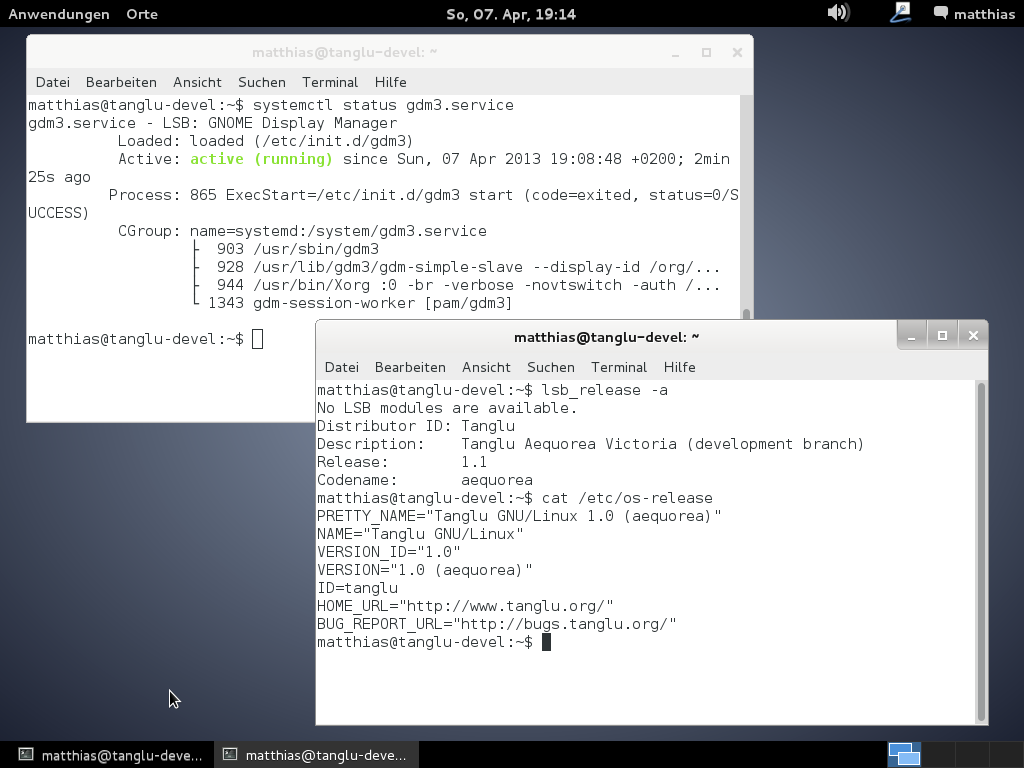
tanglu_sneak-peek_screenshot Something else I am involved in Debian for a very long time now, first as Debian Maintainer and then as Debian Developer and I never thought much about the work the Debian system administrators do. I didn t know how dak worked or how Wanna-build handles the buildds and what exactly the ftpmasters have to do. By not knowing, I mean I knew the very basic theory and what these people do. But this is something different than experiencing how much work setting up and maintaining the infrastructure is and what an awesome job the people do for Debian, keeping it all up and running and secure! Kudos for that, to all people maintaining Debian infrastructure! You rock! (And I will never ever complain about slow buildds or packages which stay in NEW for too long ;-) )

7 April 2013

Raphaël Hertzog: My Free Software Activities in March 2013

This is my monthly summary of my free software related activities. If you re among the people who made a donation to support my work (114.19 , thanks everybody!), then you can learn how I spent your money. Otherwise it s just an interesting status update on my various projects. Simple-CDD and debian-cd I tried to use wheezy s version of debian-cd and simple-cdd to generate an automatic installer. In this process, I filed a couple of bugs on simple-cdd (#701963: type-handling package is gone and should not be listed in default.downloads, and #701998: the --keyboard parameter is not working with wheezy s debian-installer) and I commited fixes for a few issues in debian-cd: Debian France I completed the new website for Debian France and I put it online. Later I merged some supplementary enhancements prepared by Tanguy Ortolo (and I gave him commits rights at the same time). I tried to update our Galette installation to the latest upstream version but I reverted to the former version after having encountered two problems (filed here and here). In the process, I created a Debian package for galette (you can grab it on git.debian.org). I also suggested an idea of improvement for Galette s paypal plugin and it has been quickly implemented. Thus I updated the plugin installed on france.debian.net. Kali related work It s been a few months that I have been helping the Kali team to prepare this new Debian derivative. Now that the derivative has gone public, I can attribute some of my Debian work to my collaboration with the Kali team. This month I contributed a few features and fixes to debian-installer and live-build: After the launch, we registered Kali in the derivative census. Paul Wise quickly reported some misfiled bugs from early Kali users and I discovered that reportbug was not behaving properly even though we correctly updated base-files (see #703678 on reportbug and #703677 on lsb-release). Misc packaging work DPL election I also spent quite some time to read and participate to the discussions on debian-vote since it was campaigning time for the DPL candidates Thanks This was a rather active month if you take into account the fact that I got a second son Lucas on March 6th. See you next month for a new summary of my activities.

4 comments Liked this article? Click here. My blog is Flattr-enabled.

5 April 2013

Phil Hands: AllTrials campaign

Ben Goldacre (Bad Science), is running a campaign for all medical trials to be published. It seems that best current evidence indicates that about half of the trials for treatments currently in use remain unpublished. That's pretty astounding when you think about it. Given that many of the trials that are published only compare new treatments against placebo, rather than against the best available existing treatment, and often barely show them as being more effective than homeopathy^Wsugar, one has to wonder how dire were the results that are not being published. If you prefer to have science done in the open, then I'd encourage you to visit www.alltrials.net and sign the petition and/or give them a donation. The fix is pretty straight-forward: Simply insist that clinical trials have to register before they start in order to be considered valid, and that all registered trials have to report their results. It need not be expensive to do -- a git repo. shared across the industry, containing a file for each trial in a standard format would do the trick probably. I imagine they'll come up with a more expensive solution, but in comparison to the cost of running a decent sized trial, it'll still be pocket change. (A note from the campaign, sent to existing petition signatories, is what prompted this blog post -- please read it and be inspired to help)

Matthew Garrett: Leaked UEFI signing keys

(See here for an update to this)

A hardware vendor apparently had a copy of an AMI private key on a public FTP site. This is concerning, but it's not immediately obvious how dangerous this is for a few reasons. The first is that this is apparently the firmware signing key, not any of the Secure Boot keys. That means it can't be used to sign a UEFI executable or bootloader, so can't be used to sidestep Secure Boot directly. The second is that it's AMI's key, not a board vendor - we don't (yet) know if this key is used to sign any actual shipping firmware images, or whether it's effectively a reference key. And, thirdly, the code apparently dates from early 2012 - even if it was an actual signing key, it may have been replaced before any firmware based on this code shipped.

But there's still the worst case scenario that this key is used to sign most (or all) AMI-based vendor firmware. Can this be used to subvert Secure Boot? Plausibly. The attack would involve producing a new, signed firmware image with Secure Boot either disabled or with an additional key installed, and then to reflash that firmware. Firmware images are very board-specific, so unless you're engaging in a very targeted attack you either need a large repository of firmware for every board you want to attack, or you need to perform in-place modification.

Taking a look at the firmware update tool used for AMI systems, the latter might be possible. It seems that the AMI firmware driver allows you to dump the existing ROM to a file. It'd then be a matter of pulling apart the firmware image, modifying the key database, putting it back together, signing it and flashing it. It looks like doing this does require that the user enter the firmware password if one's set, so the simplest mitigation strategy would be to do that.

So. If this key is used by most vendors shipping AMI-based firmware, and if it's a current (rather than test) key, then it may well be possible for it to be deployed in an automated malware attack that subverts the Secure Boot trust model on systems running AMI-based firmware. The obvious lesson here is that handing out your private keys to third parties that you don't trust is a pretty bad idea, as is including them in source repositories.

(Wow, was this really as long ago as 2004? How little things change)

comment count unavailable comments

Michal Čihař: Unknown phpMyAdmin features - server monitoring

phpMyAdmin has in last year received various useful features, which are not that well known. I've decided to give them some promotion before releasing phpMyAdmin 4.0. The server monitoring part is already present since phpMyAdmin 3.5, but some of the parts were further improved in 4.0. Server monitor Server monitor (as you can see on picture above or on demo server) allows you to follow server status in real time. Besides predefined charts, you can choose to follow any of MySQL server status variables or some system parameters. If you see something weird in the charts, you can select interval and inspect slow or general query log (if you have enabled it). This can help you finding most problematic queries for your server. Server configuration advisor Advisor (on picture above or on demo server) is another way to improve server performance - it comes with extensive set of rules, which can help you tuning performance for your workload. Your server has to be running for significant time to give some reasonable recommendations (so don't expect these on the demo server, which is restarted quite often). However it is still recommended to read server documentation before doing any adjustments, as the setting might have some side effects, which will affect your workload as well. Of course these are not magic pill to cure your unresponsive server, but can help you a lot in finding possible bottlenecks.

Filed under: English Phpmyadmin 0 comments Flattr this!

Daniel Pocock: Quickstart: Integrating SIP support into any application with reSIProcate

Today's applications are more dynamic and interactive than ever before, typically offering the user many ways to collaborate or get live data about their community or environment as they need it. Two open standards exist with a broad focus on real-time messaging and session control, SIP and XMPP (Jabber). Both of them have been supercharged by the development of technologies like WebRTC that makes every browser into a communications endpoint. Here, we look at integrating SIP into any C++ application (either client or server). We use the industry standard SIP stack reSIProcate. The quickest way to get started is with a Debian, Ubuntu or Fedora development environment. reSIProcate is conveniently packaged on all those platforms (for Fedora, it is not yet in yum and must be built from the tarball using rpmbuild). Getting the environment set up Once you have Debian or Ubuntu installed, just do:
# apt-get build-dep resiprocate
# apt-get install libresiprocate-1.8-dev
This will install all the necessary tools, libraries and header files. Headers are under /usr/include/resip Writing some code The object orientated nature of C++ is heavily leveraged by reSIProcate, and this makes it easy to code. The stack is based on a callback paradigm: you create some objects based on well-defined interfaces, give your objects to the stack, and put the stack into a loop. The stack will call your object when some event occurs (e.g. new incoming call, new text message) The easiest way to see this in practice is to browse the test cases. The test cases under the resip/dum(mirrored on github) section of the source tree provide good high-level examples of the type of code an application writes when using reSIProcate in an existing application. Sending a SIP text message Based on the basicMessage test case, I've created a trivial piece of code below to send a text message over SIP. The whole demo project is uploaded into github, see the README for instructions on how to build and run. Here, we have a quick look at the one object in the demo, it is notified on the progress of the SIP text message:
class ClientMessageHandler : public ClientPagerMessageHandler  
public:
   ClientMessageHandler()
      : finished(false),
        successful(false)
    
    ;
   virtual void onSuccess(ClientPagerMessageHandle, const SipMessage& status)
    
      InfoLog(<<"ClientMessageHandler::onSuccess\n");
      successful = true;
      finished = true;
    
   virtual void onFailure(ClientPagerMessageHandle, const SipMessage& status, std::auto_ptr<contents> contents)
    
      ErrLog(<<"ClientMessageHandler::onFailure\n");
      successful = false;
      finished = true;
    
   bool isFinished()   return finished;  ;
   bool isSuccessful()   return successful;  ;
private:
   bool finished;
   bool successful;
 ;
int main(int argc, char *argv[])
 
   // boilerplate initialisation code...
...
   NameAddr naTo(to.c_str());
   ClientPagerMessageHandle cpmh = clientDum.makePagerMessage(naTo);
   Data messageBody("Hello world!");
   auto_ptr<contents> content(new PlainContents(messageBody));
   cpmh.get()->page(content);
...
 
</contents></contents>
Going further with reSIProcate

4 April 2013

Martin Pitt: Urgent PostgreSQL security updates for Debian/Ubuntu

PostgreSQL just released security updates. 9.1 (as found in Debian testing and unstable and Ubuntu 11.10 and later) is affected by a critical remote vulnerability which potentially allows anyone who can access the TCP port (without credentials) to corrupt local files. If your PostgreSQL database exposes the TCP port to any potentially untrusted location, please shut down your servers and update now! PostgreSQL 8.4 for Debian stable (squeeze) and Ubuntu 8.04 LTS and 10.04 LTS also got an update, but these are much less urgent. Debian and Ubuntu advisories for all stable releases, as well as Debian testing are going out as we speak. The updates are already on security.debian.org and security.ubuntu.com. I also uploaded updates for Debian unstable (8.4, 9.1, and 9.2 in experimental) and the Ubuntu backports PPA, but it will take a bit for these to build as we don t have embargoed staging builds for those. Christoph updated the apt.postgresql.org repository as well. Warning: If you use the current Ubuntu raring Beta-2 candidate images, you will still have the old version. So if you do anything serious with those installations, please make sure to upgrade immediately. Update: Debian and Ubuntu security announcements have been sent out, and all packages in the backports PPA are built. Please see the official FAQ if you want to know some more details about the nature of the vulnerabilities.

Next.

Previous.