Search Results: "ag"

19 April 2007

MJ Ray: North Somerset Planning Farts

Two semi-related things. Firstly, I just got notice that North Somerset Council are going to let North Somerset Housing pointlessly tarmac over a square of grass near us. Planning application 07/P/0464/F claims to provide 3 additional car parking spaces, but it tarmacs 7m width of grass while marking 6m width of current tarmac as no-parking: a net addition of 1m! Not enough for even one additional car! Now they've made this officially-acceptable reasoning, I reckon it will feature in a planning application for building more houses on the village's green spaces. How about: you can build a new house as long as you mark an existing house as uninhabitable? Secondly, Clevedon residents are petitioning the Prime Minister to stop Tesco expansion as reported in the Mercury. Expanding the Tescopoly in Clevedon will harm what already looks to me like an endangered town centre. OK, it's not the PM's responsibility to stop one store expanding in one town, but it is his government's planning policies which are aiding and abetting the continued growth of unsustainable 'big box' stores. I can see Clevedon from my office window. I'd need binoculars to spot Morrisons, but I think Tesco is visible with the naked eye already from the top of Worlebury hill. Every Little Hurts but they just keep on rolling like Renard, not noticing the pain.

MJ Ray: TV Listings (2)

Rolandas commented:

"Do you know, that you can get free listings from broadcasting data services by going to http://www.bds.tv/ and registering as person? You need to pay money if you making money out of it."
No, I didn't know that. Thanks for the tip. It's hard to register with BDS because it isn't accessible - anyone know whether the listings are in a useful format? Still doesn't really change that the TV listings tax is unjust: why shouldn't we be able to publish remixes of this data that we already pay for?

MJ Ray: Online Banking: What works with GNU/Linux? (15)

Update: Francies commented:
"I also emailed Barclays regarding their non-listing of Linux and had the "128-bit encryption" where again Linux was not mentioned (have they even heard of it? A friend mentioned today that he has read that Barclays will be issuing chip and pin or card devices to all online banking users so could it be that these will be Windows only? If so the Linux community should complain in case all banks get the same idea."
I've also seen Barclays announce the chip-and-pin readers and a BBC report about them. Anyone seen these before? Comment form at the end of the page.

Michal Čihař: Debug packages for Gammu

As I have problem on getting useful reports from Gammu/Wammu crashes, I realised that having debug package for Gammu is good idea. However looking into official documentation didn't reveal how to achieve this. The wiki seems also miss information about this. Well then it must be something obvious. Fortunately I'm not only one who didn't find it on first attempt and dinosaur already wrote about this. However I still wonder why this didn't get to some official documentation. For now I wrote down this to wiki, so it is easier to find for anybody else.

Adam Rosi-Kessel: Adam s Super Simple Guide to mbox->maildir conversion

There are a lot of pages out there explaining how to convert your mail from mbox to maildir. I’m going to add one more, resurrecting the “tips” section of my blog. (All the tips from my blosxom days are grouped together on one page — someday I’ll get around to breaking those up properly.) If nothing else, I’ll never have to write these instructions in an email to someone again, instead I’ll just send them the link to this entry. I hope these steps are specific enough so anyone savvy enough to even have this problem in the first place will be able to follow them. One thing I find consistently concerns people when converting to maildir is how to make sure no mail is lost in the transition. The steps below address that concern. It’s really not hard at all once you understand how maildir works. First, I’m assuming you have mb2md installed and procmail support. Also, if you plan to access your mail through IMAP, your IMAP server needs to know to use ~/Maildir if ~/Mail does not exist. This is often default behavior (at least it is for Dovecot). Finally, I assume that your inbox is in /var/mail/username, and your other mail folders are in ~/mail. So, here goes:
  1. Edit your .procmailrc. The first two lines should read:
    MAILDIR=$HOME/Maildir
    DEFAULT=$MAILDIR/

    This will cause all new mail to be delivered (after you save your .procmailrc) to be stored in maildir format under ~/Maildir. The key for procmail to know to use the maildir format is the trailing slash in the “DEFAULT” line. Note that under the new system, your inbox and all your folders are kept in ~/Maildir, rather than having an inbox in /var/mail and your folders under your home directory. (This is nice because it makes it easier to back up all your mail together, among other things).
  2. If you have any specific procmail rules in your .procmailrc, you’ll also need to change the target folders for that. For example, if you have a spam filtering rule like this:
    :0 H
    * ^X-Spam-Level: *****
    spam
    It needs to be changed to this:

    :0 H
    * ^X-Spam-Level: *****
    .spam/

    The trailing slash, again, tells procmail to use maildir rather mbox format for delivery. The leading dot will make the folder appear properly for your IMAP client (there’s a trick I suggest below for making “dot” folders easy to access with a command line client like mutt).
If you have mail being delivered to a nested mail folder, an additional change is needed because maildir has a flat hierarchy. So if your mail was being delivered to “misc/other/spam” the new target should be “.misc.other.spam/”.
  • Save your .procmailrc. From this point forward, all mail will be delivered to your maildir folders. You can now import all your old mail to the new folders without concern. Since maildir stores each individual message as a separate unique file, you don’t need to worry about any overwriting issues while you are making the transition. New mail will be delivered to newly named files; old mail will be imported to other, unique, newly named files.
  • Import your mail folders:
    mb2md -s ~/mail -R
    The -R just means to import recursively through all your folders; if your mail folder is Mail rather than mail, use that instead. No destination is needed because mb2md uses ~/Maildir by default.
  • Import your inbox:
    mb2md -m
  • Move your old inbox out of the way. Most people won’t actually be able to move or delete files in /var/mail (since they don’t have directory write privileges), so the easiest thing is probably to just open the inbox in your IMAP client or with mutt and save or delete all the messages.
  • Move your old mail folder out of the way:mv ~/mail ,.bak Once you’ve confirmed that everything is okay, you should be able to delete ~/mail.bak (or compress it and move it elsewhere.) If you saved your inbox to mail folder in step 6, that will get moved out of the way here as well.
  • That’s it, you’re done.
  • Okay, so you’re not quite done if you access your mail with mutt rather than an IMAP client. (You could just point your mutt at your local IMAP server, of course). I’ve found the most convenient way to access the “dot” folders with mutt is to create a parallel symlinked folder structure without the dots. Here’s a hacked-together shell script that will do that. This could obviously be rewritten to be much more elegant (probably in perl). But we all have our messy scripts, right?

    #!/bin/bash
  • cd ~/Maildir for x in .*
    do
    y=$ x##.
    if ( echo $y grep -q ‘.’ )
    then
    mkdir -p ~/mymail/$ y%.*
    fi
    ln -s ~/Maildir/$x ~/mymail/ echo $y sed “s/.///g”
    done for x in *
    do
    ln -s ~/Maildir/$x ~/mymail
    done
    Then, just add these lines to your .muttrc file:
    set folder="~/mymail"
    set spoolfile=”~/mymail”
    Any questions?

    18 April 2007

    Jos Parrella: Sobre moderaci n en Planeta Linux

    Desde su concepci n, Planeta Linux ha exhortado a sus participantes a sindicar contenido exclusivamente relacionado con tecnolog a, computaci n, software libre y Linux, en orden incremental de preferencia. Pronto se determin que la exhortaci n no era suficiente y se pas al requerimiento. H ctor Colina y Milton Mazzarri, por nombrar dos venezolanos, estuvieron involucrados en los Lineamientos y las Preguntas Frecuentes de Planeta Linux Venezuela. Como para ese momento ya hab amos hecho un grupo inicial de “venezolanos con blog que hablan de Linux” (b sicamente gente de VELUG, SOLVE, Debian Venezuela y de unplug.org.ve), no tuvimos la oportunidad de requerirles que tuvieran una categor a dedicada a Planeta Linux. A las nuevas personas que se inscrib an por la lista, en ocasiones se les requer a la categor a si su blog conten a, a primera vista, contenido no relacionado con Linux. En todos los casos, se requer a estar de acuerdo con los Lineamientos. En el caso de las personas que me solicitaban a mi directamente (que desde hace no mucho tengo acceso al SVN de Planeta Linux) yo les requer a una categor a particular, a menos de que su software no lo permitiera. En este ltimo caso, muy a pesar de los quejones de oficio, elimin bamos a la persona de PL. Es el caso de Luigino Bracci, quien en alguna ocasi n lleg a llenar todo Planeta Linux con contenido pol tico parcializado, y quien manifest que su sistema de blogs no le permit a agregar categor as. Hay casos en los que una persona que escribe poco o que suele escribir de Linux llega y hace algun desastre al estilo Alberto Capella con su foto a tama o gigante. En esos casos alguien se da cuenta y me avisa (aunque es un error, al final de la p gina hay direcciones de contacto y en Venezuela somos varios que administramos!) pero estoy involucrado en muchas cosas como para dar respuesta inmediata a ese tipo de casos. Y ah viene otro problema. En Planeta Linux NO PODEMOS moderar un post o a una persona. Solo podemos suspenderlo o eliminarlo. No podemos borrar una imagen ni un post ni nada, porque en 15 minutos perdemos los cambios. Espero que eso de algunas luces cuando haya algo de que quejarse en Planeta Linux. El ltimo caso es particular. Jes s Lara hizo varios posts no relacionados con Linux en su blog. Particularmente hubo gente que reclam que hab an recien escrito algo relacionado con Linux y los posts de Jes s “empujaron” los posts relacionados con Linux hacia el final del Planeta. Por lo tanto suspendi la suscripci n de Jes s y lo contact el 9 de Abril. Cre una categor a y me lo comunic . Eso es suficiente para volver a reactivar su suscripci n (en este caso me tard unos d as porque el commit fall y nunca me enter de ello, ni Jes s me lo inform , realmente) Ya hay mucha gente que sindica categor as en PL, y pronto ser n muchos m s. Cont ctenme si quieren hacer el proceso pronto. Por favor, la pr xima vez que encuentren un problema en Planeta Linux:

    Benjamin Mako Hill: Feisty Release Fiesta

    With the Debian 4.0 (etch) release parties out of the way, it's time to devote a little energy to celebrating the forthcoming release of Ubuntu 7.04 (Feisty Fawn). A few of us from the nascent Massachusetts Loco Team in the Boston/Cambridge area have planned a release party -- a Feisty Fiesta if you will -- for Saturday April 21, 2007 19:30 at the Cambridge Brewing Company. For more details, answers to your questions, or to RSVP for the party so we can reserve a big enough table, please visit the party wiki page.

    Russell Coker: 2 node vs 3+ node clusters

    A comment on my post about the failure probability of clusters suggested that a six node cluster that has one node fail should become a five node cluster.

    The problem with this is what to do when nodes recover from a failure. For example if a six node cluster had a node fail and became a five node cluster, then became a three node cluster after another two nodes had failed, then you would have half the cluster that was disconnected. If the three nodes that appeared to have failed became active again but unable to see the other three nodes then you would have a split-brain situation.

    As noted in the comment the special case of a two node cluster does have different failure situations. If the connection between nodes goes down and the router can still be pinged then you can have a split brain situation. To avoid this you will generally have a direct connection between the two nodes (either a null-modem cable or a crossover Ethernet cable), such cables are more reliable than networking which involves a switch or hub. Also the network interface which involves the router in question will ideally also be used as a method of maintaining cluster status - it seems unlikely that two nodes will both be able to ping the router but be unable to send data to each other.

    For best reliability you need to use multiple network interfaces between cluster nodes. One way of doing this is to have a pair of Ethernet ports bonded for providing the service (connected to two switches and pinging a router to determine which switch is best to use). The Heartbeat software supports encrypted data so it should be safe to run it on the same interface as used for providing the service (of course if you provide a service to the public Internet then you want a firewall to prevent machines on the net from trying to attack it).

    Heartbeat also supports using multiple interfaces for maintaining the cluster data, so you can have one network dedicated to cluster operations and the network that is used for providing the service can be a backup network for cluster data. The pingd service allows Heartbeat to place services on nodes that have good connectivity to the net. So you could have multiple nodes that each have one Ethernet port for providing the service and one port as a backup for Heartbeat operations, if pingd indicates that the service port was not functioning correctly then the services would be moved to other nodes.

    If you want to avoid having private Heartbeat data going over the service interface then in the two-node case you need a minimum of two Ethernet ports for Heartbeat and one port for providing the service if you use pingd. If you don't use pingd then you need two bonded ports for providing the service and two ports (either bonded or independently configured in Hertbeat) for Heartbeat giving a total of four ports.

    When there are more than two nodes in the cluster the criteria for cluster membership is that a majority of nodes are connected. This makes split-brain impossible and reduces the need to have reliable Ethernet interfaces. A cluster with three or more nodes could have a single service port and a single private port for Heartbeat, or if you trust the service interface you could do it all on one Ethernet port.

    In summary, three nodes is better than two, but requires more hardware. Five nodes is better than three, but as I wrote in my previous post four nodes is not much good. I recommend against any even number of nodes other than two for the same reason.

    Eddy Petrișor: wiki.d.o theme

    As Bastian has pointed out, wiki.debian.org has a butt-ugly theme. I agree.

    Some of the people that were present in Extremadura in September know that I was working at the time to make a wiki theme more integrated with the www.debian.org theme.

    The result is partially complete, but is better, IMHO, than the ugly default theme. Sceenshots and the source is available (in a darcs repo). If anyone cares to continue and close all the remaining points, I would be glad to see that theme changed.

    Unless somebody does something about both issues.

    Comments are welcome! Contributions are welcome, you just do:

    darcs get http://users.alioth.debian.org/~eddyp-guest/darcs/wiki.debian.org_theme/

    And hack on that modern-wiki.debian.org theme

    Meike Reichle: Blog Birthday

    I recently read through my blog's archive and guess what, today is its official second birthday! :) Its very first post was exactly two years ago and dealt with the upcoming LinuxTag. Thinking back, this blog has come a long way: from a simple list-like page without any navigational elements in my student webspace (constantly being in trouble with my 20Mb quota), to my first forays into php, to a rather horrible nested tables fest hosted on a friend's server, to today when I finally got my own server and domain and returned to simple handwritten html + css and blosxom. Its choice of content has mainly remained the same though: Debian, uni, personal life and the the occasional rant when there was nowhere else to complain ;)

    Enrico Zini: 5-star-hotel

    5 star hotel tips There are things you don't think about until you spend 2 weeks in a 5 star hotel. In 5 star hotels you have a minibar that you're not supposed to open unless you want to be charged something stupid like 10 euros for 25cl of still water claiming to have been bottled in the opposite side of the world from where the hotel is located. But on top of the minibar there are glasses you can use for drinking, and an ice bucket you can refill in the corridor. This allows you to put ice in tap water. If the tap water is undrinkable, buy a 3l water bottle in the nearby supermarket and use the ice to make it colder without upsetting the minibar. Note: this specific minibar has sensors, and charges you the very moment you take things away from the fridge, so it's out of the question to temporarily empty it to put my things in for a while. Now, the ice bucket, the ice clips in the ice bucket and the glasses used for drinking, how do they clean them? Are they sent 6 floors downstairs to the dishwasher? Certainly not. They use the DETERGENT FOR THE WINDOWS. I went to get some ice and realised that the inside of the bucket (and the ice clip to put the ice in your cocktails) smelled like window detergent. Then I sniffed around: same did the glasses, and one had leftover foam in the bottom. So I had to wash the toxic stuff away from them before using them. Now I can assume that I have to wash the glasses every time I need them, as I know that they are not necessarily cleaned with food-safe detergents. So, here's the tip: before leaving the room in the morning, I put glasses and ice bucket back on the tray on top of the fridge, and I put the cheap-pretending-to-be-fancy cocktail mixing plastic sticks back in the glasses. This succeeded in tricking the cleaning people into believing that I didn't use them. As a consequence they didn't clean them, and now I can use them without needing to wash the window detergent away first. Another tip: don't leave your shoes next to the sofa, or the cleaning staff will put them on the sofa when cleaning (sometimes they forget them on the sofa, so you realise). Even better: don't put them next to the bed. Another tip: if the breakfast buffet has only scary things it takes half a day to digest, make friend with the omelette cook.

    Neil McGovern: Make me pwetty clothes...

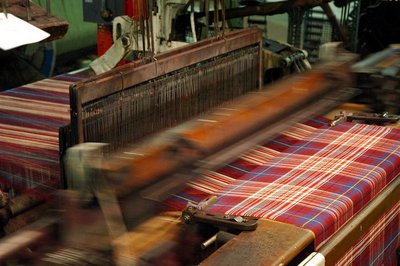
    As some people may know, there's a group of us getting some official Debian Tartan (thanks to Phil at hands.com) kits made up for DebConf 7.
    Moray got back from the weavers today, with a nice photo of the tartan being weaved :)

    Biella Coleman: The Importance of Celebration

    Recently a Debian user left a really nice note letting me know “It makes
    me happy and proud to learn that boricuas are Debian developers! (Hopefully you are not the only one). This is for me the best Debian News since Etch released. Proud and happy for you.” Here I have to confess, however that I am neither a DD nor really a true Boriqua. I have studied Debian for many years, but have never officially joined. In terms of PR, none of my family is originally from there as my father is Jewish American and my mom was born in Russian, wandered as war refugee for many years in Europe and eventually landed in Venezuela, where I was born. But I have made my home in PR for many years and do consider it one of my many homes. Speaking of many homes, I also feel, even though I am not a DD, that Debian is an important touchstone in my life. It reminded me of a conversation I had with Manoj recently related to this topic, who almost mistook me for a DD: [biella] who is that DD that wrote an anthro thesis on debian? [08:55]
    [biella] he is brazilian [manoj] I was gonna say that the dd who did an anthro thesis on debian
    was you, then it struck me that you are not a dd, but I still
    think of you as one now, and then it struck me further that
    making you a dd might compromise your postiion as an observer After many years following the project, I have grown quite attached to it, and every year, a few months before Debconf I am reminded of this attachment. I have managed to make Debconf only every other year, and usually when I face this fact, a sense of melancholia and slight sadness sets in, especially when I hear of everyone making plans to go. I always start to question my decision to stay back, then hit all sorts of websites for cheap tickets, and start to wonder if I can perhaps manage to complete some work there, which is the main reason this year I am staying away. I then make myself confront REALITY and remind myself that the whole reason I love attending Debconf is because of its extreme vitality, which after a week, leaves you wrung out and tired, because you put so much of your attention and mind, soul and heart in the events. So even if I go for a week, or longer, you usually need a week ore more to recover. I am not sure I can spare such time this year, especially since less than a month after Debconf, I am packing my bags and moving back to the east coast of the United States. And as I learned last year and the year before and two years before, these sorts of long-distance moves take a lot of your time. My longing reminds me of how important it is to celebrate those things in life you love. And while there is more to Debconf than a celebration, much of it is just that, a chance, a space, a place by which and where you celebrate. And since I sit only in the shadows of Debian, I imagine the pleasure and joy runs deeper and wider for those who sit at its heart. So if you are on the fence on whether to go, this is your friendly public service announcement that it is, indeed, so worth your while.

    Lars Wirzenius: Random hacks: Notetak 0.14

    I've rewritten Notetak, my search centric note taking application for GNOME. The goal of the rewrite was to make the code clearer, and to get test coverage to 100% on the statement level. Both goals achieved. Functionally, the new version should be identical to the old one, but I'm sure I missed something. Now that the code is clean again, I expect to start adding new things every now and then.

    Jordi Mallach: Debian's GNOME 2.18: are we there yet?

    The short answer is no, but as our status page easily reflects, there has been lots of work going on during the last two weeks, once etch's release unblocked the way to upload new versions to unstable. This post intends to resume the trend of updating on the status of GNOME in Debian, after we ended up deciding we'd ship etch with 2.14 for a number of reasons, most notably some complications with the GTK 2.10 transition at that time. You'll be able to find other related news items in Debian GNOME team's website. What has the Debian GNOME team up to during the last 6 months? Our first priority was to focus on unstable's GNOME 2.14 packages again, in an attempt to fix any outstanding remaining bugs from our packaging, and get them in the best shape possible to deliver a polished GNOME desktop for etch. I think the result is really good, and Debian's default GNOME desktop is both very usable and attractive. In parallel, the preparations for a complete set of GNOME 2.16 packages continued in our Subversion repository and kept appearing, little by little, in experimental. The most visible consequence of our 2.16 efforts translated into nobse's backport of 2.16 for etch, which can be found in the corresponding repository. And then, with etch deep frozen and nearly ready to be released, GNOME 2.18 was released, and of course the GNOME team didn't wait too much to start working on it. Our current status is looking good: the Developer Platform is already available in unstable, although buildd's are fighting the builds on various architectures. When the dust settles (GTK 2.10's landing has generated quite a big cloud; we have a list of packages that still haven't completed the GTK+ 2.10 transition), we'll be able to prepare and upload the more complex Desktop components like the panel, nautilus, evolution or control-center. Unstable users should probably be seeing daily progress on this front, so keep an eye on your package managers! Although Debian 4.0 released with an old version of GNOME, vast amounts of time and work have been invested to release it with the necessary backported fixes and enhancements. The newer GNOME versions have been available in Debian official ftp archives in very reasonable timeframes; this has only been possible thanks to the restless efforts of the (fortunately) growing Debian GNOME team members: giskard, feedback, HE, lool, np237, slomo, shaka, sjoerd, xaiki and not forgetting our incredible bug triager, svena. Thanks! On the behind the scenes department, it's a pleasure to report that Lo c Minier and Jordi Mallach very recently joined the GNOME Foundation's board of advisors in representation of the Debian Project, replacing Matthew Garrett, who has been representing us for the last few years until he left the project. Thanks, Matthew!
    Ben Armstrong: The children of Debian

    Who are the next generation of Debianists? Are they all still coming to us out of different OS backgrounds, or do we now have the significant beginnings of a home grown generation, born and raised in Debian-using families and now making their voices heard? I hope that Debian Jr. will encourage this kind of generational growth of the project. When recently I rewrote the guiding principles of Debian Jr., my vision was a Debian that children would identify as their own. I expect they will be eager to add their own ideas as they grow up with it. It was pointed out to me today that there is some evidence that this is already happening (thanks for the link, Matthew Wilcox). As for my own kids, ages 16, 15, 12, 9 and 5, only the oldest have ever used some system at home other than Debian1. They all comfortably use our Debian systems daily, discussing regularly with me what they need. This leads to filing bugs and patches on their behalf2, and inspires further development of the Debian Jr. project. So, in at least this sense, the children of Debian are already contributing members of Debian, if not voting members. The ideas of families are improving Debian for everyone. As the project grows, I expect the ways in which families will change Debian will be more significant, not only technically but also in Debian’s character.

    1 Before we started using Debian in 1995, the family system was a VT-420 terminal connected to the Solaris system running our community freenet. At that time our kids would sit in my lap and play at typing into pico for their amusement.

    2 For instance, I was pleased to discover the other day that my egoboo patch was accepted. That was a direct result of my kids asking me to make it work for them.

    Margarita Manterola: Getting a Rhino

    Ever since I stopped doing webpages, I've been missing having my own Rhino (the one I used in the past was not mine), but since I wasn't doing any JavaScript, it didn't make sense to spend U$S 50 on a book I wouldn't use. Now, with the interactive web inteface for Debbugs being accepted as a Google Summer of Code project, I finally decided to buy one for me. I ordered it yesterday from Amazon. I hope it gets here soon.

    Michal Čihař: CIA taken over

    When migrating tags from Bazaar to Subversion, I generated lots of commits. When I did that, I didn't realise, that CIA will count all my tagging as commit and I will become most active author and Wammu will read 6th position among most active projects. Anyway this has just happened and maybe it will advertise Wammu a bit. But don't expect that I or my projects will reappear there in near future ;-).

    Joey Hess: tour of the Debian 4.0 CDs

    A complete set of Debian 4.0 on CD and DVD consists of 292 CDs and 39 DVDs. If you've downloaded or bought all 331 discs, here's how you can throw 324 of them away. Or, how to pick the right ones to get in the first place. First, the one disc that is all you really need for Debian 4.0: The multi-arch DVD! This is the neatest disc available for etch, it can boot on x86 systems, both 32 bit (i386) and 64 bit (amd64), as well as on powerpcs. It will detect the architecture and automatically boot the right one. It contains enough software to install a nice desktop using only the DVD, no network needed. And it includes the source code to all that software on the same DVD. This DVD is perfect for giving out at conferences, or to friends, or for that desert island scenario, and it's really the only Debian disc you need. If you want a second Debian disc, I recommend the netinst CD. This disc is under 200 megabytes in size and is designed to be written to a 3" mini-CD. Much easier to carry around than a full-size CD, so it's great for those Debian installs that you didn't expect. It's also a handy rescue disc (just boot with "rescue"). Four other CDs are of some interest, to round out your collection. The multi-arch CD has the same software as the netinst CD, but it's a full-size CD, that supports the same three architectures as the multi-arch DVD. The first CD from the CD set can install a Gnome desktop system without accessing the network and is a good general-purpose CD. The KDE CD and XFCE CD provide some choice in which desktop environment you install. Finally, one other CD merits mention. The businesscard CD is a tiny but full-featured Debian CD that can be written to a square or "hockey rink" shaped disc that is sized the same as a business card. This can be an eye-catching giveaway, if you can get the businesscard CDs produced in bulk on the cheap (if you do, please let me know). My experience with putting them in a wallet though is that they won't last more than a few weeks. If you want to have Debian installation/rescue media you can carry with you everywhere, you'll have better luck with an inexpensive bootable USB keychain. The other 324 discs are only of interest to archivists, completists, and those in certian oddball scenarios.

    17 April 2007

    Gunnar Wolf: Init-related ideas BoF submitted for Debcamp

    Ok, so it just seems like a hot topic - I just submitted a BoF for Debcamp to talk about the init-related ideas we've been discussing. As Debconf's Pentabarf conference management system does not like disclosing talk details before the talks are accepted, I'll reproduce here my short blurb:
    This BoF comes out from several ideas posted in Planet Debian by Erich Schubert, Sven M ller, Joachim Breitner, Mike Homey and myself (so far). It's not to be "chaired" by any of us particularly, but I expect an interesting brainstorming session.
    There are several different init systems present in Debian - However, we are only supporting currently one of them, good ol' sysv-rc - We have close to a thousand packages providing init scripts suitable for it, and close to none for all of the other systems.
    In current systems, full of hot-pluggable devices, changing network configurations and so on, however, I think this situation is quite prone to change - sysv-rc and its runlevels are better suited for stable server-like systems, and is hard to adapt for future needs.
    We will talk about the potential difficulties Debian will face in order to better support more init schemes, and discuss some ideas to solve them.
    This should be a brainstorming session, not much material will be prepared (maybe some sketches by each of us, but nothing formal). If you plan on attending, take a look at the messages linked to in the 'links' section.
    Note that, following Nomeata's suggestion, I'm presenting this for Debcamp - If you are not attending Debcamp and are interested, we will try to set this up via some sort of videoconferencing (or at least the usual video feed + IRC feedback), and I do hope we can have something showable (at least a broken concept) after Debconf.
    In not-so-closely-related topics, I just learnt there is a shadow of doubt regarding my presence in Edinburgh - I will do my best to dispell the threat. I just don't want to miss a Debconf!

    Next.

    Previous.