A new release 0.3.3.9.3 of RcppEigen arrived on CRAN moments ago (and just went to Debian). Eigen is a C++ template library for linear algebra: matrices, vectors, numerical solvers, and related algorithms.
This update is again mostly maintenance. To accomodate one small aspect of the Fortran interface, we now require R 3.6.0 or later. Jonah Gabry spotted a really old typo and fixed it. The fastLm support code now uses the unabbreviated df.residual. We accomodated clang-15 in one signature as is common with many recent uploads, and also updated one aspect of GitHub Actions.
And once again as we said for the last four releases:
One additional and recent change was the accomodation of a recent CRAN Policy change to not allow gcc or clang to mess with diagnostic messages. A word of caution: this may make your compilation of packages using RcppEigen very noisy so consider adding -Wno-ignored-attributes to the compiler flags added in your ~/.R/Makevars.
We still find this requirement rather annoying. Eigen is only usable if you set, say,
asoptions in~/.R/Makevars . But CRAN makes the rules. Maybe if a few of us gently and politely nudge them they may relent one day. One can only hope.
The complete NEWS file entry follows.
Changes in RcppEigen version 0.3.3.9.3 (2022-11-04)
The dependency on R is now versioned to 3.6.0 or later for support for USE_FC_LEN_T from Fortran.
An old example typo was corrected (Jonah Gabry in #114).
The fastLm methods now reference df.residual by its full name (Closes #115).
A function prototype was updated for clang-15.
GitHub Actions were updated to checkout version 3.
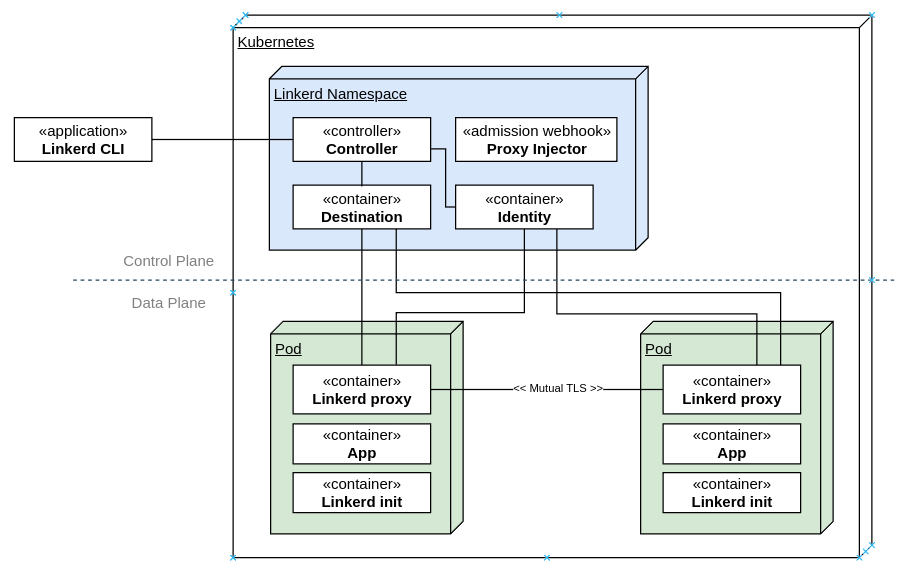
If you ve done anything in the Kubernetes space in recent years, you ve most likely come across the words Service Mesh . It s backed by a set of mature technologies that provides cross-cutting networking, security, infrastructure capabilities to be used by workloads running in Kubernetes in a manner that is transparent to the actual workload. This abstraction enables application developers to not worry about building in otherwise sophisticated capabilities for networking, routing, circuit-breaking and security, and simply rely on the services offered by the service mesh.In this post, I ll be covering Linkerd, which is an alternative to Istio. It has gone through a significant re-write when it transitioned from the JVM to a Go-based Control Plane and a Rust-based Data Plane a few years back and is now a part of the CNCF and is backed by Buoyant. It has proven itself widely for use in production workloads and has a healthy community and release cadence.It achieves this with a side-car container that communicates with a Linkerd control plane that allows central management of policy, telemetry, mutual TLS, traffic routing, shaping, retries, load balancing, circuit-breaking and other cross-cutting concerns before the traffic hits the container. This has made the task of implementing the application services much simpler as it is managed by container orchestrator and service mesh. I covered Istio in a prior post a few years back, and much of the content is still applicable for this post, if you d like to have a look.Here are the broad architectural components of Linkerd:The components are separated into the control plane and the data plane.The control plane components live in its own namespace and consists of a controller that the Linkerd CLI interacts with via the Kubernetes API. The destination service is used for service discovery, TLS identity, policy on access control for inter-service communication and service profile information on routing, retries, timeouts. The identity service acts as the Certificate Authority which responds to Certificate Signing Requests (CSRs) from proxies for initialization and for service-to-service encrypted traffic. The proxy injector is an admission webhook that injects the Linkerd proxy side car and the init container automatically into a pod when the linkerd.io/inject: enabled is available on the namespace or workload.On the data plane side are two components. First, the init container, which is responsible for automatically forwarding incoming and outgoing traffic through the Linkerd proxy via iptables rules. Second, the Linkerd proxy, which is a lightweight micro-proxy written in Rust, is the data plane itself.I will be walking you through the setup of Linkerd (2.12.2 at the time of writing) on a Kubernetes cluster.Let s see what s running on the cluster currently. This assumes you have a cluster running and kubectl is installed and available on the PATH.
On most systems, this should be sufficient to setup the CLI. You may need to restart your terminal to load the updated paths. If you have a non-standard configuration and linkerd is not found after the installation, add the following to your PATH to be able to find the cli:
export PATH=$PATH:~/.linkerd2/bin/
At this point, checking the version would give you the following:
$ linkerd version
Client version: stable-2.12.2
Server version: unavailable
Setting up Linkerd Control PlaneBefore installing Linkerd on the cluster, run the following step to check the cluster for pre-requisites:
kubernetes-api
--------------
  can initialize the client
  can query the Kubernetes API
kubernetes-version
------------------
  is running the minimum Kubernetes API version
  is running the minimum kubectl version
pre-kubernetes-setup
--------------------
  control plane namespace does not already exist
  can create non-namespaced resources
  can create ServiceAccounts
  can create Services
  can create Deployments
  can create CronJobs
  can create ConfigMaps
  can create Secrets
  can read Secrets
  can read extension-apiserver-authentication configmap
  no clock skew detected
linkerd-version
---------------
  can determine the latest version
  cli is up-to-date
Status check results are
All the pre-requisites appear to be good right now, and so installation can proceed.The first step of the installation is to setup the Custom Resource Definitions (CRDs) that Linkerd requires. The linkerd cli only prints the resource YAMLs to standard output and does not create them directly in Kubernetes, so you would need to pipe the output to kubectl apply to create the resources in the cluster that you re working with.
$ linkerd install --crds   kubectl apply -f -
Rendering Linkerd CRDs...
Next, run  linkerd install   kubectl apply -f -  to install the control plane.
customresourcedefinition.apiextensions.k8s.io/authorizationpolicies.policy.linkerd.io created
customresourcedefinition.apiextensions.k8s.io/httproutes.policy.linkerd.io created
customresourcedefinition.apiextensions.k8s.io/meshtlsauthentications.policy.linkerd.io created
customresourcedefinition.apiextensions.k8s.io/networkauthentications.policy.linkerd.io created
customresourcedefinition.apiextensions.k8s.io/serverauthorizations.policy.linkerd.io created
customresourcedefinition.apiextensions.k8s.io/servers.policy.linkerd.io created
customresourcedefinition.apiextensions.k8s.io/serviceprofiles.linkerd.io created
Next, install the Linkerd control plane components in the same manner, this time without the crds switch:
$ linkerd install   kubectl apply -f -
namespace/linkerd created
clusterrole.rbac.authorization.k8s.io/linkerd-linkerd-identity created
clusterrolebinding.rbac.authorization.k8s.io/linkerd-linkerd-identity created
serviceaccount/linkerd-identity created
clusterrole.rbac.authorization.k8s.io/linkerd-linkerd-destination created
clusterrolebinding.rbac.authorization.k8s.io/linkerd-linkerd-destination created
serviceaccount/linkerd-destination created
secret/linkerd-sp-validator-k8s-tls created
validatingwebhookconfiguration.admissionregistration.k8s.io/linkerd-sp-validator-webhook-config created
secret/linkerd-policy-validator-k8s-tls created
validatingwebhookconfiguration.admissionregistration.k8s.io/linkerd-policy-validator-webhook-config created
clusterrole.rbac.authorization.k8s.io/linkerd-policy created
clusterrolebinding.rbac.authorization.k8s.io/linkerd-destination-policy created
role.rbac.authorization.k8s.io/linkerd-heartbeat created
rolebinding.rbac.authorization.k8s.io/linkerd-heartbeat created
clusterrole.rbac.authorization.k8s.io/linkerd-heartbeat created
clusterrolebinding.rbac.authorization.k8s.io/linkerd-heartbeat created
serviceaccount/linkerd-heartbeat created
clusterrole.rbac.authorization.k8s.io/linkerd-linkerd-proxy-injector created
clusterrolebinding.rbac.authorization.k8s.io/linkerd-linkerd-proxy-injector created
serviceaccount/linkerd-proxy-injector created
secret/linkerd-proxy-injector-k8s-tls created
mutatingwebhookconfiguration.admissionregistration.k8s.io/linkerd-proxy-injector-webhook-config created
configmap/linkerd-config created
secret/linkerd-identity-issuer created
configmap/linkerd-identity-trust-roots created
service/linkerd-identity created
service/linkerd-identity-headless created
deployment.apps/linkerd-identity created
service/linkerd-dst created
service/linkerd-dst-headless created
service/linkerd-sp-validator created
service/linkerd-policy created
service/linkerd-policy-validator created
deployment.apps/linkerd-destination created
cronjob.batch/linkerd-heartbeat created
deployment.apps/linkerd-proxy-injector created
service/linkerd-proxy-injector created
secret/linkerd-config-overrides created
Kubernetes will start spinning up the data plane components and you should see the following when you list the pods:
kubernetes-api
--------------
  can initialize the client
  can query the Kubernetes API
kubernetes-version
------------------
  is running the minimum Kubernetes API version
  is running the minimum kubectl version
linkerd-existence
-----------------
  'linkerd-config' config map exists
  heartbeat ServiceAccount exist
  control plane replica sets are ready
  no unschedulable pods
  control plane pods are ready
  cluster networks contains all pods
  cluster networks contains all services
linkerd-config
--------------
  control plane Namespace exists
  control plane ClusterRoles exist
  control plane ClusterRoleBindings exist
  control plane ServiceAccounts exist
  control plane CustomResourceDefinitions exist
  control plane MutatingWebhookConfigurations exist
  control plane ValidatingWebhookConfigurations exist
  proxy-init container runs as root user if docker container runtime is used
linkerd-identity
----------------
  certificate config is valid
  trust anchors are using supported crypto algorithm
  trust anchors are within their validity period
  trust anchors are valid for at least 60 days
  issuer cert is using supported crypto algorithm
  issuer cert is within its validity period
  issuer cert is valid for at least 60 days
  issuer cert is issued by the trust anchor
linkerd-webhooks-and-apisvc-tls
-------------------------------
  proxy-injector webhook has valid cert
  proxy-injector cert is valid for at least 60 days
  sp-validator webhook has valid cert
  sp-validator cert is valid for at least 60 days
  policy-validator webhook has valid cert
  policy-validator cert is valid for at least 60 days
linkerd-version
---------------
  can determine the latest version
  cli is up-to-date
control-plane-version
---------------------
  can retrieve the control plane version
  control plane is up-to-date
  control plane and cli versions match
linkerd-control-plane-proxy
---------------------------
  control plane proxies are healthy
  control plane proxies are up-to-date
  control plane proxies and cli versions match
Status check results are
Everything looks good.Setting up the Viz ExtensionAt this point, the required components for the service mesh are setup, but let s also install the viz extension, which provides a good visualization capabilities that will come in handy subsequently. Once again, linkerd uses the same pattern for installing the extension.
$ linkerd viz install   kubectl apply -f -
namespace/linkerd-viz created
clusterrole.rbac.authorization.k8s.io/linkerd-linkerd-viz-metrics-api created
clusterrolebinding.rbac.authorization.k8s.io/linkerd-linkerd-viz-metrics-api created
serviceaccount/metrics-api created
clusterrole.rbac.authorization.k8s.io/linkerd-linkerd-viz-prometheus created
clusterrolebinding.rbac.authorization.k8s.io/linkerd-linkerd-viz-prometheus created
serviceaccount/prometheus created
clusterrole.rbac.authorization.k8s.io/linkerd-linkerd-viz-tap created
clusterrole.rbac.authorization.k8s.io/linkerd-linkerd-viz-tap-admin created
clusterrolebinding.rbac.authorization.k8s.io/linkerd-linkerd-viz-tap created
clusterrolebinding.rbac.authorization.k8s.io/linkerd-linkerd-viz-tap-auth-delegator created
serviceaccount/tap created
rolebinding.rbac.authorization.k8s.io/linkerd-linkerd-viz-tap-auth-reader created
secret/tap-k8s-tls created
apiservice.apiregistration.k8s.io/v1alpha1.tap.linkerd.io created
role.rbac.authorization.k8s.io/web created
rolebinding.rbac.authorization.k8s.io/web created
clusterrole.rbac.authorization.k8s.io/linkerd-linkerd-viz-web-check created
clusterrolebinding.rbac.authorization.k8s.io/linkerd-linkerd-viz-web-check created
clusterrolebinding.rbac.authorization.k8s.io/linkerd-linkerd-viz-web-admin created
clusterrole.rbac.authorization.k8s.io/linkerd-linkerd-viz-web-api created
clusterrolebinding.rbac.authorization.k8s.io/linkerd-linkerd-viz-web-api created
serviceaccount/web created
server.policy.linkerd.io/admin created
authorizationpolicy.policy.linkerd.io/admin created
networkauthentication.policy.linkerd.io/kubelet created
server.policy.linkerd.io/proxy-admin created
authorizationpolicy.policy.linkerd.io/proxy-admin created
service/metrics-api created
deployment.apps/metrics-api created
server.policy.linkerd.io/metrics-api created
authorizationpolicy.policy.linkerd.io/metrics-api created
meshtlsauthentication.policy.linkerd.io/metrics-api-web created
configmap/prometheus-config created
service/prometheus created
deployment.apps/prometheus created
service/tap created
deployment.apps/tap created
server.policy.linkerd.io/tap-api created
authorizationpolicy.policy.linkerd.io/tap created
clusterrole.rbac.authorization.k8s.io/linkerd-tap-injector created
clusterrolebinding.rbac.authorization.k8s.io/linkerd-tap-injector created
serviceaccount/tap-injector created
secret/tap-injector-k8s-tls created
mutatingwebhookconfiguration.admissionregistration.k8s.io/linkerd-tap-injector-webhook-config created
service/tap-injector created
deployment.apps/tap-injector created
server.policy.linkerd.io/tap-injector-webhook created
authorizationpolicy.policy.linkerd.io/tap-injector created
networkauthentication.policy.linkerd.io/kube-api-server created
service/web created
deployment.apps/web created
serviceprofile.linkerd.io/metrics-api.linkerd-viz.svc.cluster.local created
serviceprofile.linkerd.io/prometheus.linkerd-viz.svc.cluster.local created
A few seconds later, you should see the following in your pod list:
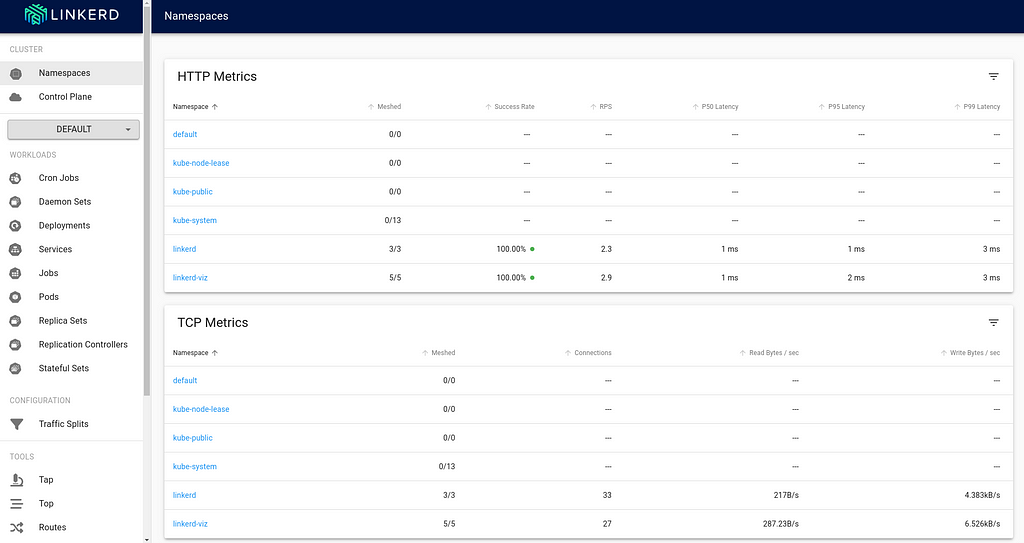
The viz components live in the linkerd-viz namespace.You can now checkout the viz dashboard:
$ linkerd viz dashboard
Linkerd dashboard available at:
http://localhost:50750
Grafana dashboard available at:
http://localhost:50750/grafana
Opening Linkerd dashboard in the default browser
Opening in existing browser session.
The Meshed column indicates the workload that is currently integrated with the Linkerd control plane. As you can see, there are no application deployments right now that are running.Injecting the Linkerd Data Plane componentsThere are two ways to integrate Linkerd to the application containers:1 by manually injecting the Linkerd data plane components 2 by instructing Kubernetes to automatically inject the data plane componentsInject Linkerd data plane manuallyLet s try the first option. Below is a simple nginx-app that I will deploy into the cluster:
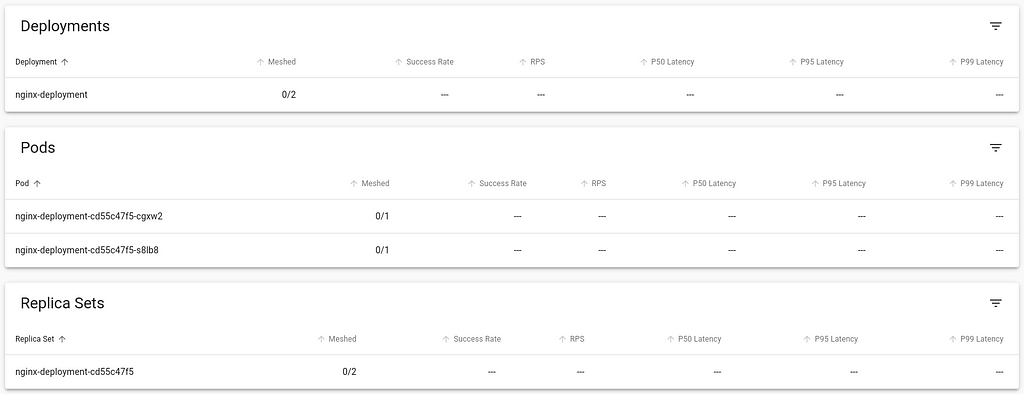
Back in the viz dashboard, I do see the workload deployed, but it isn t currently communicating with the Linkerd control plane, and so doesn t show any metrics, and the Meshed count is 0:Looking at the Pod s deployment YAML, I can see that it only includes the nginx container:
Let s directly inject the linkerd data plane into this running container. We do this by retrieving the YAML of the deployment, piping it to linkerd cli to inject the necessary components and then piping to kubectl apply the changed resources.
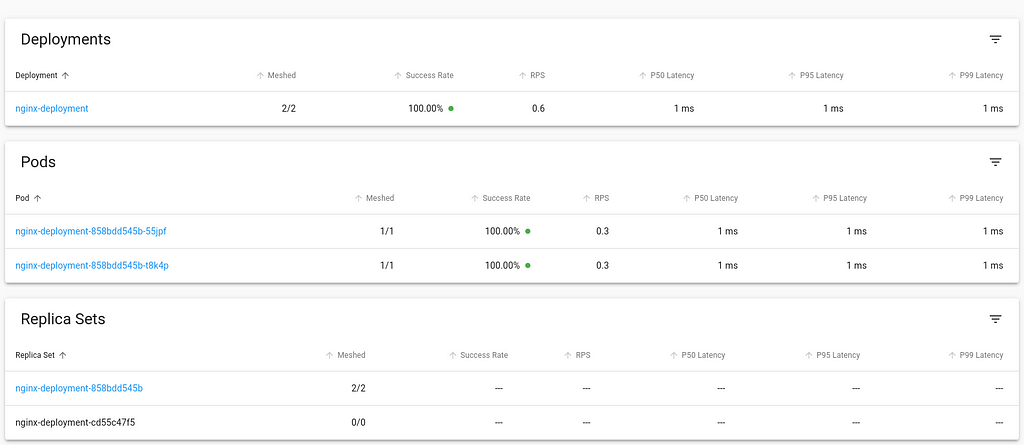
Back in the viz dashboard, the workload now is integrated into Linkerd control plane.Looking at the updated Pod definition, we see a number of changes that the linkerd has injected that allows it to integrate with the control plane. Let s have a look:
At this point, the necessary components are setup for you to explore Linkerd further. You can also try out the jaeger and multicluster extensions, similar to the process of installing and using the viz extension and try out their capabilities.Inject Linkerd data plane automaticallyIn this approach, we shall we how to instruct Kubernetes to automatically inject the Linkerd data plane to workloads at deployment time.We can achieve this by adding the linkerd.io/inject annotation to the deployment descriptor which causes the proxy injector admission hook to execute and inject linkerd data plane components automatically at the time of deployment.
This annotation can also be specified at the namespace level to affect all the workloads within the namespace. Note that any resources created before the annotation was added to the namespace will require a rollout restart to trigger the injection of the Linkerd components.Uninstalling LinkerdNow that we have walked through the installation and setup process of Linkerd, let s also cover how to remove it from the infrastructure and go back to the state prior to its installation.The first step would be to remove extensions, such as viz.
A brand-new version 0.0.9 of RcppSpdlog got onto CRAN overnight. RcppSpdlog bundles spdlog, a wonderful header-only C++ logging library with all the bells and whistles you would want that was written by Gabi Melman, and also includes fmt by Victor Zverovich.
This release contains two changes. First, we extend usability by offering both a set of simple R functions for logging from R, and a matching set of functions at the C++ level that are directly callable (and exported) from this package (so that client packages do not need to compile). Both these changes are described (as sections seven and eight) in the vignette. Second, while we were working on this Gabi released version 1.11.0 upstream so we included this as well.
The NEWS entry for this release follows.
1.3 billion announced for new Forestry Support
Funds to be delivered through new Forestry Programme
Premiums for planting trees to be increased by between 46% and 66% and extended to 20 years for farmers
#GreensInGovernment
The Taoiseach, Miche l Martin TD, Minister of State with responsibility for Forestry, Senator Pippa Hackett, and Minister for Agriculture, Food and the Marine, Charlie McConalogue T.D today announced a proposed investment by the Government of 1.3 billion in Irish forestry. The funding will be for the next national Forestry Programme and represents the largest ever investment by an Irish Government in tree-planting. The programme will now be the subject of state-aid approval by the European Commission.
The Taoiseach said:
This commitment by the Government to such a substantial financial package reflects the seriousness with which we view the climate change and biodiversity challenges, which affect all of society. Forestry is at the heart of delivering on our sustainability goals and strong support is needed to encourage engagement from all our stakeholders in reaching our objectives.
Minister Hackett said:
I m delighted to have secured a package of 1.318 billion for forestry. This will support the biggest and best-funded Forestry Programme ever in Ireland. It comes at an appropriate time, given the urgency of taking climate mitigation measures. Planting trees is one of the most effective methods of tackling climate change as well as contributing to improved biodiversity and water quality. One of my main aims is to re-engage farmers in afforestation. I m delighted therefore to be proposing a new 20-year premium term exclusively for farmers, as well as introducing a new small-scale native woodland scheme which will allow farmers to plant up to 1 hectare of native woodland on farmland and along watercourses outside of the forestry licensing process.
Minister McConalogue said:
Today we commit to providing unprecedented incentives to encourage the planting of trees that can provide a valuable addition to farm income and help to meet national climate and biodiversity objectives. This funding guarantees continued payments to those forest owners who planted under the current scheme and who are still in receipt of premiums. It also offers new and improved financial supports to those who undertake planting and sustainable forest management under the new Programme. We intend to increase premiums for planting trees by between 46% and 66% and to extend the premium period from 15 to 20 years for farmers.
"We are approaching a new and exciting period for forestry in Ireland. The new Forestry Programme will drive a new and brighter future for forestry, for farmers and for our climate.
The proposed new Forestry Programme is currently out to public consultation as part of the Strategic Environmental Assessment and Appropriate Assessment process. The Programme is the main implementation mechanism for the new Forest Strategy (2023 -2030) which reflects the ambitions contained in the recently published Shared National Vision for Trees, Woods and Forests in Ireland until 2050. The public consultation closes on 29th November, 2022 and any changes which result from this process will be incorporated into the Programme and the Forest Strategy.
Minister Hackett commented: The draft Forestry Programme and Forest Strategy are the product of extensive stakeholder consultation and feedback, and both documents are open to public consultation for the next number of weeks. I would strongly encourage all interested parties to engage with the consultation in advance of the Strategy and Programme being finalised.
The new Programme is built around the principle of right trees in the right places for the right reasons with the right management. It aims to deliver more diverse forest which will meet multiple societal objectives, economic, social and environmental. Higher grant rates for forest establishment are also proposed with increases of approximately 20% to reflect rising living costs. The new one hectare native tree area scheme will also make it easier for landowners who wish to plant small areas of trees on their farm.
The Taoiseach concluded I welcome this milestone and I believe that this funding injection will be an important catalyst in delivering on the ambition outlined in the new Forest Strategy. Our environmental challenges are huge but so is our commitment to overcoming them and this Forestry Programme is key to delivering so many of our priorities.
The new Programme will be 100% Exchequer funded and is subject to State Aid approval from the EU Commission. The Department is in contact with the Commission in relation to this approval which is a rigorous process.
Two weeks ago, I had the chance to go see Cory Doctorow at my local independent
bookstore, in Montr al. He was there to present his latest essay, co-written
with Rebecca Giblin1. Titled Chokepoint Capitalism: How Big Tech and
Big Content Captured Creative Labor Markets and How We'll Win Them Back, it
focuses on the impact of monopolies and monopsonies (more on this later) on
creative workers.
The book is divided in two main parts:
Part one, Culture has been captured (chapters 1 to 11), is a series of
case studies that focus on different examples of market failure. The specific
sectors analysed are the book market, the news media, the music industry,
Hollywood, the mobile apps industry and the online video platforms.
Part two, Braking anticompetitive flywheels (chapters 12 to 19), looks at
different solutions to try to fix these failures.
Although Doctorow is known for his strong political stances, I have to say I'm
quite surprised by the quality of the research Giblin and he did for this book.
They both show a pretty advanced understanding of the market dynamics they look
at, and even though most of the solutions they propose aren't new or
groundbreaking, they manage to be convincing and clear.
That is to say, you certainly don't need to be an economist to understand or
enjoy this book :)
As I have mentioned before, the book heavily criticises monopolies, but also
monopsonies a market structure that has only one buyer (instead of one
seller). I find this quite interesting, as whereas people are often familiar
with the concept of monopolies, monopsonies are frequently overlooked.
The classic example of a monopsony is a labor market with a single employer:
there is a multitude of workers trying to sell their labor power, but in the
end, working conditions are dictated by the sole employer, who gets to decide
who has a job and who hasn't. Mining towns are good real-world examples of
monopsonies.
In the book, the authors argue most of the contemporary work produced by
creative workers (especially musicians and writers) is sold to monopsonies and
oligopsonies, like Amazon2 or major music labels. This creates a
situation where the consumers are less directly affected by the lack of
competition in the market (they often get better prices), but where creators
have an increasingly hard time making ends meet. Not only this, but natural
monopsonies3 are relatively rare, making the case for breaking the
existing ones even stronger.
Apart from the evident need to actually start applying (the quite good)
antitrust laws in the USA, some of the other solutions put forward are:
Transparency Rights giving creative workers a way to audit the companies
that sell their work and make sure they are paid what they are due.
Collective Action
Time Limits on Copyright Contracts making sure creators that sell their
copyrights to publishers or labels can get them back after a reasonable
period of time.
Radical Interoperability forcing tech giants to make their walled-gardens
interoperable.
Minimum Wages for Creative Work enforcing minimum legal rates for workers
in certain domains, like what is already done for screenplays in the US by
members of the Writers Guild of America.
Collective Ownership
Overall, I found this book quite enjoying and well written. Since I am not a
creative worker myself and don't experience first-hand the hardships presented
in the book, it was the occasion for me to delve more deeply in this topic.
Chances are I'll reuse some of the expos s in my classes too.
Professor at the Melbourne Law School and Director of the
Intellectual Property Research Institute of Australia, amongst other things.
More on her here.
Amazon owns more than 50% of the US physical book retail market and
has an even higher market share for ebooks and audiobooks (via Audible). Not
only this, but with the decline of the physical book market, audiobooks are
an increasingly important source of revenue for authors.
Natural monopolies happen when it does not make economic sense for
multiple enterprises to compete in a market. Critical infrastructures, like
water supply or electricity, make for good examples of natural monopolies. It
simply wouldn't be efficient to have 10 separate electrical cables connecting
your house to 10 separate electric grids. In my opinion, such monopolies are
acceptable (and even desirable), as long as they are collectively owned,
either by the State or by local entities (municipalities, non-profits, etc.).
A new release 0.4.20 of RProtoBuf arrived on CRAN earlier today. RProtoBuf provides R with bindings for the Google Protocol Buffers ( ProtoBuf ) data encoding and serialization library used and released by Google, and deployed very widely in numerous projects as a language and operating-system agnostic protocol.
This release is somewhat mechanical and in the spirit of many other recent releases. clang-15 is, as more recent compilers do, more stringent on definitions and wants to see some void in argument-less signatures. Happy to oblige. At the same time, GitHub Actions started to nag us about minimum versions of node code so an upgrade to a newer action is warranted, again as with many other affected packages. We also found another http:// URL hiding somewhere so that was cleaned. Lastly, it appears Protocol Buffers themselves moved on and now need / prefer C++17 so were happy to oblige.
The following section from the NEWS.Rd file has full details.
Changes in RProtoBuf version 0.4.20 (2022-11-02)
Two function prototype were updated for clang-15.
GitHub Actions were updated to checkout version 3.
One more http:// URL was updated to https://
The package compilation is now donw with C++17 as the Protocol Buffer headers require it (and clang-15 nags otherwise).
The diffoscope maintainers are pleased to announce the release of diffoscope
version 226. This version includes the following changes:
[ Christopher Baines ]
* Add an lzip comparator with tests.
[ Chris Lamb ]
* Add support for comparing the "text" content of HTML files using html2text.
  (Closes: #1022209, reproducible-builds/diffoscope#318)
* Misc/test improvements:
  * Drop the ALLOWED_TEST_FILES test; it's mostly just annoying.
  * Drop other copyright notices from lzip.py and test_lzip.py.
  * Use assert_diff helper in test_lzip.py.
  * Pylint tests/test_source.py.
[ Mattia Rizzolo ]
* Add lzip to debian dependencies.
So this week I recycled a talk I'd given in the past, about how even using
extremely simple parsers allows a lot of useful static-analysis to be done,
for specific niche use-cases.
This included examples of scanning comments above classes to ensure they
referred to the appropriate object, ensuring that specific function
calls always included a specific (optional) parameter, etc.
Nothing too complex, but I figured I'd give a new example this time, and
I remembered I'd recently written a bunch of functions for an interpreter
which I'd ordered quite deliberately.
Assume you're writing a BASIC interpreter, you need to implement a bunch of
built-in maths functions such as SIN, COS, TAN, then some string-related
functions LEFT$, RIGHT$, MID$, etc.
When it comes to ordering there are a couple of approaches:
Stick them all in one package:
builtins/builtins.go
Create a package and group them:
builtins/maths.go
builtins/string.go
.. etc
Personal preference probably dictates the choice you make, but either way I think it would be rational and obvious that you'd put the functions in alphabetical order:
I did that myself, and I wrote a perl-script to just parse the file using a simple regexp "^func\s+([^(]+)\(" but then I figured this was a good time to write a real static-analysis tool.
The golang environment is full of trivial little linters for various purposes, and the standard "go vet .." driver makes it easy to invoke them. Realizing that I was going to get driven in the same way it was obvious I'd write something called "alphaVet".
So anyway, half written for a talk, half-written because of the name:
Golang linter that reports failures if functions aren't in alphabetical order
New Planning and Environment Court will reform planning appeals process
#GreensInGovernment
The Green Party has fulfilled an important Programme for Government commitment following the cabinet's decision to establish a new division of the High Court to specialise in environmental and planning issues. This is a major reform that will allow planning law to operate in a more efficient and environmentally friendly manner.
Steven Matthews TD, Green Party Spokesperson for Planning and Local Government, explained the aim of the new court;
The goal is to ensure that our judicial system has the capacity to decide cases as quickly as possible within a growing and increasingly complex body of Irish and EU environmental law. Timely access to justice is a cornersto ne of the effective rule of law and an international legal commitment Ireland has entered under the Aarhus Convention. This is extremely pressing given the urgent need to ease the pressure on the housing system and develop the infrastructure we need to transition to a zero-carbon economy."
The Green Party is committed to ensuring the new Court will have the resources to fulfil its role. The Government will pass new legislation to allow the number of judges to be increased and provide the necessary exchequer funding to pay for these judges.
The new Court will hear all the cases currently taken by the High Court s Commercial Planning and Strategic Infrastructure Development List and other major environmental cases. This is likely to include all major infrastructure cases as well as many cases relating to EU Environmental Law such as Environmental Impact Assessment, Strategic Environmental Assessment, Birds/Habitats, the Water Framework Directive and the Industrial Emissions Directive.
Department of Education confirms 12,544 Ukrainian pupils currently enrolled in Irish schools
#GreensInGovernment
The Department of Education can confirm that as of 1 November, 12,544 Ukrainian pupils have been enrolled in schools across Ireland. Out of that figure, 7,948 of these pupils have been accommodated in primary schools while 4,596 pupils have enrolled in post-primary schools.
To assist with the transition of Ukrainian refugees and their families into Irish schools Regional Education and Language Teams (REALT) continue to operate, hosted by the 16 regional education and training boards around Ireland and staffed by regionally based education support personnel.
These teams are ensuring that clear, accessible information flows are in place between schools, local education support services and national support structures in relation to people arriving from Ukraine.
Information for parents in Ukrainian and Russian on accessing school places is available on gov.ie/Ukraine.
The Department will continue to publish figures on the enrolment of Ukrainian children each month.
Carpe Jugulum is the 23rd Discworld novel and the 6th witches
novel. I would not recommend reading it before Maskerade, which introduces Agnes.
There are some spoilers for Wyrd
Sisters, Lords and Ladies, and
Maskerade in the setup here and hence in the plot description
below. I don't think they matter that much, but if you're avoiding all
spoilers for earlier books, you may want to skip over this one. (You're
unlikely to want to read it before those books anyway.)
It is time to name the child of the king of Lancre, and in a gesture of
good will and modernization, he has invited his neighbors in Uberwald to
attend. Given that those neighbors are vampires, an open invitation was
perhaps not the wisest choice.
Meanwhile, Granny Weatherwax's invitation has gone missing. On the plus
side, that meant she was home to be summoned to the bedside of a pregnant
woman who was kicked by a cow, where she makes the type of hard decision
that Granny has been making throughout the series. On the minus side, the
apparent snub seems to send her into a spiral of anger at the lack of
appreciation.
Points off right from the start for a plot based on a misunderstanding and
a subsequent refusal of people to simply talk to each other. It is partly
engineered, but still, it's a cheap and irritating plot.
This is an odd book.
The vampires (or vampyres, as the Count wants to use) think of themselves
as modern and sophisticated, making a break from the past by attempting to
overcome such traditional problems as burning up in the sunlight and fear
of religious symbols and garlic. The Count has put his family through
rigorous training and desensitization, deciding such traditional
vulnerabilities are outdated things of the past. He has, however, kept
the belief that vampires are at the top of a natural chain of being,
humans are essentially cattle, and vampires naturally should rule and feed
on the population. Lancre is an attractive new food source. Vampires
also have mind control powers, control the weather, and can put their
minds into magpies.
They are, in short, enemies designed for Granny Weatherwax, the witch
expert in headology. A shame that Granny is apparently off sulking.
Nanny and Agnes may have to handle the vampires on their own, with the
help of Magrat.
One of the things that makes this book odd is that it seemed like
Pratchett was setting up some character growth, giving Agnes a chance to
shine, and giving Nanny Ogg a challenge that she didn't want. This sort
of happens, but then nothing much comes of it. Most of the book is the
vampires preening about how powerful they are and easily conquering
Lancre, while everyone else flails ineffectively. Pratchett does pull
together an ending with some nice set pieces, but that ending doesn't
deliver on any of the changes or developments it felt like the story was
setting up.
We do get a lot of Granny, along with an amusingly earnest priest of Om
(lots of references to Small Gods here,
while firmly establishing it as long-ago history). Granny is one of my
favorite Discworld characters, so I don't mind that, but we've seen Granny
solve a lot of problems before. I wanted to see more of Agnes, who is the
interesting new character and whose dynamic with her inner voice feels
like it has a great deal of unrealized potential.
There is a sharp and condensed version of comparative religion from
Granny, which is probably the strongest part of the book and includes one
of those Discworld quotes that has been widely repeated out of context:
"And sin, young man, is when you treat people as things. Including
yourself. That's what sin is."
"It's a lot more complicated than that "
"No. It ain't. When people say things are a lot more complicated
than that, they means they're getting worried that they won t like the
truth. People as things, that's where it starts."
This loses a bit in context because this book is literally about treating
people as things, and thus the observation feels more obvious when it
arrives in this book than when you encounter it on its own, but it's still
a great quote.
Sadly, I found a lot of this book annoying. One of those annoyances is a
pet peeve that others may or may not share: I have very little patience
for dialogue in phonetically-spelled dialect, and there are two
substantial cases of that here. One is a servant named Igor who speaks
with an affected lisp represented by replacing every ess sound with th,
resulting in lots of this:
"No, my Uncle Igor thtill workth for him. Been thtruck by lightning
three hundred timeth and thtill putth in a full night'th work."
I like Igor as a character (he's essentially a refugee from The
Addams Family, which adds a good counterpoint to the malicious and
arrogant evil of the vampires), but my brain stumbles over words like
"thtill" every time. It's not that I can't decipher it; it's that the
deciphering breaks the flow of reading in a way that I found not at all
fun. It bugged me enough that I started skipping his lines if I couldn't
work them out right away.
The other example is the Nac Mac Feegles, who are... well, in the book,
they're Pictsies and a type of fairy, but they're Scottish Smurfs, right
down to only having one female (at least in this book). They're
entertainingly homicidal, but they all talk like this:
"Ach, hins tak yar scaggie, yer dank yowl callyake!"
I'm from the US and bad with accents and even worse with accents
reproduced in weird spellings, and I'm afraid that I found 95% of
everything said by Nac Mac Feegles completely incomprehensible to the
point where I gave up even trying to read it. (I'm now rather worried
about the Tiffany Aching books and am hoping Pratchett toned the dialect
down a lot, because I'm not sure I can deal with more of this.)
But even apart from the dialect, I thought something was off about the
plot structure of this book. There's a lot of focus on characters who
don't seem to contribute much to the plot resolution. I wanted more of
the varied strengths of Lancre coming together, rather than the focus on
Granny. And the vampires are absurdly powerful, unflappable, smarmy, and
contemptuous of everyone, which makes for threatening villains but also
means spending a lot of narrative time with a Discworld version of
Jacob Rees-Mogg. I
feel like there's enough of that in the news already.
Also, while I will avoid saying too much about the plot, I get very
suspicious when older forms of oppression are presented as good
alternatives to modernizing, rationalist spins on exploitation. I see
what Pratchett was trying to do, and there is an interesting point here
about everyone having personal relationships and knowing their roles (a
long-standing theme of the Lancre Discworld stories). But I think the
reason why there is some nostalgia for older autocracy is that we only
hear about it from stories, and the process of storytelling often creates
emotional distance and a patina of adventure and happy outcomes. Maybe
you can make an argument that classic British imperialism is superior to
smug neoliberalism, but both of them are quite bad and I don't want either
of them.
On a similar note, Nanny Ogg's tyranny over her entire extended clan
continues to be played for laughs, but it's rather unappealing and seems
more abusive the more one thinks about it. I realize the witches are not
intended to be wholly good or uncomplicated moral figures, but I want to
like Nanny, and Pratchett seems to be writing her as likable, even though
she has an astonishing lack of respect for all the people she's related
to. One might even say that she treats them like things.
There are some great bits in this book, and I suspect there are many
people who liked it more than I did. I wouldn't be surprised if it was
someone's favorite Discworld novel. But there were enough bits that
didn't work for me that I thought it averaged out to a middle-of-the-road
entry.
Followed by The Fifth Elephant in publication order. This is the
last regular witches novel, but some of the thematic thread is picked up
by The Wee Free Men, the first Tiffany Aching novel.
Rating: 7 out of 10
Someone recently asked what yak shaving means and, because I am a
professional at this pastime, I figured I would share my most recent
excursion in the field.
As a reminder, "yak shaving" describes a (anti?) pattern by which you
engage in more and more (possibly useless) tasks that lead you further
and further away from your original objective.
The path I took through the yak heard is this:
i wondered if i can use my home network to experiment with another
VPN software (e.g. Wireguard instead of IPsec)
I wasn't happy with that, so i tried an IPv6 tunnel
that broke after a few minutes, so i went on to try deploying
Wireguard with Puppet), which involved reviewing about 4
different Puppet modules
while I was there, I might as well share those findings with the
community, so I publish that as a blog post
someone else mentions that Nebula (from Slack) is a thing,
but after investigation, it's not well packaged in Debian, so
didn't test it, but add it to the blog post
now that I found the right Puppet module, I tried to deploy
it with Puppet's g10k, which requires me to input a checksum
I got lazy and figured if i would put the checksum wrong, it would
tell me what the right checksum was, but it didn't: instead it
silently succeeded instead of failing, which seemed really bad
then I looked upstream for such a bug report and saw that the
Debian package was many versions behind and, because I'm on
the Golang packaging team, I figured I would just do the
upgrade myself
... but then tried to readd it to Debian CI instead,
which didn't work
At that point, I had given up, after shaving a 12th yak. Thankfully, a
kind soul provided a working test suite and I was able to roll
back all those parenthesis and:
test the g10k package and confirm it works (and checks the
checksums)
Also notice the 8th yak, above, which might be a security issue. I
wasn't able to confirm it, because g10k does some pretty aggressive
caching, and I could "reproduce" it in the sense that the checksum
wasn't checked if it exists in the cache. So it might have just been
that I had actually already deployed the module before adding the
checksum... but I still had that distressing sentiment:
<anarcat> there's a huge yak breathing down my neck with "CVE" written in large red letters on the side
<anarcat> i'm trying to ignore it, it stinks like hell
Hopefully it's nothing to worry about. Right? Riiight.
Oh. And obviously, writing this blog post is the sugar on top, the one
last yak that is self-documented here.
As President of the GNOME Foundation, I wanted to post a quick note to pass on the thanks from the Board, the Foundation staff team and membership to our outgoing Executive Director, Neil McGovern. I had the pleasure of passing on GNOME s thanks in person at the Casa Bariachi this summer at GUADEC in Guadelajara, at the most exellent mariachi celebration of GNOME s 25th Anniversary. Kindly they stopped the music and handed me the microphone for the whole place, although I think many of the other guests celebrating their own birthdays were less excited about Neil s tenure as Executive Director and the Free and Open Source desktop in general.
Neil s 6-month handover period came to an end last month and he handed over the reins to myself and Thibault Martin on the Executive Committee, and Director of Operations Rosanna Yuen has stepped up to act as Chief of Staff and interface between the Board and the staff team for the time being. Our recruitment is ongoing for a new Executive Director although the search is a little behind schedule (mostly down to me!), and we re hugely grateful to a few volunteers who have joined our search committee to help us source, screen and interview applicants.
I have really enjoyed working closely with Neil in my time on the GNOME board, and we are hugely grateful for his contributions and achievements over the past 5 years which I posted about earlier in the year. Neil is this month starting a new role as the Executive Director of Ruby Central. Our very best wishes from the GNOME community and good luck with your new role. See you soon!
(also posted to Discourse if you wish to add any thanks or comments of your own)
A new version 0.1.4 of the tint package arrived at CRAN today. tint provides a style not unlike Tufte for use in html and pdf documents created from markdown. The github repo shows several examples in its README, more as usual in the package documentation.
This is the first release in over two years and it brings a few incremental changes which are described in detail below. The trigger was an email from CRAN desiring compacted pdf files inside the package sources. Which, coincidentally, was made a default about a year ago in the build.r script from littler I use to make packages. But as we had not updated tint this has not reached CRAN. So there.
The set of changes follows, which includes a helpful contributed PR for which we are always thankful. I also improved table rendering, most other changes are packaging mechanics.
Changes in tint version 0.1.4 (2022-11-01)
Added continuous integration at GitHub using run.sh
Non-margin reference in html mode now have an improved display (David Selby and Dirk in #47)
The LaTeX package array is now installed for improved table support (Dirk addressing #48)
Minor updates made the package directory and README.md
GitHub Actions were updated to checkout version 3.
A new maintenance release 0.0.6 of RcppXts is now on CRAN. The RcppXts package demonstrates how to access the export C API of xts which we contributed a looong time ago.
This release, like so many these days, was triggered by clang-15 wanting to see a void in an otherwise argument-less signature. We also updated a GitHub Action to avoid another nag from there.
The NEWS entries follow.
Changes in version 0.0.6 (2022-08-05)
One function prototype was updated for clang-15.
GitHub Actions were updated to checkout version 3.
Before you go on: I've been
warned off
implementing this in practice on a few counts; namely, the space tradeoff isn't
worth it, and it's unlikely to correct meaningful errors. I'm going to leave
this post up, but please do take the content with a very large grain of salt!
My initial efforts to build a PHY
and Data Link layer from
scratch using my own code have been progressing nicely since the initial
BPSK based protocol I ve documented under the PACKRAT series. As part of that,
I ve been diving deep into FEC,
and in particular, LDPC.
I won t be able to do an overview of LDPC justice in this post with any
luck that ll come in a later post to come as part of the RATPACK series,
so some knowledge is assumed. As such this post is less useful for those
looking to learn about LDPC, and a bit more targeted to those who enjoy
talking and thinking about FEC.
Hey, heads up! - This post contains extremely unvalidated and back of
the napkin quality work without any effort to prove this out generally.
Hopefully this work can be of help to others, but please double check anything
below if you need it for your own work!
While implementing LDPC, I ve gotten an encoder and checker working, enough
to use LDPC like a checksum. The next big step is to write a Decoder, which
can do error correction. The two popular approaches for the actual correction
that I ve seen while reading about LDPC are
Belief Propagation,
and some class of linear programming that I haven t dug into yet.
I m not thrilled at how expensive this all is in software, so while implementing
the stack I ve been exploring every shady side ally to try and learn more about
how encoders and decoders work, both in theory - and in practice.
Processing an LDPC Message
Checking if a message is correct is fairly straightforward with LDPC (as with
encoding, I ll note). As a quick refresher given the LDPC H (check) matrix
of width N, you can check your message vector (msg) of length N by
multipling H and msg, and checking if the output vector is all zero.
// scheme contains our G (generator) and
// H (check) matrices.
scheme:=G: Matrix... , H: Matrix...// msg contains our LDPC message (data and
// check bits).
msg:=Vector...// N is also the length of the encoded
// msg vector after check bits have been
// added.
N:=scheme.G.Width// Now, let's generate our 'check' vector.
ch:=Multiply(scheme.H, msg)
We can now see if the message is correct or not:
// if the ch vector is all zeros, we know
// that the message is valid, and we don't
// need to do anything.
ifch.IsZero()
// handle the case where the message
// is fine as-is.
return...// Expensive decode here
This is great for getting a thumbs up / thumbs down on the message being
correct, but correcting errors still requires pulling the LDPC matrix values
from the g (generator) matrix out, building a bipartite graph, and
iteratively reprocessing the bit values, until constraints are satisfied and
the message has been corrected.
This got me thinking - what is the output vector when it s not all zeros?
Since 1 values in the output vector indicates consistency problems in the
message bits as they relate to the check bits, I wondered if this could be used
to speed up my LDPC decoder. It appears to work, so this post is half an attempt
to document this technique before I put it in my hot path, and half a plea for
those who do like to talk about FEC to tell me what name this technique
actually is.
k-Bit Brute Forcing
Given that the output Vector s non-zero bit pattern is set due to the position
of errors in the message vector, let s use that fact to build up a table
of k-Bit errors that we can index into.
// for clarity's sake, the Vector
// type is being used as the lookup
// key here, even though it may
// need to be a hash or string in
// some cases.
idx:=map[Vector]intfori:=0; i < N; i++// Create a vector of length N
v:=Vectorv.FlipBit(i)
// Now, let's use the generator matrix to encode
// the data with checksums, and then use the
// check matrix on the message to figure out what
// bit pattern results
ev:=Multiply(scheme.H, Multiply(v, scheme.G))
idx[ev] = i
This can be extended to multiple bits (hence: k-Bits), but I ve only done
one here for illustration. Now that we have our idx mapping, we can now
go back to the hot path on Checking the incoming message data:
// if the ch vector is all zeros, we know
// that the message is valid, and we don't
// need to do anything.
ifch.IsZero()
// handle the case where the message
// is fine as-is.
return...errIdx, ok:=idx[ch]
ifokmsg.FlipBit(errIdx)
// Verify the LDPC message using
// H again here.
return...// Expensive decode here
Since map lookups wind up a heck of a lot faster than message-passing
bit state, the hope here is this will short-circuit easy to solve errors
for k-Bits, for some value of k that the system memory can tolerate.
Does this work?
Frankly I have no idea. I ve written a small program and brute forced
single-bit errors in all bit positions using random data to start with, and
I ve not been able to find any collisions in the 1-bit error set, using the
LDPC matrix from 802.3an-2006. Even if I was to find a collision for a
higher-order k-Bit value, I m tempted to continue with this approach, and treat
each set of bits in the Vector s bin (like a hash-table), checking the LDPC
validity after each bit set in the bin. As long as the collision rate is small
enough, it should be possible to correct k-Bits of error faster than the more
expensive Belief Propagation approach. That being said, I m not entirely
convinced collisions will be very common, but it ll take a bit more time
working through the math to say that with any confidence.
Have you seen this approach called something official in publications? See
an obvious flaw in the system? Send me a tip, please!
I hope you had a nice Halloween!
I've collected together some songs that I've enjoyed over the last couple of
years that loosely fit a theme: ambient, instrumental, experimental, industrial,
dark, disconcerting, etc. I've prepared a Spotify playlist of most of
them, but not all. The list is inline below as well, with many (but not all)
tracks linking to Bandcamp, if I could find them there.
This is a bit late, sorry. If anyone listens to something here and has any
feedback I'd love to hear it.
(If you are reading this on an aggregation site, it's possible the embeds won't
work. If so, click through to my main site)
Spotify playlist: https://open.spotify.com/playlist/3bEvEguRnf9U1RFrNbv5fk?si=9084cbf78c364ac8;
The list, with Bandcamp embeds where possible:
Review: What Makes This Book So Great, by Jo Walton
Publisher:
Tor
Copyright:
January 2014
ISBN:
0-7653-3193-4
Format:
Hardcover
Pages:
447
Jo Walton, in addition to being an excellent science fiction and fantasy
writer, is a prodigious reader and frequent participant in on-line SFF
book discussion going back to the Usenet days. This book is a collection
of short essays previously published on Tor.com between July 2008 and February 2011. The unifying theme is that
Walton regularly re-reads her favorite books, and each essay (apart from
some general essays on related topics) is about why this specific book is
one that she re-reads, and (as the title says) what makes it so great.
Searching for the title of one of the essays turns it up on Tor.com still,
so this is one of those collections that you don't have to buy since you
can read its contents on-line for free. That said, it looks like these
essays were from before Tor.com started classifying posts into series, so
it's going to be challenging to track them down in the huge number of
other articles Walton has written for the site. (That said, you can't go
far wrong by reading any of her essays at random.)
I read these essays as they were originally published, so this was also a
re-read for me, but it had been a while. I'm happy to report that they
were just as much fun the second time.
In the introduction and in the final essay of this collection, Walton
draws a distinction between what she's doing, criticism, and reviewing.
As someone else who writes about books (in a far more amateur fashion), I
liked this distinction.
The way I'd characterize it is that criticism is primarily about the work:
taking it apart to see what makes it tick, looking for symbolism and
hidden meanings, and comparing and contrasting other works that are
tackling similar themes. I've often finished a work of criticism and
still had no idea if the author enjoyed reading the work being criticized
or not, since that isn't the point.
Reviewing is assistance to consumers and focuses more on the reader: would
you enjoy this book? Is it enjoyable to read? Does it say something new?
What genre and style is it in, so that you can match that to your tastes?
Talking about books is neither of those things, although it's a bit closer
to reviewing. But the emphasis is on one's personal enjoyment instead of
attempting to review a product for others. When I talk about books with
friends, I talk primarily about what bits I liked, what bits I didn't
like, where the emotional beats were for me, and what interesting things
the book did that surprised me or caught my attention. One can find a
review in there, and sometimes even criticism, but the focus and the
formality is different. (And, to be honest, my reviews are more on the
"talking about the book" side than fully proper reviews.)
These essays are indeed talking about books. They're all re-reads; in
some cases the first re-read, but more frequently the latest of many
re-reads. There are lots of spoilers, which makes for bad reviews (the
target audience of a review hasn't read the book yet) but good fodder for
conversations about books. (The spoilers are mostly marked, but if you're
particularly averse to spoilers, you'll need to read carefully.) Most of
the essays are about a single book, but there are a few on more general
topics, such as Walton's bafflement that anyone would skim a novel.
Since these are re-reads, and the essays collected here are more than a
decade old, the focus is on older books. Some of them are famous: Vinge's
A Fire Upon the Deep and
A Deepness in the Sky, early Le Guin,
Samuel Delaney's SF novels, Salmon Rushdie's Midnight's Children.
Some of them are more obscure. C.J. Cherryh, for example, is a writer who
never seems to get much on-line attention, but who is one of Walton's
favorites.
Most of the essays stand alone or come in small clusters about a writer,
often sprinkled through the book instead of clumped together. (The book
publishes the essays in the same order they originally appeared on
Tor.com.) The two largest groups of essays are re-readings of every book
in Steven Brust's Vlad Taltos universe (including
Brokedown Palace and the
Paarfi books) up to Jhegaala, and every book in Lois McMaster Bujold's Miles
Vorkosigan series up to Diplomatic
Immunity. This is fitting: those are two of the great series of science
fiction, but don't seem to be written about nearly as much as I would
expect.
There are over 130 essays in a 447 page book, so there's a lot of material
here and none of them outlive their welcome. Walton has a comfortable,
approachable style that bubbles with delight and appreciation for books.
I think it's impossible to read this collection without wanting to read
more, and without adding several more books to the ever-teetering to-read
pile.
This is perhaps not the best source of reading recommendations if you
dislike spoilers, although it can be used for that if you read carefully.
But if you love listening to conversations about the genre and talking
about how books bounce off each other, and particularly if you have read
most of these books already or don't mind spoilers, this collection is a
delight. If you're the type of SFF reader who likes reading the reviews
in Locus or is already reading Tor.com, highly recommended.
Rating: 8 out of 10
Our local Debian user group gathered on Sunday October 30th to chat, work on
Debian and do other, non-Debian related hacking :) This time around, we met at
EfficiOS's1 offices. As you can see from the following
picture, it's a great place and the view they have is pretty awesome. Many
thanks for hosting us!
This was our 4th meeting this year and once again, attendance was great: 10
people showed up to work on various things.
Following our bi-monthly schedule, our next meeting should be in December, but
I'm not sure it'll happen. December can be a busy month here and I will have to
poke our mailing list to see if people have the spoons for an event.
This time around, I was able to get a rough log of the Debian work people did:
pollo:
 A new release 0.3.3.9.3 of RcppEigen arrived on CRAN moments ago (and just went to Debian). Eigen is a C++ template library for linear algebra: matrices, vectors, numerical solvers, and related algorithms.
This update is again mostly maintenance. To accomodate one small aspect of the Fortran interface, we now require R 3.6.0 or later. Jonah Gabry spotted a really old typo and fixed it. The
 Two weeks ago, I had the chance to go see Cory Doctorow at my local independent
bookstore, in Montr al. He was there to present his latest essay, co-written
with Rebecca Giblin
 Although Doctorow is known for his strong political stances, I have to say I'm
quite surprised by the quality of the research Giblin and he did for this book.
They both show a pretty advanced understanding of the market dynamics they look
at, and even though most of the solutions they propose aren't new or
groundbreaking, they manage to be convincing and clear.
That is to say, you certainly don't need to be an economist to understand or
enjoy this book :)
As I have mentioned before, the book heavily criticises monopolies, but also
monopsonies a market structure that has only one buyer (instead of one
seller). I find this quite interesting, as whereas people are often familiar
with the concept of monopolies, monopsonies are frequently overlooked.
The classic example of a monopsony is a labor market with a single employer:
there is a multitude of workers trying to sell their labor power, but in the
end, working conditions are dictated by the sole employer, who gets to decide
who has a job and who hasn't. Mining towns are good real-world examples of
monopsonies.
In the book, the authors argue most of the contemporary work produced by
creative workers (especially musicians and writers) is sold to monopsonies and
 So this week I recycled a talk I'd given in the past, about how even using
extremely simple parsers allows a lot of useful static-analysis to be done,
for specific niche use-cases.
This included examples of scanning comments above classes to ensure they
referred to the appropriate object, ensuring that specific function
calls always included a specific (optional) parameter, etc.
Nothing too complex, but I figured I'd give a new example this time, and
I remembered I'd recently written a bunch of functions for an interpreter
which I'd ordered quite deliberately.
Assume you're writing a BASIC interpreter, you need to implement a bunch of
built-in maths functions such as
 As President of the GNOME Foundation, I wanted to post a quick note to pass on the thanks from the Board, the Foundation staff team and membership to our outgoing Executive Director, Neil McGovern. I had the pleasure of passing on GNOME s thanks in person at the Casa Bariachi this summer at GUADEC in Guadelajara, at the most exellent mariachi celebration of GNOME s 25th Anniversary.
 Kindly they stopped the music and handed me the microphone for the whole place, although I think many of the other guests celebrating their own birthdays were less excited about Neil s tenure as Executive Director and the Free and Open Source desktop in general.


 I hope you had a nice Halloween!
I've collected together some songs that I've enjoyed over the last couple of
years that loosely fit a theme: ambient, instrumental, experimental, industrial,
dark, disconcerting, etc. I've prepared a Spotify playlist of most of
them, but not all. The list is inline below as well, with many (but not all)
tracks linking to Bandcamp, if I could find them there.
This is a bit late, sorry. If anyone listens to something here and has any
feedback I'd love to hear it.
(If you are reading this on an aggregation site, it's possible the embeds won't
work. If so, click through to my main site)
Spotify playlist:
 This was our 4th meeting this year and once again, attendance was great: 10
people showed up to work on various things.
Following our bi-monthly schedule, our next meeting should be in December, but
I'm not sure it'll happen. December can be a busy month here and I will have to
poke our mailing list to see if people have the spoons for an event.
This time around, I was able to get a rough log of the Debian work people did:
pollo: