Search Results: "spa"

3 July 2016

Thadeu Lima de Souza Cascardo: Debian on old Linux versions

On recent posts, I mentioned that I have a Chromebook, and that I would like to run Debian on devices that ship with old Linux versions. The Samsung ARM Chromebook is such a device, it has Linux 3.4, and that's still what I am running on it most of the time. After an upgrade of Debian, systemd stopped working, and it took me some time before I could look into it. In order to boot, I had to temporarily use System V init. The bug involves the use of new interfaces, bugs in such interfaces, and how versioning would not be a solution to such cases. Cases like this are not common, so it's no excuse to doing the right thing when developing software, like considering portability, API and ABI maintenance and not bundle. But they expose some of the challenges when trying to support different OSes on top of old versions of Linux, or maybe even new versions. The new version of systemd included in Debian Jessie uses a feature of Linux of checking the mount ID of a file by inspecting the mnt_id line in the fdinfo files. fdinfo files are not that new, they have been present since 2007, Linux 2.6.22. The mnt_id line, however, is from Linux 3.15, from 2014. So, a fairly new feature. But systemd falls back to other methods if the feature is not present. However, during the last few weeks of development of Linux 3.4, a bug was introduced to fdinfo handling, which will cause its access to fail in a way that will cause systemd to halt. It simply will refuse to mount the most basic filesystems and not proceed. The bug was fixed not much longer than two weeks after that, but that window of time was enough to have it on a shipped product, one that was not using systemd, let alone one that required a feature not yet present on Linux. But now I wanted to run this new systemd on this old Linux version. Being too early in the boot process, systemd even ignored some of the debug options and I had to resort to other methods of debugging. As I am running a kernel I built by myself, it wasn't hard for me to have a fixed kernel up and running after I found out the problem. Unfortunately, not everyone will be able to do it by themselves. And the point of getting different OSes working on these many varied devices is scaling. If every device needs to be tested, we lose this scalability. The other problem I found was that this old Linux version didn't load firmware files by itself, and requested help from userspace, which used to be the job of udev. Well, udev now does not support loading firmware, and the kernel must do it by itself. I managed to backport that feature too. But now, it sounds like I should get upstream support for this device. Unfortunately, this means not working on the scalability problem, but going back to get upstream support for a lot of devices out there, which is very hard to scale without the necessary people to do the work. I am certainly going to do that, because it's the right thing to do. But not as many people will benefit from that. But I think it has been interesting to look into the possible problems we might find when trying to make Debian and other OSes working on old Linux versions. I know even older Debian versions won't boot fine on Linux 2.6.32, one of the LTS versions of Linux. I have one other device which runs on it, and I am also working on getting better upstream support for it. Let's see if I can get some news on that soon.

2 July 2016

Jonathan Carter: So, that was DebCamp16!

Picture: Adrian Frith

University of Cape Town, host location to DebConf 16. Picture: Adrian Frith

What an amazingly quick week that was Our bid to host DebConf in Cape Town was accepted nearly 15 months ago. And before that, the bid itself was a big collective effort from our team. So it s almost surreal that the first half of the two weeks of DebCamp/DebConf is now over. Things have been going really well. The few problems we ve had so far were too small to even mention. It s a few degrees colder than it usually is this time of the year and there s already snow on the mountains, so Cape Town is currently quite chilly.
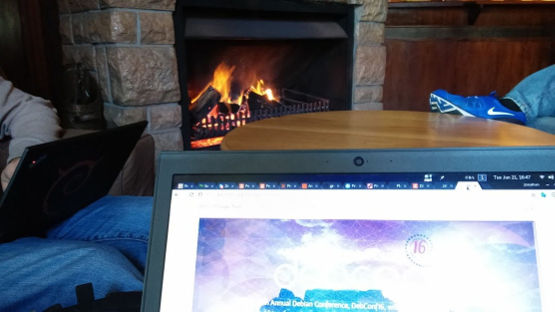
Hacking by the fire at the sports club

Gathering some heat by the fire at the sports club while catching up to the world the day before it all started.

All Kinds of Quality Time I really enjoyed working with the video team last year, but this year there was just 0 time for that. Working on the orga team means dealing with a constant torrent of small tasks, which is good in its own way because you get to deal with a wide variety of Debian people you might not usually get to interact with, but video team problems are more fun and interesting. Next year I hope to do a lot more video work again. If you re at DebConf over the next week, I can highly recommend that you get involved!
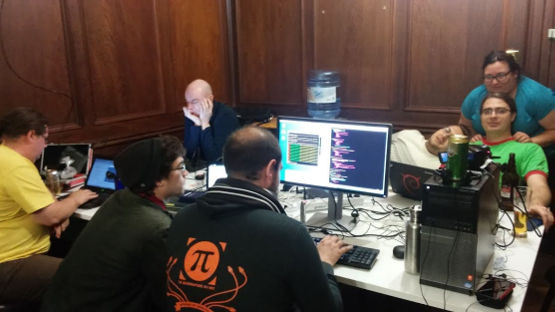
Video team hacking away at problems

Video team members hacking away at problems late at night during DebCamp

The first time I met Debian folk was early in 2004. I worked at the Shuttleworth Foundation as Open Source Technical Co-ordinator at the time, and Mark Shuttleworth had them over for one of the early Ubuntu sprints in Canonical s early days. I was so intimidated by them back then that I could hardly even manage to speak to them. I was already a big free software fan before working there, but little did I even dream to think that I would one day be involved in a project like Ubuntu or Debian. My manager back then encouraged me to go talk to them and get involved and become a Debian Developer and joked that I should become highvoltage@debian.org. I guess that was when the initial seeds got planted and since then I ve met many great people all over the world who have even became friends during UDS, DebConf, BTS and other hackfests where Debianites hang out. It gave me a really nice warm feeling to have all these amazing, talented and really friendly people from all over coming together in this little corner of the world to work together on projects that I think are really important.
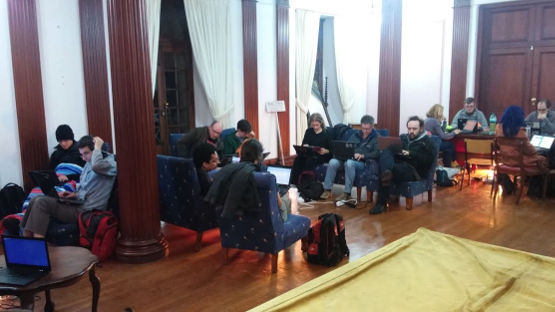
Finding a warm space to work in the Happy Feet hack lab

Finding a warm space to work in the Happy Feet hack lab

Oh the Chicken Back at DebConf12, someone (I don t remember the exact history) brought a rubber chicken to DebConf who was simply called Pollito ( chicken in Spanish). Since then the chicken has grown into somewhat of a mascot for DebConf. Back in 2012 I already imagined that if we would ever host a DebConf, I d make a little of picture book story about Pollito. Last year after DC15, when bringing Pollito over, I created a little story called Pollito s first trip to Africa . I was recovering from flu while putting that together and didn t spend much time on it, but it turned out to be somewhat of a hit. I was surprised to see it in the #debconf topic ever since I posted it :) We gave a tour of the campus on the first and second days and it was quite time consuming and there was no way we could do it every day for the rest of DebCamp, so on the 2nd day I smacked together a new rush job called Pollito s Guide to DC16 . The idea was that newcommers could use it as a visual guide and rely on others who have been there for a while if they get stuck. I wish I had the time to make it a lot nicer, but I think the general idea is good and next year we can have a much nicer one that might not be quite as Pollito focused.
Pollito's Guide to DC16

Pollito s Guide to DC16

Debian Maintainer After all these years, I finally sat down and applied to become a Debian Maintainer, and the application was successful (approved yesterday \o/). Now just for the wait until my key is uploaded to the keyring. I haven t yet had time to properly process this but I think once the DebConf dust settles and I had some time to recover, I will be ecstatic. Some actual DebCampy work Everywhere I go, I see people installing a bunch of GNOME extensions on their Debian GNOME desktops shortly after installation using http://extensions.gnome.org/ (I noticed this even at DebCamp!). A few months ago I thought that it s really about time someone package up some of the really popular ones. So I started to put together some basic packaging for AIMS Desktop around a month ago. During the last few days of DebCamp, things were going well enough with the organisational tasks that I had some time to do some actual packaging work and improve these so that they re ready for upload to the Debian archives. The little DebCamp time I had ended up being my very own little extension fest :) I worked on the following packages which are ready for upload: I worked on the following packages which still need minor work, might be able to get them in uploadable state by the end of DebConf: The actual packaging of GNOME extensions is actually pretty trivial. It s mostly source-only JavaScript with some CSS and translations and maybe some gsettings schemas and dialogs. Or at least, it would be pretty trivial, but many extensions are without licenses, contain embedded code (often JavaScript) from other projects, or have no usable form of upstream tarball, to name a few of the problems. So I ve been contacting the upstream authors of these packages where there have been problems, and for the most part they ve been friendly and pretty quick to address the problems. So that s it, for now. I couldn t possibly sum up the last week and everything that lead up to it in a single blog post. All I can really say is thank you for letting me be a part of this very special project!

Joey Hess: twenty years of free software -- part 6 moreutils

moreutils is a little love letter to the Unix Tools philosophy. It was interesting to try to find new tools as basic as cat and ls. With sponge and vidir and ifne and chronic and others, we managed to find several such tools. So, it was fun to work on moreutils, but it also ran into inherent problems with the Unix Tools philosophy. One is namespacing; there are only so many good short names for commands, and a command like parallel can easily collide with something else. And since Unix Tools have a bigger surface area than a pure function, my parallel is not going to be quite compatible with your parallel, even if they were developed with (erm) parallel intentions. Partly due to that problem, I have gotten pickier about adding new tools to moreutils as it's gotten older, and so there's a lot of suggested additions that I will probably never get to. And as my mention of pure functions suggests, I have kind of moved on from being a big fan of the Unix Tools philosophy. Unix tools are a decent approximation of pure functions for their time, but they are not really pure, and not typed at all, and not usefully namespaced, and this limits them. Next: twenty years of free software -- part 7 git-annex

Paul Tagliamonte: Hello, InfluxDB

Last week, I posted about python-sense, and API wrapper for the internal Sense API. I wrote this so that I could pull data about myself into my own databases, allowing me to use that information for myself. One way I'm doing this is by pulling my room data into an InfluxDB database, letting me run time series queries against my environmental data.
#!/usr/bin/env python
from influxdb import InfluxDBClient
import json
import datetime as dt
from sense.service import Sense
api = Sense()
data = api.room_sensors(quantity=20)
def items(data):
    for flavor, series in data.items():
        for datum in reversed(series):
            value = datum['value']
            if value == -1:
                continue
            timezone = dt.timezone(dt.timedelta(
                seconds=datum['offset_millis'] / 1000,
            ))
            when = dt.datetime.fromtimestamp(
                datum['datetime'] / 1000,
            ).replace(tzinfo=timezone)
            yield flavor, when, value
client = InfluxDBClient(
    'url.to.host.here',
    443,
    'username',
    'password',
    'sense',
    ssl=True,
)
def series(data):
    for flavor, when, value in items(data):
        yield  
            "measurement": " ".format(flavor),
            "tags":  
                "user": "paultag"
             ,
            "time": when.isoformat(),
            "fields":  
                "value": value,
             
         
client.write_points(list(series(data)))
I'm able to run this on a cron, automatically loading data from the Sense API into my Influx database. I can then use that with something like Grafana, to check out what my room looks like over time.

Paul Wise: DebCamp16 day 8

Apply wget security update to mentors.debian.net. Poke the DebConf video team about archiving the one Debian & stuff podcast episode. Discuss exclusion, privilege & DebConf. Usual spam reporting. Review wiki RecentChanges. Fix some typos from RecentChanges. File Debian wishlist bug #829177 against bugs.debian.org. Mention the recent post about breaking Android full-disk encryption on the exploits Debian wiki page. Answer questions about recommended build configuration for chromium-bsu from the maintainer of it in FreeBSD. Mention that HTML SRI could help secure initial Debian downloads. File Debian bug #829199 against file and add workaround in derivatives census. Report broken boss-gnome source package to BOSSLinux folks on IRC. Delete and re-download Parsix apt folder to stop hash sum mismatches. File Debian minor/wishlist bugs #829209/#829211/#829212 against cypher-lint. Add a porterbox guest account for one of the RTC GSoC students. Extend the expiry of another guest account. Direct query about the excuses HTML to the release team. File Debian bug #829241 against fonts-play. Discuss accessibility, life, the universe and rakia.

Russ Allbery: Review: Ashes of Honor

Review: Ashes of Honor, by Seanan McGuire
Series: October Daye #6
Publisher: DAW
Copyright: September 2012
ISBN: 1-101-59480-2
Format: Kindle
Pages: 368
This is the sixth book in the October Daye series, contains payoffs for some relationships that have been building over the whole series, and involves entangled politics set up by previous books. It's not the place to start with the series. Ashes of Honor starts, as so many of Toby's books do, with a friend asking her for help. But this request is entirely unexpected, and the help needed comes as a complete surprise: a previously unknown changeling, who has disappeared. A changeling whose powers are completely out of control, and who poses a threat to reality itself. As Toby's cases go, this involves a lot fewer horrible things happening to her and a lot more faerie politics and maneuvering than usual. I appreciated that; I'm not as fond of the books that go deep into despair or desperation. It does involve Toby getting almost killed multiple times, but, due to earlier events of the series, that isn't quite as bad as it used to be. More focus on investigation and political maneuvering and less Toby braving her way through horrors works for me. Even more notably, this book marks Toby finally figuring out that she has friends and allies who are there to help, not just be obligations she feels overwhelmed by or aid that she's not allowed to accept. This was one of her most frustrating characteristics; it's a relief to see her finally relax. This opens the way not only for deeper friendships and more complex plots but also a relationship that I've been awaiting for the entire series, and it's as much fun as I was hoping it would be. Toby started the series rather messed up and unwilling to let anyone close. It was for understandable reasons, but I like her better when she realizes why people respect her. Toby's connections with the royalty of the Bay Area also allow McGuire to tell a political story that moves farther afield from the Shadowed Hills. First in One Salt Sea and now in Ashes of Honor we see more of local politics, more of the lore of McGuire's universe, and another dangerous queen. Toby is particularly fun when she's dangerously outflanking people with considerably more power than she has. At this point, you could call it a specialty. I thought McGuire's take on San Jose and the sort of person who would be in charge of its fae was on point. We also get more of the Luidaeg, which is always a good sign for a Toby novel, and more of Tybalt, who is entangled in a major subplot of the story. Next to Luidaeg, Tybalt is my favorite of Toby's friends, so this book is full of the things that make me happy. McGuire adds some more pieces to her transplanted Celtic mythology and some tantalizing hints of what the fae have left behind. I'm hoping we see more of that in future books. (I suspect that may be what this whole series is building up to.) The story doesn't have quite as much oomph as One Salt Sea, but it's still one of the best books in the series so far. If you've enjoyed the series up to this point, keep reading. Followed by Chimes at Midnight. Rating: 8 out of 10

1 July 2016

Joachim Breitner: When to reroll a six

This is a story about counter-intuitive probabilities and how a small bit of doubt turned out to be very justified. It begins with the game To Court the King (German: Um Krone und Kragen ). It is a nice game with dice and cards, where you start with a few dice, and use your dice rolls to buy additional cards, which give you extra dice or special powers to modify the dice that you rolled. You can actually roll your dice many times, but every time, you have to set aside at least one die, which you can no longer change or reroll, until eventually all dice have been set aside. A few years ago, I have played this game a lot, both online (on yucata.de) as well as in real life. It soon became apparent that it is almost always better to go for the cards that give you an extra die, instead of those that let you modify the dice. Intuitively, this is because every additional die allows you to re-roll your dice once more. I concluded that if I have a certain number of dice (say, n), and I want to have a sum as high as possible at the end, then it may make sense to reroll as many dice as possible, setting aside only those showing a 6 (because that is the best you can get) or, if there is no dice showing a 6, then a single die with the best score. Besides for small number of dice (2 or 3), where even a 4 or 5 is worth keeping, this seemed to be a simple, obvious and correct strategy to maximize the expected outcome of this simplified game. It is definitely simple and obvious. But some doubt that it was correct remained. Having one more die still in the game (i.e. not set aside) definitely improves your expected score, because you can reroll the dice more often. How large is this advantage? What if it ever exceeds 6 then it would make sense to reroll a 6. The thought was strange, but I could not dismiss it. So I did what one does these days if one has a question: I posed it on the mathematics site of StackExchange. That was January 2015, and nothing happened. I tried to answer it myself a month later, or at least work towards at an answer, and did that by brute force. Using a library for probabilistic calculations for Haskell I could write some code that simply calculated the various expected values of n dice for up to n = 9 (beyond that, my unoptimized code would take too long):
1:  3.50000 (+3.50000)
2:  8.23611 (+4.73611)
3: 13.42490 (+5.18879)
4: 18.84364 (+5.41874)
5: 24.43605 (+5.59241)
6: 30.15198 (+5.71592)
7: 35.95216 (+5.80018)
8: 41.80969 (+5.85753)
9: 47.70676 (+5.89707)
Note that this calculation, although printed as floating point numbers, is performed using fractions of unbounded integers, so there are no rounding issues that could skew the result. The result supported the hypothesis that there is no point in rolling a 6 again: The value of an additional die grows and approaches 6 from beyond, but judging from these number is never going to reach it. Then again nothing happened. Until 14 month later, when some Byron Schmuland came along, found this an interesting puzzle, and set out a 500 point bounty to whoever solved this problem. This attracted a bit attention, and a few not very successful attempts at solving this. Eventually it reached twitter, where Roman Cheplyaka linked to it. Coincidally a day later some joriki came along, and he had a very good idea: Why not make our life easier and think about dice with less sides, and look at 3 instead of 6. This way, and using a more efficient implementation (but still properly using rationals), he could do a similar calculation for up to 50 dice. And it was very lucky that he went to 50, and not just 25, because up to 27, the results were very much as expected, approaching value of +3 from below. But then it surpassed +3 and became +3.000000008463403. In other words: If you have roll 28 dice, and you have exactly two dice showing a 3, then it gives you better expected score if you set aside only one 3, and not both of them. The advantage is minuscule, but that does not matter it is there. From then on, the results behaved strangely. Between 28 and 34, the additional value was larger than 3. Then, from 35 on again lower than 2. It oscillated. Something similar could be observed when the game is played with coins. Eventually, joriki improved his code and applied enough tricks so that he could solve it also for the 6-sided die: The difference of the expected value of 198 dice and having 199 dice is larger than 6 (by 10 21...)! The optimizations that allowed him to calculate these numbers in a reasonable amount of time unfortunately was to assume that my original hypothesis (never rerolling a 6 is optimal), which held until n < 199. But this meant that for n > 199, the code did not yield correct results. What is the rationale of the story? Don t trust common sense when it comes to statistics; don t judge a sequence just from a few initial numbers; if you have an interesting question, post it online and wait for 16 months.

Rapha&#235;l Hertzog: My Free Software Activities in June 2016

My monthly report covers a large part of what I have been doing in the free software world. I write it for my donators (thanks to them!) but also for the wider Debian community because it can give ideas to newcomers and it s one of the best ways to find volunteers to work with me on projects that matter to me. Debian packaging Django and Python. I uploaded Django 1.9.7 and filed an upstream ticket (#26755) for a failure seen in its DEP-8 tests. I packaged/sponsored python-django-modeltranslation and python-paypal. I opened a pull request on model-translation to fix failing tests in the Debian package build. I packaged a new python-django-jsonfield (1.0.0), filed a bug and discovered some regression in its PostgreSQL support. I helped on the upstream ticket and I have been granted commit rights. I used this opportunity to do some bug triage and push a few fixes. I also discussed the future of the module and ended up starting a discussion on Django s developer list about the possibility to add a JSONField to the core. CppUTest. I uploaded a new upstream version (3.8) with more than a year of work. I found out that make install does not install a required header so I opened a ticket with a patch. The package ended up not compiling on quite a few architectures so I opened a ticket and prepared a fix for some of those failures with the help of the upstream developers. I also added a DEP-8 tests after having uploaded a broken (untested) package systemd support in net-snmp and postfix. I worked on adding native systemd service units to net-snmp (#782243) and postfix (#715188). In both cases, the maintainers have not been very reactive so far so I uploaded my changes as delayed NMU. pkg-security team. The team that I started quietly a few months ago is now growing, both with new members and new packages. I created the required Teams/pkg-security wiki page. I sponsored xprobe, hydra, made an upload of medusa to merge Kali changes into Debian (and at the same time submitting the patch to upstream). fontconfig. After having read Jonathan McDowell s analysis of a bug that I experienced multiple times (and that many Kali users had too), I opened bug #828037 to get it fixed once for all. Unfortunately, nothing happened yet. DebConf 16 I spent some time to prepare the 2 talks and the BoF that I will give/manage in Cape Town next week: Distro Tracker I continued to mentor Vladimir Likic who managed to finish his first patch. He is now working on documentation for new contributors based on his recent experience. I enhanced the tox configuration to run tests with Django 1.8 LTS with fatal warnings (python -Werror) so as to ensure that I m not relying on any deprecated feature and so that I can be sure that the codebase will work on the next Django LTS release (1.11). Thanks to this, I did discover quite a few places where I have been using deprecated API and I fixed them all (the JSONField update to 1.0.0 I mentionned above was precisely to fix such a warning). I also fixed a few more issues with folded mail headers that you can t inject back in a new Message object and with messages lacking the subject field. All those have been caught through real (spam) email generating exceptions wich are then mailed to me. Kali related work I uploaded a new live-boot (5.20160608) to Debian to fix a bug where the boot process was blocking on some timeout. I forwarded a Kali bug against libatk-wrapper-java (#827741) which turned out to be an OpenJDK bug. I filed #827749 against reprepro to request a way to remove selected internal file references. This is required if you want to be able to make a file disappear and if that file is part of a snapshot that you want to keep despite this. But in truth, my real need is to be able to replace the .orig.tar.gz used by Kali by the orig.tar.gz used by Debian those conflicts break the mirroring/import script. Salt I have been using salt to deploy a new service, and I developed patches for a few issues in salt formulas. I also created a new letsencrypt-sh formula to manage TLS certificates with the letsencrypt.sh ACME client. Thanks See you next month for a new summary of my activities.

No comment Liked this article? Click here. My blog is Flattr-enabled.

Paul Wise: DebCamp16 day 7

Usual spam reporting. Review wiki RecentChanges. Provide feedback for the staging site of the new codebase for screenshots.d.n. Redirect bugs-search.d.o complaint to the BTS maintainers. Point out pastebinit already supports fpaste.org. Polish chromium-bsu, make a new upstream release to fix Debian RC bug #822711. Upload screenshot of chromium-bsu menu. Notify chromium-bsu package maintainers in other distros (hug whohas). Avoid checking WAV files for spelling errors in cats. Make the old PTS download i18n data over https. File #829092 to get the per-package i18n data to use https for links. Point someone on mentors to the Debian PHP group wiki page.

30 June 2016

Chris Lamb: Free software activities in June 2016

Here is my monthly update covering a large part of what I have been doing in the free software world (previously):
Debian My work in the Reproducible Builds project was covered in our weekly reports. (#58, #59 & #60)
Debian LTS

This month I have been paid to work 18 hours on Debian Long Term Support (LTS). In that time I did the following:
  • "Frontdesk" duties, triaging CVEs, etc.
  • Extended the lts-cve-triage.py script to ignore packages that are not subject to Long Term Support.

  • Issued DLA 512-1 for mantis fixing an XSS vulnerability.
  • Issued DLA 513-1 for nspr correcting a buffer overflow in a sprintf utility.
  • Issued DLA 515-1 for libav patching a memory corruption issue.
  • Issued DLA 524-1 for squidguard fixing a reflected cross-site scripting vulnerability.
  • Issued DLA 525-1 for gimp correcting a use-after-free vulnerability in the channel and layer properties parsing process.

Uploads
  • redis (2:3.2.1-1) New upstream bugfix release, plus subsequent upload to the backports repository.
  • python-django (1.10~beta1-1) New upstream experimental release.
  • libfiu (0.94-5) Misc packaging updates.


RC bugs

I also filed 170 FTBFS bugs against a7xpg, acepack, android-platform-dalvik, android-platform-frameworks-base, android-platform-system-extras, android-platform-tools-base, apache-directory-api, aplpy, appstream-generator, arc-gui-clients, assertj-core, astroml, bamf, breathe, buildbot, cached-property, calf, celery-haystack, charmtimetracker, clapack, cmake, commons-javaflow, dataquay, dbi, django-celery, django-celery-transactions, django-classy-tags, django-compat, django-countries, django-floppyforms, django-hijack, django-localflavor, django-markupfield, django-model-utils, django-nose, django-pipeline, django-polymorphic, django-recurrence, django-sekizai, django-sitetree, django-stronghold, django-taggit, dune-functions, elementtidy, epic4-help, fcopulae, fextremes, fnonlinear, foreign, fort77, fregression, gap-alnuth, gcin, gdb-avr, ggcov, git-repair, glance, gnome-twitch, gnustep-gui, golang-github-audriusbutkevicius-go-nat-pmp, golang-github-gosimple-slug, gprbuild, grafana, grantlee5, graphite-api, guacamole-server, ido, jless, jodreports, jreen, kdeedu-data, kdewebdev, kwalify, libarray-refelem-perl, libdbusmenu, libdebian-package-html-perl, libdevice-modem-perl, libindicator, liblrdf, libmail-milter-perl, libopenraw, libvisca, linuxdcpp, lme4, marble, mgcv, mini-buildd, mu-cade, mvtnorm, nose, octave-epstk, onioncircuits, opencolorio, parsec47, phantomjs, php-guzzlehttp-ringphp, pjproject, pokerth, prayer, pyevolve, pyinfra, python-asdf, python-ceilometermiddleware, python-django-bootstrap-form, python-django-compressor, python-django-contact-form, python-django-debug-toolbar, python-django-extensions, python-django-feincms, python-django-formtools, python-django-jsonfield, python-django-mptt, python-django-openstack-auth, python-django-pyscss, python-django-registration, python-django-tagging, python-django-treebeard, python-geopandas, python-hdf5storage, python-hypothesis, python-jingo, python-libarchive-c, python-mhash, python-oauth2client, python-proliantutils, python-pytc, python-restless, python-tidylib, python-websockets, pyvows, qct, qgo, qmidinet, quodlibet, r-cran-gss, r-cran-runit, r-cran-sn, r-cran-stabledist, r-cran-xml, rgl, rglpk, rkt, rodbc, ruby-devise-two-factor, ruby-json-schema, ruby-puppet-syntax, ruby-rspec-puppet, ruby-state-machine, ruby-xmlparser, ryu, sbd, scanlogd, signond, slpvm, sogo, sphinx-argparse, squirrel3, sugar-jukebox-activity, sugar-log-activity, systemd, tiles, tkrplot, twill, ucommon, urca, v4l-utils, view3dscene, xqilla, youtube-dl & zope.interface.

FTP Team

As a Debian FTP assistant I ACCEPTed 186 packages: akonadi4, alljoyn-core-1509, alljoyn-core-1604, alljoyn-gateway-1504, alljoyn-services-1504, alljoyn-services-1509, alljoyn-thin-client-1504, alljoyn-thin-client-1509, alljoyn-thin-client-1604, apertium-arg, apertium-arg-cat, apertium-eo-fr, apertium-es-it, apertium-eu-en, apertium-hbs, apertium-hin, apertium-isl, apertium-kaz, apertium-spa, apertium-spa-arg, apertium-tat, apertium-urd, arc-theme, argus-clients, ariba, beast-mcmc, binwalk, bottleneck, colorfultabs, dh-runit, django-modeltranslation, dq, dublin-traceroute, duktape, edk2, emacs-pdf-tools, eris, erlang-p1-oauth2, erlang-p1-sqlite3, erlang-p1-xmlrpc, faba-icon-theme, firefox-branding-iceweasel, golang-1.6, golang-defaults, golang-github-aelsabbahy-gonetstat, golang-github-howeyc-gopass, golang-github-oleiade-reflections, golang-websocket, google-android-m2repository-installer, googler, goto-chg-el, gr-radar, growl-for-linux, guvcview, haskell-open-browser, ipe, labplot, libalt-alien-ffi-system-perl, libanyevent-fcgi-perl, libcds-savot-java, libclass-ehierarchy-perl, libconfig-properties-perl, libffi-checklib-perl, libffi-platypus-perl, libhtml-element-library-perl, liblwp-authen-oauth2-perl, libmediawiki-dumpfile-perl, libmessage-passing-zeromq-perl, libmoosex-types-portnumber-perl, libmpack, libnet-ip-xs-perl, libperl-osnames-perl, libpodofo, libprogress-any-perl, libqtpas, librdkafka, libreoffice, libretro-beetle-pce-fast, libretro-beetle-psx, libretro-beetle-vb, libretro-beetle-wswan, libretro-bsnes-mercury, libretro-mupen64plus, libservicelog, libtemplate-plugin-datetime-perl, libtext-metaphone-perl, libtins, libzmq-ffi-perl, licensecheck, link-grammar, linux, linux-signed, lua-busted, magics++, mkalias, moka-icon-theme, neutron-vpnaas, newlisp, node-absolute-path, node-ejs, node-errs, node-has-flag, node-lodash-compat, node-strip-ansi, numba, numix-icon-theme, nvidia-graphics-drivers, nvidia-graphics-drivers-legacy-304xx, nvidia-graphics-drivers-legacy-340xx, obs-studio, opencv, pacapt, pgbackrest, postgis, powermock, primer3, profile-sync-daemon, pyeapi, pypandoc, pyssim, python-cutadapt, python-cymruwhois, python-fisx, python-formencode, python-hkdf, python-model-mommy, python-nanomsg, python-offtrac, python-social-auth, python-twiggy, python-vagrant, python-watcherclient, python-xkcd, pywps, r-bioc-deseq2, r-bioc-dnacopy, r-bioc-ensembldb, r-bioc-geneplotter, r-cran-adegenet, r-cran-adephylo, r-cran-distory, r-cran-fields, r-cran-future, r-cran-globals, r-cran-htmlwidgets, r-cran-listenv, r-cran-mlbench, r-cran-mlmrev, r-cran-pheatmap, r-cran-pscbs, r-cran-r.cache, refind, relatorio, reprotest, ring, ros-ros-comm, ruby-acts-as-tree, ruby-chronic-duration, ruby-flot-rails, ruby-numerizer, ruby-u2f, selenium-firefoxdriver, simgrid, skiboot, smtpping, snap-confine, snapd, sniffles, sollya, spin, subuser, superlu, swauth, swift-plugin-s3, syncthing, systemd-bootchart, tdiary-theme, texttable, tidy-html5, toxiproxy, twinkle, vmtk, wait-for-it, watcher, wcslib & xapian-core.

29 June 2016

Paul Wise: DebCamp16 day 6

Redirect one person contacting the Debian sysadmin and web teams to Debian user support. Review wiki RecentChanges. Usual spam reporting. Check and fix a derivatives census issue. Suggest sending the titanpad maintainence issue to a wider audience. Update check-all-the-things and copyright review tools wiki page for licensecheck/devscripts split. Ask if debian-debug could be added to mirror.dc16.debconf.org. Discuss more about the devscripts/licensecheck split. Yesterday I grrred at Debian perl bug #588017 that causes vulnerabilities in check-all-the-things, tried to figure out the scope of the issue and workaround all of the issues I could find. (Perls are shiny and Check All The thingS can be abbreviated as cats) Today I confirmed with the reporter (Jakub Wilk) that the patch mitigates this. Release check-all-the-things to Debian unstable (finally!!). Discuss with the borg about syncing cats to Ubuntu. Notice autoconf/automake being installed as indirect cats build-deps (via debhelper/dh-autoreconf) and poke relevant folks about this. Answer question about alioth vs debian.org LDAP.

Gunnar Wolf: Batch of the Next Thing Co.'s C.H.I.P. computers on its way to DebConf!)

Hello world! I'm very happy to inform that the Next Thing Co. has shipped us a pack of 50 C.H.I.P. computers to be given away at DebConf! What is the C.H.I.P.? As their tagline says, it's the world's first US$9 computer. Further details:
https://nextthing.co/pages/chip
All in all, it's a nice small ARM single-board computer; I won't bore you on this mail with tons of specs; suffice to say they are probably the most open ARM system I've seen to date. So, I agreed with Richard, our contact at the company, I would distribute the machines among the DebConf speakers interested in one. Of course, not every DebConf speaker wants to fiddle with an adorable tiny piece of beautiful engineering, so I'm sure I'll have some spare computers to give out to other interested DebConf attendees. We are supposed to receive the C.H.I.P.s by Monday 4; if you want to track the package shipment, the DHL tracking number is 1209937606. Don't DDoS them too hard! So, please do mail me telling why do you want one, what your projects are with it. My conditions for this giveaway are: To sign up for yours, please mail gwolf+chip@gwolf.org - I will capture mail sent to that alias ONLY.

Michal &#268;iha&#345;: PHP shapefile library

Since quite a long time phpMyAdmin had embedded the bfShapeFiles library for import of geospatial data. Over the time we had to apply fixes to it to stay compatible with newer PHP versions, but there was really no development. Unfortunately, as it seems to be only usable PHP library which can read and write ESRI shapefiles. With recent switch of phpMyAdmin to dependency handling using Composer I wondered if we should get rid of the last embedded PHP library, which was this one - bfShapeFiles. As I couldn't find alive library which would work well for us, I resisted that for quite long, until pull request to improve it came in. At that point I've realized that it's probably better to separate it and start to improve it outside our codebase. That's when phpmyadmin/shapefile was started. The code is based on bfShapeFiles, applies all fixes which were used in phpMyAdmin and adds improvements from the pull request. On top of that it has brand new testsuite (the coverage is still much lower than I'd like to have) and while writing the tests several parsing issues have been discovered and fixed. Anyway you can now get the source from GitHub or install using Composer from Packagist. PS: While fixing parser bugs I've looked at other parsers as well to see how they handle some situations unclear in the specs and I had to fix Python pyshp on the way as well :-).

Filed under: Debian English phpMyAdmin 0 comments

28 June 2016

Paul Wise: DebCamp16 day 5

Beat head against shiny cats (no animals were harmed). Discuss the spice of sillyness. Forward a wiki bounce to the person. Mention my gobby git mail cron job. Start adopting the adequate package. Discuss cats vs licensecheck with Jonas. Usual spam reporting. Review wiki RecentChanges. Whitelisted one user in the wiki anti-spam system. Finding myself longing for a web technology. Shudder and look at the twinklies.

27 June 2016

Jonathan McDowell: Hire me!

It s rare to be in a position to be able to publicly announce you re looking for a new job, but as the opportunity is currently available to me I feel I should take advantage of it. That s especially true given the fact I ll be at DebConf 16 next week and hope to be able to talk to various people who might be hiring (and will, of course, be attending the job fair). I m coming to the end of my Masters in Legal Science and although it s been fascinating I ve made the decision that I want to return to the world of tech. I like building things too much it seems. There are various people I ve already reached out to, and more that are on my list to contact, but I figure making it more widely known that I m in the market can t hurt with finding the right fit. I m on LinkedIn and OpenHUB, which should give a bit more info on my previous experience and skill set. I know I m light on details here, so feel free to email me to talk about what I might be able to specifically bring to your organisation.

Paul Wise: DebCamp16 day 4

Usual spam reporting. Review wiki RecentChanges. Rain glorious rain! Err... Update a couple of links on the debtags team page. Report Debian bug #828718 against tracker.debian.org. Update links to debtags on DDPO and the old PTS. Report minor Debian bug #828722 against debtags.debian.org. Update the debtags for check-all-the-things. More code and check fixes for check-all-the-things. Gravitate towards the fireplace and beat face against annoying access point, learn of wpa_cli blacklist & wpa_cli bssid from owner of devilish laptop. Ask stakeholders for feedback/commits before the impending release of check-all-the-things to Debian unstable. Meet developers of the One^WGNU Ring, discuss C++ library foo. Contribute some links to an open hardware thread. Point out the location of the Debian QA SVN repository. Clear skies at night, twinkling delight.

Paul Tagliamonte: Hello, Sense!

A while back, I saw a Kickstarter for one of the most well designed and pretty sleep trackers on the market. I fell in love with it, and it has stuck with me since. A few months ago, I finally got my hands on one and started to track my data. Naturally, I now want to store this new data with the rest of the data I have on myself in my own databases. I went in search of an API, but I found that the Sense API hasn't been published yet, and is being worked on by the team. Here's hoping it'll land soon! After some subdomain guessing, I hit on api.hello.is. So, naturally, I went to take a quick look at their Android app and network traffic, lo and behold, there was a pretty nicely designed API. This API is clearly an internal API, and as such, it's something that should not be considered stable. However, I'm OK with a fragile API, so I've published a quick and dirty API wrapper for the Sense API to my GitHub.. I've published it because I've found it useful, but I can't promise the world, (since I'm not a member of the Sense team at Hello!), so here are a few ground rules of this wrapper: This module is currently Python 3 only. If someone really needs Python 2 support, I'm open to minimally invasive patches to the codebase using six to support Python 2.7. Working with the API: First, let's go ahead and log in using python -m sense.
$ python -m sense
Sense OAuth Client ID: xxxxxxxx-xxxx-xxxx-xxxx-xxxxxxxxxxxx
Sense OAuth Client Secret: xxxxxxxx-xxxx-xxxx-xxxx-xxxxxxxxxxxx
Sense email: paultag@gmail.com
Sense password: 
Attempting to log into Sense's API
Success!
Attempting to query the Sense API
The humidity is **just right**.
The air quality is **just right**.
The light level is **just right**.
It's **pretty hot** in here.
The noise level is **just right**.
Success!
Now, let's see if we can pull up information on my Sense:
>>> from sense import Sense
>>> sense = Sense()
>>> sense.devices()
 'senses': [ 'id': 'xxxxxxxxxxxxxxxx', 'firmware_version': '11a1', 'last_updated': 1466991060000, 'state': 'NORMAL', 'wifi_info':  'rssi': 0, 'ssid': 'Pretty Fly for a WiFi (2.4 GhZ)', 'condition': 'GOOD', 'last_updated': 1462927722000 , 'color': 'BLACK' ], 'pills': [ 'id': 'xxxxxxxxxxxxxxxx', 'firmware_version': '2', 'last_updated': 1466990339000, 'battery_level': 87, 'color': 'BLUE', 'state': 'NORMAL' ] 
Neat! Pretty cool. Look, you can even see my WiFi AP! Let's try some more and pull some trends out.
>>> values = [x.get("value") for x in sense.room_sensors()["humidity"]][:10]
>>> min(values)
45.73904
>>> max(values)
45.985928
>>> 
I plan to keep maintaining it as long as it's needed, so I welcome co-maintainers, and I'd love to see what people build with it! So far, I'm using it to dump my room data into InfluxDB, pulling information on my room into Grafana. Hopefully more to come! Happy hacking!

26 June 2016

Paul Wise: DebCamp16 day 3

Review, approve chromium, gnome-terminal and radeontop screenshots. Disgusted to see the level of creativity GPL violators have. Words of encouragement on #debian-mentors. Pleased to see Tails reproducible builds funding by Mozilla. Point out build dates in versions leads to non-reproducible builds. Point out apt-file search to someone looking for a binary of kill. Review wiki RecentChanges. Alarmingly windy. Report important Debian bug #828215 against unattended-upgrades. Clean up some code in check-all-the-things and work on fixing Debian bug #826089. Wind glorious wind! Much clearer day, nice view of the mountain. More check-all-the-things code clean up and finish up fixing Debian bug #826089. Twinkling city lights and more wind. Final code polish during dinner/discussion. Wandering in the wind amongst the twinklies. Whitelisted one user in the wiki anti-spam system. Usual spam reporting.

Vasudev Kamath: Integrating Cython extension with setuptools and unit testing

I was reviewing changes for indic-trans as part of GSoC 2016. The module is an improvisation for our original transliteration module which was doing its job by substitution. This new module uses machine learning of some sort and utilizes Cython, numpy and scipy. Student had kept pre-compiled shared library in the git tree to make sure it builds and passes the test. But this was not correct way. I started looking at way to build these files and remove it from the code base. There is a cython documentation for distutils but none for setuptools. Probably it is similar to other Python extension integration into setuptools, but this was first time for me so after a bit of searching and trial and error below is what I did. We need to use Extensions class from setuptools and give it path to modules we want to build. In my case beamsearch and viterbi are 2 modules. So I added following lines to setup.py
from setuptools.extension import Extension
from Cython.Build import cythonize
extensions = [
 Extension(
     "indictrans._decode.beamsearch",
     [
         "indictrans/_decode/beamsearch.pyx"
     ],
     include_dirs=[numpy.get_include()]
 ),
 Extension(
     "indictrans._decode.viterbi",
     [
         "indictrans/_decode/viterbi.pyx"
     ],
     include_dirs=[numpy.get_include()]
 )
]
First argument to Extensions is the module name and second argument is a list of files to be used in building the module. The additional inculde_dirs argument is not normally necessary unless you are working in virtualenv. In my system the build used to work without this but it was failing in Travis CI, so added it to fix the CI builds. OTOH it did work without this on Circle CI. Next is provide this extensions to ext_modules argument to setup as shown below
setup(
 setup_requires=['pbr'],
 pbr=True,
 ext_modules=cythonize(extensions)
)
And for the reference here is full setup.py after modifications.
#!/usr/bin/env python
from setuptools import setup
from setuptools.extension import Extension
from Cython.Build import cythonize
import numpy
extensions = [
  Extension(
     "indictrans._decode.beamsearch",
     [
         "indictrans/_decode/beamsearch.pyx"
     ],
     include_dirs=[numpy.get_include()]
  ),
  Extension(
     "indictrans._decode.viterbi",
     [
         "indictrans/_decode/viterbi.pyx"
     ],
     include_dirs=[numpy.get_include()]
  )
]
setup(
  setup_requires=['pbr'],
  pbr=True,
  ext_modules=cythonize(extensions)
)
So now we can build the extensions (shared library) using following command.
python setup.py build_ext
Another challenge I faced was missing extension when running test. We use pbr in above project and testrepository with subunit for running tests. Looks like it does not build extensions by default so I modified the Makefile to build the extension in place before running test. The travis target of my Makefile is as follows.
travis:
     [ ! -d .testrepository ]   \
             find .testrepository -name "times.dbm*" -delete
     python setup.py build_ext -i
     python setup.py test --coverage \
             --coverage-package-name=indictrans
     flake8 --max-complexity 10 indictrans
I had to build the extension in place using -i switch. This is because other wise the tests won't find the indictrans._decode.beamsearch and indictrans._decode.viterbi modules. What basically -i switch does is after building shared library symlinks it to the module directory, in ourcase indictrans._decode The test for existence of .testrepository folder is over come this bug in testrepository which results in test failure when running tests using tox.

Kevin Avignon: Tech questions 1-9 : LINQ questions

Hey guys, This is a new series I will try to maintain to the best of my capabilities. I have this awesome blogger who happens to be also a Microsoft MVP called Iris Classon. After her first year of programming, she started to ask and get answers for what she d call stupid question . Why would Continue reading Tech questions 1-9 : LINQ questions

Next.

Previous.