Search Results: "nic"

28 September 2016

Sean Whitton: 'Do you really need to do that?'

A new postdoc student arrived at our department this semester, and after learning that he uses GNU/Linux for all his computing, I invited him along to TFUG. During some of our meetings people asked how could I do X on my GNU/Linux desktop? and, jokingly, the postdoc would respond the answer to your question is do you really need to do that? Sometimes the more experienced GNU/Linux users at the table would respond to questions by suggesting that the user should simply give up on doing X, and the postdoc would slap his thigh and laugh and say see? I told you that s the answer! The phenomenon here is that people who have at some point made a commitment to at least try to use GNU/Linux for all their computing quickly find that they have come to value using GNU/Linux more than they value engaging in certain activities that only work well/at all under a proprietary operating system. I think that this is because they get used to being treated with respect by their computer. And indeed, one of the reasons I ve almost entirely given up on computer gaming is that computer games are non-free software. Are you sure you need to do that? starts sounding like a genuine question rather than simply a polite way of saying that what someone wants to do can t be achieved. I suggest that this is a blessing in disguise. The majority of the things that you can only do under a proprietary operating system are things that it would be good for you if you were to switch them out for other activities. I m not suggesting that switching to a GNU/Linux is a good way to give up on the entertainment industry. It s a good way of moderating your engagement with the entertainment industry. Rather than logging onto Netflix, you might instead pop in a DVD of a movie. You can still engage with contemporary popular culture, but the technical barriers give you an opportunity to moderate your consumption: once you ve finished watching the movie, the software won t try to get you to watch something else by making a calculation as to what you re most likely to assent to watching next based on what you ve watched before. For this behaviour of the Netflix software is just another example of non-free software working against its user s interests: watching a movie is good for you, but binge-watching a TV series probably isn t. In cases like this, living in the world of Free Software makes it easier to engage with media healthily.

26 September 2016

Kees Cook: security things in Linux v4.3

When I gave my State of the Kernel Self-Protection Project presentation at the 2016 Linux Security Summit, I included some slides covering some quick bullet points on things I found of interest in recent Linux kernel releases. Since there wasn t a lot of time to talk about them all, I figured I d make some short blog posts here about the stuff I was paying attention to, along with links to more information. This certainly isn t everything security-related or generally of interest, but they re the things I thought needed to be pointed out. If there s something security-related you think I should cover from v4.3, please mention it in the comments. I m sure I haven t caught everything. :) A note on timing and context: the momentum for starting the Kernel Self Protection Project got rolling well before it was officially announced on November 5th last year. To that end, I included stuff from v4.3 (which was developed in the months leading up to November) under the umbrella of the project, since the goals of KSPP aren t unique to the project nor must the goals be met by people that are explicitly participating in it. Additionally, not everything I think worth mentioning here technically falls under the kernel self-protection ideal anyway some things are just really interesting userspace-facing features. So, to that end, here are things I found interesting in v4.3: CONFIG_CPU_SW_DOMAIN_PAN Russell King implemented this feature for ARM which provides emulated segregation of user-space memory when running in kernel mode, by using the ARM Domain access control feature. This is similar to a combination of Privileged eXecute Never (PXN, in later ARMv7 CPUs) and Privileged Access Never (PAN, coming in future ARMv8.1 CPUs): the kernel cannot execute user-space memory, and cannot read/write user-space memory unless it was explicitly prepared to do so. This stops a huge set of common kernel exploitation methods, where either a malicious executable payload has been built in user-space memory and the kernel was redirected to run it, or where malicious data structures have been built in user-space memory and the kernel was tricked into dereferencing the memory, ultimately leading to a redirection of execution flow. This raises the bar for attackers since they can no longer trivially build code or structures in user-space where they control the memory layout, locations, etc. Instead, an attacker must find areas in kernel memory that are writable (and in the case of code, executable), where they can discover the location as well. For an attacker, there are vastly fewer places where this is possible in kernel memory as opposed to user-space memory. And as we continue to reduce the attack surface of the kernel, these opportunities will continue to shrink. While hardware support for this kind of segregation exists in s390 (natively separate memory spaces), ARM (PXN and PAN as mentioned above), and very recent x86 (SMEP since Ivy-Bridge, SMAP since Skylake), ARM is the first upstream architecture to provide this emulation for existing hardware. Everyone running ARMv7 CPUs with this kernel feature enabled suddenly gains the protection. Similar emulation protections (PAX_MEMORY_UDEREF) have been available in PaX/Grsecurity for a while, and I m delighted to see a form of this land in upstream finally. To test this kernel protection, the ACCESS_USERSPACE and EXEC_USERSPACE triggers for lkdtm have existed since Linux v3.13, when they were introduced in anticipation of the x86 SMEP and SMAP features. Ambient Capabilities Andy Lutomirski (with Christoph Lameter and Serge Hallyn) implemented a way for processes to pass capabilities across exec() in a sensible manner. Until Ambient Capabilities, any capabilities available to a process would only be passed to a child process if the new executable was correctly marked with filesystem capability bits. This turns out to be a real headache for anyone trying to build an even marginally complex least privilege execution environment. The case that Chrome OS ran into was having a network service daemon responsible for calling out to helper tools that would perform various networking operations. Keeping the daemon not running as root and retaining the needed capabilities in children required conflicting or crazy filesystem capabilities organized across all the binaries in the expected tree of privileged processes. (For example you may need to set filesystem capabilities on bash!) By being able to explicitly pass capabilities at runtime (instead of based on filesystem markings), this becomes much easier. For more details, the commit message is well-written, almost twice as long as than the code changes, and contains a test case. If that isn t enough, there is a self-test available in tools/testing/selftests/capabilities/ too. PowerPC and Tile support for seccomp filter Michael Ellerman added support for seccomp to PowerPC, and Chris Metcalf added support to Tile. As the seccomp maintainer, I get excited when an architecture adds support, so here we are with two. Also included were updates to the seccomp self-tests (in tools/testing/selftests/seccomp), to help make sure everything continues working correctly. That s it for v4.3. If I missed stuff you found interesting, please let me know! I m going to try to get more per-version posts out in time to catch up to v4.8, which appears to be tentatively scheduled for release this coming weekend.

2016, Kees Cook. This work is licensed under a Creative Commons Attribution-ShareAlike 3.0 License.
Creative Commons License

Reproducible builds folks: Reproducible Builds: week 74 in Stretch cycle

Here is what happened in the Reproducible Builds effort between Sunday September 18 and Saturday September 24 2016: Outreachy We intend to participate in Outreachy Round 13 and look forward for new enthusiastic applications to contribute to reproducible builds. We're offering four different areas to work on: Reproducible Builds World summit #2 We are planning e a similar event to our Athens 2015 summit and expect to reveal more information soon. If you haven't been contacted yet but would like to attend, please contact holger. Toolchain development and fixes Mattia uploaded dpkg/1.18.10.0~reproducible1 to our experimental repository. and covered the details for the upload in a mailing list post. The most important change is the incorporation of improvements made by Guillem Jover (dpkg maintainer) to the .buildinfo generator. This is also in the hope that it will speed up the merge in the upstream. One of the other relevant changes from before is that .buildinfo files generated from binary-only builds will no longer include the hash of the .dsc file in Checksums-Sha256 as documented in the specification. Even if it was considered important to include a checksum of the source package in .buildinfo, storing it that way breaks other assumptions (eg. that Checksums-Sha256 contains only files part of that are part of a single upload, wheras the .dsc might not be part of that upload), thus we look forward for another solution to store the source checksum in .buildinfo. Bugs filed Reviews of unreproducible packages 250 package reviews have been added, 4 have been updated and 4 have been removed in this week, adding to our knowledge about identified issues. 4 issue types have been added: 3 issue types have been updated: Weekly QA work FTBFS bugs have been reported by: Documentation updates h01ger created a new Jenkins job so that every commit pushed to the master branch for the website will update reproducible-builds.org. diffoscope development strip-nondeterminism development reprotest development tests.reproducible-builds.org Misc. This week's edition was written by Chris Lamb, Holger Levsen and Mattia Rizzolo and reviewed by a bunch of Reproducible Builds folks on IRC.

22 September 2016

Junichi Uekawa: Tried creating a GCE control panel for myself.

Tried creating a GCE control panel for myself. GCP GCE control panel takes about 20 seconds for me to load, CPU is busy loading the page. It does so many things and it's very complex. I've noticed that the API isn't that slow, so I used OAuth to let me do what I want usually; list the hosts and start/stop the instance, and list the IPs. Takes 500ms to do it instead of 20 seconds. I've put the service on AppEngine. The hardest part was figuring out how this OAuth2 dance was supposed to work, and all the python documentation I have seen were somewhat outdated and rewriting then to a workable state. document was outdated but sample code was fixed. I had to read up on vendoring and PIP and other stuff in order to get all the dependencies installed. I guess my python appengine skills are too rusty now.

20 September 2016

Vincent Sanders: If I see an ending, I can work backward.

Now while I am sure Arthur Miller was referring to writing a play when he said those words they have an oddly appropriate resonance for my topic.

In the early nineties Lou Montulli applied the idea of magic cookies to HTTP to make the web stateful, I imagine he had no idea of the issues he was going to introduce for the future. Like most of the web technology it was a solution to an immediate problem which it has never been possible to subsequently improve.

Chocolate chip cookie are much tastier than HTTP cookiesThe HTTP cookie is simply a way for a website to identify a connecting browser session so that state can be kept between retrieving pages. Due to shortcomings in the design of cookies and implementation details in browsers this has lead to a selection of unwanted side effects. The specific issue that I am talking about here is the supercookie where the super prefix in this context has similar connotations as to when applied to the word villain.

Whenever the browser requests a resource (web page, image, etc.) the server may return a cookie along with the resource that your browser remembers. The cookie has a domain name associated with it and when your browser requests additional resources if the cookie domain matches the requested resources domain name the cookie is sent along with the request.

As an example the first time you visit a page on www.example.foo.invalid you might receive a cookie with the domain example.foo.invalid so next time you visit a page on www.example.foo.invalid your browser will send the cookie along. Indeed it will also send it along for any page on another.example.foo.invalid

A supercookies is simply one where instead of being limited to one sub-domain (example.foo.invalid) the cookie is set for a top level domain (foo.invalid) so visiting any such domain (I used the invalid name in my examples but one could substitute com or co.uk) your web browser gives out the cookie. Hackers would love to be able to set up such cookies and potentially control and hijack many sites at a time.

This problem was noted early on and browsers were not allowed to set cookie domains with fewer than two parts so example.invalid or example.com were allowed but invalid or com on their own were not. This works fine for top level domains like .com, .org and .mil but not for countries where the domain registrar had rules about second levels like the uk domain (uk domains must have a second level like .co.uk).

 NetSurf cookie manager showing a supercookieThere is no way to generate the correct set of top level domains with an algorithm so a database is required and is called the Public Suffix List (PSL). This database is a simple text formatted list with wildcard and inversion syntax and is at time of writing around 180Kb of text including comments which compresses down to 60Kb or so with deflate.

A few years ago with ICANN allowing the great expansion of top level domains the existing NetSurf supercookie handling was found to be wanting and I decided to implement a solution using the PSL. At this point in time the database was only 100Kb source or 40Kb compressed.

I started by looking at limited existing libraries. In fact only the regdom library was adequate but used 150Kb of heap to load the pre-processed list. This would have had the drawback of increasing NetSurf heap usage significantly (we still have users on 8Mb systems). Because of this and the need to run PHP script to generate the pre-processed input it was decided the library was not suitable.

Lacking other choices I came up with my own implementation which used a perl script to construct a tree of domains from the PSL in a static array with the label strings in a separate table. At the time my implementation added 70Kb of read only data which I thought reasonable and allowed for direct lookup of answers from the database.

This solution still required a pre-processing step to generate the C source code but perl is much more readily available, is a language already used by our tooling and we could always simply ship the generated file. As long as the generated file was updated at release time as we already do for our fallback SSL certificate root set this would be acceptable.

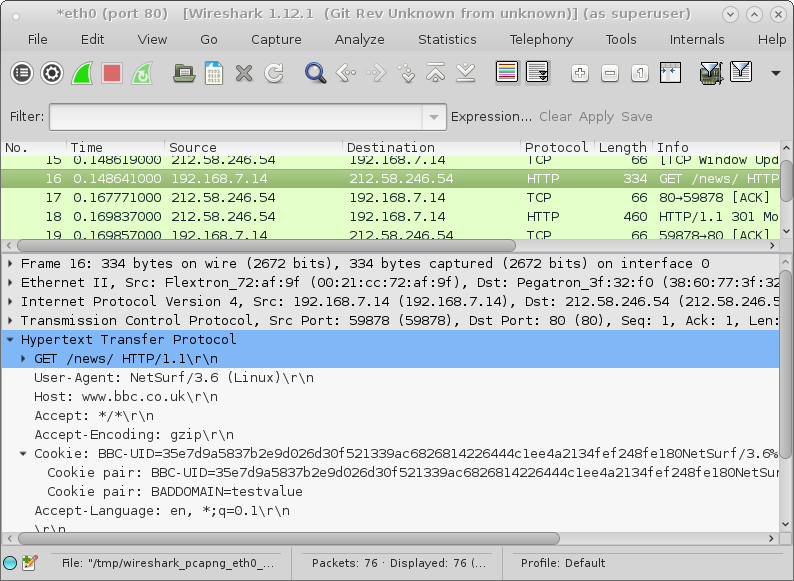
wireshark session shown NetSurf sending a co.uk supercookie to bbc.co.uk
I put the solution into NetSurf, was pleased no-one seemed to notice and moved on to other issues. Recently while fixing a completely unrelated issue in the display of session cookies in the management interface and I realised I had some test supercookies present in the display. After the initial "thats odd" I realised with horror there might be a deeper issue.

It quickly became evident the PSL generation was broken and had been for a long time, even worse somewhere along the line the "redundant" empty generated source file had been removed and the ancient fallback code path was all that had been used.

This issue had escalated somewhat from a trivial display problem. I took a moment to asses the situation a bit more broadly and came to the conclusion there were a number of interconnected causes, centered around the lack of automated testing, which could be solved by extracting the PSL handling into a "support" library.

NetSurf has several of these support libraries which could be used separately to the main browser project but are principally oriented towards it. These libraries are shipped and built in releases alongside the main browser codebase and mainly serve to make API more obvious and modular. In this case my main aim was to have the functionality segregated into a separate module which could be tested, updated and monitored directly by our CI system meaning the embarrassing failure I had found can never occur again.

Before creating my own library I did consider a library called libpsl had been created since I wrote my original implementation. Initially I was very interested in using this library given it managed a data representation within a mere 32Kb.

Unfortunately the library integrates a great deal of IDN and punycode handling which was not required in this use case. NetSurf already has to handle IDN and punycode translations and uses punycode encoded domain names internally only translating to unicode representations for display so duplicating this functionality using other libraries requires a great deal of resource above the raw data representation.

I put the library together based on the existing code generator Perl program and integrated the test set that comes along with the PSL. I was a little alarmed to discover that the PSL had almost doubled in size since the implementation was originally written and now the trivial test program of the library was weighing in at a hefty 120Kb.

This stemmed from two main causes:
  1. there were now many more domain label strings to be stored
  2. there now being many, many more nodes in the tree.
To address the first cause the length of the domain label strings was moved into the unused padding space within each tree node removing a byte from each domain label saving 6Kb. Next it occurred to me that while building the domain label string table that if the label to be added already existed as a substring within the table it could be elided.

The domain labels were sorted from longest to shortest and added in order searching for substring matches as the table was built this saved another 6Kb. I am sure there are ways to reduce this further I have missed (if you see them let me know!) but a 25% saving (47Kb to 35Kb) was a good start.

The second cause was a little harder to address. The structure representing nodes in the tree I started with was at first look reasonable.

struct pnode  
uint16_t label_index; /* index into string table of label */
uint16_t label_length; /* length of label */
uint16_t child_node_index; /* index of first child node */
uint16_t child_node_count; /* number of child nodes */
;

I examined the generated table and observed that the majority of nodes were leaf nodes (had no children) which makes sense given the type of data being represented. By allowing two types of node one for labels and a second for the child node information this would halve the node size in most cases and requiring only a modest change to the tree traversal code.

The only issue with this would be that a way to indicate a node has child information. It was realised that the domain labels can have a maximum length of 63 characters meaning their length can be represented in six bits so a uint16_t was excessive. The space was split into two uint8_t parts one for the length and one for a flag to indicate child data node followed.

union pnode  
struct
uint16_t index; /* index into string table of label */
uint8_t length; /* length of label */
uint8_t has_children; /* the next table entry is a child node */
label;
struct
uint16_t node_index; /* index of first child node */
uint16_t node_count; /* number of child nodes */
child;
;

static const union pnode pnodes[8580] =
/* root entry */
.label = 0, 0, 1 , .child = 2, 1553 ,
/* entries 2 to 1794 */
.label = 37, 2, 1 , .child = 1795, 6 ,

...

/* entries 8577 to 8578 */
.label = 31820, 6, 1 , .child = 8579, 1 ,
/* entry 8579 */
.label = 0, 1, 0 ,

;

This change reduced the node array size from 63Kb to 33Kb almost a 50% saving. I considered using bitfields to try and reduce the label length and has_children flag into a single byte but such packing will not reduce the length of a node below 32bits because it is unioned with the child structure.

A possibility of using the spare uint8_t derived by bitfield packing to store an additional label node in three other nodes was considered but added a great deal of complexity to node lookup and table construction for saving around 4Kb so was not incorporated.

With the changes incorporated the test program was a much more acceptable 75Kb reasonably close to the size of the compressed source but with the benefits of direct lookup. Integrating the libraries single API call into NetSurf was straightforward and resulted in correct operation when tested.

This episode just reminded me of the dangers of code that can fail silently. It exposed our users to a security problem that we thought had been addressed almost six years ago and squandered the limited resources of the project. Hopefully a lesson we will not have to learn again any time soon. If there is a positive to take away it is that the new implementation is more space efficient, automatically built and importantly tested

Gunnar Wolf: Proposing a GR to repeal the 2005 vote for declassification of the debian-private mailing list

For the non-Debian people among my readers: The following post presents bits of the decision-taking process in the Debian project. You might find it interesting, or terribly dull and boring :-) Proceed at your own risk. My reason for posting this entry is to get more people to read the accompanying options for my proposed General Resolution (GR), and have as full a ballot as possible. Almost three weeks ago, I sent a mail to the debian-vote mailing list. I'm quoting it here in full:
Some weeks ago, Nicolas Dandrimont proposed a GR for declassifying
debian-private[1]. In the course of the following discussion, he
accepted[2] Don Armstrong's amendment[3], which intended to clarify the
meaning and implementation regarding the work of our delegates and the
powers of the DPL, and recognizing the historical value that could lie
within said list.
[1] https://www.debian.org/vote/2016/vote_002
[2] https://lists.debian.org/debian-vote/2016/07/msg00108.html
[3] https://lists.debian.org/debian-vote/2016/07/msg00078.html
In the process of the discussion, several people objected to the
amended wording, particularly to the fact that "sufficient time and
opportunity" might not be sufficiently bound and defined.
I am, as some of its initial seconders, a strong believer in Nicolas'
original proposal; repealing a GR that was never implemented in the
slightest way basically means the Debian project should stop lying,
both to itself and to the whole free software community within which
it exists, about something that would be nice but is effectively not
implementable.
While Don's proposal is a good contribution, given that in the
aforementioned GR "Further Discussion" won 134 votes against 118, I
hereby propose the following General Resolution:
=== BEGIN GR TEXT ===
Title: Acknowledge that the debian-private list will remain private.
1. The 2005 General Resolution titled "Declassification of debian-private
   list archives" is repealed.
2. In keeping with paragraph 3 of the Debian Social Contract, Debian
   Developers are strongly encouraged to use the debian-private mailing
   list only for discussions that should not be disclosed.
=== END GR TEXT ===
Thanks for your consideration,
--
Gunnar Wolf
(with thanks to Nicolas for writing the entirety of the GR text ;-) )
Yesterday, I spoke with the Debian project secretary, who confirmed my proposal has reached enough Seconds (that is, we have reached five people wanting the vote to happen), so I could now formally do a call for votes. Thing is, there are two other proposals I feel are interesting, and should be part of the same ballot, and both address part of the reasons why the GR initially proposed by Nicolas didn't succeed: So, once more (and finally!), why am I posting this? I plan to do the formal call for votes by Friday 23.
[update] Kurt informed me that the discussion period started yesterday, when I received the 5th second. The minimum discussion period is two weeks, so I will be doing a call for votes at or after 2016-10-03.

19 September 2016

Mike Gabriel: Rocrail changed License to some dodgy non-free non-License

The Background Story A year ago, or so, I took some time to search the internet for Free Software that can be used for controlling model railways via a computer. I was happy to find Rocrail [1] being one of only a few applications available on the market. And even more, I was very happy when I saw that it had been licensed under a Free Software license: GPL-3(+). A month ago, or so, I collected my old M rklin (Digital) stuff from my parents' place and started looking into it again after +15 years, together with my little son. Some weeks ago, I remembered Rocrail and thought... Hey, this software was GPLed code and absolutely suitable for uploading to Debian and/or Ubuntu. I searched for the Rocrail source code and figured out that it got hidden from the web some time in 2015 and that the license obviously has been changed to some non-free license (I could not figure out what license, though). This made me very sad! I thought I had found a piece of software that might be interesting for testing with my model railway. Whenever I stumble over some nice piece of Free Software that I plan to use (or even only play with), I upload this to Debian as one of the first steps. However, I highly attempt to stay away from non-free sofware, so Rocrail has become a no-option for me back in 2015. I should have moved on from here on... Instead... Proactively, I signed up with the Rocrail forum and asked the author(s) if they see any chance of re-licensing the Rocrail code under GPL (or any other FLOSS license) again [2]? When I encounter situations like this, I normally offer my expertise and help with such licensing stuff for free. My impression until here already was that something strange must have happened in the past, so that software developers choose GPL and later on stepped back from that decision and from then on have been hiding the source code from the web entirely. Going deeper... The Rocrail project's wiki states that anyone can request GitBlit access via the forum and obtain the source code via Git for local build purposes only. Nice! So, I asked for access to the project's Git repository, which I had been granted. Thanks for that. Trivial Source Code Investigation... So far so good. I investigated the source code (well, only the license meta stuff shipped with the source code...) and found that the main COPYING files (found at various locations in the source tree, containing a full version of the GPL-3 license) had been replaced by this text:
Copyright (c) 2002 Robert Jan Versluis, Rocrail.net
All rights reserved.
Commercial usage needs permission.
The replacement happened with these Git commits:
commit cfee35f3ae5973e97a3d4b178f20eb69a916203e
Author: Rob Versluis <r.j.versluis@rocrail.net>
Date:   Fri Jul 17 16:09:45 2015 +0200
    update copyrights
commit df399d9d4be05799d4ae27984746c8b600adb20b
Author: Rob Versluis <r.j.versluis@rocrail.net>
Date:   Wed Jul 8 14:49:12 2015 +0200
    update licence
commit 0daffa4b8d3dc13df95ef47e0bdd52e1c2c58443
Author: Rob Versluis <r.j.versluis@rocrail.net>
Date:   Wed Jul 8 10:17:13 2015 +0200
    update
Getting in touch again, still being really interested and wanting to help... As I consider such a non-license as really dangerous when distributing any sort of software, be it Free or non-free Software, I posted the below text on the Rocrail forum:
Hi Rob,
I just stumbled over this post [3] [link reference adapted for this
blog post), which probably is the one you have referred to above.
It seems that Rocrail contains features that require a key or such
for permanent activation.  Basically, this is allowed and possible
even with the GPL-3+ (although Free Software activists will  not
appreciate that). As the GPL states that people can share the source
code, programmers can  easily deactivate license key checks (and
such) in the code and re-distribute that patchset as they  like.
Furthermore, the current COPYING file is really non-protective at
all. It does not really protect   you as copyright holder of the
code. Meaning, if people crash their trains with your software, you  
could actually be legally prosecuted for that. In theory. Or in the
U.S. ( ;-) ). Main reason for  having a long long license text is to
protect you as the author in case your software causes t trouble to
other people. You do not have any warranty disclaimer in your COPYING
file or elsewhere. Really not a good idea.
In that referenced post above, someone also writes about the nuisance
of license discussions in  this forum. I have seen various cases
where people produced software and did not really care for 
licensing. Some ended with a letter from a lawyer, some with some BIG
company using their code  under their copyright holdership and their
own commercial licensing scheme. This is not paranoia,  this is what
happens in the Free Software world from time to time.
A model that might be much more appropriate (and more protective to
you as the author), maybe, is a  dual release scheme for the code. A
possible approach could be to split Rocrail into two editions:  
Community Edition and Professional/Commercial Edition. The Community
Edition must be licensed in a  way that it allows re-using the code
in a closed-source, non-free version of Rocrail (e.g.   MIT/Expat
License or Apache2.0 License). Thus, the code base belonging to the
community edition  would be licensed, say..., as Apache-2.0 and for
the extra features in the Commercial Edition, you  may use any
non-free license you want (but please not that COPYING file you have
now, it really  does not protect your copyright holdership).
The reason for releasing (a reduced set of features of a) software as
Free Software is to extend  the user base. The honey jar effect, as
practise by many huge FLOSS projects (e.g. Owncloud,  GitLab, etc.).
If people could install Rocrail from the Debian / Ubuntu archives
directly, I am  sure that the user base of Rocrail will increase.
There may also be developers popping up showing  an interest in
Rocrail (e.g. like me). However, I know many FLOSS developers (e.g.
like me) that  won't waste their free time on working for a non-free
piece of software (without being paid).
If you follow (or want to follow) a business model with Rocrail, then
keep some interesting  features in the Commercial Edition and don't
ship that source code. People with deep interest may  opt for that.
Furthermore, another option could be dual licensing the code. As the
copyright holder of Rocrail  you are free to juggle with licenses and
apply any license to a release you want. For example, this  can be
interesing for a free-again Rocrail being shipped via Apple's iStore. 
Last but not least, as you ship the complete source code with all
previous changes as a Git project  to those who request GitBlit
access, it is possible to obtain all earlier versions of Rocrail. In 
the mail I received with my GitBlit credentials, there was some text
that  prohibits publishing the  code. Fine. But: (in theory) it is
not forbidden to share the code with a friend, for local usage.  This
friend finds the COPYING file, frowns and rewinds back to 2015 where
the license was still  GPL-3+. GPL-3+ code can be shared with anyone
and also published, so this friend could upload the  2015-version of
Rocrail to Github or such and start to work on a free fork. You also
may not want  this.
Thanks for working on this piece of software! It is highly
interesing, and I am still sad, that it  does not come with a free
license anymore. I won't continue this discussion and move on, unless
you  are interested in any of the above information and ask for more
expertise. Ping me here or directly  via mail, if needed. If the
expertise leads to parts of Rocrail becoming Free Software again, the 
expertise is offered free of charge ;-).
light+love
Mike
Wow, the first time I got moderated somewhere... What an experience! This experience now was really new. My post got immediately removed from the forum by the main author of Rocrail (with the forum's moderator's hat on). The new experience was: I got really angry when I discovererd having been moderated. Wow! Really a powerful emotion. No harassment in my words, no secrets disclosed, and still... my free speech got suppressed by someone. That feels intense! And it only occurred in the virtual realm, not face to face. Wow!!! I did not expect such intensity... The reason for wiping my post without any other communication was given as below and quite a statement to frown upon (this post has also been "moderately" removed from the forum thread [2] a bit later today):
Mike,
I think its not a good idea to point out a way to get the sources back to the GPL periode.
Therefore I deleted your posting.
(The phpBB forum software also allows moderators to edit posts, so the critical passage could have been removed instead, but immediately wiping the full message, well...). Also, just wiping my post and not replying otherwise with some apology to suppress my words, really is a no-go. And the reason for wiping the rest of the text... Any Git user can easily figure out how to get a FLOSS version of Rocrail and continue to work on that from then on. Really. Now the political part of this blog post... Fortunately, I still live in an area of the world where the right of free speech is still present. I found out: I really don't like being moderated!!! Esp. if what I share / propose is really noooo secret at all. Anyone who knows how to use Git can come to the same conclusion as I have come to this morning. [Off-topic, not at all related to Rocrail: The last votes here in Germany indicate that some really stupid folks here yearn for another this time highly idiotic wind of change, where free speech may end up as a precious good.] To other (Debian) Package Maintainers and Railroad Enthusiasts... With this blog post I probably close the last option for Rocrail going FLOSS again. Personally, I think that gate was already closed before I got in touch. Now really moving on... Probably the best approach for my new train conductor hobby (as already recommended by the woman at my side some weeks back) is to leave the laptop lid closed when switching on the train control units. I should have listened to her much earlier. I have finally removed the Rocrail source code from my computer again without building and testing the application. I neither have shared the source code with anyone. Neither have I shared the Git URL with anyone. I really think that FLOSS enthusiasts should stay away from this software for now. For my part, I have lost my interest in this completely... References light+love,
Mike

13 September 2016

John Goerzen: Two Boys, An Airplane, Plus Hundreds of Old Computers

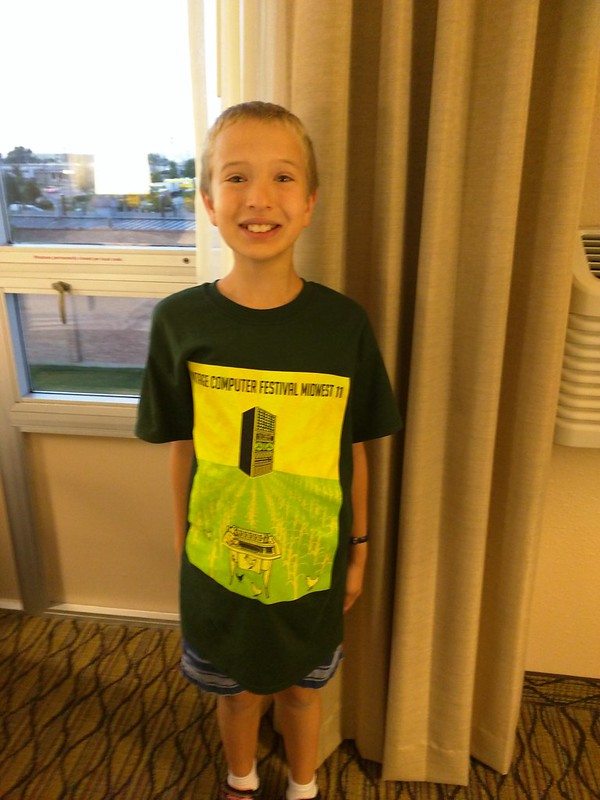
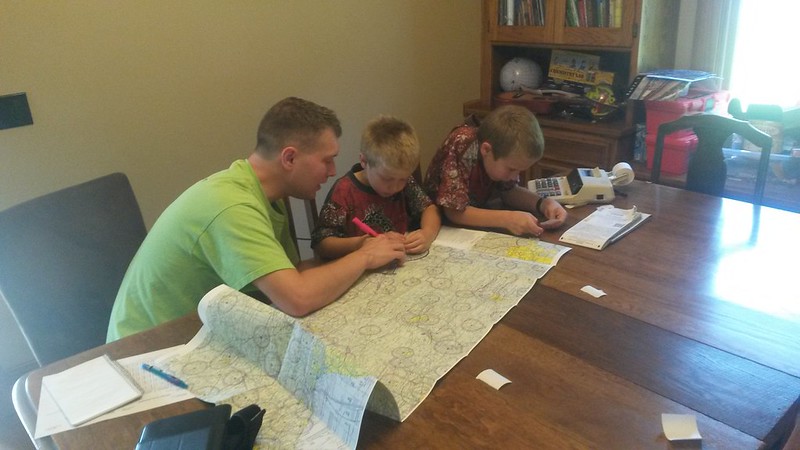
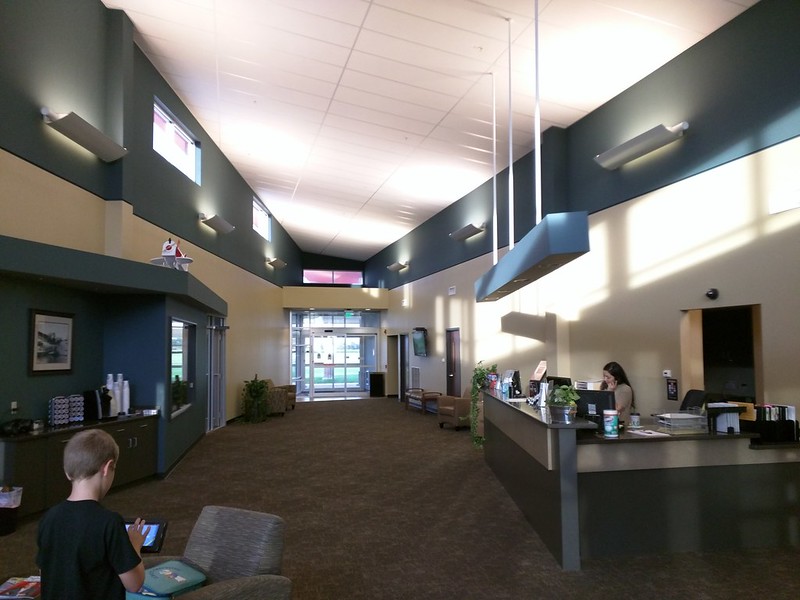
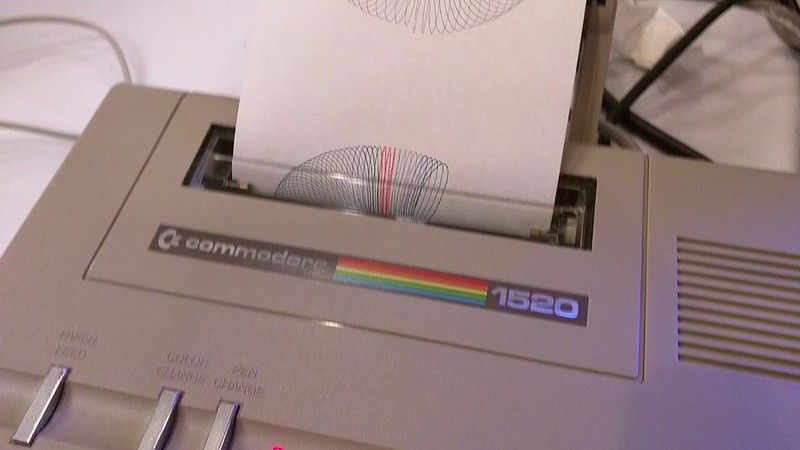
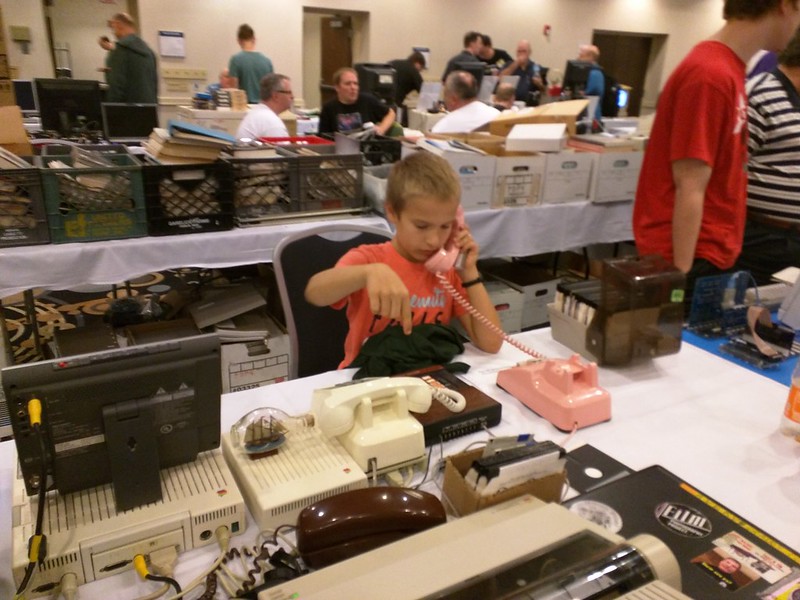
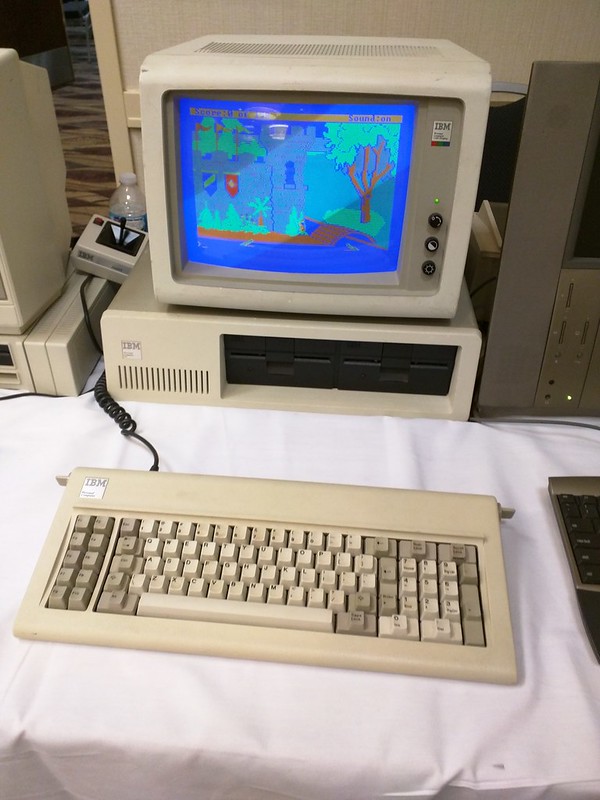
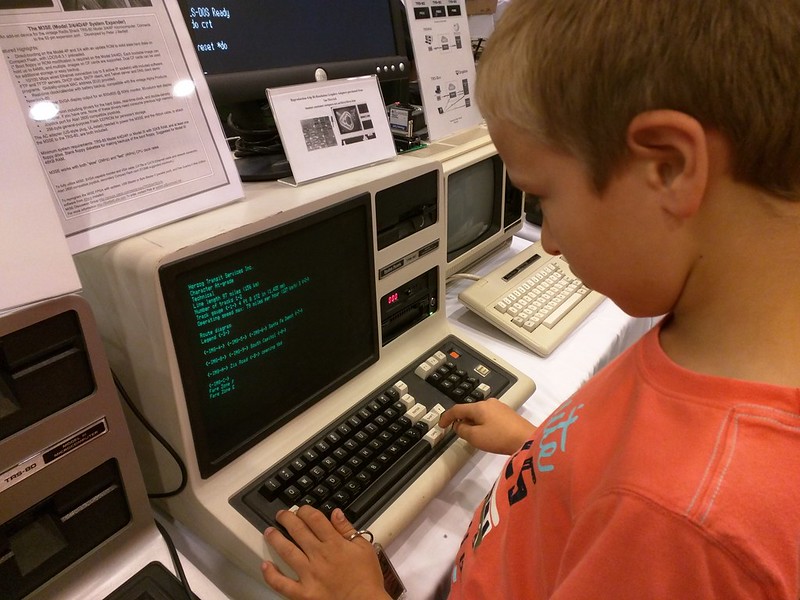
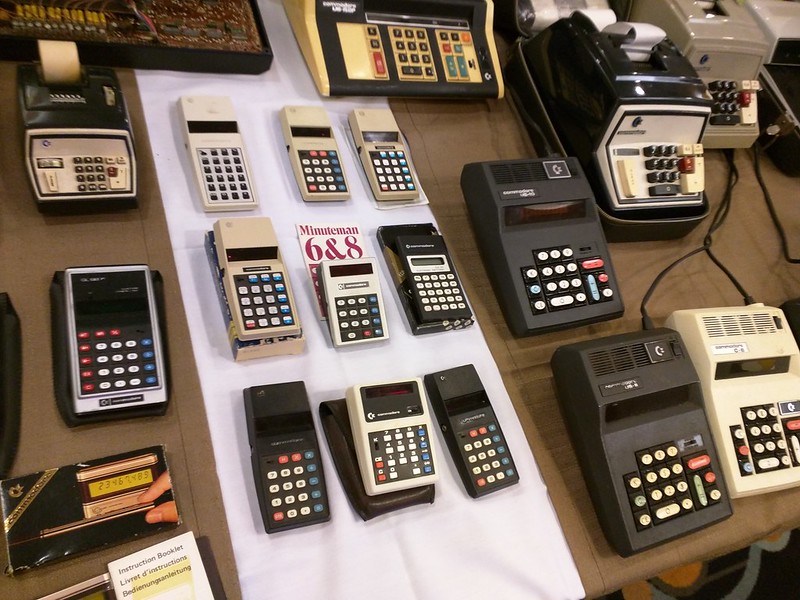
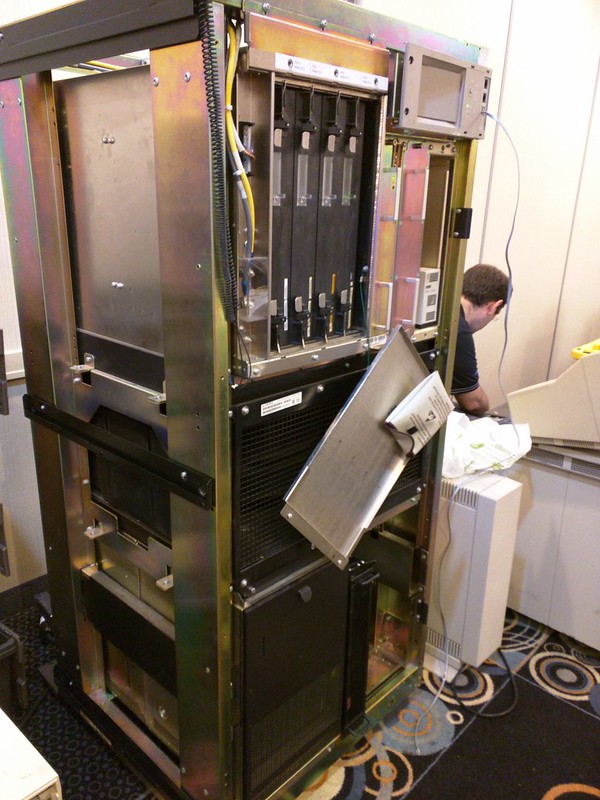
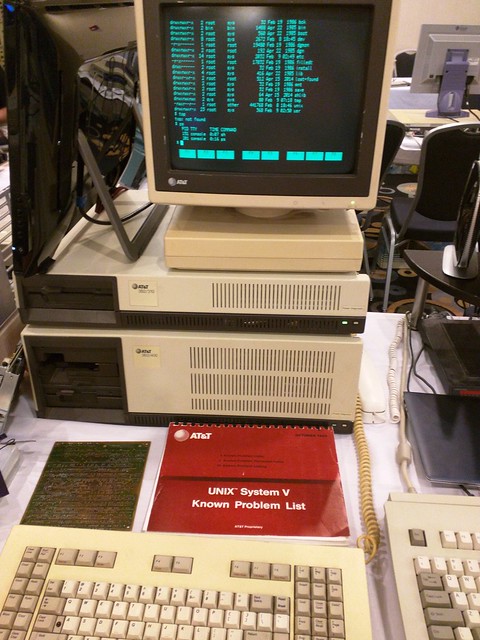
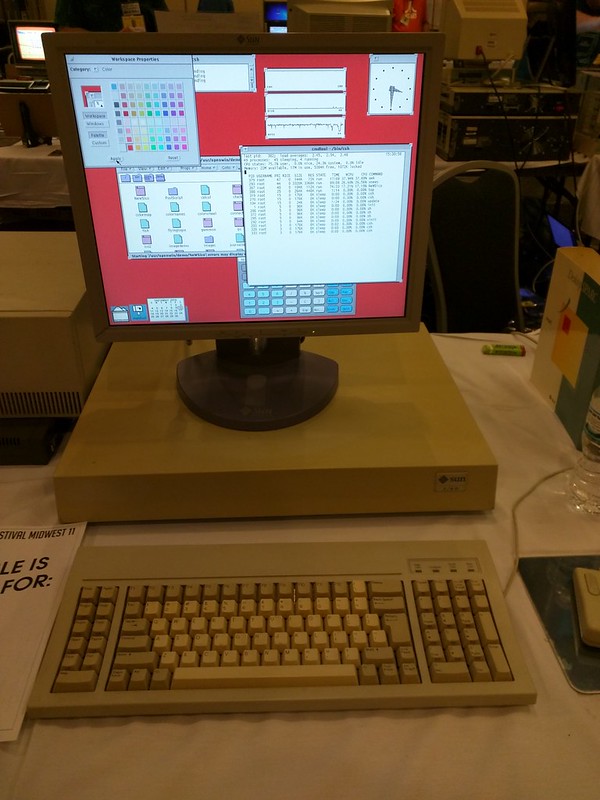
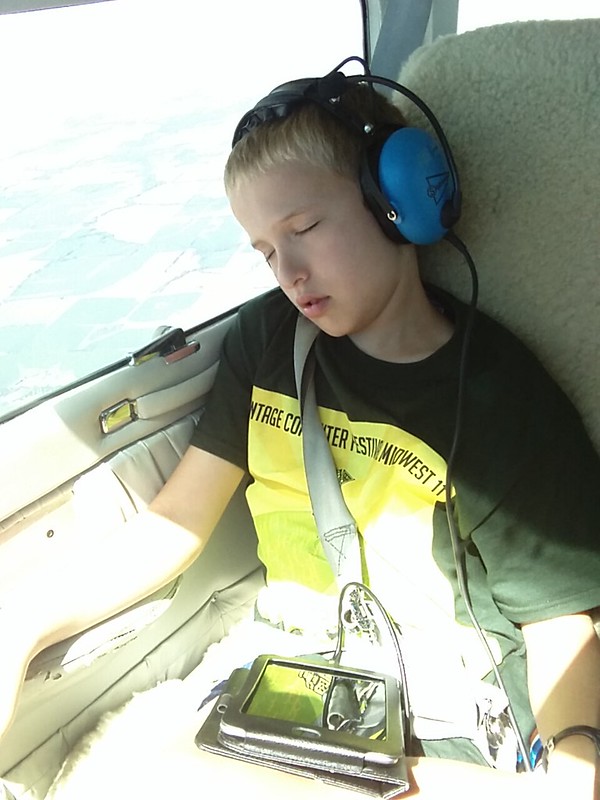
Was there anything you didn t like about our trip? Jacob s answer: That we had to leave so soon! That s always a good sign. When I first heard about the Vintage Computer Festival Midwest, I almost immediately got the notion that I wanted to go. Besides the TRS-80 CoCo II up in my attic, I also have fond memories of an old IBM PC with CGA monitor, a 25MHz 486, an Alpha also in my attic, and a lot of other computers along the way. I didn t really think my boys would be interested. But I mentioned it to them, and they just lit up. They remembered the Youtube videos I d shown them of old line printers and punch card readers, and thought it would be great fun. I thought it could be a great educational experience for them too and it was. It also turned into a trip that combined being a proud dad with so many of my other interests. Quite a fun time. IMG_20160911_061456 (Jacob modeling his new t-shirt) Captain Jacob Chicago being not all that close to Kansas, I planned to fly us there. If you re flying yourself, solid flight planning is always important. I had already planned out my flight using electronic tools, but I always carry paper maps with me in the cockpit for backup. I got them out and the boys and I planned out the flight the old-fashioned way. Here s Oliver using a scale ruler (with markings for miles corresponding to the scale of the map) and Jacob doing calculating for us. We measured the entire route and came to within one mile of the computer s calculation for each segment those boys are precise! 20160904_175519 We figured out how much fuel we d use, where we d make fuel stops, etc. The day of our flight, we made it as far as Davenport, Iowa when a chance of bad weather en route to Chicago convinced me to land there and drive the rest of the way. The boys saw that as part of the exciting adventure! Jacob is always interested in maps, and had kept wanting to use my map whenever we flew. So I dug an old Android tablet out of the attic, put Avare on it (which has aviation maps), and let him use that. He was always checking it while flying, sometimes saying this over his headset: DING. Attention all passengers, this is Captain Jacob speaking. We are now 45 miles from St. Joseph. Our altitude is 6514 feet. Our speed is 115 knots. We will be on the ground shortly. Thank you. DING Here he is at the Davenport airport, still busy looking at his maps: IMG_20160909_183813 Every little airport we stopped at featured adults smiling at the boys. People enjoyed watching a dad and his kids flying somewhere together. Oliver kept busy too. He loves to help me on my pre-flight inspections. He will report every little thing to me a scratch, a fleck of paint missing on a wheel cover, etc. He takes it seriously. Both boys love to help get the plane ready or put it away. The Computers Jacob quickly gravitated towards a few interesting things. He sat for about half an hour watching this old Commodore plotter do its thing (click for video): VID_20160910_142044 His other favorite thing was the phones. Several people had brought complete analog PBXs with them. They used them to demonstrate various old phone-related hardware; one had several BBSs running with actual modems, another had old answering machines and home-security devices. Jacob learned a lot about phones, including how to operate a rotary-dial phone, which he d never used before! IMG_20160910_151431 Oliver was drawn more to the old computers. He was fascinated by the IBM PC XT, which I explained was just about like a model I used to get to use sometimes. They learned about floppy disks and how computers store information. IMG_20160910_195145 He hadn t used joysticks much, and found Pong ( this is a soccer game! ) interesting. Somebody has also replaced the guts of a TRS-80 with a Raspberry Pi running a SNES emulator. This had thoroughly confused me for a little while, and excited Oliver. Jacob enjoyed an old TRS-80, which, through a modern Ethernet interface and a little computation help in AWS, provided an interface to Wikipedia. Jacob figured out the text-mode interface quickly. Here he is reading up on trains. IMG_20160910_140524 I had no idea that Commodore made a lot of adding machines and calculators before they got into the home computer business. There was a vast table with that older Commodore hardware, too much to get on a single photo. But some of the adding machines had their covers off, so the boys got to see all the little gears and wheels and learn how an adding machine can do its printing. IMG_20160910_145911 And then we get to my favorite: the big iron. Here is a VAX a working VAX. When you have a computer that huge, it s easier for the kids to understand just what something is. IMG_20160910_125451 When we encountered the table from the Glenside Color Computer Club, featuring the good old CoCo IIs like what I used as a kid (and have up in my attic), I pointed out to the boys that we have a computer just like this that can do these things and they responded wow! I think they are eager to try out floppy disks and disk BASIC now. Some of my favorites were the old Unix systems, which are a direct ancestor to what I ve been working with for decades now. Here s AT&T System V release 3 running on its original hardware: IMG_20160910_144923 And there were a couple of Sun workstations there, making me nostalgic for my college days. If memory serves, this one is actually running on m68k in the pre-Sparc days: IMG_20160910_153418 Returning home After all the excitement of the weekend, both boys zonked out for awhile on the flight back home. Here s Jacob, sleeping with his maps still up. IMG_20160911_132952 As we were nearly home, we hit a pocket of turbulence, the kind that feels as if the plane is dropping a bit (it s perfectly normal and safe; you ve probably felt that on commercial flights too). I was a bit concerned about Oliver; he is known to get motion sick in cars (and even planes sometimes). But what did I hear from Oliver? Whee! That was fun! It felt like a roller coaster! Do it again, dad!

Rapha&#235;l Hertzog: Freexian s report about Debian Long Term Support, August 2016

A Debian LTS logoLike each month, here comes a report about the work of paid contributors to Debian LTS. Individual reports In August, 140 work hours have been dispatched among 10 paid contributors. Their reports are available: Evolution of the situation The number of sponsored hours rised to 167 hours per month thanks to UR Communications BV joining as gold sponsor (funding 1 day of work per month)! In practice, we never distributed this amount of work per month because some sponsors did not renew in time and some of them might not even be able to renew at all. The security tracker currently lists 31 packages with a known CVE and the dla-needed.txt file 29. It s a small bump compared to last month but almost all issues are affected to someone. Thanks to our sponsors New sponsors are in bold.

No comment Liked this article? Click here. My blog is Flattr-enabled.

12 September 2016

Keith Packard: hopkins

Hopkins Trailer Brake Controller in Subaru Outback My minivan transmission gave up the ghost last year, so I bought a Subaru outback to pull my t@b travel trailer. There isn't a huge amount of space under the dash, so I didn't want to mount a trailer brake controller in the 'usual' spot, right above my right knee. Instead, I bought a Hopkins InSIGHT brake controller, 47297. That comes in three separate pieces which allows for very flexible mounting options. I stuck the 'main' box way up under the dash on the left side of the car. There was a nice flat spot with plenty of space that was facing the right direction: The next trick was to mount the display and control boxes around the storage compartment in the center console: Routing the cables from the controls over to the main unit took a piece of 14ga solid copper wire to use as a fishing line. The display wire was routed above the compartment lid, the control wire was routed below the lid. I'm not entirely happy with the wire routing; I may drill some small holes and then cut the wires to feed them through.

Steve Kemp: If your code accepts URIs as input..

There are many online sites that accept reading input from remote locations. For example a site might try to extract all the text from a webpage, or show you the HTTP-headers a given server sends back in response to a request. If you run such a site you must make sure you validate the schema you're given - also remembering to do that if you're sent any HTTP-redirects.
Really the issue here is a confusion between URL & URI.
The only time I ever communicated with Aaron Swartz was unfortunately after his death, because I didn't make the connection. I randomly stumbled upon the html2text software he put together, which had an online demo containing a form for entering a location. I tried the obvious input:
file:///etc/passwd
The software was vulnerable, read the file, and showed it to me. The site gives errors on all inputs now, so it cannot be used to demonstrate the problem, but on Friday I saw another site on Hacker News with the very same input-issue, and it reminded me that there's a very real class of security problems here. The site in question was http://fuckyeahmarkdown.com/ and allows you to enter a URL to convert to markdown - I found this via the hacker news submission. The following link shows the contents of /etc/hosts, and demonstrates the problem: http://fuckyeahmarkdown.example.com/go/?u=file:///etc/hosts&read=1&preview=1&showframe=0&submit=go The output looked like this:
..
127.0.0.1 localhost
255.255.255.255 broadcasthost
::1 localhost
fe80::1%lo0 localhost
127.0.0.1 stage
127.0.0.1 files
127.0.0.1 brettt..
..
In the actual output of '/etc/passwd' all newlines had been stripped. (Which I now recognize as being an artifact of the markdown processing.) UPDATE: The problem is fixed now.

10 September 2016

Dirk Eddelbuettel: New package gettz on CRAN

gettz is now on CRAN in its initial release 0.0.1. It provides a possible fallback in situations where Sys.timezone() fails to determine the system timezone. That can happen when e.g. the file /etc/localtime somehow is not a link into the corresponding file with zoneinfo data in, say, /usr/share/zoneinfo. Duane McCully provided a nice StackOverflow answer with code that offers fallbacks via /etc/timezone (on Debian/Ubuntu) or /etc/sysconfig/clock (on RedHat/CentOS/Fedora, and rumour has it, BSD* systems) or /etc/TIMEZONE (on Solaris). The gettz micro-package essentially encodes that approach so that we have an optional fallback when Sys.timezone() comes up empty. In the previous paragraph, note the stark absense of OS X where there seems nothing to query, and of course Windows. Contributions for either would be welcome. For questions or comments use the issue tracker off the GitHub repo.

This post by Dirk Eddelbuettel originated on his Thinking inside the box blog. Please report excessive re-aggregation in third-party for-profit settings.

7 September 2016

Julian Andres Klode: New software: sicherboot

Fork me on GitHub Today, I wrote sicherboot, a tool to integrate systemd-boot into a Linux distribution in an entirely new way: With secure boot support. To be precise: The use case here is to only run trusted code which then unmounts an otherwise fully encrypted disk, as in my setup: screenshot-from-2016-09-06-04-09-52 If you want, sicherboot automatically creates db, KEK, and PK keys, and puts the public keys on your EFI System Partition (ESP) together with the KeyTool tool, so you can enroll the keys in UEFI. You can of course also use other keys, you just need to drop a db.crt and a db.key file into /etc/sicherboot/keys. It would be nice if sicherboot could enroll the keys directly in Linux, but there seems to be a bug in efitools preventing that at the moment. For some background: The Platform Key (PK) signs the Key Exchange Key (KEK) which signs the database key (db). The db key is the one signing binaries. sicherboot also handles installing new kernels to your ESP. For this, it combines the kernel with its initramfs into one executable UEFI image, and then signs that. Combined with a fully encrypted disk setup, this assures that only you can run UEFI binaries on the system, and attackers cannot boot any other operating system or modify parts of your operating system (except for, well, any block of your encrypted data, as XTS does not authenticate the data; but then you do have to know which blocks are which which is somewhat hard). sicherboot integrates with various parts of Debian: It can work together by dracut via an evil hack (diverting dracut s kernel/postinst.d config file, so we can run sicherboot after running dracut), it should support initramfs-tools (untested), and it also integrates with systemd upgrades via triggers on the /usr/lib/systemd/boot/efi directory. Currently sicherboot only supports Debian-style setups with /boot/vmlinuz-<version> and /boot/initrd.img-<version> files, it cannot automatically create combined boot images from or install boot loader entries for other naming schemes yet. Fixing that should be trivial though, with a configuration setting and some eval magic (or string substitution). Future planned features include: (1) support for multiple ESP partitions, so you can have a fallback partition on a different drive (think RAID type situation, keep one ESP on each drive, so you can remove a failing one); and (2) a tool to create a self-contained rescue disk image from a directory (which will act as initramfs) and a kernel (falling back to a vmlinuz file ) It might also be interesting to add support for other bootloaders and setups, so you could automatically sign a grub cryptodisk image for example. Not sure how much sense that makes. I published the source at https://github.com/julian-klode/sicherboot (MIT licensed) and uploaded the package to Debian, it should enter the NEW queue soon (or be in NEW by the time you read this). Give it a try, and let me know what you think.
Filed under: Debian, sicherboot

Reproducible builds folks: Reproducible Builds: week 71 in Stretch cycle

What happened in the Reproducible Builds effort between Sunday August 28 and Saturday September 3 2016: Media coverage Antonio Terceiro blogged about testing build reprodubility with debrepro . GSoC and Outreachy updates The next round is being planned now: see their page with a timeline and participating organizations listing. Maybe you want to participate this time? Then please reach out to us as soon as possible! Packages reviewed and fixed, and bugs filed The following packages have addressed reproducibility issues in other packages: The following updated packages have become reproducible in our current test setup after being fixed: The following updated packages appear to be reproducible now, for reasons we were not able to figure out yet. (Relevant changelogs did not mention reproducible builds.) The following 4 packages were not changed, but have become reproducible due to changes in their build-dependencies: Some uploads have addressed some reproducibility issues, but not all of them: Patches submitted that have not made their way to the archive yet: Reviews of unreproducible packages 706 package reviews have been added, 22 have been updated and 16 have been removed in this week, adding to our knowledge about identified issues. 5 issue types have been added: 1 issue type has been updated: Weekly QA work FTBFS bugs have been reported by: diffoscope development diffoscope development on the next version (60) continued in git, taking in contributions from: strip-nondeterminism development Mattia Rizzolo uploaded strip-nondeterminism 0.023-2~bpo8+1 to jessie-backports. A new version of strip-nondeterminism 0.024-1 was uploaded to unstable by Chris Lamb. It included contributions from: Holger added jobs on jenkins.debian.net to run testsuites on every commit. There is one job for the master branch and one for the other branches. disorderfs development Holger added jobs on jenkins.debian.net to run testsuites on every commit. There is one job for the master branch and one for the other branches. tests.reproducible-builds.org Debian: We now vary the GECOS records of the two build users. Thanks to Paul Wise for providing the patch. Misc. This week's edition was written by Ximin Luo, Holger Levsen & Chris Lamb and reviewed by a bunch of Reproducible Builds folks on IRC.

5 September 2016

Joachim Breitner: The new CIS-194

The Haskell minicourse at the University of Pennsylvania, also known as CIS-194, has always had a reach beyond the students of Penn. At least since Brent Yorgey gave the course in 2013, who wrote extensive lecture notes and eventually put the material on Github. This year, it is my turn to give the course. I could not resist making some changes, at least to the first few weeks: Instead of starting with a locally installed compiler, doing execises that revolve mostly around arithmetic and lists, I send my students to CodeWorld, which is a web programming environment created by Chris Smith1. This greatly lowers the initial hurlde of having to set up the local toolchain, and is inclusive towards those who have had little expose to the command line before. Not that I do not expect my students to handle that, but it does not hurt to move that towards later in the course. But more importantly: CodeWorld comes with a nicely designed simple API to create vector graphics, to animate these graphics and even create interactive programs. This means that instead of having to come up with yet another set of exercieses revolving around lists and numbers, I can have the students create Haskell programs that are visual. I believe that this is more motivating and stimulating, and will nudge the students to spend more time programming and thus practicing. In fact, the goal is that in their third homework assignemnt, the students will implement a fully functional, interactive Sokoban game. And all that before talking about the built-in lists or tuples, just with higher order functions and custom datatypes. (Click on the picture above, which is part of the second weeks s homework. You can use the arrow keys to move the figure around and press the escape key to reset the game. Boxes cannot be moved yet -- that will be part of homework 3.) If this sounds interesting to you, and you always wanted to learn Haskell from scratch, feel free to tag along. The lecture notes should be elaborate enough to learn from that, and with the homework problems, you should be able to tell whether you have solved it yourself. Just do not publish your solutions before the due date. Let me know if you have any comments about the course so far. Eventually, I will move to local compilation, use of the interpreter and text-based IO and then start using more of the material of previous iterations of the course, which were held by Richard Eisenberg in 2014 and by Noam Zilberstein in 2015.

  1. Chris has been very helpful in making sure CodeWorld works in a way that suits my course, thanks for that!

4 September 2016

Carl Chenet: Retweet 0.9: Automatically retweet & like

Retweet 0.9, a self-hosted Python app to automatically retweet and like tweets from another user-defined Twitter account, was released this September, 2nd. Retweet 0.9 is already in production for Le Journal du hacker, a French-speaking Hacker News-like website, LinuxJobs.fr, a French-speaking job board and this very blog. fiesta What s the purpose of Retweet? Let s face it, it s more and more difficult to communicate about our projects. Even writing an awesome app is not enough any more. If you don t appear on a regular basis on social networks, everybody thinks you quit or that the project is stalled. But what if you already have built an audience on Twitter for, let s say, your personal account. Now you want to automatically retweet and like all tweets from the account of your new project, to push it forward. Sure, you can do it manually, like in the old good 90 s or you can use Retweet! Twitter Out Of The Browser Have a look at my Github account for my other Twitter automation tools: What about you? Do you use tools to automate the management of your Twitter account? Feel free to give me feedback in the comments below.

Iustin Pop: Usefulness of real-time data during cycling

Wow, a mouthful of a title, for a much simpler post. Up until earlier this year, I had only one sport GPS device, and that was a watch. Made sense, as my "main" sport was running (not that I did it very consistently). Upgraded over a few generations of Garmins, I mainly used it to record my track and statistics (pace, heart rate, etc.) The newest generation of watch and heart rate monitor even give more statistics (left-right leg balance, ground contact time, so on). Most of this data can be looked at while running, but only as an exception; after all, it's very hard to run with one hand up in front of your face. The other useful features guided workouts and alerts during normal runs I've used, but not consistently. So when I started biking a bit more seriously, I wondered whether it would make sense to buy a bike computer. The feature intersection between watch and bike GPS is quite large, so clearly this is a "want" not a "need" by far. Reading forum posts showed the same question repeated multiple times What convinced me to nevertheless buy such a bike GPS were the mapping/routing features. A bike GPS with good routing features, or even just maps on which tracks can be overlayed, can certainly ease the discovery of new routes. After a few months of use, my most useful feature is one that I didn't expect. While the mapping is useful and I do use it, the one that actually is significantly better than my watch is the large display with data fields that I can trivially check almost continuously on road biking, and during technically easy climbing sections for mountain biking. My setup looks like this: It's a 9-field setup; the Edge 1000 can go to 10, but I like "headline" field. The watch can only go to four, and is basically not usable during rides, unless one would use a quick-release kit for mounting on the handle bar. This setup allowed me to learn much better my physical capabilities, why I sometimes run out of energy, and how the terrain affects me. Random things that I learned: Seeing all this data only after the ride is less useful since you don't remember exactly how you felt during specific points in the ride. But as real-time data, one can easily see/feel the correlation between how the body feels and what data says. One thing that would be also useful would be real-time power data (3 sec average, not instantaneous) to correlate even better with the body state. I now use heart rate and cadence as a proxy for that, but being able to see actual power numbers would increase the usefulness of the data even more. Unfortunately, none of these makes the climbs easier. But at least it allows me to understand why one climb feels hard and another easy (relatively speaking). I wonder if, and how this could be applied to running; maybe with smart glasses? Conclusion: yes, I do recommend a bike computer with a large display (to be able to see many fields at once). Just in case one has disposable income at hand and doesn't know which hobby to spend it on ;-)

Junichi Uekawa: Tried setting up chrome remote desktop on Debian.

Tried setting up chrome remote desktop on Debian. Lack of logging made it almost impossible but after realizing that chrome browser dumps some logs on standard output and it was waiting for me to enter password, I made progress and I can use chrome remote desktop now. Awesome.

Steinar H. Gunderson: Multitrack audio in Nageru 1.4.0

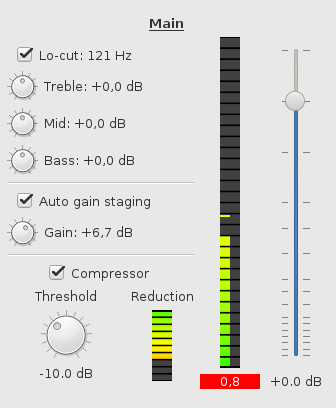
Even though the Chess Olympiad takes some attention right now, development on Nageru (my live video mixer) has continued steadily throughout since the 1.3.0 release. I wanted to take a little time to talk about the upcoming 1.4.0 release, and why things are as they are; writing down things often make them a bit clearer. Every major release of Nageru has had a specific primary focus: 1.0.0 was about just getting everything to work, 1.1.0 was about NVIDIA support for more oomph, 1.2.0 was about stabilization and polish (and added support for Blackmagic's PCI cards as a nice little bonus), and 1.3.0 was about x264 integration. For 1.4.0, I wanted to work on multitrack audio and mixing. Audio has always been a clear focus for Nageru, and for good reason; video is 90% about audio, and it's sorely neglected in most amateur productions (not to mention that processing tools are nearly non-existant in most free or cheap software video mixers). Right from the get-go, it's had a chain with proper leveling, compressors and most importantly visual monitoring, so that you know when things are not as they should be. However, it was also written with an assumption that there would be a single audio input source (one of the cameras), and that's going to change. Single-input is less of a showstopper than one'd think at first; you can work around it by buying a mixer, plug everything into that and then feed that signal into the computer. However, there are a few downsides: If you want camera audio, you'll need to pull more cable from each camera (or have SDI de-embedders). Your mixer is likely to require an extra power supply, and that means yet more cable (any decent USB video card can power over USB, so why shouldn't your audio?). You'll need to buy and transport yet another device. And so on. (If you already have a PA mixer, of course you can use it, but just reusing the PA mix as a stream mix rarely gives the best results, and mixing on an aux bus gives very little flexibility.) So for 1.4.0, I wanted something to get essentially the processing equivalent of a mid-range mixer. But even though my education is in DSP, my experience with mixers is rather limited, so I did the only reasonable thing and went over to a friend who's also an (award-winning) audio engineer. (It turns out that everything on a mixer is the way it is for a pretty good reason, tuned through 50+ years of collective audio experience. If you just try to make up something on your own without understanding what's going on, you have a 0.001% chance of stumbling upon some genius new way of doing things by accident, and a significantly larger chance than that of messing things up.) After some back and forth, we figured out a reasonable set of basic tools that would be useful in the right hands, and not too confusing for a beginner. So let's have a look at the new controls you get: Nageru expanded audio control view There's one set of these controls for each bus. (This is the expanded view; there's also a compact view that has only the meters and the fader, which is what you'll typically want to use during the run itself the expanded view is for setup and tweaking.) A bus in Nageru is a pair of channels (left/right), sourced from a video capture or ALSA card. The channel mapping is flexible; my USB sound card has 18 channels, for instance, and you can use that to make several buses. Each bus has a name (here I named it very creatively Main , but in a real setting you might want something like Blue microphone or Speaker PC ), which is just for convenience; it doesn't mean much. The most important parts of the mix are given the most screen estate, so even though the way through the signal chain is left-to-right top-to-bottom, I'll go over it in the opposite direction. By far the most important part is the audio level, so the fader naturally is very prominent. (Note that the scale is nonlinear; you want more resolution in the most important area.) Changing a fader with the mouse or keyboard is possible, and probably most people will be doing that, but Nageru will also support USB faders. These usually speak MIDI, for historical reasons, and there are some UI challenges when they're all so different, but you can get really small ones if you want to get that tactile feel without blowing up your budget or getting a bigger backpack. Then there's the meter to the left of that. Nageru already has R128 level meters in the mastering section (not shown here, but generally unchanged from 1.3.0), and those are kept as-is, but for each bus, you don't want to know loudness; you want to know recording levels, so you want a peak meter, not a loudness meter. In particular, you don't want the bus to send clipped data to the master (which would happen if you set it too high); Nageru can handle this situation pretty well (unlike most digital mixers, it mixes in full 32-bit floating-point so there's no internal clipping, and there's a limiter on the master by default), but it's still not a good place to be in, so you can see that being marked in red in this example. The meter doubles as an input peak check during setup; if you turn off all the effects and set the fader to neutral, you can see if the input hits peak or not, and then adjust it down. (Also, you can see here that I only have audio in the left channel; I'd better check my connections, or perhaps just use mono, by setting the right channel on the bus mapping to the same input as the left one.) The compressor (now moved from the mastering section to each bus) should be well-known for those using 1.3.0, but in this view, it also has a reduction meter, so that you can see whether it kicks in or not. Most casual users would want to just leave the gain staging and compressor settings alone, but a skilled audio engineer will know how to adjust these to each speaker's antics (some speak at a pretty even volume and thus can get a bit of headroom, while some are much more variable and need tighter settings). Finally (or, well, first), there's the EQ section. The lo-cut is again well-known from 1.3.0 (the cutoff frequency is the same across all buses), but there's now also a simple three-band EQ per bus. Simply ask the speaker to talk normally for a bit, and tweak the controls until it sounds good. People have different voices and different ways of holding the microphone, and if you have a reasonable ear, you can use the EQ to your advantage to make them sound a little more even on the stream. Either that, or just put it in neutral, and the entire EQ code will be bypassed. The code is making pretty good progress; all the DSP stuff is done (save for some optimizations I want to do in zita-resampler, now that the discussion flow is started again), and in theory, one could use it already as-is. However, there's a fair amount of gnarly support code that still needs to be written: In particular, I need to do some refactoring to support ALSA hotplug (you don't want your entire stream to go down just because an USB soundcard dropped out for a split second), and similarly some serialization of saving/loading bus mappings. It's not exactly rocket science, but all the code still needs to be written, and there are a number of corner cases to think of. If you want to peek, the code is in the multichannel_audio branch, but beware; I rebase/squash it pretty frequently, so if you pull from it, expect frequent git breakage.

3 September 2016

Iustin Pop: Nationalpark Bike Marathon 2016

Nationalpark Bike Marathon 2016 report: gravity rules! "Marathon" is a bit of a misnomer, since I did the short route, not the medium nor the long one. But hey, it's the official name! Setup This race has four possible lengths: "Valader" which is full round-trip Scuol-Scuol (137km/4'026m), "Jauer" (Fuldera-Scuol, 103km/2'934m), "Livignasco" (Livigno-Scuol, 66km/1'871m) and "Put r" (S-chanf to Scuol, 47Km/1'051m). After many debates, I settled on the Livignasco route, as that was what I was reasonably confident to be able to do. The only problem was that this route (and all the longer ones, of course) were going over Pass Chaschauna, which is a quite hard climb. My bike shop person, who did the full length a number of times, just said when hearing the route I was planning: "Chaschauna is a bitch " Bad language, proper characterisation. The route choice also impacts the logistics: except for the full route, the question is where to sleep the night before? One can sleep either at the start place, or sleep in Scuol itself and take the official shuttle to the start place, but this means waking up much earlier. I decided to sleep in Livigno, as with a 7:45 start this would allow me to sleep until ~6:30, have a quick breakfast and be in time for the race. Problem #1 So on Friday (26th) I drove to Scuol, picked up my start number, and then drove over to Livigno and checked in to the hotel. Speaking of picking up the start number, I saw this at the start area: While picking up my start number: the race is so fast that an STI is needed as pacer?? An STI needed as pacer? How fast are these people, I wondered? Day of the race My plan to have a relaxing sleep until relatively late failed. I went to sleep with difficulties: late dinner due to my late arrival in Livigno, and then I was stressed enough about not missing the race that at 05:05 I already woke up, and was checking the clock every five minutes. Finally at 05:30 I gave up and got out of bed, with only about 6 hours of sleep. Problem #2. The other problem was that I na vely thought the hotel will have breakfast from 07:00 or even 07:30. Hah, as if this was Switzerland. The hotel had breakfast from 08:00, no reason to hurry, right? So I had a poor man's breakfast in the room, some energy bars and an ice tea. Problem #3. At least I had time to grab this picture from the hotel room: Good morning Livigno! Not bad. On to the race! But before that, remember to fill my hydration pack with 3L of water, and put it in my not-so-light backpack. Of course I had tools and some spare parts with me, what if something happens? Problem #4, over-planning. The race The setup at the start was pretty easy. Wait near the start until 07:45, then go. For me, not too in front, of course: Ready for the start! Pass Chaschauna About 3 kilometres of easy/flat road, and then it starts. Pass Chaschauna, killing your legs softly Already climbing  on foot! But not everybody. But at least the pictures were nice! The climb is hard, but the view is worth it! Still climbing So high already! Good legs :) Looking back: it's been a loong way up I can see the top!  and the remaining steep meters to climb :( The climb is difficult. It was around 22% for most of the time, and very few people were able to bike up. Not only the absolute meters were the problem, but also the fact that the ground was quite loose, and pushing the bike, or rather climbing up while pushing the bike, was difficult to do in bike shoes with cleats. Proper hiking shoes would have been much more adequate. Maybe this is why despite the effort, some people biked as much as possible? I was careful not to over-exert myself and walked almost all the way up. Hence the pictures But at last, reached the top of the pass, and was very happy to be done with it. The GPX file from my Garmin says it took only 4 minutes (1.2km) after the race start to actually start climbing (it was not obvious we were climbing so early), and then 1h:20m/8Km to get from 1'817m altitude to the highest point at 2'658m. 8Km in 1h:20m, faster than walking pace but quite slower than running pace (on flat terrain, of course). At the top of the pass I was quite happy: Finally at the top! Clipping in and Go! Smilling and happy! And then the descent started: I wonder how steep it will be going down This was an easy section :/ All the way leading to the race I kept thinking only about climbing Chaschauna, and not about going down on it. It was quite an experience, which I won't forget soon. The trail was already well travelled, which means that besides the loose ground in form of large clumps of dried earth, there was a layer of fine, somewhat moist earth, about 3-5 centimetres deep, which made the downhill "interesting". Coupled with what was a much steeper trail than going up I saw most of the time ~33% it's no surprise that many, or even most, of the people were walking their bikes down. The GPX track says that the trail goes 319m down in 1Km (so a 31.9% over one entire kilometre), then another 130m over the next 1.4Km (9.28%), and then (not sure if this is the pass per se or after) another longer segment of ~260m over 3Km (8.56%). The first steep segment needs lots of skill and concentration, the others are normal gradients. But at least things go fast. What took uphill took ~40 minutes for the last 450m up, downhill it took only 15 minutes! Falling I was able, thanks to recent training, to bike down the trail, or at least I thought so. So on the steep segment I was struggling to bike down and keep control of my bike, putting one leg down on some sections but in general being "on the bike", being hit by the dirt I was throwing in the air despite the mud-guards, being careful but at the same time enjoying this difficult section. That is, right up to the point where I got, I think, too comfortable. After the second-to-last curve, the rear wheel slides, I lose balance and fall in the (thankfully soft) dirt a bit more forcefully than I should have, the bike also sliding along in the dirt. No damage to myself, just some trivial scratches; the bike seems a bit shaken (fork was turned 180 , full of dirt, etc.). I get again on the bike and I continue down; however, something seems off: the rear brake level doesn't have a return anymore, I have to push it to go back. Still usable, but strange. So I continue the other two segment of this descent, and over these ~4-5Km I feel the brake issue going worse and worse: it's actually hard to push the brake lever back, and even pressing it doesn't seem to have much effect. And then the realisation dawns on my: I have hydraulic brakes, and the worsening thing leads me to think my brake hose has been punctured (by what? I fell in loose dirt) and I'm losing the brake fluid with every press. Now, on flat road, biking with only the front brake is tricky but doable. On an MTB course, having only one brake is not a smart thing . Not easy, not smart, and definitely dangerous. It also felt very strange to not have both brakes, and then I realised how much I work with the brakes in unison. I knew that there are repair posts in the race, but I didn't know if they can fix such things (and doing a brake fluid refill how complicated is it, how much time does it take?). Anyway, I resolved to try and continue if the terrain allows until I reach the first repair post, and stop if it gets too steep. It would be pretty sad to have to abort the race after only 10Km, right? The terrain did cooperate: up and down, so I was able to bleed speed easily, and even though through forest, the visibility was good enough that I could plan ahead. It was strangely lonely at this time: I was going slowly and thus not reaching from behind anyone, but also not being reached by riders from behind. I did enjoy it a bit, the quietness of the forest, just interrupted by the squeaking of my front brake And then I finally see the sign for "Repair: 1Km". Yaaay! maybe I don't have to quit the race. And then, about 100m further on, another sign: "Danger! Steep descent". Uh-oh tantalisingly close Let's go slow. And yes, here I was overtaken by 3-4 other cyclists. This was the single moment in the race where I did have a moment of real fear: at one point, I was going down with the remaining brake as pressed as I could without compromising stability, and I was still gaining speed. Not smart, and as I was debating how to fall to stop my descent, the terrain started to get less steep, and I finally reached the repair station, at kilometre 21. Difficult repairs There was another person being serviced for a flat rear tire, so I wait in line and discuss with him my problem. Upon hearing I only had the front brake, he said: "Wow, how did you manage to descend this last segment?" "Well, slowly ". My turn came up, I explain my problem and my theory, and the repair guy gives me one look, the bike one look, but doesn't look at the brake hose. Instead, he looks once at the brake lever, sees that another cable guide on my handle bar was bent during the fall and actually was mechanically interfering with the brake lever, unbends that thing, and says "here you go". I was stunned. 15 seconds of looking at the problem without stress, and the problem was solved. I could have done this myself if I took the time to look and think, and not hurry. And I could have enjoyed all the downhill on the pass, with two functioning brakes. Some lessons have to be learned the hard way, and this was one. I got off easy though, as I didn't have a real accident while biking with only one brake. And they say you get wiser as you get older Anyway, brake repaired, I stopped at the Sanit r tent to have my scratches disinfected, and onwards. The following few kilometres until S-chanf I enjoyed very much. S-chanf And then, 2 hours 10 minutes into the race, I exit the forest trail, reach S-chanf, and start climbing and descending and climbing and descending. In the sun, which now (after 10 AM) is not that light anymore. The initial climb at S-chanf, while not much, took away my remaining short-term reserves. The route is 50m ascent, then down and then another 50m ascent, and after a bit of flat another 75m ascent I was getting tired, despite eating energy bars and drinking water (and juice at stops). This goes one for an entire hour, during which I cover about 23Km, so not a bad speed everything considered. But getting more and more tired. There were also some very nice segments, along the river, in the shade of the forest. Some fast downhill, some fast flat. I got overtaken by quite a few real racers, that were going so fast I couldn't keep up with them as in I didn't dare ride that fast even when I had the energy. Clearly they were from the longer segments, and boy were they fast! A number of couples (or pairs?) one woman one man, a number of bigger groups, all going as if they had E-bikes or super-powers, not just biking along tired like me Last climb And then, the last big climb: half an hour of going about 300m up (absolute values, so cumulative number would probably be higher), in the sun, over about 6Km, so only 5% average gradient. But I was tired and even resorted to walking on some portions At least I could take some pictures again: Much later, climbing again. Or have pictures taken: A bit of a smile left. Yes, that's a smile, not a grimace! Nice views: Look, nice castle! Stopping for a picture, and not because I was *dead tired* :) At one point, in a bit of a shade, I stop to catch my breath. Somebody else stopped as well and, seeing as I was checking my GPS, asks: I got overtaken by a lot of cyclists here, although many of them were from S-chanf route (based on the number colour). Sad The thing is, besides the climbing and the sun, this and the previous part was a very nice route: through small towns, high above the valley, beautiful landscapes, etc. Just enjoying it was hard, since I wasn't a) trained well enough and b) prepared well enough. Last segment, last downhill In any case, after that hard half hour, it's flat (or rather said, average gradient zero): Flat route, good pavement. Can catch my breath, and take a another picture. Good road, good views, but I'm on the last virtual bar of my battery, so the remaining 15Km I do in 40 minutes, also "eating" the last ascent meters still about 300 left, I think, but up/down/up/down, so you could reuse kinetic energy to gain potential one. The only question I had now was, the route was at this moment about 400m higher (in absolute altitude) than the finish point, so when do we lose that altitude? The answer was a very very nice answer: in the last 5Km, for an average gradient of 8%, just perfect. I was tired however, so I couldn't really enjoy or go fast here, but it was a good feeling. Finish! And then, entering Scuol, not really believing I'm near the finish, that I will be able to actually stop and relax. My finish picture doesn't do justice to how happy I was at that moment: At the finish, happy happy happy! However, after passing the finish line, it was a bit weird. I just stop now? What next? So weird to just walk, not push pedals, and not go up. Or down. The funny thing here was that I thought I didn't use much of my water (hydration pack) during the race. But soon after finishing, I drank the equivalent of about two glasses (let's say 0.5L) and it was over. So I did manage to drink 2.5L during the race, plus the sport drinks at the stops. Time for stats: my Garmin says 67.07Km, 4h:29m, average speed 15.0kph (hah), 1'615m elevation gain. Official numbers say 66Km, 1'871m elevation, and thus 14.22kph. Ranking-wise: Sigh, could have done better. I was aiming for somewhere around last 33%, not last 25% :-P First classed was ~66% faster than me Going to the train station was hard as in difficult to move my legs. Took one nice picture of Scuol though, so was able to think a bit: After the race: Scuol is not so bad And then the long way back to Livigno. Took me 4 h to bike to Scuol, and about 3 hours to go back via public transport. At least I ate a sandwich in the meantime. Then reached Livigno, which was also looking nice: Took me almost as long by public transport as by bike, but finally back in Livigno. Also nice! Then got on my bike, which at this point was magically light and easy to ride (it seems I was at least partially recovered), rode to the hotel, packed my stuff, and drove home. On the highway I had my first real meal for that day, but I was quite tired so didn't feel like the achievement it should have been Lessons The biggest takeaway from this race was the huge learning experience I got. The race was itself awesome, but the learning even more so. First, for this particular race, it's much better to sleep in Scuol and (if not doing the whole route) take the shuttle to the actual start. Yes, one has to wake up earlier, but you have assured breakfast via the organisers (++++!), and after the race you don't have to get even more tired by taking the train and the bus and Second, I need better logistics: I don't need to carry that heavy load (spare tube, pump, tools, jacket in case it's cold) when the race is well organised. The water in the hydration pack was useful, but carrying it up Chaschauna was a pain. Not sure what I'll do next; it's possible to survive only on water/drinks from the food posts (basically 2.5-2.8L is equivalent to only 4 750ml bottles, and there were I think about 6 stops?), but the hydration pack is so easy to use Keeping one's head cool and not stress about things also would help: had I looked at my brake lever in peace, I could have solved it myself, and not ride ~10Km with only one brake. Also, losing some weight (as in losing fat, not having a lighter bike) would definitely help. I could stand to lose 5Kg easily, probably 10Kg, and that would bring me more in line with other people in the race (at least looking at the pictures). And hey, my Watts/Kg would improve magically! And last but most important, I need better training. Training on how to use my energy, training longer rides so that my body gets used to it and doesn't bonk after 3 hours, training training training. Which I like, but the problem is time to do it Also, in case anybody wonders: yes, I do recommend this race! It was definitely fun, and the route itself is very nice, nicer than the pictures here show. Closing words: gravity rules. Up or down, it's hard and punishing. Still: Ride on!

Next.

Previous.