Search Results: "uli"

27 May 2021

Michael Prokop: What to expect from Debian/bullseye #newinbullseye

Bullseye Banner, Copyright 2020 Juliette Taka Debian v11 with codename bullseye is supposed to be released as new stable release soon-ish (let s hope for June, 2021! :)). Similar to what we had with #newinbuster and previous releases, now it s time for #newinbullseye! I was the driving force at several of my customers to be well prepared for bullseye before its freeze, and since then we re on good track there overall. In my opinion, Debian s release team did (and still does) a great job I m very happy about how unblock requests (not only mine but also ones I kept an eye on) were handled so far. As usual with major upgrades, there are some things to be aware of, and hereby I m starting my public notes on bullseye that might be worth also for other folks. My focus is primarily on server systems and looking at things from a sysadmin perspective. Further readings Of course start with taking a look at the official Debian release notes, make sure to especially go through What s new in Debian 11 + Issues to be aware of for bullseye. Chris published notes on upgrading to Debian bullseye, and also anarcat published upgrade notes for bullseye. Package versions As a starting point, let s look at some selected packages and their versions in buster vs. bullseye as of 2021-05-27 (mainly having amd64 in mind):
Package buster/v10 bullseye/v11
ansible 2.7.7 2.10.8
apache 2.4.38 2.4.46
apt 1.8.2.2 2.2.3
bash 5.0 5.1
ceph 12.2.11 14.2.20
docker 18.09.1 20.10.5
dovecot 2.3.4 2.3.13
dpkg 1.19.7 1.20.9
emacs 26.1 27.1
gcc 8.3.0 10.2.1
git 2.20.1 2.30.2
golang 1.11 1.15
libc 2.28 2.31
linux kernel 4.19 5.10
llvm 7.0 11.0
lxc 3.0.3 4.0.6
mariadb 10.3.27 10.5.10
nginx 1.14.2 1.18.0
nodejs 10.24.0 12.21.0
openjdk 11.0.9.1 11.0.11+9 + 17~19
openssh 7.9p1 8.4p1
openssl 1.1.1d 1.1.1k
perl 5.28.1 5.32.1
php 7.3 7.4+76
postfix 3.4.14 3.5.6
postgres 11 13
puppet 5.5.10 5.5.22
python2 2.7.16 2.7.18
python3 3.7.3 3.9.2
qemu/kvm 3.1 5.2
ruby 2.5.1 2.7+2
rust 1.41.1 1.48.0
samba 4.9.5 4.13.5
systemd 241 247.3
unattended-upgrades 1.11.2 2.8
util-linux 2.33.1 2.36.1
vagrant 2.2.3 2.2.14
vim 8.1.0875 8.2.2434
zsh 5.7.1 5.8
Linux Kernel The bullseye release will ship a Linux kernel based on v5.10 (v5.10.28 as of 2021-05-27, with v5.10.38 pending in unstable/sid), whereas buster shipped kernel 4.19. As usual there are plenty of changes in the kernel area and this might warrant a separate blog entry, but to highlight some issues: One surprising change might be that the scrollback buffer (Shift + PageUp) is gone from the Linux console. Make sure to always use screen/tmux or handle output through a pager of your choice if you need all of it and you re in the console. The kernel provides BTF support (via CONFIG_DEBUG_INFO_BTF, see #973870), which means it s no longer necessary to install LLVM, Clang, etc (requiring >100MB of disk space), see Gregg s excellent blog post regarding the underlying rational. Sadly the libbpf-tools packaging didn t make it into bullseye (#978727), but if you want to use your own self-made Debian packages, my notes might be useful. With kernel version 5.4, SUBDIRS support was removed from kbuild, so if an out-of-tree kernel module (like a *-dkms package) fails to compile on bullseye, make sure to use a recent version of it which uses M= or KBUILD_EXTMOD= instead. Unprivileged user namespaces are enabled by default (see #898446 + #987777), so programs can create more restricted sandboxes without the need to run as root or via a setuid-root helper. If you prefer to keep this feature restricted (or tools like web browsers, WebKitGTK, Flatpak, don t work), use sysctl -w kernel.unprivileged_userns_clone=0 . The /boot/System.map file(s) no longer provide the actual data, you need to switch to the dbg package if you rely on that information:
% cat /boot/System.map-5.10.0-6-amd64 
ffffffffffffffff B The real System.map is in the linux-image-<version>-dbg package
Be aware though, that the *-dbg package requires ~5GB of additional disk space. Systemd systemd v247 made it into bullseye (updated from v241). Same as for the kernel this might warrant a separate blog entry, but to mention some highlights: Systemd in bullseye activates its persistent journal functionality by default (storing its files in /var/log/journal/, see #717388). systemd-timesyncd is no longer part of the systemd binary package itself, but available as standalone package. This allows usage of ntp, chrony, openntpd, without having systemd-timesyncd installed (which prevents race conditions like #889290, which was biting me more than once). journalctl gained new options:
--cursor-file=FILE      Show entries after cursor in FILE and update FILE
--facility=FACILITY...  Show entries with the specified facilities
--image=IMAGE           Operate on files in filesystem image
--namespace=NAMESPACE   Show journal data from specified namespace
--relinquish-var        Stop logging to disk, log to temporary file system
--smart-relinquish-var  Similar, but NOP if log directory is on root mount
systemctl gained new options:
clean UNIT...                       Clean runtime, cache, state, logs or configuration of unit
freeze PATTERN...                   Freeze execution of unit processes
thaw PATTERN...                     Resume execution of a frozen unit
log-level [LEVEL]                   Get/set logging threshold for manager
log-target [TARGET]                 Get/set logging target for manager
service-watchdogs [BOOL]            Get/set service watchdog state
--with-dependencies                 Show unit dependencies with 'status', 'cat', 'list-units', and 'list-unit-files'
 -T --show-transaction              When enqueuing a unit job, show full transaction
 --what=RESOURCES                   Which types of resources to remove
--boot-loader-menu=TIME             Boot into boot loader menu on next boot
--boot-loader-entry=NAME            Boot into a specific boot loader entry on next boot
--timestamp=FORMAT                  Change format of printed timestamps
If you use systemctl edit to adjust overrides, then you ll now also get the existing configuration file listed as comment, which I consider very helpful. The MACAddressPolicy behavior with systemd naming schema v241 changed for virtual devices (I plan to write about this in a separate blog post). There are plenty of new manual pages: systemd also gained new unit configurations related to security hardening: Another new unit configuration is SystemCallLog= , which supports listing the system calls to be logged. This is very useful for for auditing or temporarily when constructing system call filters. The cgroupv2 change is also documented in the release notes, but to explicitly mention it also here, quoting from /usr/share/doc/systemd/NEWS.Debian.gz:
systemd now defaults to the unified cgroup hierarchy (i.e. cgroupv2).
This change reflects the fact that cgroups2 support has matured
substantially in both systemd and in the kernel.
All major container tools nowadays should support cgroupv2.
If you run into problems with cgroupv2, you can switch back to the previous,
hybrid setup by adding systemd.unified_cgroup_hierarchy=false to the
kernel command line.
You can read more about the benefits of cgroupv2 at
https://www.kernel.org/doc/html/latest/admin-guide/cgroup-v2.html
Note that cgroup-tools (lssubsys + lscgroup etc) don t work in cgroup2/unified hierarchy yet (see #959022 for the details). Configuration management puppet s upstream doesn t provide packages for bullseye yet (see PA-3624 + MODULES-11060), and sadly neither v6 nor v7 made it into bullseye, so when using the packages from Debian you re still stuck with v5.5 (also see #950182). ansible is also available, and while it looked like that only version 2.9.16 would make it into bullseye (see #984557 + #986213), actually version 2.10.8 made it into bullseye. chef was removed from Debian and is not available with bullseye (due to trademark issues). Prometheus stack Prometheus server was updated from v2.7.1 to v2.24.1, and the prometheus service by default applies some systemd hardening now. Also all the usual exporters are still there, but bullseye also gained some new ones: Virtualization docker (v20.10.5), ganeti (v3.0.1), libvirt (v7.0.0), lxc (v4.0.6), openstack, qemu/kvm (v5.2), xen (v4.14.1), are all still around, though what s new and noteworthy is that podman version 3.0.1 (tool for managing OCI containers and pods) made it into bullseye. If you re using the docker packages from upstream, be aware that they still don t seem to understand Debian package version handling. The docker* packages will not be automatically considered for upgrade, as 5:20.10.6~3-0~debian-buster is considered newer than 5:20.10.6~3-0~debian-bullseye:
% apt-cache policy docker-ce
  docker-ce:
    Installed: 5:20.10.6~3-0~debian-buster
    Candidate: 5:20.10.6~3-0~debian-buster
    Version table:
   *** 5:20.10.6~3-0~debian-buster 100
          100 /var/lib/dpkg/status
       5:20.10.6~3-0~debian-bullseye 500
          500 https://download.docker.com/linux/debian bullseye/stable amd64 Packages
Vagrant is available in version 2.2.14, the package from upstream works perfectly fine on bullseye as well. If you re relying on VirtualBox, be aware that upstream doesn t provide packages for bullseye yet, but the package from Debian/unstable (v6.1.22 as of 2021-05-27) works fine on bullseye (VirtualBox isn t shipped with stable releases since quite some time due to lack of cooperation from upstream on security support for older releases, see #794466). If you rely on the virtualbox-guest-additions-iso and its shared folders support, you might be glad to hear that v6.1.22 made it into bullseye (see #988783), properly supporting more recent kernel versions like present in bullseye. debuginfod There s a new service debuginfod.debian.net (see debian-devel-announce and Debian Wiki), which makes the debugging experience way smoother. You no longer need to download the debugging Debian packages (*-dbgsym/*-dbg), but instead can fetch them on demand, by exporting the following variables (before invoking gdb or alike):
% export DEBUGINFOD_PROGRESS=1    # for optional download progress reporting
% export DEBUGINFOD_URLS="https://debuginfod.debian.net"
BTW: if you can t rely on debuginfod (for whatever reason), I d like to point your attention towards find-dbgsym-packages from the debian-goodies package. Vim Sadly Vim 8.2 once again makes another change for bad defaults (hello mouse behavior!). When incsearch is set, it also applies to :substitute. This makes it veeeeeeeeeery annoying when running something like :%s/\s\+$// to get rid of trailing whitespace characters, because if there are no matches it jumps to the beginning of the file and then back, sigh. To get the old behavior back, you can use this:
au CmdLineEnter : let s:incs = &incsearch   set noincsearch
au CmdLineLeave : let &incsearch = s:incs
rsync rsync was updated from v3.1.3 to v3.2.3. It provides various checksum enhancements (see option --checksum-choice). We got new capabilities (hardlink-specials, atimes, optional protect-args, stop-at, no crtimes) and the addition of zstd and lz4 compression algorithms. And we got new options: OpenSSH OpenSSH was updated from v7.9p1 to 8.4p1, so if you re interested in all the changes, check out the release notes between those version (8.0, 8.1, 8.2, 8.3 + 8.4). Let s highlight some notable new features: Misc unsorted

25 May 2021

Shirish Agarwal: Pandemic, Toolkit and India

Pandemic Situation in India. I don t know from where I should start. This is probably a good start. I actually would recommend Indiacable as they do attempt to share some things happening in India from day to day but still there is a lot thatt they just can t cover, nobody can cover. There were two reports which kind of shook me all inside. One which sadly came from the UK publication Independent, probably as no Indian publication would dare publish it. The other from Rural India. I have been privileged in many ways, including friends who have asked me if I need any financial help. But seeing reports like above, these people need more help, guidance and help than I. While I m never one to say give to Foundations. If some people do want to help people from Maharashtra, then moneylifefoundation could be a good place where they could donate. FWIW, they usually use the foundation to help savers and investors be safe and help in getting money when taken by companies with dubious intentions. That is their drive. Two articles show their bent. The first one is about the Algo scam which I have written previously about the same in this blog. Interestingly, when I talk about this scam, all Modi supporters are silent. The other one does give some idea as to why the Govt. is indifferent. That is going to a heavy cross for all relatives to bear. There has been a lot that has been happening. Now instead of being limited to cities, Covid has now gone hinterland in a big way. One could ask also Praveen as he probably knows what would be good for Kerala and surrounding areas. The biggest change, however, has been that India is now battling not just the pandemic but also Mucormycosis also known as black fungus and its deadlier cousin the white fungus. Mucormycosis came largely due to an ill-advise given that applying cow dung gives protection to Corona. And many applied it due to faith. And people who know science do know that in fact it has that bacteria. Sadly, those of us who are and were more interested in law, computer science etc. has now also have to keep on top of what is happening in the medical field. It isn t that I hate it, but it has a lot of costs. From what I could gather on various social media and elsewhere, a single injection of anti-fungal for the above costs INR 3k/- and that needs to be 5 times in a day and that course has to be for three weeks. So even the relatively wealthy people can and will become poor in no time. No wonder thousands of those went to UK, US, Dubai or wherever they could find safe-harbor from the pandemic with no plans of arriving back soon. There was also the whole bit about FBS or Fetal Bovin Serum. India ordered millions of blood serum products from abroad and continues to. This was quickly shut down as news on Social Media. Apparently, it is only the Indian cow which is worthy of reverence. All other cows and their children are fair game according to those in power. Of course, that discussion was quickly shut down as was the discussion about IGP (Indian Genome Project). People over the years had asked me why India never participated for the HGP (Human Gnome Project). I actually had no answer for that. Then in 2020, there was idea of IGP which was put up and then it was quickly shot down as the results could damage a political party s image. In fact, a note to people who want to join Indian civil services tells the reason exactly. While many countries in the world are hypocrites, including the U.S. none can take the place that India has made for itself in that field.

The Online experience The vaccination process has been made online and has led to severe heartburn and trouble for many including many memes. For e.g.

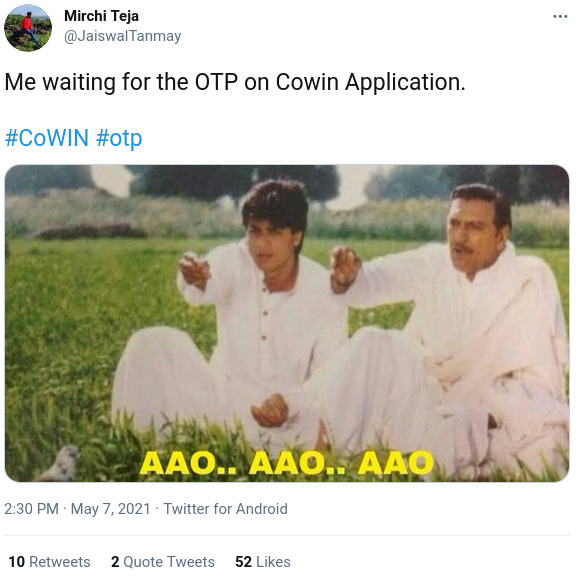
Daily work, get up, have a bath, see if you got a slot on the app, sleep.
People trying desperately to get a slot, taken from Hindi Movie Dilwale Dulhania Le Jaygenge.
Just to explain what is happening, one has to go to the website of cowin. Sharing a screenshot of the same.
Cowin app. sceeenshot
I have deliberately taken a screenshot of the cowin app. in U.P. which is one of the areas where the ruling party, BJP has. I haven t taken my state for the simple reason, even if a slot is open, it is of no use as there are no vaccines. As have been shared in India Cable as well as in many newspapers, it is the Central Govt. which holds the strings for the vaccines. Maharashtra did put up an international tender but to no effect. All vaccine manufacturers want only Central Govt. for purchases for multiple reasons. And GOI is saying it has no money even though recently it got loans as well as a dividend from RBI to the tune of 99k crore. For what all that money is, we have no clue. Coming back though, to the issue at hand. the cowin app. is made an open api. While normally, people like us should and are happy when an API is open, it has made those who understand how to use git, compile, etc. better than others. A copy of the public repo. of how you can do the same can be found on Github. Now, obviously, for people like me and many others it has ethical issues.

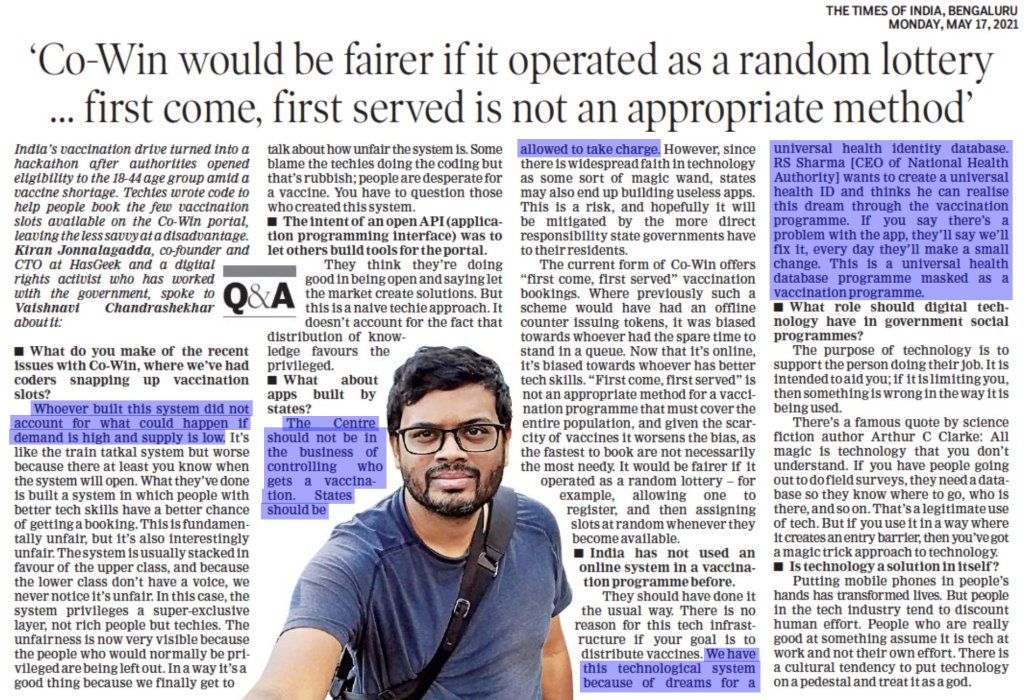
Kiran s Interview in Times of India (TOI) There isn t much to say apart from I haven t used it. I just didn t want to. It just is unethical. Hopefully, in the coming days GOI does something better. That is the only thing we are surviving on, hope.

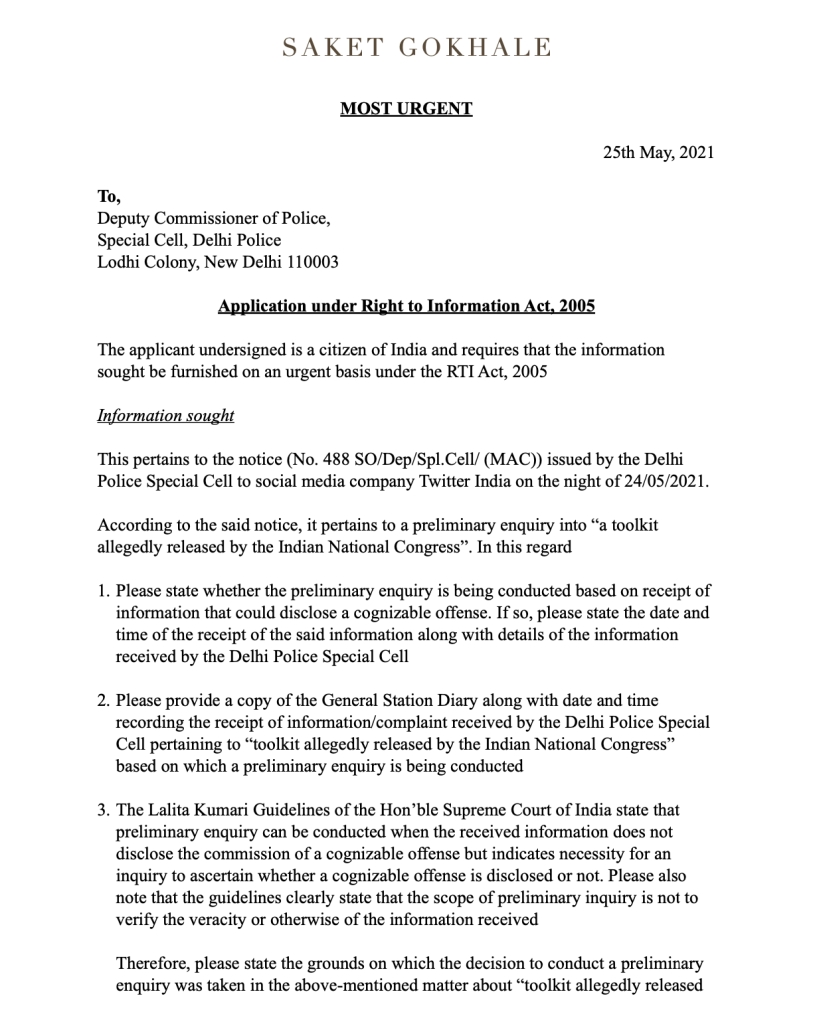
The Toolkit saga A few days before, GOI shared a toolkit apparently made by Congress to defame the party in power. That toolkit was shared before the press and Altnews did the investigation and promptly shredded the claims. Congress promptly made an FIR in Chhattisgarh where it is in power. The gentleman who made the claims Mr. Sambit Patra refused to appear against the police without evidence citing personal reasons and asking 1 week to appear before them. Apart from Altnews which did a great job, sadly many people didn t even know that there is something called WYSIWYG. I had to explain that so many Industries, whether it is politics, creative industries, legal, ad industries, medical transcription, and imaging all use this, and all the participants use the same version of the software. The reason being that in most Industries, there is a huge loss and issue of legal liabilities if something untoward happens. For e.g. if medical transcription is done in India is wrong (although his or her work will be checked by a superior in the West), but for whatever reason is not, and a wrong diagnosis is put (due to wrong color or something) then a patient could die and the firm who does that work could face heavy penalties which could be the death of them. There is another myth that Congress has unlimited wealth or huge wealth. I asked if that was the case, why didn t they shift to Mac. Of course, none have answers on this one. There is another reason why they didn t want to appear. The Rona Wilson investigation by Arsenal Experts also has made them cautious. Previously, they had a free run. Nowadays, software forensic tools are available to one and all. For e.g. Debian itself has a good variety of tools for the same. I remember Vipin s sharing few years back. For those who want to start, just install the apps. and try figuring out. Expertise on using the tools takes years though, as you use the tool day in night. Update 25/05/2021 Apparently because Twitter made and showcased few tweets as Manipulated Media , those in Govt. are and were dead against it. So they conducted a raid against Twitter India headquarters, knowing fully well that there would be nobody except security. The moment I read this, my mind went to the whole Fruit of the poisonous tree legal doctrine. Sadly though, India doesn t recognize it and in fact, still believes in the pre-colonial era that evidence however collected is good. A good explanation of the same can be found here. There are some exceptions to the rule, but they are done so fine that more often than not, they can t be used in the court of law in India. Although a good RTI was shared by Mr. Saket Gokhale on the same issue, which does raise some interesting points
Twitter India Raid, Saket Gokhale RTI 1
Saket Gokhale RTI query , Twitter India Raid 2
FWIW, Saket has been successful in getting his prayers heard either as answers to RTI queries or then following it up in the various High Courts of India. Of course, those who are in the ruling party ridicule him but are unable to find faults in his application of logic. And quite a few times, I have learned from his applications as well as nuances or whatever is there in law, a judgment or a guideline which he invokes in his prayer. For e.g. the Lalitha Kumari Guidelines which the gentleman has shared in his prayer can be found here. Hence now, it would be upto the Delhi Police Cell to prove their case in response to RTI. He has also trapped them as he has shared they can t give excuses/exemptions which they have tried before. As I had shared earlier, High Courts in India have woken up, whether it is Delhi, Mumbai, Aurangabad, Madhya Pradesh, Uttar Pradesh, Odisha or Kerala. Just today i.e. on 25th May 2021, Justices Bela Trivedi and Justice Kalra had asked how come all the hospitals don t have NOC from the Fire De[partment. They also questioned the ASG (Assistant Solicitor General) as how BU (Building Use Certificate) has been granted as almost all the 400 hospitals are in residential area. To which the ASG replies, it is the same state in almost 4000 schools as well as 6000 odd factories in Ahemdabad alone, leave the rest of the district and state alone. And this is when last year strict instuctions were passed. They chose to do nothing sadly. I will share a link on this when bar and bench gives me  The Hindu also shared the whole raid on twitter saga.

Conclusion In conclusion, I sincerely do not where we are headed. The only thing I know is that we cannot expect things to be better before year-end and maybe even after that. It all depends on the vaccines and their availability. After that ruralindia article, I had to see quite a few movies and whatnot just to get that out of my head. And this is apart from the 1600 odd teachers and workers who have died in the U.P. poll duty. Now, what a loss, not just to the family members of the victims, but a whole generation of school children who would not be able to get quality teaching and be deprived of education. What will be their future, God only knows. The only good Bollywood movie which I saw was Ramprasad ki Teravi . The movie was an accurate representation of most families in and around me. There was a movie called Sansar (1987) which showed the breakup of the joint family and into a nuclear family. This movie could very well have been a continuation of the same. Even Marathi movies which at one time were very progressive have gone back to the same boy, girl love story routine. Sameer, though released in late 2020, was able to see it only recently. Vakeel Saab was an ok copy of Pink . I loved Sameer as, unlike Salman Khan films, it showed pretty much an authentic human struggle of a person who goes to the Middle East without any qualifications and works as a laborer and the trials he goes through. Somehow, Malayalam movies have a knack for showing truth without much of budget. Most of the Indian web series didn t make an impact. I think many of them were just going through the motions, it seems as everybody is concerned with the well-being of their near and dear ones. There was also this (Trigger Warning: This story discusses organized campaigns glorifying and advocating sexual violence against Muslim women.) Hoping people somehow make it to the other side of the pandemic.

13 May 2021

Shirish Agarwal: Population, Immigration, Vaccines and Mass-Surveilance.

The Population Issue and its many facets Another couple of weeks passed. A Lot of things happening, lots of anger and depression in folks due to handling in pandemic, but instead of blaming they are willing to blame everybody else including the population. Many of them want forced sterilization like what Sanjay Gandhi did during the Emergency (1975). I had to share So Long, My son . A very moving tale of two families of what happened to them during the one-child policy in China. I was so moved by it and couldn t believe that the Chinese censors allowed it to be produced, shot, edited, and then shared worldwide. It also won a couple of awards at the 69th Berlin Film Festival, silver bear for the best actor and the actress in that category. But more than the award, the theme, and the concept as well as the length of the movie which was astonishing. Over a 3 hr. something it paints a moving picture of love, loss, shame, relief, anger, and asking for forgiveness. All of which can be identified by any rational person with feelings worldwide.

Girl child What was also interesting though was what it couldn t or wasn t able to talk about and that is the Chinese leftover men. In fact, a similar situation exists here in India, only it has been suppressed. This has been more pronounced more in Asia than in other places. One big thing in this is human trafficking and mostly women trafficking. For the Chinese male, that was happening on a large scale from all neighboring countries including India. This has been shared in media and everybody knows about it and yet people are silent. But this is not limited to just the Chinese, even Indians have been doing it. Even yesteryear actress Rupa Ganguly was caught red-handed but then later let off after formal questioning as she is from the ruling party. So much for justice. What is and has been surprising at least for me is Rwanda which is in the top 10 of some of the best places in equal gender. It, along with other African countries have also been in news for putting quite a significant amount of percentage of GDP into public healthcare (between 20-10%), but that is a story for a bit later. People forget or want to forget that it was in Satara, a city in my own state where 220 girls changed their name from nakusha or unwanted to something else and that had become a piece of global news. One would think that after so many years, things would have changed, the only change that has happened is that now we have two ministries, The Ministry of Women and Child Development (MoWCD) and The Ministry of Health and Welfare (MoHFW). Sadly, in both cases, the ministries have been found wanting, Whether it was the high-profile Hathras case or even the routine cries of help which given by women on the twitter helpline. Sadly, neither of these ministries talks about POSH guidelines which came up after the 2012 gangrape case. For both these ministries, it should have been a pinned tweet. There is also the 1994 PCPNDT Act which although made in 1994, actually functioned in 2006, although what happens underground even today nobody knows  . On the global stage, about a decade ago, Stephen J. Dubner and Steven Levitt argued in their book Freakonomics how legalized abortion both made the coming population explosion as well as expected crime rates to be reduced. There was a huge pushback on the same from the conservatives and has become a matter of debate, perhaps something that the Conservatives wanted. Interestingly, it hasn t made them go back but go forward as can be seen from the Freakonomics site.

Climate Change Another topic that came up for discussion was repeatedly climate change, but when I share Shell s own 1998 Confidential report titled Greenhouse effect all become strangely silent. The silence here is of two parts, there probably is a large swathe of Indians who haven t read the report and there may be a minority who have read it and know what already has been shared with U.S. Congress. The Conservative s argument has been for it is jobs and a weak we need to research more . There was a partial debunk of it on the TBD podcast by Matt Farell and his brother Sean Farell as to how quickly the energy companies are taking to the coming change.

Health Budget Before going to Covid stories. I first wanted to talk about Health Budgets. From the last 7 years the Center s allocation for health has been between 0.34 to 0.8% per year. That amount barely covers the salaries to the staff, let alone any money for equipment or anything else. And here by allocation I mean, what is actually spent, not the one that is shared by GOI as part of budget proposal. In fact, an article on Wire gives a good breakdown of the numbers. Even those who are on the path of free markets describe India s health business model as a flawed one. See the Bloomberg Quint story on that. Now let me come to Rwanda. Why did I chose Rwanda, I could have chosen South Africa where I went for Debconf 2016, I chose because Rwanda s story is that much more inspiring. In many ways much more inspiring than that South Africa in many ways. Here is a country which for decades had one war or the other, culminating into the Rwanda Civil War which ended in 1994. And coincidentally, they gained independence on a similar timeline as South Africa ending Apartheid in 1994. What does the country do, when it gains its independence, it first puts most of its resources in the healthcare sector. The first few years at 20% of GDP, later than at 10% of GDP till everybody has universal medical coverage. Coming back to the Bloomberg article I shared, the story does not go into the depth of beyond-expiry date medicines, spurious medicines and whatnot. Sadly, most media in India does not cover the deaths happening in rural areas and this I am talking about normal times. Today what is happening in rural areas is just pure madness. For last couple of days have been talking with people who are and have been covering rural areas. In many of those communities, there is vaccine hesitancy and why, because there have been whatsapp forwards sharing that if you go to a hospital you will die and your kidney or some other part of the body will be taken by the doctor. This does two things, it scares people into not going and getting vaccinated, at the same time they are prejudiced against science. This is politics of the lowest kind. And they do it so that they will be forced to go to temples or babas and what not and ask for solutions. And whether they work or not is immaterial, they get fixed and property and money is seized. Sadly, there are not many Indian movies of North which have tried to show it except for oh my god but even here it doesn t go the distance. A much more honest approach was done in Trance . I have never understood how the South Indian movies are able to do a more honest job of story-telling than what is done in Bollywood even though they do in 1/10th the budget that is needed in Bollywood. Although, have to say with OTT, some baggage has been shed but with the whole film certification rearing its ugly head through MEITY orders, it seems two steps backward instead of forward. The idea being simply to infantilize the citizens even more. That is a whole different ball-game which probably will require its own space.

Vaccine issues One good news though is that Vaccination has started. But it has been a long story full of greed by none other than GOI (Government of India) or the ruling party BJP. Where should I start with. I probably should start with this excellent article done by Priyanka Pulla. It is interesting and fascinating to know how vaccines are made, at least one way which she shared. She also shared about the Cutter Incident which happened in the late 50 s. The response was on expected lines, character assassination of her and the newspaper they published but could not critique any of the points made by her. Not a single point that she didn t think about x or y. Interestingly enough, in January 2021 Bharati Biotech was supposed to be share phase 3 trial data but hasn t been put up in public domain till May 2021. In fact, there have been a few threads raised by both well-meaning Indians as well as others globally especially on twitter to which GOI/ICMR (Indian Council of Medical Research) is silent. Another interesting point to note is that Russia did say in its press release that it is possible that their vaccine may not be standard (read inactivation on their vaccines and another way is possible but would take time, again Brazil has objected, but India hasn t till date.) What also has been interesting is the homegrown B.1.617 lineage or known as double mutant . This was first discovered from my own state, Maharashtra and then transported around the world. There is also B.1.618 which was found in West Bengal and is same or supposed to be similar to the one found in South Africa. This one is known as Triple mutant . About B.1.618 we don t know much other than knowing that it is much more easily transferable, much more infectious. Most countries have banned flights from India and I cannot fault them anyway. Hell, when even our diplomats do not care for procedures to be followed during the pandemic then how a common man is supposed to do. Of course, now for next month, Mr. Modi was supposed to go and now will not attend the G7 meeting. Whether, it is because he would have to face the press (the only Prime Minister and the only Indian Prime Minister who never has faced free press.) or because the Indian delegation has been disinvited, we would never know.

A good article which shares lots of lows with how things have been done in India has been an article by Arundhati Roy. And while the article in itself is excellent and shares a bit of the bitter truth but is still incomplete as so much has been happening. The problem is that the issue manifests in so many ways, it is difficult to hold on. As Arundhati shared, should we just look at figures and numbers and hold on, or should we look at individual ones, for e.g. the one shared in Outlook India. Or the one shared by Dr. Dipshika Ghosh who works in Covid ICU in some hospital
Dr. Dipika Ghosh sharing an incident in Covid Ward

Interestingly as well, while in the vaccine issue, Brazil Anvisa doesn t know what they are doing or the regulator just isn t knowledgeable etc. (statements by various people in GOI, when it comes to testing kits, the same is an approver.)

ICMR/DGCI approving internationally validated kits, Press release.

Twitter In the midst of all this, one thing that many people have forgotten and seem to have forgotten that Twitter and other tools are used by only the elite. The reason why the whole thing has become serious now than in the first phase is because the elite of India have also fallen sick and dying which was not the case so much in the first phase. The population on Twitter is estimated to be around 30-34 million and people who are everyday around 20 odd million or so, which is what 2% of the Indian population which is estimated to be around 1.34 billion. The other 98% don t even know that there is something like twitter on which you can ask help. Twitter itself is exclusionary in many ways, with both the emoticons, the language and all sorts of things. There is a small subset who does use Twitter in regional languages, but they are too small to write anything about. The main language is English which does become a hindrance to lot of people.

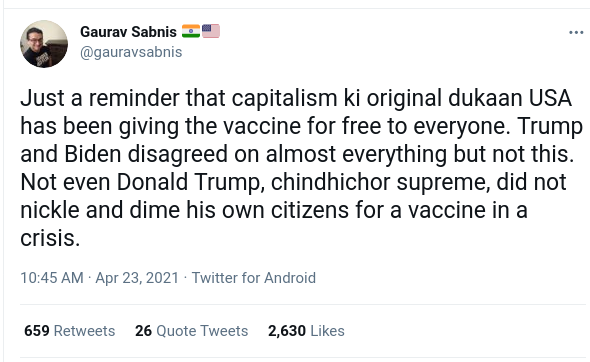
Censorship Censorship of Indians critical of Govt. mishandling has been non-stop. Even U.S. which usually doesn t interfere into India s internal politics was forced to make an exception. But of course, this has been on deaf ears. There is and was a good thread on Twitter by Gaurav Sabnis, a friend, fellow Puneite now settled in U.S. as a professor.
Gaurav on Trump-Biden on vaccination of their own citizens
Now just to surmise what has been happened in India and what has been happening in most of the countries around the world. Most of the countries have done centralization purchasing of the vaccine and then is distributed by the States, this is what we understand as co-operative federalism. While last year, GOI took a lot of money under the shady PM Cares fund for vaccine purchase, donations from well-meaning Indians as well as Industries and trade bodies. Then later, GOI said it would leave the states hanging and it is they who would have to buy vaccines from the manufacturers. This is again cheap politics. The idea behind it is simple, GOI knows that almost all the states are strapped for cash. This is not new news, this I have shared a couple of months back. The problem has been that for the last 6-8 months no GST meeting has taken place as shared by Punjab s Finance Minister Amarinder Singh. What will happen is that all the states will fight in-between themselves for the vaccine and most of them are now non-BJP Governments. The idea is let the states fight and somehow be on top. So, the pandemic, instead of being a public health issue has become something of on which politics has to played. The news on whatsapp by RW media is it s ok even if a million or two also die, as it is India is heavily populated. Although that argument vanishes for those who lose their dear and near ones. But that just isn t the issue, the issue goes much more deeper than that Oxygen:12%
Remedisivir:12%
Sanitiser:12%
Ventilator:12%
PPE:18%
Ambulances 28% Now all the products above are essential medical equipment and should be declared as essential medical equipment and should have price controls on which GST is levied. In times of pandemic, should the center be profiting on those. States want to let go and even want the center to let go so that some relief is there to the public, while at the same time make them as essential medical equipment with price controls. But GOI doesn t want to. Leaders of opposition parties wrote open letters but no effect. What is sad to me is how Ambulances are being taxed at 28%. Are they luxury items or sin goods ? This also reminds of the recent discovery shared by Mr. Pappu Yadav in Bihar. You can see the color of ambulances as shared by Mr. Yadav, and the same news being shared by India TV news showing other ambulances. Also, the weak argument being made of not having enough drivers. Ideally, you should have 2-3 people, both 9-1-1 and Chicago Fire show 2 people in ambulance but a few times they have also shown to be flipped over. European seems to have three people in ambulance, also they are also much more disciplined as drivers, at least an opinion shared by an American expat.
Pappu Yadav, President Jan Adhikar Party, Bihar May 11, 2021
What is also interesting to note is GOI plays this game of Health is State subject and health is Central subject depending on its convenience. Last year, when it invoked the Epidemic and DMA Act it was a Central subject, now when bodies are flowing down the Ganges and pyres being lit everywhere, it becomes a State subject. But when and where money is involved, it again becomes a Central subject. The States are also understanding it, but they are fighting on too many fronts.
Snippets from Karnataka High Court hearing today, 13th March 2021
One of the good things is most of the High Courts have woken up. Many of the people on the RW think that the Courts are doing Judicial activism . And while there may be an iota of truth in it, the bitter truth is that many judges or relatives or their helpers have diagnosed and some have even died due to Covid. In face of the inevitable, what can they do. They are hauling up local Governments to make sure they are accountable while at the same time making sure that they get access to medical facilities. And I as a citizen don t see any wrong in that even if they are doing it for selfish reasons. Because, even if justice is being done for selfish reasons, if it does improve medical delivery systems for the masses, it is cool. If it means that the poor and everybody else are able to get vaccinations, oxygen and whatever they need, it is cool. Of course, we are still seeing reports of patients spending in the region of INR 50k and more for each day spent in hospital. But as there are no price controls, judges cannot do anything unless they want to make an enemy of the medical lobby in the country. A good story on medicines and what happens in rural areas, see no further than Laakhon mein ek.
Allahabad High Court hauling Uttar Pradesh Govt. for lack of Oxygen is equal to genocide, May 11, 2021
The censorship is not just related to takedown requests on twitter but nowadays also any articles which are critical of the GOI s handling. I have been seeing many articles which have shared facts and have been critical of GOI being taken down. Previously, we used to see 404 errors happen 7-10 years down the line and that was reasonable. Now we see that happen, days weeks or months. India seems to be turning more into China and North Korea and become more anti-science day-by-day

Fake websites Before going into fake websites, let me start with a fake newspaper which was started by none other than the Gujarat CM Mr. Modi in 2005 .
Gujarat Satya Samachar 2005 launched by Mr. Modi.
And if this wasn t enough than on Feb 8, 2005, he had invoked Official Secrets Act
Mr. Modi invoking Official Secrets Act, Feb 8 2005 Gujarat Samachar
The headlines were In Modi s regime press freedom is in peril-Down with Modi s dictatorship. So this was a tried and tested technique. The above information was shared by Mr. Urvish Kothari, who incidentally also has his own youtube channel. Now cut to 2021, and we have a slew of fake websites being done by the same party. In fact, it seems they started this right from 2011. A good article on BBC itself tells the story. Hell, Disinfo.eu which basically combats disinformation in EU has a whole pdf chronicling how BJP has been doing it. Some of the sites it shared are

Times of New York
Manchester Times
Times of Los Angeles
Manhattan Post
Washington Herald
and many more. The idea being take any site name which sounds similar to a brand name recognized by Indians and make fool of them. Of course, those of who use whois and other such tools can easily know what is happening. Two more were added to the list yesterday, Daily Guardian and Australia Today. There are of course, many features which tell them apart from genuine websites. Most of these are on shared hosting rather than dedicated hosting, most of these are bought either from Godaddy and Bluehost. While Bluehost used to be a class act once upon a time, both the above will do anything as long as they get money. Don t care whether it s a fake website or true. Capitalism at its finest or worst depending upon how you look at it. But most of these details are lost on people who do not know web servers, at all and instead think see it is from an exotic site, a foreign site and it chooses to have same ideas as me. Those who are corrupt or see politics as a tool to win at any cost will not see it as evil. And as a gentleman Raghav shared with me, it is so easy to fool us. An example he shared which I had forgotten. Peter England which used to be an Irish brand was bought by Aditya Birla group way back in 2000. But even today, when you go for Peter England, the way the packaging is done, the way the prices are, more often than not, people believe they are buying the Irish brand. While sharing this, there is so much of Naom Chomsky which comes to my mind again and again

Caste Issues I had written about caste issues a few times on this blog. This again came to the fore as news came that a Hindu sect used forced labor from Dalit community to make a temple. This was also shared by the hill. In both, Mr. Joshi doesn t tell that if they were volunteers then why their passports have been taken forcibly, also I looked at both minimum wage prevailing in New Jersey as a state as well as wage given to those who are in the construction Industry. Even in minimum wage, they were giving $1 when the prevailing minimum wage for unskilled work is $12.00 and as Mr. Joshi shared that they are specialized artisans, then they should be paid between $23 $30 per hour. If this isn t exploitation, then I don t know what is. And this is not the first instance, the first instance was perhaps the case against Cisco which was done by John Doe. While I had been busy with other things, it seems Cisco had put up both a demurrer petition and a petition to strike which the Court stayed. This seemed to all over again a type of apartheid practice, only this time applied to caste. The good thing is that the court stayed the petition. Dr. Ambedkar s statement if Hindus migrate to other regions on earth, Indian caste would become a world problem given at Columbia University in 1916, seems to be proven right in today s time and sadly has aged well. But this is not just something which is there only in U.S. this is there in India even today, just couple of days back, a popular actress Munmun Dutta used a casteist slur and then later apologized giving the excuse that she didn t know Hindi. And this is patently false as she has been in the Bollywood industry for almost now 16-17 years. This again, was not an isolated incident. Seema Singh, a lecturer in IIT-Kharagpur abused students from SC, ST backgrounds and was later suspended. There is an SC/ST Atrocities Act but that has been diluted by this Govt. A bit on the background of Dr. Ambedkar can be found at a blog on Columbia website. As I have shared and asked before, how do we think, for what reason the Age of Englightenment or the Age of Reason happened. If I were a fat monk or a priest who was privileges, would I have let Age of Enlightenment happen. It broke religion or rather Church which was most powerful to not so powerful and that power was more distributed among all sort of thinkers, philosophers, tinkers, inventors and so on and so forth.

Situation going forward I believe things are going to be far more complex and deadly before they get better. I had to share another term called Comorbidities which fortunately or unfortunately has also become part of twitter lexicon. While I have shared what it means, it simply means when you have an existing ailment or condition and then Coronavirus attacks you. The Virus will weaken you. The Vaccine in the best case just stops the damage, but the damage already done can t be reversed. There are people who advise and people who are taking steroids but that again has its own side-effects. And this is now, when we are in summer. I am afraid for those who have recovered, what will happen to them during the Monsoons. We know that the Virus attacks most the lungs and their quality of life will be affected. Even the immune system may have issues. We also know about the inflammation. And the grant that has been given to University of Dundee also has signs of worry, both for people like me (obese) as well as those who have heart issues already. In other news, my city which has been under partial lockdown since a month, has been extended for another couple of weeks. There are rumors that the same may continue till the year-end even if it means economics goes out of the window.There is possibility that in the next few months something like 2 million odd Indians could die
The above is a conversation between Karan Thapar and an Oxford Mathematician Dr. Murad Banaji who has shared that the under-counting of cases in India is huge. Even BBC shared an article on the scope of under-counting. Of course, those on the RW call of the evidence including the deaths and obituaries in newspapers as a narrative . And when asked that when deaths used to be in the 20 s or 30 s which has jumped to 200-300 deaths and this is just the middle class and above. The poor don t have the money to get wood and that is the reason you are seeing the bodies in Ganges whether in Buxar Bihar or Gajipur, Uttar Pradesh. The sights and visuals makes for sorry reading
Pandit Ranjan Mishra son on his father s death due to unavailability of oxygen, Varanasi, Uttar Pradesh, 11th May 2021.
For those who don t know Pandit Ranjan Mishra was a renowned classical singer. More importantly, he was the first person to suggest Mr. Modi s name as a Prime Ministerial Candidate. If they couldn t fulfil his oxygen needs, then what can be expected for the normal public.

Conclusion Sadly, this time I have no humorous piece to share, I can however share a documentary which was shared on Feluda . I have shared about Feluda or Prodosh Chandra Mitter a few times on this blog. He has been the answer of James Bond from India. I have shared previously about The Golden Fortress . An amazing piece of art by Satyajit Ray. I watched that documentary two-three times. I thought, mistakenly that I am the only fool or fan of Feluda in Pune to find out that there are people who are even more than me. There were so many facets both about Feluda and master craftsman Satyajit Ray that I was unaware about. I was just simply amazed. I even shared few of the tidbits with mum as well, although now she has been truly hooked to Korean dramas. The only solace from all the surrounding madness. So, if you have nothing to do, you can look up his books, read them and then see the movies. And my first recommendation would be the Golden Fortress. The only thing I would say, do not have high hopes. The movie is beautiful. It starts slow and then picks up speed, just like a train. So, till later. Update The Mass surveillance part I could not do justice do hence removed it at the last moment. It actually needs its whole space, article. There is so much that the Govt. is doing under the guise of the pandemic that it is difficult to share it all in one article. As it is, the article is big

3 May 2021

Russ Allbery: Review: The Voyage of the Dawn Treader

Review: The Voyage of the Dawn Treader, by C.S. Lewis
Illustrator: Pauline Baynes
Series: Chronicles of Narnia #3
Publisher: Collier Books
Copyright: 1952
Printing: 1978
ISBN: 0-02-044260-2
Format: Mass market
Pages: 216
There was a boy named Eustace Clarence Scrubb and he almost deserved it.
The Voyage of the Dawn Treader is the third Narnia book in original publication order (see my review of The Lion, the Witch and the Wardrobe for more about reading order). You could arguably start reading here; there are a lot of references to the previous books, but mostly as background material, and I don't think any of it is vital. If you wanted to sample a single Narnia book to see if you'd get along with the series, this is the one I'd recommend. Since I was a kid, The Voyage of the Dawn Treader has held the spot of my favorite of the series. I'm happy to report that it still holds up. Apart from one bit that didn't age well (more on that below), this is the book where the story and the world-building come together, in part because Lewis picks a plot shape that works with what he wants to write about. The younger two Pevensie children, Edmund and Lucy, are spending the summer with Uncle Harold and Aunt Alberta because their parents are in America. That means spending the summer with their cousin Eustace. C.S. Lewis had strong opinions about child-raising that crop up here and there in his books, and Harold and Alberta are his example of everything he dislikes: caricatured progressive, "scientific" parents who don't believe in fiction or mess or vices. Eustace therefore starts the book as a terror, a whiny bully who has only read boring practical books and is constantly scoffing at the Pevensies and making fun of their stories of Narnia. He is therefore entirely unprepared when the painting of a ship in the guest bedroom turns into a portal to the Narnia and dumps the three children into the middle of the ocean. Thankfully, they're in the middle of the ocean near the ship in the painting. That ship is the Dawn Treader, and onboard is Caspian from the previous book, now king of Narnia. He has (improbably) sorted things out in his kingdom and is now on a sea voyage to find seven honorable Telmarine lords who left Narnia while his uncle was usurping the throne. They're already days away from land, headed towards the Lone Islands and, beyond that, into uncharted seas. MAJOR SPOILERS BELOW. Obviously, Eustace gets a redemption arc, which is roughly the first half of this book. It's not a bad arc, but I am always happy when it's over. Lewis tries so hard to make Eustace insufferable that it becomes tedious. As an indoor kid who would not consider being dumped on a primitive sailing ship to be a grand adventure, I wanted to have more sympathy for him than the book would allow. The other problem with Eustace's initial character is that Lewis wants it to stem from "modern" parenting and not reading the right sort of books, but I don't buy it. I've known kids whose parents didn't believe in fiction, and they didn't act anything like this (and kids pick up a lot more via osmosis regardless of parenting than Lewis seems to realize). What Eustace acts like instead is an entitled, arrogant rich kid who is used to the world revolving around him, and it's fascinating to me how Lewis ignores class to focus on educational philosophy. The best part of Eustace's story is Reepicheep, which is just setup for Reepicheep becoming the best part of The Voyage of the Dawn Treader. Reepicheep, the leader of Narnia's talking mice, first appears in Prince Caspian, but there he's mostly played for laughs: the absurdly brave and dashing mouse who rushes into every fight he sees. In this book, he comes into his own as the courage and occasionally the moral conscience of the party. Caspian wants to explore and to find the lords of his past, the Pevensie kids want to have a sea adventure, and Eustace is in this book to have a redemption arc, but Reepicheep is the driving force at the heart of the voyage. He's going to Aslan's country beyond the sea, armed with a nursemaid's song about his destiny and a determination to be his best and most honorable self every step of the way, and nothing is going to stop him. Eustace, of course, takes an immediate dislike to a talking rodent. Reepicheep, in return, is the least interested of anyone on the ship in tolerating Eustace's obnoxious behavior and would be quite happy to duel him. But when Eustace is turned into a dragon, Reepicheep is the one who spends hours with him, telling him stories and ensuring he's not alone. It's beautifully handled, and my only complaint is that Lewis doesn't do enough with the Eustace and Reepicheep friendship (or indeed with Eustace at all) for the rest of the book. After Eustace's restoration and a few other relatively short incidents comes the second long section of the book and the part that didn't age well: the island of the Dufflepuds. It's a shame because the setup is wonderful: a cultivated island in the middle of nowhere with no one in sight, mysterious pounding sounds and voices, the fun of trying to figure out just what these invisible creatures could possibly be, and of course Lucy's foray into the second floor of a house, braving the lair of a magician to find and read one of the best books of magic in fantasy. Everything about how Lewis sets this scene is so well done. The kids are coming from an encounter with a sea serpent and a horrifically dangerous magic island and land on this scene of eerily normal domesticity. The most dangerous excursion is Lucy going upstairs in a brightly lit house with soft carpet in the middle of the day. And yet it's incredibly tense because Lewis knows exactly how to put you in Lucy's head, right down to having to stand with her back to an open door to read the book. And that book! The pages only turn forward, the spells are beautifully illustrated, and the sense of temptation is palpable. Lucy reading the eavesdropping spell is one of the more memorable bits in this series, at least for me, and makes a surprisingly subtle moral point about the practical reasons why invading other people's privacy is unwise and can just make you miserable. And then, when Lucy reads the visibility spell that was her goal, there's this exchange, which is pure C.S. Lewis:
"Oh Aslan," said she, "it was kind of you to come." "I have been here all the time," said he, "but you have just made me visible." "Aslan!" said Lucy almost a little reproachfully. "Don't make fun of me. As if anything I could do would make you visible!" "It did," said Aslan. "Did you think I wouldn't obey my own rules?"
I love the subtlety of what's happening here: the way that Lucy is much more powerful than she thinks she is, but only because Aslan decided to make the rules that way and chooses to follow his own rules, making himself vulnerable in a fascinating way. The best part is that Lewis never belabors points like this; the characters immediately move on to talk about other things, and no one feels obligated to explain. But, unfortunately, along with the explanation of the thumping and the magician, we learn that the Dufflepuds are (remarkably dim-witted) dwarfs, the magician is their guardian (put there by Aslan, no less!), he transformed them into rather absurd shapes that they hate, and all of this is played for laughs. Once you notice that these are sentient creatures being treated essentially like pets (and physically transformed against their will), the level of paternalistic colonialism going on here is very off-putting. It's even worse that the Dufflepuds are memorably funny (washing dishes before dinner to save time afterwards!) and are arguably too dim to manage on their own, because Lewis made the authorial choice to write them that way. The "white man's burden" feeling is very strong. And Lewis could have made other choices! Coriakin the magician is a fascinating and somewhat morally ambiguous character. We learn later in the book that he's a star and his presence on the island is a punishment of sorts, leading to one of my other favorite bits of theology in this book:
"My son," said Ramandu, "it is not for you, a son of Adam, to know what faults a star can commit."
Lewis could have kept most of the setup, kept the delightfully silly things the Dufflepuds believe, changed who was responsible for their transformation, and given Coriakin a less authoritarian role, and the story would have been so much stronger for it. After this, the story gets stranger and wilder, and it's in the last part that I think the true magic of this book lies. The entirety of The Voyage of the Dawn Treader is a progression from a relatively mundane sea voyage to something more awe-inspiring. The last few chapters are a tour de force of wonder: rejuvenating stars, sunbirds, the Witch's stone knife, undersea kingdoms, a sea of lilies, a wall of water, the cliffs of Aslan's country, and the literal end of the world. Lewis does it without much conflict, with sparse description in a very few pages, and with beautifully memorable touches like the quality of the light and the hush that falls over the ship. This is the part of Narnia that I point to and wonder why I don't see more emulation (although I should note that it is arguably an immram). Tolkien-style fantasy, with dwarfs and elves and magic rings and great battles, is everywhere, but I can't think of many examples of this sense of awe and discovery without great battles and detailed explanations. Or of characters like Reepicheep, who gets one of the best lines of the series:
"My own plans are made. While I can, I sail east in the Dawn Treader. When she fails me, I paddle east in my coracle. When she sinks, I shall swim east with my four paws. And when I can swim no longer, if I have not reached Aslan's country, or shot over the edge of the world in some vast cataract, I shall sink with my nose to the sunrise and Peepiceek shall be the head of the talking mice in Narnia."
The last section of The Voyage of the Dawn Treader is one of my favorite endings of any book precisely because it's so different than the typical ending of a novel. The final return to England is always a bit disappointing in this series, but it's very short and is preceded by so much wonder that I don't mind. Aslan does appear to the kids as a lamb at the very end of the world, making Lewis's intended Christian context a bit more obvious, but even that isn't belabored, just left there for those who recognize the symbolism to notice. I was curious during this re-read to understand why The Voyage of the Dawn Treader is so much better than the first two books in the series. I think it's primarily due to two things: pacing, and a story structure that's better aligned with what Lewis wants to write about. For pacing, both The Lion, the Witch and the Wardrobe and Prince Caspian have surprisingly long setups for short books. In The Voyage of the Dawn Treader, by contrast, it takes only 35 pages to get the kids in Narnia, introduce all the characters, tour the ship, learn why Caspian is off on a sea voyage, establish where this book fits in the Narnian timeline, and have the kids be captured by slavers. None of the Narnia books are exactly slow, but Dawn Treader is the first book of the series that feels like it knows exactly where it's going and isn't wasting time getting there. The other structural success of this book is that it's a semi-episodic adventure, which means Lewis can stop trying to write about battles and political changes whose details he's clearly not interested in and instead focus wholeheartedly on sense-of-wonder exploration. The island-hopping structure lets Lewis play with ideas and drop them before they wear out their welcome. And the lack of major historical events also means that Aslan doesn't have to come in to resolve everything and instead can play the role of guardian angel. I think The Voyage of the Dawn Treader has the most compelling portrayal of Aslan in the series. He doesn't make decisions for the kids or tell them directly what to do the way he did in the previous two books. Instead, he shows up whenever they're about to make a dreadful mistake and does just enough to get them to make a better decision. Some readers may find this takes too much of the tension out of the book, but I have always appreciated it. It lets nervous child readers enjoy the adventures while knowing that Aslan will keep anything too bad from happening. He plays the role of a protective but non-interfering parent in a genre that usually doesn't have parents because they would intervene to prevent adventures. I enjoyed this book just as much as I remembered enjoying it during my childhood re-reads. Still the best book of the series. This, as with both The Lion, the Witch and the Wardrobe and Prince Caspian, was originally intended to be the last book of the series. That, of course, turned out to not be the case, and The Voyage of the Dawn Treader is followed (in both chronological and original publication order) by The Silver Chair. Rating: 9 out of 10

22 April 2021

Shirish Agarwal: The Great Train Robbery

I had a twitter fight few days back with a gentleman and the article is a result of that fight. Sadly, I do not know the name of the gentleman as he goes via a psuedo name and then again I ve not taken permission from him to quote him in either way. So I will just state the observations I was able to make from the conversations we had. As people who read this blog regularly would know, I am and have been against Railway Privatization which is happening in India. And will be sharing some of the case studies from other countries as to how it panned out for them.

UK Railways
How Privatization Fails : Railways
The Above video is by a gentleman called Shaun who basically shared that privatization as far as UK is concerned is nothing but monopolies and while there are complex reasons for the same, the design of the Railways is such that it will always be a monopoly structure. At the most what you can do is have several monopolies but that is all that can happen. The idea of competition just cannot happen. Even the idea that subsidies will be less or/and trains will run on time is far from fact. Both of these facts have been checked and found to be truthful by fullfact.org. It is and argued that UK is small and perhaps it doesn t have the right conditions. It is probably true but still we do deserve to have a glance at the UK railway map.
UK railway map with operatorsUK railway map with operators
The above map is copyrighted to Map Marketing where you could see it today . As can be seen above most companies had their own specified areas. Now if you had looked at the facts then you would have seen that UK fares have been higher. In fact, an oldish article from Metro (a UK publication) shares the same. In fact, UK nationalized its railways effectively as many large rail operators were running in red. Even Scotland is set to nationalised back in March 2022. Remember this is a country which hasn t seen inflation go upwards of 5% in nearly a decade. The only outlier was 2011 where they indeed breached the 5% mark. So from this, what we see is Private Gains and Private Gains Public Losses perhaps seem fit. But then maybe we didn t use the right example. Perhaps Japan would be better. They have bullet trains while UK is still thinking about it. (HS2).

Japanese Railway Below is the map of Japanese Railway
Railway map of Japan with private ownership courtesy Wikimedia commons
Japan started privatizing its railway in 1987 and to date it has not been fully privatized. And on top of it, amount as much as 24 trillion of the long-term JNR debt was shouldered by the government at the expense of taxpayers of Japan while also reducing almost 1/4th of it employees. To add to it, while some parts of Japanese Railways did make profits, many of them made profits by doing large-scale non-railway business mostly real estate of land adjacent to railway stations. In many cases, it seems this went all the way up to 60% of the revenue. The most profitable has been the Shinkansen though. And while it has been profitable, it has not been without safety scandals over the years, the biggest in recent years was the 2005 Amagasaki derailment. What was interesting to me was the Aftermath, while the Wikipedia page doesn t share much, I had read at the time and probably could be found how a lot of ordinary people stood up to the companies in a country where it is a known fact that most companies are owned by the Yakuza. And this is a country where people are loyal to their corporation or company no matter what. It is a strange culture to west and also here in India where people change jobs on drop of hat, although nowadays we have record unemployment. So perhaps Japan too does not meet our standard as it doesn t do competition with each other but each is a set monopoly in those regions. Also how much subsidy is there or not is not really transparent.

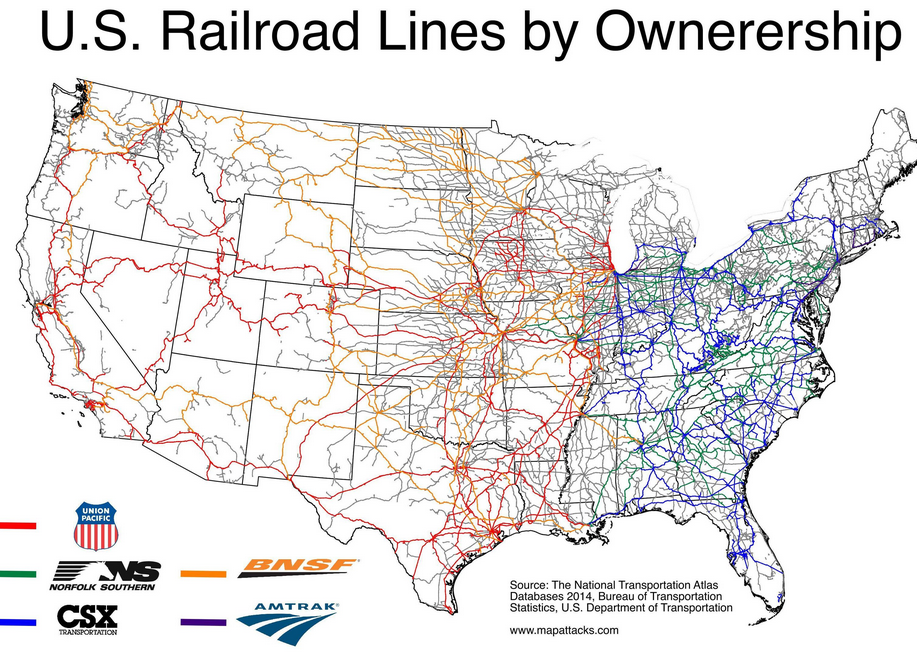
U.S. Railways Last, but not the least I share the U.S. Railway map. This is provided by A Mr. Tom Alison on reddit on channel maporn. As the thread itself is archived and I do not know the gentleman concerned, nor have taken permission for the map, hence sharing the compressed version


U.S. Railway lines with the different owners
Now the U.S. Railways is and has always been peculiar as unlike the above two the U.S. has always been more of a freight network. Probably, much of it has to do that in the 1960 s when oil was cheap, the U.S. made zillions of roadways and romanticized the road trip and has been doing it ever since. Also the creation of low-cost airlines definitely didn t help the railways to have more passenger services, in fact the opposite. There are and have been smaller services and attempts of privatization in both New Zealand and Australia and both have been failures. Please see papers in that regard. My simple point is this, as can be seen above, there have been various attempts at privatization of railways and most of them have been a mixed bag. The only one which comes close to what we think as good is Japanese but that also used a lot of public debt which we don t know what will happen on next. Also for higher-speed train services like a bullet train or whatever, you need to direct, no hair pen bends. In fact, a good talk on the topic is the TBD podcast which while it talks about hyperloop, the same questions is and would be asked if were to do in India. Another thing to be kept in mind is that the Japanese have been exceptional builders and this is because they have been forced to. They live in a seismically active zone which made Fukushima disaster a reality but at the same time, their buildings are earthquake-resistant. Standard Disclaimer The above is a simplified version of things. I could have added in financial accounts but that again has no set pattern. For e.g. some Railways use accrual, some use cash and some use hybrid. I could have also shared in either the guage or electrification but all have slightly different standards, although uniguage is something that all Railways aspire for and electrification is again something that all Railways want although in many cases it just isn t economically feasible.

Indian Railways Indian Railways itself recently made the move from Cash to Accrual couple of years back. In-between for a couple of years, it was hybrid. The sad part is and was you can now never measure against past performance in the old way because it is so different. Hence, whether the Railways will be making a loss or a profit, we would come to know only much later. Also, most accountants don t know the new system well, so it is gonna take more time, how much unknown. Sadly, what GOI did a few years back is merge the Railway budget into the Union Budget. Of course, the excuse they gave is too many pressures of new trains, while the truth is, by doing this, they decreased transparency about the whole thing. For e.g. for the last few years, the only state which had significant work being done is in U.P. (Uttar Pradesh) and a bit in Goa, although that is has been protested time and again. I being from the neighborly state of Maharashtra , and have been there several times. Now it does feels all like a dream, going to Goa :(.

Covid news Now before I jump on the news, I should share the movie Virus (2019) which was made by the talented Aashiq Abu. Even though, am not a Malayalee, I still have enjoyed many of his movies simply because he is a terrific director and Malayalam movies, at least most of them have English subtitles and lot of original content.. Interestingly, unlike the first couple of times when I saw it a couple of years back. The first time I saw it, I couldn t sleep a wink for a week. Even the next time, it was heavy. I had shared the movie with mum, and even she couldn t see it in one go. It is and was that powerful Now maybe because we are headlong in the pandemic, and the madness is all around us. There are two terms that helped me though understand a great deal of what is happening in the movie, the first term was altered sensorium which has been defined here. The other is saturation or to be more precise oxygen saturation . This term has also entered the Indian twitter lexicon quite a bit as India has started running out of oxygen. Just today Delhi High Court did an emergency hearing on the subject late at night. Although there is much to share about the mismanagement of the center, the best piece on the subject has been by Miss Priya Ramani. Yup, the same lady who has won against M.J. Akbar and this is when Mr. Akbar had 100 lawyers for this specific case. It would be interesting to see what happens ahead. There are however few things even she forgot in her piece, For e.g. reverse migration i.e. from urban to rural migration started again. Two articles from different entities sharing a similar outlook.Sadly, the right have no empathy or feeling for either the poor or the sick. Even the labor minister Santosh Gangwar s statement that around 1.04 crores were the only people who walked back home. While there is not much data, however some work/research has been done on migration to cites that the number could be easily 10 times as much. And this was in the lockdown of last year. This year, again the same issue has re-surfaced and migrants learning lessons started leaving cities. And I m ashamed to say I think they are doing the right thing. Most State Governments have not learned lessons nor have they done any work to earn the trust of migrants. This is true of almost all state Governments. Last year, just before the lockdown was announced, me and my friend spent almost 30k getting a cab all the way from Chennai to Pune, how much we paid for the cab, how much we bribed the various people just so we could cross the state borders to return home to our anxious families. Thankfully, unlike the migrants, we were better off although we did make a loss. I probably wouldn t be alive if I were in their situation as many didn t. That number is still in the air undocumented deaths  Vaccine issues Currently, though the issue has been the Vaccine and the pricing of the same. A good article to get a summation of the issues outlined has been shared on Economist. Another article that goes to the heart of the issue is at scroll. To buttress the argument, the SII chairman had shared this few weeks back
Adar Poonawala talking to Vishnu Som on Left, right center, 7th April 2021.
So, a licensee manufacturer wants to make super-profits during the pandemic. And now, as shared above they can very easily do it. Even the quotes given to nearby countries is smaller than the quotes given to Indian states

Prices of AstraZeneca among various states and countries.
The situation around beds, vaccines, oxygen, anything is so dire that people could go to any lengths to save their loved ones. Even if they know if a certain medicine doesn t work. For e.g. Remdesivir, 5 WHO trials have concluded that it doesn t increase mortality. Heck, even AIIMS chief said the same. But both doctors and relatives desperation to cling on hope has made Remdesivir as a black market drug with unoffical prices hovering anywhere between INR 14k/- to INR30k/- per vial. One of the executives of a top firm was also arrested in Gujarat. In Maharashtra, the opposition M.P. came to the rescue of the officials of Bruick pharms in Mumbai. Sadly, this strange affliction to the party in the center is also there in my extended family. At one end, they will heap praise on Mr. Modi, at the same time they can t get wait to get fast out of India. Many of them have settled in horrors of horror Dubai, as it is the best place to do business, get international schools for the young ones at decent prices, cheaper or maybe a tad more than what they paid in Delhi or elsewhere. Being an Agarwal or a Gupta makes it easier to compartmentalize both things. Ease of doing business, 5 days flat to get a business registered, up and running. And the paranoia is still there. They won t talk on the phone about him because they are afraid they may say something which comes back to bite them. As far as their decision to migrate, can t really blame them. If I were 20-25 yeas younger and my mum were in a better shape than she is, we probably would have migrated as well, although would have preferred Europe than anywhere else.

Internet Freedom and Aarogya Setu App.


Internet Freedom had shared the chilling effects of the Aarogya Setu App. This had also been shared by FSCI in the past, and recently had their handle being banned on Twitter. This was also apparent in a legal bail order which the high court judge gave. While I won t go into the merits and demerits of the bail order, it is astounding for the judge to say that the accused, even though he would be on bail install an app. so he can be surveilled. And this is a high court judge, such a sad state of affairs. We seem to be putting up new lows every day when it comes to judicial jurisprudence. One interesting aspect of the whole case was shared by Aishwarya Iyer. She shared a story that she and her team worked on quint which raises questions on the quality of the work done by Delhi Police. This is of course, up to Delhi Police to ascertain the truth of the matter because unless and until they are able to tie in the PMO s office in for a leak or POTUS s office it hardly seems possible. For e.g. the dates when two heads of state can meet each other would be decided by the secretaries of the two. Once the date is known, it would be shared with the press while at the same time some sort of security apparatus would kick in place. It is incumbent, especially on the host to take as much care as he can of the guest. We all remember that World War 1 (the war to end all wars) started due to the murder of Archduke Ferdinand.

As nobody wants that, the best way is to make sure that a political murder doesn t happen on your watch. Now while I won t comment on what it would be, it would be safe to assume that it would be z+ security along with higher readiness. Especially if it as somebody as important as POTUS. Now, it would be quite a reach for Delhi Police to connect the two dates. They either will have to get creative with the dates or some other way. Otherwise, with practically no knowledge in the public domain, they can t work in limbo. In either case, I do hope the case comes up for hearing soon and we see what the Delhi Police says and contends in the High Court about the same. At the very least, it would be irritating for them to talk of the dates unless they can contend some mass conspiracy which involves the PMO (and would bring into question the constant vetting done by the Intelligence dept. of all those who work in PMO). And this whole case is to kind of shelter to the Delhi riots which happened in which majorly the Muslims died but their deaths lay unaccounted till date

Conclusion In Conclusion, I would like to share a bit of humor because right now the atmosphere is humorless, both with authoritarian tendencies of the Central Govt. and the mass mismanagement of public health which they now have left to the state to do as they fit. The peice I am sharing is from arre, one of my goto sites whenever I feel low.

4 April 2021

Russ Allbery: Review: Prince Caspian

Review: Prince Caspian, by C.S. Lewis
Illustrator: Pauline Baynes
Series: Chronicles of Narnia #2
Publisher: Collier Books
Copyright: 1951
Printing: 1979
ISBN: 0-02-044240-8
Format: Mass market
Pages: 216
Prince Caspian is the second book of the Chronicles of Narnia in the original publication order (the fourth in the new publication order) and a direct sequel to The Lion, the Witch and the Wardrobe. As much as I would like to say you could start here if you wanted less of Lewis's exploration of secondary-world Christianity and more children's adventure, I'm not sure it would be a good reading experience. Prince Caspian rests heavily on the events of The Lion, the Witch and the Wardrobe. If you haven't already, you may also want to read my review of that book for some introductory material about my past relationship with the series and why I follow the original publication order. Prince Caspian always feels like the real beginning of a re-read. Re-reading The Lion, the Witch and the Wardrobe is okay but a bit of a chore: it's very random, the business with Edmund drags on, and it's very concerned with hitting the mandatory theological notes. Prince Caspian is more similar to the following books and feels like Narnia proper. That said, I have always found the ending of Prince Caspian oddly forgettable. This re-read helped me see why: one of the worst bits of the series is in the middle of this book, and then the dramatic shape of the ending is very strange. MAJOR SPOILERS BELOW for both this book and The Lion, the Witch and the Wardrobe. Prince Caspian opens with the Pevensie kids heading to school by rail at the end of the summer holidays. They're saying their goodbyes to each other at a train station when they are first pulled and then dumped into the middle of a wood. After a bit of exploration and the discovery of a seashore, they find an overgrown and partly ruined castle. They have, of course, been pulled back into Narnia, and the castle is Cair Paravel, their great capital when they ruled as kings and queens. The twist is that it's over a thousand years later, long enough that Cair Paravel is now on an island and has been abandoned to the forest. They discover parts of how that happened when they rescue a dwarf named Trumpkin from two soldiers who are trying to drown him near the supposedly haunted woods. Most of the books in this series have good hooks, but Prince Caspian has one of the best. I adored everything about the start of this book as a kid: the initial delight at being by the sea when they were on their way to boarding school, the realization that getting food was not going to be easy, the abandoned castle, the dawning understanding of where they are, the treasure room, and the extended story about Prince Caspian, his discovery of the Old Narnia, and his flight from his usurper uncle. It becomes clear from Trumpkin's story that the children were pulled back into Narnia by Susan's horn (the best artifact in these books), but Caspian's forces were expecting the great kings and queens of legend from Narnia's Golden Age. Trumpkin is delightfully nonplussed at four school-age kids who are determined to join up with Prince Caspian and help. That's the first half of Prince Caspian, and it's a solid magical adventure story with lots of potential. The ending, alas, doesn't entirely work. And between that, we get the business with Aslan and Lucy in the woods, or as I thought of it even as a kid, the bit where Aslan is awful to everyone for no reason. For those who have forgotten, or who don't care about spoilers, the kids plus Trumpkin are trying to make their way to Aslan's How (formerly the Stone Table) where Prince Caspian and his forces were gathered, when they hit an unexpected deep gorge. Lucy sees Aslan and thinks he's calling for them to go up the gorge, but none of the other kids or Trumpkin can see him and only Edmund believes her. They go down instead, which almost gets them killed by archers. Then, that night, Lucy wakes up and finds Aslan again, who tells her to wake the others and follow him, but warns she may have to follow him alone if she can't convince the others to go along. She wakes them up (which does not go over well), Aslan continues to be invisible to everyone else despite being right there, Susan is particularly upset at Lucy, and everything is awful. But this time they do follow her (with lots of grumbling and over Susan's objections). This, of course, is the right decision: Aslan leads them to a hidden path that takes them over the river they're trying to cross, and becomes visible to everyone when they reach the other side. This is a mess. It made me angry as a kid, and it still makes me angry now. No one has ever had trouble seeing Aslan before, so the kids are rightfully skeptical. By intentionally deceiving them, Aslan puts the other kids in an awful position: they either have to believe Lucy is telling the truth and Aslan is being weirdly malicious, or Lucy is mistaken even though she's certain. It not only leads directly to conflict among the kids, it makes Lucy (the one who does all the right things all along) utterly miserable. It's just cruel and mean, for no purpose. It seems clear to me that this is C.S. Lewis trying to make a theological point about faith, and in a way that makes it even worse because I think he's making a different point than he intended to make. Why is religious faith necessary; why doesn't God simply make himself apparent to everyone and remove the doubt? This is one of the major problems in Christian apologetics, Lewis chooses to raise it here, and the answer he gives is that God only shows himself to his special favorites and hides from everyone else as a test. It's clearly not even a question of intention to have faith; Edmund has way more faith here than Lucy does (since Lucy doesn't need it) and still doesn't get to see Aslan properly until everyone else does. Pah. The worst part of this is that it's effectively the last we see of Susan. Prince Caspian is otherwise the book in which Susan comes into her own. The sibling relationship between the kids is great here in general, but Susan is particularly good. She is the one who takes bold action to rescue Trumpkin, risking herself by firing an arrow into the helmet of one of the soldiers despite being the most cautious of the kids. (And then gets a little defensive about her shot because she doesn't want anyone to think she would miss that badly at short range, a detail I just love.) I identified so much with her not wanting to beat Trumpkin at an archery contest because she felt bad for him (but then doing it anyway). She is, in short, awesome. I was fine with her being the most grumpy and frustrated with the argument over picking a direction. They're all kids, and sometimes one gets grumpy and frustrated and awful to the people around you. Once everyone sees Aslan again, Susan offers a truly excellent apology to Lucy, so it seemed like Lewis was setting up a redemption arc for her the way that he did for Edmund in The Lion, the Witch and the Wardrobe (although I maintain that nearly all of this mess was Aslan's fault). But then we never see Susan's conversation with Aslan, Peter later says he and Susan are now too old to return to Narnia, and that's it for Susan. Argh. I'll have more to say about this later (and it's not an original opinion), but the way Lewis treats Susan is the worst part of this series, and it adds insult to injury that it happens immediately after she has a chance to shine. The rest of the book suffers from the same problem that The Lion, the Witch and the Wardrobe did, namely that Aslan fixes everything in a somewhat surreal wild party and it's unclear why the kids needed to be there. (This is the book where Bacchus and Silenus show up, there is a staggering quantity of wine for a children's book, and Aslan turns a bunch of obnoxious school kids into pigs.) The kids do have more of a role to play this time: Peter and Edmund help save Caspian, and there's a (somewhat poorly motivated) duel that sends up the ending. But other than the brief battle in the How, the battle is won by Aslan waking the trees, and it's not clear why he didn't do that earlier. The ending is, at best, rushed and not worthy of its excellent setup. I was also disappointed that the "wait, why are you all kids?" moment was hand-waved away by Narnia giving the kids magical gravitas. Lewis never felt in control of either The Lion, the Witch and the Wardrobe or Prince Caspian. In both cases, he had a great hook and some ideas of what he wanted to hit along the way, but the endings are more sense of wonder and random Aslan set pieces than anything that follows naturally from the setup. This is part of why I'm not commenting too much on the sour notes, such as the red dwarves being the good and loyal ones but the black dwarves being suspicious and only out for themselves. If I thought bits like that were deliberate, I'd complain more, but instead it feels like Lewis threw random things he liked about children's books and animal stories into the book and gave it a good stir, and some of his subconscious prejudices fell into the story along the way. That said, resolving your civil war children's book by gathering all the people who hate talking animals (but who have lived in Narnia for generations) and exiling them through a magical gateway to a conveniently uninhabited country is certainly a choice, particularly when you wrote the book only two years after the Partition of India. Good lord. Prince Caspian is a much better book than The Lion, the Witch and the Wardrobe for the first half, and then it mostly falls apart. The first half is so good, though. I want to read the book that this could have become, but I'm not sure anyone else writes quite like Lewis at his best. Followed by The Voyage of the Dawn Treader, which is my absolute favorite of the series. Rating: 7 out of 10

28 March 2021

Norbert Preining: RMS, Debian, and the world

Too much has been written, a war of support letters is going on, Debian is heading head first like Lemmings into the same war. And then, there is this by the first female President of the American Civil Liberties Union (ACLU): Civil Rights Activist Nadine Strossen s Response To #CancelStallman:
I find it so odd that the strong zeal for revenge and punishment if someone says anything that is perceived to be sexist or racist or discriminatory comes from liberals and progressives. There are so many violations [in cases like Stallman s] of such fundamental principles to which progressives and liberals cling in general as to what is justice, what is fairness, what is due process.
One is proportionality: that the punishment should be proportional to the offense. Another one is restorative justice: that rather than retribution and punishment, we should seek to have the person constructively come to understand, repent, and make amends for an infraction. Liberals generally believe society to be too punitive, too harsh, not forgiving enough. They are certainly against the death penalty and other harsh punishments even for the most violent, the mass murderers. Progressives are right now advocating for the release of criminals, even murderers. To then have exactly the opposite attitude towards something that certainly is not committing physical violence against somebody, I don t understand the double standard!
Another cardinal principle is we shouldn t have any guilt by association. [To hold culpable] these board members who were affiliated with him and ostensibly didn t do enough to punish him for things that he said which by the way were completely separate from the Free Software Foundation is multiplying the problems of unwarranted punishment. It extends the punishment where the argument for responsibility and culpability becomes thinner and thinner to the vanishing point. That is also going to have an enormous adverse impact on the freedom of association, which is an important right protected in the U.S. by the First Amendment.
The Supreme Court has upheld freedom of association in cases involving organizations that were at the time highly controversial. It started with NAACP (National Association for the Advancement of Colored People) during the civil rights movement in the 1950s and 60s, but we have a case that s going to the Supreme Court right now regarding Black Lives Matter. The Supreme Court says even if one member of the group does commit a crime in both of those cases physical violence and assault that is not a justification for punishing other members of the group unless they specifically intended to participate in the particular punishable conduct.
Now, let s assume for the sake of argument, Stallman had an attitude that was objectively described as discriminatory on the basis on race and gender (and by the way I have seen nothing to indicate that), that he s an unrepentant misogynist, who really believes women are inferior. We are not going to correct those ideas, to enlighten him towards rejecting them and deciding to treat women as equals through a punitive approach! The only approach that could possibly work is an educational one! Engaging in speech, dialogue, discussion and leading him to re-examine his own ideas.
Even if I strongly disagree with a position or an idea, an expression of an idea, advocacy of an idea, and even if the vast majority of the public disagrees with the idea and finds it offensive, that is not a justification for suppressing the idea. And it s not a justification for taking away the equal rights of the person who espouses that idea including the right to continue holding a tenured position or other prominent position for which that person is qualified.
But a number of the ideas for which Richard Stallman has been attacked and punished are ideas that I as a feminist advocate of human rights find completely correct and positive from the perspective of women s equality and dignity! So for example, when he talks about the misuse and over use and flawed use of the term sexual assault, I completely agree with that critique! People are indiscriminantly using that term or synonyms to describe everything from the most appaulling violent abuse of helpless vulnerable victims (such as a rape of a minor) to any conduct or expression in the realm of gender or sexuality that they find unpleasant or disagreeable.
So we see the term sexual assault and sexual harrassment used for example, when a guy asks a woman out on a date and she doesn t find that an appealing invitation. Maybe he used poor judgement in asking her out, maybe he didn t, but in any case that is NOT sexual assault or harassment. To call it that is to really demean the huge horror and violence and predation that does exist when you are talking about violent sexual assault. People use the term sexual assault/ sexual harassment to refer to any comment about gender or sexuality issues that they disagree with or a joke that might not be in the best taste, again is that to be commended? No! But to condemn it and equate it with a violent sexual assault again is really denying and demeaning the actual suffering that people who are victims of sexual assault endure. It trivializes the serious infractions that are committed by people like Jeffrey Epstein and Harvey Weinstein. So that is one point that he made that I think is very important that I strongly agree with.
Secondly and relatedly, [Richard Stallman] never said that he endorse child pornography, which by definition the United States Supreme Court has defined it multiple times is the sexual exploitation of an actual minor. Coerced, forced, sexual activity by that minor, with that minor that happens to be filmed or photographed. That is the definition of child pornography. He never defends that! What the point he makes, a very important one, which the U.S. Supreme Court has also made, is mainly that we overuse and distort the term child pornography to refer to any depiction of any minor in any context that is even vaguely sexual.
So some people have not only denounced as child pornography but prosecuted and jailed loving devoted parents who committed the crime of taking a nude or semi-nude picture of their own child in a bathtub or their own child in a bathing suit. Again it is the hysteria that has totally refused to draw an absolutely critical distinction between actual violence and abuse, which is criminal and should be criminal, to any potentially sexual depiction of a minor. And I say potentially because I think if you look at a picture a parent has taken of a child in a bathtub and you see that as sexual, then I d say there s something in your perspective that might be questioned or challenged! But don t foist that upon the parent who is lovingly documenting their beloved child s life and activities without seeing anything sexual in that image.
This is a decision that involves line drawing. We tend to have this hysteria where once we hear terms like pedophilia of course you are going to condemn anything that could possibly have that label. Of course you would. But societies around the world throughout history various cultures and various religions and moral positions have disagreed about at what age do you respect the autonomy and individuality and freedom of choice of a young person around sexuality. And the U.S. Supreme Court held that in a case involving minors right to choose to have an abortion.
By the way, [contraception and abortion] is a realm of sexuality where liberals and progressives and feminists have been saying, Yes! If you re old enough to have sex. You should have the right to contraception and access to it. You should have the right to have an abortion. You shouldn t have to consult with your parents and have their permission or a judge s permission because you re sufficiently mature. And the Supreme Court sided in accord of that position. The U.S. Supreme Court said constitutional rights do not magically mature and spring into being only when someone happens to attain the state defined age of majority.
In other words the constitution doesn t prevent anyone from exercising rights, including Rights and sexual freedoms, freedom of choice and autonomy at a certain age! And so you can t have it both ways. You can t say well we re strongly in favor of minors having the right to decide what to do with their own bodies, to have an abortion what is in some people s minds murder but we re not going to trust them to decide to have sex with somewhat older than they are.
And I say somewhat older than they are because that s something where the law has also been subject to change. On all issues of when you obtain the age of majority, states differ on that widely and they choose different ages for different activities. When you re old enough to drive, to have sex with someone around your age, to have sex with someone much older than you. There is no magic objective answer to these questions. I think people need to take seriously the importance of sexual freedom and autonomy and that certainly includes women, feminists. They have to take seriously the question of respecting a young person s autonomy in that area.
There have been famous cases of 18 year olds who have gone to prison because they had consensual sex with their girlfriends who were a couple of years younger. A lot of people would not consider that pedophilia and yet under some strict laws and some absolute definitions it is. Romeo and Juliet laws make an exception to pedophilia laws when there is only a relatively small age difference. But what is relatively small? So to me, especially when he says he is re-examining his position, Stallman is just thinking through the very serious debate of how to be protective and respectful of young people. He is not being disrespectful, much less wishing harm upon young people, which seems to be what his detractors think he s doing.
Unfortunately, I don t think the Anti-Harassment Team of Debian and others of the usual group of warriors will ever read less understand what is written there. So sad.

20 March 2021

Russ Allbery: rra-c-util 9.0

rra-c-util is my collection of support functions, Autoconf macros, test programs, and other infrastructure that I use to build other packages. This release includes lots of portability work to support the INN 2.6.4 release, much of it by Julien LIE. There are some incompatibilities in the Autoconf macros compared to previous versions, hence the version bump. There are also some fixes for portability of the test suite and other minor portability improvements. You can get the latest release from the rra-c-util distribution page.

6 March 2021

Shirish Agarwal: Making life difficult

Freedom house puts India in partly free Just couple of days ago, freedom house published its 2020 rankings for all countries including India. While freedom house shared how democracy in the world has weakened, India chose to take offense about it being called partly free .
India, leader in Internet shutdowns Access Now (copyright)
The above illustration is shared by accessnow . The next big ones who have Internet shutdowns are Yemen 6 and Ethiopia 4. Such internet shutdowns have and will have sad repercussions as would share in another story as well.

Color-coding journalists A story was broken by caravan magazine yesterday and which was followed by newslaundry which shows how the Govt. is looking to just drive some narrative, does not matter whether it s true or false, it should just show that the Govt. is right and others are all wrong. As can be seen, almost all reporters barring a few have kept silent rather than refuting statements attributed to them or happenings which didn t happen. And this goes to a much larger narrative and disinformation route taken by the Govt. which doesn t have any semblance to the truth or reality as people know it. I would illustrate couple of examples below which shares that. In all my young and even adult-life I hadn t seen a Govt. this much against its own people.

Omega Seiki puts a manufacturing plant in Bangladesh Now Omega Seiki is an Indian vendor who chose or had to go to manufacture their electric vehicles in Bangladesh. Now while this is a slightly old story this was broken on social media recently. Everybody starting blaming both the vendor and saying we should break FTA (Free Trade Agreement) with Bangladesh, not knowing that despite the FTA, India has put tariff barriers between India and Bangladesh. I had to share research from Brookings to show where India has been losing. Of course, those who don t want to see, wouldn t see anything wrong in the picture.

Teen raped, asked to marry the accused when she turns 18 Now you may see the above headlines and feel it is ridiculous, but the fact is that these orders were put or given by Madras High Court couple of months back. This was then reported by both Livelaw and BarandBench respectively. Now to be truthful, this news didn t make much noise as it should have, probably as I had shared previously that the Govt. wants to lower the marriageable age to 15 or even less. And this is despite all the medical evidence on the contrary, because it assuages this Govt s masculinity. There is also the very recent case where the SC CJI asked the rapist if he is willing to marry a girl who was underage when she reaches maturity. Another one in which it seems martial rape is not a crime according to the CJI. So it seems these are the state of things in which India finds itself today. There are judges like Vrinda Grover who do question CJI but they are few and there are costs to them who ask questions. Although, as shared this news was overtaken by other news and would have remained so, if not one of the leaders of the present Govt. , a Ramesh Jarkiholi, who hails from Belagavi region of north Karnataka was caught in a sex CD scandal basically asking sexual favors for a permanent Govt. job. He had made statements after the Madras High Court case applauding the judgement given by the judge. While, due to public pressure he had to resign, but not before stating that he had everybody blue films including the Chief Minister of the State. And sad to report that six Karnataka Ministers rushed today or rather yesterday to put a petition in the civil court to restrain media from airing/printing/publishing any defamatory content against them. The court has granted a media gag against 68 media houses for the same. Sadly, the recent happening only reinforce what has been happening in Karnataka since a decade. Update 07/03/2021 Seems yesterday another 10 odd ministers rushed to get the same order. Seems different laws apply to politicians vis-a-vis others. A recent example of Rhea Chakravarthy, an actress and girlfriend of Sushant Singh who was hounded in his suicide case and many accusations made on TV but no evidence till date. From what we know as facts, Sushant committed suicide as he was not getting work due to cronyism in Bollywood. In fact, those who were behind it have white-washed themselves, deleted their tweets etc. and while the public knows, no accountability on them. In fact, there is and was so much that I wanted to share as to what has been happening to women, sadly and thankfully arre did the needful for me. They wrote an entire article which tells what the situation for women in India today is. And if you are wondering why I said, that is because when a site which was made exclusively for people to laugh and have a good time and get relief, when they start writing serious articles, you can be sure that things have gone horribly wrong

Asking Tesla to come to India and at the same time ambivalent on battery Recently, Mr. Nitin Gadkari, a prominent minister of the present Govt. invited Tesla and gave all sorts of incentives to start a manufacturing plant here in India. And while it seems that Tesla has accepted, looking at the Vodafone case, hopefully Tesla does make such contracts where if something goes wrong and they need to sue the Govt. they can do it in States or elsewhere. The way the Govt. acted in the Vodafone case had been a dampener to any MNC investments so far. Although to be fair to both Tesla and GOI, the basic models even if they are manufactured in India will go to less than 1% of the population. The cheapest Tesla Model Y which retails in the U.S. for USD 40k would be around INR 30 lakh. And this is their cheapest car to date. I do know there are rumors of the 25k but that is probably 2-3 years away as shared by Tesla China President Tom Zhu in an interview shared on YT.

https://www.youtube.com/watch?v=aH5leMWFBxI There are couple of interesting comments being made. The fact that China is going to fully open its automobile market to western companies shows how confident China feels about their own vendors. And I m not much impressed about Tesla as I am about the tiny car revolution happening in China. India, if it wanted to, could learn many lessons from China. Even the electric buses they had started in 2010 itself where people in our auto industry thought it was all a fad. Sadly, we are missing most of the technology and if and by the time Tesla starts a production line, dunno where we could get our lithium. India hasn t been as aggressive as other countries when it comes to securing raw natural resources in other countries, as some other countries have.  Even besides that, it has been tough when you have so many people who still believe that ICE vehicles (Internal Combustion Engines) are better than EV s and even if they know they choose to believe the propaganda. Couple of months ago a young UK girl who had died due to asthma, an inquest found that air pollution was a factor. The girl s name was Ella Adoo-Kissi-Debrah. This is the first case where the doctor ruled air pollution as a chief factor in a person s death. Probably first of its kind of ruling anywhere in the world. I also shared TCO studies between BEV and ICE vehicles done by people who are considering an electric vehicle but those studies seem to fall on deaf ears.

Starlink This is another of Elon Musk s ventures and would be a money spinner for sure in around the globe. While Starlink has asked TRAI for permission, I don t think they will get it. There is also Bharti Global s Oneweb which probably has a better chance of getting permissions. The reason is censorship. As shared above, India is now a leader in Internet shutdowns and do see this trend only accelerate rather than go the other way around. For people who don t remember, remember how satellite phones were made illegal even though only businessmen could afford it. And this was just 5 years ago. As shared Oneweb would have better shot as they would accept all Government directives without a second thought. Unless Starlink gives a binding to the Govt. to be a willing partner when it wants to have internet shutdowns, it will not work. Now how Elon approaches that is to be seen and known. FWIW, you can t access Starlink webpage on BSNL broadband. My broadband provider gives at the most 300 kbps and sometimes, at late nights or early mornings, around 500 kbps.

Farmer Protests
Lastly, farmer protests have entered 100 days. In the interim, Vivek Kaul, an economist took stock of the Bihar APMC to see if things have really worked as the Govt. supporters were telling. The investigation and the results didn t inspire the confidence as the Govt. said. The sad part is though, that nowadays nobody, at least those in power as well as those who are supporters are keen to read, understand and even argue otherwise. They are all happy with whatsapp knowledge. Till date 200+ people have died in the farmer protests. All mainstream media houses have stopped talking about farmers in the hope that they will disappear. At the end of the day the Govt. wants that the corporates should win at whatever the cost.

2 March 2021

Russ Allbery: Review: The Lion, the Witch and the Wardrobe

Review: The Lion, the Witch and the Wardrobe, by C.S. Lewis
Illustrator: Pauline Baynes
Series: Chronicles of Narnia #1
Publisher: Collier Books
Copyright: 1950
Printing: 1978
ISBN: 0-02-044220-3
Format: Mass market
Pages: 186
Although it's been more than 20 years since I last read it, I believe I have read The Lion, the Witch and the Wardrobe more times than any other book. The count is certainly in double digits. As you might guess, I also have strong opinions about it, some of which are unorthodox, and I've been threatening to write this review for years. It seemed a fitting choice for my 1000th review. There is quite a lot that can and has been said about this book and this series, and this review is already going to be much too long, so I'm only going to say a fraction of it. I'm going to focus on my personal reactions as someone raised a white evangelical Christian but no longer part of that faith, and the role this book played in my religion. I'm not going to talk much about some of its flaws, particularly Lewis's treatment of race and gender. This is not because I don't agree they're there, but only that I don't have much to say that isn't covered far better in other places. Unlike my other reviews, this one will contain major spoilers. If you have managed to remain unspoiled for a 70-year-old novel that spawned multiple movies and became part of the shared culture of evangelical Christianity, and want to stay that way, I'll warn you in ALL CAPS when it's time to go. But first, a few non-spoiler notes. First, reading order. Most modern publications of The Chronicles of Narnia will list The Magician's Nephew as the first book. This follows internal chronological order and is at C.S. Lewis's request. However, I think Lewis was wrong. You should read this series in original publication order, starting with The Lion, the Witch and the Wardrobe (which I'm going to abbreviate as TLtWatW like everyone else who writes about it). I will caveat this by saying that I have a bias towards reading books in the order an author wrote them because I like seeing the development of the author's view of their work, and I love books that jump back in time and fill in background, so your experience may vary. But the problem I see with the revised publication order is that The Magician's Nephew explains the origins of Narnia and, thus, many of the odd mysteries of TLtWatW that Lewis intended to be mysterious. Reading it first damages both books, like watching a slow-motion how-to video for a magic trick before ever seeing it performed. The reader is not primed to care about the things The Magician's Nephew is explaining, which makes it less interesting. And the bits of unexpected magic and mystery in TLtWatW that give it so much charm (and which it needs, given the thinness of the plot) are already explained away and lose appeal because of it. I have read this series repeatedly in both internal chronological order and in original publication order. I have even read it in strict chronological order, wherein one pauses halfway through the last chapter of TLtWatW to read The Horse and His Boy before returning. I think original publication order is the best. (The Horse and His Boy is a side story and it doesn't matter that much where you read it as long as you read it after TLtWatW. For this re-read, I will follow original publication order and read it fifth.) Second, allegory. The common understanding of TLtWatW is that it's a Christian allegory for children, often provoking irritated reactions from readers who enjoyed the story on its own terms and later discovered all of the religion beneath it. I think this view partly misunderstands how Lewis thought about the world and there is a more interesting way of looking at the book. I'm not as dogmatic about this as I used to be; if you want to read it as an allegory, there are plenty of carefully crafted parallels to the gospels to support that reading. But here's my pitch for a different reading. To C.S. Lewis, the redemption of the world through the death of Jesus Christ is as foundational a part of reality as gravity. He spent much of his life writing about religion and Christianity in both fiction and non-fiction, and this was the sort of thing he constantly thought about. If somewhere there is another group of sentient creatures, Lewis's theology says that they must fit into that narrative in some way. Either they would have to be unfallen and thus not need redemption (roughly the position taken by The Space Trilogy), or they would need their own version of redemption. So yes, there are close parallels in Narnia to events of the Christian Bible, but I think they can be read as speculating how Christian salvation would play out in a separate creation with talking animals, rather than an attempt to disguise Christianity in an allegory for children. It's a subtle difference, but I think Narnia more an answer to "how would Christ appear in this fantasy world?" than to "how do I get children interested in the themes of Christianity?", although certainly both are in play. Put more bluntly, where other people see allegory, I see the further adventures of Jesus Christ as an anthropomorphic lion, which in my opinion is an altogether more delightful way to read the books. So much for the preamble; on to the book. The Pevensie kids, Peter, Susan, Edmund, and Lucy, have been evacuated to a huge old house in the country due to the air raids (setting this book during World War II, something that is passed over with barely a mention and not a hint of trauma in a way that a modern book would never do). While exploring this house, which despite the scant description is still stuck in my mind as the canonical huge country home, Lucy steps into a wardrobe because she wants to feel the fur of the coats. Much to her surprise, the wardrobe appears not to have a back, and she finds herself eventually stepping into a snow-covered pine forest where she meets a Fawn named Mr. Tumnus by an unlikely lamp-post. MAJOR SPOILERS BELOW, so if you don't want to see those, here's your cue to stop reading. Two things surprised me when re-reading TLtWatW. The first, which I remember surprising me every time I read it, is how far into this (very short) book one has to go before the plot kicks into gear. It's not until "What Happened After Dinner" more than a third in that we learn much of substance about Narnia, and not until "The Spell Begins to Break" halfway through the book that things start to happen. The early chapters are concerned primarily with the unreliability of the wardrobe portal, with a couple of early and brief excursions by Edmund and Lucy, and with Edmund being absolutely awful to Lucy. The second thing that surprised me is how little of what happens is driven by the kids. The second half of TLtWatW is about the fight between Aslan and the White Witch, but this fight was not set off by the children and their decisions don't shape it in any significant way. They're primarily bystanders; the few times they take action, it's either off-camera or they're told explicitly what to do. The arguable exception is Edmund, who provides the justification for the final conflict, but he functions more as plot device than as a character with much agency. When that is combined with how much of the story is also on rails via its need to recapitulate part of the gospels (more on that in a moment), it makes the plot feel astonishingly thin and simple. Edmund is the one protagonist who gets to make some decisions, all of them bad. As a kid, I hated reading these parts because Edmund is an ass, the White Witch is obviously evil, and everyone knows not to eat the food. Re-reading now, I have more appreciation for how Lewis shows Edmund's slide into treachery. He starts teasing Lucy because he thinks it's funny (even though it's not), has a moment when he realizes he was wrong and almost apologizes, but then decides to blame his discomfort on the victim. From that point, he is caught, with some help from the White Witch's magic, in a spiral of doubling down on his previous cruelty and then feeling unfairly attacked. Breaking the cycle is beyond him because it would require admitting just how badly he behaved and, worse, that he was wrong and his little sister was right. He instead tries to justify himself by spreading poisonous bits of doubt, and looks for reasons to believe the friends of the other children are untrustworthy. It's simplistic, to be sure, but it's such a good model of how people slide into believing conspiracy theories and joining hate groups. The Republican Party is currently drowning in Edmunds. That said, Lewis does one disturbing thing with Edmund that leaped out on re-reading. Everyone in this book has a reaction when Aslan's name is mentioned. For the other three kids, that reaction is awe or delight. For Edmund, it's mysterious horror. I know where Lewis is getting this from, but this is a nasty theological trap. One of the problems that religion should confront directly is criticism that questions the moral foundations of that religion. If one postulates that those who have thrown in with some version of the Devil have an instinctual revulsion for God, it's a free intellectual dodge. Valid moral criticism can be hand-waved away as Edmund's horrified reaction to Aslan: a sign of Edmund's guilt, rather than a possible flaw to consider seriously. It's also, needless to say, not the effect you would expect from a god who wants universal salvation! But this is only an odd side note, and once Edmund is rescued it's never mentioned again. This brings us to Aslan himself, the Great Lion, and to the heart of why I think this book and series are so popular. In reinterpreting Christianity for the world of Narnia, Lewis created a far more satisfying and relatable god than Jesus Christ, particularly for kids. I'm not sure I can describe, for someone who didn't grow up in that faith, how central the idea of a personal relationship with Jesus is to evangelical Christianity. It's more than a theological principle; it's the standard by which one's faith is judged. And it is very difficult for a kid to mentally bootstrap themselves into a feeling of a personal relationship with a radical preacher from 2000 years ago who spoke in gnomic parables about subtle points of adult theology. It's hard enough for adults with theological training to understand what that phrase is intended to mean. For kids, you may as well tell them they have a personal relationship with Aristotle. But a giant, awe-inspiring lion with understanding eyes, a roar like thunder, and a warm mane that you can bury your fingers into? A lion who sacrifices himself for your brother, who can be comforted and who comforts you in turn, and who makes a glorious surprise return? That's the kind of god with which one can imagine having a personal relationship. Aslan felt physical and embodied and present in the imagination in a way that Jesus never did. I am certain I was not the only Christian kid for whom Aslan was much more viscerally real than Jesus, and who had a tendency to mentally substitute Aslan for Jesus in most thoughts about religion. I am getting ahead of myself a bit because this is a review of TLtWatW and not of the whole series, and Aslan in this book is still a partly unformed idea. He's much more mundanely present here than he is later, more of a field general than a god, and there are some bits that are just wrong (like him clapping his paws together). But the scenes with Susan and Lucy, the night at the Stone Table and the rescue of the statues afterwards, remain my absolute favorite parts of this book and some of the best bits of the whole series. They strike just the right balance of sadness, awe, despair, and delight. The image of a lion also lets Lewis show joy in a relatable way. Aslan plays, he runs, he wrestles with the kids, he thrills in the victory over evil just as much as Susan and Lucy do, and he is clearly having the time of his life turning people back to flesh from stone. The combination of translation, different conventions, and historical distance means the Bible has none of this for the modern reader, and while people have tried to layer it on with Bible stories for kids, none of them (and I read a lot of them) capture anything close to the sheer joy of this story. The trade-off Lewis makes for that immediacy is that Aslan is a wonderful god, but TLtWatW has very little religion. Lewis can have his characters interact with Aslan directly, which reduces the need for abstract theology and difficult questions of how to know God's will. But even when theology is unavoidable, this book doesn't ask for the type of belief that Christianity demands. For example, there is a crucifixion parallel, because in Lewis's world view there would have to be. That means Lewis has to deal with substitutionary atonement (the belief that Christ died for the sins of the world), which is one of the hardest parts of Christianity to justify. How he does this is fascinating. The Narnian equivalent is the Deep Magic, which says that the lives of all traitors belong to the White Witch. If she is ever denied a life, Narnia will be destroyed by fire and water. The Witch demands Edmund's life, which sets up Aslan to volunteer to be sacrificed in Edmund's place. This triggers the Deeper Magic that she did not know about, freeing Narnia from her power. You may have noticed the card that Lewis is palming, and to give him credit, so do the kids, leading to this exchange when the White Witch is still demanding Edmund:
"Oh, Aslan!" whispered Susan in the Lion's ear, "can't we I mean, you won't, will you? Can't we do something about the Deep Magic? Isn't there something you can work against it?" "Work against the Emperor's magic?" said Aslan, turning to her with something like a frown on his face. And nobody ever made that suggestion to him again.
The problem with substitutionary atonement is why would a supposedly benevolent god create such a morally abhorrent rule in the first place? And Lewis totally punts. Susan is simply not allowed to ask the question. Lewis does try to tackle this problem elsewhere in his apologetics for adults (without, in my opinion, much success). But here it's just a part of the laws of this universe, which all of the characters, including Aslan, have to work within. That leads to another interesting point of theology, which is that if you didn't already know about the Christian doctrine of the trinity, you would never guess it from this book. The Emperor-Beyond-the-Sea and Aslan are clearly separate characters, with Aslan below the Emperor in the pantheon. This makes rules like the above work out more smoothly than they do in Christianity because Aslan is bound by the Emperor's rules and the Emperor is inscrutable and not present in the story. (The Holy Spirit is Deity Not-appearing-in-this-book, but to be fair to Lewis, that's largely true of the Bible as well.) What all this means is that Aslan's death is presented straightforwardly as a magic spell. It works because Aslan has the deepest understanding of the fixed laws of the Emperor's magic, and it looks nothing like what we normally think of as religion. Faith is not that important in this book because Aslan is physically present, so it doesn't require any faith for the children to believe he exists. (The Beavers, who believed in him from prophecy without having seen him, are another matter, but this book never talks about that.) The structure of religion is therefore remarkably absent despite the story's Christian parallels. All that's expected of the kids is the normal moral virtues of loyalty and courage and opposition to cruelty. I have read this book so many times that I've scrutinized every word, so I have to resist the temptation to dig into every nook and cranny: the beautiful description of spring, the weird insertion of Lilith as Adam's first wife, how the controversial appearance of Santa Claus in this book reveals Lewis's love of Platonic ideals... the list is endless, and the review is already much longer than normal. But I never get to talk about book endings in reviews, so one more indulgence. The best thing that can be said about the ending of TLtWatW is that it is partly redeemed by the start of Prince Caspian. Other than that, the last chapter of this book has always been one of my least favorite parts of The Chronicles of Narnia. For those who haven't read it (and who by this point clearly don't mind spoilers), the four kids are immediately and improbably crowned Kings and Queens of Narnia. Apparently, to answer the Professor from earlier in the book, ruling magical kingdoms is what they were teaching in those schools? They then spend years in Narnia, never apparently giving a second thought to their parents (you know, the ones who are caught up in World War II, which prompted the evacuation of the kids to the country in the first place). This, for some reason, leaves them talking like medieval literature, which may be moderately funny if you read their dialogue in silly voices to a five-year-old and is otherwise kind of tedious. Finally, in a hunt for the white stag, they stumble across the wardrobe and tumble back into their own world, where they are children again and not a moment has passed. I will give Lewis credit for not doing a full reset and having the kids not remember anything, which is possibly my least favorite trope in fiction. But this is almost as bad. If the kids returned immediately, that would make sense. If they stayed in Narnia until they died, that arguably would also make sense (their poor parents!). But growing up in Narnia and then returning as if nothing happened doesn't work. Do they remember all of their skills? How do you readjust to going to school after you've lived a life as a medieval Queen? Do they remember any of their friends after fifteen years in Narnia? Argh. It's a very "adventures are over, now time for bed" sort of ending, although the next book does try to patch some of this up. As a single book taken on its own terms, TLtWatW is weirdly slight, disjointed, and hits almost none of the beats that one would expect from a children's novel. What saves it is a sense of delight and joy that suffuses the descriptions of Narnia, even when locked in endless winter, and Aslan. The plot is full of holes, the role of the children in that plot makes no sense, and Santa Claus literally shows up in the middle of the story to hand out plot devices and make an incredibly sexist statement about war. And yet, I memorized every gift the children received as a kid, I can still feel the coziness of the Beaver's home while Mr. Beaver is explaining prophecy, and the night at the Stone Table remains ten times more emotionally effective for me than the description of the analogous event in the Bible. And, of course, there's Aslan.
"Safe?" said Mr. Beaver. "Don't you hear what Mrs. Beaver tells you? Who said anything about safe? 'Course he isn't safe. But he's good. He's the king, I tell you."
Aslan is not a tame lion, to use the phrase that echos through this series. That, I think, is the key to the god that I find the most memorable in all of fantasy literature, even in this awkward, flawed, and decidedly strange introduction. Followed by Prince Caspian, in which the children return to a much-changed Narnia. Lewis has gotten most of the obligatory cosmological beats out of the way in this book, so subsequent books can tell more conventional stories. Rating: 7 out of 10

18 February 2021

Julian Andres Klode: APT 2.2 released

APT 2.2.0 marks the freeze of the 2.1 development series and the start of the 2.2 stable series. Let s have a look at what changed compared to 2.2. Many of you who run Debian testing or unstable, or Ubuntu groovy or hirsute will already have seen most of those changes.

New features
  • Various patterns related to dependencies, such as ?depends are now available (2.1.16)
  • The Protected field is now supported. It replaces the previous Important field and is like Essential, but only for installed packages (some minor more differences maybe in terms of ordering the installs).
  • The update command has gained an --error-on=any option that makes it error out on any failure, not just what it considers persistent ons.
  • The rred method can now be used as a standalone program to merge pdiff files
  • APT now implements phased updates. Phasing is used in Ubuntu to slow down and control the roll out of updates in the -updates pocket, but has previously only been available to desktop users using update-manager.

Other behavioral changes
  • The kernel autoremoval helper code has been rewritten from shell in C++ and now runs at run-time, rather than at kernel install time, in order to correctly protect the kernel that is running now, rather than the kernel that was running when we were installing the newest one. It also now protects only up to 3 kernels, instead of up to 4, as was originally intended, and was the case before 1.1 series. This avoids /boot partitions from running out of space, especially on Ubuntu which has boot partitions sized for the original spec.

Performance improvements
  • The cache is now hashed using XXH3 instead of Adler32 (or CRC32c on SSE4.2 platforms)
  • The hash table size has been increased

Bug fixes
  • * wildcards work normally again (since 2.1.0)
  • The cache file now includes all translation files in /var/lib/apt/lists, so multi-user systems with different locales correctly show translated descriptions now.
  • URLs are no longer dequoted on redirects only to be requoted again, fixing some redirects where servers did not expect different quoting.
  • Immediate configuration is now best-effort, and failure is no longer fatal.
  • various changes to solver marking leading to different/better results in some cases (since 2.1.0)
  • The lower level I/O bits of the HTTP method have been rewritten to hopefully improve stability
  • The HTTP method no longer infinitely retries downloads on some connection errors
  • The pkgnames command no longer accidentally includes source packages
  • Various fixes from fuzzing efforts by David

Security fixes
  • Out-of-bound reads in ar and tar implementations (CVE-2020-3810, 2.1.2)
  • Integer overflows in ar and tar (CVE-2020-27350, 2.1.13)
(all of which have been backported to all stable series, back all the way to 1.0.9.8.* series in jessie eLTS)

Incompatibilities
  • N/A - there were no breaking changes in apt 2.2 that we are aware of.

Deprecations
  • apt-key(1) is scheduled to be removed for Q2/2022, and several new warnings have been added. apt-key was made obsolete in version 0.7.25.1, released in January 2010, by /etc/apt/trusted.gpg.d becoming a supported place to drop additional keyring files, and was since then only intended for deleting keys in the legacy trusted.gpg keyring. Please manage files in trusted.gpg.d yourself; or place them in a different location such as /etc/apt/keyrings (or make up your own, there s no standard location) or /usr/share/keyrings, and use signed-by in the sources.list.d files. The legacy trusted.gpg keyring still works, but will also stop working eventually. Please make sure you have all your keys in trusted.gpg.d. Warnings might be added in the upcoming months when a signature could not be verified using just trusted.gpg.d. Future versions of APT might switch away from GPG.
  • As a reminder, regular expressions and wildcards other than * inside package names are deprecated (since 2.0). They are not available anymore in apt(8), and will be removed for safety reasons in apt-get in a later release.

11 February 2021

Julien Danjou: Debugging C code on macOS

Debugging C code on macOSI started to write C 25 years ago now, with many different tools over the year. As many open source developers, I spent most of my life working with the GNU tools out there.As I've been using an Apple computer over the last years, I had to adapt to this environment and learn the tricks of the trade. Here are some of my notes so a search engine can index them and I'll be able to find them later.

Debugger: lldbI was used to gdb for most of years doing C. I never managed to install gdb correctly on macOS as it needs certificates, authorization, you name it, to work properly.macOS provides a native debugger named lldb, which really looks like gdb to me it runs in a terminal with a prompt.I had to learn the few commands I mostly use, which are:
  • lldb -- myprogram -options to run the program with options
  • r to run the program
  • bt or bt N to get a backtrace of the latest N frames
  • f N to select frame N
  • p V to print some variable value or memory address
Those commands cover 99% of my use case with a debugger when writing C, so once I lost my old gdb habits, I was good to go.

Debugging Memory Overflows

On GNU/LinuxOne of my favorite tools when writing C has always been Electric Fence (and DUMA more recently). It's a library that overrides the standard memory manipulation function (e.g., malloc) and instantly makes the program crash when an out of memory error is produced, rather than corrupting the heap.Heap corruption issues are hard to debug without such tools as they can happen at any time and stay unnoticed for a while, crashing your program in a totally different location later.There's no need to compile your program with those libraries. By using the dynamic loader, you can preload them and overload the standard C library functions.
LD_PRELOAD=/usr/lib/libefence.so.0.0 my-program
Run my-program with Eletric Fence loaded on GNU/Linux
My gdb configuration has been sprinkle with my friends efence and duma, and I would activate them from gdb easily with this configuration in ~/.gdbinit:
define efence
        set environment EF_PROTECT_BELOW 0
        set environment EF_ALLOW_MALLOC_0 1
        set environment LD_PRELOAD /usr/lib/libefence.so.0.0
        echo Enabled Electric Fence\n
end
document efence
Enable memory allocation debugging through Electric Fence (efence(3)).
        See also nofence and underfence.
end
define underfence
        set environment EF_PROTECT_BELOW 1
        set environment EF_ALLOW_MALLOC_0 1
        set environment LD_PRELOAD /usr/lib/libefence.so.0.0
        echo Enabled Electric Fence for underflow detection\n
end
document underfence
Enable memory allocation debugging for underflows through Electric Fence
(efence(3)).
        See also nofence and efence.
end
define nofence
        unset environment LD_PRELOAD
        echo Disabled Electric Fence\n
end
document nofence
Disable memory allocation debugging through Electric Fence (efence(3)).
end
define duma
        set environment DUMA_PROTECT_BELOW 0
        set environment DYMA_ALLOW_MALLOC_0 1
        set environment LD_PRELOAD /usr/lib/libduma.so
        echo Enabled DUMA\n
end
document duma
Enable memory allocation debugging through DUMA (duma(3)).
        See also noduma and underduma.
end

On macOSI've been looking for equivalent features in macOS, and after many hours of research, I found out that this feature is shipped natively with libgmalloc. It works in the same way, and its features are documented by Apple.My ~/.lldbinit file now contains the following:
command alias gm _regexp-env DYLD_INSERT_LIBRARIES=/usr/lib/libgmalloc.dylib
This command alias allows enabling gmalloc by just typing gm at the lldb prompt and then run the program again to see if it crashes with gmalloc enabled.

Debugging CPythonIt's not a mystery that I spend a lot of time writing Python code that's the main reason I've been doing C lately.When playing with CPython, it can be useful to, e.g., dump the content of PyObject structs on the heap or get the Python backtrace.I've been using cpython-lldb for this with great success. It adds a few bells and whistles when debugging CPython or extensions inside lldb. For example, the alias py-bt is handy to get the Python traceback of your calls rather than a bunch of cryptic C frames.Now, you should be ready to debug your nasty issues and memory problems on macOS efficiently!

7 February 2021

Chris Lamb: Favourite books of 2020

I won't reveal precisely how many books I read in 2020, but it was definitely an improvement on 74 in 2019, 53 in 2018 and 50 in 2017. But not only did I read more in a quantitative sense, the quality seemed higher as well. There were certainly fewer disappointments: given its cultural resonance, I was nonplussed by Nick Hornby's Fever Pitch and whilst Ian Fleming's The Man with the Golden Gun was a little thin (again, given the obvious influence of the Bond franchise) the booked lacked 'thinness' in a way that made it interesting to critique. The weakest novel I read this year was probably J. M. Berger's Optimal, but even this hybrid of Ready Player One late-period Black Mirror wasn't that cringeworthy, all things considered. Alas, graphic novels continue to not quite be my thing, I'm afraid. I perhaps experienced more disappointments in the non-fiction section. Paul Bloom's Against Empathy was frustrating, particularly in that it expended unnecessary energy battling its misleading title and accepted terminology, and it could so easily have been an 20-minute video essay instead). (Elsewhere in the social sciences, David and Goliath will likely be the last Malcolm Gladwell book I voluntarily read.) After so many positive citations, I was also more than a little underwhelmed by Shoshana Zuboff's The Age of Surveillance Capitalism, and after Ryan Holiday's many engaging reboots of Stoic philosophy, his Conspiracy (on Peter Thiel and Hulk Hogan taking on Gawker) was slightly wide of the mark for me. Anyway, here follows a selection of my favourites from 2020, in no particular order:

Fiction Wolf Hall & Bring Up the Bodies & The Mirror and the Light Hilary Mantel During the early weeks of 2020, I re-read the first two parts of Hilary Mantel's Thomas Cromwell trilogy in time for the March release of The Mirror and the Light. I had actually spent the last few years eagerly following any news of the final instalment, feigning outrage whenever Mantel appeared to be spending time on other projects. Wolf Hall turned out to be an even better book than I remembered, and when The Mirror and the Light finally landed at midnight on 5th March, I began in earnest the next morning. Note that date carefully; this was early 2020, and the book swiftly became something of a heavy-handed allegory about the world at the time. That is to say and without claiming that I am Monsieur Cromuel in any meaningful sense it was an uneasy experience to be reading about a man whose confident grasp on his world, friends and life was slipping beyond his control, and at least in Cromwell's case, was heading inexorably towards its denouement. The final instalment in Mantel's trilogy is not perfect, and despite my love of her writing I would concur with the judges who decided against awarding her a third Booker Prize. For instance, there is something of the longueur that readers dislike in the second novel, although this might not be entirely Mantel's fault after all, the rise of the "ugly" Anne of Cleves and laborious trade negotiations for an uninspiring mineral (this is no Herbertian 'spice') will never match the court intrigues of Anne Boleyn, Jane Seymour and that man for all seasons, Thomas More. Still, I am already looking forward to returning to the verbal sparring between King Henry and Cromwell when I read the entire trilogy once again, tentatively planned for 2022.

The Fault in Our Stars John Green I came across John Green's The Fault in Our Stars via a fantastic video by Lindsay Ellis discussing Roland Barthes famous 1967 essay on authorial intent. However, I might have eventually come across The Fault in Our Stars regardless, not because of Green's status as an internet celebrity of sorts but because I'm a complete sucker for this kind of emotionally-manipulative bildungsroman, likely due to reading Philip Pullman's His Dark Materials a few too many times in my teens. Although its title is taken from Shakespeare's Julius Caesar, The Fault in Our Stars is actually more Romeo & Juliet. Hazel, a 16-year-old cancer patient falls in love with Gus, an equally ill teen from her cancer support group. Hazel and Gus share the same acerbic (and distinctly unteenage) wit and a love of books, centred around Hazel's obsession of An Imperial Affliction, a novel by the meta-fictional author Peter Van Houten. Through a kind of American version of Jim'll Fix It, Gus and Hazel go and visit Van Houten in Amsterdam. I'm afraid it's even cheesier than I'm describing it. Yet just as there is a time and a place for Michelin stars and Haribo Starmix, there's surely a place for this kind of well-constructed but altogether maudlin literature. One test for emotionally manipulative works like this is how well it can mask its internal contradictions while Green's story focuses on the universalities of love, fate and the shortness of life (as do almost all of his works, it seems), The Fault in Our Stars manages to hide, for example, that this is an exceedingly favourable treatment of terminal illness that is only possible for the better off. The 2014 film adaptation does somewhat worse in peddling this fantasy (and has a much weaker treatment of the relationship between the teens' parents too, an underappreciated subtlety of the book). The novel, however, is pretty slick stuff, and it is difficult to fault it for what it is. For some comparison, I later read Green's Looking for Alaska and Paper Towns which, as I mention, tug at many of the same strings, but they don't come together nearly as well as The Fault in Our Stars. James Joyce claimed that "sentimentality is unearned emotion", and in this respect, The Fault in Our Stars really does earn it.

The Plague Albert Camus P. D. James' The Children of Men, George Orwell's Nineteen Eighty-Four, Arthur Koestler's Darkness at Noon ... dystopian fiction was already a theme of my reading in 2020, so given world events it was an inevitability that I would end up with Camus's novel about a plague that swept through the Algerian city of Oran. Is The Plague an allegory about the Nazi occupation of France during World War Two? Where are all the female characters? Where are the Arab ones? Since its original publication in 1947, there's been so much written about The Plague that it's hard to say anything new today. Nevertheless, I was taken aback by how well it captured so much of the nuance of 2020. Whilst we were saying just how 'unprecedented' these times were, it was eerie how a novel written in the 1940s could accurately how many of us were feeling well over seventy years on later: the attitudes of the people; the confident declarations from the institutions; the misaligned conversations that led to accidental misunderstandings. The disconnected lovers. The only thing that perhaps did not work for me in The Plague was the 'character' of the church. Although I could appreciate most of the allusion and metaphor, it was difficult for me to relate to the significance of Father Paneloux, particularly regarding his change of view on the doctrinal implications of the virus, and spoiler alert that he finally died of a "doubtful case" of the disease, beyond the idea that Paneloux's beliefs are in themselves "doubtful". Answers on a postcard, perhaps. The Plague even seemed to predict how we, at least speaking of the UK, would react when the waves of the virus waxed and waned as well:
The disease stiffened and carried off three or four patients who were expected to recover. These were the unfortunates of the plague, those whom it killed when hope was high
It somehow captured the nostalgic yearning for high-definition videos of cities and public transport; one character even visits the completely deserted railway station in Oman simply to read the timetables on the wall.

Tinker, Tailor, Soldier, Spy John le Carr There's absolutely none of the Mad Men glamour of James Bond in John le Carr 's icy world of Cold War spies:
Small, podgy, and at best middle-aged, Smiley was by appearance one of London's meek who do not inherit the earth. His legs were short, his gait anything but agile, his dress costly, ill-fitting, and extremely wet.
Almost a direct rebuttal to Ian Fleming's 007, Tinker, Tailor has broken-down cars, bad clothes, women with their own internal and external lives (!), pathetically primitive gadgets, and (contra Mad Men) hangovers that significantly longer than ten minutes. In fact, the main aspect that the mostly excellent 2011 film adaption doesn't really capture is the smoggy and run-down nature of 1970s London this is not your proto-Cool Britannia of Austin Powers or GTA:1969, the city is truly 'gritty' in the sense there is a thin film of dirt and grime on every surface imaginable. Another angle that the film cannot capture well is just how purposefully the novel does not mention the United States. Despite the US obviously being the dominant power, the British vacillate between pretending it doesn't exist or implying its irrelevance to the matter at hand. This is no mistake on Le Carr 's part, as careful readers are rewarded by finding this denial of US hegemony in metaphor throughout --pace Ian Fleming, there is no obvious Felix Leiter to loudly throw money at the problem or a Sheriff Pepper to serve as cartoon racist for the Brits to feel superior about. By contrast, I recall that a clever allusion to "dusty teabags" is subtly mirrored a few paragraphs later with a reference to the installation of a coffee machine in the office, likely symbolic of the omnipresent and unavoidable influence of America. (The officer class convince themselves that coffee is a European import.) Indeed, Le Carr communicates a feeling of being surrounded on all sides by the peeling wallpaper of Empire. Oftentimes, the writing style matches the graceless and inelegance of the world it depicts. The sentences are dense and you find your brain performing a fair amount of mid-flight sentence reconstruction, reparsing clauses, commas and conjunctions to interpret Le Carr 's intended meaning. In fact, in his eulogy-cum-analysis of Le Carr 's writing style, William Boyd, himself a ventrioquilist of Ian Fleming, named this intentional technique 'staccato'. Like the musical term, I suspect the effect of this literary staccato is as much about the impact it makes on a sentence as the imperceptible space it generates after it. Lastly, the large cast in this sprawling novel is completely believable, all the way from the Russian spymaster Karla to minor schoolboy Roach the latter possibly a stand-in for Le Carr himself. I got through the 500-odd pages in just a few days, somehow managing to hold the almost-absurdly complicated plot in my head. This is one of those classic books of the genre that made me wonder why I had not got around to it before.

The Nickel Boys Colson Whitehead According to the judges who awarded it the Pulitzer Prize for Fiction, The Nickel Boys is "a devastating exploration of abuse at a reform school in Jim Crow-era Florida" that serves as a "powerful tale of human perseverance, dignity and redemption". But whilst there is plenty of this perseverance and dignity on display, I found little redemption in this deeply cynical novel. It could almost be read as a follow-up book to Whitehead's popular The Underground Railroad, which itself won the Pulitzer Prize in 2017. Indeed, each book focuses on a young protagonist who might be euphemistically referred to as 'downtrodden'. But The Nickel Boys is not only far darker in tone, it feels much closer and more connected to us today. Perhaps this is unsurprising, given that it is based on the story of the Dozier School in northern Florida which operated for over a century before its long history of institutional abuse and racism was exposed a 2012 investigation. Nevertheless, if you liked the social commentary in The Underground Railroad, then there is much more of that in The Nickel Boys:
Perhaps his life might have veered elsewhere if the US government had opened the country to colored advancement like they opened the army. But it was one thing to allow someone to kill for you and another to let him live next door.
Sardonic aper us of this kind are pretty relentless throughout the book, but it never tips its hand too far into on nihilism, especially when some of the visual metaphors are often first-rate: "An American flag sighed on a pole" is one I can easily recall from memory. In general though, The Nickel Boys is not only more world-weary in tenor than his previous novel, the United States it describes seems almost too beaten down to have the energy conjure up the Swiftian magical realism that prevented The Underground Railroad from being overly lachrymose. Indeed, even we Whitehead transports us a present-day New York City, we can't indulge in another kind of fantasy, the one where America has solved its problems:
The Daily News review described the [Manhattan restaurant] as nouveau Southern, "down-home plates with a twist." What was the twist that it was soul food made by white people?
It might be overly reductionist to connect Whitehead's tonal downshift with the racial justice movements of the past few years, but whatever the reason, we've ended up with a hard-hitting, crushing and frankly excellent book.

True Grit & No Country for Old Men Charles Portis & Cormac McCarthy It's one of the most tedious cliches to claim the book is better than the film, but these two books are of such high quality that even the Coen Brothers at their best cannot transcend them. I'm grouping these books together here though, not because their respective adaptations will exemplify some of the best cinema of the 21st century, but because of their superb treatment of language. Take the use of dialogue. Cormac McCarthy famously does not use any punctuation "I believe in periods, in capitals, in the occasional comma, and that's it" but the conversations in No Country for Old Men together feel familiar and commonplace, despite being relayed through this unconventional technique. In lesser hands, McCarthy's written-out Texan drawl would be the novelistic equivalent of white rap or Jar Jar Binks, but not only is the effect entirely gripping, it helps you to believe you are physically present in the many intimate and domestic conversations that hold this book together. Perhaps the cinematic familiarity helps, as you can almost hear Tommy Lee Jones' voice as Sheriff Bell from the opening page to the last. Charles Portis' True Grit excels in its dialogue too, but in this book it is not so much in how it flows (although that is delightful in its own way) but in how forthright and sardonic Maddie Ross is:
"Earlier tonight I gave some thought to stealing a kiss from you, though you are very young, and sick and unattractive to boot, but now I am of a mind to give you five or six good licks with my belt." "One would be as unpleasant as the other."
Perhaps this should be unsurprising. Maddie, a fourteen-year-old girl from Yell County, Arkansas, can barely fire her father's heavy pistol, so she can only has words to wield as her weapon. Anyway, it's not just me who treasures this book. In her encomium that presages most modern editions, Donna Tartt of The Secret History fame traces the novels origins through Huckleberry Finn, praising its elegance and economy: "The plot of True Grit is uncomplicated and as pure in its way as one of the Canterbury Tales". I've read any Chaucer, but I am inclined to agree. Tartt also recalls that True Grit vanished almost entirely from the public eye after the release of John Wayne's flimsy cinematic vehicle in 1969 this earlier film was, Tartt believes, "good enough, but doesn't do the book justice". As it happens, reading a book with its big screen adaptation as a chaser has been a minor theme of my 2020, including P. D. James' The Children of Men, Kazuo Ishiguro's Never Let Me Go, Patricia Highsmith's Strangers on a Train, James Ellroy's The Black Dahlia, John Green's The Fault in Our Stars, John le Carr 's Tinker, Tailor Soldier, Spy and even a staged production of Charles Dicken's A Christmas Carol streamed from The Old Vic. For an autodidact with no academic background in literature or cinema, I've been finding this an effective and enjoyable means of getting closer to these fine books and films it is precisely where they deviate (or perhaps where they are deficient) that offers a means by which one can see how they were constructed. I've also found that adaptations can also tell you a lot about the culture in which they were made: take the 'straightwashing' in the film version of Strangers on a Train (1951) compared to the original novel, for example. It is certainly true that adaptions rarely (as Tartt put it) "do the book justice", but she might be also right to alight on a legal metaphor, for as the saying goes, to judge a movie in comparison to the book is to do both a disservice.

The Glass Hotel Emily St. John Mandel In The Glass Hotel, Mandel somehow pulls off the impossible; writing a loose roman- -clef on Bernie Madoff, a Ponzi scheme and the ephemeral nature of finance capital that is tranquil and shimmeringly beautiful. Indeed, don't get the wrong idea about the subject matter; this is no over over-caffeinated The Big Short, as The Glass Hotel is less about a Madoff or coked-up financebros but the fragile unreality of the late 2010s, a time which was, as we indeed discovered in 2020, one event away from almost shattering completely. Mandel's prose has that translucent, phantom quality to it where the chapters slip through your fingers when you try to grasp at them, and the plot is like a ghost ship that that slips silently, like the Mary Celeste, onto the Canadian water next to which the eponymous 'Glass Hotel' resides. Indeed, not unlike The Overlook Hotel, the novel so overflows with symbolism so that even the title needs to evoke the idea of impermanence permanently living in a hotel might serve as a house, but it won't provide a home. It's risky to generalise about such things post-2016, but the whole story sits in that the infinitesimally small distance between perception and reality, a self-constructed culture that is not so much 'post truth' but between them. There's something to consider in almost every character too. Take the stand-in for Bernie Madoff: no caricature of Wall Street out of a 1920s political cartoon or Brechtian satire, Jonathan Alkaitis has none of the oleaginous sleaze of a Dominic Strauss-Kahn, the cold sociopathy of a Marcus Halberstam nor the well-exercised sinuses of, say, Jordan Belford. Alkaitis is dare I say it? eminently likeable, and the book is all the better for it. Even the C-level characters have something to say: Enrico, trivially escaping from the regulators (who are pathetically late to the fraud without Mandel ever telling us explicitly), is daydreaming about the girlfriend he abandoned in New York: "He wished he'd realised he loved her before he left". What was in his previous life that prevented him from doing so? Perhaps he was never in love at all, or is love itself just as transient as the imaginary money in all those bank accounts? Maybe he fell in love just as he crossed safely into Mexico? When, precisely, do we fall in love anyway? I went on to read Mandel's Last Night in Montreal, an early work where you can feel her reaching for that other-worldly quality that she so masterfully achieves in The Glass Hotel. Her f ted Station Eleven is on my must-read list for 2021. "What is truth?" asked Pontius Pilate. Not even Mandel cannot give us the answer, but this will certainly do for now.

Running the Light Sam Tallent Although it trades in all of the clich s and stereotypes of the stand-up comedian (the triumvirate of drink, drugs and divorce), Sam Tallent's debut novel depicts an extremely convincing fictional account of a touring road comic. The comedian Doug Stanhope (who himself released a fairly decent No Encore for the Donkey memoir in 2020) hyped Sam's book relentlessly on his podcast during lockdown... and justifiably so. I ripped through Running the Light in a few short hours, the only disappointment being that I can't seem to find videos online of Sam that come anywhere close to match up to his writing style. If you liked the rollercoaster energy of Paul Beatty's The Sellout, the cynicism of George Carlin and the car-crash invertibility of final season Breaking Bad, check this great book out.

Non-fiction Inside Story Martin Amis This was my first introduction to Martin Amis's work after hearing that his "novelised autobiography" contained a fair amount about Christopher Hitchens, an author with whom I had a one of those rather clich d parasocial relationship with in the early days of YouTube. (Hey, it could have been much worse.) Amis calls his book a "novelised autobiography", and just as much has been made of its quasi-fictional nature as the many diversions into didactic writing advice that betwixt each chapter: "Not content with being a novel, this book also wants to tell you how to write novels", complained Tim Adams in The Guardian. I suspect that reviewers who grew up with Martin since his debut book in 1973 rolled their eyes at yet another demonstration of his manifest cleverness, but as my first exposure to Amis's gift of observation, I confess that I was thought it was actually kinda clever. Try, for example, "it remains a maddening truth that both sexual success and sexual failure are steeply self-perpetuating" or "a hospital gym is a contradiction like a young Conservative", etc. Then again, perhaps I was experiencing a form of nostalgia for a pre-Gamergate YouTube, when everything in the world was a lot simpler... or at least things could be solved by articulate gentlemen who honed their art of rhetoric at the Oxford Union. I went on to read Martin's first novel, The Rachel Papers (is it 'arrogance' if you are, indeed, that confident?), as well as his 1997 Night Train. I plan to read more of him in the future.

The Collected Essays, Journalism and Letters: Volume 1 & Volume 2 & Volume 3 & Volume 4 George Orwell These deceptively bulky four volumes contain all of George Orwell's essays, reviews and correspondence, from his teenage letters sent to local newspapers to notes to his literary executor on his deathbed in 1950. Reading this was part of a larger, multi-year project of mine to cover the entirety of his output. By including this here, however, I'm not recommending that you read everything that came out of Orwell's typewriter. The letters to friends and publishers will only be interesting to biographers or hardcore fans (although I would recommend Dorian Lynskey's The Ministry of Truth: A Biography of George Orwell's 1984 first). Furthermore, many of his book reviews will be of little interest today. Still, some insights can be gleaned; if there is any inconsistency in this huge corpus is that his best work is almost 'too' good and too impactful, making his merely-average writing appear like hackwork. There are some gems that don't make the usual essay collections too, and some of Orwell's most astute social commentary came out of series of articles he wrote for the left-leaning newspaper Tribune, related in many ways to the US Jacobin. You can also see some of his most famous ideas start to take shape years if not decades before they appear in his novels in these prototype blog posts. I also read Dennis Glover's novelised account of the writing of Nineteen-Eighty Four called The Last Man in Europe, and I plan to re-read some of Orwell's earlier novels during 2021 too, including A Clergyman's Daughter and his 'antebellum' Coming Up for Air that he wrote just before the Second World War; his most under-rated novel in my estimation. As it happens, and with the exception of the US and Spain, copyright in the works published in his lifetime ends on 1st January 2021. Make of that what you will.

Capitalist Realism & Chavs: The Demonisation of the Working Class Mark Fisher & Owen Jones These two books are not natural companions to one another and there is likely much that Jones and Fisher would vehemently disagree on, but I am pairing these books together here because they represent the best of the 'political' books I read in 2020. Mark Fisher was a dedicated leftist whose first book, Capitalist Realism, marked an important contribution to political philosophy in the UK. However, since his suicide in early 2017, the currency of his writing has markedly risen, and Fisher is now frequently referenced due to his belief that the prevalence of mental health conditions in modern life is a side-effect of various material conditions, rather than a natural or unalterable fact "like weather". (Of course, our 'weather' is being increasingly determined by a combination of politics, economics and petrochemistry than pure randomness.) Still, Fisher wrote on all manner of topics, from the 2012 London Olympics and "weird and eerie" electronic music that yearns for a lost future that will never arrive, possibly prefiguring or influencing the Fallout video game series. Saying that, I suspect Fisher will resonate better with a UK audience more than one across the Atlantic, not necessarily because he was minded to write about the parochial politics and culture of Britain, but because his writing often carries some exasperation at the suppression of class in favour of identity-oriented politics, a viewpoint not entirely prevalent in the United States outside of, say, Tour F. Reed or the late Michael Brooks. (Indeed, Fisher is likely best known in the US as the author of his controversial 2013 essay, Exiting the Vampire Castle, but that does not figure greatly in this book). Regardless, Capitalist Realism is an insightful, damning and deeply unoptimistic book, best enjoyed in the warm sunshine I found it an ironic compliment that I had quoted so many paragraphs that my Kindle's copy protection routines prevented me from clipping any further. Owen Jones needs no introduction to anyone who regularly reads a British newspaper, especially since 2015 where he unofficially served as a proxy and punching bag for expressing frustrations with the then-Labour leader, Jeremy Corbyn. However, as the subtitle of Jones' 2012 book suggests, Chavs attempts to reveal the "demonisation of the working class" in post-financial crisis Britain. Indeed, the timing of the book is central to Jones' analysis, specifically that the stereotype of the "chav" is used by government and the media as a convenient figleaf to avoid meaningful engagement with economic and social problems on an austerity ridden island. (I'm not quite sure what the US equivalent to 'chav' might be. Perhaps Florida Man without the implications of mental health.) Anyway, Jones certainly has a point. From Vicky Pollard to the attacks on Jade Goody, there is an ignorance and prejudice at the heart of the 'chav' backlash, and that would be bad enough even if it was not being co-opted or criminalised for ideological ends. Elsewhere in political science, I also caught Michael Brooks' Against the Web and David Graeber's Bullshit Jobs, although they are not quite methodical enough to recommend here. However, Graeber's award-winning Debt: The First 5000 Years will be read in 2021. Matt Taibbi's Hate Inc: Why Today's Media Makes Us Despise One Another is worth a brief mention here though, but its sprawling nature felt very much like I was reading a set of Substack articles loosely edited together. And, indeed, I was.

The Golden Thread: The Story of Writing Ewan Clayton A recommendation from a dear friend, Ewan Clayton's The Golden Thread is a journey through the long history of the writing from the Dawn of Man to present day. Whether you are a linguist, a graphic designer, a visual artist, a typographer, an archaeologist or 'just' a reader, there is probably something in here for you. I was already dipping my quill into calligraphy this year so I suspect I would have liked this book in any case, but highlights would definitely include the changing role of writing due to the influence of textual forms in the workplace as well as digression on ergonomic desks employed by monks and scribes in the Middle Ages. A lot of books by otherwise-sensible authors overstretch themselves when they write about computers or other technology from the Information Age, at best resulting in bizarre non-sequiturs and dangerously Panglossian viewpoints at worst. But Clayton surprised me by writing extremely cogently and accurate on the role of text in this new and unpredictable era. After finishing it I realised why for a number of years, Clayton was a consultant for the legendary Xerox PARC where he worked in a group focusing on documents and contemporary communications whilst his colleagues were busy inventing the graphical user interface, laser printing, text editors and the computer mouse.

New Dark Age & Radical Technologies: The Design of Everyday Life James Bridle & Adam Greenfield I struggled to describe these two books to friends, so I doubt I will suddenly do a better job here. Allow me to quote from Will Self's review of James Bridle's New Dark Age in the Guardian:
We're accustomed to worrying about AI systems being built that will either "go rogue" and attack us, or succeed us in a bizarre evolution of, um, evolution what we didn't reckon on is the sheer inscrutability of these manufactured minds. And minds is not a misnomer. How else should we think about the neural network Google has built so its translator can model the interrelation of all words in all languages, in a kind of three-dimensional "semantic space"?
New Dark Age also turns its attention to the weird, algorithmically-derived products offered for sale on Amazon as well as the disturbing and abusive videos that are automatically uploaded by bots to YouTube. It should, by rights, be a mess of disparate ideas and concerns, but Bridle has a flair for introducing topics which reveals he comes to computer science from another discipline altogether; indeed, on a four-part series he made for Radio 4, he's primarily referred to as "an artist". Whilst New Dark Age has rather abstract section topics, Adam Greenfield's Radical Technologies is a rather different book altogether. Each chapter dissects one of the so-called 'radical' technologies that condition the choices available to us, asking how do they work, what challenges do they present to us and who ultimately benefits from their adoption. Greenfield takes his scalpel to smartphones, machine learning, cryptocurrencies, artificial intelligence, etc., and I don't think it would be unfair to say that starts and ends with a cynical point of view. He is no reactionary Luddite, though, and this is both informed and extremely well-explained, and it also lacks the lazy, affected and Private Eye-like cynicism of, say, Attack of the 50 Foot Blockchain. The books aren't a natural pair, for Bridle's writing contains quite a bit of air in places, ironically mimics the very 'clouds' he inveighs against. Greenfield's book, by contrast, as little air and much lower pH value. Still, it was more than refreshing to read two technology books that do not limit themselves to platitudinal booleans, be those dangerously naive (e.g. Kevin Kelly's The Inevitable) or relentlessly nihilistic (Shoshana Zuboff's The Age of Surveillance Capitalism). Sure, they are both anti-technology screeds, but they tend to make arguments about systems of power rather than specific companies and avoid being too anti-'Big Tech' through a narrower, Silicon Valley obsessed lens for that (dipping into some other 2020 reading of mine) I might suggest Wendy Liu's Abolish Silicon Valley or Scott Galloway's The Four. Still, both books are superlatively written. In fact, Adam Greenfield has some of the best non-fiction writing around, both in terms of how he can explain complicated concepts (particularly the smart contract mechanism of the Ethereum cryptocurrency) as well as in the extremely finely-crafted sentences I often felt that the writing style almost had no need to be that poetic, and I particularly enjoyed his fictional scenarios at the end of the book.

The Algebra of Happiness & Indistractable: How to Control Your Attention and Choose Your Life Scott Galloway & Nir Eyal A cocktail of insight, informality and abrasiveness makes NYU Professor Scott Galloway uncannily appealing to guys around my age. Although Galloway definitely has his own wisdom and experience, similar to Joe Rogan I suspect that a crucial part of Galloway's appeal is that you feel you are learning right alongside him. Thankfully, 'Prof G' is far less err problematic than Rogan (Galloway is more of a well-meaning, spirited centrist), although he, too, has some pretty awful takes at time. This is a shame, because removed from the whirlwind of social media he can be really quite considered, such as in this long-form interview with Stephanie Ruhle. In fact, it is this kind of sentiment that he captured in his 2019 Algebra of Happiness. When I look over my highlighted sections, it's clear that it's rather schmaltzy out of context ("Things you hate become just inconveniences in the presence of people you love..."), but his one-two punch of cynicism and saccharine ("Ask somebody who purchased a home in 2007 if their 'American Dream' came true...") is weirdly effective, especially when he uses his own family experiences as part of his story:
A better proxy for your life isn't your first home, but your last. Where you draw your last breath is more meaningful, as it's a reflection of your success and, more important, the number of people who care about your well-being. Your first house signals the meaningful your future and possibility. Your last home signals the profound the people who love you. Where you die, and who is around you at the end, is a strong signal of your success or failure in life.
Nir Eyal's Indistractable, however, is a totally different kind of 'self-help' book. The important background story is that Eyal was the author of the widely-read Hooked which turned into a secular Bible of so-called 'addictive design'. (If you've ever been cornered by a techbro wielding a Wikipedia-thin knowledge of B. F. Skinner's behaviourist psychology and how it can get you to click 'Like' more often, it ultimately came from Hooked.) However, Eyal's latest effort is actually an extended mea culpa for his previous sin and he offers both high and low-level palliative advice on how to avoid falling for the tricks he so studiously espoused before. I suppose we should be thankful to capitalism for selling both cause and cure. Speaking of markets, there appears to be a growing appetite for books in this 'anti-distraction' category, and whilst I cannot claim to have done an exhausting study of this nascent field, Indistractable argues its points well without relying on accurate-but-dry "studies show..." or, worse, Gladwellian gotchas. My main criticism, however, would be that Eyal doesn't acknowledge the limits of a self-help approach to this problem; it seems that many of the issues he outlines are an inescapable part of the alienation in modern Western society, and the only way one can really avoid distraction is to move up the income ladder or move out to a 500-acre ranch.

29 January 2021

Russ Allbery: INN 2.6.4

INN 2.6.4 has been released. This is a bug fix and minor feature release over INN 2.6.3, and the upgrade should be painless. You can download the new release from ftp.isc.org or my personal INN pages. The latter also has links to the full changelog and the other INN documentation. As always, thanks to Julien LIE for preparing this release and doing most of the maintenance work on INN! Changes in this release:

13 January 2021

Vincent Fourmond: Taking advantage of Ruby in QSoas

First of all, let me all wish you a happy new year, with all my wishes of health and succes. I sincerely hope this year will be simpler for most people as last year ! For the first post of the year, I wanted to show you how to take advantage of Ruby, the programming language embedded in QSoas, to make various things, like:

Summing the values in a column When using commands that take formulas (Ruby code), like apply-formula, the code is run for every single point, for which all the values are updated. In particulier, the state of the previous point is not known. However, it is possible to store values in what is called global variables, whose name start with an $ sign. Using this, we can keep track of the previous values. For instance, to create a new column with the sum of the y values, one can use the following approach:
QSoas> eval $sum=0
QSoas> apply-formula /extra-columns=1 $sum+=y;y2=$sum
The first line initializes the variable to 0, before we start summing, and the code in the second line is run for each dataset row, in order. For the first row, for instance, $sum is initially 0 (from the eval line); after the execution of the code, it is now the first value of y. After the second row, the second value of y is added, and so on. The image below shows the resulting y2 when used on:
QSoas> generate-dataset -1 1 x


Extending values in a column Another use of the global variables is to add "missing" data. For instance, let's imagine that a files given the variation of current over time as the potential is changed, but the potential is only changed stepwise and only indicated when it changes:
## time	current	potential
0	0.1	0.5
1	0.2
2	0.3
3	0.2
4	1.2	0.6
5	1.3
...
If you need to have the values everywhere, for instance if you need to split on their values, you could also use a global variable, taking advantage of the fact that missing values are represented by QSoas using "Not A Number" values, which can be detected using the Ruby function nan?:
QSoas> apply-formula "if y2.nan?; then y2=$value; else $value=y2;end"
Note the need of quotes because there are spaces in the ruby code. If the value of y2 is NaN, that is it is missing, then it is taken from the global variable $value else $value is set the current value of y2. Hence, the values are propagated down:
## time	current	potential
0	0.1	0.5
1	0.2	0.5
2	0.3	0.5
3	0.2	0.5
4	1.2	0.6
5	1.3	0.6
...
Of course, this doesn't work if the first value of y2 is missing.

Renaming using a pattern The command save-datasets can be used to save a whole series of datasets to the disk. It can also rename them on the fly, and, using the /mode=rename option, does only the renaming part, without saving. You can make full use of meta-data (see also a first post here)for renaming. The full power is unlocked using the /expression= option. For instance, for renaming the last 5 datasets (so numbers 0 to 4) using a scheme based on the value of their pH meta-data, you can use the following code:
QSoas> save-datasets /mode=rename /expression='"dataset-# $meta.pH "' 0..4
The double quotes are cumbersome but necessary, since the outer quotes (') prevent the inner ones (") to be removed and the inner quotes are here to indicate to Ruby that we are dealing with text. The bit inside # ... is interpreted by Ruby as Ruby code; here it is $meta.pH, the value of the "pH" meta-data. Finally the 0..4 specifies the datasets to work with. So theses datasets will change name to become dataset-7 for pH 7, etc...

About QSoas QSoas is a powerful open source data analysis program that focuses on flexibility and powerful fitting capacities. It is released under the GNU General Public License. It is described in Fourmond, Anal. Chem., 2016, 88 (10), pp 5050 5052. Current version is 3.0. You can download its source code there (or clone from the GitHub repository) and compile it yourself, or buy precompiled versions for MacOS and Windows there.

1 January 2021

Utkarsh Gupta: FOSS Activites in December 2020

Here s my (fifteenth) monthly update about the activities I ve done in the F/L/OSS world.

Debian
This was my 24th month of contributing to Debian. I became a DM in late March last year and a DD last Christmas! \o/ Amongs a lot of things, this was month was crazy, hectic, adventerous, and the last of 2020 more on some parts later this month.
I finally finished my 7th semester (FTW!) and moved onto my last one! That said, I had been busy with other things but still did a bunch of Debian stuff Here are the following things I did this month:

Uploads and bug fixes:

Other $things:
  • Attended the Debian Ruby team meeting.
  • Mentoring for newcomers.
  • FTP Trainee reviewing.
  • Moderation of -project mailing list.
  • Sponsored golang-github-gorilla-css for Fedrico.

Debian (E)LTS
Debian Long Term Support (LTS) is a project to extend the lifetime of all Debian stable releases to (at least) 5 years. Debian LTS is not handled by the Debian security team, but by a separate group of volunteers and companies interested in making it a success. And Debian Extended LTS (ELTS) is its sister project, extending support to the Jessie release (+2 years after LTS support). This was my fifteenth month as a Debian LTS and sixth month as a Debian ELTS paid contributor.
I was assigned 26.00 hours for LTS and 38.25 hours for ELTS and worked on the following things:

LTS CVE Fixes and Announcements:
  • Issued DLA 2474-1, fixing CVE-2020-28928, for musl.
    For Debian 9 Stretch, these problems have been fixed in version 1.1.16-3+deb9u1.
  • Issued DLA 2481-1, fixing CVE-2020-25709 and CVE-2020-25710, for openldap.
    For Debian 9 Stretch, these problems have been fixed in version 2.4.44+dfsg-5+deb9u6.
  • Issued DLA 2484-1, fixing #969126, for python-certbot.
    For Debian 9 Stretch, these problems have been fixed in version 0.28.0-1~deb9u3.
  • Issued DLA 2487-1, fixing CVE-2020-27350, for apt.
    For Debian 9 Stretch, these problems have been fixed in version 1.4.11. The update was prepared by the maintainer, Julian.
  • Issued DLA 2488-1, fixing CVE-2020-27351, for python-apt.
    For Debian 9 Stretch, these problems have been fixed in version 1.4.2. The update was prepared by the maintainer, Julian.
  • Issued DLA 2495-1, fixing CVE-2020-17527, for tomcat8.
    For Debian 9 Stretch, these problems have been fixed in version 8.5.54-0+deb9u5.
  • Issued DLA 2488-2, for python-apt.
    For Debian 9 Stretch, these problems have been fixed in version 1.4.3. The update was prepared by the maintainer, Julian.
  • Issued DLA 2508-1, fixing CVE-2020-35730, for roundcube.
    For Debian 9 Stretch, these problems have been fixed in version 1.2.3+dfsg.1-4+deb9u8. The update was prepared by the maintainer, Guilhem.

ELTS CVE Fixes and Announcements:

Other (E)LTS Work:
  • Front-desk duty from 21-12 until 27-12 and from 28-12 until 03-01 for both LTS and ELTS.
  • Triaged openldap, python-certbot, lemonldap-ng, qemu, gdm3, open-iscsi, gobby, jackson-databind, wavpack, cairo, nsd, tomcat8, and bountycastle.
  • Marked CVE-2020-17527/tomcat8 as not-affected for jessie.
  • Marked CVE-2020-28052/bountycastle as not-affected for jessie.
  • Marked CVE-2020-14394/qemu as postponed for jessie.
  • Marked CVE-2020-35738/wavpack as not-affected for jessie.
  • Marked CVE-2020-3550 3-6 /qemu as postponed for jessie.
  • Marked CVE-2020-3550 3-6 /qemu as postponed for stretch.
  • Marked CVE-2020-16093/lemonldap-ng as no-dsa for stretch.
  • Marked CVE-2020-27837/gdm3 as no-dsa for stretch.
  • Marked CVE-2020- 13987, 13988, 17437 /open-iscsi as no-dsa for stretch.
  • Marked CVE-2020-35450/gobby as no-dsa for stretch.
  • Marked CVE-2020-35728/jackson-databind as no-dsa for stretch.
  • Marked CVE-2020-28935/nsd as no-dsa for stretch.
  • Auto EOL ed libpam-tacplus, open-iscsi, wireshark, gdm3, golang-go.crypto, jackson-databind, spotweb, python-autobahn, asterisk, nsd, ruby-nokogiri, linux, and motion for jessie.
  • General discussion on LTS private and public mailing list.

Other $things! \o/

Bugs and Patches Well, I did report some bugs and issues and also sent some patches:
  • Issue #44 for github-activity-readme, asking for a feature request to set custom committer s email address.
  • Issue #711 for git2go, reporting build failure for the library.
  • PR #89 for rubocop-rails_config, bumping RuboCop::Packaging to v0.5.
  • Issue #36 for rubocop-packaging, asking to try out mutant :)
  • PR #212 for cucumber-ruby-core, bumping RuboCop::Packaging to v0.5.
  • PR #213 for cucumber-ruby-core, enabling RuboCop::Packaging.
  • Issue #19 for behance, asking to relax constraints on faraday and faraday_middleware.
  • PR #37 for rubocop-packaging, enabling tests against ruby3.0! \o/
  • PR #489 for cucumber-rails, bumping RuboCop::Packaging to v0.5.
  • Issue #362 for nheko, reporting a crash when opening the application.
  • PR #1282 for paper_trail, adding RuboCop::Packaging amongst other used extensions.
  • Bug #978640 for nheko Debian package, reporting a crash, as a result of libfmt7 regression.

Misc and Fun Besides squashing bugs and submitting patches, I did some other things as well!
  • Participated in my first Advent of Code event! :)
    Whilst it was indeed fun, I didn t really complete it. No reason, really. But I ll definitely come back stronger next year, heh! :)
    All the solutions thus far could be found here.
  • Did a couple of reviews for some PRs and triaged some bugs here and there, meh.
  • Also did some cloud debugging, not so fun if you ask me, but cool enough to make me want to do it again! ^_^
  • Worked along with pollo, zigo, ehashman, rlb, et al for puppet and puppetserver in Debian. OMG, they re so lovely! <3
  • Ordered some interesting books to read January onward. New year resolution? Meh, not really. Or maybe. But nah.
  • Also did some interesting stuff this month but can t really talk about it now. Hopefully sooooon.

Until next time.
:wq for today.

29 December 2020

Shirish Agarwal: Inequality in Indian Education

Farmer on-going protests Before I start with the education system in India which I have talked about many times in the past, first let me share couple of pieces about the farmer movement which is still at Sanghu Delhi border.
<Manjeet Kaur,62 at farmer protest with her friends.
The above picture became somewhat viral as it showed Manjeet Kaur, who drove down from Patiala, Punjab to Sanghu border along with her friends to take part in the on-going protests. The picture not only shares how the women are part and parcel of this protest but also they are independently taking part in the protest. The other were two articles I read today, first was an article in tribune which questions that if the policy worked, why it didn t work in the state of Bihar. The other by a young law student who had to go from Chandigarh to Delhi with family for some work and her experience with the ongoing protest. In fact, an interesting observation was made by the CJI in the many suits against farmer protests in the SC. This makes for much more interesting read when you see an RTI query filed by Saket Gokhale to NHAI , a Central Govt. agency which is supposed to be independent and asks if they had filed an FIR and asked compensation from Haryana State and Haryana State Police which had dug up National Highway 44 and if any permission was asked for the same from NHAI. And NHAI unable to take any action for the same. If this isn t shameful, I dunno what is
Saket Gokhale s RTI query on digging up NH44
NHAI response to Saket Gokhale s query.
Sadly, the way the response has been worded makes it impossible for NHAI to discharge its own responsibilities and this becomes a precedent for other states now that know that NHAI is vulnerable. A pretty sad turn on events. Indian Education can t go online There was a recent article on scroll which shared how Indian education can t go online as only a few have computers with decent netlink speeds as well as other factors which are needed for online education. But there are also many things that the article doesn t take into account which actually make the task more difficult and raise the boundary more. Now in most schools and colleges, the number of students to teacher ratio could be anywhere between 70-150 or even more. In the last few years, a lot of schools have been closed down by various Governments, including and not limited to the ruling Govt. They have in fact intensified closures of public schools wherever their Govt. has been in power. Closing to 5000+ schools in one state in a year is a dramatic shift and such has been happening time and again. In fact, the rising costs of Indian education has made many to leave Indian shores and do studies abroad. And once they do their masters or whatever, the chances of them coming back to India become more and more remote. In India the costs have been becoming so bad that NBFC s have started products targeting the same. How NBFC and Banks have (both public and private) have fared with respect to Indian consumers needs its own blog post but one word to describe it is bad . But as shared above, needs its own blog post. Coming to the Indian context though, what has not been captured in that article is that the responsibility of making new content also raises huge barriers for teachers. My own experience in teacher s trainings for ICT usage has shown that most teachers do not know and use internet effectively both to sustain their own curiosity as well as their students. Part of which is whether you are private employee or a public school teacher, the teacher is not paid enough. I have had multiple conversations with friends over the years who are teachers who shared that they get 50% salary in-hand while they sign for 100%. This is more in the case or private schools though. In Govt. schools, the teachers apart from their regular administrative duties apart from teaching duties are also unpaid labor for Govt. policy. Take the recent covid crisis, it was the teachers who for months together went from door-to-door asking if they had a covid patient. This was all over India. Even for voter registration, census, polio and various other immunization efforts, the teachers are roped in. So apart from that, they somehow have to figure out how to make ends meet and also boost student morale. Hence the attention is only limited to the first couple of benches rather than the whole as a 45-minute to an hr. session is just not enough to go through a class of 70-150 school students giving individual attention. And this is when for most teachers, teaching is a means to an end and not the end itself. I am going to take one example of science and sort of break-it-down in multiple steps and how I would have approached that topic for say the 5th-6th standard students in say a public school in Pune and especially if Covid would not have been an issue so you have face-to-face meetup. There was recent news about a mysterious radio signal which came from one of our closest galactic neighbors Proxima Centauri. Now let s say there was a class I was teaching/sharing which I had shared before and there already is trust formed. So before coming to the news, I would tell the students about frequency and more generally the notation of why we like to measure things and how we measure things. There is so much beautiful history which could be acted and enacted which can show and remains in mind why measurement is needed. Once that is understood, discussed and an underpinning is established, we could move to human perception or the lack of it. We know that humans have lots of limits in almost everything, whether it is talking, touching, hearing, all of our five senses are pretty limited with what we know of spectrum available in the immediate family kingdom as well as in the Universe. I would start with how far can a person throw his voice and be heard without using any other means. There does come a point where they need to use anything from a megaphone to a loudspeaker and what it actually does. The other thing I would then talk is about the radio and ask the students to find more about the internals of a radio. If possible to bring an old radio to school where it could be disassembled. After they are familiar with some names of the electronic components and what they do, take them to the electronics market where they try to source all the things needed to make a radio and whatever they encounter. This would allow the students to try and do bargain shopping as well as learn from where to source things. Some might even get a copy or two of electronic projects where the shop themselves sell blueprints to hobbyists so that they can tinker. If there is a place in the school where soldering can be done, then all can try and sooner or later we come to know if something works or not. There is also possibility of talking about noise cancellation and then the topic of ITU can also be bought up and how they do frequency allocation. Last but not the least then the topic can be approached about an alien civilization and an unknown radio signal and what it means and what it can mean. Now if just one topic can give such a wide range of things to do and develop an understanding about not the subject itself but surrounding subjects as well I see no reason why teachers can t do this except they are handcuffed to lot of policy as well as real-life constraints. For e.g. I remember in my school days, we used to go out once or twice a year and that used to be either a school picnic or something similar. The only other I know is going to Mumbai for Nehru planetarium and Nehru science Centre. Unfortunately, I didn t go at that time because the school was taking students via air and the tickets were super costly at the time and that too for a 10 minute journey between the two cities. Those were different days, today you can t have a direct flight between the two cities as it doesn t make an economic sense. It makes more sense to go to Mumbai via train or bus as you will reach Mumbai in about couple of hrs. Of course, Pune does have its own planetarium at New English school and there are a few amateur astronomy clubs in Pune but nothing on the scale that what Mumbai has, but then this is getting off-topic. Now, again in an online world could this be done? Not without both the teacher and the student both spending lot of resources online and even then will be a lower understanding as both the hands-on experience as well as interacting with other students and learning from other students (aping) would be hugely limited. Even the social skills that students develop in a school setting will be rusted. My own social skills probably have weakened and rusted as I have very limited interaction with people over the past few months due to Covid fears and would be at least for the next few years till a large enough population is not vaccinated.

23 December 2020

John Goerzen: How & Why To Use Airgapped Backups

A good backup strategy needs to consider various threats to the integrity of data. For instance: It s that last one that is of particular interest today. A lot of backup strategies are such that if a user (or administrator) has their local account or network compromised, their backups could very well be destroyed as well. For instance, do you ssh from the account being backed up to the system holding the backups? Or rsync using a keypair stored on it? Or access S3 buckets, etc? It is trivially easy in many of these schemes to totally ruin cloud-based backups, or even some other schemes. rsync can be run with delete (and often is, to prune remotes), S3 buckets can be deleted, etc. And even if you try to lock down an over-network backup to be append-only, still there are vectors for attack (ssh credentials, OpenSSL bugs, etc). In this post, I try to explore how we can protect against them and still retain some modern conveniences. A backup scheme also needs to make a balance between: My story so far About 20 years ago, I had an Exabyte tape drive, with the amazing capacity of 7GB per tape! Eventually as disk prices fell, I had external disks plugged in to a server, and would periodically rotate them offsite. I ve also had various combinations of partial or complete offsite copies over the Internet as well. I have around 6TB of data to back up (after compression), a figure that is growing somewhat rapidly as I digitize some old family recordings and videos. Since I last wrote about backups 5 years ago, my scheme has been largely unchanged; at present I use ZFS for local and to-disk backups and borg for the copies over the Internet. Let s take a look at some options that could make this better. Tape The original airgapped backup. You back up to a tape, then you take the (fairly cheap) tape out of the drive and put in another one. In cost per GB, tape is probably the cheapest medium out there. But of course it has its drawbacks. Let s start with cost. To get a drive that can handle capacities of what I d be needing, at least LTO-6 (2.5TB per tape) would be needed, if not LTO-7 (6TB). New, these drives cost several thousand dollars, plus they need LVD SCSI or Fibre Channel cards. You re not going to be hanging one off a Raspberry Pi; these things need a real server with enterprise-style connectivity. If you re particularly lucky, you might find an LTO-6 drive for as low as $500 on eBay. Then there are tapes. A 10-pack of LTO-6 tapes runs more than $200, and provides a total capacity of 25TB sufficient for these needs (note that, of course, you need to have at least double the actual space of the data, to account for multiple full backups in a set). A 5-pack of LTO-7 tapes is a little more expensive, while providing more storage. So all-in, this is going to be in the best possible scenario nearly $1000, and possibly a lot more. For a large company with many TB of storage, the initial costs can be defrayed due to the cheaper media, but for a home user, not so much. Consider that 8TB hard drives can be found for $150 $200. A pair of them (for redundancy) would run $300-400, and then you have all the other benefits of disk (quicker access, etc.) Plus they can be driven by something as cheap as a Raspberry Pi. Fancier tape setups involve auto-changers, but then you re not really airgapped, are you? (If you leave all your tapes in the changer, they can generally be selected and overwritten, barring things like hardware WORM). As useful as tape is, for this project, it would simply be way more expensive than disk-based options. Fundamentals of disk-based airgapping The fundamental thing we need to address with disk-based airgapping is that the machines being backed up have no real-time contact with the backup storage system. This rules out most solutions out there, that want to sync by comparing local state with remote state. If one is willing to throw storage efficiency out the window maybe practical for very small data sets one could just send a full backup daily. But in reality, what is more likely needed is a way to store a local proxy for the remote state. Then a runner device (a USB stick, disk, etc) could be plugged into the network, filled with queued data, then plugged into the backup system to have the data dequeued and processed. Some may be tempted to short-circuit this and just plug external disks into a backup system. I ve done that for a long time. This is, however, a risk, because it makes those disks vulnerable to whatever may be attacking the local system (anything from lightning to ransomware). ZFS ZFS is, it should be no surprise, particularly well suited for this. zfs send/receive can send an incremental stream that represents a delta between two checkpoints (snapshots or bookmarks) on a filesystem. It can do this very efficiently, much more so than walking an entire filesystem tree. Additionally, with the recent addition of ZFS crypto to ZFS on Linux, the replication stream can optionally reflect the encrypted data. Yes, as long as you don t need to mount them, you can mostly work with ZFS datasets on an encrypted basis, and can directly tell zfs send to just send the encrypted data instead of the decrypted data. The downside of ZFS is the resource requirements at the destination, which in terms of RAM are higher than most of the older Raspberry Pi-style devices. Still, one could perhaps just save off zfs send streams and restore them later if need be, but that implies a periodic resend of a full stream, an inefficient operation. dedpulicating software such as borg could be used on those streams (though with less effectiveness if they re encrypted). Tar Perhaps surprisingly, tar in listed incremental mode can solve this problem for non-ZFS users. It will keep a local cache of the state of the filesystem as of the time of the last run of tar, and can generate new tarballs that reflect the changes since the previous run (even deletions). This can achieve a similar result to the ZFS send/receive, though in a much less elegant way. Bacula / Bareos Bacula (and its fork Bareos) both have support for a FIFO destination. Theoretically this could be used to queue of data for transfer to the airgapped machine. This support is very poorly documented in both and is rumored to have bitrotted, however. rdiff and xdelta rdiff and xdelta can be used as sort of a non-real-time rsync, at least on a per-file basis. Theoretically, one could generate a full backup (with tar, ZFS send, or whatever), take an rdiff signature, and send over the file while keeping the signature. On the next run, another full backup is piped into rdiff, and on the basis of the signature file of the old and the new data, it produces a binary patch that can be queued for the backup target to update its stored copy of the file. This leaves history preservation as an exercise to be undertaken on the backup target. It may not necessarily be easy and may not be efficient. rsync batches rsync can be used to compute a delta between two directory trees and express this as a single-file batch that can be processed by a remote rsync. Unfortunately this implies the sender must always keep an old tree around (barring a solution such as ZFS snapshots) in order to compute the delta, and of course it still implies the need for history processing on the remote. Getting the Data There OK, so you ve got an airgapped system, some sort of runner device for your sneakernet (USB stick, hard drive, etc). Now what? Obviously you could just copy data on the runner and move it back off at the backup target. But a tool like NNCP (sort of a modernized UUCP) offer a lot of help in automating the process, returning error reports, etc. NNCP can be used online over TCP, over reliable serial links, over ssh, with offline onion routing via intermediaries or directly, etc. Imagine having an airgapped machine at a different location you go to frequently (workplace, friend, etc). Before leaving, you put a USB stick in your pocket. When you get there, you pop it in. It s despooled and processed while you want, and return emails or whatever are queued up to be sent when you get back home. Not bad, eh? Future installment I m going to try some of these approaches and report back on my experiences in the next few weeks.

22 December 2020

Julien Danjou: I am a Software Engineer and I am in Charge

I am a Software Engineer and I am in ChargeFifteen years have passed since I started my career in IT which is quite some time. I've been playing with computers for 25 years now, which makes me quite knowledgeable about the field, for sure.However, while I was fully prepared to bargain with computers, I was not prepared to do so with humans. The whole career management thing was unknown to me. I had no useful skills to navigate within the enterprise organization. I had to learn the ropes the hard way, failing along the way. It hurt.Almost ten years ago, I had the chance to meet a new colleague Alexis Monville. Alexis was a team facilitator, and I started to work with him on many non-technical levels. He taught me a lot about agility and team organization. Working on this set of new skills changed how I envisioned my work and how I fit into the company.
I am a Software Engineer and I am in ChargeAlexis Monville
I worked on those aspects of my job because I decided to be in charge of my career rather than keeping things boring. That was one of the best decisions I ever made. Growing the social aspect of my profession allowed me to develop and find aspiring jobs and missions.Getting to that point takes a lot of time and effort, and it's pretty hard to do it alone. My friend Alexis wrote an excellent book titled I am a Software Engineer and I am in Charge. I'm proud to have been the first reviewer the book before it was released a few weeks ago.Many developers out there are stuck in a place where they are not excited by their colleagues' work and whose managers do not appropriately recognize their achievement. It would be best for them if they did something about that.
I am a Software Engineer and I am in ChargeThe book!
This book is an excellent piece for engineers who wants to break the cycle of frustration. It covers many situations I encountered across my professional life those last years, giving good insights into how to solve them.To paraphrase Alexis, the answers to your career management problems are not on StackOverflow they're not technical issues. However, you can still solve them with the right tools. That's where I am a Software Engineer and I am in Charge shines. It gives you leads, solutions, and exercise to get out of this kind of situation. It helps increase your impact and satisfaction at work.I love this book, and I wish I had access to it years ago. Developing technical leadership is not easy and requires a mindset shift. Having a way to bootstrap yourself with this is a luxury.If you're a software engineer at the beginning of your career or struggling with your current professional situation, I profoundly recommend reading this book! You'll get a fast track on your career, for sure.
I am a Software Engineer and I am in Charge

20 December 2020

Shirish Agarwal: Insane Logic and Farming in other countries

The people who are pro-Government and in this case pro-Corporate do not have any success stories that they can share. Hence, most of the time the arguments are that the other are bad. For e.g. quite a few people argue that we don t need farmers, we can just order from restaurant. They have completely disassociated the idea that even then you need farmers as unless the farmers put the seed in, till the soil and wait for the rains or have irrigation you won t get ripe vegetables which then has to be taken out, and somehow sold to the wholesaler from where it comes to the restaurant and then to your plate. Sadly, even the farm-to-fork infographics are so depressingly sad, you want to look away. If you see the infographic you see it is just not non-veg but also vegetarian food grains which go under lot of questionable practices. Even, with such scenarios that is done by corporations our people want to go ahead. I will share stories from other countries which tell how they are doing more. The Soldier-Farmer Another sad part of these protests have been soldiers who have been returning their medals. The ones who oppose have the gall to say they should return the cash rewards they got. So just like farmers, seems soldiers also do not need money to survive. They are supposed to live only on air and water. This is after the present Govt. has reduced their pensions after retirement and that too without any discussion
GOI pensions to ex-servicemen
Now I nor anybody else would have minded if these conditions were shared going forward rather than doing it retrospectively. People who usually go to the army are not in it for money but for the adventure and glory they bring. But they do also have a family and have a family responsibility. In most other countries, the soldier and his families are well-looked after. If you know that even after you die, the Government would look after your family, you will do your best. Unfortunately, many veterans in India themselves are asked to help by many war widows as the widows don t get family pensions. The proposal naturally has left many miffed. In fact many of the veterans who used to advise people to join the armed forces now advise young people to pursue civilian life and careers. This is when Indian Army has been ironically having shortage of officers from well over a decade and stresses felt by Army personnel also known for a long time. Even under this nationalistic Government, if it cannot take care of its soldiers, then forget about others.
India Defence Spending vis-a-vis other countries.
Now it is nobody s argument that India needs to improve its tooth-to-tail ratio but this is the wrong way to go about it. I would probably talk about that some other time as that totally needs its whole place. Even OROP, which was the mandate of this Government hasn t had been done in full as there are quite a few cases in the Supreme Court. Almost all the cases have been heard and only decisions have to be given which the SC for whatever reason doesn t want to give. They just keep changing the date of the hearing. Nowadays, in many suits/cases, the SC asks for fresh hearings even though all the old records are there. This is a newish phenomena which is being observed in SC. Why is it being done? Your guess is as good as mine. One thing for sure has changed, the SC which used to be citizen-focussed or enabler of human rights and used to be held as a beacon for judicial activism has changed but these are other topics which need their own space. Update 16/12/2020 The SC recommends setting up a committee to discuss farmer issues. And this is nothing new. This is called death by committee. When there is already so much literature on the subject, including the works done by Swaminathan Commission. There has been 6 reports which do look at farmer issues in a holistic manner. This is the Supreme Court giving an escape route to GOI. They also have abstained from having a whole session citing Covid. This is when the ruling Govt. is putting a massive 1000 crore on a new building on which the SC has put on hold. And even then the GOI went ahead and did a Bhoomi-Pujan (traditional ceremony when making a new construction from scratch.) Naturally due to the double whammy of both the pension reforms and now the laws to make corporate farming more aggressive has left a deep impact on the soldier-farmer that the state does not think or feel for him. Even the United States farm-aid eloquently describes how corporate farming has made independent farmers suffer. You read that, and it seems it is as the state of our farmers here in India. Even their average land-holding has dropped a bit. I have shared about the state of farmers in India, in two blog posts previously. And it is not just farm owners who have had it bad, even farm workers in U.S. The issue may look to be about the pandemic but goes far deeper. The Israeli Model The Israelis have always used collective farming and do have a large share in farming there. The old model called Kibbutz is what made Israelis self-sufficient in food and water and actually are world-leaders where they export their services to other nations on the same thing. France Just like many other countries, France also seems to have favored farmer co-operatives. Almost 75% of all farmers are in co-operatives. Italy The country world-famous for its wines and cheese are made by its co-operatives. In fact co-ops are the buzzword it seems in Italy, more so in Northern Italy. Asian economies Even Asian economies, especially East Asian economies by and large have been turning to co-operatives. Brazil Now Brazil is almost 40% more than India. In fact, in most of the indices, Brazil beats India handsomely. So one would be forgiven to think that Brazil must have corporate farming. But nothing could be further from the truth. The only downer is that they have high crime in some areas. Otherwise, they are in many ways better than India. In fact, I was surprised a few years ago to learn about Mercsour. I would have to admit though I learned much about Brazil when Debian was holding a debconf about a year back. Otherwise, I had known about the country for number of years but apart from its carnival and samba, hadn t known much about it. I did come to know that most of Latin America also loves spices as much as Indians do. They show that love by using hot sauces. I do one day wanna try one of their sauces to see what makes it tick. I do know they like to barbecue vegetables as much as barbecuing non-veg food. This is going a bit OT but then that s the foodie in me  Conclusion I could have shared more countries which have chosen the co-operative way rather than corporate farming and that is simply because they know what is best for their people and what is best even politically. The new farm laws are neither grounded in farmer s welfare nor anything else. The Govt. has been trying to undermine the farmers for years together. In fact, Madhya Pradesh has openly said that they will not allow farmers from other states to sell in their state. Although, even before these laws there was nothing to restrict the farmer from selling his produce anywhere in the country. Angering the farmers is not good politics as was found sometime back but guessing some lessons need to be re-learned. One comment though, on social media I have seen many people especially youngsters having no real understanding of what inflation is all about. For e.g. if you ask them how come we are having a sort of record inflation in a technical recession (there has been a contraction, actually) and you see them putting themselves into bigger and bigger ditches. This does explain in part why the BJP wins in elections. If you do more rhetoric, which BJP is good as, rather than educating people than you are bound to win. You don t need plans, you don t need a vision, just rhetoric will do. What more evidence is needed when the economy is and was in a worse shape even before the pandemic and BJP won. I would probably write about that as that again needs lot of background and understanding as well as related terms.

Next.

Previous.