Reproducible Builds (diffoscope): diffoscope 322 released
322. This version includes the following changes:
[ Zbigniew J drzejewski-Szmek ]
* Add a local version of the (deprecated) os.path.commonprefix method.
322. This version includes the following changes:
[ Zbigniew J drzejewski-Szmek ]
* Add a local version of the (deprecated) os.path.commonprefix method.
A new small package of mine just hit CRAN. The tl package wraps the (also
very new) rspdlite package
(announced last
week) to offer a lightweight and consistent logging interface from
both R and C++ that is also tiny, fast, capable thanks to rspdlite.
The rspdlite
announcement is a good place to get a first glimpse at that package;
the upstream spdlite
repo has all the details (for the C++ side of things). With tl we follow the same idea
that our spdl package
introduced: a simple consistent interface via just the tl::
prefix and the appropropriate logging level. In other words
tl::debug("Alert -- foo is at ' '", foo) will work from
both R and C++ (given a variable foo, and in the case of
C++ an extra semicolon). Just give it a try, and see how it goes. The
package is still young and small.
The NEWS entry for this release is also very simple and just
announces that we have a release. More details are in the ChangeLog
and the GitHub
repo.
Changes in version 0.0.1 (2025-06-17)
- Initial CRAN upload
This post by Dirk Eddelbuettel originated on his Thinking inside the box blog. If you like this or other open-source work I do, you can sponsor me at GitHub.
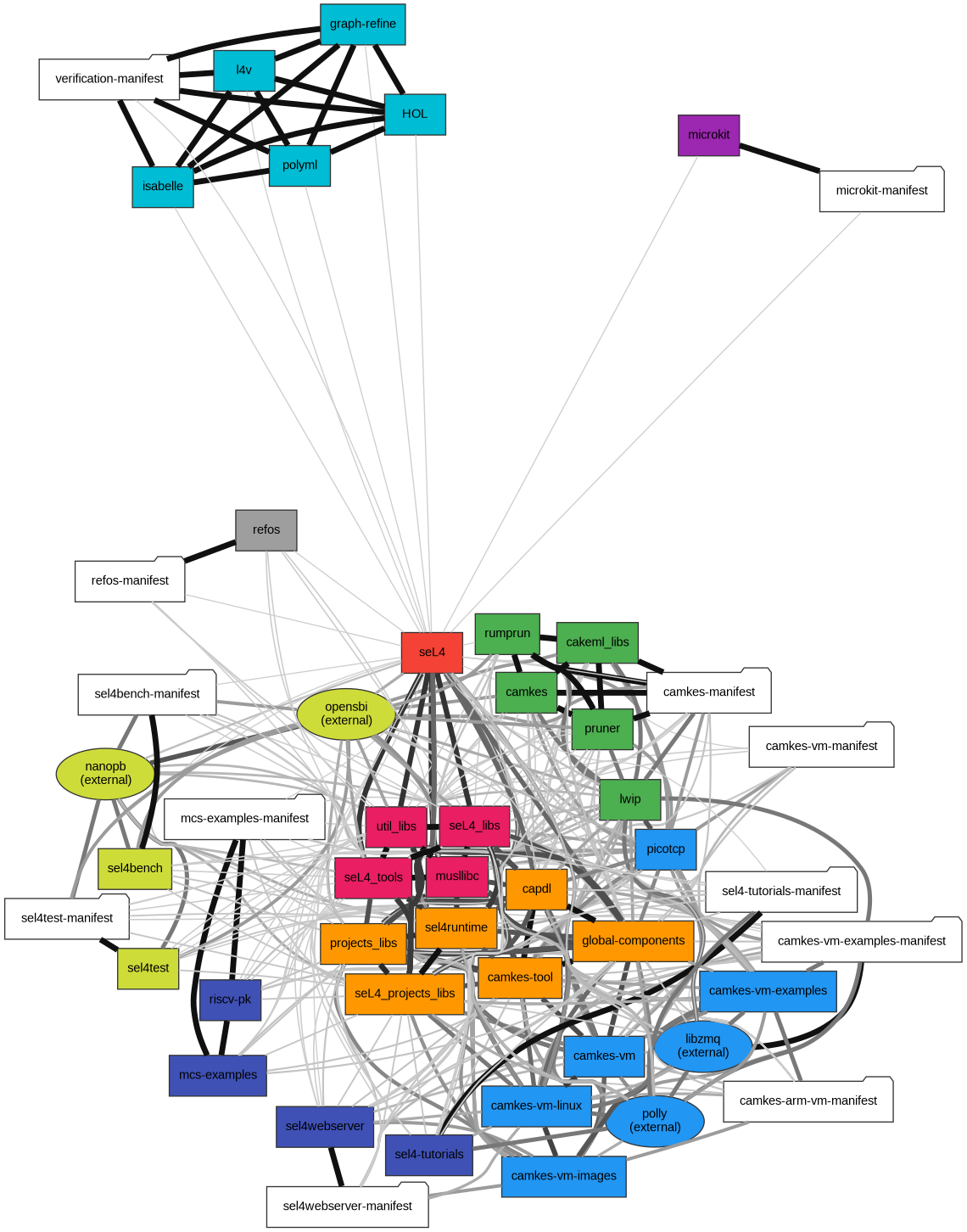
seL4 microkernel proper. This often but not
always co-exists with the main cluster of core libraries, but it
is pulled away slightly by the verification and microkit
manifests.
l4v, HOL,
graph-refine, polyml, isabelle) form a very distinct group.
These are connected only to the seL4 microkernel itself, which is
the only component formally verified.
microkit is a newer operating system framework
that does not use CAmkES, so stands apart from the rest of the
pack. I chose to scope this work to the seL4 org, so the LionsOS
ecosystem and sDDF which are maintained by Trustworthy Systems are
not shown. Also not linked is rust-sel4, because this modern
world isn t using git-repo in the main to manage its repositories.
refos before, but it appears to
be an example OS from 2021 built on the seL4 kernel.
camkes is correctly identified as more peripheral than
camkes-tool, which contains the actual core CAmkES code.
Reflecting on this approach, in hindsight I m surprised that using
co-occurences worked as well as it did there was no attempt to
actually inspect the code and find direct mentions of other code
e.g. library header dependencies. As the newer microkit effort
largely eschews git-repo, better results might be found by actually
taking that more detailed approach, so that graph edges could
represent real dependencies between two packages. Additionally, this
could allow diving into the various libraries held in the different
libs repos, to get a more granular graph of relationships between
them.
However, I think I spent more time on making it possible to render
graphviz graphs easily on my blog than actually gaining any insight
into the codebase!
Armadillo is a powerful
and expressive C++ template library for linear algebra and scientific
computing. It aims towards a good balance between speed and ease of use,
has a syntax deliberately close to Matlab, and is useful for algorithm
development directly in C++, or quick conversion of research code into
production environments. RcppArmadillo
integrates this library with the R environment and language and is
widely used by (currently) 1282 other packages on CRAN, downloaded 47.1 million
times (per the partial logs from the cloud mirrors of CRAN), and the CSDA paper (preprint
/ vignette) by Conrad and myself has been cited 697 times according
to Google Scholar.
This versions updates to the 15.4.0 upstream Armadillo release made on
Thursday. We had run a complete reverse-dependency check leading up to
it, asserting there were no issues with packages dependent on it. As it
sometimes goes with that many packages involved, one CRAN package reported one test
failure. And it turned out to be both unrelated and pre-existing. But
sorting this out over one round of email delayed things by a day. And
then I went cycling
for a good cause so this announcement post comes a little later than
usual. The package has also been updated for Debian, built for r2u, and by now also at
CRAN for the different binary
releases.
All changes since the last CRAN release follow.
Courtesy of my CRANberries, there is a diffstat report relative to previous release. More detailed information is on the RcppArmadillo page. Questions, comments etc should go to the rcpp-devel mailing list off the Rcpp R-Forge page.Changes in RcppArmadillo version 15.4.0-1 (2026-06-17)
- Upgraded to Armadillo release 15.4.0 (Medium Roast Agave)
- Added
fill::nan,fill::pos_inf,fill::neg_infas optional fill forms for theMatclass- Added
.push_back()for appending elements to vectors- Faster handling of
find()within.elem()- Faster element-wise
min()andmax()- Faster
conv_towhen element types of input and output objects are the same
This post by Dirk Eddelbuettel originated on his Thinking inside the box blog. If you like this or other open-source work I do, you can sponsor me at GitHub. You can also sponsor my Tour de Shore 2026 ride in support of the Maywood Fine Arts Center.
Following up on my previous post, I have released the
debvulns CLI. This utility uses
the same parsing logic as the debsecan-mcp server but exposes the
functionality directly via the command line.
usage: debvulns [-h] [-s critical,high,medium,low,negligible ] [-f json,csv ] [--sort-by package,cve ] [--vuln-url VULN_URL] [--epss-url EPSS_URL] [--suite SUITE]
[--cache-dir CACHE_DIR] [--no-cache] [-v]
debvulns - CLI Debian Vulnerabilities Tracker
options:
-h, --help show this help message and exit
-s, --severity critical,high,medium,low,negligible
Filter vulnerabilities by severity
-f, --format json,csv
Output format (default: json)
-sort-by package,cve
Sort vulnerabilities by 'package' or 'cve'
--vuln-url VULN_URL Custom URL or local path for Debian Security Tracker data
--epss-url EPSS_URL Custom URL or local path for EPSS scores data
--suite SUITE Debian suite name (e.g. bookworm, sid). Auto-detected by default.
--cache-dir CACHE_DIR
Directory to cache fetched and parsed data (default: /var/cache/debvulns)
--no-cache Do not use cached data, force downloading and parsing
-v, --verbose Enable verbose debug logging (sent to stderr)
| Z640 (1 socket) | Z4G4 | Z6G4 (1 socket) | Z8G4 | |
|---|---|---|---|---|
| DIMM slots | 4 | 8 | 6 | 24 |
| Max DDR4 speed | 2400 | 2666/2933 | 2666/2933 | 2666/2933 |
| Max DIMM size | 32G | 64G | 64G | 64G/128G |
| System Max Ram | 128G | 512G | 192G/384G | 1.5T/3T |
| CPU Socket | LGA2011-3 | LGA2066 | LGA3647 | LGA3647 |
| Best CPU | E5-2699A v4 | W-2195/W-2295 | Platinum 8180/W-3275 | Platinum 8180/8280 |
| Motherboard NVMe | 0 | 2 | 2 | ? |
This post is a review for Computing Reviews for systemd for Linux SysAdmins , a book published in Apresssystemd. Yes, in full lowercase. If there was ever a technology to cause controversy in the Linux world, this is it. Since its inception in 2010, systemd s goals were set quite high: to replace the vital part in every Linux system that takes care of the system boot process. It quickly reached maturity, allowing it to be adopted as the main init system in most major distributions just five years later. Despite describing events that happened over a decade ago, systemd adoption still raises the temperature in any Linux-related discussion. David Both s comprehensive book tackles the what, why, and how issues surrounding systemd. Carefully divided into 16 chapters, going from the basics and some of the technical and political history behind the project to the different subsystems and aspects covered by systemd, its almost 450 pages can scare people away. But the text is written in a very clear, tutorial-like fashion, and while it can be read sequentially, cover-to-cover, readers can also pick a single aspect and jump straight to the relevant chapter. A frequent criticism of the systemd project is that it aims to basically rewrite all of a Linux system, and just looking at this book s index shows there is some truth to it. The first chapter is an introduction to the systemd project and a brief overview of its history (including the controversies around it), and the following four chapters deal with understanding and controlling the system boot process. That leaves ten chapters to cover different aspects or subprojects of systemd, such as time and date issues (synchronization, time specifications, and controlling repetitive tasks), understanding and leveraging the system journal that strongly departs from the old syslog system, network configuration and firewall management, system health and performance debugging all aspects that in the traditional Unix philosophy were managed by independent programs. And I can identify several systemd subprojects not covered by this book! We long-time Unix and Linux administrators took pride in how highly performant and stable systems were supported by the simplicity of our tools; systemd critics point out this massive project has absorbed dozens of individual tools, yielding corporate control over vast swaths of vital system tooling. Truth is, as a sysadmin myself, systemd is today one of my greatest allies. I appreciate how the author evaluates every component independently, including his personal evaluation of each even acknowledging when he prefers working with the traditional programs. If I had to note one criticism: given the many console captures, having a maximum width below 70 characters means several lines are unnaturally cut short (and continued with odd indentations). There is probably no right way to solve this, but it does affect the reading experience.
Through work, I have paid license to windsurf

(recently renamed to "devin"), an application for LLM-based (aka,
"Agentic") development.
I hadn't been using it that much, but in an effort to more clearly
understand how this whole AI development thing works, I decided to give
it a closer look recently.
My conclusions:
In its current form, this whole LLM wave is problematic for multiple
reasons. But ignoring that, and looking at the technology only, I can
say that:
sendmail to finish, but the hang was happening when the
application was idle, not when it was sending out emails, and only
when I told it about it happening when it was idle did it find the
deadlock.
So it's not a fully automatic process, and it needs to be guided by
someone who knows what they're doing. But if that is the case, you can
come up with something that works. I spent evenings and breaks for about
a week, and I managed to create a working application which, had I
written it by hand, would have taken me a few months of full-time work
to come up with. And I now have a side project, fully complete and
working, that I had been thinking about doing for more than a decade,
but never got around to actually doing, because of all the work that
would be involved and I just didn't see myself having the time for.
It's not perfect code. But it's mostly good enough, and it will perform
the job it needs to. And it looks far slicker than most of the side
projects I've done in the past, because in the past I would prioritize
between implementing new features or making something look slick, and I
would decide that the new feature was more important because it's only
for me and there's only me and nobody cares if it looks good or not and
I don't have three weeks to come up with something that looks better.
But here, I found myself sometimes spending 10 minutes writing a prompt
with instructions on making things look better. Because what's 10
minutes when you just spent an hour writing down and refining
specifications for functionality and tests?
There are a number of other things in which an LLM can help a
programmer.
For instance.
I received a bug report recently in a project I'm paid to
maintain that I couldn't make heads
or tails of. I opened the source code in my windsurf IDE, pasted the bug
report in the prompt, and then requested the tool to analyze the source
code and the associated logs and tell me how the described behavior
could be happening. It turned out that I had overlooked something, but
with the help of the tool, I found the bug in minutes.
I was trying to understand a particular part of a large
codebase that I didn't really grasp very well.
I loaded the codebase in the tool, and asked it to explain to me how a
particular action is performed by the code. I requested specific
functions and line numbers. I now have a far better understanding of how
the code works, and will be able to write that patch that I've been
wanting to write for years -- without using the LLM.
I have been struggling for, literally, years with understanding why
another tool that I
maintain was
misbehaving in a particular way but only in Firefox. I opened the
codebase in Firefox, explained the buggy behavior in plain English, and
asked it to explain how this could be happening. It picked up some
obscure corner case behavior of ffmpeg and mp4 containers that I was not
aware of and that perfectly explained why things were misbehaving in the
way that they were.
At the same time, there are limitations. Giving an LLM a codebase that
was originally generated by an LLM (either the same one or another one)
seems to work well. Giving it a codebase that was written by a human and
expecting it to correctly update it seems to be more error-prone. I did
one or two of those as a trial, and it is more problematic than
anything.
An LLM is also not intelligent, notwithstanding the popular term of
"Artificial Intelligence". On multiple occasions, I've asked it to write
a test case for some code that was not set up to do so; and rather than
suggesting a refactor is required, it would instead copy the code that
needed to be tested and then test the copy, rather than the original.
The tool has made multiple similar errors. I have sometimes people
describe agentic coding as "similar to interacting with junior
programmers", but that is not the case. A junior programmer will either
fill in the gaps in your specifications, or ask for clarification when
something seems off. The LLM will not do that; it will do what you ask,
exactly that and nothing more. If you missed a corner case in your
specification, then all bets are off.
I remember learning about programming language generations in college.
A first-generation language is "machine code", a second-generation
language is "assembler", a third-generation language is any high-level
language such as C, Perl, or Pascal. I've forgotten what set a
3rd-generation language apart from a 4th-generation language. But I
remember the definition they gave me for a 5th-generation language: "you
tell the computer what to do, and it will do it". At the time, I thought
it was ridiculous. Nobody could ever write something like that.
But it's here.
And it's a threat to free software.
If all you have is a hammer, then everything looks like a nail.LLMs are an outgrowth of machine learning, pushed by large corporations. These large corporations have a lot of money. If all you have is money, then every problem can be fixed by throwing more money at it. The initial language models were promising but not (yet) good enough, and it seemed that one way in which they could be improved was to increase the scale of the statistics: throw more hardware (and thus money) at it, and rather than improving the efficiency of the models, just scale up. Scaling up is something that megacorporations are very good at. It's only a money problem, after all. Does that mean that "scaling up" is the only way to improve the models, though? I'm not convinced. Some hardware, such as most modern Apple and Samsung devices, ship with accelerator hardware for machine learning algorithms. There are some models that are small enough to be able to run on these devices. I don't see why it should not be possible to create a small(er) language model that can do some useful part of the above-described use cases; if not locally, then at least on a server that one can run on-prem rather than requiring that you pay rent to one of the LLM companies. The Software Freedom Conservancy has published an aspirational statement on machine learning-assisted programming that, I think, gets a lot right. It's not quite a definition, but it's something to keep in mind. Perhaps that's the way forward? More questions than answers at this point, anyway.
320. This version includes the following changes:
[ Chris Lamb ]
* Support androguard 4 and previous versions. Thanks, linsui!
(Closes: #1140016)
* Use --long-form arguments when calling apktool in order to support apktool
version 3. Thanks again to linsui. (Closes: #1140015)
* Update copyright years.
The Debian LTS Team, funded by Freexian s Debian LTS offering, is
pleased to report its activities for May.
321. This version includes the following changes:
[ Chris Lamb ]
* Fix compatibility with Ocaml 5.4.1.
There has been a video blog post recently published with a review of Ubuntu Touch as an option to opt out of the Android world: https://www.youtube.com/watch?v=wTK6TS3pXgc
Thanks to @SwitchandClick for spending time on this and publishing that video. Much appreciated.
Many Issues amended in upcoming 24.04-2.0 Release
When I watched that video referenced above, I continuously thought: ah... this is fixed in the next major release of Ubuntu Touch, or: ah... this is a known issue that we have on the roadmap..., or: ah... this is done in this ways by design (so it's a feature or basic functionality)...
Let me just state, that most of the criticized aspects will be resolved in upcoming Ubuntu Touch release 24.04-2.0 (the tests in that video blog post have been run on Ubuntu Touch 24.04-1.x):
Very happy to share that a new package rspdlite arrived on
CRAN today in its inaugural
version 0.1.0-1. It wraps and provides the (header-only) C++20 library
spdlite which its author
describes (aptly) as tiny, fast, capable. Just like its bigger
sibbling spdlog (which we
wrapped as rcppspdlog), it is
written by Gabi Melman. However,
with a focus on C++20 and compile-time configuration, it is lighter,
nimbler and faster. It is also still a fairly young project so changes
may occur.
I have been working on this for about a month, and it is ready for
use by R and C++. It contains the initial upstream release 0.1.0, and I
plan to follow the upstream versioning making this first release as
0.1.0-1.
The package itself provides the headers for use from other C++
projects (i.e. mostly other packages), as well as a simple R wrapper so
that logging can occur from either C++ or R. It will generally access
the single logger instance in a compilation unit. So for a package built
against these header it would be shared library of that package. At
present we provide the basic logging level setters and getters,
formatting accessors, and two (compile-time) options of a null logger
and a file-based logger. More options are availble from the C++ level,
multiple logging sinks are but one example. Some examples are provided
in the package as an R
example and a C++
example; these are probably best examined from the sources.
The NEWS entry for this release is simply and just announces that we
have a release. More details are in the ChangeLog
and the GitHub
repo.
Changes in version 0.1.0-1 (2025-06-08)
- Initial complete version and CRAN upload
This post by Dirk Eddelbuettel originated on his Thinking inside the box blog. If you like this or other open-source work I do, you can sponsor me at GitHub. You can also sponsor my Tour de Shore 2026 ride in support of the Maywood Fine Arts Center.
The next Ubuntu Touch major release is approaching rapidly, yesterday we reached a major step in the preparation of the upcoming Ubuntu Touch 24.04-2.0 release: The branching-off (see below on what that is).
Ubuntu Touch 24.04-2.0 Beta is Now Available
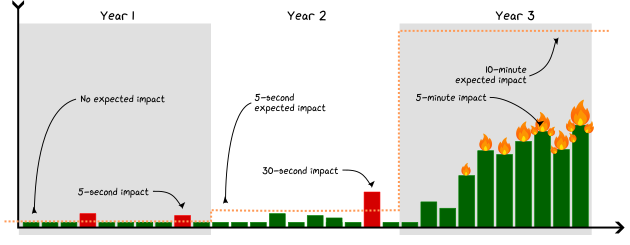
Part of this development release step is the publication of the 24.04-2.0 Beta release images, for more details and information see:Disclaimer This is a story I like to tell to warn people about Goodhart s law.2 As these events happened almost 15 years ago, my recollection is a bit fuzzy. I left in 2012.
Quick note to share that rbenchmark
is back on CRAN! The rbenchmark
package makes it easy to benchmark (and compare) simple R
expressions.
This package has been on CRAN for many years. At one point
fourteen years ago it appeared to be rudderless so I offered help but
things realigned. Now it was just tossed off CRAN, taking a number of packages
depending on it with it (as shown in this CRANberries
skeet listing a set of removed packages) so I offered again to help,
and CRAN agreed. So here we
are.
So far I just made a number of small editing changes, added CI
support, and enable dbsr-universe coverage . I do not expect to change
the package materially. So far the package has no NEWS file either so
maybe glance at the ChangeLog
at the git
repo.
This post by Dirk Eddelbuettel originated on his Thinking inside the box blog. If you like this or other open-source work I do, you can sponsor me at GitHub. You can also sponsor my Tour de Shore 2026 ride in support of the Maywood Fine Arts Center.
GO111MODULE=off, which practically implies a
very old compatibility version that enables a number of insecure settings. Most
Linux distributions use the default GO111MODULE=on and therefore consult a
go.mod file that often declares a sensible version. While doing so is the way
for Debian longer term, getting there involves major changes so we also sought
a more short term workaround. We developed a
patch to the Go compiler
that would enable it to pick up a compatibility version from the environment.
Tobias uploaded it to unstable. The next step is
communicating the declared compatibility version
from go.mod to the compiler via the new variable. Then, rebuilding the archive
resolves the immediate symptoms. This does not save us from having to perform
the larger transition to GO111MODULE=on, but this shortcut can be backported
to trixie.
Build-Depends of glib during the toolchain bootstrap. It
implicitly depends on build-essential, which happens to depend on libc6-dev.
This poses a cycle. It applies even for cross building, because it is
interpreted for the host architecture and that there is no way of satisfying
this dependency during the toolchain bootstrap.
Given discussions at MiniDebConf Hamburg
with Jochen Sprickerhof and others, a seemingly stupid idea evolved: Let s
delete build-essential. What looks insane on the surface might deserve a
second look. Given how we moved away from C, C++ and autotools, what is in
build-essential no longer is required by much of the archive. With the rise of
debputy, debian/rules no longer has to be a makefile. While the task would
be huge, those packages relevant to architecture bootstrap could explicitly
support building without the implied dependency making their dependencies
explicit. In a number of cases, this amounts to issuing a dependency on
g++-for-host. This dependency requires the use of architecture-prefixed tools.
Therefore, Helmut wrote a debhelper change
that makes it always pass build tools to various build systems. This also
enables more packages to honour environment variables such as CC and CXX.
wheel format, and some discussion of the new
abi3t shared library format for free-threaded python.
In preparation for the event, Stefano did a complete review of the current patch
stack.
Stefano s primary goal was to get some of Debian s patches merged during the
sprints, and results were mixed. Some trivial patches
(e.g. GH-150098, made progress
and merged, but the most consequential patch Debian is carrying
is still blocked. Stefano will
continue to try to drive progress on this.
debvm and guess_concurrency both featuring improved
reproducibility and documentation.gcc-defaults. Additionally, he poked at existing gcc patches giving answers,
rebasing or closing them.debci to configure a global
notice (which is being used in Debian CI to point to the system status pages).gem2deb (Ruby packaging helper) and in ruby-byebug, both
already fixed in unstable.python-pip, pystemmer, snowball-data,
snowball (making up a mini, uncoordinated snowball transition),
python-authlib, python-discovery, python-installer, python-mitogen,
python-pipx, python-cachecontrol, platformdirs, and python-virtualenv.dh-python, culminating in the
7.20260524 upload.hplip. He also
uploaded a new upstream version of epson-inkjet-printer-escpr. Last but not
least with the help of other contributors he could fix bugs in lprng.clang-extract package for debian. clang-extract is one of the
building blocks that will help to extract specific functions from large C code,
so only relevant code can be patched, without recompiling the whole original
basecode.
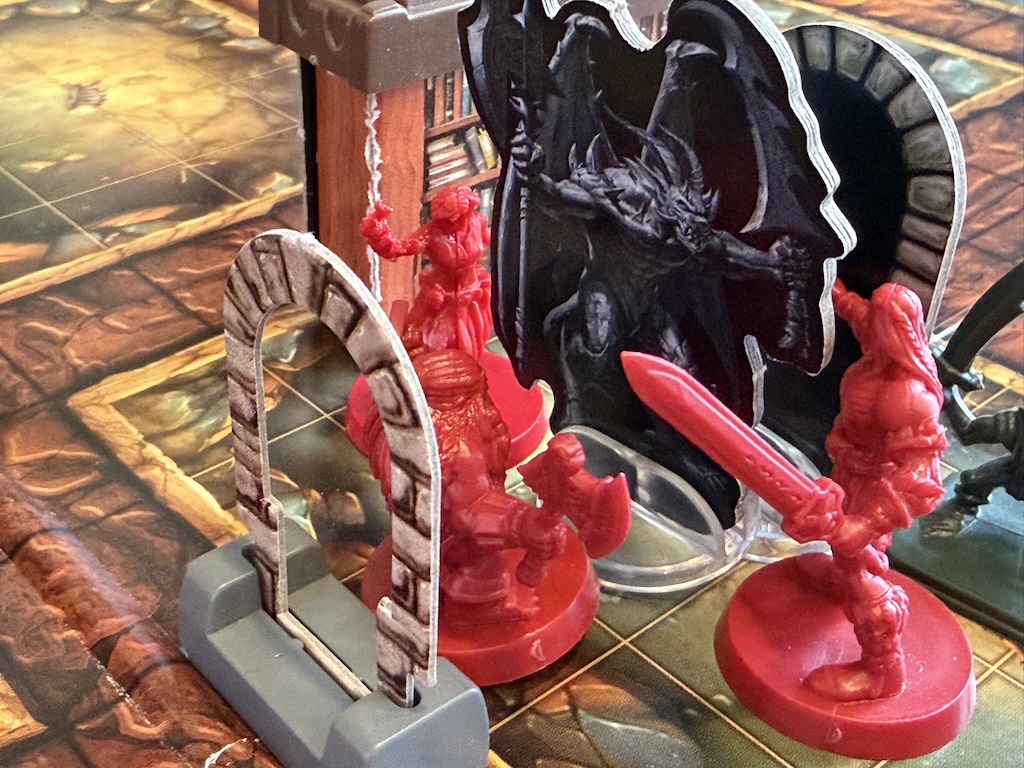
My youngest daughter and I recently started playing the tabletop game
HeroQuest. Specifically, the recently-issued, cut-down variant
HeroQuest: First Light. This is quite advanced for her age, and I'm
a little surprised she's taken to it, but she's really loving it,
It's pushed her to read bits of lore on cards and quest books that is
way above her expected reading level, and we've been exercising her
maths by adding up the gold we find on our quests and calculating what
the heroes can buy with it in the store afterwards.
Originally from 1989,
Hasbro re-issued HeroQuest in 2020. I read about it at the time but didn't
buy it. I wasn't
sure who I would play it with. It also seemed expensive to me. It probably
wasn't unusually expensive in 2020, nor now, for the sheer volume of
finely-sculpted miniatures included.
I also knew I had the original game in the loft, and
I wasn't that keen on buying something I already had,
although untangling the contents from several similar boxed games would
take me many hours, and I wasn't sure how much of the game I would find.
First Light was compelling because it is much, much cheaper than the full
remake, so I was happy
to take a punt. It's cheaper because it doesn't have any plastic monsters or
furniture: instead cardboard cut-outs that stand up on plastic stands. For us,
that is a significant drawback: 3D miniatures are much more immersive, But I
can re-use the plastic miniatures I can find from the original game. First
Light has a newly written adventure, better suited to beginners than the
original game.
The re-issue(s) have new art and new model sculpts that look fantastic. They've
changed anything which tied into Games Workshop's IP and I'm really happy about
that. They've made an effort to add women, almost entirely absent from the
original. I'm certain my daughter wouldn't have tried it otherwise.
Next.