Search Results: "tb"

5 June 2025

Matthew Garrett: Twitter's new encrypted DMs aren't better than the old ones

(Edit: Twitter could improve this significantly with very few changes - I wrote about that here. It's unclear why they'd launch without doing that, since it entirely defeats the point of using HSMs)

When Twitter[1] launched encrypted DMs a couple
of years ago, it was the worst kind of end-to-end
encrypted - technically e2ee, but in a way that made it relatively easy for Twitter to inject new encryption keys and get everyone's messages anyway. It was also lacking a whole bunch of features such as "sending pictures", so the entire thing was largely a waste of time. But a couple of days ago, Elon announced the arrival of "XChat", a new encrypted message platform built on Rust with (Bitcoin style) encryption, whole new architecture. Maybe this time they've got it right?

tl;dr - no. Use Signal. Twitter can probably obtain your private keys, and admit that they can MITM you and have full access to your metadata.

The new approach is pretty similar to the old one in that it's based on pretty straightforward and well tested cryptographic primitives, but merely using good cryptography doesn't mean you end up with a good solution. This time they've pivoted away from using the underlying cryptographic primitives directly and into higher level abstractions, which is probably a good thing. They're using Libsodium's boxes for message encryption, which is, well, fine? It doesn't offer forward secrecy (if someone's private key is leaked then all existing messages can be decrypted) so it's a long way from the state of the art for a messaging client (Signal's had forward secrecy for over a decade!), but it's not inherently broken or anything. It is, however, written in C, not Rust[2].

That's about the extent of the good news. Twitter's old implementation involved clients generating keypairs and pushing the public key to Twitter. Each client (a physical device or a browser instance) had its own private key, and messages were simply encrypted to every public key associated with an account. This meant that new devices couldn't decrypt old messages, and also meant there was a maximum number of supported devices and terrible scaling issues and it was pretty bad. The new approach generates a keypair and then stores the private key using the Juicebox protocol. Other devices can then retrieve the private key.

Doesn't this mean Twitter has the private key? Well, no. There's a PIN involved, and the PIN is used to generate an encryption key. The stored copy of the private key is encrypted with that key, so if you don't know the PIN you can't decrypt the key. So we brute force the PIN, right? Juicebox actually protects against that - before the backend will hand over the encrypted key, you have to prove knowledge of the PIN to it (this is done in a clever way that doesn't directly reveal the PIN to the backend). If you ask for the key too many times while providing the wrong PIN, access is locked down.

But this is true only if the Juicebox backend is trustworthy. If the backend is controlled by someone untrustworthy[3] then they're going to be able to obtain the encrypted key material (even if it's in an HSM, they can simply watch what comes out of the HSM when the user authenticates if there's no validation of the HSM's keys). And now all they need is the PIN. Turning the PIN into an encryption key is done using the Argon2id key derivation function, using 32 iterations and a memory cost of 16MB (the Juicebox white paper says 16KB, but (a) that's laughably small and (b) the code says 16 * 1024 in an argument that takes kilobytes), which makes it computationally and moderately memory expensive to generate the encryption key used to decrypt the private key. How expensive? Well, on my (not very fast) laptop, that takes less than 0.2 seconds. How many attempts to I need to crack the PIN? Twitter's chosen to fix that to 4 digits, so a maximum of 10,000. You aren't going to need many machines running in parallel to bring this down to a very small amount of time, at which point private keys can, to a first approximation, be extracted at will.

Juicebox attempts to defend against this by supporting sharding your key over multiple backends, and only requiring a subset of those to recover the original. I can't find any evidence that Twitter's does seem to be making use of this,Twitter uses three backends and requires data from at least two, but all the backends used are under x.com so are presumably under Twitter's direct control. Trusting the keystore without needing to trust whoever's hosting it requires a trustworthy communications mechanism between the client and the keystore. If the device you're talking to can prove that it's an HSM that implements the attempt limiting protocol and has no other mechanism to export the data, this can be made to work. Signal makes use of something along these lines using Intel SGX for contact list and settings storage and recovery, and Google and Apple also have documentation about how they handle this in ways that make it difficult for them to obtain backed up key material. Twitter has no documentation of this, and as far as I can tell does nothing to prove that the backend is in any way trustworthy. (Edit to add: The Juicebox API does support authenticated communication between the client and the HSM, but that relies on you having some way to prove that the public key you're presented with corresponds to a private key that only exists in the HSM. Twitter gives you the public key whenever you communicate with them, so even if they've implemented this properly you can't prove they haven't made up a new key and MITMed you the next time you retrieve your key)

On the plus side, Juicebox is written in Rust, so Elon's not 100% wrong. Just mostly wrong.

But ok, at least you've got viable end-to-end encryption even if someone can put in some (not all that much, really) effort to obtain your private key and render it all pointless? Actually no, since you're still relying on the Twitter server to give you the public key of the other party and there's no out of band mechanism to do that or verify the authenticity of that public key at present. Twitter can simply give you a public key where they control the private key, decrypt the message, and then reencrypt it with the intended recipient's key and pass it on. The support page makes it clear that this is a known shortcoming and that it'll be fixed at some point, but they said that about the original encrypted DM support and it never was, so that's probably dependent on whether Elon gets distracted by something else again. And the server knows who and when you're messaging even if they haven't bothered to break your private key, so there's a lot of metadata leakage.

Signal doesn't have these shortcomings. Use Signal.

[1] I'll respect their name change once Elon respects his daughter

[2] There are implementations written in Rust, but Twitter's using the C one with these JNI bindings

[3] Or someone nominally trustworthy but who's been compelled to act against your interests - even if Elon were absolutely committed to protecting all his users, his overarching goals for Twitter require him to have legal presence in multiple jurisdictions that are not necessarily above placing employees in physical danger if there's a perception that they could obtain someone's encryption keys

comment count unavailable comments

4 June 2025

Russell Coker: Trying DeepSeek R1

I saw this document on running DeepSeek R1 [1] and decided to give it a go. I downloaded the llama.cpp source and compiled it and downloaded the 131G of data as described. Running it with the default options gave about 7 CPU cores in use. Changing the --threads parameter to 44 caused it to use 17 CPU cores (changing it to larger numbers like 80 made it drop to 2.5 cores). I used the --n-gpu-layers parameter with the value of 1 as I currently have a GPU with only 6G of RAM (AliExpress is delaying my delivery of a PCIe power adaptor for a better GPU). Running it like this makes the GPU take 12W more power than standby and using 5.5G of VRAM according to nvidia-smi so it is doing a small amount of work, but not much. The documentation refers to the DeepSeek R1 1.58bit model which I m using as having 61 layers so presumably less than 2% of the work is done on the GPU. Running like this it takes 2 hours of CPU time (just over 3 minutes of elapsed time at 17 cores) to give 8 words of output. I didn t let any tests run long enough to give complete output. The documentation claims that it will run on CPU with 20G of RAM. In my tests it takes between 161G and 195G of RAM to run depending on the number of threads. The documentation describes running on the CPU as very slow which presumably means 3 words per minute on a system with a pair of E5-2699A v4 CPUs and 256G of RAM. When I try to use more than 44 threads I get output like system_info: n_threads = 200 (n_threads_batch = 200) / 44 and it seems that I only have a few threads actually in use. Apparently there s some issue with having more threads than the 44 CPU cores in the system. I was expecting this to go badly and it met my expectations in that regard. But it was interesting to see exactly how it went badly. It seems that if I had a GPU with 24G of VRAM I d still have 54/61 layers running on the CPU so even the largest of home GPUs probably wouldn t make much difference. Maybe if I configured the server to have hyper-threading enabled and 88 HT cores then I could have 88 threads and about 34 CPU cores in use which might help. But even if I got the output speed from 3 to 6 words per minute that still wouldn t be very usable.

1 June 2025

Ben Hutchings: FOSS activity in May 2025

31 May 2025

Russell Coker: Links May 2025

Christopher Biggs gave an informative Evrything Open lecture about voice recognition [1]. We need this on Debian phones. Guido wrote an informative blog post about booting a custom Android kernel on a Pixel 3a [2]. Good work in writing this up, but a pity that Google made the process so difficult. Interesting to read about an expert being a victim of a phishing attack [3]. It can happen to anyone, everyone has moments when they aren t concentrating. Interesting advice on how to leak to a journalist [4]. Brian Krebs wrote an informative article about the ways that Trump is deliberately reducing the cyber security of the US government [5]. Brian Krebs wrote an interesting article about the main smishng groups from China [6]. Louis Rossmann (who is known for high quality YouTube videos about computer repair) made an informative video about a scammy Australian company run by a child sex offender [7]. The Helmover was one of the wildest engineering projects of WW2, an over the horizon guided torpedo that could one-shot a battleship [8]. Interesting blog post about DDoSecrets and the utter failure of the company Telemessages which was used by the US government [9]. Jonathan McDowell wrote an interesting blog post about developing a free software competitor to Alexa etc, the listening hardware costs $13US per node [10]. Noema Magazine published an insightful article about Rewilding the Internet, it has some great ideas [11].

Antoine Beaupr : Traffic meter per ASN without logs

Have you ever found yourself in the situation where you had no or anonymized logs and still wanted to figure out where your traffic was coming from? Or you have multiple upstreams and are looking to see if you can save fees by getting into peering agreements with some other party? Or your site is getting heavy load but you can't pinpoint it on a single IP and you suspect some amoral corporation is training their degenerate AI on your content with a bot army? (You might be getting onto something there.) If that rings a bell, read on.

TL;DR: ... or just skip the cruft and install asncounter:
pip install asncounter
Also available in Debian 14 or later, or possibly in Debian 13 backports (soon to be released) if people are interested:
apt install asncounter
Then count whoever is hitting your network with:
awk ' print $2 ' /var/log/apache2/*access*.log   asncounter
or:
tail -F /var/log/apache2/*access*.log   awk ' print $2 '   asncounter
or:
tcpdump -q -n   asncounter --input-format=tcpdump --repl
or:
tcpdump -q -i eth0 -n -Q in "tcp and tcp[tcpflags] & tcp-syn != 0 and (port 80 or port 443)"   asncounter --input-format=tcpdump --repl
Read on for why this matters, and why I wrote yet another weird tool (almost) from scratch.

Background and manual work This is a tool I've been dreaming of for a long, long time. Back in 2006, at Koumbit a colleague had setup TAS ("Traffic Accounting System", " " in Russian, apparently), a collection of Perl script that would do per-IP accounting. It was pretty cool: it would count bytes per IP addresses and, from that, you could do analysis. But the project died, and it was kind of bespoke. Fast forward twenty years, and I find myself fighting off bots at the Tor Project (the irony...), with our GitLab suffering pretty bad slowdowns (see issue tpo/tpa/team#41677 for the latest public issue, the juicier one is confidential, unfortunately). (We did have some issues caused by overloads in CI, as we host, after all, a fork of Firefox, which is a massive repository, but the applications team did sustained, awesome work to fix issues on that side, again and again (see tpo/applications/tor-browser#43121 for the latest, and tpo/applications/tor-browser#43121 for some pretty impressive correlation work, I work with really skilled people). But those issues, I believe were fixed.) So I had the feeling it was our turn to get hammered by the AI bots. But how do we tell? I could tell something was hammering at the costly /commit/ and (especially costly) /blame/ endpoint. So at first, I pulled out the trusted awk, sort uniq -c sort -n tail pipeline I am sure others have worked out before:
awk ' print $1 ' /var/log/nginx/*.log   sort   uniq -c   sort -n   tail -10
For people new to this, that pulls the first field out of web server log files, sort the list, counts the number of unique entries, and sorts that so that the most common entries (or IPs) show up first, then show the top 10. That, other words, answers the question of "which IP address visits this web server the most?" Based on this, I found a couple of IP addresses that looked like Alibaba. I had already addressed an abuse complaint to them (tpo/tpa/team#42152) but never got a response, so I just blocked their entire network blocks, rather violently:
for cidr in 47.240.0.0/14 47.246.0.0/16 47.244.0.0/15 47.235.0.0/16 47.236.0.0/14; do 
  iptables-legacy -I INPUT -s $cidr -j REJECT
done
That made Ali Baba and his forty thieves (specifically their AL-3 network go away, but our load was still high, and I was still seeing various IPs crawling the costly endpoints. And this time, it was hard to tell who they were: you'll notice all the Alibaba IPs are inside the same 47.0.0.0/8 prefix. Although it's not a /8 itself, it's all inside the same prefix, so it's visually easy to pick it apart, especially for a brain like mine who's stared too long at logs flowing by too fast for their own mental health. What I had then was different, and I was tired of doing the stupid thing I had been doing for decades at this point. I had recently stumbled upon pyasn recently (in January, according to my notes) and somehow found it again, and thought "I bet I could write a quick script that loops over IPs and counts IPs per ASN". (Obviously, there are lots of other tools out there for that kind of monitoring. Argos, for example, presumably does this, but it's a kind of a huge stack. You can also get into netflows, but there's serious privacy implications with those. There are also lots of per-IP counters like promacct, but that doesn't scale. Or maybe someone already had solved this problem and I just wasted a week of my life, who knows. Someone will let me know, I hope, either way.)

ASNs and networks A quick aside, for people not familiar with how the internet works. People that know about ASNs, BGP announcements and so on can skip. The internet is the network of networks. It's made of multiple networks that talk to each other. The way this works is there is a Border Gateway Protocol (BGP), a relatively simple TCP-based protocol, that the edge routers of those networks used to announce each other what network they manage. Each of those network is called an Autonomous System (AS) and has an AS number (ASN) to uniquely identify it. Just like IP addresses, ASNs are allocated by IANA and local registries, they're pretty cheap and useful if you like running your own routers, get one. When you have an ASN, you'll use it to, say, announce to your BGP neighbors "I have 198.51.100.0/24" over here and the others might say "okay, and I have 216.90.108.31/19 over here, and I know of this other ASN over there that has 192.0.2.1/24 too! And gradually, those announcements flood the entire network, and you end up with each BGP having a routing table of the global internet, with a map of which network block, or "prefix" is announced by which ASN. It's how the internet works, and it's a useful thing to know, because it's what, ultimately, makes an organisation responsible for an IP address. There are "looking glass" tools like the one provided by routeviews.org which allow you to effectively run "trace routes" (but not the same as traceroute, which actively sends probes from your location), type an IP address in that form to fiddle with it. You will end up with an "AS path", the way to get from the looking glass to the announced network. But I digress, and that's kind of out of scope. Point is, internet is made of networks, networks are autonomous systems (AS) and they have numbers (ASNs), and they announced IP prefixes (or "network blocks") that ultimately tells you who is responsible for traffic on the internet.

Introducing asncounter So my goal was to get from "lots of IP addresses" to "list of ASNs", possibly also the list of prefixes (because why not). Turns out pyasn makes that really easy. I managed to build a prototype in probably less than an hour, just look at the first version, it's 44 lines (sloccount) of Python, and it works, provided you have already downloaded the required datafiles from routeviews.org. (Obviously, the latest version is longer at close to 1000 lines, but it downloads the data files automatically, and has many more features). The way the first prototype (and later versions too, mostly) worked is that you feed it a list of IP addresses on standard input, it looks up the ASN and prefix associated with the IP, and increments a counter for those, then print the result. That showed me something like this:
root@gitlab-02:~/anarcat-scripts# tcpdump -q -i eth0 -n -Q in "(udp or tcp)"   ./asncounter.py --tcpdump                                                                                                                                                                          
tcpdump: verbose output suppressed, use -v[v]... for full protocol decode                                                                
listening on eth0, link-type EN10MB (Ethernet), snapshot length 262144 bytes                                                             
INFO: collecting IPs from stdin, using datfile ipasn_20250523.1600.dat.gz                                                                
INFO: loading datfile /root/.cache/pyasn/ipasn_20250523.1600.dat.gz...                                                                   
INFO: loading /root/.cache/pyasn/asnames.json                       
ASN     count   AS               
136907  7811    HWCLOUDS-AS-AP HUAWEI CLOUDS, HK                                                                                         
[----]  359     [REDACTED]
[----]  313     [REDACTED]
8075    254     MICROSOFT-CORP-MSN-AS-BLOCK, US
[---]   164     [REDACTED]
[----]  136     [REDACTED]
24940   114     HETZNER-AS, DE  
[----]  98      [REDACTED]
14618   82      AMAZON-AES, US                                                                                                           
[----]  79      [REDACTED]
prefix  count                                         
166.108.192.0/20        1294                                                                                                             
188.239.32.0/20 1056                                          
166.108.224.0/20        970                    
111.119.192.0/20        951              
124.243.128.0/18        667                                         
94.74.80.0/20   651                                                 
111.119.224.0/20        622                                         
111.119.240.0/20        566           
111.119.208.0/20        538                                         
[REDACTED]  313           
Even without ratios and a total count (which will come later), it was quite clear that Huawei was doing something big on the server. At that point, it was responsible for a quarter to half of the traffic on our GitLab server or about 5-10 queries per second. But just looking at the logs, or per IP hit counts, it was really hard to tell. That traffic is really well distributed. If you look more closely at the output above, you'll notice I redacted a couple of entries except major providers, for privacy reasons. But you'll also notice almost nothing is redacted in the prefix list, why? Because all of those networks are Huawei! Their announcements are kind of bonkers: they have hundreds of such prefixes. Now, clever people in the know will say "of course they do, it's an hyperscaler; just ASN14618 (AMAZON-AES) there is way more announcements, they have 1416 prefixes!" Yes, of course, but they are not generating half of my traffic (at least, not yet). But even then: this also applies to Amazon! This way of counting traffic is way more useful for large scale operations like this, because you group by organisation instead of by server or individual endpoint. And, ultimately, this is why asncounter matters: it allows you to group your traffic by organisation, the place you can actually negotiate with. Now, of course, that assumes those are entities you can talk with. I have written to both Alibaba and Huawei, and have yet to receive a response. I assume I never will. In their defence, I wrote in English, perhaps I should have made the effort of translating my message in Chinese, but then again English is the Lingua Franca of the Internet, and I doubt that's actually the issue.

The Huawei and Facebook blocks Another aside, because this is my blog and I am not looking for a Pullitzer here. So I blocked Huawei from our GitLab server (and before you tear your shirt open: only our GitLab server, everything else is still accessible to them, including our email server to respond to my complaint). I did so 24h after emailing them, and after examining their user agent (UA) headers. Boy that was fun. In a sample of 268 requests I analyzed, they churned out 246 different UAs. At first glance, they looked legit, like:
Mozilla/5.0 (Macintosh; Intel Mac OS X 10_15_7) AppleWebKit/537.36 (KHTML, like Gecko) Chrome/131.0.0.0 Safari/537.36
Safari on a Mac, so far so good. But when you start digging, you notice some strange things, like here's Safari running on Linux:
Mozilla/5.0 (X11; U; Linux i686; en-US) AppleWebKit/534.3 (KHTML, like Gecko) Chrome/6.0.457.0 Safari/534.3
Was Safari ported to Linux? I guess that's.. possible? But here is Safari running on a 15 year old Ubuntu release (10.10):
Mozilla/5.0 (X11; Linux i686) AppleWebKit/534.24 (KHTML, like Gecko) Ubuntu/10.10 Chromium/12.0.702.0 Chrome/12.0.702.0 Safari/534.24
Speaking of old, here's Safari again, but this time running on Windows NT 5.1, AKA Windows XP, released 2001, EOL since 2019:
Mozilla/5.0 (Windows; U; Windows NT 5.1; en-CA) AppleWebKit/534.13 (KHTML like Gecko) Chrome/9.0.597.98 Safari/534.13
Really? Here's Firefox 3.6, released 14 years ago, there were quite a lot of those:
Mozilla/5.0 (Windows; U; Windows NT 6.1; lt; rv:1.9.2) Gecko/20100115 Firefox/3.6
I remember running those old Firefox releases, those were the days. But to me, those look like entirely fake UAs, deliberately rotated to make it look like legitimate traffic. In comparison, Facebook seemed a bit more legit, in the sense that they don't fake it. most hits are from:
meta-externalagent/1.1 (+https://developers.facebook.com/docs/sharing/webmasters/crawler)
which, according their documentation:
crawls the web for use cases such as training AI models or improving products by indexing content directly
From what I could tell, it was even respecting our rather liberal robots.txt rules, in that it wasn't crawling the sprawling /blame/ or /commit/ endpoints, explicitly forbidden by robots.txt. So I've blocked the Facebook bot in robots.txt and, amazingly, it just went away. Good job Facebook, as much as I think you've given the empire to neo-nazis, cause depression and genocide, you know how to run a crawler, thanks. Huawei was blocked at the web server level, with a friendly 429 status code telling people to contact us (over email) if they need help. And they don't care: they're still hammering the server, from what I can tell, but then again, I didn't block the entire ASN just yet, just the blocks I found crawling the server over a couple hours.

A full asncounter run So what does a day in asncounter look like? Well, you start with a problem, say you're getting too much traffic and want to see where it's from. First you need to sample it. Typically, you'd do that with tcpdump or tailing a log file:
tail -F /var/log/apache2/*access*.log   awk ' print $2 '   asncounter
If you have lots of traffic or care about your users' privacy, you're not going to log IP addresses, so tcpdump is likely a good option instead:
tcpdump -q -n   asncounter --input-format=tcpdump --repl
If you really get a lot of traffic, you might want to get a subset of that to avoid overwhelming asncounter, it's not fast enough to do multiple gigabit/second, I bet, so here's only incoming SYN IPv4 packets:
tcpdump -q -n -Q in "tcp and tcp[tcpflags] & tcp-syn != 0 and (port 80 or port 443)"   asncounter --input-format=tcpdump --repl
In any case, at this point you're staring at a process, just sitting there. If you passed the --repl or --manhole arguments, you're lucky: you have a Python shell inside the program. Otherwise, send SIGHUP to the thing to have it dump the nice tables out:
pkill -HUP asncounter
Here's an example run:
> awk ' print $2 ' /var/log/apache2/*access*.log   asncounter
INFO: using datfile ipasn_20250527.1600.dat.gz
INFO: collecting addresses from <stdin>
INFO: loading datfile /home/anarcat/.cache/pyasn/ipasn_20250527.1600.dat.gz...
INFO: finished reading data
INFO: loading /home/anarcat/.cache/pyasn/asnames.json
count   percent ASN AS
12779   69.33   66496   SAMPLE, CA
3361    18.23   None    None
366 1.99    66497   EXAMPLE, FR
337 1.83    16276   OVH, FR
321 1.74    8075    MICROSOFT-CORP-MSN-AS-BLOCK, US
309 1.68    14061   DIGITALOCEAN-ASN, US
128 0.69    16509   AMAZON-02, US
77  0.42    48090   DMZHOST, GB
56  0.3 136907  HWCLOUDS-AS-AP HUAWEI CLOUDS, HK
53  0.29    17621   CNCGROUP-SH China Unicom Shanghai network, CN
total: 18433
count   percent prefix  ASN AS
12779   69.33   192.0.2.0/24    66496   SAMPLE, CA
3361    18.23   None        
298 1.62    178.128.208.0/20    14061   DIGITALOCEAN-ASN, US
289 1.57    51.222.0.0/16   16276   OVH, FR
272 1.48    2001:DB8::/48   66497   EXAMPLE, FR
235 1.27    172.160.0.0/11  8075    MICROSOFT-CORP-MSN-AS-BLOCK, US
94  0.51    2001:DB8:1::/48 66497   EXAMPLE, FR
72  0.39    47.128.0.0/14   16509   AMAZON-02, US
69  0.37    93.123.109.0/24 48090   DMZHOST, GB
53  0.29    27.115.124.0/24 17621   CNCGROUP-SH China Unicom Shanghai network, CN
Those numbers are actually from my home network, not GitLab. Over there, the battle still rages on, but at least the vampire bots are banging their heads against the solid Nginx wall instead of eating the fragile heart of GitLab. We had a significant improvement in latency thanks to the Facebook and Huawei blocks... Here are the "workhorse request duration stats" for various time ranges, 20h after the block:
range mean max stdev
20h 449ms 958ms 39ms
7d 1.78s 5m 14.9s
30d 2.08s 3.86m 8.86s
6m 901ms 27.3s 2.43s
We went from two seconds mean to 500ms! And look at that standard deviation! 39ms! It was ten seconds before! I doubt we'll keep it that way very long but for now, it feels like I won a battle, and I didn't even have to setup anubis or go-away, although I suspect that will unfortunately come. Note that asncounter also supports exporting Prometheus metrics, but you should be careful with this, as it can lead to cardinal explosion, especially if you track by prefix (which can be disabled with --no-prefixes . Folks interested in more details should read the fine manual for more examples, usage, and discussion. It shows, among other things, how to effectively block lots of networks from Nginx, aggregate multiple prefixes, block entire ASNs, and more! So there you have it: I now have the tool I wish I had 20 years ago. Hopefully it will stay useful for another 20 years, although I'm not sure we'll have still have internet in 20 years. I welcome constructive feedback, "oh no you rewrote X", Grafana dashboards, bug reports, pull requests, and "hell yeah" comments. Hacker News, let it rip, I know you can give me another juicy quote for my blog. This work was done as part of my paid work for the Tor Project, currently in a fundraising drive, give us money if you like what you read.

30 May 2025

Russell Coker: Service Setup Difficulties

Marco wrote a blog post opposing hyperscale systems which included We want to use an hyperscaler cloud because our developers do not want to operate a scalable and redundant database just means that you need to hire competent developers and/or system administrators. [1]. I previously wrote a blog post Why Clusters Usually Don t Work [2] and I believe that all the points there are valid today and possibly exacerbated by clusters getting less direct use as clustering is increasingly being done by hyperscale providers. Take a basic need, a MySQL or PostgreSQL database for example. You want it to run and basically do the job and to have good recovery options. You could set it up locally, run backups, test the backups, have a recovery plan for failures, maybe have a hot-spare server if it s really important, have tests for backups and hot-spare server, etc. Then you could have documentation for this so if the person who set it up isn t available when there s a problem they will be able to find out what to do. But the hyperscale option is to just select a database in your provider and have all this just work. If the person who set it up isn t available for recovery in the event of failure the company can just put out a job advert for person with experience on cloud company X and have them just immediately go to work on it. I don t like hyperscale providers as they are all monopolistic companies that do anti-competitive actions. Google should be broken up, Android development and the Play Store should be separated from Gmail etc which should be separated from search and adverts, and all of them should be separated from the GCP cloud service. Amazon should be broken up, running the Amazon store should be separated from selling items on the store, which should be separated from running a video on demand platform, and all of them should be separated from the AWS cloud. Microsoft should be broken up, OS development should be separated from application development all of that should be separated from cloud services (Teams and Office 365), and everything else should be separate from the Azure cloud system. But the cloud providers offer real benefits at small scale. Running a MySQL or PostgreSQL database for local services is easy, it s a simple apt command to install it and then it basically works. Doing backup and recovery isn t so easy. One could say just hire competent people but if you do hire competent people do you want them running MySQL databases etc or have them just click on the create mysql database option on a cloud control panel and then move on to more important things? The FreedomBox project is a great project for installing and managing home/personal services [3]. But it s not about running things like database servers, it s for a high level running mail servers and other things for the user not for the developer. The Debian packaging of Open Stack looks interesting [4], it s a complete setup for running your own hyper scale cloud service. For medium and large organisations running Open Stack could be a good approach. But for small organisations it s cheaper and easier to just use a cloud service to run things. The issue of when to run things in-house and when to put them in the cloud is very complex. I think that if the organisation is going to spend less money on cloud services than on the salary of one sysadmin then it s probably best to have things in the cloud. When cloud costs start to exceed the salary of one person who manages systems then having them spend the extra time and effort to run things locally starts making more sense. There is also an opportunity cost in having a good sysadmin work on the backups for all the different systems instead of letting the cloud provider just do it. Another possibility of course is to run things in-house on low end hardware and just deal with the occasional downtime to save money. Knowingly choosing less reliability to save money can be quite reasonable as long as you have considered the options and all the responsible people are involved in the discussion. The one situation that I strongly oppose is having hyper scale services setup by people who don t understand them. Running a database server on a cloud service because you don t want to spend the time managing it is a reasonable choice in many situations. Running a database server on a cloud service because you don t understand how to setup a database server is never a good choice. While the cloud services are quite resilient there are still ways of breaking the overall system if you don t understand it. Also while it is quite possible for someone to know how to develop for databases including avoiding SQL injection etc but be unable to setup a database server that s probably not going to be common, probably if someone can t set it up (a generally easy task) then they can t do the hard tasks of making it secure.

Russell Coker: Machine Learning Security

I just read an interesting blog post about ML security recommended by Bruce Schneier [1]. This approach of having 2 AI systems where one processes user input and the second performs actions on quarantined data is good and solves some real problems. But I think the bigger issue is the need to do this. Why not have a multi stage approach, instead of a single user input to do everything (the example given is Can you send Bob the document he requested in our last meeting? Bob s email and the document he asked for are in the meeting notes file ) you could have get Bob s email address from the meeting notes file followed by create a new email to that address and find the document etc. A major problem with many plans for ML systems is that they are based around automating relatively simple tasks. The example of sending an email based on meeting notes is a trivial task that s done many times a day but for which expressing it verbally isn t much faster than doing it the usual way. The usual way of doing such things (manually finding the email address from the meeting notes etc) can be accelerated without ML by having a recent documents access method that gets the notes, having the email address be a hot link to the email program (IE wordprocessor or note taking program being able to call the MUA), having a put all data objects of type X into the clipboard (where X can be email address, URL, filename, or whatever), and maybe optimising the MUA UI. The problems that people are talking about solving via ML and treating everything as text to be arbitrarily parsed can in many cases by solved by having the programs dealing with the data know what they have and have support for calling system services accordingly. The blog post suggests a problem of user fatigue from asking the user to confirm all actions, that is a real concern if the system is going to automate everything such that the user gives a verbal description of the problem and then says yes many times to confirm it. But if the user is at every step of the way pushing the process take this email address attach this file it won t be a series of yes operations with a risk of saying yes once too often. I think that one thing that should be investigated is better integration between services to allow working live on data. If in an online meeting someone says I ll work on task A please send me an email at the end of the meeting with all issues related to it then you should be able to click on their email address in the meeting software to bring up the MUA to send a message and then just paste stuff in. The user could then not immediately send the message and clicking on the email address again would bring up the message in progress to allow adding to it (the behaviour of most MUAs of creating a new message for every click on a mailto:// URL is usually not what you desire). In this example you could of course use ALT-TAB or other methods to switch windows to the email, but imagine the situation of having 5 people in the meeting who are to be emailed about different things and that wouldn t scale. Another thing for the meeting example is that having a text chat for a video conference is a standard feature now and being able to directly message individuals is available in BBB and probably some other online meeting systems. It shouldn t be hard to add a feature to BBB and similar programs to have each user receive an email at the end of the meeting with the contents of every DM chat they were involved in and have everyone in the meeting receive an emailed transcript of the public chat. In conclusion I think that there are real issues with ML security and something like this technology is needed. But for most cases the best option is to just not have ML systems do such things. Also there is significant scope for improving the integration of various existing systems in a non-ML way.

Utkarsh Gupta: FOSS Activites in May 2025

Here s my 68th monthly but brief update about the activities I ve done in the F/L/OSS world.

Debian
This was my 77th month of actively contributing to Debian. I became a DM in late March 2019 and a DD on Christmas 19! \o/ This month I ve just been sort of MIA, mostly because of a combination of the Canonical engineering sprints in Frankfurt, a bit of vacation in Italy, and then being sick. So didn t really get much done in Debian this month.

Ubuntu
This was my 53rd month of actively contributing to Ubuntu. I joined Canonical to work on Ubuntu full-time back in February 2021. Whilst I can t give a full, detailed list of things I did (there s so much and some of it might not be public yet!), here s a quick TL;DR of what I did:

Debian (E)LTS
Debian Long Term Support (LTS) is a project to extend the lifetime of all Debian stable releases to (at least) 5 years. Debian LTS is not handled by the Debian security team, but by a separate group of volunteers and companies interested in making it a success. And Debian Extended LTS (ELTS) is its sister project, extending support to the buster, stretch, and jessie release (+2 years after LTS support). This was my 68th month as a Debian LTS and 55th month as a Debian ELTS paid contributor.
Due to a combination of the Canonical engineering sprints in Frankfurt, a bit of vacation in Italy, and then being sick, I was barely able to do (E)LTS work. So this month, I worked for only 1.00 hours for LTS and 0 hours for ELTS. I did the following things:
  • [LTS] Attended the hourly LTS meeting on IRC. Summary here.

Until next time.
:wq for today.

27 May 2025

Russell Coker: Leaf ZE1

I ve just got a second hand Nissan LEAF. It s not nearly as luxurious as the Genesis EV that I test drove [1]. It s also just over 5 years old so it s not as slick as the MG4 I test drove [2]. But the going rate for a LEAF of that age is $17,000 vs $35,000 or more for a new MG4 or $130,000+ for a Genesis. At this time the LEAF is the only EV in Australia that s available on the second hand market in quantity. Apparently the cheapest new EV in Australia is a Great Wall one which is $32,000 and which had a wait list last time I checked, so $17,000 is a decent price if you want an electric car and aren t interested in paying the price of a new car. Starting the Car One thing I don t like about most recent cars (petrol as well as electric) is that they needlessly break traditions of car design. Inserting a key and turning it clockwise to start a car is a long standing tradition that shouldn t be broken without a good reason. With the use of traditional keys you know that when a car has the key removed it can t be operated, there s no situation of the person with the key walking away and leaving the car driveable and there s no possibility of the owner driving somewhere without the key and then being unable to start it. To start a LEAF you have to have the key fob device in range, hold down the brake pedal, and then press the power button. To turn on accessories you do the same but without holding down the brake pedal. They also have patterns of pushes, push twice to turn it on, push three times to turn it off. This is all a lot easier with a key where you can just rotate it as many clicks as needed. The change of car design for the key means that no physical contact is needed to unlock the car. If someone stands by a car fiddling with the door lock it will get noticed which deters certain types of crime. If a potential thief can sit in a nearby car to try attack methods and only walk to the target vehicle once it s unlocked it makes the crime a lot easier. Even if the electronic key is as secure as a physical key allowing attempts to unlock remotely weakens security. Reports on forums suggest that the electronic key is vulnerable to replay attacks. I guess I just have to hope that as car thieves typically get less than 10% of the value of a car it s just not worth their effort to steal a $17,000 car. Unlocking doors remotely is a common feature that s been around for a while but starting a car without a key being physically inserted is a new thing. Other Features The headlights turn on automatically when the car thinks that the level of ambient light warrants it. There is an option to override this to turn on lights but no option to force the lights to be off. So if you have your car in the on state while parked the headlights will be on even if you are parked and listening to the radio. The LEAF has a bunch of luxury features which seem a bit ridiculous like seat warmers. It also has a heated steering wheel which has turned out to be a good option for me as I have problems with my hands getting cold. According to the My Nissan LEAF Forum the seat warmer uses a maximum of 50W per seat while the car heater uses a minimum of 250W [3]. So if there are one or two people in the car then significantly less power is used by just heating the seats and also keeping the car air cool reduces window fog. The Bluetooth audio support works well. I ve done hands free calls and used it for playing music from my phone. This is the first car I ve owned with Bluetooth support. It also has line-in which might have had some use in 2019 but is becoming increasingly useless as phones with Bluetooth become more popular. It has support for two devices connecting via Bluetooth at the same time which could be handy if you wanted to watch movies on a laptop or tablet while waiting for someone. The LEAF has some of the newer safety features, it tracks lane markers and notifies the driver via beeps and vibration if they stray from their lane. It also tries to read speed limit signs and display the last observed speed limit on the dash display. It also has a skid alert which in my experience goes off under hard acceleration when it s not skidding but doesn t go off if you lose grip when cornering. The features for detecting changing lanes when close to other cars and for emergency braking when another car is partly in the lane (even if moving out of the lane) don t seem well tuned for Australian driving, the common trend on Australian roads is lawful-evil to use DND terminology. Range My most recent driving was just over 2 hours driving with a distance of a bit over 100Km which took the battery from 62% to 14%. So it looks like I can drive a bit over 200Km at an average speed of 50Km/h. I have been unable to find out the battery size for my car, my model will have either a 40KWh or 62KWh battery. Google results say it should be printed on the B pillar (it s not) and that it can be deduced from the VIN (it can t). I m guessing that my car is the cheaper option which is supposed to do 240Km when new which means that a bit over 200Km at an average speed of 50Km/h when 6yo is about what s expected. If it has the larger battery designed to do 340Km then doing 200Km in real use would be rather disappointing. Assuming the battery is 40KWh that means it s 5Km/KWh or 10KW average for the duration. That means that the 250W or so used by the car heater should only make a about 2% difference to range which is something that a human won t usually notice. If I was to drive to another state I d definitely avoid using the heater or airconditioner as an extra 4km could really matter when trying to find a place to charge when you aren t familiar with the area. It s also widely reported that the LEAF is less efficient at highway speeds which is an extra difficulty for that. It seems that the LEAF just isn t designed for interstate driving in Australia, it would be fine for driving between provinces of the Netherlands as it s difficult to drive for 200km without leaving that country. Driving 700km to another city in a car with 200km range would mean charging 3 times along the way, that s 2 hours of charging time when using fast chargers. This isn t a problem at all as the average household in Australia has 1.8 cars and the battery electric vehicles only comprise 6.3% of the market. So if a household had a LEAF and a Prius they could just use the Prius for interstate driving. A recent Prius could drive from Melbourne to Canberra or Adelaide without refuelling on the way. If I was driving to another state a couple of times a year I could rent an old fashioned car to do that and still be saving money when compared to buying petrol all the time. Running Cost Currently I m paying about $0.28 per KWh for electricity, it s reported that the efficiency of charging a LEAF is as low as 83% with the best efficiency when fast charging. I don t own the fast charge hardware and don t plan to install it as that would require getting a replacement of the connection to my home from the street, a new switchboard, and other expenses. So I expect I ll be getting 83% efficiency when charging which means 48KWh for 200KM or 96KWH for the equivalent of a $110 tank of petrol. At $0.28/KWh it will cost $26 for the same amount of driving as $110 of petrol. I also anticipate saving money on service as there s no need for engine oil changes and all the other maintenance of a petrol engine and regenerative braking will reduce the incidence of brake pad replacement. I expect to save over $1100 per annum on using electricity instead of petrol even if I pay the full rate. But if I charge my car in the middle of the day when there is over supply and I don t get paid for feeding electricity from my solar panels into the grid (as is common nowadays) it could be almost free to charge the car and I could save about $1500 on fuel. Comfort Electric cars are much quieter than cars with petrol or Diesel engines which is a major luxury feature. This car is also significantly newer than any other car I ve driven much so it has features like Bluetooth audio which weren t in other cars I ve driven. When doing 100Km/h I can hear a lot of noise from the airflow, part of that would be due to the LEAF not having the extreme streamlining features that are associated with Teslas (such as retracting door handles) and part of that would be due to the car being older and the door seals not being as good as they were when new. It s still a very quiet car with a very smooth ride. It would be nice if they used the quality of seals and soundproofing that VW uses in the Passat but I guess the car would be heavier and have a shorter range if they did that. This car has less space for the driver than any other car I ve driven (with the possible exception of a 1989 Ford Laser AKA Mazda 323). The front seats have less space than the Prius. Also the batteries seem to be under the front seats so there s a bulge in the floor going slightly in front of the front seats when they are moved back which gives less space for the front passenger to move their legs and less space for the driver when sitting in a parked car. There are a selection of electric cars from MG, BYD, and Great Wall that have more space in the front seats, if those cars were on the second hand market I might have made a different choice but a second hand LEAF is the only option for a cheap electric car in Australia now. The heated steering wheel and heated seats took a bit of getting used to but I have come to appreciate the steering wheel and the heated seats are a good way of extending the range of the car. Misc Notes The LEAF is a fun car to drive and being quiet is a luxury feature, it s no different to other EVs in this regard. It isn t nearly as fast as a Tesla, but is faster than most cars actually drive on the road. When I was looking into buying a LEAF from one of the car sales sites I was looking at models less than 5 years old. But the ZR1 series went from 2017 to 2023 so there s probably not much difference between a 2019 model and a 2021 model but there is a significant price difference. I didn t deliberately choose a 2019 car, it was what a relative was selling at a time when I needed a new car. But knowing what I know now I d probably look at that age of LEAF if choosing from the car sales sites. Problems When I turn the car off the side mirrors fold in but when I turn it on they usually don t automatically unfold if I have anything connected to the cigarette lighter power port. This is a well known problem and documented on forums. This is something that Nissan really should have tested before release because phone chargers that connect to the car cigarette lighter port have been common for at least 6 years before my car was manufactured and at least 4 years before the ZE1 model was released. The built in USB port doesn t supply enough power to match the power use of a Galaxy Note 9 running Google maps and playing music through Bluetooth. On it s own this isn t a big deal but combined with the mirror issue of using a charger in the cigarette lighter port it s a problem. The cover over the charging ports doesn t seem to lock easily enough, I had it come open when doing 100Km/h on a freeway. This wasn t a big deal but as the cover opens in a suicide-door manner at a higher speed it could have broken off. The word is that LEAF service in Australia is not done well. Why do you need regular service of an electric car anyway? For petrol and Diesel cars it s engine oil replacement that makes it necessary to have regular service. Surely you can just drive it until either the brakes squeak or the tires seem worn. I have been having problems charging, sometimes it will charge from ~20% to 100% in under 24 hours, sometimes in 14+ hours it only gets to 30%. Conclusion This is a good car and the going price on them is low. I generally recommend them as long as you aren t really big and aren t too worried about the poor security. It s a fun car to drive even with a few annoying things like the mirrors not automatically extending on start. The older ones like this are cheap enough that they should be able to cover the entire purchase cost in 10 years by the savings from not buying petrol even if you don t drive a lot. With a petrol car I use about 13 tanks of petrol a year so my driving is about half the average for Australia. Some people could cover the purchase price of a second hand leaf in under 5 years.

21 May 2025

Russell Coker: Digital Sovereignty and Email

Running Your Own Email Srever I run my own mail server. I have run it since about 1995, initially on a 28k8 modem connection but the connection improved as technology became cheaper and now I m running it on a VM on a Hetzner server which is also running domains for some small businesses. I make a small amount of money running mail services for those companies but generally not enough to make it profitable. From a strictly financial basis I might be better off just using a big service, but I like having control over my own email. If email doesn t arrive I can read the logs to find out why. I repeatedly have issues of big services not accepting mail. The most recent is the MS services claiming that my IP has a bad ratio of good mail to spam and blocked me so I had to tunnel that through a different IP address. It seems that the way things are going is that if you run a small server companies like MS can block you even though your amount of spam is low but if you run a large scale service that is horrible for sending spam then you don t get blocked. For most users they just use one of the major email services (Gmail or Microsoft) and find that no-one blocks them because those providers are too big to block and things mostly work. Until of course the company decides to cancel their account. The Latest News The latest news is that MS is shutting down services for the International Court of Justice after a panel of ICC judges issued arrest warrants against Israeli Prime Minister Benjamin Netanyahu [1] . This is now making politicians realise the issues of email accounts hosted outside their jurisdiction. What we need is for each independent jurisdiction to have it s own email infrastructure, that means controlling DNS servers for their domains, commercial and government mail services on those domains, running the servers for those services on hardware located in the jurisdiction and run by people based in that jurisdiction and citizens of it. I say independent jurisdiction because there are groups like the EU which have sufficient harmony of laws to not require different services. With the current EU arrangements I don t think it s possible for the German government to block French people from accessing email or vice versa. While Australia and New Zealand have a long history of cooperation there s still the possibility of a lying asshole like Scott Morrison trying something on so New Zealanders shouldn t feel safe using services run in Australia. Note that Scott Morrison misled his own parliamentary colleagues about what he was doing and got himself assigned as a secret minister [2] demonstrating that even conservatives can t trust someone like him. With the ongoing human rights abuses by the Morrison government it s easy to imagine New Zealand based organisations that protect human rights being treated by the Australian government in the way that the ICC was treated by the US government. The Problem with Partial Solutions Now it would be very easy for the ICC to host their own mail servers and they probably will do just that in the near future. I m sure that there are many companies offering to set them up accounts in a hurry to deal with this (probably including some of the Dutch companies I ve worked for). Let s imagine for the sake of discussion that the ICC has their own private server, the US government could compel Google and MS to block the IP addresses of that server and then at least 1/3 of the EU population won t get mail from them. If the ICC used email addresses hosted on someone else s server then Google and MS could be compelled to block the addresses in question for the same result. The ICC could have changing email addresses to get around block lists and there could be a game of cat and mouse between the ICC and the US government but that would just be annoying for everyone. The EU needs to have services hosted and run in their jurisdiction that are used by the vast majority of the people in the country. The more people who are using services outside the control of hostile governments the lesser the impact of bad IT policies by those hostile governments. One possible model to consider is the Postbank model. Postbank is a bank run in the Netherlands from post offices which provides services to people deemed unprofitable for the big banks. If the post offices were associated with a mail service you could have it government subsidised providing free service for citizens and using government ID if the user forgets their password. You could also have it provide a cheap service for non-citizen residents. Other Problems What will the US government do next? Will they demand that Apple and Google do a remote-wipe on all phones run by ICC employees? Are they currently tracking all ICC employees by Android and iPhone services? Huawei s decision to develop their own phone OS was a reasonable one but there s no need to go that far. Other governments could setup their own equivalent to Google Play services for Android and have their own localised Android build. Even a small country like Australia could get this going for the services of calendaring etc. But the app store needs a bigger market. There s no reason why Android has to tie the app store to the services for calendaring etc. So you could have a per country system for calendaring and a per region system for selling apps. The invasion of Amazon services such as Alexa is also a major problem for digital sovereignty. We need government controls about this sort of thing, maybe have high tariffs on the import of all hardware that can only work with a single cloud service. Have 100+% tariffs on every phone, home automation system, or networked device that is either tied to a single cloud service or which can t work in a usable manner on other cloud services.

17 May 2025

Russell Coker: DDR4 RAM Size

I ve been looking at computer hardware on AliExpress a lot recently and I saw an advert for a motherboard which can take 256G DDR4 RDIMMs (presumably LRDIMMs). Most web pages about DDR4 state that 128G is the largest possible. The Wikipedia page for DDR4 doesn t state that 128G is the maximum but does have 128G as the largest size mentioned on the page. Recently I ve been buying 32G DDR4 RDIMMs for between $25 and $30 each. A friend can get me 64G modules for about $70 at the lowest price. If I hadn t already bought a heap of 32G modules I d buy some 64G modules right now at that price as it s worth paying 40% extra to allow better options for future expansion. Apparently the going rate for 128G modules is $300 each which is within the range for a hobbyist who has a real need for RAM. 256G modules are around $1200 each which is starting to get a big expensive. But at that price I could buy 2TB of RAM for $9600 and the computer containing it still wouldn t be the most expensive computer I ve bought the laptop that cost $5800 in 1998 takes that honour when inflation is taken into account. DDR5 RDIMMs are currently around $10/GB compared to DDR4 for $1/GB for 32G modules and DDR3 for $0.50/GB. DDR6 is supposed to be released late this year or early next year so hopefully enterprise grade systems with DDR5 RAM and DDR5 RDIMMs will be getting cheaper on ebay by the end of next year.

14 May 2025

Jonathan McDowell: Local Voice Assistant Step 3: A Detour into Tensorflow

To build our local voice satellite on a Debian system rather than using the ATOM Echo device we need something that can handle the wake word component; the piece that means we only send audio to the Home Assistant server for processing by whisper.cpp when we ve detected someone is trying to talk to us. openWakeWord seems to be one of the better ways to do this, and is well supported. However. It relies on TensorFlow Lite (now LiteRT) which is a complicated mess of machine learning code. tflite-runtime is available from PyPI, but that s prebuilt and we re trying to avoid that. Despite, on initial impressions, it looking quite complicated to deal with building TensorFlow - Bazel is an immediate warning - it turns out to be incredibly simple to build your own .deb:

$ wget -O tensorflow-v2.15.1.tar.gz https://github.com/tensorflow/tensorflow/archive/refs/tags/v2.15.1.tar.gz
 
$ tar -axf tensorflow-v2.15.1.tar.gz
$ cd tensorflow-2.15.1/
$ BUILD_NUM_JOBS=$(nproc) BUILD_DEB=y tensorflow/lite/tools/pip_package/build_pip_package_with_cmake.sh
 
$ find . -name *.deb
./tensorflow/lite/tools/pip_package/gen/tflite_pip/python3-tflite-runtime-dbgsym_2.15.1-1_amd64.deb
./tensorflow/lite/tools/pip_package/gen/tflite_pip/python3-tflite-runtime_2.15.1-1_amd64.deb
This is hiding an awful lot of complexity, however. In particular the number of 3rd party projects that are being downloaded in the background (and compiled, to be fair, rather than using binary artefacts). We can build the main C++ wrapper .so directly with cmake, allowing us to investigate a bit more:
mkdir tf-build
cd tf-build/
cmake \
    -DCMAKE_C_FLAGS="-I/usr/include/python3.11" \
    -DCMAKE_CXX_FLAGS="-I/usr/include/python3.11" \
    ../tensorflow-2.15.1/tensorflow/lite/
cmake --build . -t _pywrap_tensorflow_interpreter_wrapper
 
[100%] Built target _pywrap_tensorflow_interpreter_wrapper
$ ldd _pywrap_tensorflow_interpreter_wrapper.so
    linux-vdso.so.1 (0x00007ffec9588000)
    libm.so.6 => /lib/x86_64-linux-gnu/libm.so.6 (0x00007f22d00d0000)
    libstdc++.so.6 => /lib/x86_64-linux-gnu/libstdc++.so.6 (0x00007f22cf600000)
    libgcc_s.so.1 => /lib/x86_64-linux-gnu/libgcc_s.so.1 (0x00007f22d00b0000)
    libc.so.6 => /lib/x86_64-linux-gnu/libc.so.6 (0x00007f22cf81f000)
    /lib64/ld-linux-x86-64.so.2 (0x00007f22d01d1000)
Looking at the output we can see that pthreadpool, FXdiv, FP16 + PSimd are all downloaded, and seem to have ways to point to a local copy. That seems positive. However, there are even more hidden dependencies, which we can see if we look in the _deps/ subdirectory of the build tree. These don t appear to be as easy to override, and not all of them have packages already in Debian. First, the ones that seem to be available: abseil-cpp, cpuinfo, eigen, farmhash, flatbuffers, gemmlowp, ruy + xnnpack (lots of credit to the Debian Deep Learning Team for these, and in particular Mo Zhou) Dependencies I couldn t see existing packages for are: OouraFFT, ml_dtypes & neon2sse. At this point I just used the package I built with the initial steps above. I live in hope someone will eventually package this properly for Debian, or that I ll find the time to try and help out, but that s not going to be today. I wish upstream developers made it easier to use system copies of their library dependencies. I wish library developers made it easier to build and install system copies of their work. pkgconf is not new tech these days (pkg-config appears to date back to 2000), and has decent support in CMake. I get that there can be issues with incompatibilities even in minor releases, or awkwardness in doing builds of multiple connected projects, but at least give me the option to do so.

13 May 2025

Ben Hutchings: Report for Debian BSP near Leuven in April 2025

On 26th and 27th April we held a Debian bug-squashing party near Leuven, Belgium. Several longstanding and new Debian contributors gathered to work through some of the highest priority bugs affecting the upcoming release of Debian 13 trixie . We were hosted by the Familia community centre in Tildonk. As this venue currently does not have an Internet connection, we brought a mobile hotspot and a local Debian mirror. In attendance were: The new contributors were variously using Arch, Fedora, and Ubuntu, and the DDs spent some some time setting them up with Debian dvelopment environments. The bugs we worked on included:

12 May 2025

Reproducible Builds: Reproducible Builds in April 2025

Welcome to our fourth report from the Reproducible Builds project in 2025. These monthly reports outline what we ve been up to over the past month, and highlight items of news from elsewhere in the increasingly-important area of software supply-chain security. Lastly, if you are interested in contributing to the Reproducible Builds project, please visit our Contribute page on our website. Table of contents:
  1. reproduce.debian.net
  2. Fifty Years of Open Source Software Supply Chain Security
  3. 4th CHAINS Software Supply Chain Workshop
  4. Mailing list updates
  5. Canonicalization for Unreproducible Builds in Java
  6. OSS Rebuild adds new TUI features
  7. Distribution roundup
  8. diffoscope & strip-nondeterminism
  9. Website updates
  10. Reproducibility testing framework
  11. Upstream patches

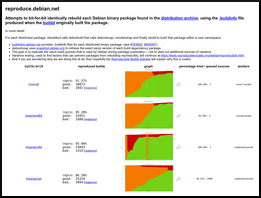
reproduce.debian.net The last few months have seen the introduction, development and deployment of reproduce.debian.net. In technical terms, this is an instance of rebuilderd, our server designed monitor the official package repositories of Linux distributions and attempt to reproduce the observed results there. This month, however, we are pleased to announce that reproduce.debian.net now tests all the Debian trixie architectures except s390x and mips64el. The ppc64el architecture was added through the generous support of Oregon State University Open Source Laboratory (OSUOSL), and we can support the armel architecture thanks to CodeThink.

Fifty Years of Open Source Software Supply Chain Security Russ Cox has published a must-read article in ACM Queue on Fifty Years of Open Source Software Supply Chain Security. Subtitled, For decades, software reuse was only a lofty goal. Now it s very real. , Russ article goes on to outline the history and original goals of software supply-chain security in the US military in the early 1970s, all the way to the XZ Utils backdoor of 2024. Through that lens, Russ explores the problem and how it has changed, and hasn t changed, over time. He concludes as follows:
We are all struggling with a massive shift that has happened in the past 10 or 20 years in the software industry. For decades, software reuse was only a lofty goal. Now it s very real. Modern programming environments such as Go, Node and Rust have made it trivial to reuse work by others, but our instincts about responsible behaviors have not yet adapted to this new reality. We all have more work to do.

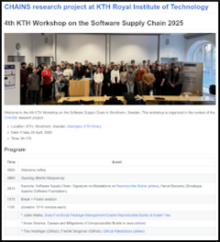
4th CHAINS Software Supply Chain Workshop Convened as part of the CHAINS research project at the KTH Royal Institute of Technology in Stockholm, Sweden, the 4th CHAINS Software Supply Chain Workshop occurred during April. During the workshop, there were a number of relevant workshops, including: The full listing of the agenda is available on the workshop s website.

Mailing list updates On our mailing list this month:
  • Luca DiMaio of Chainguard posted to the list reporting that they had successfully implemented reproducible filesystem images with both ext4 and an EFI system partition. They go on to list the various methods, and the thread generated at least fifteen replies.
  • David Wheeler announced that the OpenSSF is building a glossary of sorts in order that they consistently use the same meaning for the same term and, moreover, that they have drafted a definition for reproducible build . The thread generated a significant number of replies on the definition, leading to a potential update to the Reproducible Build s own definition.
  • Lastly, kpcyrd posted to the list with a timely reminder and update on their repro-env tool. As first reported in our July 2023 report, kpcyrd mentions that:
    My initial interest in reproducible builds was how do I distribute pre-compiled binaries on GitHub without people raising security concerns about them . I ve cycled back to this original problem about 5 years later and built a tool that is meant to address this. [ ]

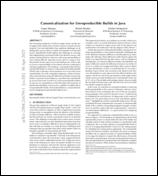
Canonicalization for Unreproducible Builds in Java Aman Sharma, Benoit Baudry and Martin Monperrus have published a new scholarly study related to reproducible builds within Java. Titled Canonicalization for Unreproducible Builds in Java, the article s abstract is as follows:
[ ] Achieving reproducibility at scale remains difficult, especially in Java, due to a range of non-deterministic factors and caveats in the build process. In this work, we focus on reproducibility in Java-based software, archetypal of enterprise applications. We introduce a conceptual framework for reproducible builds, we analyze a large dataset from Reproducible Central and we develop a novel taxonomy of six root causes of unreproducibility. We study actionable mitigations: artifact and bytecode canonicalization using OSS-Rebuild and jNorm respectively. Finally, we present Chains-Rebuild, a tool that raises reproducibility success from 9.48% to 26.89% on 12,283 unreproducible artifacts. To sum up, our contributions are the first large-scale taxonomy of build unreproducibility causes in Java, a publicly available dataset of unreproducible builds, and Chains-Rebuild, a canonicalization tool for mitigating unreproducible builds in Java.
A full PDF of their article is available from arXiv.

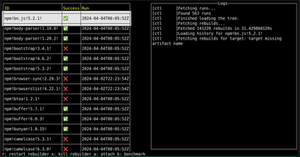
OSS Rebuild adds new TUI features OSS Rebuild aims to automate rebuilding upstream language packages (e.g. from PyPI, crates.io and npm registries) and publish signed attestations and build definitions for public use. OSS Rebuild ships a text-based user interface (TUI) for viewing, launching, and debugging rebuilds. While previously requiring ownership of a full instance of OSS Rebuild s hosted infrastructure, the TUI now supports a fully local mode of build execution and artifact storage. Thanks to Giacomo Benedetti for his usage feedback and work to extend the local-only development toolkit. Another feature added to the TUI was an experimental chatbot integration that provides interactive feedback on rebuild failure root causes and suggests fixes.

Distribution roundup In Debian this month:
  • Roland Clobus posted another status report on reproducible ISO images on our mailing list this month, with the summary that all live images build reproducibly from the online Debian archive .
  • Debian developer Simon Josefsson published another two reproducibility-related blog posts this month, the first on the topic of Verified Reproducible Tarballs. Simon sardonically challenges the reader as follows: Do you want a supply-chain challenge for the Easter weekend? Pick some well-known software and try to re-create the official release tarballs from the corresponding Git checkout. Is anyone able to reproduce anything these days? After that, they also published a blog post on Building Debian in a GitLab Pipeline using their multi-stage rebuild approach.
  • Roland also posted to our mailing list to highlight that there is now another tool in Debian that generates reproducible output, equivs . This is a tool to create trivial Debian packages that might Depend on other packages. As Roland writes, building the [equivs] package has been reproducible for a while, [but] now the output of the [tool] has become reproducible as well .
  • Lastly, 9 reviews of Debian packages were added, 10 were updated and 10 were removed this month adding to our extensive knowledge about identified issues.
The IzzyOnDroid Android APK repository made more progress in April. Thanks to funding by NLnet and Mobifree, the project was also to put more time into their tooling. For instance, developers can now easily run their own verification builder in less than 5 minutes . This currently supports Debian-based systems, but support for RPM-based systems is incoming.
  • The rbuilder_setup tool can now setup the entire framework within less than five minutes. The process is configurable, too, so everything from just the basics to verify builds up to a fully-fledged RB environment is also possible.
  • This tool works on Debian, RedHat and Arch Linux, as well as their derivates. The project has received successful reports from Debian, Ubuntu, Fedora and some Arch Linux derivates so far.
  • Documentation on how to work with reproducible builds (making apps reproducible, debugging unreproducible packages, etc) is available in the project s wiki page.
  • Future work is also in the pipeline, including documentation, guidelines and helpers for debugging.
NixOS defined an Outreachy project for improving build reproducibility. In the application phase, NixOS saw some strong candidates providing contributions, both on the NixOS side and upstream: guider-le-ecit analyzed a libpinyin issue. Tessy James fixed an issue in arandr and helped analyze one in libvlc that led to a proposed upstream fix. Finally, 3pleX fixed an issue which was accepted in upstream kitty, one in upstream maturin, one in upstream python-sip and one in the Nix packaging of python-libbytesize. Sadly, the funding for this internship fell through, so NixOS were forced to abandon their search. Lastly, in openSUSE news, Bernhard M. Wiedemann posted another monthly update for their work there.

diffoscope & strip-nondeterminism diffoscope is our in-depth and content-aware diff utility that can locate and diagnose reproducibility issues. This month, Chris Lamb made the following changes, including preparing and uploading a number of versions to Debian:
  • Use the --walk argument over the potentially dangerous alternative --scan when calling out to zipdetails(1). [ ]
  • Correct a longstanding issue where many >-based version tests used in conditional fixtures were broken. This was used to ensure that specific tests were only run when the version on the system was newer than a particular number. Thanks to Colin Watson for the report (Debian bug #1102658) [ ]
  • Address a long-hidden issue in the test_versions testsuite as well, where we weren t actually testing the greater-than comparisons mentioned above, as it was masked by the tests for equality. [ ]
  • Update copyright years. [ ]
In strip-nondeterminism, however, Holger Levsen updated the Continuous Integration (CI) configuration in order to use the standard Debian pipelines via debian/salsa-ci.yml instead of using .gitlab-ci.yml. [ ]

Website updates Once again, there were a number of improvements made to our website this month including:
  • Aman Sharma added OSS-Rebuild s stabilize tool to the Tools page. [ ][ ]
  • Chris Lamb added a configure.ac (GNU Autotools) example for using SOURCE_DATE_EPOCH. [ ]. Chris also updated the SOURCE_DATE_EPOCH snippet and move the archive metadata to a more suitable location. [ ]
  • Denis Carikli added GNU Boot to our ever-evolving Projects page.

Reproducibility testing framework The Reproducible Builds project operates a comprehensive testing framework running primarily at tests.reproducible-builds.org in order to check packages and other artifacts for reproducibility. In April, a number of changes were made by Holger Levsen, including:
  • reproduce.debian.net-related:
    • Add armel.reproduce.debian.net to support the armel architecture. [ ][ ]
    • Add a new ARM node, codethink05. [ ][ ]
    • Add ppc64el.reproduce.debian.net to support testing of the ppc64el architecture. [ ][ ][ ]
    • Improve the reproduce.debian.net front page. [ ][ ]
    • Make various changes to the ppc64el nodes. [ ][ ]9[ ][ ]
    • Make various changes to the arm64 and armhf nodes. [ ][ ][ ][ ]
    • Various changes related to the rebuilderd-worker entry point. [ ][ ][ ]
    • Create and deploy a pkgsync script. [ ][ ][ ][ ][ ][ ][ ][ ]
    • Fix the monitoring of the riscv64 architecture. [ ][ ]
    • Make a number of changes related to starting the rebuilderd service. [ ][ ][ ][ ]
  • Backup-related:
    • Backup the rebuilder databases every week. [ ][ ][ ][ ]
    • Improve the node health checks. [ ][ ]
  • Misc:
    • Re-use existing connections to the SSH proxy node on the riscv64 nodes. [ ][ ]
    • Node maintenance. [ ][ ][ ]
In addition:
  • Jochen Sprickerhof fixed the risvc64 host names [ ] and requested access to all the rebuilderd nodes [ ].
  • Mattia Rizzolo updated the self-serve rebuild scheduling tool, replacing the deprecated SSO -style authentication with OpenIDC which authenticates against salsa.debian.org. [ ][ ][ ]
  • Roland Clobus updated the configuration for the osuosl3 node to designate 4 workers for bigger builds. [ ]

Upstream patches The Reproducible Builds project detects, dissects and attempts to fix as many currently-unreproducible packages as possible. We endeavour to send all of our patches upstream where appropriate. This month, we wrote a large number of such patches, including:

Finally, if you are interested in contributing to the Reproducible Builds project, please visit our Contribute page on our website. However, you can get in touch with us via:

Freexian Collaborators: Debian Contributions: DebConf 25 preparations, PyPA tools updates, Removing libcrypt-dev from build-essential and more! (by Anupa Ann Joseph)

Debian Contributions: 2025-04 Contributing to Debian is part of Freexian s mission. This article covers the latest achievements of Freexian and their collaborators. All of this is made possible by organizations subscribing to our Long Term Support contracts and consulting services.

DebConf 25 Preparations, by Stefano Rivera and Santiago Ruano Rinc n DebConf 25 preparations continue. In April, the bursary team reviewed and ranked bursary applications. Santiago Ruano Rinc n examined the current state of the conference s finances, to see if we could allocate any more money to bursaries. Stefano Rivera supported the bursary team s work with infrastructure and advice and added some metrics to assist Santiago s budget review. Santiago was also involved in different parts of the organization, including Content team matters, as reviewing the first of proposals, preparing public information about the new Academic Track; or coordinating different aspects of the Day trip activities and the Conference Dinner.

PyPA tools updates, by Stefano Rivera Around the beginning of the freeze (in retrospect, definitely too late) Stefano looked at updating setuptools in the archive to 78.1.0. This brings support for more comprehensive license expressions (PEP-639), that people are expected to adopt soon upstream. While the reverse-autopkgtests all passed, it all came with some unexpected complications, and turned into a mini-transition. The new setuptools broke shebangs for scripts (pypa/setuptools#4952). It also required a bump of wheel to 0.46 and wheel 0.46 now has a dependency outside the standard library (it de-vendored packaging). This meant it was no longer suitable to distribute a standalone wheel.whl file to seed into new virtualenvs, as virtualenv does by default. The good news here is that setuptools doesn t need wheel any more, it included its own implementation of the bdist_wheel command, in 70.1. But the world hadn t adapted to take advantage of this, yet. Stefano scrambled to get all of these issues resolved upstream and in Debian: We re now at the point where python3-wheel-whl is no longer needed in Debian unstable, and it should migrate to trixie.

Removing libcrypt-dev from build-essential, by Helmut Grohne The crypt function was originally part of glibc, but it got separated to libxcrypt. As a result, libc6-dev now depends on libcrypt-dev. This poses a cycle during architecture cross bootstrap. As the number of packages actually using crypt is relatively small, Helmut proposed removing the dependency. He analyzed an archive rebuild kindly performed by Santiago Vila (not affiliated with Freexian) and estimated the necessary changes. It looks like we may complete this with modifications to less than 300 source packages in the forky cycle. Half of the bugs have been filed at this time. They are tracked with libcrypt-* usertags.

Miscellaneous contributions
  • Carles uploaded a new version of simplemonitor.
  • Carles improved the documentation of salsa-ci-team/pipeline regarding piuparts arguments.
  • Carles closed an FTBFS on gcc-15 on qnetload.
  • Carles worked on Catalan translations using po-debconf-manager: reviewed 57 translations and created their merge requests in salsa, created 59 bug reports for packages that didn t merge in more than 30 days. Followed-up merge requests and comments in bug reports. Managed some translations manually for packages that are not in Salsa.
  • Lucas did some work on the DebConf Content and Bursary teams.
  • Lucas fixed multiple CVEs and bugs involving the upgrade from bookworm to trixie in ruby3.3.
  • Lucas fixed a CVE in valkey in unstable.
  • Stefano updated beautifulsoup4, python-authlib, python-html2text, python-packaging, python-pip, python-soupsieve, and unidecode.
  • Stefano packaged python-dependency-groups, a new vendored library in python-pip.
  • During an afternoon Bug Squashing Party in Montevideo, Santiago uploaded a couple of packages fixing RC bugs #1057226 and #1102487. The latter was a sponsored upload.
  • Thorsten uploaded new upstream versions of brlaser, ptouch-driver and sane-airscan to get the latest upstream bug fixes into Trixie.
  • Rapha l filed an upstream bug on zim for a graphical glitch that he has been experiencing.
  • Colin Watson upgraded openssh to 10.0p1 (also known as 10.0p2), and debugged various follow-up bugs. This included adding riscv64 support to vmdb2 in passing, and enabling native wtmpdb support so that wtmpdb last now reports the correct tty for SSH connections.
  • Colin fixed dput-ng s override option, which had never previously worked.
  • Colin fixed a security bug in debmirror.
  • Colin did his usual routine work on the Python team: 21 packages upgraded to new upstream versions, 8 CVEs fixed, and about 25 release-critical bugs fixed.
  • Helmut filed patches for 21 cross build failures.
  • Helmut uploaded a new version of debvm featuring a new tool debefivm-create to generate EFI-bootable disk images compatible with other tools such as libvirt or VirtualBox. Much of the work was prototyped in earlier months. This generalizes mmdebstrap-autopkgtest-build-qemu.
  • Helmut continued reporting undeclared file conflicts and suggested package removals from unstable.
  • Helmut proposed build profiles for libftdi1 and gnupg2. To deal with recently added dependencies in the architecture cross bootstrap package set.
  • Helmut managed the /usr-move transition. He worked on ensuring that systemd would comply with Debian s policy. Dumat continues to locate problems here and there yielding discussion occasionally. He sent a patch for an upgrade problem in zutils.
  • Anupa worked with the Debian publicity team to publish Micronews and Bits posts.
  • Anupa worked with the DebConf 25 content team to review talk and event proposals for DebConf 25.

9 May 2025

Abhijith PA: Bug squashing party, Kochi

Last weekend, 4 people (3 DDs and 1 soon to be, hopefully in coming months) sit together for a Bug squashing party in Kochi. We fixed lot of things including my broken autopkgtest setup. BSP-Kochi It all began from a discussion in #debian-in of not having any BSPs in the past in India. Then twisted in to hosting a BSP by me. I fixed the dates to 3rd & 4th May to get packages migrate naturally to testing with NMUs before the hard freeze on 15th May. Finding a venue was a huge challenge. Unlike other places, we have very limited options on hackerspaces. We also had some company spaces (if we asked), but we may have to follow their office timings and finding accommodation near by was also a challenge. Later we decided to go with a rental apartment where could hack all night and sleep. We booked a very bare minimal apartment for 3 nights and 3 days. I updated wiki page and sent announcement. Not even Wi-Fi was there in the apartment, so we setup everything by ourselves (DebConf style :p ). I short listed some newbie bugs, just in case if newcomers joined the party. But it was only we 4 people and Kathara who joined remotely. We started from May 2nd night, stacked our cabin with snacks, instant noodles and drinks. Arranged beds, tables and started hacking and having discussions. My autopkgtest-lxc setup was broken. I think its related to #1017753, which got fixed magically and now I started using autopkgtest-podman. stack I learned On last day, we went to a nice restaurant and had food. There was a church festival nearby, so we were able to watch wonderful procession and fireworks at night. food All in all we managed to touch 46 bugs of which 35 is now fixed/done and 11 is open, some of this get status done when it reaches testing. It was a fun and productive weekend. More importantly we had fun.

4 May 2025

Colin Watson: Free software activity in April 2025

About 90% of my Debian contributions this month were sponsored by Freexian. You can also support my work directly via Liberapay. Request for OpenSSH debugging help Following the OpenSSH work described below, I have an open report about the sshd server sometimes crashing when clients try to connect to it. I can t reproduce this myself, and arm s-length debugging is very difficult, but three different users have reported it. For the time being I can t pass it upstream, as it s entirely possible it s due to a Debian patch. Is there anyone reading this who can reproduce this bug and is capable of doing some independent debugging work, most likely involving bisecting changes to OpenSSH? I d suggest first seeing whether a build of the unmodified upstream 10.0p2 release exhibits the same bug. If it does, then bisect between 9.9p2 and 10.0p2; if not, then bisect the list of Debian patches. This would be extremely helpful, since at the moment it s a bit like trying to look for a needle in a haystack from the next field over by sending instructions to somebody with a magnifying glass. OpenSSH I upgraded the Debian packaging to OpenSSH 10.0p1 (now designated 10.0p2 by upstream due to a mistake in the release process, but they re the same thing), fixing CVE-2025-32728. This also involved a diffoscope bug report due to the version number change. I enabled the new --with-linux-memlock-onfault configure option to protect sshd against being swapped out, but this turned out to cause test failures on riscv64, so I disabled it again there. Debugging this took some time since I needed to do it under emulation, and in the process of setting up a testbed I added riscv64 support to vmdb2. In coordination with the wtmpdb maintainer, I enabled the new Y2038-safe native wtmpdb support in OpenSSH, so wtmpdb last now reports the correct tty. I fixed a couple of packaging bugs: I reviewed and merged several packaging contributions from others: dput-ng Since we added dput-ng integration to Debusine recently, I wanted to make sure that it was in good condition in trixie, so I fixed dput-ng: will FTBFS during trixie support period. Previously a similar bug had been fixed by just using different Ubuntu release names in tests; this time I made the tests independent of the current supported release data returned by distro_info, so this shouldn t come up again. We also ran into dput-ng: override doesn t override profile parameters, which needed somewhat more extensive changes since it turned out that that option had never worked. I fixed this after some discussion with Paul Tagliamonte to make sure I understood the background properly. man-db I released man-db 2.13.1. This just included various small fixes and a number of translation updates, but I wanted to get it into trixie in order to include a contribution to increase the MAX_NAME constant, since that was now causing problems for some pathological cases of manual pages in the wild that documented a very large number of terms. debmirror I fixed one security bug: debmirror prints credentials with progress. Python team I upgraded these packages to new upstream versions: In bookworm-backports, I updated these packages: I dropped a stale build-dependency from python-aiohttp-security that kept it out of testing (though unfortunately too late for the trixie freeze). I fixed or helped to fix various other build/test failures: I packaged python-typing-inspection, needed for a new upstream version of pydantic. I documented the architecture field in debian/tests/autopkgtest-pkg-pybuild.conf files. I fixed other odds and ends of bugs: Science team I fixed various build/test failures:

Russ Allbery: Review: The Book That Held Her Heart

Review: The Book That Held Her Heart, by Mark Lawrence
Series: Library Trilogy #3
Publisher: ACE
Copyright: 2025
ISBN: 0-593-43799-3
Format: Kindle
Pages: 367
The Book That Held Her Heart is the third and final book of the Library fantasy trilogy and a direct sequel to The Book That Broke the World. Lawrence provides a much-needed summary of the previous volumes at the start of this book (thank you to every author who does this!), but I was still struggling a bit with the blizzard of character names. I recommend reading this series entry in relatively close proximity to the other two. At the end of the previous book, and following some rather horrific violence, the cast split into four groups. Three of those are pursuing different resolutions to the moral problem of the Library's existence. The fourth group opens the book still stuck with the series villains, who were responsible for the over-the-top morality that undermined my enjoyment of The Book That Broke the World. Lawrence follows all four groups in interwoven chapters, maintaining that complex structure through most of this book. I thought this was a questionable structural decision that made this book feel choppy, disconnected, and unnecessarily confusing. The larger problem, though, is that this is the payoff book, the book where we find out if Lawrence is equal to the tricky ethical questions he's raised and the world-building masterpiece that The Book That Wouldn't Burn kicked off. The answer, unfortunately, is "not really." This is not a total failure; there are some excellent set pieces and world-building twists, and the characters remain likable and enjoyable to read about (although the regrettable sidelining of Livira continues). But the grand finale is weirdly conservative and not particularly grand, and Lawrence's answer to the moral questions he raised is cliched and wholly unsatisfying. I was really hoping Lawrence was going somewhere more interesting than "Nazis bad." I am entirely sympathetic to this moral position, but so is every other likely reader of this series, and we all know how that story goes. What a waste of a compelling setup. Sadly, "Nazis bad" isn't even a metaphor for the black-and-white morality that Lawrence first introduced at the end of the previous book. It's a literal description of the main moral thrust of this book. Lawrence introduces yet another new character and timeline so that he can write about thinly-disguised Nazis persecuting even more thinly-disguised Jews, and this conflict is roughly half this book. It's also integral to the ending, which uses obvious, stock secular sainthood as a sort of trump card to resolve ideological conflicts at the heart of the series. This is one of the things I was worried about after I read the short stories that Lawrence published between the volumes of this series. All of them were thuddingly trite, which did not make me optimistic that Lawrence would find a sufficiently interesting answer to his moral trilemma to satisfy the high expectations created by the build-up. That is, I am sad to report, precisely the failure mode of this book. The resolution of the moral question of the series is arguably radical within the context of the prior world-building, but in a way that effectively reduces it to the boring, small-c conservative bromides of everyday reality. This is precisely the opposite of why I read fantasy, and I did not find Lawrence's arguments for it at all convincing. Neither, I think, did Lawrence, given that the critical debate takes place off camera so that he could avoid having to present the argument. This is, unfortunately, another series where the author's reach exceeded their grasp. The world-building of The Book That Wouldn't Burn is a masterpiece that created one of the most original and compelling settings that I have read in fantasy for a long time, but unfortunately Lawrence did not have an equally original plan for how to use the setting. This is a common problem and I'm not going to judge it too harshly; it's much harder to end a series than it is to start one. I thought the occasional flashes of brilliance was worth the journey, and they continue into this book with some elaborations on the Library's mythic structure that are going to stick in my mind. You can sense the story slipping away from the hoped-for conclusion as you read, though. The story shifts more and more away from the setting and the world-building and towards character stories, and while Lawrence's characters are fine, they're not that novel. I am happy to read about Clovis and Arpix, but I can read variations of that story in a lot of places. Livira never recovers her dynamism and drive from the first book, and there is much less beneath Yute's thoughtful calm than I was hoping to find. I think Lawrence knows that the story was not entirely working because the narrative voice becomes more strident as the morality becomes less interesting. I know of only one fantasy author who can make this type of overbearing and freighted narrative style work, and Lawrence is sadly not Guy Gavriel Kay. This is not a bad book. It is an enjoyable adventure story on its own terms, with some moments of real beauty and awe and a handful of memorable characters, somewhat undermined by a painfully obvious and unoriginal moral frame. It's only a disappointment in the context of what came before it, and it is far from the first series conclusion that doesn't quite live up to the earlier volumes. I'm glad that I read it, and the series as a whole, and I do appreciate that Lawrence brought the whole series to a firm and at least somewhat satisfying conclusion in the promised number of volumes. But I do wish the series as a whole had been as special as the first book. Rating: 6 out of 10

3 May 2025

Russell Coker: Silly Job Titles

Many years ago I was on a programming project porting code from OS/2 1.x to NT. When I was there they suddenly decided to make a database of all people and get job titles for everyone apparently the position description used when advertising the jobs wasn t sufficient. When I got given a clipboard with a form to write my details I looked at what everyone else had done, It was a heap of ridiculous propaganda with everyone trying to put in synonyms for senior or skillful and listing things that they were allegedly in charge of. There were even some people trying to create impressive titles for their managers to try and suck up. I chose the job title coder as the shortest and most accurate description of what I was doing. I had to confirm that yes I really did want to put a one word title and not a paragraph of frippery. Part of my intent was to mock the ridiculously long job titles used by others but I don t think anyone realised that. I was reminded of that company when watching a video of a Trump cabinet meeting where everyone had to tell Trump how great he is. I think that a programmer who wants to be known as a Principal Solutions Architect of Advanced Algorithmic Systems and Digital Innovation Strategy (suggested by ChatGPT because I can t write such ridiculous things) is showing a Trump level of lack of self esteem. When job titles are discussed there s always someone who will say what if my title isn t impressive enough and I don t get a pay rise . If a company bases salaries on how impressive job titles are and not on whether people actually do good work then it s a very dysfunctional workplace. But dysfunctional companies aren t uncommon so it s something you might reasonably have to do. In the company in question I could have described my work as lead debugger as I ended up doing most of the debugging on that project (as on many programming projects). The title lead debugger accurately described a significant part of my work and it s work that is essential to project completion. What do you think are the worst job titles?

Russ Allbery: Review: Paper Soldiers

Review: Paper Soldiers, by Saleha Mohsin
Publisher: Portfolio
Copyright: 2024
ISBN: 0-593-53912-5
Format: Kindle
Pages: 250
The subtitle of Paper Soldiers is "How the Weaponization of the Dollar Changed the World Order," which may give you the impression that this book is about US use of the dollar system for political purposes such as sanctions. Do not be fooled like I was; this subtitle is, at best, deceptive. Coverage of the weaponization of the dollar is superficial and limited to a few chapters. This book is, instead, a history of the strong dollar policy told via a collection of hagiographies of US Treasury Secretaries and written with all of the skeptical cynicism of a poleaxed fawn. There is going to be some grumbling about the state of journalism in this review. Per the author's note, Saleha Mohsin is the Bloomberg News beat reporter for the US Department of the Treasury. That is, sadly, exactly what this book reads like: routine beat reporting. Mohsin asked current and former Treasury officials what they were thinking at various points in history and then wrote down their answers without, so far as I can tell, considering any contradictory evidence or wondering whether they were telling the truth. Paper Soldiers does contain extensive notes (those plus the index fill about forty pages), so I guess you could do the cross-checking yourself, although apparently most of the interviews for this book were "on background" and are therefore unattributed. (Is this weird? I feel like this is weird.) Mohsin adds a bit of utterly conventional and uncritical economic framing and casts the whole project in the sort of slightly breathless and dramatized prose style that infests routine news stories in the US. I find this style of book unbelievably frustrating because it represents such a wasted opportunity. To me, the point of book-length journalism is precisely to not write in this style. When you're trying to crank out two or three articles a week covering current events, I understand why there isn't always space or time to go deep into background, skepticism, and contrary opinions. But when you expand that material into a book, surely the whole point is to take the time to do some real reporting. Dig into what people told you, see if they're lying, talk to the people who disagree with them, question the conventional assumptions, and show your work on the page so that the reader is smarter after finishing your book than they were before they started. International political economics is not a sequence of objective facts. It's a set of decisions made in pursuit of economic and political theories that are disputed and arguable, and I think you owe the reader some sense of the argument and, ideally, some defensible position on the merits that is more than a transcription of your interviews. This is... not that.
It's a power loop that the United States still enjoys today: trust in America's dollar (and its democratic government) allows for cheap debt financing, which buys health care built on the most advanced research and development and inventions like airplanes and the iPhone. All of this is propelled by free market innovation and the superpowered strength to keep the nation safe from foreign threats. That investment boosts the nation's economic, military, and technological prowess, making its economy (and the dollar) even more attractive.
Let me be precise about my criticism. I am not saying that every contention in the above excerpt is wrong. Some of them are probably correct; more of them are at least arguable. This book is strictly about the era after Bretton Woods, so using airplanes as an example invention is a bizarre choice, but sure, whatever, I get the point. My criticism is that paragraphs like this, as written in this book, are not introductions to deeper discussions that question or defend that model of economic and political power. They are simple assertions that stand entirely unsupported. Mohsin routinely writes paragraphs like the above as if they are self-evident, and then immediately moves on to the next anecdote about Treasury dollar policy. Take, for example, the role of the US dollar as the world's reserve currency, which roughly means that most international transactions are conducted in dollars and numerous countries and organizations around the world hold large deposits in dollars instead of in their native currency. The conventional wisdom holds that this is a great boon to the US economy, but there are also substantive critiques and questions about that conventional wisdom. You would never know that from this book; Mohsin asserts the conventional wisdom about reserve currencies without so much as a hint that anyone might disagree. For example, one common argument, repeated several times by Mohsin, is that the US can only get away with the amount of deficit spending and cheap borrowing that it does because the dollar is the world's reserve currency. Consider two other countries whose currencies are clearly not the international reserve currency: Japan and the United Kingdom. The current US debt to GDP ratio is about 125% and the current interest rate on US 10-year bonds is about 4.2%. The current Japanese debt to GDP ratio is about 260% and the current interest rate on Japanese 10-year bonds is about 1.2%. The current UK debt to GDP ratio is 160% and the current interest rate on UK 10-year bonds is 4.5%. Are you seeing the dramatic effects of the role of the dollar as reserve currency? Me either. Again, I am not saying that this is a decisive counter-argument. I am not an economist; I'm just some random guy on the Internet who finds macroeconomics interesting and reads a few newsletters. I know the Japanese bond market is unusual in ways I'm not accounting for. There may well be compelling arguments for why reserve currency status matters immensely for US borrowing capacity. My point is not that Mohsin is wrong; my point is that you have to convince me and she doesn't even try. Nowhere in this book is a serious effort to view conventional wisdom with skepticism or confront it with opposing arguments. Instead, this book is full of blithe assertions that happen to support the narrative the author was fed by a bunch of former Treasury officials and does not appear to question in any way. I want books like this to increase my understanding of the world. To do that, they need to show me multiple sides of debates and teach me how to evaluate evidence, not simply reinforce a superficial conventional wisdom. It doesn't help that whatever fact-checking process this book went through left some glaring errors. For example, on the Plaza Accord:
With their central banks working in concert, enough dollars were purchased on the open market to weaken the currency, making American goods more affordable for foreign buyers.
I don't know what happened after the Plaza Accord (I read books like this to find out!), but clearly it wasn't that. This is utter nonsense. Buying dollars on the open market would increase the value of the dollar, not weaken it; this is basic supply and demand that you learn in the first week of a college economics class. This is the type of error that makes me question all the other claims in the book that I can't easily check. Mohsin does offer a more credible explanation of the importance of a reserve currency late in the book, although it's not clear to me that she realizes it: The widespread use of the US dollar gives US government sanctions vast international reach, allowing the US to punish and coerce its enemies through the threat of denying them access to the international financial system. Now we're getting somewhere! This is a more believable argument than a small and possibly imaginary effect on government borrowing costs. It is clear why a bellicose US government, particularly one led by advocates of a unitary executive theory that elevates the US president to a status of near-emperor, want to turn the dollar into a weapon of international control. It's much less obvious how comfortable the rest of the world should be with that concentration of power. This would be a fascinating topic for a journalistic non-fiction book. Some reporter should dive deep into the mechanics of sanctions and ask serious questions about the moral, practical, and diplomatic consequences of this aggressive wielding of US power. One could give it a title like Paper Soldiers that reflected the use of banks and paper currency as foot soldiers enforcing imperious dictates on the rest of the world. Alas, apart from a brief section in which the US scared other countries away from questioning the dollar, Mohsin does not tug at this thread. Maybe someone should write that book someday. As you will have gathered by now, I think this is a bad book and I do not recommend that you read it. Its worst flaw is one that it shares with far too much mainstream US print and TV journalism: the utter credulity of the author. I have the old-fashioned belief that a journalist should be more than a transcriptionist for powerful people. They should be skeptical, they should assume public figures may be lying, they should look for ulterior motives, and they should try to bring the reader closer to some objective truths about the world, wherever they may lie. I have no solution for this degradation of journalism. I'm not even sure that it's a change. There were always reporters eager to transcribe the voice of power into the newspaper, and if we remember the history of journalism differently, that may be because we have elevated the rare exceptions and forgotten the average. But after watching too many journalists I once respected start parroting every piece of nonsense someone tells them, from NFTs to UFOs to the existential threat of AI, I've concluded that the least I can do as a reader is to stop rewarding reporters who cannot approach powerful subjects with skepticism, suspicion, and critical research. I failed in this case, but perhaps I can serve as a warning to others. Rating: 3 out of 10

Next.

Previous.