Search Results: "tach"

17 May 2020

Erich Schubert: Contact Tracing Apps are Useless

Some people believe that automatic contact tracing apps will help contain the Coronavirus epidemic. They won t. Sorry to bring the bad news, but IT and mobile phones and artificial intelligence will not solve every problem. In my opinion, those that promise to solve these things with artificial intelligence / mobile phones / apps / your-favorite-buzzword are at least overly optimistic and blinder Aktionismus (*), if not naive, detachted from reality, or fraudsters that just want to get some funding. (*) there does not seem to be an English word for this doing something just for the sake of doing something, without thinking about whether it makes sense to do so Here are the reasons why it will not work:
  1. Signal quality. Forget detecting proximity with Bluetooth Low Energy. Yes, there are attempts to use BLE beacons for indoor positioning. But these use that you can learn fingerprints of which beacons are visible at which points, combined with additional information such as movement sensors and history (you do not teleport around in a building). BLE signals and antennas apparently tend to be very prone to orientation differences, signal reflections, and of course you will not have the idealized controlled environment used in such prototypes. The contacts have a single device, and they move this is not comparable to indoor positioning. I strongly doubt you can tell whether you are close to someone, or not.
  2. Close vs. protection. The app cannot detect protection in place. Being close to someone behind a plexiglass window or even a solid wall is very different from being close otherwise. You will get a lot of false contacts this way. That neighbor that you have never seen living in the appartment above will likely be considered a close contact of yours, as you sleep next to each other every day
  3. Low adoption rates. Apparently even in technology affine Singapore, fewer than 20% of people installed the app. That does not even mean they use it regularly. In Austria, the number is apparently below 5%, and people complain that it does not detect contact But in order for this approach to work, you will need Chinese-style mass surveillance that literally puts you in prison if you do not install the app.
  4. False alerts. Because of these issues, you will get false alerts, until you just do not care anymore.
  5. False sense of security. Honestly: the app does not pretect you at all. All it tries to do is to make the tracing of contacts easier. It will not tell you reliably if you have been infected (as mentioned above, too many false positives, too few users) nor that you are relatively safe (too few contacts included, too slow testing and reporting). It will all be on the quality of about 10 days ago you may or may not have contact with someone that tested positive, please contact someone to expose more data to tell you that it is actually another false alert .
  6. Trust. In Germany, the app will be operated by T-Systems and SAP. Not exactly two companies that have a lot of fans SAP seems to be one of the most hated software around. Neither company is known for caring about privacy much, but they are prototypical for business first . Its trust the cat to keep the cream. Yes, I know they want to make it open-source. But likely only the client, and you will still have to trust that the binary in the app stores is actually built from this source code, and not from a modified copy. As long as the name T-Systems and SAP are associated to the app, people will not trust it. Plus, we all know that the app will be bad, given the reputation of these companies at making horrible software systems
  7. Too late. SAP and T-Systems want to have the app ready in mid June. Seriously, this must be a joke? It will be very buggy in the beginning (because it is SAP!) and it will not be working reliably before end of July. There will not be a substantial user before fall. But given the low infection rates in Germany, nobody will bother to install it anymore, because the perceived benefit is 0 one the infection rates are low.
  8. Infighting. You may remember that there was the discussion before that there should be a pan-european effort. Except that in the end, everybody fought everybody else, countries went into different directions and they all broke up. France wanted a centralized systems, while in Germany people pointed out that the users will not accept this and only a distributed system will have a chance. That failed effort was known as Pan-European Privacy-Preserving Proximity Tracing (PEPP-PT) vs. Decentralized Privacy-Preserving Proximity Tracing (DP-3T) , and it turned out to have become a big clusterfuck . And that is just the tip of the iceberg.
Iceleand, probably the country that handled the Corona crisis best (they issued a travel advisory against Austria, when they were still happily spreading the virus at apres-ski; they massively tested, and got the infections down to almost zero within 6 weeks), has been experimenting with such an app. Iceland as a fairly close community managed to have almost 40% of people install their app. So did it help? No: The technology is more or less I wouldn t say useless [ ] it wasn t a game changer for us. The contact tracing app is just a huge waste of effort and public money. And pretty much the same applies to any other attempts to solve this with IT. There is a lot of buzz about solving the Corona crisis with artificial intelligence: bullshit! That is just naive. Do not speculate about magic power of AI. Get the data, understand the data, and you will see it does not help. Because its real data. Its dirty. Its late. Its contradicting. Its incomplete. It is all what AI currently can not handle well. This is not image recognition. You have no labels. Many of the attempts in this direction already fail at the trivial 7-day seasonality you observe in the data For example, the widely known John Hopkins Has the curve flattened trend has a stupid, useless indicator based on 5 day averages. And hence you get the weekly up and downs due to weekends. They show pretty up and down indicators. But these are affected mostly by the day of the week. And nobody cares. Notice that they currently even have big negative infections in their plots? There is no data on when someone was infected. Because such data simply does not exist. What you have is data when someone tested positive (mostly), when someone reported symptons (sometimes, but some never have symptoms!), and when someone dies (but then you do not know if it was because of Corona, because of other issues that became just worse because of Corona, or hit by a car without any relation to Corona). The data that we work with is incredibly delayed, yet we pretend it is live . Stop reading tea leaves. Stop pretending AI can save the world from Corona.

12 May 2020

Evgeni Golov: Building a Shelly 2.5 USB to TTL adapter cable

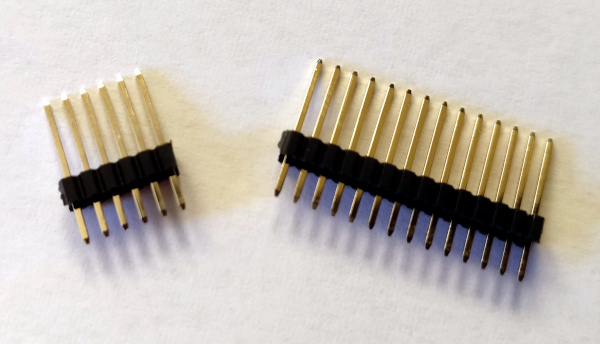
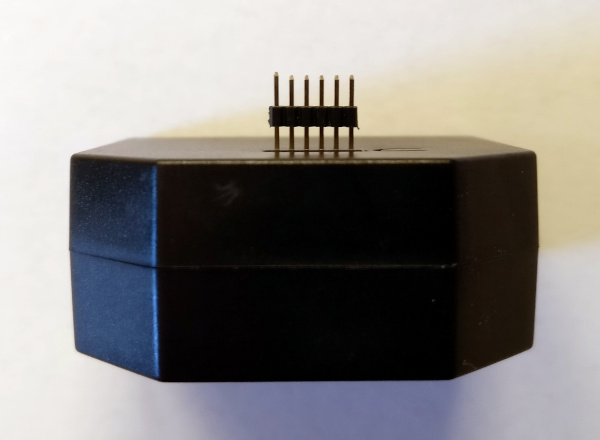
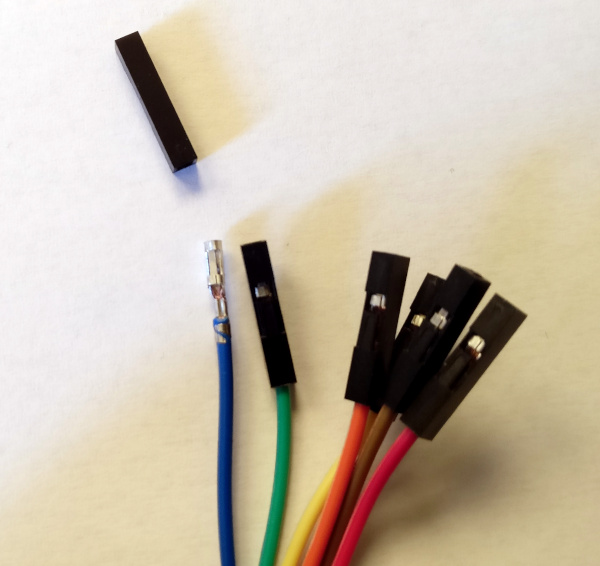
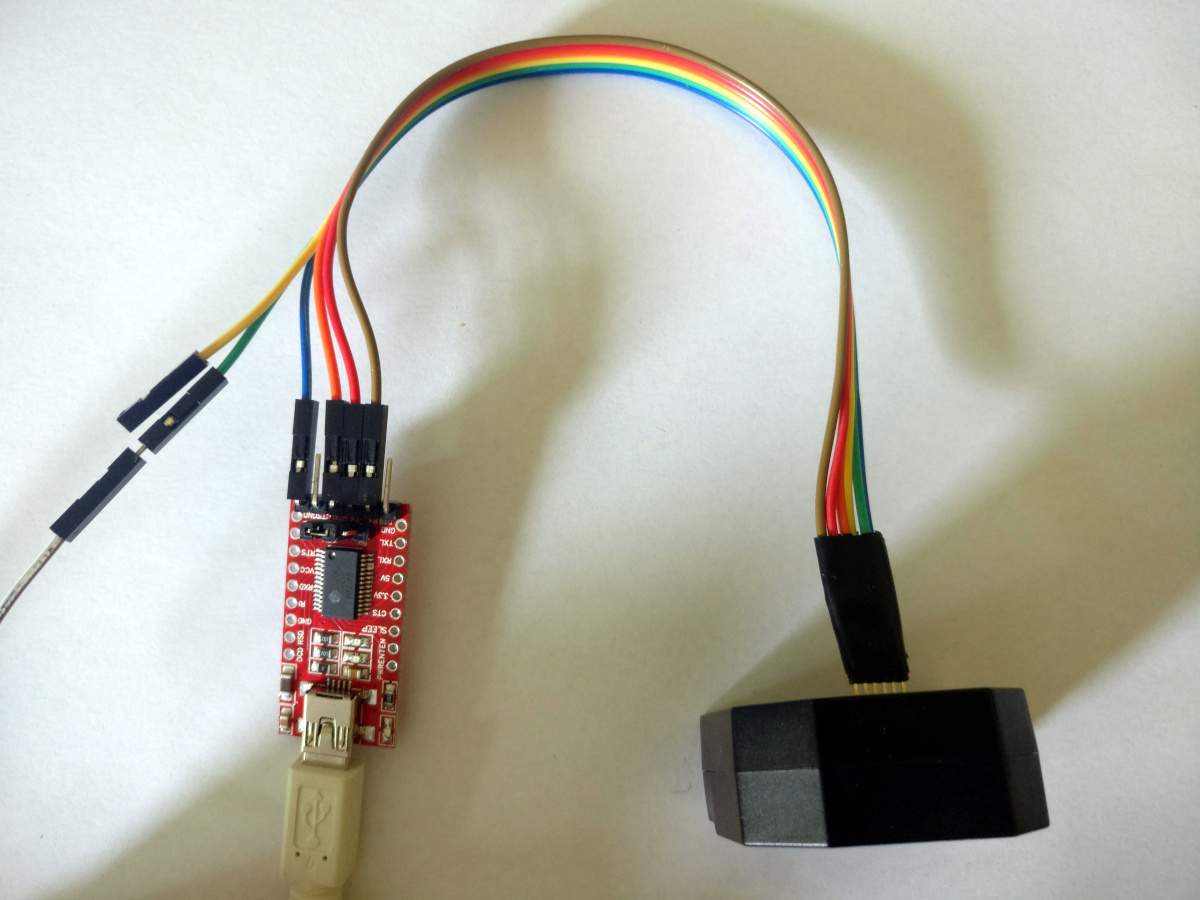
When you want to flash your Shelly 2.5 with anything but the original firmware for the first time, you'll need to attach it to your computer. Later flashes can happen over the air (at least with ESPHome or Tasmota), but the first one cannot. In theory, this is not a problem as the Shelly has a quite exposed and well documented interface: Shelly 2.5 pinout However, on closer inspection you'll notice that your normal jumper wires don't fit as the Shelly has a connector with 1.27mm (0.05in) pitch and 1mm diameter holes. Now, there are various tutorials on the Internet how to build a compatible connector using Ethernet cables and hot glue or with female header socket legs, and you can even buy cables on Amazon for 18 ! But 18 sounded like a lot and the female header socket thing while working was pretty finicky to use, so I decided to build something different. We'll need 6 female-to-female jumper wires and a 1.27mm pitch male header. Jumper wires I had at home, the header I got is a SL 1X20G 1,27 from reichelt.de for 0.61 . It's a 20 pin one, so we can make 3 adapters out of it if needed. Oh and we'll need some isolation tape. SL 1X20G 1,27 The first step is to cut the header into 6 pin chunks. Make sure not to cut too close to the 6th pin as the whole thing is rather fragile and you might lose it. SL 1X20G 1,27 cut into pieces It now fits very well into the Shelly with the longer side of the pins. Shelly 2.5 with pin headers attached Second step is to strip the plastic part of one side of the jumper wires. Those are designed to fit 2.54mm pitch headers and won't work for our use case otherwise. jumper wire with removed plastic As the connectors are still too big, even after removing the plastic, the next step is to take some pliers and gently press the connectors until they fit the smaller pins of our header. Shelly 2.5 with pin headers and a jumper wire attached Now is the time to put everything together. To avoid short circuiting the pins/connectors, apply some isolation tape while assembling, but not too much as the space is really limited. Shelly 2.5 with pin headers and a jumper wire attached and taped And we're done, a wonderful (lol) and working (yay) Shelly 2.5 cable that can be attached to any USB-TTL adapter, like the pictured FTDI clone you get almost everywhere. Shelly 2.5 with full cable and FTDI attached Yes, in an ideal world we would have soldered the header to the cable, but I didn't feel like soldering on that limited space. And yes, shrink-wrap might be a good thing too, but again, limited space and with isolation tape you only need one layer between two pins, not two.

Daniel Silverstone: The Lars, Mark, and Daniel Club

Last night, Lars, Mark, and I discussed Jeremy Kun's The communicative value of using Git well post. While a lot of our discussion was spawned by the article, we did go off-piste a little, and I hope that my notes below will enlighten you all as to a bit of how we see revision control these days. It was remarkably pleasant to read an article where the comments section wasn't a cesspool of horror, so if this posting encourages you to go and read the article, don't stop when you reach the bottom -- the comments are good and useful too.
This was a fairly non-contentious article for us though each of us had points we wished to bring up and chat about it turned into a very convivial chat. We saw the main thrust of the article as being about using the metadata of revision control to communicate intent, process, and decision making. We agreed that it must be possible to do so effectively with Mercurial (thus deciding that the mention of it was simply a bit of clickbait / red herring) and indeed Mark figured that he was doing at least some of this kind of thing way back with CVS. We all discussed how knowing the fundamentals of Git's data model improved our ability to work wih the tool. Lars and I mentioned how jarring it has originally been to come to Git from revision control systems such as Bazaar (bzr) but how over time we came to appreciate Git for what it is. For Mark this was less painful because he came to Git early enough that there was little more than the fundamental data model, without much of the porcelain which now exists. One point which we all, though Mark in particular, felt was worth considering was that of distinguishing between published and unpublished changes. The article touches on it a little, but one of the benefits of the workflow which Jeremy espouses is that of using the revision control system as an integral part of the review pipeline. This is perhaps done very well with Git based workflows, but can be done with other VCSs. With respect to the points Jeremy makes regarding making commits which are good for reviewing, we had a general agreement that things were good and sensible, to a point, but that some things were missed out on. For example, I raised that commit messages often need to be more thorough than one-liners, but Jeremy's examples (perhaps through expedience for the article?) were all pretty trite one-liners which perhaps would have been entirely obvious from the commit content. Jeremy makes the point that large changes are hard to review, and Lars poined out that Greg Wilson did research in this area, and at least one article mentions 200 lines as a maximum size of a reviewable segment. I had a brief warble at this point about how reviewing needs to be able to consider the whole of the intended change (i.e. a diff from base to tip) not just individual commits, which is also missing from Jeremy's article, but that such a review does not need to necessarily be thorough and detailed since the commit-by-commit review remains necessary. I use that high level diff as a way to get a feel for the full shape of the intended change, a look at the end-game if you will, before I read the story of how someone got to it. As an aside at this point, I talked about how Jeremy included a 'style fixes' commit in his example, but I loathe seeing such things and would much rather it was either not in the series because it's unrelated to it; or else the style fixes were folded into the commits they were related to. We discussed how style rules, as well as commit-bisectability, and other rules which may exist for a codebase, the adherence to which would form part of the checks that a code reviewer may perform, are there to be held to when they help the project, and to be broken when they are in the way of good communication between humans. In this, Lars talked about how revision control histories provide high level valuable communication between developers. Communication between humans is fraught with error and the rules are not always clear on what will work and what won't, since this depends on the communicators, the context, etc. However whatever communication rules are in place should be followed. We often say that it takes two people to communicate information, but when you're writing commit messages or arranging your commit history, the second party is often nebulous "other" and so the code reviewer fulfils that role to concretise it for the purpose of communication. At this point, I wondered a little about what value there might be (if any) in maintaining the metachanges (pull request info, mailing list discussions, etc) for historical context of decision making. Mark suggested that this is useful for design decisions etc but not for the style/correctness discussions which often form a large section of review feedback. Maybe some of the metachange tracking is done automatically by the review causing the augmentation of the changes (e.g. by comments, or inclusion of design documentation changes) to explain why changes are made. We discussed how the "rebase always vs. rebase never" feeling flip-flopped in us for many years until, as an example, what finally won Lars over was that he wants the history of the project to tell the story, in the git commits, of how the software has changed and evolved in an intentional manner. Lars said that he doesn't care about the meanderings, but rather about a clear story which can be followed and understood. I described this as the switch from "the revision history is about what I did to achieve the goal" to being more "the revision history is how I would hope someone else would have done this". Mark further refined that to "The revision history of a project tells the story of how the project, as a whole, chose to perform its sequence of evolution." We discussed how project history must necessarily then contain issue tracking, mailing list discussions, wikis, etc. There are exist free software projects where part of their history is forever lost because, for example, the project moved from Sourceforge to Github, but made no effort (or was unable) to migrate issues or somesuch. Linkages between changes and the issues they relate to can easily be broken, though at least with mailing lists you can often rewrite URLs if you have something consistent like a Message-Id. We talked about how cover notes, pull request messages, etc. can thus also be lost to some extent. Is this an argument to always use merges whose message bodies contain those details, rather than always fast-forwarding? Or is it a reason to encapsulate all those discussions into git objects which can be forever associated with the changes in the DAG? We then diverted into discussion of CI, testing every commit, and the benefits and limitations of automated testing vs. manual testing; though I think that's a little too off-piste for even this summary. We also talked about how commit message audiences include software perhaps, with the recent movement toward conventional commits and how, with respect to commit messages for machine readability, it can become very complex/tricky to craft good commit messages once there are multiple disparate audiences. For projects the size of the Linux kernel this kind of thing would be nearly impossible, but for smaller projects, perhaps there's value. Finally, we all agreed that we liked the quote at the end of the article, and so I'd like to close out by repeating it for you all... Hal Abelson famously said:
Programs must be written for people to read, and only incidentally for machines to execute.
Jeremy agrees, as do we, and extends that to the metacommit information as well.

4 May 2020

Jonathan Dowland: Amiga floppy recovery project: what next?

This is the ninth part in a series of blog posts. The previous post was Amiga floppy recovery project scope. The whole series is available here: Amiga.
It's been a while since I've reported on my Amiga floppy recovery project. With my bulky Philips CRT attached I slowly ground through the process of importing all my floppy disks, which is now done. The majority of disks were imported without errors. Commercial disks were the most likely to fail to import. Possibly I'd have more success with them if I used a different copying technique than X-COPY's default, but my focus was not on the commercial disks. I have not yet restored the use of my LCD TV with the Amiga. I was waiting to hear back from Amiga Kit about an agreed return, but despite their web store claiming they're still open for business, I haven't been able to get any response to my emails to them since mid-February. I've given up, written off that order and bought an RGB/SCART adaptor elsewhere instead. Meanwhile my bulky CRT has returned to the loft. The next step is pretty boring: time to check over my spreadsheet of disks, the imported copies of them, make sure everything is accounted for and decide whether to make further attempts for any that failed or write them off. For commercial disks it's almost certainly less effort to track down someone else's rip than to try mine again. After that I can return to moving the Gotek floppy adaptor inside the Amiga case, as described in the last entry, and start playing.

23 April 2020

Evgeni Golov: Controlling roller shutters using a Shelly 2.5, ESPHome and Home Assistant

Our house has roller shutters on all windows and most of them have an electric motor to open and close them. The motors are Schellenberg shaft motors (not sure this is the right English term), that you can configure end positions for and then by applying current to the right pair of pins they move the shutters up and down until the current is removed or one of the endstops is reached. As the motors were installed over a long period of time, the attached control units varied in functionality: different ways to program open/close times, with and without battery for the clock/settings etc, but they all had something in common: no central management and pretty ugly. We decided to replace those control units with regular 2 gang light switches that match the other switches in the house. And as we didn't want to lose the automatic open/close timer, we had to add some smarts to it. Shelly 2.5 and ESPHome Say hello to Shelly 2.5! The Shelly 2.5 is an ESP8266 with two relays attached to it in a super tiny package you can hide in the wall behind a regular switch. Pretty nifty. It originally comes with a Mongoose OS based firmware and an own app, but ain't nobody needs that, especially nobody who wants to implement some crude logic. That said, the original firmware isn't bad. It has a no-cloud mode, a REST API and does support MQTT for integration into Home Assistant and others. My ESP firmware of choice is ESPHome, which you can flash easily onto a Shelly (no matter 1, 2 or 2.5) using a USB TTL adapter that provides 3.3V. Home Assistant has native ESPHome support with auto-discovery, which is much nicer than manually attaching things to MQTT topics. To get ESPHome compiled for the Shelly 2.5, we'll need a basic configuration like this:
esphome:
  name: shelly25
  platform: ESP8266
  board: modwifi
  arduino_version: 2.4.2
We're using board: modwifi as the Shelly 2.5 (and all other Shellys) has 2MB flash and the usually recommended esp01_1m would only use 1MB of that - otherwise the configurations are identical (see the PlatformIO entries for modwifi and esp01_1m). And arduino_version: 2.4.2 is what the Internet suggests is the most stable SDK version, and who will argue with the Internet?! Now an ESP8266 without network connection is boring, so we add a WiFi configuration:
wifi:
  ssid: !secret wifi_ssid
  password: !secret wifi_password
  power_save_mode: none
The !secret commands load the named variables from secrets.yaml. While testing, I found the network connection of the Shelly very unreliable, especially when placed inside the wall and thus having rather bad bad reception (-75dBm according to ESPHome). However, setting power_save_mode: none explicitly seems to have fixed this, even if NONE is supposed to be the default on ESP8266. At this point the Shelly has a working firmware and WiFi, but does not expose any of its features: no switches, no relays, no power meters. To fix that we first need to find out the GPIO pins all these are connected to. Thankfully we can basically copy paste the definition from the Tasmota (another open-source firmware for ESPs) template:
pin_led1: GPIO0
pin_button1: GPIO2
pin_relay1: GPIO4
pin_switch2n: GPIO5
pin_sda: GPIO12
pin_switch1n: GPIO13
pin_scl: GPIO14
pin_relay2: GPIO15
pin_ade7953: GPIO16
pin_temp: A0
If we place that into the substitutions section of the ESPHome config, we can use the names everywhere and don't have to remember the pin numbers. The configuration for the ADE7953 power sensor and the NTC temperature sensor are taken verbatim from the ESPHome documentation, so there is no need to repeat them here. The configuration for the switches and relays are also rather straight forward:
binary_sensor:
  - platform: gpio
    pin: $ pin_switch1n 
    name: "Switch #1"
    internal: true
    id: switch1
  - platform: gpio
    pin: $ pin_switch2n 
    name: "Switch #2"
    internal: true
    id: switch2
switch:
  - platform: gpio
    pin: $ pin_relay1 
    name: "Relay #1"
    internal: true
    id: relay1
    interlock: &interlock_group [relay1, relay2]
  - platform: gpio
    pin: $ pin_relay2 
    name: "Relay #2"
    internal: true
    id: relay2
    interlock: *interlock_group
All marked as internal: true, as we don't need them visible in Home Assistant. ESPHome and Schellenberg roller shutters Now that we have a working Shelly 2.5 with ESPHome, how do we control Schellenberg (and other) roller shutters with it? Well, first of all we need to connect the Up and Down wires of the shutter motor to the two relays of the Shelly. And if they would not be marked as internal: true, they would show up in Home Assistant and we would be able to flip them on and off, moving the shutters. But this would also mean that we need to flip them off each time after use, as while the motor knows when to stop and will do so, applying current to both wires at the same time produces rather interesting results. So instead of fiddling around with the relays directly, we define a time-based cover in our configuration:
cover:
  - platform: time_based
    name: "$ location  Rolladen"
    id: rolladen
    open_action:
      - switch.turn_on: relay2
    open_duration: $ open_duration 
    close_action:
      - switch.turn_on: relay1
    close_duration: $ close_duration 
    stop_action:
      - switch.turn_off: relay1
      - switch.turn_off: relay2
We use a time-based cover because that's the easiest thing that will also turn the relays off for us after the shutters have been opened/closed, as the motor does not "report" any state back. We could use the integrated power meter of the Shelly to turn off when the load falls under a threshold, but I was too lazy and this works just fine as it is. Next, let's add the physical switches to it. We could just add on_press automations to the binary GPIO sensors we configured for the two switch inputs the Shelly has. But if you have kids at home, you'll know that they like to press ALL THE THINGS and what could be better than a small kill-switch against small fingers?
switch:
  [ previous definitions go here ]
  - platform: template
    id: block_control
    name: "$ location  Block Control"
    optimistic: true
  - platform: template
    name: "Move UP"
    internal: true
    lambda:  -
      if (id(switch1).state && !id(block_control).state)  
        return true;
        else  
        return false;
       
    on_turn_on:
      then:
        cover.open: rolladen
    on_turn_off:
      then:
        cover.stop: rolladen
  - platform: template
    name: "Move DOWN"
    internal: true
    lambda:  -
      if (id(switch2).state && !id(block_control).state)  
        return true;
        else  
        return false;
       
    on_turn_on:
      then:
        cover.close: rolladen
    on_turn_off:
      then:
        cover.stop: rolladen
This adds three more template switches. The first one, "Block Control", is exposed to Home Assistant, has no lambda definition and is set to optimistic: true, which makes is basically a dumb switch that can be flipped at will and the only thing it does is storing the binary on/off state. The two others are almost identical. The name differs, obviously, and so does the on_turn_on automation (one triggers the cover to open, the other to close). And the really interesting part is the lambda that monitors one of the physical switches and if that is turned on, plus "Block Control" is off, reports the switch as turned on, thus triggering the automation. With this we can now block the physical switches via Home Assistant, while still being able to control the shutters via the same. All this (and a bit more) can be found in my esphome-configs repository on GitHub, enjoy!

29 March 2020

Molly de Blanc: Computing Under Quarantine

Under the current climate of lock-ins, self-isolation, shelter-in-place policies, and quarantine, it is becoming evident to more people the integral role computers play in our lives. Students are learning entirely online, those who can are working from home, and our personal relationships are being carried largely by technology like video chats, online games, and group messages. When these things have become our only means of socializing with those outside our homes, we begin to realize how important they are and the inequity inherent to many technologies. Someone was telling me how a neighbor doesn t have a printer, so they are printing off school assignments for their neighbor. People I know are sharing internet connections with people in their buildings, when possible, to help save on costs with people losing jobs. I worry now even more about people who have limited access to home devices or poor internet connections. As we are forced into our homes and are increasingly limited in the resources we have available, we find ourselves potentially unable to easily fill material needs and desires. In my neighborhood, it s hard to find flour. A friend cannot find yeast. A coworker couldn t find eggs. Someone else is without dish soap. Supply chains are not designed to meet with the demand currently being exerted on the system. This problem is mimicked in technology. If your computer breaks, it is much harder to fix it, and you lose a lot more than just a machine you lose your source of connection with the world. If you run out of toner cartridges for your printer and only one particular brand works the risk of losing your printer, and your access to school work, becomes a bigger deal. As an increasing number of things in our homes are wired, networked, and only able to function with a prescribed set of proprietary parts, gaps in supply chains become an even bigger issue. When you cannot use whatever is available, and instead need to wait for the particular thing, you find yourself either hoarding or going without. What happens when you can t get the toothbrush heads for your smart toothbrush due to prioritization and scarcity with online ordering when it s not so easy to just go to the pharmacy and get a regular toothbrush? In response to COVID-19 Adobe is offering no-cost access to some of their services. If people allow themselves to rely on these free services, they end up in a bad situation when a cost is re-attached. Lock-in is always a risk, but when people are desperate, unemployed, and lacking the resources they need to survive, the implications of being trapped in these proprietary systems are much more painful. What worries me even more than this is the reliance on insecure communication apps. Zoom, which is becoming the default service in many fields right now, offers anti-features like attendee attention tracking and user reporting. We are now being required to use technologies designed to maximize opportunities for surveillance to learn, work, and socialize. This is worrisome to me for two main reasons: the violation of privacy and the normalization of a surveillance state. It is a violation of privacy, to have our actions tracked. It also gets us used to being watched, which is dangerous as we look towards the future.

16 March 2020

Ulrike Uhlig: Deconstructing the term control freak

Control freaks. You may have called people like this. Or you may have been called one yourself. Maybe you got angry. Or, on the contrary, you felt like being a control freak is a feature, because who would notice all these little details that are not exactly perfect if not you? This post is an attempt to deconstruct the term. Etymological considerations Control - from latin contra- rotulus - refers to the copy of an account register as a means of verification of the original register. So control is about keeping track, not making mistakes, i.e. it's about doing a perfect calculation. The meaning of control in our society is linked to authority, or to policing like in crowd control. What English calls an inspector, is a Kontrolleur in German or contr leur in French. The word is also linked to manufacturing, as in quality control. We also talk about being in control, which is linked to the desire of being autonomous, to be able to act on one's own account. Being in control can also designate a need to preserve one's own integrity: if I have integrity (in the sense of feeling whole), I can self-determine, which is the most fundamental requirement for having one's own identity. Freak - refers to someone who does not fit the norm. Calling someone a freak is per se problematic, because it blames a person for being atypical, abnormal. Freak is a word that, while pointing a finger at difference, at the same time denies people the right to be different and diverse. People can reappropriate such words to make it clear that not fitting the norm is a wanted expression of their diversity we can see that if we follow the history of the word queer for an example. Types of control freaking To me, being a control freak is mostly a feature, if it's about controlling my own life and my own effectiveness. Control freaking becomes troublesome when it's about controlling other people's effectiveness. And it becomes highly problematic when it's about controlling other people's lives. Controlling one's own life Having control over one's own life is a basic human need. In particular people who are part of minorities, people who face discrimination and oppression every day have an increased need for self-determination, and the need to see their existence and their identity acknowledged and accepted by the rest of the world. Too often do we experience that other people (generally the ones with privilege, or not facing the same oppression) try to own the narrative over our lives (1)(2). Calling this control freakish is missing the point, and is probably a sign of looking at it from a perspective of privilege. Controlling one's own effectiveness People produce things. People write code, make ceramics, or write texts, for example. People have a need to control their own effectiveness: they set up routines, product tests, documentation. This type of control is a feature, and can help to release better software, better texts, or perfectly burnt clay pots ultimately controlling one's own effectiveness helps to learn from one's mistakes and to improve routines over time. The grey zone The grey zone describes the zone in between wanting to control one's own effectiveness and wanting to control other people's effectiveness. Here we could situate the type of control freak who does not delegate tasks to others for fear of seeing them done differently then they had expected them to be done. This can be harmful particularly to the person who does not delegate: they can get overworked or burnt out. This type of control freakism might be linked to perfectionism. Controlling other people's effectiveness When we work with other people, our own effectiveness might get in the way of other people's effectiveness, or vice versa. Indeed, it happens - not only in work contexts - that people find themselves in setups in which mutual responsibilities and autonomies conflict with one another because one person is dependent on the other for making decisions or moving things forward as they see fit. (There is generally a relation of dependency between two conflicting parties that is worth looking at (3).) Add to this the fact that, when delegating a task, some people have a hard time also delegating the responsibility and autonomy needed to resolve the task. They lack trust that another person can also do the work, or want that person to do the work exactly in the same way they would do it. (In some cases this can be related to Founder's Syndrome and can result in organizations staying stuck with one or a small group of founders holding knowledge and power, and preventing the organization from growing. Page 11 in the booklet "Working with conflict in our groups" describes how such an informal hierarchy can come into being in grassroot groups.) The (perfectly valid) need behind this type of control freaking could be to make sure that a group of people builds a successful product, releases a fact-checked documentary, or creates a publication without mistakes. But controlling other people's effectiveness as a strategy to satisfy this need can create a non-cooperative climate in which people do not meet each other on eye level, but are dependent on each other, experience a lack autonomy, a break of boundaries, or sometimes feel authority to be overexerted. Acknowledging the need to build a good product, it is possible to create the appropriate strategies to guarantee that the involved people can meet each other on eye level: for example by clearly defining and documenting role-responsibility-accountability along with appropriate decision making processes, or by distributing leadership ( you should totally click on that link!), by looking at inclusive leadership models, by learning from past mistakes, by instating feedback cycles, by making boundaries between the direction of an organization and the day-to-day work clear. An organization I work with has the rule that people can make decisions for themselves if the decision only affects their work, while decisions that affect a team should be made with the team, and decisions that affect the organization as a whole need to be made at the organizational level. They call that a no-brainer, but in organizations with traditional hierarchies, or in grown grassroot environments that have never clearly defined and assigned responsibilities and accountabilities (aka "functional roles") this is not so obvious at all. Controlling someone else's life This type of control freak does not only desire to control their own life but for a reason or another wants to know and control what other people do, think (especially about the control freak), decide, or how they live. In some cases, this type of control freak might even want to force upon others things they should do as a way to be accepted by the control freak. It's what we call narcissism, harassment, abuse. It is unacceptable. Conclusion In summary, the distinctions I came up with in this post describe the boundaries along which control freakism takes hold of someone else's effectiveness or life and ultimately prevents them from self-determining. In German we have the word bergriffig which describes that someone is infringing someone else's boundaries they are over - grabbing, seizing, grasping, taking hold of. Which type of control freak are you, if any?

(1) Like when a West-Berliner in a round of 15 East Germans arrogantly talks about the time when the wall came down and tells the story that he could not go shopping between Thursdays and Sundays because the East Germans bought too many products in the supermarkets while this event marked an unimaginable rift in the biographies of 17 million East Germans, 15 of whom are sitting right in front of him. Thirty years after 1989, many of us are finally starting to question this publicly ( links in German language).

(2) Women experience it similary regularly, see Men Explain Things to me, a book by Rebecca Solnit.

(3) By the way, rather than having "recruited the wrong person" conflict may intrinsically arise as part of certain work relationships, simply due to the inter-dependencies of roles or workers, like in a delivery chain.

8 March 2020

Ulrike Uhlig: Implementing feedback into our work culture

Everywhere I worked in the past, the only feedback that was asked of employees was during a yearly evaluation meeting. These meetings always felt to me like talking to Santa Claus and his Knecht Ruprecht. I was asked: Were you a good employee last year? If yes, we might give you a raise. If no, admit all your mistakes now, even if we already know everything, ho ho ho. And don't you talk about your feelings, or your well-being, or say anything about the organization's (invisible) hierarchies, otherwise we will put you on the "naughty list", and that's it with candy. The yearly evaluation set aside, there was no other place to give feedback (except by escalating a matter by involving the Labour Court, if you happen to work in France, or going on strike, also mostly part of French culture). Feedback allows to reflect on work processes, to situate oneself, and to get closure. How surprised was I when, some years ago, I received an email from a collaborator asking me: kindly for just few paragraphs (doesn t have to be anything long) to hear from you about the process, your work, challenges you had, or anything else you want to mention there.. Wow!
This simple email allowed me to reflect about: How do we get to a feedback culture? How do we get from German Christmas folklore, protestant work ethics, and the deeply rooted principles of disciplining and punishing to a feedback culture on eye level? It sounds a bit like going from the dark ages to a really cool science fiction utopia with universal peace, telepathy, and magic between all sentient beings on all inhabited planets in the cosmos at least that's how I imagined it as a child, just like some of my heroes did: the cosmonaut girl who saves Earth, the boy who talks to space flowers that give him the capacity to fly, and the little onion who fights for justice (the Italian author was so popular on our side of the iron curtain that a soviet astronomer named a minor planet after him. His wife meanwhile immortalized Karl Marx.) and some romantic part of me hangs on to these ideas. Feedback is not always easy to hear and to give. I-Statements Giving and receiving feedback is hard in a culture where people learnt that when they made a mistake they won't get candy. Or that they have to constantly please other people because they are not worthy by themselves. This can lead to people putting mistakes on one another. Every sentence that starts with You are has the potential of creating a lot of hurt, and anger. Have you heard of I-Statements? They have very powerfully changed my world view, as they shift from accusation to ownership of feelings. So instead of telling someone Your writing style is impossible! You really need to change the way you write., with an I-Statement one could say I have a hard time understanding that part of the text. I-Statements make cooperation possible. Listening actively Feedback is not about being right or wrong, it's first of all about being able to see how another person has experienced a situation. Active listening is a tool that helps with understanding. It might seem easy, but needs quite some practice and a safe space. One part of active listening is to restate what you hear the other person say (by mirroring, or paraphrasing), to make sure you understood, and make sure they know you understood what they were trying to say. You can practise this: in a circle of three people, have one person tell how they experienced a (possibly conflictual) situation, have one person do the active listening, and the third person observing in order to give feedback to the active listener about how they did. Then switch roles, for example clockwise, until everyone has had every role. Encouraging continuous feedback A working feedback culture does not take place only once a year. It needs to be a continuous process and therefore implemented in meetings, teams, eventually on the level of a project. Making clear: Who can I talk to if I experience an issue? is not different than telling developers and users where and how they can report a bug, or request a feature. A safe space to express feedback is key. Encouraging multiple feedback channels Some people might feel less empowered or more vulnerable over a channel than others. Make sure to have different channels for receiving feedback such as email, a point on each meeting agenda, a one-to-one meeting, or a poll. Giving and receiving feedback on eye level In a workplace that does not have a working feedback culture, feedback is easily perceived as policing. If your feedback process consists of asking people to upload a form to a cloud server every 3 months, and you notice that some people don't do it, you could ask yourself if there is an issue with how your colleagues perceive giving feedback in your organization. Do you meet your colleagues on eye level when it comes to feedback? Do you take feedback seriously and act on it? How do you deal with unpleasant feedback? How do you react when colleagues don't meet your expectations? Can people participate in the feedback process within their paid work time? Did everybody understand what the feedback process is about? Don't jump to conclusions Humans are problem solving animals. When someone comes to us with a problem, the first thing we want to do is to solve it, to help them. But sometimes this is uncalled for, it can be disempowering, or prevent people from acquiring competences themselves, and it can even break people's boundaries. So instead of asking What can I do for you?, try asking What do you need right now? People will often reply something that you did not expect at all. Acting on feedback Make sure you have a process to collect feedback (possibly anonymized) and to regularly evaluate if the organization needs to implement changes to thrive. Conclusion I stumbled upon Hans-Christian Dany's critique of feedback again recently, therefore I need to make it clear: I'm not interested in improving capitalist work culture by using cybernetic principles of self-regulation through feedback. Instead, I am interested in improving cooperation between people who work either individually or in organizations on eye level. In this framework, I see feedback processes as profoundly anti-capitalist methods to improve cooperation while working towards common good. Implementing these ideas should be doable: there are organizations who provide feedback training for example. This document, initially aiming at people in cooperatives, gives many insights on communication skills and feedback, the agile and UX worlds do feedback "retrospectives". and otherwise I'll have to go and write science fiction stories for children myself.

7 March 2020

Matthias Klumpp: Introducing the MetaInfo Creator

This year s FOSDEM conference was a lot of fun one of the things I always enjoy most about this particular conference (besides having some of the outstanding food you can get in Brussels and meeting with friends from the free software world) is the ability to meet a large range of new people who I wouldn t usually have interacted with, or getting people from different communities together who otherwise would not meet in person as each bigger project has their own conference (for example, the amount of VideoLAN people is much lower at GUADEC and Akademy compared to FOSDEM). It s also really neat to have GNOME and KDE developers within reach at the same place, as I care about both desktops a lot. An unexpected issue This blog post however is not about that. It s about what I learned when talking to people there about AppStream, and the outcome of that. Especially when talking to application authors but also to people who deal with larger software repositories, it became apparent that many app authors don t really want to deal with the extra effort of writing metadata at all. This was a bit of a surprise to me, as I thought that there would be a strong interest for application authors to make their apps look as good as possible in software catalogs. A bit less surprising was the fact that people apparently don t enjoy reading a large specification, reading a long-ish intro guide with lots of dos and don ts or basically reading any longer text at all before being able to create an AppStream MetaInfo/AppData file describing their software. Another common problem seems to be that people don t immediately know what a reverse-DNS ID is, the format AppStream uses for uniquely identifying each software component. So naturally, people either have to read about it again (bah, reading!  ) or make something up, which occasionally is wrong and not the actual component-ID their software component should have. The MetaInfo Creator It was actually suggested to me twice that what people really would like to have is a simple tool to put together a MetaInfo file for their software. Basically a simple form with a few questions which produces the final file. I always considered this a nice to have, but not essential feature, but now I was convinced that this actually has a priority attached to it. So, instead of jumping into my favourite editor and writing a bunch of C code to create this make MetaInfo file form as part of appstreamcli, this time I decided to try what the cool kids are doing and make a web application that runs in your browser and creates all metadata there. So, behold the MetaInfo Creator! If you click this link, you will end up at an Angular-based web application that will let you generate MetaInfo/AppData files for a few component-types simply by answering a set of questions. The intent was to make this tool as easy to use as possible for someone who basically doesn t know anything about AppStream at all. Therefore, the tool will: For the Meson feature, the tool simply can not generate a use this and be done script, as each Meson snippet needs to be adjusted for the individual project. So this option is disabled by default, but when enabled, a few simple Meson snippets will be produced which can be easily adjusted to the project they should be part of. The tool currently does not generate any release information for a MetaInfo file at all, This may be added in future. The initial goal was to have people create any MetaInfo file in the first place, having projects also ship release details would be the icing on the cake. I hope people find this project useful and use it to create better MetaInfo files, so distribution repositories and Flatpak repos look better in software centers. Also, since MetaInfo files can be used to create an inventory of software and to install missing stuff as-needed, having more of them will help to build smarter software managers, create smaller OS base installations and introspect what software bundles are made of easily. I welcome contributions to the MetaInfo Creator! You can find its source code on GitHub. This is my first web application ever, the first time I wrote TypeScript and the first time I used Angular, so I d bet a veteran developer more familiar with these tools will cringe at what I produced. So, scratch that itch and submit a PR!  Also, if you want to create a form for a new component type, please submit a patch as well. C developer s experience notes for Angular, TypeScript, NodeJS This section is just to ramble a bit about random things I found interesting as a developer who mostly works with C/C++ and Python and stepped into the web-application developer s world for the first time. For a project like this, I would usually have gone with my default way of developing something for the web: Creating a Flask-based application in Python. I really love Python and Flask, but of course using them would have meant that all processing would have had to be done on the server. One the one hand I could have used libappstream that way to create the XML, format it and validate it, but on the other hand I would have had to host the Python app on my own server, find a place at Purism/Debian/GNOME/KDE or get it housed at Freedesktop somehow (which would have taken a while to arrange) and I really wanted to have a permanent location for this application immediately. Additionally, I didn t want people to send the details of new unpublished software to my server. TypeScript I must say that I really like TypeScript as a language compared to JavaScript. It is not really revolutionary (I looked into Dart and other ways to compile $stuff to JavaScript first), but it removes just enough JavaScript weirdness to be pleasant to use. At the same time, since TS is a superset of JS, JavaScript code is valid TypeScript code, so you can integrate with existing JS code easily. Picking TS up took me much less than an hour, and most of its features you learn organically when working on a project. The optional type-safety is a blessing and actually helped me a few times to find an issue. It being so close to JS is both a strength and weakness: On the one hand you have all the JS oddities in the language (implicit type conversion is really weird sometimes) and have to basically refrain from using them or count on the linter to spot them, but on the other hand you can immediately use the massive amount of JavaScript code available on the web. Angular The Angular web framework took a few hours to pick up there are a lot of concepts to understand. But ultimately, it s manageable and pretty nice to use. When working at the system level, a lot of complexity is in understanding how the CPU is processing data, managing memory and using the low-level APIs the operating system provides. With the web application stuff, a lot of the complexity for me was in learning about all the moving parts the system is comprised of, what their names are, what they are, and what works with which. And that is not a flat learning curve at all. As C developer, you need to know how the computer works to be efficient, as web developer you need to know a bunch of different tools really well to be productive. One thing I am still a bit puzzled about is the amount of duplicated HTML templates my project has. I haven t found a way to reuse template blocks in multiple components with Angular, like I would with Jinja2. The documentation suggests this feature does not exist, but maybe I simply can t find it or there is a completely different way to achieve the same result. NPM Ecosystem The MetaInfo Creator application ultimately doesn t do much. But according to GitHub, it has 985 (!!!) dependencies in NPM/NodeJS. And that is the bare minimum! I only added one dependency myself to it. I feel really uneasy about this, as I prefer the Python approach of having a rich standard library instead of billions of small modules scattered across the web. If there is a bug in one of the standard library functions, I can submit a patch to Python where some core developer is there to review it. In NodeJS, I imagine fixing some module is much harder. That being said though, using npm is actually pretty nice there is a module available for most things, and adding a new dependency is easy. NPM will also manage all the details of your dependency chain, GitHub will warn about security issues in modules you depend on, etc. So, from a usability perspective, there isn t much to complain about (unlike with Python, where creating or using a module ends up as a fight the system event way too often and the question which random file do I need to create now to achieve what I want? always exists. Fortunately, Poetry made this a bit more pleasant for me recently). So, tl;dr for this section: The web application development excursion was actually a lot of fun, and I may make more of those in future, now that I learned more about how to write web applications. Ultimately though, I enjoy the lower-level software development and backend development a bit more. Summary Check out the MetaInfo Creator and its source code, if you want to create MetaInfo files for a GUI application, console application, addon or service component quickly.

17 November 2017

Jonathan Carter: I am now a Debian Developer

It finally happened On the 6th of April 2017, I finally took the plunge and applied for Debian Developer status. On 1 August, during DebConf in Montr al, my application was approved. If you re paying attention to the dates you might notice that that was nearly 4 months ago already. I was trying to write a story about how it came to be, but it ended up long. Really long (current draft is around 20 times longer than this entire post). So I decided I d rather do a proper bio page one day and just do a super short version for now so that someone might end up actually reading it. How it started In 1999 no wait, I can t start there, as much as I want to, this is a short post, so In 2003, I started doing some contract work for the Shuttleworth Foundation. I was interested in collaborating with them on tuXlabs, a project to get Linux computers into schools. For the few months before that, I was mostly using SuSE Linux. The open source team at the Shuttleworth Foundation all used Debian though, which seemed like a bizarre choice to me since everything in Debian was really old and its boot-floppies installer program kept crashing on my very vanilla computers.

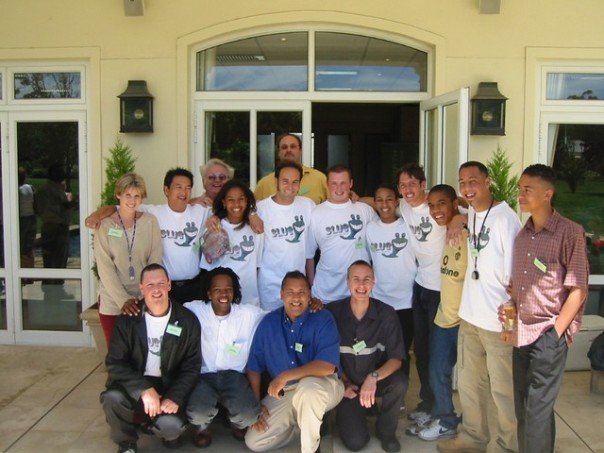
SLUG (Schools Linux Users Group) group photo. SLUG was founded to support the tuXlab schools that ran Linux.

My contract work then later turned into a full-time job there. This was a big deal for me, because I didn t want to support Windows ever again, and I didn t ever think that it would even be possible for me to get a job where I could work on free software full time. Since everyone in my team used Debian, I thought that I should probably give it another try. I did, and I hated it. One morning I went to talk to my manager, Thomas Black, and told him that I just don t get it and I need some help. Thomas was a big mentor to me during this phase. He told me that I should try upgrading to testing, which I did, and somehow I ended up on unstable, and I loved it. Before that I used to subscribe to a website called freshmeat that listed new releases of upstream software and then, I would download and compile it myself so that I always had the newest versions of everything. Debian unstable made that whole process obsolete, and I became a huge fan of it. Early on I also hit a problem where two packages tried to install the same file, and I was delighted to find how easily I could find package state and maintainer scripts and fix them to get my system going again. Thomas told me that anyone could become a Debian Developer and maintain packages in Debian and that I should check it out and joked that maybe I could eventually snap up highvoltage@debian.org . I just laughed because back then you might as well have told me that I could run for president of the United States, it really felt like something rather far-fetched and unobtainable at that point, but the seed was planted :) Ubuntu and beyond

Ubuntu 4.10 default desktop Image from distrowatch

One day, Thomas told me that Mark is planning to provide official support for Debian unstable. The details were sparse, but this was still exciting news. A few months later Thomas gave me a CD with just warty written on it and said that I should install it on a server so that we can try it out. It was great, it used the new debian-installer and installed fine everywhere I tried it, and the software was nice and fresh. Later Thomas told me that this system is going to be called Ubuntu and the desktop edition has naked people on it. I wasn t sure what he meant and was kind of dumbfounded so I just laughed and said something like Uh ok . At least it made a lot more sense when I finally saw the desktop pre-release version and when it got the byline Linux for Human Beings . Fun fact, one of my first jobs at the foundation was to register the ubuntu.com domain name. Unfortunately I found it was already owned by a domain squatter and it was eventually handled by legal. Closer to Ubuntu s first release, Mark brought over a whole bunch of Debian developers that was working on Ubuntu over to the foundation and they were around for a few days getting some sun. Thomas kept saying Go talk to them! Go talk to them! , but I felt so intimidated by them that I couldn t even bring myself to walk up and say hello. In the interest of keeping this short, I m leaving out a lot of history but later on, I read through the Debian packaging policy and really started getting into packaging and also discovered Daniel Holbach s packaging tutorials on YouTube. These helped me tremendously. Some day (hopefully soon), I d like to do a similar video series that might help a new generation of packagers. I ve also been following DebConf online since DebConf 7, which was incredibly educational for me. Little did I know that just 5 years later I would even attend one, and another 5 years after that I d end up being on the DebConf Committee and have also already been on a local team for one.

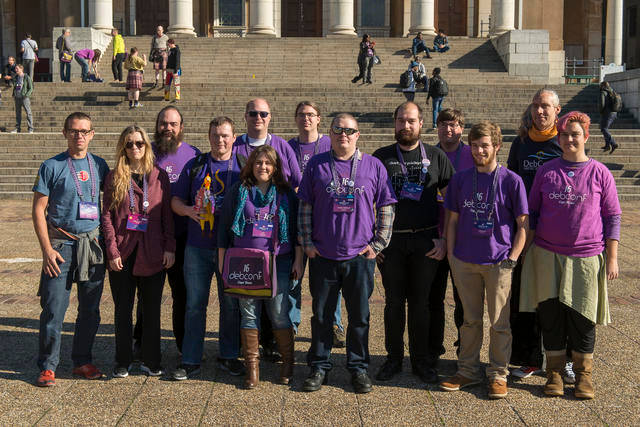
DebConf16 Organisers, Photo by Jurie Senekal.

It s been a long journey for me and I would like to help anyone who is also interested in becoming a Debian maintainer or developer. If you ever need help with your package, upload it to https://mentors.debian.net and if I have some spare time I ll certainly help you out and sponsor an upload. Thanks to everyone who have helped me along the way, I really appreciate it!

13 November 2017

Markus Koschany: My Free Software Activities in October 2017

Welcome to gambaru.de. Here is my monthly report that covers what I have been doing for Debian. If you re interested in Java, Games and LTS topics, this might be interesting for you. Debian Games Debian Java Debian LTS This was my twentieth month as a paid contributor and I have been paid to work 19 hours on Debian LTS, a project started by Rapha l Hertzog. I will catch up with the remaining 1,75 hours in November. In that time I did the following: Misc Thanks for reading and see you next time.

12 November 2017

Sven Hoexter: Offering a Simtec Entropy Key

Since I started to lean a bit towards the concept of minimalism I've got rid of stuff, including all stationary computers. So for now I'm left with just my laptop and that's something where I do not want to attach an USB entropy key permanently. That's why I've a spare Simtec Entropy Key I no longer use, and I'm willing to sell. In case someone is interested, I'm willing to give it away for 20EUR + shipping. If you can convince me it'll be of use for the Debian project (end up on a DSA managed machine for example) I'm willing to give it away for less. If you're located in Cologne, Copenhagen or Barcelona we might be able, depending on the timing, to do a personal handover (with or without keysigning). Otherwise I guess shipping is mainly interesting for someone also located in Europe. You can use sven at stormbind dot net or hoexter at debian dot org to contact me and use GPG key 0xA6DC24D9DA2493D1.

7 November 2017

Don Armstrong: Autorandr: automatically adjust screen layout

Like many laptop users, I often plug my laptop into different monitor setups (multiple monitors at my desk, projector when presenting, etc.) Running xrandr commands or clicking through interfaces gets tedious, and writing scripts isn't much better. Recently, I ran across autorandr, which detects attached monitors using EDID (and other settings), saves xrandr configurations, and restores them. It can also run arbitrary scripts when a particular configuration is loaded. I've packed it, and it is currently waiting in NEW. If you can't wait, the deb is here and the git repo is here. To use it, simply install the package, and create your initial configuration (in my case, undocked):
 autorandr --save undocked
then, dock your laptop (or plug in your external monitor(s)), change the configuration using xrandr (or whatever you use), and save your new configuration (in my case, workstation):
autorandr --save workstation
repeat for any additional configurations you have (or as you find new configurations). Autorandr has udev, systemd, and pm-utils hooks, and autorandr --change should be run any time that new displays appear. You can also run autorandr --change or autorandr --load workstation manually too if you need to. You can also add your own ~/.config/autorandr/$PROFILE/postswitch script to run after a configuration is loaded. Since I run i3, my workstation configuration looks like this:
 #!/bin/bash
 xrandr --dpi 92
 xrandr --output DP2-2 --primary
 i3-msg '[workspace="^(1 4 6)"] move workspace to output DP2-2;'
 i3-msg '[workspace="^(2 5 9)"] move workspace to output DP2-3;'
 i3-msg '[workspace="^(3 8)"] move workspace to output DP2-1;'
which fixes the dpi appropriately, sets the primary screen (possibly not needed?), and moves the i3 workspaces about. You can also arrange for configurations to never be run by adding a block hook in the profile directory. Check it out if you change your monitor configuration regularly!

27 October 2017

Russ Allbery: Review: The Black Gryphon

Review: The Black Gryphon, by Mercedes Lackey & Larry Dixon
Series: Mage Wars #1
Publisher: DAW
Copyright: 1994
Printing: January 1995
ISBN: 0-88677-643-0
Format: Mass market
Pages: 460
The Mage Wars series (or the Gryphon series, which isn't its official title but which is in all of the titles) is part of the sprawling Valdemar mega-series, but it's a prequel to all of the other stories. It's also slightly challenging if you're reading in publication order, since it was published simultaneously with the Mage Storms series. If you're following publication order, in theory you should interleave the two series, but I hate doing that. I'm therefore reading it after Mage Winds and before Mage Storms. We'll see whether that was a good idea when I get to the next series. You could, if you really wanted to, read this series before any other Valdemar book. As a prequel from the deep past of Valdemar's world, it doesn't depend on the other series, and you'll get a rediscovery of lost knowledge feel from later books. The downside is that it's a rather boring introduction, and that order would spoil a lot of the revelatory flow of the other series (particularly Elspeth's adventures in the Mage Winds books). I'm now getting into the Valdemar books that I've only read once. I've been putting off continuing my Valdemar re-read because this series was next and I remember being rather bored with it the first time I read it. But I'm re-reading for the world-building and background as much as for the characters, and this is a huge chunk of world background that fills in the bones underneath Winds of Fate and its sequels. Here's why Dhorisha is a crater, here's why the Pelagiris forests are such a mess, here's where Ma'ar starts, here's the origin of both the gryphons and K'Leshya, and here, finally, we get to see the legendary Urtho on the page. The problem with writing novels set in the epic backstory of your universe is that it's hard to live up to the drama that readers have invented for themselves. A lot of The Black Gryphon is background to events Valdemar readers already know will happen, creating a corresponding lack of surprise. I reached the end of the book and said "yup, that's pretty much what everyone said had happened." Lackey and Dixon do try to do some interesting things here, one of which being the backgrounding of the war. The Black Gryphon starts in the middle of a long-running conflict between Urtho and Ma'ar and doesn't follow the generals or the battles. The protagonists, instead, are a kestra'chern (a type of psychiatrist and spiritual healer who also uses sex, with the expected conflicts of people who incorrectly think of them as prostitutes) and the eventual leader of the gryphons (Skandranon, who is referenced in later books and who provides the title). We get some combat scenes from Skandranon and later another gryphon, but a lot of the book is Amberdrake fighting the effects of the war instead of the details of the war itself. There's a deep and moving story in that idea, and in some of the attached love stories that play out in the army camps. There's also a great story somewhere around Urtho: a brilliant but detached mage who is way out of his depth trying to run an army but smart enough to gather good people around him. He's also a creator of new life, including the gryphons. The Black Gryphon tries to talk about Urtho's paternalism, the weird emotional currents of his relationship with his creations, and the places Urtho keeps things from others for, supposedly, their own good. If this book had looked a bit deeper at the support structure for an army that's trying to be humane, or at the ways in which Urtho strays far too close to being an abusive tyrant through inaction despite having the best of intentions at every step, I think it could have said something significant. Unfortunately, that's not this book. This book is full of relentlessly black and white morality (the flaw of much of the Valdemar series) that bleaches away interesting shades of grey. Urtho is good and wise by authorial fiat, and Ma'ar is the same utterly irredeemable force of evil that he is in other books. The story skitters over Urtho's odd tyrannies, making them all better with the pure power of friendship and good intentions. There just isn't much emotional depth, and while I don't expect that of Lackey in general, this story really needed that depth to work. What we get instead is repetition, as Lackey and Dixon hit the same emotional notes with Amberdrake repeatedly. This is one of those books that makes me wonder if Lackey was trying to write too many novels in a short time than was good for their individual quality. (Collaborations often mean that the lesser-known name is doing all the work, but Dixon is Lackey's husband and the tone of the book is sufficiently Lackey that I don't think that happened here.) It felt padded by Amberdrake turning over the same emotional rocks repeatedly, to largely the same effect. This is, in short, not Lackey's finest effort, although it does have its moments. As always, Lackey is at her best when writing psychological healing narratives. Zhaneel's story is a bit too easy, but the dynamic between Amberdrake and Winterhart is the best part of the book. And The Black Gryphon does tell the reader exactly what led up to the Cataclysm and why. There are no major surprises, but there are some small ones, and it's a nice payoff for the lore-obsessed (like me). This is missable unless you want the full world-building behind Valdemar's past, and it's not the best writing. But if you're heavily invested in the Valdemar universe, it's at least readable and provides an important bit of the history. Followed by The White Gryphon. Rating: 5 out of 10

16 October 2017

Gustavo Noronha Silva: Who knew we still had low-hanging fruits?

Earlier this month I had the pleasure of attending the Web Engines Hackfest, hosted by Igalia at their offices in A Coru a, and also sponsored by my employer, Collabora, Google and Mozilla. It has grown a lot and we had many new people this year. Fun fact: I am one of the 3 or 4 people who have attended all of the editions of the hackfest since its inception in 2009, when it was called WebKitGTK+ hackfest \o/ 20171002_204405 It was a great get together where I met many friends and made some new ones. Had plenty of discussions, mainly with Antonio Gomes and Google s Robert Kroeger, about the way forward for Chromium on Wayland. We had the opportunity of explaining how we at Collabora cooperated with igalians to implemented and optimise a Wayland nested compositor for WebKit2 to share buffers between processes in an efficient way even on broken drivers. Most of the discussions and some of the work that led to this was done in previous hackfests, by the way! 20171002_193518 The idea seems to have been mostly welcomed, the only concern being that Wayland s interfaces would need to be tested for security (fuzzed). So we may end up going that same route with Chromium for allowing process separation between the UI and GPU (being renamed Viz, currently) processes. On another note, and going back to the title of the post, at Collabora we have recently adopted Mattermost to replace our internal IRC server. Many Collaborans have decided to use Mattermost through an Epiphany Web Application or through a simple Python application that just shows a GTK+ window wrapping a WebKitGTK+ WebView. 20171002_101952 Some people noticed that when the connection was lost Mattermost would take a very long time to notice and reconnect its web sockets were taking a long, long time to timeout, according to our colleague Andrew Shadura. I did some quick searching on the codebase and noticed WebCore has a NetworkStateNotifier interface that it uses to get notified when connection changes. That was not implemented for WebKitGTK+, so it was likely what caused stuff to linger when a connection hiccup happened. Given we have GNetworkMonitor, implementation of the missing interfaces required only 3 lines of actual code (plus the necessary boilerplate)! screenshot-from-2017-10-16-11-13-39 I was surprised to still find such as low hanging fruit in WebKitGTK+, so I decided to look for more. Turns out WebCore also has a notifier for low power situations, which was implemented only by the iOS port, and causes the engine to throttle some timers and avoid some expensive checks it would do in normal situations. This required a few more lines to implement using upower-glib, but not that many either! That was the fun I had during the hackfest in terms of coding. Mostly I had fun just lurking in break out sessions discussing the past, present and future of tech such as WebRTC, Servo, Rust, WebKit, Chromium, WebVR, and more. I also beat a few challengers in Street Fighter 2, as usual. I d like to say thanks to Collabora, Igalia, Google, and Mozilla for sponsoring and attending the hackfest. Thanks to Igalia for hosting and to Collabora for sponsoring my attendance along with two other Collaborans. It was a great hackfest and I m looking forward to the next one! See you in 2018 =)

14 October 2017

Lior Kaplan: Debian Installer git repository

While dealing with d-i s translation last month in FOSScamp, I was kinda surprised it s still on SVN. While reviewing PO files from others, I couldn t select specific parts to commit. Debian does have a git server, and many DDs (Debian Developers) use it for their Debian work, but it s not as public as I wish it to be. Meaning I lack the pull / merge request abilities as well as the review process. Recently I got a reminder that the D-I s Hebrew translation needs some love. I asked my local community for help. Receiving a PO file by mail, reminded me of the SVN annoyance. So this time I decided to convert it to git and ask people to send me pull requests. Another benefit would be making the process more transparent as others could see these PRs (and hopefully comment if needed). For this experiment, I opened a repository on GitHub at https://github.com/kaplanlior/debian-installer I know they aren t open source as GitLab, but they are a popular choice which is a good start for my experiment. If and when it succeeds, we can discuss the platform.
debian-9

Debian 9

(featured image by Jonathan Carter)
Filed under: Debian GNU/Linux

10 October 2017

Carl Chenet: The Slack Threat

During a long era, electronic mail was the main communication tool for enterprises. Slack, which offer public or private group discussion boards and instant messaging between two people, challenge its position, especially in the IT industry. Not only Slack has features known and used since IRC launch in the late 80s, but Slack also offers file sending and sharing, code quoting, and it indexing for ulterior searches everything that goes through the application. Slack is also modular with numerous plug-in to easily add new features. Using the Software-As-A-Service (SAAS) model, Slack basic version is free, and users pay for options. Slack is now considered by the Github generation like the new main enterprise communication tool. As I did in my previous article on the Github threat, this one won t promote Slask s advantages, as many other articles have already covered all these points ad nauseam, but to show the other side and to warn the companies using this service about its inherent risks. So far, these risks have been ignored, sometimes voluntary in the name of the It works ideology. Neglecting all economic and safety consideration, neglecting all threat to privacy and individual freedom. We ll see about them below.


Github, a software forge as a SAAS, with all the advantage but also all the risk of its economic model

All your company communication since its creation When a start-up chooses Slack, all of its internal communication will be stored by Slack. When someone uses this service, the simple fact to chat through it means that the whole communication is archived. One may point that within the basic Slack offer, only the last 10.000 messages can be read and searched. Bad argument. Slack stored every message and every file shared as it pleases. We ll see below this application behavior is of capital importance in the Slack threat to enterprises. And the problem is the same for all other companies which choose Slack at one point or another. If they replace their traditional communication method with it, Slack will have access to capital data, not only in volume, but also because of their value for the company itself Or anyone interested in this company life. Search Your Entire Archive One of the main arguments to use Slack is its Search your entire archive feature. One can search almost anything one can think of. Why? Because everything is indexed. Your team chat archive or the more or less confidential documents exchanged with the accountant department; everything is in it in order to provide the most effective search tool.

The search bar, well-known by Slack users

We can t deny it s a very attractive feature for everyone inside the company. But it is also a very attractive feature for everyone outside of the company who would want to know more about its internal life. Even more if you re looking for a specific subject. If Slack is the main communication tool of your company, and if as I ve experienced in my professional life, some teams prefer to use it than to go to the office next door or even bug you to put the information on the dedicated channel, one can easily deduce that nothing in this type of company escape Slack. The automatic indexation and the search feature efficiency are excellent tools to get all the information needed, in quantity and in quality. As such, it s a great social engineering tool for everyone who has access to it, with a history as old as the use of Slack as a communication tool in the company. Across borders And Beyond! Slack is a Web service which uses mainly Amazon Web services and most specially Cloudfront, as stated by the available information on Slack infrastructure. Even without a complete study of said infrastructure, it s easy to state that all the data regarding many innovative global companies around the world (and some of them including for all their internal communication since their creation) are located in the United States, or at least in the hands of a US company, which must follow US laws, a country with a well-known history of large scale industrial espionage, as the whistleblower Edward Snowden demonstrated it in 2013 and where company data access has no restriction under the Patriot Act, as in the Microsoft case (2014) where data stored in Ireland by the Redmond software editor have been given to US authorities.

Edward Snowden, an individual and corporate freedom fighter

As such, Slack s automatic indexation and search tool are a boon for anyone spy agency or hacker which get authorized access to it. To trust a third party with all, or at least most of, your internal corporate communication is a certain risk for your company if the said third party doesn t follow the same regulations as yours or if it has different interests, from a data security point of view or more globally on its competitiveness. A badly timed data leak can be catastrophic. What s the point of secretly preparing a new product launch or an aggressive takeover if all your recent Slack conversations have leaked, including your secret plans? What if Slack is hacked? First let s remember that even if a cyber attack may appear as a rare or hypothetical scenario to a badly informed and hurried manager, it is far from being as rare as she or he believes it (or wants to believe it). Infrastructure hacking is quite common, as a regular visit to Hacker News will give you multiple evidence. And Slack itself has already been hacked. February 2015: Slack is the victim during four days of a cyber attack, which was made public by the company in March. Officially, the unauthorized access was limited to information on the users profiles. It is impossible to measure exactly what and who was impacted by this attack. In a recent announcement, Yahoo confessed that these 3 billion accounts (you ve read well: 3 billions) were compromised late 2014!

Yahoo, the company which suffered the largest recorded cyberattack regarding the compromised account numbers

Officially, Slack stated that No financial or payment information was accessed or compromised in this attack. Which is, and by far, the least interesting of all data stored within Slack! With company internal communication indexed sometimes from the very beginning of said company and searchable, Slack may be a potential target for cybercriminal not looking for its users financial credentials but more their internal data already in a usable format. One can imagine Slack must give information on a massive data leak, which can t be ignored. But what would happen if only one Slack user is the victim of said leak? The Free Alternative Solutions As we demonstrated above, companies need to find an alternative solution to Slack, one they can host themselves to reduce data leaks and industrial espionage and dependency on the Internet connection. Luckily, Slack success created its own copycats, some of them being also free software. Rocket.chat is one of them. Its comprehensive service offers chat rooms, direct messages and file sharing but also videoconferencing and screen sharing, and even most features. Check their dedicated page. You can also try an online demo. And even more, Rocket Chat has a very simple extension system and an API. Mattermost is another service which has the advantages of proximity and of compatibility with Slack. It offers numerous features including the main expected by this type of software. It also offers numerous apps and plug-ins to interact with online services, software forges, and continuous integration tools. It works In the introduction, we discussed the It works effect, usually invoked to dispel any arguments about data protection and exchange confidentiality we discussed in this article. True, one single developer can ask: why worry about it? All I want is to chat with my colleagues and send files! Because Slack service subscription in the long term put the company continuously at risk. Maybe it s not the employees place to worry about it, they just have to do their job the more efficiently possible. On the other side, the company management, usually non-technical, may not be aware of what risks will threaten their company with this technical choice. The technical management may pretend to be omniscient, nobody is fooled. Either someone from the direction will ask the right question (where are our data and who can access them?) or someone from the technical side alert them officially on these problems. This is this technical audience, even if not always heard by their direction, which is the target of this article. May they find in it the right arguments to be convincing. We hope that the several points we developed in this article will help you to make the right choice. About Me Carl Chenet, Free Software Indie Hacker, founder of the French-speaking Hacker News-like Journal du hacker. Follow me on social networks Translated from French by St phanie Chaptal. Original article written in October 2016.



9 October 2017

Gunnar Wolf: Achievement unlocked - Made with Creative Commons translated to Spanish! (Thanks, @xattack!)

I am very, very, very happy to report this And I cannot believe we have achieved this so fast: Back in June, I announced I'd start working on the translation of the Made with Creative Commons book into Spanish. Over the following few weeks, I worked out the most viable infrastructure, gathered input and commitments for help from a couple of friends, submitted my project for inclusion in the Hosted Weblate translations site (and got it approved!) Then, we quietly and slowly started working. Then, as it usually happens in late August, early September... The rush of the semester caught me in full, and I left this translation project for later For the next semester, perhaps... Today, I received a mail that surprised me. That stunned me. 99% of translated strings! Of course, it does not look as neat as "100%" would, but there are several strings not to be translated. So, yay for collaborative work! Oh, and FWIW Thanks to everybody who helped. And really, really, really, hats off to Luis Enrique Amaya, a friend whom I see way less than I should. A LIDSOL graduate, and a nice guy all around. Why to him specially? Well... This has several wrinkles to iron out, but, by number of translated lines: ...Need I say more? Luis, I hope you enjoyed reading the book :-] There is still a lot of work to do, and I'm asking the rest of the team some days so I can get my act together. From the mail I just sent, I need to:
  1. Review the Pandoc conversion process, to get the strings formatted again into a book; I had got this working somewhere in the process, but last I checked it broke. I expect this not to be too much of a hurdle, and it will help all other translations.
  2. Start the editorial process at my Institute. Once the book builds, I'll have to start again the stylistic correction process so the Institute agrees to print it out under its seal. This time, we have the hurdle that our correctors will probably hate us due to part of the work being done before we had actually agreed on some important Spanish language issues... which are different between Mexico, Argentina and Costa Rica (where translators are from). Anyway This sets the mood for a great start of the week. Yay!
AttachmentSize
Screenshot from 2017-10-08 20-55-30.png103.1 KB

8 October 2017

Ricardo Mones: Cannot enable. Maybe the USB cable is bad?

One of the reasons which made me switch my old 17" BenQ monitor for a Dell U2413 three years ago was it had an integrated SD card reader. I find very convenient to take camera's card out, plug the card into the monitor and click on KDE device monitor's option Open with digiKam to download the photos or videos.

But last week, when trying to reconnect the USB cable to the new board just didn't work and the kernel log messages were not very hopeful:

[190231.770349] usb 2-2.3.3: new SuperSpeed USB device number 15 using xhci_hcd
[190231.890439] usb 2-2.3.3: New USB device found, idVendor=0bda, idProduct=0307
[190231.890444] usb 2-2.3.3: New USB device strings: Mfr=1, Product=2, SerialNumber=3
[190231.890446] usb 2-2.3.3: Product: USB3.0 Card Reader
[190231.890449] usb 2-2.3.3: Manufacturer: Realtek
[190231.890451] usb 2-2.3.3: SerialNumber: F141000037E1
[190231.896592] usb-storage 2-2.3.3:1.0: USB Mass Storage device detected
[190231.896764] scsi host8: usb-storage 2-2.3.3:1.0
[190232.931861] scsi 8:0:0:0: Direct-Access     Generic- SD/MMC/MS/MSPRO  1.00 PQ: 0 ANSI: 6
[190232.933902] sd 8:0:0:0: Attached scsi generic sg5 type 0
[190232.937989] sd 8:0:0:0: [sde] Attached SCSI removable disk
[190243.069680] hub 2-2.3:1.0: hub_ext_port_status failed (err = -71)
[190243.070037] usb 2-2.3-port3: cannot reset (err = -71)
[190243.070410] usb 2-2.3-port3: cannot reset (err = -71)
[190243.070660] usb 2-2.3-port3: cannot reset (err = -71)
[190243.071035] usb 2-2.3-port3: cannot reset (err = -71)
[190243.071409] usb 2-2.3-port3: cannot reset (err = -71)
[190243.071413] usb 2-2.3-port3: Cannot enable. Maybe the USB cable is bad?
...

I was sure USB 3.0 ports were working, because I've already used them with a USB 3.0 drive, so first thought was the monitor USB hub had failed. It seemed unlikely that a cable which has not been moved in 3 years was suddenly failing, is that even possible?

But a few moments later the same cable plugged into a USB 2.0 worked flawlessly and all photos could be downloaded, just noticeably slower.

A bit confused, and thinking that, since everything else was working maybe the cable had to be replaced, it happened I upgraded the system in the meantime. And luck came into rescue, because now it works again in 4.9.30-2+deb9u5 kernel. Looking at the package changelog it seems the fix was this usb:xhci:Fix regression when ATI chipsets detected . So, not a bad cable but a little kernel bug ;-)

Thanks to all involved, specially Ben for the package update!

6 October 2017

Scarlett Clark: KDE at #UbuntuRally in New York! KDE Applications snaps!

#UbuntuRally New York

KDE at #UbuntuRally New York

I was happy to attend Ubuntu Rally last week in New York with Aleix Pol to represent KDE.
We were able toaccomplish many things during this week, and that is a result of having direct contact with Snap developers.
So a big thank you out to Canonical for sponsoring me. I now have all of KDE core applications,
and many KDE extragear applications in the edge channel looking for testers.
I have also made a huge dent in also making the massive KDE PIM snap!
I hope to have this done by week end.
Most of our issue list made it onto TO-DO lists
So from KDE perspective, this sprint was a huge success!

Next.

Previous.