Search Results: "storm"

5 June 2012

Anand Kumria: Internet-o! Or why the Internode Business SLA is not worth a damn.

Last week (28th May), I had five Internet services across two countries. This week, I have seven (7), with two new ones in Australia. It all begin, when Internode decided that in their own best interest to migrate me from my existing DSLAM to one of their own infrastructure. They had sent an email indicating when it was likely to occur. And they were sending invoices to the same address. Naturally, they would send the date of the migration to the same address they had used for the past 9 months to communicate to me with, right? Wrong. Internode still do not understand why they never sent the notification email, as it turns out. Compare the response time, update times, and restore times they specify to what actually occurred.
2012-05-28 12:05 BST
I'm informed of an outage. In the past, the problem has been at my end, so I run through the standard diagnostic procedure. Everything seems to be normal, so I call Internode. Sure enough, our service dropped off the Internet. According to Timothy, that happened at 11:15 AEST because of a migration to their own DSLAM. After some diagnosis from Internode, they realise that whilst the migration has successfully disconnected the service, they have not reconnected anything. There is no sync. Ticket #454448 raised - which is when I'm informed that I'm on the business SLA. I've asked for updated to both an Australian and UK mobile. "Not a problem". Estimated time of resolution: 48 hours. Yes, 48 hours. There goes the first SLA milestone.
2012-05-30 07:28 BST
I ring and speak with Carl. He indicates that as best he knows, the service is to be 7pm. for those keeping score, no updates have occurred during this time. To either number. I query him about the SLA period. He says the response time is 2hrs and restore time is 10hrs. He also indicates that this can all be checked online and that we can apply for a refund.
2012-05-30 10:27 BST
I ring, again, and this time speak with Justin. I ask why I've not have an updated, since 7pm AEST has well and truly gone. He authenticates me and places me on hold to investigate. Advises that the issue is fixed, says he sees sync on the line. I indicate that I do not. He asks me to turn off the ADSL modem, we do, and he still sees sync. on the line. Believes there is another problem at the exchange, another issue raised with wholesaler. No ticket number issues to me. ETA to fix 7pm 2nd June. Note:This was a 1 hour International call
2012-06-01 04:00 BST
I happened to check, and notice I have connectivity to the external interfaces (and thus, obviously, line sync.) again. No notification though.
2012-06-01 14:31 BST
Amidst all this, I also have to to source two external connections - Telstra & Optus, get them setup, reconfigure routing, email delivery and other network services so that the businesses which are relying on the Internet, still work. Not fun. Especially when I have no access to the routers. I had to get multiple people on site.
2012-06-04 11:XX CEST
I'm told that the second site has gone done. Inexplicably. After some round-trip and diagnosis, we determine that the routing change has occurred. However it has been done incorrectly. And, of course, no notice / or update occurred either. Multiple tickets are raised by multiple people, amongst them: #4562559 from my mobile phone whilst I am in Zurich.
2012-06-04 16:56 CEST
I am informed, and it is confirmed, that the attempted routing change has been reverted and we are back to how things were on 2012-06-01.
2012-06-05 05:44 CEST
I wake up, and find out that of at least three hours ago, they appear to have called (finally!) and actually fixed the routing to both sites. That is a week of down time, multiple people (4 people) around in various countries around the World and hundreds of dollars in calls between us all to get things working. Now, to look into compensation.
2012-06-05 09:43 CEST
I receive a missed call, which I later learn is Internode actually calling me (for once!). At that moment, I'm actually giving a lightening talk on Django-PaaS
And that, dear reader, is why Internode Business SLA is a waste of money. The services were broken by a change of no net benefit to me, was over a week ago. Also, during this process. My UK home Internet went down. My UK Three post-paid service "ran out of money" and Vodafone has a service outage for half a day. A perfect storm of Internet dis-connectivity. So, if you have been wondering, that is why I've been offline for various parts of the last week.

2 May 2012

Dirk Eddelbuettel: Boston Marathon 2012

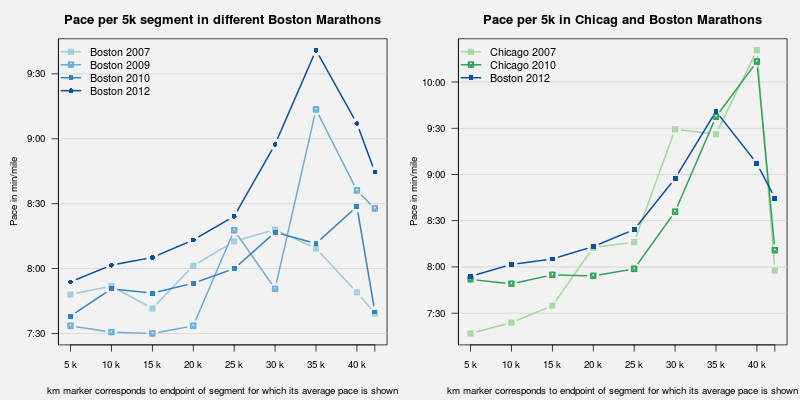
Two weeks ago I ran the 116th running of the Boston Marathon. Weather is often part of the story in Boston as e.g. my first one in 2007 happened after a storm-drenched and very wet weekend. This time, it was the opposite. Temperatures in the 60s in the morning before the start at 10:00am, which tempaeratures climbing well into the 80s for most of the race. The organizers had sent increasingly alarming email to us participants, warning about the weather conditions. And it was unpleasantly hot. Race support was great though: lots of locals had sprinklers pointed to the street; water stops were plenty and amply stocked and, being a nice summery day, lots of spectators made for lots of cheer. But heat makes for dreadful running conditions. I was pretty well trained, but I ended up running 3:43:55, or a tad slower than in Chicago 2007 (also record heat, with the race stopped around the four-hour mark) and Chicago 2009 (hot, though not that hot---but I was somewhat undertrained). Which makes this a personal worst. Oh well, stuff happens. And it was a pretty rough day---reports claimed that 2100 runners, or about 10%, were seeking some form of medical attention during or after the race which is a much higher proportion than under normal conditions. The chart below is an updated version of a chart which had appeared on my running page before. I regrouped my prior Bostons (2007, 2009 and 2010) on the left, and the Chicago runs 2007 and 2009 on the right---and each with the current Boston marathon. (Boston 2012 marathon in comparison to other Boston and Chicago marathons) So compared to the prior Boston races, I did indeed relatively poorly. Starting slower, and slowing down even more leading to about 1:45 for the first half and 1:58 for the second. Compared to the two poor Chicago races (put of the six times I have ran that race), things are not quite as bad as at least I didn't peak at over 10 min/mile. Weather will always remain a challenge. The previous marathon (which was last fall's Fox Valley 2011) was unseasonally cold and wet---making for a time fast enough to get me back to Boston. I am registered again for this one, so we will see what September brings this year.

26 April 2012

Paul Wise: What happens when a Debian derivative shuts down?

Over the past months we have seen the end of two Debian derivatives. In January the news came that Junta de Extremadura (Spain) were abandoning the development of LinEx and switching to Debian itself. Early in March the Debian derivatives census scripts noted that the Vanillux apt repository was down. Fabrice Quenneville then confirmed that he had to put a hold on the Vanillux project due to the cost of bandwidth and servers. In addition the future of StormOS is in doubt after Illumian was created. StormOS is a port of Debian to the OpenSolaris kernel and Illumian is similar but uses only apt/dpkg and repackages everything else. The LinEx page in the Debian derivatives census did not reveal much information about the project that would have been useful to Debian, in particular it does not list any apt repositories. As a result it is quite hard to say what has potentially been lost. Two mails from people close to or involved in the project indicate that much of the LinEx distribution was already merged into Debian. It is probably safe to say that everything of value has been merged into Debian, including at least one of the developers involved in LinEx. Vanillux was a small distribution with few developers according to the Google caches of their website. If we look at the patches created by the derivatives census scripts, we can see that the 5 source packages that were possibly derived from Debian source packages were simply imported from Christian Marillat's repository of non-free, patented, legally restricted and multimedia-related packages. The patches indicate that 3 source packages were forked from Debian and that 2 source packages were done from scratch. The forked packages seem to be mainly about enabling support for proprietary and patented codecs in several programs. This is a surprisingly small number of altered/differing packages, so what else could Vanillux folks have been working on? It appears that there were 12 new source packages that were not derived from Debian source packages. These appear to be mainly multimedia-related packages, one font imported from an Ubuntu PPA, some syslinux themes and a metapackage. The multimedia packages are all from Christian Marillat's repository. The Debian multimedia team is working hard on bringing multimedia related software to Debian and welcomes help with that. The font (Cantarell) is now in Debian under a different source package name. The metapackage appears to be very similar to from the ubuntu-meta source package from Ubuntu that uses germinate. So at first glance, the contribution of Vanillux to the world of Linux distributions appears to be in the area of artwork and package selection. The artwork produced is basically Vanillux branding and is thus not usable by Debian, although we would like more artists involved in Debian. The meta-package is not easily useful to Debian since we use a different mechanism for our task packages and our task packages have already been updated for the GNOME 3 transition. Still, the amount of difference between to source packages is relatively small. So, what else? Perusing the diff between the list of source packages exposed by the Packages and Sources files, I noted that a number of binary packages in the Packages files reference source packages not listed in the Sources files. When I saw picasa in that list, it occurred to me that Vanillux might have directly imported some binary packages without their corresponding source packages. Perusing their apt metadata confirms that they have imported some binary packages of non-free software directly from vendors. These include Google Desktop, Opera, Picasa and VirtualBox 3.2. The rest of the packages in the diff appear to be caused by some sort of issue with the import process from Debian and other apt repos. Most of the above could be achieved by adding some external commerical repositories to a normal Debian system or by merging some of those repositories (such as the Opera one) into Debian. The interesting thing about the Debian derivatives census is that it allows us to perform analyses like these and figure out what patches and packages we might like to integrate into Debian. In this way we can salvage some of the value of our derivatives if they abandon ship. If you have any ideas or code for improving the census or are running a Debian derivative, please join us at the Debian derivatives frontdesk.

15 April 2012

Sam Hartman: Moonshot and RDSI

Moonshot continues to be busy. Lately we ve been focusing on finishing our core technical specs, better understanding how Moonshot will be deployed and working on our trust infrastructure. At the same time, we re beginning to watch organizations evaluate whether Moonshot addresses a need they have. I m excited by this process because I like to see technology I work on adopted and because the feedback we get is very valuable. This week though, I personally get to participate in such an exercise. Tomorrow I ll be speaking at the Australian Research Data Storage Initiative s workshop on Moonshot. I ll be giving background on the project, talking about community success, and talking about how Moonshot can help Australia. I m looking forward to that. I m also very excited about a brainstorming exercise I ll be participating in today. Several key participants in the RDSI project and I will get together to carefully evaluate their needs and see what it would take for a Moonshot solution. I hope Moonshot does end up being a good fit. Regardless, I enjoy this sort of problem solving session and am happy to have the opportunity to sit down with knowledgeable people and see how we can solve real problems!

22 March 2012

Richard Hartmann: Svalbard

Svalbard The things you find when cleaning out a disk; preparing for re-installation of your laptop on a larger disk once the laptop comes back from repair... I thought I had posted this in early January, but apparently not. As it would be a shame to just throw this away, here goes: I am sitting in the Oslo airport, waiting for boarding back home to start. Seeing the sun after a week of darkness still feels strange. Inital trouble It's been a very interesting week, starting with our trip to Oslo in the other direction. We spent New Year's Eve in Oslo, timing our forced overnight stay before reaching Svalbard to coincide with something interesting. The close timing of our travel meant that there was exactly one flight to Oslo we could take. Never having heard of Air Baltic before and finding out that they are a discount airline, my gut feeling told me to be be wary. I refuse to fly with those airlines on principle, not wanting to support their business model while hurting airlines with decent treatment of customers. Unfortunately, I was forced to book with them in this case. As it turns out, my gut was right. More on that below. Our plane was late in landing and my luggage was lost. As it was New Year's Eve, the staff at Oslo airport understandably wanted to be home, not at work. Still, getting them to file a report was tedious and finding out days later that the report was incomplete was, well, not good. The express train from the airport to Oslo central station had closed early without any advance notice or local signs, presumably because of NYE. The gates were simply closed and that's that. We figured out how the bus system worked, got our tickets from a vending machine, saw the one bus to central station drive away, and proceeded to wait in the outside waiting area; at least we had a front spot in the queue. While we don't get cold easily, it was funny to see Norwegians in thin clothes stand around in the biting wind, apparently being comfortable. A young mother with a baby, who didn't anticipate being forced to wait outside at -15C, as opposed to just sitting down in a train, had no warm clothes for her son; something that was fixed by wrapping him in spare clothes from Ilona's luggage. After waiting for about thirty minutes for the next bus to appear, it parked twenty or thirty meters away from the designated parking spot. The rough queue disintegrated and if not for Ilona's leaving me with luggage and backpacks and storming off to fight the masses, said mother with baby and ourselves would have waited for another thirty minutes. More than hundred people were left stranded at the airport to celebrate there or on the bus. Meh. We hurried, by taxi, from central station to hotel to harbour and arrived about five minutes to twelve. NYE itself was nice. We stood on top of the opera house and watched a rather impressive show of fireworks through the thickening mists. Norwegian fireworks pack lot more punch than German ones; you actually feel your clothes shake when they go off. Getting to Longyearbyen The flight from Troms to Longyearbyen had free in-flight Wi-Fi and flying over the edge of satellite coverage demonstrated how far we were from everywhere else rather impressively. Arriving at Longyearbyen, I fixed the lost luggage claim with the help of an extremely nice woman working at the airport. She confirmed that Air Baltic is legally required to reimburse me after an arcane system based on a virtual IMF currency to the tune of about 1.500. That may sound like a lot, but seeing as I had most of my scuba gear with me, that's not even half of what my luggage was worth. I was forced to get by New Years with what I had on my body and went shopping the next day when I could buy at least a few things. I got by with spending about 180 by going for non-fitting bargain bin clothes, wanting to reduce impact on Air Baltic. Shortly after that, my luggage arrived, unannounced. Air Baltic refused to reimburse me even though they are legally required to, again the airport staff confirmed this. But unless I sue in the country of destination, Norway, I won't see any money. Long story short: Avoid Air Baltic if possible. They will break the law to cheat you out of money when they have a reasonable expectation of getting away with it. Update: Yep, seems they got away with it unless I take legal measures. You have been warned. Longyearbyen itself was very nice. We started off with a short, guided taxi tour around the city, seeing literally everything of it as there's not a lot of Longyearbyen to start with. Dogsledding Next day, as noted earlier, we went shopping and spent the "evening" with dogsledding which turned out to be tons of fun. We helped with harnessing the dogs which is somewhat cumbersome as the dogs are so eager to burn off their energy that they want to run all over the place, not being put into a harness and snapped onto the pull-line. Never having been dogsledding before I was a bit wary, but riding over not too rough terrain is almost trivial once you get the hang of it; listen to what the musher in front of you yells and emulate the same shouts with your own dogs. If the dogs become too fast, step onto the brake pad which simply drives spikes into the snow. If the dogs slow down while going uphill, skate with one foot to help them. That's it for speed. As the dogs are following the musher's sled anyway, steering the dogs was not a concern. Fun fact: The musher used a laser pointer to steer his dogs; simple, efficient, and presumably fun. We learned, by demonstration, that sledding dogs can eat snow, take a leak, and take a dump while running at full speed and pretty much all at the same time. The dogs are left either in cages or on long chains far away from the city as they tend to bark and howl a lot. We were surprised to learn that, even when there are seals left to hang dry as dog food nearby, there are no problems with bear attacks. Apparently even the extremely aggressive and hungry one year old males will not go near dogs. Still, while out in the ice and snow, our guide carefully flooded all crevices and cliff bases to root out female bears with young ones early. They hide their children from the wind and they will attack, dogs and all, if we get too close. That's why our musher carried rifle in his sled and flare gun on his body. Snowmobile The next "morning", we drove around by snowmobile. This turned out to be extremely boring as it was a curated trip with over half a dozen snowmobiles in our group; a stark contrast to our two-sled tour the day before. The last time I went snowmobiling, we raced each other up and down a two-star black (i.e. steep, bumpy, and curvy) ski slope, jumping several meters when racing over larger bumps and crossing streets, so riding single file at 30 km/h was... anticlimatic. Again, the guide had rifle and flare gun with him. We spent the afternoon and evening walking around the city. Ice bears, part I As the ice caves and the glacier were still closed, we decided to have another walk around the city. Having planned make it a quick tour, we lost track of time due to lack of sun and ended up walking around for seven hours. A note about that trip.. If you are alone with your wife, unarmed, climbing up a very steep and slippery mountainside over a sheet of ice with deep snow underneath and loose rocks in between, and then start shining around with your flashlight under the stilts of an abandoned mine that looks like in a horror movie, the correct answer to "What are you doing?" is never ever "Looking for ice bears". Even if it's the truth, this is not an acceptable answer. I crawled up the last part on all fours, camera and tripod in hand while Ilona stayed about two dozen meters below the mines' entrance, refusing to go another step towards the mine. As soon I made it up the creaky and shaky, for a lack of a better word, let's call it ladder, she forced me to come down again. Bleh, but I guess I deserved that. Armed photographer Next day, we got final confirmation that we would not be allowed to rent snowmobiles to explore the hinterland on our own and that other for some, and I quote, "crazy Russians", no one would even attempt to cross over to Barentsburg. Thus, we ended up renting a car for the ~20 kilometers of total road length. That turned out to be a great idea as it allowed us to get away from the light and take some very nice long exposures. It was then that I got a rental rifle, as well. There is a law against leaving the town unarmed and I was not about to test my luck too much. Turns out that, as part of Germany's WWII reparations, Norway received our all hand guns and as they still function perfectly when dirty and in cold climate which makes them still popular in Svalbard, today. The Karabiner 98 Kurz which I received is built incredibly well. It's somewhat scary inasmuch every detail is designed to make this weapon ready to fire. If you hurry or are inexperienced, you will end up with an unlocked and loaded rifle after putting in the bolt. Putting the safety in and not chambering a bullet takes conscious effort and knowledge of the weapon. This is in stark contrast to other weapons I had the chance to dissect, which all defaulted to being safe. Even other military weapons such as the AK74 and the M4A1 are inherently more secure, designed to be locked and safe. The Mauser K98... not so much. As an aside, they didn't bother to remove the Reichsadler and Swastika from the rifle, contending themselves with striking out the German registration number and stamping the rifle with a Norwegian one. I guess Norwegians don't really "care" about these signs as much as we Germans do. In a way, that's a good thing I guess, at least as long as it's an indication of indifference towards the sign, not one of forgetting or ignoring the underlying issues. Still, I was very glad to have rented the rifle. While Ilona tended to stay in the running car with heat and lights on, I went out and away from the car. Even when standing near a street, a medium snow storm will make you appreciate the four powerful arguments against being eaten by a random bear which are at the ready over your shoulder. We even went to the shooting range so I could get some practice. The procedure is very trusting, as is anything in Longyearbyen. After accessing the interior of one of the houses in a particular way which I won't specify here, you simply switch on the floodlights, put up the red flag, position a target and write your name into the guest book. Once you're done shooting, toss a few coins into the bowl next to the guest book, remove the targets and flag, turn off the lights, close the door and that's that. Unfortunately, the way in was under a few meters of snow so I couldn't get in any practice shots. Ice bears, part II Later, as I was standing on a wind-polished slate of ice taking pictures of the Seed Vault (located here), I heard an ice bear roar behind (i.e. to the north of) me. I consciously remember hearing the bear, I consciously remember facing the other way around, half-crouched, rifle raised in the direction of the roar. I also consciously remember smacking the safety off and chambering a bullet after having regained control of my body. I do not remember spinning around on a wind-polished slate of ice, so treacherous I hand to balance with my arms and didn't even lift my feet when walking over it, without losing balance or footing, nor do I remember crouching and raising the gun. Evolution really is amazing; no matter what primal chord that roar struck, it certainly saved a ton of people over the years. In my case, thankfully, there was no bear to be seen down the slope. There may be no sun or anything, but the snow reflects the starlight so you tend to see surprisingly far and as I was on on the mountainside and the roar came from down from the coast, and as I had my rifle, I decided to finish the photo session while keeping the slope in close view. In hindsight, I am still glad I decided to do that as the shots came out rather nice. Next day, we drove out to Mine 12, the farthest you can away from Longyearbyen. The dump truck transporting coal alternated between driving a full load of coal back to the city and being its own snowplow. One quick trip to get coal, one slow and empty trip to plow away snow, rinse, repeat. If not for that, our 4WD would never have made it all the way up to the mine. Neither snow storms in North America nor around the Alps prepared me for what people on Longyearbyen consider normal wind in their backyard. This is where the word wind-swept was invented. The main reason that Svalbard is inhabited at all, other than the Gulf Stream, is coal. We have been told that the coal up there is of extremely high quality and while I can't say much about that, I can say that it's hard as stone. This is nice as it does not smear when you get coal all over yourself. Just shake out your jacket and pants and you are good as new. On our way back, we met two locals who had just prepared the glacier and ice caves for tourists. Had I known that in advance, I would have tried to go with them to take pictures completely away from all artificial light. Oh well, can't have everything. Speaking of not being able to have everything, the outdoor hot tub in our hotel which integrated ice bar and BBQ grill was still under several meters of snow so we couldn't use that, either. Finally, the few divers who are in Longyearbyen didn't have time to take me onto a trip while I was there. As I already missed my opportunity to dive the Arctic circle when the one diver on Gr msey happened to be on the mainland and barely missing it by diving Str tan instead, this was kind of a bummer. On the plus side, this has given me a goal to pursue and achieve. Random notes For the rest of my notes, I will resort to a largely unsorted list of bullet points as there's just too much to talk about in prose. All in all, it was well worth it. PS: If you know anyone working with Google Maps, ask them to consider improving their coverage of the Arctic. This is a real pity. As is the rest of the Arctic and the fact that Google Earth cheats you out of the North and South Pole by stretching adjacent tiles into and over them.

12 March 2012

Vincent Sanders: Time flies when you are having fun.

It has been months since I last put something here, so I think that requires a quick catchup.

The family Christmas was a brilliantly restful affair mostly spent doing nothing at home, just slightly tinged with anticipation of starting the new job.

I arranged to rent a room in Cambridge with just a moderate three mile walk to work. This has meant that after a decade of my daily commute being the steps downstairs to my desk I am now walking six miles a day!

Because of this unexpected physical exertion I seem to be slowly loosing weight instead of gaining it. Alas there is still a long way to go before I am my recommended weight (unless I gain three feet in height ;-)

Work has been fabulous, lots of great people doing interesting stuff. I was here only a month before I got sent to San Francisco for the Linaro connect event. Though getting on the outbound plane amidst the worst snowstorm in recent times was both tiring and not a little stressful.

The waking up at 03:00 to get the 04:00 coach from Cambridge to Heathrow would not have been too much of an issue If I had managed to travel down from Leeds and arrive before 02:00. The coach was so much fun that I arrived at 08:40 just as check in was closing for my 09:45 flight.

This was my first experience of San Francisco (although I have been to LA and Portland previously) and while most of the time was spent out in Redwood city at the conference venue Robert did take us for cocktails, comedy and cable cars which was a wonderful night out.

Since my return from the US I have also attended the Debian Bug Squashing Party in Cambridge and had a thoroughly amusing time with many of the usual suspects though I was encouraged to see a few new faces about too.

The commute up and down the country is getting tedious and seems to vary between taking two and four hours depending on traffic. This is encouraging me to consider moving the family as soon as I can. They are all doing great and seem to be thriving despite my absence during weekdays.

I hope to put finger to keyboard here a bit more regularly in the forthcoming weeks though a lot of my personal time is being swallowed with commuting and not being directed towards my open source pursuits.

9 March 2012

John Goerzen: Dear FedEx: I Live Here

FedEx has had some issues in my area. There for awhile, they kept returning packages as undeliverable, saying the address was bad. It wasn t. Just because their GPS can t find it or their driver doesn t know it doesn t mean it doesn t exist. A map, a real map, would have done it. I had this kind of conversation with them once. Me: So you re returning my package to the sender. FedEx: Yes sir, the address was wrong. Me: No, it wasn t. [ we confirm we're talking about the same address. ] FedEx: Our driver says it doesn t exist. Me: I ve lived here for [x] years. I do know my address. FedEx: Maybe it s just new. Me: Someone has lived at this spot since the 1890s. FedEx: Hmm. I don t know then. Me: How about I give you directions? FedEx: Well, OK, I guess I could send directions. But they probably won t see them for three days. Me: Where will my package be by then? FedEx: Hard to say. Me: Do you people have cell phones maybe? FedEx: No. Me: Well, OK then Lately we have been noticing that the driver throws the package from the truck without stopping. We find them all over the yard. Unless it s big, in which case he puts it on the porch, puts a completely useless sticker on the door saying We delivered your package to right here! , and doesn t ring the doorbell. And panics due to the muddy road. The FedEx driver once told Terah, I almost got stuck on that muddy road! What s the good one? Terah: Well, which one did you take? [ he describes ] Terah: [ serious ] That IS the good road. FedEx: [ turning pale ] Oh my. I don t know if I can make it back to the highway. Terah: Well, I suppose I could get the boys in the car and drive you into town FedEx: [ embarrassed and more pale ] Uhm that s OK uhm I think A *month* later, we got another FedEx package. The driver called me at work, saying, I just don t know how I m going to get down those roads. Can I deliver the package to you here? (10 miles away). I said yes, and managed to suppress a significant snicker at his obvious relief. FedEx drivers seem to come and go. The UPS driver, on the other hand, knows the names of our boys, our cat, and puts anything small behind the storm door so it won t blow away if we re not home. And he gets a great big laugh when I tell him that the FedEx drivers are afraid of our roads. Haha, he thinks THAT S mud? Obviously he never drives in Butler County.

18 January 2012

Christian Perrier: Zou....Italian (and Danish, and Dutch....) take off!

The increasing storm of localization NMUs and uploads, related to debconf translations, has an interesting effect: some teams are now incredibly active at pushing translations for their language towards the magic 100%. So, after Danish (effort lead by Joe Hansen) and Dutch (effort lead by Jeroen Schot) which I already mentioned, it seems that the Italian localization team started engines and is now taking off. It will be interesting to watch these teams competing (in a friendly way) to climb in statistics over next months..:-) So, if you're Italian (or speak it well) and want to help, please join the Italian l10n mailing list (debian-l10n-italian on lists.debian.org. If you're Danish or Dutch and want to stay ahread the two others, please joind debian-l10n-danish or debian-l10n-dutch. PS: why did I write "Zou" in this post's title? Because this is a common French interjection for "Whoooosh" and because this is part of the nickname of the tireless and incredibly active, in many places, Francesca Ciceri, aka MadameZou, who's is doing so much for Italian localization (and many other areas in Debian such as the publicity and web team). And that really deserves some lights, trumpets, etc.

15 January 2012

Scott Kitterman: LEGO MINDSTORMS NXT 2.0 Support in Debian/Ubuntu

A LEGO MINDSTORMS NXT 2.0 recently arrived at our house. Of course it only comes with proprietary support for Windows/Mac, so I set out to see what FOSS support for the hardware I could find. I found nxt-python. It wasn t packaged, so I packaged it up and uploaded to Debian (from whence it came to Ubuntu). It s now in for the next release of both distributions (Wheezy/Precise). This is a bit different than the provided software (which compiles code, downloads it to the NXT, and then runs it untethered). For nxt-python the nxt needs to be connected to your computer via USB or bluetooth. It s a lot of fun and it s given me a chance to introduced our youngest child to the idea that there s more to computers than point and click. Currently user level access to the device doesn t work, it has to be accessed by root. Fixing that is on my TODO. I hope someone else out there has an NXT and enjoys this too. UPDATE: Added a udev rule and uploaded again, so anyone in plugdev can access the NXT brick.

22 December 2011

Biella Coleman: The Best of NYC

Rosco-Biella-on-Train Now that the semester is done and now that I have compiled my crazy paperwork for Canada (wow, it is a lot), I will be heading in six days to the wonderful city of Montreal to settle down, at least for a few years. I am ready to leave but it is not an easy move, as I like NYC and my job. I came to New York City for the first time at the age of 19 after spending a year on a ship and I rather did not like the city for those 5 years, although loved my college years and all the time I spent chasing a Frisbee while running on grassy fields all over the east coast. When I left in 1998, I said, never again. But the future is impossible to predict so of course I came back when I got a job, my only job, at NYU MCC and headed quite happily here (incidentally from Canada). And NYC was much much much better the second time around, most likely as I had a salary, and here is what I <3 and loved about the city. 1. Not having a car (which will still be the case in Montreal)
2. The bike path on the Hudson, especially the gardens and the Irish famine memoriall
3. The farmer s markets (won t miss the prices though)
4. High walkability factor (and though I did not love my hood, I loved being 1.5 blocks from my office)
5. The music jam circles in Washington Square Park (I was always left wondering if they were spontaneously generated or long standing groups // prolly both) and the occasional but mighty impressive hawks in the park.
6. Coney Island especially under certain special conditions when you can rly enjoy the lights radiating out of the amusement park
7. Leaving the city for some nature time
8. 24 hour trains (despite not loving them cuz the noise robbed some life from me every time I took them)
9. Grand Central Station s ceiling
10. The gluten free options (this is going to be the hardest to give up as Montreal sort of sucks in comparison)
11. Being able to take your small dog on the train ;-) which is only a recent pleasure

12. My department
13. East Asian Starr library at Columbia University (still my favorite library in the world) and totally loathed NYU s Bobst, ugly on the outside, ugly on the inside
14. NYC sunrises which I have like only seen 3 times (sadly) but they have been stunning every time
15. Walking across the Brooklyn Bridge
16. HOPE
17. The Highline
18. The Strand
19. My favorite thing = Massive Snow Storms in the City (good thing I am moving to Canada, eh?)

26 November 2011

Andrew McMillan: CeBIT 2011 in (overdue) review

The German Linux Magazine runs a sponsored an "Open Source Lounge" at CeBIT each year. Last year I put in a proposal for DAViCal and it got accepted! With some airfare support from InternetNZ I got to showcase my Free Software project at the largest IT trade fair in the world.If you have an open source project to promote I can't recommend this highly enough. Below is a review of my experience at CeBIT early this year. This is long overdue for posting, and I'm prompted now because submissions are now open for the Open Source Project Lounge at CeBIT in 2012. Apply now.The German Linux Magazine runs a sponsored an "Open Source Lounge" at CeBIT each year. Last year I put in a proposal for DAViCal and it got accepted! With some airfare support from InternetNZ I got to showcase my Free Software project at the largest IT trade fair in the world. If you have an open source project to promote I can't recommend this highly enough. Below is a review of my experience at CeBIT early this year. This is long overdue for posting, and I'm prompted now because submissions are now open for the Open Source Project Lounge at CeBIT in 2012. Apply now.

CeBIT Hall 2 is an enormous space

DAViCal at CeBIT 2011 CeBIT in Hannover is said to be the largest trade fair in the world, attracting over 300,000 visitors during it's five days. Late last year a DAViCal user in Germany suggested that I apply for a free booth for DAViCal in the Linux New Media Open Source Project Lounge . When DAViCal was accepted, I realised I needed some funding to help me travel around the world to attend, so I applied for a grant from InternetNZ who were kind enough to agree to cover part of my travel costs, and I was on my way. Germany in March is cold, especially for me coming from Summer! My travel allowed for a couple of days in Germany before CeBIT because that was when I could get the cheapest flights, and I wanted to have a little time to recover from the journey. Everyone had warned me to pack my winter woollies, and they were definitely needed! I stayed with a friend in Hamburg for two days and on the the second day we walked through the frozen park, past the frozen lake and over the frozen streams to see the Attraktor Hackerspace in Hamburg Nord where the CCC also hold their meetings a very impressive hackerspace in a repurposed bank (including the vault :-) with several separated areas for talks, meetings and workplaces. The day before CeBIT I travelled to Hannover to take a look at my booth space, fetch exhibitor passes for myself and volunteers and generally prepare to do battle with the crowds. The following day the fair started and it was up at 6:30 to get ready and catch the 7:38 train out to the fairgrounds. Although the fair opens at 9:00 there was always something to do between eight o'clock or so when I arrived at my booth and when the attendees started wandering past.
I was fortunate to have two volunteers for my booth who were there all week, as well as a couple more who turned up on the first two days. Not only did this mean that I got to spend a few hours during the week actually wandering the fairgrounds, but that I had some knowledgeable native german speakers for the occasional visitor who could not speak English. DAViCal has been translated into a dozen languages, and there had been some extra work put in to update the German translation before CeBIT also. As well as showing DAViCal, I was also able to demonstrate a new project at the fair which was aCal - a CalDAV Calendar Client for Android which I had released into the market just a few days beforehand for a token sum (it is licensed GPL v3 or later and the source code is available on gitorious.org). Having the smartphone devices available was great for giving live demonstrations, and I used the timetable for events at the Open Source Forum across the aisle from the Open Source Lounge to populate a calendar that we shared among a variety of devices. The first day was really the calm before the storm, and we saw lots of people asking what we were about, and had some good conversations with people wanting to know more, or telling us they used the software and were very happy with it.
CeBIT closes the gates at 18:00 with the visitor supply drying up pretty quickly around then and the secret lives of the exhibitors are revealed with people starting to relax and joke, and beer or wine starting to come out and some booth parties kicking off... if you have the stamina! I didn't, so it was off back to the train, to Hildesheim, to dinner and to bed. That first day blurred into the next, and the next and by Friday I was starting to lose my voice with all the talking I had been doing. I was visited by a chap from Posnan University who are a DAViCal user and he invited me down to the Polish stand to tell me about what they do there, and he agreed that they would love to help get the Polish translation improved. Another DAViCal user turned up with some bavarian wheat beer and a special beer glass for it by way of thanks. In some spare moments I fixed a bug in aCal's handling of character sets and uploaded a new version, so that we could use umlauts in events. Many people came past to talk to us, some of whom want to help with them project or have ideas for interesting things to do with DAViCal, some were already users of DAViCal and some went away thinking that they would be in the future. The last day of CeBIT is a little different: it's a Saturday and the doors are opened to the public and the minimum age is lowered to allow children to attend the event. I had been warned that this day is a madhouse, and it did indeed seem to be so for many booths. For DAViCal it was probably quieter than the day before, I think perhaps because calendar server software is inherently less sexy than many of the other things on display. We still had plenty of great discussions with interested people nonetheless and to be honest I was fairly happy to be spared the further exhaustion that had been threatened. Sunday was spent recuperating: discovering that Hildesheim has a great little restaurant that does traditional german pancakes for breakfast and then wandering around the small city soaking in the sunshine that I'd seen through the windows outside all week. On Monday I caught the train to M nchengladbach to meet with an organisation that might provide support for DAViCal in Germany, but who hadn't been able to come to the fair to see me due to illness. I was encouraged to spend the night in Aachen a beautiful little city , which I did, arriving around sunset and I spent a couple more days before flying home being intensely antisocial to recover from the furious week beforehand. Is CeBIT worth it? CeBIT seemed to me to be quite a different business model, or perhaps on a different scale. I've seen trade fairs in New Zealand for other purposes, but not to showcase software and services in quite this way. To give an idea of it's scale, consider that I had a tiny booth in a hall that was probably four times the size of the TSB Arena, and CeBIT included around 20 such buildings , packed with exhibitors, with free buses to get around the campus, acres of multi-storey parking buildings, two train stations, and so on. The scale of the event is incredible.

Polish people are huge too, like these friendly DAViCal
users from Pozna University of Technology who
showed me all the cool toys they brought to CeBIT.

As a result of this scale, CeBIT boasts impressive visitor numbers, and while a visitor will usually attend with a specific area of interest in relation to their business they will also wander the fair to see other areas of more personal interest, or just to see what is around. Open Source is a specific area of interest to a significant percentage of business in Germany, and Deutsche Messe, the fair operators, recognise the value of having an open source area as a draw for visitors, with the primary open source area placed in Hall 2, directly off the main north entrance. Within the open source area, the Open Source Project Lounge , where DAViCal was located, is a series of booths sponsored by Linux New Media AG. Projects in the Open Source Lounge are selected by a jury of Linux New Media, Deutsche Messe and several community advisors, so as such there is a range of interesting projects on show and the draw of any given project has a flow-on effect to the others. As an example, at one point while briefly minding the adjacent stand for the OpenEmbedded project I was unable to help an inquiring visitor, but I was able to talk about DAViCal with him until the exhibitor returned to answer his question. His interest in DAViCal was definitely increased in this process, and I'm sure that many people came into our area of the lounge attracted by a specific exhibitor and moving on to see some of the others. Outside of this association with open source, however, CeBIT offers something which general free software events cannot: an association with mainstream software and services. This presentation of Open Source alongside IBM, SAP, HP, Oracle, Software AG, Apple, Microsoft and so forth makes inclusion at this event particularly valuable. Free software solutions can have good brand recognition within the open ecosystem itself and yet be practically unheard of outside it. Most traditional methods of communication with suppliers don't work well with Open Source projects: a request for proposal will sail silently by, unless noted by a related commercial entity. In general there is no sales department, and marketing is frequently a desultory hit or miss affair. The fair is different. The fair is about talking with people. While there is still plenty of collateral marketing with brochures, signs, presentations and giveaway knick-knacks those things are just there to bring people into range: the real action happens when you engage a person in conversation, and at that point a humble free software project can be on an equal footing with a larger booth staffed with eager young salesmen. Of course there are a number of places where free software can get a booth. Linuxtag is a German example where there are many booths for free software projects, linux.conf.au also offers booths to free software projects during it's more outreach Open Day and software freedom day events happen all around the world where booths are available, but the audience arriving at these events are all largely pre-sold on openness and free software. So in presenting this broad blend of people, in a way in which free software projects can present on a roughly equal footing with their commercial brethren, CeBIT is an opportunity not to be missed. The numbers speak for themselves, too: traffic to the DAViCal websites has increased by about 50% around CeBIT with 25% coming from Germany, but significant increases also from France, Netherlands, Italy, Switzerland and Poland. Traffic to the DAViCal wiki has doubled over the last 12 months in a steady increase to around 200,000 page views each month. This sudden increase to around 10000/day in March, with some days during CeBIT peaking at over 20000/day The Future I won't be returning to CeBIT to represent DAViCal in Hannover next year as the sponsored booth is pretty much a one-time thing and the costs involved in purchasing a booth for attendance at the fair are significant (around NZD$15000 for a small 3m x 2m stall). It's possible that I will return next year in a different capacity, as one of the larger stand organisers has confidentially indicated he will invite me to attend as part of an Open Source Apps area that he is considering running on his stand, somewhat along the lines of the Open Source Lounge . Time will tell, I guess, but if invited I think I would definitely go for that. I will definitely be suggesting to a few specific free software projects that they should apply for the Linux New Media opportunity when it comes around again. Koha is one project that immediately springs to mind, but of course there are many, many worthy free software projects and this opportunity seems to be little-understood outside of Germany.

Britta was unfailingly helpful and charming

If I do convince a project to apply, and they are successful, I will also try and give them some assistance and background knowledge to understand the fair, and how best they can take advantage of the opportunity it offers. Some basic tips would be: and finally... I would like to express my appreciation to InternetNZ for the grant to partially cover my travel costs to Hannover, making my attendance at this outstanding event much more achievable. My thanks also to Britta Wulfling who supported all of the projects in the Open Source Lounge. My friends Alexander & Meike in Hildesheim who supplied somewhere for me to recuperate, and accompanied me to the fair every day to run the Debian booth. Thanks also, of course, to the German Linux Magazine for selecting DAViCal for a free booth, and to Benny who pointed the opportunity out, encouraged me to apply, and came along and helped out for the whole week.

6 October 2011

Colin Watson: Top ideas on Ubuntu Brainstorm (August 2011)

The Ubuntu Technical Board conducts a regular review of the most popular Ubuntu Brainstorm ideas (previous reviews conducted by Matt Zimmerman and Martin Pitt). This time it was my turn. Apologies for the late arrival of this review. Contact lens in the Unity Dash (#27584) Unity supports Lenses, which provide a consistent way for users to quickly search for information via the Dash. Current lenses include Applications, Files, and Music, but a number of people have asked for contacts to be accessible using the same interface. While Canonical's DX team isn't currently working on this for Ubuntu 11.10 or 12.04, we'd love somebody who's interested in this to get involved. Allison Randal explains how to get started, including some skeleton example code and several useful links. Displaying Ubuntu version information (#27460) Several people have asked for it to be more obvious what Ubuntu version they're running, as well as other general information about their system. John Lea, user experience architect on the Unity team, responds that in Ubuntu 11.10 the new LightDM greeter shows the Ubuntu version number, making that basic information very easily visible. For more detail, System Settings -> System Info provides a simple summary. Volume adjustments for headphone use (#27275) People often find that they need to adjust their sound volume when plugging in or removing headphones. It seems as though the computer ought to be able to remember this kind of thing and do it automatically; after all, a major goal of Ubuntu is to make the desktop Just Work. David Henningson, a member of Canonical's OEM Services group and an Ubuntu audio developer, responds on his blog with a summary of how PulseAudio jack detection has improved matters in Ubuntu 11.10, and what's left to do:
The good news: in the upcoming Ubuntu Oneiric (11.10), this is actually working. The bad news: it isn't working for everyone.
Making it easier to find software to handle a file (#28148) Ubuntu is not always as helpful as it could be when you don't have the right software installed to handle a particular file. Michael Vogt, one of the developers of the Ubuntu Software Center, responded to this. It seems that most of the pieces to make this work nicely are in place, but there are a few more bits of glue required:
Thanks a lot for this suggestion. I like the idea and it's something that software-center itself supports now. In the coming version 5.0 we will offer to "sort by top-rated" (based on the ratings&reviews data). It's also possible to search for an application based on its mime data. To search for a mime-type, you can enter "mime:text/html" or "mime:audio/ogg" into the search field. What is needed however is better integration into the file manager nautilus. I will make sure this gets attention at the next developer meeting and filed bug #860536 about it. In nautilus, there is now a button called "Find applications online" available as an option when opening an unknown file or when the user selects "open with...other application" in the context menu. But that will not use the data from software-center.
Show pop-up alert on low battery (#28037) Some users have reported on Brainstorm that they are not alerted frequently enough when their laptop's battery is low, as they clearly ought to be. This is an odd one, because there are already several power alert levels and this has been working well for us for some time. Nevertheless, enough people have voted for this idea that there must be something behind it, perhaps a bug that only affects certain systems. Martin Pitt, technical lead of the Ubuntu desktop team, has responded directly to the Brainstorm idea with a description of the current system and how to file a bug when it does not work as intended.

21 August 2011

Matthew Palmer: Unintended Consequences: Why Evidence Matters

If you were trying to get rid of hiring discrimination (on grounds irrelevant to the ability to do the job), you d think a good way to do it would be to reduce the ability of the hiring manager to discriminate, by restricting their access to irrelevant (but possibly prejudicial) information. It s certainly what I might come up with as an early idea in a brainstorming session. I m not alone: France had this same idea, and gave it a go, by passing a law requiring companies to anonymise resumes before they got to any decision makers. So far, so average. But rather than just coming up with an idea and inflicting it on everyone by a blanket law, they did what should be done with all new ideas: they trialled it (with 50 large corporations, according to the report) before making it universal, to make sure that the theory matched reality. Then, after giving it a good shake, they examined the evidence, and found that the idea had some unintended consequences:
Applicants with foreign names, or who lived in under privileged areas were found to be less likely to be called in for an interview without the listing of their name and address. Researchers reasoned that this was because employers and recruiters made allowances for subpar presentation or limited French speaking if their performance could be explained by deprivation or foreign birth.
The icing on the cake is that now the evidence is in, they re now planning on making it optional (I m not sure how that s different from killing it entirely, but I guess it s worth the same in the end). So we ve got the quinella of decision-making awesome: Far too often, we get far too attached to our ideas, and don t let them go when reality doesn t fit our preconceptions. Kudos to the people involved in this idea for not letting their egos get in the way of good government. Let it be an object lesson for us all.

18 August 2011

Thorsten Glaser: How not to create DEB files

Once upon a time, there was Deb and Ian. That was about exactly 18 years ago. We don t talk about the 0.939000 format any more, but they eventually settled on:

	$ ar rc pkg_1.0_all.deb debian-binary control.tar.gz data.tar.gz
	$ hexdump -C pkg_1.0_all.deb   head
	00000000  21 3c 61 72 63 68 3e 0a  64 65 62 69 61 6e 2d 62   !<arch>.debian-b 
	00000010  69 6e 61 72 79 20 20 20  31 33 31 33 36 38 33 35   inary   13136835 
	00000020  32 39 20 20 31 30 30 36  20 20 32 30 30 20 20 20   29  1006  200    
	00000030  31 30 30 36 34 34 20 20  34 20 20 20 20 20 20 20   100644  4        
	00000040  20 20 60 0a 32 2e 30 0a  63 6f 6e 74 72 6f 6c 2e      .2.0.control. 
	00000050  74 61 72 2e 67 7a 20 20  31 33 31 33 36 38 33 35   tar.gz  13136835 
	00000060  32 39 20 20 31 30 30 36  20 20 32 30 30 20 20 20   29  1006  200    
	00000070  31 30 30 36 34 34 20 20  31 33 39 31 20 20 20 20   100644  1391     
	00000080  20 20 60 0a 1f 8b 08 00  00 00 00 00 00 03 ed 59      ............Y 
	00000090  eb 6f db 36 10 f7 d7 f0  af b8 3a 5e 9b 74 b1 f5   .o.6......:^.t.. 
 

By then, systems were a.out(5), and everything was good. (Of course, if you look at the mtimes, you ll notice I faked this. But it s really equivalent to the real thing.

But oh horror! GNU binutils, not always everyone s friend, switched from using BSD style Unix Archiver libraries in ar(1) to SYSV style libraries on elf(5) systems:

	$ ar rc on-elf debian-binary control.tar.gz data.tar.gz
	$ hexdump -C on-elf   head
	00000000  21 3c 61 72 63 68 3e 0a  64 65 62 69 61 6e 2d 62   !<arch>.debian-b 
	00000010  69 6e 61 72 79 2f 20 20  31 33 31 33 36 38 33 35   inary/  13136835 
	00000020  32 39 20 20 31 30 30 36  20 20 32 30 30 20 20 20   29  1006  200    
	00000030  31 30 30 36 34 34 20 20  34 20 20 20 20 20 20 20   100644  4        
	00000040  20 20 60 0a 32 2e 30 0a  63 6f 6e 74 72 6f 6c 2e      .2.0.control. 
	00000050  74 61 72 2e 67 7a 2f 20  31 33 31 33 36 38 33 35   tar.gz/ 13136835 
	00000060  32 39 20 20 31 30 30 36  20 20 32 30 30 20 20 20   29  1006  200    
	00000070  31 30 30 36 34 34 20 20  31 33 39 31 20 20 20 20   100644  1391     
	00000080  20 20 60 0a 1f 8b 08 00  00 00 00 00 00 03 ed 59      ............Y 
	00000090  eb 6f db 36 10 f7 d7 f0  af b8 3a 5e 9b 74 b1 f5   .o.6......:^.t.. 
 

Can you spot the difference?

Of course, ELF is what you want , so there is little choice. Unix Archiver libraries are system dependent, and no format has ever been normed, but DEB files use it as format so what is one to do?

	$ GNUTARGET=a.out-i386-linux ar rc with-aout \
	> debian-binary control.tar.gz data.tar.gz
	$ md5sum pkg_1.0_all.deb with-aout on-elf
	248f78d42f8ca8f2a3560f9800b2bf01  pkg_1.0_all.deb
	248f78d42f8ca8f2a3560f9800b2bf01  with-aout
	09eca70c9b11b6b55bbadcab5c3201fb  on-elf
 

OK, and what do I do on my Debian/m68k system?

ar(1) uses bfd, and GNU binutils can not only forcibly set the target emulation but also show them:

debian_m68k$ ar -h 2>&1 grep '^ar: supported targets'
ar: supported targets: elf32-m68k a.out-m68k-linux elf32-little elf32-big plugin srec symbolsrec verilog tekhex binary ihex trad-core
debian_i386$ ar -h 2>&1 grep '^ar: supported targets'
ar: supported targets: elf32-i386 a.out-i386-linux pei-i386 elf32-little elf32-big elf64-x86-64 elf32-x86-64 pei-x86-64 elf64-l1om elf64-k1om elf64-little elf64-big plugin srec symbolsrec verilog tekhex binary ihex trad-core
debian_i386$ ar -h 2>&1 grep '^ar: supported targets' # binutils-multiarch
ar: supported targets: elf32-i386 a.out-i386-linux pei-i386 elf32-little elf32-big elf64-alpha ecoff-littlealpha elf64-little elf64-big elf32-littlearm elf32-bigarm elf32-hppa-linux elf32-hppa elf64-x86-64 elf32-x86-64 elf64-l1om elf64-k1om elf64-ia64-little elf64-ia64-big pei-ia64 elf32-m68k a.out-m68k-linux coff-m68k versados ieee a.out-zero-big elf32-tradbigmips elf32-tradlittlemips ecoff-bigmips ecoff-littlemips elf32-ntradbigmips elf64-tradbigmips elf32-ntradlittlemips elf64-tradlittlemips elf32-powerpc aixcoff-rs6000 elf32-powerpcle ppcboot elf64-powerpc elf64-powerpcle aixcoff64-rs6000 aix5coff64-rs6000 elf32-s390 elf64-s390 elf32-shbig-linux elf32-sh-linux elf32-sh64-linux elf32-sh64big-linux elf64-sh64-linux elf64-sh64big-linux elf32-sparc a.out-sparc-linux elf64-sparc a.out-sunos-big pei-x86-64 elf32-m32r-linux elf32-m32rle-linux elf32-spu plugin srec symbolsrec verilog tekhex binary ihex trad-core
mirbsd_i386$ ar -h 2>&1 grep '^ar: supported targets'
ar: supported targets: elf32-i386 coff-a29k-big a.out.adobe aix5coff64-rs6000 a.out-zero-big a.out-mips-little epoc-pe-arm-big epoc-pe-arm-little epoc-pei-arm-big epoc-pei-arm-little coff-arm-big coff-arm-little a.out-arm-netbsd pe-arm-big pe-arm-little pei-arm-big pei-arm-little b.out.big b.out.little efi-app-ia32 efi-app-ia64 elf32-avr elf32-big elf32-bigarc elf32-bigarm elf32-bigarm-symbian elf32-bigarm-vxworks elf32-bigmips elf32-cr16c elf32-cris elf32-crx elf32-d10v elf32-d30v elf32-dlx elf32-fr30 elf32-frv elf32-frvfdpic elf32-h8300 elf32-hppa-linux elf32-hppa-netbsd elf32-hppa elf32-i370 elf32-i386-freebsd elf32-i386-vxworks elf32-i860-little elf32-i860 elf32-i960 elf32-ia64-hpux-big elf32-ip2k elf32-iq2000 elf32-little elf32-littlearc elf32-littlearm elf32-littlearm-symbian elf32-littlearm-vxworks elf32-littlemips elf32-m32r elf32-m32rle elf32-m32r-linux elf32-m32rle-linux elf32-m68hc11 elf32-m68hc12 elf32-m68k elf32-m88k elf32-mcore-big elf32-mcore-little elf32-mn10200 elf32-mn10300 elf32-msp430 elf32-nbigmips elf32-nlittlemips elf32-ntradbigmips elf32-ntradlittlemips elf32-openrisc elf32-or32 elf32-pj elf32-pjl elf32-powerpc elf32-powerpc-vxworks elf32-powerpcle elf32-s390 elf32-sh elf32-shbig-linux elf32-shl elf32-shl-symbian elf32-sh-linux elf32-shl-nbsd elf32-sh-nbsd elf32-sh64 elf32-sh64l elf32-sh64l-nbsd elf32-sh64-nbsd elf32-sh64-linux elf32-sh64big-linux elf32-sparc elf32-tradbigmips elf32-tradlittlemips elf32-us-cris elf32-v850 elf32-vax elf32-xstormy16 elf32-xtensa-be elf32-xtensa-le elf64-alpha-freebsd elf64-alpha elf64-big elf64-bigmips elf64-hppa-linux elf64-hppa elf64-ia64-big elf64-ia64-hpux-big elf64-ia64-little elf64-little elf64-littlemips elf64-mmix elf64-powerpc elf64-powerpcle elf64-s390 elf64-sh64 elf64-sh64l elf64-sh64l-nbsd elf64-sh64-nbsd elf64-sh64-linux elf64-sh64big-linux elf64-sparc elf64-tradbigmips elf64-tradlittlemips elf64-x86-64 mmo pe-powerpc pei-powerpc pe-powerpcle pei-powerpcle a.out-cris demo64 ecoff-bigmips ecoff-biglittlemips ecoff-littlemips ecoff-littlealpha coff-go32 coff-go32-exe coff-h8300 coff-h8500 a.out-hp300hpux a.out-i386 a.out-i386-bsd coff-i386 a.out-i386-freebsd a.out-i386-lynx coff-i386-lynx msdos a.out-i386-netbsd i386os9k pe-i386 pei-i386 coff-i860 coff-Intel-big coff-Intel-little ieee coff-m68k coff-m68k-un a.out-m68k-lynx coff-m68k-lynx a.out-m68k-netbsd coff-m68k-sysv coff-m88kbcs a.out-m88k-mach3 a.out-m88k-openbsd mach-o-be mach-o-le mach-o-fat coff-maxq pe-mcore-big pe-mcore-little pei-mcore-big pei-mcore-little pe-mips pei-mips a.out-newsos3 nlm32-alpha nlm32-i386 nlm32-powerpc nlm32-sparc coff-or32-big a.out-pc532-mach a.out-ns32k-netbsd a.out-pdp11 pef pef-xlib ppcboot aixcoff64-rs6000 aixcoff-rs6000 coff-sh-small coff-sh coff-shl-small coff-shl pe-shl pei-shl coff-sparc a.out-sparc-little a.out-sparc-linux a.out-sparc-lynx coff-sparc-lynx a.out-sparc-netbsd a.out-sunos-big sym a.out-tic30 coff-tic30 coff0-beh-c54x coff0-c54x coff1-beh-c54x coff1-c54x coff2-beh-c54x coff2-c54x coff-tic80 a.out-vax-bsd a.out-vax-netbsd a.out-vax1k-netbsd versados vms-alpha vms-vax coff-w65 coff-we32k coff-z8k elf32-am33lin elf32-ms1 srec symbolsrec tekhex binary ihex netbsd-core

Wow. While binutils share no single supported working target, they can be built multiarch, or (on MirBSD) with --enable-targets=all --enable-64-bit-bfd. Doesn t help if you want to stay portable: GNUTARGET=srec is common on all Debian (sid) binutils versions (single or multiarch), but errors out on older binutils. The a.out-* targets are not common. Sure, you could hack around things, but this is tedious. If you follow things or know me a little, you might already have guessed that I wouldn t let that stand.

pax(1) to the rescue. On MirBSD, we use paxtar, which has cpio(1) and tar(1) front-ends and supports multiple formats (4 cpio and 2 tar variants) and has already been extended a lot and is lovingly called paxmirabilis (mirabilos peace in Latin) it has options to anonymise archives: set uid and gid to zero, set mtime to zero, (for ustar) only write the numeric uid and gid to the archive, (for cpio formats) serialise inodes and device information, write content of hardlinked files only once (breaks partial extraction but saves a lot of space, e.g. 2 MiB off the Grml initrd.gz). And, recently, the ability to append a trailing slash to pathnames of ustar members which are directories (GNU tar does it and I thought some Debian utilities check for it). So why not (the -M dist and fakeroot set the uid/gid to 0)

	$ find debian-binary control.tar.gz data.tar.gz   \
	> mircpio -oHar -Mdist >with-mircpio
	$ mirpax -w -M dist -f with-mirpax -x ar \
	> debian-binary control.tar.gz data.tar.gz
	$ mirtar -M dist -A -cf with-mirtar \
	> debian-binary control.tar.gz data.tar.gz
	$ GNUTARGET=a.out-i386-linux fakeroot ar rc with-aout-ar \
	> debian-binary control.tar.gz data.tar.gz
	$ md5sum with-*
	a466e2fd57cdee141fe585a43245548f  with-aout-ar
	a466e2fd57cdee141fe585a43245548f  with-mircpio
	a466e2fd57cdee141fe585a43245548f  with-mirpax
	a466e2fd57cdee141fe585a43245548f  with-mirtar
 

Voil . I got it, and even appending is possible. It supports the BSD format with special focus on DEB files, and deals with long filenames, but not symbol or filename tables (used by ranlib(1) or strange formats, respectively, but since we don t create *.a files to use with some native linker/binder/loader, we don t need that anyway).

On extraction (oh, and listing!) it deals with SYSV style filenames as well.

	$ mirtar tvf on-elf
	-rw-r--r--  1 tg       tg          4 Aug 18 16:05 debian-binary
	-rw-r--r--  1 tg       tg       1391 Aug 18 16:05 control.tar.gz
	-rw-r--r--  1 tg       tg      18135 Aug 18 16:05 data.tar.gz
	$ mirtar tvf with-aout
	-rw-r--r--  1 tg       tg          4 Aug 18 16:05 debian-binary
	-rw-r--r--  1 tg       tg       1391 Aug 18 16:05 control.tar.gz
	-rw-r--r--  1 tg       tg      18135 Aug 18 16:05 data.tar.gz
 

One of the real benefits is that you can use the front-ends interchangably for example, mirtar tzf foo.cpio.gz would work (which GNU tar can t do), and mircpio s ustar implementation, unlike GNU cpio s, is not horribly broken. Of course, there are some drawbacks: it s not GNU tar or GNU cpio, so there are absolutely zero --long-options. Some of their features are missing (but tar s -O is implemented now), so it s no replacement (but very well usable alongside it). The format called pax, committee-designed to replace ustar, isn t yet supported ironically, but that s on the TODO.

So, what do you think?

	tg@frozenfish:~/Debs/dists/sid/wtf/Pkgs/mircpio $ ll *.deb
	-rw-r--r-- 2 tg freewrt 78140 Aug 17 11:04 mircpio_20110817-0wtf2_amd64.deb
	-rw-r--r-- 3 tg freewrt 72262 Aug 17 11:00 mircpio_20110817-0wtf2_i386.deb
	-rw-r--r-- 1 tg freewrt 67446 Aug 17 18:21 mircpio_20110817-0wtf2_m68k.deb
 

Should I upload this to Debian proper? As for the licence: 3-clause UCB (and 2-clause BSD, which is a subset of it), so no problem. I m asking because the other package which I had been using for a long time and not uploaded, jupp, got uploaded recently (during DebConf) on user input (people wondered why it did not yet exist in Debian proper). I guess the old saying if it s not in Debian, it doesn t exist holds true in many parts of the OSS world. It s up to date wrt. standards btw, and lintian-clean save for two pedantic-class warnings (no upstream changelog file, no homepage link) which aren t fulfillable (could link this wlog entry as homepage). If you know Alioth you re familiar with the software formerly known as SourceForge, formerly known as GForge, currently known as FusionForge. My employer both uses it and contributes to it, we run an adapted (mostly themed, prototyping new functions that often end up in FusionForge itself, and backporting functions from FF to our production codebase ) version.

I ve backported the extratabs plugin to appease project managers and other non-technical people while we move our codebase to FF 5.1, and I did so on an installed version of the plugin rather than the source because the latter was tightly integrated with rather heavy packaging style changes.

	[ ]
	dh_builddeb
	# create fusionforge-plugin-extratabs binary package
	toplev=$$(pwd); cd plugins/fusionforge-plugin-extratabs; \
	p=$$(print -r -- $$(sed -n '/^Package: /s///p' C/control   head -1)); \
	v=$$(print -r -- $$(sed -n '/^Version: /s///p' C/control   head -1)); \
	a=$$(print -r -- $$(sed -n '/^Architecture: /s///p' C/control   head -1)); \
	d=$$ p _$$ v _$$ a .deb; \
	rm -f $$toplev/../$$d control.tar.gz data.tar.gz; \
	(cd control; find .   fgrep -v /.svn   sort   \
	    mircpio -oC512 -Hustar -M0x0B -Mgslash)   gzip -n9 >control.tar.gz; \
	(cd data; find .   fgrep -v /.svn   sort   \
	    mircpio -oC512 -Hustar -M0x0B -Mgslash)   gzip -n9 >data.tar.gz; \
	mirtar -M dist -Acf $$toplev/../$$d debian-binary cont*gz dat*gz; \
	rm -f control.tar.gz data.tar.gz; \
	cd $$toplev; dpkg-distaddfile $$d non-free/devel optional
 

The hardest part of extending debian/rules with that was to get the autobuild and dpkg-distaddfile call right. This works, even though I d call it a temporary kludge. (No need to tell me I should have used && I know. And I only shell out to mksh(1) because the inner part was already there from before, when I still used ar(1). This was slightly edited for the wlog.) In the meanwhile, apt-extracttemplates can deal with SYSV style filenames in DEB files on Debian sid, but not on Kubuntu hardy, which some people are using as Desktop OS still

16 August 2011

John Goerzen: Being Helpful

After a couple of recent storms, we had some large branches down in our yard. Today was a new milestone: it was the first time out boys helped me clean up storm damage. We all trooped outside, and for a minute, the boys kind of ran around while I found a saw. We needed to saw off a few branches that were down but still connected. I did one. Jacob wanted to try, but it was a little too hard. But on the second one, which went a little easier, he helped out and with my guidance actually did some sawing. He was very proud of his work. Then we got into the pickup always a highlight for the boys, even if we only drove it around on the yard. I brought it up close and started loading brush onto it. Jacob went around finding whatever pieces of wood he could carry, and happily threw them onto the pickup. Oliver, on the other hand, meticulously picked up smaller pieces of wood and carefully set them on the rear tire then shoved them off the back. This really annoyed Jacob because Oliver wasn t doing it right, so Jacob kept trying to find the wood Oliver was dropping. And then, of course, they got to play in the pickup bed. Next it was off to the brush pile (also on our yard) to unload our 5ft high pile. I got the really heavy stuff mostly off. I told the boys they could throw whatever they wanted off the pickup. Jacob threw things onto the brush pile, and Oliver, who doesn t really have any aim yet, just threw things and enjoyed trying to figure out where they went. But the big highlight came when the boys got to sit in the back while I pulled the truck a few feet forward and the rest of the brush just fell off the end all by itself ! I complimented both of them on their good work they both really did contribute. Terah commented that when they came in, they both kind of strutted in, looking very tall, proud, and like they did some Good Work with their dad. And later, when Terah said to Oliver, Dad tells me that you were very helpful, Oliver, Jacob overheard and came running in to say, I was very helpful too!

24 July 2011

Tore S. Bekkedal: Ut ya: English version

If a single man can display so much hatred
think only of how much love we all can display together.

Stine Renate H heim

I wrote a Norwegian post explaining my experience at Ut ya. I had taken this blog for dead, and had entirely forgotten that it was syndicated on Planet Debian. I don t want to let Google Translate make this disaster any worse than it is the translation of bullets into balls being particularly bad so the international attention the massacre has garnered in consideration, I am writing an English translation of my experiences. I feel somehow duty-bound to make people aware of what happened, but I don t want to get into anything else but a sober description of the events and some very brief reflections. There are many details I have chosen to omit. Others have written their experiences of the events at Ut ya. I wanted to write mine down as well, and get it out there . Partly, I want to write this down because I m unsure if I will remember all the details at a later point in time, although I think I d prefer it if I couldn t. I m also writing this because people are asking about my experiences and it s much better to have an URL to give them, lest I have to keep going through the same spiel over and over again. Our former Prime Minister and current labour movement demigod Gro Harlem Brundtland had recently left the island. I had been the cameraman for a video interview of her talking about Ut ya, and I was in the media group room encoding the video into a file suitable for YouTube, when someone else in the room startled and said that Twitter was full of messages about a loud explosion in Oslo. As the newspapers brought us information about the extent of the damages, a consensus arose that an informational meeting was in order. As soon as the current round of talks finished, we were gathered into the main hall. The meeting was duly held, and after the statement was made that a TV feed would be made available, I took it upon myself as the local alpha geek to make it happen. Of course, the situation caused both the wireless network and the GPRS networks to become totally unusable. As I was waiting for someone to set up a password, I took the opportunity to face the consequences of having eaten two bits of a microwavable dish called Hold-It the local equivalent of a Hot Pocket and went to the toilet. As I was in there, I first heard agitated shouting, then screams, then gunshots coming from just outside the toilets. More than anything else, it sounded like a toy gun. I was convinced that someone was making a joke in incredibly bad taste and I stormed out of the booth with the intent of halting it. As I tore the door open, I saw two of my comrades hiding in a recessed corner. Their facial expressions left absolutely no doubt that this was no toy. They signalled for me to get back in the booth. I closed the door, did a mental double-take in utter, complete confusion, and opened it again. They were still signalling. Had they not stood there, I would have run straight into the gunman; they saved my life. I looked out into the hallway, and I made eye contact with a young boy lying in a pool of blood. He was motioning for me to help him. I heard more gunshots from inside the building and retreated back inside. As I was trying to think through my next move, I realized that the decidedly insubstantial wood-fiber door would not resist any kind of bullets. I made my way out into the hallway, with the intent of escaping outside. At that point, I was of course not aware that there was an intention to kill as many as possible, so I thought that the open spaces outside would be a place of relative safety. Of course, this proved to be wrong and my life was probably saved a second time by one of the caf volunteers taking me into a hard-to-spot employee s bathroom. We sat there for ninety minutes. Always ready to make a run for it, ready for just about anything. A peculiar group dynamic arose with these two people with whom I had barely previously spoken. We came to share a strange sense of common destiny and gallows humour. One of them had seen the shooter and described the police uniform. I perceived it to be realistic that we were the only ones aware of the wounded outside the toilet. I tried to reach the emergency services, but all their lines were busy; the terror attack in Oslo had probably clogged their lines. I finally got through to the fire services, who could inform me that the police did know about the situation and were on their way. This was to take 90 minutes and by the time we evacuated, the young boy outside my door had perished. The despair I first saw in his eyes as I passed him, fleeing from one room to the other and the empty, blank stare as we left, are burned into me and they are images I will never in my life forget. Finally, the real police arrived. We walked out. I chose the path through the minor conference hall something I now regret. The sight was simply beyond my capacity to describe fully, and so terrifying that I barely remember the sight only the terror it struck in me. There were several people bunched up in a corner, a big amorphous heap of bodies. Some were conscious and yelled at me not to do anything that could startle the police, others lay still. Their bodies were all covered in blood, and a thick pool of blood extended at least a half-metre in all directions around them. The policeman across the hall was screaming orders at me, but he was screaming so loudly that I couldn t make out his words at first. We were first moved into the camp newspaper s offices. There were about eight of us there, I think, in addition to one girl who lay wounded. Towards the end she was drifting in and out of consciousness. We covered her with sweaters to keep her warm and one of us tried to at least temper her bleeding. The bullet had missed her heart, but by the entry wound it was clear that it was not by far. I do not know who this girl was or how she is now. I sat behind and never saw her face. The wounded were evacuated first. I don t remember how long we remained; I had lost all concept of time. In spite of protests from the group who knew him, one kid was put in handcuffs. At the time I didn t understand why, and the policeman seemed to say something almost to the effect that there was no reason for it at all. I didn t see when they undid his cuffs, but I remember thinking that this treatment made a terrible experience even worse for him. I tried my best to comfort him but knew it would be little help. Later, when things stabilised a little, we were told that he was handcuffed because he had come from an unsecured area. The police was extremely good at carefully explaining what was happening and why; this was a big help and I am grateful for it. Eventually we were moved out into the main corridor of the building, where we joined up into a group of about fifty. Only when I saw the two people who saved my life did any emotion other than mild confusion arise. I broke down shivering in tears in one of their arms. After a few seconds, I came back to my senses and realised that this was not the time. I quickly gathered myself, got the shaking under control, and sat down. We were given some chocolate and soda from the kiosk. I remember making an offhand remark that an inability to find joy in free candy was a sure sign of a bad situation. We all laughed out loud. Gallows humour is a coping mechanism, but in retrospect one almost feels guilty for it. We were shown out in a single file with hands above our heads. I remember an intense concern that someone would slip in the steep, muddy slope and create a misunderstanding. Outside, there were more bodies. Some under improvised covers a tarpaulin from the waffle stand, the deflated bouncy castle but some simply lay there. Everyone I met displayed a courage, a mental discipline and unity of purpose far beyond anything one would ever wish to expect from people this young. Everyone conducted themselves with an attitude that could almost be described as stiff upper lip . Safely across the fjord we were offered blankets. I was asked if I was aware of any injuries, and asked to lift my shirt and show my abdominal region. We were shown into the bus which took us to the hotel used by the survivors and their family. I simply cannot describe in any words the relief I felt when I was able to embrace my living comrades. It was completely unlike anything I had ever felt before in my life. The euphoric feeling was tempered only by the realisation that there would be many I could never see again, comrades whom I had taken great pride in calling my friends, with futures in the service of all mankind, futures I had previously found such great joy in pondering and guessing about. The feeling which continues to upset me the most, is the feeling that so many of my comrades left behind grieving families and friends. Torn away senselessly. I do not know how much more than this relatively sober account of the events on Ut ya I can muster. I would, however, like to offer some reflections. First of all, from the bottom of my heart, I want to thank the police who saved the lives of so many still on the island, the holidaymakers who took aboard swimmers into their boats and the rescue services staffed primarily by volunteers who have spared no effort in trying to soften the blow as much as they can. The opportunity to spend time with those comrades who underwent the same experience as myself has also been an immeasurable aid. I was also so relieved to find my very closest friend among the survivors, which has also been an indescribable help. If I can name a single positive in this tragedy: Had he arrived with his automatic weapon fifteen or twenty minutes prior, he would have arrived during the informational meeting, at a time when the major hall was absolutely jam-packed the death toll would be many times what it ended up being. I am agonisingly aware of the meager comfort this provides to those who have been bereft of their closest, but I do find some solace in this. We cannot sweep under a rug that this was without question! a political attack on the labour movement. But it is thankfully also an attack which has been perceived by everyone as an attack on the Norwegian society, and on a symbol of the wide recruitment to the participatory democracy which lies at our very national soul. I cannot thank the Norwegian people, and indeed the people in other nations who have offered their condolences, enough for their shows of support and shared grief. It really has been a tremendous help to me knowing that so many people feel with us. I also want to thank from the bottom of my heart the rock-steadiness of everyone in both the national and local wings of the Labour Party and Labour Youth in supporting us, and the political milieu in general for their resolute steadfastness saving me from losing yet more that I cherish; our freedoms in a participatory democracy. Our Party has lost many of its very brightest youngsters. Personally I feel an angry spite, a deep restless urge to get the wheels of society going again. I want to show his kind that we will not be broken. We re stronger than that. I will not be frightened into silence and passivity. I want to remember the dead, and honor them by carrying on our common work. I want to end this with a request to everyone who reads this, echoing a statement I read by one of my good friends and comrades: Please, don t let me see any messages of hatred, wishes for the death penalty, anything like that. If anyone should be of the belief that anything will improve by murdering this sad little person, they would be profoundly wrong. All attention now should be plowed into caring for those victims and their relatives who did not share my luck, and not giving an audience to a perpetrator who wants one. Tore Sinding Bekkedal

Tore S. Bekkedal: Ut ya

Oppdatering: Jeg har skrevet en engelsk versjon av dette som er mer gjennomtenkt. I have written an English version of this post which I have had more time to think through. Det var meningen f rst ha dette som en kladd, for senere g igjennom og skrive mer, men WordPress krangler og jeg orker ikke finne ut av det. Derfor publiserer jeg dette n . Jeg har lenge nsket sette opp en ny bloggmotor men har aldri kommet meg til gj re det og dette er definitivt ikke tidspunktet, s jeg gjenoppliver min gamle, engelskspr klige blogg. Andre har skrevet sine fortellinger om hva som skjedde p Ut ya. Jeg ville gjerne skrive ned min ogs , f den ut. Jeg vil dels skrive det ned fordi jeg ikke vet om jeg vil huske alle disse detaljene senere. P en m te h per jeg ikke det. Dels ogs for at jeg skal slippe m tte beskrive dette hele tiden for alle som sp r. Gro Harlem Brundtland hadde nylig forlatt leiren. Jeg hadde tatt opp en videohilsen fra henne, og var i kontoret til mediegruppen for redigere filen til noe vi kunne laste opp p YouTube. En av de som var i rommet skvatt til og fortalte at Twitter var fullt av meldinger om en eksplosjon i Oslo. Etterhvert som pressen kunne fortelle om hvor angrepet hadde skjedd, ble det mer og mer tydelig at et informasjonsm te var p sin plass. Det ble enighet om at det m tet skulle avholdes etter at bolken med innledninger var ferdig. Informasjonsm tet ble avholdt, og jeg tok p meg som den lokale nerd-in-chief sette opp en laptop som kunne vise NRK Nett-TV s folk kunne f sett hva som skjedde. Det tr dl se nettverket gikk nesten umiddelbart ned, s vi ble enige om at det skulle settes et passord p det. I p vente av at noen andre gjorde det, gikk jeg p do. Idet jeg satt der, h rte jeg f rst agitert roping, s skriking, s skudd. Det h rtes mer ut som en lekepistol enn noe annet og jeg antok at dette bare var en eller annen som kom med en totalt smakl s vits. Med dette i tankene, kom jeg n rmest stormende ut av b sen men idet jeg vrengte opp d ren s jeg to mennesker som signaliserte at jeg skulle komme meg inn igjen. Ansiktsuttrykkene deres levnet overhodet ingen tvil om at dette var alvor. At de var der reddet utvilsomt livet mitt. Jeg var mest av alt forvirret. Jeg antok der og da det var en AUFer som hadde gjort dette, g tt amok. Jeg tittet ut igjen. De to var der fremdeles. Denne gangen s jeg en person som l der p gulvet, i en blodp l. Jeg hadde yekontakt med ham, og han signaliserte tydelig etter hjelp. Jeg tenkte umiddelbart at de d rene ikke ville st imot noen som helst type kuler, s jeg tenkte kun p forflytte meg vekk fra b sen. Min f rste tanke var komme meg utend rs. Jeg l p ut korridoren, og akkurat da kom en fra kaf gjengen mot meg. Hun pnet ansatt-toalettet, og jeg, hun, og en annen kastet seg inn. Det er bare en av de mange tilfeldighetene som jeg i etterkant m innse at jeg antar reddet livet mitt. Vi satt der, i halvannen time. Klare til l pe, klare for egentlig hva som helst. Det ble til en eiendommelig dynamikk mellom oss tre, en slags perpleks galgenhumor. Jeg, ettersom det var helt realistisk at v r gruppe var den eneste som visste om likene i bygget, pr vde umiddelbart f varslet om det. 112 fungerte ikke. 110 fungerte ikke. Til slutt kom jeg igjennom p 113, og de kunne opplyse om at politiet var klar over situasjonen og var p vei. Det skulle ta halvannen time, og da vi ble evakuert l han der d d. Det ekte politiet ankom omsider. Vi gikk ut. Jeg tok veien rundt lillesalen, noe jeg i etterkant angrer p ; det jeg s der vil nok bli med meg en stund. Det l en haug med folk jeg husker ingen ansikter, bare et stort, amorft sammensurium av kropper i en fryktelig stor blodp l noen av dem, jeg mener huske to, var fremdeles bevisste. Vi ble f rst flyttet til Planet Ut ya-kontoret leiravisa hvor det var en jente som hadde blitt skutt. Vi rev opp noen poser med gensere fra lageret og dekket til henne. Der satt vi en stund jeg hadde forlengst mistet tidsbegrepet jeg mener det m ha v rt tolv av oss. En av ungdommene ble trass i protester fra de i gruppa som kjente og gikk god for ham p f rt h ndjern. Jeg forstod ikke helt hvorfor. Senere ble vi forklart at det var fordi han hadde kommet fra et omr de politiet ikke hadde oversikt over. Jeg s ikke n r de h ndjernene ble l snet, men jeg husker ihvertfall at det slo meg som uverdig behandling. Politimannen som hadde vakt p posten der vi var, var veldig dyktig til forklare oss situasjonen. Vi ble flyttet ut til hovedkorridoren, hvor omkring 50 av oss var. F rst idet jeg s og omfavnet de som antakeligvis reddet livet mitt, knakk jeg sammen i gr t. Jeg tok meg fort inn igjen, fikk skjelvingen under kontroll, og etter en del venting ble vi marsjert med hendene p hodet mot fergen. Jeg husker hvor redd jeg var for at noen skulle gli i den bratte, gj rmete bakken og skape en misforst else. Det var flere lik ute. Noen var tildekket p improvisert vis, andre l der bare. Alle jeg s viste mot, ro og beherskelse p et niv langt over det noen nsker forvente fra folk i de aldersgruppene. Det var et samhold og en m lbevissthet som gjorde et inntrykk. Vel over fjorden ble vi tilbudt tepper. Jeg ble spurt om jeg var skadet, og bedt om vise mageregionen. Vi ble loset ombord i bussen, og kj rt til Sundvolden hotell. F lelsen, den totalt utrolige lettelsen av se sine n rmeste venner igjen kan jeg virkelig ikke beskrive. Lettelsen ble temperert av usikkerheten rundt de man ikke s . Det dreier seg blant annet om mennesker som jeg i skrivende stund m anta har mistet livet. Blant dem mennesker jeg tidligere hadde hatt stor glede av vissheten om at kom til gj re fantastiske ting i landets og verdens tjeneste n er de revet vekk. Jeg vet ikke hvor mye mer enn denne litt n kterne rapport av hendelsene jeg klarer komme med akkurat n . Men slik var det ihvertfall jeg opplevde situasjonen jeg kom ut av takket v re en serie tilfeldigheter. Litt kort vil jeg legge til: Redningstjenestene var en stor hjelp. Vel s stor, om ikke st rre, har muligheten til tilbringe tid sammen med de andre overlevende v rt. Vi holder sammen og tr ster hverandre med v r felles erfaring. Ett lyspunkt ser jeg her: Mest av alt er jeg s utrolig glad for at han ikke var fremme tyve minutter tidligere, under informasjonsm tet. Da var hele Ut ya samlet som sild i t nne i hovedsalen, og med hans automatv pen ville d dstallene i l pet av noen titalls sekunder blitt det mangedobbelte av det vi endte opp med. At det er en veldig mager tr st for de etterlatte er jeg inderlig klar over. Mine aller dypeste tanker er med dem alle. Dette var et angrep p hele det norske demokratiet. I forvirrelsen f ler jeg en bitter trass. Vi skal vise hans likesinnede at det er sterkere enn som s . Jeg vil ikke la meg skremme til taushet og passivitet. Jeg nsker minnes de d de, og deretter hedre dem ved fortsette arbeidet de var en del av.

21 July 2011

Stefano Zacchiroli: Test Driven Development in Debian

... or TDDD and DEP8 context As a nice byproduct of the huge "rolling" discussion we had back in April/May, various people have brainstormed about applying Test-Driven Development (TDD) techniques to Debian development. Here is a brief summary of some opinions on the matter: ... and hey, they've also coined the cool TDDD acronym, which I hereby took the freedom to re-target to Test-Driven Development in Debian. Having a cool acronym, we are already half-way to actually having the process up and running *g*. more testing I believe Debian needs more testing and I've been advocating for that since quite a while e.g. at DebConf10, as one of the main goals we should pursue in the near future. Of course advocating alone is not enough in Debian to make things happen and that is probably why this goal has been (thus far) less successful that others we have put forward, such as welcoming non-packaging contributors as Debian Project members. There are important reasons for increasing testing in Debian. quality assurance Quality Assurance has always been, and still is, one of the distinctive traits of Debian. I often say that Debian has a widespread culture of technical excellence and that is visible in several places: the Debian Policy process, lintian, piuparts, periodic full archive rebuilds, the EDOS/Mancoosi QA tools, the cultural fact that maintainers tend to know a lot about the software they're packaging rather than only about packaging, the we release when it's ready mantra, etc. But caring about quality is not a boolean, it's rather something that should be continuously cherished, refining quality requirements over time. By simply maintaining the status quo in its QA tools and processes, Debian won't remain for long a distribution who could claim to care about package quality. Others will catch up and are in fact already doing that. In particular, we surely have room for improvements in our quality tools and processes for: reducing inertia Inertia is a recurring topic among Debian lovers (and haters). It is often argued how difficult it is to make changes in Debian, both small and large, due to several (alleged) hindrances such as the size of the archive, the number of ports, the number of maintainers that should agree before proceeding with a cross-package change, etc. It's undeniable that the more code/ports/diversity you have, the more difficult is to apply "global" changes. But at least for what concerns the archive size, I believe that for the most part it's just FUD: simply debunking the self-inflicted culture about how "dangerous" doing NMUs is might go and has already gone, imho a long way to fight inertia. Adding per-package and integration tests will make us go another long way in reducing inertia when it comes to performing archive-wide changes. Indeed if a package you are not entirely familiar with has extensive test suites, and if they still pass after your changes, you can be more confident in your changes. The barrier to contribution, possibly via NMU, gets reduced as a result. And if your change will turn out to be bad but still not spot by the test suites, then you can NMU (or otherwise contribute) again to extend the test suite and make the life easier for future contributors to that package. It smells a lot like an useful virtuous cycle to me. autopkgtest / DEP8 how you can help Of all the above, the topic that intrigues me the most is as-installed package testing. Work on that front has been started a few years ago by Ian Jackson when he was working for Canonical. The status quo is embodied by the autopkgtest package. At present, the package contains of various tools and the following two specs:
  1. README.package-tests provides a standard format to declare per-package tests using the new debian/tests/control file. Tests come as executable files which will be run by the adt-run tool in a testbed where the package(s) to be tested is already installed. This part of the specs has been reified as DEP8 which I'm (supposedly) co-driving with Iustin Pop and Ian (for well-deserved credits).
  2. README.virtualisation-sever describes the interface among the test runner and the testbed. A nice separation is provided among the runner and the testbed, enabling different testbed environments with a varying degree of isolation: you can have a "null" testbed which runs tests on your real machines (needless to say, this is highly discouraged, but is provided by the adt-virt-null tool), a chroot testbed (adt-chroot), or a XEN/LVM based testbed (adt-virt-xenlvm).
The specs allow for several runtime testing scenarios and look quite flexible. The tools on the other hand suffer a bit of bitrot, which is unsurprisingly given they haven't been used much for several years. At the very minimum the following Python development tasks are in need of some love: If you are both interested in TDDD and grok Python, the above and many others tasks might whet your appetite. If this is the case don't hesitate to contact me, I'll be happy to provide some guidance.
Note: this post is the basis for the TDDD BoF that I will co-host with Tom Marble at DebConf11. If you plan to come, we will appreciate your thoughts on this matter as well as your help in getting the autopkgtest toolchain up and running again.

17 July 2011

Cyril Brulebois: Thoughts on multiple webcams

Keeping an eye on something with a webcam is really easy: just a matter of setting up for example (c)vlc to multicast from /dev/videoX to the network, and done. Example:
# Streaming:
cvlc v4l2:///dev/video0 --no-audio --sout "#transcode vcodec=mp2v,vb=3072 :std access=udp,mux=ts,dst=224.0.0.1 "
# Playing, possibly on a remote machine:
vlc udp://@224.0.0.1:1234
Notes: Possible problems: Where to go from here:

23 June 2011

Evgeni Golov: monitoring Adaptec RAID controllers in Debian

So I got my hands on that new machine, somewhere, somehow, and I had to make myself comfortable on it. The biggest difference in that machine and the ones I used before is the RAID controller, an Adaptec 5405, instead of the 3ware ones I used to have before. That means getting used to new tools, messages and all these things which I ll try to document here.Step 1: does vendor deliver?Well, yes, mostly. There is (mainline) kernel support for the controller, Squeeze s kernel will boot up just fine and I just throw my junk into /dev/sda and it will handle the whole raidy thingy itself. But what is when I want to check the health of the disks, to add a spare or modify the caching? Ask the mighty vendor and it will answer Yes, you can! .So I downloaded that asm_debian_x86_x64_v6_50_18570.tgz, unpacked and faced two debs, one i368 and one amd64. Yes, you could have saved half of the bandwidth if someone would have asked for the arch before, but who cares for some additional 60MiB today? So let s see what it does. Oh no, wait, there is a README ASM_IUG_for_Debian_and_Ubuntu.txt:
1. Make sure to be in root level access.
2. Install the ASM storman .deb package. For example, if the package is storman_6.50-18570_i386.deb,
   then install it using the following command dpkg -i storman_6.50-18570_i386.deb
3. Adaptec Storage Manager will get installed at /usr/StorMan
4. Add the line /usr/StorMan to /etc/ld.so.conf. Then run "ldconfig". This is needed for the arcconf
   utility to find the path of the libstdc++.so.5 library
Well, 1 is obvious, so is 2.
For 3: hum, /usr/StorMan? Ever heard of FHS? Don t think so.
For 4: WTF?! I prefer to get libstdc++5 from my local Debian mirror instead.But at least they provide a .deb, right? Uhm, no, it s an RPM converted via alien :( And don t dare to look at preinst, postinst and postrm (it extracts an own copy of Sun JRE 1.6u16, chmods around wildly on install and does rm -rf something on uninstall, did I see that some days ago on the webs?). Let s get rid of that package as soon as possible, I decided, and just keep arcconf (which will be described later), esp because StorMan itself seems to include some call-home functionality which I d like not to have:
cp -a /usr/StorMan/arcconf /usr/local/sbin/
apt-get remove --purge storman
Step 2: does community deliver?You can, by the way, get (better) packages at http://hwraid.le-vert.net/wiki/DebianPackages from Adam C cile (Le_Vert). I didn t test those much, but I currently use the arcconf package from there, which seems to be exactly what I need: proper dependencies and just the arcconf binary, no Java sh*t.Step 3: monitor the controllerAs this post is about monitoring, not ranting, let s continue. As mentioned before, I only have arcconf installed, which is just a cli to do stuff with the controller. If I understood the docs right, the actual StorMan is able to send notification mails when a disk dies or the controller gets eaten by aliens, but as I don t have StorMan, I have to do things myself.Adam has a aacraid-status package in his repository, which includes some minimalistic shell-daemon to monitor the output of arcconf. It didn t perfectly fit my needs (and had some hickups with my disks which refuse to report a vendor, whyever), so I decided to write something myself (slightly based on what Adam has done in aacraid-status, though).The result is on GitHub: https://github.com/evgeni/aacraidAs you can see the code contains (at the time of writing) exactly ZERO comments and there is no README either, but it s actually quite usable already.I am now running aacraidd and get happy mails when something breaks :) [running = running from /etc/rc.local, no init script yet :)]Step 4: monitor the disks via smartmontoolsThere is one little problem I have with arcconf: it s closed source and does magic to the controller.With the old 3ware controller I was able to monitor the disks with smartmontools/smartd using something like this:
/dev/twa0 -d 3ware,0 -a -s L/../../2/01 -m root
/dev/twa0 -d 3ware,1 -a -s L/../../2/03
This is possible with Adaptect controllers too (not through /dev/twaX obviously). You have to have the sg module loaded, which will result in /dev/sg[012] on my machine, with sg0 being the controller itself and sg1/sg2 the both disks attached to it. Having sg loaded, one can now use smartd with:
/dev/sg1 -d sat -a -s L/../../7/01 -m root
/dev/sg2 -d sat -a -s L/../../7/02 -m root
(-d sat is the important option here!)Thanks to Thomas Krenn Wiki: Smartmontools mit Adaptec RAID Controller for the basic info and ostlogd.spenneberg.net: Adaptec-Raid-Controller S.M.A.R.T.-Healthstatus monitoren for the pointer to the sg module!Step 5: relaxYupp, 4 steps are enough, go relax until the next disk dies (you will be doing something REALLY important that moment according to Murphy).

Next.

Previous.