Search Results: "rmh"

30 August 2009

Robert Millan: GRUB 1.97 beta1


GNU GRUB 1.97 beta1 is out. Give it a shot!

10 November 2008

Matthew Garrett: Android

As a brief introduction to this - I first read through the Android code when interviewing with Google for an opening with the Android kernel team. I didn't get the job, and while I don't think anything that follows here is as a result of residual bitterness you might want to take some of it with a pinch of salt.

Anyway. Android is a Linux kernel with a heavily customised user layer that bears little resemblance to any traditional Linux system. I write in C because using pointer arithmetic lets people know that you're virile so this Java-like thing is of little interest to me and I'm going to ignore it and just look at the kernel, because after all that's what I'm paid to be good at.

The short summary of the rest of this post is that I'm not planning on giving up my iphone yet.

The Android kernel source lives in a git tree here. It can pretty much be logically split into two parts - the port to Qualcomm's MSM7xxx series chips and the special Android customisations. A bunch of the MSM7xxx port code has been merged through the ARM tree and is now upstream, and Brian Swetland seems to have been fairly active in looking after that. Full marks to Google there. This code is handy outside the Android world and benefits anyone wanting to run Linux on similar devices.

The Android-specific code is more... interesting.

As I mentioned, the Android application layer isn't Unix in any real sense. The kernel reflects this. It ranges from pragmatic (if hacky) approaches like encoding security policy and capabilities in group IDs that are hardcoded into the kernel through to implementing an in-kernel IPC mechanism (apparently related to the OpenBinder implementation from Palm, but judging by the copyrights a complete rewrite). To an extent, I'm fine with this. Something like Binder is pretty clearly not going upstream, so the fact that it engages in bizarre design decisions like sticking chunks of its interface in /proc is pretty irrelevant. What's more interesting is the code that should be generalisable.

I work on power management, so I'm always interested in what kind of power management functionality and interfaces people want. Plumbers included a nice discussion with someone from an embedded company I can't remember, culminating in us deciding that the existing cpufreq interface did what they wanted and so no new interfaces needed to be defined. Google was going to be an interesting case of a large company hiring people both from the embedded world and also the existing Linux development community and then producing an embedded device that was intended to compete with the very best existing platforms. I had high hopes that this combination of factors would result in the Linux community as a whole having a better idea what the constraints and requirements for high-quality power management in the embedded world were, rather than us ending up with another pile of vendor code sitting on an FTP site somewhere in Taiwan that implements its power management by passing tokenised dead mice through a wormhole.

To a certain extent, my hopes were fulfilled. We got a git server in California.

Android contains something called the android_power driver (ignore the references to CSMI, which is a piece of OMAP-specific hardware for communicating with the baseband - I'm not sure what they're doing in there). As far as I can tell, this is an interface that handles the device being locked and unlocked, and associated powering down of certain bits of hardware. Except it's shit. Devices register device handlers and a level where they wish to be suspended. There's no direct concept of intra-device dependencies so you end up with stuff like:
android_early_suspend_t early_suspend;
android_early_suspend_t slightly_earlier_suspend;
to deal with the fact that the MSM framebuffer driver depends on the MDDI driver having brought the link bank up and so needs its suspend method called before the MDDI driver but its resume method to be called after, and the only way to handle that is to register two methods - the "slightly earlier" one which has a suspend method but no resume, and the "early" one which has a resume method but no suspend one.

Of course, this also means that all of your device runtime power management policy ends up in the kernel. Userspace indicates what state it wants to go to and the kernel decides what's going to get powered down. This kind of coarse grained approach means that as your hardware setup becomes more complex you hit combinatorial explosion. Expressing all the useful combinations of hardware state simply becomes impractical if all you're exposing is a single variable. What would be more useful is the ability for userland to interact with individual pieces of hardware.

The amusing thing is that in many cases Linux already has this. Take a look at the backlight and LCD class drivers, for instance. They provide a trivial mechanism for userspace to indicate its desires and then modify the device power state. It's true that there are other pieces of hardware that don't currently have interfaces to provide this kind of information. And that's where cooperation with the existing community comes in. We've already successfully fleshed out interfaces for runtime power management for several hardware classes, with the main thing blocking us being a lack of awareness of what the use cases for the remaining classes are. But linux-pm has seen nobody from the Android team, and so we end up with a lump of code solving a problem that shouldn't exist.

When Robert Love gave his presentation on Android at Lugradio Live in SF back in April, he talked about how one of the reasons that Google weren't releasing the source for their userland stack until they shipped phones was to prevent it being seen as throwing unfinished code over the wall and then ignoring the community. It's unfortunate that this is almost exactly what's happened with their kernel. Right now the fact that Android is based on Linux is doing almost nothing to benefit the larger Linux community. What could have been a valuable opportunity for us to gain understanding of an interesting problem has instead ended up as yet another embedded vendor kernel, despite all the assurances I got from various people at Google.

Disappointing.

2 November 2008

Joey Hess: pears and pets

What I've been up to the past few days, other than nervously refreshing polling and sites over and over.. Like Anna I skulked around an abandoned farmhouse yesterday, and found a pear windfall. (Better than expected pears too.) Actually, the farm turns out to not be abandoned, the fireplace had hot coals in it. Been too long since I was out there, and in touch with what's going on. Found the At Play column by John Harris, full of enthusiastic writing about rogue-like games. Inspired by that I dusted off my nethack fingers. I basically suck at nethack, but still dream of ascending one decade. But playing it on a laptop is such a pain. I tossed together this script to let me use the arrow keys with nethack, rather than hjkl, because vim has ruined me. Oh, and I've been making salsa with the last of the summer tomatoes, as they ripen.

21 September 2008

Frank S. Thomas: Goddies with bts status and select

Since I was watching Don Armstrong’s talk about Debbugs’ SOAP interface I wanted to use devscripts' bts to get a list of boinc’s top five bug reporter. Finally, this is possible with devscripts (>= 2.10.36):
bts status file:-  bts select source:boinc archive:both  \
    egrep "^originator"   cut -f2-   sort   uniq -ci   sort -n \
    tail -n5
 2 Riccardo Stagni <unriccio@email.it>
 3 Martin Michlmayr <tbm@cyrius.com>
 6 Robert Millan <rmh@aybabtu.com>
 6 Thibaut VARENE <varenet@debian.org>
10 Sandro Tosi <matrixhasu@gmail.com>
Sweet - Thanks Debbugs and Devscripts maintainers!
And congratulations Sandro (or thank you - whatever you find appropriate)!

6 August 2008

Pablo Lorenzzoni: 100-thousand and counting

For those of you wondering how is the battle against the Brazilian Internet Surveillance Bill, I have to report we already got more than 100-thousand people to sign the petition. You can check the current count in the image on the right. I am updating it every 15 minutes, so you can even use its URL in another place (as are some people doing already). The bill will be voted by the Chamber-of-Deputies any time now We heard it would be on yesterday, but apparently it was not even enlisted for this week. This doesn t mean much, since the Deputies can hold an out-of-list voting we ll be watching. Meanwhile, I read an article by S rgio Amadeu that summarizes some of our feeling about that bill. Are we in the Western World (allegedly freedom lovers) turning into control-freaks? A whole lot of people I know are not even offended by this bill! These are the same people that don t think it s weird that USA claimed the right to seize any storage device entering their borders, for any time they want, with no warranted privacy. Are we in a middle of a paradigm shift? Are we accepting less freedom? What would George Orwell think of that? Maybe we got in a wormhole and ended up in 1984

29 April 2008

Aigars Mahinovs: The Andromeda Strain 2008

When I heard that there will be a miniseries based on “The Andromeda Strain” book, I was very exited. That was one of my favorite sci-fi books in my childhood. After watching the miniseries I must conclude that this is another book perverted and trivialized by Hollywood. SPOILERS AHEAD! They created some crazy pseido-sci-fi idea that humans from the future sent Andromeda back from the future via a wormhole in a container that contained a message which was then picked up by a satellite that was sent up to investigate the wormhole. No wormhole was there in the book. The book had a much more modest idea - a Scoop satellite was to skim the outer layers of the atmosphere for mutations of common Earth bacteria for military purposes when it was impacted my a micrometeorite carrying the Andromeda. Much more probable, no need to involve wormholes, time travel, ASCII messages, eco-terrorists and a sub-plot on conservation of marine species. Due to extreme modernization of the script, the whole subplot of the teletype mechanical failure was omitted. Andromeda was made sentient instead and communicated via ’some kind of inductive field’ to shoot down a fighter jet and activate a nuke. The survivors and their pH levels got barely a glance. Also the amount of destruction was obviously too low for the movie, so the Andromeda was made to mutate more, spread out of containment easily and even make a flock of birds attack a squad of solders ‘Hitchcock style’. Disgustingly cheap scriptwriting. Huge chunks of plot were ripped out (searching for the micro-meteorite impact crater with different lenses, central core security) and the two hours were filled with Rembo style journalism vs. black ops, selfless president and scenes of animals eating each other and dieing. At the end they ran out of budget and just made it look like presence of Andromeda made air and water bright red so that people would have something to run away from in fear. Oh and the scientists are allowed to freely talk about the event after it’s done. Yeah, right. In my book this movie rates very close to the infamous “The Core” with the only difference that they managed to fuck up a really good book. Do not watch it and read the book instead.

28 March 2008

John Goerzen: A Realistic View of the Economy

Yesterday, I read an article on CNN called From $70K to food bank.

It describes a woman who was laid off in February from a job paying $70,000 a year. "Weeks later", with bills "piling up and in need of food for her family", she went to a food bank.

The article proceeds to talk about the subprime lending situation at great length, which is largely irrelevant to this person's situation.

Then we learn she applied for food stamps, but was denied. There's a quote from this person about how frustrating that was, and general "tugging at the heartstrings" trying to make us feel sorry for this woman with two children whose mother moved in to help make the house payment. It seems to me that this is a correct decision; someone that can pay a $2500 mortgage each month ought to move into an apartment before trying to leech food or money from social service agencies.

And that's where this story gets interesting.

She has an interest-only mortgage, and is managing to pay the $2500 bill each month.

If you're not familiar with an interest-only mortgage, here's how it works. The bank loans you money to buy your house -- say, $200,000. This is a loan, and you have to pay interest on it each month, just like a regular mortgage. But with an interest-only mortgage, you never pay off the loan. You could be making monthly payments for 30 years and still owe $200,000. In general, the only ways to "pay off" this kind of loan is to sell your house, or get a conventional mortgage that pays off the interest-only loan.

Interest-only mortgages were largely banned after the Great Depression. Prior to that time, they were how mortgages normally worked. But there are several problems with them. One is that you have to pay on them forever, even after you retire. Another is that you can't move unless you can sell your house for at least as much as the bank financed, even if you've lived there for 20 years. In times of declining housing prices and unemployment, that really stinks. People often default on the loans, and from a bank's perspective, that really stinks, too.

Interest-only mortgages are usually used by banks financing construction (we had one for a few months when we renovated our farmhouse) or other short-term projects such as professional real-estate investors that buy old houses and fix them up to sell at a profit. Except for these things, in general, they should never be used for a primary house. It's not in the interest of the bank or the homeowner.

But since you never pay off the principal, the monthly payments can be lower. It seems likely that this woman took a knowing gamble, buying a home more expensive than she could afford, and somehow found a bank willing to finance this. Problem is, both she and the bank took a knowing risk. If she ever ran into financial difficulties, she'd have to sell the house quick. But now the house is probably worth less than the value of the mortgage, so selling it won't remove the loan -- BUT it would let her pay off a large part of the principal, reducing her monthly payments and giving her some wiggle-room to buy food and pay off the rest of it.

It seems to me that she is unwilling to own up to the calculated risk she took, and wants society to help bail her out. Don't get me wrong; I think we need to help people that run into hard times. We need to help make sure they still have the tools they need to find a job and a place to stay. But bailing out people that take huge financial risks shouldn't be the job of society. Let's help them land softly, but not be enablers keeping them in a home they never could -- and still can't -- afford. Fortunately, I don't think anyone in government (or running for president) is suggesting we should.

Not only that, but her bank shouldn't have ever made that loan. Banks should be held accountable to not sell unwise products to people that rely on them for their primary residences.

Here's another interesting point: in just a few weeks, she had burned through her entire savings.

This, unfortunately, is a quite typical situation for many Americans. My financial planner, and I think most experts, suggest that everyone ought to have 6 months of income in liquid non-retirement assets (savings accounts, investments, etc.) in case something like a layoff happens. Very few Americans have this.

And when it comes down to it, isn't that part of the problem? The economy thrives on consumer spending. Or, put more starkly, overconsumption. If people start saving like they ought to, and stop feeling like they're outcasts just for not keeping up with the Joneses and buying every last gadget or the biggest house, we'd all be in better shape -- but the economy wouldn't have grown as much.

The growth it would have seen, had we all been more responsible, would have been a lot more durable and recession-proof, I think.

4 February 2008

Daniel Baumann: My misc developement news (Januar 2008)

In the past I was not blogging small things if they were not worth a full blog entry on their own (or if I did not have the time to make up a full entry of it :). Inspired by the example of Raphaël Hertzog <hertzog@debian.org> with "News for Debian developers" for <debian-devel-announce@lists.debian.org>, I am intending to do the same on a monthly basis about my own Debian related work. This first entry about January 2008 also covers a few things from the last month of 2007. General News Package News Team News

21 January 2008

John Goerzen: One Year Ago

One year ago today, I wrote that we had moved onto the farm on Jan. 20. That was quite the day: 7.5" of snow, and windy.

When we moved in, our kitchen didn't yet have its flooring or any appliances. We had a microwave sitting on a 5-gallon bucket and a borrowed dorm fridge for the "kitchen". There were other little things being finished up, too. Of course, "moving in" doesn't just happen in an afternoon either. We are still sorting through boxes from time to time, cleaning up stuff in the elevator (some of which was grandpa's), and punching down the last few network runs.

Before we moved in, we spent three months in a drafty basement apartment. Our previous house had sold, and the farmhouse wasn't ready to move into yet. And we moved out of that other house about 3 weeks after Jacob was born.

It was a busy, exhausting time. But we're so glad we did it. Jacob's room is much closer to ours, which is quite helpful. He loves to scoot around on the wood floors. Terah bought him a large pillow, and he likes it when I give him pillow rides around the house.

Older people that knew my grandparents love to drop by, too. For awhile after we moved in, we'd have people just drive on the yard to see what it looks like now. The person who pruned our trees hinted that he was curious what the inside of the house looked like, so I showed him. He grew up Amish, and said, "wow, this would be a perfect Amish house!" I guess the Amish could remove the network jacks.

We have some neighbors a mile away. They're two sisters living on their parents' farm. I think they're in their 70s or 80s. They drive whatever car their dad bought before he died 20 or 30 years ago. Last month, one of them gave me a call. I've been collecting photos for the upcoming church centennial, and she had some that she thought I might be interested in. It was snowy and cold, so I said I'd be happy to go over and look at them sometime. That wasn't quite her plan. "Oh, that's no trouble. I like to get out, and you're not far away." She brought over some wonderful photos (which I scanned), and also got to see the inside of the house for the first time in years.

That's how things go out there. Last June, we had some tourists drop by. It's been a lot of fun to be part of this community again.

Before long, Jacob is going to love playing in the elevator and walking down to the creek. Maybe he'll like making a snowman next winter, or riding a bicycle up and down the driveway someday. It will be fun to see.

14 September 2007

Gunnar Wolf: Click-through GPL sucks!

I completely agree with Adrian's comment. I've recently installed a lab full of OpenOffice for Windows. Of course, the installation is easy (but you have to explicitly accept the GPL to get on with it - why?), but what's really annoying is that the first time each and every user starts the program for the first time, they are also prompted for license agreement. Even worse, they are expected to fill out a quite lengthy survey (which I filled once, of course, but still is too much to ask for the vast majority of our users!). Free Software should be exempt from the stupid click-through nonsense!
Anyway... also echoing Adrian and Otavio: Robert Millan's work on win32-loader just kicks ass. If you are not reading me through Planet Debian, please take a look at this ogg video file (Windows users: you can use VLC) showing what happens if you insert the (Sid) Debian installer CD into a Windows system. No more fiddling around trying to get the stupid machine to boot off your favorite media! Good job!

13 September 2007

Adrian von Bidder: Mr. Shine! Him Diamond!

In other words: Sex sells. We need blue LEDs. Blinking lights. More gadgets. The new Debian loader to boot into Debian installer from a Windows machine is totally cool. And it has become very obvious that we need a bootsplash in the installer (and if the user selects Desktop or Laptop in tasksel or whatever it's called these days, in the default install, too.) The people we are trying to reach via such migration tools are not technical people but average computer users - and they won't understand why Debian boots DOS at first because the graphical part comes up. (If you don't do tech support to non-technical users: any text mode screen will automatically be referred to as DOS. I've seen that again and again, and it's always difficult to explain to these people that “up to date operating system” doesn't automatically mean “GUI” Is this important? Of course it's not important for the current average Debian user (who knows quite a bit around Linux, and who also, I guess, has moved to Debian after having tried and discarded Fedora or SuSE.) But it's important for new users who migrate to Debian directly from Windows, who have a hard time using Synaptic with the default settings and who were just lucky (instead of having made a choice) when they bought it that their Internet access uses an Ethernet based device instead of a cheap USB modem. Do we want those users? They may be a burden to support, but overall I think that the wider our user base, the wider is the pool of potential contributors (translators, or even just users who help other users.) (... and incidentally: please, please, please let's skip the “accep the GPL” dialog. Or at least check the box by default. After all, the big difference to our proprietary competitors is that we don't restrict use and redistribution of the software at all, and modification only moderately, so if a user has decided to burn this CD-ROM and try this system, we shouldn't annoy him.)

12 September 2007

Otavio Salvador: Move from Windows to Debian has never been so easy!

Since some time, Robert Millan has been working at a tool to make the Debian GNU/Linux installation easier for Windows users[1]. His work has been integrated on Debian Installer daily images and now on Debian-CD (tool used to produce the Debian .iso images) and hence provinding a better user experience.
1. http://packages.debian.org/sid/win32-loader
Up to now, the user would see a “MS-DOS Window”[2] while running Debian autorun to open the README.html existent inside of the CD. It was ugly and user would need to know how to use the CD-ROM to boot and maybe even know how to set the BIOS to allow it. It has improved a lot since it now instead loads a nice graphical application that loads the README (and uses translated versions if available) and minimize itself[3], the tool allows the user to reboot the system and use the Windows bootloader to load the installer without requiring any special knowledge from the user.
2. http://people.debian.org/~rmh/d-i/win32-loader/autorun/before.ogg 3. http://people.debian.org/~rmh/d-i/win32-loader/autorun/after.ogg
Update: Those screencasts were done by Robert, not by me.
31 August 2007

John Goerzen: The Story of One Barn

img_2575

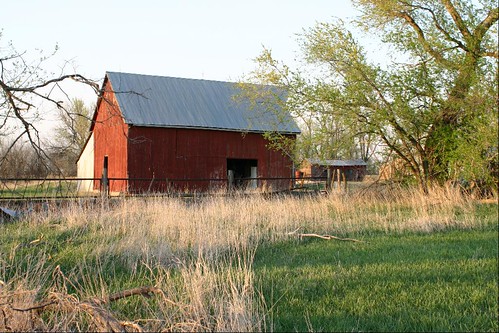
About 80 years ago, a Kansas family -- the Janzens -- built this barn.

About 60 years ago, my grandparents moved onto the farm. Their cattle were kept right here. I remember Grandpa's red tractor being parked in the barn.

So many memories have this barn in the background. We had a visit from one of the Janzens that lived here as a child. He had fond memories of this building. My dad and his siblings once played in the deep snow in front of this barn.

Here's one memory from those times:

078.jpg

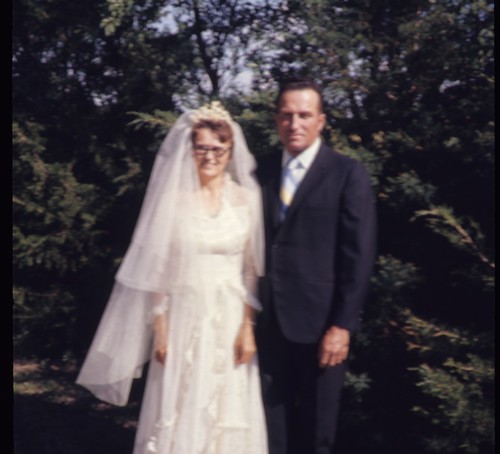
That's my grandma and grandpa on their 25th anniversary in 1970. It was a working barn back then, so they probably weren't standing right next to it for this picture, if you get my drift. But they were on the yard.

About 25 years ago, Grandma lost her battle with cancer. At some point or another, Grandpa had eased out of farming, so the barn had a lot less activity. I remember exploring his outbuildings when I got bored at family gatherings. And I used to mow the lawn next to it every summer when Grandpa went off to be a cook at a camp. I didn't mind mowing next to the barn. But I always tried to go past one corner of the house as fast as I could, because there were wasp and hornet nests right there.

About 7 years ago, it was time for Grandpa to move off the farm. It was getting to be too much to keep up the old house, the barn, the yard, and deal with things like freezing water pipes and water getting in through the windows. He moved to an independent-living duplex in town. He was always worried about what would happen to the farm. Over the next few years, the farm would sometimes be vacant, sometimes have renters. Some renters did some work on the house, but the barn sat. Grandpa would eventually move into the nursing home because of his Parkinson's.

Two and a half years ago, Grandpa passed away. I shared some memories from Grandpa's place at the funeral.

But what of the house, the farm now? Renters went, and it sat empty. Nothing was in great shape, and the house needed a lot of work. Perhaps the whole place would be leveled and turned back into the prairie that it once was, or used as farmland. Perhaps someone would have an interest someday.

A year and a half ago, Jacob was on the way. Terah and I had occasionally thought of buying Grandpa's place, but we never talked about it seriously. We figured that we better finally decide what we're doing, before we have a baby around, or a child in school. So in April 2006, we went out to the farm and checked it out. The picture at the top of this post is from that visit. Terah and I checked out the house, the barns, the granary, the pasture, and the creek. As we walked past one of the barns, a pigeon flew out. Terah jumped with a shout. I grew up around barns and didn't really notice it. In the big red barn, besides Grandpa's tractor, we found some remnants from years ago: some old bales, corn cobs that raccoons had found long ago, several generations of electric fencers, old appliances.

And we decided to go for it and buy the farm. This was right at a year after Grandpa died.

The family always liked to get together for Easter. What would happen for 2006? Well, they decided to have a picnic out at the farm. It was vacant, and a bit eerie. Yet they knew that we were working on buying the place and moving in. All but one took a last look through the house before our renovations began. The one person who didn't was my great aunt, Grandma's sister. She said, "I haven't been in this house for years. I remember how it looked back then. I don't want to remember how it looks now, run down like this. So I'm not going in. But once you have it all fixed up, THEN I'll go in!"

In June of 2006, we bought the farm.

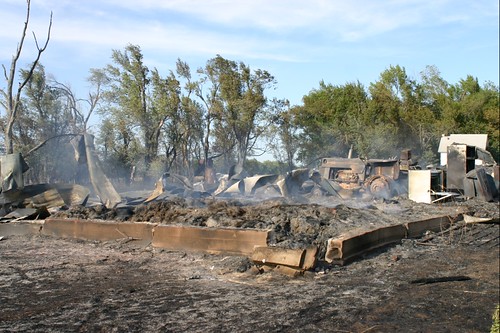
One month later, we lost this barn, and two other buildings, to a fire at our yard. This is what the beautiful red barn looked like that sad afternoon last year:

IMG_3630.JPG

As I wrote back then, nobody got hurt, the barn was insured, but "somehow, despite all these things, it still feels like we lost a little bit of Grandpa today."

2006 was a hot, dry summer. We had a patch of debris, then a patch of dirt, where the barn once stood.

7 months ago, Terah, Jacob, and I moved out to the farm. For the first time in 80 years, someone could stand in the farmhouse in the evening, look to the west, and see the colorful Kansas sunset over the pasture; the trees down by the creek; and even the neighbor's barn off in the distance. It was a beautiful sight, but it was also sad; that's not the view we had expected.

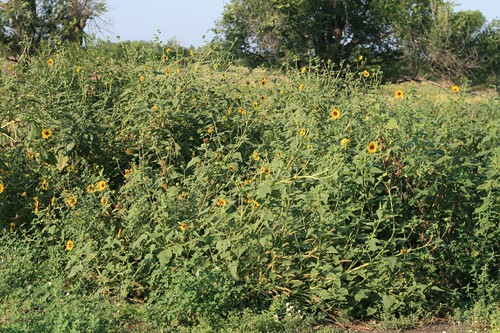
But then a surprise. This spring and summer, plants started coming up where none had grown for 80 years. But only where this barn stood -- not where the other two buildings were.

We watched as they grew tall. I'm sure decades of animals hanging out there were well appreciated by the plants.

As they grew, it looked like we might be seeing Terah's favorite flower: wild Kansas sunflowers.

And sure enough, they were.

Last weekend, Terah, Jacob, and I went out to the old barn. I took some pictures of its new appearance.

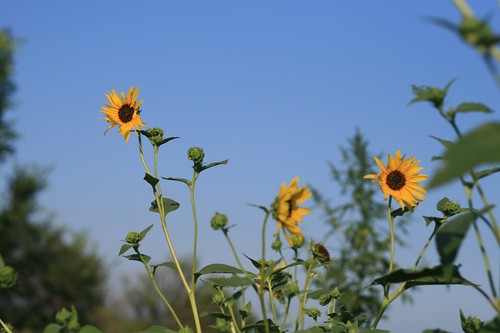
img_3429.jpg

This one stands where Grandpa's tractor used to be parked.

img_3401.jpg

And here we see a lifetime of flowers, from the old and withering, to the young just about ready to bloom.

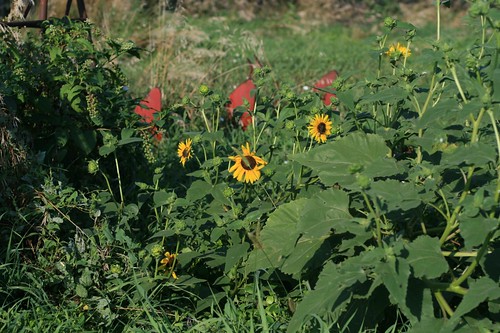
img_3462.jpg

At the edge of the sunflowers, there's an old plow next to them. Though you might think it's barn-colored.

img_3411.jpg

Animals continue to be attracted to the area. Here's one of the smaller visitors.

img_3447.jpg

And here's a picture of almost the whole patch, right where the barn used to stand. I still mow right up to it.

I still miss the old barn. But somehow it still seems to be full of surprises and worth exploring. I wonder what next year will bring.

And I wonder if, a few years from now, Jacob will tell his friends about mowing right up to the sunflower patch, going fast to try to avoid any trouble with the bees.

18 February 2007

Evan Prodromou: 28 Pluvi se CCXV

Ugh. I have some blogging catching-up to do, which I'm going to try to take at a fast clip. I tend to get bogged down in the daily details, which can make getting my info down electronically kind of difficult.

Trip to New York City Maj, Amita June and I drove down through upstate New York for LinuxWorld OpenSolutions Summit. It was a good drive -- really pretty going through the Adirondacks in winter. There were icicles hanging dozens of meters from stone cliffs -- really dramatic. We spent Tuesday night with our friends Jen Bohner and Massoud Marzban. Jen is a friend of mine from high school, and Massoud is her husband. They live in Sunnyside, Queens now, after a year stint here in Montreal just before Amita was born. We miss having them around here, but they seem to have settled in well in NYC. Jen is working way too hard on a master's of education while teaching 5 classes during the day in New York public schools. Despite this, they found time to make us a great dinner, open a bottle of wine, and spend the evening chatting. Really decent people. tags:

LWOSS The next morning, Valentine's Day, I got up early to go into Manhattan for LWOSS. I called for a car service that Jen and Massoud use, but they failed to show up, and when I called back they hung up on me. Deborah's Car Service, there. Make sure to miss them if you're in the area. Anyways, I managed to flag down a cab and get into Manhattan anyways. It wasn't too much fun -- there'd been a big snowstorm the night before, and traffic was gnarled and bitter. Still, I got to the event hotel -- the New York Marriott Marquis on Times Square, got checked in, and registered for the event just fine. The keynote speaker was security expert Bruce Schneier, who gave an extremely insightful talk about economic laws as they apply to computer security. It was very interesting, if hard to follow at times -- it's not always easy to keep economic theories and security practices juggling in your brain at the same time. I met up with Don Marti, who'd invited me to participate at LWOSS, in the speakers' lounge. He had assembled a great team of interesting people who know a lot about Linux and Open Source: John Mark Walker, Jeremy Allison and Jerry Carter of the Samba project, and Jeremy Garcia of LinuxQuestions. Sadly, the snowstorm had canceled the flights of two more participants, Donald Becker and Sascha Chua. (Those weren't the only two people who couldn't come because of the flying problems. I overheard dozens of conversations on cell phones of people whose colleagues couldn't make it for the show. In retrospect, it's pretty surprising that we had the event at all. Schools and businesses were closed all across New York on the 14th and 15th.) Don's plan was simple: to hold an "unconference" at the heart of the conference. We took a section of the showroom floor, set up some chairs and a big monitor for demoing, plus a whiteboard, and just started some interesting conversations. I talked about Web APIs, since I wrote an article on Web APIs for LinuxWorld.com in December. Other people talked about their own projects, about Linux distros, about tools in the Open Source toolkit, about the process itself, and all kinds of things. It was really fun and productive. (I'm realizing now that I should put Don in touch with Ted Ernst, who's been instrumental in organizing three of the Open Space events I went to in the last year. It would be really interesting to have an Open Space event the day before or after the main conference... making mental note, here.) Otherwise, the event was really pretty good. I talked a lot with Jeremy Garcia, who started using MediaWiki about the same time we started using it for Wikitravel. LQ is a really great project, and a nice mix of different community platforms. I managed to luck into an LQ t-shirt, which I'll wear proudly. The other big news, for me, was getting a loaner Nokia N800 to use during the event. The N800 is an Internet tablet, about the size of a cell phone, but without phone features. I liked it so much that I asked the Nokia team to loan me the device for a long-term review, and they agreed. So I took it home with me. Meanwhile, Maj and Amita June had a nice time tooling around New York. They went to the American Museum of Natural History on Thursday, which was pretty great -- Amita loved looking at the animals. We had dinner on Wednesday at a pub off of Times Square called The Perfect Pint -- although the food was a little more upscale than pubby. Thursday night we got a babysitter through the hotel and had drinks at the Broadway Bar (in the hotel) and dinner at The View (also in the hotel). The View is a rotating restaurant at the top of the Marriott Marquis -- pretty fun to do. tags:

UbuCon On Friday, I went to the Google HQ in Manhattan for TheUbucon, another (!) unconference, this time about Ubuntu and the people who love it. I got to hear Mako talk about the Ubuntu community process, how it works, and how to get involved. It was pretty impressive. I also did some key-signings and talked to a lot of interesting people. Including Kevin Mark, who had lots of comments on my blog. Hi, Kevin! I had to take off just as the event was getting started, to go pick up Maj and Amita June at the hotel and check out. We took a cab back to Queens, where we'd stashed the car so we didn't have pay outrageous Manhattan parking fees. Sadly, someone had taken the opportunity to key our paint job. I love you back, New York. tags:

Drive home I wanted to drive back through Connecticut, Massachusetts and Vermont on the way back, for variety, so we turned east and headed up through Westchester County. It turned out to be a real mistake -- traffic on a Friday afternoon out of New York is apparently pretty miserable. We took 4 hours to get to Hartford, by which time the baby was miserable and the rest of us were feeling pretty punked out, too. We ended up in the Motel 6 in Enfield (Connecticut) where we ordered pizza, took showers, and just got our heads back together. Today we got up early and had a nice drive through Western Mass and Vermont. The little northern New England towns were pretty beautiful in the snow, and we passed a lot of barns and farmhouses that looked like movie sets. We stopped in Burlington for lunch, and had a leisurely drive over the border and back home. When we got to our house, I had to shovel drifted snow -- about 3-4 feet deep -- out of our parking space so I can pull the car in. But otherwise the house is in good order. I'm glad to be back. tags:

28 January 2007

Joey Hess: goodbye microsoft

Today Robert Millan announced http://goodbye-microsoft.com/, which makes loading and booting d-i from Windows easy. These screenshots show how it works, and I like this one especially: screenshot The Windows program is even compilable from Debian, so this can be wrapped up into a Debian package and go into the official archive eventually. Gorgeous.
Update: slashdotted -- screenshot mirror here, front page mirror here

19 January 2007

John Goerzen: Everything Update

It's been very busy lately. So here's an update on lots of things.

We move in to the farmhouse this weekend, starting this evening. It's not completely done, but close enough! That's exciting. But I spent 12 hours out there on Tuesday cleaning out the attic (took the day off work to do that). So I'm exhausted, and the moving hasn't even started yet.

The wood floors are all done and looking nice.

Jacob is starting teething. We have discovered that he likes both the taste and effect of infant tylenol. Though he's been better in the past few days.

More pictures of Jacob and the house will be posted once we have a chance to get them assembled.

My MacBook Pro at work finally can suspend to RAM! 2.6.19.2 with the latest mactel patches makes it work with uswsusp.

We'll probably be without Internet at home for a few days -- at least until I get the place wired up and the firewall set up.

One of our neighbors out by the farm died this week. He was out working with his tractor when it slipped off an icy road and landed on him. His wife had just moved from Tennessee last spring when they got married, and has enjoyed working with all their animals. I didn't know either of them very well, and had only met his wife. But she was interested in our house renovation project and stopped by every so often to check on it and chat (their animals are across the road from us). We were looking forward to getting to know them both.

17 October 2006

John Goerzen: Goodbye, Dutch Avenue

This morning, we closed on the sale of the house we've been in since 2002.

We're excited about Grandpa's farmhouse that we're having renovated, and it will be great when we get to move in there in December or January.

But it's sad to leave the place that has been home for these last few years. Terah and I got a chance to spend a few last minutes over there today.

All sorts of memories came back. We remembered our long walks up and down the driveway, hand in hand, laughing and talking. We remembered sitting out on the west edge of our property watching the sun set behind the trees. We remembered playing with our cats, having friends and family over, the excitement when we moved in, all the hard work we put into renovating the old part of the house, and so many more things.

We also been looking back and laughing at things that were really pretty annoying at the time: having no water because of ants, having to move out for a few days on Valentine's Day because of a skunk, being without power for most of a week because of ice (and having to cut my way in and out through the driveway).

We'll have memories, photos, and some small souvenirs from our old house. But we'll miss it, too, just like we missed our house in Indianapolis and its pond with attack geese. (That's another story.)

When we moved to Kansas, my grandma, who grew up a few miles away, heard our address and said, "Dutch Avenue! That's right at home for me." It was right at home for us, too.

4 August 2006

John Goerzen: Family Patterns and The Great Grandparents' House

First, a random amusing pattern: If you follow my family tree up, once you get back to the 1800s, you'll see several generations in a row in which people alternated names between B. H. Friesen and H. B. Friesen. The pattern finally broke when D. B. Friesen was born in 1891. This was back in the day when people were often called by their initials. (The initials stood for Heinrich Bernhard, by the way.)

Now then...

Frequent readers of this blog know that Terah and I purchased the place my grandparents owned (where my dad grew up).

The part I haven't mentioned is that my parents did the same thing -- my great grandparents owned the farm that my parents bought after they got married. My dad's mother grew up there.

My parents had an old farmhouse on their property, too. They opted to build a new house -- the old house made a nice home for rats, but not such a great home for people by that time. But that doesn't mean that the old house got torn down.

Nope, they had it moved to a museum, where a group of volunteers restored it.

Terah and I went to visit the 1911 Friesen House at the Mennonite Heritage Museum in Goessel a couple of weeks ago to get some decorating ideas for the house we're renovating. I'm going to get some more photos this weekend -- it's THRESHING DAYS again at the museum! Cliff, there's still time to drive down to Kansas! (Here's a partial schedule)

Terah liked the idea of buying the farm. But I don't think she'll go for restarting the other family tradition.... (well, I wouldn't, either, but it is funny...)

So I will end this post with a small collection of photos from Threshing Days 2004 (click the link).

Here's the usual sample:

10 March 2006

Axel Beckert: Which SciFi crew would I best fit in?

In m³’s online pamphlete, I found a new quiz I immediately had to take:

Which sci-fi crew would you best fit in? Before taking the quiz I already wondered which possible answers it offers and what I’d expect as result. The only thing I knew so far was that The Matrix was featured in the quiz since m3 scored as Nebuchadnezzar. Farscape came to my mind. During the quiz some of the questions seemed quite obvious on which crew they would count resp. not count. Since I don’t like military, I knew that Star Trek crews won’t be on the top of my list… Well, it seems as if had guessed quite well:

You scored as Moya (Farscape). You are surrounded by muppets. But that is okay because they are your friends and have shown many times that they can be trusted. Now if only you could stop being bothered about wormholes.
Moya (Farscape)
88%
Babylon 5 (Babylon 5)
81%
Deep Space Nine (Star Trek)
75%
Serenity (Firefly)
69%
Enterprise D (Star Trek)
69%
Nebuchadnezzar (The Matrix)
69%
Millennium Falcon (Star Wars)
63%
Andromeda Ascendant (Andromeda)
56%
FBI's X-Files Division (The X-Files)
56%
SG-1 (Stargate)
56%
Bebop (Cowboy Bebop)
50%
Galactica (Battlestar: Galactica)
44%

Your Ultimate Sci-Fi Profile II: which sci-fi crew would you best fit in? (pics)
Created with QuizFarm.com.

Interestingly the Enterprise D from Star Trek TNG is also in the list and not that far down as I expected it. So there seems to be at least a slight correlation between what SciFi series/movies I like most (Farscape, Star Trek TNG and DS9, the early Star Wars movies, The Matrix, Babylon 5) and with which crew’s philosophy I agree most as well as which ships appeal most to me (Millennium Falcon, Moya and many ships from B5, TNG and DS9) and vice versa: I’m not that big fan of Battlestar Galactica nor Star Gate neither do I like the design of the ships showing up there. Another two things I noticed by this quiz: I should perhaps once have a look at Firefly which I haven’t seen yet nor do I know much about it. And I probably won’t find Cowboy Bebop that appealing if I would watch it once. BTW: Series I missed in the list: Star Trek TOS, SeaQuest DSV and Futurama.

Next.

Previous.