Search Results: "nic"

1 January 2026

Russ Allbery: Review: This Brutal Moon

Review: This Brutal Moon, by Bethany Jacobs
Series: Kindom Trilogy #3
Publisher: Orbit
Copyright: December 2025
ISBN: 0-316-46373-6
Format: Kindle
Pages: 497
This Brutal Moon is a science fiction thriller with bits of cyberpunk and space opera. It concludes the trilogy begun with These Burning Stars. The three books tell one story in three volumes, and ideally you would read all three in close succession. There is a massive twist in the first book that I am still not trying to spoil, so please forgive some vague description. At the conclusion of These Burning Stars, Jacobs had moved a lot of pieces into position, but it was not yet clear to me where the plot was going, or even if it would come to a solid ending in three volumes as promised by the series title. It does. This Brutal Moon opens with some of the political maneuvering that characterized These Burning Stars, but once things start happening, the reader gets all of the action they could wish for and then some. I am pleased to report that, at least as far as I'm concerned, Jacobs nails the ending. Not only is it deeply satisfying, the characterization in this book is so good, and adds so smoothly to the characterization of the previous books, that I saw the whole series in a new light. I thought this was one of the best science fiction series finales I've ever read. Take that with a grain of salt, since some of those reasons are specific to me and the mood I was in when I read it, but this is fantastic stuff. There is a lot of action at the climax of this book, split across at least four vantage points and linked in a grand strategy with chaotic surprises. I kept all of the pieces straight and understood how they were linked thanks to Jacobs's clear narration, which is impressive given the number of pieces in motion. That's not the heart of this book, though. The action climax is payoff for the readers who want to see some ass-kicking, and it does contain some moving and memorable moments, but it relies on some questionable villain behavior and a convenient plot device introduced only in this volume. The action-thriller payoff is competent but not, I think, outstanding. What put this book into a category of its own were the characters, and specifically how Jacobs assembles sweeping political consequences from characters who, each alone, would never have brought about such a thing, and in some cases had little desire for it. Looking back on the trilogy, I think Jacobs has captured, among all of the violence and action-movie combat and space-opera politics, the understanding that political upheaval is a relay race. The people who have the personalities to start it don't have the personality required to nurture it or supply it, and those who can end it are yet again different. This series is a fascinating catalog of political actors the instigator, the idealist, the pragmatist, the soldier, the one who supports her friends, and several varieties and intensities of leaders and it respects all of them without anointing any of them as the One True Revolutionary. The characters are larger than life, yes, and this series isn't going to win awards for gritty realism, but it's saying something satisfyingly complex about where we find courage and how a cause is pushed forward by different people with different skills and emotions at different points in time. Sometimes accidentally, and often in entirely unexpected ways. As before, the main story is interwoven with flashbacks. This time, we finally see the full story of the destruction of the moon of Jeve. The reader has known about this since the first volume, but Jacobs has a few more secrets to show (including, I will admit, setting up a plot device) and some pointed commentary on resource extraction economies. I think this part of the book was a bit obviously constructed, although the characterization was great and the visible junction points of the plot didn't stop me from enjoying the thrill when the pieces came together. But the best part of this book was the fact there was 10% of it left after the climax. Jacobs wrote an actual denouement, and it was everything I wanted and then some. We get proper story conclusions for each of the characters, several powerful emotional gut punches, some remarkably subtle and thoughtful discussion of political construction for a series that tended more towards space-opera action, and a conclusion for the primary series relationship that may not be to every reader's taste but was utterly, perfectly, beautifully correct for mine. I spent a whole lot of the last fifty pages of this book trying not to cry, in the best way. The character evolution over the course of this series is simply superb. Each character ages like fine wine, developing more depth, more nuance, but without merging. They become more themselves, which is an impressive feat across at least four very different major characters. You can see the vulnerabilities and know what put them there, you can see the strengths they developed to compensate, and you can see why they need the support the other characters provide. And each of them is so delightfully different. This was so good. This was so precisely the type of story that I was in the mood for, with just the type of tenderness for its characters that I wanted, that I am certain I am not objective about it. It will be one of those books where other people will complain about flaws that I didn't see or didn't care about because it was doing the things I wanted from it so perfectly. It's so good that it elevated the entire trilogy; the journey was so worth the ending. I'm afraid this review will be less than helpful because it's mostly nonspecific raving. This series is such a spoiler minefield that I'd need a full spoiler review to be specific, but my reaction is so driven by emotion that I'm not sure that would help if the characters didn't strike you the way that they struck me. I think the best advice I can offer is to say that if you liked the emotional tone of the end of These Burning Stars (not the big plot twist, the character reaction to the political goal that you learn drove the plot), stick with the series, because that's a sign of the questions Jacobs is asking. If you didn't like the characters at the end (not the middle) of the first novel, bail out, because you're going to get a lot more of that. Highly, highly recommended, and the best thing I've read all year, with the caveats that you should read the content notes, and that some people are going to bounce off this series because it's too intense and melodramatic. That intensity will not let up, so if that's not what you're in the mood for, wait on this trilogy until you are. Content notes: Graphic violence, torture, mentions of off-screen child sexual assault, a graphic corpse, and a whole lot of trauma. One somewhat grumbly postscript: This is the sort of book where I need to not read other people's reviews because I'll get too defensive of it (it's just a book I liked!). But there is one bit of review commentary I've seen about the trilogy that annoys me enough I have to mention it. Other reviewers seem to be latching on to the Jeveni (an ethnic group in the trilogy) as Space Jews and then having various feelings about that. I can see some parallels, I'm not going to say that it's completely wrong, but I also beg people to read about a fictional oppressed ethnic and religious minority and not immediately think "oh, they must be stand-ins for Jews." That's kind of weird? And people from the US, in particular, perhaps should not read a story about an ethnic group enslaved due to their productive skill and economic value and think "they must be analogous to Jews, there are no other possible parallels here." There are a lot of other comparisons that can be made, including to the commonalities between the methods many different oppressed minorities have used to survive and preserve their culture. Rating: 10 out of 10

Daniel Baumann: P r ch storage (in Western Europe)

The majority of P r ch ( ) is stored in Asia (predominantly China, some in Malaysia and Taiwan) because of its climatic conditions:
  • warm (~30 C)
  • humid (~75% RH)
  • stable (comparatively small day to day, day to night, and seasonal differences)
These are ideal for ageing and allow efficient storage in simple storehouses, usually without the need for any air conditioning. The climate in Western European countries is significantly colder, drier, and more variable. However, residential houses offers throughout the year a warm (~20 C), humid (~50% RH), and stable baseline to start with. High quality, long term storage and ageing is possible too with some of the Asian procedures slightly adjusted for the local conditions. Nevertheless, fast accelerated ageing still doesn t work here (even with massive climate control). Personally I prefer the balanced, natural storage over the classical wet or dry , or the mixed traditional storage (of course all storage types are not that meaningful as they are all relative terms anyway). Also I don t like strong fermentation either (P r is not my favourite tea, I only drink it in the 3 months of winter). Therefore, my intention is primarily to preserve the tea while it continues to age normally, keep it in optimal drinking condition and don t rush its fermentation. The value of correct storage is of great importance and has a big effect on P r, and is often overlooked and underrated. Here s a short summary on how to store P r ch (in Western Europe).
P ' r ch  storage (in Western Europe) Image: some D y P r ch stored at home
1. Location
1.1 No light Choose a location with neither direct nor indirect sunlight (= ultraviolet radiation) exposure:
  • direct sunlight damages organic material ( bleeching )
  • indirect sunlight by heating up the containers inbalances the microclimate ( suppression )
1.2 No odors Choose a location with neither direct nor indirect odor exposure:
  • direct odor immissions (like incense, food, air polution, etc.) makes the tea undrinkable
  • indirect odor immissions (especially other teas stored next to it) taint the taste and dilute the flavours
Always use individual containers for each tea, store only identical tea of the same year and batch in the same container. Idealy never store one cake, brick or tuo on its own, buy multiples and store them together for better ageing.
2. Climate
2.1 Consistent temperature Use a location with no interference from any devices or structures next to it:
  • use an regular indoor location for mild temperature curves (i.e. no attics with large day/night temperature differences)
  • aim for >= 20 C average temperature for natural storage (i.e. no cold basements)
  • don t use a place next to any heat dissipating devices (like radiators, computers, etc.)
  • don t use a place next to an outside facing wall
  • always leave 5 to 10cm distance to a wall for air to circulate (generally prevents mold on the wall but also isolates the containers further from possible immissions)
As consistent temperature as possible allows even and steady fermentation. However, neither air conditioning or filtering is needed. Regular day to day, day to night, and season to season fluctuations are balanced out fine with otherwise correct indoor storage. Also humidity control is much more important for storage and ageing, and much less forgiving than temperature control.
2.2 Consistent humidity Use humidity control packs to ensure a stable humidity level:
  • aim for ~65% RH
Lower than 60% RH will (completely) dry out the tea, higher than 70% RH increases chances for mold.
3. Equipment
3.1 Proper containers Use containers that are long term available and that are easily stackable, both in form and dimensions as well as load-bearing capacity. They should be inexpensive, otherwise it s most likely scam (there are people selling snake-oil containers specifically for tea storage). For long term storage and ageing:
  • never use plastic: they leak chemicals over time (no tupperdors , mylar and zip lock bags, etc.)
  • never use cardboard or bamboo: they let to much air in, absorb too much humity and dry to slow
  • never use wood: they emit odors (no humidors)
  • never use clay: they absorb all humidity and dry out the tea (glazed or porcelain urns are acceptable for short term storage)
Always use sealed but not air tight, cleaned steal cans (i.e. with no oil residues from manufacturing; such as these).
3.2 Proper humidity control Use two-way humidity control packs to either absorb or add moisture depending on the needs:
  • use humidity control pack(s) in every container
  • use one 60g pack (such as these) per 500g of tea
3.3 Proper labels Put labels on the outside of the containers to not need to open them to know what is inside and disturbe the ageing:
  • write at least manufacturer and name, pressing year, and batch number on the label (such as these)
  • if desired and not otherwise kept track already elsewhere, add additional information such as the amount of items, weights, previous storage location/type, date of purchase, vendor, or price, etc.
3.4 Proper monitoring Measuring and checking temperature and humidity regularly prevents storage parameters turning bad going unnoticed:
  • put temperature and humidity measurement sensors (such as these) inside some of the containers (e.g. at least one in every different size/type of container)
  • keep at least one temperature and humidity measurement sensor next to the containers on the outside to monitor the storage location
4. Storage
4.1 Continued maintenance Before beginning to initially store a new tea, let it acclimatize for 2h after unpacking from transport (or longer if temperature differences between indoors and outdoors are high, i.e. in winter). Then continuesly:
  • once a month briefly air all containers for a minute or two
  • once a month check for mold, just to be safe
  • every 3 to 6 months check all humidity control packs for need of replacement
  • monitor battery life of temperature and humidity measurement sensors
Humidity control packs can be recharged (usually voiding any warranty) by submerging them for 2 days in distilled water and 4 hours drying on paper towl afterwards. Check with a weight scale after recharging, they should regain their original weight (e.g. 60g plus ~2 to 5g for the packaging).
Finally With a correct P r ch storage:
  • beginn to drink Sh ng P r ( ) roughly after about 10-15 years, or later
  • beginn to drink Sh u P r ( ) roughly after about 3-5 years, or later
Prepare the tea by breaking it into, or breaking off from it, ~5 to 10g pieces about 1 to 3 months ahead of drinking and consider increase humidity to 70% RH during that time. 2026

31 December 2025

Junichi Uekawa: Happy new year.

Happy new year.

Bits from Debian: DebConf26 dates announced

Alt Debconf26 by Romina Molina As announced in Brest, France, in July, the Debian Conference is heading to Santa Fe, Argentina. The DebConf26 team and the local organizers team in Argentina are excited to announce Debconf26 dates, the 27th edition of the Debian Developers and Contributors Conference: DebCamp, the annual hacking session, will run from Monday July 13th to Sunday to July 19th 2026, followed by DebConf from Monday July 20th to Saturday July 25th 2026. For all those who wish to meet us in Santa Fe, the next step will be the opening of registration on January 26, 2026. The call for proposals period for anyone wishing to submit a conference or event proposal will be launched on the same day. DebConf26 is looking for sponsors; if you are interested or think you know of others who would be willing to help, please have a look at our sponsorship page and get in touch with sponsors@debconf.org. About Debian The Debian Project was founded in 1993 by Ian Murdock to be a truly free community project. Since then the project has grown to be one of the largest and most influential Open Source projects. Thousands of volunteers from all over the world work together to create and maintain Debian software. Available in 70 languages, and supporting a huge range of computer types, Debian calls itself the universal operating system. About DebConf DebConf is the Debian Project's developer conference. In addition to a full schedule of technical, social and policy talks, DebConf provides an opportunity for developers, contributors and other interested people to meet in person and work together more closely. It has taken place annually since 2000 in locations as varied as Scotland, Bosnia and Herzegovina, India, Korea. More information about DebConf is available from https://debconf.org/. For further information, please visit the DebConf26 web page at https://debconf26.debconf.org/ or send mail to press@debian.org. Debconf26 is made possible by Proxmox and others.

Sergio Cipriano: Zero-Code Instrumentation of an Envoy TCP Proxy using eBPF

Zero-Code Instrumentation of an Envoy TCP Proxy using eBPF I recently had to debug an Envoy Network Load Balancer, and the options Envoy provides just weren't enough. We were seeing a small number of HTTP 499 errors caused by latency somewhere in our cloud, but it wasn't clear what the bottleneck was. As a result, each team had to set up additional instrumentation to catch latency spikes and figure out what was going on. My team is responsible for the LBaaS product (Load Balancer as a Service) and, of course, we are the first suspects when this kind of problem appear. Before going for the current solution, I read a lot of Envoy's documentation. It is possible to enable access logs for Envoy, but they don't provide the information required for this debug. This is an example of the output:
[2025-12-08T20:44:49.918Z] "- - -" 0 - 78 223 1 - "-" "-" "-" "-" "172.18.0.2:8080"
I won't go into detail about the line above, since it's not possible to trace the request using access logs alone. Envoy also has OpenTelemetry tracing, which is perfect for understanding sources of latency. Unfortunatly, it is only available for Application Load Balancers. Most of the HTTP 499 were happening every 10 minutes, so we managed to get some of the requests with tcpdump, Wireshark and using http headers to filter the requests. This approach helped us reproduce and track down the problem, but it wasn't a great solution. We clearly needed better tools to catch this kind of issue the next time it happened. Therefore, I decided to try out OpenTelemetry eBPF Instrumentation, also referred to as OBI. I saw the announcement of Grafana Beyla before it was renamed to OBI, but I didn't have the time or a strong reason to try it out until now. Even then, I really liked the idea, and the possibility of using eBPF to solve this instrumentation problem had been in the back of my mind. OBI promises zero-code automatic instrumentation for Linux services using eBPF, so I put together a minimal setup to see how well it works.

Reproducible setup I used the following tools: Setting up a TCP Proxy with Envoy was straightforward:
static_resources:
  listeners:
  - name: go_server_listener
    address:
      socket_address:
        address: 0.0.0.0
        port_value: 8000
    filter_chains:
    - filters:
      - name: envoy.filters.network.tcp_proxy
        typed_config:
          "@type": type.googleapis.com/envoy.extensions.filters.network.tcp_proxy.v3.TcpProxy
          stat_prefix: go_server_tcp
          cluster: go_server_cluster
  clusters:
  - name: go_server_cluster
    connect_timeout: 1s
    type: LOGICAL_DNS
    load_assignment:
      cluster_name: go_server_cluster
      endpoints:
      - lb_endpoints:
        - endpoint:
            address:
              socket_address:
                address: target-backend
                port_value: 8080
This is the simplest Envoy TCP proxy configuration: a listener on port 8000 forwarding traffic to a backend running on port 8080. For the backend, I used a basic Go HTTP server:
package main

import (
    "fmt"
    "net/http"
)

func main()  
    http.Handle("/", http.FileServer(http.Dir(".")))

    server := http.Server Addr: ":8080" 

    fmt.Println("Starting server on :8080")
    panic(server.ListenAndServe())
 
Finally, I wrapped everything together with Docker Compose:
services:
  autoinstrumenter:
    image: otel/ebpf-instrument:main
    pid: "service:envoy"
    privileged: true
    environment:
      OTEL_EBPF_TRACE_PRINTER: text
      OTEL_EBPF_OPEN_PORT: 8000

  envoy:
    image: envoyproxy/envoy:v1.33-latest
    ports:
      - 8000:8000
    volumes:
      - ./envoy.yaml:/etc/envoy/envoy.yaml 
    depends_on:
      - target-backend
  
  target-backend:
    image: golang:1.22-alpine
    command: go run /app/backend.go
    volumes:
      - ./backend.go:/app/backend.go:ro
    expose:
      - 8080
OBI should output traces to the standard output similar to this when a HTTP request is made to Envoy:
2025-12-08 20:44:49.12884449 (305.572 s[305.572 s]) HTTPClient 200 GET /(/) [172.18.0.3 as envoy:36832]->[172.18.0.2 as localhost:8080] contentLen:78B responseLen:0B svc=[envoy generic] traceparent=[00-529458a2be271956134872668dc5ee47-6dba451ec8935e3e[06c7f817e6a5dae2]-01]
2025-12-08 20:44:49.12884449 (1.260901ms[366.65 s]) HTTP 200 GET /(/) [172.18.0.1 as 172.18.0.1:36282]->[172.18.0.3 as envoy:8000] contentLen:78B responseLen:223B svc=[envoy generic] traceparent=[00-529458a2be271956134872668dc5ee47-06c7f817e6a5dae2[0000000000000000]-01]
This is exactly what we needed, with zero-code. The above trace shows:
  • 2025-12-08 20:44:49.12884449: time of the trace.
  • (1.260901ms[366.65 s]): total response time for the request, with the actual internal execution time of the request (not counting the request enqueuing time).
  • HTTP 200 GET /: protocol, response code, HTTP method, and URL path.
  • [172.18.0.1 as 172.18.0.1:36282]->[172.18.0.3 as envoy:8000]: source and destination host:port. The initial request originates from my machine through the gateway (172.18.0.1), hits the Envoy (172.23.0.3), the proxy then forwards it to the backend application (172.23.0.2).
  • contentLen:78B: HTTP Content-Length. I used curl and the default request size for it is 78B.
  • responseLen:223B: Size of the response body.
  • svc=[envoy generic]: traced service.
  • traceparent: ids to trace the parent request. We can see that the Envoy makes a request to the target and this request has the other one as parent.
Let's add one more Envoy to show that it's also possible to track multiple services.
  envoy1:
    image: envoyproxy/envoy:v1.33-latest
    ports:
      - 9000:9000
    volumes:
      - ./envoy1.yaml:/etc/envoy/envoy.yaml
    depends_on:
      - envoy
The new Envoy will listen on port 9000 and forward the request to the other Envoy listening on port 8000. Now we just need to change OBI open port variable to look at a range:
OTEL_EBPF_OPEN_PORT: 8000-9000
And change the pid field of the autoinstrumenter service to use the host's PID namespace inside the container:
pid: host
This is the output I got after one curl:
2025-12-09 12:28:05.12912285 (2.202041ms[1.524713ms]) HTTP 200 GET /(/) [172.19.0.1 as 172.19.0.1:59030]->[172.19.0.5 as envoy:9000] contentLen:78B responseLen:223B svc=[envoy generic] traceparent=[00-69977bee0c2964b8fe53cdd16f8a9d19-856c9f700e73bf0d[0000000000000000]-01]
2025-12-09 12:28:05.12912285 (1.389336ms[1.389336ms]) HTTPClient 200 GET /(/) [172.19.0.5 as envoy:59806]->[172.19.0.4 as localhost:8000] contentLen:78B responseLen:0B svc=[envoy generic] traceparent=[00-69977bee0c2964b8fe53cdd16f8a9d19-caa7f1ad1c68fa77[856c9f700e73bf0d]-01]
2025-12-09 12:28:05.12912285 (1.5431ms[848.574 s]) HTTP 200 GET /(/) [172.19.0.5 as 172.19.0.5:59806]->[172.19.0.4 as envoy:8000] contentLen:78B responseLen:223B svc=[envoy generic] traceparent=[00-69977bee0c2964b8fe53cdd16f8a9d19-cbca9d64d3d26b40[caa7f1ad1c68fa77]-01]
2025-12-09 12:28:05.12912285 (690.217 s[690.217 s]) HTTPClient 200 GET /(/) [172.19.0.4 as envoy:34256]->[172.19.0.3 as localhost:8080] contentLen:78B responseLen:0B svc=[envoy generic] traceparent=[00-69977bee0c2964b8fe53cdd16f8a9d19-5502f7760ed77b5b[cbca9d64d3d26b40]-01]
2025-12-09 12:28:05.12912285 (267.9 s[238.737 s]) HTTP 200 GET /(/) [172.19.0.4 as 172.19.0.4:34256]->[172.19.0.3 as backend:8080] contentLen:0B responseLen:0B svc=[backend go] traceparent=[00-69977bee0c2964b8fe53cdd16f8a9d19-ac05c7ebe26f2530[5502f7760ed77b5b]-01]
Each log line represents a span belonging to the same trace (69977bee0c2964b8fe53cdd16f8a9d19). For readability, I ordered the spans by their traceparent relationship, showing the request's path as it moves through the system: from the client-facing Envoy, through the internal Envoy hop, and finally to the Go backend. You can see both server-side (HTTP) and client-side (HTTPClient) spans at each hop, along with per-span latency, source and destination addresses, and response sizes, making it easy to pinpoint where time is spent along the request chain. The log lines are helpful, but we need better ways to visualize the traces and the metrics generated by OBI. I'll share another setup that more closely reflects what we actually use.

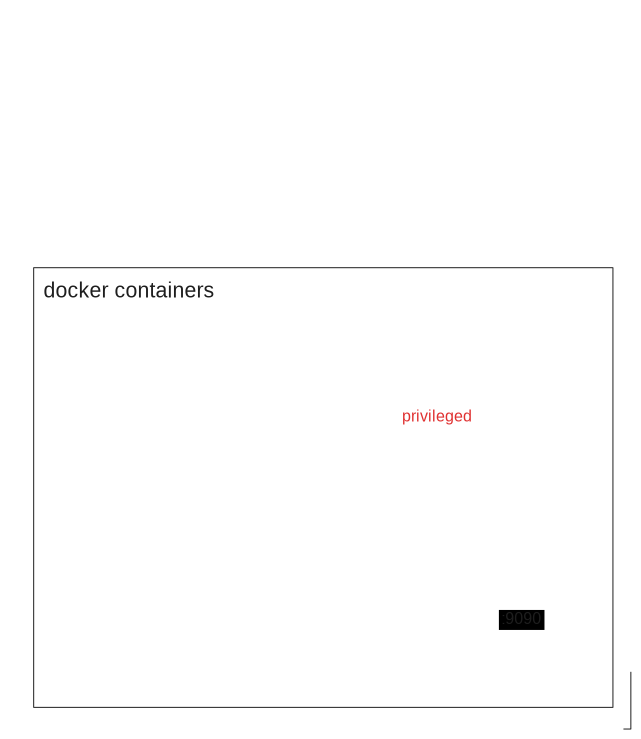
Production setup I'll be using the following tools this time: The goal of this setup is to mirror an environment similar to what I used in production. This time, I've omitted the load balancer and shifted the emphasis to observability instead. setup diagram I will run three HTTP servers on port 8080: two inside Incus containers and one on the host machine. The OBI process will export metrics and traces to an OpenTelemetry Collector, which will forward traces to Jaeger and expose a metrics endpoint for Prometheus to scrape. Grafana will also be added to visualize the collected metrics using dashboards. The aim of this approach is to instrument only one of the HTTP servers while ignoring the others. This simulates an environment with hundreds of Incus containers, where the objective is to debug a single container without being overwhelmed by excessive and irrelevant telemetry data from the rest of the system. OBI can filter metrics and traces based on attribute values, but I was not able to filter by process PID. This is where the OBI Collector comes into play, it allows me to use a processor to filter telemetry data by the PID of the process being instrumented. These are the steps to reproduce this setup:
  1. Create the incus containers.
$ incus launch images:debian/trixie server01
Launching server01
$ incus launch images:debian/trixie server02
Launching server02
  1. Start the HTTP server on each container.
$ apt install python3 --update -y
$ tee /etc/systemd/system/server.service > /dev/null <<'EOF'
[Unit]
Description=Python HTTP server
After=network.target
[Service]
User=root
Group=root
Type=simple
ExecStart=/usr/bin/python3 -m http.server 8080
Restart=always
StandardOutput=journal
StandardError=journal
[Install]
WantedBy=multi-user.target
EOF
$ systemctl start server.service
  1. Start the HTTP server on the host.
$ python3 -m http.server 8080
  1. Start the Docker compose.
services:
  autoinstrumenter:
    image: otel/ebpf-instrument:main
    pid: host
    privileged: true
    environment:
      OTEL_EBPF_CONFIG_PATH: /etc/obi/obi.yml 
    volumes:
      - ./obi.yml:/etc/obi/obi.yml

  otel-collector:
    image: otel/opentelemetry-collector-contrib:0.98.0
    command: ["--config=/etc/otel-collector-config.yml"]
    volumes:
      - ./otel-collector-config.yml:/etc/otel-collector-config.yml
    ports:
      - "4318:4318" # Otel Receiver
      - "8889:8889" # Prometheus Scrape
    depends_on:
      - autoinstrumenter
      - jaeger
      - prometheus

  prometheus:
    image: prom/prometheus
    volumes:
      - ./prometheus.yml:/etc/prometheus/prometheus.yml
    ports:
      - "9090:9090" # Prometheus UI

  grafana:
    image: grafana/grafana
    restart: always
    environment:
      - GF_SECURITY_ADMIN_USER=admin
      - GF_SECURITY_ADMIN_PASSWORD=RandomString123!
    volumes:
      - ./grafana-ds.yml:/etc/grafana/provisioning/datasources/datasource.yml
    ports:
      - "3000:3000" # Grafana UI

  jaeger:
    image: jaegertracing/all-in-one
    container_name: jaeger
    ports:
      - "16686:16686" # Jaeger UI
      - "4317:4317"  # Jaeger OTLP/gRPC Collector
Here's what the configuration files look like:
  • obi.yml:
log_level: INFO
trace_printer: text

discovery:
  instrument:
    - open_ports: 8080

otel_metrics_export:
  endpoint: http://otel-collector:4318
otel_traces_export:
  endpoint: http://otel-collector:4318
  • prometheus.yml:
global:
  scrape_interval: 5s

scrape_configs:
  - job_name: 'otel-collector'
    static_configs:
      - targets: ['otel-collector:8889']
  • grafana-ds.yml:
apiVersion: 1

datasources:
  - name: Prometheus
    type: prometheus
    access: proxy
    url: http://prometheus:9090
    isDefault: true
  • otel-collector-config.yml:
receivers:
  otlp:
    protocols:
      http:
        endpoint: otel-collector:4318

exporters:
  otlp/jaeger:
    endpoint: jaeger:4317
    tls:
      insecure: true

  prometheus:
    endpoint: 0.0.0.0:8889
    namespace: default

service:
  pipelines:
    traces:
      receivers: [otlp]
      exporters: [otlp/jaeger]

    metrics:
      receivers: [otlp] 
      exporters: [prometheus]
We're almost there, the OpenTelemetry Collector is just missing a processor. To create the processor filter, we can look at the OBI logs to find the PID of the HTTP server being instrumented:
autoinstrumenter-1    time=2025-12-30T19:57:17.593Z level=INFO msg="instrumenting process" component=discover.traceAttacher cmd=/usr/bin/python3.13 pid=297514 ino=460310 type=python service=""
autoinstrumenter-1    time=2025-12-30T19:57:18.320Z level=INFO msg="instrumenting process" component=discover.traceAttacher cmd=/usr/bin/python3.13 pid=310288 ino=722998 type=python service=""
autoinstrumenter-1    time=2025-12-30T19:57:18.512Z level=INFO msg="instrumenting process" component=discover.traceAttacher cmd=/usr/bin/python3.13 pid=315183 ino=2888480 type=python service=""
Which can also be obtained using standard GNU/Linux utilities:
$ cat /sys/fs/cgroup/lxc.payload.server01/system.slice/server.service/cgroup.procs 
297514
$ cat /sys/fs/cgroup/lxc.payload.server02/system.slice/server.service/cgroup.procs 
310288
$ ps -aux   grep http.server
USER         PID %CPU %MEM    VSZ   RSS TTY      STAT START   TIME COMMAND
1000000   297514  0.0  0.1  32120 14856 ?        Ss   16:03   0:00 /usr/bin/python3 -m http.server 8080
1000000   310288  0.0  0.1  32120 10616 ?        Ss   16:09   0:00 /usr/bin/python3 -m http.server 8080
cipriano  315183  0.0  0.1 103476 11480 pts/3    S+   16:17   0:00 python -m http.server 8080
If we search for the PID in the OpenTelemetry Collector endpoint where Prometheus metrics are exposed, we can find the attribute values to filter on.
$ curl http://localhost:8889/metrics   rg 297514
default_target_info host_id="148f400ad3ea",host_name="148f400ad3ea",instance="148f400ad3ea:297514",job="python3.13",os_type="linux",service_instance_id="148f400ad3ea:297514",service_name="python3.13",telemetry_sdk_language="python",telemetry_sdk_name="opentelemetry-ebpf-instrumentation",telemetry_sdk_version="main"  1
Now we just need to add the processor to the collector configuration:
processors: # <--- NEW BLOCK
  filter/host_id:
    traces:
      span:
        - 'resource.attributes["service.instance.id"] == "148f400ad3ea:297514"'

service:
  pipelines:
    traces:
      receivers: [otlp]
      processors: [filter/host_id] # <--- NEW LINE
      exporters: [otlp/jaeger]

    metrics:
      receivers: [otlp] 
      processors:  # <--- NEW BLOCK
        - filter/host_id
      exporters: [prometheus]
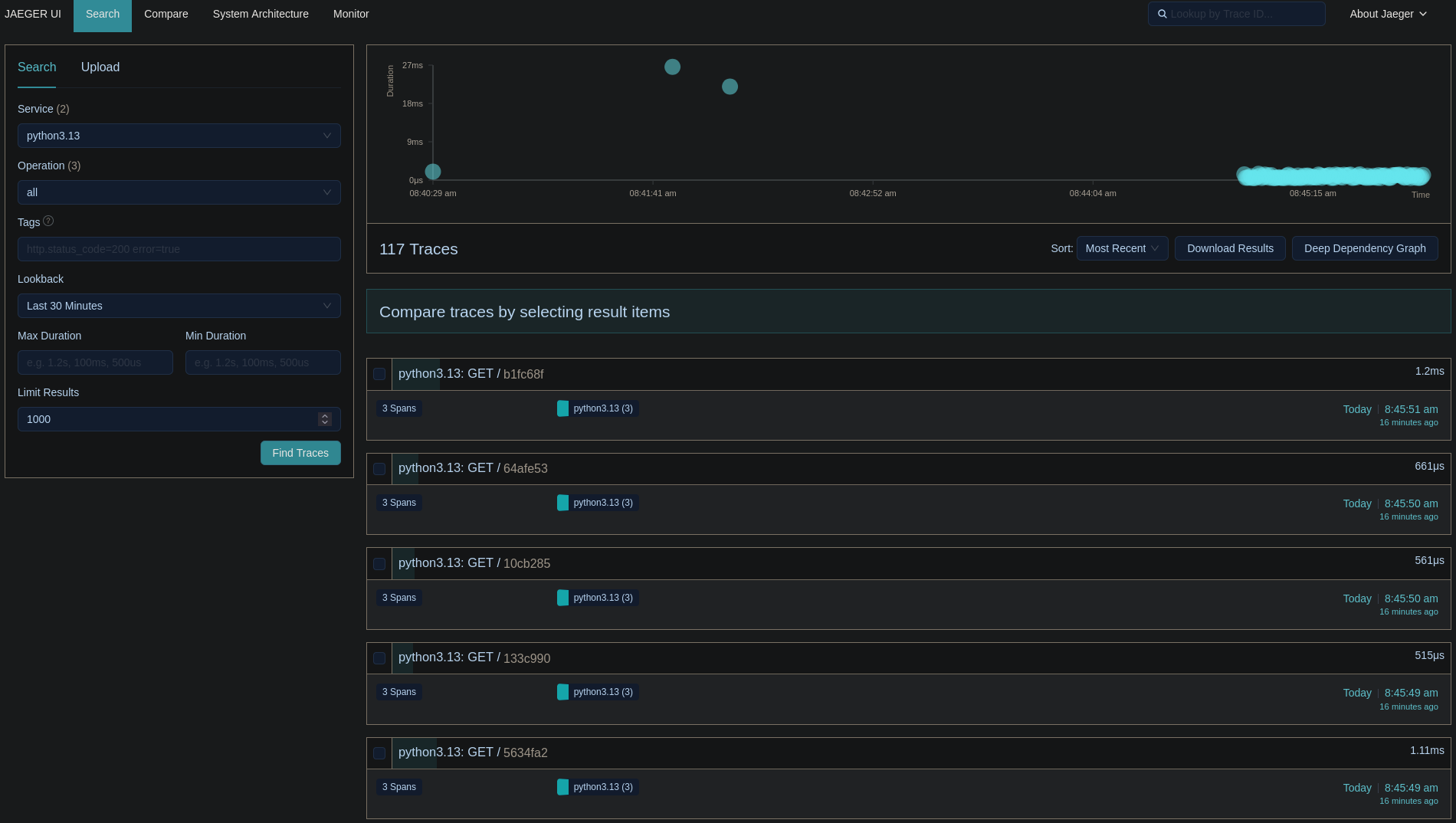
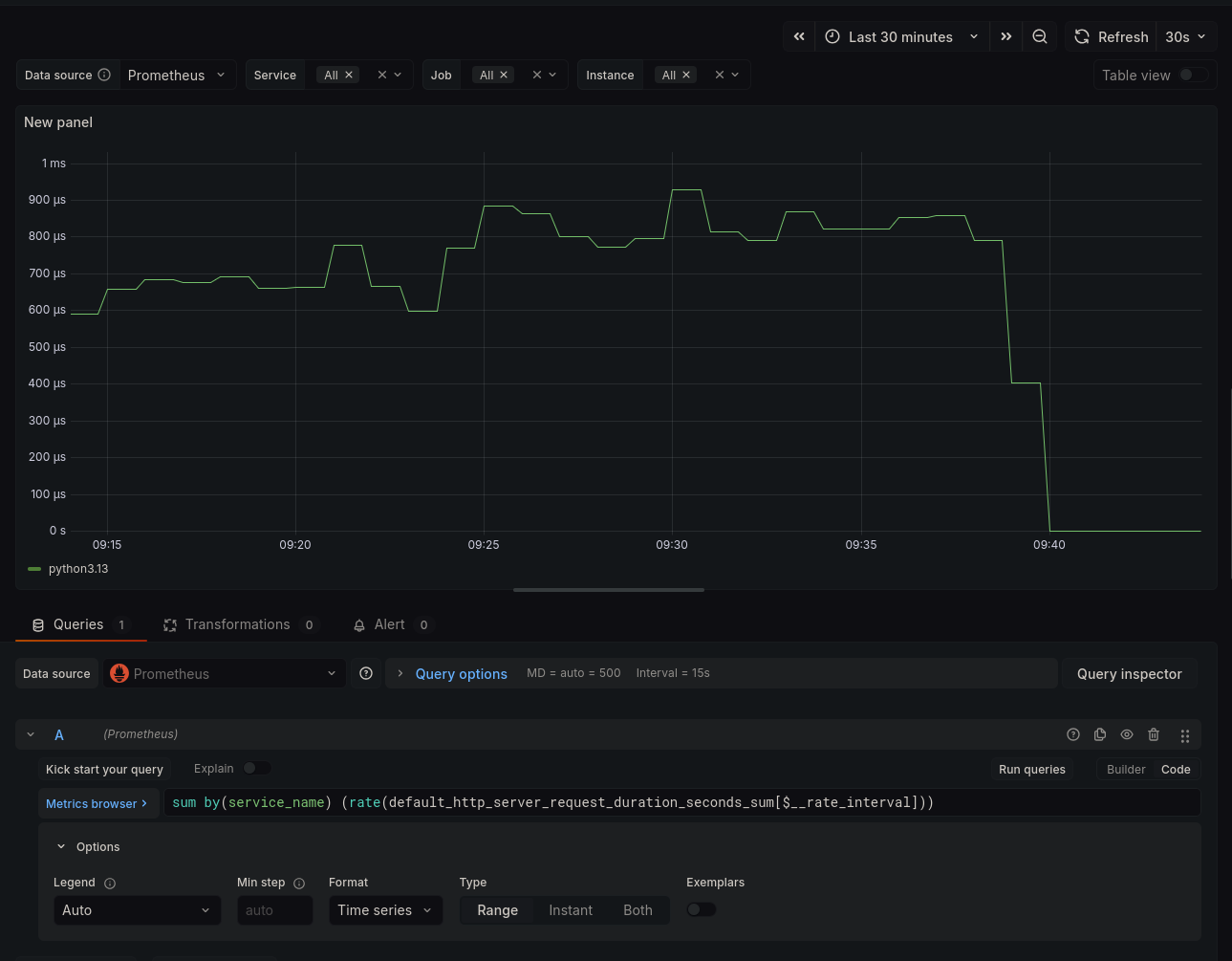
That's it! The processor will handle the filtering for us, and we'll only see traces and metrics from the HTTP server running in the server01 container. Below are some screenshots from Jaeger and Grafana: jaeger search will all traces one jaeger trace grafana request duration panel

Closing Notes I am still amazed at how powerful OBI can be. For those curious about the debug, we found out that a service responsible for the network orchestration of the Envoy containers was running netplan apply every 10 minutes because of a bug. Netplan apply causes interfaces to go down temporarily and this made the latency go above 500ms which caused the 499s.

Petter Reinholdtsen: Some of my 2025 free software activities

I guess it is about time I posted a new summary of the free software and open culture activites and projects I have been involved in the last year. The days have been so packed the last year that I have failed with my intention to post at least one blog post per month, so this summary became rather long. I am sorry about this. This year was the year I got tired of the lack of new releases of the multimedia related libraries published via Xiph, and I decided to wrap up the current state and make the releases myself. In a burst of activity early this year, I collected and tested patches, coordinated with other developers and finally made new tarballs and release announcement for theora, and new tarball releases for liboggz, kate and fishsound. This upstreamed several patches accumulated in Debian and other Linux distributions for the last 15 years or so. To change the world and the future, it is important to start with the kids, and one such avenue of change have been created by the current president of FSF Europe, Matthias Kirschner. He wrote a book for children, Ada & Zangemann, and I have been involved in its translation framework for the entire year. The source code has been transformed to Docbook and I have been conducting and coordinating translations into Norwegian Bokm l and Nynorsk, as well as preparing paper editions of the book and an animation movie with Norwegian voices. The Bokm l edition is very close to ready, and will be available early in 2026, and the movie release will follow shortly after this. I intend announce this on my blog and elsewhere when this happen. Please get in touch if you want to help spread the word about this book in Norwegian. I hope we can get the author to Norway when making the Norwegian releases. This year I continued a push for the system I made a few years ago to improve hardware dongle handling on Linux. The Isenkram system use hardware mapping information provided by relevant packages using the AppStream system to propose which Linux distribution packages to install on a given machine to support dongles like cameras, finger print readers, smart card readers, LEGO controllers, ECC memory and other hardware. I have followed up on the list of packages providing such mapping, either to get it into Debian or to upstream the necessary metadata. I am not sure if we are at a point where package maintainers on their own add such information to their packages, but there are Debian lintian reports suggesting it and I have send patches to all packages I am aware of that should include such mappings. Most of the patches are included in Debian now, only 27 was left the last time I checked. As part of my involvement with Debian, I continued my push to get all orphaned packages without a version control repository migrated to git. I am not sure how many packages I went through, but it was in the range of 200-300 packages. In addition to this I updated, sponsored, pushed maintainers for updates upstreamed patches for and fixed RC issues with battery-stats, bs1770gain, isenkram, libonvif, mfiutil, opensnitch, simplescreenrecorder, vlc-plugin-bittorrent and wakeonlan. I've also followed up LEGO related packages, dahdi support for Asterisk, llama.cpp and whisper.cpp in particular for the AMD GPU I was donated by AMD, as well as tried yet again to convince the upstream developers of the photogrammetric workstion e-foto to get their program into a state that could be included in Debian. As I do not buy into the story that it is great to expose oneself to the whims of and priorities of commercial entities to have access to cultural expressions like films and music, I still maintain a huge collection of movies. For this to work well, I have ended up as part of the people maintaining lsdvd upstream and wrapped up a new release fixing several crash bugs caused by DVDs with intentionally broken metadata, and introduced code to list a DVD ID in the lsdvd output. Related to this, I have also worked some add-ons for my main video and music player, and took over upstream maintenance of the Invidious add-on, which sadly stopped working for non-authenticated users when web scrapers made it impossible for Invidious installations to provide a open API, as well as contributed to the NRK and projector control add-ons. As part of my involvement in the Norwegian archiving community and standardisation work, we organised a Noark 5 workshop this spring discussing how to decide what to keep and what to delete in digital archives. We finally managed to apply for Noark 5 certification for the free software archive API Nikita, as well as worked to test and improve the performance of Nikita together with people on my day job at the university. Manufacturing using Free Software is still a focus for me, and I have continued my involved with the LinuxCNC community, organising a developer gathering this summer with the help and sponsoring from the initial start in 2023 from NUUG Foundation and sponsoring from Debian and Redpill-Linpro. We plan to repeat the event also in 2026, but this time NUUG Foundation have told us they do not want a role, so we have found another friendly organisation to handle the money. A popular machine controller with LinuxCNC is the MESA set of electronics, which is centred around a FPGA which now can be programmed using only Free Software. We discussed during this summers gathering how hard it would be to compile the current FPGA source using a Free Software tool chain, and I started looking into this, locating tools to transform the VHDL source into something the Yosys tool chain can handle. Still lot to do there, and I hope to get further next year. An important part of Free Software manufacturing is the ability to design parts and create programs that can be passed to machines making parts, also known as CAD/CAM. The most prominent project for this is FreeCAD, and I have been both pushing to get opencamlib integrated with it in Debian as well as fixing bugs in the handling of Fanuc controlled machines, do make it easier to generate instructions for machines I have access to. I expect to also continue this also next year. This year the UN conference Internet Governance Forum (IGF) was held in Norway, and I tried my best to get a stand for the Norwegian Unix Users Group (NUUG) there. Sadly the effort failed, due to lack of interest with the NUUG Board, but I was happy to see several members at least attend some of the activities related to IGF. Sadly to participate at IGF one need to hand over quite private information, so I decided not to participate in any of the closed forum events myself. Related to NUUG I have been a member of the election board proposing board member candidates to the general assembly, and been part of the program committee of the "Big Tech m vekk" (Big Tech must go away) festival organised by Attac in concert with NUUG and EFN. I've also assisted the Norwegian open TV channel Frikanalen with access to their machines located in a machine room at the university. Related to the University, I have become involved in a small team of students working to build and program robots for the Robocup@Home competition. For 2026 we also plan to use the new features of FreeCAD to make parts for the open hardware robot arm OpenArm. This is also the group that will handle the money for the LinuxCNC gathering in 2026. Also related to the university I was looking into the Linux security auditing system Falco earlier this year, making improvements to the detection rules. This activity is on hold at the moment, and do not expect to continue with this in 2026. I will most likely have to cut down a bit on my free software and open culture activities going forward, as NUUG Foundation, who have funded one day a week for such activities for several years no, sadly have decided they do not want to continue doing this. I am very grateful for their contributions over the years, both with freeing up time for me and supporting several events and projects where I have been involved or taken the initiative on. Now they are reorganizing with more focus on paperwork and applications. As usual, if you use Bitcoin and want to show your support of my activities, please send Bitcoin donations to my address 15oWEoG9dUPovwmUL9KWAnYRtNJEkP1u1b.

Chris Lamb: Favourites of 2025

Here are my favourite books and movies that I read and watched throughout 2025.

Books

Eliza Clark: Boy Parts (2020)Rachel Cusk: The Outline Trilogy (2014 2018)Edith Wharton: The House of Mirth (1905)Michael Finkel: The Art Thief (2023)Tony Judt: When the Facts Change: Essays 1995-2010 (2010)Jennette McCurdy: I'm Glad My Mom Died (2022)Joan Didion: The Year of Magical Thinking (2005)Jill Lepore: These Truths: A History of the United States (2018)

Films Recent releases

Disappointments this year included 28 Years Later (Danny Boyle, 2025), Cover-Up (Laura Poitras & Mark Obenhaus, 2025), Bugonia (Yorgos Lanthimos, 2025) and Caught Stealing (Darren Aronofsky, 2025).
Older releases ie. Films released before 2024, and not including rewatches from previous years. Distinctly unenjoyable watches included War of the Worlds (Rich Lee, 2025), Highest 2 Lowest (Spike Lee, 2025), Elizabethtown (Cameron Crowe, 2005), Crazy Rich Asians (Jon M. Chu, 2018) and Spinal Tap II: The End Continues (Rob Reiner, 2025). On the other hand, unforgettable cinema experiences this year included big-screen rewatches of Chinatown (Roman Polanski, 1974), Koyaanisqatsi (Godfrey Reggio, 1982), Heat (Michael Mann, 1995) and Night of the Hunter (Charles Laughton, 1955).

kpcyrd: 2025 wrapped

Same as last year, this is a summary of what I ve been up to throughout the year. See also the recap/retrospection published by my friends (antiz, jvoisin, orhun). Thanks to everybody who has been part of my human experience, past or present. Especially those who ve been closest.

30 December 2025

Utkarsh Gupta: FOSS Activites in December 2025

Here s my monthly but brief update about the activities I ve done in the FOSS world.

Debian
Whilst I didn t get a chance to do much, here are still a few things that I worked on:
  • Prepared security update for wordpress for trixie and bookworm.
  • A few discussions with the new DFSG team, et al.
  • Assited a few folks in getting their patches submitted via Salsa.
  • Mentoring for newcomers.
  • Moderation of -project mailing list.

Ubuntu
I joined Canonical to work on Ubuntu full-time back in February 2021. Whilst I can t give a full, detailed list of things I did, here s a quick TL;DR of what I did:
  • Successfully released Resolute Snapshot 2!
    • This one was also done without the ISO tracker and cdimage access.
    • I think this one went rather smooth. Let s see what we re able to do for snapshot 3.
  • Worked on removing GPG keys from the cdimage instance. That took a while, whew!
  • Assisted a bunch of folks with my Archive Admin and Release team hats to:
    • review NEW packages for Ubuntu Studio.
    • remove old binaries that are stalling transition and/or migration.
    • LTS requalification of Ubuntu flavours.
    • bootstrapping dotnet-10 packages for Stable Release Updates.
  • With that, we ve entered the EOY break. :)
    • I was anyway on vacation for majority of this month. ;)

Debian (E)LTS
This month I have worked 72 hours on Debian Long Term Support (LTS) and on its sister Extended LTS project and did the following things:

Released Security Updates
  • ruby-git: Multiple vulnerabilities leading to command line injection and improper path escaping.
  • ruby-sidekiq: Multiple vulnerabilities leading to Cross-site Scripting (XSS) and Denial of Service in Web UI.
  • python-apt: Vulnerability leading to crash via invalid nullptr dereference in TagSection.keys().
    • [LTS]: Fixed CVE-2025-6966 via 2.2.1.1 for bullseye. This has been released as DLA 4408-1.
    • [ELTS]: Fixed CVE-2025-6966 via 1.8.4.4 for buster and 1.4.4 for stretch. This has been released as ELA 1596-1.
    • All of this was coordinated b/w the Security team and Julian Andres Klode. Julian will take care of the stable uploads.
  • node-url-parse: Vulnerability allowing authorization bypass through specially crafted URL with empty userinfo and no host.
  • wordpress: Multiple vulnerabilities in WordPress core, leading to Sent Data & Cross-site Scripting.
  • usbmuxd: Privilege escalation vulnerability via path traversal in SavePairRecord command.
    • [LTS]: Fixed CVE-2025-66004 via 1.1.1-2+deb11u1 for bullseye. This has been released as DLA 4417-1.
    • [ELTS]: Fixed CVE-2025-66004 via 1.1.1~git20181007.f838cf6-1+deb10u1 for buster and 1.1.0-2+deb9u1 for stretch. This has been released as ELA 1599-1.
    • All of this was coordinated b/w the Security team and Yves-Alexis Perez. Yves will take care of the stable uploads.
  • gst-plugins-good1.0: Multiple vulnerabilities in isomp4 plugin leading to potential out-of-bounds reads and information disclosure.
  • postgresql-13: Multiple vulnerabilities including unauthorized schema statistics creation and integer overflow in libpq allocation calculations.
  • gst-plugins-base1.0: Multiple vulnerabilities in SubRip subtitle parsing leading to potential crashes and buffer issues.

Work in Progress
  • ceph: Affected by CVE-2024-47866, using the argument x-amz-copy-source to put an object and specifying an empty string as its content leads to the RGW daemon crashing, resulting in a DoS attack.
  • knot-resolver: Affected by CVE-2023-26249, CVE-2023-46317, and CVE-2022-40188, leading to Denial of Service.
  • adminer: Affected by CVE-2023-45195 and CVE-2023-45196, leading to SSRF and DoS, respectively.
  • u-boot: Affected by CVE-2025-24857, where boot code access control flaw in U-Boot allowing arbitrary code execution via physical access.
    • [ELTS]: As it s only affected the version in stretch, I ve started the work to find the fixing commits and prepare a backport. Not much progress there, I ll roll it over to January.
  • ruby-rack: There were multiple vulnerabilities reported in Rack, leading to DoS (memory exhaustion) and proxy bypass.
    • [ELTS]: After completing the work for LTS myself, Bastien picked it up for ELTS and reached out about an upstream regression and we ve been doing some exchanges. Bastien has done most of the work backporting the patches but needs a review and help backporting CVE-2025-61771.

Other Activities
  • Frontdesk from 01-12-2025 to 07-12-2025.
    • Auto EOL d a bunch of packages.
    • Marked CVE-2025-12084/python2.7 as end-of-life for bullseye, buster, and stretch.
    • Marked CVE-2025-12084/jython as end-of-life for bullseye.
    • Marked CVE-2025-13992/chromium as end-of-life for bullseye.
    • Marked apache2 CVEs as postponed for bullseye, buster, and stretch.
    • Marked CVE-2025-13654/duc as postponed for bullseye and buster.
    • Marked CVE-2025-32900/kdeconnect as ignored for bullseye.
    • Marked CVE-2025-12084/pypy3 as postponed for bullseye.
    • Marked CVE-2025-14104/util-linux as postponed for bullseye, buster, and stretch.
    • Marked several CVEs for fastdds as postponed for bullseye.
    • Marked several CVEs for pytorch as postponed for bullseye.
    • Marked CVE-2025-2486/edk2 as postponed for bullseye.
    • Marked CVE-2025-6172 7,9 /golang-1.15 as postponed for bullseye.
    • Marked CVE-2025-65637/golang-logrus as postponed for bullseye.
    • Marked CVE-2025-12385/qtdeclarative-opensource-src ,gles as postponed for bullseye, buster, and stretch.
    • Marked TEMP-0000000-D08402/rust-maxminddb as postponed for bullseye.
    • Added the following packages to d,e la-needed.txt:
      • liblivemedia, sogo.
    • During my triage, I had to make the bin/elts-eol script robust to determine the lts_admin repository - did a back and forth with Emilio about this on the list.
    • I sent a gentle reminder to the LTS team about the issues fixed in bullseye but not in bookworm via mailing list: https://lists.debian.org/debian-lts/2025/12/msg00013.html.
  • I claimed php-horde-css-parser to work on CVE-2020-13756 for buster and did almost all the work only to realize that the patch already existed in buster and the changelog confirmed that it was intentionally fixed.
    • After speaking with Andreas Henriksson, we figured that the CVE ID was missed when the ELA was generated and so I fixed that via 87afaaf19ce56123bc9508d9c6cd5360b18114ef and 5621431e84818b4e650ffdce4c456daec0ee4d51 in the ELTS security tracker to reflect the situation.
  • Participated in a thread which I started last month around using Salsa CI for E/LTS packages and if we plan to sunset it in favor of using Debusine. The plan for now is to keep it around as it s still beneficial and Debusine is still in its early phase.
  • Did a lot of back and forth with Helmut about debusine uploads on #debian-elts.
    • While debugging a failure in dcut uploads, I ran into an SSH compatibility issue on deb-master.freexian.com that could be fixed on the server-side. I shared all my findings to Freexian s sysadmin team.
    • A minimal fix on the server side would be one of:
      PubkeyAcceptedAlgorithms -ssh-dss
      
      or explicitly restricting to modern algorithms, e.g.:
      PubkeyAcceptedAlgorithms
      ssh-ed25519,ecdsa-sha2-nistp256,rsa-sha2-512,rsa-sha2-256
      
  • Jelly on #debian-lts reported that all my DLA mails had broken GMail s DKIM signature. So I set up sending replies from @debian.org and that seems to have fixed that! \o/
  • [LTS] Attended a rather short monthly LTS meeting on Jitsi. Summary here.
  • [E/LTS] Monitored discussions on mailing lists, IRC, and all the documentation updates.

Until next time.
:wq for today.

25 December 2025

Russ Allbery: Review: Machine

Review: Machine, by Elizabeth Bear
Series: White Space #2
Publisher: Saga Press
Copyright: October 2020
ISBN: 1-5344-0303-5
Format: Kindle
Pages: 485
Machine is a far-future space opera. It is a loose sequel to Ancestral Night, but you do not have to remember the first book to enjoy this book and they have only a couple of secondary characters in common. There are passing spoilers for Ancestral Night in the story, though, if you care. Dr. Brookllyn Jens is a rescue paramedic on Synarche Medical Vessel I Race To Seek the Living. That means she goes into dangerous situations to get you out of them, patches you up enough to not die, and brings you to doctors who can do the slower and more time-consuming work. She was previously a cop (well, Judiciary, which in this universe is mostly the same thing) and then found that medicine, and specifically the flagship Synarche hospital Core General, was the institution in all the universe that she believed in the most. As Machine opens, Jens is boarding the Big Rock Candy Mountain, a generation ship launched from Earth during the bad era before right-minding and joining the Synarche, back when it looked like humanity on Earth wouldn't survive. Big Rock Candy Mountain was discovered by accident in the wrong place, going faster than it was supposed to be going and not responding to hails. The Synarche ship that first discovered and docked with it is also mysteriously silent. It's the job of Jens and her colleagues to get on board, see if anyone is still alive, and rescue them if possible. What they find is a corpse and a disturbingly servile early AI guarding a whole lot of people frozen in primitive cryobeds, along with odd artificial machinery that seems to be controlled by the AI. Or possibly controlling the AI. Jens assumes her job will be complete once she gets the cryobeds and the AI back to Core General where both the humans and the AI can be treated by appropriate doctors. Jens is very wrong. Machine is Elizabeth Bear's version of a James White Sector General novel. If one reads this book without any prior knowledge, the way that I did, you may not realize this until the characters make it to Core General, but then it becomes obvious to anyone who has read White's series. Most of the standard Sector General elements are here: A vast space station with rings at different gravity levels and atmospheres, a baffling array of species, and the ability to load other people's personalities into your head to treat other species at the cost of discomfort and body dysmorphia. There's a gruff supervisor, a fragile alien doctor, and a whole lot of idealistic and well-meaning people working around complex interspecies differences. Sadly, Bear does drop White's entertainingly oversimplified species classification codes; this is the correct call for suspension of disbelief, but I kind of missed them. I thoroughly enjoy the idea of the Sector General series, so I was delighted by an updated version that drops the sexism and the doctor/nurse hierarchy and adds AIs, doctors for AIs, and a more complicated political structure. The hospital is even run by a sentient tree, which is an inspired choice. Bear, of course, doesn't settle for a relatively simple James White problem-solving plot. There are interlocking, layered problems here, medical and political, immediate and structural, that unwind in ways that I found satisfyingly twisty. As with Ancestral Night, Bear has some complex points to make about morality. I think that aspect of the story was a bit less convincing than Ancestral Night, in part because some of the characters use rather bizarre tactics (although I will grant they are the sort of bizarre tactics that I could imagine would be used by well-meaning people using who didn't think through all of the possible consequences). I enjoyed the ethical dilemmas here, but they didn't grab me the way that Ancestral Night did. The setting, though, is even better: An interspecies hospital was a brilliant setting when James White used it, and it continues to be a brilliant setting in Bear's hands. It's also worth mentioning that Jens has a chronic inflammatory disease and uses an exoskeleton for mobility, and (as much as I can judge while not being disabled myself) everything about this aspect of the character was excellent. It's rare to see characters with meaningful disabilities in far-future science fiction. When present at all, they're usually treated like Geordi's sight: something little different than the differential abilities of the various aliens, or even a backdoor advantage. Jens has a true, meaningful disability that she has to manage and that causes a constant cognitive drain, and the treatment of her assistive device is complex and nuanced in a way that I found thoughtful and satisfying. The one structural complaint that I will make is that Jens is an astonishingly talkative first-person protagonist, particularly for an Elizabeth Bear novel. This is still better than being inscrutable, but she is prone to such extended philosophical digressions or infodumps in the middle of a scene that I found myself wishing she'd get on with it already in a few places. This provides good characterization, in the sense that the reader certainly gets inside Jens's head, but I think Bear didn't get the balance quite right. That complaint aside, this was very fun, and I am certainly going to keep reading this series. Recommended, particularly if you like James White, or want to see why other people do.
The most important thing in the universe is not, it turns out, a single, objective truth. It's not a hospital whose ideals you love, that treats all comers. It's not a lover; it's not a job. It's not friends and teammates. It's not even a child that rarely writes me back, and to be honest I probably earned that. I could have been there for her. I didn't know how to be there for anybody, though. Not even for me. The most important thing in the universe, it turns out, is a complex of subjective and individual approximations. Of tries and fails. Of ideals, and things we do to try to get close to those ideals. It's who we are when nobody is looking.
Followed by The Folded Sky. Rating: 8 out of 10

23 December 2025

Jonathan Dowland: Remarkable

Remarkable tablet displaying my 2025 planner PDF. My Remarkable tablet, displaying my 2025 planner.
During my PhD, on a sunny summer s day, I copied some papers to read onto an iPad and cycled down to an outdoor cafe next to the beach. armed with a coffee and an ice cream, I sat and enjoyed the warmth. The only problem was that due to the bright sunlight, I couldn t see a damn thing. In 2021 I decided to take the plunge and buy the Remarkable 2 that has been heavily advertised at the time. Over the next four or so years, I made good use of it to read papers; read drafts of my own papers and chapters; read a small number of technical books; use as a daily planner; take meeting notes for work, PhD and later, personal matters. I didn t buy the remarkable stylus or folio cover instead opting for a (at the time, slightly cheaper) LAMY AL-star EMR. And a fantastic fabric sleeve cover from Emmerson Gray. I installed a hack which let me use the Lamy s button to activate an eraser and also added a bunch of other tweaks. I wouldn t recommend that specific hack anymore as there are safer alternatives (personally untested, but e.g. https://github.com/isaacwisdom/RemarkableLamyEraser) Pros: the writing experience is unparalleled. Excellent. I enjoy writing with fountain pens on good paper but that experience comes with inky fingers, dried up nibs, and a growing pile of paper notebooks. The remarkable is very nearly as good without those drawbacks. Cons: lower contrast than black on white paper and no built in illumination. It needs good light to read. Almost the opposite problem to the iPad! I ve tried a limited number of external clip on lights but nothing is frictionless to use. The traditional two-column, wide margin formatting for academic papers is a bad fit for the remarkable s size (just as it is for computer display sizes. Really is it good for anything people use anymore?). You can pinch to zoom which is OK, or pre-process papers (with e.g. Briss) to reframe them to be more suitable but that s laborious. The newer model, the Remarkable Paper Pro, might address both those issues: its bigger; has illumination and has also added colour which would be a nice to have. It s also a lot more expensive. I had considered selling on the tablet after I finished my PhD. My current plan, inspired to some extent by my former colleague Aleksey Shipil v, who makes great use of his, is to have a go at using it more often, to see if it continues to provide value for me: more noodling out thoughts for work tasks, more drawings (e.g. plans for 3D models) and more reading of tech books.

Daniel Kahn Gillmor: AI and Secure Messaging Don't Mix

AI and Secure Messaging Don't Mix Over on the ACLU's Free Future blog, I just published an article titled AI and Secure Messaging Don't Mix. The blogpost assumes for the sake of the argument that people might actually want to have an AI involved in their personal conversations, and explores why Meta's Private Processing doesn't offer the level of assurance that they want it to offer. In short, the promises of "confidential cloud computing" are built on shaky foundations, especially against adversaries as powerful as Meta themselves. If you really want AI in your chat, the baseline step for privacy preservation is to include it in your local compute base, not to use a network service! But these operators clearly don't value private communication as much as they value binding you to their services. But let's imagine some secure messenger that actually does put message confidentiality first -- and imagine they had integrated some sort of AI capability into the messenger. That at least bypasses the privacy questions around AI use. Would you really want to talk with your friends, as augmented by their local AI, though? Would you want an AI, even one running locally with perfect privacy, intervening in your social connections? What if it summarized your friend's messages to you in a way that led you to misunderstand (or ignore) an important point your friend had made? What if it encouraged you to make an edgy joke that comes across wrong? Or to say something that seriously upsets a friend? How would you respond? How would you even know that it had happened? My handle is dkg. More times than i can count, i've had someone address me in a chat as "dog" and then cringe and apologize and blame their spellchecker/autocorrect. I can laugh these off because the failure mode is so obvious and transparent -- and repeatable. (also, dogs are awesome, so i don't really mind!) But when our attention (and our responses!) are being shaped and molded by these plausibility engines, how will we even know that mistakes are being made? What if the plausibility engine you've hooked into your messenger embeds subtle (or unsubtle!) bias? Don't we owe it to each other to engage with actual human attention?

22 December 2025

Isoken Ibizugbe: Everybody Struggles

That s right: everyone struggles. You could be working on a project only to find a mountain of new things to learn, or your code might keep failing until you start to doubt yourself. I feel like that sometimes, wondering if I m good enough. But in those moments, I whisper to myself: You don t know it yet; once you do, it will get easy. While contributing to the Debian openQA project, there was so much to learn, from understanding what Debian actually is to learning the various installation methods and image types. I then had to tackle the installation and usage of openQA itself. I am incredibly grateful for the installation guideprovided by Roland Clobus and the documentation on writing code for openQA.

Overcoming Technical Hurdles Even with amazing guides, I hit major roadblocks. Initially, I was using Windows with VirtualBox, but openQA couldn t seem to run the tests properly. Despite my mentors (Roland and Phil) suggesting alternatives, the issues persisted. I actually installed openQA twice on VirtualBox and realized that if you miss even one small step in the installation, it becomes very difficult to move forward. Eventually, I took the big step and dual-booted my machine to Linux. Even then, the challenges didn t stop. My openQA Virtual Machine (VM) ran out of allocated space and froze, halting my testing. I reached out on the IRC chat and received the help I needed to get back on track.

My Research Line-up When I m struggling for information, I follow my go-to first step for research, followed by other alternatives:
  1. Google: This is my first stop. It helped me navigate the switch to a Linux OS and troubleshoot KVM connection issues for the VM. Whether it s an Ubuntu forum or a technical blog, I skim through until I find what can help.
  2. The Upstream Documentation: If Google doesn t have the answer, I go straight to the official openQA documentation. This is a goldmine. It explains functions, how to use them, and lists usable test variables.
  3. The Debian openQA UI: While working on the apps_startstop tests, I look at previous similar tests on openqa.debian.net/tests. I checked the Settings tab to see exactly what variables were used and how the test was configured.
  1. Salsa (Debian s GitLab): I reference the Salsa Debian openQA README and the developer guides sometimes; Getting started, Developer docs on how to write tests
I also had to learn the basics of the Perl programming language during the four-week contribution stage. While we don t need to be Perl experts, I found it essential to understand the logic so I can explain my work to others. I ve spent a lot of time studying the codebase, which is time-consuming but incredibly valuable. For example, my apps_startstop test command originally used a long list of applications via ENTRYPOINT. I began to wonder if there was a more efficient way. With Roland s guidance, I explored the main.pm file. This helped me understand how the apps_startstop function works and how it calls variables. I also noticed there are utility functions that are called in tests. I also check them and try to understand their function, so I know if I need them or not. I know I still have a lot to learn, and yes, the doubt still creeps in sometimes. But I am encouraged by the support of my mentors and the fact that they believe in my ability to contribute to this project.
If you re struggling too, just remember: you don t know it yet; once you do, it will get easy.

Hellen Chemtai: Overcoming Challenges in OpenQA Images Testing: My Internship Journey

Hello there  . Today will be an in depth review on my work with the Debian OpenQA images testing team. I will highlight the struggles that I have had so far during my Outreachy internship. The OpenQA images testing team uses OpenQA to automatically install images e.g. Gnome Images. The images are then tested using tests written in Perl. My current tasks include speech install and capture all audio. I am also installing Live Gnome image to Windows using BalenaEtcher then testing it. A set of similar tasks will also be collaborated on. While working on tasks, I have to go through the guides. I also learn how Perl works so as to edit and create tests. For every change made, I have to re-run the job in developer mode. I have to create needles that have matches and click co-ordinates. I have been stuck on some of these instances:
  1. During installation, my job would not process a second HDD I had added. Roland Clobus , one of my mentors from the team gave me a variable to work with. The solution was adding NUMDISKS=2 as part of the command.
  2. While working on a file, one of the needles would only work after file edits. Afterwards it would fail to assert_and_click . What kept bugging me was why it was passing after the first instance then failing after. The solution was adding a wait_still_screen to the code. This would ensure any screen changes loaded first before clicking happened.
  3. I was stuck on finding the keys that would be needed for a context menu. I added button => right in the assert_and_click code.
  4. Windows 11 installation was constantly failing. Roland pointed out he was working on it so I had to use Windows 10.
  5. Windows 10 Virtual Machine does not connect to the internet because of update restrictions. I had to switch to Linux Virtual Machine for a download job.
When I get stuck, at times I seek guidance from the mentors. I still look for solutions in the documentation. Here are some of the documentation that have helped me get through some of these challenges.
  1. Installation and creating tests guide https://salsa.debian.org/qa/openqa/openqa-tests-debian/-/tree/debian/documentation . These guides help in installation and creating of tests.
  2. OpenQA official documentation https://open.qa/docs/ . This documentation is very comprehensive. I used it recently to read about PUBLISH_HDD_n to save the updated version of a HDD_n I am using.
  3. OpenQA test API documentation https://open.qa/api/testapi/ . This documentation shows me which parameters to use. I have used it recently to find how to right click on a mouse and special characters.
  4. OpenQA variables file in Gitlab https://salsa.debian.org/qa/openqa/openqa-tests-debian/-/blob/debian/VARIABLES.md . This has explanations of the most commonly used variables .
  5. OpenQA repository in Gitlab https://salsa.debian.org/qa/openqa/openqa-tests-debian . I go through the Perl tests. Understand how they work . Then integrate my tests using the a similar manner so that it would look uniform.
  6. OpenQa tests https://openqa.debian.net/tests. I use these tests to find machine settings. I also find test sequences and the assets I would need to create similar tests. I used it recently to look at how graphical login was being implemented then shutdown.
The list above are the documentation that are supposed to be used for these tests and finding solutions. If I don t find anything within these, I then ask Roland for help. I try to go through the autoinst documentation that are from the links provided in the Gitlab README.md file : https://salsa.debian.org/qa/openqa/openqa-tests-debian/-/blob/debian/README.md . They are also comprehensive but are very technical . In general, I get challenges but there is always a means to solve them through documentation provided. The mentors are also very helpful whenever we get challenges. I have gained team contribution skills , upgraded my git skills, learned Perl and how to test using OpenQA. I am still polishing on how to make my needles better. My current progress is thus good. We learn one day at a time.

Fran ois Marier: LXC setup on Debian forky

Similar to what I wrote for Ubuntu 18.04, here is how to setup an LXC container on Debian forky.

Installing the required packages Start by installing the necessary packages on the host:
apt install lxc libvirt-clients debootstrap

Network setup Ensure the veth kernel module is loaded by adding the following to /etc/modules-load.d/lxc-local.conf:
veth
and then loading it manually for now:
modprobe veth
Enable IPv4 forwarding by putting this in /etc/sysctl.d/lxc-local.conf:
net.ipv4.ip_forward=1
and applying it:
sysctl -p /etc/sysctl.d/lxc-local.conf
Restart the LXC network bridge:
systemctl restart lxc-net.service
Ensure that container traffic is not blocked by the host firewall, for example by adding the following to /etc/network/iptables.up.rules:
-A FORWARD -d 10.0.3.0/24 -m conntrack --ctstate RELATED,ESTABLISHED -j ACCEPT
-A FORWARD -s 10.0.3.0/24 -j ACCEPT
-A INPUT -d 224.0.0.251 -s 10.0.3.1 -j ACCEPT
-A INPUT -d 239.255.255.250 -s 10.0.3.1 -j ACCEPT
-A INPUT -d 10.0.3.255 -s 10.0.3.1 -j ACCEPT
-A INPUT -d 10.0.3.1 -s 10.0.3.0/24 -j ACCEPT
and applying the rules:
iptables-apply

Creating a container To see all available images, run:
lxc-create -n foo --template=download -- --list
and then create a Debian forky container using:
lxc-create -n forky -t download -- -d debian -r forky -a amd64
Start and stop the container like this:
lxc-start -n forky
lxc-stop -n forky

Connecting to the container Attach to the running container's console:
lxc-attach -n forky
Inside the container, you can change the root password by typing:
passwd
and install some essential packages:
apt install openssh-server vim
To find the container's IP address (for example, so that you can ssh to it from the host):
lxc-ls --fancy

21 December 2025

Ian Jackson: Debian s git transition

tl;dr: There is a Debian git transition plan. It s going OK so far but we need help, especially with outreach and updating Debian s documentation. Goals of the Debian git transition project
  1. Everyone who interacts with Debian source code should be able to do so entirely in git.
That means, more specifically:
  1. All examination and edits to the source should be performed via normal git operations.
  2. Source code should be transferred and exchanged as git data, not tarballs. git should be the canonical form everywhere.
  3. Upstream git histories should be re-published, traceably, as part of formal git releases published by Debian.
  4. No-one should have to learn about Debian Source Packages, which are bizarre, and have been obsoleted by modern version control.
This is very ambitious, but we have come a long way! Achievements so far, and current status We have come a very long way. But, there is still much to do - especially, the git transition team needs your help with adoption, developer outreach, and developer documentation overhaul. We ve made big strides towards goals 1 and 4. Goal 2 is partially achieved: we currently have dual running. Goal 3 is within our reach but depends on widespread adoption of tag2upload (and/or dgit push). Downstreams and users can obtain the source code of any Debian package in git form. (dgit clone, 2013). They can then work with this source code completely in git, including building binaries, merging new versions, even automatically (eg Raspbian, 2016), and all without having to deal with source packages at all (eg Wikimedia 2025). A Debian maintainer can maintain their own package entirely in git. They can obtain upstream source code from git, and do their packaging work in git (git-buildpackage, 2006). Every Debian maintainer can (and should!) release their package from git reliably and in a standard form (dgit push, 2013; tag2upload, 2025). This is not only more principled, but also more convenient, and with better UX, than pre-dgit tooling like dput. Indeed a Debian maintainer can now often release their changes to Debian, from git, using only git branches (so no tarballs). Releasing to Debian can be simply pushing a signed tag (tag2upload, 2025). A Debian maintainer can maintain a stack of changes to upstream source code in git (gbp pq 2009). They can even maintain such a delta series as a rebasing git branch, directly buildable, and use normal git rebase style operations to edit their changes, (git-dpm, 2010; git-debrebase, 2018) An authorised Debian developer can do a modest update to any package in Debian, even one maintained by someone else, working entirely in git in a standard and convenient way (dgit, 2013). Debian contributors can share their work-in-progress on git forges and collaborate using merge requests, git based code review, and so on. (Alioth, 2003; Salsa, 2018.) Core engineering principle The Debian git transition project is based on one core engineering principle: Every Debian Source Package can be losslessly converted to and from git. In order to transition away from Debian Source Packages, we need to gateway between the old dsc approach, and the new git approach. This gateway obviously needs to be bidirectional: source packages uploaded with legacy tooling like dput need to be imported into a canonical git representation; and of course git branches prepared by developers need to be converted to source packages for the benefit of legacy downstream systems (such as the Debian Archive and apt source). This bidirectional gateway is implemented in src:dgit, and is allowing us to gradually replace dsc-based parts of the Debian system with git-based ones. Correspondence between dsc and git A faithful bidirectional gateway must define an invariant: The canonical git tree, corresponding to a .dsc, is the tree resulting from dpkg-source -x. This canonical form is sometimes called the dgit view . It s sometimes not the same as the maintainer s git branch, because many maintainers are still working with patches-unapplied git branches. More on this below. (For 3.0 (quilt) .dscs, the canonical git tree doesn t include the quilt .pc directory.) Patches-applied vs patches-unapplied The canonical git format is patches applied . That is: If Debian has modified the upstream source code, a normal git clone of the canonical branch gives the modified source tree, ready for reading and building. Many Debian maintainers keep their packages in a different git branch format, where the changes made by Debian, to the upstream source code, are in actual patch files in a debian/patches/ subdirectory. Patches-applied has a number of important advantages over patches-unapplied: The downside is that, with the (bizarre) 3.0 (quilt) source format, the patch files files in debian/patches/ must somehow be kept up to date. Nowadays though, tools like git-debrebase and git-dpm (and dgit for NMUs) make it very easy to work with patches-applied git branches. git-debrebase can deal very ergonomically even with big patch stacks. (For smaller packages which usually have no patches, plain git merge with an upstream git branch, and a much simpler dsc format, sidesteps the problem entirely.) Prioritising Debian s users (and other outsiders) We want everyone to be able to share and modify the software that they interact with. That means we should make source code truly accessible, on the user s terms. Many of Debian s processes assume everyone is an insider. It s okay that there are Debian insiders and that people feel part of something that they worked hard to become involved with. But lack of perspective can lead to software which fails to uphold our values. Our source code practices in particular, our determination to share properly (and systematically) are a key part of what makes Debian worthwhile at all. Like Debian s installer, we want our source code to be useable by Debian outsiders. This is why we have chosen to privilege a git branch format which is more familiar to the world at large, even if it s less popular in Debian. Consequences, some of which are annoying The requirement that the conversion be bidirectional, lossless, and context-free can be inconvenient. For example, we cannot support .gitattributes which modify files during git checkin and checkout. .gitattributes cause the meaning of a git tree to depend on the context, in possibly arbitrary ways, so the conversion from git to source package wouldn t be stable. And, worse, some source packages might not to be representable in git at all. Another example: Maintainers often have existing git branches for their packages, generated with pre-dgit tooling which is less careful and less principled than ours. That can result in discrepancies between git and dsc, which need to be resolved before a proper git-based upload can succeed. That some maintainers use patches-unapplied, and some patches-unapplied, means that there has to be some kind of conversion to a standard git representation. Choosing the less-popular patches-applied format as the canonical form, means that many packages need their git representation converted. It also means that user- and outsider-facing branches from browse,git .dgit.d.o and dgit clone are not always compatible with maintainer branches on Salsa. User-contributed changes need cherry-picking rather than merging, or conversion back to the maintainer format. The good news is that dgit can automate much of this, and the manual parts are usually easy git operations. Distributing the source code as git Our source code management should be normal, modern, and based on git. That means the Debian Archive is obsolete and needs to be replaced with a set of git repositories. The replacement repository for source code formally released to Debian is *.dgit.debian.org. This contains all the git objects for every git-based upload since 2013, including the signed tag for each released package version. The plan is that it will contain a git view of every uploaded Debian package, by centrally importing all legacy uploads into git. Tracking the relevant git data, when changes are made in the legacy Archive Currently, many critical source code management tasks are done by changes to the legacy Debian Archive, which works entirely with dsc files (and the associated tarballs etc). The contents of the Archive are therefore still an important source of truth. But, the Archive s architecture means it cannot sensibly directly contain git data. To track changes made in the Archive, we added the Dgit: field to the .dsc of a git-based upload (2013). This declares which git commit this package was converted from. and where those git objects can be obtained. Thus, given a Debian Source Package from a git-based upload, it is possible for the new git tooling to obtain the equivalent git objects. If the user is going to work in git, there is no need for any tarballs to be downloaded: the git data could be obtained from the depository using the git protocol. The signed tags, available from the git depository, have standardised metdata which gives traceability back to the uploading Debian contributor. Why *.dgit.debian.org is not Salsa We need a git depository - a formal, reliable and permanent git repository of source code actually released to Debian. Git forges like Gitlab can be very convenient. But Gitlab is not sufficiently secure, and too full of bugs, to be the principal and only archive of all our source code. (The open core business model of the Gitlab corporation, and the constant-churn development approach, are critical underlying problems.) Our git depository lacks forge features like Merge Requests. But: The dgit git depository outlasted Alioth and it may well outlast Salsa. We need both a good forge, and the *.dgit.debian.org formal git depository. Roadmap In progress Right now we are quite focused on tag2upload. We are working hard on eliminating the remaining issues that we feel need to be addressed before declaring the service out of beta. Future Technology Whole-archive dsc importer Currently, the git depository only has git data for git-based package updates (tag2upload and dgit push). Legacy dput-based uploads are not currently present there. This means that the git-based and legacy uploads must be resolved client-side, by dgit clone. We will want to start importing legacy uploads to git. Then downstreams and users will be able to get the source code for any package simply with git clone, even if the maintainer is using legacy upload tools like dput. Support for git-based uploads to security.debian.org Security patching is a task which would particularly benefit from better and more formal use of git. git-based approaches to applying and backporting security patches are much more convenient than messing about with actual patch files. Currently, one can use git to help prepare a security upload, but it often involves starting with a dsc import (which lacks the proper git history) or figuring out a package maintainer s unstandardised git usage conventions on Salsa. And it is not possible to properly perform the security release as git. Internal Debian consumers switch to getting source from git Buildds, QA work such as lintian checks, and so on, could be simpler if they don t need to deal with source packages. And since git is actually the canonical form, we want them to use it directly. Problems for the distant future For decades, Debian has been built around source packages. Replacing them is a long and complex process. Certainly source packages are going to continue to be supported for the foreseeable future. There are no doubt going to be unanticipated problems. There are also foreseeable issues: for example, perhaps there are packages that work very badly when represented in git. We think we can rise to these challenges as they come up. Mindshare and adoption - please help! We and our users are very pleased with our technology. It is convenient and highly dependable. dgit in particular is superb, even if we say so ourselves. As technologists, we have been very focused on building good software, but it seems we have fallen short in the marketing department. A rant about publishing the source code git is the preferred form for modification. Our upstreams are overwhelmingly using git. We are overwhelmingly using git. It is a scandal that for many packages, Debian does not properly, formally and officially publish the git history. Properly publishing the source code as git means publishing it in a way that means that anyone can automatically and reliably obtain and build the exact source code corresponding to the binaries. The test is: could you use that to build a derivative? Putting a package in git on Salsa is often a good idea, but it is not sufficient. No standard branch structure git on Salsa is enforced, nor should it be (so it can t be automatically and reliably obtained), the tree is not in a standard form (so it can t be automatically built), and is not necessarily identical to the source package. So Vcs-Git fields, and git from Salsa, will never be sufficient to make a derivative. Debian is not publishing the source code! The time has come for proper publication of source code by Debian to no longer be a minority sport. Every maintainer of a package whose upstream is using git (which is nearly all packages nowadays) should be basing their work on upstream git, and properly publishing that via tag2upload or dgit. And it s not even difficult! The modern git-based tooling provides a far superior upload experience. A common misunderstanding dgit push is not an alternative to gbp pq or quilt. Nor is tag2upload. These upload tools complement your existing git workflow. They replace and improve source package building/signing and the subsequent dput. If you are using one of the usual git layouts on salsa, and your package is in good shape, you can adopt tag2upload and/or dgit push right away. git-debrebase is distinct and does provides an alternative way to manage your git packaging, do your upstream rebases, etc. Documentation Debian s documentation all needs to be updated, including particularly instructions for packaging, to recommend use of git-first workflows. Debian should not be importing git-using upstreams release tarballs into git. (Debian outsiders who discover this practice are typically horrified.) We should use only upstream git, work only in git, and properly release (and publish) in git form. We, the git transition team, are experts in the technology, and can provide good suggestions. But we do not have the bandwidth to also engage in the massive campaigns of education and documentation updates that are necessary especially given that (as with any programme for change) many people will be sceptical or even hostile. So we would greatly appreciate help with writing and outreach. Personnel We consider ourselves the Debian git transition team. Currently we are: We wear the following hats related to the git transition: You can contact us: We do most of our heavy-duty development on Salsa. Thanks Particular thanks are due to Joey Hess, who, in the now-famous design session in Vaumarcus in 2013, helped invent dgit. Since then we have had a lot of support: most recently political support to help get tag2upload deployed, but also, over the years, helpful bug reports and kind words from our users, as well as translations and code contributions. Many other people have contributed more generally to support for working with Debian source code in git. We particularly want to mention Guido G nther (git-buildpackage); and of course Alexander Wirt, Joerg Jaspert, Thomas Goirand and Antonio Terceiro (Salsa administrators); and before them the Alioth administrators.

comment count unavailable comments

Russell Coker: Links December 2025

Russ Allbery wrote an interesting review of Politics on the Edge, by Rory Stewart who sems like one of the few conservative politicians I could respect and possibly even like [1]. It has some good insights about the problems with our current political environment. The NY Times has an amusing article about the attempt to sell the solution to the CIA s encrypted artwork [2]. Wired has an interesting article about computer face recognition systems failing on people with facial disabilities or scars [3]. This is a major accessibility issue potentially violating disability legislation and a demonstration of the problems of fully automating systems when there should be a human in the loop. The October 2025 report from the Debian Reproducible Builds team is particularly interesting [4]. kpcyrd forwarded a fascinating tidbit regarding so-called ninja and samurai build ordering, that uses data structures in which the pointer values returned from malloc are used to determine some order of execution LOL Louis Rossmann made an insightful youtube video about the moral case for piracy of software and media [5]. Louis Rossman made an insightful video about the way that Hyundai is circumventing Right to Repair laws to make repairs needlessly expensive [6]. Korean cars aren t much good nowadays. Their prices keep increasing and the quality doesn t. Brian Krebs wrote an interesting article about how Google is taking legal action against SMS phishing crime groups [7]. We need more of this! Josh Griffiths wrote an informative blog post about how YouTube is awful [8]. I really should investigate Peertube. Louis Rossman made an informative YouTube video about Right to Repair and the US military, if even the US military is getting ripped off by this it s a bigger problem than most people realise [9]. He also asks the rhetorical question of whether politicians are bought or whether it s a subscription model . Brian Krebs wrote an informative article about the US plans to ban TP Link devices, OpenWRT seems like a good option [10]. Brian Krebs wrote an informative article about free streaming Android TV boxes that act as hidden residential VPN proxies [11]. Also the free streaming violates copyright law. Bruce Schneier and Nathan E. Sanders wrote an interesting article about ways that AI is being used to strengthen democracy [12]. Cory Doctorow wrote an insightful article about the incentives for making shitty goods and services and why we need legislation to protect consumers [13]. Linus Tech Tips has an interesting interview with Linus Torvalds [14]. Interesting video about the Kowloon Walled City [15]. It would be nice if a government deliberately created a hive city like that, the only example I know of is the Alaskan town in a single building. David Brin wrote an insightful set of 3 blog posts about a Democratic American deal that could improve the situation there [16].

16 December 2025

Christian Kastner: Simple-PPA, a minimalistic PPA implementation

Today, the Debusine developers launched Debusine repositories, a beta implementation of PPAs. In the announcement, Colin remarks that "[d]iscussions about this have been happening for long enough that people started referring to PPAs for Debian as 'bikesheds'"; a characterization that I'm sure most will agree with. So it is with great amusement that on this same day, I launch a second PPA implementation for Debian: Simple-PPA. Simple-PPA was never meant to compete with Debusine, though. In fact, it's entirely the opposite: from discussions at DebConf, I knew that it was only a matter of time until Debusine gained a PPA-like feature, but I needed a stop-gap solution earlier, and with some polish, what was once by Python script already doing APT processing for apt.ai.debian.net, recently became Simple-PPA. Consequently, Simple-PPA lacks (and will always lack) all of the features that Debusine offers: there is no auto-building, no CI, nor any other type of QA. It's the simplest possible type of APT repository: you just upload packages, they get imported into an archive, and the archive is exposed via a web server. Under the hood, reprepro does all the heavy lifting. However, this also means it's trivial to set up. The following is the entire configuration that simple-ppa.debian.net started with:
# simple-ppa.conf
[CORE]
SignWith = 2906D748B7551BC8
ExportDir = /srv/www/simple-ppa
MailFrom: Simple-PPA <admin@simple-ppa.debian.net>
Codenames = sid forky trixie trixie-backports bookworm bookworm-backports
AlsoAllow = forky: unstable
            trixie: unstable
            bookworm: unstable
[simple-ppa-dev]
Label = Simple-PPA's self-hosted development repository
# ckk's key
Uploaders = allow * by key E76004C5CEF0C94C+
[ckk]
Label = Christian Kastner at Simple-PPA
Uploaders = allow * by key E76004C5CEF0C94C+
The CORE section just sets some defaults and sensible rules. Two PPAs are defined, simple-ppa-dev and ckk, which accept packages signed by the key with the ID E76004C5CEF0C94C. These PPAs use the global defaults, but individual PPAs can override Architectures, Suites, and Components, and of course allow an arbitrary number of users. Users upload to this archive using SFTP (e.g.: with dput-ng). Every 15 minutes, uploads get processed, with ACCEPTED or REJECTED mails sent to the Maintainer address. The APT archive of all PPAs is signed with a single global key. I myself intend to use Debusine repositories soon, as the autobuilding and the QA tasks Debusine offers are something I need. However, I do still see a niche use case for Simple-PPA: when you need an APT archive, but don't want to do a deep dive into reprepro (which is extremely powerful). If you'd like to give Simple-PPA a try, head over to simple-ppa.debian.net and follow the instructions for users.

Freexian Collaborators: Monthly report about Debian Long Term Support, November 2025 (by Santiago Ruano Rinc n)

The Debian LTS Team, funded by [Freexian s Debian LTS offering] (https://www.freexian.com/lts/debian/), is pleased to report its activities for November.

Activity summary During the month of November, 18 contributors have been paid to work on Debian LTS (links to individual contributor reports are located below). The team released 33 DLAs fixing 219 CVEs. The LTS Team kept going with the usual cadence of preparing security updates for Debian 11 bullseye , but also for Debian 12 bookworm , Debian 13 trixie and even Debian unstable. As in previous months, we are pleased to say that there have been multiple contributions of LTS uploads by Debian Fellows outside the regular LTS Team. Notable security updates:
  • Guilhem Moulin prepared DLA 4365-1 for unbound, a caching DNS resolver, fixing a cache poisoning vulnerability that could lead to domain hijacking.
  • Another update related to DNS software was made by Andreas Henriksson. Andreas completed the work on bind9, released as DLA 4364-1 to fix cache poisoning and Denial of Service (DoS) vulnerabilities.
  • Chris Lamb released DLA 4374-1 to fix a potential arbitrary code execution vulnerability in pdfminer, a tool for extracting information from PDF documents.
  • Ben Hutchings published a regular security update for the linux 6.1 bullseye backport, as DLA 4379-1.
  • A couple of other important recurrent updates were prepared by Emilio Pozuelo, who handled firefox-esr and thunderbird (in collaboration with Christoph Goehre), published as DLAs DLA 4370-1 and DLA 4372-1, respectively.
Contributions from fellows outside the LTS Team:
  • Thomas Goirand uploaded a bullseye update for keystone and swift
  • Jeremy B cha prepared the bullseye update for gst-plugins-base1.0
  • As mentioned above, Christoph Goehre prepared the bullseye update for thunderbird.
  • Mathias Behrle provided feedback about the tryton-server and tryton-sao vulnerabilities that were disclosed last month, and helped to review the bullseye patches for tryton-server.
Other than the regular LTS updates for bullseye, the LTS Team has also contributed updates to the latest Debian releases:
  • Bastien Roucari s prepared a bookworm update for squid, the web proxy cache server.
  • Carlos Henrique Lima Melara filed a bookworm point update request for gdk-pixbuf to fix CVE-2025-7345, a heap buffer overflow vulnerability that could lead to arbitrary code execution.
  • Daniel Leidert prepared bookworm and trixie updates for r-cran-gh to fix CVE-2025-54956, an issue that may expose user credentials in HTTP responses.
  • Along with the bullseye updates for unbound mentioned above, Guilhem helped to prepare the trixie update for unbound.
  • In collaboration with Lukas M rdian, Tobias Frost prepared trixie and bookworm updates for log4cxx, the C++ port of the logging framework for JAVA.
  • Jochen Sprickerhof prepared a bookworm update for syslog-ng.
  • Utkarsh completed the bookworm update for wordpress, addressing multiple security issues in the popular blogging tool.
Beyond security updates, there has been a significant effort in revamping our documentation, aiming to make the processes more clear and consistent for all the members of the team. This work was mainly carried out by Sylvain, Jochen and Roberto. We would like to express our gratitude to the sponsors for making the Debian LTS project possible. Also, special thanks to the fellows outside the LTS team for their valuable help.

Individual Debian LTS contributor reports

Thanks to our sponsors Sponsors that joined recently are in bold.

Freexian Collaborators: Debusine repositories now in beta (by Colin Watson)

We re happy to announce that Debusine can now be used to maintain APT-compatible add-on package repositories for Debian. This facility is available in public beta to Debian developers and maintainers.

Why? Debian developers typically put most of their effort towards maintaining the main Debian archive. However, it s often useful to have other places to work, for various reasons:
  • Developers working on a set of packages might need to check that changes to several of them all work properly together on a real system.
  • Somebody fixing a bug might need to ask affected users to test the fix before uploading it to Debian.
  • Some projects are difficult to package in a way that meets Debian policy, or are too niche to include in Debian, but it s still useful to distribute them in a packaged form.
  • For some packages, it s useful to provide multiple upstream versions for multiple Debian releases, even though Debian itself would normally want to keep that to a minimum.
The Ubuntu ecosystem has had PPAs for a long time to meet these sorts of needs, but people working directly on Debian have had to make do with putting things together themselves using something like reprepro or aptly. Discussions about this have been happening for long enough that people started referring to PPAs for Debian as bikesheds , and users often find themselves trying to use Ubuntu PPAs on Debian systems and hoping that dependencies will be compatible enough for things to more or less work. This clearly isn t ideal, and solving it is one of Freexian s objectives for Debusine. Developers publishing packages to Debusine repositories can take advantage of all Debusine s existing facilities, including a battery of QA tests and regression tracking (coming soon). Repositories are signed using per-repository keys held in Debusine s signing service, and uploads to repositories are built against the current contents of that repository as well as the corresponding base Debian release. All repositories include automatic built-in snapshot capabilities.

Who can use this service? We ve set up debusine.debian.net to allow using repositories. All Debian Developers and Debian Maintainers can log in there and publish packages to it. The resulting repositories are public by default. debusine.debian.net only allows packages with licences that allow distribution by Debian, and it is intended primarily for work that could reasonably end up in Debian; Freexian reserves the right to remove repositories from it.

How can I use it? If you are a Debian contributor, we d be very excited to have you try this out, especially if you give us feedback. We have published instructions for developers on using this. Since this is a beta service, you can expect things to change, but we ll maintain compatibility where we can. If you re interested in using this in a commercial setting, please contact Freexian to discuss what we can do for you.

Next.

Previous.