Search Results: "mez"

15 August 2008

DebConf 8 video: Debian Derivers Roundtable

Participiants: Martin F Krafft <madduck@madduck.net> (vcs-pkg.org), Florian Maier <contact@marsmenschen.com> (LiMux), Cesar Gomez <cesar.gomez@gmail.com> (Linex), Holger Levsen <holger@layer-acht.org> (Debian Edu), Andreas Tille <tille@debian.org>, Mark Shuttleworth <marks@debian.org> (Ubuntu), Bdale Garbee (Debian)
Full event details

26 July 2008

MJ Ray: Good Tour for Software and Cooperatives Enters Final Weekend

This weekend, I will be mostly watching the Tour de France. It’s been a very good tour for software and cooperatives. Look at the current leaderboards:-
Teams
  1. Carlos Sastre Candil (also 2nd in King of Mountains) Team Computer Sciences Corporation - Saxo Bank
  2. Frank Schleck (3rd KoM) Team CSC - Saxo Bank
  3. Bernhard Kohl (1st KoM) Gerolsteiner bottled water - OK, not related
  4. Cadel Evans, Silence anti-snoring product - Lotto Belgium - also unrelated
  5. Denis Menchov, Rabobank cooperative
Points
  1. Oscar Freire Gomez, Rabobank
  2. Erik Zabel, Team Milram, a brand of Nordmilch cooperative
  3. Thor Hushovd, Cr dit Agricole cooperative banks
Teams
  1. Team CSC Saxo Bank
  2. AG2R-La Mondiale insurance mutuals
  3. Rabobank
  4. Euskaltel - Euskadi - privately-owned telco and a government
  5. Caisse d’Epargne cooperative bank
So however it finishes, I think it probably will have been a much better race for software and cooperatives than last year’s tour, likely to take 4 of the top 5 team positions and 1-2-3 in the green jersey contest… even the doping scandals have been for other teams this year, I think. One day, one of my companies will sponsor pro-cycling. I hope. Anyway, if you’d like to cheer on other Software and Cooperative firm teams until then, European TV coverage details are on another site of mine and Saturday’s time trial start times are posted on a sister site.

25 July 2008

Gerfried Fuchs: Blosxom 2.1

Sometimes things like these happen. Noone really did expect it, but it did: blosxom Version 2.1 got released by the new Upstream Team. It does incorporate all previous Debian patches which I'm quite happy about, and contains other long standing and needed fixes and changes. Though, there is also a tiny drawback in that, especially for the Debian package: some of the changes might not be totally approved by all the users of the Debian package. This is unfortunate, but it had to be done to get the package finally yet in a cleaner state (maybe you remember the cleanup run when I originally took over the package). Please be sure to read the NEWS.Debian entry (apt-listchanges might help here) about the most important changes, one of them might even mean that upgrades to this package will flood planets. This is extremely unfortunate but for getting things clean unavoidable:
blosxom (2.1.0-1) unstable; urgency=low
  * This update is a major switch, all local patches have been incorporated
    into upstream version again. Furthermore, html and rss flavours are now
    included in the blosxom script directly and the old 1993 and index
    flavours are not included anymore, to get rid of some further historical
    annoyances with the packaging.
  * MOST IMPORTANTLY: This update adds a new tag into rss feeds:
    <guid isPermanentLink="true"> which helps to notice duplicates and not let
    them appear again on planets. Though, for the time of switching it might
    mean that your last entries might appear as new when planet doesn't check
    <link> (which already should be cached) when finding <guid>. This is
    unfortunate but not really avoidable. To limit impact a new plugin was
    added: 00RssLimit which turns the syndicated feed in only pick up the last
    5 entries.
  * The plugin timezone got disabled and gets only installed into a new
    /etc/blosxom/plugins-available directory which is the first step to the
    planned blosxom-plugins package. If you found it useful and made use of it
    just symlink it from the plugins directory.
 -- Gerfried Fuchs <rhonda@debian.at>  Fri, 25 Jul 2008 16:19:49 +0200
Technically it means you might want to tweak the included 00RssLimit plugin to even just 1 until you blogged some more and raise it with time if your blog runs through some planet. If you do the upgrade, did set 00RssLimit to 1 and do not reappear with your last entry on your planet sites feel free to switch it back. Again, this is an unfortunate situation, and it's not really related to the Debian package only–the addition of the <guid> tag happened upstream and will affect all users of blosxom. It's just that I added the selfwritten 00RssLimit plugin to reduce the impact for the Debian users. Hope you don't mind. ;) Ah yes, and if you might ask where the package is: I did put it into my website for now so people have some time to stumble upon this blog entry before they install the package from unstable without prior notice and maybe not even using apt-listchanges. I will upload the package within the next day.

12 July 2008

Petr Rockai: fast forward

Lucy left for England yesterday (OK, now it’s two days ago — last Friday). That means that I have unusual amount of free time at my hands, and yet even more things that could be done with it. But I suppose it’s time to update this little blog. It’s probably pointless to enumerate what happened, or what changed. Everything is fine and smooth over here — the wrinkles get worked out over time (with Lucy, without Lucy). Hobbies still take time and I still haven’t given up. My latest determination is to get myself a bassoon for next Christmas. (Now, that will be a year since we got Lucy a Marigaux 901, used, in great condition for a great price, lo and behold, on Austrian ebay. World is so weird sometimes…) And in the land of [LVM], I have finally started the process to merge code to improve LVM’s behaviour in presence of failed storage hardware (physical volumes gone missing). In the land of Adept, well… first things first. FOSSCamp I have visited Prague for the latest Ubuntu- (well, Canonical-) organised event, the FOSSCamp. I have met Johnatan (KUbuntu), Seli (KWin), Lidya (Amarok), Robert (Konsole), Jos (Strigi) and Inge (KOffice). See also Johnatan’s Blog (including a real blurry picture). So back to Adept — I had some hacking time over there in Prague, and I have almost brought Installer and Updater back to life for Adept 3. I unfortunately didn’t have as much time for it since then — but my current free time situation does open up some possibilities. First and foremost, I should really make a text interface to the underlying libraries for myself, maybe with fancy colourful UI, hopefully one that is comfortably close enough to apt-get and still offers advantages. Hmmmm… Intermezzo 1 Now zoom out and zoom in somewhere else, enough of coding matters. Our research group at the University had a (tool) paper accepted for ATVA 2008, meaning that I am not unlikely to visit Seoul, South Korea in October. Another piece of distant world to visit. FOSDEM Now, that reminds me… Since the last time, I have also been in Belgium — to visit FOSDEM — meeting Alasdair (of LVM) and Bart and Pino of Krita and Okular, respectively… although unfortunately, I didn’t spend nearly enough time with Pino… At least we have spend a day walking around Ghent with Bart (and Lucy, who visited Belgium with me, also having friends of her own there). Moreover, I have spent a lot of mostly productive time with Alasdair, discussing LVM2. And Belgium is nice and pretty, although I didn’t really get around to taste any beer. Maybe next time. And Antwerps were nice, too. Photos? Someday. LinuxTag And after that, I have visited Berlin again, for LinuxTag as usual — plus the accompanying LVM discussions, with Milan, Kabi and Mikul (Blek) of the Czech part of the team, and Heinz, John and of course Alasdair for the rest of the world… Also as usual, we walked around, had dinners, discussed non-work stuff, etc… a good event all in all. At LinuxTag, I have briefly seen Lidya again, as well as Ossi (whom I nearly didn’t recognise…) and Aaron who (for a change) didn’t recognise me (but to be fair, I didn’t quite stop by to chat and he’s been busy…) and Sebas, cordial as ever (and always a pleasure to meet)… reminds me of Paris two years ago, too. Intermezzo 2 Less than a month ago, I have finished my first semester of master’s study — two or three more to go (I have completed bachelor’s the semester before). Yes, I am a bachelor of computer science, or something like that, anyway, now. Or so I hope. I did not attend the whatever ceremony and I don’t really have the diploma (or maybe I do, but gods know where it is…). A short note on Debian with best intentions I am now sponsoring Trent Buck’s ?darcs packages, contributing a little on the go (making me wish that alpha buildd would make a little more progress…). With Enrico, we have uploaded new versions of wibble and libept, both of which I think make both of us fairly happy. (Although we again managed to hit a way strange compiler issue (only manifested on arm… what have I done that the gods punish me so?), as documented in Debian bug 487406…) I have packaged dzen2 and taken over haskell-mode (I am losing track of my own packages again — I really need to set up reliable watch files so I don’t miss out too many releases… apparently neither has new upstream versions, so I can sleep peacefully for a little longer). Intermezzo 3 I am not going to DebConf nor Akademy this year. That makes me a little sad, but it’s all my own fault (and laziness). Next time folks, next time. I haven’t seen K vin in aeons and he probably removed me from his memory by now… No matter, I’ll try a little harder next year, promise (oh, how many have I made to date?). Finale Nothing grandiose, just best wishes to everyone, I have to land in bed now it seems, as I am ever so sleepy. (Just So Stories, anyone?) There I go.

4 June 2008

Russell Coker: The Date Command and Seconds Since 1970-01-01

The man page for the date command says that the %s option will give “seconds since 1970-01-01 00:00:00 UTC“. I had expected that everything that date did would give output in my time zone unless I requested otherwise.. But it seems that in this case the result is in UTC, and the same seems to be also true for most programs that log dates with the number of seconds. In a quick google search for how to use a shell script to convert from the number of seconds since 1970-01-01 00:00:00 UTC to a more human readable format the only remotely useful result I found was the command date -d "1970-01-01 1212642879 sec", which in my timezone gives an error of ten hours (at the moment - it would give eleven hours in summer). The correct method is date -d "1970-01-01 1212642879 sec utc", you can verify this with the command date -d "1970-01-01 $(date +%s) sec utc" (which should give the same result as date).

1 June 2008

Gunnar Wolf: A long-needed explanation on $self->status

[Attention] Personal content follows. If you got to this post expecting technical or organizational content, go ahead and skip it.
Sometimes, when you don't want something to happen... You don't even talk about it. Sometimes you try hard not even to think about it - Well, it wasn't so in this case, as it has been a long time devoted to... Thinking, thinking a lot.
The important thing is that I feel there is a fact I should have shared with the people I consider close to me. And some people do know it, of course, but it has been hardest for me to share this with who I consider my closest friends - maybe out of hope that the result will be something different?
Anyway... the fact is I have been living on my own for the last two months. Nadezhda and I decided to take a three month period to... Decide what comes next. And most of the time since this strange period began has been quite decent... But the last week or so has been... A bit different. I have been much more... introspective. Maybe it could be seen as more depressive, more introverted.
So, what does this mean? Do I have my mind clear on what to do? No. Not by far. But I am working on finding my feelings and my reality, full-time. I might be under-achieving both in my Real-Life works and in Debian - please cope with me. There is a reason for it, as you now see.
And, no, this post is not aiming at getting sympathy and hugs... It is just... Because I need to finally share this thing I am going through with. Think of it as finally stepping out of the closet, more as a step for myself than for anything else... A significant share of who I consider dear to me, even though we share no contact besides mailing lists I have mostly abandoned and two cathartic and beautiful (and, of course, technically productive!) weeks a year, lives in different timezones and countries - I do hope to have stabilized on either of the two possible realities by the time I meet my Debian fellows. As for my Mexican friends following my life by this blog... Well, just excuse me for not speaking out face to face, as this should have been done.
Comments intentionally closed. Want to say something? Just think it hard enough, it will get to its destination ;-)

10 April 2008

Russell Coker: Football Cards and Free Kittens

My cousin Greg Coker has created an eBay auction for Football cards with the proceeds going to a charity that protects animal welfare (I can’t remember the name - I’ll update this post later). He also has a bunch of other eBay auctions of football cards going which are not for charity. The charity auction is held in association with SEN (Sports Entertainment Network - a sports talk-back AM radio station) [1]. This afternoon Greg was interviewed on SEN about football cards in general. He gave a good talk, he could probably do some professional radio work if he was interested. Greg’s cards are from the VFL (Victorian Football League) before it became the AFL (Australian Football League) [2]. The cards used to be sold in “milk bars” (small stores that sold a variety of junk food and some essential food items including milk - most such stores are closed now as they have been replaced by petrol stations and supermarkets) and each pack of ~5 cards had some crewing gum included (which Greg often discarded because he didn’t like it - he should have given it to me, I was not so fussy). The back side of the cards had a jigsaw picture which I have never seen anyone complete (I expect that Greg has assembled at least one jigsaw as he has some sets). Probably the way the cards were collected, traded, etc is very similar to sports based cards from other countries (such as baseball cards in the US). On the animal front, I’ve had a mother cat and four kittens move into the shed in my back-yard. The mother cat has no collar and is not known by anyone in the area so she appears to have been dumped by her owner when she got pregnant. There are four kittens, one is ginger, one is black, and two are mottled part black and part ginger. They are all healthy and friendly and the kittens are all really cute. The kittens have become used to being patted and handled by humans so it will be easy to make them household pets. If an owner is not found for them then they will probably all end up being put to sleep (unfortunately I can’t keep them so I’ll have to deliver them to the local council). If anyone in Melbourne, Australia wants some free cats then I would be happy to deliver them. I’ll supply as many cats as desired. I can’t give away the mother until the kittens have been given away, so if you want the mother cat (dark coloured) then you may have to wait for a while. Judging by the date that I first noticed them (when they were walking around, had their eyes open, and ate solid food) the kittens would have to be at least 7 weeks old. It’s recommended that kittens not be given away before they are 8 weeks old and given that it will probably take a week to organise anything I expect that anyone who reads I don’t think that there is any risk of giving them away too early. Please let me know by email or a comment if you are in the vicinity of Melbourne, Australia and want a new pet (or several new pets).

31 March 2008

David Pashley: Daylight Saving under Debian

Unfortunately I live in the UK, where 6 months of the year, the time is GMT. Now is the time of year when I discover which of my servers don't have the right timezone configuration and show the wrong time during daylight saving. For future reference, here's how to set the timezone to Europe/London rather than UTC.
root@cms01:/tmp/openssl-0.9.8g# date
Mon Mar 31 08:23:35 GMT 2008
root@cms01:/tmp/openssl-0.9.8g# tzconfig
Your current time zone is set to GMT
Do you want to change that? [n]: y
Please enter the number of the geographic area in which you live:
   1) Africa         7) Australia
   2) America        8) Europe
   3) US time zones     9) Indian Ocean
   4) Canada time zones    10) Pacific Ocean
   5) Asia           11) Use System V style time zones
   6) Atlantic Ocean    12) None of the above
Then you will be shown a list of cities which represent the time zone
in which they are located. You should choose a city in your time zone.
Number: 8
Amsterdam Andorra Athens Belfast Belgrade Berlin Bratislava Brussels
Bucharest Budapest Chisinau Copenhagen Dublin Gibraltar Guernsey Helsinki
Isle_of_Man Istanbul Jersey Kaliningrad Kiev Lisbon Ljubljana London
Luxembourg Madrid Malta Mariehamn Minsk Monaco Moscow Nicosia Oslo Paris
Podgorica Prague Riga Rome Samara San_Marino Sarajevo Simferopol Skopje
Sofia Stockholm Tallinn Tirane Tiraspol Uzhgorod Vaduz Vatican Vienna
Vilnius Volgograd Warsaw Zagreb Zaporozhye Zurich
Please enter the name of one of these cities or zones
You just need to type enough letters to resolve ambiguities
Press Enter to view all of them again
Name: [] London
Your default time zone is set to 'Europe/London'.
Local time is now:      Mon Mar 31 09:23:48 BST 2008.
Universal Time is now:  Mon Mar 31 08:23:48 UTC 2008.
More information is available in the Debian System Administrator Manual.
Read Comments (1)

26 March 2008

Erich Schubert: Measuring code quality by database support...

Do you know why so many (mostly PHP) developers have problems porting their applications to PostgreSQL?Because PostgreSQL actually enforces constraints on the data.MySQL, which can even have values that are NULL and NOT NULL at the same time (yes, this is not a joke, Details are found here), is not particularly good at that. And people get used to all kind of stuff they can throw at MySQL and it will try to make the best out of it, instead of forcing the programmer to correctly specify what he intends to do.That's the reason why I so far have been avoiding any application which only support MySQL: If it only supports MySQL, it probably means they can't get it to work with anything else. And that is a really bad sign.I was looking for some cheap WebCMS. The big names are Typo3, Joomla, Drupal. Joomla is MySQL only. Plus it doesn't support iCalendar. Typo3, I've had had a look on that one before, it was ugly, used things like line numbers for layouting. And Drupal was pretty much the only one I heard not just negative things about (I was mostly talking to tech guys, not "web designers"). So I thought I'd give it a try. With PostgreSQL, since I want a consistent database.Drupal (6.1) installation with PostgreSQL worked fine. Then I tried installing the add-on modules I was most interested in: Date and Event; since the web site I'm considering it for will be mostly around organizing events, so I do need some solid calendaring functions.Apparently, the Date module of Drupal currently does not support PostgreSQL, it failed creating or filling it's timezone table in the database.How come that pretty much all PHP stuff is broken on so many levels? I figure the Drupal people have spent a lot of time in getting their core working well, and I also believe that the cores of the other systems might all be okay. But when it comes to extension modules, it seems to be as bad as ever before with PHP...Some people might just say "well, run MySQL, and it would be working".If a module isn't capable of storing timezone information in other SQL databases, how can it be of good code quality?(Yes, I know that I'm not being entirely fair. Picking on Drupal or even on the not yet finished Date extension is probably not really fair. But you have to admit that an application which can work with multiple databases probably has received more attention to doing database things the proper way, right?The Date module is not yet "released". I'm not saying it's worthless, it just does not work for me yet. And it actually backs my first claim: working support for other SQL databases is a sign of code maturity.And in most (if not all) PHP web applications, extension modules with their varying code quality are known for introducing security issues again and again.)

4 February 2008

Matthew Palmer: What Time Is It There, Anyway?

As Internet-connected people, we tend to interact with a lot of people who aren't necessarily geographically co-located. Hence today's cool little program I found: gworldclock. You pick an arbitrary number of timezones to have in your list, and the current time in all of them is displayed in a neat list, quietly ticking away regularly. Small? Yes. Trivial? Getting close to it. Really Useful? You betcha. It also has a very tidy 'rendezvous' mode, where you choose a time, a timezone (from your list of selected timezones) and it shows the corresponding time in all of your other chosen timezones. Again, something that 20 minutes of coding will probably produce, but the whole point of this open source thing is not having to re-invent the wheel... The 'g' does indicate a GTK application, but there is a kworldclock for people who wouldn't be seen dead with a GTK application on their desktop, and a console-only version, tzclock, for anyone who lives the text-mode life.

28 December 2007

Margarita Manterola: Argentina changes timezone

In a sudden rush of stupidity, the Argentinian government decided that we should change our timezone to include DST. For those that don't know, Argentina lies almost completely in the GMT-4 zone. 20 years ago we used to have DST, switching between GMT-4 and GMT-3. But since 1990 we've been using GMT-3 as the permanent timezone for our country. Thus, noon happens at 13:00 (or even later in more western parts of the country). Now, since we are in energetic crisis, our government decided that we should go back to DST, but instead of GMT-4 and GMT-3, we are going to be GMT-3 and GMT-2. This means that during the summer noon will happen at 14:00 or later. Not only this, but they decided to do this on December 21st, passed the law on December 26th, and published it on December 28th. And the day of the switch is December 30th!. Thanks to the quick work of Clint Adams, a patch was provided, applied and uploaded to unstable today, and it's already available. After the package was uploaded, I patched Etch's version so that we could upgrade all our servers. So, in case you need to take Argentina's stupidity into account, you can currently download tzdata_2007j-3 from unstable, or download tzdata_2007j-1etch2 from:
deb http://volatile.debian.org/debian-volatile stable/volatile main
Updated to reflect current situation of the package

8 December 2007

Raphael Geissert: DeBaBaReTools: finally something functional...

...but a lot of code still needs to be written.

Let's give a try to the last changes...

processIncoming
$ VERBOSE=1 processIncoming
processIncoming v0.1 started.
Processing /home/raphael/Deb/repository/pub/UploadQueue/php-timezonedb_2007.10-1_source.changes...
mv'ing "/home/raphael/Deb/repository/pub/UploadQueue/php-timezonedb_2007.10-1.diff.gz" to "/home/raphael/Deb/repository/incoming/accepted/"
mv'ing "/home/raphael/Deb/repository/pub/UploadQueue/php-timezonedb_2007.10-1.dsc" to "/home/raphael/Deb/repository/incoming/accepted/"
mv'ing "/home/raphael/Deb/repository/pub/UploadQueue/php-timezonedb_2007.10-1_source.changes" to "/home/raphael/Deb/repository/incoming/accepted/"
mv'ing "/home/raphael/Deb/repository/pub/UploadQueue/php-timezonedb_2007.10.orig.tar.gz" to "/home/raphael/Deb/repository/incoming/accepted/"
processIncoming v0.1 stopped.


needsBuild
$ VERBOSE=1 needsBuild
needsBuild v0.2 started.
Architectures: i386 amd64 all
Now processing /home/raphael/Deb/repository/incoming/accepted/php-timezonedb_2007.10-1_source.changes
Adding php-timezonedb to be built in i386 for the sid distribution
Adding php-timezonedb to be built in amd64 for the sid distribution
mv'ing "/home/raphael/Deb/repository/incoming/accepted/php-timezonedb_2007.10-1.dsc" to "/home/raphael/Deb/repository/incoming"
mv'ing "/home/raphael/Deb/repository/incoming/accepted/php-timezonedb_2007.10.orig.tar.gz" to "/home/raphael/Deb/repository/incoming"
mv'ing "/home/raphael/Deb/repository/incoming/accepted/php-timezonedb_2007.10-1.diff.gz" to "/home/raphael/Deb/repository/incoming"
mv'ing "/home/raphael/Deb/repository/incoming/accepted/php-timezonedb_2007.10-1_source.changes" to "/home/raphael/Deb/repository/incoming"
needsBuild v0.2 stopped.


wannaBuild
$ VERBOSE=1 wannaBuild
wannaBuild v0.1 started.
Fetching list of packages to be built for unstable
Fetching source package php-timezonedb v2007.10-1
Use of uninitialized value in string eq at /usr/bin/dget line 377.
cat: /home/raphael/Deb/repository/build/data/needsBuild.unstable: No such file or directory
Starting build backend...
Executing sudo pbuilder --update --basetgz /var/cache/pbuilder/unstable.tgz
Starting build process
Could not find /home/raphael/Deb/repository/build/php-timezonedbx10525/*.changes, build failed
Fetching list of packages to be built for testing
Fetching list of packages to be built for stable
Fetching list of packages to be built for oldstable
wannaBuild v0.1 stopped.

Yikes!
$ c=/home/raphael/Deb/repository/build/php-timezonedbx10525/*.changes; echo $c
/home/raphael/Deb/repository/build/php-timezonedbx10525/php-timezonedb_2007.10-1_i386.changes

wth?:
#!/bin/bash
#... some code
set +f
#... some code
CHANGES=$workingDir/*.changes
#
# Make sure we got something
#
if [ ! -f "$CHANGES" ]; then
Say "\t\tCould not find $CHANGES, build failed"
buildQueue "$ENTRY" "$buildingForArchs" "failed"
continue
fi

no globbing? :(
this works:
#!/bin/bash
#... some code
set +f
#... some code
CHANGES=$workingDir/*.changes
#
# Make sure we got something
#
if [ ! -f $CHANGES ]; then
Say "\t\tCould not find $CHANGES, build failed"
buildQueue "$ENTRY" "$buildingForArchs" "failed"
continue
fi

(note that $CHANGES is not between quotation marks in the functional piece of code)

but how can I get file globbing to make $CHANGES actually store the globbed path? :confused:

4 December 2007

Ond&#345;ej &#268;ert&iacute;k: Merida

We spent the whole Friday hacking, Lucas will send a summary email soon. More people joined.

Ana Guerrero:


Amaya Rodrigo:


Mark Purcell:


Kilian Krause and C sar G mez Mart n


and Holger Levsen with red hair:


On Saturday we were again working and in the late afternoon we took a walk in M rida, visited the famous ancient Roman monuments. Now it's 3:30am and we will soon go to Madrid and back home.

30 November 2007

C sar G mez Mart n: Mark-ocracy

Yesterday we (ana, dato, holger and me) were at the CUM (University of Extremadura) to give a talk about Debian in general and QA in particular. We were talking about how things work within free software, we talked about do-ocracy and I coined the expression Mark-ocracy. It was funny :) Mark-ocracy: to do the things that Mark wants to do.

28 November 2007

Neil Williams: Next stages


emsource/emdebuild machine variants

Extending the customisation support in Emdebian so that the Emdebian package now becomes the source package for a machine specific variant build. Using the same principles as the machine variant handling in emsandbox, customised builds would apply patches over the Emdebian source to modify dependency chains, remove unwanted binaries etc.. emsource would use the existing Emdebian package (i.e. the package must have been cross built for Emdebian already) as the source, providing an unpacked package with the Emdebian patches already applied. emsource would use the ../machine/$machine/$variant directory instead of trunk/. Patches from the machine/$machine/$variant/f/foo/ subdirectory of your Emdebian work directory would then be applied. emdebuild would update those patches because the relevant $foo.old directory would contain the Emdebian source. The Debian source would always be available in trunk/ for comparison. Using the Emdebian package as source means that the variant build tree will not contain any .svn/ or CVS/ directories so machine/variant builds can use your preferred RCS. Expected in emdebian-tools >> 0.7.0.

langupdate and tdeb packages

The current Emdebian package search script will be adapted to handle the buildd.emdebian.org/locale repository and omit locale packages (tdebs) from the default search and package count. locale packages will be migrated into the locale repository with a cron task, removing them from the main repository at the same time. This way, uploads proceed as normal, no modifications are needed for the .changes file and the main repository apt cache is kept as small as possible. langupdate itself will use apt options to direct apt to the langupdate cache of locale packages. Unlike the main apt cache, this cache is removed after each langupdate run (actually it will probably be removed just before the packages are unpacked). langupdate will call apt to do the download and actual installation. Whilst this does mean that the installed tdebs will show up in the apt and dpkg cache data, it does prevent the other 90% of locale packages from also ending up in the main apt cache. Besides, the user should be able to see which tdeb packages are installed using the normal dpkg -l queries. tdeb packages are very small but hopefully apt-get autoclean will clean up the downloaded package files. langupdate will also automatically remove any tdebs and translation files for unsupported locales. Finally, langupdate will be run for the first time by the eventual Emdebian installer - as soon as the user has selected a timezone and set of supported locales. langupdate may well be extended in future to support handling the zoneinfo data from tzdata and the gconv data from glibc. langupdate currently uses libglib2.0-0 (because I like using it) but if anyone fancies developing it in plain C (or probably C++ to fit in better with apt), let me know. Code is in Emdebian SVN.


27 November 2007

Clint Adams: Return of the Back Bay Backbiters

I was running down Boylston to avoid smelling ICF guy, and, much to my surprise, I accidentally kidnapped a young girl. Look well, I said, after distracting her from the lotion store. Up there, by the rainbow mezuzot, what do you see? She squinted, bit her lip, and squeaked Is that Coldplay they're listening to? I'm afraid so, I replied, and waited as she drew me this: [happy family]

15 November 2007

Steve Kemp: It brings on many changes, and I can take or leave it as I please

On Tuesday I released a new version of rinse which now supports Fedora Core 8. On Wednesday I rebuilt xen-unstable several times, and reported a vaguely security relevant issue against the Exaile music player. I flagged that as important, but I'm not really sure how important it should be. True it works. True it requires DNS takeover, or similar, to become a practical attack, but .. serious or not? Today I'm wondering about "hiding" messages in debian/changelog files. Each changelog entry includes the time & date of the new revision. I tend to pick the last two digits of the timestamp pretty much as random. (ie. the hours and minutes are always correct, but the seconds is a random value). Given two digits which may be manipulated in the range 0-59 I'm sure a few small messages could be inserted into a package. But the effort would be high. (Hmmm timezone offset too?) And that concludes todays entry.

15 August 2007

Holger Levsen: Debians 24th birthday

So Debian is now 14 years old - ignoring the timezone differences :-) Thanks for all your contributions and have fun with Debian today and everyday! ;-)

While thinking about it, I remembered a question I was recently asked in an interview to look into my crystal ball and tell how Debian will look like in ten years. I couldn't really figure out a concrete answer, I just said vaguely that I hope it changes in some ways, while I hope other things stay like they are.

What do you think?

12 August 2007

Dirk Eddelbuettel: The amazing Prof. Ripley (cont'ed)

A little mini-meme got started on August 1 when Ben Bolker posted the following code to the r-devel list (and here I substituted the more standard '-' assignment operator for the less standard though-now permitted '='):
x <- readLines("http://developer.r-project.org/R.svnlog.2007")
rx <- x[grep("^r",x)]
who <- gsub(" ","",sapply(strsplit(rx,"\\ "),"[",2))
twho <- table(who)
twho["ripley"]/sum(twho)
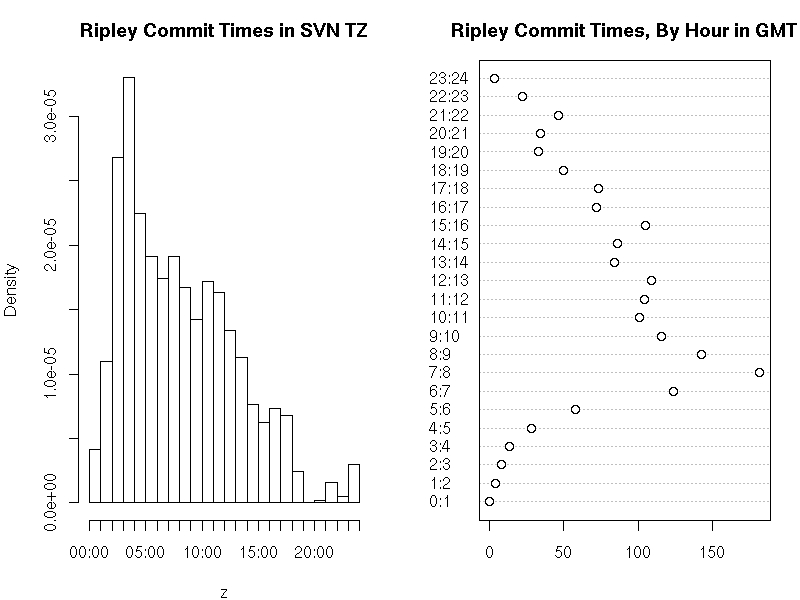
In five lines (that could be shortened to three at the expense of some readibility), the SVN log for R is downloaded directly from the website, the revision authors are extraced and then tabulated by submitter. The relative percentage of Brian Ripley is found to be a staggering 74.8% -- or about three times as much as the other fifteen committers combined. Smokes. [ Oh, and for those who don't know him, he's also got a day job which presumably entails looking after his graduate students at Oxford. Who knows, he may even teach. Kidding aside, he's actually one of the nicest persons you'll ever meet in real life. ] Now yesterday, Simon Jackman who had at first simply repeated Ben's analysis on his own blog followed up with a nice analysis (albeit typeset in a way that rendered the code inoperational, which has now been fixes) that creates both a histogram and a dotplot of commits per hour of the day. Omitting Ben's code which Simon reuses, we have the following for histogram and dotchart:
tod <- unlist(sapply(rx,function(x)strsplit(x,split=" ")[[1]][6]))
tod <- tod[who=="ripley"]
tz <- sub(pattern=".*(-[0-9] 4 ).*",replacement="\\1",x=rx)
tz <- tz[who=="ripley"]
tz <- as.numeric(tz)/100
offset <- 3600*tz
z <- strptime(tod,format="%H:%M:%S")
hist(z,"hours",main="Ripley Commit Times in SVN TZ")
h <- z - offset
h <- format(h,format="%H")
h <- factor(as.numeric(h), levels=0:23)
dotchart(table(h), main="Ripley Commit Times, By Hour in GMT",
         labels=paste(0:23,1:24,sep=":"))
This extracts the commit times, subsets to the ones by Prof. Ripley, extracts the timezones component (as strptime seemingly doesn't do that which is a pain), extracts the tz-less time via strptime into a variable 'z' for which the histogram is drawn. He then corrects the times by the tz offset expressed in seconds, formats is as hour of the day and turns it into a 'factor' (an R data type for qualitative variables which may be ordered as is the case here) and draws a dotplot. This results in the following chart: Simon Jackman's per-hour charts of Brian Ripley's commit patterns Now, nobody has looked at the time series. So we correct this and add the following:
## rather extract both  date and time
dat <- unlist(sapply(rx, function(x)  
  txt <- strsplit(x,split=" ")[[1]]
  paste(txt[5], txt[6])
 ))
## subset on Prof Ripley
dat <- dat[who == "ripley"]
## and convert to POSIXct, correcting by tz as well
datpt <- as.POSIXct(strptime(dat,format="%Y-%m-%d %H:%M:%S")) - offset
## turn into zoo -- we use a constant series of ones as each
## committ is taken as a timestamped event
datzoo <- zoo(1, order.by=datpt)
## and use zoo to aggregate into commits per date
daily <- aggregate(datzoo, as.Date(index(datzoo)), sum)
## now plot as grey bars
plot(daily, col='darkgrey', type='h', lwd=2,
     ylab="Nb of SVN commits, three-week median",
     xlab="R release dates 2.5.0 and 2.5.1 shown in orange",
     main="The amazing Prof. Ripley")
## mark the two R releases of 2007
abline(v=c(as.Date("2007-04-24"),as.Date("2007-06-28")),col='orange',lwd=1.5)
## and do a quick centered rolling median
lines(rollmedian(daily, 21, align="center"), lwd=3)
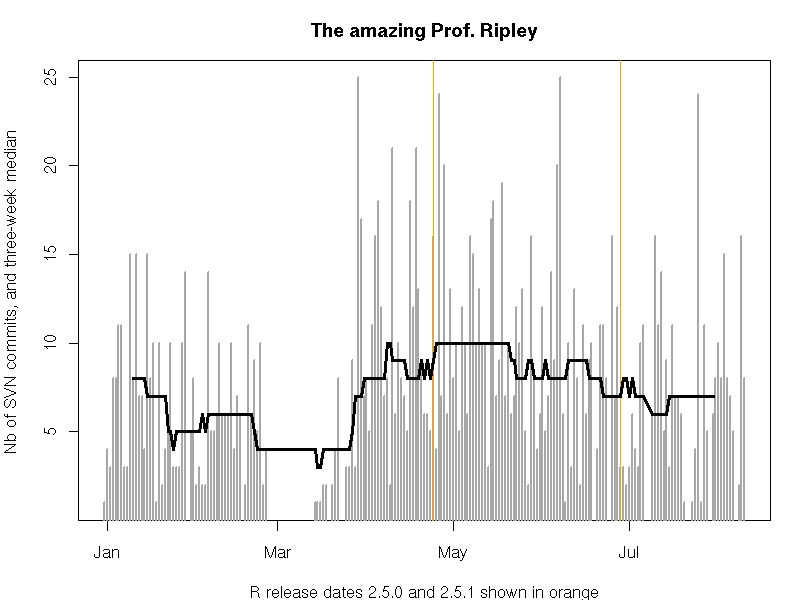
This extracts both date and time, creates a proper R time object (a so-called POSIXct type) from it, fills a zoo ('the' magic class for time series) object with it, uses zoo to aggregate commits per day and plots those in a barchart-alike (I know, I know, ...) plot to which we add the two releases as well as a rolling and centered three-week median (as a real quick hack rather than a proper smooth). Timeseries of Brian Ripley's commit patterns This shows that Prof Ripley averaged about ten commits a day before and after the release of R 2.5.0, and that he has slowed down ever so slightly since then to end up at around a mere seven commits a day. Every day. For the seven-plus months we looked at. So, anyone for analysing his r-help posting frequencies ?

27 July 2007

Uwe Hermann: Testing stuff with QEMU - Part 3: Debian GNU/kFreeBSD

Debian GNU/kFreeBSD screenshot 1
Note: This article is part of my Testing stuff with QEMU series.
From the Debian GNU/kFreeBSD port page:
Debian GNU/kFreeBSD is a port that consists of GNU userland using the GNU C library on top of FreeBSD's kernel, coupled with the regular Debian package set.
Q: Why would anybody want to do that?
A: Why not? [1] So, after we have talked about that, let's start:
  1. Install QEMU:
    apt-get install qemu
  2. Download the latest Debian GNU/kFreeBSD installer ISO image (either for i386 or amd64):
    wget http://glibc-bsd.alioth.debian.org/install-cd/kfreebsd-i386/20070313/debian-20070313-kfreebsd-i386-install.iso
  3. Create a QEMU image which will hold the Debian GNU/kFreeBSD (i386) installation:
    qemu-img create -f qcow2 qemu_kfreebsd_i386.img 5G
  4. Boot directly from the ISO image and install Debian into the QEMU image:
    qemu -boot d -cdrom debian-20070313-kfreebsd-i386-install.iso -hda qemu_kfreebsd_i386.img
  5. The FreeBSD installer will now start. For more detailed instructions see the Installing Debian GNU/kFreeBSD manual.
    First you can choose between an "Express" or "Custom" install (I used "Express").
  6. Next you end up in the partitioning tool. Type "a" to use the entire (QEMU) disk for the installation (the disk is called "ad0", not "hda" as on Linux). Type "q" to quit the partitioning tool.
  7. You are now asked which boot manager to use. For QEMU you should use "BootMgr", the default FreeBSD boot manager. If you install on real hardware you can also use GRUB; in that case choose "None" here (see the manual for more information), but note that the installer does not install or configure GRUB for you! You should do that beforehand!
  8. Next up: The disklabel editor. Here you'll create a partition ("slice" in FreeBSD-speak) for the root filesystem and a swap partition.
    Press "c" to create a new slice (will be called "ad0s1"), enter "4GB", choose "FS" (filesystem), and enter "/" for the root filesystem. Per default the UFS2 file system will be used. To create the swap partition, press "c" again, enter "1023MB", and select "swap". The new slice is called "ad0s1b". Press "q" to quit.
  9. Choose "minimal" when asked which distribution to install.
  10. Installation media dialog: select "CD/DVD" and "acd0" (for QEMU's ATAPI/IDE CD-ROM drive).
  11. The installation will now begin, and after a while you're asked to switch to console 3 using ALT-F3. Do it.
  12. You'll have to answer a bunch of questions: geographic area + city you're in (for timezone), whether you want to participate in the Debian popularity contest, whether module-init-tools should load additional drivers (no, so press ENTER three times). The installation will soon be finished.
At the end you must select "No" as you're told to do, then reboot via "Exit Install". You can then shutdown QEMU.
  1. Restart QEMU with the newly installed Debian GNU/kFreeBSD:
    qemu -hda qemu_kfreebsd_i386.img
    Debian GNU/kFreeBSD screenshot 2
  2. Press enter at the FreeBSD boot manager prompt, then login as root (there's no password).
  3. First things first: Set up a root password:
    passwd
  4. Now let's fix networking, update the system and install a bunch of packages:
    nano /etc/network/interfaces
    Yes, there's no vi, not even a symlink to nano! Uncomment the two "ed0" lines ("ed0" is the equivalent to "eth0" on Linux, I guess).
    /etc/init.d/networking restart
    apt-get update && apt-get dist-upgrade
    apt-get install vim xorg icewm xterm
  5. You can fix your console keymap using the kbdcontrol package (just select your keymap from the menu):
    apt-get install kbdcontrol
  6. Finally, let's fix X11 and start it. But first we create a new user, as we don't want to run X11 as root:
    adduser uwe
    vi /etc/X11/xorg.conf
    The mouse device is "/dev/psm0", the protocol "PS/2", and the graphics driver should be "vesa":
  Section "InputDevice"
      Option "Device" "/dev/psm0"
      Option "Protocol" "PS/2"
  [...]
  Section "Device"
      Driver "vesa"
    
  • That's about it. Login as "uwe" (or whatever your username is) and start X11:
    startx
  • Wasn't all that hard, eh? Now, if you've got some spare time, head over to the Debian GNU/kFreeBSD wiki page and help improving this port ;-) You should probably start with reading the PORTING guide. Both kfrebsd-i386 and kfreebsd-amd64 seem to be reasonably stable already (and more than 70% of the whole Debian archive builds fine on these architectures, see kfreebsd-i386_stats and kfreebsd-amd64_stats). I'll quite likely install kfreebsd-amd64 on one of my boxes soonish and start using it, maybe I'll even find some time to fix/patch/port some packages... [1] More elaborate answer(s) and reasons are available in the Debian wiki.

    Next.

    Previous.