Search Results: "matthew"

15 October 2013

Matthew Garrett: Hacker News is a social echo chamber

Hacker News is a fairly influential link aggregation site, with stories submitted and voted on by users. As explained in the FAQ, the ranking of stories is roughly determined by the number of votes divided by a function of the time since submission. It's not a huge traffic driver (my personal experience of stories on the front page is on the order of 30,000 hits), but it's notable because the demographic tends to include a more technically literate and influential set of readers than most other sites. The discussion that ensues from technical posts often includes meaningful feedback from domain experts. Stories that appear there are likely to be noted by technology workers, especially in the Silicon Valley startup field[1].

That rather specific demographic appears to correlate with other traits. There's a rather more techno-libertarian bias on Hacker News than on most general discussion forums, which is consistent with the startup-oriented culture that it springs from - the desire to provide disruptive solutions to real world problems tends to collide with existing regulatory frameworks, so it's unsurprising that a belief in individual rights and small government would overlap with US startup culture. There's a leaning towards the use of web technologies rather than traditional client applications, which matches what people are doing in the rest of the world. And there's more enthusiasm for liberal open-source licenses over Copyleft licenses, which makes sense in a web-focused environment (as I wrote about here).

Now, personally I'm a big-government, client-app, Copyleft kind of person, but for the most part I don't think the above is actively dangerous. It's inevitable that political views will vary, we'll probably continue to cycle between thick and thin clients for generations and nobody's ever going to demonstrably prove that one licensing model deserves to win over another. But what is important is that the ongoing debates between these opinions be driven by facts, and that it remain obvious that these disagreements exist. As far as technical (and even political) discussion goes, Hacker News doesn't seem to
have a problem with that. Disagreeing with the orthodoxy is tolerated.


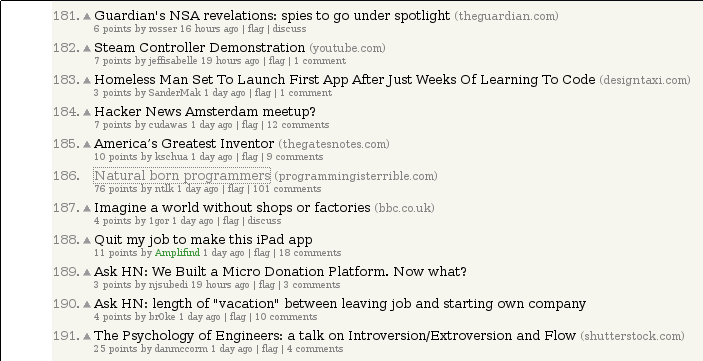
This seems less true when it comes to social issues. When a posting discussing the myth of the natural born programmer[2] hit the front page, the top rated comment is Paul Graham[3] off-handedly discounting the conclusions drawn. The original story linked to a review of peer-reviewed scientific research. Graham simply discounts it on the basis of his preconceptions. Shortly afterwards, the story plummeted off the front page, now surrounded by stories posted around the same time but with much lower scores.

How does this happen? There's two publicised methods which can result in stories dropping down the order. Users with high karma scores (either via submitting popular stories or writing popular comments) are able to flag submissions, and if enough do so then a negative weighting is applied to the story. There's also a flamewar detector, a heuristic that attempts to detect contentious subjects and pushes them off the front page.

The effect of both is to enforce the status quo of social beliefs. Stories that appear to challenge the narrative that good programmers are just naturally talented tend to vanish. Stories that discuss the difficulties faced by minorities in our field are summarily disappeared. There are no social problems in the technology industry. We have always been at war with Eastasia.

This isn't healthy. We don't improve the state of the software industry by hiding stories that expose conflicts. Flamewars don't solve problems, but without them we'd be entirely unaware of how much of a victim blaming mentality exists amongst our peers. It's true that conflict may reinforce preconceptions, causing people to dig in as they defend their beliefs. However, the absence of conflict does nothing to counteract that. If you're never exposed to opinions you disagree with, you'll never question your existing beliefs.

Hacker News is a privately run site and nobody's under any obligation to change how they choose to run it. But the focus on avoiding conflict to such an extent that controversial stories receive less exposure than ones that fit people's existing beliefs doesn't enhance our community. If we want to be able to use technology as an instrument of beneficial change to society as a whole, we benefit from building a diverse and welcoming community and questioning our preconceptions. Building a social echo chamber risks marginalising us from the rest of society, gradually becoming ignored and irrelevant as our self-reinforcing opinions drift ever further away from the mainstream. It doesn't help anybody.

[1] During the batch of interviews I did last year, two separate interviewers both mentioned a story they'd read on Hacker News that turned out to have been written by me. I'm not saying that that's what determined a hire/don't hire decision, but it seems likely that it helped.
[2] The article in question discusses the pervasive idea that some people are inherently good programmers. It turns out that perpetuating the idea that some people are just born good at a particular skill actually discourages others from even trying to learn it, even those who are just as capable.
[3] One of the co-founders of Y-Combinator and creator of Hacker News.

(Edited to fix a footnote reference)

comment count unavailable comments

13 October 2013

Matthew Palmer: RACK_ENV: It's not *for* you

(With apologies to Penny Arcade I m probably the last person on earth to realise this, but the RACK_ENV environment variable (and the -E option to rackup) isn t intended for consumption by anything other than Rack itself. If you want to indicate what sort of environment your application should run in, you re going to have to do it via some other means. Why is this? Because the interpretation that Rack applies to the value of RACK_ENV that you set makes no sense whatsoever outside of Rack. Valid options are development , deployment , and none . If you follow the usual Rails convention of naming your environments development , test , and production (and maybe staging if you re feeling adventurous), then in any environment other than development , you re not going to be telling Rack anything it understands. As I said, I may be the last person on earth to have worked this out, but I doubt it. There are plenty of bug reports and WTF? blog posts and Stack Overflow questions that appear to stem from people misunderstanding the purpose of RACK_ENV. Sadly, the Rack documentation is very quiet on the whole topic, and the only place that mentions how the environment is interpreted is in the comments for Rack::Server.new and that doesn t tie that environment to the -E option or RACK_ENV environment variable. At any rate, the take away is simple: unless you want Rack to pre-configure a bundle of middleware for you, RACK_ENV or rackup -E is not the configuration variable you re looking for. Use something else to tell your app how it s supposed to work.

10 October 2013

Matthew Palmer: How *not* to respond to interview feedback

Seen at $DAYJOB, from a candidate we rejected due to a pretty poor showing in a phone interview:
May I suggest that your company puts in place a more effective way of interviewing potential candidates. Please pass this to comment to your senior management so they may look at improving this process.
I m not sure I ve ever seen such a clear confirmation that our interviewing process is working as intended. While we hire for smart people who don t meekly accept the status quo, we d prefer it if our staff don t mouth off when things don t go their way. Customers tend to frown on such outbursts.

2 October 2013

Matthew Garrett: The state of XMir

XMir's been delayed from Ubuntu 13.10. The stated reason is that multi-monitor support isn't sufficiently reliable. That's true, but it's far from the only problem that XMir still has:

It's clear that XMir has turned into a larger project than Canonical had originally anticipated, but that's hardly surprising. There's only one developer with previous X experience working on it full-time, and the announced schedule provided no opportunity to deal with unexpected problems. As if that weren't enough, there's obvious conflict between Ubuntu Desktop and Ubuntu Phone when it comes to developer time and required functionality. The one hardware vendor who's willing to take a public stand has demonstrated that they have no interest in supporting XMir, despite Canonical assuring people that they were already engaging in productive negotiations with GPU manufacturers.

Multiple monitor support may be the single most obvious feature where XMir is lacking, but it's not the only one. Technically and politically, this code is a long way from being ready for prime time. Without significant community contribution, Canonical need to focus on prioritising it appropriately rather than expecting a tiny number of developers to perform miracles. Or, alternatively, they could just drop XMir entirely and focus on Unity 8.

comment count unavailable comments

Matthew Palmer: A vim-outliner cheatsheet

Being a bit of a vim-outliner fanatic, but having an inability to remember all of the various key combos, is a sad place to be. Having lived there for far too long, I finally got up the energy to learn enough Inkscape to produce my very own vim-outliner cheatsheet. One more thing I can ,,x

22 September 2013

Matthew Garrett: Implementing UEFI Boot to Zork

One of the earlier examples of students using MIT computer resources to lay the groundwork for a later commercial endeavour, Zork was originally written in a LISP derivative called MDL. This was later tuned into the Zork Implementation Language, a domain specific language that was compiled to target the Z-machine rather than a specific piece of hardware. Combined with machine-specific Z-machine interpreters, this allowed rapid porting of games to a wide range of platforms - the only thing that needed to be rewritten was the interpreter, and that could be reused for any future games running on the same hardware. Infocom were eventually acquired and killed off, but fan interest in their games continued. New Z-machine interpreters were written in order to allow their games (including Zork) to be run on platforms that Infocom had never targetted. One of the best known is Frotz. This has the advantage of being (a) portable and (b) including a "dumb" UI that makes no assumptions about the availablity of any vaguely useful functionality. Like, say, a Curses library. So, Frotz seemed like the natural choice when this happened. But despite having a set of functionality that makes it look much more like an OS than a boot environment, UEFI doesn't actually expose a standard C library. The EFI Application Development Kit solves this particular design decision. Porting Frotz ended up involving far more fixing up of Frotz bugs that tripped up -Werror than anything else. One note, though - make sure you include DevShell in the list of required packages at build time, otherwise file i/o will mysteriously fail. The tying of file i/o to the shell protocol unfortunately means that Frotz can't be directly launched by the firmware. The Boot to Zork images therefore contain a UEFI shell in the standard boot location (\EFI\BOOT\BOOTX64.EFI) which is executed when the firmware attempts to boot the device. The shell then looks for a file called "startup.nsh" in the root directory of the boot device and executes it. Unfortunately this doesn't actually set the shell equivalent of the current device, and so just launching Frotz from startup.nsh fails when Frotz can't open the Zork data file. The solution for this is simple, if ugly - the script walks through the list of devices, looking for one that contains ZORK1.DAT in the root directory. It then changes to that device and launches Frotz. If Frotz exits, it then resets the system. This could be avoided by doing some more work and turning Frotz into a more UEFI-native application. Teaching Frotz to make native UEFI calls would avoid the requirement for the shell protocols, and the firmware provides a mechanism to obtain the path of the currently running executable which would avoid the need to explicitly locate the device. But I'm lazy and this was a "I'm spending the day on a plane" project initially inspired by a Sazerac-fuelled conversation during the UEFI plugfest, not a demonstration of UEFI best practices. UEFI Boot To Zork and the source code to the modified Frotz can be downloaded here.

comment count unavailable comments

15 September 2013

Ben Hutchings: The terrible state of EFI variable storage

EFI includes support for storing persistent 'variables': it implements a key-value store where keys are (UUID, string) and values are arbitrary blobs. (There are also some flags that restrict when the variables can be accessed.) The physical storage medium is normally flash. The Linux efivars module provides access to variable storage, both through a specific interface in sysfs and through the somewhat abstracted pstore interface. An EFI implementation reads the boot order and (if applicable) Secure Boot configuration from specific EFI variables. An operating system can add arbitrary variables, using its own UUID(s). On Linux, the efibootmgr utility is used to read and write the boot order and the pstore interface is used within the kernel to dump kernel log messages or other information when particular events occur. Since efivars is needed to set the boot order on EFI systems, it's a critical part of installation. But it wasn't being loaded on Debian systems until efibootmgr was run. This doesn't work so well when using a rescue system, as the installation kernel and installed kernel may be different (Debian bug 703363). In future (Debian package version 3.2.41-1) this will be loaded automatically on EFI systems. But now comes a new problem: bugs in the implementation of variable storage can prevent a system from booting, and even worse, they may prevent manual recovery without special equipment (the system is 'bricked'). Matthew Garrett recently talked about this and mentioned that some Samsung laptops are bricked if the variable storage becomes more than 50% full. efivars now has some extra checks to avoid triggering this (both in mainline and in stable branches). This isn't the end of the story, unfortunately. Remember that nothing can be overwritten in flash without erasing a relatively large block, and that writes may fail after a few thousand erase cycles (number depending on the type of flash used). Therefore, deleting a variable usually does not free storage immediately, and overwriting a variable usually reduces the amount of free storage. In the case of the Samsung laptops, unused storage is apparently reclaimed at the next reboot. However, while testing the backported efivars changes I found that my EFI-booting system (Asus P8Z68-V LX motherboard) does not reclaim unused storage until it's very nearly full. Since the firmware itself increments a counter variable on every boot, using 36 more bytes of storage, I was able to observe the available space dropping to under 100 bytes, and then after another boot jumping to about 42K (out of 64K). This means that well over 50% of storage was unused, yet efivars would refuse to write any variables because the firmware didn't reclaim it. This would prevent (re)installation of Linux, as the boot configuration could not be written. On the assumption that both behaviours are common, I've settled on a compromise that I hope minimises overall risk: But it's essential that we find a way to identify and work safely with both behaviours. Not only do I want to eliminate the possibility of bricking or installaton failure, but I want to make EFI-backed pstore safe to enable. Crash logs are often hard to obtain and pstore can help to solve that problem. Updated 2013-09-15: The free space check has been revised (in Linux 3.2.48, 3.5.7.17, 3.8.13.5, 3.9.7 and 3.10) based on advice from Samsung. The kernel leaves at least 5K (rather than 50%) of the EFI variable store free. If it is about to breach this limit, it attempts to write a dummy variable that is larger than the free space, which will either fail or trigger garbage collection. The normal variable can then be written if garbage collection freed up enough space. This check can be disabled using the kernel parameter efi_no_storage_paranoia, but there should be no need to do so.

22 August 2013

Matthew Garrett: Re: Default offerings, target audiences, and the future of Fedora

Eric (a fellow Fedora board member) has a post describing his vision for what Fedora as an end goal should look like. It's essentially an assertion that since we have no idea who our users are or what they want, we should offer them everything on an equal footing.

Shockingly enough, I disagree.

At the most basic level, the output of different Special Interest Groups is not all equal. We've had issues over the past few releases where various spins have shipped in a broken state, because the SIG responsible for producing them doesn't have the resources to actually test them. We're potentially going to end up shipping F20 with old Bluetooth code because the smaller desktops aren't able to port to the new API in time[1]. Promoting these equally implies that they're equal, and doing so when we know it isn't the case is a disservice to our users.

But it's not just about our users. Before I joined the Fedora project, I'd worked on both Debian and Ubuntu. Debian is broadly similar to the current state of Fedora - no strong idea about what is actually being produced, and a desire among many developers to cater to every user's requirements. Ubuntu's pretty much the direct opposite, with a strongly defined goal and a willingness to sacrifice some use cases in order to achieve that goal.

This leads to an interestingly different social dynamic. Ubuntu contributors know what they're working on. If a change furthers the well-defined aim of the project, that change happens. Moving from Ubuntu to Fedora was a shock to me - there were several rough edges in Fedora that simply couldn't be smoothed out because fixing them for one use case would compromise another use case, and nobody could decide which was more important[2]. It's basically unthinkable that such a situation could arise in Ubuntu, not just because there was a self appointed dictator but because there was an explicit goal and people could prioritise based on that[3].

Bluntly, if you have a well-defined goal, people are more likely to either work towards that goal or go and do something else. If you don't, people will just do whatever they want. The risk of defining that goal is that you'll lose some of your existing contributors, but the benefit is that the existing contributors will be more likely to work together rather than heading off in several different directions.

But perhaps more importantly, having a goal can attract people. Ubuntu's Bug #1 was a solid statement of intent. Being freer than Microsoft wasn't enough. Ubuntu had to be better than Microsoft products on every axis, and joining Ubuntu meant that you were going to be part of that. Now it's been closed and Ubuntu's wandered off into convergence land, and signing up to spend your free time on producing something to help someone sell phones is much less compelling than doing it to produce a product you can give to your friends.

Fedora should be the obvious replacement, but it's not because it's unclear to a casual observer what Fedora actually is. The website proudly leads with a description of Fedora as a fast, stable and powerful operating system, but it's obvious that many of the community don't think of Fedora that way - instead it's a playground to produce a range of niche derivatives, with little consideration as to whether contributing to Fedora in that way benefits the project as a whole. Codifying that would actively harm our ability to produce a compelling product, and in turn reduce our ability to attract new contributors even further.

Which is why I think the current proposal to produce three first-class products is exciting. Offering several different desktops on the download page is confusing. Offering distinct desktop, server and cloud products isn't. It makes it clear to our users what we care about, and in turn that makes it easier for users to be excited about contributing to Fedora. Let's not make the mistake of trying to be all things to all people.

[1] Although clearly in this case the absence of a stable ABI in BlueZ despite it having had a dbus interface for the best part of a decade is a pretty fundamental problem.
[2] See the multi-year argument over default firewall rules and the resulting lack of working SMB browsing or mDNS resolving
[3] To be fair, one of the reasons I was happy to jump ship was because of the increasingly autocratic way Ubuntu was being run. By the end of my involvement, significant technical decisions were being made in internal IRC channels - despite being on the project's Technical Board, I had no idea how or why some significant technical changes were being made. I don't think this is a fundamental outcome of having a well-defined goal, though. A goal defined by the community (or their elected representatives) should function just as well.

comment count unavailable comments

Matthew Garrett: If you ever use text VTs, don't run XMir right now

It'd be easy to assume that in a Mir-based world, the Mir server receives input events and hands them over to Mir clients. In fact, as I described here, XMir uses standard Xorg input drivers and so receives all input events directly. This led to issues like the duplicate mouse pointer seen in earlier versions of XMir - as well as the pointer being drawn by XMir, Mir was drawing its own pointer.

But there's also some more subtle issues. Mir recently gained a fairly simple implementation of VT switching, simply listening for input events where a function key is hit while the ctrl and alt modifiers are set[1]. It then performs the appropriate ioctl on /dev/console and the kernel switches the VT. The problem here is that Mir doesn't tell XMir that this has happened, and so XMir still has all of its input devices open and still pays attention to any input events.

This is pretty easy to demonstrate. Open a terminal or text editor under Xmir and make sure it has focus. Hit ctrl+alt+f1 and log in. Hit ctlr+alt+f7 again. Your username and password will be sitting in the window.

This is Launchpad bug 1192843, filed on the 20th of June. A month and a half later, Mir was added to the main Ubuntu repositories. Towards the bottom, there's a note saying "XMir always listening to keyboard, passwords may appear in other X sessions". This is pretty misleading, since "other X sessions" implies that it's only going to happen if you run multiple X sessions. Regardless, it's a known bug that can potentially leak user passwords.

So it's kind of odd that that's the only mention of it, hidden in a disused toilet behind a "Doesn't work on VESA" sign. If you follow the link to installation instructions you get this page which doesn't mention the problem at all. Now, to be fair, it doesn't mention any of the other problems with Mir either, but the other problems merely result in things not working rather than your password ending up in IRC.

This being developmental software isn't an excuse. There's been plenty of Canonical-led publicity about Mir and people are inevitably going to test it out. The lack of clear and explicit warnings is utterly inexcusable, and these packages shouldn't have landed in the archive until the issue was fixed. This is brutally irresponsible behaviour on the part of Canonical.

So, if you ever switch to a text VT, either make sure you're not running XMir at the moment or make sure that you never leave any kind of network client focused when you switch away from X. And you might want to check IRC and IM logs to make sure you haven't made a mistake already.

[1] One lesser-known feature of X is that the VT switching events are actually configured in the keymap. ctrl+alt+f1 defaults to switching to VT1, but you can remap any key combination to any VT switch event. Except, of course, this is broken in XMir because Mir catches the keystroke and handles it anyway.

comment count unavailable comments

10 August 2013

Matthew Garrett: When to add a platform-specific quirk to a Linux driver

If you're tempted to add a platform-specific quirk to a Linux driver, pause and do the following:

  1. Check whether the platform works correctly with the generic Windows driver for the hardware in question. If it requires a platform-specific driver rather than the generic one, adding a quirk is probably ok.
  2. If the generic Windows driver works, check whether there's any evidence of platform-specific code in the Windows driver. This will typically be in the .inf file, but occasionally you'll want to run strings against the Windows driver and see whether any functions or strings match the platform in question. If there's evidence of special-casing in the generic Windows driver, adding a quirk is probably ok
  3. If the generic Windows driver works and doesn't appear to have any platform-specific special casing, don't add a quirk. You'll plausibly fix the machine you care about, but you won't fix any others that have the same behaviour. Even worse, if someone does eventually fix the problem properly, there's a risk that your special-casing will now break your system.

The moral to this story is: if you think adding a quirk is the right solution, you're almost certainly wrong.

comment count unavailable comments

1 August 2013

Matthew Garrett: Don't ship 32-bit UEFI firmware on x86

Shipping a UEFI-bootable Linux distribution is a touch awkward[1], with the main sticking point being the necessity to produce boot media with multiple El-Torito images. An El-Torito image is either an image of a floppy disk or a small hard drive, embedded into the ISO. This allows BIOS systems to look for an El Torito image, hook some interrupts and then boot without the BIOS having to care about the fact that the image is embedded in an ISO-9660 filesystem. UEFI systems will look for an El-Torito image with a special tag - if they find it they'll mount it as a FAT filesystem and look for a bootloader, and if not they'll fall back to BIOS compatibility.

So, if you want a CD that'll boot on both BIOS and UEFI systems, you need two El-Torito images - one for BIOS, one for UEFI. Unfortunately, various BIOSes deal exceptionally badly with CD images that contain more than one El-Torito image. The most common failure case is to print a menu asking you to choose an option without labelling the options, but some will just fail outright. Thankfully, this is pretty much exclusively limited to 32-bit systems.

Things get irritatingly more complicated due to a quirk of UEFI. UEFI is based on executing code in native mode. That means that 32-bit UEFI systems can't execute 64-bit code in firmware, even if the CPU is capable of it. A 64-bit OS can only boot on 32-bit UEFI if it has very ugly compatibility hacks, including having to rewrite structures and register state every time it makes a UEFI call. The only OS I'm aware of that implements this is MacOS X. Having looked into what it'd take to implement it in Linux, I decided that hammering rusty nails through my feet would be a preferable use of time. Thankfully, I went drinking instead.

So distributions have a choice. They can either produce UEFI-bootable CD images for 32-bit x86 and risk failures on actual 32-bit systems, or they can ignore UEFI entirely on 32-bit and succeed in booting on all the hardware that people actually own[2]. Unsurprisingly, they tend to choose the second option.

So, if you're building an x86 hardware platform, don't ship with 32-bit UEFI. If you're stuck with a 32-bit CPU then just ship BIOS. If you have a 64-bit CPU then ship a 64-bit UEFI. If you ship with 32-bit UEFI, no significant existing Linux distribution will support you, and you'll face an uphill battle to convince them to do so.

32-bit UEFI. Just say what on earth were you thinking, please, no, can't you find a solution that doesn't involve me getting tetanus jabs.

(If you're worried about the extra memory consumption of 64-bit OSes, just encourage 32-bit userspace on a 64-bit kernel. Or just boot via BIOS)

[1] See the number that still don't manage it despite having had several years to adapt
[2] Until recently, the only vendor to ship 32-bit UEFI firmware on volume hardware was Apple. This was fine on their 32-bit systems, but on their 64-bit systems with 32-bit UEFI booting a 64-bit version of Windows would result in boot failure. Apple rectified this by stating that 64-bit Windows wasn't supported on platforms with 32-bit UEFI, which is a neat trick if you can manage it. 32-bit Windows (and Linux) was fine because it didn't include a UEFI boot image and so didn't trigger the bug.

comment count unavailable comments

22 July 2013

Matthew Garrett: ARM and firmware specifications

Jon Masters, Chief ARM Architect at Red Hat, recently posted a description of his expectations for baseline arm64 servers. The quick summary is that systems should implement UEFI and ACPI, and any more traditional ARM boot mechanisms should be ignored. This is an interesting departure from the status quo in the ARM world, and it's worth thinking about the benefits and drawbacks of this approach.

It's very easy to build a generic kernel for most x86 systems, since the PC platform is fairly well defined even if not terribly well specified. Where system hardware does vary, it's almost always exposed on an enumerable bus (such as PCI or USB) which allows the OS to bind appropriate drivers. Things are different in the ARM world. Even once you're past the point of different SoC vendors requiring different kernel setup code and drivers, you still have to cope with the fact that system vendors can wire these SoCs up very differently. Hardware is often attached via GPIO lines without any means to enumerate them. The end result is that you've traditionally needed a different kernel for every ARM board. This is viable if you're selling the OS and hardware as a single product, but less viable if there's any desire to run a generic OS on the hardware.

The solution that's been adopted for this in the Linux world is called Device Tree. Device Tree actually has significant history, having been used as the device descriptor format in Open Firmware. Since there was already support for it in the Linux kernel, adapting it for use in ARM devices was straightforward. Device Tree aware devices can pass a descriptor blob to the kernel at startup[1], and devices without that knowledge can have a blob build into the kernel.

So, if this problem is already solved, why the push to move to UEFI and ACPI? This push didn't actually originate in the Linux world - Microsoft mandate that Windows RT devices implement UEFI and ACPI, and were they to launch a Windows ARM server product would probably carry that over. That makes sense for Microsoft, since recent versions of Windows have been x86 only and so have grown all kinds of support for ACPI and UEFI. Supporting Device Tree would require Microsoft to rewrite large parts of Windows, whereas mandating UEFI and ACPI allowed them to reuse most of their existing Windows boot and driver code. As a result, largely at Microsoft's behest, ACPI 5 has grown a range of additional features for describing things like GPIO pinouts and I2C connections. Whatever your weird device layout, you can probably express it via ACPI.

This argument works less well for Linux. Linux already supports Device Tree, whereas it currently doesn't support ACPI or UEFI on ARM[2]. Hardware vendors are already used to working with Device Tree. Moving to UEFI and ACPI has the potential to uncover a range of exciting new kernel issues and vendor bugs. It's not obviously an engineering win.

So how about users? There's an argument that since server vendors are now mostly shipping ACPI and UEFI systems, having ARM support these technologies makes it easier for customers to replace x86 systems with ARM systems. This really doesn't fly for ACPI, which is entirely invisible to the user. There are no standard ACPI entry points for system configuration, and the bits of ACPI that are generically useful (such as configuring system wakeup times) are already abstracted away to a standard interface by the kernel. It's somewhat more compelling for UEFI. UEFI supports a platform-independent bytecode language (EFI Byte Code, or EBC), which means that customers can write their own system management utilities, build them for EBC and then deploy them to their servers without caring about whether they're x86 or ARM. Want a bootloader that'll hit an internal HTTP server in order to determine which system image to deploy, and which works on both x86 and ARM? Straightforward.

Arnd Bergmann has a interesting counterargument. In a nutshell, ARM servers aren't currently aiming for the same market as x86 servers, and as a result customers are unlikely to gain any significant benefit from shared functionality between the two.

So if there's no real benefit to users, and if there's no benefit to kernel developers, what's the point? The main one that springs to mind is that there is a benefit to distributions. Moving to UEFI means that there's a standard mechanism for distributions to interact with the firmware and configure the bootloader. The traditional ARM approach has been for vendors to ship their own version of u-boot. If that's in flash then it's not much of a problem[3], but if it's on disk then you have to ship a range of different bootloaders and know which one to install (and let's not even talk about initial bootstrapping).

This seems like the most compelling argument. UEFI provides a genuine benefit for distributions, and long term it probably provides some benefit to customers. The question is whether that benefit is worth the flux. The same distribution benefit could be gained by simply mandating a minimum set of u-boot functionality, which would seem much more straightforward. The customer benefit is currently unclear.

In the end it'll probably be a market decision. If Red Hat produce an ARM product that has these requirements, and if Suse produce an ARM product that will work with u-boot and Device Tree, it'll be up to vendors to decide whether the additional work to support UEFI/ACPI is worth it in order to be able to sell to customers who want Red Hat. I expect that large vendors like HP and Dell will probably do it, but the smaller ones may not. The customer demand issue is also going to be unclear until we learn whether using UEFI is something that customers actually care about, rather than a theoretical benefit.

Overall, I'm on the fence as to whether a UEFI requirement is going to stick, and I suspect that the ACPI requirement is tilting at windmills. There's nothing stopping vendors from providing a Device Tree blob from UEFI, and I can't think of any benefits they gain from using ACPI instead. Vendor interest in the generic parts of the ACPI spec has been tepid even in the x86 world (the vast majority of ACPI spec updates come from Microsoft and Intel, not any of the system vendors), and I don't see that changing with the introduction of a range of ARM vendors who are already happy with Device Tree.

We'll see. Linux is going to need to gain the support for UEFI and ACPI on ARM in any case, since there's already hardware shipping in that configuration. But with ARM vendors still getting to grips with Device Tree, forcing them to go through another change in how they do things is going to be hard work. Red Hat may be successful in enforcing these requirements at the cost of some vendor unhappiness, or Red Hat may find that their product doesn't boot on most of the available hardware. It's an aggressive gamble, and while it'll be interesting to see how it plays out, I'm not that optimistic.

[1] The blob could be pulled from the firmware, but it's not uncommon for it to be built into u-boot instead. This does mean that you have a device-specific u-boot even if you have a generic kernel, but that's typically true anyway.
[2] Patches have been posted for ARM UEFI support. They're not mergeable in their current form, but they should be in the near future. ACPI support is in development.
[3] Although not all u-boots are created equal - some vendors ship versions that will only boot off FAT, some vendors ship versions that will only boot off ext2. Having to special case this stuff in your installer is a pain.

comment count unavailable comments

Daniel Pocock: Winning at any cost

It's not every day that a student messing around with keystroke loggers comes to fame through slashdot. Nonetheless, systematically rigging an election and getting sentenced to 12 months in a dorm with bars has helped raise 22 year old Matthew Weaver's profile well above that of the average script kiddie. Now let's stop and reflect on poor Weaver's future. You may be thinking that with an exchange program like this on his academic record he won't be so popular with employers. Given that he was busted by campus security rather than the FBI he won't even attract the interest of those companies who hire ex-hackers. So where could he go? How is it done in Australia? Not too long ago, when I was a student myself, one of our prominent universities was subjected to a very similar scam. Four members of the Tin Tin for NUS ticket at La Trobe University were implicated in stuffing the ballot the old fashioned way. The incidents even share the characteristics of chronic stupidity: just as Weaver had been caught voting for himself 259 times from the same IP address in a campus computer lab, team Tin Tin had tried to hand their bag of manipulated postal votes directly to the deputy returning officer rather than discretely posting them through the internal mail. According to an official report by the Deputy Returning Officer, Karsten Haley, all four candidates were charged with Dishonest Conduct and Interfering with Ballot Papers. Unfortunately, the report notes that
La Trobe University SRC Electoral Regulations do not empower the Returning Officer or Deputy to enforce charges or disciplinary procedures and the charges were never faced by the accused.
Given the seriousness of the matter, Haley did not give up his attempts to hold them to account. He escalated it to the Dean of the college and then to the University Secretary. He reports that "their disinterest was extraordinary" and that nobody would involve the police. Young Labor suspended Just over a year later, in 1997, the ALP's youth division for the state of Victoria, Young Labor, was suspended after attempts to rig the ballot to elect the Young Labor leadership team. The guilty parties were never publicly named. Nobody was formally suspended or expelled and this simply left them with more time on their hands to invest their energy in other elections. The suspension of Victorian Young Labor remained in effect for a number of years. The specific allegations about the Young Labor ballot suggest that those people particularly keen to win had printed fake student cards and given them to stooges who would impersonate other Young Labor members who had not attended to vote in person. Where are they now? It is no co-incidence that these students were (and still are) members of Labor Unity, a powerful faction within Australia's ruling Labor Party, the ALP. Most political organisations would presumably express concern about these allegations. The ALP does things differently. One of the students who withdrew his nomination in La Trobe, Mr Larocca, subsequently became Mayor in the City of Moreland, one of the ALP's strongholds. Even more remarkably from an outsider's viewpoint, another of these figures, Stephen Donnelly, is currently employed as the Assistant State Secretary of the ALP in Victoria. Communications like this newsletter reveal that he is one of the key figures in the party's pre-selection process. He has recently been appointed to direct the ALP's 2013 federal election campaign for the state of Victoria. Another co-incidence On the same weekend that Weaver was in the news for his antics, Donnelly's latest employer, the ALP's Victorian branch, was conducting pre-selection ballots to choose candidates for the upcoming federal election. So it's no surprise that Monday's newspaper headlines report fresh allegations of voting irregularities. Sadly, I've seen some of Labor Unity's bad behavior first hand. About 10 years ago I was living in South Melbourne, which is in the federal electoral district of Melbourne Ports. A young female friend of mine, a member of the local Elwood branch of the ALP, had spent election day handing out brochures for an ALP candidate in a marginal seat rather than assisting the controversial local ALP candidate, Michael Danby. A few days later I was witness to an incident where Danby aggressively confronted this young woman and demanded to know why he hadn't seen her handing out his own leaflets on polling day. He stood within centimeters of her and was literally looking down on her as he demanded some kind of apology to sooth his bruised ego. She looked terrified and barely responded. Within moments one of his handlers approached and physically moved Danby away from this young woman, I dare to think where things would have gone otherwise. Eye for talent Remarkably, at the same time, the infamous Stephen Donnelly had started shadowing Danby in his movements about the district. Fresh out of university, his talents had been recognised by Danby and he was employed in Danby's office, enabling him to continue honing his skills on a full-time basis with a tax-payer funded salary. What a remarkable contrast to the story of Weaver. Can anybody imagine a US congressman collecting Weaver from the prison gates and deploying him to an office on Capitol Hill? The biggest bankruptcy in student history Around the same time, Donnelly's Student Unity, the student arm of Labor Unity were successful in taking over the student union of my own campus, the University of Melbourne. Not long after I graduated I heard that they had been accused of skimming off $1 million from catering providers and a high-risk $46 million property transaction that put the organisation into liquidation. Unlike Mr Weaver, who's scheme at Cal State barely got off the ground, none of those involved in the Melbourne University incident has faced criminal proceedings. One ALP figure, Andrew Landeryou, spent several months in Costa Rica while wanted for questioning in the Supreme Court. His wife has just been endorsed for a seat in the Senate with support from various Labor Unity figures including Danby. The Gillard questions In 1996, around the same time that Donnelly & Co. were romping around student unions learning the tricks of the political trade, a lawyer quietly departed from the firm Slater and Gorden after an internal investigation into a property transaction linked to a union slush fund. Like Donnelly, this lawyer's next move was to take employment in the office of a Labor Party MP. More recently she was backed by Labor Unity to become Prime Minister. The union slush fund remains under investigation, frustrated by the disappearance of documents. The $60 million heist Recently I blogged about Gillard and Abbott, leaders of the two main political parties in Australia, agreeing to take $60 million of taxpayer money to fund their parties' campaigns in the upcoming federal election, giving themselves an obscenely unfair unadvantage over all other contestants. Where would that money end up? In the case of the ALP, does it appear likely that figures like the Victorian ALP's federal campaign director, Mr Donnelly, would be involved in the expenditure? National shame With this background, it becomes easier to understand the quality (or lack of it) in Australia's national leadership. When you consider that the generation responsible for the La Trobe incident, the Young Labor suspension and the MUSU bankruptcy are now growing into positions of greater responsibility in the ALP it leaves me feeling the quality of leadership is only going to get a lot worse before it starts getting better. For example, the recent incident where coloured people were fed to the sharks has nothing to do with the worldwide refugee crisis and everything to do with maintaining the dumbed-down level of political discourse that Labor Unity thugs and their followers can cope with. Real issues like climate change and energy policy, for example, appear to be beyond the pay grade of Australia's political class Ranjini - coloured, indefinite detention It is startling that up to her own recent demise, Gillard herself had repeatedly begged the public to stop asking questions about her own past and remember that Labor politicians are innocent until proven guilty - yet she had a pregnant coloured woman thrown into a concentration camp on unfounded fears about "national security". No evidence has ever been presented that poor Ranjini committed a crime, but the houses bought with money from trade unions, transactions handled through Gillard's own office, seem to be as solid as bricks and mortar. If only poor Matthew Weaver had been an Australian, how much further would his star have risen? Update: please sign the petition at change.org asking La Trobe university to re-examine the report and refer it formally to the police. If you are concerned about the plight of poor Ranjini and other people subject to Australia's domestic rendition program, please take a moment to see Letters for Ranjini

15 July 2013

Matthew Garrett: How XMir and Mir fit together

Mir is Canonical's new display server. It fulfils a broadly similar role to Wayland and Android's Surfaceflinger, in that it takes final responsibility for getting pixels onto the screen. XMir is an X server that runs on top of Mir. It permits applications that know how to speak the X protocol but don't know how to speak to Mir (ie, approximately all of them at present) to run in a Mir-based environment.

For Ubuntu 13.10, Canonical are proposing to use Mir by default. This doesn't mean that most applications will be using Mir, though - instead, the default session will run XMir as a full-screen client and a normal X environment will be run on that. This lets Canonical deploy Mir without forcing anyone to update their applications, allowing them to take a gradual approach. By 14.10, Canonical expect the default Unity session to be a Mir client rather than an X client. In theory it will then be possible to run an Ubuntu system without any X applications at all, leaving XMir to do nothing other than run legacy applications.

Of course, this requires a certain amount of replumbing. X would normally be responsible for doing things like setting up the screen and pushing the pixels out to the hardware, but this is now handled by Mir instead. Where a native X server would allocate a framebuffer in video memory and render into it, XMir asks Mir for a window corresponding to the size of the screen and renders into that and then simply asks Mir to display it. This step is actually more interesting than it sounds.

Unless you're willing to throw lots of CPU at them, unaccelerated graphics are slow. Even if you are, you're going to end up consuming more power for the same performance, so XMir would be impractical if it didn't provide access to accelerated hardware graphics functions. It makes use of the existing Xorg accelerated X drivers to do this, which is as simple as telling the drivers to render into the window that XMir requested from Mir rather than into the video framebuffer directly. In other words, when displaying through XMir, you're using exactly the same display driver stack as you would be if you were using Xorg. In theory you'd expect identical performance - in practice there's a 10-20% performance hit right now, but that's being actively worked on. Fullscreen 3D apps will also currently take a hit due to there being no support for skipping compositing, which is being fixed. XMir should certainly be capable of performing around as well as native X, but there's no reason for it to be any faster.

The output drivers aren't the only part of the stack. XMir still needs some way to get input events. You might naively expect that Mir would forward input events to XMir, but the current state of affairs is that XMir loads the existing X input drivers which in turn open the input devices themselves. This explains why XMir currently shows two cursors[1] - the first cursor is the Mir cursor that's being driven by the input events Mir is receiving, while the second is the cursor being drawn by XMir in response to the input events that it's receiving[2].

The final main piece of duplicated functionality is output management. In the case where X is its own display server, it can simply ask the kernel to program the outputs. XMir can't do that, so would have to ask Mir to do it instead. Sadly, that functionality's not implemented yet. Running xrandr on Xmir gives:
Screen 0: minimum 320 x 320, current 1366 x 768, maximum 8192 x 8192
XMIR-1 connected primary 1366x768+0+0 (normal left inverted right x axis y axis) 0mm x 0mm
   XMIR mode of death[3]   60.0*+
which translates as "I have a screen that can be any size from 320x320 to 8192x8192, and have one output of unknown physical size that can only display 1366x768 at 60Hz". Other than the 1366x768, the result will be identical no matter how many outputs you have - XMir currently has no support for configuring multiple displays, and will always report 60Hz. It also has no support for placing monitors into any kind of DPMS state.

Obviously, this is still software under active development. There's three months from now until until Ubuntu is due to release with this functionality enabled by default, and the only significant missing features are xrandr and DPMS support. As long as Mir exposes interfaces for controlling those, they shouldn't be a problem to implement. To most users, the transition from native Xorg to XMir should be completely invisible.

Which is kind of the problem. What benefits does the user gain from using XMir on Mir rather than native Xorg?

Features? XMir is a total of around 1000 lines of code on top of Xorg. It implements no functionality that isn't present in Xorg.

Performance? XMir effectively is Xorg - it's the same code running the same drivers. It's not going to be any faster. At the moment it's actually slower, but that's probably fixable.

Security? Again, XMir is effectively Xorg. It still runs as root. It has the same privileges. There's no security benefit to using XMir instead of Xorg.

Like I said, the transition should be completely invisible - no drawbacks, but no benefits. What it does do is get Mir deployed on a larger number of systems, which means Canonical can both get wider testing of the basic Mir functionality and argue that the number of deployed Mir systems means hardware vendors should support it. Users won't see any of the benefits until Unity transitions to being a native Mir client, which is slated for 14.10 next year.

As a PR move, it's pretty great. The public perception is that Mir has gone from not existing to being sufficient to run a full desktop environment in very little time, and it's natural to compare it to Wayland which has been in development for longer and still isn't running a fully featured desktop session. The problem with that perception is that Mir is doing very little at the moment. It's setting an output mode (by asking the kernel to), allocating a window for XMir to draw into and then pushing that window onto the screen whenever XMir tells it that it's changed. This isn't advanced display server functionality, it's the bare minimum that a display server could possibly do[4]. Which is a shame, because Mir is significantly more functional than that, it's just not being used to do anything we couldn't already do.

In summary: XMir on Mir in Ubuntu provides no user benefits and isn't a compelling technology demo. Mir itself will permit a range of additional features, but isn't slated to be running a user session itself until 14.10. The only obvious benefit to Canonical in shipping XMir on Mir is to gain additional testing, which makes using it in 14.04, a supposedly stable and long term release, a somewhat surprising choice.

[1] Although this is in the process of being fixed
[2] This also explains why, on systems with a trackpoint and a touchpad, only the trackpoint moves the Mir cursor while both move the XMir cursor. The X touchpad driver has put the touchpad in absolute mode, which means it's now reporting events that Mir currently ignores.
[3] "XMIR mode of death" is hardcoded into XMir. I'm really hoping it's a Regular Show reference.
[4] So why hasn't anyone done this with Wayland? Mostly because, as described above, there's no technical benefit in doing so. Wayland does have an X server for compatibility purposes, and if you wanted you could run it as a full screen client and run an entire session underneath it. But you'd gain nothing by doing so. The Wayland X server is intended for running individual clients rather than an entire X session. Run an X client under Wayland and it'll pop up in its own individual window and managed by your Wayland session's window manager, just like it would under X. XMir currently has no support for this "rootless" mode - right now if you want to run X apps under Mir, you'll need to launch an entire X session with its own window manager.

comment count unavailable comments

3 July 2013

Matthew Garrett: Explaining Intel Rapid Start Technology

Recent Intel-based systems often implement something called Intel Rapid Start Technology. Like many things with the word "Technology" in the name, there's a large part of this that's marketing. The relatively small amount of technical documentation available implies that it's tied to your motherboard chipset and CPU, but as far as I can tell it's entirely implemented in firmware and could work just as well on, say, a Cyrix on a circa 1996 SIS-based motherboard if someone wrote the BIOS code[1]. But since nobody has, we're stuck with the vendors who've met Intel's requirements and licensed the code.

The concept of IRST is pretty simple. There's a firmware mechanism for setting a sleep timeout. If you suspend your computer and this timeout expires, it'll resume. However, instead of handing control back to the OS, the firmware just copies the entire contents of RAM to a special partition and turns the computer off. Next time you hit the power button, the firmware dumps the partition contents back into RAM and resumes as if nothing had changed. This takes a few seconds longer than resume from S3 but is far faster than resume from hibernation since it starts the moment the system gets power.

At a more technical level, it's a little more complicated. The first thing to know about this feature is that it's entirely invisible unless your hard drive is set up correctly. There needs to be a partition that's at least the size of your system's physical RAM. For GPT systems, this needs to have a type GUID of D3BFE2DE-3DAF-11DF-BA-40-E3A556D89593. For MBR systems, you need a partition type of 0x84[2]. If the firmware doesn't find an appropriate partition then the OS will get no indication that the firmware supports it. Boo.

(The second thing is that it seems like it really does have to be on an SSD, and if you try to do this on spinning media your firmware will ignore it anyway)

If all the prerequisites are in place, an ACPI device with an HID of INT3392 will exist. It has four methods associated with it: GFFS, SFFS, GFTV and SFTV. GFFS returns an integer representing the events that will cause the system to wake up from S3 and suspend to SSD. The system will wake after the timeout expires if bit 0 is set, and will wake when the battery becomes critically low if bit 1 is set. The other bits appear to be unused at the moment[3]. SFFS sets the wakeup events, using the same bit values as GFFS. GFTV returns an integer containing the current wakeup timeout in minutes. SFTV sets it. Values above 1440 (ie, 24 hours) seem to be considered invalid - if I set them the value instead ends up as 10 and the timeout flag gets cleared from the wakeup events field.

I've submitted a patch that adds a sysfs interface for setting these values, and unless anyone objects it'll probably end up in 3.11. There's still the remaining question of how userspace should make use of these, and also how installers should behave when it comes to systems that support IRST. As previously mentioned, there's no obvious indication to the OS that the feature is supported unless the appropriate partition already exists. The easiest way to deal with this is for installers to default to retaining any partitions with the magic IDs, but I'm still looking into whether it's possible to get the firmware to cough up some more information so it can be created automatically even if the drive's entirely blank.

And now, having got this working on a test machine, I just need to split my Thinkpad's swap partition in half and make sure it works here as well. Woo.

[1] Note: I am not going to do this.
[2] Conveniently, the same as the partition type that APM systems used for suspend to disk back when dubstep hadn't been invented yet
[3] At least, if you attempt to set them they get ignored.

comment count unavailable comments

2 July 2013

Ondřej Čertík: My impressions from the SciPy 2013 conference

I have attended the SciPy 2013 conference in Austin, Texas. Here are my impressions.

Number one is the fact that the IPython notebook was used by pretty much everyone. I use it a lot myself, but I didn't realize how ubiquitous it has become. It is quickly becoming the standard now. The IPython notebook is using Markdown and in fact it is better than Rest. The way to remember the "[]()" syntax for links is that in regular text you put links into () parentheses, so you do the same in Markdown, and append [] for the text of the link. The other way to remember is that [] feel more serious and thus are used for the text of the link. I stressed several times to +Fernando Perez and +Brian Granger how awesome it would be to have interactive widgets in the notebook. Fortunately that was pretty much preaching to the choir, as that's one of the first things they plan to implement good foundations for and I just can't wait to use that.

It is now clear, that the IPython notebook is the way to store computations that I want to share with other people, or to use it as a "lab notebook" for myself, so that I can remember what exactly I did to obtain the results (for example how exactly I obtained some figures from raw data). In other words --- instead of having sets of scripts and manual bash commands that have to be executed in particular order to do what I want, just use IPython notebook and put everything in there.

Number two is that how big the conference has become since the last time I attended (couple years ago), yet it still has the friendly feeling. Unfortunately, I had to miss a lot of talks, due to scheduling conflicts (there were three parallel sessions), so I look forward to seeing them on video.

+Aaron Meurer and I have done the SymPy tutorial (see the link for videos and other tutorial materials). It's been nice to finally meet +Matthew Rocklin (very active SymPy contributor) in person. He also had an interesting presentation
about symbolic matrices + Lapack code generation. +Jason Moore presented PyDy.
It's been a great pleasure for us to invite +David Li (still a high school student) to attend the conference and give a presentation about his work on sympygamma.com and live.sympy.org.

It was nice to meet the Julia guys, +Jeff Bezanson and +Stefan Karpinski. I contributed the Fortran benchmarks on the Julia's website some time ago, but I had the feeling that a lot of them are quite artificial and not very meaningful. I think Jeff and Stefan confirmed my feeling. Julia seems to have quite interesting type system and multiple dispatch, that SymPy should learn from.

I met the VTK guys +Matthew McCormick and +Pat Marion. One of the keynotes was given by +Will Schroeder from Kitware about publishing. I remember him stressing to manage dependencies well as well as to use BSD like license (as opposed to viral licenses like GPL or LGPL). That opensource has pretty much won (i.e. it is now clear that that is the way to go).

I had great discussions with +Francesc Alted, +Andy Terrel, +Brett Murphy, +Jonathan Rocher, +Eric Jones, +Travis Oliphant, +Mark Wiebe, +Ilan Schnell, +St fan van der Walt, +David Cournapeau, +Anthony Scopatz, +Paul Ivanov, +Michael Droettboom, +Wes McKinney, +Jake Vanderplas, +Kurt Smith, +Aron Ahmadia, +Kyle Mandli, +Benjamin Root and others.


It's also been nice to have a chat with +Jason Vertrees and other guys from Schr dinger.

One other thing that I realized last week at the conference is that pretty much everyone agreed on the fact that NumPy should act as the default way to represent memory (no matter if the array was created in Fortran or other code) and allow manipulations on it. Faster libraries like Blaze or ODIN should then hook themselves up into NumPy using multiple dispatch. Also SymPy would then hook itself up so that it can be used with array operations natively. Currently SymPy does work with NumPy (see our tests for some examples what works), but the solution is a bit fragile (it is not possible to override NumPy behavior, but because NumPy supports general objects, we simply give it SymPy objects and things mostly work).

Similar to this, I would like to create multiple dispatch in SymPy core itself, so that other (faster) libraries for symbolic manipulation can hook themselves up, so that their own (faster) multiplication, expansion or series expansion would get called instead of the SymPy default one implemented in pure Python.

Other blog posts from the conference:

27 June 2013

Matthew Garrett: Automating HP server BIOS setup

One of the goals of our work at Nebula is making it as easy as possible for someone to set up a private cloud. In an ideal world that would involve being able to just plug in the controller hardware, wire up a rack of servers and turn everything on, but right now there are cases where the default firmware configuration on the servers doesn't match our desired configuration. Plugging a console into individual servers just to set some BIOS options is (based on personal experience) about as much fun as writing a doctoral thesis on the experience of watching paint dry, so it seemed worth trying to find a way to avoid people having to deal with that. Thankfully, it turns out that the industry has come to a similar set of conclusions. Recent Dell hardware lets you use WS-MAN, which makes it easy to do things like enable security features as long as you have an authenticated connection to the iDRAC management system. This actually works out wonderfully - the first time a Dell node sends a PXE request to the Cloud Controller, it can push back some configuration changes, reboot the system and then boot it in a known good configuration. Thanks, Dell![1].

HP's slightly trickier. As far as I've been able to work out, the remotely-available programmatic interfaces only provide configuration interfaces to the iLO device itself, along with a range of chassis-level monitoring. Instead, HP provide a couple of utilities that allow the OS to change values. The first of these is called conrep. Conrep is able to modify BIOS settings, but needs an XML file which tells it which configuration values are at which addresses. That's a bit of a pain. Thankfully it's being replaced with a new tool called hprcu which is able to directly query the firmware in order to figure out which configuration options are available and which values have to be stored where in order to set them. You run hprcu once and it spits out a file containing your existing settings. You modify that, feed it back into hprcu, reboot and you're set.

Sounds pretty ideal. What's the problem? The first is that hprcu is currently only shipped as a 32-bit binary, and right now we don't deploy any 32-bit support code on our nodes. It'd be irritating to have to do so just to configure the firmware. The second is that it works by doing raw port IO, and that's not going to be possible from userspace once we've moved to a UEFI Secure Boot setup.

So, obviously, I've been working on reimplementing it. The first step was to figure out what it was actually doing. The first step was to strace it to see if it was using the kernel IPMI interface. strace showed no accesses to /dev/ipmi*. My next thought was that it could be using some sort of shared memory segment with the iLO hardware, so I used MMIOTrace to dump the memory accesses it made. Turned out there weren't many, and certainly not enough to do anything interesting. Then I went back to the strace logs and saw that it was calling iopl() a bunch, and then I got sad.

iopl() allows a userspace application to change its io privilege levels. The Linux manpage for the iopl() call is amazingly helpful, informing us with a straight face that "This call is necessary to allow 8514-compatible X servers to run under Linux." What it actually does is grant userspace access to the full range of io ports.

So, what's an io port? The x86 architecture (and some others) provide two ways to communicate with hardware. The one that's mostly used these days is to map the hardware into the same address space as memory (memory-mapped io), but x86 has an entirely separate address range that can be used. This is significantly more limited, as only 65,536 addresses are available for the entire system. Further, you can only read or write a maximum of 4 bytes in a single transaction. However, while slower and less generally useful than memory-mapped io, port io has the advantage that it's much simpler to implement. As a result, a lot of the original PC hardware was intended to be accessed via port io, and a bunch of that's still present. Want to reprogram your real-time clock? Port io. Want to read from the legacy keyboard controller? Port io. For low-bandwidth transactions, it's a completely reasonable way to implement hardware.

Applications[2] perform port io by executing in and out instructions. Since these instructions allow you to do things like, say, hit the keyboard controller directly[3], userspace is generally forbidden from calling them. Sufficiently privileged applications can call iopl() to raise their privileges and gain access to the full set of io ports. But, since in and out are CPU-level instructions, the actual port io accesses won't show up in strace. So I had to take another approach.

The correct way of doing this would be to LD_PRELOAD something that intercepted iopl(), didn't call it, let the application perform an in or out instruction, caught the fault, looked at the stack frame, called iopl(), performed the access, dumped debug details, dropped iopl() again and restored state. Because that seemed like a bunch of work, I took advantage of the fact that hprcu had separate in and out functions and used gdb. I told gdb to break on every call to in or out, dump the register state and then continue. Then I hacked up a script to parse the register dumps and tell me where the reads and writes were going. Astonishingly, it worked. And then I read the results and got really sad.

PCI setup is hard, if you're a BIOS. You've got PCI devices with large memory windows and you've got to arrange them all somehow and look you've only got 640K of RAM you can access while you're doing this and come on, seriously? So PC-type systems define a port IO interface to performing PCI configuration. Each PCI device has an address made up of a bus, a device and a function. You take a 32-bit integer, set the top bit to indicate that you want PCI access, put the bus in bits 16-23, the device in bits 11-15, the function in bits 8-10 and the configuration register on that device you want to access in bits 0-7. Then you write that to io port 0xcf8. Reads or writes to io port 0xcfc then read or write from that configuration register on that device. This lets the BIOS tell each PCI device where it's going to live in mmio address space without having to actually perform any mmio. Good work, BIOS developers.

This works fine in the BIOS, because nothing else is running while the BIOS is. It even works fine in the kernel, which uses this approach on older hardware that doesn't provide a memory-mapped mechanism to access PCI configuration registers. But it works really badly if you're doing it in userspace, because it shares a problem with all other indexed accesses. You write an address to 0xcf8. You write a value to 0xcfc. What happens if the kernel writes to 0xcf8 before you write to 0xcfc? Your access goes to some other register on some other device and suddenly you've just mapped a PCI device over the top of RAM and well I sure hope you saved all your work.

So, I wasn't thrilled to discover that hprcu was communicating with the iLO by using 0xcf8/0xcfc port io accesses. Not only was it going to stop working once we started deploying UEFI Secure Boot, it had the potential to cause really annoyingly hard to debug problems. Working out how to reimplement it became something of a priority.

By looking at the XML files it generated, and by following the port IO accesses it was performing, I could figure out pretty much how it worked. Some configuration values are stored in the real-time clock CMOS. These were just done in the standard way - write the address to port 0x70, read or write the value to port 0x71[4]. Other configuration values were stored in NVRAM, with accesses going via PCI. This was a little trickier to figure out, because sometimes different NVRAM addresses went to the same PCI address. I finally figured it out - there's a 48 byte window into NVRAM via the PCI configuration registers, and another register which chooses which set of NVRAM is visible. So, take the NVRAM address, divide by 48, write that value to register 0xa6, take the modulus, add it to 0x80 and write the desired value to that address.

So now I knew enough to be able to take an existing XML file and deploy it. Definitely progress, and I could even add support to the kernel. But I still wanted to know how hprcu generated that XML file in the first place. Running strings over the binary showed a bunch of debug output that it never actually printed, but immediately after the help text it also printed SsLlFf:HhAaTtOoDd. I've lost enough years of my life to this kind of thing to be able to identity that as a getopt format string, and there was that tantalising D option at the end that went entirely unmentioned in the help text. Re-running hprcu with the -D argument gave me huge piles of debug output, including references to a DMI entry and an $RBS table.

DMI is a standard for exposing system information, and one aspect of it is providing data from the firmware to the operating system. The OS can look for a defined signature in a fixed area of memory and then pull out a bunch of data about the hardware, including things like the vendor name, model, serial number, BIOS version and more. Some of these information tables are standardised and some are vendor-specific. hprcu was looking for a vendor-specific table and then scanning for it looking for a known signature. That table turned out to to contain a set of signatures and addresses. The address corresponding to the signature hprcu was contained a bunch of data starting with "$RBS". It also contained a huge quantity of ASCII that looked awfully like the strings in the XML file that hprcu had written. Success!

So, the rest of today was spent on working out the format of this table. This was only marginally less tedious than setting up BIOS settings on 20 servers by hand, but I've made enough progress to be able to figure out how to write a kernel-level driver for this. That's about half-done now - the parsing code is all implemented, I just need to add the sysfs glue and I am nowhere near drunk enough for that right now[5], so for now you're just getting a format description.

To start with, look for a DMI table with a type of 0xe5. This contains several entries of 4 bytes of signature, 8 bytes of address and 4 bytes of length. Find the entry with a signature of "$CRQ" and map the corresponding address. The first four bytes of the mapped region should be "$RBS". The first record is 21 bytes into the file. Each record starts with a single byte representing the type and two bytes representing the record length. Records of type 1 contain an ascii string that starts 8 bytes into the record, and have a further type number 6 bytes into the record that tells you what type of string it is. 0x05 indicates that it's a "Feature string", which defines the overall classification of the following features. 0x06 is an "Option string", which provides a human readable explanation of what this configuration value corresponds to. 0x60 is an "Optional warning string", which tells the user which further configuration may be required before the configuration change takes effect.

All other types appear to be configuration options. Bytes 3 to 6 provide the little-endian name of the configuration option. Bytes 7 and 8 provide a unique numberical identifier for the configuration option. Byte 13 indicates the type. 0x03 is stored in CMOS. 0x04 is stored in NVRAM. 0x05 appears to be some different kind of CMOS store. I haven't figured out the others. There then follows a set of choices. These vary in length depending on the type - 0x03 are 14 bytes long, 0x04 are 6 bytes long, 0x05 are 5 bytes long. Type 0x03 choices have the choice id at byte 0, the CMOS offset at byte 2, the mask at byte 3 and the value at byte 4. Type 0x04 choices have the choice id at byte 0, the nvram offset at bytes 1 and 2, the mask at byte 3 and the value at byte 4. Type 0x05 choices have the choice id at byte 0, the cmos offset at byte 1, the mask at byte 2 and the value at byte 3. There are optional flags following each choice - if the final byte of the choice isn't 0, there then follow 6 bytes of flags. The first four bytes provide the name of a configuration option (little-endian, again), the fifth byte refers to a choice on that option and the sixth byte indicates what kind of flag. 0x1 appears to indicate that the option is mutually exclusive with that other option. Examples include the embedded serial port and virtual serial port options, where it's impossible to map both to the same address at once. A choice can have multiple flags.

After a configuration option, there'll be a set of option string records. In turn, these correspond to the previous choices - if a configuration option had three choices, there'll be three option string records. I haven't figured out whether there's a stronger way of binding the option string records to the configuration choice yet. The other thing I haven't entirely figured out are the details of configuring the platform to perform a cold reboot on the next power cycle, but the io traces for that don't look too bad.

The aim is to provide a kernel driver that exposes all these configuration options via sysfs, including indicating the current value, the available values and letting the user set a new value. In an ideal world we'd have a wonderfully generic interface to this kind of functionality, but I'm (sadly) not sure that that's possible.

And that's how I spent the past two days.

[1] (Thell)
[2] Or, indeed, kernels
[3] And, hence, read your keystrokes
[4] Which has exactly the same problems as the PCI access, in that if you happen to ask the clock what the time is while hprcu is accessing CMOS, at least one of you is going to get very confused
[5] Obviously, I would never write kernel code while drunk. You're certainly not running any of it in your enterprise kernel.

comment count unavailable comments

19 June 2013

Matthew Garrett: Mir, the Canonical CLA and skewing the playing field

Mir is Canonical's equivalent to Wayland - a display server, responsible for getting application pixmaps onto a screen. It's intended to scale from mobile devices to the desktop, and as such is expected to turn up in Ubuntu Phone before too long[1]. There's already plenty of discussion about whether the technical differences between Wayland and Mir are sufficient to justify Canonical going their own way, so I'm not planning on talking about that.

Like many Canonical-led projects, Mir is under GPLv3 - a strong copyleft license. There's a couple of aspects of GPLv3 that are intended to protect users from being unable to make use of the rights that the license grants them. The first is that if GPLv3 code is shipped as part of a user product, it must be possible for the user to replace that GPLv3 code. That's a problem if your device is intended to be locked down enough that it can only run vendor code. The second is that it grants an explicit patent license to downstream recipients, permitting them to make use of those patents in derivative works.

One of the consequences of these obligations is that companies whose business models depend on either selling locked-down devices or licensing patents tend to be fairly reluctant to ship GPLv3 software. In effect, this is GPLv3 acting entirely as intended - unless you're willing to guarantee that a user can exercise the freedoms defined by the free software definition, you don't get to ship GPLv3 material. Some companies have decided that shipping GPLv3 code would be more expensive than either improving existing code under a more liberal license or writing new code from scratch. Android's a pretty great example of this - it contains no GPLv3 code, and even GPLv2 code (outside the kernel) is kept to a minimum.

Which, given Canonical's focus on pushing Ubuntu into GPLv3-hostile markets, makes the choice of GPLv3 an odd one. This isn't a problem as long as they're the sole copyright holder, because the copyright holder is obviously free to ship their code under as many licenses as they want. But Canonical still aim to foster community involvement, and ideally that includes accepting external contributions to their code. If Canonical simply accepted those contributions under GPLv3 then they'd no longer have the right to relicense the entire codebase, so any contributions are only accepted if the contributor has signed a Contributor License Agreement.

Canonical's CLA is pretty simple. In essence, it grants Canonical the right to use, modify and distribute your code, and it grants Canonical a patent license under any patents you own that may cover the code in question. But, most importantly, it grants Canonical the right to relicense your contribution under their choice of license. This means that, despite not being the sole copyright holder, Canonical are free to relicense your code under a proprietary license.

Given Canonical's market goals, this makes sense. They can relicense Mir (and any other GPLv3 projects they own) under licenses that keep their hardware partners happy, and they can ship in the phone market. Everyone's a winner.

Except, if Canonical want to ship proprietary versions, why not just license Mir under a license that permits that in the first place? This is where the asymmetry comes in. The Android userland is released under a permissive license that allows anyone to take Google's code, modify it as they wish and ship it on whatever hardware they want. I could legally start a company that provided customised versions of Android to phone vendors without them having any GPLv3 concerns. I won't be able to do that with Ubuntu Phone.

I'm a fan of GPLv3. I think the provisions it contains to support user freedom are important. I hate the growing trend of using free software to build devices that are, effectively, impossible for the end user to modify. If Canonical were releasing software under GPLv3 because of a commitment to free software then that would be an amazing thing. But it's pretty much impossible to square the CLA's requirement that contributors grant Canonical the right to ship under a proprietary license with a commitment to free software. Instead you end up with a situation that looks awfully like Canonical wanting to squash competition by making it impossible for anyone else to sell modified versions of Canonical's software in the same market.

Canonical aren't doing anything illegal or immoral here. They're free to run their projects in any way they choose. But retaining the right to produce proprietary versions of external contributions without granting equivalent reciprocal rights isn't consistent with caring about free software or contributing to the wider Linux community, especially if it means you get to exclude those external contributors from the market you're selling their code into.

(Edit to add: a friend in the contracting industry points out that it also prevents vendors who won't ship GPLv3 from using external contractors to work on Mir - they have to go to Canonical, because only Canonical can relicense contributions under a proprietary license.)

[1] Right now Ubuntu Phone is using Surfaceflinger, the Android display server, but that's apparently just an interim solution.

comment count unavailable comments

17 June 2013

Matthew Palmer: Thought for the day

When the Syrian Electronic Army hacked The Onion s twitter account, what did they do to cause panic and mayhem? Post real news stories?

3 June 2013

Matthew Garrett: Dealing with UEFI non-volatile memory quirks

Since I wrote this, we've made some worthwhile progress on avoiding damaging Samsung hardware. The first is that the samsung-laptop driver appeared to be causing the firmware to attempt to write to an area of memory that was marked in the chipset, triggering a Machine Check Exception. That was what generated the pstore output that caused the problem originally. The driver now refuses to load if EFI is enabled, which avoids the problem. It's not ideal, since it's currently the only mechanism we have for certain functionality on Samsung laptops, but there you go.

The second problem was that avoiding crashing on boot didn't actually fix the problem in any fundamental way. Even with pstore disabled, it was possible for userspace to fill the nvram and trigger the same problem. Our first approach to this was to prevent any writes to nvram if the UEFI QueryVariableInfo() call reported that more than 50% of the nvram storage space would be used. That was safe, but led to another issue. The nvram storage area is typically implemented as part of the same flash chip as the firmware. Flash isn't arbitrarily accessible - changing the contents of a block typically involves rewriting the entire block. It's impractical to rewrite the entire nvram area on every write, so what actually happens is that deleting variables just results in them being marked as inactive but doesn't actually free up the space. The firmware can later perform some sort of garbage collection to free it up.

This caused us problems, since inactive space that hasn't been garbage collected yet isn't actually available, and as a result firmware implementations tend to count it as used. Say you had 64KB of nvram and wrote 32KB of variables. We'd then refuse to write any more because you'd drop below 50%. So you delete 16KB of the variables you've created and try again. Unfortunately, the firmware still thinks that there's 32KB in use and Linux would still refuse.

If you were lucky, rebooting would trigger a garbage collection run. If you weren't, it wouldn't. Problematic. Our next approach was to try to account for the space actually actively used by the variables, rather than relying on what the firmware told us via QueryVariableInfo(). This seems simple enough - just add up the size of all the variables and subtract that from the overall size to determine how much of the "used" space is actually just old inactive variables that can be ignored. However, there's still some problems there. The first is that each variable has some additional overhead associated with it, and the size of that overhead varies depending on the system vendor. We had to make a conservative guess, which could cause problems if systems had large numbers of small variables. The second is that the only variables the kernel can see are those that are flagged as runtime-visible. There may also be a significant quantity of nvram used to store variables that are only visible in boot services code. We could work around this by adding up sizes while we're still in boot services code, but on some systems calling QueryVariableInfo() before ExitBootServices() results in later calls to GetNextVariable() jumping to invalid addresses and crashing the kernel. Not a great approach.

Meanwhile, Samsung got back to us and let us know that their systems didn't require more than 5KB of nvram space to be available, which meant we could get rid of the 50% value and replace it with 5KB. The hope was that any system that booted with only 5KB of space available in nvram would trigger a garbage collection run. Unfortunately, it turned out that that wasn't true - some systems will only trigger garbage collection if the OS actually makes an attempt to write a variable that won't otherwise fit.

Hence this patch. The new approach is to ask the firmware how much space is available. If the size of the new variable would reduce this to less than 5K, we attempt to create a variable bigger than the remaining space. This should cause the firmware to realise that it's out of room and either (depending on implementation) perform a garbage collection run at runtime or set a flag that will cause the system to perform garbage collection on the next reboot. We then call QueryVariableInfo() again to see whether a garbage collection run actually happened, and if so check whether we now have enough space. If so, we go ahead and write the variable. If not, we tell userspace that there's not enough space.

This seems to work in all the situations I've tested, and it should avoid ending up in a situation where a Samsung can end up bricked. However, it's firmware, so who knows whether it's going to break things for someone else.

comment count unavailable comments

Next.

Previous.