
Search Results: "mats"

29 September 2013

Dirk Eddelbuettel: Rcpp 0.10.5

A new version of Rcpp is now on the CRAN network for GNU R; binaries for Debian have been uploaded as well. Once more, this release brings a large number of exciting changes to Rcpp. Some concern usability, some bring new features, some increase performance; see below for the detailed list. We have now released three updates on a quarterly cycle; if we keep this up the next version ought to be ready at the end of December. As in the past, we tested the release rather rigorously by checking against all packages I could (relatively easily) built on my server: this time it successfully passed \code R CMD check for all 107 packages I can build locally out of a total of 136 packages. (Two failed: one for an error in \code Makevars , and one for the need of an X11 server during tests; this may get addressed in the in test script next time). As all of these 107 packages passed, we do not expect any issues with dependent packages. Should there be issues we would appreciate a note, preferably with reproducible code, to the rcpp-devel mailing list. The complete NEWS entry for 0.10.4 is below; more details are in the ChangeLog file in the package and on the Rcpp Changelog page.
Changes in Rcpp version 0.10.5 (2013-09-28)
  • Changes in R code:
    • New R function demangle that calls the DEMANGLE macro.
    • New R function sizeof to query the byte size of a type. This returns an object of S3 class bytes that has a print method showing bytes and bits.
  • Changes in Rcpp API:
    • Add defined(__sun) to lists of operating systems to test for when checking for lack of backtrace() needed for stack traces.
    • as<T*>, as<const T*>, as<T&> and as<const T&> are now supported, when T is a class exposed by modules, i.e. with RCPP_EXPOSED_CLASS
    • DoubleVector as been added as an alias to NumericVector
    • New template function is<T> to identify if an R object can be seen as a T. For example is<DataFrame>(x). This is a building block for more expressive dispatch in various places (modules and attributes functions).
    • wrap can now handle more types, i.e. types that iterate over std::pair<const KEY, VALUE> where KEY can be converted to a String and VALUE is either a primitive type (int, double) or a type that wraps. Examples :
      • std::map<int, double> : we can make a String from an int, and double is primitive
      • boost::unordered_map<double, std::vector<double> >: we can make a String from a double and std::vector<double> can wrap itself
      Other examples of this are included at the end of the wrap unit test file (runit.wrap.R and wrap.cpp).
    • wrap now handles containers of classes handled by modules. e.g. if you expose a class Foo via modules, then you can wrap vector<Foo>, ... An example is included in the wrap unit test file.
    • RcppLdFlags(), often used in Makevars files of packages using Rcpp, is now exported from the package namespace.
  • Changes in Attributes:
    • Objects exported by a module (i.e. by a RCPP_MODULE call in a file that is processed by sourceCpp) are now directly available in the environment. We used to make the module object available, which was less useful.
    • A plugin for openmp has been added to support use of OpenMP.
    • Rcpp::export now takes advantage of the more flexible as<>, handling constness and referenceness of the input types. For users, it means that for the parameters of function exported by modules, we can now use references, pointers and const versions of them. The file Module.cpp file has an example.
    • No longer call non-exported functions from the tools package
    • No longer search the inline package as a fallback when loading plugins for the the Rcpp::plugins attribute.
  • Changes in Modules:
    • We can now expose functions and methods that take T& or const T& as arguments. In these situations objects are no longer copied as they used to be.
  • Changes in sugar:
    • is_na supports classes DatetimeVector and DateVector
  • Changes in Rcpp documentation:
    • The vignettes have been moved from inst/doc/ to the vignettes directory which is now preferred.
    • The appearance of the vignettes has been refreshed by switching to the Bistream Charter font, and microtype package.
  • Deprecation of RCPP_FUNCTION_*:
    • The macros from the preprocessor_generated.h file have been deprecated. They are still available, but they print a message in addition to their expected behavior.
    • The macros will be permanently removed in the first Rcpp release after July 2014.
    • Users of these macros should start replacing them with more up-to-date code, such as using 'Rcpp attributes' or 'Rcpp modules'.
Thanks to CRANberries, you can also look at a diff to the previous release 0.10.4. As always, even fuller details are on the Rcpp Changelog page and the Rcpp page which also leads to the downloads, the browseable doxygen docs and zip files of doxygen output for the standard formats. A local directory has source and documentation too. Questions, comments etc should go to the rcpp-devel mailing list off the R-Forge page

24 September 2013

Tanguy Ortolo: Working with XML using standard Unix tools

Like it or not, XML has been used everywhere, even in cases where text-based formats would have been sufficient. Unfortunately, standard tools such as grep, sed or awk are not really adapted to work with XML. Let us take the following example:
<chapter
    xmlns="http://docbook.org/ns/docbook" version="5.0">
    <title>The Debian distribution</title>
    <para>Debian is a free operating system, describing itself as  the
    universal operating system . It is mostly known as a GNU/Linux
    distribution, but it also exist in other variants such as GNU/Hurd
    and GNU/kFreeBSD </para>
</chapter>
PYX and xml2 There are at least two line-oriented alternative formats for XML: This is what our example would like in PYX:
(chapter
Aversion 5.0
-\n
(title
-The Debian distribution
)title
-\n\n
(para
-Debian is a free operating system, describing itself as
- the\n    universal operating system . It is mostly known as a GNU/Linux\n    distribution, but it also exist in other variants such as GNU/Hurd\n    and GNU/kFreeBSD 
)para
-\n
)chapter
And in the xml2 format:
/chapter/@xmlns=http://docbook.org/ns/docbook
/chapter/@version=5.0
/chapter/title=The Debian distribution
/chapter/para=Debian is a free operating system, describing itself as  the
/chapter/para=    universal operating system . It is mostly known as a GNU/Linux
/chapter/para=    distribution, but it also exist in other variants such as GNU/Hurd
/chapter/para=    and GNU/kFreeBSD 
Examples of use We want to extract the DocBook version number. This is not easy to do in a reliable way using the XML directly, but it appears directly with xml2:
$ xml2 < chapter.xml   grep '^/chapter/@version=' \
      cut -d= -f2
5.0
We want to move the title into an info tag, using PYX:
$ xmlstarlet pyx chapter.xml   sed -e '/^(title$/i\
(info
/^)title$/a\
)info'   xmlstarlet p2x
<chapter version="5.0">
    <info><title>The Debian distribution</title></info>
    [ ]
We could go further, adding a keywords entry in that info tag for instance, but you get the idea: when you want to work with XML in a reliable way, try xmlstarlet pyx or xml2.

11 September 2013

Bastian Venthur: What are the most popular .vimrc options?

Hi always wondered what the most popular options are, you usually find in .vimrc files. So I downloaded 155 .vimrc files from the net (mostly from dotfiles.org and github.com), and wrote a little script which counts the number of times an option has been set. Since most options come in normal- and shortcut form, I mapped the shortcuts to the long version whenever I recognized them. So without further ado, here are the most popular .vimrc options (without values!). The number specifies the number of times this option has been set. The most popular option is on the bottom:
10 tselect
10 dictionary
10 runtimepath
11 mousehide
11 t_vb
11 foldlevel
11 foldopen
12 suffixes
12 matchtime
12 fileencoding
13 modelines
13 wrap
14 sidescrolloff
14 clipboard
14 lines
14 novisualbell
15 linebreak
15 cursorline
15 fileformats
15 columns
15 cindent
16 undolevels
16 shiftround
16 lazyredraw
16 completeopt
18 modeline
18 whichwrap
18 comments
18 wildignore
19 list
19 autowrite
19 foldcolumn
19 grepprg
19 titlestring
20 autoread
20 title
21 foldenable
21 cmdheight
22 pastetoggle
23 formatoptions
23 fileencodings
24 tags
24 directory
25 ttyfast
26 termencoding
26 complete
27 nohlsearch
27 noerrorbells
27 visualbell
28 shortmess
30 showmode
31 wildmode
32 t_Co
32 listchars
32 backupdir
34 hidden
34 backup
35 smarttab
35 foldmethod
36 viminfo
36 textwidth
37 scrolloff
37 nobackup
41 nowrap
44 encoding
47 guifont
51 guioptions
53 smartcase
54 wildmenu
57 smartindent
60 mouse
63 background
64 softtabstop
66 history
70 showmatch
72 ignorecase
74 showcmd
74 laststatus
79 number
82 hlsearch
91 statusline
94 expandtab
94 ruler
96 autoindent
96 backspace
99 tabstop
109 incsearch
114 shiftwidth
124 nocompatible Out of 155 .vimrcs
Fun fact: nocompatible is the most popular, but also most useless one. The fact that you have an .vimrc automatically implies the nocompatible mode in vim.

5 September 2013

Keith Packard: Airfest-altimeter-testing

Altimeter Testing at Airfest Bdale and I, along with AJ Towns and Mike Beattie, spent last weekend in Argonia, Kansas, flying rockets with our Kloudbusters friends at Airfest 19. We had a great time! AJ and Mike both arrived a week early at Bdale s to build L3 project airframes, and both flew successful cert flights at Airfest! Airfest was an opportunity for us to test fly prototypes of new flight electronics Bdale and I have spent the last few weeks developing, and I thought I d take a few minutes today to write some notes about what we built and flew. TeleMega We ve been working on TeleMega for quite a while. It s a huge step up in complexity from our original TeleMetrum, as it has a raft of external sensors and six pyro circuits. Bdale flew TeleMega in his new fiberglass 4 airframe on a Loki 75mm blue M demo motor. GPS tracking was excellent; you can see here that GPS altitude tracked the barometric sensor timing exactly: GPS lost lock when the motor lit, but about 3 seconds after motor burnout, it re-acquired the satellite signals and was reporting usable altitude data right away. The GPS reported altitude was higher than the baro sensor, but that can be explained by our approximation of an atmospheric model used to convert pressure into altitude. The rest of the flight was also nominal; TeleMega deployed drogue and main chutes just fine. TeleMetrum We ve redesigned TeleMetrum. The new version uses better sensors (MS5607 baro sensor, MMA6555 accelerometer) and a higher power radio (CC1120 40mW). The board is the same size, all the connectors are in the same places so it s a drop-in replacement, and it s still got two pyro channels and USB for configuration, data download and battery charging. I loaded up my Candy-Cane airframe with a small 5 grain 38mm CTI classic: The flight computer worked perfectly, but GPS reception was not as good as we d like to see: Given how well TeleMega was receiving GPS signals, I m hopeful that we ll be able to tweak TeleMetrum to improve performance. TeleMini We ve also redesigned TeleMini. It s still a two-channel flight computer with logging and telemetry, but we ve replaced the baro sensor with the MS5607, added on-board flash for increased logging space and added on-board screw terminals for an external battery and power switch. You can still use one of our 3.7V batteries, but you can also use another battery providing from 3.7 to 15V. I was hoping to finish up the firmware and fly it, but I ran out of time before the launch. The good news is that all of the components of the board have been tested and work correctly, and the firmware is feature complete , meaning we ve gotten all of the features coded, it s just not quite working yet. EasyMini EasyMini is a new product for us. It s essentially the same as a TeleMini, but without a radio. Two channels, baro-only, with logging. Like TeleMini, it includes an on-board USB connector and can use either one of our 3.7V batteries, or an external battery from 3.7V to 15V. EasyMini and TeleMini are the same size, and have holes in the same places, so you can swap between them easily. I flew EasyMini in my Koala airframe with a 29mm 3 grain CTI blue-streak motor. EasyMini successfully deployed the main chute and logged flight data: We also sent a couple of boards home with Kevin Trojanowski and Greg Rothman for them to play with. TeleGPS TeleGPS is a GPS tracker, incorporating a u-blox Max receiver and a 70cm transmitter. It can send position information via APRS or our usual digital telemetry formats. I was also hoping to have the TeleGPS firmware working, and I spent a couple of nights in the motel coding, but didn t manage to finish up. So, no data from this board either. Production Plans Given the success of the latest TeleMega prototype, we re hoping to have it into production first. We ll do some more RF testing on the bench with the boards to make sure it meets our standards before sending it out for the first production run. The goal is to have TeleMega ready to sell by the end of October. TeleMetrum clearly needs work on the layout to improve GPS RF performance. With the testing equipment that Bdale is in the midst of re-acquiring, it should be possible to finish this up fairly soon. However, the flight firmware looks great, so we re hoping to get these done in time to sell by the end of November. TeleMini is looking great from a hardware perspective, but the firmware needs work. Once the firmware is running, we ll need to make enough test flights to shake out any remaining issues before moving forward with it. EasyMini is also looking finished; I ve got a stack of prototypes and will be getting people to fly them at my local launch in another couple of weeks. The plan here is to build a small batch by hand and get them into the store once we re finished testing, using those to gauge interest before we pay for a larger production run.

1 September 2013

Eddy Petri&#537;or: Integrating Beyond Compare with Semanticmerge

Note: This post will probably not be on the liking of those who think free software is always preferable to closed source software, so if you are such a person, please take this article as an invitation to implement better open source alternatives that can realistically compete with the closed source applications I am mentioning here. I am not going to mention here where the open source alternatives are not up to the same level as the commercial tools, I'll leave that for the readers or for another article.


Semanticmerge is a merge tool that attempts to do the right thing when it comes to merging source code. It is language aware and it currently supports Java and C#. Just today the creators of the software have started working on the support for C.

Recently they added Debian packages, so I installed it on my system. For open source development Codice Software, the creators of Semanticmerge, offers free licenses, so I decided to ask for one today, and, although is Sunday, I received an answer and I will get my license on Monday.

When a method is moved from one place to another and changed in a conflicting way in two parallel development lines, Semanticmerge can isolate the offending method and can pass all its incarnations (base, source and destination or, if you prefer, base, mine and theirs) to a text based merge tool to allow the developer to decide how to resolve the merge. On Linux, the Semanticmerge samples are using kdiff3 as the text-based merge tool, which is nice, but I don't use kdiff3, I use Meld, another open source visual tool for merges and comparisons.


OTOH, Beyond Compare is a merge and compare tool made by Scooter Software which provides a very good text based 3-way merge with a 3 sources + 1 result pane, and can compare both files and directories. Two of its killer features is having the ability split differences into important and non-important ones according to the syntax of the compared/merged files, and the ability to easily change or add to the syntax rules in a very user-friendly way. This allows to easily ignore changes in comments, but also basic refactoring such as variable renaming, or other trivial code-wide changes, which allows the developer to focus on the important changes/differences during merges or code reviews.

Syntax support for usual file formats like C, Java, shell, Perl etc. is built in (but can be modified, which is a good thing) and new file types with their syntaxes can be added via the GUI from scratch or based on existing rules.

I evaluated Beyond Compare at my workplace and we decided it would be a good investment to purchases licenses for it for the people in our department.


Having these two software separate is good, but having them integrated with each other would be even better. So I decided I would try to see how it can be done. I installed Beyond compare on my system, too and looked through the examples


The first thing I discovered is that the main assumption of Semanticmerge developers was that the application would be called via the SCM when merges are to be done, so passing lots of parameters would not be problem. I realised that when I saw how one of the samples' starting script invoked semantic merge:
semanticmergetool -s=$sm_dir/src.java -b=$sm_dir/base.java -d=$sm_dir/dst.java -r=/tmp/semanticmergetoolresult.java -edt="kdiff3 \"#sourcefile\" \"#destinationfile\"" -emt="kdiff3 \"#basefile\" \"#sourcefile\" \"#destinationfile\" --L1 \"#basesymbolic\" --L2 \"#sourcesymbolic\" --L3 \"#destinationsymbolic\" -o \"#output\"" -e2mt="kdiff3 \"#sourcefile\" \"#destinationfile\" -o \"#output\""
Can you see the problem? It seems Semanticmerge has no persistent knowledge of the user preferences with regards to the text-based merge tool and exports the issue to the SCM, at the price of overcomplicating the command line. I already mentioned this issue in my license request mail and added the issue and my fix suggestion in their voting system of features to be implemented.

The upside was that by comparing the command line for kdiff3 invocations, the kdiff3 documentation and, by comparison, the Beyond Compare SCM integration information, I could deduce what is the command line necessary for Semanticmerge to use Beyond Compare as an external merge and diff tool.

The -edt, -emt and -e2mt options are the ones which specify how the external diff tool, external 3-way merge tool and external 2-way merge tool is to be called. Once I understood that, I split the problem in its obvious parts, each invocation had to be mapped, from kdiff3 options to beyond compare options, adding the occasional bell and whistle, if possible.

The parts to figure out, ordered by compexity, were:

  1. -edt="kdiff3 \"#sourcefile\" \"#destinationfile\"

  2. -e2mt="kdiff3 \"#sourcefile\" \"#destinationfile\" -o \"#output\""

  3. -emt="kdiff3 \"#basefile\" \"#sourcefile\" \"#destinationfile\" --L1 \"#basesymbolic\" --L2 \"#sourcesymbolic\" --L3 \"#destinationsymbolic\" -o \"#output\""

Semantic merge integrates with kdiff3 in diff mode via the -edt option. This was easy to map to Beyond Compare, I just replaced kdiff3 with bcompare:
-edt="bcompare \"#sourcefile\" \"#destinationfile\""
Integration for 2-way merges was also quite easy, the mapping to Beyond Compare was:
-e2mt="bcompare \"#sourcefile\" \"#destinationfile\" -savetarget=\"#output\""
For the 3-way merge I was a little confused because the Beyond Compare documentation and options were inconsistent between Windows and Linux. On Windows, for some of the SCMs, the options that set the titles for the panes are '/title1', '/title2', '/title3' and '/title4' (way too descriptive for my taste /sarcasm), but for some others are '/lefttitle', '/centertitle', '/righttitle', '/outputtitle', while on Linux the options are the more explicit kind, but with a '-' instead of a '/'.

The basic things were easy, ordering the parameters in the 'source, destination, base, output' instead of kdiff3's 'base, source, destination, -o ouptut', so I wanted to add the bells and whistles, since it really makes more sense for the developer to see something like 'Destination: [method] readOptions' instead of '/tmp/tmp4327687242.tmp', and because that's exactly what is necessary for Semanticmerge when merging methods, since on conflicts the various versions of the functions are placed in temporary files which don't mean anything.

So, after some digging into the examples from Beyond Compare and kdiff3 documentation, I ended up with:
-emt="bcompare \"#sourcefile\" \"#destinationfile\" \"#basefile\" \"#output\" -lefttitle='#sourcesymbolic' -righttitle='#destinationsymbolic' -centertitle='#basesymbolic' -outputtitle='merge result'"

Sadly, I wasn't able to identify the symbolic name for the output, so I added the hard coded 'merge result'. If Codice people would like to help with with this information (or if it exists), I would be more than willing to do update the information and do the necessary changes.

Then I added the bells and whistles for the -edt and -e2mt options, so I ended up with an even more complicated command line. The end result was this monstrosity:
semanticmergetool -s=$sm_dir/src.java -b=$sm_dir/base.java -d=$sm_dir/dst.java -r=/tmp/semanticmergetoolresult.java -edt="bcompare \"#sourcefile\" \"#destinationfile\" -lefttitle='#sourcesymbolic' -righttitle='#destinationsymbolic'" -emt="bcompare \"#sourcefile\" \"#destinationfile\" \"#basefile\" \"#output\" -lefttitle='#sourcesymbolic' -righttitle='#destinationsymbolic' -centertitle='#basesymbolic' -outputtitle='merge result'" -e2mt="bcompare \"#sourcefile\" \"#destinationfile\" -savetarget=\"#output\" -lefttitle='#sourcesymbolic' -righttitle='#destinationsymbolic'"
So when I 3-way merge a function I get something like this (sorry for high resolution, lower resolutions don't do justice to the tools):


I don't expect this post to remain relevant for too much time, because after sending my feedback to Codice, they were open to my suggestion to have persistent settings for the external tool integration, so, in the future, the command line could probably be as simple as:
semanticmergetool -s=$sm_dir/src.java -b=$sm_dir/base.java -d=$sm_dir/dst.java -r=/tmp/semanticmergetoolresult.java
And the integration could be done via the GUI, while the command line can become a way to override the defaults.

Rapha&#235;l Hertzog: My Free Software Activities in August 2013

This is my monthly summary of my free software related activities. If you re among the people who made a donation to support my work (47.50 , thanks everybody!), then you can learn how I spent your money. Otherwise it s just an interesting status update on my various projects. Package Tracking System There are only 2-3 weeks left in the summer of code project dedicated to rewrite the package tracking system. We have come a long way during August check it out yourself in pts.debian.net. The rewrite doesn t have all the features of the old PTS yet, but I opted to keep some of the easy and less interesting features for others to re-implement. Instead I asked Marko to work in the coming weeks on new features that will bring more value, like the possibility to have user accounts with the possibility to easily review and tweak all your subscriptions on the web, and like the possibility to subscribe to groups of packages (i.e. those managed by a team). Our main problem right now is that exim has a pretty poor default behavior of forking hundreds of processes if you get hundreds of mails (in a batch) to an address that delivers via a pipe (postfix is saner, it serializes the deliveries on pipes). The new PTS is much more modular and its memory footprint is bigger (about 3 times more for the process that delivers mails, 30Mb instead of 10Mb), and in such a situation we managed to run out of memory for now we worked around the situation with an exim setting that queues mails once the load gets too high but it s a poor workaround IMO. We could obviously implement our own queue and a daemon but I d like to avoid this. So who knows how to tell exim to behave? :-) On the positive side, Marko has gotten some feedback from people who like the new PTS and are using it daily already. And several persons have expressed their interest to work on the new codebase already. On my side, I created a package so that it s easy to deploy for derivatives. In this process, I revamped the way we manage the Django settings (for development and for production). The package is not finished yet, but it s mostly usable already. But I still want to do some cleanup/refactoring in the models before others start deploying it. We must also enable South to make it possible to upgrade easily afterwards. DebConf 13 in Vaumarcus From August 10th to 17th, I was attending DebConf 13. It matched the only week of vacation that my wife had this summer so we went there with the whole family (that is with a 3 years old son, and 6 months old one). Thus I could not immerse myself in Debconf and missed all the nice things that happen outside of the talk rooms. I picked 3-4 interesting talks per day and I spent the rest with my family. On the positive side, I was pleased that my wife could meet (or at least see) some other Debian people. She knows quite a few (of you) by name because I have been telling her Debian stories for years now Debian France Debian France sold quite some merchandise during Debconf but I didn t take care of that. It was supervised by Sylvestre Ledru but fortunately he got the help of multiple persons, both to bring everything there, to sell it, and to bring back the rest. The good news of the month is that the upstream author of galette published a new version with all the features that we ordered him a few months ago. We send now automatic reminders to members who must renew their subscription, we have automatic update of our accounting books (in a ledger file in a git repository) when we people donate or pay their subscription via the paypal form on our website. I was so pleased to finally have this that I took some hours to finalize the packaging of galette, so that it could be uploaded to Debian. It s now waiting in the NEW queue. I also spent multiple hours to write the python script that is executed by galette and that updates the accounting files. Misc Debian stuff Debian Packaging. I did two uploads of logidee-tools to fix bugs #718671 and #718836. I created a package for Dolibarr a PHP-based CRM and ERP software (it doesn t do accounting however), it s sitting in the NEW queue for almost a month already. I forwarded #719000 to the upstream Publican developers. I filed #720393 to request a new upstream version of libphp-mailer. git-multimail. After its deployment on Alioth last month, Niels Thykier reported me a case where it lead to bounces, I filed this as a new upstream ticket and in fact I fixed it myself a few days after. I got the fixed version installed on Alioth. dpkg. I investigated why the the automatic builds of dpkg were no longer happening and asked Michael Prokop if he could install a newer version of gettext in the build chroot. He told me that he would need a backport for that so I asked Santiago Vila if he was willing to provide it and he kindly accepted. A few days after, the package was in backports and I m now again running the latest dpkg out of git thanks to the nice service provided by Michael. Misc discussions. The thread about user planets drifted into a discussion of how to avoid promotional posts on such planets and in that context someone again brought up the Debian Machine Usage Policy as a way to shut down any kind of (self-)promotional content on planet if there s money involved. This always irritates me and this time I opted to ask James Troup about the origin of that clause in the DMUP. So who is willing to work with DSA to fix the DMUP so that people stop abusing it in contexts where it doesn t make sense? I also participated in some discussions concerning dgit. I like the ideas behind the tool, but I m saddened by the behavior of Ian Jackson. I helped him to fill his gap of knowledge about new sources formats but he keeps on bashing about the 3.0 (quilt) source format both in the manual page and in the output of the program. He believes that dgit is no longer an experiment but the truth is that it s still a poorly commented Perl script doing lots of hackish things. Kali Linux Between Debconf and all, I haven t done much for Kali except a couple of fixes. There s a nice story of how I tracked a bug in live-installer on the Kali blog. That fix has been committed to Debian. I also improved live-build to include xfsprogs/jfsutils on the ISO image when you include the debian-installer (so that you don t end up in problems when you pick JFS or XFS as file systems for your installation). Thanks See you next month for a new summary of my activities.

One comment Liked this article? Click here. My blog is Flattr-enabled.

26 August 2013

Vincent Fourmond: Announcing version 0.5 of ctioga2

I've just released version 0.5 of ctioga2, my plotting program. While there is still quite a lot of improvements I'd like to get in some day, the past few days have seen a lot of activity. Probably the most important change is the new space-separated command file format, much simpler than the old one (which is still supported, although marked clearly as deprecated now). Another important change for the users is the large improvement of error reporting: in most cases, ctioga2 pinpoints the exact location where things go wrong; it also features reporting on LaTeX errors. The last important feature is also the introduction of real contour plots, such as the one below, coming from the documentation:
Now, I feel like ctioga2 is coming close to gnuplot in terms of features and ease of use. Part of my plans for the website is to create a gnuplot mockup gallery, in which I would take as many examples from the gnuplot website as possible (ie all the ones ctioga2 can reproduce) and compare the code and look of both.Among features I'd like to implement for ctioga2, here are the ones that I think are the most important ones:But maybe you have other ideas you'd like to see before that ?

17 August 2013

Lars Wirzenius: Yarn, a scenario testing tool

I write a fair number of Unix command line programs, and I want to have test suites for them. A year and a half ago I wrote a tool to make that easier: cmdtest. However, it turned out to not be a particularly good one, primarily because it doesn't make it easy to write good test code. Tests and test code should be obviously correct, so you don't need a test suite for your test suite. Earlier this year, Daniel and I started a slow, but long discussion about this. We'd talk it over during many a lunch, figuring out what we actually want. We eventually converged on an approach based on for Unix command line programs, and based on Markdown documents. We then wrote that up as a README, and then took another month refining the README before writing any code. The naming discussion only took a week. As a concrete example, here is a real test scenario, from Obnam, for testing its new FUSE plugin:
SCENARIO Browsing backups with FUSE plugin
ASSUMING user is in group fuse
GIVEN a live data directory
AND a 0 byte file called empty
AND a 1 byte file called one
AND a 4096 byte file called 4k
AND a 10485760 byte file called 10meg
AND a hardlink to 4k called 4k-hardlink
AND a symlink to 4k called 4k-symlink
AND a directory called some-dir
AND a symlink to ../4k called some-dir/other-symlink
WHEN live data is backed up
AND repository is fuse mounted
THEN latest generation can be copied correctly from fuse mount
FINALLY unmount repository
Some explanations: Test scenarios like this are obviously not directly executable. We need to provide the code that actually executs each step. For this, yarn provides an IMPLEMENTS section, of which I will show one example: the creation of the files.
IMPLEMENTS GIVEN a (\d+) byte file called (\S+)
dd if=/dev/zero of="$DATADIR/live/$MATCH_2" bs=1 count="$MATCH_1"
(The other IMPLEMENTS sections for that Obnam test scenario are also only about a line of shell. The longest one is four lines, because it has an if statement that I like to format in a fairly verbose way. I'm skipping the others to avoid needless repetition.) The text after the keyword (GIVEN, WHEN, THEN, etc) in the test scenario is a single line of free-form text, which is matched by a regular expression in the IMPLEMENTS section. There must be exactly one matching IMPLEMENTS for each line in a test scenario. The body of IMPLEMENTS is a shell script snippet. Yarn provides a temporary directory for each scenario, and the path to that is given in the DATADIR environment variable. Yarn also cleans up the directory afterwards, unless the user running yarn requests otherwise, so tests that only change things in the temporary directory don't need any FINALLY steps. The above example uses FINALLY to unmount the FUSE filesystem at the end. The regular expressions can capture parts of the text in the scenario step, and these are provided to the shell script using environment variables: MATCH_1 etc. This is a simple, but powerful mechanism for implementing very flexible steps, which also means the number of steps can be kept down. The IMPLEMENTS sections are shared between all test scenarios. This makes it very easy to write new scenarios using already-existing steps, by choosing which ones to use, in which order, and making use of any variability in the steps that their implementations provide. Yarn is a new tool, and I expect it to mature in the coming months. It's included in the cmdtest Debian package, and is already in Debian jessie and unstable, for those who want to try it. (My personal apt repository has a .deb for wheezy as well; backports are welcome). The yarn scenario testing language itself is not set in stone, but Daniel and I both want to be careful about making changes to it. It's all meant to be very simple: an obviously correct testing tool is better than an intricate one. I've used yarn in several of my own little programs now, as has Daniel, and we've used it at work as well. Undoubtedly we'll find bugs in the implementation, and we're still feeling our way to figuring out how to write really excellent scenarios, and how to structure steps with the best possible taste. We'll also start designing a shell library that yarn provides to the IMPLEMENTS sections, for doing things that we find ourselves doing in many projects. It is already clear to me, however, that yarn is oh so much better than cmdtest could ever be. I'm even starting to express ideas for new tools as yarn test documents, so I'm clear what they should do. If and when I ever get to actually implementing the tools, I'll have a test suite for them already. See, for example, first attempts at specifying how a fast file transfer tool, fling, which is to use Linux-only system calls to reach wire speeds over wired LAN, and a tool to recompress compressed files with another compression tool. We hope yarn will prove to be useful for others as well. If you try it, and have suggestions or comments, please e-mail us.

9 August 2013

Michal &#268;iha&#345;: Roadmap for Weblate 1.7

Weblate 1.6 is already two weeks out without any regressions, so now it's time to think about features for 1.7. I definitely want to improve support for monolingual translation formats as they currently suffer by various metadata issues (eg. checks not working correctly). This requires quite big change in underlying database, but I think it's quite manageable. When talking about checks, I want to make them configurable per project as global configuration is quite limiting for shared sites like hosted Weblate. I will definitely need to touch registration and authentication, either by supporting latest django-registration API or to move some other solution with support for federated login. Which of these approaches will be used depends on my time, what is always the most limiting factor. This might sound as too few features, but I'd like to make releases more often, so that should fit into this plan. However if you want to push for some feature, you still have two days to fund something on Catincan!

Filed under: English Weblate 0 comments Flattr this!

3 August 2013

Russell Coker: Religious Conversion

Today I was in the center of Melbourne and I saw two stands run by Muslims advocating their faith. They had a selection of DVDs and brochures to give away and seemed friendly enough for anyone who wanted a chat. I think that this is a good thing, if the majority of the Australian population would think of the Muslim minority as people who give away DVDs rather than as potential suicide bombers then it would be a great benefit for society. Then I saw a Christian stand which had placards indicating that Jesus loves Muslims, which is fine. One of the workers on that stand then gleefully told me that there had been a Muslim stand in that area but the Muslims departed when they arrived. It would be good if advocates for the various religions could work together to promote positive things that they all agree on (generally related to being nice to other people). When they seem to be essentially bullying other religious groups into leaving the area they aren t making a good case for a kind and caring god. The Christian who was so happy about the Muslims departing then tried to convert me. He started by talking about a mobile phone not being able to appear from nothing which was the start of an utterly stupid argument about creationism. That was stupid firstly because it s obvious that evolution doesn t apply to consumer electronics, if I leave a phone lying on top of another phone overnight I m not going to get some little phones appearing as a result. But the bigger stupidity is in even promoting creationism in the first place. Advocating creationism is essentially claiming that god is so incapable that ze can t manage an evolutionary process. An all-seeing all-knowing god of infinite intelligence could just create a plasma cloud that will form into a solar system and evolve life. People who argue for creationism don t believe in a capable god, they believe in a being that resembles a god in the way a magician resembles someone who can actually perform magic. Arguing for creationism is arguing for a limited being which probably isn t worthy of worship (why worship space aliens who are probably only a few thousand years ahead of us). Regardless of the scientific evidence (which is strongly in favor of evolution) just logically thinking about the issue in regard to what a being with infinite powers might actually do suggests that ze could just as easily create or evolve all life and probably wouldn t care about what we believe. Genesis should be taken as metaphor because it s obvious that nothing that s taught in a year 7 science class could be taught to your typical stone age goat-herd, but even if it was taken literally it s not specified as a required belief (as opposed to a belief in a single god, repenting sins, and other beliefs which are required). The greatest stupidity however is the fact that even if it made any sense to promote creationism it wouldn t make sense to do so immediately. Any time you want to convert someone to a set of beliefs it s a good strategy to start with the ones which will seem least wacky. I can have have a conversation with Christians about positive things which we generally agree on such as donating to charity and trying to do good things in various ways. But when they start with the stupid stuff I walk away. When the weather is better I plan to interview representatives of the various religious groups who are trying to convert people on the street and rate them according to how wacky they are. I ll be a little limited in my ability to review them by the total lack of any right to free speech in Australia (our laws are much the same as those in the UK). But I should still be able to give them a reasonable review.

1 August 2013

Michal &#268;iha&#345;: Weblate 1.6 in SUSE Studio

Finally, Weblate 1.6 is available as ready to use appliance in SUSE Studio. This took quite long as openSUSE 12.3 does not work as expected inside SUSE Studio and I was too lazy to find all necessary tweaks earlier. The same problem actually prevented from Weblate 1.5 being there at all. The biggest obstacle was MySQL setup - after enabling "Set up MySQL" in studio, you end up with MySQL database with empty mysql.users table, which obviously can not authenticate anybody. As I've found out, the only way around is manual setup. Once this was figured out, the appliance only needed minor tweaking and is now ready to use in SUSE Gallery in all formats used for virtualization.

Filed under: English Suse Weblate 0 comments Flattr this!

18 July 2013

Vincent Bernat: Packaging a daemon for OS X

There are three main ways to distribute a command-line daemon for OS X:
  1. Distributing source code and instructions on how to compile it.
  2. Using a third-party package manager, like Homebrew.
  3. Providing an installer package.

Homebrew Homebrew is a popular package management system. It works like the BSDs ports collections by downloading, compiling and installing the requested software, while also installing any required dependencies automatically. Creating a new package is quite easy and there are a lot of examples available. However, there are some limitations:
  • You don t really build a package but execute a recipe to locally install the software.
  • You need to install development tools, either a whole Xcode installation1 or the command line version.
  • If you need to execute some steps as root, you will have to explain them to the user for her to execute by hand. This includes the creation of a system user or the installation of a daemon through launchd.
If you can t live with those limitations, you may need to build an installer package.

Building an installer package OS X comes with a graphical and a command-line installer. The graphical one is run by opening a package from the Finder. Then, the user experiences some familiar wizard allowing her to install the software in a matter of a few seconds. OS X graphical installer The documentation around how to build such a package is somewhat clumsy. You may find outdated information or pieces of information that only apply to projects using Xcode. I will try to provide here accurate bits in the following context:
  1. You are packaging a pure command-line tool.
  2. You are using Autoconf and Automake as a build system.
  3. You want to support several architectures.
  4. You want to support older versions of OS X.

Creating a package Building such a package was previously done with some graphical tool called PackageMaker. This tool is not available any more and developers are asked to switch to pkgbuild and productbuild. There is a very neat Stackoverflow article on how those tools work. A package is built in two steps:
  1. Build component packages.
  2. Combine them into a product archive.
A component package contains a set of files and a set of scripts to execute at various steps of the installation. You can have several component packages, for example a package for the daemon and a package for the client. They are built with pkgbuild. A product archive contains the previously created component packages as well as a file describing various options of the installer (required and optional components, license, welcome text, ). To create a component package, we need to install the needed files in some directory:
$ ./configure --prefix=/usr --sysconfdir=/private/etc
$ make
$ make install DESTDIR=$PWD/osx-pkg
We will now put the content of osx-pkg into a component package with pkgbuild:
$ mkdir pkg1
$ pkgbuild --root osx-pkg \
>    --identifier org.someid.daemon \
>    --version 0.47 \
>    --ownership recommended
>    pkg1/output.pkg
pkgbuild: Inferring bundle components from contents of osx-pkg
pkgbuild: Wrote package to output.pkg
You need to be careful with the identifier. It needs to be unique and identify your software as well as the specific component. Then, you need to create an XML file describing the installer. Let s call it distribution.xml:
<?xml version="1.0" encoding="utf-8" standalone="no"?>
<installer-gui-script minSpecVersion="1">
    <title>Some daemon</title>
    <organization>org.someid</organization>
    <domains enable_localSystem="true"/>
    <options customize="never" require-scripts="true" rootVolumeOnly="true" />
    <!-- Define documents displayed at various steps -->
    <welcome    file="welcome.html"    mime-type="text/html" />
    <license    file="license.html"    mime-type="text/html" />
    <conclusion file="conclusion.html" mime-type="text/html" />
    <!-- List all component packages -->
    <pkg-ref id="org.someid.daemon"
             version="0"
             auth="root">output.pkg</pkg-ref>
    <!-- List them again here. They can now be organized
         as a hierarchy if you want. -->
    <choices-outline>
        <line choice="org.someid.daemon"/>
    </choices-outline>
    <!-- Define each choice above -->
    <choice
        id="org.someid.daemon"
        visible="false"
        title="some daemon"
        description="The daemon"
        start_selected="true">
      <pkg-ref id="org.someid.daemon"/>
    </choice>
</installer-gui-script>
Fortunately, this file is documented on Apple Developer Library. Since we only describe one package, we pass customize="never" as an option to skip the choice part. You can however remove this attribute when you have several component packages. The attribute rootVolumeOnly="true" explains that this daemon can only be installed system-wide. It is marked as deprecated but still works. Its replacement (domains tag) displays an unusual and buggy pane which Apple doesn t use in any of its packages. You need to put the HTML2 documents into a resources directory. It is also possible to choose the background by specifying a <background/> tag. The following command will generate the product archive:
$ productbuild --distribution distribution.xml \
>              --resources resources \
>              --package-path pkg1 \
>              --version 0.47 \
>              ../final.pkg
productbuild: Wrote product to ../final.pkg

Scripts The installer can execute some scripts during installation. For example, suppose we would like to register our daemon with launchd for it to be run at system start. You first need to write some org.someid.plist file and ensure it will get installed in /Library/LaunchDaemons:
<?xml version="1.0" encoding="UTF-8"?>
<!DOCTYPE plist PUBLIC "-//Apple//DTD PLIST 1.0//EN" "http://www.apple.com/DTDs/PropertyList-1.0.dtd">
<plist version="1.0">
<dict>
  <key>Label</key>
  <string>org.someid</string>
  <key>ProgramArguments</key>
  <array>
    <string>/usr/sbin/mydaemon</string>
    <string>-d</string>
  </array>
  <key>RunAtLoad</key><true/>
  <key>KeepAlive</key><true/>
</dict>
</plist>
Then create a scripts/postinstall file with the following content:
#!/bin/sh
set -e
/bin/launchctl load "/Library/LaunchDaemons/org.someid.plist"
You also need a scripts/preinstall file which will allow your program to be smoothly upgraded:
#!/bin/bash
set -e
if /bin/launchctl list "org.someid" &> /dev/null; then
    /bin/launchctl unload "/Library/LaunchDaemons/org.someid.plist"
fi
Ensure that those scripts are executable and add --scripts scripts to pkgbuild invocation. If you need to add a system user, use dscl.

Dependencies There is no dependency management built into OS X installer. Therefore, you should ensure that everything is present in the package or in the base system. For example, lldpd relies on libevent, an event notification library. This library is not provided with OS X. When it is not found, the build system will use an embedded copy. However, if you have installed libevent with Homebrew, you will get binaries linked to this local libevent installation. Your package won t work on another host. The output of otool -L can detect unwanted dependencies:
$ otool -L build/usr/sbin/lldpd
build/usr/sbin/lldpd:
        /usr/lib/libresolv.9.dylib (compatibility version 1.0.0, current version 1.0.0)
        /System/Library/Frameworks/IOKit.framework/Versions/A/IOKit (compatibility version 1.0.0, current version 275.0.0)
        /System/Library/Frameworks/CoreFoundation.framework/Versions/A/CoreFoundation (compatibility version 150.0.0, current version 744.19.0)
        /System/Library/Frameworks/Foundation.framework/Versions/C/Foundation (compatibility version 300.0.0, current version 945.18.0)
        /usr/lib/libSystem.B.dylib (compatibility version 1.0.0, current version 169.3.0)

Compilation for older versions of OS X The package as built above may only work on the same version of OS X that you use to compile. If you want a package that will work on OS X 10.6, you will need to download the appropriate SDK3. Then, you need to tell the compiler the target version of OS X and the SDK location. You can do this by setting CFLAGS and LDFLAGS (and CXXFLAGS if you use C++):
$ SDK=/Developer/SDKs/MacOSX10.6.sdk
$ ./configure --prefix=/usr --sysconfdir=/private/etc \
>         CFLAGS="-mmacosx-version-min=10.6 -isysroot $SDK" \
>         LDFLAGS="-mmacosx-version-min=10.6 -isysroot $SDK"
The -mmacosx-version-min flag will be used by various macros in the headers to mark some functions as available or not, depending on the version of OS X you target. It will also be used by the linker. The -isysroot will tell the location of the SDK. Headers and libraries will be looked up in this location first.

Universal binaries Mac OS X 10.6 was available for both IA-32 and x86-64 architectures. If you want to support both installations with a single package, you need to build universal binaries. The Mach object file format, used by OS X, allows several versions of the executable in the same file. The operating system will select the most appropriate one. An easy way to generate such files is to pass -arch i386 -arch x86_64 to the compiler:
$ ./configure --prefix=/usr --sysconfdir=/private/etc \
>     CC="gcc -arch i386 -arch x86_64" \
>     CPP="gcc -E"
However, this is a dangerous option. Suppose that your ./configure script tries to determine some architecture-dependent parameter, like the size of an integer (with AC_CHECK_SIZEOF); it will compute it for the host architecture. The binary generated for the other architecture will therefore use a wrong value and may crash at some point. The correct way to generate an universal binary is to execute two separate compilations and to build the universal binary with lipo:
$ for arch in i386 x86_64; do
>   mkdir $arch ; cd $arch
>   ../configure --prefix=/usr --sysconfdir=/private/etc \
>       CC="gcc -arch $ARCH" \
>       CPP="gcc -E"
>   make
>   make install DESTDIR=$PWD/../target-$ARCH
>   cd ..
> done
[...]
$ lipo -create -output daemon i386/usr/sbin/daemon x86_64/usr/sbin/daemon
Since lipo only works on file, I have written a Python script applying lipo recursively to several directories.

Putting everything together Now, we need to automate a bit. You could provide some nifty script. I propose an appropriate Makefile.am instead. This way, we can use the output variables, like @VERSION@, from ./configure to generate some of the files, like distribution.xml. You need to add that in your configure.ac:
AC_CONFIG_FILES([osx/Makefile osx/distribution.xml osx/im.bernat.lldpd.plist])
AC_CONFIG_FILES([osx/scripts/preinstall],  [chmod +x osx/scripts/preinstall])
AC_CONFIG_FILES([osx/scripts/postinstall], [chmod +x osx/scripts/postinstall])
AC_SUBST([CONFIGURE_ARGS], [$ac_configure_args])
Let s have a look at osx/Makefile.am. First, we define some variables:
PKG_NAME=@PACKAGE@-@VERSION@.pkg
PKG_TITLE=@PACKAGE@ @VERSION@
PKG_DIR=@PACKAGE@-@VERSION@
ARCHS=@host_cpu@
If we want to build for several architectures, we will type make ARCHS="x86_64 i386". Otherwise it defaults to the current host s architecture. We use install-data-local target to install files specific to OS X:
install-data-local:
    install -m 0755 -d $(DESTDIR)/Library/LaunchDaemons
    install -m 0644 im.bernat.@PACKAGE@.plist $(DESTDIR)/Library/LaunchDaemons
uninstall-local:
    rm -f $(DESTDIR)/Library/LaunchDaemons/im.bernat.@PACKAGE@.plist
The main target is the product archive, built with productbuild:
../$(PKG_NAME): pkg.1/$(PKG_NAME) distribution.xml resources
    $(PRODUCTBUILD) \
        --distribution distribution.xml \
        --resources resources \
        --package-path pkg.1 \
        --version @VERSION@ \
        $@
Its main dependency is the component package:
pkg.1/$(PKG_NAME): $(PKG_DIR) scripts
    [ -d pkg.1 ]   mkdir pkg.1
    $(PKGBUILD) \
        --root $(PKG_DIR) \
        --identifier im.bernat.@PACKAGE@.daemon \
        --version @VERSION@ \
        --ownership recommended \
        --scripts scripts \
        $@
Now, we need to build $(PKG_DIR):
$(PKG_DIR): stamp-$(PKG_DIR)
stamp-$(PKG_DIR): $(ARCHS:%=%/$(PKG_DIR))
    $(srcdir)/lipo $(PKG_DIR) $^
    touch $@
The $(ARCHS:%=%/$(PKG_DIR)) will expand to x86_64/$(PKG_DIR) i386/$(PKG_DIR). This is a substitution reference4. Before applying our lipo script, we need to be able to build the architecture-dependent package directories:
pkg_curarch = $(@:stamp-%=%)
$(ARCHS:%=%/$(PKG_DIR)): %/$(PKG_DIR): stamp-%
$(ARCHS:%=stamp-%): stamp-%: im.bernat.lldpd.plist
    [ -d $(pkg_curarch) ]   mkdir -p $(pkg_curarch)
    (cd $(pkg_curarch) && \
        $(abs_top_srcdir)/configure @CONFIGURE_ARGS@ \
            CC="@CC@ -arch $(pkg_curarch)" \
            CPP="@CPP@")
    (cd $(pkg_curarch) && \
        $(MAKE) install DESTDIR=$(abs_builddir)/$(pkg_curarch)/$(PKG_DIR))
    touch $@
This may seem a bit obscure, but this is really like what we have described previously. Note that we use @CONFIGURE_ARGS@ which is a variable we have defined in configure.ac. Here is how a user would create its own OS X package:
$ SDK=/Developer/SDKs/MacOSX10.6.sdk
$ mkdir build && cd build
$ ../configure --prefix=/usr --sysconfdir=/private/etc --with-embedded-libevent \
   CFLAGS="-mmacosx-version-min=10.6 -isysroot $SDK" \
   LDFLAGS="-mmacosx-version-min=10.6 -isysroot $SDK"
[...]
$ make -C osx pkg ARCHS="i386 x86_64"
[...]
productbuild: Wrote product to ../lldpd-0.7.5-21-g5b90c4f-dirty.pkg
The package has been built in ../lldpd-0.7.5-21-g5b90c4f-dirty.pkg.

  1. Even if Xcode is free, you will need to register to Apple and show a valid credit card number. That s quite an interesting requirement.
  2. It is possible to use other formats (like RTF or just plain text) for documents but HTML seems the best choice if you want some formatting without fiddling with RTF.
  3. Unfortunately, Apple makes it difficult to find them. The easiest way to get the SDK for Mac OS X 10.6 is to download Xcode 4.3.3, mount the image and copy the SDK to /Developer/SDKs.
  4. This is equivalent to the use of patsubst function. However, this function is specific to GNU make. The substitution reference pattern was accepted recently in POSIX and is coined as pattern macro expansion.

17 July 2013

Daniel Pocock: Some further observations on init replacement

My blog about replacements for SysV init received a significant number of comments Monday, revealing a solid base of community support for systemd. One reader was even generous enough to contribute a pull request fixing the reSIProcate package systemd artifact The blog wasn't intended to disparage any of the init replacements or suggest that these types of issues are show-stoppers. Rather, it was simply to demonstrate the fact that developers need to divert attention from other activities (like bug fixing, new features, etc) to correctly adapt things and support the wide range of init replacements that have emerged. As revealed in some comments like this one, systemd can even assist with privileged port assignments: it's nice a feature, but also likely to require more development time to integrate. None of these things are difficult though, they just take time. The real challenge The biggest headache is that it becomes tedious for any upstream developer to start getting into that much depth learning about each system they want to support. That is before we even start talking about how daemons and other services are managed in cloud deployments (e.g. the Juju charms from Ubuntu). For a developer to seriously integrate and test their daemon in all of these environments and make maximum use of all their features could easily take a month: without adding any new features to the application itself. In the last five years, I have personally come across all of these platforms and formal packaging systems: This is nothing to boast about: with enough time (and bandwidth to download the installer ISOs) I'm sure anybody could set up all these environments and many more. The question, though, is whether developers can afford to stretch themselves so thin, particularly on smaller projects that are not commercially supported. systemd: struggling to find documentation My first impression of systemd was that it is not widely documented. This is not the developers fault, they do provide some great documentation. Rather, at the time I was looking for it, Google's search algorithm was under the impression that systemd was a typo. Several other forum posts reveal other people had the same problem. I wasn't immediately aware of the fact that systemd has to be quoted in Google searches although I've since discovered quoting it can help find significantly more helpful details in a search. Nonetheless, this initial experience wasted time for me and it is more likely that I would have discovered things like tmpfiles.d if I hadn't lost time on that issue. In my mind, this is not a fault with systemd at all, it is just bad luck and limited time to allocate on the task. A single effort to support multiple solutions This brings me back to one of the points I made Monday, that it would be good to see a single solution that allows upstream developers to auto-generate artifacts for all common init replacements. Maybe it wouldn't exercise all of their cool new features. One further comment on Monday even observed that such a tool does exist for invoking systemd artifacts from SysV init. Obviously we already have tools like alien to convert package formats (although it is obviously not used to auto-create packages for Debian's archive). Nonetheless, developers of free software would be able to see their code deployed much more widely, more quickly, if they could get away with using a common tool for this job, just as a single autotools or cmake can support compilation on platforms the developer never even heard of.

25 June 2013

Dirk Eddelbuettel: Rcpp 0.10.4

A new version of Rcpp is now on the CRAN network for GNU R; binaries for Debian have been uploaded as well. This release brings a fairly large number of fixes and improvements across a number of Rcpp features, see below for the detailed list. We are also announcing with this release that we plan to phase out the RCPP_FUNCTION_* macros. Not only have they been superceded by Rcpp Modules and Rcpp Atributes (each of which has its own pdf vignette in the Rcpp package), but they also appear to be at best lightly used. We are for example not aware of any CRAN packages deploying them. To provide a smooth transition, we are aiming to keep them around for another twelve months, but plan to remove them with the first release after that time window has passed. As before, we tested the release rather rigorously by checking against all packages I could (relatively easily) built on my server: this time it covered 91 of the 124 CRAN packages depending on Rcpp. As all of these 91 packages passed their checks, we do not expect any issues with dependent packages. The complete NEWS entry for 0.10.4 is below; more details are in the ChangeLog file in the package and on the Rcpp Changelog page.
Changes in Rcpp version 0.10.4 (2013-06-23)
  • Changes in R code: None beyond those detailed for Rcpp Attributes
  • Changes in Rcpp attributes:
    • Fixed problem whereby the interaction between the gc and the RNGScope destructor could cause a crash.
    • Don't include package header file in generated C++ interface header files.
    • Lookup plugins in inline package if they aren't found within the Rcpp package.
    • Disallow compilation for files that don't have extensions supported by R CMD SHLIB
  • Changes in Rcpp API:
    • The DataFrame::create set of functions has been reworked to just use List::create and feed to the DataFrame constructor
    • The operator-() semantics for Date and Datetime are now more inline with standard C++ behaviour; with thanks to Robin Girard for the report.
    • RNGScope counter now uses unsigned long rather than int.
    • Vector<*>::erase(iterator, iterator) was fixed. Now it does not remove the element pointed by last (similar to what is done on stl types and what was intended initially). Reported on Rcpp-devel by Toni Giorgino.
    • Added equality operator between elements of CharacterVectors.
  • Changes in Rcpp sugar:
  • Changes in Rcpp build tools:
    • Fix by Martyn Plummer for Solaris in handling of SingleLogicalResult.
    • The src/Makevars file can now optionally override the path for /usr/bin/install_name_tool which is used on OS X.
    • Vignettes are trying harder not to be built in parallel.
  • Changes in Rcpp documentation:
    • Updated the bibliography in Rcpp.bib (which is also sourced by packages using Rcpp).
    • Updated the THANKS file.
  • Planned Deprecation of RCPP_FUNCTION_*:
    • The set of macros RCPP_FUNCTION_ etc ... from the preprocessor_generated.h file will be deprecated in the next version of Rcpp, i.e they will still be available but will generate some warning in addition to their expected behavior.
    • In the first release that is at least 12 months after this announcement, the macros will be removed from Rcpp.
    • Users of these macros (if there are any) should start replacing them with more up to date code, such as using Rcpp attributes or Rcpp modules.
Thanks to CRANberries, you can also look at a diff to the previous release 0.10.3. As always, even fuller details are on the Rcpp Changelog page and the Rcpp page which also leads to the downloads, the browseable doxygen docs and zip files of doxygen output for the standard formats. A local directory has source and documentation too. Questions, comments etc should go to the rcpp-devel mailing list off the R-Forge page

18 June 2013

Tollef Fog Heen: An otter, please (or, a better notification system)

Recently, there's been discussions on IRC and the debian-devel mailing list about how to notify users, typically from a cron script or a system daemon needing to tell the user their hard drive is about to expire. The current way is generally "send email to root" and for some bits "pop up a notification bubble, hoping the user will see it". Emailing me means I get far too many notifications. They're often not actionable (apt-get update failed two days ago) and they're not aggregated. I think we need a system that at its core has level and edge triggers and some way of doing flap detection. Level interrupts means "tell me if a disk is full right now". Edge means "tell me if the checksums have changed, even if they now look ok". Flap detection means "tell me if the nightly apt-get update fails more often than once a week". It would be useful if it could extrapolate some notifications too, so it could tell me "your disk is going to be full in $period unless you add more space". The system needs to be able to take in input in a variety of formats: syslog, unstructured output from cron scripts (including their exit codes), snmp, nagios notifications, sockets and fifos and so on. Based on those inputs and any correlations it can pull out of it, it should try to reason about what's happening on the system. If the conclusion there is "something is broken", it should see if it's something that it can reasonably fix by itself. If so, fix it and record it (so it can be used for notification if appropriate: I want to be told if you restart apache every two minutes). If it can't fix it, notify the admin. It should also group similar messages so a single important message doesn't drown in a million unimportant ones. Ideally, this should be cross-host aggregation. The notifications should be possible to escalate if they're not handled within some time period. I'm not aware of such a tool. Maybe one could be rigged together by careful application of logstash, nagios, munin/ganglia/something and sentry. If anybody knows of such a tool, let me know, or if you're working on one, also please let me know.

25 May 2013

Gunnar Wolf: A little extra value in 3.0 (quilt) format

Wouter still does not like the 3.0 (quilt) packaging format. And as he writes on his blog, I shall answer on mine. And what if one of the blogs becomes unreachable with time? Aha! That's one of the weaknesses, Wouter, on yuor closing comment:
I have all my packages stored in git with a proper Vcs-Git: header; if people really want to look at individual patches, they can just use debcheckout, kthxbye.
I am aware this would not be so much of an argument, or so much of a change. But the way I view a shipped package is that it should, by itself, be as a snapshot with its whole, full description. Say that three years from now Apple has scrubbed your brain and you went to work with them. And you decided to pull all of your non-iOS repositories. They have convinced you working for Debian is bad for mankind. So you erase all of your Git repos, including those in Alioth or whatever. But Debian Wheezy has some of your packages. And three years from now, I decided to be the maintainer. So, having fully commented and individually marked patches is a sort-of-way to avoid a situation akin to the tentacles of evil. Now, it's not that I'm criticizing your workflow. I have sen many ways to manage patches in quite a natural way, and I undestand it might be way easier when dealing with complex packages (FWIW I usually deal with very little complexity). Still, it is an argument.

24 May 2013

Wouter Verhelst: Not switching to 3.0 (quilt) just yet

I had a look at the 3.0 source formats just now. I've never been very fond of that, mainly because of the fact that it wants to store individual patches for no particularly good reason1. However, recently I found out about the --single-debian-patch option to dpkg-source, which makes the 3.0 (quilt) format behave somewhat more like the non-native 1.0 format, which is good. Unfortunately, "somewhat more" does not mean "entirely". For some weird reason, after converting the source to a 3.0 source package and running "dpkg-buildpackage", I find that suddenly my source tree is devoid of the patches that I'd applied to it. I'm sure there's another option hidden somewhere to make it not do that either, but I was quickly annoyed about it enough that I didn't care anymore. I just removed the debian/source directory entirely again, instead. Maybe I'll look into this again at some future point, but it's pretty unlikely. 1I have all my packages stored in git with a proper Vcs-Git: header; if people really want to look at individual patches, they can just use debcheckout, kthxbye.

19 May 2013

Neil Williams: pybit 1.0.0 - distributed, scalable builds direct from VCS or archives

PyBit is a distributed build system able to build packages in response to VCS commits or other triggers, across multiple architectures, multiple clients and multiple build environments with automated uploads to a nominated repository.
Support is included in 1.0.0 for building Debian packages using sbuild in response to subversion commits or changes in debian-devel-changes@lists.debian.org (by using apt as a version control handler) for any architecture and build environment which sbuild can support. There is also an example git commit template. Pybit has been designed to be fully extensible, so support for RPM or other package formats can be added as well as other version control handlers, other build environments and other architectures. Pybit is also scalable, when one type of client is struggling with the workload, another machine of the same architecture can be added to the pool to share the load. Pybit can also build a package for any number of architectures and build environments at the same time. The Pybit web interface provides an at-a-glance summary of all current builds as well as options to blacklist certain combinations, cancel and retry specific jobs and add monitor each pybit client. Current use cases include:

16 May 2013

Vincent Sanders: True art selects and paraphrases, but seldom gives a verbatim translation

In my professional life I am sometimes required to provide technical support to one of our salesmen. I find this an interesting change in pace though sometimes challenging.

Occasionally I fail to clearly convey the solution we are trying to sell because of my tendency to focus on detail the customer probably does not need to understand but I think is the interesting part of the problem.

Conversely sometimes the sales people gloss over important technology choices which have a deeper impact on the overall solution. I was recently in such a situation where as part of a larger project the subject of internationalisation (you can see why it gets abbreviated to i18n) was raised.

I had little direct personal experience with handling this within a project workflow so could not give any guidance but the salesman recommended the Transifex service as he had seen it used before, indicated integration was simple and we moved onto the next topic.

Unfortunately previous experience tells me that sometime in the near future someone is going to ask me hard technical questions about i18n and possibly how to integrate Transifex into their workflow (or at least give a good estimate on the work required).
LearningBeing an engineer I have few coping strategies available for situations when I do not know how something works. The approach I best know how to employ is to give myself a practical crash course and write up what I learned...so I did.

I proceeded to do all the usual things you do when approaching something unfamiliar (wikipedia, google, colleagues etc.) and got a basic understanding of internationalisation and localisation and how they fit together.

This enabled me to understand that the Transifex workflow proposed only covered the translation part of the problem and that, as Aldrich observed in my title quote, there is an awful lot more to translation than I suspected.
PlatformsMy research indicated that there are numerous translation platforms available for both open source and commercial projects and Transifex is one of many solutions.

Although the specific platform used was Transifex most of these observations apply to all these other platforms. The main lesson though is that all platforms are special snowflakes and once a project invests effort and time into one platform it will result in the dreaded lock in. The effort to move to another platform afterwards is at least as great as the initial implementation.

It became apparent to me that all of these services, regardless of their type, boil down to a very simple data structure. They appear to be a trivial table of Key:Language:Value wrapped in a selection of tools to perform format conversions and interfaces to manipulate the data.

There may be facilities to attach additional metadata to the table such as groupings for specific sets of keys (often referred to as resources) or translator hints to provide context but the fundamental operation is common.

The pseudo workflow is:
The first three steps are almost always performed together by the uploading of a resource file containing an initial set of translations in the "default" language and due to the world being the way it is this is almost always english (some services are so poorly tested with other defaults they fail if this is not the case!)

The platforms I looked at generally follow this pattern with a greater or lesser degree of freedom in what the keys are, how the groupings into resources are made and the languages that can be used. The most common issue with these platforms (especially open source ones) is that the input convertors will only accept a very limited number of formats and often restricted to just GNU gettext PO files. This means that to use those platforms a project would have to be able to convert any internal resources into gettext translatable format.

The prevalence of the PO format pushes assumptions into almost every platform I examined, mainly that a resource is for a single language translation and that the Key (msgid in gettext terms) is the untranslated default language string in the C locale.

The Transifex service does at least allow for the Key values to be arbitrary although the resources are separated by language.

Even assuming a project uses gettext PO files and UTF-8 character encoding (and please can we kill every other character encoding and move the whole world to UTF-8) the tools to integrate the import/export into the project must be written.

A project must decide some pretty important policies, including:
These are project policy decisions and, as I discovered, just as difficult to answer as the technical challenges.

Armed with my basic understanding it was time to move on and see how the transifex platform could be integrated into a real project workflow.
ImplementingProof of conceptMy first exercise was to take a trivial command line tool, use xgettext to generate a PO file and add the relevant libintl calls to produce gettext internationalised tool.

A transifex project was created and the english po file uploaded as the initial resource. A french language was added and the online editor used to provide translations for some strings. The PO resource file for french was exported and the tool executed with LANGUAGE=fr and the french translation seen.

This proved the trivial workflow was straightforward to implement. It also provided insight into the need to automate the process as the manual website operation would soon become exceptionally tedious and error prone.
Something more usefulTo get a better understanding of a real world workflow I needed a project that:
I selected the NetSurf web browser as it best fit this list.

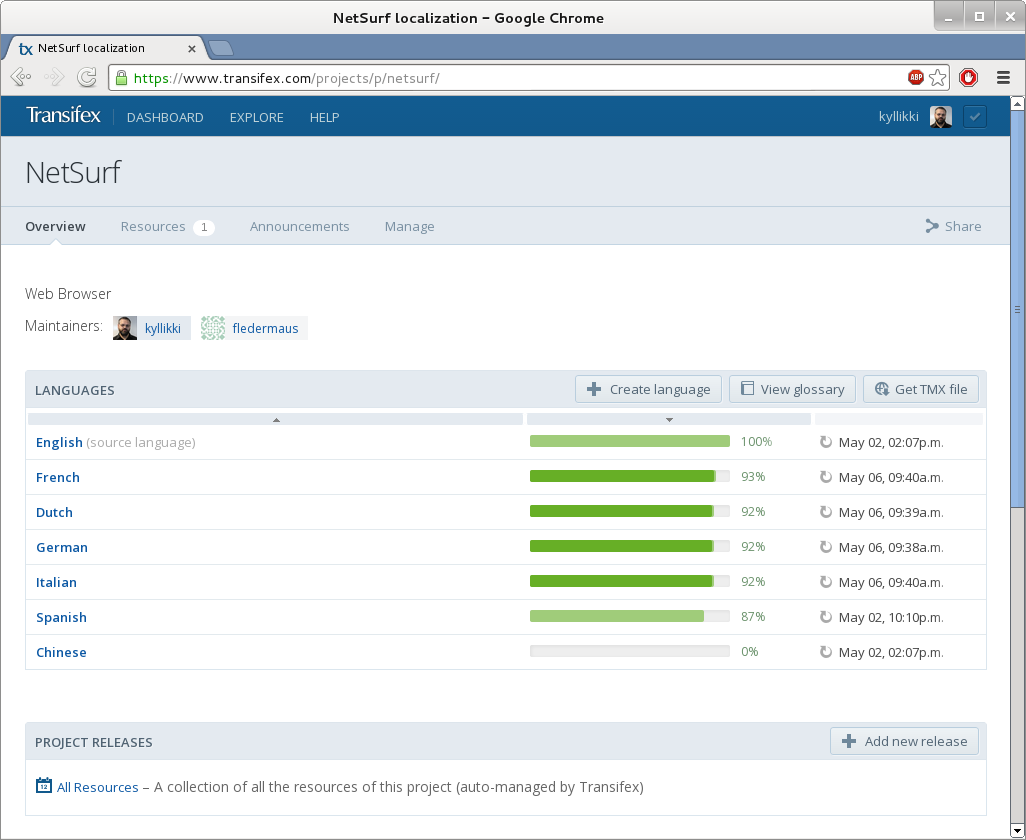
Internally NetSurf keeps all the translated messages in a simple associative array this is serialised to an equally straightforward file named FatMessages. The file is UTF-8 encoded with keys separated from values by a colon. The Key is constrained to be ASCII characters with no colons and is structured as language.toolkit.identifier and is unique on identifier part alone.

This file is processed at build time into a simple identifier:value dictionary for each language and toolkit.

Transifex can import several resource formats similar to this, after experimenting with YAML and Android Resource format I immediately discovered a problem, the services import and export routines were somewhat buggy.

These routines coped ok with simple use cases but having more complex characters such as angle brackets and quotation marks in the translated strings would completely defeat the escaping mechanisms employed by both these formats (through entity escaping in android resource format XML is problematic anyway)

Finally the Java property file format was used (with UTF-8 encoding) which while having bugs in the import and export escaping these could at least be worked around. The existing tool that was used to process the FatMessages file was rewritten to cope with generating different output formats and a second tool to merge the java property format resources.

To create these two tools I enlisted the assistance of my colleague Vivek Dasmohapatra as his Perl language skills exceeded my own. He eventually managed to overcome the format translation issues and produce correct input and output.

I used the Transifex platforms free open source product, created a new project and configured it for free machine translation from the Microsoft service, all of which is pretty clearly documented by Transifex.

Once this was done the messages file was split up tinto resources for the supported languages and uploaded to the transifex system.

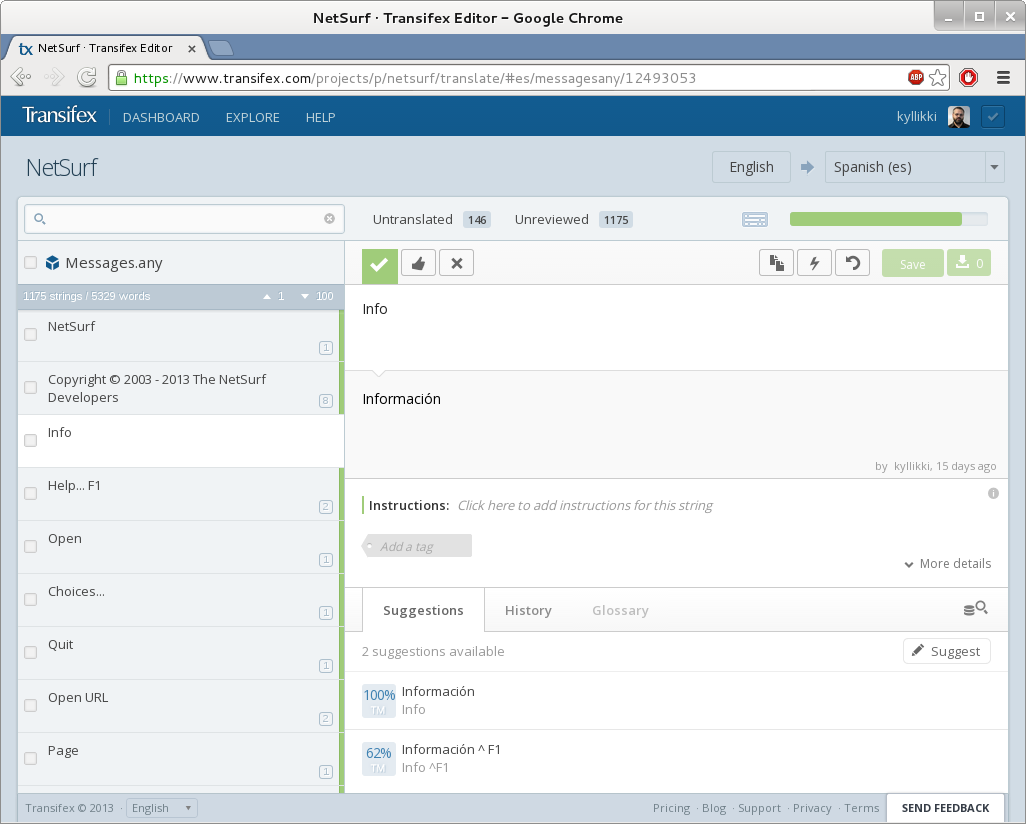
I manually marked all the uploaded translations as "verified" and then added a few machine translations to a couple of languages. I also created spanish as a new language and machine translated most of the keys.

The resources for each language were then downloaded and merged and the resulting FatMessages file checked for differences and verified only the changes I expected appeared.

I quickly determined that manually downloading the language resources every time was not going to work with any form of automation, so I wrote a perl script to retrieve the resources automatically (might be useful for other projects too).

Once these tools were written and integrated into the build system I could finally make an evaluation as to how successful this exercise had been.
ConclusionsThe main things I learned from this investigation were:

Overall I think the final observation has to be that integrating translation services is not a straightforward operation and each project has unique challenges and requirements which reduce the existing platforms to compromise solutions.

15 May 2013

Craig Small: itools is back

My last post I said that I had to remove my internet query tools due to some bugs that were a concern. Some of the code was hard to maintain and probably had holes and I had noticed that it looped at times. I m happy to say that I have restored some of those tools now, still located at http://enc.com.au/itools This code is completely re-written in Python using the TurboGears toolkit which means it is a lot cleaner in how it works and how it looks. Some of the lookup tables use a database rather than an array for ease of updating and querying. The downside is the backends will take time. It currently only does nslookup queries and whois only works for IPv4 addresses. The domain name queries will be a while off as these are the most complicated to handle. To give you an idea, all IPv4 and IPv6 address information comes from 5 sources with two formats while domain names come from over 200 sources with about 40 formats. This means the information from Regional Internet Registries will be done first.

Next.

Previous.


