Search Results: "joey"

7 June 2012

Rog rio Brito: I am not going to DebConf 12

Due to some real life impediments (including a beautiful one with just over 2 months of life called Daniel), I will not be able to go to this year's DebConf, even though it seems that this DebConf will exceed many expectations with the support that the governement of Nicaragua just offered. Things that I would like to have worked on Unfortunately, this means that I will not be working with some fellows that may be there, like people from the pkg-multimedia team. In particular, as I am working on some packages that are not that well suited to distributions (especially regarding HandBrake), it would be highly productive to have a hacking session or two with other people interested in having this popular and easy-to-use video ripper/transcoder on Debian. I would also like to be able to talk in person with other people (including Joey Hess) about controversial packaging of some programs, like GNU Parallel, which I maintain in Debian. There are many things else that I would love to work on, besides helping a bit with some of the still pending transitions of the the Debian Fonts Task Force umbrella, meeting friends and other social stuff. Oh, well. I guess that working at home will be the solution for some time.

5 June 2012

Lars Wirzenius: errno lookups on the command line

I've had a little command line tool called errno for many years now. It's a short Python script, and lets me look up Unix errno names and values given values or names.
$ errno 2
ENOENT 2 No such file or directory
$ errno EEXIST
EEXIST 17 File exists
$
This is occasionally very useful when reading logs from various programs. I thought it might be useful for others as well, so I decided to rewrite it in C so I can offer it to become part of moreutils. It is now in the master branch of moreutils. Today I added a couple of options: --list lists all the errno values, and --search does a full text (case insensitive) search of all descriptions. I also added a script that lets you do the search in all installed locales. (These changes are waiting for Joey to merge them. Meanwhile, they're at gitorious.)
$ errno-all onnistu   sort -u
EDEADLOCK 0 Onnistui
ENOMEM 12 Muistin varaaminen ei onnistu
ENOTSUP 0 Onnistui
EWOULDBLOCK 0 Onnistui
$ 
(That's Finnish.) Hopefully others will find this useful as well.

3 June 2012

Joey Hess: a year of olduse.net

My olduse.net exhibit has now finished replaying the first year of historical Usenet posts from 30 years ago, in real time. That was only twelve thousand messages, probably less than many people get on Facebook in a year.. but if you read along this year, you probably have a much better feel for what early Usenet was like. If you didn't, it's not too early to start, 9 years of Usenet's flowering lie ahead. I don't know how many people followed along. I read .. not every message, but a large fraction of them. I see 40 or so unique NNTP connections per day, and some seem to stick around and read for quite a while, so I'm guessing there might be a few hundred people following on a weekly basis. If you're not one of them, and don't read our olduse.net blog, here are a few of the year's highlights: I will probably be expiring the first year's messages before too long, to have a more uncluttered view. So if you wanted to read them, hurry up!

31 May 2012

Richard Hartmann: Potpourri II

Traffic jams suck; but they do give you a chance to think and blog. Truckers hams are telling me that four trucks are totalled and need to be removed by the THW. As the trucker next to me just broke out his gas grill and several people are joining him in a spontaneous BBQ, I don't expect to be moving any time soon. Kicking things along This is coming along nicely RAID 4 Unless you are forced to support legacy systems or playing RAIDemon and gotta try them all, there is no valid use case for RAID 4. So doing so is a patently bad idea. RAID 5 is always the better option as you are not relying on a single disk which contains the checksums, but use striping to distribute them. RAID 4 has a chance of 1/n that a failed disk will force all remaining disks to read all respective sectors and then the controller/CPU to XOR everything. There is a reason why RAID 3 was replaced with RAID 4; just as there's a reason why RAID 4 was replaced by RAID 5. Don't use RAID 4. Seriously. Tom Tom vs OSM In case you have been following the news in the GPS circles, you will have noticed that TomTom pretty gave up on innovating and resigned themselves to dying a slow death. Well that and to start a nice amount of FUD. While they have been rebuked pretty thoroughly already, I wanted to add my own POV. There is a kernel of truth in what TomTom said inasmuch they state that pedestrian paths are better than car paths. Of course, while they got the relative quality right, they are wrong about the absolute quality of the data. They claim pedestrian is OK and motorized is bad. In my experience, maps for motorized traffic are good while pedestrian tracks are mind-boggingly great. These days, most people (and probably all who read this) will be at least somewhat familiar with the quality of OSM in the random cities they visit over the year. The common verdict is usually "very nice". But that's not where OSM shines. It's in the lesser-known places where you don't expect too many tech-minded people to come along where it starts to really impress me. While I found a few stubs on a dead-end street in Akureyri which were not mapped, every foot trail I ever walked along in Iceland has been mapped. ski-doo tracks on Svalbard? Check. Backyard in Novosibirsk? Check, as well. And we are talking "packed earth track in between garages opening up into a 'playground' where a man and a pregnant women are passing a bottle back and forth while smoking and watching over their two kids who play next to a middle-aged man who is lying on the ground wasted, using a rock as a pillow all the while an extremely blingy Mercedes with two muscle-packed thugs is cruising by, all in the time it took us to walk through". Mapped. Horse tracks and hiking trails in Mongolia? Yep. Hutongs in Beijing including alleys so narrow you have to walk single file? Of course. Richard Fairhurst is right that the plural of anecdote is not data, but OSM is good. TomTom is afraid for a reason. As an aside, I find the picture used in TomTom's newsletter extremely funny; I am sure they didn't intend this, but hey. Windows 100-300 MiB for any random driver installation package is par for the course. Be it GFX, audio, or network card. If you plug in a different USB mouse, Windows 7 will take several seconds while "setting up" a standard USB HID device. And hitting ctrl-alt-del in the login screen or while logged in does not give you a quick way to shut down or reboot the machine. As I am breaking out the Windows installation every month to install updates and every six months to actually use this does not affect me a lot. Still, it's amazing that so many people are putting up with this. UEFI It's nice to see that Matthew Garrett is still going strong. I am not sure if this is the best way, but it seems to be a workable solution while in between a rock and a hard place. Not sure about the requirements of GPLv3 with regards to the keys Fedora will use to sign GRUB 2 with. From what I remember without rereading the license, as long as Fedora is not selling a system on which you can not disable secure boot they should be in the clear. IANAL, IIRC, etc. Wrapping up And I have not moved a single meter, other than making way to a police motorbike, in over an hour. Pity I don't have anything to BBQ with me; smells delicious over there.

27 May 2012

Lars Wirzenius: Larch 1.20120527 (Python B-tree library)

It has been a long time since I announced a version of Larch on my blog: about 14 months. A fair bit has happened since then: see the NEWS file for details. Below is the snippet for today's release. This is an implementation of particular kind of B-tree, based on research by Ohad Rodeh. See "B-trees, Shadowing, and Clones" (copied here with permission of author) for details on the data structure. This is the same data structure that btrfs uses. Note that my implementation is independent from the btrfs one, and might differ from what the paper describes. The distinctive feature of this B-tree is that a node is never modified (sort-of). Instead, all updates are done by copy-on-write. Among other things, this makes it easy to clone a tree, and modify only the clone, while other processes access the original tree. This is utterly wonderful for my backup application, and that's the reason I wrote larch in the first place. See the home page and README for more information; the API docs may be amusingly sparse. Version 1.20120527, released 2012-05-27

26 May 2012

Joey Hess: the rocket

The best thing about rockets is when they go up successfully, and don't come back down. graph My git-annex Kickstarter reached escape velocity 24 hours after launch, and is now past 200% funded. This is great news, because it gives me more time to spend hacking on git-annex, and will let me add more features and polish it better. I had set the goal at a minimal amount because I'd have hated not to get funded at all if this hadn't taken off. But the current funding is much more comfortable, and the further up it goes, the more scope the project can have. screenshot At the point shown above, the project had started to be highlighted as popular, based largely on kind and generous readers of this blog and git-annex users who chipped in. For a while, I personally knew around 1/3rd of contributors. That was enough to get it noticed by Kickstarter staff, which in turn has led to more growth. I love the juxtaposition of geeky tech project with other stuff here. screenshot I have 17 days remaining until the Kickstarter is finished. I really had worried it might take that long to get funded. As it is, I can't wait to see where the rocket's trajectory takes it in that time!

24 May 2012

Richard Hartmann: Public service announcement

This will be a repost for anyone subscribed to Planet Debian, sorry. In case you have not heard about git-annex yet and you care about syncing, tracking, and managing your private or public files, go click the link; it's OK, I will wait. The use cases sound intriguing, don't they? But unless you are comfortable with a shell and git, don't bother using it; pain is inevitable. joeyh announced a kickstarter project to make git-annex more user friendly, support automated adding and syncing of files, and a web front-end. Notwithstanding the cut that kickstarter and amazon payments will take and the inherent questions that are being raised by paying for FLOSS, this is a very worthwhile endeavour to support. PS: Yes, this feels a tad circle-jerky inasmuch joeyh's post links to my blog; I would have linked to his post anyway, though. If anything, this made me think twice about posting this here. PPS: Yes, I will continue writing my Trans-Siberian series even though I am home already. Air China decided to keep me in China longer than planned, real life is busy, and, truth be told, Diablo 3 came out. The second Mongolian post is half-way finished, at least.

23 May 2012

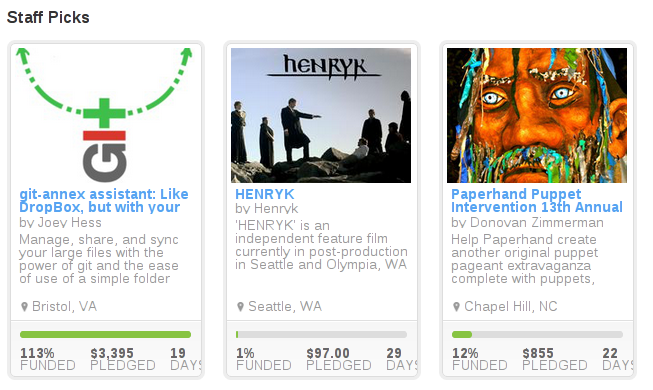
Joey Hess: kickstarter for git-annex assistant

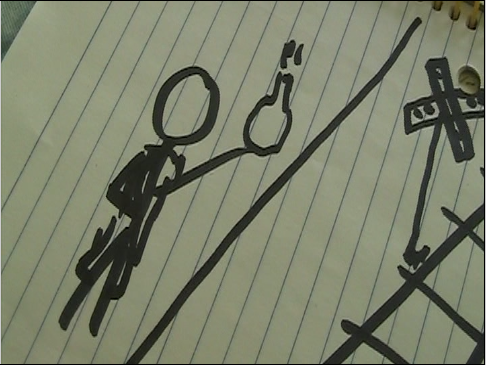
I'm doing a Kickstarter! The plan is to take git-annex and use it as the foundation to build a DropBox-like application, that can be used without any knowledge of git. The other part of the plan is for me to get through the summer with my finances intact. :) kickstarter My Kickstarter page explains in more detail, but the basic idea is to make git-annex watch a directory, with inotify, and automatically add and sync files placed there. Then build a local web app to control and configure it. I have a working prototype of the inotify part already; getting the distributed syncronisation to work well will be a major challenge; and overall it's going to be a challanging but I think very achievable project. One thing I'm really excited about is the potential of Kickstarter to connect me with a diverse group of potential users, who are interested enough in a distributed and autonomous equivilant to DropBox to fund my project. Because, with luck, their involvement won't stop at giving some money, but will extend to actually using what I'm developing, and giving me feedback on it. I hope this will widen the sphere of git-annex users, beyond the current very technically inclined crowd. It's awesome to have users doing things like taking git-annex on the transiberian railroad to help manage all their photos, and others using it to store scientific data ... but getting more regular folks using git, even if they don't know about it, is something I'm very interested in. xkcd-esque drawing BTW, I was surprised how much I got into doing the video for the Kickstarter. Using xkcd-style drawings used to explain technical concepts is a medium I enjoy working in. My own git-annex is stuffed with 17 gigabytes of video clips -- 99 separate takes! -- that boiled down to a 2 minute video. Anyway, please consider backing me if you can, and more importantly, do anything you can to help spread the word. Thanks!

12 May 2012

Joey Hess: popcon graphs for tasks

Last year I was able to switch tasksel to using metapackages, instead of the weird non-package task things that had been used before Debian supported Recommends fields well. An unanticipated result of the new task packages is that I have this nice popcon data available for them, so can get graphs like these. For new installs of testing, KDE and Xfce are neck and neck. With Gnome being the default, it's hard to say which desktop users really prefer. My feeling is that it's probably nearly evenly split now. (I installed Xfce on my sister's laptop last week, and anticipate moving all my family to it, rather than Gnome 3.) The above graph also shows a surprisingly large number of ssh server task installs. In fact, it's the most often manually installed task. Probably many of those are server machines, and so I'm considering having tasksel automatically select ssh on systems where it doesn't automatically select a desktop. Language data is also available. Taskel uses language tasks internally, without exposing an interface, so this will be almost entirely users who did an install of testing localised to their language. Interesting data can be teased out of this too. For example there seem more installs in Catalan than Chinese ... and at least 10 Esperanto users. (As with any popcon number, this is a lower bound, to be multiplied by the scaling guesstimate of your choice.)
By the way, I've got a new vanity domain for my blog and wiki: http://joeyh.name/ The old http://kitenet.net/~joey/ will continue to work, like it has since 1997. But the new is easier to type. And it let me move my site to Branchable, at last.

22 April 2012

Joey Hess: moving my email archives and packages to git-annex

I've recently been moving some important data into git-annex, and finding it simplifies things while also increasing my flexability. email archives I've kept my email archives in git for years. This works ok, just choose the right file format (compressed mbox) and number of files (one archive per mailbox per month or so) and git can handle this well enough, as email is not really large. But, email is not really small either. Keeping my email repository checked out on my netbook consumes 2 gigabytes of its 30 gigabyte SSD, half of which is duplication in .git. Also, I have only kept it at 2 gigabytes through careful selection of what classes of mail I archive. That made sense when archival disk was more expensive, but what makes sense these days is to archive everything. For a while I've wanted to have a "raw" archive, that includes all email I receive. (Even spam.) This protects against various disasters in mail filtering or reading. Setting that up was my impetus for switching my mail archives to git-annex today. The new system I've settled on is to first copy all incoming mail into a "raw" maildir folder. Then mailfilter sorts it into the folders I sync (with offlineimap) and read. Each day, the "raw" folder is moved into a mbox archive, and that's added to the git annex. Each month, the mail I've read is moved into a monthly archives, and added to the git annex. A simple script does the work. I counted the number of copies that existed of my mail when it was stored in git, and found 7 copies spread amoung just 3 drives. I decided to slim that back, and configured git-annex to require only 5 copies. But those 5 copies will spread amoung more drives, including several offline archival drives, so it will be more robust overall. My netbook will have an incomplete checkout of my mail, omitting the "raw" archive. If I need to peek inside a spam folder for a lost mail, I can quickly pull it down; if I need to free up space I can quickly drop older archives. This is the flexability that git-annex fans love. :) By the way, this also makes it easier to permanantly delete mail, when you really need to (ie, for contractual reasons). Before, I'd have to do a painful git-filter-branch if I needed to get rid of eg, mail for old jobs. Now I can git annex drop --force. Pro Tip: If you're doing this kind of migration to git-annex, you can save bandwidth by not re-transferring files to machines that already have a copy. I ran this command on my netbook to inject the archives it had in the old repository into the new repository, verifying checksums as it goes:
cd ~/mail/archive; find -type l -exec git annex reinject ~/mail.old/archive/    \;
Note on mairix compatability: I use mairix to index and search my mail. But it refuses to follow git-annex's symlinks to the content. So I have to point it at .git/annex/objects/. I also configured annex.backend to SHA256E, which keeps the extensions on my compressed mailbox files, which is necessary for mairix to realize they're compressed. debian packages I'd evolved a complex and fragile chain of personal apt repositories to hold Debian packages I've released. I recently got rid of the mess, which looked like this: dput local mini-dinstall repo dput→mini-dinstallrepo on my server →dput Debian The point of all that was that I could "upload" a package locally while offline and batch transfer it later. And I had a local and a public apt repository of just the packages I've uploaded. But these days, packages uploaded to Debian are available nearly immediately, so there's not much reason to do that. My old system also had a problem: It only kept the most recent single copy of each package. Again, disk is cheap, so I'd rather have archives of everything I have uploaded. Again I switched to git-annex. My new system is simplicity itself. I release a package by checking it into a "toupload" directory in my git annex repository on my netbook. Items in that directory are dput to Debian and moved to "released". I have various other clones of that repository, which I git annex move packages to periodically to free up SSD space. In the rare cases when I build a package on a server, I check it into the clone on the server, and again rely on git-annex to copy it around. Now, does anyone know a good way to download a copy of every package you're ever released from archive.debian.org? (Ideally as a list of urls I can feed to git annex addurl.) conclusion My email and Debian packages were the last large files I was not storing in git-annex. Even backups of my backups end up checked into git-annex and archived away. Now that I'm using git-annex in every place I can, my goal with it is to make it as easy as possible for as many of you to use it as possible, too. I have some inotify tricks up my sleeve that seem promising. Kickstarter may be involved. Watch this space!

19 April 2012

Raphaël Hertzog: People behind Debian: Samuel Thibault, working on accessibility and the Hurd

Samuel Thibault is a French guy like me, but it took years until we met. He tends to keep a low profile, even though he s doing lots of good work that deserves to be mentioned. He focuses on improving Debian s accessibility and contributes to the Hurd. Who said he s a dreamer? :-) Checkout his interview to have some news of Wheezy s status on those topics. Raphael: Who are you? Samuel: I am 30 years old, and live in Bordeaux, France. During the workday, I teach Computer Science (Architecture, Networking, Operating Systems, and Parallel Programming, roughly) at the University of Bordeaux, and conduct researches in heterogeneous parallel computing. During the evening, I play the drums and the trombone in various orchestra (harmonic/symphonic/banda/brass). During the night, I hack on whatever fun things I can find, mainly accessibility and the Hurd at the moment, but also miscellaneous bits such as the Linux console support. I am also involved in the development of Aquilenet, an associative ISP around Bordeaux, and getting involved in the development of the network infrastructure in Bordeaux. I am not practicing Judo any more, but I roller-skate to work, and I like hiking in the mountains. I also read quite a few mangas. Saturday mornings do not exist in my schedule (Sunday mornings do, it s Brass Band rehearsal :) ). Raphael: How did you start contributing to Debian? Samuel: Bit by bit. I have been hacking around GNU/Linux since around 1998. I installed my first Debian system around 2000, as a replacement for my old Mandrake installation (which after all my tinkering was actually no longer looking like a Mandrake system any more!). That was Potato at the time, which somebody offered me through a set of CDs (downloading packages over the Internet was unthinkable at the time with the old modems). I have been happily reading and hacking around documentation, source code, etc. provided on them. Contribution things really started to take off when I went to the ENS Lyon high school in 2001: broadband Internet access in one s own student room! Since sending a mail was then really free, I started submitting bugs against various packages I was using. Right after that I started submitting patches along them, and then patches to other bugs. I did that for a long time actually. I had very little knowledge of all packaging details at the time, I was just a happy hacker submitting reports and patches against the upstream source code. At ENS Lyon, I met a blind colleague with very similar hacking tastes (of course we got friends) and he proposed me, for our student project, to work on a brlnet project (now called brlapi), a client/server protocol that lets applications render text on braille devices themselves. Along the way, I got to learn in details how a blind person can use a Unix system and the principles that should be followed when developing Accessibility. That is how I got involved in it. We presented our project at JDLL, and the Hurd booth happened to be next to our table, so I discussed with the Hurd people there about how the Hurd console could be used through braille. That is how I got into the Hurd too. From then on, I progressively contributed more and more to the upstream parts of both accessibility software and the Hurd. And then to the packaging part of them. Through patches in bug reports first, as usual, as well as through discussions on the mailing lists. But quickly enough people gave me commit access so I could just throw the code in. I was also given control over the Hurd buildds to keep them running. It was all good at that stage: I could contribute in all the parts I was caring about. People however started telling me that I should just apply for being a Debian Developer; both from accessibility and Hurd sides. I had also seen a bunch of my friends going through the process. I was however a bit scared (or probably it was just an excuse) by having to manage a gpg key, it seemed like a quite dangerous tool to me (even if I already had commit access to glibc at the time anyway ). I eventually applied for DM in 2008 so as to at least be able to upload some packages to help the little manpower of the Accessibility and Hurd teams. Henceforth I had already a gpg key, thus no excuse any more. And having it in the DM keyring was not enough for e.g. signing the hurd-i386 buildd packages. So I ended up going through NM in 2009, which went very fast, since I had already been contributing to Debian and learning all the needed stuff for almost 10 years! I now have around 50 packages in my QA page, and being a DD is actually useful for my work, to easily push our software to the masses :) So to sum it up, the Debian project is very easy to contribute to and open to new people. It was used during discussions at the GNU Hackers Meeting 2011 as an example of a very open community with public mailing lists and discussions. The mere fact that anybody can take the initiative of manipulating the BTS (if not scared by the commands) without having to ask anybody is an excellent thing to welcome contributions; it is notable tha the GNU project migrated to the Debbugs BTS. More generally, I don t really see the DD status as a must, especially now that we have the DM status (which is still a very good way to drag people into becoming DDs). For instance, I gave a talk at FOSDEM 2008 about the state of accessibility in Debian. People did not care whom I was, they cared that there was important stuff going on and somebody talking about it. More generally, decisions that are made through a vote are actually very rare. Most of the time, things just happen on the mailing lists or IRC channels where anybody can join the discussion. So I would recommend beginners to first use the software, then start reporting bugs, then start digging in the software to try fix the bugs by oneself, eventually propose patches, get them reviewed. At some point the submitted patches will be correct already most of the time. That s when the maintainers will start getting bored of just applying the patches, and simply provide with commit access, and voil , one has become a main contributor. Raphael: You re one of the main contributors to the Debian GNU/Hurd port. What motivates you in this project? Samuel: As I mentioned above, I first got real contact with the Hurd from the accessibility point of view. That initially brought me into the Hurd console, which uses a flexible design and nice interfaces to interact with it. The Hurd driver for console accessibility is actually very straightforward, way simpler than the Windows or Linux drivers. That is what caught me initially. I have continued working on it for several reasons. First, the design is really interesting for users. There are many things that are natural in the Hurd while Linux is still struggling to achieve them, such as UID isolation, recently mentioned in LWN. What I really like in the Hurd is that it excels at providing users with the same features as the administrator s. For instance, I find it annoying that I still can not mount an ISO image that I build on e.g. ries.debian.org. Linux now has FUSE which is supposed to permit that, but I have never seen it enabled on an ssh-accessible machine, only on desktop machines, and usually just because the administrator happens to be the user of the machine (who could as well just have used sudo ) For me, it is actually Freedom #0 of Free Software: let the user run programs for any purpose, that is, combining things together all the possible ways, and not being prevented from doing some things just because the design does not permit to achieve them securely. I had the chance to give a Hurd talk to explain that at GHM 2011, whose main topic was extensibility , I called it GNU/Hurd AKA Extensibility from the Ground, because the design of the Hurd is basically meant for extensibility, and does not care whether it is done by root or a mere user. All the tools that root uses to build a GNU/Hurd system can be used by the user to build its own GNU/Hurd environment. That is guaranteed by the design itself: the libc asks for things not to the kernel, but to servers (called translators), which can be provided by root, or by the user. It is interesting to see that it is actually also tried with varying success in GNU/Linux, through gvfs or Plash. An example of things I love being able to do is: $ zgrep foo ~/ftp://cdn.debian.net/debian/dists/sid/main/Contents-*.gz On my Hurd box, the ~/ftp: directory is indeed actually served by an ftpfs translator, run under my user uid, which is thus completely harmless to the system. Secondly and not the least, the Hurd provides me with interesting yet not too hard challenges. LWN confirmed several times that the Linux kernel has become very difficult to significantly contribute to, so it is no real hacking fun any more. I have notably implemented TLS support in the Hurd and the Xen and 64bit support in the GNU Mach kernel used by the Hurd. All three were very interesting to do, but were already done for Linux (at least for all the architectures which I actually know a bit and own). It happens that both TLS and Xen hacking experience became actually useful later on: I implemented TLS in the threading library of our research team, and the Xen port was a quite interesting line on my CV for getting a postdoc position at XenSource :) Lastly, I would say that I am used to lost causes :) My work on accessibility is sometimes a real struggle, so the Hurd is almost a kind of relief. It is famous for his vapourware reputation anyway, and so it is fun to just try to contribute to it nevertheless. An interesting thing is that the opinion of people on the Hurd is often quite extreme, and only rarely neutral. Some will say it is pure vapourware, while others will say that it is the hope of humanity (yes we do see those coming to #hurd, and they are not always just trolls!). When I published a 0.401 version on 2011 April 1st, the comments of people were very diverse, and some even went as far as saying that it was horrible of us to make a joke about the promised software :) Raphael: The FTPmasters want to demote the Hurd port to the debian-ports.org archive if it doesn t manage a stable release with wheezy. We re now at 2 months of the freeze. How far are you from being releasable ? Samuel: Of course, I can not speak for the Debian Release team. The current progress is however encouraging. During Debconf11, Michael Banck and I discussed with a few Debian Release team members about the kind of goals that should be achieved, and we are near completion of that part. The Debian GNU/Hurd port can almost completely be installed from the official mirrors, using the standard Debian Installer. Some patches need some polishing, but others are just waiting for being uploaded Debian GNU/Hurd can start a graphical desktop and run office tools such as gnumeric, as well as the iceweasel graphical web browser, KDE applications thanks to Pino Toscano s care, and GNOME application thanks to Emilio Pozuelo Monfort s care. Of course, general textmode hacking with gcc/make/gdb/etc. just works smoothly. Thanks to recent work on ghc and ada by Svante Signell, the archive coverage has passed 76%. There was a concern about network board driver support: until recently, the GNU Mach kernel was indeed still using a glue layer to embed the Linux 2.2 or even 2.0 drivers (!). Finding a network board supported by such drivers had of course become a real challenge. Thanks to the GSoC work of Zheng Da, the DDE layer can now be used to embed Linux 2.6.32 drivers in userland translators, which was recently ACCEPTed into the archive, and thus brings way larger support for network boards. It also pushes yet more toward the Hurd design: network drivers as userland process rather than kernel modules. That said, the freeze itself is not the final deadline. Actually, freeze periods are rests for porters, because maintainers stop bringing newer upstream versions which of course break on peculiar architectures. That will probably be helpful to continue improving the archive coverage. Raphael: The kfreebsd port brought into light all the packages which were not portable between different kernels. Did that help the Hurd port or are the problems too different to expect any mutual benefit? Samuel: The two ports have clearly helped each other in many aspects. The hurd-i386 port is the only non-Linux one that has been kept working (at least basically) for the past decade. That helped to make sure that all tools (dpkg, apt, toolchain, etc.) were able to cope with non-Linux ports, and keep that odd-but-why-not goal around, and evidently-enough achievable. In return, the kFreeBSD port managed to show that it was actually releasable, at least as a technological preview, thus making an example. In the daily work, we have sometimes worked hand in hand. The recent porting efforts of the Debian Installer happened roughly at the same time. When fixing some piece of code for one, the switch-case would be left for the other. When some code could be reused by the other, a mail would be sent to advise doing so, etc. In the packaging effort, it also made a lot of difference that a non-Linux port is exposed as released architecture: people attempted by themselves to fix code that is Linuxish for no real reason. The presence of the kFreeBSD is however also sometimes a difficulty for the Hurd: in the discussions, it sometimes tends to become a target to be reached, even if the systems are not really comparable. I do not need to detail the long history of the FreeBSD kernel and the amount of people hacking on it, some of them full-time, while the Hurd has only a small handful of free-time hackers. The FreeBSD kernel stability has already seen long-term polishing, and a fair amount of the Debian software was actually already ported to the FreeBSD kernel, thanks to the big existing pure-FreeBSD hackerbase. These do not hold for the GNU/Hurd port, so the expectations should go along. Raphael: You re also very much involved in the Debian Accessibility team. What are the responsibilities of this team and what are you doing there? Samuel: As you would expect it, the Debian Accessibility team works on packaging accessibility-related packages, and helping users with them; I thus do both. But the goal is way beyond just that. Actual accessibility requires integration. Ideally enough, a blind user should be able to just come to a Debian desktop system, plug his braille device, or press a shortcut to enable speech synthesis, and just use the damn computer, without having to ask the administrator to install some oddly-named package and whatnot. Just like any sighted user would do. He should be able to diagnose why his system does not boot, and at worse be able to reinstall his computer all by himself (typically at 2am ). And that is hard to achieve, because it means discussing about integration by default of accessibility features. For instance, the Debian CD images now beep during at the boot menu. That is a precious feature that has been discussed between debian-boot and debian-accessibility for a few weeks before agreeing on how to do it without too much disturbance. Similarly, my proposition of installing the desktop accessibility engines has been discussed for some time before being commited. What was however surprisingly great is that when somebody brought the topic back for discussion, non-debian-accessibility people answered themselves. This is reassuring, because it means things can be done durably in Debian. On the installation side, our current status is that the stable Debian installer has a high contrast color theme, and several years ago, I have pushed toward making standard CD images automatically detect braille devices, which permits standalone installation. I have added to the Wheezy installer some software speech synthesis (which again brought discussion about size increase vs versatility etc.) for blind people who do not have a braille device. I find it interesting to work on such topic in Debian rather than another distribution, because Debian is an upstream for a lot of distributions. Hopefully they just inherit our accessibility work. It at least worked for the text installer of Ubuntu. Of course, the Accessibility team is looking for help, to maintain our current packages, but also introduce new packages from the TODO list or create some backports. One does not need to be an expert in accessibility: tools can usually be tested, at least basically, by anybody, without particular hardware (I do not own any, I contributed virtual ones to qemu). For new developments and ideas, it is strongly recommended to come and discuss on debian-accessibility, because it is easy to get on a wrong track that does not bring actual accessibility. We still have several goals to achieve: the closest one is to just fix the transition to gnome3, which has been quite bad for accessibility so far :/ On the longer run, we should ideally reach the scenario I have detailed above: desktop accessibility available and ready to be enabled easily by default. Raphael: What s the biggest problem of Debian? Samuel: Debian is famous for its heated debian-devel discussions. And some people eventually say this no fun any more . That is exemplified in a less extreme way in the debian-boot/accessibility discussions that I have mentioned above. Sometimes, one needs to have a real stubborn thick head to continue the discussion until finding a compromise that will be accepted for commit. That is a problem because people do not necessarily have so much patience, and will thus prefer to contribute to a project with easier acceptance. But it is also a quality: as I explained above, once it is there, it is apparently for good. The Ubuntu support of accessibility in its installer has been very diverse, in part due to quite changing codebase. The Debian Installer codebase is more in a convergence process. Its base will have almost not changed between squeeze and wheezy. That allowed the Debian Accessibility team to continue improving its accessibility support, and not have to re-do it. A wiki page explains how to test its accessibility features, and some non-debian-accessibility people do go through it. A problem I am much more frightened by is the manpower in some core teams. The Debian Installer, grub, glibc, Xorg, gcc, mozilla derivatives, When reading the changelogs of these, we essentially keep seeing the same very few names over and over. And when one core developer leaves, it is very often still the same names which appear again to do the work. It is hard to believe that there are a thousand DDs working on Debian. I fear that Debian does not manage to get people to work on core things. I often hear people saying that they do not even dare thinking about putting their hands inside Xorg, for instance. Xorg is complex, but it seems to me that it tends to be overrated, and a lot of people could actually help there, as well as all the teams mentioned above. And if nobody does it, who will? Raphael: Do you have wishes for Debian Wheezy? Samuel: That is an easy one :) Of course I wish that we manage to release the hurd-i386 port. I also wish that accessibility of gnome3 gets fixed enough to become usable again. The current state is worrying: so much has changed that the transition will be difficult for users already, the current bugs will clearly not help. I also hope to find the time to fix the qt-at-spi bridge, which should (at last!) bring complete KDE accessibility. Raphael: Is there someone in Debian that you admire for their contributions? Samuel: Given the concerns I expressed above, I admire all the people who do spend time on core packages, even when that is really not fun everyday. Just to alphabetically name a few people I have seen so often here and there in the areas I have touched in the last few years: Aur lien Jarno, Bastian Blank, Christian Perrier, Colin Watson, Cyril Brulebois, Frans Pop, J rg Jaspert, Joey Hess, Josselin Mouette, Julien Cristau, Matthias Klose, Mike Hommey, Otavio Salvador, Petr Salinger, Robert Millan, Steve Langasek. Man, so many things that each of them works on! Of course this list is biased towards the parts that I touched, but people working in others core areas also deserve the same admiration.
Thank you to Samuel for the time spent answering my questions. I hope you enjoyed reading his answers as I did. Note that older interviews are indexed on wiki.debian.org/PeopleBehindDebian.

Subscribe to my newsletter to get my monthly summary of the Debian/Ubuntu news and to not miss further interviews. You can also follow along on Identi.ca, Google+, Twitter and Facebook.

3 comments Liked this article? Click here. My blog is Flattr-enabled.

9 April 2012

Joey Hess: Stand by the grey stone when the thrush knocks

Today, map in hand, I explored the "long valley, narrower than the great dale in the South where the Gates of the river stood, and walled with lower spurs of the Mountain".
"The dangerous search on the western slopes for the secret door"
"It seemed as if darkness flowed out like a vapour from the hole in the mountain-side" "They spoke low and never called or sang, for danger brooded in every rock."
"It is almost dark so that its vastness can only be dimly guessed, but rising from the near side of the rocky floor there is a great glow. The glow of Smaug!"

6 April 2012

Raphaël Hertzog: People Behind Debian: Francesca Ciceri, Member of the Debian Press & Publicity Teams

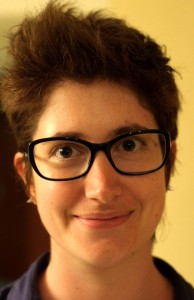
Francesca Ciceri, photo by Andrew McMillan, CC-BY-SA 2.0

I met Francesca in Debconf 11 in Banja Luka. If I recall correctly, it s Enrico Zini who introduced me to her, because she was the madamezou (her IRC nickname) who started to get involved in the publicity team. Since then and despite having a bachelor thesis to complete she got way more involved and even gained official responsibilities in the project. Before starting with the interview, I wanted to mention that Francesca is drafting a diversity statement for Debian I was expecting the discussions to go nowhere but she listened to all objections and managed to improve the text and build a consensus around it. Thank you for this and keep up the good work, Francesca! Rapha l: Who are you? Francesca: My name is Francesca, I m 30 and I studied Social Sciences. Currently I live in Italy but I m planning to go abroad (not a lot of jobs here for geeky social scientists). Apart for Debian and FLOSS world in general, I have unrestrained passions for chocolate; zombie movies; sci-fi; zombie books; knitting sewing crafting and DIY in general; zombie videogames; bicycles; pulling apart objects to look inside them; splatter B movies, David Foster Wallace s books, playing trumpet, and did I already mentioned zombies? Days are too short for all this stuff, but I try to do my best. Raphael: How did you start contributing to Debian? Francesca: Some years ago I was stuck in bed for literally some months, due to a grave series of migraine attacks. I wasn t able to do anything: no social life, no books or television. So, I decided to turn on the laptop and do something constructive with it: I was already a Debian user and it seemed quite logical to me to try to give back to the community. I am not a coder and I ve not studied Computer Science, so my first step was to join an Italian Debian on-line community (Debianizzati) and help with tutorials, users support, wiki management. In a couple of months I learnt many things: helping other users with their problems forces you to do lots of research! My first contributions to the Debian project were mostly translations of the main website. Translators are the perfect typos spotters: they work so precisely on the text to be translated that they finish to do a great QA job. This is how I ve started to contribute to the Debian website: with very simple things, fixing typos or wrong links or misplaced wml tags. I still remember my first commit to the website: the idea was to undercase some tags, but it ended up that I misplaced some of them and in addition I fixed them only in the English page and not on the translations as well. When after a couple of minutes, K re Thor Olsen a long time contributor of the team and now webmaster reverted my commit, I felt so stupid and full of shame. But, to my great surprise, no one treated me like an idiot for that error: Gerfried Fuchs, one of the guru of the team, replies me in a really helpful and polite way explaining what I did wrong and how to do things correctly. I think this episode was a turning point in my Debian life: there s this idea that Debian Developers are just a bunch of arrogant assholes and maybe it was true in the past, but for my experience they are not. Well, at least the ones I met and work with ;) .
To my great surprise, no one treated me like an idiot for that error.
Since then, I joined the WWW team and helped them apply the shiny new design provided by Kalle S derman. A lot of work was done during the week immediately before the release of the new website. Oh that was a week! We worked night and day to have the new design ready for February 6th, and it was fantastic when we finally published it, simultaneously with the release of Squeeze. At the same time, I started to contribute more actively to the Debian Publicity team, not only translating news but also writing them. It can sound scary for a non native English speaker to write something from scratch in English, but you have to keep in mind that your text will be reviewed by native speakers before being published. And we have some fantastic reviewers in the English localisation team: particularly Justin B Rye, who is tireless in his effort and more recently Moray Allan. I think I m particularly lucky to work with all these people: there s a special mood in both Publicity and WWW team, which makes you feel happy to do things and at the same time pushes you to do more just because it s fun to work with them sharing jokes, ideas, rants, patches and hugs. Rapha l: I believe that you have been trough the new member process very quickly. You re now a Non-Uploading Debian Developer. How was the experience and what does this mean to you? Francesca: Becoming a Debian Developer was not so obvious for me, because I didn t need to be a DD for the work I do in Debian. For instance, I don t maintain packages, so I had no reasons to want to become a DD in order to have uploading rights. For a while I didn t really feel the necessity of being a DD. Luckily, some people started to pester me about it, asking me to apply for the NM process. I remember Martin Zobel-Helas doing this for an entire week every single day, and Gerfried Fuchs doing it as well. Suddenly, I realized that people I worked with felt that I deserved the DD status and that I simply had thought I didn t. As a non coder and a woman, there probably was a bit of impostor syndrome involved. Having people encouraging me, gave me more confidence and the desire to finally become a DD. And so I did. The process for non uploading DD is identical to the one to become an uploading DD, with one exception: in the second part of the process (named Tasks and Skills) instead of questions about how to create and maintain packages, there are questions about the non packaging work you usually do in Debian. The general resolution which created the possibility to become a non uploading DD gave us a chance to recognize the great effort of Debian contributors who work in various area (translations, documentation, artworks, etc.) that were not always considered as important as packaging efforts. And this is great because if you are a regular contributor, if you love Debian and you are committed to the project, there are no reasons to not be an official member of it. With regards to this, I like the metaphor used by Meike Reichle in her recent talk about the Debian Women Project (video recording here):
a Debian Developer status is a lot like a citizenship in a country that you re living in. If you live in a country and you don t have citizenship, you can find a job, buy a house, have a family [...] but if this country at any point in time decides to go into a direction that you don t like, there s nothing you can do about it. You are not in the position to make any change or to make any effect on that country: you just live there, but there s no way that you can excercise influence on the people who run this country.
Rapha l: You recently joined the Debian Press Team. What does it involve and how are you managing this new responsibility? Francesca: The Press Team is basically the armed wing of the Publicity Team: it handles announcements that need to be kept private until the release, moderate the debian-announce and debian-news mailing list and maintain contacts with press people from outside the project. The real job, so, is done within the Publicity Team. The most important part of our work is to write announcements and the newsletter: while the newsletter is published bi-weekly, the announcements need to be write in a shorter timeframe. Localization is really important in spreading Debian word, so we work closely with translators: both announcements and DPN are usually translated in four or five different languages. The publicity work could be stressful, as we have strict deadlines, we need to take quick decisions and often do last-minute changes. Personally, I like it: I work better under pressure. But I know that is sometimes difficult for contributors to accept that we can t debate endlessly on details, we have just to go on and do our best in a given timeframe.
The publicity work could be stressful, as we have strict deadlines, [ ]. Personally, I like it.
Raphael: You re one of the main editor behind the Debian Project News. What s the role and scope of this newsletter? Francesca: Debian Project News is our beloved newsletter, direct successor of the Debian Weekly News founded by Joey Hess in 1999 and later kept alive by Martin Schulze. In 2007, Debian Weekly News was discontinued but in 2008 the project was revived by Alexander Reichle Schmehl. The idea behind DPN is to provide our users an overview of what is happening inside and outside the project. As the core team of editors is formed by three people, the main problem is to be able to collect enough news from various sources: in this sense we are always glad when someone points us to interesting blogposts, mails and articles. DPN is also a good chance for non coders to contribute to Debian: propose news, write paragraphs and review the draft before the publication are quite easy tasks but very useful. English native speakers can do a proofread (as no one of the main editors is a native speaker) while others can always translate DPN in their native language. People who want to help us can take a look at our wiki page.
DPN is also a good chance for non coders to contribute to Debian.
Just yesterday I realized that since January we don t miss or delay an issue: so I d like to thank the fantastic team of editors, reviewers and translators who made it possible. The team is now working on another way of spreading Debian s message: a long-time project is finally becoming real. Stay tuned, surprise arriving! Raphael: You re trying to organize IRC training sessions but that doesn t seem to take off in Debian, while it s quite common in the Ubuntu community. How do you explain that? Francesca: I m not sure about it: both Debian users and contributors seemed to appreciate this initiative in the past. I was quite surprised by the amount of Debian members present during the various sessions and by the amount of interesting questions asked by the users. So the only reason I can think about is that I need to put more enthusiasm in convincing the teams to do it: they need more encouragement (or to be pestered more!). I, for myself, think that IRC training sessions are a great way to promote our work, to share our best practice, to talk about our project to a wider audience. And I ll sure try to organize more of them. Help, suggestions, ideas are really welcome! Raphael: If you could spend all your time on Debian, what would you work on? Francesca: There is a project I d like to give more love, but I always end up without the time to do it: the debian-community.org project. Back in 2007, Holger Levsen founded it with the aim of reducing the gap between Debian contributors and Debian users, giving all an opportunity to contribute, share ideas and more. The project was discontinued and I d really like to revive it: in these years various things have changed, but I think that the core idea of having a node to connect existing local communities is still good and doable. In Debian we don t have the wide and well articulated local infrastructure present in other distributions (Ubuntu, particularly, but also Fedora): even if I don t like too centralized structures, I think that a better connection between the project and local groups of users and on-line communities would be a step forward for the project. Being part of the Events Team, I m aware of how much we need to improve our communication with local groups. An example is the events organization: sometimes, Publicity and Events teams even don t know about regional Debian related events (like booth at conferences, workshops, talks, install parties, etc) and this is a shame because we could offer a lot of help in organizing and promoting local events. What we lack is better communication. And debian-community.org project could give us exactly this. Could be a cluster of local groups, a platform for events organization and even a useful resource for newbies who want to find a local group near them. I started some effort in this sense, sending a proposal about it, working on a census of Debian local groups. Any help is appreciated! I m really curious to see how many Debian communities (from all around the world and the web) are out there, and I d love to have members from these communities better connected with the Debian Project. Raphael: What s the biggest problem of Debian? Probably the bikeshedding feticism of almost all of us. It s the other side of the coin of Debian s commitment to technical excellence and our perfectionism, but sometimes it leads just to endless discussions about details, and it is a blocker for various initiatives. In Debian, you have to be really patient and in a way stubborn to push some changes. This is frustrating sometimes. On the other hand, I really appreciate how people take some times to think to each proposals, give some feedback and discuss about it: the process could be annoying, indeed, but the result is often an improvement of the initial proposal. Raphael: Is there someone in Debian that you admire for their contributions? Most of my teammates are simply brilliant and adorable and hard-working. But I have to admit that I particularly admire David Pr vot: beside being a webmaster he does a lot of things, from French translations to DPN editing. All his contributions have a great quality and he s able to push you always further in doing things and doing them better. He is a good example of how I d like to be as contributor: smart, tireless, friendly.
Thank you to Francesca for the time spent answering my questions. I hope you enjoyed reading her answers as I did. Note that older interviews are indexed on wiki.debian.org/PeopleBehindDebian.

Subscribe to my newsletter to get my monthly summary of the Debian/Ubuntu news and to not miss further interviews. You can also follow along on Identi.ca, Google+, Twitter and Facebook.

3 comments Liked this article? Click here. My blog is Flattr-enabled.

1 April 2012

Joey Hess: ls: the missing options

I'm honored and pleased to be the person who gets to complete ls. This project, begun around when I was born, was slow to turn into anything more than a simple for loop over a dirent. It really took off in the mid and late 80's, when Richard Stallman added numerous features, and the growth has been steady ever since. But, a glance at the man page shows that ls has never quite been complete. It fell to me to finish the job, and I have produced several handy patches to this end: The only obvious lack now is a -z option, which should make output filenames be NULL terminated for consuption by other programs. I think this would be easy to write, but I've been extermely busy IRL (moving lots of furniture) and didn't get to it. Any takers to write it? Due to the nature of these patches, they conflict with each other. Here's a combined patch suitable to be applied and tested.
diff -ur orig/coreutils-8.13/src/ls.c coreutils-8.13/src/ls.c
--- orig/coreutils-8.13/src/ls.c    2011-07-28 06:38:27.000000000 -0400
+++ coreutils-8.13/src/ls.c 2012-04-01 12:41:56.835106346 -0400
@@ -270,6 +270,7 @@
 static int format_group_width (gid_t g);
 static void print_long_format (const struct fileinfo *f);
 static void print_many_per_line (void);
+static void print_jam (void);
 static size_t print_name_with_quoting (const struct fileinfo *f,
                                        bool symlink_target,
                                        struct obstack *stack,
@@ -382,6 +383,7 @@
    many_per_line for just names, many per line, sorted vertically.
    horizontal for just names, many per line, sorted horizontally.
    with_commas for just names, many per line, separated by commas.
+   jam to fit in the most information possible.
 
    -l (and other options that imply -l), -1, -C, -x and -m control
    this parameter.  */
@@ -392,7 +394,8 @@
     one_per_line,      /* -1 */
     many_per_line,     /* -C */
     horizontal,            /* -x */
-    with_commas            /* -m */
+    with_commas,       /* -m */
+    jam            /* -j */
    ;
 
 static enum format format;
@@ -630,6 +633,11 @@
 
 static bool immediate_dirs;
 
+/* True means when multiple directories are being displayed, combine
+ * their contents as if all in one directory. -e */
+
+static bool entangle_dirs;
+
 /* True means that directories are grouped before files. */
 
 static bool directories_first;
@@ -705,6 +713,10 @@
 
 static bool format_needs_type;
 
+/* Answer "yes" to all prompts. */
+
+static bool yes;
+
 /* An arbitrary limit on the number of bytes in a printed time stamp.
    This is set to a relatively small value to avoid the need to worry
    about denial-of-service attacks on servers that run "ls" on behalf
@@ -804,6 +816,7 @@
    "escape", no_argument, NULL, 'b' ,
    "directory", no_argument, NULL, 'd' ,
    "dired", no_argument, NULL, 'D' ,
+   "entangle", no_argument, NULL, 'e' ,
    "full-time", no_argument, NULL, FULL_TIME_OPTION ,
    "group-directories-first", no_argument, NULL,
    GROUP_DIRECTORIES_FIRST_OPTION ,
@@ -849,12 +862,12 @@
 static char const *const format_args[] =
  
   "verbose", "long", "commas", "horizontal", "across",
-  "vertical", "single-column", NULL
+  "vertical", "single-column", "jam", NULL
  ;
 static enum format const format_types[] =
  
   long_format, long_format, with_commas, horizontal, horizontal,
-  many_per_line, one_per_line
+  many_per_line, one_per_line, jam
  ;
 ARGMATCH_VERIFY (format_args, format_types);
 
@@ -1448,6 +1461,9 @@
       print_dir_name = true;
      
 
+  if (entangle_dirs)
+      print_current_files ();
+
   if (print_with_color)
      
       int j;
@@ -1559,6 +1575,7 @@
   print_block_size = false;
   indicator_style = none;
   print_inode = false;
+  yes = false;
   dereference = DEREF_UNDEFINED;
   recursive = false;
   immediate_dirs = false;
@@ -1644,7 +1661,7 @@
      
       int oi = -1;
       int c = getopt_long (argc, argv,
-                           "abcdfghiklmnopqrstuvw:xABCDFGHI:LNQRST:UXZ1",
+                           "abcdefghijklmnopqrstuvw:xyABCDFGHI:LNQRST:UXZ1",
                            long_options, &oi);
       if (c == -1)
         break;
@@ -1667,6 +1684,10 @@
           immediate_dirs = true;
           break;
 
+   case 'e':
+          entangle_dirs = true;
+     break;
+
         case 'f':
           /* Same as enabling -a -U and disabling -l -s.  */
           ignore_mode = IGNORE_MINIMAL;
@@ -1697,6 +1718,10 @@
           print_inode = true;
           break;
 
+   case 'j':
+     format = jam;
+     break;
+
         case 'k':
           human_output_opts = 0;
           file_output_block_size = output_block_size = 1024;
@@ -1765,6 +1790,10 @@
           format = horizontal;
           break;
 
+   case 'y':
+     yes = true;
+     break;
+
         case 'A':
           if (ignore_mode == IGNORE_DEFAULT)
             ignore_mode = IGNORE_DOT_AND_DOTDOT;
@@ -2510,7 +2539,7 @@
       DEV_INO_PUSH (dir_stat.st_dev, dir_stat.st_ino);
      
 
-  if (recursive   print_dir_name)
+  if ((recursive   print_dir_name) && ! entangle_dirs)
      
       if (!first)
         DIRED_PUTCHAR ('\n');
@@ -2526,7 +2555,8 @@
   /* Read the directory entries, and insert the subfiles into the  cwd_file'
      table.  */
 
-  clear_files ();
+  if (! entangle_dirs)
+     clear_files ();
 
   while (1)
      
@@ -2615,7 +2645,7 @@
       DIRED_PUTCHAR ('\n');
      
 
-  if (cwd_n_used)
+  if (cwd_n_used && ! entangle_dirs)
     print_current_files ();
  
 
@@ -3464,6 +3494,10 @@
       print_with_commas ();
       break;
 
+    case jam:
+      print_jam ();
+      break;
+
     case long_format:
       for (i = 0; i < cwd_n_used; i++)
          
@@ -4418,6 +4452,24 @@
   putchar ('\n');
  
 
+static void
+print_jam (void)
+ 
+  size_t filesno;
+  size_t pos = 0;
+
+  for (filesno = 0; filesno < cwd_n_used; filesno++)
+     
+      struct fileinfo const *f = sorted_file[filesno];
+      size_t len = length_of_file_name_and_frills (f);
+
+      print_file_name_and_frills (f, pos);
+      pos += len;
+     
+  putchar ('\n');
+ 
+
+
 /* Assuming cursor is at position FROM, indent up to position TO.
    Use a TAB character instead of two or more spaces whenever possible.  */
 
@@ -4627,11 +4679,13 @@
   -D, --dired                generate output designed for Emacs' dired mode\n\
 "), stdout);
       fputs (_("\
+  -e, --entangle             display multiple directory contents as one\n\
   -f                         do not sort, enable -aU, disable -ls --color\n\
   -F, --classify             append indicator (one of */=>@ ) to entries\n\
       --file-type            likewise, except do not append  *'\n\
       --format=WORD          across -x, commas -m, horizontal -x, long -l,\n\
                                single-column -1, verbose -l, vertical -C\n\
+                               jam -j\n\
       --full-time            like -l --time-style=full-iso\n\
 "), stdout);
       fputs (_("\
@@ -4667,6 +4721,8 @@
   -i, --inode                print the index number of each file\n\
   -I, --ignore=PATTERN       do not list implied entries matching shell PATTERN\
 \n\
+  -j                         jam output together, makes the most of limited\n\
+                             space on modern systems (cell phones, twitter)\n\
   -k                         like --block-size=1K\n\
 "), stdout);
       fputs (_("\
@@ -4733,6 +4789,7 @@
   -w, --width=COLS           assume screen width instead of current value\n\
   -x                         list entries by lines instead of by columns\n\
   -X                         sort alphabetically by entry extension\n\
+  -y                         answer all questions with \"yes\"\n\
   -Z, --context              print any SELinux security context of each file\n\
   -1                         list one file per line\n\
 "), stdout);
It remains to be seen if multi-option enabled coreutils will be accepted into Debian in time for the next release. Due to some disagreements with the coreutils maintainer, the matter has been referred to the Technical Committee (Flattr me) Traditionally new ls contributors stop once enough options have been added that they can spell their name, in the best traditions of yellow snow. Once ls -richard -stallman worked, I'm sure RMS moved on other other more pressing concerns. The current maintainer, David MacKenzie, was clearly not done yet, since only ls -david -mack worked. But he was being slow to add these last few features, and ls was very deficient in the realm of spelling my name (ls -o -hss .. srsly?), so I took matter into my own hands in the best tradition of free software.

30 March 2012

Joey Hess: podcasts that don't suck

My public radio station is engaged in a most obnoxious spring pledge drive. Good time to listen to podcasts. Here are the ones I'm currently liking.

19 March 2012

Lars Wirzenius: branchable-noncorporate

Branchable, the Ikiwiki hosting service by Joey Hess and myself, is going non-corporate. See link for details. I'll also mention that our offer of the first month being free for the basic plan continues, as is the offer to host a wiki or blog for free software projects.

14 March 2012

Richard Hartmann: Open Source Days 2012, the aftermath

Open Source Days Open Source Days were nice, especially the meating(sic) of and talking to old friends and new people. I got to discuss Mercurial with two of its developers which was very interesting indeed. It's funny how similar git and Mercurial are in some regards and how different in others. Overall, it feels a bit as if Mercurial is not quite as distributed as git. Its local, sliding revision index feels like disaster waiting to happen, to me. On the other hand, Mercurials ability to not check out large files to your local repository sounds very git-annex-ish, which is nice. Choice is good :) My talk about how to gitify your life (slides, no video) went extremely well. Within my time-slot, there were a total of six talks, and lunch(!), in parallel. About 300 people attended OSD on Sunday and of those, many were at booths, stands, eating, etc. My personal turnout was 50-70 listeners so I was well above mathematical average and from what I heard, my talk was the most-visited one during that time. Add the fact that several people asked me to put up the resource links up again after the talk so they could take pictures and I would say this talk really was a success. Ego-stroking? Yes. Vanity? Most likely. Being able to see that people can really want to learn about what you have to say? Priceless. It's a real pity that there was no video recording, but it's obviously too late to do anything about that. Joey Hess asked me to at least make an audio recording on my laptop, but that turned out to be a lot of useless white noise with faint mumbling in between. Maybe I should at least get a small microphone or recorder so I will always have an audio copy. I already did order a presentation clickie with built-in laser pointer so I won't have to rely on possibly non-existent conference infra, any more. If there's any interest, I may re-record the talk as audio, else I will just try to get another speaker slot at another conference, with video recording, and link that. Denmark Barring the airport, central station, bus, hotel, venue, and metro, I did not see anything of Copenhagen. That's a pity, but I didn't want to leave the conference early. To continue my recent tradition of dumping random observations about places I visit onto my blog, here goes:

4 March 2012

Joey Hess: case study: adding box.com support to git-annex

git-annex has special remotes that allow large files checked into git to be stored in arbitrary places, that are not proper git remotes. One key use of the special remotes is to store files in The Cloud. Until now the flagship special remote used Amazon S3, although a few other things like Archive.org, rsync.net, and Tahoe-Laffs can be made to work too. One of my goals is to add as many cloud storage options to git-annex as possible. Box.com came to my attention because they currently have a promotion that provides 50 gigabytes of free "lifetime" service. Which is a nice amount of cloud storage to have for free. I decided that I didn't want to spend more than 4 hours of my time to make git-annex use it though. (I probably have spent a week on the S3 support by contrast.) So, this is a case study in quickly adding support for one cloud storage provider to git-annex. The end result is that there are detailed instructions for using box.com as a special remote. And it seems to work quite well now. I just set up my production box.com special remote. All content written to it is gpg encrypted, and various of my computers have access to it, each using their own gpg key to decrypt the files uploaded by the others. (git-annex's encryption feature makes this work really well!) So..
There is a DropBox API for haskell. But as I'm not a customer, the 2 gb free account hardly makes it worth my while to make git-annex use it. Would someone like to fund my time to add a dropbox special remote to git-annex?

29 February 2012

Joey Hess: leap day

This leap day saw me driving along the river on a rainy, with 4 chickens in the car's trunk, and 3 terabytes of disk (and a half a bale of straw) in the back seat. I may have not been blogging much lately about life, because these situations can be hard to explain. (Or because "joined the Debian haskell team and spent two days working on rebuilds for the ghc 7.4 transition" is not thrilling reading.)
hens in a car
The Light Sussex chickens are my sister's spare flock, which are "too tame". They're now cozily installed into a coop we built last weekend. In return I gave her a 6 foot long APC power strip, which had been mounted on the wall of my office. I'm preparing my house in town to be rented, and have little need for two dozen power outlets here in solar power land. Google <3s Your Work Indeed, today is a gift economy day all around -- when I arrived at the cabin, there on the porch was an unexpected package from Google. Particularly surprising since I never get deliveries here, since the driveway is a mile long and often seems like it could dead-end into the woods at any moment. The combination of technological wackiness (I also debugged a laptop whose USB hub hangs when a particular trackball is plugged in) and in your face country texture (including coal trains, being stuck behind a tractor, and miles of amazing tree-height mist) made this a memorable day.

24 February 2012

Richard Hartmann: apt-get install vcsh

apt-get install vcsh I finally got around to package vcsh and David Bremner was kind enough to sponsor it. vcsh is available in testing, unstable, and squeeze-backports. Also, Ubuntu seems to have copied it over into their repositories automagically. As you probably don't know, vcsh is a tool to manage config files in git. Say you want to maintain one repository for zsh, one for vim, one for ssh, one for mplayer, and one for mr, but obviously there can only be one .git in $HOME. vcsh helps by moving $GIT_DIR into $XDG_CONFIG_HOME/vcsh/repo.d/ but keeping $GIT_WORK_TREE in $HOME. The splitting of configuration sets into separate repositories allows you avoid checking out, say, mplayer's config on your servers, or checking out your ssh config at work. If this sounds complicated, it's not; vcsh hides all of the dirty details from you. vcsh integrates nicely with mr by means of a plugin, making handling your configurations even more trivial. If you do get stuck along the way, simply drop into #vcs-home on irc.oftc.net or send email to the vcs-home mailing list. popcon tells me that there are more users than I know about directly, so pipe up if you're one of them. And if you are one of the people who have it installed but don't use it, I am even more interested. I would love to know why so I can improve it. Long story short, if you care about the integrity and/or history of your configuration, or if you use one or more computers, you should definitely give vcsh a try. Any kind of feedback appreciated :)

Next.

Previous.