Search Results: "ina"

12 April 2026

Dirk Eddelbuettel: littler 0.3.23 on CRAN: Mostly Internal Fixes

max-heap image The twentyfourth release of littler as a CRAN package landed on CRAN just now, following in the now twenty-one year history (!!) as a (initially non-CRAN) package started by Jeff in 2006, and joined by me a few weeks later. littler is the first command-line interface for R as it predates Rscript. It allows for piping as well for shebang scripting via #!, uses command-line arguments more consistently and still starts faster. It also always loaded the methods package which Rscript only began to do in later years. littler lives on Linux and Unix, has its difficulties on macOS due to some-braindeadedness there (who ever thought case-insensitive filesystems as a default were a good idea?) and simply does not exist on Windows (yet the build system could be extended see RInside for an existence proof, and volunteers are welcome!). See the FAQ vignette on how to add it to your PATH. A few examples are highlighted at the Github repo:, as well as in the examples vignette. This release, which comes just two months after the previous 0.3.22 release that brought a few new features, is mostly internal. (The previous release erroneously had 0.3.23 in its blog and social media posts, it really was 0.3.22 and this one now is is 0.3.23.) Mattias Ellert address a nag (when building for a distribution) about one example file with a shebang not have excutable modes. I accommodated the ever-changing interface the C API of R (within about twelve hours of being notified). A few other smaller changes were made as well polishing a script or two or usual, see below for more. The full change description follows.

Changes in littler version 0.3.23 (2026-04-12)
  • Changes in examples scripts
    • Correct spelling in installGithub.r to lower-case h
    • The r2u.r now recognises resolute aka 26.06
    • installRub.r can install (more easily) from r-multiverse
    • A file permission was corrected (Mattias Ellert in #131)
  • Changes in package
    • Update script count and examples in README.md
    • Continuous intgegration scripts received minor updates
    • The C level access to the R API was updated to reflect most recent standards (Dirk in #132)

My CRANberries service provides a comparison to the previous release. Full details for the littler release are provided as usual at the ChangeLog page, and also on the package docs website. The code is available via the GitHub repo, from tarballs and now of course also from its CRAN page and via install.packages("littler"). Binary packages are available directly in Debian as well as (in a day or two) Ubuntu binaries at CRAN thanks to the tireless Michael Rutter. Comments and suggestions are welcome at the GitHub repo.

This post by Dirk Eddelbuettel originated on his Thinking inside the box blog. If you like this or other open-source work I do, you can sponsor me at GitHub. You can also sponsor my Tour de Shore 2026 ride in support of the Maywood Fine Arts Center.

Vasudev Kamath: Hardening the Unpacakgeable: A systemd-run Sandbox for Third-Party Binaries

The Shift in Software Consumption Historically, I have been a "distribution-first" user. Sticking to tools packaged within the Debian archives provides a layer of trust; maintainers validate licenses, audit code, and ensure the entire dependency chain is verified. However, the rapid pace of development in the Generative AI space specifically with new tools like Gemini-CLI has made this traditional approach difficult to sustain. Many modern CLI tools are built within the npm or Python ecosystems. For a distribution packager, these are a nightmare; packaging a single tool often requires packaging a massive, shifting dependency chain. Consequently, I found myself forced to use third-party binaries, bypassing the safety of the Debian archive.
The Supply Chain Risk Recent supply chain attacks affecting widely used packages like axios and LiteLLM have made it clear: running unvetted binaries on a personal system is a significant risk. These scripts often have full access to your $HOME directory, SSH keys, and the system D-Bus. After discussing these concerns with a colleague, I was inspired by his approach using a Flatpak-style sandbox for even basic applications like Google Chrome. I decided to build a generalized version of this using OpenCode and Qwen 3.6 Fast (which was available for free use at the time) to create a robust, transient sandbox utility.
The Solution: safe-run-binary My script, safe-run-binary, leverages systemd-run to execute binaries within an isolated scope. It implements strict filesystem masking and resource control to ensure that even if a dependency is compromised, the "blast radius" is contained.
Key Technical Features
1. Virtualized Home Directory (tmpfs)
Instead of exposing my real home directory, the script mounts a tmpfs over $HOME. It then selectively creates and bind-mounts only the necessary subdirectories (like .cache or .config) into a virtual structure. This prevents the application from ever "seeing" sensitive files like ~/.ssh or ~/.gnupg.
2. D-Bus Isolation via xdg-dbus-proxy
For GUI applications, providing raw access to the D-Bus is a security hole. The script uses xdg-dbus-proxy to sit between the application and the system bus. By using the --filter and --talk=org.freedesktop.portal.* flags, the app can only communicate with necessary portals (like the file picker) rather than sniffing the entire bus.
3. Linux Namespace Restrictions

The sandbox utilizes several systemd execution properties to harden the process:

  • RestrictNamespaces=yes: For CLI tools, this prevents the app from creating its own nested namespaces.
  • PrivateTmp=yes: Ensures a private /tmp space that isn't shared with the host.
  • NoNewPrivileges=yes: Prevents the binary from gaining elevated permissions through SUID/SGID bits.
4. GPU and Audio Passthrough
The script intelligently detects and binds Wayland, PipeWire, and NVIDIA/DRI device nodes. This allows browsers like Firefox to run with full hardware acceleration and audio support while remaining locked out of the rest of the filesystem.
Usage To run a CLI tool like Gemini-CLI with access only to a specific directory:
safe-run-binary -b ~/.gemini-config -- npx @google/gemini-cli
For a GUI application like Firefox:
safe-run-binary --gui -b ~/.mozilla -b ~/.cache/mozilla -b ~/Downloads -- firefox
Conclusion While it is not always possible to escape the need for third-party software, it is possible to control the environment in which it operates. By leveraging native Linux primitives like systemd and namespaces, high-grade isolation is achievable. PS: If you spot any issues or have suggestions for improving the script, feel free to raise a PR on the repo.

Russ Allbery: Review: The Teller of Small Fortunes

Review: The Teller of Small Fortunes, by Julie Leong
Publisher: Ace
Copyright: November 2024
ISBN: 0-593-81590-4
Format: Kindle
Pages: 324
The Teller of Small Fortunes is a cozy found-family fantasy with a roughly medieval setting. It was Julie Leong's first novel. Tao is a traveling teller of small fortunes. In her wagon, pulled by her friendly mule Laohu, she wanders the small villages of Eshtera and reads the trivial fortunes of villagers in the tea leaves. An upcoming injury, a lost ring, a future kiss, a small business deal... she looks around the large lines of fate and finds the small threads. After a few days, she moves on, making her solitary way to another village. Tao is not originally from Eshtera. She is Shinn, which means she encounters a bit of suspicion and hostility mixed with the fascination of the exotic. (Language and culture clues lead me to think Shinara is intended to be this world's not-China, but it's not a direct mapping.) Tao uses the fascination to help her business; fortune telling is more believable from someone who seems exotic. The hostility she's learned to deflect and ignore. In the worst case, there's always another village. If you've read any cozy found-family novels, you know roughly what happens next. Tao encounters people on the road and, for various reasons, they decide to travel together. The first two are a massive mercenary (Mash) and a semi-reformed thief (Silt), who join Tao somewhat awkwardly after Tao gives Mash a fortune that is far more significant than she intended. One town later, they pick up an apprentice baker best known for her misshapen pastries. They also collect a stray cat, because of course they do. It's that sort of book. For me, this sort of novel lives or dies by the characters, so it's good news that I liked Tao and enjoyed spending time with her. She's quiet, resilient, competent, and self-contained, with a difficult past and some mysteries and emotions the others can draw over time. She's also thoughtful and introspective, which means the tight third-person narration that almost always stays on Tao offers emotional growth to mull over. I also liked Kina (the baker) and Mash; they're a bit more obvious and straightforward, but Kina adds irrepressible energy and Mash is a good example of the sometimes-gruff soldier with a soft heart. Silt was a bit more annoying and I never entirely warmed to him, but he's tolerable and does get a bit of much-needed (if superficial) character development. It takes some time for the reader to learn about the primary conflict of the story (Tao does not give up her secrets quickly), so I won't spoil it, but I thought it worked well. I was momentarily afraid the story would develop a clear villain, but Leong has some satisfying alternate surprises in store. The ending was well-done, although it is very happily-ever-after in a way that may strike some readers as too neat. The Teller of Small Fortunes aims for a quiet and relaxed mood rather than forcing character development through difficult choices; it's a fine aim for a novel, but it won't match everyone's mood. I liked the world-building, although expect small and somewhat disconnected details rather than an overarching theory of magic. Tao's ability gets the most elaboration, for obvious reasons, and I liked how Leong describes it and explores its consequences. Most of the attention in the setting is on the friction, wistfulness, and small reminders of coming from a different culture than everyone around you, but so long ago that you are not fully a part of either world. This, I thought, was very well-done and is one of the places where the story is comfortable with complex feelings and doesn't try to reach a simplifying conclusion. There is one bit of the story that felt like it was taken directly out of a Dungeons & Dragons campaign to a degree that felt jarring, but that was the only odd world-building note. This book felt like a warm cup of tea intended to comfort and relax, without large or complex thoughts about the world. It's not intended to be challenging; there are a few plot twists I didn't anticipate, but nothing that dramatic, and I doubt anyone will be surprised by the conclusions it reaches. It's a pleasant time with some nice people and just enough tension and mystery to add some motivation to find out what happens next. If that's what you're in the mood for, recommended. If you want a book that has Things To Say or will put you on the edge of your seat, maybe save this one for another mood. All the on-line sources I found for this book call it a standalone, but The Keeper of Magical Things is set in the same world, so I would call it a loose series with different protagonists. The Teller of Small Fortunes is a complete story in one book, though. Rating: 7 out of 10

10 April 2026

Reproducible Builds: Reproducible Builds in March 2026

Welcome to the March 2026 report from the Reproducible Builds project! These reports outline what we ve been up to over the past month, highlighting items of news from elsewhere in the increasingly-important area of software supply-chain security. As ever, if you are interested in contributing to the Reproducible Builds project, please see the Contribute page on our website.

  1. Linux kernel hash-based integrity checking proposed
  2. Distribution work
  3. Tool development
  4. Upstream patches
  5. Documentation updates
  6. Two new academic papers
  7. Misc news

Linux kernel hash-based integrity checking proposed Eric Biggers posted to the Linux Kernel Mailing List in response to a patch series posted by Thomas Wei schuh to introduce a calculated hash-based system of integrity checking to complement the existing signature-based approach. Thomas original post mentions:
The current signature-based module integrity checking has some drawbacks in combination with reproducible builds. Either the module signing key is generated at build time, which makes the build unreproducible, or a static signing key is used, which precludes rebuilds by third parties and makes the whole build and packaging process much more complicated.
However, Eric s followup message goes further:
I think this actually undersells the feature. It s also much simpler than the signature-based module authentication. The latter relies on PKCS#7, X.509, ASN.1, OID registry, crypto_sig API, etc in addition to the implementations of the actual signature algorithm (RSA / ECDSA / ML-DSA) and at least one hash algorithm.

Distribution work In Debian this month,
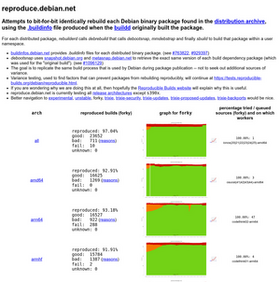
  • Lucas Nussbaum announced Debaudit, a new service to verify the reproducibility of Debian source packages :
    debaudit complements the work of the Reproducible Builds project. While reproduce.debian.net focuses on ensuring that binary packages can be bit-for-bit reproduced from their source packages, debaudit focuses on the preceding step: ensuring that the source package itself is a faithful and reproducible representation of its upstream source or Vcs-Git repository.
  • kpcyrd filed a bug against the librust-const-random-dev package reporting that the compile-time-rng feature of the ahash crate uses the const-random crate in turn, which uses a macro to read/generate a random number generator during the build. This issue was also filed upstream.
  • 60 reviews of Debian packages were added, 4 were updated and 16 were removed this month adding to our knowledge about identified issues. One new issue types was added, pkgjs_lock_json_file_issue.
Lastly, Bernhard M. Wiedemann posted another openSUSE monthly update for their work there.

Tool development diffoscope is our in-depth and content-aware diff utility that can locate and diagnose reproducibility issues. This month, Chris Lamb made a number of changes, including preparing and uploading versions, 314 and 315 to Debian.
  • Chris Lamb:
    • Don t run test_code_is_black_clean test in the autopkgtests. (#1130402). [ ]
    • Add some debugging info for PyPI debugging. [ ]
  • Jelle van der Waa:
    • Fix compatibility with LLVM version 22. [ ]
    • Adjust the PGP file detection regular expression. [ ]
  • Michael R. Crusoe:
    • Reformat the source code using Black version 26.1.0 [ ][ ]
In addition, Vagrant Cascadian updated diffoscope in GNU Guix to version 315.
rebuilderd, our server designed monitor the official package repositories of Linux distributions and attempt to reproduce the observed results there; it powers, amongst other things, reproduce.debian.net. A new version, 0.26.0, was released this month, with the following improvements:
  • Much smoother onboarding/installation.
  • Complete database redesign with many improvements.
  • New REST HTTP API.
  • It s now possible to artificially delay the first reproduce attempt. This gives archive infrastructure more time to catch up.
  • And many, many other changes.

Upstream patches The Reproducible Builds project detects, dissects and attempts to fix as many currently-unreproducible packages as possible. We endeavour to send all of our patches upstream where appropriate. This month, we wrote a large number of such patches, including:

Documentation updates Once again, there were a number of improvements made to our website this month including:
  • kpcyrd:
    • Add a new page about Rust specifics. [ ][ ][ ]
  • Robin Candau:
    • Add link to the diffoci Arch Linux package on the Tools page. [ ]
  • Timo Pohl:

Two new academic papers Marc Ohm, Timo Pohl, Ben Swierzy and Michael Meier published a paper on the threat of cache poisoning in the Python ecosystem: Attacks on software supply chains are on the rise, and attackers are becoming increasingly creative in how they inject malicious code into software components. This paper is the first to investigate Python cache poisoning, which manipulates bytecode cache files to execute malicious code without altering the human-readable source code. We demonstrate a proof of concept, showing that an attacker can inject malicious bytecode into a cache file without failing the Python interpreter s integrity checks. In a large-scale analysis of the Python Package Index, we find that about 12,500 packages are distributed with cache files. Through manual investigation of cache files that cannot be reproduced automatically from the corresponding source files, we identify classes of reasons for irreproducibility to locate malicious cache files. While we did not identify any malware leveraging this attack vector, we demonstrate that several widespread package managers are vulnerable to such attacks. A PDF of the paper is available online.
Mario Lins of the University of Linz, Austria, has published their PhD doctoral thesis on the topic of Software supply chain transparency: We begin by examining threats to the software distribution stage the point at which artifacts (e.g., mobile apps) are delivered to end users with an emphasis on mobile ecosystems [and] we next focus on the operating system on mobile devices, with an emphasis on mitigating bootloader-targeted attacks. We demonstrate how to compensate lost security guarantees on devices with an unlocked bootloader. This allows users to flash custom operating systems on devices that no longer receive security updates from the original manufacturer without compromising security. We then move to the source code stage. [Also,] we introduce a new architecture to ensure strong source-to-binary correspondence by leveraging the security guarantees of Confidential Computing technology. Finally, we present The Supply Chain Game, an organizational security approach that enhances standard risk-management methods. We demonstrate how game-theoretic techniques, combined with common risk management practices, can derive new criteria to better support decision makers. A PDF of the paper is available online.

Misc news On our mailing list this month:
  • Holger Levsen announced that this year s Reproducible Builds summit will almost certainly be held in Gothenburg, Sweden, from September 22 until 24, followed by two days of hacking. However, these dates are preliminary and not 100% final an official announcement is forthcoming.
  • Mark Wielaard posted to our list asking a question on the difference between debugedit and relative debug paths based on a comment on the Build path page: Have people tried more modern versions of debugedit to get deterministic (absolute) DWARF paths and found issues with it?


Finally, if you are interested in contributing to the Reproducible Builds project, please visit our Contribute page on our website. However, you can get in touch with us via:

Jamie McClelland: AI Hacking the Planet

A colleague asked me if we should move all our money to our pillow cases after reading the latest AI editorial from Thomas Friedman. The article reads like a press release from Anthropic, repeating the claim that their latest AI model is so good at finding software vulnerabilities that it is a danger to the world. I think I now know what it s like to be a doctor who is forced to watch Gray s Anatomy. By now every journalist should be able to recognize the AI publicity playbook: Step 1: Start with a wildly unsubstantiated claim about how dangerous your product is: AI will cause human extinction before we have a chance to colonize mars (remember that one? Even Kim Stanley Robinson, author of perhaps the most compelling science fiction on colonizing mars calls bull shit on it). AI will eliminate all of our jobs (this one was extremely effective at providing cover for software companies laying off staff but it has quickly dawned on people that the companies that did this are living in chaos not humming along happily with functional robots) AI will discover massive software vulnerabilities allowing bad actors to hack pretty much every major software system in the world . (Did Friedman pull that directly from Anthropic s press release or was that his contribution?) Step 2: To help stave off human collapse, only release the new version to a vetted group of software companies and developers, preferably ones with big social media followings Step 3: Wait for the limited release developers to spew unbridled enthusiasm and shocking examples that seem to suggest this new AI produce is truly unbelievable Step 4: Watch stock prices and valuations soar Step 5: Release to the world, and experience a steady stream of mockery as people discover how wrong you are Step 6: Start over Even if Friedman missed the text book example of the playbook, I have to ask: if you think bad actors compromising software resulting in massive loss of private data, major outages and wasted resources needs to be reported on, then where have you been for the last 10 years? This literally happens on a daily basis due to the fundamentally flawed way capitalism has been writing software even before the invention of AI. A small part of me wonders - maybe AI writing software is not so bad, because how could it be any worse than it is now? Also, let s keep in mind that AI s super ability at finding vulnerable software depends on having access to the software s source code, which most companies keep locked up tight. That means the owners of the software can use AI to find vulnerabilities and fix them but bad actors can t. Oh, but wait, what if a company is so incompetent that they accidentally release their proprietary software to the Internet? Surely that would allow AI bots to discover their vulnerabilities and destroy the company right? I m not sure if anyone has discovered world ending vulnerabilities in Anthropic s Claude code since it was accidentally released, but it is fun to watch people mock software that is clearly written by AI (and spoiler alert, it seems way worse that software written now). Well we probably should all be keeping our money in a pillow case anyway.

9 April 2026

Russell Coker: HP Z640 and E5-2696 v4

I recently decided to upgrade the CPU in my workstation, the E5-2696 v3 CPU was OK (passmark 2045 for single thread and 21,380 for multi thread) [1] but I felt like buying something better so I got a E5-2696 v4 (passmark 2115 and 24,643) [2]. I chose the E5-2696 v4 because I was looking for a E5-2699 v4 and found an ebay seller who had them at $140 but was offering the E5-2696 v4 for $99 and the passmark results for the two CPUs are almost identical. After buying the CPU and waiting for it to be delivered I realised that the Z640 doesn t include it in the list of supported CPUs and that the maximum TDP of any supported CPU is 145W while according to passmark it has a TDP of 150W. I looked for information about it on Intel ARK (the official site for specs of Intel CPUs) and discovered that The Intel Xeon Processor E5-2696 v4 is designed to be used by system manufacturers (OEMs), and this means they can modify its specifications depending on the system where it will be implemented and The processor does not have an ARK page for this reason, since it has no standard specification from Intel, so depending on the original system, it is necessary to contact that system manufacturer for information [3]. That s the official response from an Intel employee saying that there are no standard specs for that CPU!!! Somehow I had used a E5-2696 v3 for 3 years without realising that the same lack of support and specs applies to it [4]! I installed the new CPU in another Z640 which had a E5-1620 v3 CPU and it worked. I was a little surprised to discover that the hole in the corner is in the bottom right (according to the alignment of the printed text on the top) for all my E5-26xx CPUs while it s in the top left on the E5-1620 v3. Google searches for things like e5-2600 e5-1600 difference and e5-2600 e5-1600 difference hole in corner didn t turn up any useful information. The best information I found was from the Linus Tech Tips forum which says that the hole is to allow gasses to escape when the CPU package is glued together [5] which implies (but doesn t state) that the location of the hole has no meaning. I had previously thought that the hole was to indicate the location of pin 1 and was surprised when the new CPU had the hole in the opposite corner. Hopefully in future when people have such concerns they can find this post and not be worried that they are about to destroy their CPU, PC, or both when upgrading the CPU. The previous Z640 was one I bought from Facebook marketplace for $50 in unknown condition in the expectation that I would get at least $50 of parts but it worked perfectly apart from one DIMM socket. The Z640 I m using now is one I bought from Facebook marketplace for $200 and it s working perfectly with 4 DIMMs, 128G of RAM, and the E5-2696 v4 CPU. $300 for a workstation with ECC RAM and a 22 core CPU is good value for money! There are some accounts of the E5-2696 v4 not working on white-box motherboards including a claim that when it was selling for $4000US someone s motherboard destroyed one. The best plan for such CPUs is to google for someone who s already got it working in the same machine, which means a name-brand server. That doesn t guarantee that it will work (Intel refuses to supply specs and states that different items may work differently) but greatly improves the probability. This system has the HP BIOS version 2.61, note that the Linux fwupd package doesn t seem to update the BIOS on HP workstations so you need to manually download it and install it. There is a possibility that a Z640 with an older BIOS won t work with this CPU. Here is the previous post in my Z640 saga [6].

6 April 2026

Thorsten Alteholz: My Debian Activities in March 2026

Debian LTS/ELTS This was my hundred-forty-first month that I did some work for the Debian LTS initiative, started by Raphael Hertzog at Freexian. During my allocated time I uploaded or worked on: I also worked on the check-advisories script and proposed a fix for cases where issues would be assigned to the coordinator instead of the person who forgot doing something. I also did some work for a kernel update and packages snapd and ldx on security-master and attended the monthly LTS/ELTS meeting. Last but not least I started to work on gst-plugins-bad1.0 Debian Printing This month I uploaded a new upstream versions: Several packages take care of group lpadmin in their maintainer scripts. With the upload of version 260.1-1 of systemd there is now a central package (systemd systemd-standalone-sysusers systemd-sysusers) that takes care of this. Other dependencies like adduser can now be dropped. This work is generously funded by Freexian! Debian Lomiri This month I continued to work on unifying packaging on Debian and Ubuntu. This makes it easier to work on those packages independent of the used platform. I am also able to upload Debian packages to the corresponding Ubuntu PPA now. A small bug had to be fixed in the python script to allow the initial configuration in Launchpad. This work is generously funded by Fre(i)e Software GmbH! Debian Astro This month I uploaded a new upstream version or a bugfix version of: I also uploaded lots of indi-drivers (libplayerone, libsbig, libricohcamerasdk, indi-asi, indi-eqmod, indi-fishcamp, indi-inovaplx, indi-pentax, indi-playerone, indi-sbig, indi-mi, libahp-xc, indi-aagcloudwatcher, indi-aok, indi-apogee, libapogee3, indi-nightscape, libasi, libinovasdk, libmicam, indi-avalon, indi-beefocus, indi-bresserexos2, indi-dsi, indi-ffmv, indi-fli, indi-gige, info-gphoto, indi-gpsd, indi-gpsnmea, indi-limesdr, indi-maxdomeii, indi-mgen, indi-rtklib, indi-shelyak, indi-starbook, indi-starbookten, indi-talon6, indi-weewx-json, indi-webcam, indi-orion-ssg3, indi-armadillo-playtypus ) to experimental to make progress with the indi-transition. No problems with those drivers appeared and the next step would be the upload of indi version 2.x to unstable. I hope this will happen soon, as new drivers are already waiting in the pipeline. There have been also four packages, that migrated to the official indi package and are no longer needed as 3rdparty drivers (indi-astrolink4, indi-astromechfoc, indi-dreamfocuser, indi-spectracyber). While working on these packages, I thought about testing them. Unfortunately I don t have enough hardware to really check out every package, so I can upload most of them only as is. In case anybody is interested in a better testing coverage and me being able to provide upstream patches, I would be very glad about hardware donations. Debian IoT This month I uploaded a new upstream version or a bugfix version of: Debian Mobcom This month I uploaded a new upstream version or a bugfix version of: misc This month I uploaded a new upstream version or a bugfix version of: I also sponsored the upload of Matomo. Thanks a lot to William for preparing the package.

4 April 2026

Isoken Ibizugbe: Post Outreachy Activities

It s been about a month since I wrapped up my Outreachy internship, but my journey with Debian is far from over. I planned to keep contributing and exploring the community, and these past few weeks have been busy

Testing Locales and Solving Bug #1111214

For the openQA project, we decided to explore how accurate local language installations are and see if we can improve the translations. While exploring this, I started working on automating a test for a specific bug report: Debian Bug #1111214

This is a test I had started by writing a detailed description of the installation process to confirm that selecting the Spanish_panama locale works accurately. I spent time studying previous language installation tests, and I learned that I needed to add a specific tag (LANGUAGE-) to the needles (visual test markers).

Since the installation wasn t in English anymore, taking the correct screenshots and defining the areas took quite some time. I used the following command on the CLI to run the test:

openqa-cli api -X POST isos ISO=debian-live-testing-amd64-gnome.iso DISTRI=debian-live VERSION=forky FLAVOR=gnome LANGUAGE=spanish_panama ARCH=x86_64 BUILD=1311 CHECKSUM=unknown

While working on this, I got stuck at the complete_installation step. Because the keyboard layout had changed to Spanish, the commands required to confirm a successful install weren t working as expected. Specifically, we had an issue typing the greater than sign (>).

My mentor, Roland Clobus, worked on a clever maneuver for the keys (AltGr-Shift-X), which was actually submitted upstream to openSUSE.

In this step, I also had to confirm that the locale was correctly set to LANG= es_PA.UTF-8 . I had to dig into the scripts and Linux commands to make this work. It was a bit intimidating at first, but it turned out to be a great learning experience. You can follow my progress on this Merge Request here. I m currently debugging a small issue where the home key seems to click twice in the final step, and after that, the test would be complete  .

Community & Connections

Beyond the code, I ve been getting more involved in the social side of Debian:

  • Debian Women: I attended the monthly meeting and met Sruthi Chandran. I ve always seen her name as an Outreachy organizer, so it was great to meet her! She is currently running for Debian Project Leader (DPL). We also discussed starting technical sessions to introduce members to packaging, which I am very excited to learn.
  • DebConf Preparation: I am officially preparing for my first DebConf! My mentors, Tassia and Roland, along with my fellow intern Hellen, have been incredibly supportive in guiding me through the application and presentation process.

Dirk Eddelbuettel: Sponsor me for Tour de Shore 2026 to support MFA

tour de shore 2026 On June 19 and 20, I will cycle a little over 100 miles from downtown Chicago and its wonderful Millenium Park to New Buffalo, Michigan, as part of the Tour de Shore 2026. The ride passes through northwest Indiana and the extended Indiana Dunes National Park ending the next morning in the southwestern Michigan town of New Buffalo. I rode Tour de Shore once before in 2024 and had a generally wonderful time (even considering some soreness after a century of miles over 1 1/2 days). Tour de Shore is riding in support of Maywood Fine Arts Center, a local arts and sports center in Maywood, Illinois, a suburb one over from where I live and hence just a few good miles west of downtown. Maywood, Illinois is home to legends such as the late John Prine as well as several NBA players such as player and coach Doc Rivers. tour de shore 2026 donation page But Maywood, Illinois is also little less well off than other western suburbs. The Maywood Fine Arts Center is simply legendary is what they do for this community (and surrounding communities), and especially the youth support. They can use a dollar a two. Their story about Tour de Shore is worth a read too for background and motivation. I have bootstrapped my donation page page with a dollar for each mile to be cycled. It would be simply terrific if you could join me. A nickel, a dime, or a quarter per mile cycled would help. Multiples of that help too: More is of course still always better. Anything you can afford will go a long way towards a worthy goal in a community that could use the help. Of and if you are local to the area, I believe you can still register for Tour de Shore 2026. So see you out there in June? And if not, maybe help with a dollar or two?

This post by Dirk Eddelbuettel originated on his Thinking inside the box blog.

2 April 2026

Joerg Jaspert: Building a house - 1 year in

Haven t written here about it, but last March we finally started on our journey to get our own house build, so we can move out of the rented flat here. That will be a big step, both the actual building, but also the moving - I am living at this one single place for 36 years now. If you can read german there is a dedicated webpage where I sometimes write about the process. Will have much more details (and way more ramblings) than the following part. If you can t read german, a somewhat short summary follows. Yes, still a lot of text, but shortened, still.

What? Why now? Current flat has 83m - which simply isn t enough space. And the number of rooms also doesn t fit anymore. But it is hard to find a place that fits our requirements (which do include location). Moving to a different rented place would also mean changed amount of rent. And nowadays that would be huge increase (my current rent is still the price from about 30 years ago!). So if we go and pay more - we could adjust and pay for something we own instead. And both, my wife and I had changes in our jobs that made it possible for us now, so we started looking.

Market Brrrr, looking is good, actually finding something that fits - not so. We never found an offer that fit. Space wise, sure. But then location was off, or price was idiotically high. Location fit, but then size was a joke, and guess about the price Who needs 200 square meters with 3 rooms? Entirely stupid design choices there. Or how about 40 square meters of hallway - with 50m of tiny rooms around. What are they smoking? Oh, there, useful size, good rooms - but now you want more money than a kidney is worth, or something. Thanks, no.

New place In February 2025 we finally got lucky and found a (newly opened) area with a large number of places to build a house on. Had multiple talks with someone from on of the companies developing that area (there are two you can select from), then talked with banks and signed a contract in March 2025. We got promised that actual house construction would be first quarter of 2026, finished in second quarter.

House type There are basically 2 ways of building a new house (that matter here). First is called Massivhaus , second is called Fertighaus in german, roughly translating to solid and prefabricated. The latter commonly a wood based construction, though it doesn t need to be. The important part of it is the prefabrication, walls and stuff get assembled in a factory somewhere and then transported to your place, where they play big kid lego for a day and suddenly a house is there. A common thought is prefabricated is faster, but that is only a half true. Sure, the actual work on side is way shorter - usually one or two days and the house is done - while a massive construction usually takes weeks to build up. But that is only a tiny part of the time needed, the major part goes of into planning and waiting and in there it doesn t matter what material you end up with.

Money fun Last year already wasn t the best time to start a huge loan - but isn t it always a few years ago would have been better ? So we had multiple talks with different banks and specialised consultants until we found something that we thought is good for us. Thinking about it now - we should have put even more money on top as reserve , but who could have thought that 2026 turns into such a shitshow? Does not help at all, quite the contrary. And that damn lotto game always ends up with the wrong numbers, meh.

Plans and plans and more plans - and rules For whichever reason you can not just go and put something on your ground and be happy. At least not if you are part of the normal people and not enormously rich. There is a large set of rules to follow. Usually that is a good thing, even though some rules are sometimes hard to understand. In Germany, besides the usual laws, we have something that is called Bebauungsplan , which translates to development plan (don t know if that carries the right meaning, it s a plan on what and how may be build, which can have really detailed specifications in). It basically tells you every aspect on top of the normal law that you have to keep in mind. In our case we have the requirement of 2 full floors and CAN have a third smaller on top, it limits how high the house can be and also how high our ground floor may be compared to the street. It regulates where on the property we may build and how much ground we may cover with the house, it gives a set of colors we are allowed to use, it demands a flat roof that we must have as a green roof and has a number of things more that aren t important enough to list here. If you do want to see the full list, my german post on it has all the details that matter to us. With all that stuff in mind - off to plans. Wouldn t have believed how many details there are to take in. Room sizes are simple, but how to arrange them for ideal usage of the sun, useful ways inside the house, but also keeping in mind that water needs to flow through and out. Putting a bath room right atop a living room means a water pipe needs to go down there. Switch the bath room side in the house, and it suddenly is above the kitchen - means you can connect the pipes from it to the ones from kitchen, which is much preferred than going through the living room. And lots more such things. It took us until nearly end of October to finalize the plans! And we learned a whole load from it. We started with a lot of wishes. The planner tried to make them work. Then we changed our minds. Plans changed. Minds changed again. Comparing the end result with the first draft we changed most of the ground floor around, with only the stairs and the entrance door at the same position. Less changes for the upper floor, but still enough.

Side quests The whole year was riddled with something my son named side quests. We visited a construction exhibition near us, we went to the house builders factory and took a look on how they work. We went to many different other companies that do SOME type of work which we need soon, say inside floors, painters, kitchen and more stuff. Of course the most important side quest was a visit to the notary to finalize the contracts, especially for the plot of land (in Germany you must have a notary for that to get entered into the governments books). Creates lots of fees, of course, for the notary and also the government (both fees and taxes here).

Building permit We had been lucky and only needed a small change to the plans to get the building permit - and the second part, the wastewater permit (yes, you need a separate one for this) also got through without trouble.

Choices, so many of them So in January we finally had an appointment for something that s called Bemusterung which badly translates to Sampling . Basically two days at the house builders factory to select all of what s needed for the house that you don t do in the plans. Doors, inside and out and their type and color and handles. Same things for the windows and the blinds and the protection level you want the windows to have. Decide about stairs, design for the sanitary installations - and also the height of the toilet! - and the tiles to put into the bathrooms. Decisions on all the tech needed (heating system, ventilation and whatnot. Two days, busy ones - and you can easily spend a lot of extra money here if you aren t careful. We managed to get out of it with only about 4000 extra, so pretty good.

Electro and automation Now, here I am special. Back when I was young the job I learned is electrician. So here I have very detailed wishes. I am also running lots of automatism in my current flat - obviously the new house should be better than that. So I have a lot of ideas and thoughts on it, so this is entirely extra and certainly out of the ordinary the house builder usually see. Which means I do all of that on my own. Well, the planning and some of the work, I must have a company at hand for certain tasks, it is required by some rules. But they will do what I planned, as long as I don t violate regulations. Which means the whole electrical installation is different. Entirely planned for automatisms and using KNX for it. I am so happy to ditch Homeassistant and the load of Homematic, Zigbee and ZWave based wireless things. Ok, Homeassistant is a nice thing - it can do a lot. And it can bridge between about any system you can find. But it is a central single point of failure. And it is a system that needs constant maintenance. Not touched for a while? Plan for a few hours playing update whack-a-mole. And often enough a component here or there breaks with an update. Can be fixed, but takes another hour or two. So I change. Away from wireless based stuff. To wires. To a system thats a standard for decades already. And works entirely without a SPOF. (Yes, you can add one here too). And, most important, should I ever die - can easily be maintained by anyone out there dealing with KNX, which is a large number of people and companies. Without digging through dozens of specialised integrations and whatnot. I may even end up with Homeassistant again - but that will entirely be as a client. It won t drive automations. It won t be the central point to do anything for the house. It will be a logging and data collecting thing that enables me to put up easy visualizations. It may be an easy interface for smartphones or tablets to control parts of the house, for those parts where one wants this to happen. Not the usual day-to-day stuff, extras on top.

Actual work happening Since march there finally is action visible. The base of the house is getting build. Wednesday the 1st April we finally got the base slab poured on the construction site and in another 10 days the house is getting delivered and build up. A 40ton mobile crane will be there.

1 April 2026

Ben Hutchings: FOSS activity in March 2026

Matthew Garrett: Self hosting as much of my online presence as practical

Because I am bad at giving up on things, I ve been running my own email server for over 20 years. Some of that time it s been a PC at the end of a DSL line, some of that time it s been a Mac Mini in a data centre, and some of that time it s been a hosted VM. Last year I decided to bring it in house, and since then I ve been gradually consolidating as much of the rest of my online presence as possible on it. I mentioned this on Mastodon and a couple of people asked for more details, so here we are. First: my ISP doesn t guarantee a static IPv4 unless I m on a business plan and that seems like it d cost a bunch more, so I m doing what I described here: running a Wireguard link between a box that sits in a cupboard in my living room and the smallest OVH instance I can, with an additional IP address allocated to the VM and NATted over the VPN link. The practical outcome of this is that my home IP address is irrelevant and can change as much as it wants - my DNS points at the OVH IP, and traffic to that all ends up hitting my server. The server itself is pretty uninteresting. It s a refurbished HP EliteDesk which idles at 10W or so, along 2TB of NVMe and 32GB of RAM that I found under a pile of laptops in my office. We re not talking rackmount Xeon levels of performance, but it s entirely adequate for everything I m doing here. So. Let s talk about the services I m hosting.

Web This one s trivial. I m not really hosting much of a website right now, but what there is is served via Apache with a Let s Encrypt certificate. Nothing interesting at all here, other than the proxying that s going to be relevant later.

Email Inbound email is easy enough. I m running Postfix with a pretty stock configuration, and my MX records point at me. The same Let s Encrypt certificate is there for TLS delivery. I m using Dovecot as an IMAP server (again with the same cert). You can find plenty of guides on setting this up. Outbound email? That s harder. I m on a residential IP address, so if I send email directly nobody s going to deliver it. Going via my OVH address isn t going to be a lot better. I have a Google Workspace, so in the end I just made use of Google s SMTP relay service. There s various commerical alternatives available, I just chose this one because it didn t cost me anything more than I m already paying.

Blog My blog is largely static content generated by Hugo. Comments are Remark42 running in a Docker container. If you don t want to handle even that level of dynamic content you can use a third party comment provider like Disqus.

Mastodon I m deploying Mastodon pretty much along the lines of the upstream compose file. Apache is proxying /api/v1/streaming to the websocket provided by the streaming container and / to the actual Mastodon service. The only thing I tripped over for a while was the need to set the X-Forwarded-Proto header since otherwise you get stuck in a redirect loop of Mastodon receiving a request over http (because TLS termination is being done by the Apache proxy) and redirecting to https, except that s where we just came from. Mastodon is easily the heaviest part of all of this, using around 5GB of RAM and 60GB of disk for an instance with 3 users. This is more a point of principle than an especially good idea.

Bluesky I m arguably cheating here. Bluesky s federation model is quite different to Mastodon - while running a Mastodon service implies running the webview and other infrastructure associated with it, Bluesky has split that into multiple parts. User data is stored on Personal Data Servers, then aggregated from those by Relays, and then displayed on Appviews. Third parties can run any of these, but a user s actual posts are stored on a PDS. There are various reasons to run the others, for instance to implement alternative moderation policies, but if all you want is to ensure that you have control over your data, running a PDS is sufficient. I followed these instructions, other than using Apache as the frontend proxy rather than nginx, and it s all been working fine since then. In terms of ensuring that my data remains under my control, it s sufficient.

Backups I m using borgmatic, backing up to a local Synology NAS and also to my parents home (where I have another HP EliteDesk set up with an equivalent OVH IPv4 fronting setup). At some point I ll check that I m actually able to restore them.

Conclusion Most of what I post is now stored on a system that s happily living under a TV, but is available to the rest of the world just as visibly as if I used a hosted provider. Is this necessary? No. Does it improve my life? In no practical way. Does it generate additional complexity? Absolutely. Should you do it? Oh good heavens no. But you can, and once it s working it largely just keeps working, and there s a certain sense of comfort in knowing that my online presence is carefully contained in a small box making a gentle whirring noise.

31 March 2026

C.J. Collier: Finding: Promoting SeaBIOS Cloud Images to UEFI Secure Boot (Proxmox)

Discovery Legacy cloud templates often lack the partitioning and bootloader
binaries required for UEFI Secure Boot. Attempting to switch such a VM
to OVMF in Proxmox results in not a bootable disk. We discovered that
a surgical promotion is possible by manipulating the block device and
EFI variables from the hypervisor.

The Problem
  1. Protective MBR Flags: Legacy installers often set
    the pmbr_boot flag on the GPT s protective MBR. Strict UEFI
    implementations (OVMF) will ignore the GPT if this flag is present.
  2. Missing ESP: Cloud images often lack a FAT32 EFI
    System Partition (ESP).
  3. Variable Store: A fresh Proxmox
    efidisk0 is empty and lacks both the trust certificates
    (PK/KEK/db) and the BootOrder entries required for an automated
    boot.

The Promotion Rule To upgrade a SeaBIOS VM to Secure Boot without a full OS reinstall:
1. Surgical Partitioning: Map the disk on the host and
add a FAT32 partition (Type EF00). Clear the
pmbr_boot flag from the MBR. 2. Binary
Preparation: Boot the VM in SeaBIOS mode to install
shim and grub-efi packages. Use
grub2-mkconfig to populate the new ESP. 3. Trust
Injection: Use the virt-fw-vars utility on the
hypervisor to programmatically enroll the Red Hat/Microsoft CA keys and
any custom certificates (e.g., FreeIPA CA) into the VM s
efidisk. 4. Boot Pinning: Explicitly set
the UEFI BootOrder to point to the shimx64.efi
path via virt-fw-vars --append-boot-filepath.

Solution (Example Command
Sequence) On the Proxmox Host (root):
# Map and Clean MBR
DEV=$(rbd map pool/disk)
parted -s $DEV disk_set pmbr_boot off

# Inject Trust and Boot Path (VM must be stopped)
virt-fw-vars --inplace /dev/rbd/mapped_efidisk \
  --enroll-redhat \
  --add-db <GUID> /path/to/ipa-ca.crt \
  --append-boot-filepath '\EFI\centos\shimx64.efi' \
  --sb
This workflow enables high-integrity Secure Boot environments using
existing SeaBIOS infrastructure templates.

Russ Allbery: Review: Code Blue Emergency

Review: Code Blue Emergency, by James White
Series: Sector General #7
Publisher: Orb
Copyright: 1987
Printing: May 2003
ISBN: 0-7653-0663-8
Format: Trade paperback
Pages: 252
Code Blue Emergency (annoying em-dash in original title) is the seventh book of James White's Sector General science fiction series about a vast multi-species hospital station. While there are some references to (and spoilers for) earlier books in the series, you don't have to remember the previous books to read this one. I had no trouble despite a nine-year gap. I read this as part of the Orb General Practice omnibus, which collects this novel and The Genocidal Healer. Cha Thrat is a Sommaradvan warrior-surgeon, member of a newly-discovered species that is beginning the process of contact with the Federation. She saved a Monitor corps human after an accident on her world, performing some some highly competent surgery on a species she had never seen before. That plus her somewhat outcast status on her own world due to her very traditional attitude towards medical ethics led Sector General to extend an offer of medical internship, and led her to leap into the unknown by accepting. This may have been a mistake; there is a great deal that Sector General does not understand about Sommaradvan medical ethics. This series entry is another proper (if somewhat episodic) novel and the first book of the series that doesn't primarily focus on Conway. He makes an appearance in his new role as Diagnostician, but only as a supporting character. Code Blue Emergency is told in the tight third-person perspective of Cha Thrat, an alien who finds many things about Sector General baffling, confusing, and ethically troubling (and who therefore provides a good reader surrogate for reintroducing the basics of how the hospital works). Using an alien viewpoint is a more sophisticated narrative technique than White has used previously. I'm glad he tried it, and it mostly works, although I have some complaints. Cha Thrat comes from the middle caste of a strictly hierarchical society of three castes, but is also immensely stubborn and used to a medical system in which doctors take sole responsibility for their patients. This creates a lot of cultural conflicts, and I do enjoy science fiction where the human attitudes are portrayed as the strange ones, but the cultural analysis offered by this novel is not very deep. The pattern of this book is for Cha Thrat to stumble into a successful approach to a problem while being either oblivious to or hostile to the normal hierarchical structure expected of medical trainees. This is believable as far as it goes. She is a skilled and intelligent doctor with some good instincts and a strong commitment to patient care, but is also culturally inclined to not ask for help. It makes sense for that to be a serious problem in a hospital. Unfortunately, no one says this directly. Sector General staff get quite upset in ways that seem more territorial than oriented towards patient safety, no one directly explains to Cha Thrat why following a process is important or shows examples of what could go wrong, and plot armor means that her mistakes usually have positive outcomes. One can extrapolate the reasons why she is not a good medical student, but the reader is forced to do the extrapolation. This is the sort of book where the narration makes clear there are unresolved cultural clashes that are going to cause problems but hides the details. To Cha Thrat, her perspective is so obvious she never bothers to explain it to the reader, so the specifics come as a surprise. As with the alien perspective, I've seen this technique used with more subtlety and sophistication in other books, but White's version mostly works. Cha Thrat is a sympathetic protagonist because she is truly trying to take the most ethical and empathetic action in every situation and is clearly competent. Most of my frustration as a reader, ironically, lands on the other Sector General doctors who seem to make little to no effort to understand her perspective when she fails to conform to their expectations. This is believable in the abstract, but the whole point of Sector General is that they're supposed to be wiser about interspecies difference than this. Also, sometimes their reactions just seem petty. Cha Thrat has a very hierarchical concept of medicine that matches the social classes of her culture. For her, the highest tier of doctor are wizards who treat rulers, because the work of rulers is mostly mental and intellectual and therefore the diseases of rulers are treated with magic spells performed with words to reshape their thinking rather than surgery on their bodies. O'Mara and the other Sector General psychologists take great offense at this, muttering about being called witch doctors, which I found completely absurd. This is a comprehensible, if odd, description of psychology from a wholly alien species. Surely one's first reaction should be that words like "wizard" or "magic" are translation errors. Don't get offended; look to see if the underlying substance matches, which it clearly does. Apart from cultural and psychological clashes, Code Blue Emergency has the standard episodic Sector General structure of interesting medical mysteries that require lateral thinking. I find this sort of puzzle story satisfying, particularly given the firm belief of every character in an essentially pacifist and empathetic approach to even the most alien of creatures. This determined non-violence is one of the more interesting things about this series, and it continues here. White does tend towards both biological and gender essentialism for everyone other than the protagonist and main supporting characters, but he seemed to be walking back some of the more outrageous limitations on women that appeared in previous books. There is still some nonsense in here about how females of any species can't be Diagnosticians, but then Cha Thrat, who is female, seems to violate the justification for that rule over the course of this novel (sadly without comment). Perhaps he's setting up for proving Sector General wrong about this prejudice. I picked this up after reading Elizabeth Bear's Machine, which is essentially a (better written) Sector General novel that got me in the mood for reading more. I wouldn't give Code Blue Emergency any awards, but it delivered exactly what I was looking for. This series is not as deep or well-written as some more recent SF, but it is reliably itself and reliably entertaining. There are worse things in a series. Recommended if you're in the mood for alien ER in space. The omnibus edition that I read has an introduction to both novels by John Clute. It does add some interesting insights, but (as is somewhat typical for Clute) it also spoils parts of both books. You may want to read it after you read the novels. Followed by The Genocidal Healer. Rating: 7 out of 10

30 March 2026

Jamie McClelland: Mailman3 has 2 databases. Whoops.

At May First we have been carefully planning our migration of about 1200 lists from mailman2 to mailman3 for almost six months now. We did a lot of user communications, had several months of beta testing with a handful of lists ported over, and everything was looking good. So we kicked off the migration! But, about 15% of the way through I started seeing sqlite lock errors. Wait, what? I carefully re-configured mailman3 to use postgres, not sqlite. Well, yes, but apparently that was for the database managing the email list configuration, not the database powering the django web app, which, incidentally, also includes hundresds of gigabytes of archives. In other words, the one we really need in postgres, not sqlite.

Moving from sqlite to postgres Well that sucks. We immediately stopped the migration to deal with this. I noticed that the web is full of useful django instructions on how to migrate your database from one database to antoher. However, if you read the fine print, those convenient looking dumpdata loaddata workflows are designed to move the table definitions and a small amount of data. In our case, even after just 15% of our lists moved, our sqlite database was about 30GB. I considered some of the hacks to manage memory and try to run this via django, but eventually decided that pgloader was a more robust option. This option also allowed me to more easily test things out on a copy of our sqlite database (made while mailman was turned off). This way I could migrate and re-migrate the sqlite database over and over without impacting our live installation until I was satisfied it was all working. My first decision was to opt out of pgloader s schema creation. I used django s schema creation tool by:
  • Turning off mailman3 and mailman3-web and changing the mailman web configuration to use the new postgresql database.
  • Running mailman-web migrate
  • Changing the mailman web configuration back to sqlite and starting everything again.
Note: I tried just adding new database settings in the mailman web configuration indexed to new - django has the ability to define different databases by name, then you can run mailman-web migrate --database new. But, during the migration, I caught django querying the sqlite database for some migrations that required referencing existing fields (specifically hyperkitty s 0003_thread_starting_email). I didn t want any of these steps to touch the live database so I opted for the cleaner approach. Once I had a clean postgres schema, I dumped it so I could easily return to this spot. Next I started working on our pgloader load file. After a lot of trial and error, I ended with:
LOAD DATABASE
    FROM sqlite:///var/lib/mailman3/sqlite-postgres-migration/mailman3web.clean.backup.db
    INTO postgresql://mailmanweb:xxxxxxxxxxx@localhost:5432/mailmanweb

WITH data only,
    reset sequences,
    include no drop,
    disable triggers,
    create no tables,
    batch size = 5MB,
    batch rows = 500,
    prefetch rows = 50,
    workers = 2,
    concurrency = 1

SET work_mem to '64MB',
    maintenance_work_mem to '512MB'

CAST type datetime to timestamptz drop default drop not null,
    type date to date drop default drop not null,
    type int when (= precision 1) to boolean using tinyint-to-boolean,
    type text to varchar using remove-null-characters;
The batch, prefetch, workers and concurreny settings are all there to ensure memory doesn t blow up. I also discovered that I had to make some changes to the schema before loading data. Mostly truncating tables that the django migrate command populated to avoid duplicate key errors:
TRUNCATE TABLE django_migrations CASCADE;
TRUNCATE TABLE django_content_type CASCADE;
TRUNCATE TABLE auth_permission CASCADE;
TRUNCATE TABLE django_site CASCADE;
And also, I had to change a column type. Apparently the mailman import process allowed an attachment file name that exceeds the limit for postgres, but was allowed into sqlite:
ALTER TABLE hyperkitty_attachment ALTER COLUMN name TYPE text
When pgloader runs, we still get a lot of warnings from pgloader, which wants to cast columns differently than django does. These are harmless (I was able to import the data without a problem). And there are still a lot of warnings along the lines of:
2026-03-30T14:08:01.691990Z WARNING PostgreSQL warning: constraint hyperkitty_vote_email_id_73a50f4d_fk_hyperkitty_email_id of relation hyperkitty_vote does not exist, skipping
These are harmless as well. They appear because disable triggers disables foreign key constraints. Without it, we wouldn t be able to load tables that require values in tables that have not yet been populated. After all the tweaking, the import of our 30GB sqlite database took about 40 minutes.

Final Steps I think the reset sequences from pgloader should take care of this, but just in case:
mailman-web sqlsequencereset hyperkitty mailman_django auth   mailman-web dbshell
And, just to ensure postgres is optimized, run this in the psql shell:
ANALYZE VERBOSE;

Last thoughts I understand very well all the decisions the mailman3 devs made in designing the next version of mailman, and if I was in the same place I may have made them the same ones. For example, separating the code running the mailing list from the code managing the archives and the web interface makes perfectly good sense - many people might want to run just the mailing list part without a web interface. And building the web interface in django makes a lot of sense as well - why re-invent the wheel? I m sure a lot of time and effort was saved by simply using the built in features you get for free with django. But the unfortunate consequence of these decisions is that sys admins have a much harder time. Almost everyone wants the email lists along with the web interface and the archives. But nobody wants two different configuration files with different syntaxes and logic, not to mention two different command lines to use for maintenance and configuration with completely different APIs. Trying to understand how to change a default template or set list defaults requires a lot of research and usually you have to write a python script to do it. I have finally come to the conclusion that mailman2 is designed for sys admins, while mailman3 is designed for developers. Despite these short comings, I am impressed with the community and their quick and friendly responses to the questions of a confused sys admin. That might be more valuable than anything else.

Utkarsh Gupta: FOSS Activites in March 2026

Here s my monthly but brief update about the activities I ve done in the FOSS world.

Debian
Whilst I didn t get a chance to do much, here are still a few things that I worked on:
  • A quick exchange with Xavier about node-lodash fixes for stable releases.
  • Uploaded ruby-rack to CVE-2026-25500 & CVE-2026-22860 to sid, trixie, and bookworm.
  • Started to work on the DebConf Bursary team along with PEB.
  • Assited a few folks in getting their patches submitted via Salsa.
  • Mentoring for newcomers.
  • Moderation of -project mailing list.

Ubuntu
I joined Canonical to work on Ubuntu full-time back in February 2021. Whilst I can t give a full, detailed list of things I did, here s a quick TL;DR of what I did:
  • Successfully released 26.04 LTS Beta!
  • Worked further on the whole artifact signing story for cdimage.
  • Assisted a bunch of folks with my Archive Admin and Release team hats to:
    • Review and grant FFes.
    • Coordinating weekly syncs.
    • Promoting/demoting binaries to/from main.
    • Taking care of package removals and so on.
  • Was pretty occupied with the new release processs architecture and design.
  • Preparing for the 26.04 LTS final release.

Debian (E)LTS
This month I have worked 50 hours on Debian Long Term Support (LTS) and on its sister Extended LTS project and did the following things:

Released Security Updates

Work in Progress
  • knot-resolver: Affected by CVE-2023-26249, CVE-2023-46317, and CVE-2022-40188, leading to Denial of Service.
  • node-lodash: Affected by CVE-2025-13465, prototype pollution in the baseUnset function.
    • [stable]: Xavier from the JS team ACK d the patch. The trixie and bookworm uploads will follow.
    • [LTS]: The bullseye test and upload will follow in April once the stable uploads are in and ACK d by the SRMs.
  • vlc: Affected by CVE-2025-51602, an out-of-bounds read and denial of service via a crafted 0x01 response from an MMS server.
    • [LTS]: 3.0.23 backport is ready but not tested. I ll get this over the line in March.
    • [ELTS]: 3.0.23 backport is ready but not very clean. Would like to complete LTS and get back to this.

Other Activities
  • [ELTS] Continued to review ruby-rack for ELTS it has since received about 13 new CVEs, making it even more chaotic. Might consider releasing in batches.
  • [E/LTS] Monitored discussions on mailing lists, IRC, and all the documentation updates.
  • [E/LTS] Attended the monthly LTS meeting on IRC. Summary here.
  • [Other] Spent quite some time debugging a bug in debusine. Filed https://salsa.debian.org/freexian-team/debusine/-/issues/1412 for the same. Have worked on a preliminary patch but would like to submit something for Colin to review. Will follow up in April.

Until next time.
:wq for today.

29 March 2026

Russell Coker: Ebook Readers in Debian

Laptop For a while I ve been using Calibre 8.5.0+ds-1+deb13u1 in Debian/Trixie running KDE for reading ebooks on my laptop, it generally works well and has a large font size. The only downsides of it for that use are taking more RAM than I would prefer (about 780M RSS which seems a lot for a relatively simple task) and having separate windows for the list of books and reading an actual book without any options to just open the last book and not delay me. I tried Arianna 25.04.0-1 in Debian/Trixie, it has a significantly smaller font size and doesn t allow high contrast colors as the default is black on gray with the dark theme in KDE. It also only allows left and right arrows for moving through the book while Calibre uses up/down, left/right, or pgup/pgdn so whatever keys seem reasonable to you are going to work. The RSS was 762M which wasn t great but wasn t the real problem. Rumours of Arianna using less RAM than Calibre seem exaggerated. Librem5 On my Librem5 phone with Plasma Mobile Calibre 8.5.0+ds-1+deb13u1 both the initial setup screen and the main screen for selecting a book to read don t work in the width of portrait view on the phone. After putting it in landscape mode it worked, but I couldn t touch on a book title to select it I had to touch on the number of the book at the left of the list box. But once it was loaded everything was fine. On the Librem5 Arianna 25.04.0-1 just worked fine, although only using left/right swipes to change pages instead of up/down was annoying. Furilabs FLX1s On my Furilabs FLX1s with phosh Arianna 25.04.0-1 and Calibre 8.16.2+ds+~0.10.5-3 both gave the same result of not displaying text or images from the book, I m not sure if it s phosh or some other aspect of the FLX1s configuration at fault. PinePhonePro On my PinePhonePro running Debian/Testing with Plasma Mobile Arianna 25.12.3-1 worked without any issue and up/down swipes worked. Calibre 9.5.0+ds+~0.10.5-1 had the initial screen work fine in portrait mode but the main screen was too wide and needed landscape. Also the issue of having to touch the number applied. Laptop running Debian/Unstable Calibre 9.6.0+ds+~0.10.5-2 and Arianna 25.12.3-1 worked quite nicely on a Thinkpad running Debian/Unstable. One thing I discovered while testing it is that Calibre supports the CTRL-PLUS and CTRL-MINUS key combinations to change font sizes and that also works on the version in Debian/Trixie. Arianna doesn t support CTRL-PLUS/MINUS. Conclusion The problems I had were Arianna on a laptop, everything on the Furilabs FLX1s, and Calibre s UI not being well adjusted for mobile devices.

Russ Allbery: Review: The Sovereign

Review: The Sovereign, by C.L. Clark
Series: Magic of the Lost #3
Publisher: Orbit
Copyright: September 2025
ISBN: 0-316-54286-5
Format: Kindle
Pages: 575
The Sovereign is the third and concluding book of C.L. Clark's Magic of the Lost high fantasy trilogy. I recommend reading the books of this series close together, since there are a lot of characters and a lot of continuity between books that is helpful to remember, but it was not quite as difficult this time to remember where the story left off. At the end of The Faithless, the political situation in Balladaire (not-France) was more stable, but the threat of a plague lay on the horizon. That threat arrives in earnest in this book, along with new threats from both Balladaire's former colonial conscript soldiers and from neighboring Taargen (not-Germany, sort of, although the parallel isn't as close). Luca and Touraine have finally admitted that they're deeply in love, but they are still very different people with different goals and ethics. Luca is determined to do anything necessary to save her kingdom, but her definition of her kingdom is sharp and brittle. Touraine is torn between far too many loyalties, plus the lingering worry that her morals and Luca's may not be compatible. I think the hardest part of this sort of series is finding an ending the reader will find satisfying. This one, unfortunately, did not work for me, but that may be more due to personal preference than objective flaws. There have been two threads through this series: an improbable romance embedded in a network of complex personal relationships, and a political commentary on colonialism and post-colonial wars. I was enjoying the former, but it was the latter that felt fresh and interesting to me. The plot threads in The Faithless outside of Balladaire expanded that complexity, and I was hoping the final volume would continue in that direction. How could a colonial power atone for its history? How does the former colony establish its own governance? Is there a path to freedom without violence? Are attempts to chart a more moral course doomed to open lines of attack for one's other enemies? It's clear that Clark was thinking about similar themes, but The Sovereign narrows the field instead of widens it, restricts the political options, and then resolves most questions in a massive war. This is not that surprising of a conclusion, but it's one that I found unsatisfying and, honestly, a little boring. Yes, one way to resolve all the competing tensions is for everyone to try to kill each other and whoever survives wins, and historically that's one of the more likely outcomes, but that ending doesn't wrestle with the politics as much as it collapses them. Clark instead focuses this concluding volume on the romance, which becomes even more fraught, tragic, and dramatic than it was in previous books (and that's saying something). The hard questions of divided loyalties and moral conflicts are mostly framed by questions about Touraine's loyalty to Luca and Luca's trust of Touraine. This is all very Shakespearean, full of hard choices, sudden reversals, miscommunication, and a very deep conflict between Luca's realpolitik and Touraine's stubborn personal morality. If this is what you were reading the series for, if you were hoping for a maximum-drama sapphic relationship, you may thoroughly enjoy this. I thought it had its moments, but I wish they had been balanced by more moments of cool-headed practicality and creative political ingenuity. My biggest frustration with this ending is that the characters largely stop doing politics. The political complexity was the strength of both The Unbroken and The Faithless: People who intensely dislike each other negotiate because there is something larger to be gained, personal decisions made without considering the political ramifications have costs, and multiple characters are trying hard to find a way to turn a nasty, exploitative world into something better without simply killing everyone who disagrees. Many of the characters were objectively bad at politics, inexperienced and immature, but they stumbled or dragged or fought their way into political solutions anyway. I thought Clark moved too far away from that in The Sovereign. Everyone goes deep into their own emotions and desire for vengeance or conquest or revolution and stops compromising. To a depressingly large extent, the story is resolved by killing everyone who disagrees. I think the story is poorer for it. One of the other threads of the series is Balladairan magic, or rather its odd absence. Luca has one understanding of it, the rebels introduced in The Faithless have a different understanding of it, and its pursuit is set up as critical to resolving the threat of a plague. We do get an explanation of sorts, but it's not as complete or as satisfying as I was hoping, and the symbolism of Balladaire's missing magic is left frustratingly murky. For me, this has some of the same problems as the political conclusion: I wanted an intellectual catharsis alongside the emotional catharsis, but that was not the direction Clark was taking the story. I like reading about these characters. All of Luca, Touraine, and Pruett are complex, comprehensible, flawed, and often intriguing. But my favorite character in the story, the person I latched on to as an emotional path through the story, was Sabine. Her refreshingly straightforward loyalty and lack of drama was a breath of fresh air. She has some great moments in this book, but there too I got wrong-footed by the direction Clark went with her arc and found its conclusion deeply unsatisfying. I'm not sure how many of these complaints are because of missed opportunities in the novel, how many were due to a mismatch of taste, and how many were due to not being in the right mood to read this conclusion. I'm sure that it didn't help that I read this simultaneous with another novel in which the characters were always miserable, or that I read it in early 2026 with, uh, all that entails. I suspect that if you came away from the first two books invested in the messy romance and wanting MOAR DRAMA, you may get exactly what you were hoping for. That, sadly, was not what I was hoping for. I can't really recommend this. I thought it dragged in places and didn't deliver the ending I wanted. But it has some great moments, it does wrap up the threads of the trilogy as advertised, and at least the romance gets a dramatic climax worthy of the tension that has been built through the previous books. If that matches what you were enjoying in the previous books, you may well enjoy this more than I did. Rating: 5 out of 10

Samuel Henrique: Latest NVIDIA Drivers for Debian (Packaged with AI)

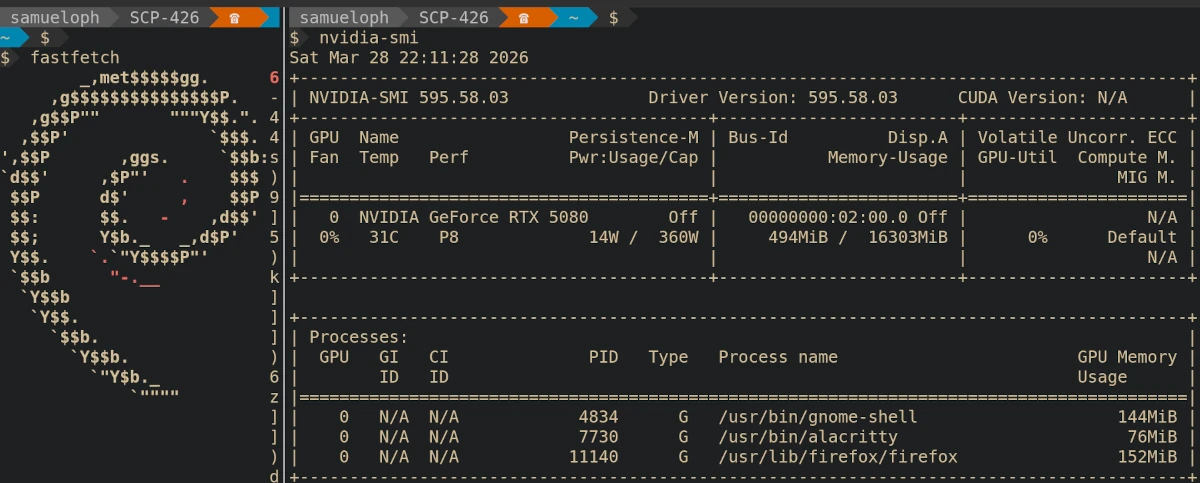
Two terminal windows side-by-side, on the left there's the Debian logo in ASCII art, and on the right it's the output of nvidia-smi, showing the driver version 595.58.03 running on a machine that has an NVIDIA RTS 5080

tl;dr This is not an official package, it's good enough for me and it might be good enough for you, confirmed as working in Debian Testing but I don't have a Stable machine to test there. You can use my custom repo to install the latest NVIDIA drivers on Debian Stable, Testing or Unstable (install from Sid repository): https://deb.debusine.debian.net/debian/r-samueloph-nvidia-ai/ The page above contains the APT sources you need, just add the one for your release to /etc/apt/sources.list.d/r-samueloph-nvidia-ai.sources, run sudo apt update and install the packages, you might need to disable Secure Boot.

This is not about AI Discussions about AI are quite divisive in the Free Software communities, and there's so much to be said about it that I'm not willing to go into in this blog post. This is rather just me telling people that if they need up-to-date NVIDIA packages for Debian, they could check if my custom repository gets the job done. The AI part is a means to an end, I've been careful to note in the repository names that the packages were produced with AI to respect people who do not want to run it for any reason.

RTX 5000 series support Back in May 2025 I opened a bug report asking for the NVIDIA drivers on Debian to be updated to support the RTX 5000 series. The Nouveau drivers might be good enough for some people, but I need the NVIDIA drivers because I want to play games and do experiments with open weight models. Opening a bug report doesn't guarantee anything, at the end of the day Debian Developers are volunteers, so if I really wanted the newer drivers, I would have to do something about it, ideally submitting a merge request. I briefly looked into the NVIDIA packaging, which involves 3 source packages (and one extra git repo for tarballs), unfortunately this was going to take more time and effort than what I was willing to spend.

What I Did After a few weeks of lamenting that I wasn't running the NVIDIA drivers, I figured I was willing to put in more effort than I originally thought, just enough to instruct the Claude Code agent to package the latest releases. I'm skilled enough with agentic tools that I knew how to use it to save time; providing a clear instruction on how to build the package and explaining the packaging layout, then letting the agent iterate until it gets a working build. The agent was running inside a VM that didn't have any of my credentials. After a little bit of back and forth, where I was reviewing the changes guiding the agent into how to fix certain issues, I ended up with a working set of packages. Once I installed it on my machine and confirmed they worked, I set up a debusine repository to make it easier to install future updates, and let others test it out. Debusine is analogous to Ubuntu's famous PPA, or Fedora's EPEL, it's a relatively new project but it has been working fine for this. Matheus Polkorny helped me test the packages and did spot a few issues which are fixed now. The Debusine developers were also always quick to respond to my questions and bug reports.

How Good Is It? Short answer: good enough for daily use, but not a substitute for an official Debian package. The whole point of doing this is because I don't have enough free time to maintain the package myself. All of this work was done as a volunteer, on my personal time. This means I'm trusting the agent to some degree; I review its commits but I don't go too deep into it, the quality will be dictated by the fact that I'm a Debian Developer and so by how easily I can spot issues without double checking everything. I only have a single machine with an NVIDIA GPU, this machine runs Debian Testing and so I don't have a way to test the Stable packages. I can do my best to address problems but at this point there is a risk that new updates break something. Installing NVIDIA drivers has always been a bit risky regardless, if you're comfortable with reverting updates and handling a system without a graphical interface (in case you end up in a tty), you will be fine. You will likely need to disable Secure Boot in order to use them, or set up your BIOS so that a MOK can be used to sign the DKMS modules. When choosing the version strings for the packages, I was careful enough to pick something that would sort lower than an official Debian package, meaning that whenever that same version is packaged in Debian, your system will see it as an upgrade. If you have any other methods of installing the NVIDIA drivers on your Debian system that is working for you, you should likely stick to that. I have a strong preference for installing them through .deb packages, making the package sort out configuration changes and dependency updates, besides handling the DKMS modules. Ultimately I'm not happy with the amount of difficulty that Debian users have in installing up-to-date NVIDIA drivers, and I hope this makes it easier for some.

How To Install Head over to the Debusine page that contains both repos for Trixie (Debian Stable) and Sid (for Debian Testing and Unstable): https://deb.debusine.debian.net/debian/r-samueloph-nvidia-ai/ If you are running Debian Testing, then pick the Sid repository. That page contains the contents of the apt .sources file you need, create the file /etc/apt/sources.list.d/r-samueloph-nvidia-ai.sources with the sources for your release. Run sudo apt update and install the packages you need, if you already have a previous version installed, sudo apt upgrade --update would update them. If there are no upgrades, meaning you don't have a previous version installed, then you need to explicitly install them.
sudo apt install nvidia-open-kernel-dkms nvidia-driver
If you run into issues in Debian Stable, consider using the Linux kernel package from the backports repository, if you need an up-to-date NVIDIA driver, you likely should also be running the backports kernel package (if you can't upgrade to Debian Testing).

Future Plans I currently have no means of measuring how many people are using the debusine repositories, so if you do end up using it feel free to let me know somehow. I don't know for how long I will keep managing this repository, and how much effort I will spend, but my machine needs it and for now I will keep it up-to-date with the latest production-grade NVIDIA drivers.

Sources The sources of the packages are available under a namespace in Salsa (Debian's GitLab instance): https://salsa.debian.org/samueloph-forks-team/nvidia-drivers-forks-with-ai You can also get the exact sources used in the repositories from debusine: https://debusine.debian.net/debian/r-samueloph-nvidia-ai/collection/debian:suite/sid-nvidia-ai/search/?category=debian:source-package https://debusine.debian.net/debian/r-samueloph-nvidia-ai/collection/debian:suite/trixie-nvidia-ai/search/?category=debian:source-package

28 March 2026

Evgeni Golov: Converting Dovecot password schemes on the fly without (too much) cursing

I finally upgraded my mail server to Debian 13 and, as expected, the Dovecot part was quite a ride. The configuration syntax changed between Dovecot 2.3 (Debian 12) and Dovecot 2.4 (Debian 13), so I started first with diffing my configuration against a vanilla Debian 12 one (this setup is slightly old) and then applied the same (logical) changes to a vanilla Debian 13 one. This mostly went well. Mostly because my user database is stored in SQL and while the Dovecot Configuration Upgrader says it can convert old dovecot-auth-sql.conf.ext files to the new syntax, it only does so for the structure, not the SQL queries themselves. While I don't expect it to be able to parse the queries and adopt them correctly, at least a hint that the field names in userdb changed and might require adjustment would've been cool. Once I got that all sorted, Dovecot would still refuse to let me in:
Error: sql: Invalid password in passdb: Weak password scheme 'MD5-CRYPT' used and refused
Yeah, right. Did I mention that this setup is old? The quick cure against this is a auth_allow_weak_schemes = yes in /etc/dovecot/conf.d/10-auth.conf, but long term I really should upgrade the password hashes in the database to something more modern. And this is what this post is about. My database only contains hashed (and salted) passwords, so I can't just update them without changing the password. And while there are only 9 users in total, I wanted to play nice and professional. (LOL) There is a Converting Password Schemes howto in the Dovecot documentation, but it uses a rather odd looking PHP script, wrapped in a shell script which leaks the plaintext password to the process list, and I really didn't want to remember how to write PHP to complete this task. Luckily, I know Python. The general idea is: To make the plaintext password available to the post-login script, we add '% password ' as userdb_plain_pass to the SELECT statement of our passdb query. The original howto also says to add a prefetch userdb, which we do. The sql userdb remains, as otherwise Postfix can't use Dovecot to deliver mail. Now comes the interesting part. We need to write a script that is executed by Dovecot's script-login and that will update the database for us. Thanks to Python's passlib and mysqlclient, the database and hashing parts are relatively straight forward:
#!/usr/bin/env python3
import os
import MySQLdb
import passlib.hash
DB_SETTINGS =  "host": "127.0.0.1", "user": "user", "password": "password", "database": "mail" 
SELECT_QUERY = "SELECT password_enc FROM mail_users WHERE username=%(username)s"
UPDATE_QUERY = "UPDATE mail_users SET password_enc=%(pwhash)s WHERE username=%(username)s"
SCHEME = "bcrypt"
EXPECTED_PREFIX = "$2b$"
def main():
    # https://doc.dovecot.org/2.4.3/core/config/post_login_scripting.html
    # https://doc.dovecot.org/2.4.3/howto/convert_password_schemes.html
    user = os.environ.get("USER")
    plain_pass = os.environ.get("PLAIN_PASS")
    if plain_pass is not None:
        db = MySQLdb.connect(**DB_SETTINGS)
        cursor = db.cursor()
        cursor.execute(SELECT_QUERY,  "username": user )
        result = cursor.fetchone()
        current_pwhash = result[0]
        if not current_pwhash.startswith(EXPECTED_PREFIX):
            hash_module = getattr(passlib.hash, SCHEME)
            pwhash = hash_module.hash(plain_pass)
            data =  "pwhash": pwhash, "username": user 
            cursor.execute(UPDATE_QUERY, data)
        cursor.close()
        db.close()
if __name__ == "__main__":
    main()
But if we add that as executable = script-login /etc/dovecot/dpsu.py to our imap-postlogin service, as the howto suggests, the users won't be able to login anymore:
Error: Post-login script denied access to user
WAT? Remember that shell script I wanted to avoid? It ends with exec "$@". Turns out the script-login "API" is rather interesting. It's not "pass in a list of scripts to call and I'll call all of them". It's "pass a list of scripts, I'll execv the first item and pass the rest as args, and every item is expected to execv the next one again". With that (cursed) knowledge, the script becomes:
#!/usr/bin/env python3
import os
import sys
import MySQLdb
import passlib.hash
DB_SETTINGS =  "host": "127.0.0.1", "user": "user", "password": "password", "database": "mail" 
SELECT_QUERY = "SELECT password_enc FROM mail_users WHERE username=%(username)s"
UPDATE_QUERY = "UPDATE mail_users SET password_enc=%(pwhash)s WHERE username=%(username)s"
SCHEME = "bcrypt"
EXPECTED_PREFIX = "$2b$"
def main():
    # https://doc.dovecot.org/2.4.3/core/config/post_login_scripting.html
    # https://doc.dovecot.org/2.4.3/howto/convert_password_schemes.html
    user = os.environ.get("USER")
    plain_pass = os.environ.get("PLAIN_PASS")
    if plain_pass is not None:
        db = MySQLdb.connect(**DB_SETTINGS)
        cursor = db.cursor()
        cursor.execute(SELECT_QUERY,  "username": user )
        result = cursor.fetchone()
        current_pwhash = result[0]
        if not current_pwhash.startswith(EXPECTED_PREFIX):
            hash_module = getattr(passlib.hash, SCHEME)
            pwhash = hash_module.hash(plain_pass)
            data =  "pwhash": pwhash, "username": user 
            cursor.execute(UPDATE_QUERY, data)
        cursor.close()
        db.close()
    os.execv(sys.argv[1], sys.argv[1:])
if __name__ == "__main__":
    main()
And the passwords are getting gradually updated as the users log in. Once all are updated, we can remove the post-login script and drop the auth_allow_weak_schemes = yes.

Next.

Previous.