Search Results: "gabriel"

8 May 2009

Biella Coleman: Capital Punishment

Check out the one comment

7 May 2009

Biella Coleman: Go Elsevier

It looks like publishing fake journals was becoming closer to habit for Elsevir rather than a one-time exceptional mistake.
Scientific publishing giant Elsevier put out a total of six publications between 2000 and 2005 that were sponsored by unnamed pharmaceutical companies and looked like peer reviewed medical journals, but did not disclose sponsorship, the company has admitted. Elsevier is conducting an internal review of its publishing practices after allegations came to light that the company produced a pharmaceutical company-funded publication in the early 2000s without disclosing that the journal was corporate sponsored.
I really hope people use this an an opportunity to detach fully from them.

Biella Coleman: Open Video Conference

The Open Video Conference is happening in NYC/NYU in June and registration now open. The line-up looks fantastic so if you are inclined and are in the area, do drop by.

Biella Coleman: Make our words glisten


glisten vs hardened words, originally uploaded by the biella.
Now that I am (thankfully) done teaching until September, I have time to devour two small mountains of readings that I need to finish before I return to my manuscript, which I will be working on, I hope uber-productively, all summer long. One pile of readings deals with coding, open source, and the commons, such as Scott Rosenberg s Dreaming in Code and David Bollier s Viral Spiral. Another pile of reading edges toward the theoretical side of things, having to do with craft, pleasure, and humor, since it is pleasure in its many many many guises from from the calm feeling of self-satisfaction that underlies pride in one s craft, to the more sublime feeling of ecstatic bliss that powers many creative sprints. If one entertains pleasure, one must also entertain its darker side, for all of this feel good stuff is nonetheless often springs forth from a deep sea of passionate frustration. This seems to be the driving theme of Dreaming in Code and it is also what animates Ellen Ullman s fictional account of pure frustration, The Bug. I am quite fond of native expressions of geek frustration and recently was provided with an exquisite example a rant against the Adobe PSD format. The author of Xee, A light-weight, fast and convenient image viewer for Mac OS X explained his utter contempt for the Adobe PSD in the following way:
At this point, I d like to take a moment to speak to you about the Adobe PSD format. PSD is not a good format. PSD is not even a bad format. Calling it such would be an insult to other bad formats, such as PCX or JPEG. No, PSD is an abysmal format. Having worked on this code for several weeks now, my hate for PSD has grown to a raging fire that burns with the fierce passion of a million suns. If there are two different ways of doing something, PSD will do both, in different places. It will then make up three more ways no sane human would think of, and do those too. PSD makes inconsistency an art form. Why, for instance, did it suddenly decide that *these* particular chunks should be aligned to four bytes, and that this alignement should *not* be included in the size? Other chunks in other places are either unaligned, or aligned with the alignment included in the size. Here, though, it is not included. Were it within my power, I would gather every single copy of those specs, and launch them on a spaceship directly into the sun.
Even if this account represents unadulterated irritation, he leaves us, the reader, with nothing of the irritation, only pleasure. This aftermath of frustration is delivered through the vehicle of humor, which within the hacker context, is the cultural container that best captures the spirit of hacker pleasure or so I will be arguing. Like many humorous rants from the world of hacking (and please send me any others you know of), this text dances with liveliness; it exudes its own rhythm; it glistens to use Ronald Barthes apt phrasing from his short book The Pleasure of Text, which I just finished as part of my theoretical escape into the pleasure-dome. Although there are parts of his book which are to be frank, *really* *not* *pleasurable*, partly due to obscure references to High French Theory, which elide even an academic pair of eyes, the book generally pleases. And one of the most pleasing chunks is his definition of a stereotype:
The stereotype is the word repeated without any magic, any enthusiasm, as though it were natural, as though by some miracle this recurring words were adequate on each occasion for different reasons, as though to imitate could no longer be sensed as an imitation: an unconstrained word that claims consistency and is unaware of its own insistence
In contrast to the stereotype, a string of words that enchants does so by slipping off the page to hit you squarely in the heart or the gut. Unfortunately, while academic writing steers clear of stereotypes, often trying to present the detailed singularity of a phenomena (even when conditioned by social forces), it does not exactly glisten, though there are a handful of exceptions. I think we need more texts that glisten, even if only during sections or parts of our books and articles (much like the rant helped enliven the more staid technical document). In recent years, in large part due to the influence of free software, there has been an explosion, a move toward going open access. All of this is laudable and I fully embrace it (and have gotten into some small battles over it). But without an aesthetic politics that values pleasure in reading and writing we are doomed to obscurity anyway. A move toward making our knowledge public also required a move toward thinking about the literary aesthetics of pleasure.

Biella Coleman: Not Crazy Just Nuts

So I am sipping some hot chocolate made from a recently purchased cream substitute by the name of Mimiccreme. Honestly, the stuff tastes good and better, it froths, unlike most non-dairy substitutes. Yet there is a hitch (there always is). As I was whisking away at my cream (mixed with water), I was staring blankly at the box and noticed that they have applied for a patent, which is indeed the case. Since their formula is made out of nuts, their motto is Not Crazy Just Nuts and if they are granted the patent (though I am confused as to what they are trying to patent) it will be Nuts and Crazy as well. update: Ettienne pointed us in the comments to the the patent application

30 April 2009

Biella Coleman: Enid Gabriella Biella Coleman

Today I found out that some of my students refer to me as Enid, a name which has rarely been used to call my attention but now circulates almost daily to my students whenever I post a message on Blackboard. It was a little mortifying to find out as I don t identify much with Enid, though it has always tagged quietly along with my other names. BB, which we use for readings, our discussion forum,and email messages, spits out my legal (tax) name, which bears the full Enid Gabriella Coleman. Although I have tried, somewhat persistently, I have failed to change it to the E. Gabriella Coleman that I would rather use. While I find it hard to embrace Enid as I just don t feel like an Enid, at least yet (and may break it out when I write fiction or when I turn 65), I have always liked having the name Enid in so far as it pays homage to my Aunt Enid whose life ended far too early, soon before I was born and from all accounts, she was one stellar woman. My parents chose to tack it on for commemorative purposes, intending to call me Gabriella after some Italian cabaret singer my mother loved. The plan, however, was immediately foiled by my older sister who apparently blurted out something like Biella when she saw the scraggly rat-like baby (as my mom used to describe me) that was christened her younger sister. Biella, like Gabriella, also has Italian roots: it is a beautiful town in Italty and a less than beautiful but so-ugly-it-is-kinda-cute Italian Pug. Perhaps the lesson in all of this is to tell students about my name and finally ditch BB, which is the software equivalent to Soviet style communist housing, and move over to another platform.

Biella Coleman: bie!!a


bie!!a, originally uploaded by the biella.
Today I found out that some of my students refer to me as Enid, a name which has rarely been used to call my attention but now circulates almost daily to my students whenever I post a message on Blackboard. It was a little mortifying to find out as I don t identify much with Enid, though it has always tagged quietly along with my other names. BB, which we use for readings, our discussion forum,and email messages, spits out my legal (tax) name, which bears the full Enid Gabriella Coleman. Although I have tried, somewhat persistently, I have failed to change it to the E. Gabriella Coleman that I would rather use. While I find it hard to embrace Enid as I just don t feel like an Enid, at least yet (and may break it out when I write fiction or when I turn 65), I have always liked having the name Enid in so far as it pays homage to my Aunt Enid whose life ended far too early, soon before I was born and from all accounts, she was one stellar woman. My parents chose to tack it on for commemorative purposes, intending to call me Gabriella after some Italian cabaret singer my mother loved. The plan, however, was immediately foiled by my older sister who apparently blurted out something like Biella when she saw the scraggly rat-like baby (as my mom used to describe me) that was christened her younger sister. Biella, like Gabriella, also has Italian roots: it is a beautiful town in Italty and a less than beautiful but so-ugly-it-is-kinda-cute Italian Pug. Perhaps the lesson in all of this is to tell students about my name and finally ditch BB, which is the software equivalent to Soviet style communist housing, and move over to another platform.

29 April 2009

Biella Coleman: The Politics of Open Source

Call for papers: JITP-2010
The Politics of Open Source
May 6-7, 2010 - Amherst, Massachusetts Full Paper Submission Due Date: January 10, 2010 Approach
Free/Libre and Open Source Software (FOSS) has made significant advances, both technically and organizationally, since its emergence in the mid-1980s. Over the last decade, it has moved from a software development approach involving mostly volunteers to a more complex ecology where firms, nonprofit organizations, government agencies and volunteers may be involved. Moreover, the production paradigm continues to expand to other areas of digital content (e.g., Creative Commons, Wikipedia, Connexions, etc.). In this conference we use the phrase open source to capture this broader phenomenon. The Program Committee encourages disciplinary and interdisciplinary approaches to the study of open source, broadly defined. Politics in the conference title, can have many interpretations. Political issues closely tied to the free and open source software movement(s) include: national government policies related to the adoption of open source technologies or questions related to interoperability and open standards, software patents, vendor lock-in, and copyright. These are central themes we expect may be discussed in this forum. In this context, we welcome international submissions since differences in the political perspective appear in international contexts. However, topics related to how the concept of openness has led to various interpretations, adaptations, and applications of open source in other domains, and political issues that surround these broader innovations, are also welcome. Specific topics might include, but are not limited to: General topics related to the politics of open source:
+ How open source software or its principles are changing politics
+ Emerging transparencies in software, systems and society
+ Open source in the developing world and other international contexts
+ The political economy of open source
+ Digital divides and open source Open source and the public sector:
+ Open source software and transparency in government
+ Government policies toward open source and open standards
+ Regulation and open source Open source and democracy:
+ Open source and democratic engagement
+ Open source voting systems
+ Activism, political mobilization and open source The expansion of open source into other domains:
+ Understanding how open source collaboration works and how it can be extended into other areas of collective action
+ Policy areas, such as the effects of free textbooks on education policy or the politics of One Laptop Per Child
+ The political implications of open source in other cultural domains Keynote Speakers
We are pleased to confirm Eric von Hippel (MIT) and Clay Johnson (Sunlight Labs) as the daily keynote speakers for JITP-2010. Paper Submissions
Authors are invited to prepare and submit to JITP a manuscript following one of the six submission formats by January 10, 2010. These formats include research papers, policy viewpoints, workbench notes, review essays, book reviews, and papers on teaching innovation. The goal is to produce a special issue, or double issue, of JITP with a wide variety of approaches to the broad theme of The Politics of Open Source.

How to Submit
Everything you need to know about how to prepare and submit a strong JITP paper is documented at http://www.jitp.net/. Papers will be put through an expedited blind peer review process by the Program Committee, and authors will be notified about a decision by March 10, 2010. A small number of papers will be accepted for presentation at the conference. Other paper authors will be invited to present a poster during the Friday evening reception. All posters must include a YouTube version of their research findings. Best Paper and Poster Cash Prizes
The author (or authors) of the best research paper will receive a single $1,000 prize. The creator (or creators) of the best poster/research presentation will also receive a single prize of $1,000. Program Committee
M.V. Lee Badgett, University of Massachusetts Amherst
Paul M.A. Baker, Georgia Institute of Technology
Deborah Bryant, Oregon State University Open Source Lab
Andrea Calderaro, European University Institute
Mark Cassell, Kent State University
Edward Cherlin, Earth Treasury
Gabriella Coleman, New York University
Doug Downham, University of Massachusetts Amherst
Robert English, Daystar Computing & University of Massachusetts Amherst
Joseph Feller, University College Cork
Jelena Karanovic, Rutgers University
Dave Karpf, University of Pennsylvania/Miller Center for Public Affairs
Jeremy Hunsinger, Virginia Tech
Andrea Kavanaugh, Virginia Tech
Jose Marichal, California Lutheran University
Jens Hardings Perl, Pontificia Universidad Cat lica de Chile
Charlie Schweik, University of Massachusetts Amherst, co-chair
Stuart Shulman, University of Massachusetts Amherst, co-chair
Megan Squire, Elon University
Krishna Ravi Srinivas, Research Information System For Developing Nations
Louis Suarez-Potts, Sun Microsystems, Inc. & OpenOffice.org
Anas Tawileh, Cardiff University & Meedan.net

28 April 2009

Biella Coleman: Mobile Phones in Africa: an on the ground perspective

Here is a short clip on the topic.

Biella Coleman: Free Access: Hacker Practice

So lately I have not had much luck getting open licenses for my articles (though I have for my book, which I will write about later) but SAGE is offering Free Access for the month of April. Alex Rex Golub and I have a piece, which is fairly jargony (in the academic sense) on three variants of hacking, which you can download here. The forthcoming articles are more accessible and I will drop a note when they are published.

27 April 2009

Biella Coleman: Mr Kelty in Madrid

I know there are DD s and other FLOSS folks in Madrid, so don t miss Chris Kelty s talk on Free Software and Open Biology on May 5th!

Biella Coleman: Free as in Beer?

Who sent me beer?

26 April 2009

Biella Coleman: Oggs

Here are the Winter Camp interviews in Ogg format

Biella Coleman: Arrrghgghghg


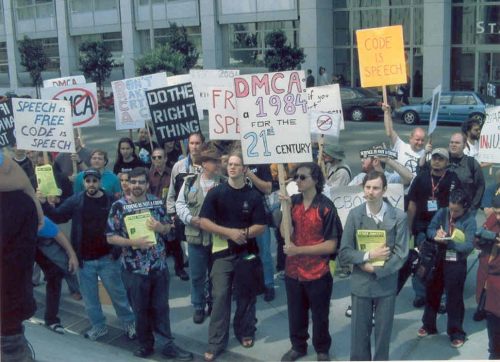
anthropologist, originally uploaded by the biella.
So for years and years and years I assumed this photo was taken by a good friend of mine (and we sill think it may be) but we can t totally verify if it is his as he lost all his old photos after a server hack-in. Do you recognize this photo? Do you have photos from this Free Dmitry protest (August 2008, in front of the San Francisco Prosecutors office) that would share for an academic publication on this topic??? Help!

25 April 2009

Biella Coleman: What We Know So Far

So, when I like something, I tend to yap about it for weeks and weeks. Take Icelandic Yogurt, for example. After re-discovering it a month ago, I went on a mini-binge (not a mega as it is too expensive) and spread the word to anyone who would listen. The stuff, especially with fun flavors like ginger and orange, just made my morning. Another fine fine thing out there is the performance group What We Know So Far who give performance-based lectures that mix intellectual insight with artistic flair. They put us regular academics to shame who are a bit more staid, to put it mildly. After seeing them a few weeks ago at the 3rd Ward, I snagged them to give a version of their A-mazing talk on Memes in my class and am organizing a much larger event at NYU for the fall of 2009. This is a sort of long winded way of announcing their up and coming show on April 27th the Hannah Complex, which entertains, among other topics, the nature of common sense: Can there be more than one common sense? they ask on their site. And I can t wait to hear the answer as this is a recurrent topic that anthropologists like to entertain. And in fact one of my favorite essays to teach is on this topic, Clifford Geertz Common Sense as Cultural System, a short excerpt which I found here and below is his thesis in a nutshell:
There are a number of reasons why treating common sense as a relatively organized body of considered thought, rather than just what anyone clothed and in his right mind knows, should lead on to some useful conclusions; but perhaps the most important is that it is an inherent characteristic of common-sense thought precisely to deny this and to affirm that its tenets are immediate deliverances of experience, not deliberated reflections upon it. Knowing that rain wets and that one ought to come in out of it, or that fire burns and one ought not to play with it (to stick to our own culture for the moment) are conflated into comprising one large realm of the given and undeniable, a catalog of in-the-grain-of-nature realities so peremptory as to force themselves upon any mind sufficiently unclouded to receive them. Yet this is clearly not so. No one, or no one functioning very well, doubts that rain wets; but there may be some people around who question the proposition that one ought to come in out of it, holding that it is good for one s character to brave the elements hatlessness is next to godliness. And the attractions of playing with fire often, with some people usually, override the full recognition of the pain that will result. Religion rests its case on revelation, science on method, ideology on moral passion; but common sense rests its on the assertion that it is not a case at all, just life in a nutshell. The world is its authority.

Biella Coleman: Wikipedia Art

This is a website kick started by artists who are collecting performance pieces critical of (and perhaps also commenting on) this pretty famous site, who is unhappy that the art project incorporates their name into their webpage. Here is some more official commentary from the EFF who is supporting the artists.

24 April 2009

Biella Coleman: World Copyright Day

Is today?!$

22 April 2009

Biella Coleman: They keep on coming

There are two topics that seem to receive a steady stream of comments on this blog. My entry on Edmonton garners a smattering of comments every few months, usually giving E-town a huge thumbs down. The other entry concerns my tribulations with BCBS and here I receive a steady stream of sad stories all of which point to the horrors caused by some branch of BCBS such as my least favorite one Horizon Blue Cross Blue Shield of NJ. Along with the comment posted above, I got this one asking me to reveal the email address of the PR director of BCBS NJ. In the past I advised folks to google it to find it. But I just tried and it is actually a bit harder to find and I wonder if I should post to one of the many press releases that exist on the web with this information? I hope thats some with some sort of time and lots of anger (toward BCBS) to start a website specifically geared toward and against BCBS. Call it Blue Cross No Shield (I think I actually own that and am pretty proud of the name) or something of that nature and throw up some blog and post horror stories in the style of the consumerist. There will be no shortage of them, especially if the blog is national in scope. Get a mailing list going and start a fax campaign among many others. Share contact information about public relations directors and Other People in Power, tips and advice on fighting them, and perhaps even move to the next level of organizing. I am not sure writing this here will do anything to inspire other and I would love to do this sort of rabble rousing as I get immense pleasure from doing so. But I simply am in the red when it comes to time. But I hope that some of the folks that have posted comments on this blog take the initiative to start a larger campaign (or someone can point me to an exisitng one). update: Now that I think of it, The Consumerist should really take up this cause and devote a section JUST to health insurance. They are already a brand name of sorts with lots of eyeballs on the site, everyday.

14 April 2009

Biella Coleman: Paris in June (and better with hackers)

========================================================================
/tmp/lab announces the second Hacker Space Festival
(Paris, 26-30 June 2009)
======================================================================== Hacker Space Festival 2009 Call For Proposals HSF2009 In 2008, we organized HSF[1] on the spot, as an ad-hoc meeting for
hackerspaces-related networks, technical and artistic research emerging
from them and social questionning arising from them. This sudden
experiment proved to be a huge success, as much as on the
self-organizing level as on the participants and meetings quality, as
well as the emotionally-charged ambient, the kind of which you make
fond memories. The 2008 edition generated a strong emulation in France, from its
historical role as the first official hack meeting there, and in Europe
with the subsequent creation of the Hacker Space Brussels[2], the
rapprochement with The Fiber in Amsterdam and the hackerspaces.org[3]
network. Initiatives of hackerspace openings in Grenoble or Lille, or
the upcoming FrHack[4] conference show an actual enthusiasm in the
French hackers community that was doomed to the underground not so
long ago. We salute these initiatives and their diversity! Soon enough, we wanted to reiterate the HSF experience : however, it
was out of the question to institutionalize this temporary autonomous
zone, nor make it an ersatz of the previous edition, nor even to wrap
it into an elite or underground aura. On the opposite, we ardently
desire; and especially to explore further, in all directions some
lesser known domains (see below) et foster meeting and sharing around
experiences at the confluence of art, technology and politics. The world financial crisis, the decay of democracy in Europe, the
obscurantism, paranoia and lack of culture presiding over legislation
(Internet and Reaction Err Creation Law[5][6]) seem a fertile
environment for the sensible development of new (social ) life forms.
Quick! Let s rest for a few days in jubilation and ecstasy to take a
deep breathe of freedom under the indelicate smells of the medicine
factory nearby! For if the public space is shrinking to oblivion, where any side-step
becomes suspect, and that, from an early age (deviant behavior
detection in nursery school), where moving without a mobile phone
becomes suspect (hello you Julien Coupat[7], a French political
prisoner in France!), there s a domain that the Leviathan would have a
lot of trouble to contain, and for a reason: that of sensitivity. Even
the desperate attempts of the State to block the free and premonitory
expression of sense (hello you Demeure du Chaos![8]) cannot do anything
against a loud laughter or a knowing glance, a sensual kiss or an
explosion of colors. Sensitivity, we could say, is what is left to a human being when she
has nothing anymore, and differenciates her from the body corporate or
the institution, that are, in essence, devoid of it. Therefore, Art
definitely remains the public space to share between humans, and only
between us. And if it the last one to share, we propose to explore it
and take it over during the upcoming edition of the Hacker Space
Festival, from the 26th to 30th of June, 2009 at Vitry sur Seine[9]. ========================================================================
Keynote Speakers: Sergey Grim and Larry Fake with Eric Schmoudt
Groogle Summer of Crode, Survivor style
VLC, I vote against you because you really fucked up when ========================================================================
== W A N T E D ========================================================= Focus on solutions rather than problems. * The Final (Hardware) Frontier: Open FPGA Cores, Reverse Engineering
* Designer Religions and Creative Beliefs Systems
* WiFiDoors & WiFi System-on-Chip controllers firmware hacking,
infection & backdooring
* Telecom Core Network Equipment Reverse Engineering: MSC, STP,
Switches,
* Algebraic Attacks and Modern Cryptography Attacks
* Autonomous, Parasitic and Viral Drones
* Enhanced or Infected Reality Swarms
* Auto-Builders / Self-Fabrication
* Embedded OS breakins stories & recipes
* Actualization rather than mere concepts
* FPGA & ASIC hacking / backdooring
* Cloud+Privacy+Open Source: O Brave New World?
* Explosion-Proof clothing
* Radio Appz & Hackz: Mesh @ RF Layer 1-3
* Database & Privacy
* Problematic & Ethical Open Source/Content Licenses
* Institutional Relationships: Lobbying or Licking?
* Non Lethal Protection (anti-taser vests?)
* Survival in the Age of the Ministry of Immigration and National
Identity
* Mental asylum improvised visit
* Open Source Legacy Media(TM) Production Solutions (TV, Radio, Press,
DRM)
* Gas Sensors & Environmental Benchmarking
* Building Hackerspaces Without Money
* Milsatcomm hacking: Military satellites shots, broken birds in the
sky
* Other research topics on security and insecurity
* Academics and Hackers
* Organics and Fermentation
* Clean Food in Tainted Environment
* Low Impact Energy & Recycling
* Media Sandwich: layers of crap makes good food?
* Deconstructing Carla Sarkozy
* Knitting DIY Factory (jazzy, eh?)
* Signs of life among industrial wasteland
* Hallucinogenic & Computing: Can you Code on Acid?
* Mesh Networking (Wireless BattleMesh Royal!)
* Legal Sabotage: When Democracy Needs You And anything that does not fit. ========================================================================
== P R O P O S E ======================================================= Send you contributions to HSF2009-CFP@lists.tmplab.org + Type of the proposal: 1. conference (45min. presentation + 10min. for questions)
2. workshop / demo (30min. 2 heures)
3. installation / performance (music, plastic, sound, video) Lightning talks can be proposed and organized until the last moment,
according to available space and schedule, in the form of BarCamps or
Blitz Conferences. + Required Information: * Title of the presentation
* Type (see above)
* Language : French or English
* Name of speaker(s)
* Affiliation (organization / company)
* Short biography
* Abstract (5 to 10 lines)
* Topics / Keywords
* Includes a demo? YES NO
* Release during the festival? YES NO
* Internet connection required? YES NO + Acceptable Formats * Open Document
* PDF
* Plain Text
* RTF + Agenda * beginning of proposals : now
* end of proposals : 01 May 2009
* selection notification : 07 May 2009
* publication of program : 15 May 2009 + Evaluation criteria for proposals: 1. Innovating Topic
2. Open Technology
3. Demonstration / Live Act
4. DIY Reproducibility
5. Fun Potential The Programming Committee resembles that of last year
See : http://hackerspace.net/committee ========================================================================
== V E N U E =========================================================== /tmp/lab
6 Bis rue Leon Geffroy
94400 Vitry sur Seine
France http://hackerspace.net/directions ========================================================================
== P A R T I C I P A T E =============================================== Email : http://lists.tmplab.org/listinfo.cgi/hsf2009-talk-tmplab.org
CFPmail: HSF2009-CFP@lists.tmplab.org
IRC : irc://irc.freenode.net/frlab
Jabber : xmpp:hsf2009@space.cepheide.org?join
Wiki : http://hackerspace.net/hsf2009 ========================================================================
== L I N K S =========================================================== The CFP is available online at http://hackerspace.net/cfp [1] http://hackerspace.net/hsf2008
[2] http://hsb.wikidot.com/
[3] http://hackerspaces.org/
[4] http://www.frhack.org/
[5] http://jaimelesautistes.fr/
[6] http://laquadrature.net/
[7] http://fr.wikipedia.org/wiki/Julien_Coupat
[8] http://www.demeureduchaos.org/
[9] http://hackerspace.net/
Philippe Langlois
Email: philippelanglois@free.fr
PGP Key: 8DAEE244

Next.

Previous.