Search Results: "edd"

15 December 2024

Russell Coker: OnePlus 6 Debian

I recently got a OnePlus 6 for the purpose of running Debian, here s the Debian wiki page about it [1]. It runs Debian nicely and the basic functions all work, but the problem I m having now is that AldiMobile (Telstra) and KoganMobile (Vodafone) don t enable VoLTE for that and all the Australian telcos have turned off 3G. The OnePlus 6 does VoLTE with Chinese SIMs so the phone itself can do it. The OnePlus 6 was never sold in Australia by the telcos, so they are all gray-market imports which aren t designed by OnePlus to work in Australia. Until recently that wasn t a problem, but now that the 3G network has been turned off we need VoLTE and OnePlus didn t include that in the OS. Reddit has documentation on how to fix this but it has to be done on Android [2]. So I had to go back from Mobian to Android to get VoLTE (and VoWifi) working and then install Mobian again. For people with similar issues Telstra has a page for checking which phones are supported [3], it s the only way to determine if it s the phone or the network that makes VoLTE not work Android isn t informative about such things. Telstra lists the OP6 as a suitable phone. Now after doing this I still can t get the OP6 working for phone calls on Phosh or PlasmaMobile and I m not sure why. I m going to give the PinePhone Pro another go and see if it now works better. In the past I had problems with the PinePhonePro battery discharging too fast, charging too slowly, and having poor call quality [4]. The battery discharge issue should be at least alleviated by some of the changes in the Plasma 6 code that s now in Debian/Unstable. I ve also been lent a PinePhone (non-pro) and been told that it will have better battery life in many situations. I ll do some tests of that. The PinePhonePro isn t capable of doing the convergence things I was hoping to do so the greater RAM and CPU power that it has aren t as relevant as they otherwise would be. I have a vision for how phones should work. I am not discouraged by the Librem 5, PinePhonePro, Note 9, and OnePlus 6 failing in various ways to do what I hoped for. I will eventually find a phone that I can get working well enough.

12 December 2024

Dirk Eddelbuettel: #44: r2u For ML and MLops Talk

Welcome to the 44th post in the $R^4 series. A few weeks ago, and following an informal call for talks by James Lamb, I had an opportunity to talk about r2u to the Chicago ML and MLops meetup groups. You can find the slides here. Over the last 2 1/2 years, r2u has become a widely-deployed mechanism in a number of settings, including (but not limited to) software testing via continuous integration, deployment on cloud servers besides of course to more standard use on local laptops or workstation. 30 million downloads illustrate this. My thesis for the talk was that this extends equally to ML(ops) where no surprises, no hickups automated deployments are key for large-scale model training, evaluation and of course production deployments. In this context, I introduce r2u while giving credit both to what came before it, the existing alternatives (or competitors for mindshare if one prefers that phrasing), and of course what lies underneath it. The central takeaway, I argue, is that r2u can and does take advantage of a unique situation in that we can join the package manager task for the underlying (operating) system and and the application domain, here R and its unique CRAN repository network. Other approaches can, and of course do, provide binaries, but by doing this outside the realm of the system package manager can only arrive at a lesser integration (and I show a common error arising in that case). So where r2u is feasible, it dominates the alternatives (while the alternatives may well provide deployment on more platforms which, even when less integrated, may be of greater importance for some). As always, it all depends. But the talk, and its slides, motivate and illustrate why we keep calling r2u by its slogan of r2u: Fast. Easy. Reliable. Pick All Three.

This post by Dirk Eddelbuettel originated on his Thinking inside the box blog. If you like this or other open-source work I do, you can now sponsor me at GitHub. Please report excessive re-aggregation in third-party for-profit settings.

Dirk Eddelbuettel: RcppCCTZ 0.2.13 on CRAN: Maintenance

A new release 0.2.13 of RcppCCTZ is now on CRAN. RcppCCTZ uses Rcpp to bring CCTZ to R. CCTZ is a C++ library for translating between absolute and civil times using the rules of a time zone. In fact, it is two libraries. One for dealing with civil time: human-readable dates and times, and one for converting between between absolute and civil times via time zones. And while CCTZ is made by Google(rs), it is not an official Google product. The RcppCCTZ page has a few usage examples and details. This package was the first CRAN package to use CCTZ; by now several others packages (four the last time we counted) include its sources too. Not ideal, but beyond our control. This version include most routine package maintenance as well as one small contributed code improvement. The changes since the last CRAN release are summarised below.

Changes in version 0.2.13 (2024-12-11)
  • No longer set compilation standard as recent R version set a sufficiently high minimum
  • Qualify a call to cctz::format (Michael Quinn in #44)
  • Routine updates to continuous integration and badges
  • Switch to Authors@R in DESCRIPTION

Courtesy of my CRANberries, there is a diffstat report relative to to the previous version. More details are at the RcppCCTZ page; code, issue tickets etc at the GitHub repository. If you like this or other open-source work I do, you can sponsor me at GitHub.

This post by Dirk Eddelbuettel originated on his Thinking inside the box blog. Please report excessive re-aggregation in third-party for-profit settings.

8 December 2024

Dirk Eddelbuettel: pinp 0.0.11 on CRAN: Maintenance

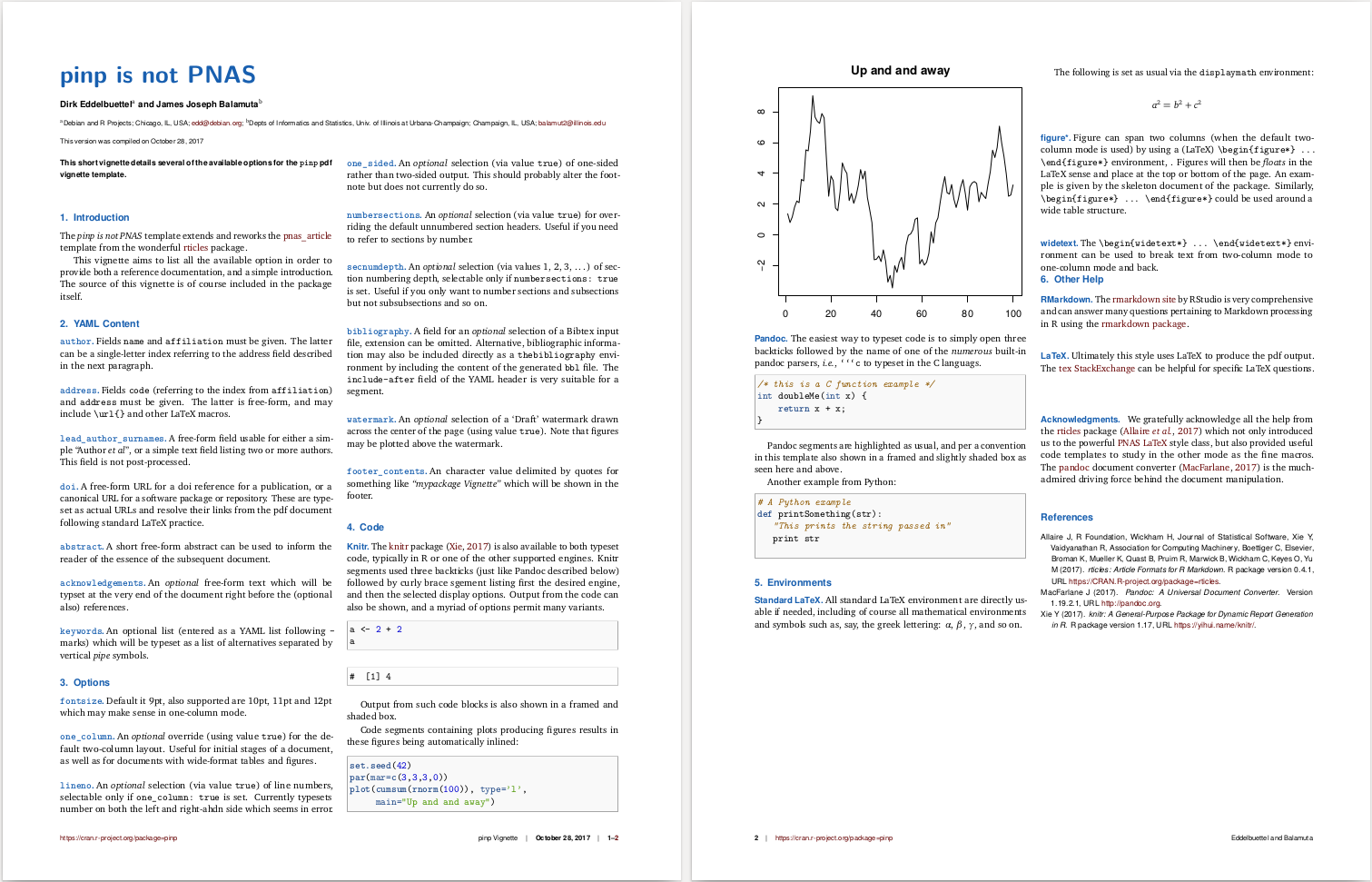
A new version of our pinp package arrived on CRAN today, and is the first release in four years. The pinp package allows for snazzier one or two column Markdown-based pdf vignettes, and is now used by a few packages. A screenshot of the package vignette can be seen below. Additional screenshots are at the pinp page. pinp vignette This release contains no new features or new user-facing changes but reflects the standard package and repository maintenance over the four-year window since the last release: updating of actions, updating of URLs and addressing small packaging changes spotted by ever-more-vigilant R checking code. The NEWS entry for this release follows.

Changes in pinp version 0.0.11 (2024-12-08)
  • Standard package maintenance for continuous integration, URL updates, and packaging conventions
  • Correct two minor nags in the Rd file

Courtesy of my CRANberries, there is a diffstat report relative to previous release. More detailed information is on the ping page. For questions or comments use the issue tracker off the GitHub repo. If you like this or other open-source work I do, you can sponsor me at GitHub.

This post by Dirk Eddelbuettel originated on his Thinking inside the box blog. Please report excessive re-aggregation in third-party for-profit settings.

6 December 2024

Dirk Eddelbuettel: RcppArmadillo 14.2.2-1 on CRAN: Small Upstream Fixes

armadillo image Armadillo is a powerful and expressive C++ template library for linear algebra and scientific computing. It aims towards a good balance between speed and ease of use, has a syntax deliberately close to Matlab, and is useful for algorithm development directly in C++, or quick conversion of research code into production environments. RcppArmadillo integrates this library with the R environment and language and is widely used by (currently) 1197 other packages on CRAN, downloaded 37.5 million times (per the partial logs from the cloud mirrors of CRAN), and the CSDA paper (preprint / vignette) by Conrad and myself has been cited 605 times according to Google Scholar. Conrad released a minor version 14.2.2 yesterday. This followed a bit of recent work a few of us did in the ensmallen and mlpack repositories following the [14.2.0 release]. Use of (member functions) .min(index) and .max(index) was deprecated in Armadillo in favor of .index_mix() and .index_max(). By now ensmallen and mlpack have been updated at CRAN. To add some spice, CRAN emailed that the (very much unreleased as of now, but coming likely next spring) gcc-15 was unhappy with RcppArmadillo due to some Armadillo code. This likely related to the listed gcc-15 C++ change about Qualified name lookup failure into the current instantiation . Anyway, Conrad fixed it within days and that change too is part of this new version (as is a small behaviour normalization between the two indexing methods that matters in case of ties, this was in 14.2.1). The changes since the last CRAN release are summarised below.

Changes in RcppArmadillo version 14.2.2-1 (2024-12-05)
  • Upgraded to Armadillo release 14.2.2 (Smooth Caffeine)
    • Workarounds for regressions in pre-release versions of GCC 15
    • More selective detection of symmetric/hermitian matrices by various functions

Changes in RcppArmadillo version 14.2.1-1 (2024-11-24) (GitHub Only)
  • Upgraded to Armadillo release 14.2.1 (Smooth Caffeine)
    • Fix for index_min() and index_max() to ensure that the first index of equal extremum values is found

Courtesy of my CRANberries, there is a diffstat report relative to previous release. More detailed information is on the RcppArmadillo page. Questions, comments etc should go to the rcpp-devel mailing list off the Rcpp R-Forge page. If you like this or other open-source work I do, you can sponsor me at GitHub.

This post by Dirk Eddelbuettel originated on his Thinking inside the box blog. Please report excessive re-aggregation in third-party for-profit settings.

4 December 2024

Dirk Eddelbuettel: corels 0.0.5 on CRAN: Maintenance

An updated version of the corels package is now on CRAN! The Certifiably Optimal RulE ListS (Corels) learner provides interpretable decision rules with an optimality guarantee a nice feature which sets it apart in machine learning. You can learn more about corels at its UBC site. The changes concern mostly maintenance for both the repository (such as continunous integration setup, badges, documentation links, ) and the package level (such as removing the no-longer-requiring C++ compilation standard setter now emitting a NOTE at CRAN.

This post by Dirk Eddelbuettel originated on his Thinking inside the box blog. Please report excessive re-aggregation in third-party for-profit settings.

2 December 2024

Dirk Eddelbuettel: anytime 0.3.10 on CRAN: Multiple Enhancements

A new release of the anytime package arrived on CRAN today the first is well over four years. The package is fairly feature-complete, and code and functionality remain mature and stable, of course. anytime is a very focused package aiming to do just one thing really well: to convert anything in integer, numeric, character, factor, ordered, input format to either POSIXct (when called as anytime) or Date objects (when called as anydate) and to do so without requiring a format string as well as accomodating different formats in one input vector. See the anytime page, or the GitHub repo for a few examples, and the beautiful documentation site for all documentation. This release slowly matured over four years. It combines a number of strictly internal repository maintenance such as changes to continuous integration with small enhancements (adding for example some new formats, responding better to an error condition, dealing with logical input as an error) with a relaxation of the C++ compilation standard. While we once needed C++11, it is now a constraint as as R itself is quite proactive (the last two releases defaulted already to C++17, suitable compiler permitting) we can now relax this constraint. The documentation site is new, as some other small changes. See the full list of changes which follows.

Changes in anytime version 0.3.10 (2024-12-02)
  • A new documentation site was added.
  • Continuous Integration now uses run.sh from r-ci with bspm
  • Logical input vectors are now recognised as an error (#121)
  • Additional dot-separated format '%Y.%m.%d' is supported
  • Other small updates were made throughout the package
  • No longer set a C++ compilation standard as the default choices by R are sufficient for the package
  • Switch Rcpp include file to Rcpp/Lightest
  • We recommend ~/.R/Makevars compiler flag options -Wno-ignored-attributes -Wno-nonnull -Wno-parentheses
  • The tinytest runner was simplified
  • NA values from conversion now trigger a warning

Courtesy of my CRANberries, there is also a diffstat report of changes relative to the previous release. The issue tracker tracker off the GitHub repo can be use for questions and comments. More information about the package is at the package page, the GitHub repo and the documentation site. If you like this or other open-source work I do, you can now sponsor me at GitHub.

This post by Dirk Eddelbuettel originated on his Thinking inside the box blog. Please report excessive re-aggregation in third-party for-profit settings.

29 November 2024

Dirk Eddelbuettel: RcppAPT 0.0.10: Maintenance

A new version of the RcppAPT package arrived on CRAN earlier today. RcppAPT connects R to the C++ library behind the awesome apt, apt-get, apt-cache, commands (and their cache) which powering Debian, Ubuntu and other derivative distributions. RcppAPT allows you to query the (Debian or Ubuntu) package dependency graph at will, with build-dependencies (if you have deb-src entries), reverse dependencies, and all other goodies. See the vignette and examples for illustrations. This release moves the C++ compilation standard from C++11 to C++17. I had removed the setting for C++11 last year as compilation by compiler default worked well enough. But the version at CRAN still carried, which started to lead to build failures on Debian unstable so it was time for an update. And rather than implicitly relying on C++17 as selected by the last two R releases, we made it explicit. Otherwise a few of the regular package and repository updates have been made, but no new code or features were added The NEWS entries follow.

Changes in version 0.0.10 (2024-11-29)
  • Package maintenance updating continuous integration script versions as well as coverage link from README, and switching to Authors@R
  • C++ compilation standards updated to C++17 to comply with libapt-pkg

Courtesy of my CRANberries, there is also a diffstat report for this release. A bit more information about the package is available here as well as at the GitHub repo. If you like this or other open-source work I do, you can now sponsor me at GitHub.

This post by Dirk Eddelbuettel originated on his Thinking inside the box blog. Please report excessive re-aggregation in third-party for-profit settings.

19 November 2024

Melissa Wen: Display/KMS Meeting at XDC 2024: Detailed Report

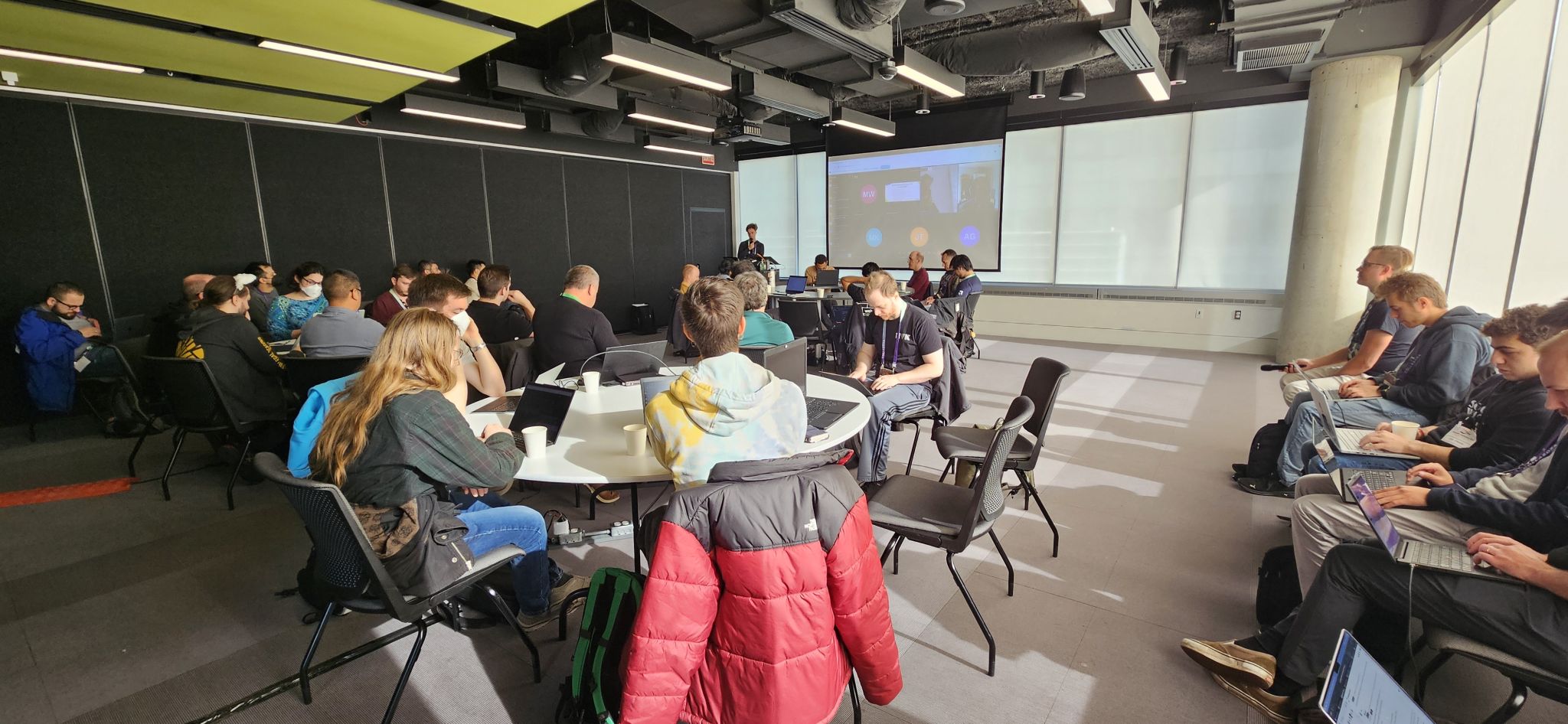
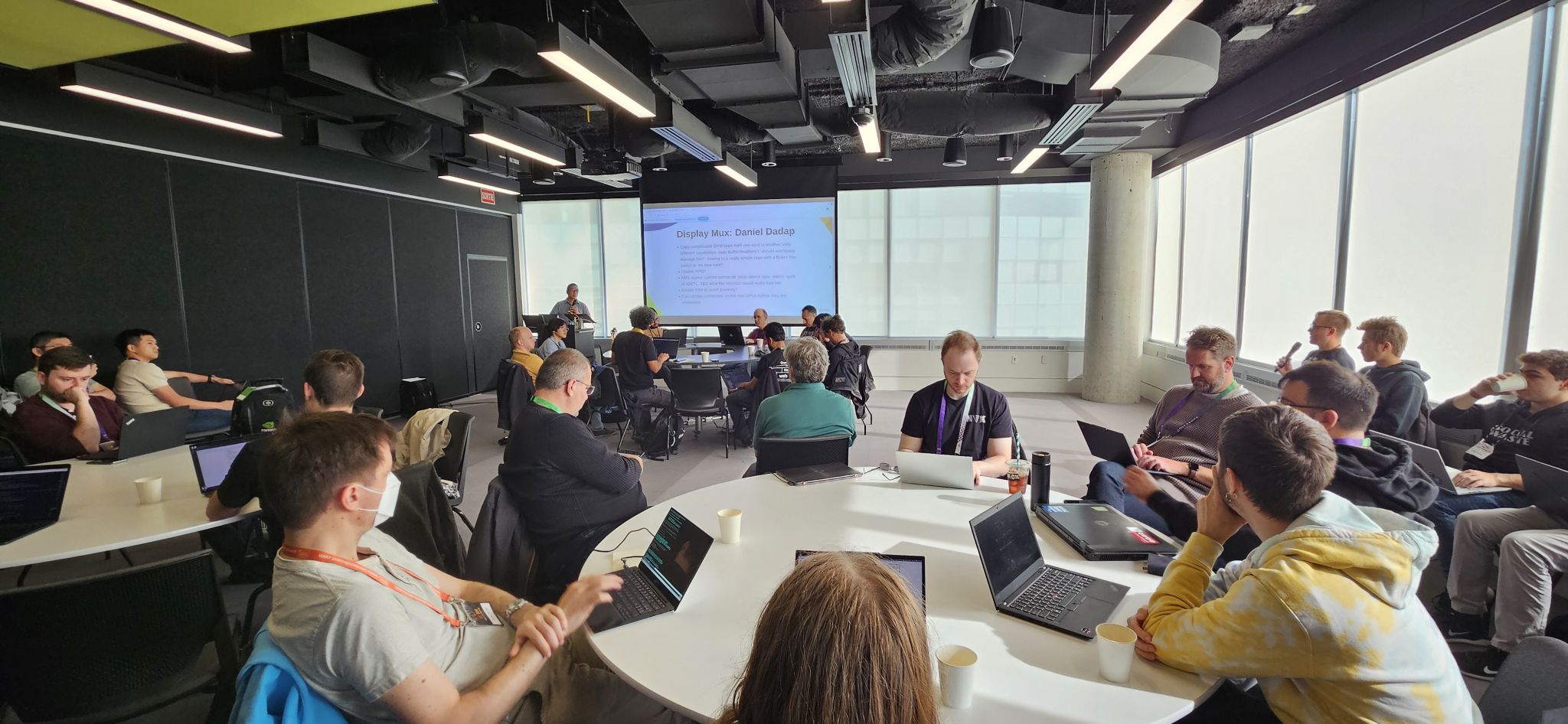
XDC 2024 in Montreal was another fantastic gathering for the Linux Graphics community. It was again a great time to immerse in the world of graphics development, engage in stimulating conversations, and learn from inspiring developers. Many Igalia colleagues and I participated in the conference again, delivering multiple talks about our work on the Linux Graphics stack and also organizing the Display/KMS meeting. This blog post is a detailed report on the Display/KMS meeting held during this XDC edition. Short on Time?
  1. Catch the lightning talk summarizing the meeting here (you can even speed up 2x):
  1. For a quick written summary, scroll down to the TL;DR section.

TL;DR This meeting took 3 hours and tackled a variety of topics related to DRM/KMS (Linux/DRM Kernel Modesetting):
  • Sharing Drivers Between V4L2 and KMS: Brainstorming solutions for using a single driver for devices used in both camera capture and display pipelines.
  • Real-Time Scheduling: Addressing issues with non-blocking page flips encountering sigkills under real-time scheduling.
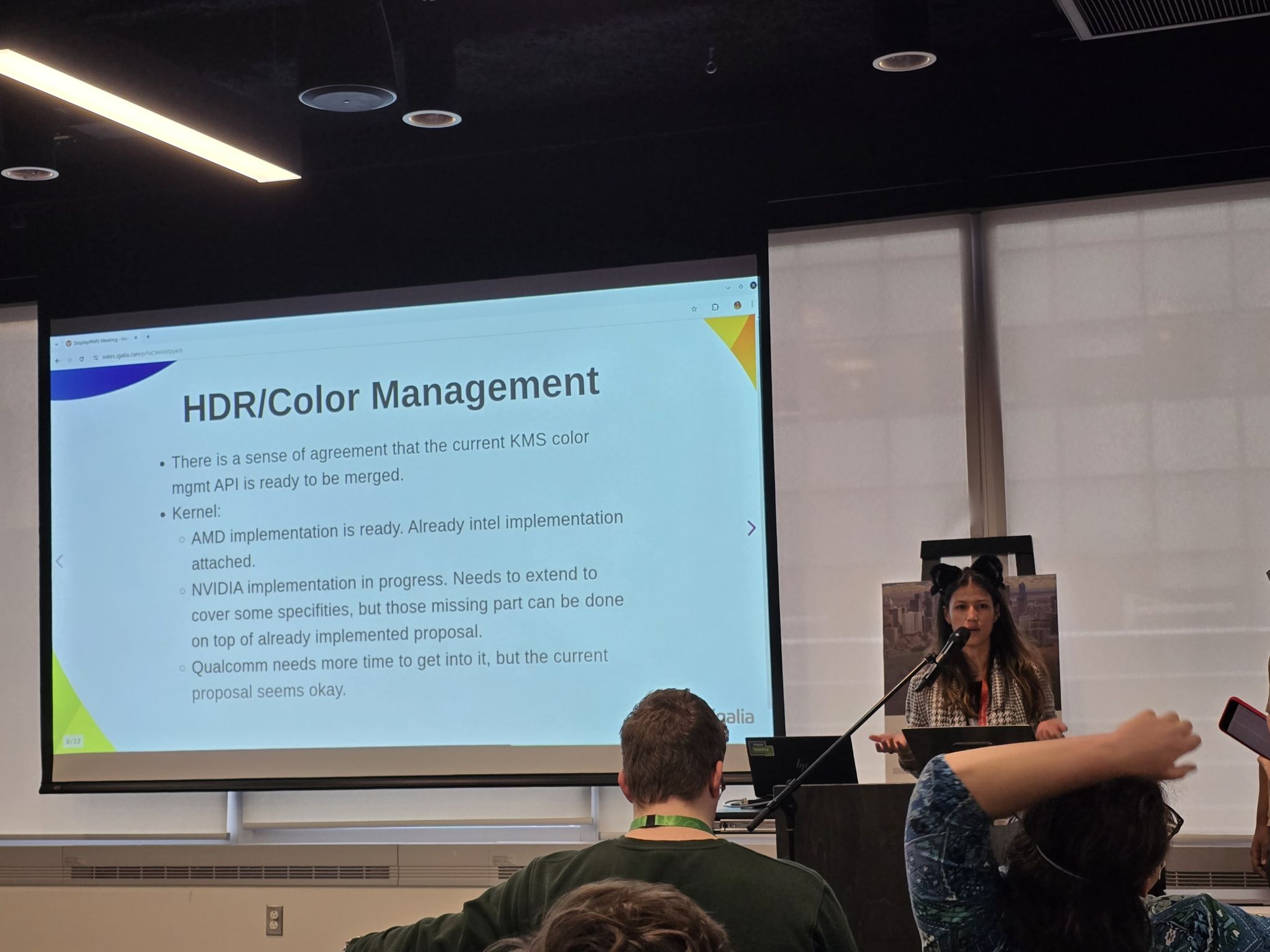
  • HDR/Color Management: Agreement on merging the current proposal, with NVIDIA implementing its special cases on VKMS and adding missing parts on top of Harry Wentland s (AMD) changes.
  • Display Mux: Collaborative design discussions focusing on compositor control and cross-sync considerations.
  • Better Commit Failure Feedback: Exploring ways to equip compositors with more detailed information for failure analysis.

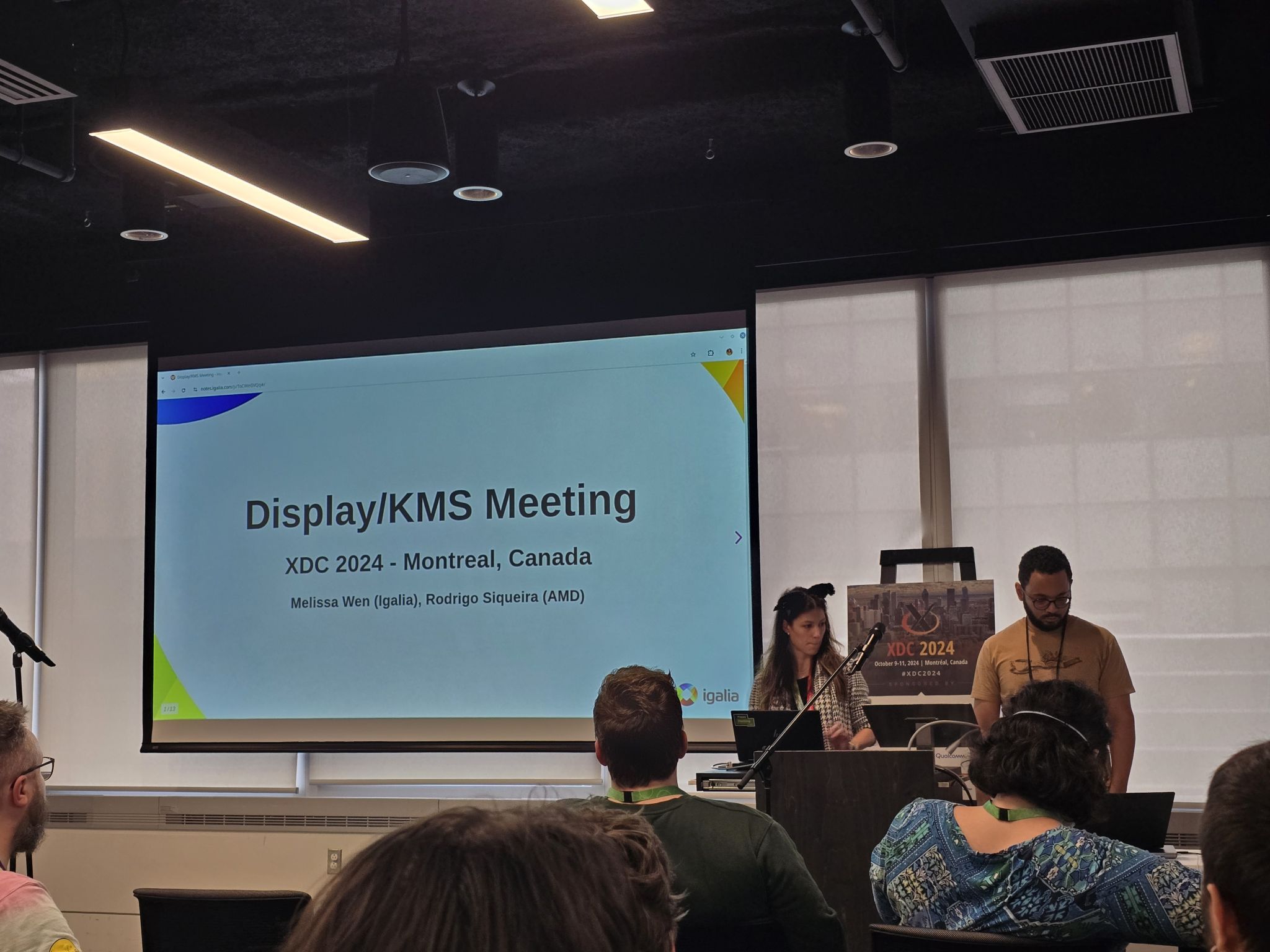
Bringing together Linux display developers in the XDC 2024 While I didn t present a talk this year, I co-organized a Display/KMS meeting (with Rodrigo Siqueira of AMD) to build upon the momentum from the 2024 Linux Display Next hackfest. The meeting was attended by around 30 people in person and 4 remote participants. Speakers: Melissa Wen (Igalia) and Rodrigo Siqueira (AMD) Link: https://indico.freedesktop.org/event/6/contributions/383/ Topics: Similar to the hackfest, the meeting agenda was built over the first two days of the conference and mixed talks follow-up with new ideas and ongoing community efforts. The final agenda covered five topics in the scheduled order:
  1. How to share drivers between V4L2 and DRM for bridge-like components (new topic);
  2. Real-time Scheduling (problems encountered after the Display Next hackfest);
  3. HDR/Color Management (ofc);
  4. Display Mux (from Display hackfest and XDC 2024 talk, bringing AMD and NVIDIA together);
  5. (Better) Commit Failure Feedback (continuing the last minute topic of the Display Next hackfest).

Unpacking the Topics Similar to the hackfest, the meeting agenda evolved over the conference. During the 3 hours of meeting, I coordinated the room and discussion rounds, and Rodrigo Siqueira took notes and also contacted key developers to provide a detailed report of the many topics discussed. From his notes, let s dive into the key discussions!

How to share drivers between V4L2 and KMS for bridge-like components. Led by Laurent Pinchart, we delved into the challenge of creating a unified driver for hardware devices (like scalers) that are used in both camera capture pipelines and display pipelines.
  • Problem Statement: How can we design a single kernel driver to handle devices that serve dual purposes in both V4L2 and DRM subsystems?
  • Potential Solutions:
    1. Multiple Compatible Strings: We could assign different compatible strings to the device tree node based on its usage in either the camera or display pipeline. However, this approach might raise concerns from device tree maintainers as it could be seen as a layer violation.
    2. Separate Abstractions: A single driver could expose the device to both DRM and V4L2 through separate abstractions: drm-bridge for DRM and V4L2 subdev for video. While simple, this approach requires maintaining two different abstractions for the same underlying device.
    3. Unified Kernel Abstraction: We could create a new, unified kernel abstraction that combines the best aspects of drm-bridge and V4L2 subdev. This approach offers a more elegant solution but requires significant design effort and potential migration challenges for existing hardware.

Real-Time Scheduling Challenges We have discussed real-time scheduling during this year Linux Display Next hackfest and, during the XDC 2024, Jonas Adahl brought up issues uncovered while progressing on this front.
  • Context: Non-blocking page-flips can, on rare occasions, take a long time and, for that reason, get a sigkill if the thread doing the atomic commit is a real-time schedule.
  • Action items:
    • Explore alternative backtraces during the busy wait (e.g., ftrace).
    • Investigate the maximum thread time in busy wait to reproduce issues faced by compositors. Tools like RTKit (mutter) can be used for better control (Michel D nzer can help with this setup).

HDR/Color Management This is a well-known topic with ongoing effort on all layers of the Linux Display stack and has been discussed online and in-person in conferences and meetings over the last years. Here s a breakdown of the key points raised at this meeting:
  • Talk: Color operations for Linux color pipeline on AMD devices: In the previous day, Alex Hung (AMD) presented the implementation of this API on AMD display driver.
  • NVIDIA Integration: While they agree with the overall proposal, NVIDIA needs to add some missing parts. Importantly, they will implement these on top of Harry Wentland s (AMD) proposal. Their specific requirements will be implemented on VKMS (Virtual Kernel Mode Setting driver) for further discussion. This VKMS implementation can benefit compositor developers by providing insights into NVIDIA s specific needs.
  • Other vendors: There is a version of the KMS API applied on Intel color pipeline. Apart from that, other vendors appear to be comfortable with the current proposal but lacks the bandwidth to implement it right now.
  • Upstream Patches: The relevant upstream patches were can be found here. [As humorously notes, this series is eagerly awaiting your Acked-by (approval)]
  • Compositor Side: The compositor developers have also made significant progress.
    • KDE has already implemented and validated the API through an experimental implementation in Kwin.
    • Gamescope currently uses a driver-specific implementation but has a draft that utilizes the generic version. However, some work is still required to fully transition away from the driver-specific approach. AP: work on porting gamescope to KMS generic API
    • Weston has also begun exploring implementation, and we might see something from them by the end of the year.
  • Kernel and Testing: The kernel API proposal is well-refined and meets the DRM subsystem requirements. Thanks to Harry Wentland effort, we already have the API attached to two hardware vendors and IGT tests, and, thanks to Xaver Hugl, a compositor implementation in place.
Finally, there was a strong sense of agreement that the current proposal for HDR/Color Management is ready to be merged. In simpler terms, everything seems to be working well on the technical side - all signs point to merging and shipping the DRM/KMS plane color management API!

Display Mux During the meeting, Daniel Dadap led a brainstorming session on the design of the display mux switching sequence, in which the compositor would arm the switch via sysfs, then send a modeset to the outgoing driver, followed by a modeset to the incoming driver.
  • Context:
  • Key Considerations:
    • HPD Handling: There was a general consensus that disabling HPD can be part of the sequence for internal panels and we don t need to focus on it here.
    • Cross-Sync: Ensuring synchronization between the compositor and the drivers is crucial. The compositor should act as the drm-master to coordinate the entire sequence, but how can this be ensured?
    • Future-Proofing: The design should not assume the presence of a mux. In future scenarios, direct sharing over DP might be possible.
  • Action points:
    • Sharing DP AUX: Explore the idea of sharing DP AUX and its implications.
    • Backlight: The backlight definition represents a problem in the mux switch context, so we should explore some of the current specs available for that.

Towards Better Commit Failure Feedback In the last part of the meeting, Xaver Hugl asked for better commit failure feedback.
  • Problem description: Compositors currently face challenges in collecting detailed information from the kernel about commit failures. This lack of granular data hinders their ability to understand and address the root causes of these failures.
To address this issue, we discussed several potential improvements:
  • Direct Kernel Log Access: One idea is to directly load relevant kernel logs into the compositor. This would provide more detailed information about the failure and potentially aid in debugging.
  • Finer-Grained Failure Reporting: We also explored the possibility of separating atomic failures into more specific categories. Not all failures are critical, and understanding the nature of the failure can help compositors take appropriate action.
  • Enhanced Logging: Currently, the dmesg log doesn t provide enough information for user-space validation. Raising the log level to capture more detailed information during failures could be a viable solution.
By implementing these improvements, we aim to equip compositors with the necessary tools to better understand and resolve commit failures, leading to a more robust and stable display system.

A Big Thank You! Huge thanks to Rodrigo Siqueira for these detailed meeting notes. Also, Laurent Pinchart, Jonas Adahl, Daniel Dadap, Xaver Hugl, and Harry Wentland for bringing up interesting topics and leading discussions. Finally, thanks to all the participants who enriched the discussions with their experience, ideas, and inputs, especially Alex Goins, Antonino Maniscalco, Austin Shafer, Daniel Stone, Demi Obenour, Jessica Zhang, Joan Torres, Leo Li, Liviu Dudau, Mario Limonciello, Michel D nzer, Rob Clark, Simon Ser and Teddy Li. This collaborative effort will undoubtedly contribute to the continued development of the Linux display stack. Stay tuned for future updates!

18 November 2024

Dirk Eddelbuettel: RcppArmadillo 14.2.0-1 on CRAN: New Upstream Minor

armadillo image Armadillo is a powerful and expressive C++ template library for linear algebra and scientific computing. It aims towards a good balance between speed and ease of use, has a syntax deliberately close to Matlab, and is useful for algorithm development directly in C++, or quick conversion of research code into production environments. RcppArmadillo integrates this library with the R environment and language and is widely used by (currently) 1191 other packages on CRAN, downloaded 37.2 million times (per the partial logs from the cloud mirrors of CRAN), and the CSDA paper (preprint / vignette) by Conrad and myself has been cited 603 times according to Google Scholar. Conrad released a minor version 14.2.0 a few days ago after we spent about two weeks with several runs of reverse-dependency checks covering corner cases. After a short delay at CRAN due to a false positive on a test, a package failing tests we also failed under the previous version, and some concern over new deprecation warnings _whem using the headers directly as _e.g. mlpack R package does we are now on CRAN. I noticed a missing feature under large 64bit word (for large floating-point matrices) and added an exporter for icube going to double to support the 64-bit integer range (as we already did, of course, for vectors and matrices). Changes since the last CRAN release are summarised below.

Changes in RcppArmadillo version 14.2.0-1 (2024-11-16)
  • Upgraded to Armadillo release 14.2.0 (Smooth Caffeine)
    • Faster handling of symmetric matrices by inv() and rcond()
    • Faster handling of hermitian matrices by inv(), rcond(), cond(), pinv(), rank()
    • Added solve_opts::force_sym option to solve() to force the use of the symmetric solver
    • More efficient handling of compound expressions by solve()
  • Added exporter specialisation for icube for the ARMA_64BIT_WORD case

Courtesy of my CRANberries, there is a diffstat report relative to previous release. More detailed information is on the RcppArmadillo page. Questions, comments etc should go to the rcpp-devel mailing list off the Rcpp R-Forge page. If you like this or other open-source work I do, you can sponsor me at GitHub.

This post by Dirk Eddelbuettel originated on his Thinking inside the box blog. Please report excessive re-aggregation in third-party for-profit settings.

Russ Allbery: Review: Delilah Green Doesn't Care

Review: Delilah Green Doesn't Care, by Ashley Herring Blake
Series: Bright Falls #1
Publisher: Jove
Copyright: February 2022
ISBN: 0-593-33641-0
Format: Kindle
Pages: 374
Delilah Green Doesn't Care is a sapphic romance novel. It's the first of a trilogy, although in the normal romance series fashion each book follows a different protagonist and has its own happy ending. It is apparently classified as romantic comedy, which did not occur to me while reading but which I suppose I can see in retrospect. Delilah Green got the hell out of Bright Falls as soon as she could and tried not to look back. After her father died, her step-mother lavished all of her perfectionist attention on her overachiever step-sister, leaving Delilah feeling like an unwanted ghost. She escaped to New York where there was space for a queer woman with an acerbic personality and a burgeoning career in photography. Her estranged step-sister's upcoming wedding was not a good enough reason to return to the stifling small town of her childhood. The pay for photographing the wedding was, since it amounted to three months of rent and trying to sell photographs in galleries was not exactly a steady living. So back to Bright Falls Delilah goes. Claire never left Bright Falls. She got pregnant young and ended up with a different life than she expected, although not a bad one. Now she's raising her daughter as a single mom, running the town bookstore, and dealing with her unreliable ex. She and Iris are Astrid Parker's best friends and have been since fifth grade, which means she wants to be happy for Astrid's upcoming wedding. There's only one problem: the groom. He's a controlling, boorish ass, but worse, Astrid seems to turn into a different person around him. Someone Claire doesn't like. Then, to make life even more complicated, Claire tries to pick up Astrid's estranged step-sister in Bright Falls's bar without recognizing her. I have a lot of things to say about this novel, but here's the core of my review: I started this book at 4pm on a Saturday because I hadn't read anything so far that day and wanted to at least start a book. I finished it at 11pm, having blown off everything else I had intended to do that evening, completely unable to put it down. It turns out there is a specific type of romance novel protagonist that I absolutely adore: the sarcastic, confident, no-bullshit character who is willing to pick the fights and say the things that the other overly polite and anxious characters aren't able to get out. Astrid does not react well to criticism, for reasons that are far more complicated than it may first appear, and Claire and Iris have been dancing around the obvious problems with her surprise engagement. As the title says, Delilah thinks she doesn't care: she's here to do a job and get out, and maybe she'll get to tweak her annoying step-sister a bit in the process. But that also means that she is unwilling to play along with Astrid's obsessively controlling mother or her obnoxious fiance, and thus, to the barely disguised glee of Claire and Iris, is a direct threat to the tidy life that Astrid's mother is trying to shoehorn her daughter into. This book is a great example of why I prefer sapphic romances: I think this character setup would not work, at least for me, in a heterosexual romance. Delilah's role only works if she's a woman; if a male character were the sarcastic conversational bulldozer, it would be almost impossible to avoid falling into the gender stereotype of a male rescuer. If this were a heterosexual romance trying to avoid that trap, the long-time friend who doesn't know how to directly confront Astrid would have to be the male protagonist. That could work, but it would be a tricky book to write without turning it into a story focused primarily on the subversion of gender roles. Making both protagonists women dodges the problem entirely and gives them so much narrative and conceptual space to simply be themselves, rather than characters obscured by the shadows of societal gender rules. This is also, at it's core, a book about friendship. Claire, Astrid, and Iris have the sort of close-knit friend group that looks exclusive and unapproachable from the outside. Delilah was the stereotypical outsider, mocked and excluded when they thought of her at all. This, at least, is how the dynamics look at the start of the book, but Blake did an impressive job of shifting my understanding of those relationships without changing their essential nature. She fleshes out all of the characters, not just the romantic leads, and adds complexity, nuance, and perspective. And, yes, past misunderstanding, but it's mostly not the cheap sort that sometimes drives romance plots. It's the misunderstanding rooted in remembered teenage social dynamics, the sort of misunderstanding that happens because communication is incredibly difficult, even more difficult when one has no practice or life experience, and requires knowing oneself well enough to even know what to communicate. The encounter between Delilah and Claire in the bar near the start of the book is cornerstone of the plot, but the moment that grabbed me and pulled me in was Delilah's first interaction with Claire's daughter Ruby. That was the point when I knew these were characters I could trust, and Blake never let me down. I love how Ruby is handled throughout this book, with all of the messy complexity of a kid of divorced parents with her own life and her own personality and complicated relationships with both parents that are independent of the relationship their parents have with each other. This is not a perfect book. There's one prank scene that I thought was excessively juvenile and should have been counter-productive, and there's one tricky question of (nonsexual) consent that the book raises and then later seems to ignore in a way that bugged me after I finished it. There is a third-act breakup, which is not my favorite plot structure, but I think Blake handles it reasonably well. I would probably find more niggles and nitpicks if I re-read it more slowly. But it was utterly engrossing reading that exactly matched my mood the day that I picked it up, and that was a fantastic reading experience. I'm not much of a romance reader and am not the traditional audience for sapphic romance, so I'm probably not the person you should be looking to for recommendations, but this is the sort of book that got me to immediately buy all of the sequels and start thinking about a re-read. It's also the sort of book that dragged me back in for several chapters when I was fact-checking bits of my review. Take that recommendation for whatever it's worth. Content note: Reviews of Delilah Green Doesn't Care tend to call it steamy or spicy. I have no calibration for this for romance novels. I did not find it very sex-focused (I have read genre fantasy novels with more sex), but there are several on-page sex scenes if that's something you care about one way or the other. Followed by Astrid Parker Doesn't Fail. Rating: 9 out of 10

11 November 2024

Dirk Eddelbuettel: RcppSpdlog 0.0.19 on CRAN: New Upstream, New Features

Version 0.0.19 of RcppSpdlog arrived on CRAN early this morning and has been uploaded to Debian. RcppSpdlog bundles spdlog, a wonderful header-only C++ logging library with all the bells and whistles you would want that was written by Gabi Melman, and also includes fmt by Victor Zverovich. You can learn more at the nice package documention site. This releases updates the code to the version 1.15.0 of spdlog which was released on Saturday, and contains fmt 11.0.2. It also contains a contributed PR which allows use std::format under C++20, bypassing fmt (with some post-merge polish too), and another PR correcting a documentation double-entry. The NEWS entry for this release follows.

Changes in RcppSpdlog version 0.0.19 (2024-11-10)
  • Support use of std::format under C++20 via opt-in define instead of fmt (Xanthos Xanthopoulos in #19)
  • An erroneous duplicate log=level documentation level was removed (Contantinos Giachalis in #20)
  • Upgraded to upstream release spdlog 1.15.0 (Dirk in #21)
  • Partially revert / simplify src/formatter.cpp accomodating both #19 and previous state (Dirk in #21)

Courtesy of my CRANberries, there is also a diffstat report. More detailed information is on the RcppSpdlog page, or the package documention site. If you like this or other open-source work I do, you can sponsor me at GitHub.

This post by Dirk Eddelbuettel originated on his Thinking inside the box blog. Please report excessive re-aggregation in third-party for-profit settings.

10 November 2024

Dirk Eddelbuettel: inline 0.3.20: Mostly Maintenance

A new release of the inline package got to CRAN today marking the first release in three and half years. inline facilitates writing code in-line in simple string expressions or short files. The package was used quite extensively by Rcpp in the very early days before Rcpp Attributes arrived on the scene providing an even better alternative for its use cases. inline is still used by rstan and a number of other packages. This release was tickled by changing in r-devel just this week, and the corresponding please fix or else email I received this morning. R_NO_REMAP is now the default in r-devel, and while we had already converted most (old-style) calls into the API to using the now mandatory Rf_ prefix, the package contained few remaining cases in examples as well as one in code generation. The release also contains a helpful contributed PR making an error message a little clearer, plus several small and common maintenance changed around continuous integration, package layout and the repository. The NEWS extract follows and details the changes some more.

Changes in inline version 0.3.20 (2024-11-10)
  • Error message formatting is improved for compileCode (Alexis Derumigny in #25)
  • Switch to using Authors@R, other general packaging maintenance for continuous integration and repository
  • Use Rf_ in a handful of cases as R-devel now mandates it

Thanks to my CRANberries, you can also look at a diff to the previous release Questions, comments etc should go to the rcpp-devel mailing list off the R-Forge page. Bugs reports are welcome at the GitHub issue tracker as well (where one can also search among open or closed issues). If you like this or other open-source work I do, you can sponsor me at GitHub.

This post by Dirk Eddelbuettel originated on his Thinking inside the box blog. Please report excessive re-aggregation in third-party for-profit settings.

Reproducible Builds: Reproducible Builds in October 2024

Welcome to the October 2024 report from the Reproducible Builds project. Our reports attempt to outline what we ve been up to over the past month, highlighting news items from elsewhere in tech where they are related. As ever, if you are interested in contributing to the project, please visit our Contribute page on our website. Table of contents:
  1. Beyond bitwise equality for Reproducible Builds?
  2. Two Ways to Trustworthy at SeaGL 2024
  3. Number of cores affected Android compiler output
  4. On our mailing list
  5. diffoscope
  6. IzzyOnDroid passed 25% reproducible apps
  7. Distribution work
  8. Website updates
  9. Reproducibility testing framework
  10. Supply-chain security at Open Source Summit EU
  11. Upstream patches

Beyond bitwise equality for Reproducible Builds? Jens Dietrich, Tim White, of Victoria University of Wellington, New Zealand along with Behnaz Hassanshahi and Paddy Krishnan of Oracle Labs Australia published a paper entitled Levels of Binary Equivalence for the Comparison of Binaries from Alternative Builds :
The availability of multiple binaries built from the same sources creates new challenges and opportunities, and raises questions such as: Does build A confirm the integrity of build B? or Can build A reveal a compromised build B? . To answer such questions requires a notion of equivalence between binaries. We demonstrate that the obvious approach based on bitwise equality has significant shortcomings in practice, and that there is value in opting for alternative notions. We conceptualise this by introducing levels of equivalence, inspired by clone detection types.
A PDF of the paper is freely available.

Two Ways to Trustworthy at SeaGL 2024 On Friday 8th November, Vagrant Cascadian will present a talk entitled Two Ways to Trustworthy at SeaGL in Seattle, WA. Founded in 2013, SeaGL is a free, grassroots technical summit dedicated to spreading awareness and knowledge about free source software, hardware and culture. Vagrant s talk:
[ ] delves into how two project[s] approaches fundamental security features through Reproducible Builds, Bootstrappable Builds, code auditability, etc. to improve trustworthiness, allowing independent verification; trustworthy projects require little to no trust. Exploring the challenges that each project faces due to very different technical architectures, but also contextually relevant social structure, adoption patterns, and organizational history should provide a good backdrop to understand how different approaches to security might evolve, with real-world merits and downsides.

Number of cores affected Android compiler output Fay Stegerman wrote that the cause of the Android toolchain bug from September s report that she reported to the Android issue tracker has been found and the bug has been fixed.
the D8 Java to DEX compiler (part of the Android toolchain) eliminated a redundant field load if running the class s static initialiser was known to be free of side effects, which ended up accidentally depending on the sharding of the input, which is dependent on the number of CPU cores used during the build.
To make it easier to understand the bug and the patch, Fay also made a small example to illustrate when and why the optimisation involved is valid.

On our mailing list On our mailing list this month:

diffoscope diffoscope is our in-depth and content-aware diff utility that can locate and diagnose reproducibility issues. This month, Chris Lamb made the following changes, including preparing and uploading versions 279, 280, 281 and 282 to Debian:
  • Ignore errors when listing .ar archives (#1085257). [ ]
  • Don t try and test with systemd-ukify in the Debian stable distribution. [ ]
  • Drop Depends on the deprecated python3-pkg-resources (#1083362). [ ]
In addition, Jelle van der Waa added support for Unified Kernel Image (UKI) files. [ ][ ][ ] Furthermore, Vagrant Cascadian updated diffoscope in GNU Guix to version 282. [ ][ ]

IzzyOnDroid passed 25% reproducible apps The IzzyOnDroid project has reached a good milestone by reaching over 25% of the ~1,200 Android apps provided by their repository (of official APKs built by the original application developers) having been confirmed to be reproducible by a rebuilder.

Distribution work In Debian this month:
  • Holger Levsen uploaded devscripts version 2.24.2, including many changes to the debootsnap, debrebuild and reproducible-check scripts. This is the first time that debrebuild actually works (using sbuild s unshare backend). As part of this, Holger also fixed an issue in the reproducible-check script where a typo in the code led to incorrect results [ ]
  • Recently, a news entry was added to snapshot.debian.org s homepage, describing the recent changes that made the system stable again:
    The new server has no problems keeping up with importing the full archives on every update, as each run finishes comfortably in time before it s time to run again. [While] the new server is the one doing all the importing of updated archives, the HTTP interface is being served by both the new server and one of the VM s at LeaseWeb.
    The entry list a number of specific updates surrounding the API endpoints and rate limiting.
  • Lastly, 12 reviews of Debian packages were added, 3 were updated and 18 were removed this month adding to our knowledge about identified issues.
Elsewhere in distribution news, Zbigniew J drzejewski-Szmek performed another rebuild of Fedora 42 packages, with the headline result being that 91% of the packages are reproducible. Zbigniew also reported a reproducibility problem with QImage. Finally, in openSUSE, Bernhard M. Wiedemann published another report for that distribution.

Website updates There were an enormous number of improvements made to our website this month, including:
  • Alba Herrerias:
    • Improve consistency across distribution-specific guides. [ ]
    • Fix a number of links on the Contribute page. [ ]
  • Chris Lamb:
  • hulkoba
  • James Addison:
    • Huge and significant work on a (as-yet-merged) quickstart guide to be linked from the homepage [ ][ ][ ][ ][ ]
    • On the homepage, link directly to the Projects subpage. [ ]
    • Relocate dependency-drift notes to the Volatile inputs page. [ ]
  • Ninette Adhikari:
    • Add a brand new Success stories page that highlights the success stories of Reproducible Builds, showcasing real-world examples of projects shipping with verifiable, reproducible builds . [ ][ ][ ][ ][ ][ ]
  • Pol Dellaiera:
    • Update the website s README page for building the website under NixOS. [ ][ ][ ][ ][ ]
    • Add a new academic paper citation. [ ]
Lastly, Holger Levsen filed an extensive issue detailing a request to create an overview of recommendations and standards in relation to reproducible builds.

Reproducibility testing framework The Reproducible Builds project operates a comprehensive testing framework running primarily at tests.reproducible-builds.org in order to check packages and other artifacts for reproducibility. In October, a number of changes were made by Holger Levsen, including:
  • Add a basic index.html for rebuilderd. [ ]
  • Update the nginx.conf configuration file for rebuilderd. [ ]
  • Document how to use a rescue system for Infomaniak s OpenStack cloud. [ ]
  • Update usage info for two particular nodes. [ ]
  • Fix up a version skew check to fix the name of the riscv64 architecture. [ ]
  • Update the rebuilderd-related TODO. [ ]
In addition, Mattia Rizzolo added a new IP address for the inos5 node [ ] and Vagrant Cascadian brought 4 virt nodes back online [ ].

Supply-chain security at Open Source Summit EU The Open Source Summit EU took place recently, and covered plenty of topics related to supply-chain security, including:

Upstream patches The Reproducible Builds project detects, dissects and attempts to fix as many currently-unreproducible packages as possible. We endeavour to send all of our patches upstream where appropriate. This month, we wrote a large number of such patches, including:

Finally, If you are interested in contributing to the Reproducible Builds project, please visit our Contribute page on our website. However, you can get in touch with us via:

2 November 2024

Dirk Eddelbuettel: Rcpp 1.0.13-1 on CRAN: Hot Fix

rcpp logo A hot-fix release 1.0.13-1, consisting of two small PRs relative to the last regular CRAN release 1.0.13, just arrived on CRAN. When we prepared 1.0.13, we included a change related to the tightening of the C API of R itself. Sadly, we pinned an expected change to comes with next (minor) release 4.4.2 rather than now next (normal aka major) release 4.5.0 . And now that R 4.4.2 is out (as of two days ago) we accidentally broke building against the header file with that check. Whoops. Bugs happen, and we are truly sorry but this is now addressed in 1.0.13-1. The normal (bi-annual) release cycle will resume with 1.0.14 slated for January. As you can see from the NEWS file of the development branch, we have a number of changes coming. You can safely access that release candidate version, either off the default branch at github or via r-universe artifacts. The list below details all changes, as usual. The only other change concerns the now-mandatory use of Authors@R.
Changes in Rcpp release version 1.0.13-1 (2024-11-01)
  • Changes in Rcpp API:
    • Use read-only VECTOR_PTR and STRING_PTR only with with R 4.5.0 or later (Kevin in #1342 fixing #1341)
  • Changes in Rcpp Deployment:
    • Authors@R is now used in DESCRIPTION as mandated by CRAN

Thanks to my CRANberries, you can also look at a diff to the previous release Questions, comments etc should go to the rcpp-devel mailing list off the R-Forge page. Bugs reports are welcome at the GitHub issue tracker as well (where one can also search among open or closed issues). If you like this or other open-source work I do, you can sponsor me at GitHub.

This post by Dirk Eddelbuettel originated on his Thinking inside the box blog. Please report excessive re-aggregation in third-party for-profit settings.

Russell Coker: More About the Yoga Gen3

Two months ago I bought a Thinkpad X1 Yoga Gen3 [1]. I m still very happy with it, the screen is a great improvement over the FullHD screen on my previous Thinkpad. I have yet to discover what s the best resolution to have on a laptop if price isn t an issue, but it s at least 1440p for a 14 display, that s 210DPI. The latest Thinkpad X1 Yoga is the 7th gen and has up to 3840*2400 resolution on the internal display for 323DPI. Apple apparently uses the term Retina Display to mean something in the range of 250DPI to 300DPI, so my current laptop is below Retina while the most expensive new Thinkpads are above it. I did some tests on external displays and found that this Thinkpad along with a Dell Latitude of the same form factor and about the same age can only handle one 4K display on a Thunderbolt dock and one on HDMI. On Reddit u/Carlioso1234 pointed out this specs page which says it supports a maximum of 3 displays including the built in TFT [2]. The Thunderbolt/USB-C connection has a maximum resolution of 5120*2880 and the HDMI port has a maximum of 4K. The latest Yoga can support four displays total which means 2*5K over Thunderbolt and one 4K over HDMI. It would be nice if someone made a 8000*2880 ultrawide display that looked like 2*5K displays when connected via Thunderbolt. It would also be nice if someone made a 32 5K display, currently they all seem to be 27 and I ve found that even for 4K resolution 32 is better than 27 . With the typical configuration of Linux and the BIOS the Yoga Gen3 will have it s touch screen stop working after suspend. I have confirmed this for stylus use but as the finger-touch functionality is broken I couldn t confirm that. On r/thinkpad u/p9k told me how to fix this problem [3]. I had to set the BIOS to Win 10 Sleep aka Hybrid sleep and then put the following in /etc/systemd/system/thinkpad-wakeup-config.service :
# https://www.reddit.com/r/thinkpad/comments/1blpy20/comment/kw7se2l/?context=3
[Unit]
Description=Workarounds for sleep wakeup source for Thinkpad X1 Yoga 3
After=sysinit.target
After=systemd-modules-load.service
[Service]
Type=oneshot
ExecStart=/bin/sh -c "echo 'enabled' > /sys/devices/platform/i8042/serio0/power/wakeup"
ExecStart=/bin/sh -c "echo 'enabled' > /sys/devices/platform/i8042/serio1/power/wakeup"
ExecStart=/bin/sh -c "echo 'LID' > /proc/acpi/wakeup"
[Install]
WantedBy=multi-user.target
Now it works fine, for stylus at least. I still get kernel error messages like the following which don t seem to cause problems:
wacom 0003:056A:5146.0005: wacom_idleprox_timeout: tool appears to be hung in-prox. forcing it out.
When it wasn t working I got the above but also kernel error messages like:
wacom 0003:056A:5146.0005: wacom_wac_queue_insert: kfifo has filled, starting to drop events
This change affected the way suspend etc operate. Now when I connect the laptop to power it will leave suspend mode. I ve configured KDE to suspend when the lid is closed and there s no monitor connected.

30 October 2024

Dirk Eddelbuettel: gcbd 0.2.7 on CRAN: More Mere Maintenance

Another pure maintenance release 0.2.7 of the gcbd package is now on CRAN. The gcbd proposes a benchmarking framework for LAPACK and BLAS operations (as the library can exchanged in a plug-and-play sense on suitable OSs) and records result in local database. Its original motivation was to also compare to GPU-based operations. However, as it is both challenging to keep CUDA working packages on CRAN providing the basic functionality appear to come and go so testing the GPU feature can be challenging. The main point of gcbd is now to actually demonstrate that yes indeed we can just swap BLAS/LAPACK libraries without any change to R, or R packages. The configure / rebuild R for xyz often seen with xyz being Goto or MKL is simply plain wrong: you really can just swap them (on proper operating systems, and R configs see the package vignette for more). But nomatter how often we aim to correct this record, it invariably raises its head another time. This release accommodates a CRAN change request as we were referencing the (now only suggested) package gputools. As hinted in the previous paragraph, it was once on CRAN but is not right now so we adjusted our reference. CRANberries also provides a diffstat report for the latest release. If you like this or other open-source work I do, you can sponsor me at GitHub.

This post by Dirk Eddelbuettel originated on his Thinking inside the box blog. Please report excessive re-aggregation in third-party for-profit settings.

22 October 2024

Dirk Eddelbuettel: drat 0.2.5 on CRAN: Small Updates

drat user A new minor release of the drat package arrived on CRAN today, which is just over a year since the previous release. drat stands for drat R Archive Template, and helps with easy-to-create and easy-to-use repositories for R packages. Since its inception in early 2015 it has found reasonably widespread adoption among R users because repositories with marked releases is the better way to distribute code. Because for once it really is as your mother told you: Friends don t let friends install random git commit snapshots. Properly rolled-up releases it is. Just how CRAN shows us: a model that has demonstrated for over two-and-a-half decades how to do this. And you can too: drat is easy to use, documented by six vignettes and just works. Detailed information about drat is at its documentation site. That said, and these days , if you mainly care about github code then r-universe is there too, also offering binaries its makes and all that jazz. But sometimes you just want to, or need to, roll a local repository and drat can help you there. This release contains a small PR (made by Arne Holmin just after the previous release) adding support for an OSflacour variable (helpful for macOS). We also corrected an issue with one test file being insufficiently careful of using git2r only when installed, and as usual did a round of maintenance for the package concerning both continuous integration and documentation. The NEWS file summarises the release as follows:

Changes in drat version 0.2.5 (2024-10-21)
  • Function insertPackage has a new optional argument OSflavour (Arne Holmin in #142)
  • A test file conditions correctly about git2r being present (Dirk)
  • Several smaller packaging updates and enhancements to continuous integration and documentation have been added (Dirk)

Courtesy of my CRANberries, there is a comparison to the previous release. More detailed information is on the drat page as well as at the documentation site. If you like this or other open-source work I do, you can sponsor me at GitHub.

This post by Dirk Eddelbuettel originated on his Thinking inside the box blog. Please report excessive re-aggregation in third-party for-profit settings.

15 October 2024

Dirk Eddelbuettel: qlcal 0.0.13 on CRAN: Small Calendar Update

The thirteenth release of the qlcal package arrivied at CRAN today. qlcal delivers the calendaring parts of QuantLib. It is provided (for the R package) as a set of included files, so the package is self-contained and does not depend on an external QuantLib library (which can be demanding to build). qlcal covers over sixty country / market calendars and can compute holiday lists, its complement (i.e. business day lists) and much more. Examples are in the README at the repository, the package page, and course at the CRAN package page. This releases synchronizes qlcal with the QuantLib release 1.36 (made this week) and contains some minor updates to two calendars.

Changes in version 0.0.13 (2024-10-15)
  • Synchronized with QuantLib 1.36 released yesterday
  • Calendar updates for South Korea and Poland

Courtesy of my CRANberries, there is a diffstat report for this release. See the project page and package documentation for more details, and more examples. If you like this or other open-source work I do, you can sponsor me at GitHub.

This post by Dirk Eddelbuettel originated on his Thinking inside the box blog. Please report excessive re-aggregation in third-party for-profit settings.

14 October 2024

Dirk Eddelbuettel: RcppDate 0.0.4: New Upstream Minor

RcppDate wraps the featureful date library written by Howard Hinnant for use with R. This header-only modern C++ library has been in pretty wide-spread use for a while now, and adds to C++11/C++14/C++17 what will be (with minor modifications) the date library in C++20. This release, the first in 3 1/2 years, syncs the code with the recent date 3.0.2 release from a few days ago. It also updates a few packaging details such as URLs, badges or continuous integration.

Changes in version 0.0.4 (2024-10-14)
  • Updated to upstream version 3.0.2 (and adjusting one pragma)
  • Several small updates to overall packaging and testing

Courtesy of my CRANberries, there is also a diffstat report for the most recent release. More information is available at the repository or the package page. If you like this or other open-source work I do, you can sponsor me at GitHub.

This post by Dirk Eddelbuettel originated on his Thinking inside the box blog. Please report excessive re-aggregation in third-party for-profit settings.

Next.

Previous.