Search Results: "ean"

31 October 2025

Scarlett Gately Moore: A New Chapter: Career Transition Update

I m pleased to share that my career transition has been successful! I ve joined our local county assessor s office, beginning a new path in property assessment for taxation and valuation. While the compensation is modest, it offers the stability I was looking for. My new schedule consists of four 10-hour days with an hour commute each way, which means Monday through Thursday will be largely devoted to work and travel. However, I ll have Fridays available for open source contributions once I ve completed my existing website maintenance commitments.

Open Source Priorities Going forward, my contribution focus will be:
  1. Ubuntu Community Council
  2. Kubuntu/Debian
  3. Snap packages (as time permits)
Regarding the snap packages: my earlier hope of transitioning them to Carl hasn t worked out as planned. He s taken on maintaining KDE Neon single-handedly, and understandably, adding snap maintenance on top of that proved unfeasible. I ll do what I can to help when time allows.

Looking for Contributors If you re interested in contributing to Kubuntu or helping with snap packages, I d love to hear from you! Feel free to reach out community involvement is what makes these projects thrive. Thanks for your patience and understanding as I navigate this transition.

Russell Coker: Links October 2025

Informative video about the way corporations charge different rates based on location and even type of device used on the web site [1]. This should be illegal everywhere! Bruce Schneier with Heather Adkins and Gadi Evron wrote an insightful post about AI Hacking and the Future of Cybersecurity, the future seems grim [2]. Slaughterbots is an interesting Dust SciFi movie exploring the future of autonoms weapons [3]. Arstechnica has an intersting article on a genetically engineered plant with a more efficient system for photosynthesis [4]. If this goes to plan it could revolutionise agriculture! David Brin wrote an insightful blog post about the Seldon Paradox [5]. Also he wrote the final book in the Foundation series so he is the current living export on Hari Seldon. Charles Stross wrote an insightful blog post about the pivot away from fossil fuels and the future of computers without Moore s Law [6]. Audrey Woods wrote an insightful article about the end of Moore s Law, we can get more transistors from multichip modules bit it s only small linear improvements not exponential [7]. Bruce Schneier and Barath Raghavan wrote an interesting article about AI s OODA loop problem, it s a good way of thinking about some of these issues [8]. I think that LLM security is a losing game. Getting them to mostly not tell people how to commit crimes is the limit of controls. Manga telling the story of Revelations in all it s drug inspired madness [9]. When I read the entire Bible I skipped Revelations because it s too obviously the product of mental illness. CNN has an interesting article about bitcoin ARMs which are almost exclusively used for crime [10].

Emmanuel Kasper: Best Pick-up-and-play with a gamepad on Debian and other Linux distributions: SuperTux

After playing some 16 bits era classic games on my Mist FPGA I was wondering what I could play on my Debian desktop as a semi-casual gamer. By semi-casual I mean that if a game needs more than 30 minutes to understand the mechanics, or needs 10 buttons on the gamepad I usually drop it. After testing a dozen games available in the Debian archive my favorite Pick-up-and-play is SuperTux. SuperTux is a 2D platformer quite similar to Super Mario World or Sonic, well also 16 bits classics, but of course you play a friendly penguin. What I like in SuperTux:
  • complete free and opensource application packaged in the Debian main package repository, including all the game assets. So no fiddling around to get game data like Quake / Doom3, everything is available in the Debian repositories. The game is also available from all major Linux distributions in their standard repositories.
  • gamepad immediately usable. Probably the credits has to go the SDL library, but my 8bitdo wireless controller was usable instantly either via 2.4Ghz dongle or Bluetooth
  • well suited for casual players: the game mechanics are easy to grasp and the tutorial is excellent
  • polished interface, the menus are clear and easy to navigate, and there is no internal jargon in the default navigation till you run your first game. (Something which confused me when playing the SuperTuxKart racing game: when I was offered to leave STK I was wondering what that STK mode is. I understood afterwards STK is just the acronym of the game)
  • feel reasonably modern, the game does not start in a 640 480 window with 16 colors and you could demo it without shame for a casual gamer audience.
What can be say of the game itself ? You play a penguin who can run, shoot small fireballs, fall on your back to hit enemies harder. I played 10 levels, most levels had to be tried between 1 and 10 times which I find OK, the difficulty is raising in a very smooth curve. SuperTux has complete localization, hence my screenshots show french text. SuperTux tutorial Comprehensive in-game tutorial World Map There is a large ice flow world, but we are going underground now Example Level Good level design that you have to use to avoid those spiky enemies Underground level The point where I had to pause the game, after missing those flying wigs 15 times in a row SuperTux can be played with keyboard or gamepad, and has minimal hardware requirements, anything computer with working 3D graphic acceleration released in the last 20 years will be able to run it.

28 October 2025

Russ Allbery: Review: Those Who Wait

Review: Those Who Wait, by Haley Cass
Publisher: Haley Cass
Copyright: 2020
ISBN: 979-8-9884929-1-7
Format: Kindle
Pages: 556
Those Who Wait is a stand-alone self-published sapphic romance novel. Given the lack of connection between political figures named in this book and our reality, it's also technically an alternate history, but it will be entirely unsatisfying to anyone who reads it in that genre. Sutton Spencer is an English grad student in New York City. As the story opens, she has recently realized that she's bisexual rather than straight. She certainly has not done anything about that revelation; the very thought makes her blush. Her friend and roommate Regan, not known for either her patience or her impulse control, decides to force the issue by stealing Sutton's phone, creating a profile on a lesbian dating app, and messaging the first woman Sutton admits being attracted to. Charlotte Thompson is a highly ambitious politician, current deputy mayor of New York City for health and human services, and granddaughter of the first female president of the United States. She fully intends to become president of the United States herself. The next step on that path is an open special election for a seat in the House of Representatives. With her family political connections and the firm support of the mayor of New York City (who is also dating her brother), she thinks she has an excellent shot of winning. Charlotte is also a lesbian, something she's known since she was a teenager and which still poses serious problems for a political career. She is therefore out to her family and a few close friends, but otherwise in the closet. Compared to her political ambitions, Charlotte considers her love life almost irrelevant, and therefore has a strict policy of limiting herself to anonymous one-night stands arranged on dating apps. Even that is about to become impossible given her upcoming campaign, but she indulges in one last glance at SapphicSpark before she deletes her account. Sutton is as far as possible from the sort of person who does one-night stands, which is a shame as far as Charlotte is concerned. It would have been a fun last night out. Despite that, both of them find the other unexpectedly enjoyable to chat with. (There are a lot of text message bubbles in this book.) This is when Sutton has her brilliant idea: Charlotte is charming, experienced, and also kind and understanding of Sutton's anxiety, at least in app messages. Maybe Charlotte can be her mentor? Tell her how to approach women, give her some guidance, point her in the right directions. Given the genre, you can guess how this (eventually) turns out. I'm going to say a lot of good things about this book, so let me get the complaints over with first. As you might guess from that introduction, Charlotte's political career and the danger of being outed are central to this story. This is a bit unfortunate because you should not, under any circumstances, attempt to think deeply about the politics in this book. In 550 pages, Charlotte does not mention or expound a single meaningful political position. You come away from this book as ignorant about what Charlotte wants to accomplish as a politician as you entered. Apparently she wants to be president because her grandmother was president and she thinks she'd be good at it. The closest the story comes to a position is something unbelievably vague about homeless services and Charlotte's internal assertion that she wants to help people and make real change. There are even transcripts of media interviews, later in the book, and they somehow manage to be more vacuous than US political talk shows, which is saying something. I also can't remember a single mention of fundraising anywhere in this book, which in US politics is absurd (although I will be generous and say this is due to Cass's alternate history). I assume this was a deliberate choice and Cass didn't want politics to distract from the romance, but as someone with a lot of opinions about concrete political issues, the resulting vague soft-liberal squishiness was actively off-putting. In an actual politician, this would be an entire clothesline of red flags. Thankfully, it's ignorable for the same reason; this is so obviously not the focus of the book that one can mostly perform the same sort of mental trick that one does when ignoring the backdrop in a cheap theater. My second complaint is that I don't know what Sutton does outside of the romance. Yes, she's an English grad student, and she does some grading and some vaguely-described work and is later referred to a prestigious internship, but this is as devoid of detail as Charlotte's political positions. It's not quite as jarring because Cass does eventually show Sutton helping concretely with her mother's work (about which I have some other issues that I won't get into), but it deprives Sutton of an opportunity to be visibly expert in something. The romance setup casts Charlotte as the experienced one to Sutton's naivete, and I think it would have been a better balance to give Sutton something concrete and tangible that she was clearly better at than Charlotte. Those complaints aside, I quite enjoyed this. It was a recommendation from the same BookTuber who recommended Delilah Green Doesn't Care, so her recommendations are quickly accumulating more weight. The chemistry between Sutton and Charlotte is quite believable; the dialogue sparkles, the descriptions of the subtle cues they pick up from each other are excellent, and it's just fun to read about how they navigate a whole lot of small (and sometimes large) misunderstandings and mismatches in personality and world view. Normally, misunderstandings are my least favorite part of a romance novel, but Sutton and Charlotte come from such different perspectives that their misunderstandings feel more justified than is typical. The characters are also fairly mature about working through them: Main characters who track the other character down and insist on talking when something happens they don't understand! Can you imagine! Only with the third-act breakup is the reader dragged through multiple chapters of both characters being miserable, and while I also usually hate third-act breakups, this one is so obviously coming and so clearly advertised from the initial setup that I couldn't really be mad. I did wish the payoff make-up scene at the end of the book had a bit more oomph, though; I thought Sutton's side of it didn't have quite the emotional catharsis that it could have had. I particularly enjoyed the reasons why the two characters fall in love, and how different they are. Charlotte is delighted by Sutton because she's awkward and shy but also straightforward and frequently surprisingly blunt, which fits perfectly with how much Charlotte is otherwise living in a world of polished politicians in constant control of their personas. Sutton's perspective is more physical, but the part I liked was the way that she treats Charlotte like a puzzle. Rather than trying to change how Charlotte expresses herself, she instead discovers that she's remarkably good at reading Charlotte if she trusts her instincts. There was something about Sutton's growing perceptiveness that I found quietly delightful. It's the sort of non-sexual intimacy that often gets lost among the big emotions in romance novels. The supporting cast was also great. Both characters have deep support networks of friends and family who are unambiguously on their side. Regan is pure chaos, and I would not be friends with her, but Cass shows her deep loyalty in a way that makes her dynamic with Sutton make sense. Both characters have thoughtful and loving families who support them but don't make decisions for them, which is a nice change of pace from the usually more mixed family situations of romance novel protagonists. There's a lot of emotional turbulence in the main relationship, and I think that only worked for me because of how rock-solid and kind the supporting cast is. This is, as you might guess from the title, a very slow burn, although the slow burn is for the emotional relationship rather than the physical one (for reasons that would be spoilers). As usual, I have no calibration for spiciness level, but I'd say that this was roughly on par with the later books in the Bright Falls series. If you know something about politics (or political history) and try to take that part of this book seriously, it will drive you to drink, but if you can put that aside and can deal with misunderstandings and emotional turmoil, this was both fun and satisfying. I liked both of the characters, I liked the timing of the alternating viewpoints, and I believed in the relationship and chemistry, as improbable and chaotic as some of the setup was. It's not the greatest thing I ever read, and I wish the ending was a smidgen stronger, but it was an enjoyable way to spend a few reading days. Recommended. Rating: 7 out of 10

27 October 2025

Russ Allbery: Review: On Vicious Worlds

Review: On Vicious Worlds, by Bethany Jacobs
Series: Kindom Trilogy #2
Publisher: Orbit
Copyright: October 2024
ISBN: 0-316-46362-0
Format: Kindle
Pages: 444
On Vicious Worlds is a science fiction thriller with bits of cyberpunk and a direct sequel to These Burning Stars. This is one of those series where each book has massive spoilers for the previous book and builds on characters and situations from that book. I would not read it out of order. It is Bethany Jacobs's second novel. Whooboy, how to review this without spoilers. There are so many major twists in the first book with lingering consequences that it's nearly impossible. I said at the end of my review of These Burning Stars that I was impressed with the ending for reasons that I can't reveal. One thread of this book follows the aftermath: What do you do after the plan? If you have honed yourself for one purpose, can you repurpose yourself? The other thread of the book is a murder mystery. The protectors of the community are being picked off, one by one. The culprit might be a hacker so good that they are causing Jun, the expert hacker of the first book, serious problems. Meanwhile, the political fault lines of the community are cracking open under pressure, and the leaders are untested, exhausted, and navigating difficult emotional terrain. These two story threads alternate, and interspersed are yet more flashbacks. As with the first book, the flashbacks fill in the backstory of Chono and and Esek. This time, though, we get Six's viewpoint. The good news is that On Vicious Worlds tones down the sociopathy considerably without letting up on the political twists. This is the book where Chono comes into her own. She has much more freedom of action, despite being at the center of complicated and cut-throat politics, and I thoroughly enjoyed her principled solidity. She gets a chance to transcend her previous role as an abuse victim, and it's worth the wait. The bad news is that this is very much a middle book of a trilogy. While there are a lot of bloody battles, emotional drama, political betrayals, and plot twists, the series plot has not advanced much by the end of the book. I would not say the characters were left in the same position they started the character development is real and the perils have changed but neither would I say that any of the open questions from These Burning Stars have resolved. The last book I read used science-fiction world-building to tell a story about moral philosophy that was somewhat less drama-filled than one might have expected. That is so not the case here. On Vicious Worlds is, if anything, even more dramatic than the first book of the series. In Chono's thread, the slow burn attempt to understand Six's motives has been replaced with almost non-stop melodrama, full of betrayals, reversals, risky attempts, and emotional roller coasters. Jun's part of the story is a bit more sedate at first, but there too the interpersonal drama setting is headed towards 10. This is the novel equivalent of an action movie. Jun, and her part of the story, are fine. I like the new viewpoint character, I find their system of governance somewhat interesting (although highly optimized for small groups), and I think the climax worked. But I'm invested in this series for Chono and Six. Both of them, but particularly Six, are absurdly over the top, ten people's worth of drama stuffed into one character, unable to communicate in anything less than dramatic gestures and absurd plans, but I find them magnetically fascinating. I'm not sure if written characters can have charisma, but if so, they have it. I liked this entry in the series, but then I also liked the first book. It's trauma-filled and dramatic and involved a bit too much bloody maiming for my tastes, but this whole series is about revolutions and what happens when you decide to fight, and sometimes I'm in the mood for complicated and damaged action heroes who loathe oppression and want to kill some people. This is the sort of series book that will neither be the reason you read the series nor the reason why you stop reading. If you enjoyed These Burning Stars, this is more of the same, with arguably better character development but less plot catharsis. If you didn't like These Burning Stars, this probably won't change your mind, although if you hated it specifically because of Esek's sociopathy, I think you would find this book more congenial. But maybe not; Jacobs is still the same author, and most of the characters in this series are made of sharp edges. I'm still in; I have already pre-ordered the next book. Followed by This Brutal Moon, due out in December of 2025 and advertised as the conclusion. Rating: 7 out of 10

26 October 2025

Dirk Eddelbuettel: duckdb-mlpack 0.0.2: mlpack is now a duckdb community extension

A couple of days ago in a short post, I announced duckdb-mlpack as ML quacks : combining the powerful C++ machine learning library mlpack with the amazing analytical database engine duckdb. See that post for more background. The duckdb-mlpack package is now a community extension joining an impressive list of existing extensions. This means duckdb builds and distributes duckdb-mlpack for all supported platforms allowing users to just install the resulting (signed) binary. (We currently only support Linux in both arm64 and amd64, adding macOS should be straightforward once we sort one build issue out. Windows and WASM should work too, with a little love and polish, as both duckdb and mlpack support them.) Given the binary build, a simple
INSTALL mlpack FROM community;
LOAD mlpack;
installs and loads the package. By the duckdb convention the code is stored per-user and per-version, so the first line needs to be executed only once per duckdb release used. The second line is then per session. We also extended the capabilities of duckdb-mlpack. While still a MVP stressing minimal viable product, the two supported methods adaBoost and (regularized) linear regression both serialize and store their model object permitting rapid prediction on new data as shown in the adaBoost example:
-- Perform adaBoost (using weak learner 'Perceptron' by default)
-- Read 'features' into 'X', 'labels' into 'Y', use optional parameters
-- from 'Z', and prepare model storage in 'M'
CREATE TABLE X AS SELECT * FROM read_csv("https://eddelbuettel.github.io/duckdb-mlpack/data/iris.csv");
CREATE TABLE Y AS SELECT * FROM read_csv("https://eddelbuettel.github.io/duckdb-mlpack/data/iris_labels.csv");
CREATE TABLE Z (name VARCHAR, value VARCHAR);
INSERT INTO Z VALUES ('iterations', '50'), ('tolerance', '1e-7');
CREATE TABLE M (json VARCHAR);

-- Train model for 'Y' on 'X' using parameters 'Z', store in 'M'
CREATE TEMP TABLE A AS SELECT * FROM mlpack_adaboost("X", "Y", "Z", "M");

-- Count by predicted group
SELECT COUNT(*) as n, predicted FROM A GROUP BY predicted;

-- Model 'M' can be used to predict
CREATE TABLE N (x1 DOUBLE, x2 DOUBLE, x3 DOUBLE, x4 DOUBLE);
-- inserting approximate column mean values
INSERT INTO N VALUES (5.843, 3.054, 3.759, 1.199);
-- inserting approximate column mean values, min values, max values
INSERT INTO N VALUES (5.843, 3.054, 3.759, 1.199), (4.3, 2.0, 1.0, 0.1), (7.9, 4.4, 6.9, 2.5);
-- and this predict one element each
SELECT * FROM mlpack_adaboost_pred("N", "M");
Ryan and I have some ideas for where to go from here, ideally towards autogenerating bindings for most (if not all) methods as is done for the mlpack language bindings. Anybody interested and willing to help should reach out to us.

This post by Dirk Eddelbuettel originated on his Thinking inside the box blog. If you like this or other open-source work I do, you can sponsor me at GitHub.

21 October 2025

Gunnar Wolf: LLM Hallucinations in Practical Code Generation Phenomena, Mechanism, and Mitigation

This post is a review for Computing Reviews for LLM Hallucinations in Practical Code Generation Phenomena, Mechanism, and Mitigation , a article published in Proceedings of the ACM on Software Engineering, Volume 2, Issue ISSTA
How good can large language models (LLMs) be at generating code? This may not seem like a very novel question, as several benchmarks (for example, HumanEval and MBPP, published in 2021) existed before LLMs burst into public view and started the current artificial intelligence (AI) inflation. However, as the paper s authors point out, code generation is very seldom done as an isolated function, but instead must be deployed in a coherent fashion together with the rest of the project or repository it is meant to be integrated into. Today, several benchmarks (for example, CoderEval or EvoCodeBench) measure the functional correctness of LLM-generated code via test case pass rates. This paper brings a new proposal to the table: comparing LLM-generated repository-level evaluated code by examining the hallucinations generated. The authors begin by running the Python code generation tasks proposed in the CoderEval benchmark against six code-generating LLMs. Next, they analyze the results and build a taxonomy to describe code-based LLM hallucinations, with three types of conflicts (task requirement, factual knowledge, and project context) as first-level categories and eight subcategories within them. The authors then compare the results of each of the LLMs per the main hallucination category. Finally, they try to find the root cause for the hallucinations. The paper is structured very clearly, not only presenting the three research questions (RQ) but also referring to them as needed to explain why and how each partial result is interpreted. RQ1 (establishing a hallucination taxonomy) is the most thoroughly explored. While RQ2 (LLM comparison) is clear, it just presents straightforward results without much analysis. RQ3 (root cause discussion) is undoubtedly interesting, but I feel it to be much more speculative and not directly related to the analysis performed. After tackling their research questions, Zhang et al. propose a possible mitigation to counter the effect of hallucinations: enhance the LLM with retrieval-augmented generation (RAG) so it better understands task requirements, factual knowledge, and project context. The presented results show that all of the models are clearly (though modestly) improved by the proposed RAG-based mitigation. The paper is clearly written and easy to read. It should provide its target audience with interesting insights and discussions. I would have liked more details on their RAG implementation, but I suppose that s for a follow-up work.

Emmanuel Kasper: How configuration is passed from the BinderHub helm chart to a running BinderHub

Context: At $WORK I am doing a lot of datascience work around Jupyter Notebooks and their ecosystem. Right now I am setting BinderHub, which is a service to start a Jupyter Notebook from a git repo in your browser. For setting up BinderHub I am using the BinderHub helm chart, and I was wondering how configuration changes are propagated from the BinderHub helm chart to the process running in a Kubernetes Pod. After going through this I can say I am not right now a great fan of Helm, as it looks to me like an unnecessary, overengineered abstraction layer on top of Kubernetes manifests. Or maybe it is just that I don t want to learn the golang templating synthax. I am looking forward to testing Kustomize as an alternative, but I havn t had the chance yet. Starting from the list of config parameters available: Although many parameters are mentioned in the installer document, you have to go to the developer doc at https://binderhub.readthedocs.io/en/latest/reference/ref-index.html to get a whole overview. In my case I want to set the hostname parameter for the Gitlab Repoprovider. This is the relevelant snippet in the developer doc:
hostname c.GitLabRepoProvider.hostname = Unicode('gitlab.com')
    The host of the GitLab instance
The string c.GitLabRepoProvider.hostname here means, that the value of the hostname parameter will be loaded at the path config.GitLabRepoProvider inside a configuration file. Using the yaml synthax this means the configuration file should contain a snippet like:
config:
  GitlabRepoProvider
    hostname: my-domain.com
Digging through Kubernetes constructs: Helm values files When installing BinderHub using the provided helm chart, we can either put the configuration snippet in the config.yaml or secret.yaml helm values files. In my case I have put the snippet in config.yaml, since the hostname is not a secret thing, I can verify with yq that it correctly set:
$ yq --raw-output '.config.GitLabRepoProvider.hostname' config.yaml
my-domain.com
How do we make sure this parameter is properly applied to our running binder processes ? As said previouly this parameter is passed as a value file to helm ( value or -f option) in the command:
$ helm upgrade \                                                                                  
    binderhub \                                                                                     
    jupyterhub/binderhub \                                                                          
    --install \                                                                                     
    --version=$(RELEASE) \                                                                          
    --create-namespace \                                                                            
    --namespace=binderhub \                                                                         
    --values secret.yaml \                                                                                
    --values config.yaml \                                                                                
    --debug 
According to the helm documentation in https://helm.sh/docs/helm/helm_install/ the values file are concatenated to form a single object, and priority will be given to the last (right-most) file specified. For example, if both myvalues.yaml and override.yaml contained a key called Test , the value set in override.yaml would take precedence:
$ helm install --values myvalues.yaml --values override.yaml  myredis ./redis
Digging through Kubernetes constructs: Secrets and Volumes When helm upgrade is run the helm values of type config are stashed in a Kubernetes secret binder-secret: https://github.com/jupyterhub/binderhub/blob/main/helm-chart/binderhub/templates/secret.yaml#L12
stringData:
   - /*
    Stash away relevant Helm template values for
    the BinderHub Python application to read from
    in binderhub_config.py.
  */ 
  values.yaml:  
     - pick .Values "config" "imageBuilderType" "cors" "dind" "pink" "extraConfig"   toYaml   nindent 4  
We can verify that our hostname is passed to our Secret:
$ kubectl get secret binder-secret -o yaml   yq --raw-output '.data."values.yaml"'    base64 --decode
...
  GitLabRepoProvider:
    hostname: my-domain.com
...
Finally a configuration file inside the Binder pod is populated from the Secret, using the Kubernetes Volume construct. Looking at the Pod, we do see a volume called config, created from the binder-secret Secret:
$ kubectl get pod -l component=binder -o yaml   grep --context 4 binder-secret
    volumes:
    - name: config
      secret:
        defaultMode: 420
        secretName: binder-secret
That volume is mounted inside the pod at /etc/binderhub/config:
      volumeMounts:
      - mountPath: /etc/binderhub/config/
        name: config
        readOnly: true
Runtime verification Looking inside our pod we see our hostname value available in a file underneath the mount point:
oc exec binder-74d9c7db95-qtp8r -- grep hostname /etc/binderhub/config/values.yaml
    hostname: my-domain.com

Russ Allbery: Review: Space Trucker Jess

Review: Space Trucker Jess, by Matthew Kressel
Publisher: Fairwood Press
Copyright: July 2025
ISBN: 1-958880-27-2
Format: Kindle
Pages: 472
Space Trucker Jess is a stand-alone far-future space fantasy novel. Jess is a sixteen-year-old mechanic working grey-market jobs on Chadeisson Station with a couple of younger kids. She's there because her charming and utterly unreliable father got caught running a crypto scam and is sitting in detention. This was only the latest in a long series of scams, con jobs, and misadventures she's been dragged through since her mother disappeared without a word. Jess is cynical, world-weary, and infuriated by her own sputtering loyalty to her good-for-nothing dad. What Jess wants most in the universe is to own a CCM 6454 Spark Megahauler, the absolute best cargo ship in the universe according to Jess. She should know; she's worked on nearly every type of ship in existence. With her own ship, she could make a living hauling cargo, repairing her own ship, and going anywhere she wants, free of her father and his endless schemes. (A romantic relationship with her friend Leurie would be a nice bonus.) Then her father is taken off the station on a ship leaving the galactic plane, no one will tell her why, and all the records of the ship appear to have been erased. Jess thinks her father is an asshole, but that doesn't mean she can sit idly by when he disappears. That's how she ends up getting in serious trouble with station security due to some risky in-person sleuthing, followed by an expensive flight off the station with a dodgy guy and a kid in a stolen spaceship. The setup for this book was so great. Kressel felt the need to make up a futuristic slang for Jess and her friends to speak, which rarely works as well as the author expects and does not work here, but apart from that I was hooked. Jess is sarcastic, blustery, and a bit of a con artist herself, but with the idealistic sincerity of someone who knows that her life is been kind of broken and understands the value of friends. She's profoundly cynical in the heartbreakingly defensive way of a sixteen-year-old with a rough life. I have a soft spot in my heart for working-class science fiction (there isn't nearly enough of it), and there are few things I enjoy more than reading about the kind of protagonist who has Opinions about starship models and a dislike of shoddy work. I think this is the only book I've bought solely on the basis of one of the Big Idea blog posts John Scalzi hosts. I really wish this book had stuck with the setup instead of morphing into a weird drug-enabled mystical space fantasy, to which Jess's family is bizarrely central. SPOILERS below because I can't figure out how to rant about what annoyed me without them. Search for the next occurrence of spoilers to skip past them. There are three places where this book lost me. The first was when Jess, after agreeing to help another kid find his father, ends up on a world obsessed with a religious cult involving using hallucinatory drugs to commune with alien gods. Jess immediately flags this as unbelievable bullshit and I was enjoying her well-founded cynicism until Kressel pulls the rug out from under both Jess and the reader by establishing that this new-age claptrap is essentially true. Kressel does try to put a bit of a science fiction gloss on it, but sadly I think that effort was unsuccessful. Sometimes absurdly powerful advanced aliens with near-telepathic powers are part of the fun of a good space opera, but I want the author to make an effort to connect the aliens to plausibility or, failing that, at least avoid sounding indistinguishable from psychic self-help grifters or religious fantasy about spiritual warfare. Stargate SG-1 and Babylon 5 failed on the first part but at least held the second line. Kressel gets depressingly close to Seth territory, although at least Jess is allowed to retain some cynicism about motives. The second, related problem is that Jess ends up being a sort of Chosen One, which I found intensely annoying. This may be a fault of reader expectations more than authorial skill, but one of the things I like to see in working-class science fiction is for the protagonist to not be absurdly central to the future of the galaxy, or to at least force themselves into that position through their own ethics and hard work. This book turns into a sort of quest story with epic fantasy stakes, which I thought was much less interesting than the story the start of the book promised and which made Jess a less interesting character. Finally, this is one of those books where Jess's family troubles and the plot she stumbles across turn into the same plot. Space Trucker Jess is far from alone in having that plot structure, and that's the problem. I'm not universally opposed to this story shape, but Jess felt like the wrong character for it. She starts the story with a lot of self-awareness about how messed up her family dynamics were, and I was rooting for her to find some space to construct her own identity separate from her family. To have her family turn out to be central not only to this story but to the entire galaxy felt like it undermined that human core of the story, although I admit it's a good analogy to the type of drama escalation that dysfunctional families throw at anyone attempting to separate from them. Spoilers end here. I rather enjoyed the first third of this book, despite being a bit annoyed at the constructed slang, and then started rolling my eyes and muttering things about the story going off the rails. Jess is a compelling enough character (and I'm stubborn enough) that I did finish the book, so I can say that I liked the very end. Kressel does finally arrive at the sort of story that I wanted to read all along. Unfortunately, I didn't enjoy the path he took to get there. I think much of my problem was that I wanted Jess to be a more defiant character earlier in the novel, and I wanted her family problems to influence her character growth but not be central to her story. Both of these may be matters of opinion and an artifact of coming into the book with the wrong assumptions. If you are interested in a flawed and backsliding effort to untangle one's identity from a dysfunctional family and don't mind some barely-SF space mysticism and chosen one vibes, it's possible this book will click with you. It's not one that I can recommend, though. I still want the book that I hoped I was getting from that Big Idea piece. Rating: 4 out of 10

20 October 2025

Matthew Garrett: Where are we on X Chat security?

AWS had an outage today and Signal was unavailable for some users for a while. This has confused some people, including Elon Musk, who are concerned that having a dependency on AWS means that Signal could somehow be compromised by anyone with sufficient influence over AWS (it can't). Which means we're back to the richest man in the world recommending his own "X Chat", saying The messages are fully encrypted with no advertising hooks or strange AWS dependencies such that I can t read your messages even if someone put a gun to my head.

Elon is either uninformed about his own product, lying, or both.

As I wrote back in June, X Chat genuinely end-to-end encrypted, but ownership of the keys is complicated. The encryption key is stored using the Juicebox protocol, sharded between multiple backends. Two of these are asserted to be HSM backed - a discussion of the commissioning ceremony was recently posted here. I have not watched the almost 7 hours of video to verify that this was performed correctly, and I also haven't been able to verify that the public keys included in the post were the keys generated during the ceremony, although that may be down to me just not finding the appropriate point in the video (sorry, Twitter's video hosting doesn't appear to have any skip feature and would frequently just sit spinning if I tried to seek to far and I should probably just download them and figure it out but I'm not doing that now). With enough effort it would probably also have been possible to fake the entire thing - I have no reason to believe that this has happened, but it's not externally verifiable.

But let's assume these published public keys are legitimately the ones used in the HSM Juicebox realms[1] and that everything was done correctly. Does that prevent Elon from obtaining your key and decrypting your messages? No.

On startup, the X Chat client makes an API call called GetPublicKeysResult, and the public keys of the realms are returned. Right now when I make that call I get the public keys listed above, so there's at least some indication that I'm going to be communicating with actual HSMs. But what if that API call returned different keys? Could Elon stick a proxy in front of the HSMs and grab a cleartext portion of the key shards? Yes, he absolutely could, and then he'd be able to decrypt your messages.

(I will accept that there is a plausible argument that Elon is telling the truth in that even if you held a gun to his head he's not smart enough to be able to do this himself, but that'd be true even if there were no security whatsoever, so it still says nothing about the security of his product)

The solution to this is remote attestation - a process where the device you're speaking to proves its identity to you. In theory the endpoint could attest that it's an HSM running this specific code, and we could look at the Juicebox repo and verify that it's that code and hasn't been tampered with, and then we'd know that our communication channel was secure. Elon hasn't done that, despite it being table stakes for this sort of thing (Signal uses remote attestation to verify the enclave code used for private contact discovery, for instance, which ensures that the client will refuse to hand over any data until it's verified the identity and state of the enclave). There's no excuse whatsoever to build a new end-to-end encrypted messenger which relies on a network service for security without providing a trustworthy mechanism to verify you're speaking to the real service.

We know how to do this properly. We have done for years. Launching without it is unforgivable.

[1] There are three Juicebox realms overall, one of which doesn't appear to use HSMs, but you need at least two in order to obtain the key so at least part of the key will always be held in HSMs

comment count unavailable comments

Dirk Eddelbuettel: RcppArmadillo 15.2.0-0 on GitHub: New Upstream, Simpler OpenMP

armadillo image Armadillo is a powerful and expressive C++ template library for linear algebra and scientific computing. It aims towards a good balance between speed and ease of use, has a syntax deliberately close to Matlab, and is useful for algorithm development directly in C++, or quick conversion of research code into production environments. RcppArmadillo integrates this library with the R environment and language and is widely used by (currently) 1270 other packages on CRAN, downloaded 42 million times (per the partial logs from the cloud mirrors of CRAN), and the CSDA paper (preprint / vignette) by Conrad and myself has been cited 650 times according to Google Scholar. This versions updates to the 15.2.0 upstream release made today. It brings a few changes over Armadillo 15.0 (see below for more). It follows the most recent RcppArmadillo 15.0.2-2 release and the Armadillo 15 upstream transition with its dual focus on moving on from C++11 and deprecation of a number of API access points. As we had a few releases last month to manage the transition, we will sit this upgrade out and not upload to CRAN in order to normalize our update cadence towards the desired about six in six months (that the CRAN Policy asks for). One can of course install as usual directly from the GitHub repository as well as from r-universe which also offers binaries for all CRAN platforms. The transition to Armadillo 15 appears to be going slowly but steadily. We had well over 300 packages with either a need to relax the C++11 setting and/or update away from now-deprecated API access points. That number has been cut in half thanks to a lot of work from a lot of package maintainers which is really appreciated! Of course, a lot remains to be done. Issues #489 and #491 contain the over sixty PRs and patches I prepared for all packages with at least one reverse dependency. Most (but not all) have aided in CRAN updates, some packages are still outstanding in terms of updates. As before meta-issue #475 regroups all the resources for the transition. If you, dear reader, have a package that is affected and I could be of assistance please do reach out. The other change we made is to greatly simplify the detection and setup of OpenMP. As before, we rely on configure to attempt compilation of a minimal OpenMP-using program in order to pass the success or failure onto Armadillo as a can-or-cannot use OpenMP. In the year 2025 one of the leading consumer brands still cannot ship an OS where this works out of the box, so we try to aide there. For all others systems, R actually covers this pretty well and has a reliable configuration variable that we rely upon. Just as we recommend for downstream users of the package. This setup should be robust, but is a change so by all means if you knowingly rely on OpenMP please test and report back. The detailed changes since the last CRAN release follow.

Changes in RcppArmadillo version 15.2.0-0 (2025-10-20) (GitHub Only)
  • Upgraded to Armadillo release 15.2.0 (Medium Roast Deluxe)
    • Added rande() for generating matrices with elements from exponential distributions
    • shift() has been deprecated in favour of circshift(), for consistency with Matlab/Octave
    • Reworked detection of aliasing, leading to more efficient compiled code
  • OpenMP detection in configure has been simplified

More detailed information is on the RcppArmadillo page. Questions, comments etc should go to the rcpp-devel mailing list off the Rcpp R-Forge page.

This post by Dirk Eddelbuettel originated on his Thinking inside the box blog. If you like this or other open-source work I do, you can sponsor me at GitHub.

Birger Schacht: A plea for <dialog>

A couple of weeks ago there was an article on the Freexian blog about Using JavaScript in Debusine without depending on JavaScript. It describes how JavaScript is used in the Debusine Django app, namely for progressive enhancement rather than core functionality . This is an approach I also follow when implementing web interfaces and I think developments in web technologies and standardization in recent years have made this a lot easier. One of the examples described in the post, the Bootstrap toast messages, was something that I implemented myself recently, in a similar but slightly different way. In the main app I develop for my day job we also use the Bootstrap framework. I have also used it for different personal projects (for example the GSOC project I did for Debian in 2018, was also a Django app that used Bootstrap). Bootstrap is still primarily a CSS framework, but it also comes with a JavaScript library for some functionality. Previous versions of Bootstrap depended on jQuery, but since version 5 of Bootstrap, you don t need jQuery anymore. In my experience, two of the more commonly used JavaScript utilities of Bootstrap are modals (also called lightbox or popup, they are elements that are displayed above the main content of a website) and toasts (also called alerts, they are little notification windows that often disappear after a timeout). The thing is, Bootstrap 5 was released in 2021 and a lot has happened since then regarding web technologies. I believe that both these UI components can nowadays be implemented using standard HTML5 elements. An eye opening talk I watched was Stop using JS for that from last years JSConf(!). In this talk the speaker argues that the Rule of least power is one of the core principles of web development, which means we should use HTML over CSS and CSS over JavaScript. And the speaker also presents some CSS rules and HTML elements that added recently and that help to make that happen, one of them being the dialog element:
The <dialog> HTML element represents a modal or non-modal dialog box or other interactive component, such as a dismissible alert, inspector, or subwindow. The Dialog element at MDN
The baseline for this element is widely available :
This feature is well established and works across many devices and browser versions. It s been available across browsers since March 2022. The Dialog element at MDN
This means there is an HTML element that does what a modal Bootstrap does! Once I had watched that talk I removed all my Bootstrap modals and replaced them with HTML <dialog> elements (JavaScript is still needed to .show() and .close() the elements, though, but those are two methods instead of a full library). This meant not only that I replaced code that depended on an external library, I m now also a lot more flexible regarding the styling of the elements. When I started implementing notifications for our app, my first approach was to use Bootstrap toasts, similar to how it is implemented in Debusine. But looking at the amount of HTML code I had to write for a simple toast message, I thought that it might be possible to also implement toasts with the <dialog> element. I mean, basically it is the same, only the styling is a bit different. So what I did was that I added a #snackbar area to the DOM of the app. This would be the container for the toast messages. All the toast messages are simply <dialog> elements with the open attribute, which means that they are visible right away when the page loads.
<div id="snackbar">
   % for message in messages % 
    <dialog class="mytoast alert alert-  message.tags  " role="alert" open>
        message  
    </dialog>
   % endfor % 
</div>
This looks a lot simpler than the Bootstrap toasts would have. To make the <dialog> elements a little bit more fancy, I added some CSS to make them fade in and out:
.mytoast  
    z-index: 1;
    animation: fadein 0.5s, fadeout 0.5s 2.6s;
 
@keyframes fadein  
    from  
        opacity: 0;
     
    to  
        opacity: 1;
     
 
@keyframes fadeout  
    from  
        opacity: 1;
     
    to  
        opacity: 0;
     
 
To close a <dialog> element once it has faded away, I had to add one JavaScript event listener:
window.addEventListener('load', () =>  
    document.querySelectorAll(".mytoast").forEach((element) =>  
        element.addEventListener('animationend', function(e)  
            e.animationName == "fadeout" && element.close();
         );
     );
 );
(If one would want to use the same HTML code for both script and noscript users, then the CSS should probably adapted: it fades away and if there is no JavaScript to close the element, it stays visible after the animation is over. A solution would for example be to use a close button and for noscript users simply let it stay visible - this is also what happens with the noscript messages in Debusine). So there are many new elements in HTML and a lot of new features of CSS. It makes sense to sometimes ask ourselves if instead of the solutions we know (or what a web search / some AI shows us as the most common solution) there might be some newer solution that was not there when the first choice was created. Using standardized solutions instead of custom libraries makes the software more maintainable. In web development I also prefer standardized elements over a third party library because they have usually better accessibility and UX. In How Functional Programming Shaped (and Twisted) Frontend Development the author writes:
Consider the humble modal dialog. The web has <dialog>, a native element with built-in functionality: it manages focus trapping, handles Escape key dismissal, provides a backdrop, controls scroll-locking on the body, and integrates with the accessibility tree. It exists in the DOM but remains hidden until opened. No JavaScript mounting required. [ ] you ve trained developers to not even look for native solutions. The platform becomes invisible. When someone asks how do I build a modal? , the answer is install a library or here s my custom hook, never use <dialog>. Ahmad Alfy

19 October 2025

Otto Kek l inen: Could the XZ backdoor have been detected with better Git and Debian packaging practices?

Featured image of post Could the XZ backdoor have been detected with better Git and Debian packaging practices?The discovery of a backdoor in XZ Utils in the spring of 2024 shocked the open source community, raising critical questions about software supply chain security. This post explores whether better Debian packaging practices could have detected this threat, offering a guide to auditing packages and suggesting future improvements. The XZ backdoor in versions 5.6.0/5.6.1 made its way briefly into many major Linux distributions such as Debian and Fedora, but luckily didn t reach that many actual users, as the backdoored releases were quickly removed thanks to the heroic diligence of Andres Freund. We are all extremely lucky that he detected a half a second performance regression in SSH, cared enough to trace it down, discovered malicious code in the XZ library loaded by SSH, and reported promtly to various security teams for quick coordinated actions. This episode makes software engineers pondering the following questions: As a Debian Developer, I decided to audit the xz package in Debian, share my methodology and findings in this post, and also suggest some improvements on how the software supply-chain security could be tightened in Debian specifically. Note that the scope here is only to inspect how Debian imports software from its upstreams, and how they are distributed to Debian s users. This excludes the whole story of how to assess if an upstream project is following software development security best practices. This post doesn t discuss how to operate an individual computer running Debian to ensure it remains untampered as there are plenty of guides on that already.
Downloading Debian and upstream source packages Let s start by working backwards from what the Debian package repositories offer for download. As auditing binaries is extremely complicated, we skip that, and assume the Debian build hosts are trustworthy and reliably building binaries from the source packages, and the focus should be on auditing the source code packages. As with everything in Debian, there are multiple tools and ways to do the same thing, but in this post only one (and hopefully the best) way to do something is presented for brevity. The first step is to download the latest version and some past versions of the package from the Debian archive, which is easiest done with debsnap. The following command will download all Debian source packages of xz-utils from Debian release 5.2.4-1 onwards:
$ debsnap --verbose --first 5.2.4-1 xz-utils
Getting json https://snapshot.debian.org/mr/package/xz-utils/
...
Getting dsc file xz-utils_5.2.4-1.dsc: https://snapshot.debian.org/file/a98271e4291bed8df795ce04d9dc8e4ce959462d
Getting file xz-utils_5.2.4.orig.tar.xz.asc: https://snapshot.debian.org/file/59ccbfb2405abe510999afef4b374cad30c09275
Getting file xz-utils_5.2.4-1.debian.tar.xz: https://snapshot.debian.org/file/667c14fd9409ca54c397b07d2d70140d6297393f
source-xz-utils/xz-utils_5.2.4-1.dsc:
Good signature found
validating xz-utils_5.2.4.orig.tar.xz
validating xz-utils_5.2.4.orig.tar.xz.asc
validating xz-utils_5.2.4-1.debian.tar.xz
All files validated successfully.
Once debsnap completes there will be a subfolder source-<package name> with the following types of files:
  • *.orig.tar.xz: source code from upstream
  • *.orig.tar.xz.asc: detached signature (if upstream signs their releases)
  • *.debian.tar.xz: Debian packaging source, i.e. the debian/ subdirectory contents
  • *.dsc: Debian source control file, including signature by Debian Developer/Maintainer
Example:
$ ls -1 source-xz-utils/
...
xz-utils_5.6.4.orig.tar.xz
xz-utils_5.6.4.orig.tar.xz.asc
xz-utils_5.6.4-1.debian.tar.xz
xz-utils_5.6.4-1.dsc
xz-utils_5.8.0.orig.tar.xz
xz-utils_5.8.0.orig.tar.xz.asc
xz-utils_5.8.0-1.debian.tar.xz
xz-utils_5.8.0-1.dsc
xz-utils_5.8.1.orig.tar.xz
xz-utils_5.8.1.orig.tar.xz.asc
xz-utils_5.8.1-1.1.debian.tar.xz
xz-utils_5.8.1-1.1.dsc
xz-utils_5.8.1-1.debian.tar.xz
xz-utils_5.8.1-1.dsc
xz-utils_5.8.1-2.debian.tar.xz
xz-utils_5.8.1-2.dsc

Verifying authenticity of upstream and Debian sources using OpenPGP signatures As seen in the output of debsnap, it already automatically verifies that the downloaded files match the OpenPGP signatures. To have full clarity on what files were authenticated with what keys, we should verify the Debian packagers signature with:
$ gpg --verify --auto-key-retrieve --keyserver hkps://keyring.debian.org xz-utils_5.8.1-2.dsc
gpg: Signature made Fri Oct 3 22:04:44 2025 UTC
gpg: using RSA key 57892E705233051337F6FDD105641F175712FA5B
gpg: requesting key 05641F175712FA5B from hkps://keyring.debian.org
gpg: key 7B96E8162A8CF5D1: public key "Sebastian Andrzej Siewior" imported
gpg: Total number processed: 1
gpg: imported: 1
gpg: Good signature from "Sebastian Andrzej Siewior" [unknown]
gpg: aka "Sebastian Andrzej Siewior <bigeasy@linutronix.de>" [unknown]
gpg: aka "Sebastian Andrzej Siewior <sebastian@breakpoint.cc>" [unknown]
gpg: WARNING: This key is not certified with a trusted signature!
gpg: There is no indication that the signature belongs to the owner.
Primary key fingerprint: 6425 4695 FFF0 AA44 66CC 19E6 7B96 E816 2A8C F5D1
Subkey fingerprint: 5789 2E70 5233 0513 37F6 FDD1 0564 1F17 5712 FA5B
The upstream tarball signature (if available) can be verified with:
$ gpg --verify --auto-key-retrieve xz-utils_5.8.1.orig.tar.xz.asc
gpg: assuming signed data in 'xz-utils_5.8.1.orig.tar.xz'
gpg: Signature made Thu Apr 3 11:38:23 2025 UTC
gpg: using RSA key 3690C240CE51B4670D30AD1C38EE757D69184620
gpg: key 38EE757D69184620: public key "Lasse Collin <lasse.collin@tukaani.org>" imported
gpg: Total number processed: 1
gpg: imported: 1
gpg: Good signature from "Lasse Collin <lasse.collin@tukaani.org>" [unknown]
gpg: WARNING: This key is not certified with a trusted signature!
gpg: There is no indication that the signature belongs to the owner.
Primary key fingerprint: 3690 C240 CE51 B467 0D30 AD1C 38EE 757D 6918 4620
Note that this only proves that there is a key that created a valid signature for this content. The authenticity of the keys themselves need to be validated separately before trusting they in fact are the keys of these people. That can be done by checking e.g. the upstream website for what key fingerprints they published, or the Debian keyring for Debian Developers and Maintainers, or by relying on the OpenPGP web-of-trust .

Verifying authenticity of upstream sources by comparing checksums In case the upstream in question does not publish release signatures, the second best way to verify the authenticity of the sources used in Debian is to download the sources directly from upstream and compare that the sha256 checksums match. This should be done using the debian/watch file inside the Debian packaging, which defines where the upstream source is downloaded from. Continuing on the example situation above, we can unpack the latest Debian sources, enter and then run uscan to download:
$ tar xvf xz-utils_5.8.1-2.debian.tar.xz
...
debian/rules
debian/source/format
debian/source.lintian-overrides
debian/symbols
debian/tests/control
debian/tests/testsuite
debian/upstream/signing-key.asc
debian/watch
...
$ uscan --download-current-version --destdir /tmp
Newest version of xz-utils on remote site is 5.8.1, specified download version is 5.8.1
gpgv: Signature made Thu Apr 3 11:38:23 2025 UTC
gpgv: using RSA key 3690C240CE51B4670D30AD1C38EE757D69184620
gpgv: Good signature from "Lasse Collin <lasse.collin@tukaani.org>"
Successfully symlinked /tmp/xz-5.8.1.tar.xz to /tmp/xz-utils_5.8.1.orig.tar.xz.
The original files downloaded from upstream are now in /tmp along with the files renamed to follow Debian conventions. Using everything downloaded so far the sha256 checksums can be compared across the files and also to what the .dsc file advertised:
$ ls -1 /tmp/
xz-5.8.1.tar.xz
xz-5.8.1.tar.xz.sig
xz-utils_5.8.1.orig.tar.xz
xz-utils_5.8.1.orig.tar.xz.asc
$ sha256sum xz-utils_5.8.1.orig.tar.xz /tmp/xz-5.8.1.tar.xz
0b54f79df85912504de0b14aec7971e3f964491af1812d83447005807513cd9e xz-utils_5.8.1.orig.tar.xz
0b54f79df85912504de0b14aec7971e3f964491af1812d83447005807513cd9e /tmp/xz-5.8.1.tar.xz
$ grep -A 3 Sha256 xz-utils_5.8.1-2.dsc
Checksums-Sha256:
0b54f79df85912504de0b14aec7971e3f964491af1812d83447005807513cd9e 1461872 xz-utils_5.8.1.orig.tar.xz
4138f4ceca1aa7fd2085fb15a23f6d495d27bca6d3c49c429a8520ea622c27ae 833 xz-utils_5.8.1.orig.tar.xz.asc
3ed458da17e4023ec45b2c398480ed4fe6a7bfc1d108675ec837b5ca9a4b5ccb 24648 xz-utils_5.8.1-2.debian.tar.xz
In the example above the checksum 0b54f79df85... is the same across the files, so it is a match.

Repackaged upstream sources can t be verified as easily Note that uscan may in rare cases repackage some upstream sources, for example to exclude files that don t adhere to Debian s copyright and licensing requirements. Those files and paths would be listed under the Files-Excluded section in the debian/copyright file. There are also other situations where the file that represents the upstream sources in Debian isn t bit-by-bit the same as what upstream published. If checksums don t match, an experienced Debian Developer should review all package settings (e.g. debian/source/options) to see if there was a valid and intentional reason for divergence.

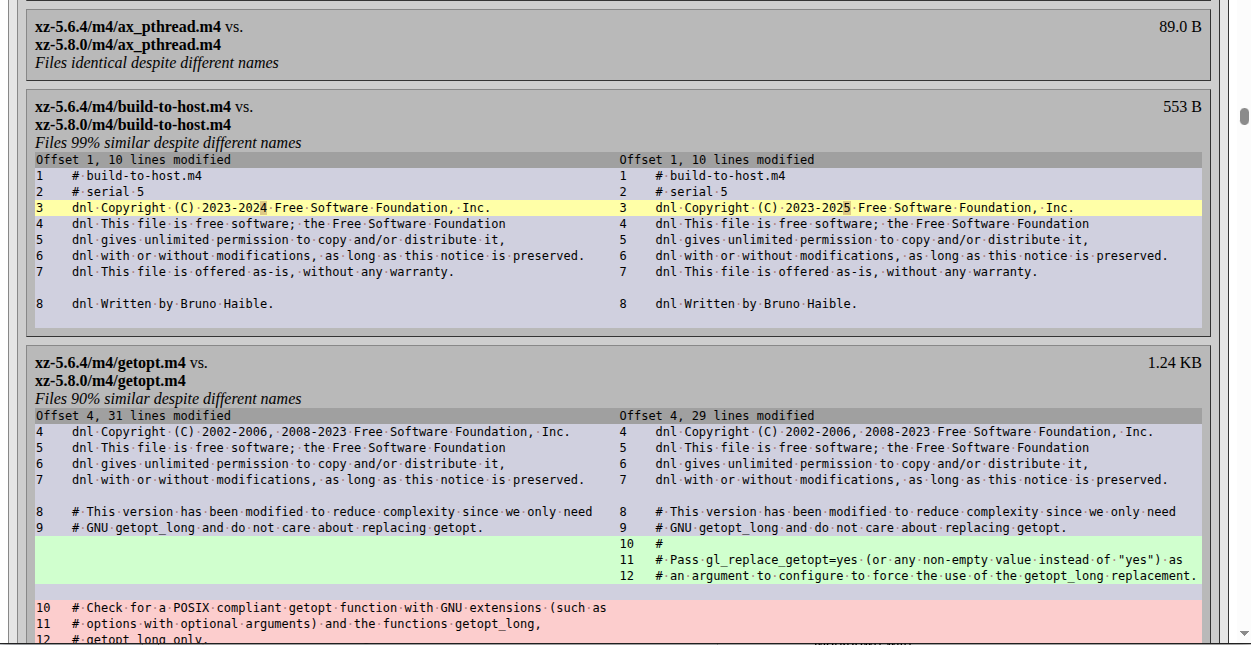
Reviewing changes between two source packages using diffoscope Diffoscope is an incredibly capable and handy tool to compare arbitrary files. For example, to view a report in HTML format of the differences between two XZ releases, run:
diffoscope --html-dir xz-utils-5.6.4_vs_5.8.0 xz-utils_5.6.4.orig.tar.xz xz-utils_5.8.0.orig.tar.xz
browse xz-utils-5.6.4_vs_5.8.0/index.html
Inspecting diffoscope output of differences between two XZ Utils releases If the changes are extensive, and you want to use a LLM to help spot potential security issues, generate the report of both the upstream and Debian packaging differences in Markdown with:
diffoscope --markdown diffoscope-debian.md xz-utils_5.6.4-1.debian.tar.xz xz-utils_5.8.1-2.debian.tar.xz
diffoscope --markdown diffoscope.md xz-utils_5.6.4.orig.tar.xz xz-utils_5.8.0.orig.tar.xz
The Markdown files created above can then be passed to your favorite LLM, along with a prompt such as:
Based on the attached diffoscope output for a new Debian package version compared with the previous one, list all suspicious changes that might have introduced a backdoor, followed by other potential security issues. If there are none, list a short summary of changes as the conclusion.

Reviewing Debian source packages in version control As of today only 93% of all Debian source packages are tracked in git on Debian s GitLab instance at salsa.debian.org. Some key packages such as Coreutils and Bash are not using version control at all, as their maintainers apparently don t see value in using git for Debian packaging, and the Debian Policy does not require it. Thus, the only reliable and consistent way to audit changes in Debian packages is to compare the full versions from the archive as shown above. However, for packages that are hosted on Salsa, one can view the git history to gain additional insight into what exactly changed, when and why. For packages that are using version control, their location can be found in the Git-Vcs header in the debian/control file. For xz-utils the location is salsa.debian.org/debian/xz-utils. Note that the Debian policy does not state anything about how Salsa should be used, or what git repository layout or development practices to follow. In practice most packages follow the DEP-14 proposal, and use git-buildpackage as the tool for managing changes and pushing and pulling them between upstream and salsa.debian.org. To get the XZ Utils source, run:
$ gbp clone https://salsa.debian.org/debian/xz-utils.git
gbp:info: Cloning from 'https://salsa.debian.org/debian/xz-utils.git'
At the time of writing this post the git history shows:
$ git log --graph --oneline
* bb787585 (HEAD -> debian/unstable, origin/debian/unstable, origin/HEAD) Prepare 5.8.1-2
* 4b769547 d: Remove the symlinks from -dev package.
* a39f3428 Correct the nocheck build profile
* 1b806b8d Import Debian changes 5.8.1-1.1
* b1cad34b Prepare 5.8.1-1
* a8646015 Import 5.8.1
* 2808ec2d Update upstream source from tag 'upstream/5.8.1'
 \
  * fa1e8796 (origin/upstream/v5.8, upstream/v5.8) New upstream version 5.8.1
  * a522a226 Bump version and soname for 5.8.1
  * 1c462c2a Add NEWS for 5.8.1
  * 513cabcf Tests: Call lzma_code() in smaller chunks in fuzz_common.h
  * 48440e24 Tests: Add a fuzzing target for the multithreaded .xz decoder
  * 0c80045a liblzma: mt dec: Fix lack of parallelization in single-shot decoding
  * 81880488 liblzma: mt dec: Don't modify thr->in_size in the worker thread
  * d5a2ffe4 liblzma: mt dec: Don't free the input buffer too early (CVE-2025-31115)
  * c0c83596 liblzma: mt dec: Simplify by removing the THR_STOP state
  * 831b55b9 liblzma: mt dec: Fix a comment
  * b9d168ee liblzma: Add assertions to lzma_bufcpy()
  * c8e0a489 DOS: Update Makefile to fix the build
  * 307c02ed sysdefs.h: Avoid <stdalign.h> even with C11 compilers
  * 7ce38b31 Update THANKS
  * 688e51bd Translations: Update the Croatian translation
*   a6b54dde Prepare 5.8.0-1.
*   77d9470f Add 5.8 symbols.
*   9268eb66 Import 5.8.0
*   6f85ef4f Update upstream source from tag 'upstream/5.8.0'
 \ \
  *   afba662b New upstream version 5.8.0
   /
  * 173fb5c6 doc/SHA256SUMS: Add 5.8.0
  * db9258e8 Bump version and soname for 5.8.0
  * bfb752a3 Add NEWS for 5.8.0
  * 6ccbb904 Translations: Run "make -C po update-po"
  * 891a5f05 Translations: Run po4a/update-po
  * 4f52e738 Translations: Partially fix overtranslation in Serbian man pages
  * ff5d9447 liblzma: Count the extra bytes in LZMA/LZMA2 decoder memory usage
  * 943b012d liblzma: Use SSE2 intrinsics instead of memcpy() in dict_repeat()
This shows both the changes on the debian/unstable branch as well as the intermediate upstream import branch, and the actual real upstream development branch. See my Debian source packages in git explainer for details of what these branches are used for. To only view changes on the Debian branch, run git log --graph --oneline --first-parent or git log --graph --oneline -- debian. The Debian branch should only have changes inside the debian/ subdirectory, which is easy to check with:
$ git diff --stat upstream/v5.8
debian/README.source   16 +++
debian/autogen.sh   32 +++++
debian/changelog   949 ++++++++++++++++++++++++++
...
debian/upstream/signing-key.asc   52 +++++++++
debian/watch   4 +
debian/xz-utils.README.Debian   47 ++++++++
debian/xz-utils.docs   6 +
debian/xz-utils.install   28 +++++
debian/xz-utils.postinst   19 +++
debian/xz-utils.prerm   10 ++
debian/xzdec.docs   6 +
debian/xzdec.install   4 +
33 files changed, 2014 insertions(+)
All the files outside the debian/ directory originate from upstream, and for example running git blame on them should show only upstream commits:
$ git blame CMakeLists.txt
22af94128 (Lasse Collin 2024-02-12 17:09:10 +0200 1) # SPDX-License-Identifier: 0BSD
22af94128 (Lasse Collin 2024-02-12 17:09:10 +0200 2)
7e3493d40 (Lasse Collin 2020-02-24 23:38:16 +0200 3) ###############
7e3493d40 (Lasse Collin 2020-02-24 23:38:16 +0200 4) #
426bdc709 (Lasse Collin 2024-02-17 21:45:07 +0200 5) # CMake support for building XZ Utils
If the upstream in question signs commits or tags, they can be verified with e.g.:
$ git verify-tag v5.6.2
gpg: Signature made Wed 29 May 2024 09:39:42 AM PDT
gpg: using RSA key 3690C240CE51B4670D30AD1C38EE757D69184620
gpg: issuer "lasse.collin@tukaani.org"
gpg: Good signature from "Lasse Collin <lasse.collin@tukaani.org>" [expired]
gpg: Note: This key has expired!
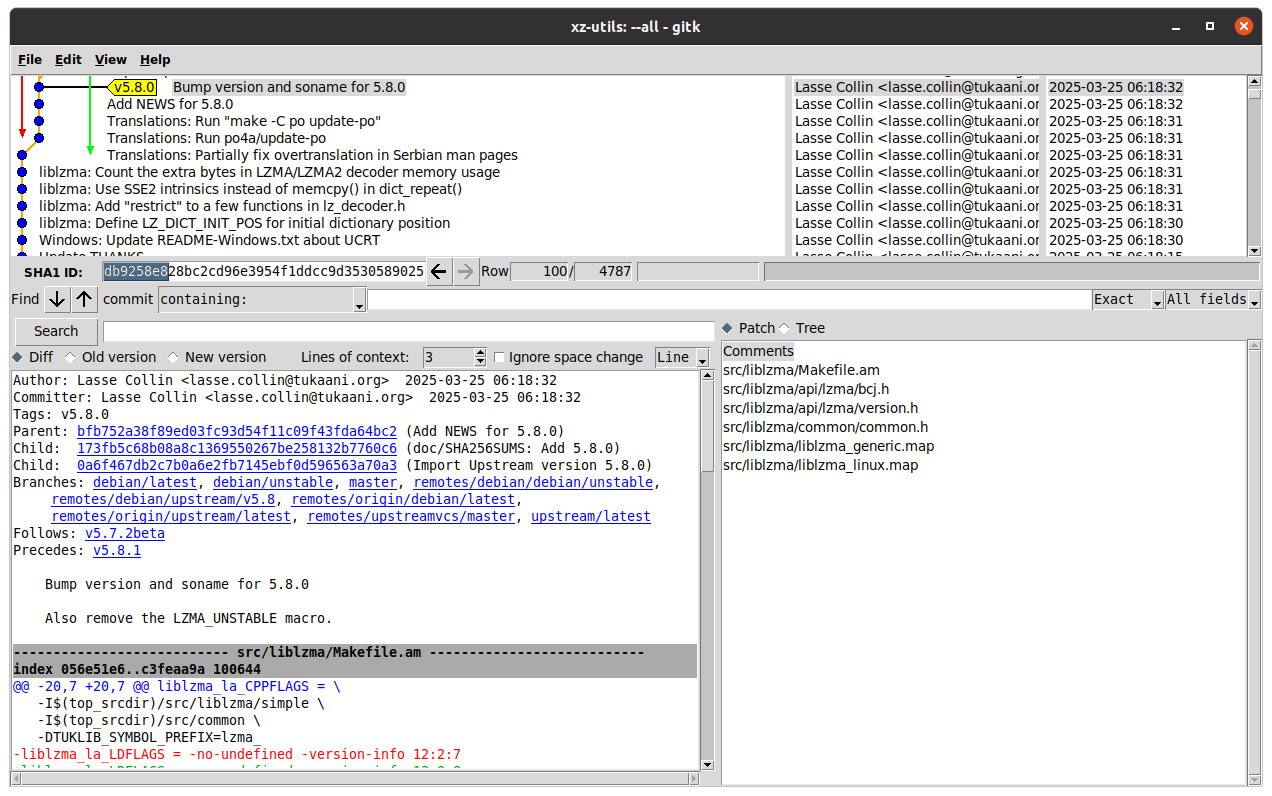
The main benefit of reviewing changes in git is the ability to see detailed information about each individual change, instead of just staring at a massive list of changes without any explanations. In this example, to view all the upstream commits since the previous import to Debian, one would view the commit range from afba662b New upstream version 5.8.0 to fa1e8796 New upstream version 5.8.1 with git log --reverse -p afba662b...fa1e8796. However, a far superior way to review changes would be to browse this range using a visual git history viewer, such as gitk. Either way, looking at one code change at a time and reading the git commit message makes the review much easier. Browsing git history in gitk --all

Comparing Debian source packages to git contents As stated in the beginning of the previous section, and worth repeating, there is no guarantee that the contents in the Debian packaging git repository matches what was actually uploaded to Debian. While the tag2upload project in Debian is getting more and more popular, Debian is still far from having any system to enforce that the git repository would be in sync with the Debian archive contents. To detect such differences we can run diff across the Debian source packages downloaded with debsnap earlier (path source-xz-utils/xz-utils_5.8.1-2.debian) and the git repository cloned in the previous section (path xz-utils):
diff
$ diff -u source-xz-utils/xz-utils_5.8.1-2.debian/ xz-utils/debian/
diff -u source-xz-utils/xz-utils_5.8.1-2.debian/changelog xz-utils/debian/changelog
--- debsnap/source-xz-utils/xz-utils_5.8.1-2.debian/changelog 2025-10-03 09:32:16.000000000 -0700
+++ xz-utils/debian/changelog 2025-10-12 12:18:04.623054758 -0700
@@ -5,7 +5,7 @@
 * Remove the symlinks from -dev, pointing to the lib package.
 (Closes: #1109354)

- -- Sebastian Andrzej Siewior <sebastian@breakpoint.cc> Fri, 03 Oct 2025 18:32:16 +0200
+ -- Sebastian Andrzej Siewior <sebastian@breakpoint.cc> Fri, 03 Oct 2025 18:36:59 +0200
In the case above diff revealed that the timestamp in the changelog in the version uploaded to Debian is different from what was committed to git. This is not malicious, just a mistake by the maintainer who probably didn t run gbp tag immediately after upload, but instead some dch command and ended up with having a different timestamps in the git compared to what was actually uploaded to Debian.

Creating syntetic Debian packaging git repositories If no Debian packaging git repository exists, or if it is lagging behind what was uploaded to Debian s archive, one can use git-buildpackage s import-dscs feature to create synthetic git commits based on the files downloaded by debsnap, ensuring the git contents fully matches what was uploaded to the archive. To import a single version there is gbp import-dsc (no s at the end), of which an example invocation would be:
$ gbp import-dsc --verbose ../source-xz-utils/xz-utils_5.8.1-2.dsc
Version '5.8.1-2' imported under '/home/otto/debian/xz-utils-2025-09-29'
Example commit history from a repository with commits added with gbp import-dsc:
$ git log --graph --oneline
* 86aed07b (HEAD -> debian/unstable, tag: debian/5.8.1-2, origin/debian/unstable) Import Debian changes 5.8.1-2
* f111d93b (tag: debian/5.8.1-1.1) Import Debian changes 5.8.1-1.1
* 1106e19b (tag: debian/5.8.1-1) Import Debian changes 5.8.1-1
 \
  * 08edbe38 (tag: upstream/5.8.1, origin/upstream/v5.8, upstream/v5.8) Import Upstream version 5.8.1
   \
    * a522a226 (tag: v5.8.1) Bump version and soname for 5.8.1
    * 1c462c2a Add NEWS for 5.8.1
    * 513cabcf Tests: Call lzma_code() in smaller chunks in fuzz_common.h
An online example repository with only a few missing uploads added using gbp import-dsc can be viewed at salsa.debian.org/otto/xz-utils-2025-09-29/-/network/debian%2Funstable An example repository that was fully crafted using gbp import-dscs can be viewed at salsa.debian.org/otto/xz-utils-gbp-import-dscs-debsnap-generated/-/network/debian%2Flatest. There exists also dgit, which in a similar way creates a synthetic git history to allow viewing the Debian archive contents via git tools. However, its focus is on producing new package versions, so fetching a package with dgit that has not had the history recorded in dgit earlier will only show the latest versions:
$ dgit clone xz-utils
canonical suite name for unstable is sid
starting new git history
last upload to archive: NO git hash
downloading http://ftp.debian.org/debian//pool/main/x/xz-utils/xz-utils_5.8.1.orig.tar.xz...
downloading http://ftp.debian.org/debian//pool/main/x/xz-utils/xz-utils_5.8.1.orig.tar.xz.asc...
downloading http://ftp.debian.org/debian//pool/main/x/xz-utils/xz-utils_5.8.1-2.debian.tar.xz...
dpkg-source: info: extracting xz-utils in unpacked
dpkg-source: info: unpacking xz-utils_5.8.1.orig.tar.xz
dpkg-source: info: unpacking xz-utils_5.8.1-2.debian.tar.xz
synthesised git commit from .dsc 5.8.1-2
HEAD is now at f9bcaf7 xz-utils (5.8.1-2) unstable; urgency=medium
dgit ok: ready for work in xz-utils
$ dgit/sid   git log --graph --oneline
* f9bcaf7 xz-utils (5.8.1-2) unstable; urgency=medium 9 days ago (HEAD -> dgit/sid, dgit/dgit/sid)
 \
  * 11d3a62 Import xz-utils_5.8.1-2.debian.tar.xz 9 days ago
* 15dcd95 Import xz-utils_5.8.1.orig.tar.xz 6 months ago
Unlike git-buildpackage managed git repositories, the dgit managed repositories cannot incorporate the upstream git history and are thus less useful for auditing the full software supply-chain in git.

Comparing upstream source packages to git contents Equally important to the note in the beginning of the previous section, one must also keep in mind that the upstream release source packages, often called release tarballs, are not guaranteed to have the exact same contents as the upstream git repository. Projects might strip out test data or extra development files from their release tarballs to avoid shipping unnecessary files to users, or projects might add documentation files or versioning information into the tarball that isn t stored in git. While a small minority, there are also upstreams that don t use git at all, so the plain files in a release tarball is still the lowest common denominator for all open source software projects, and exporting and importing source code needs to interface with it. In the case of XZ, the release tarball has additional version info and also a sizeable amount of pregenerated compiler configuration files. Detecting and comparing differences between git contents and tarballs can of course be done manually by running diff across an unpacked tarball and a checked out git repository. If using git-buildpackage, the difference between the git contents and tarball contents can be made visible directly in the import commit. In this XZ example, consider this git history:
* b1cad34b Prepare 5.8.1-1
* a8646015 Import 5.8.1
* 2808ec2d Update upstream source from tag 'upstream/5.8.1'
 \
  * fa1e8796 (debian/upstream/v5.8, upstream/v5.8) New upstream version 5.8.1
  * a522a226 (tag: v5.8.1) Bump version and soname for 5.8.1
  * 1c462c2a Add NEWS for 5.8.1
The commit a522a226 was the upstream release commit, which upstream also tagged v5.8.1. The merge commit 2808ec2d applied the new upstream import branch contents on the Debian branch. Between these is the special commit fa1e8796 New upstream version 5.8.1 tagged upstream/v5.8. This commit and tag exists only in the Debian packaging repository, and they show what is the contents imported into Debian. This is generated automatically by git-buildpackage when running git import-orig --uscan for Debian packages with the correct settings in debian/gbp.conf. By viewing this commit one can see exactly how the upstream release tarball differs from the upstream git contents (if at all). In the case of XZ, the difference is substantial, and shown below in full as it is very interesting:
$ git show --stat fa1e8796
commit fa1e8796dabd91a0f667b9e90f9841825225413a
(debian/upstream/v5.8, upstream/v5.8)
Author: Sebastian Andrzej Siewior <sebastian@breakpoint.cc>
Date: Thu Apr 3 22:58:39 2025 +0200
New upstream version 5.8.1
.codespellrc   30 -
.gitattributes   8 -
.github/workflows/ci.yml   163 -
.github/workflows/freebsd.yml   32 -
.github/workflows/netbsd.yml   32 -
.github/workflows/openbsd.yml   35 -
.github/workflows/solaris.yml   32 -
.github/workflows/windows-ci.yml   124 -
.gitignore   113 -
ABOUT-NLS   1 +
ChangeLog   17392 +++++++++++++++++++++
Makefile.in   1097 +++++++
aclocal.m4   1353 ++++++++
build-aux/ci_build.bash   286 --
build-aux/compile   351 ++
build-aux/config.guess   1815 ++++++++++
build-aux/config.rpath   751 +++++
build-aux/config.sub   2354 +++++++++++++
build-aux/depcomp   792 +++++
build-aux/install-sh   541 +++
build-aux/ltmain.sh   11524 ++++++++++++++++++++++
build-aux/missing   236 ++
build-aux/test-driver   160 +
config.h.in   634 ++++
configure   26434 ++++++++++++++++++++++
debug/Makefile.in   756 +++++
doc/SHA256SUMS   236 --
doc/man/txt/lzmainfo.txt   36 +
doc/man/txt/xz.txt   1708 ++++++++++
doc/man/txt/xzdec.txt   76 +
doc/man/txt/xzdiff.txt   39 +
doc/man/txt/xzgrep.txt   70 +
doc/man/txt/xzless.txt   36 +
doc/man/txt/xzmore.txt   31 +
lib/Makefile.in   623 ++++
m4/.gitignore   40 -
m4/build-to-host.m4   274 ++
m4/gettext.m4   392 +++
m4/host-cpu-c-abi.m4   529 +++
m4/iconv.m4   324 ++
m4/intlmacosx.m4   71 +
m4/lib-ld.m4   170 +
m4/lib-link.m4   815 +++++
m4/lib-prefix.m4   334 ++
m4/libtool.m4   8488 +++++++++++++++++++++
m4/ltoptions.m4   467 +++
m4/ltsugar.m4   124 +
m4/ltversion.m4   24 +
m4/lt~obsolete.m4   99 +
m4/nls.m4   33 +
m4/po.m4   456 +++
m4/progtest.m4   92 +
po/.gitignore   31 -
po/Makefile.in.in   517 +++
po/Rules-quot   66 +
po/boldquot.sed   21 +
po/ca.gmo   Bin 0 -> 15587 bytes
po/cs.gmo   Bin 0 -> 7983 bytes
po/da.gmo   Bin 0 -> 9040 bytes
po/de.gmo   Bin 0 -> 29882 bytes
po/en@boldquot.header   35 +
po/en@quot.header   32 +
po/eo.gmo   Bin 0 -> 15060 bytes
po/es.gmo   Bin 0 -> 29228 bytes
po/fi.gmo   Bin 0 -> 28225 bytes
po/fr.gmo   Bin 0 -> 10232 bytes
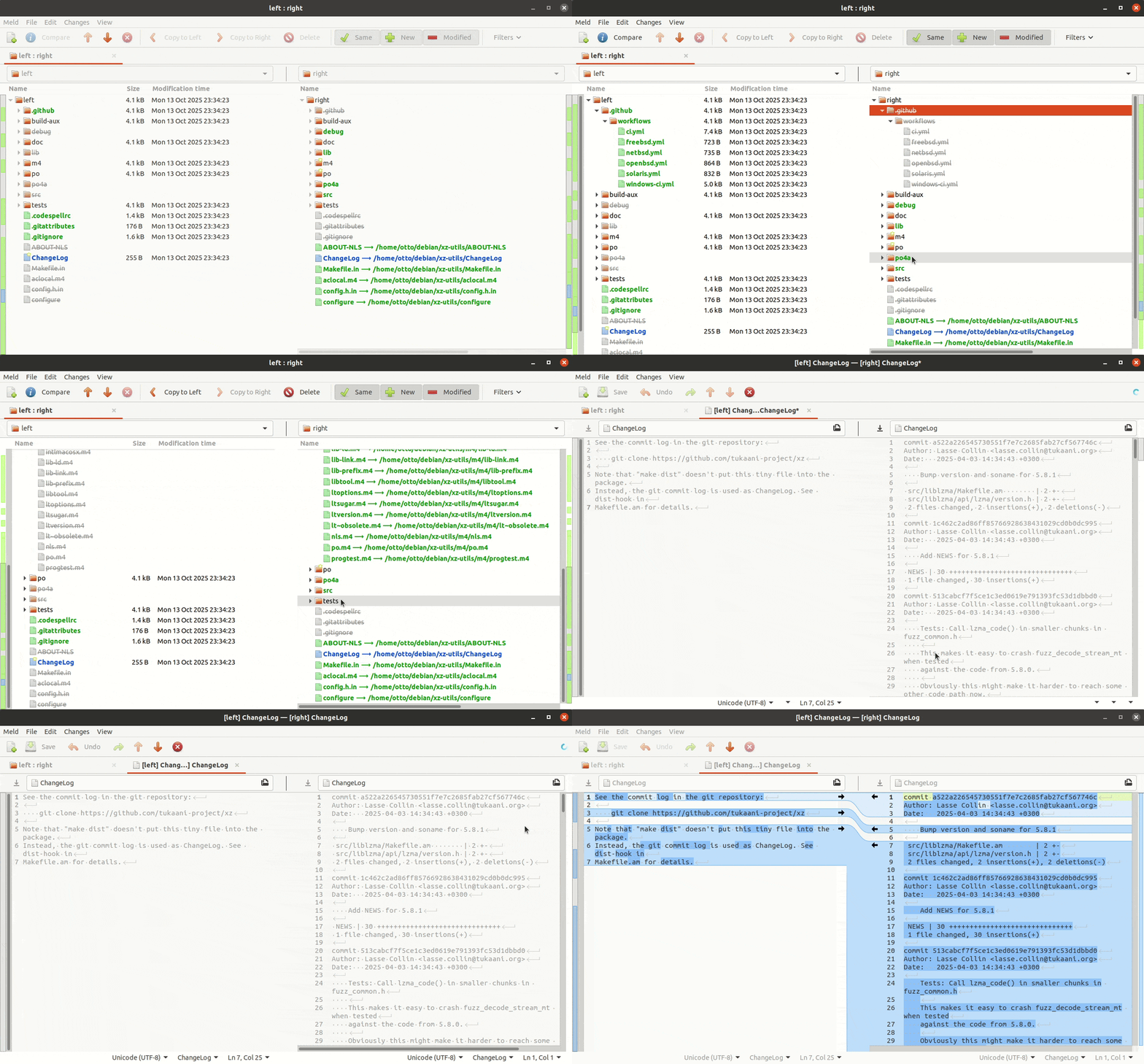
To be able to easily inspect exactly what changed in the release tarball compared to git release tag contents, the best tool for the job is Meld, invoked via git difftool --dir-diff fa1e8796^..fa1e8796. Meld invoked by git difftool --dir-diff afba662b..fa1e8796 to show differences between git release tag and release tarball contents To compare changes across the new and old upstream tarball, one would need to compare commits afba662b New upstream version 5.8.0 and fa1e8796 New upstream version 5.8.1 by running git difftool --dir-diff afba662b..fa1e8796. Meld invoked by git difftool --dir-diff afba662b..fa1e8796 to show differences between to upstream release tarball contents With all the above tips you can now go and try to audit your own favorite package in Debian and see if it is identical with upstream, and if not, how it differs.
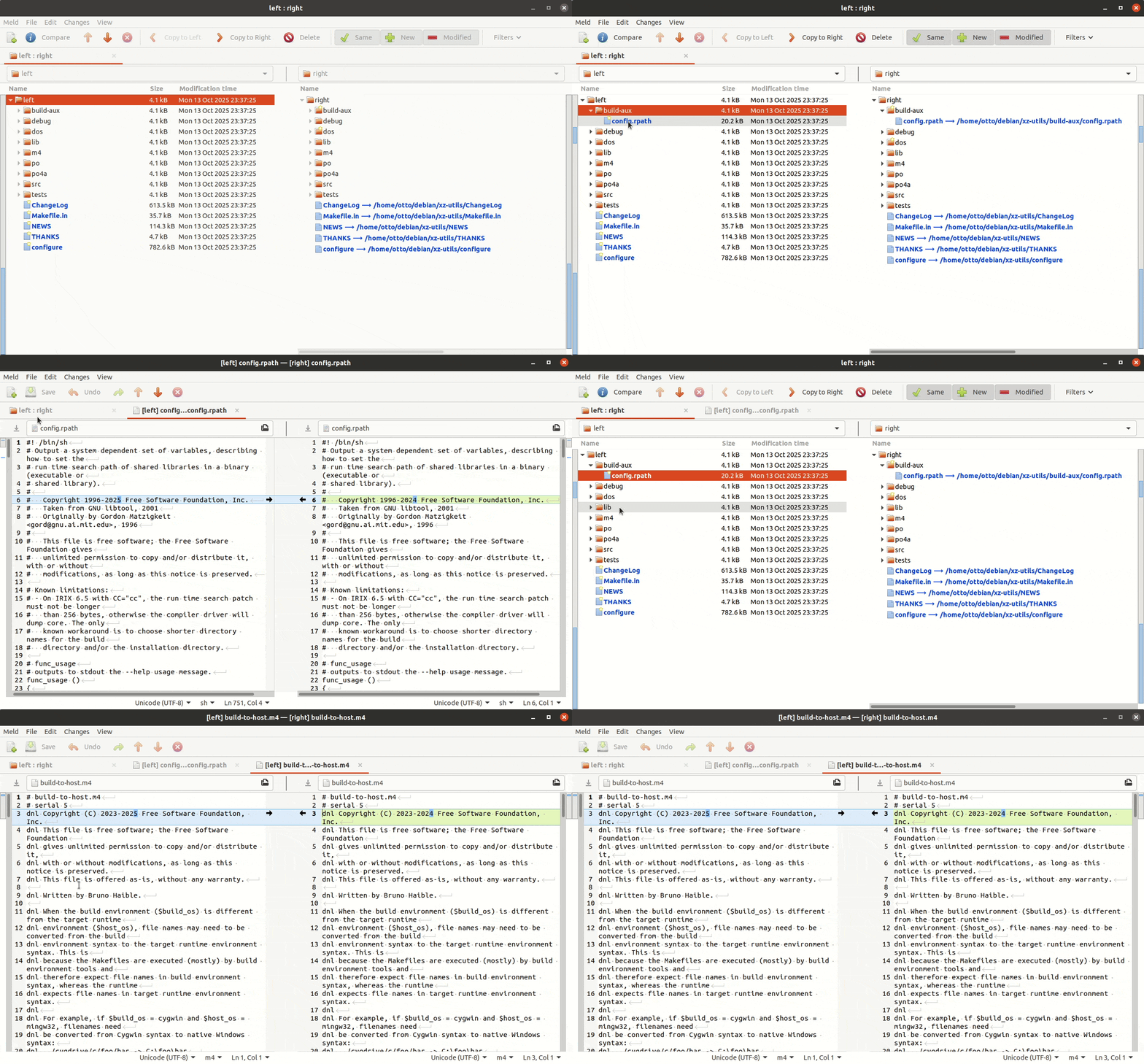
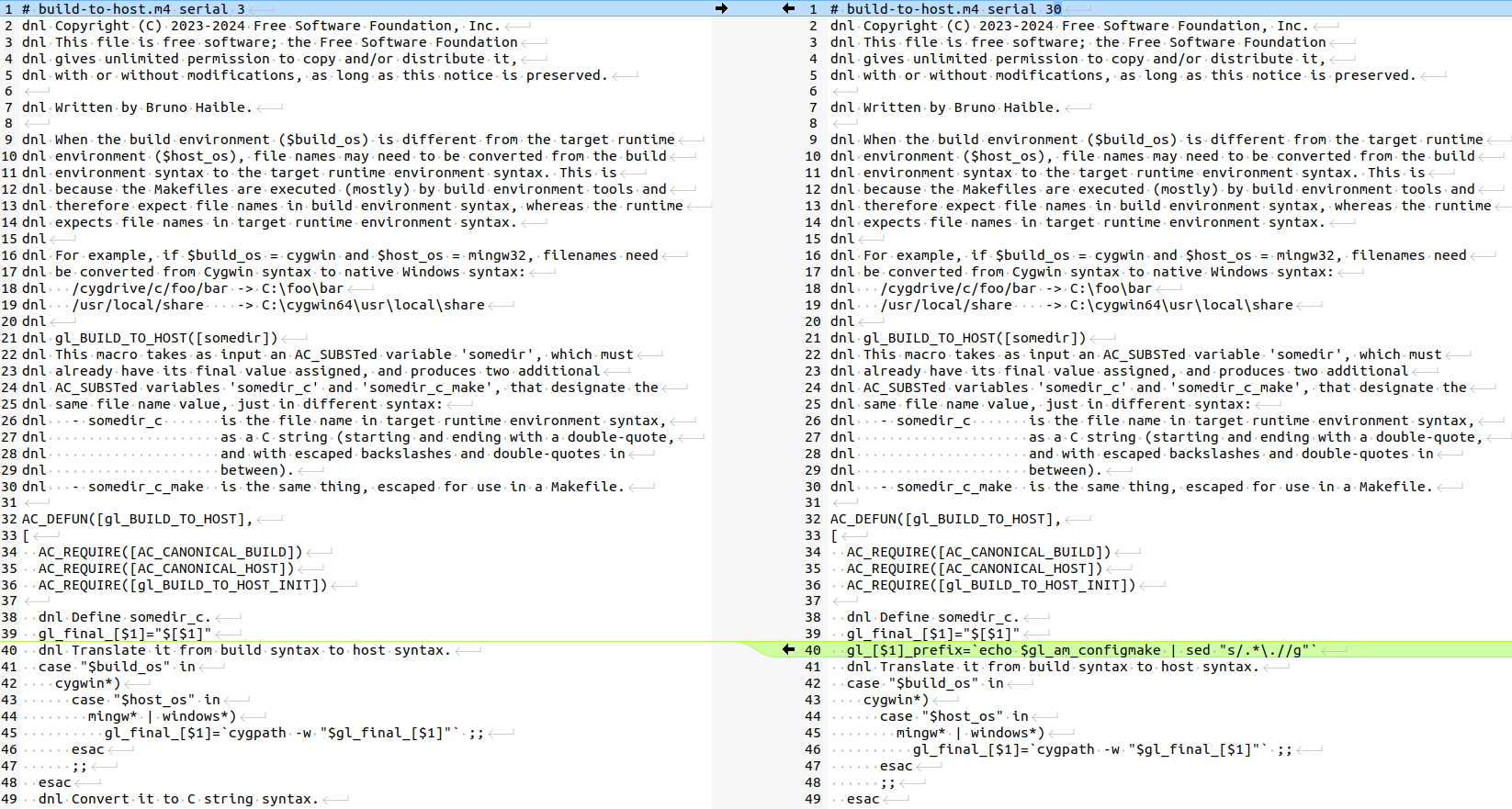
Should the XZ backdoor have been detected using these tools? The famous XZ Utils backdoor (CVE-2024-3094) consisted of two parts: the actual backdoor inside two binary blobs masqueraded as a test files (tests/files/bad-3-corrupt_lzma2.xz, tests/files/good-large_compressed.lzma), and a small modification in the build scripts (m4/build-to-host.m4) to extract the backdoor and plant it into the built binary. The build script was not tracked in version control, but generated with GNU Autotools at release time and only shipped as additional files in the release tarball. The entire reason for me to write this post was to ponder if a diligent engineer using git-buildpackage best practices could have reasonably spotted this while importing the new upstream release into Debian. The short answer is no . The malicious actor here clearly anticipated all the typical ways anyone might inspect both git commits, and release tarball contents, and masqueraded the changes very well and over a long timespan. First of all, XZ has for legitimate reasons for several carefully crafted .xz files as test data to help catch regressions in the decompression code path. The test files are shipped in the release so users can run the test suite and validate that the binary is built correctly and xz works properly. Debian famously runs massive amounts of testing in its CI and autopkgtest system across tens of thousands of packages to uphold high quality despite frequent upgrades of the build toolchain and while supporting more CPU architectures than any other distro. Test data is useful and should stay. When git-buildpackage is used correctly, the upstream commits are visible in the Debian packaging for easy review, but the commit cf44e4b that introduced the test files does not deviate enough from regular sloppy coding practices to really stand out. It is unfortunately very common for git commit to lack a message body explaining why the change was done, and to not be properly atomic with test code and test data together in the same commit, and for commits to be pushed directly to mainline without using code reviews (the commit was not part of any PR in this case). Only another upstream developer could have spotted that this change is not on par to what the project expects, and that the test code was never added, only test data, and thus that this commit was not just a sloppy one but potentially malicious. Secondly, the fact that a new Autotools file appeared (m4/build-to-host.m4) in the XZ Utils 5.6.0 is not suspicious. This is perfectly normal for Autotools. In fact, starting from XZ Utils version 5.8.1 it is now shipping a m4/build-to-host.m4 file that it actually uses now. Spotting that there is anything fishy is practically impossible by simply reading the code, as Autotools files are full custom m4 syntax interwoven with shell script, and there are plenty of backticks ( ) that spawn subshells and evals that execute variable contents further, which is just normal for Autotools. Russ Cox s XZ post explains how exactly the Autotools code fetched the actual backdoor from the test files and injected it into the build. Inspecting the m4/build-to-host.m4 changes in Meld launched via git difftool There is only one tiny thing that maybe a very experienced Autotools user could potentially have noticed: the serial 30 in the version header is way too high. In theory one could also have noticed this Autotools file deviates from what other packages in Debian ship with the same filename, such as e.g. the serial 3, serial 5a or 5b versions. That would however require and an insane amount extra checking work, and is not something we should plan to start doing. A much simpler solution would be to simply strongly recommend all open source projects to stop using Autotools to eventually get rid of it entirely.

Not detectable with reasonable effort While planting backdoors is evil, it is hard not to feel some respect to the level of skill and dedication of the people behind this. I ve been involved in a bunch of security breach investigations during my IT career, and never have I seen anything this well executed. If it hadn t slowed down SSH by ~500 milliseconds and been discovered due to that, it would most likely have stayed undetected for months or years. Hiding backdoors in closed source software is relatively trivial, but hiding backdoors in plain sight in a popular open source project requires some unusual amount of expertise and creativity as shown above.

Is the software supply-chain in Debian easy to audit? While maintaining a Debian package source using git-buildpackage can make the package history a lot easier to inspect, most packages have incomplete configurations in their debian/gbp.conf, and thus their package development histories are not always correctly constructed or uniform and easy to compare. The Debian Policy does not mandate git usage at all, and there are many important packages that are not using git at all. Additionally the Debian Policy also allows for non-maintainers to upload new versions to Debian without committing anything in git even for packages where the original maintainer wanted to use git. Uploads that bypass git unfortunately happen surpisingly often. Because of the situation, I am afraid that we could have multiple similar backdoors lurking that simply haven t been detected yet. More audits, that hopefully also get published openly, would be welcome! More people auditing the contents of the Debian archives would probably also help surface what tools and policies Debian might be missing to make the work easier, and thus help improve the security of Debian s users, and improve trust in Debian.

Is Debian currently missing some software that could help detect similar things? To my knowledge there is currently no system in place as part of Debian s QA or security infrastructure to verify that the upstream source packages in Debian are actually from upstream. I ve come across a lot of packages where the debian/watch or other configs are incorrect and even cases where maintainers have manually created upstream tarballs as it was easier than configuring automation to work. It is obvious that for those packages the source tarball now in Debian is not at all the same as upstream. I am not aware of any malicious cases though (if I was, I would report them of course). I am also aware of packages in the Debian repository that are misconfigured to be of type 1.0 (native) packages, mixing the upstream files and debian/ contents and having patches applied, while they actually should be configured as 3.0 (quilt), and not hide what is the true upstream sources. Debian should extend the QA tools to scan for such things. If I find a sponsor, I might build it myself as my next major contribution to Debian. In addition to better tooling for finding mismatches in the source code, Debian could also have better tooling for tracking in built binaries what their source files were, but solutions like Fraunhofer-AISEC s supply-graph or Sony s ESSTRA are not practical yet. Julien Malka s post about NixOS discusses the role of reproducible builds, which may help in some cases across all distros.

Or, is Debian missing some policies or practices to mitigate this? Perhaps more importantly than more security scanning, the Debian Developer community should switch the general mindset from anyone is free to do anything to valuing having more shared workflows. The ability to audit anything is severely hampered by the fact that there are so many ways to do the same thing, and distinguishing what is a normal deviation from a malicious deviation is too hard, as the normal can basically be almost anything. Also, as there is no documented and recommended default workflow, both those who are old and new to Debian packaging might never learn any one optimal workflow, and end up doing many steps in the packaging process in a way that kind of works, but is actually wrong or unnecessary, causing process deviations that look malicious, but turn out to just be a result of not fully understanding what would have been the right way to do something. In the long run, once individual developers workflows are more aligned, doing code reviews will become a lot easier and smoother as the excess noise of workflow differences diminishes and reviews will feel much more productive to all participants. Debian fostering a culture of code reviews would allow us to slowly move from the current practice of mainly solo packaging work towards true collaboration forming around those code reviews. I have been promoting increased use of Merge Requests in Debian already for some time, for example by proposing DEP-18: Encourage Continuous Integration and Merge Request based Collaboration for Debian packages. If you are involved in Debian development, please give a thumbs up in dep-team/deps!21 if you want me to continue promoting it.

Can we trust open source software? Yes and I would argue that we can only trust open source software. There is no way to audit closed source software, and anyone using e.g. Windows or MacOS just have to trust the vendor s word when they say they have no intentional or accidental backdoors in their software. Or, when the news gets out that the systems of a closed source vendor was compromised, like Crowdstrike some weeks ago, we can t audit anything, and time after time we simply need to take their word when they say they have properly cleaned up their code base. In theory, a vendor could give some kind of contractual or financial guarantee to its customer that there are no preventable security issues, but in practice that never happens. I am not aware of a single case of e.g. Microsoft or Oracle would have paid damages to their customers after a security flaw was found in their software. In theory you could also pay a vendor more to have them focus more effort in security, but since there is no way to verify what they did, or to get compensation when they didn t, any increased fees are likely just pocketed as increased profit. Open source is clearly better overall. You can, if you are an individual with the time and skills, audit every step in the supply-chain, or you could as an organization make investments in open source security improvements and actually verify what changes were made and how security improved. If your organisation is using Debian (or derivatives, such as Ubuntu) and you are interested in sponsoring my work to improve Debian, please reach out.

14 October 2025

Freexian Collaborators: Debian Contributions: Old Debian Printing software and C23, Work to decommission packages.qa.debian.org, rebootstrap uses *-for-host and more! (by Anupa Ann Joseph)

Debian Contributions: 2025-09 Contributing to Debian is part of Freexian s mission. This article covers the latest achievements of Freexian and their collaborators. All of this is made possible by organizations subscribing to our Long Term Support contracts and consulting services.

Updating old Debian Printing software to meet C23 requirements, by Thorsten Alteholz The work of Thorsten fell under the motto gcc15 . Due to the introduction of gcc15 in Debian, the default language version was changed to C23. This means that for example, function declarations without parameters are no longer allowed. As old software, which was created with ANSI C (or C89) syntax, made use of such function declarations, it was a busy month. One could have used something like -std=c17 as compile flags, but this would have just postponed the tasks. As a result Thorsten uploaded modernized versions of ink, nm2ppa and rlpr for the Debian printing team.

Work done to decommission packages.qa.debian.org, by Rapha l Hertzog Rapha l worked to decommission the old package tracking system (packages.qa.debian.org). After figuring out that it was still receiving emails from the bug tracking system (bugs.debian.org), from multiple debian lists and from some release team tools, he reached out to the respective teams to either drop those emails or adjust them so that they are sent to the current Debian Package Tracker (tracker.debian.org).

rebootstrap uses *-for-host, by Helmut Grohne Architecture cross bootstrapping is an ongoing effort that has shaped Debian in various ways over the years. A longer effort to express toolchain dependencies now bears fruit. When cross compiling, it becomes important to express what architecture one is compiling for in Build-Depends. As these packages have become available in trixie , more and more packages add this extra information and in August, the libtool package gained a gfortran-for-host dependency. It was the first package in the essential build closure to adopt this and required putting the pieces together in rebootstrap that now has to build gcc-defaults early on. There still are hundreds of packages whose dependencies need to be updated though.

Miscellaneous contributions
  • Rapha l dropped the Build Log Scan integration in tracker.debian.org since it was showing stale data for a while as the underlying service has been discontinued.
  • Emilio updated pixman to 0.46.4.
  • Emilio coordinated several transitions, and NMUed guestfs-tools to unblock one.
  • Stefano uploaded Python 3.14rc3 to Debian unstable. It s not yet used by any packages, but it allows testing the level of support in packages to begin.
  • Stefano upgraded almost all of the debian-social infrastructure to Debian trixie .
  • Stefano published the sponsorship brochures for DebConf 26.
  • Stefano attended the Debian Technical Committee meeting.
  • Stefano uploaded routine upstream updates for a handful of Python packages (pycparser, beautifulsoup4, platformdirs, pycparser, python-authlib, python-cffi, python-mitogen, python-resolvelib, python-super-collections, twine).
  • Stefano reviewed and responded to DebConf 25 feedback.
  • Stefano investigated and fixed a request visibility bug in debian-reimbursements (for admin-altered requests).
  • Lucas reviewed a couple of merge requests from external contributors for Go and Ruby packages.
  • Lucas updated some ruby packages to its latest upstream version (thin, passenger, and puma is still WIP).
  • Lucas set up the build environment to run rebuilds of reverse dependencies of ruby using ruby3.4. As an alternative, he is looking for personal repositories provided by Debusine to perform this task more easily. This is the preparation for the transition to ruby3.4 as the default in Debian.
  • Lucas helped on the next round of the Outreachy internship program.
  • Helmut sent patches for 30 cross build failures and responded to cross building support questions on the mailing list.
  • Helmut continued to maintain rebootstrap. As gcc version 15 became the default, test jobs for version 14 had to be dropped. A fair number of patches were applied to packages and could be dropped.
  • Helmut resumed removing RC-buggy packages from unstable and sponsored a termrec upload to avoid its deletion. This work was paused to give packages some time to migrate to forky .
  • Santiago reviewed different merge requests created by different contributors. Those MRs include a new test to build reverse dependencies, created by Aquila Macedo as part of his GSoC internship; restore how lintian was used in experimental, thanks Otto Kek l inen; and the fix by Christian Bayle to support again extra repositories in deb822-style sources, whose support was broken with the move to sbuild+unshare last month.
  • While doing some new upstream release updates, thanks to Debusine s reverse dependencies autopkgtest checks, Santiago discovered that paramiko 4.0 will introduce a regression in libcloud by the drop of support for the obsolete DSA keys. Santiago finally uploaded to unstable both paramiko 4.0, and a regression fix for libcloud.
  • Santiago has taken part in different discussions and meetings for the preparation of DebConf 26. The DebConf 26 local team aims to prepare for the conference with enough time in advance.
  • Carles kept working on the missing-package-relations and reporting missing Recommends. He improved the tooling to detect and report bugs creating 269 bugs and followed up comments. 37 bugs have been resolved, others acknowledged. The missing Recommends are a mixture of packages that are gone from Debian, packages that changed name, typos and also packages that were recommended but are not packaged in Debian.
  • Carles improved the missing-package-relations to report broken Suggests only for packages that used to be in Debian but are removed from it now. No bugs have been created yet for this case but identified 1320 of them.
  • Colin spent much of the month chasing down build/test regressions in various Python packages due to other upgrades, particularly relating to pydantic, python-pytest-asyncio, and rust-pyo3.
  • Colin optimized some code in ubuntu-dev-tools (affecting e.g. pull-debian-source) that made O(n) HTTP requests when it could instead make O(1).
  • Anupa published Micronews as part of Debian Publicity team work.

13 October 2025

Jonathan McDowell: onak 0.6.4 released

A bit delayed in terms of an announcement, but last month I tagged a new version of onak, my OpenPGP compatible keyserver. It s been 2 years since the last release, and this is largely a bunch of minor fixes to make compilation under Debian trixie with more recent CMake + GCC versions happy. OpenPGP v6 support, RFC9580, hasn t made it. I ve got a branch which adds it, but a lack of keys to do any proper testing with, and no X448 support implemented, mean I m not ready to include it in a release yet. The plan is that ll land for 0.7.0 (along with some backend work), but no idea when that might be. Available locally or via GitHub.

0.6.4 - 7th September 2025
  • Fix building with CMake 4.0
  • Fixes for building with GCC 15
  • Rename keyd(ctl) to onak-keyd(ctl)

Freexian Collaborators: Monthly report about Debian Long Term Support, September 2025 (by Roberto C. S nchez)

Like each month, have a look at the work funded by Freexian s Debian LTS offering.

Debian LTS contributors In September, 20 contributors have been paid to work on Debian LTS, their reports are available:
  • Abhijith PA did 10.0h (out of 10.0h assigned and 4.0h from previous period), thus carrying over 4.0h to the next month.
  • Andreas Henriksson did 1.0h (out of 0.0h assigned and 20.0h from previous period), thus carrying over 19.0h to the next month.
  • Bastien Roucari s did 20.0h (out of 20.0h assigned).
  • Ben Hutchings did 20.0h (out of 21.0h assigned), thus carrying over 1.0h to the next month.
  • Carlos Henrique Lima Melara did 10.0h (out of 12.0h assigned), thus carrying over 2.0h to the next month.
  • Chris Lamb did 18.0h (out of 18.0h assigned).
  • Daniel Leidert did 21.0h (out of 21.0h assigned).
  • Emilio Pozuelo Monfort did 39.75h (out of 40.0h assigned), thus carrying over 0.25h to the next month.
  • Guilhem Moulin did 15.0h (out of 15.0h assigned).
  • Jochen Sprickerhof did 12.0h (out of 9.25h assigned and 11.75h from previous period), thus carrying over 9.0h to the next month.
  • Lee Garrett did 13.5h (out of 21.0h assigned), thus carrying over 7.5h to the next month.
  • Lucas Kanashiro did 8.0h (out of 20.0h assigned), thus carrying over 12.0h to the next month.
  • Markus Koschany did 15.0h (out of 3.25h assigned and 17.75h from previous period), thus carrying over 6.0h to the next month.
  • Paride Legovini did 6.0h (out of 8.0h assigned), thus carrying over 2.0h to the next month.
  • Roberto C. S nchez did 7.25h (out of 7.75h assigned and 13.25h from previous period), thus carrying over 13.75h to the next month.
  • Santiago Ruano Rinc n did 13.25h (out of 13.5h assigned and 1.5h from previous period), thus carrying over 1.75h to the next month.
  • Sylvain Beucler did 17.0h (out of 7.75h assigned and 13.25h from previous period), thus carrying over 4.0h to the next month.
  • Thorsten Alteholz did 21.0h (out of 21.0h assigned).
  • Tobias Frost did 5.0h (out of 0.0h assigned and 8.0h from previous period), thus carrying over 3.0h to the next month.
  • Utkarsh Gupta did 16.5h (out of 14.25h assigned and 6.75h from previous period), thus carrying over 4.5h to the next month.

Evolution of the situation In September, we released 38 DLAs.
  • Notable security updates:
    • modsecurity-apache prepared by Adrian Bunk, fixes a cross-site scripting vulnerability
    • cups, prepared by Thorsten Alteholz, fixes authentication bypass and denial of service vulnerabilities
    • jetty9, prepared by Adrian Bunk, fixes the MadeYouReset vulnerability (a recent, well-known denial of service vulnerability)
    • python-django, prepared by Chris Lamb, fixes a SQL injection vulnerability
    • firefox-esr and thunderbird, prepared by Emilio Pozuelo Monfort, were updated from the 128.x ESR series to the 140.x ESR series, fixing a number of vulnerabilities as well
  • Notable non-security updates:
    • wireless-regdb prepared by Ben Hutchings, updates information reflecting changes to radio regulations in many countries
There was one package update contributed by a Debian Developer outside of the LTS Team: an update of node-tar-fs, prepared by Xavier Guimard (a member of the Node packaging team). Finally, LTS Team members also contributed updates of the following packages:
  • libxslt (to stable and oldstable), prepared by Guilhem Moulin, to address a regression introduced in a previous security update
  • libphp-adodb (to stable and oldstable), prepared by Abhijith PA
  • cups (to stable and oldstable), prepared by Thorsten Alteholz
  • u-boot (to oldstable), prepared by Daniel Leidert and Jochen Sprickerhof
  • libcommongs-lang3-java (to stable and oldstable), prepared by Daniel Leidert
  • python-internetarchive (to oldstable), prepared by Daniel Leidert
One other notable contribution by a member of the LTS Team is that Sylvain Beucler proposed a fix upstream for CVE-2025-2760 in gimp2. Upstream no longer supports gimp2, but it is still present in Debian LTS, and so proposing this fix upstream is of benefit to other distros which may still be supporting the older gimp2 packages.

Thanks to our sponsors Sponsors that joined recently are in bold.

10 October 2025

Reproducible Builds: Reproducible Builds in September 2025

Welcome to the September 2025 report from the Reproducible Builds project! Welcome to the very latest report from the Reproducible Builds project. Our monthly reports outline what we ve been up to over the past month, and highlight items of news from elsewhere in the increasingly-important area of software supply-chain security. As ever, if you are interested in contributing to the Reproducible Builds project, please see the Contribute page on our website. In this report:

  1. Reproducible Builds Summit 2025
  2. Can t we have nice things?
  3. Distribution work
  4. Tool development
  5. Reproducibility testing framework
  6. Upstream patches

Reproducible Builds Summit 2025 Please join us at the upcoming Reproducible Builds Summit, set to take place from October 28th 30th 2025 in Vienna, Austria! We are thrilled to host the eighth edition of this exciting event, following the success of previous summits in various iconic locations around the world, including Venice, Marrakesh, Paris, Berlin, Hamburg and Athens. Our summits are a unique gathering that brings together attendees from diverse projects, united by a shared vision of advancing the Reproducible Builds effort. During this enriching event, participants will have the opportunity to engage in discussions, establish connections and exchange ideas to drive progress in this vital field. Our aim is to create an inclusive space that fosters collaboration, innovation and problem-solving. If you re interesting in joining us this year, please make sure to read the event page which has more details about the event and location. Registration is open until 20th September 2025, and we are very much looking forward to seeing many readers of these reports there!

Can t we have nice things? Debian Developer Gunnar Wolf blogged that George V. Neville-Neil s Kode Vicious column in Communications of the ACM in which reproducible builds is mentioned without needing to introduce it (assuming familiarity across the computing industry and academia) . Titled, Can t we have nice things?, the article mentions:
Once the proper measurement points are known, we want to constrain the system such that what it does is simple enough to understand and easy to repeat. It is quite telling that the push for software that enables reproducible builds only really took off after an embarrassing widespread security issue ended up affecting the entire Internet. That there had already been 50 years of software development before anyone thought that introducing a few constraints might be a good idea is, well, let s just say it generates many emotions, none of them happy, fuzzy ones. [ ]

Distribution work In Debian this month, Johannes Starosta filed a bug against the debian-repro-status package, reporting that it does not work on Debian trixie. (An upstream bug report was also filed.) Furthermore, 17 reviews of Debian packages were added, 10 were updated and 14 were removed this month adding to our knowledge about identified issues. In March s report, we included the news that Fedora would aim for 99% package reproducibility. This change has now been deferred to Fedora 44 according to Phoronix. Lastly, Bernhard M. Wiedemann posted another openSUSE monthly update for their work there.

Tool development diffoscope version 306 was uploaded to Debian unstable by Chris Lamb. It included contributions already covered in previous months as well as some changes by Zbigniew J drzejewski-Szmek to address issues with the fdtump support [ ] and to move away from the deprecated codes.open method. [ ][ ] strip-nondeterminism version 1.15.0-1 was uploaded to Debian unstable by Chris Lamb. It included a contribution by Matwey Kornilov to add support for inline archive files for Erlang s escript [ ]. kpcyrd has released a new version of rebuilderd. As a quick recap, rebuilderd is an automatic build scheduler that tracks binary packages available in a Linux distribution and attempts to compile the official binary packages from their (purported) source code and dependencies. The code for in-toto attestations has been reworked, and the instances now feature a new endpoint that can be queried to fetch the list of public-keys an instance currently identifies itself by. [ ] Lastly, Holger Levsen bumped the Standards-Version field of disorderfs, with no changes needed. [ ][ ]

Reproducibility testing framework The Reproducible Builds project operates a comprehensive testing framework running primarily at tests.reproducible-builds.org in order to check packages and other artifacts for reproducibility. In August, however, a number of changes were made by Holger Levsen, including:
  • Setting up six new rebuilderd workers with 16 cores and 16 GB RAM each.
  • reproduce.debian.net-related:
    • Do not expose pending jobs; they are confusing without explaination. [ ]
    • Add a link to v1 API specification. [ ]
    • Drop rebuilderd-worker.conf on a node. [ ]
    • Allow manual scheduling for any architectures. [ ]
    • Update path to trixie graphs. [ ]
    • Use the same rebuilder-debian.sh script for all hosts. [ ]
    • Add all other suites to all other archs. [ ][ ][ ][ ]
    • Update SSH host keys for new hosts. [ ]
    • Move to the pull184 branch. [ ][ ][ ][ ][ ]
    • Only allow 20 GB cache for workers. [ ]
  • OpenWrt-related:
    • Grant developer aparcar full sudo control on the ionos30 node. [ ][ ]
  • Jenkins nodes:
    • Add a number of new nodes. [ ][ ][ ][ ][ ]
    • Dont expect /srv/workspace to exist on OSUOSL nodes. [ ]
    • Stop hardcoding IP addresses in munin.conf. [ ]
    • Add maintenance and health check jobs for new nodes. [ ]
    • Document slight changes in IONOS resources usage. [ ]
  • Misc:
    • Drop disabled Alpine Linux tests for good. [ ]
    • Move Debian live builds and some other Debian builds to the ionos10 node. [ ]
    • Cleanup some legacy support from releases before Debian trixie. [ ]
In addition, Jochen Sprickerhof made the following changes relating to reproduce.debian.net:
  • Do not expose pending jobs on the main site. [ ]
  • Switch the frontpage to reference Debian forky [ ], but do not attempt to build Debian forky on the armel architecture [ ].
  • Use consistent and up to date rebuilder-debian.sh script. [ ]
  • Fix supported worker architectures. [ ]
  • Add a basic excuses page. [ ]
  • Move to the pull184 branch. [ ][ ][ ][ ]
  • Fix a typo in the JavaScript. [ ]
  • Update front page for the new v1 API. [ ][ ]
Lastly, Roland Clobus did some maintenance relating to the reproducibility testing of the Debian Live images. [ ][ ][ ][ ]

Upstream patches The Reproducible Builds project detects, dissects and attempts to fix as many currently-unreproducible packages as possible. We endeavour to send all of our patches upstream where appropriate. This month, we wrote a large number of such patches, including:

Finally, if you are interested in contributing to the Reproducible Builds project, please visit our Contribute page on our website. However, you can get in touch with us via:

Sergio Cipriano: Avoiding 5XX errors by adjusting Load Balancer Idle Timeout

Avoiding 5XX errors by adjusting Load Balancer Idle Timeout Recently I faced a problem in production where a client was running a RabbitMQ server behind the Load Balancers we provisioned and the TCP connections were closed every minute. My team is responsible for the LBaaS (Load Balancer as a Service) product and this Load Balancer was an Envoy proxy provisioned by our control plane. The error was similar to this:
[2025-10-03 12:37:17,525 - pika.adapters.utils.connection_workflow - ERROR] AMQPConnector - reporting failure: AMQPConnectorSocketConnectError: timeout("TCP connection attempt timed out: ''/(<AddressFamily.AF_INET: 2>, <SocketKind.SOCK_STREAM: 1>, 6, '', ('<IP>', 5672))")
[2025-10-03 12:37:17,526 - pika.adapters.utils.connection_workflow - ERROR] AMQP connection workflow failed: AMQPConnectionWorkflowFailed: 1 exceptions in all; last exception - AMQPConnectorSocketConnectError: timeout("TCP connection attempt timed out: ''/(<AddressFamily.AF_INET: 2>, <SocketKind.SOCK_STREAM: 1>, 6, '', ('<IP>', 5672))"); first exception - None.
[2025-10-03 12:37:17,526 - pika.adapters.utils.connection_workflow - ERROR] AMQPConnectionWorkflow - reporting failure: AMQPConnectionWorkflowFailed: 1 exceptions in all; last exception - AMQPConnectorSocketConnectError: timeout("TCP connection attempt timed out: ''/(<AddressFamily.AF_INET: 2>, <SocketKind.SOCK_STREAM: 1>, 6, '', ('<IP>', 5672))"); first exception - None
At first glance, the issue is simple: the Load Balancer's idle timeout is shorter than the RabbitMQ heartbeat interval. The idle timeout is the time at which a downstream or upstream connection will be terminated if there are no active streams. Heartbeats generate periodic network traffic to prevent idle TCP connections from closing prematurely. Adjusting these timeout settings to align properly solved the issue. However, what I want to explore in this post are other similar scenarios where it's not so obvious that the idle timeout is the problem. Introducing an extra network layer, such as an Envoy proxy, can introduce unpredictable behavior across your services, like intermittent 5XX errors. To make this issue more concrete, let's look at a minimal, reproducible setup that demonstrates how adding an Envoy proxy can lead to sporadic errors.

Reproducible setup I'll be using the following tools: This setup is based on what Kai Burjack presented in his article. Setting up Envoy with Docker is straightforward:
$ docker run \
    --name envoy --rm \
    --network host \
    -v $(pwd)/envoy.yaml:/etc/envoy/envoy.yaml \
    envoyproxy/envoy:v1.33-latest
I'll be running experiments with two different envoy.yaml configurations: one that uses Envoy's TCP proxy, and another that uses Envoy's HTTP connection manager. Here's the simplest Envoy TCP proxy setup: a listener on port 8000 forwarding traffic to a backend running on port 8080.
static_resources:
  listeners:
  - name: go_server_listener
    address:
      socket_address:
        address: 0.0.0.0
        port_value: 8000
    filter_chains:
    - filters:
      - name: envoy.filters.network.tcp_proxy
        typed_config:
          "@type": type.googleapis.com/envoy.extensions.filters.network.tcp_proxy.v3.TcpProxy
          stat_prefix: go_server_tcp
          cluster: go_server_cluster
  clusters:
  - name: go_server_cluster
    connect_timeout: 1s
    type: static
    load_assignment:
      cluster_name: go_server_cluster
      endpoints:
      - lb_endpoints:
        - endpoint:
            address:
              socket_address:
                address: 127.0.0.1
                port_value: 8080
The default idle timeout if not otherwise specified is 1 hour, which is the case here. The backend setup is simple as well:
package main

import (
    "fmt"
    "net/http"
    "time"
)

func helloHandler(w http.ResponseWriter, r *http.Request)  
  w.Write([]byte("Hello from Go!"))
 

func main()  
    http.HandleFunc("/", helloHandler)

    server := http.Server 
        Addr:        ":8080",
        IdleTimeout: 3 * time.Second,
     

    fmt.Println("Starting server on :8080")
    panic(server.ListenAndServe())
 
The IdleTimeout is set to 3 seconds to make it easier to test. Now, oha is the perfect tool to generate the HTTP requests for this test. The Load test is not meant to stress this setup, the idea is to wait long enough so that some requests are closed. The burst-delay feature will help with that:
$ oha -z 30s -w --burst-delay 3s --burst-rate 100 http://localhost:8000
I'm running the Load test for 30 seconds, sending 100 requests at three-second intervals. I also use the -w option to wait for ongoing requests when the duration is reached. The result looks like this: oha test report tcp fail We had 886 responses with status code 200 and 64 connections closed. The backend terminated 64 connections while the load balancer still had active requests directed to it. Let's change the Load Balancer idle_timeout to two seconds.
filter_chains:
- filters:
  - name: envoy.filters.network.tcp_proxy
    typed_config:
      "@type": type.googleapis.com/envoy.extensions.filters.network.tcp_proxy.v3.TcpProxy
      stat_prefix: go_server_tcp
      cluster: go_server_cluster
      idle_timeout: 2s # <--- NEW LINE
Run the same test again. oha test report tcp success Great! Now all the requests worked. This is a common issue, not specific to Envoy Proxy or the setup shown earlier. Major cloud providers have all documented it. AWS troubleshoot guide for Application Load Balancers says this: The target closed the connection with a TCP RST or a TCP FIN while the load balancer had an outstanding request to the target. Check whether the keep-alive duration of the target is shorter than the idle timeout value of the load balancer. Google troubleshoot guide for Application Load Balancers mention this as well: Verify that the keepalive configuration parameter for the HTTP server software running on the backend instance is not less than the keepalive timeout of the load balancer, whose value is fixed at 10 minutes (600 seconds) and is not configurable. The load balancer generates an HTTP 5XX response code when the connection to the backend has unexpectedly closed while sending the HTTP request or before the complete HTTP response has been received. This can happen because the keepalive configuration parameter for the web server software running on the backend instance is less than the fixed keepalive timeout of the load balancer. Ensure that the keepalive timeout configuration for HTTP server software on each backend is set to slightly greater than 10 minutes (the recommended value is 620 seconds). RabbitMQ docs also warn about this: Certain networking tools (HAproxy, AWS ELB) and equipment (hardware load balancers) may terminate "idle" TCP connections when there is no activity on them for a certain period of time. Most of the time it is not desirable. Most of them are talking about Application Load Balancers and the test I did was using a Network Load Balancer. For the sake of completeness, I will do the same test but using Envoy's HTTP connection manager. The updated envoy.yaml:
static_resources:
  listeners:
  - name: listener
    address:
      socket_address:
        address: 0.0.0.0
        port_value: 8000
    filter_chains:
    - filters:
      - name: envoy.filters.network.http_connection_manager
        typed_config:
          "@type": type.googleapis.com/envoy.extensions.filters.network.http_connection_manager.v3.HttpConnectionManager
          stat_prefix: go_server_http
          access_log:
          - name: envoy.access_loggers.stdout
            typed_config:
              "@type": type.googleapis.com/envoy.extensions.access_loggers.stream.v3.StdoutAccessLog
          http_filters:
          - name: envoy.filters.http.router
            typed_config:
              "@type": type.googleapis.com/envoy.extensions.filters.http.router.v3.Router
          route_config:
            name: http_route
            virtual_hosts:
            - name: local_service
              domains: ["*"]
              routes:
              - match:
                  prefix: "/"
                route:
                  cluster: go_server_cluster
  clusters:
  - name: go_server_cluster
    type: STATIC
    load_assignment:
      cluster_name: go_server_cluster
      endpoints:
      - lb_endpoints:
        - endpoint:
            address:
              socket_address:
                address: 0.0.0.0
                port_value: 8080
The yaml above is an example of a service proxying HTTP from 0.0.0.0:8000 to 0.0.0.0:8080. The only difference from a minimal configuration is that I enabled access logs. Let's run the same tests with oha. oha test report http fail Even thought the success rate is 100%, the status code distribution show some responses with status code 503. This is the case where is not that obvious that the problem is related to idle timeout. However, it's clear when we look the Envoy access logs:
[2025-10-10T13:32:26.617Z] "GET / HTTP/1.1" 503 UC 0 95 0 - "-" "oha/1.10.0" "9b1cb963-449b-41d7-b614-f851ced92c3b" "localhost:8000" "0.0.0.0:8080"
UC is the short name for UpstreamConnectionTermination. This means the upstream, which is the golang server, terminated the connection. To fix this once again, the Load Balancer idle timeout needs to change:
  clusters:
  - name: go_server_cluster
    type: STATIC
    typed_extension_protocol_options: # <--- NEW BLOCK
      envoy.extensions.upstreams.http.v3.HttpProtocolOptions:
        "@type": type.googleapis.com/envoy.extensions.upstreams.http.v3.HttpProtocolOptions
        common_http_protocol_options:
          idle_timeout: 2s # <--- NEW VALUE
        explicit_http_config:
          http_protocol_options:  
Finally, the sporadic 503 errors are over: oha test report http success

To Sum Up Here's an example of the values my team recommends to our clients: recap drawing Key Takeaways:
  1. The Load Balancer idle timeout should be less than the backend (upstream) idle/keepalive timeout.
  2. When we are working with long lived connections, the client (downstream) should use a keepalive smaller than the LB idle timeout.

9 October 2025

Thorsten Alteholz: My Debian Activities in September 2025

Debian LTS This was my hundred-thirty-fifth month that I did some work for the Debian LTS initiative, started by Raphael Hertzog at Freexian. During my allocated time I uploaded or worked on: An upload of spim was not needed, as the corresponding CVE could be marked as ignored. I also started to work on an open-vm-tools and attended the monthly LTS/ELTS meeting. Debian ELTS This month was the eighty-sixth ELTS month. During my allocated time I uploaded or worked on: The CVEs for open-vm-tools could be marked as not-affeceted as the corresponding plugin was not yet available. I also attended the monthly LTS/ELTS meeting. Debian Printing This month I uploaded a new upstream version or a bugfix version of: This work is generously funded by Freexian! Debian Astro This month I uploaded a new upstream version or a bugfix version of: Debian IoT This month I uploaded a new upstream version or a bugfix version of: Debian Mobcom This month I uploaded a new upstream version or a bugfix version of: misc The main topic of this month has been gcc15 and cmake4, so my upload rate was extra high. This month I uploaded a new upstream version or a bugfix version of: I wonder what MBF will happen next, I guess the /var/lock-issue will be a good candidate. On my fight against outdated RFPs, I closed 30 of them in September. Meanwhile only 3397 are still open, so don t hesitate to help closing one or another. FTP master This month I accepted 294 and rejected 28 packages. The overall number of packages that got accepted was 294.

Dirk Eddelbuettel: xptr 1.2.0 on CRAN: New(ly Adopted) Package!

Excited to share that xptr is back on CRAN! The xptr package helps to create, check, modify, use, share, external pointer objects. External pointers are used quite extensively throughout R to manage external resources such as datanbase connection objects and alike, and can be very useful to pass pointers to just about any C / C++ data structure around. While described in Writing R Extensions (notably Section 5.13), they can be a little bare-bones and so this package can be useful. It had been created by Randy Lai and maintained by him during 2017 to 2020, but then fell off CRAN. In work with nanoarrow and its clean and minimal Arrow interface xptr came in handy so I adopted it. Several extensions and updates have been added: (compiled) function registration, continuous integration, tests, refreshed and extended documentation as well as a print format extension useful for PyCapsule objects when passing via reticulate. The package documentation site was switched to altdoc driving the most excellent Material for MkDocs framework (providing my first test case of altdoc replacing my older local scripts; I should post some more about that ). The first NEWS entry follow.

Changes in version 1.2.0 (2025-10-03)
  • New maintainer
  • Compiled functions are now registered, .Call() adjusted
  • README.md and DESCRIPTION edited and update
  • Simple unit tests and continunous integration have been added
  • The package documentation site has been recreated using altdoc
  • All manual pages for functions now contain \value sections

For more, see the package page, the git repo or the documentation site.

This post by Dirk Eddelbuettel originated on his Thinking inside the box blog. If you like this or other open-source work I do, you can sponsor me at GitHub.

Next.

Previous.