Search Results: "bod"

13 July 2024

Ravi Dwivedi: Yellow Fever Vaccine

Recently, I got vaccinated with yellow fever vaccine as I am planning to travel to Kenya, a high risk country for yellow fever, in the near future. The vaccine takes 10 days to produce the required antibodies, so it should be taken at least 10 days before the date of departure to the at-risk country. In order to get vaccinated, I searched for vaccination centers in Delhi for yellow fever. I found this page by the Indian government which lists vaccination centers for yellow fever all over India. From that list, I made a phone call to the Airport Health Organization, a vaccination center near to the Delhi Airport. They asked me to write an email stating that I need yellow fever vaccination. After sending the email, they requested a scanned copy of my passport. Subsequently, they emailed me my appointment date, asking me to pay 300 INR in advance along with other instructions. You have to reach vaccination center at any time between 10 AM to 12 noon. I got there at around 11 AM on my appointment date and got vaccinated in around 40 minutes, followed by obtaining a vaccine certificate in half an hour. One dosage of this vaccine gives immunity against yellow fever for lifetime. Therefore, I can travel to any country at risk of yellow fever. Although some countries may require proof of vaccination within some time frame and some people might need a booster dose to maintain immunity.

12 July 2024

Russ Allbery: Review: The Splinter in the Sky

Review: The Splinter in the Sky, by Kemi Ashing-Giwa
Publisher: Saga Press
Copyright: July 2023
ISBN: 1-6680-0849-1
Format: Kindle
Pages: 372
The Splinter in the Sky is a stand-alone science fiction political thriller. It is Kemi Ashing-Giwa's first novel. Enitan is from Koriko, a vegetation-heavy moon colonized by the Vaalbaran empire. She lives in the Ijebu community with her sibling Xiang and has an on-again, off-again relationship with Ajana, the Vaalbaran-appointed governor. Xiang is studying to be an architect, which requires passing stringent entrance exams to be allowed to attend an ancillary imperial school intended for "primitives." Enitan works as a scribe and translator, one of the few Korikese allowed to use the sacred Orin language of Vaalbara. In her free time, she grows and processes tea. When Xiang mysteriously disappears while she's at work, Enitan goes to Ajana for help. Then Ajana dies, supposedly from suicide. The Vaalbaran government demands a local hostage while the death is investigated, someone who will be held as a diplomatic "guest" on the home world and executed if there is any local unrest. This hostage is supposed to be the child of the local headwoman, a concept that the Korikese do not have. Seeing a chance to search for Xiang, Enitan volunteers, heading into the heart of imperial power with nothing but desperate determination and a tea set. The empire doesn't stand a chance. Admittedly, a lot of the reason why the empire doesn't stand a chance is because the author is thoroughly on Enitan's side. Before she even arrives on Gondwana, Vaalbara's home world, Enitan is recruited as a spy by the other Gondwana power and Vaalbara's long-standing enemy. Her arrival in the Splinter, the floating arcology that serves as the center of Vaalbaran government, is followed by a startlingly meteoric rise in access. Some of this is explained by being a cultural curiosity for bored nobles, and some is explained by political factors Enitan is not yet aware of, but one can see the author's thumb resting on the scales. This was the sort of book that was great fun to read, but whose political implausibility provoked "wait, that didn't make sense" thoughts afterwards. I think one has to assume that the total population of Vaalbara is much less than first comes to mind when considering an interplanetary empire, which would help explain the odd lack of bureaucracy. Enitan is also living in, effectively, the palace complex, for reasonably well-explained political reasons, and that could grant her a surprising amount of access. But there are other things that are harder to explain away: the lack of surveillance, the relative lack of guards, and the odd political structure that's required for the plot to work. It's tricky to talk about this without spoilers, but the plot rests heavily on a conspiratorial view of how government power is wielded that I think strains plausibility. I'm not naive enough to think that the true power structure of a society matches the formal power structure, but I don't think they diverge as much as people think they do. It's one thing to say that the true power brokers of society can be largely unknown to the general population. In a repressive society with a weak media, that's believable. It's quite another matter for the people inside the palace to be in the dark about who is running what. I thought that was the biggest problem with this book. Its greatest feature is the characters, and particularly the character relationships. Enitan is an excellent protagonist: fascinating, sympathetic, determined, and daring in ways that make her success more believable. Early in the book, she forms an uneasy partnership that becomes the heart of the book, and I loved everything about that relationship. The politics of her situation might be a bit too simple, but the emotions were extremely well-done. This is a book about colonialism. Specifically, it's a book about cultural looting, appropriation, and racist superiority. The Vaalbarans consider Enitan barely better than an animal, and in her home they're merciless and repressive. Taken out of that context into their imperial capital, they see her as a harmless curiosity and novelty. Enitan exploits this in ways that are entirely believable. She is also driven to incandescent fury in ways that are entirely believable, and which she only rarely can allow herself to act on. Ashing-Giwa drives home the sheer uselessness of even the more sympathetic Vaalbarans more forthrightly than science fiction is usually willing to be. It's not a subtle point, but it is an accurate one. The first two thirds of this book had me thoroughly engrossed and unable to put it down. The last third unfortunately turns into a Pok mon hunt of antagonists, which I found less satisfying and somewhat less believable. I wish there had been more need for Enitan to build political alliances and go deeper into the social maneuverings of the first part of the book, rather than gaining some deus ex machina allies who trivially solve some otherwise-tricky plot problems. The setup is amazing; the resolution felt a bit like escaping a maze by blasting through the walls, which I don't think played to the strengths of the characters and relationships that Ashing-Giwa had constructed. The advantage of that approach is that we do get a satisfying resolution and a standalone novel. The central relationship of the book is unfortunately too much of a spoiler to talk about in a review, but I thought it was the best part of the story. This is a political thriller on the surface, but I think it's heart is an unexpected political alliance with a fascinatingly tricky balance of power. I was delighted that Ashing-Giwa never allows the tension in that relationship to collapse into one of the stock patterns it so easily could have become. The Splinter in the Sky reminded me a little of Arkady Martine's A Memory Called Empire. It's not as assured or as adroitly balanced as that book, and the characters are not quite as memorable, but that's a very high bar. The political point is even sharper, and it has some of the same appeal. I had so much fun reading this book. You may need to suspend your disbelief about some of the politics, and I wish the conclusion had been a bit less brute-force, but this is great stuff. Recommended when you're in the mood for a character story in the trappings of a political thriller. Rating: 8 out of 10

9 July 2024

Russ Allbery: Review: Raising Steam

Review: Raising Steam, by Terry Pratchett
Series: Discworld #40
Publisher: Anchor Books
Copyright: 2013
Printing: October 2014
ISBN: 0-8041-6920-9
Format: Trade paperback
Pages: 365
Raising Steam is the 40th Discworld novel and the third Moist von Lipwig novel, following Making Money. This is not a good place to start reading the series. Dick Simnel is a tinkerer from a line of tinkerers. He has been obsessed with mastering the power of steam since the age of ten, when his father died in a steam accident. That pursuit took him deeper into mathematics and precision, calculations and experiments, until he built Iron Girder: Discworld's first steam-powered locomotive. His early funding came from some convenient family pirate treasure, but turning his prototype into something more will require significantly more resources. That is how he ends up in the office of Harry King, Ankh-Morpork's sanitation magnate. Simnel's steam locomotive has the potential to solve some obvious logistical problems, such as getting fish from the docks of Quirm to the streets of Ankh-Morpork before it stops being vaguely edible. That's not what makes railways catch fire, however. As soon as Iron Girder is huffing and puffing its way around King's compound, it becomes the most popular attraction in the city. People stand in line for hours to ride it over and over again for reasons that they cannot entirely explain. There is something wild and uncontrollable going on. Vetinari is not sure he likes wild and uncontrollable, but he knows the lap into which such problems can be dumped: Moist von Lipwig, who is already getting bored with being a figurehead for the city's banking system. The setup for Raising Steam reminds me more of Moving Pictures than the other Moist von Lipwig novels. Simnel himself is a relentlessly practical engineer, but the trains themselves have tapped some sort of primal magic. Unlike Moving Pictures, Pratchett doesn't provide an explicit fantasy explanation involving intruding powers from another world. It might have been a more interesting book if he had. Instead, this book expects the reader to believe there is something inherently appealing and fascinating about trains, without providing much logic or underlying justification. I think some readers will be willing to go along with this, and others (myself included) will be left wishing the story had more world-building and fewer exclamation points. That's not the real problem with this book, though. Sadly, its true downfall is that Pratchett's writing ability had almost completely collapsed by the time he wrote it. As mentioned in my review of Snuff, we're now well into the period where Pratchett was suffering the effects of early-onset Alzheimer's. In that book, his health issues mostly affected the dialogue near the end of the novel. In this book, published two years later, it's pervasive and much worse. Here's a typical passage from early in the book:
It is said that a soft answer turneth away wrath, but this assertion has a lot to do with hope and was now turning out to be patently inaccurate, since even a well-spoken and thoughtful soft answer could actually drive the wrong kind of person into a state of fury if wrath was what they had in mind, and that was the state the elderly dwarf was now enjoying.
One of the best things about Discworld is Pratchett's ability to drop unexpected bits of wisdom in a sentence or two, or twist a verbal knife in an unexpected and surprising direction. Raising Steam still shows flashes of that ability, but it's buried in run-on sentences, drowned in cliches and repetition, and often left behind as the containing sentence meanders off into the weeds and sputters to a confused halt. The idea is still there; the delivery, sadly, is not. This is the first Discworld novel that I found mentally taxing to read. Sentences are often so overpacked that they require real effort to untangle, and the untangled meaning rarely feels worth the effort. The individual voice of the characters is almost gone. Vetinari's monologues, rather than being a rare event with dangerous layers, are frequent, rambling, and indecisive, often sounding like an entirely different character than the Vetinari we know. The constant repetition of the name any given character is speaking to was impossible for me to ignore. And the momentum of the story feels wrong; rather than constructing the events of the story in a way that sweeps the reader along, it felt like Pratchett was constantly pushing, trying to convince the reader that trains were the most exciting thing to ever happen to Discworld. The bones of a good story are here, including further development of dwarf politics from The Fifth Elephant and Thud! and the further fallout of the events of Snuff. There are also glimmers of Pratchett's typically sharp observations and turns of phrase that could have been unearthed and polished. But at the very least this book needed way more editing and a lot of rewriting. I suspect it could have dropped thirty pages just by tightening the dialogue and removing some of the repetition. I'm afraid I did not enjoy this. I am a bit of a hard sell for the magic fascination of trains I love trains, but my model railroad days are behind me and I'm now more interested in them as part of urban transportation policy. Previous Discworld books on technology and social systems did more of the work of drawing the reader in, providing character hooks and additional complexity, and building a firmer foundation than "trains are awesome." The main problem, though, was the quality of the writing, particularly when compared to the previous novels with the same characters. I dragged myself through this book out of a sense of completionism and obligation, and was relieved when I finished it. This is the first Discworld novel that I don't recommend. I think the only reason to read it is if you want to have read all of Discworld. Otherwise, consider stopping with Snuff and letting it be the send-off for the Ankh-Morpork characters. Followed by The Shepherd's Crown, a Tiffany Aching story and the last Discworld novel. Rating: 3 out of 10

8 July 2024

Russ Allbery: Review: Beyond Control

Review: Beyond Control, by Kit Rocha
Series: Beyond #2
Publisher: Kit Rocha
Copyright: December 2013
ASIN: B00GIA4GN8
Format: Kindle
Pages: 364
Beyond Control is science fiction erotica (dystopian erotic romance, per the marketing) and a direct sequel to Beyond Shame. These books shift protagonists with each volume and enough of the world background is explained that you could start here, but there are significant spoilers for the previous book. I read this book as part of the Beyond Series Bundle (Books 1-3), which is what the sidebar information is for. This is one of those reviews that I write because I'm stubborn about reviewing all the books I read, not because it's likely to be useful to anyone. There are also considerably more spoilers for the shape of the story than I normally include, so be warned. The Beyond series is erotica. Specifically, so far, consensual BDSM erotica with bisexuality but otherwise typical gender stereotypes. The authors (Kit Rocha is a pen name for Donna Herren and Bree Bridges) are women, so it's more female gaze than male gaze, but by erotica I don't mean romance with an above-average number of steamy scenes. I mean it felt like half the book by page count was descriptions of sex. This review is rather pointless because, one, I'm not going to review the sex that's the main point of the book, and two, I skimmed all the sex and read it for the story because I'm weird. Beyond Shame got me interested in these absurdly horny people and their post-apocalyptic survival struggles in the outskirts of a city run by a religious surveillance state, and I wanted to find out what happened next. Besides, this book promised to focus on my favorite character from the first novel, Lex, and I wanted to read more about her. Beyond Control uses a series pattern that I understand is common in romance but which is not often seen in SFF (my usual genre): each book focuses on a new couple adjacent to the previous couple, while the happily ever after of the previous couple plays out in the background. In this case, it also teases the protagonists of the next book. I can see why romance uses this structure: it's an excuse to provide satisfying interludes for the reader. In between Lex and Dallas's current relationship problems, one gets to enjoy how well everything worked out for Noelle and how much she's grown. In Beyond Shame, Lex was the sort-of partner of Dallas O'Kane, the leader of the street gang that is running Sector Four. (Picture a circle surrounding the rich-people-only city of Eden. That circle is divided into eight wedge-shaped sectors, which provide heavy industries, black-market pleasures, and slums for agricultural workers.) Dallas is an intensely possessive, personally charismatic semi-dictator who cultivates the image of a dangerous barbarian to everyone outside and most of the people inside Sector Four. Since he's supposed to be one of the good guys, this is more image than reality, but it's not entirely disconnected from reality. This book is about Lex and Dallas forming an actual relationship, instead of the fraught and complicated thing they had in the first book. I was hoping that this would involve Dallas becoming less of an asshole. It unfortunately does not, although some of what I attributed to malice may be adequately explained by stupidity. I'm not sure that's an improvement. Lex is great, just like she was in the first book. It's obvious by this point in the series that she does most of the emotional labor of keeping the gang running, and her support is central to Dallas's success. Like most of the people in this story, she has a nasty and abusive background that she's still dealing with in various ways. Dallas's possessiveness is intensely appealing to her, but she wants that possessiveness on different terms than Dallas may be willing to offer, or is even aware of. Lex was, I thought, exceptionally clear about what she wanted out of this relationship. Dallas thinks this is entirely about sex, and is, in general, dumber than a sack of hammers. That means fights. Also orgies, but, well, hopefully you knew what you were getting into if you picked up this book. I know, I know, it's erotica, that's the whole point, but these people have a truly absurd amount of sex. Eden puts birth control in the water supply, which is a neat way to simplify some of the in-story consequences of erotica. They must be putting aphrodisiacs in the water supply as well. There was a lot of sector politics in this book that I found way more interesting than it had any right to be. I really like most of these people, even Dallas when he manages to get his three brain cells connected for more than a few minutes. The events of the first book have a lot of significant fallout, Lex continues being a badass, the social dynamics between the women are very well-done (and pass the Bechdel test yet again even though this is mostly traditional-gender-role erotica), and if Dallas had managed to understand what he did wrong at a deeper-than-emotional level, I would have rather enjoyed the non-erotica story parts. Alas. I therefore wouldn't recommend this book even if I were willing to offer any recommendations about erotica (which I'm not). I was hoping it was going somewhere more rewarding than it did. But I still kind of want to read another one? I am weirdly fascinated with the lives of these people. The next book is about Six, who has the potential to turn into the sort of snarky, cynical character I love reading about. And it's not that hard to skim over the orgies. Maybe Dallas will get one additional brain cell per book? Followed by Beyond Pain. Rating: 5 out of 10

7 July 2024

Russ Allbery: Review: Welcome to Boy.Net

Review: Welcome to Boy.Net, by Lyda Morehouse
Series: Earth's Shadow #1
Publisher: Wizard's Tower Press
Copyright: April 2024
ISBN: 1-913892-71-9
Format: Kindle
Pages: 355
Welcome to Boy.Net is a science fiction novel with cyberpunk vibes, the first of a possible series. Earth is a largely abandoned wasteland. Humanity has survived in the rest of the solar system and spread from Earth's moon to the outer planets. Mars is the power in the inner system, obsessed with all things Earth and effectively run by the Earth Nations' Peacekeeping Force, the ENForcers. An ENForcer soldier is raised in a creche from an early age, implanted with cybernetic wetware and nanite enhancements, and extensively trained to be an elite fighting unit. As befits a proper military, every ENForcer is, of course, male. The ENForcers thought Lucia Del Toro was a good, obedient soldier. They also thought she was a man. They were wrong about those and many other things. After her role in an atrocity that named her the Scourge of New Shanghai, she went AWOL and stole her command ship. Now she and her partner/girlfriend Hawk, a computer hacker from Luna, make a living with bounty hunting jobs in the outer system. The ENForcers rarely cross the asteroid belt; the United Miners see to that. The appearance of an F-class ENForcer battle cruiser in Jupiter orbit is a very unpleasant surprise. Lucia and Hawk hope it has nothing to do with them. That hope is dashed when ENForcers turn up in the middle of their next job: a bounty to retrieve an AI eye. I first found Lyda Morehouse via her AngeLINK cyberpunk series, the last of which was published in 2011. Since then, she's been writing paranormal romance and urban fantasy as Tate Hallaway. This return to science fiction is an adventure with trickster hackers, throwback anime-based cowboy bars, tense confrontations with fascist thugs, and unexpected mutual aid, but its core is a cyberpunk look at the people who are unwilling or unable to follow the rules of social conformity. Gender conformity, specifically. Once you understand what this book is about, Welcome to Boy.Net is a great title, but I'm not sure it serves its purpose as a marketing tool. This is not the book that I would have expected from that title in isolation, and I'm a bit worried that people who would like it might pass it by. Inside the story, Boy.Net is the slang term for the cybernetic network that links all ENForcers. If this were the derogatory term used by people outside the ENForcers, I could see it, but it's what the ENForcers themselves call it. That left me with a few suspension of disbelief problems, since the sort of macho assholes who are this obsessed with male gender conformance usually consider "boys" to be derogatory and wouldn't call their military cybernetic network something that sounds that belittling, even as a joke. It would be named after some sort of Orwellian reference to freedom, or something related to violence, dominance, brutality, or some other "traditional male" virtue. But although this term didn't work for me as world-building, it's a beautiful touch thematically. What Morehouse is doing here is the sort of concretized metaphor that science fiction is so good at: an element of world-building that is both an analogy for something the reader is familiar with and is also a concrete piece of world background that follows believable rules and can be manipulated by the characters. Boy.Net is trying to reconnect to Lucia against her will. If it succeeds, it will treat the body modifications she's made as damage and try to reverse all of them, attempting to convert her back to the model of an ENForcer. But it is also a sharp metaphor for how gender roles are enforced in our world: a child assigned male is connected to a pervasive network of gender expectations and is programmed, shaped, and monitored to match the social role of a boy. Even if they reject those expectations, the gender role keeps trying to reconnect and convert them back. I really enjoyed Morehouse's handling of the gender dynamics. It's an important part of the plot, but it's not the only thing going on or the only thing the characters think about. Lucia is occasionally caught by surprise by well-described gender euphoria, but mostly gender is something other people keep trying to impose on her because they're obsessed with forcing social conformity. The rest of the book is a fun romp with a few memorable characters and a couple of great moments with unexpected allies. Hawk and Lucia have an imperfect but low drama relationship that features a great combination of insight and the occasional misunderstanding. It's the kind of believable human relationship that I don't see very much in science fiction, written with the comfortable assurance of an author with over a dozen books under her belt. Some of the supporting characters are also excellent, including a non-binary deaf hacker that I wish had been a bit more central to the story. This is not the greatest science fiction novel I've read, but it was entertaining throughout and kept me turning the pages. Recommended if you want some solar-system cyberpunk in your life. Welcome to Boy.Net reaches a conclusion of sorts, but there's an obvious hook for a sequel and a lot of room left for more stories. I hope enough people buy this book so that I can read it. Rating: 7 out of 10

3 July 2024

Sahil Dhiman: RTI to NPL Regarding Their NTP Infrastructure

I became interested in Network Time Protocol (NTP) last year after learning how fundamental this protocol is to the functioning of the global Internet. NTP helps synchronize clocks on devices over the Internet, which is essential for secure browsing, timestamping, keeping everyone in sync or just checking what time it is. Computers usually have a hardware real-time clock (RTC) but that deviates over time, so an occasional sync over NTP is required to keep the time accurate. Many network and IoT devices don t have hardware RTC so have even more reliance on NTP. Accurate time keeping starts with reference clocks like atomic clocks, GPS etc. Multiple government standard agencies host these reference clocks, which are regarded as Stratum 0. Stratum 1 servers are known as primary servers, and directly connect to Stratum 0 clocks for time. Stratum 1 servers then distribute time to Stratum 2 and further down the hierarchy. Computers typically connects to one or more Stratum 1/2/3 servers to get their time. Someone has to host these public Stratum 1,2,3 NTP servers. That s what NTP pool, a global effort by volunteers does. They provide NTP servers for the public to use. As of today, there are 4700+ servers in the pool which are free to use for anyone. Now let s come to the reason for writing this post. Indian Computer Emergency Response Team (CERT-In) in April 2022 released a set of cybersecurity directions which set the alarm bells ringing. Internet Society (and almost everyone else) wrote about it. And then there was this specific section about NTP:
All service providers, intermediaries, data centres, body corporate and Government organisations shall connect to the Network Time Protocol (NTP) Server of National Informatics Centre (NIC) or National Physical Laboratory (NPL) or with NTP servers traceable to these NTP servers, for synchronisation of all their ICT systems clocks. Entities having ICT infrastructure spanning multiple geographies may also use accurate and standard time source other than NPL and NIC, however it is to be ensured that their time source shall not deviate from NPL and NIC.
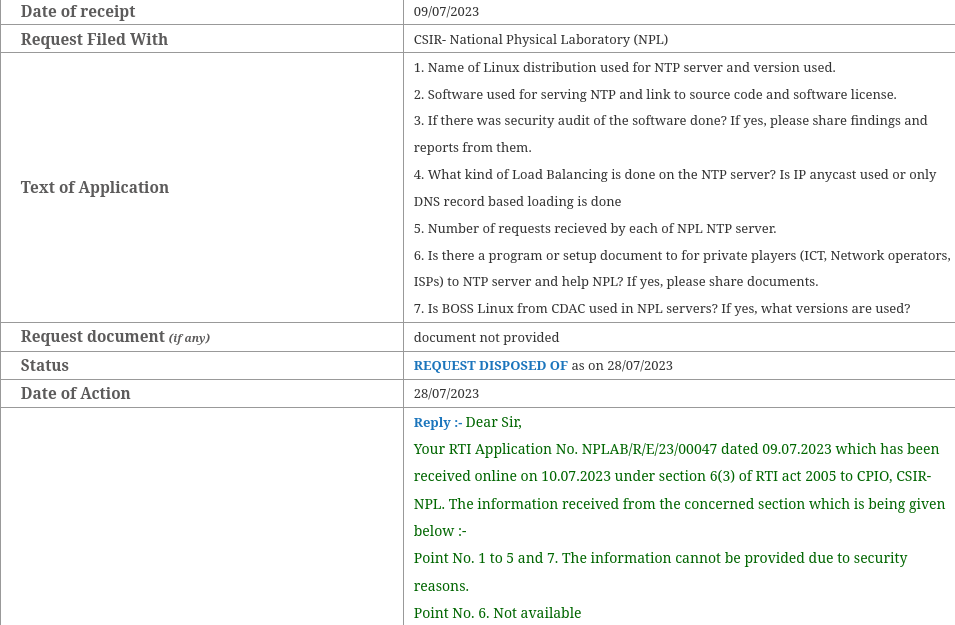
CSIR-National Physical Laboratory (NPL) is the official timekeeper for India and hosts the only public Stratum 1 clock in India, according to NTP pool website. So I was naturally curious to know what kind of infrastructure they re running for NTP. India has a Right to Information (RTI) Act which, like the Freedom of Information Act (FOIA) in the United States, gives citizens rights to request information from governmental entities, to which they have to respond in under 30 days. So last year, I filed two sets of RTI (one after the first reply came) inquiring about NPL s public NTP server setup. The first RTI had some generic questions: RTI 1
First RTI. Click to enlarge
This gave a vague idea about the setup, so I sat down and came with some specific questions in the next RTI. RTI 2
Second RTI. Click to enlarge
Feel free to make your conclusions from it now. Bear in mind these were filled last year so things might have changed. Do let me know if you have more information about it. Update (07/07/2024): Found an article from Medianama about Indian government time servers with information sourced through RTI.

Samuel Henrique: Announcing wcurl: a curl wrapper to download files

tl;dr Whenever you need to download files through the terminal and don't feel like using wget:
wcurl example.com/filename.txt
Manpage:
https://manpages.debian.org/unstable/curl/wcurl.1.en.html

Availability (comes installed with the curl package):
  • Debian unstable - Since 2024-07-02
  • Debian testing - Since 2024-07-18
  • Debian 12/bookworm backports - Expected by the end of August 2024.
  • Debian 12/bookworm - Depends on whether Debian's release team will approve it, it could be available in the next point release.
  • Debian derivatives - Rolling releases will get it by the time it's on Debian testing (e.g.: Kali Linux). Stable derivatives only in their next major release.
If you don't want to wait for the package update to arrive, you can always copy the script and place it in your /usr/bin, the code is here:
https://github.com/Debian/wcurl/blob/main/wcurl
https://salsa.debian.org/debian/wcurl/-/blob/main/wcurl?ref_type=heads

Smoother CLI experience Starting with curl version 8.8.0-2, the Debian's curl package now ships a wcurl executable. wcurl is the solution for those who just need to download files without having to remember curl's parameters for things like automatically naming the files. Some people, myself included, would fall back to using wget whenever there was a need to download a file. Sometimes even installing wget just for that usecase. After all, it's easier to remember "apt install wget" rather than "curl -L -O -C - ...". wcurl consists of a simple shell script that provides sane defaults for the curl invocation, for when the use case is to just download files. By default, wcurl will:
  • Encode whitespaces in URLs;
  • Download multiple URLs in parallel if the installed curl's version is >= 7.66.0;
  • Follow redirects;
  • Automatically choose a filename as output;
  • Avoid overwriting files if the installed curl's version is >= 7.83.0 (--no-clobber);
  • Perform retries;
  • Set the downloaded file timestamp to the value provided by the server, if available;
  • Default to the protocol used as https if the URL doesn't contain any;
  • Disable curl's URL globbing parser so and [] characters in URLs are not treated specially.
Example to download a single file:
wcurl example.com/filename.txt
If you ever need to set a custom flag, you can make use of the --curl-options wcurl option, anything set there will be passed to the curl invocation. Just beware that if you need to set any custom flags, it's likely you will be better served by calling curl directly. The --curl-options option is there to allow for some flexibility in unforeseen circumstances.

The need for wcurl I've always felt a bit ashamed of not remembering curl's parameters for downloading a file and automatically naming it, having resorted to wget most of the times this was needed (even installing wget when it wasn't there, just for this). I've spoken to a few other experienced people I know and confirmed what could be obvious to others: a lot of people struggle with this. Recently, the curl project released the results of 2024's curl survey, which also showed this is as a much needed feature, just look at some of the answers:

Q: Which curl command line option do you think needs improvement and how?
-O, I really want wget like functionality where I don't have to specify the name
Downloading a file (like wget) could be improved - with automatic naming of the file
downloading files - wget is much cleaner
I wish the default behaviour when GETting a binary was to drop it on disk. That's the only reason 'wget foo.tgz" is still ingrained in my muscle memory .
Maybe have a way to download without specifying something in -o (the only reason i used wget still)
--remote-time should be default
--remote-name-all could really use a short flag

Q: If you miss support for something, tell us what!
"Write the data to the file named in the URL (or in redirects if I'm feeling daring), and timestamp the file to the last-modified-date". This is the main reason I'm still using wget.
I can finally feel less bad about falling back to wget due to not remembering the parameters I want.

Idealization vs. reality I don't believe curl will ever change its default behavior in such a way that would accommodate this need, as that would have a side-effect of breaking things which expect the current behavior (the blast radius is literally the solar system). This means a new executable needs to be shipped side-by-side with curl, an opportunity to start fresh and work with a more focused use case (to download files). Ideally, this new executable would be maintained by the curl project, make use of libcurl under-the-hood, and be available everywhere. Nobody wants to worry if their systems have the tool or not, it should always be there. Given I'm just a Debian Developer, with not as much free time as I wish, I've decided to write a simple shell script wrapper calling the curl CLI under-the-hood. wcurl will come installed with the curl package from now on, and I will check with the release team about shipping it on the current Debian stable as well. Shipping wcurl in other distros will be up to them (Debian-derivatives should pick it up automatically, though). We've tried to make it easy for anyone to ship this by using the curl license, keeping the script POSIX-compliant, and shipping a manpage. Maybe if there's enough interest across distributions, someone might sign up for implementing this in upstream curl and increase its reach. I would be happy with the curl project reusing the wcurl name when that happens. It's unlikely that wcurl would be shipped by curl upstream as it is, assuming they would prefer a solution that uses libcurl direclty (more similar to curl the CLI, to maintain). In the worst case, wcurl becomes a Debian-specific tool that only a few people are aware of, in the best case, it becomes the new go-to CLI tool for simply downloading files. I would be happy if at least someone other than me finds it useful.

Naming is hard When I started working on it, I was calling the new executable "curld" (stands for "curl download"), but then when discussing this in one of our weekly calls in the Debian Bras lia community, it was mentioned that this could be confused for a daemon. We then settled for the name "wcurl", suggested by Carlos Henrique Lima Melara <charles>. It doesn't really stand for anything, but it's very easy to remember. You know... "it's that wget alternative for when you want to use curl instead" :)

Feedback I'm hosting the code on Github and Debian's GitLab instance, feel free to open an issue to provide feedback.
https://salsa.debian.org/debian/wcurl
https://github.com/Debian/wcurl We also have a Matrix room for the Debian curl maintainers:
https://matrix.to/#/#debian-curl-maintainers:matrix.org

Acknowledgments The idea for wcurl came a few days before the curl-up conference 2024. I've been thinking a lot about developer productivity in the terminal lately, different tools and better defaults. Before curl-up, I was also thinking about packaging improvements for the curl package. I don't remember what exactly happened, but I likely had to download something and felt a bit ashamed of maintaining curl and not remembering the parameters to download files the way I wanted. I first discussed this idea in the conference, where I asked the participants about it and there were no concerns raised, and some people said I should give it a go. Participating in curl-up was a really great experience and I'm thankful for the interactions I've had there. On the Debian side, I've got reviews of the code and manpage by Sergio Durigan Junior <sergiodj>, Guilherme Puida Moreira <puida> and Carlos Henrique Lima Melara <charles>. Sergio ended up rewriting the tool to be POSIX-compliant (my version was written in bash), so he takes all the credit for the portability.

Changes since publication

2024-07-18
  • Update date of availability for Debian testing and expected date for bookworm backports.
  • Mention charles as the person who suggested "wcurl" as a name.
  • Update wcurl's -o/--opts options, it's now just --curl-options.
  • Remove mention of language spoken in the Matrix room, we are using English now.
  • Update list of features of wcurl.

1 July 2024

Russ Allbery: Review: Snuff

Review: Snuff, by Terry Pratchett
Series: Discworld #39
Publisher: Harper
Copyright: October 2011
Printing: January 2013
ISBN: 0-06-221886-7
Format: Mass market
Pages: 470
Snuff is the 39th Discworld novel and the 8th (and last) Watch novel. This is not a good place to start reading. Sam Vines has been talked, cajoled, and coerced into taking a vacation. Since he is now the Duke of Ankh, he has a country estate that he's never visited. Lady Sybil is insistent on remedying this, as is Vetinari. Both of them may have ulterior motives. They may also be colluding. It does not take long for Vimes to realize that something is amiss in the countryside. It's not that the servants are uncomfortable with him talking to them, the senior servants are annoyed that he talks to the wrong servants, and the maids turn to face the wall at the sight of him. Those are just the strange customs of the aristocracy, for which he has little understanding and even less patience. There's something else going on. The nobility is wary, the town blacksmith is angry about something more than disliking the nobles, and the bartender doesn't want to get involved. Vimes smells something suspicious. When he's framed for a murder, the suspicions seem justified. It takes some time before the reader learns what the local nobility are squirming about, so I won't spoil it. What I will say is that Snuff is Pratchett hammering away at one of his favorite targets: prejudice, cruelty, and treating people like things. Vimes, with his uncompromising morality, is one of the first to realize the depth of the problem. It takes most of the rest longer to come around, even Sybil. It's both painful, and painfully accurate, to contemplate how often recognition of other people's worth only comes once they do something that you recognize as valuable. This is one of the better-plotted Discworld novels. Vimes starts out with nothing but suspicions and stubbornness, and manages to turn Snuff into a mystery novel through dogged persistence. The story is one continuous plot arc with the normal Pratchett color (Young Sam's obsession with types of poo, for example) but without extended digressions. It also has considerably better villains than most Pratchett novels: layers of foot soldiers and plotters, each of which have to be dealt with in a suitable way. Even the concluding action sequences worked for me, which is not always a given in Discworld. The problem, unfortunately, is that the writing is getting a bit wobbly. Pratchett died of early-onset Alzheimer's in 2015, four years after this book was first published, and this is the first novel where I can see some early effects. It mostly shows up in the dialogue: it's just a bit flabby and a bit repetitive, and the characters, particularly towards the end of the book, start repeating the name of the person they're talking to every other line. Once I saw it, I couldn't unsee it, and it was annoying enough to rob a bit of enjoyment from the end of the book. That aside, though, this was a solid Discworld novel. Vimes testing his moral certainty against the world and forcing it into a more ethical shape is always rewarding, and here he takes more risks, with better justification, than in most of the Watch novels. We also find out that Vimes has a legacy from the events of Thud!, which has interesting implications that I wish Pratchett had more time to explore. I think the best part of this book is how it models the process of social change through archetypes: the campaigner who knew the right choice early on, the person who formed their opinion the first time they saw injustice, the person who gets there through a more explicit moral code, the ones who have to be pushed by someone who was a bit faster, the ones who have to be convinced but then work to convince others, and of course the person who is willing to take on the unfair and far-too-heavy burden of being exceptional enough that they can be used as a tool to force other people to acknowledge them as a person. And, since this is Discworld, Vetinari is lurking in the scenery pulling strings, balancing threats, navigating politics, and giving Vimes just enough leeway to try to change the world without abusing his power. I love that the amount of leeway Vimes gets depends on how egregious the offense is, and Vetinari calibrates this quite carefully without ever saying so openly. Recommended, and as much as I don't want to see this series end, this is not a bad entry for the Watch novels to end on. Followed in publication order by Raising Steam. Rating: 8 out of 10

29 June 2024

Russ Allbery: Review: Bitter Angels

Review: Bitter Angels, by C.L. Anderson
Publisher: Ballantine Books
Copyright: 2009
ISBN: 0-553-59217-3
Format: Mass market
Pages: 438
Bitter Angels is a stand-alone science fiction novel. It won the Philip K. Dick award for best SF original paperback in 2010. C.L. Anderson is a pen name for Sarah Zettel. Terese was a Guardian, one of the agents of the Pax Solaris who find ways to keep the peace in troubled systems and high-stress situations with the help of an implanted Companion, an assistant AI. Forty years ago, on one of those missions, she was captured and her Companion was forcibly removed. She was rescued by her friend and mentor and retired afterwards, starting a new life and a new family, trying to leave the memories behind. Now, the woman who rescued her is dead. She was murdered on duty in the Erasmus system, a corporate hellhole that appears to be on the verge of exploding into a political hot spot. Bianca's last instructions asked for Terese to replace her. Terese's family is furious at her for even considering returning to the Guardians, but she can't say no. Duty, and Bianca's dying request, call too strongly. Amerand is Security on Dazzle, one of the Erasmus stations. He is one of the refugees from Oblivion, the station that the First Bloods who rule the system let die. He keeps his head above water and tries to protect his father and find his mother without doing anything that the ever-present Clerks might find concerning. Keeping an eye on newly-arriving Solaris saints is a typical assignment, since the First Bloods don't trust the meddling do-gooders. But something is not quite right, and a cryptic warning from his Clerk makes him even more suspicious. This is the second book by Sarah Zettel that I've read, and both of them have been tense, claustrophobic thrillers set in a world with harsh social inequality and little space for the characters to maneuver. In this case, the structure of her future universe reminded me a bit of Iain M. Banks's Culture, but with less advanced technology and only humans. The Pax Solaris has eliminated war within its borders and greatly extended lifespans. That peace is maintained by Guardians, who play a role similar to Special Circumstances but a bit more idealist and less lethal. They show up where there are problems and meddle, manipulating and pushing to try to defuse the problems before they reach the Pax Solaris. Like a Culture novel, nearly all of the action takes place outside the Pax Solaris in the Erasmus system. Erasmus is a corporate colony that has turned into a cross between a hereditary dictatorship and the Corporate Rim from Martha Wells's Murderbot series. Debt slavery is ubiquitous, economic inequality is inconceivably vast, and the Clerks are everywhere. Erasmus natives like Amerand have very little leeway and even fewer options. Survival is a matter of not drawing the attention of the wrong people. Terese and her fellow Guardians are appalled, but also keenly aware that destabilizing the local politics may make the situation even worse and get a lot of people killed. Bitter Angels is structured like a mystery: who killed Bianca, and what was her plan when she was killed? Unlike a lot of books of this type, the villains are not idiots and their plan is both satisfyingly complex and still depressingly relevant. I don't think I'm giving anything away by saying that I have read recent news articles about people with very similar plans, albeit involving less science-fiction technology. Anderson starts with a tense situation and increases the pressure relentlessly, leaving the heroes one step behind the villains for almost the entire novel. It is not happy or optimistic reading at times, the book is quite dark but it certainly was engrossing. The one world-building quibble that I had is that the Erasmus system is portrayed partly as a hydraulic empire, and while this is arguably feasible given that spaceship travel is strictly controlled, it seemed like a weird choice given the prevalence of water on the nearby moons. Water smuggling plays a significant role in the plot, and I wasn't entirely convinced of the politics and logistics behind it. If this sort of thing bugs you, there are some pieces that may require suspension of disbelief. Bitter Angels is the sort of tense thriller where catastrophe is barely avoided and the cost of victory is too high, so you will want to be in the mood for that before you dive in. But if that's what you're looking for, I thought Anderson delivered a complex and satisfying story. Content warning: major character suicide. Rating: 7 out of 10

27 June 2024

Russ Allbery: Review: Lyorn

Review: Lyorn, by Steven Brust
Series: Vlad Taltos #17
Publisher: Tor
Copyright: 2024
ISBN: 1-4668-8971-3
Format: Kindle
Pages: 274
Lyorn is the 17th Vlad Taltos book and a direct sequel to 2014's Hawk. (Yes, actual main story progress!) You do not want to start reading here; you would be hopelessly confused. When this series is complete, I want to re-read the entire thing from the beginning and pick up more of the bits I missed the first time. Vlad is not, in fact, free to see his friends and get entangled in imperial politics again as I thought after Hawk. Despite the successes of that story, there is one remaining small problem: incredibly powerful magic users still want to kill him. His immediate solution is to shelter in a theater, since Draegaran theaters are well-known for their excellent magical shielding. This works well enough at first, but the theater is rehearsing a play about Draegaran politics that is highly offensive to the Lyorn and the theater may be shut down because of it. Vlad's enemies are also willing to lean on his friends to find him and kill him. This series continues to be thoroughly enjoyable. Lyorn is "just" more of Vlad being Vlad, meddling in everyone's business and coming up with elaborate plans with too many moving parts that he somehow manages to pull off, but I'll happily read lots of books like that. Vlad is both anxious and grumpy, both of which give the plot some needed tension without being overwhelming. There are no truly major world-building revelations here (or, if there are, I missed them), but there's a lot of processing of what the reader learned in Tsalmoth. It's increasingly looking like the payoff from those revelations is going to be the series finale. This is the first Vlad book that contains solid confirmation of where the series as a whole is headed. Brust mentioned some time ago that the last book is titled The Last Contract, and Lyorn comes close to stating explicitly what that contract will be. I am sure that it will be more complicated than it appears now and there are misdirections yet to come, but I am excited to see where Brust takes this idea. Vlad has been insistently apolitical for much of the series, meddling in politics only when he has to or to help his friends and otherwise treating it as a system that he has to navigate and survive. That was the root of the conflict in Teckla, all the way back at the start of the series. This may be starting to change, and when Brust ties it together with the Jenoine, the Great Weapon Godslayer, and the rest of the world-building he's cued up, the results are going to be explosive. Two books left: Chreotha and The Last Contract. I can hardly wait. In every Vlad book, Brust plays some sort of structural game. This time, befitting the setting, it's a musical. The action is interspersed with quotes from a fictional history about the play the theater is putting on, a work called Song of the Presses about political censorship during the reign of a Lyorn emperor in the 14th cycle, thousands of years before the time of this book. This was, at times, nearly as interesting as the main plot. The chapters are also numbered like the acts and scenes of a play, although this I didn't notice as much since books often have that structure anyway. Since this is a musical, there are also songs. Specifically, each chapter is introduced by a parody of songs from various musicals in our world, rewritten so that they fit within Brust's fictional musical. Brust is also a musician and a filker, so these songs are actually good, or at least they amused me a great deal. I'm not much of a musical fan and I still could hear the tune playing when I read most of them. Lyorn is not so good that I would rave about it. It's one of those functional connective books of a series that advances the plot, tells a good story, and has some fun along the way. The guns on the mantelpiece of this world have not gone off yet, and Vlad is still maneuvering into position. But it's looking like we're going to get the conclusion, and it's going to be spectacular. If you have read this far, you will want to keep reading. Followed by Chreotha, which may be a bit of a wait because apparently Brust is going to write The Last Contract first to make sure he ties up loose ends properly. Rating: 7 out of 10

22 June 2024

Russ Allbery: Review: And the Stars Will Sing

Review: And the Stars Will Sing, by Michelle Browne
Series: The Meaning Wars #1
Publisher: Michelle Browne
Copyright: 2012, 2021
Printing: 2021
ASIN: B0075G7GEA
Format: Kindle
Pages: 85
And the Stars Will Sing is a self-published science fiction novella, the first of a (currently) five book series. I believe it may be Browne's first publication, although I don't have a good data source to confirm. Crystal Weiss is a new graduate from Mars, about to leave the solar system to her first job assignment: installation of a permanent wormhole in the vicinity of Messier 14. Her expertise is the placement calculations. The heavy mathematical lifting is of course done by computers, but humans have to do the mapping and some of the guidance. And the Stars Will Sing is an epistolary novel, told in the form of her letters to her friend Sarah. I feel bad when I stumble across a book like this. I want to stick with my habit of writing a review of each book I read, but it's one thing to pan a bad book by a famous author and another thing to pick on a self-published novella that I read due to some recommendation or mention whose details I've forgotten. Worse, I think this wasn't even the recommended book; I looked up the author, saw that the first of a series was on sale, and thought "oh, hey, I like epistolary novels and I'm in the mood for some queer space opera." This book didn't seem that queer (there is a secondary lesbian relationship but the main relationship seemed rather conventional), but I'll get to the romance in a moment. I was not the reader for this book. There's a reason why most of the books I read are from traditional publishers; I'm too critical of a reader for a lot of early self-published work. It's not that I dislike self-publishing as a concept many self-published books are excellent and the large publishers have numerous problems but publishers enforce a quality bar. Inconsistently, unfairly, and by rejecting a lot of good work, but still, they do. I'm fairly sure traditional publishers would have passed on this book; the quality of the writing isn't there yet. (It's certainly a better book than I could have written! But that's why I'm writing my reviews over in my quiet corner of the Internet and not selling fiction to other people.) The early chapters aren't too bad, although they have a choppy, cliched style that more writing experience usually smoothes out. The later chapters have more dialogue, enough that I started wondering how Crystal could remember that much dialogue verbatim to put into a letter, and it's not good. All of the characters talk roughly the same (even the aliens), the dialogue felt even more cliched than the rest of the writing, and I started getting distracted by the speech tags. Crystal comes across as very young, impulsive, and a drama magnet who likes being all up in her coworkers' business. None of these are objective flaws in the book, but I could tell early on that I was going to find her annoying. She has a heavily-foreshadowed enemies-to-lovers thing with one of her male coworkers. Her constant complaining about him at the start of the story was bad enough, but the real problem is that in the very few places where he has more personality than plastic lawn furniture, he's being obnoxious to Crystal. I'm used to being puzzled by a protagonist's choice in love interests, but this one felt less like an odd personality choice and more a lack of writing skill. Even if the relationship is being set up for failure (not true by the end of this book), you've got to help me understand what the protagonist saw in him or was getting out of the relationship. The plot was so predictable that it ironically surprised me. I was sure that some sort of twist or complication was coming, but no. I will give Browne some credit for writing a slightly more realistic character reaction to violence than most SF authors, but there was nothing in the plot to hold my interest. The world-building was generic science fiction with aliens. It had a few glimmers of promise, but there was some sort of psychic hand-waving involved in siting wormholes that didn't work for me and the plot climax made no sense to me whatsoever. This is the kind of bad book that I don't want to hold against the writer. Twelve years later and with numerous other novels and novellas under her belt, her writing is probably much better. I do think this book would have benefited from an editor telling her it wasn't good enough for publication yet, but that's not how the Kindle self-publishing world works. Mostly, this is my fault: I half-followed a recommendation into an area of publishing that I know from past experience I should avoid without a solid review from an equally critical reader. Followed by The Stolen, a two-story collection. Rating: 3 out of 10

19 June 2024

Dirk Eddelbuettel: nanotime 0.3.8 on CRAN: More Maintenance

Leonardo and I are happy to annunce that a new version 0.3.8 of our nanotime package arrived on CRAN today. It is the first release in over 1 1/2 years. nanotime relies on the RcppCCTZ package (as well as the RcppDate package for additional C++ operations) and offers efficient high(er) resolution time parsing and formatting up to nanosecond resolution, using the bit64 package for the actual integer64 arithmetic. Initially implemented using the S3 system, it has benefitted greatly from a rigorous refactoring by Leonardo who not only rejigged nanotime internals in S4 but also added new S4 types for periods, intervals and durations. This release responds to a number of enhancements including a new paramter accurate for POSIXct to nanotime conversions, a vector date converter, a switch to double return value when durations objects are dividded as well as a small battery of CRAN requests for changes and updates. This started with a move away from the now non-API function SET_S4_OBJECT which has been replaced by use of Rf_asS4. We also no longer need a custom compiler flag on Windows (where for some reasons nobody understands or remembers, bitfields are not packed) to small enhancements of manual page formatting and last-but-not-least avoidance of some new UBSAN warnings. The NEWS snippet has the full details.

Changes in version 0.3.8 (2024-06-19)
  • Time format documentation now has a reference to RcppCCTZ
  • The package no longer sets a default C++ compilation standard of C++11 (Dirk initially in #114, and later switched to C++17)
  • New accurate parameter for conversion from POSIXct to nanotime (Davor Josipovic and Leonardo in #116 closing #115)
  • The as.Date() function is now vectorized and can take a TZ argument (Leonardo and Dirk in #119 closing #118)
  • Use of internal function SET_S4_OBJECT has been replaced by API function Rf_asS4 (Leonardo in #121 closing #120)
  • An nanoduration / nanoduration expression now returns a double (Leonardo in #122 closing #117)
  • Bitfield calculations no longer require an Windows-only compiler switch (Leonardo in #124)
  • A simple manual page format nag involving has been addressed (Dirk in #126 fixing #125)
  • An set of tests tickling an UBSAN issue via Rcpp code no longer run unless CI is set (Dirk in #127 fixing #123)

Thanks to my CRANberries, there is a diffstat report for this release. More details and examples are at the nanotime page; code, issue tickets etc at the GitHub repository and all documentation is provided at the nanotime documentation site. If you like this or other open-source work I do, you can sponsor me at GitHub.

This post by Dirk Eddelbuettel originated on his Thinking inside the box blog. Please report excessive re-aggregation in third-party for-profit settings.

14 June 2024

Paul Tagliamonte: Reverse Engineering a Restaurant Pager system

It s been a while since I played with something new been stuck in a bit of a rut with radios recently - working on refining and debugging stuff I mostly understand for the time being. The other day, I was out getting some food and I idly wondered how the restaurant pager system worked. Idle curiosity gave way to the realization that I, in fact, likely had the means and ability to answer this question, so I bought the first set of the most popular looking restaurant pagers I could find on eBay, figuring it d be a fun multi-week adventure.

Order up! I wound up buying a Retekess brand TD-158 Restaurant Pager System (they looked like ones I d seen before and seemed to be low-cost and popular), and quickly after, had a pack of 10 pagers and a base station in-hand. The manual stated that the radios operated at 433 MHz (cool! can do! Love a good ISM band device), and after taking an inital read through the manual for tips on the PHY, I picked out a few interesting things. First is that the base station ID was limited to 0-999, which is weird because it means the limiting factor is likely the base-10 display on the base station, not the protocol we need enough bits to store 999 at least 10 bits. Nothing else seemed to catch my eye, so I figured may as well jump right to it. Not being the type to mess with success, I did exactly the same thing as I did in my christmas tree post, and took a capture at 433.92MHz since it was in the middle of the band, and immediately got deja-vu. Not only was the signal at 433.92MHz, but throwing the packet into inspectrum gave me the identical plot of the OOK encoding scheme. Not just similar identical. The only major difference was the baud rate and bit structure of the packets, and the only minor difference was the existence of what I think is a wakeup preamble packet (of all zeros), rather than a preamble symbol that lasted longer than usual PHY symbol (which makes this pager system a bit easier to work with than my tree, IMHO). Getting down to work, I took some measurements to determine what the symbol duration was over the course of a few packets, I was able to determine the symbol rate was somewhere around 858 microseconds (0.000858 seconds per symbol), which is a weird number, but maybe I m slightly off or there s some larger math I m missing that makes this number satisfyingly round (internal low cost crystal clock or something? I assume this is some hardware constrait with the pager?) Anyway, good enough. Moving along, let s try our hand at a demod let s just assume it s all the same as the chrismas tree post and demod ones and zeros the same way here. That gives us 26 bits:
00001101110000001010001000
Now, I know we need at least 10 bits for the base station ID, some number of bits for the pager ID, and some bits for the command. This was a capture of me hitting call from a base station ID of 55 to a pager with the ID of 10, so let s blindly look for 10 bit chunks with the numbers we re looking for:
0000110111 0000001010 001000
Jeez. First try. 10 bits for the base station ID (55 in binary is 0000110111), 10 bits for the pager ID (10 in binary is 0000001010), which leaves us with 6 bits for a command (and maybe something else too?) which is 8 here. Great, cool, let s work off that being the case and revisit it if we hit bugs. Besides our data packet, there s also a preamble packet that I ll add in, in case it s used for signal detection or wakeup or something which is fairly easy to do since it s the same packet structure as the above, just all zeros. Very kind of them to leave it with the same number of bits and encoding scheme it s nice that it can live outside the PHY. Once I got here, I wrote a quick and dirty modulator, and was able to ring up pagers! Unmitigated success and good news only downside was that it took me a single night, and not the multi-week adventure I was looking for. Well, let s finish the job and document what we ve found for the sake of completeness.

Boxing everything up My best guess on the packet structure is as follows:
base id
argument
command
For a call or F2 operation, the argument is the Pager s ID code, but for other commands it s a value or an enum, depending. Here s a table of my by-hand demodulation of all the packet types the base station produces:
Type Cmd Id Description
Call8Call the pager identified by the id in argument
Off60Request any pagers on the charger power off when power is removed, argument is all zero
F240Program a pager to the specified Pager ID (in argument) and base station
F344Set the reminder duration in seconds specified in argument
F448Set the pager's beep mode to the one in argument (0 is disabled, 1 is slow, 2 is medium, 3 is fast)
F552Set the pager's vibration mode to the one in argument (0 is disabled, 1 is enabled)

Kitchen s closed for the night I m not going to be publishing this code since I can t think of a good use anyone would have for this besides folks using a low cost SDR and annoying local resturants; but there s enough here for folks who find this interesting to try modulating this protocol on their own hardware if they want to buy their own pack of pagers and give it a shot, which I do encourage! It s fun! Radios are great, and this is a good protocol to hack with it s really nice. All in all, this wasn t the multi-week adventure I was looking for, this was still a great exercise and a fun reminder that I ve come a far way from when I ve started. It felt a lot like cheating since I was able to infer a lot about the PHY because I d seen it before, but it was still a great time. I may grab a few more restaurant pagers and see if I can find one with a more exotic PHY to emulate next. I mean why not, I ve already got the thermal printer libraries working

8 June 2024

Thorsten Alteholz: My Debian Activities in May 2024

FTP master This month I accepted 347 and rejected 49 packages. The overall number of packages that got accepted was 348.

Debian LTS This was my hundred-nineteenth month that I did some work for the Debian LTS initiative, started by Raphael Hertzog at Freexian. During my allocated time I uploaded or worked on: I also continued to work on tiff and last but not least did a week of FD and attended the monthly LTS/ELTS meeting. Unfortunately I used lots of time to debug an issue with nghttp2. Please see my odyssey below. Debian ELTS This month was the seventieth ELTS month. During my allocated time I uploaded: For some tests I installed the new nghttp2 package on my Stretch VM and started the daemon. Unfortunately I got an unexpected error from getaddrinfo() about ai_socktype not supported. The daemon was configured to listen on lo, the device was available, but the error remained. I was pretty sure that my patch was not the reason for this and indeed the unpatched version showed this error as well. I didn t want to release an untested package, so nghttp2 had to start at least! Therefore I built a minimal example to reproduce the issue. getaddrinfo() failed for hints.ai_socktype=SOCK_STREAM and a numerical IP address. Having no hints at all or localhost instead of 127.0.0.1 made the error disappear (as a remark: localhost resolves to 127.0.0.1, the ipv6 variant is ip6-localhost ). I could see that in nghttp2 as well. Configuring it with localhost let the error vanish but the daemon still exited due to other reasons. After some time of debugging, I added another network interface to my VM and configured it with a dummy IPv4 address. Voila, everything worked as expected. According to Wikipedia, IPv6 was ratified as standard in 2017 and Stretch was also released in 2017. No wonder that a IPv6-only-VM had problems back then and these problems survived to the present. I also continued to work on an update for tiff in Jessie and Stretch, did a week of FD and attended the LTS/ELTS meeting. Debian Printing This month I uploaded new upstream or bugfix versions of: This work is generously funded by Freexian! Debian Astro This month I uploaded a new upstream or bugfix version of: Debian IoT This month I uploaded new upstream or bugfix versions of: Debian Mobcom Due to more and more problems with time_t, I removed osmo-iuh and all dependencies from armel, armhf and i386, sorry. If there is really anybody using this software on 32-bit architectures don t hesitate to get in touch. It is official now, the GSoC student working on the Mobcom packages is Nathan Doris. He already finished the hardest part of the job and I could upload the latest version of libosmocore. I really enjoy working with him and look forward to a pleasant SoC :-). misc This month I uploaded new upstream or bugfix versions of: Did I already mention that I love lists with topics I can work on. I print out such lists and enjoy checking off one after the other. End of May Helmut told me that I am a bit lazy and gave me such a list with all my packages that have one or the other issue with /usr-move. Most of the uploads above are packages on that list and I could check off a lot :-).

7 June 2024

Freexian Collaborators: Debian Contributions: DebConf Bursaries, /usr-move, sbuild, and more! (by Stefano Rivera)

Contributing to Debian is part of Freexian s mission. This article covers the latest achievements of Freexian and their collaborators. All of this is made possible by organizations subscribing to our Long Term Support contracts and consulting services.

DebConf Bursary updates, by Utkarsh Gupta Utkarsh is the bursaries team lead for DebConf 24. Bursary requests are dispatched to a team of volunteers to review. The results are collated, adjusted and merged to produce priority lists of requests to fund. Utkarsh raised the team, coordinated the review, and issued bursaries to attendees.

/usr-move, by Helmut Grohne More and more, the /usr-move transition is being carried out by multiple contributors and many performed around a hundred of the requested uploads. Of these, Helmut contributed five patches and two uploads. As a result, there are less than 350 packages left to be converted, and all of the non-trivial cases have patches. We started with three times that number. Thanks to everyone involved for supporting this effort. For people interested in background information of this transition, Helmut gave a presentation at MiniDebConf Berlin 2024 (slides).

sbuild, by Helmut Grohne While unshare mode of sbuild has existed for quite a while, it is now getting significant use in Debian, and new problems are popping up. Helmut looked into an apparmor-related failure and provided a diagnosis. While relevant code would detect the chroot nature of a schroot backend and skip apparmor tests, the unshare environment would be just good enough to run and fail the test. As sbuild exposes fewer special kernel filesystems, the tests will be skipped again. Another problem popped up when gobject-introspection added a dependency on the host architecture Python interpreter in a cross build environment. sbuild would prefer installing (and failing) a host architecture Python to installing the qemu alternative. Attempts to fix this would result in systemd killing sbuild. ischroot as used by libc6.postinst would not classify the unshare environment as a chroot. Therefore libc6.postinst would run telinit which would kill the build process. This is a complex interaction problem that shall eventually be solved by providing triggers from libc6 to be implemented by affected init systems.

Salsa CI updates, by Santiago Ruano Rinc n Several issues arose about Salsa CI last month, and it is probably worth mentioning part of the challenges of defining its framework in YAML. With the upcoming end-of-support of Debian 10 buster as LTS, armel was removed from deb.debian.org, making the jobs that build images for buster/armel to fail. While the removal of buster/armel from the repositories is a natural change, it put some light on the flaws in the Salsa CI design regarding the support of the different Debian releases. Currently, the images are defined like these (from .images-debian.yml):
.all-supported-releases: &all-supported-releases
  - stretch
  - stretch-backports
  - buster
  - bullseye
  - bullseye-backports
  - bookworm
  - bookworm-backports
  - trixie
  - sid
  - experimental
And from them, different images are built according to the different jobs and how they are supported, for example:
images-prod-arm:
  stage: build
  extends: .build_template
  tags:
    - $SALSA_CI_ARM_RUNNER_TAG
  parallel:
    matrix:
      # Base image, all releases, all arches
      - IMAGE_NAME: base
        ARCH:
          - arm32v5
          - arm32v7
          - arm64v8
        RELEASE: *all-supported-releases
The removal of buster/armel could be easily reflected as:
images-prod-arm:
  stage: build
  extends: .build_template
  tags:
    - $SALSA_CI_ARM_RUNNER_TAG
  parallel:
    matrix:
      # Base image, fully supported releases, all arches
      - IMAGE_NAME: base
        ARCH:
          - arm32v5
          - arm32v7
          - arm64v8
        RELEASE:
          - stretch
          - buster
          - bullseye
          - bullseye-backports
          - bookworm
          - bookworm-backports
          - trixie
          - sid
          - experimental
      # buster only supports armhf and arm64
      - IMAGE_NAME: base
        ARCH:
          - arm32v7
          - arm64v8
        RELEASE: buster
Evidently, this increases duplication of the release support data, which is of course not optimal and it is error prone when changing the data about supported releases. A better approach would be to have two different YAML lists, such as:
# releases that have partial support. E.g.: buster is transitioning to
# Debian LTS, and buster armel is no longer found in deb.debian.org
.old-releases: &old-releases
  - stretch
  - buster

.currently-supported-releases: &currently-supported-releases
  - bullseye
  - bullseye-backports
  - bookworm
  - bookworm-backports
  - trixie
  - sid
  - experimental
and then a unified list:
.all-supported-releases: &all-supported-releases
  - *old-releases
  - *currently-supported-releases
that could be used in the matrix of the jobs that build all the images available in the pipeline container registry. However, due to limitations in GitLab, it is not possible to expand the variables or mapping values in a parallel:matrix context. At least not in an elegant fashion. This is the kind of issue that recently arose and that Santiago is currently working to solve, in the simplest possible way. Astute readers would notice that stretch is listed in the fully supported releases. And there is no problem with stretch, because it is built from archive.debian.org. Otto actually has tried to fix the broken image build job doing the same, but it is still incorrect, because the security repository is not (yet) available in archive.debian.org. Additionally, Santiago has also worked on other merge requests, such as:
  1. support branch/tags as target head in the test projects,
  2. build autopkgtest image on top of stable
  3. Add .yamllint and make it happy in the autopkgtest-lxc project
  4. enable FF_SCRIPT_SECTIONS to log multiline commands, among others.

Archiving DebConf Websites, by Stefano Rivera DebConf, the annual Debian conference, has its own new website every year. These are typically complex dynamic web applications (featuring registration, call for papers, scheduling, etc.) Once the conference is over, there is no need to keep maintaining these applications, so we archive the sites off as static HTML, and serve them from Debian s static CDN. Stefano archived the websites for the last two DebConfs. The schedule system behind DebConf 14 and 15 s websites was a derivative of Canonical s summit system. This was only used for a couple of years before migrating to wafer, the current system. Archiving summit content has been on the nice to have list for years, but nobody has ever tackled it. The machine that served the sites went away a couple of years ago. After much digging, a backup of the database was found, and Stefano got this code running on an ancient Python 2.7. Recently Stefano put this all together and hooked in an archive export to finally get this content preserved.

Python 3.x and pypy3 security bug triage, by Stefano Rivera Stefano Rivera triaged all the open security bugs against the Python 3.x and PyPy3 packages for Debian s stable and LTS releases. Several had been fixed but this wasn t recorded in the security tracker.

Linux livepatching support for Debian, by Santiago Ruano Rinc n In collaboration with Emmanuel Arias, Santiago filed ITP bug #1070494. As stated in the bug, more than an Intent to Package, it is an Intent to Design and Implement live patching support for the Linux kernel in Debian. For now, Emmanuel and Santiago have done exploratory work and they are working to understand the different possibilities to implement livepatching. One possible direction is to rely on kpatch, and the other is to package the modules using regular packaging tools. Also, it is needed to evaluate if it is possible to rely on distributing the modules via packages, or instead as a service, as it is done by some commercial distributions.

Miscellaneous contributions
  • Thorsten Alteholz uploaded cups-bjnp to improve packaging.
  • Colin Watson tracked down a baffling CI issue in openssh to unblock several merge requests, removed the user_readenv=1 option from its PAM configuration, and started on the first stage of his plan to split out GSS-API key exchange support to separate packages.
  • Colin did his usual routine work on the Python team, upgrading 26 packages to new upstream versions, and cherry-picking an upstream PR to fix a pytest 8 incompatibility in ipywidgets.
  • Colin NMUed a couple of packages to reduce the need for explicit overrides in Packages-arch-specific, and removed some other obsolete entries from there.
  • Emilio managed various library transitions, and helped finish a few of the remaining t64 transitions.
  • Helmut sent a patch for enabling piuparts to work as a regular user building on earlier work.
  • Helmut sent patches for 7 cross build failures, 6 other debian bugs and fixed an infrastructure problem in crossqa.debian.net.
  • Nicholas worked on a sponsored package upload, and discovered the blhc tool for diagnosing build hardening.
  • Stefano Rivera started and completed the re2 transition. The release team suggested moving to a virtual package scheme that includes the absl ABI (as re2 now depends on it). Adopted this.
  • Stefano continued to work on DebConf 24 planning.
  • Santiago continued to work on DebConf24 Content tasks as well as Debconf25 organisation.

1 June 2024

Russ Allbery: Review: I Shall Wear Midnight

Review: I Shall Wear Midnight, by Terry Pratchett
Series: Discworld #38
Publisher: Harper
Copyright: 2010
Printing: 2011
ISBN: 0-06-143306-3
Format: Trade paperback
Pages: 355
I Shall Wear Midnight is the 38th Discworld novel and the 4th Tiffany Aching novel. This is not a good place to start reading. Tiffany has finished her training and has returned to her home on the Chalk, taking up her duties as the local witch. There are a lot of those, because there's a lot that needs doing. In some cases, such as taking away the pain of the old Duke, they involve things that require magic and that only Tiffany can do. In many other cases, other people could pick up some of the work, but they lack Tiffany's sense of duty and willingness to pay attention. The people of the Chalk have always been a bit suspicious of witches, in part because the job was done for so long by Tiffany's grandmother and no one thought she was a witch. (She was a witch.) Of late, however, that suspicion seems to be getting worse. It comes to a head when Tiffany is accused of theft and worse by the old Duke's maid, a woman with very fixed ideas about the evils of witches. Tiffany has to sort out what's going on and clear herself, all while navigating her now-awkward relationship with the Duke's son Roland, his unimpressive fiancee, and his spectacularly annoying aunt. Ah, this is the stuff. This is exactly the Tiffany Aching novel that I have been hoping Pratchett would write. It's pure, snarky competence porn from start to finish.
"I'm a witch. It's what we do. When it's nobody else's business, it's my business."
One of the things that I adore about this series is how well Pratchett shows the different ways in which one can be a witch. Granny Weatherwax out-thinks everyone and nudges (or shoves) people in the right direction, but her natural tendency is to be icy and a bit frightening. Nanny Ogg is that person you can't help but talk to, who may seem happy-go-lucky and hedonistic but who can effortlessly change the mood of a room. And Tiffany is stubborn duty and blunt practicality, which fits the daughter of shepherds. In previous books, we've watched Tiffany as a student, learning the practicalities of being a witch. This is the book where she realizes how much she knows and how much easier the world is to navigate when she's in her own territory. There is a wonderful scene, late in this book, where Pratchett shows Nanny Ogg at her best, doing the kinds of things that only Nanny Ogg can do. Both Tiffany and the reader are in awe.
I should have learned this, she thought. I wanted to learn fire, and pain, but I should have learned people.
And it's true that Nanny Ogg can do things that Tiffany can't. But what makes this book so great is that it shows how Tiffany's personality and her training come together with her knowledge of the Chalk. She may not know people, in general, but she knows her neighbors and how they think. She doesn't manage them the way that Nanny Ogg would; she's better at solving different kinds of problems, in different ways. But they're the right ways, and the right problems, for her home. This is another Discworld novel with a forgettable villain that's more of a malevolent force of nature than a character in its own right. It's also another Discworld novel where Pratchett externalizes a human tendency into a malevolent force that can possess people. I have mixed feelings about this narrative approach. That externalization of evil into (in essence) demons has been repeatedly used to squirm out of responsibility and excuse atrocities, and it neatly avoids having to wrestle with the hard questions of prejudice and injustice and why apparently good people do awful things. I think some of those weaknesses persist even in Pratchett's hands, but I think what he was attempting with that approach in this book is to show how almost no one is immune to nastier ideas that spread through society. Rather than using the externalization of evil as an excuse, he's using it as a warning. With enough exposure to those ideas, they start sounding tempting and partly credible even to people who would never have embraced them earlier. Pratchett also does a good job capturing the way prejudice can start from thoughtless actions that have more to do with the specific circumstances of someone's life than any coherent strategy. Still, the one major complaint I have about this book is that the externalization of evil is an inaccurate portrayal of the world, and this catches up with Pratchett at the ending. Postulating an external malevolent force reduces evil to something that can be puzzled out and decisively defeated, thus resolving the problem. Sadly, this is not how humans actually work. I'll forgive that structural flaw, though, because the rest of this book is so good. It's rare that a plot twist in a Discworld novel surprises me twisty plots are not Pratchett's strength but this one did. I will not spoil the surprise, but one of the characters is not quite who they seem to be, and Tiffany's reactions once she figures that out are one of my favorite parts of this book. Pratchett is making a point about assumptions, observation, and the importance of being willing to change one's mind about someone when you know more, and I thought it was very well done. But, most of all, I enjoyed reading about Tiffany being calm, competent, determined, and capable. There's also a bit of an unexpected romance plot that's one of my favorite types: the person who notices that you're doing a lot of work and quietly steps in and starts helping while paying attention to what's needed and not taking over. And it's full of the sort of pithy moral wisdom that makes Discworld such a delight to read.
"There have been times, lately, when I dearly wished that I could change the past. Well, I can't, but I can change the present, so that when it becomes the past it will turn out to be a past worth having."
This was just what I wanted. Highly recommended. Followed by Snuff in publication order. The next (and last, sadly) Tiffany Aching book is The Shepherd's Crown. Rating: 9 out of 10

14 May 2024

Evgeni Golov: Using Packit to build RPMs for projects that depend on or vendor your code

I am a huge fan of Packit as it allows us to provide RPMs to our users and testers directly from a pull-request, thus massively tightening the feedback loop and involving people who otherwise might not be able to apply the changes (for whatever reason) and "quickly test" something out. It's also a great way to validate that a change actually builds in a production environment, where no unnecessary development and test dependencies are installed. You can also run tests of the built packages on Testing Farm and automate pushing releases into Fedora/CentOS Stream, but this is neither a (plain) Packit advertisement post, nor is that functionality that I can talk about with a certain level of experience. Adam recently asked why we don't have Packit builds for our our Puppet modules and my first answer was: "well, puppet-* doesn't produce a thing we ship directly, so nobody dared to do it". My second answer was that I had blogged how to test a Puppet module PR with Packit, but I totally agree that the process was a tad cumbersome and could be improved. Now some madman did it and we all get to hear his story! ;-) What is the problem anyway? The Foreman Installer is a bit of Ruby code1 that provides a CLI to puppet apply based on a set of Puppet modules. As the Puppet modules can also be used outside the installer and have their own lifecycle, they live in separate git repositories and their releases get uploaded to the Puppet Forge. Users however do not want to (and should not have to) install the modules themselves. So we have to ship the modules inside the foreman-installer package. Packaging 25 modules for two packaging systems (we support Enterprise Linux and Debian/Ubuntu) seems like a lot of work. Especially if you consider that the main foreman-installer package would need to be rebuilt after each module change as it contains generated files based on the modules which are too expensive to generate at runtime. So we can ship the modules inside the foreman-installer source release, thus vendoring those modules into the installer release. To do so we use librarian-puppet with a Puppetfile and either a Puppetfile.lock for stable releases or by letting librarian-puppet fetch latest for nightly snapshots. This works beautifully for changes that land in the development and release branches of our repositories - regardless if it's foreman-installer.git or any of the puppet-*.git ones. It also works nicely for pull-requests against foreman-installer.git. But because the puppet-* repositories do not map to packages, we assumed it wouldn't work well for pull-requests against those. How can we solve this? Well, the "obvious" solution is to build the foreman-installer package via Packit also for pull-requests against the puppet-* repositories. However, as usual, the devil is in the details. Packit by default clones the repository of the pull-request and tries to create a source tarball from that using git archive. As this might be too simple for many projects, one can define a custom create-archive action that runs after the pull-request has been cloned and produces the tarball instead. We already use that in the Packit configuration for foreman-installer to run the pkg:generate_source rake target which executes librarian-puppet for us. But now the pull-request is against one of the Puppet modules, so Packit will clone that, not the installer. We gotta clone foreman-installer on our own. And then point librarian-puppet at the pull-request. Fun. Cloning is relatively simple, call git clone -- sorry Packit/Copr infrastructure. But the Puppet module pull-request? One can use :git => 'https://git.example.com/repo.git' in the Puppetfile to fetch a git repository. In fact, that's what we already do for our nightly snapshots. It also supports :ref => 'some_branch_or_tag_name', if the remote HEAD is not what you want. My brain first went "I know this! GitHub has this magic refs/pull/1/head and refs/pull/1/merge refs you can checkout to get the contents of the pull-request without bothering to add a remote for the source of the pull-request". Well, this requires to know the ID of the pull-request and Packit does not expose that in the environment variables available during create-archive. Wait, but we already have a checkout. Can we just say :git => '../.git'? Cloning a .git folder is totally possible after all.
[Librarian]     --> fatal: repository '../.git' does not exist
Could not checkout ../.git: fatal: repository '../.git' does not exist
Seems librarian disagrees. Damn. (Yes, I checked, the path exists.) does it maybe just not like relative paths?! Yepp, using an absolute path absolutely works! For some reason it ends up checking out the default HEAD of the "real" (GitHub) remote, not of ../. Luckily this can be fixed by explicitly passing :ref => 'origin/HEAD', which resolves to the branch Packit created for the pull-request. Now we just need to put all of that together and remember to execute all commands from inside the foreman-installer checkout as that is where all our vendoring recipes etc live. Putting it all together Let's look at the diff between the packit.yaml for foreman-installer and the one I've proposed for puppet-pulpcore:
--- a/foreman-installer/.packit.yaml    2024-05-14 21:45:26.545260798 +0200
+++ b/puppet-pulpcore/.packit.yaml  2024-05-14 21:44:47.834162418 +0200
@@ -18,13 +18,15 @@
 actions:
   post-upstream-clone:
     - "wget https://raw.githubusercontent.com/theforeman/foreman-packaging/rpm/develop/packages/foreman/foreman-installer/foreman-installer.spec -O foreman-installer.spec"
+    - "git clone https://github.com/theforeman/foreman-installer"
+    - "sed -i '/theforeman.pulpcore/ s@:git.*@:git => \"# __dir__ /../.git\", :ref => \"origin/HEAD\"@' foreman-installer/Puppetfile"
   get-current-version:
-    - "sed 's/-develop//' VERSION"
+    - "sed 's/-develop//' foreman-installer/VERSION"
   create-archive:
-    - bundle config set --local path vendor/bundle
-    - bundle config set --local without development:test
-    - bundle install
-    - bundle exec rake pkg:generate_source
+    - bash -c "cd foreman-installer && bundle config set --local path vendor/bundle"
+    - bash -c "cd foreman-installer && bundle config set --local without development:test"
+    - bash -c "cd foreman-installer && bundle install"
+    - bash -c "cd foreman-installer && bundle exec rake pkg:generate_source"
  1. It clones foreman-installer (in post-upstream-clone, as that felt more natural after some thinking)
  2. It adjusts the Puppetfile to use # __dir__ /../.git as the Git repository, abusing the fact that a Puppetfile is really just a Ruby script (sorry Ben!) and knows the __dir__ it lives in
  3. It fetches the version from the foreman-installer checkout, so it's sort-of reasonable
  4. It performs all building inside the foreman-installer checkout
Can this be used in other scenarios? I hope so! Vendoring is not unheard of. And testing your "consumers" (dependents? naming is hard) is good style anyway!

  1. three Ruby modules in a trench coat, so to say

12 May 2024

Elana Hashman: I am very sick

I have not been able to walk since February 18, 2023. When people ask me how I'm doing, this is the first thing that comes to mind. "Well, you know, the usual, but also I still can't walk," I think to myself. If I dream at night, I often see myself walking or running. In conversation, if I talk about going somewhere, I'll imagine walking there. Even though it's been over a year, I remember walking to the bus, riding to see my friends, going out for brunch, cooking community dinners. But these days, I can't manage going anywhere except by car, and I can't do the driving, and I can't dis/assemble and load my chair. When I'm resting in bed and follow a guided meditation, I might be asked to imagine walking up a staircase, step by step. Sometimes, I do. Other times, I imagine taking a little elevator in my chair, or wheeling up ramps. I feel like there is little I can say that can express the extent of what this illness has taken from me, but it's worth trying. To an able-bodied person, seeing me in a power wheelchair is usually "enough." One of my acquaintances cried when they last saw me in person. But frankly, I love my wheelchair. I am not "wheelchair-bound" I am bed-bound, and the wheelchair gets me out of bed. My chair hasn't taken anything from me. *** In October of 2022, I was diagnosed with myalgic encephalomyelitis. Scientists and doctors don't really know what myalgic encephalomyelitis (ME) is. Diseases like it have been described for over 200 years.1 It primarily affects women between the ages of 10-39, and the primary symptom is "post-exertional malaise" or PEM: debilitating, disproportionate fatigue following activity, often delayed by 24-72 hours and not relieved by sleep. That fatigue has earned the illness the misleading name of "Chronic Fatigue Syndrome" or CFS, as though we're all just very tired all the time. But tired people respond to exercise positively. People with ME/CFS do not.2 Given the dearth of research and complete lack of on-label treatments, you may think this illness is at least rare, but it is actually quite common: in the United States, an estimated 836k-2.5m people3 have ME/CFS. It is frequently misdiagnosed, and it is estimated that as many as 90% of cases are missed,4 due to mild or moderate symptoms that mimic other diseases. Furthermore, over half of Long COVID cases likely meet the diagnostic criteria for ME,5 so these numbers have increased greatly in recent years. That is, ME is at least as common as rheumatoid arthritis,6 another delightful illness I have. But while any doctor knows what rheumatoid arthritis is, not enough7 have heard of "myalgic encephalomylitis." Despite a high frequency and disease burden, post-viral associated conditions (PASCs) such as ME have been neglected for medical funding for decades.8 Indeed, many people, including medical care workers, find it hard to believe that after the acute phase of illness, severe symptoms can persist. PASCs such as ME and Long COVID defy the typical narrative around common illnesses. I was always told that if I got sick, I should expect to rest for a bit, maybe take some medications, and a week or two later, I'd get better, right? But I never got better. These are complex, multi-system diseases that do not neatly fit into the Western medical system's specializations. I have seen nearly every specialty because ME/CFS affects nearly every system of the body: cardiology, nephrology, pulmonology, neurology, opthalmology, and, many, many more. You'd think they'd hand out frequent flyer cards, or a medical passport with fun stamps, but nope. Just hundreds of pages of medical records. And when I don't fit neatly into one particular specialist's box, then I'm sent back to my primary care doctor to regroup while we try to troubleshoot my latest concerning symptoms. "Sorry, can't help you. Not my department." With little available medical expertise, a lot of my disease management has been self-directed in partnership with primary care. I've read hundreds of articles, papers, publications, CME material normally reserved for doctors. It's truly out of necessity, and I'm certain I would be much worse off if I lacked the skills and connections to do this; there are so few ME/CFS experts in the US that there isn't one in my state or any adjacent state.9 So I've done a lot of my own work, much of it while barely being able to read. (A text-to-speech service is a real lifesaver.) To facilitate managing my illness, I've built a mental model of how my particular flavour of ME/CFS works based on the available research I've been able to read and how I respond to treatments. Here is my best attempt to explain it: The best way I have learned to manage this is to prevent myself from doing activities where I will exceed that aerobic threshold by wearing a heartrate monitor,12 but the amount of activity that permits in my current state of health is laughably restrictive. Most days I'm unable to spend more than one to two hours out of bed. Over time, this has meant worsening from a persistent feeling of tiredness all the time and difficulty commuting into an office or sitting at a desk, to being unable to sit at a desk for an entire workday even while working from home and avoiding physically intense chores or exercise without really understanding why, to being unable to leave my apartment for days at a time, and finally, being unable to stand for more than a minute or two or walk. But it's not merely that I can't walk. Many folks in wheelchairs are able to live excellent lives with adaptive technology. The problem is that I am so fatigued, any activity can destroy my remaining quality of life. In my worst moments, I've been unable to read, move my arms or legs, or speak aloud. Every single one of my limbs burned, as though I had caught fire. Food sat in my stomach for hours, undigested, while my stomach seemingly lacked the energy to do its job. I currently rely on family and friends for full-time caretaking, plus a paid home health aide, as I am unable to prep meals, shower, or leave the house independently. This assistance has helped me slowly improve from my poorest levels of function. While I am doing better than I was at my worst, I've had to give up essentially all of my hobbies with physical components. These include singing, cooking, baking, taking care of my houseplants, cross-stitching, painting, and so on. Doing any of these result in post-exertional malaise so I've had to stop; this reduction of activity to prevent worsening the illness is referred to as "pacing." I've also had to cut back essentially all of my volunteering and work in open source; I am only cleared by my doctor to work 15h/wk (from bed) as of writing. *** CW: severe illness, death, and suicide (skip this section) The difficulty of living with a chronic illness is that there's no light at the end of the tunnel. Some diseases have a clear treatment path: you take the medications, you complete the procedures, you hit all the milestones, and then you're done, perhaps with some long-term maintenance work. But with ME, there isn't really an end in sight. The median duration of illness reported in one 1997 study was over 6 years, with some patients reporting 20 years of symptoms.13 While a small number of patients spontaneously recover, and many improve, the vast majority of patients are unable to regain their baseline function.14 My greatest fear since losing the ability to walk is getting worse still. Because, while I already require assistance with nearly every activity of daily living, there is still room for decline. The prognosis for extremely ill patients is dismal, and many require feeding tubes and daily nursing care. This may lead to life-threatening malnutrition;15 a number of these extremely severe patients have died, either due to medical neglect or suicide.16 Extremely severe patients cannot tolerate light, sound, touch, or cognitive exertion,17 and often spend most of their time lying flat in a darkened room with ear muffs or an eye mask.18 This is all to say, my prognosis is not great. But while I recognize that the odds aren't exactly in my favour, I am also damn stubborn. (A friend once cheerfully described me as "stubbornly optimistic!") I only get one shot at life, and I do not want to spend the entirety of it barely able to perceive what's going on around me. So while my prognosis is uncertain, there's lots of evidence that I can improve somewhat,19 and there's also lots of evidence that I can live 20+ years with this disease. It's a bitter pill to swallow, but it also means I might have the gift of time something that not all my friends with severe complex illnesses have had. I feel like I owe it to myself to do the best I can to improve; to try to help others in a similar situation; and to enjoy the time that I have. I already feel like my life has been moving in slow motion for the past 4 years there's no need to add more suffering. Finding joy, as much as I can, every day, is essential to keep up my strength for this marathon. Even if it takes 20 years to find a cure, I am convinced that the standard of care is going to improve. All the research and advocacy that's been happening over the past decade is plenty to feel hopeful about.20 Hope is a discipline,21 and I try to remind myself of this on the hardest days. *** I'm not entirely sure why I decided to write this. Certainly, today is International ME/CFS Awareness Day, and I'm hoping this post will raise awareness in spaces that aren't often thinking about chronic illnesses. But I think there is also a part of me that wants to share, reach out in some way to the people I've lost contact with while I've been treading water, managing the day to day of my illness. I experience this profound sense of loss, especially when I think back to the life I had before. Everyone hits limitations in what they can do and accomplish, but there is so little I can do with the time and energy that I have. And yet, I understand even this precious little could still be less. So I pace myself. Perhaps I can inspire you to take action on behalf of those of us too fatigued to do the advocacy we need and deserve. Should you donate to a charity or advocacy organization supporting ME/CFS research? In the US, there are many excellent organizations, such as ME Action, the Open Medicine Foundation, SolveME, the Bateman Horne Center, and the Workwell Foundation. I am also happy to match any donations through the end of May 2024 if you send me your receipts. But charitable giving only goes so far, and I think this problem deserves the backing of more powerful organizations. Proportionate government funding and support is desperately needed. It's critical for us to push governments22 to provide the funding required for research that will make an impact on patients' lives now. Many organizers are running campaigns around the world, advocating for this investment. There is a natural partnership between ME advocacy and Long COVID advocacy, for example, and we have an opportunity to make a great difference to many people by pushing for research and resources inclusive of all PASCs. Some examples I'm aware of include: But outside of collective organizing, there are a lot of sick individuals out there that need help, too. Please, don't forget about us. We need you to visit us, care for us, be our confidantes, show up as friends. There are a lot of people who are very sick out here and need your care. I'm one of them.
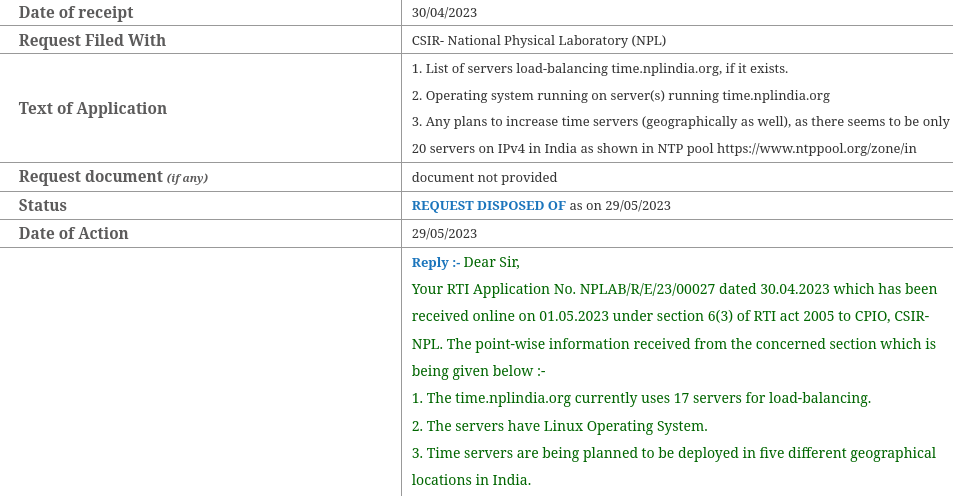
Daniel Lange: htop and PCP have a new home at Hack Club

After the unfortunate and somewhat surprising shutdown of the Open Collective Foundation (OCF), htop and Performance Co-Pilot (PCP) have migrated to Hack Club. Initially founded to improve STEM education, support high school computer science clubs and firmly founded in the hacker culture, Hack Club have created a US IRS approved 501(c)(3) charity that provides what Open Collective did/does1 and more at a flat 7% fee of the project income. Nathan Scott organized these moves with Paul Spitler. Many thanks! We considered other options for the projects, e.g. Gentoo has moved to Software in the Public Interest (SPI) and I know SPI quite well as they were created initially to host Debian. But PCP moved from SPI to OCF in 2021. Open Collective has a European branch that seems independent of the dissolved US foundation. But all-in-all Hack Club seemed the best fit. You can find the new fiscal sponsorship and donation landing pages at:
htophttps://hcb.hackclub.com/htop/https://hcb.hackclub.com/donations/start/htop
PCPhttps://hcb.hackclub.com/pcp/https://hcb.hackclub.com/donations/start/pcp

  1. Open Collective as in the fancy "manage your project donations and reimbursements" website still continues to run but the foundation of the same name that provided the actual fiscal sponsorship (i.e. managing the funds) got dissolved. It's ... complicated.

10 May 2024

Reproducible Builds: Reproducible Builds in April 2024

Welcome to the April 2024 report from the Reproducible Builds project! In our reports, we attempt to outline what we have been up to over the past month, as well as mentioning some of the important things happening more generally in software supply-chain security. As ever, if you are interested in contributing to the project, please visit our Contribute page on our website. Table of contents:
  1. New backseat-signed tool to validate distributions source inputs
  2. NixOS is not reproducible
  3. Certificate vulnerabilities in F-Droid s fdroidserver
  4. Website updates
  5. Reproducible Builds and Insights from an Independent Verifier for Arch Linux
  6. libntlm now releasing minimal source-only tarballs
  7. Distribution work
  8. Mailing list news
  9. diffoscope
  10. Upstream patches
  11. reprotest
  12. Reproducibility testing framework

New backseat-signed tool to validate distributions source inputs kpcyrd announced a new tool called backseat-signed, after:
I figured out a somewhat straight-forward way to check if a given git archive output is cryptographically claimed to be the source input of a given binary package in either Arch Linux or Debian (or both).
Elaborating more in their announcement post, kpcyrd writes:
I believe this to be the reproducible source tarball thing some people have been asking about. As explained in the README, I believe reproducing autotools-generated tarballs isn t worth everybody s time and instead a distribution that claims to build from source should operate on VCS snapshots instead of tarballs with 25k lines of pre-generated shell-script.
Indeed, many distributions packages already build from VCS snapshots, and this trend is likely to accelerate in response to the xz incident. The announcement led to a lengthy discussion on our mailing list, as well as shorter followup thread from kpcyrd about bootstrapping Autotools projects.

NixOS is not reproducible Morten Linderud posted an post on his blog this month, provocatively titled, NixOS is not reproducible . Although quickly admitting that his title is indeed clickbait , Morten goes on to clarify the precise guarantees and promises that NixOS provides its users. Later in the most, Morten mentions that he was motivated to write the post because:
I have heavily invested my free-time on this topic since 2017, and met some of the accomplishments we have had with Doesn t NixOS solve this? for just as long and I thought it would be of peoples interest to clarify[.]

Certificate vulnerabilities in F-Droid s fdroidserver In early April, Fay Stegerman announced a certificate pinning bypass vulnerability and Proof of Concept (PoC) in the F-Droid fdroidserver tools for managing builds, indexes, updates, and deployments for F-Droid repositories to the oss-security mailing list.
We observed that embedding a v1 (JAR) signature file in an APK with minSdk >= 24 will be ignored by Android/apksigner, which only checks v2/v3 in that case. However, since fdroidserver checks v1 first, regardless of minSdk, and does not verify the signature, it will accept a fake certificate and see an incorrect certificate fingerprint. [ ] We also realised that the above mentioned discrepancy between apksigner and androguard (which fdroidserver uses to extract the v2/v3 certificates) can be abused here as well. [ ]
Later on in the month, Fay followed up with a second post detailing a third vulnerability and a script that could be used to scan for potentially affected .apk files and mentioned that, whilst upstream had acknowledged the vulnerability, they had not yet applied any ameliorating fixes.

Website updates There were a number of improvements made to our website this month, including Chris Lamb updating the archive page to recommend -X and unzipping with TZ=UTC [ ] and adding Maven, Gradle, JDK and Groovy examples to the SOURCE_DATE_EPOCH page [ ]. In addition Jan Zerebecki added a new /contribute/opensuse/ page [ ] and Sertonix fixed the automatic RSS feed detection [ ][ ].

Reproducible Builds and Insights from an Independent Verifier for Arch Linux Joshua Drexel, Esther H nggi and Iy n M ndez Veiga of the School of Computer Science and Information Technology, Hochschule Luzern (HSLU) in Switzerland published a paper this month entitled Reproducible Builds and Insights from an Independent Verifier for Arch Linux. The paper establishes the context as follows:
Supply chain attacks have emerged as a prominent cybersecurity threat in recent years. Reproducible and bootstrappable builds have the potential to reduce such attacks significantly. In combination with independent, exhaustive and periodic source code audits, these measures can effectively eradicate compromises in the building process. In this paper we introduce both concepts, we analyze the achievements over the last ten years and explain the remaining challenges.
What is more, the paper aims to:
contribute to the reproducible builds effort by setting up a rebuilder and verifier instance to test the reproducibility of Arch Linux packages. Using the results from this instance, we uncover an unnoticed and security-relevant packaging issue affecting 16 packages related to Certbot [ ].
A PDF of the paper is available.

libntlm now releasing minimal source-only tarballs Simon Josefsson wrote on his blog this month that, going forward, the libntlm project will now be releasing what they call minimal source-only tarballs :
The XZUtils incident illustrate that tarballs with files that are not included in the git archive offer an opportunity to disguise malicious backdoors. [The] risk of hiding malware is not the only motivation to publish signed minimal source-only tarballs. With pre-generated content in tarballs, there is a risk that GNU/Linux distributions [ship] generated files coming from the tarball into the binary *.deb or *.rpm package file. Typically the person packaging the upstream project never realized that some installed artifacts was not re-built[.]
Simon s post goes into further details how this was achieved, and describes some potential caveats and counters some expected responses as well. A shorter version can be found in the announcement for the 1.8 release of libntlm.

Distribution work In Debian this month, Helmut Grohne filed a bug suggesting the removal of dh-buildinfo, a tool to generate and distribute .buildinfo-like files within binary packages. Note that this is distinct from the .buildinfo generation performed by dpkg-genbuildinfo. By contrast, the entirely optional dh-buildinfo generated a debian/buildinfo file that would be shipped within binary packages as /usr/share/doc/package/buildinfo_$arch.gz. Adrian Bunk recently asked about including source hashes in Debian s .buildinfo files, which prompted Guillem Jover to refresh some old patches to dpkg to make this possible, which revealed some quirks Vagrant Cascadian discovered when testing. In addition, 21 reviews of Debian packages were added, 22 were updated and 16 were removed this month adding to our knowledge about identified issues. A number issue types have been added, such as new random_temporary_filenames_embedded_by_mesonpy and timestamps_added_by_librime toolchain issues. In openSUSE, it was announced that their Factory distribution enabled bit-by-bit reproducible builds for almost all parts of the package. Previously, more parts needed to be ignored when comparing package files, but now only the signature needs to be deleted. In addition, Bernhard M. Wiedemann published theunreproduciblepackage as a proper .rpm package which it allows to better test tools intended to debug reproducibility. Furthermore, it was announced that Bernhard s work on a 100% reproducible openSUSE-based distribution will be funded by NLnet. He also posted another monthly report for his reproducibility work in openSUSE. In GNU Guix, Janneke Nieuwenhuizen submitted a patch set for creating a reproducible source tarball for Guix. That is to say, ensuring that make dist is reproducible when run from Git. [ ] Lastly, in Fedora, a new wiki page was created to propose a change to the distribution. Titled Changes/ReproduciblePackageBuilds , the page summarises itself as a proposal whereby A post-build cleanup is integrated into the RPM build process so that common causes of build irreproducibility in packages are removed, making most of Fedora packages reproducible.

Mailing list news On our mailing list this month:
  • Continuing a thread started in March 2024 about the Arch Linux minimal container now being 100% reproducible, John Gilmore followed up with a post about the practical and philosophical distinctions of local vs. remote storage of the various artifacts needed to build packages.
  • Chris Lamb asked the list which conferences readers are attending these days: After peak Covid and other industry-wide changes, conferences are no longer the must attend events they previously were especially in the area of software supply-chain security. In rough, practical terms, it seems harder to justify conference travel today than it did in mid-2019. The thread generated a number of responses which would be of interest to anyone planning travel in Q3 and Q4 of 2024.
  • James Addison wrote to the list about a quirk in Git related to its core.autocrlf functionality, thus helpfully passing on a slightly off-topic and perhaps not of direct relevance to anyone on the list today note that might still be the kind of issue that is useful to be aware of if-and-when puzzling over unexpected git content / checksum issues (situations that I do expect people on this list encounter from time-to-time) .

diffoscope diffoscope is our in-depth and content-aware diff utility that can locate and diagnose reproducibility issues. This month, Chris Lamb made a number of changes such as uploading versions 263, 264 and 265 to Debian and made the following additional changes:
  • Don t crash on invalid .zip files, even if we encounter their badness halfway through the file and not at the time of their initial opening. [ ]
  • Prevent odt2txt tests from always being skipped due to an (impossibly) new version requirement. [ ]
  • Avoid parens-in-parens in test skipping messages. [ ]
  • Ensure that tests with >=-style version constraints actually print the tool name. [ ]
In addition, Fay Stegerman fixed a crash when there are (invalid) duplicate entries in .zip which was originally reported in Debian bug #1068705). [ ] Fay also added a user-visible note to a diff when there are duplicate entries in ZIP files [ ]. Lastly, Vagrant Cascadian added an external tool pointer for the zipdetails tool under GNU Guix [ ] and proposed updates to diffoscope in Guix as well [ ] which were merged as [264] [265], fixed a regression in test coverage and increased verbosity of the test suite[ ].

Upstream patches The Reproducible Builds project detects, dissects and attempts to fix as many currently-unreproducible packages as possible. We endeavour to send all of our patches upstream where appropriate. This month, we wrote a large number of such patches, including:

reprotest reprotest is our tool for building the same source code twice in different environments and then checking the binaries produced by each build for any differences. This month, reprotest version 0.7.27 was uploaded to Debian unstable) by Vagrant Cascadian who made the following additional changes:
  • Enable specific number of CPUs using --vary=num_cpus.cpus=X. [ ]
  • Consistently use 398 days for time variation, rather than choosing randomly each time. [ ]
  • Disable builds of arch:any packages. [ ]
  • Update the description for the build_path.path option in README.rst. [ ]
  • Update escape sequences for compatibility with Python 3.12. (#1068853). [ ]
  • Remove the generic upstream signing-key [ ] and update the packages signing key with the currently active team members [ ].
  • Update the packaging Standards-Version to 4.7.0. [ ]
In addition, Holger Levsen fixed some spelling errors detected by the spellintian tool [ ] and Vagrant Cascadian updated reprotest in GNU Guix to 0.7.27.

Reproducibility testing framework The Reproducible Builds project operates a comprehensive testing framework running primarily at tests.reproducible-builds.org in order to check packages and other artifacts for reproducibility. In April, an enormous number of changes were made by Holger Levsen:
  • Debian-related changes:
    • Adjust for changed internal IP addresses at Codethink. [ ]
    • Automatically cleanup failed diffoscope user services if there are too many failures. [ ][ ]
    • Configure two new nodes at infomanik.cloud. [ ][ ]
    • Schedule Debian experimental even less. [ ][ ]
  • Breakage detection:
    • Exclude currently building packages from breakage detection. [ ]
    • Be more noisy if diffoscope crashes. [ ]
    • Health check: provide clickable URLs in jenkins job log for failed pkg builds due to diffoscope crashes. [ ]
    • Limit graph to about the last 100 days of breakages only. [ ]
    • Fix all found files with bad permissions. [ ]
    • Prepare dealing with diffoscope timeouts. [ ]
    • Detect more cases of failure to debootstrap base system. [ ]
    • Include timestamps of failed job runs. [ ]
  • Documentation updates:
    • Document how to access arm64 nodes at Codethink. [ ]
    • Document how to use infomaniak.cloud. [ ]
    • Drop notes about long stalled LeMaker HiKey960 boards sponsored by HPE and hosted at ETH. [ ]
    • Mention osuosl4 and osuosl5 and explain their usage. [ ]
    • Mention that some packages are built differently. [ ][ ]
    • Improve language in a comment. [ ]
    • Add more notes how to query resource usage from infomaniak.cloud. [ ]
  • Node maintenance:
    • Add ionos4 and ionos14 to THANKS. [ ][ ][ ][ ][ ]
    • Deprecate Squid on ionos1 and ionos10. [ ]
    • Drop obsolete script to powercycle arm64 architecture nodes. [ ]
    • Update system_health_check for new proxy nodes. [ ]
  • Misc changes:
    • Make the update_jdn.sh script more robust. [ ][ ]
    • Update my SSH public key. [ ]
In addition, Mattia Rizzolo added some new host details. [ ]

If you are interested in contributing to the Reproducible Builds project, please visit our Contribute page on our website. However, you can get in touch with us via:

Next.

Previous.