Search Results: "ads"

4 April 2026

Dirk Eddelbuettel: Sponsor me for Tour de Shore 2026 to support MFA

tour de shore 2026 On June 19 and 20, I will cycle a little over 100 miles from downtown Chicago and its wonderful Millenium Park to New Buffalo, Michigan, as part of the Tour de Shore 2026. The ride passes through northwest Indiana and the extended Indiana Dunes National Park ending the next morning in the southwestern Michigan town of New Buffalo. I rode Tour de Shore once before in 2024 and had a generally wonderful time (even considering some soreness after a century of miles over 1 1/2 days). Tour de Shore is riding in support of Maywood Fine Arts Center, a local arts and sports center in Maywood, Illinois, a suburb one over from where I live and hence just a few good miles west of downtown. Maywood, Illinois is home to legends such as the late John Prine as well as several NBA players such as player and coach Doc Rivers. tour de shore 2026 donation page But Maywood, Illinois is also little less well off than other western suburbs. The Maywood Fine Arts Center is simply legendary is what they do for this community (and surrounding communities), and especially the youth support. They can use a dollar a two. Their story about Tour de Shore is worth a read too for background and motivation. I have bootstrapped my donation page page with a dollar for each mile to be cycled. It would be simply terrific if you could join me. A nickel, a dime, or a quarter per mile cycled would help. Multiples of that help too: More is of course still always better. Anything you can afford will go a long way towards a worthy goal in a community that could use the help. Of and if you are local to the area, I believe you can still register for Tour de Shore 2026. So see you out there in June? And if not, maybe help with a dollar or two?

This post by Dirk Eddelbuettel originated on his Thinking inside the box blog.

2 April 2026

Samuel Henrique: Bringing HTTP/3 to curl on Amazon Linux

Screenshot of the top entry of the curl package's changelog, showing the following: Changelogs for curl-8.17.0-1.amzn2023.0.2.x86_64 * Mon Mar 16 00:00:00 2026 Samuel Henrique (samueloph) <samhn@amazon.com> - 8.17.0-1.amzn2023.0.2 - Enable HTTP/3 support in the full build using ngtcp2 and nghttp3 - HTTP/3 is explicitly disabled in the minimal build - Add runtime dependencies on libnghttp3 and libngtcp2 with minimum version pinning - Run tests in parallel via upstream make test-nonflaky, with serial fallback for race-prone tests

tl;dr Starting with curl 8.17.0-1.amzn2023.0.2 in Amazon Linux 2023, you can now use HTTP/3.
dnf swap -y libcurl-minimal libcurl-full
dnf swap -y curl-minimal curl-full
curl --http3-only https://example.com
(HTTP/3 is only enabled in the curl -full builds) Or, if you would like to try it out in a container:
podman run amazonlinux:2023 /bin/sh -c 'dnf upgrade -y --releasever=latest && dnf swap -y libcurl-minimal libcurl-full && dnf swap -y curl-minimal curl-full && curl --http3-only https://example.com'
For a list of test endpoints, you can refer to https://bagder.github.io/HTTP3-test/

The Upgrade I Didn't Have to Make My teammate Steve Zarkos, who previously worked on upgrading OpenSSL in Amazon Linux from 3.0 to 3.2, spent the last few months on the complex task of bumping OpenSSL again, this time to 3.5. A bump like this only happens after extensive code analysis and testing, something that I didn't foresee happening when AL2023 was released but that was a notable request from users. Having enabled HTTP/3 on Debian, I was always keeping an eye on when I would get to do the same for Amazon Linux (mind you, I work at AWS, in the Amazon Linux org). The bump to OpenSSL 3.5 was the perfect opportunity to do that, for the first time Amazon Linux is shipping an OpenSSL version that is supported by ngtcp2 for HTTP/3 support.

Non-Intrusive Change In order to avoid any intrusive changes to existing users of AL2023, I've only enabled HTTP/3 in the full build of curl, not in the minimal one, this means there is no change for the minimal images. The way curl handles HTTP/3 today also does not lead to any behavior changes for those who have the full variants of curl installed, this is due to the fact that HTTP/3 is only used if the user explicitly asks for it with the flags --http3 or --http3-only.

Side Quests Supporting HTTP/3 on curl also requires building it with ngtcp2 and nghttp3, two packages which were not shipped in Amazon Linux, besides, my team doesn't even own the curl package, we are a security team so our packages are the security related stuff such as OpenSSL and GnuTLS. Our main focus is the services behind Amazon Linux's vulnerability handling, not package maintenance. I worked with the owners of the curl package and got approvals on a plan to introduce the two new dependencies under their ownership and to enable the feature on curl, I appreciate their responsiveness. Amazon Linux 2023 is forked from Fedora, so while introducing ngtcp2, I also sent a couple of Pull Requests upstream to keep things in sync: [ngtcp2] package latest release 1.21.0 [ngtcp2] do not skip tests While building the curl package in Amazon Linux, I've noticed the build was taking 1 hour from start to end, and the culprit was something well known to me; tests. The curl test suite is quite extensive, with more than 1600 tests, all of that running without parallelization, running two times for each build of the package; once for the minimal build and again for the full build. I had previously enabled parallel tests in Debian back in 2024 but never got around to submit the same improvements to Amazon Linux or Fedora, this is now fixed. The build times for Amazon Linux came down to 10 minutes under the same host (previously 1 hour), and Fedora promptly merged my PR to do the same there: [curl] run tests in parallel All of this uncovered a test which is timing-dependent, meaning it's not supposed to be run with high levels of parallelism, so there goes another PR, this time to curl: Flag test 766 as timing-dependent#21155 What started as enabling a single feature turned into improvements that landed in curl, Fedora, and Amazon Linux alike. I did this in a mix of work and volunteer time, mostly during work hours (work email address used when this was the case), but I'm glad I put in the extra time for the sake of improving curl for everyone.

Release Notes Amazon Linux 2023 release notes for 2023.10.20260330

1 April 2026

Joey Hess: banning all Anthropic employees

Per my policies, I need to ban every employee and contractor of Anthropic Inc from ever contributing code to any of my projects. Anyone have a list? Any project that requires a Developer Certificate of Origin or similar should be doing this, because Anthropic is making tools that explicitly lie about the origin of patches to free software projects.
UNDERCOVER MODE CRITICAL You are operating UNDERCOVER in a PUBLIC/OPEN-SOURCE repository. [...] Do not blow your cover. NEVER include in commit messages or PR descriptions: [...] The phrase 'Claude Code' or any mention that you are an AI
Co-Authored-By lines or any other attribution
-- via @vedolos

Ben Hutchings: FOSS activity in March 2026

Matthew Garrett: Self hosting as much of my online presence as practical

Because I am bad at giving up on things, I ve been running my own email server for over 20 years. Some of that time it s been a PC at the end of a DSL line, some of that time it s been a Mac Mini in a data centre, and some of that time it s been a hosted VM. Last year I decided to bring it in house, and since then I ve been gradually consolidating as much of the rest of my online presence as possible on it. I mentioned this on Mastodon and a couple of people asked for more details, so here we are. First: my ISP doesn t guarantee a static IPv4 unless I m on a business plan and that seems like it d cost a bunch more, so I m doing what I described here: running a Wireguard link between a box that sits in a cupboard in my living room and the smallest OVH instance I can, with an additional IP address allocated to the VM and NATted over the VPN link. The practical outcome of this is that my home IP address is irrelevant and can change as much as it wants - my DNS points at the OVH IP, and traffic to that all ends up hitting my server. The server itself is pretty uninteresting. It s a refurbished HP EliteDesk which idles at 10W or so, along 2TB of NVMe and 32GB of RAM that I found under a pile of laptops in my office. We re not talking rackmount Xeon levels of performance, but it s entirely adequate for everything I m doing here. So. Let s talk about the services I m hosting.

Web This one s trivial. I m not really hosting much of a website right now, but what there is is served via Apache with a Let s Encrypt certificate. Nothing interesting at all here, other than the proxying that s going to be relevant later.

Email Inbound email is easy enough. I m running Postfix with a pretty stock configuration, and my MX records point at me. The same Let s Encrypt certificate is there for TLS delivery. I m using Dovecot as an IMAP server (again with the same cert). You can find plenty of guides on setting this up. Outbound email? That s harder. I m on a residential IP address, so if I send email directly nobody s going to deliver it. Going via my OVH address isn t going to be a lot better. I have a Google Workspace, so in the end I just made use of Google s SMTP relay service. There s various commerical alternatives available, I just chose this one because it didn t cost me anything more than I m already paying.

Blog My blog is largely static content generated by Hugo. Comments are Remark42 running in a Docker container. If you don t want to handle even that level of dynamic content you can use a third party comment provider like Disqus.

Mastodon I m deploying Mastodon pretty much along the lines of the upstream compose file. Apache is proxying /api/v1/streaming to the websocket provided by the streaming container and / to the actual Mastodon service. The only thing I tripped over for a while was the need to set the X-Forwarded-Proto header since otherwise you get stuck in a redirect loop of Mastodon receiving a request over http (because TLS termination is being done by the Apache proxy) and redirecting to https, except that s where we just came from. Mastodon is easily the heaviest part of all of this, using around 5GB of RAM and 60GB of disk for an instance with 3 users. This is more a point of principle than an especially good idea.

Bluesky I m arguably cheating here. Bluesky s federation model is quite different to Mastodon - while running a Mastodon service implies running the webview and other infrastructure associated with it, Bluesky has split that into multiple parts. User data is stored on Personal Data Servers, then aggregated from those by Relays, and then displayed on Appviews. Third parties can run any of these, but a user s actual posts are stored on a PDS. There are various reasons to run the others, for instance to implement alternative moderation policies, but if all you want is to ensure that you have control over your data, running a PDS is sufficient. I followed these instructions, other than using Apache as the frontend proxy rather than nginx, and it s all been working fine since then. In terms of ensuring that my data remains under my control, it s sufficient.

Backups I m using borgmatic, backing up to a local Synology NAS and also to my parents home (where I have another HP EliteDesk set up with an equivalent OVH IPv4 fronting setup). At some point I ll check that I m actually able to restore them.

Conclusion Most of what I post is now stored on a system that s happily living under a TV, but is available to the rest of the world just as visibly as if I used a hosted provider. Is this necessary? No. Does it improve my life? In no practical way. Does it generate additional complexity? Absolutely. Should you do it? Oh good heavens no. But you can, and once it s working it largely just keeps working, and there s a certain sense of comfort in knowing that my online presence is carefully contained in a small box making a gentle whirring noise.

31 March 2026

Junichi Uekawa: April already.

April already. Wondering how bazel update is going in Debian. Seems like a large undertaking.

Benjamin Mako Hill: Quote #75514

Although I never submitted to it, I made several appearances in the now-defunct quote database on bash.org (QDB). I m dealing with a broken keyboard now, and went to dig hard to find this classic in the Wayback machine. I thought I would put it back on the web:

<mako> my letter "eye" stopped worng <luca> k, too? <mako> yeah <luca> sounds like a mountain dew spill <mako> and comma <mako> those three <mako> ths s horrble <luca> tme for a new eyboard <luca> 've successfully taen my eyboard apart and fxed t by cleanng t wth alcohol <mako> stop mang fun of me <mako> ths s a laptop!

It was, in fact, horrble.

C.J. Collier: Finding: Promoting SeaBIOS Cloud Images to UEFI Secure Boot (Proxmox)

Discovery Legacy cloud templates often lack the partitioning and bootloader
binaries required for UEFI Secure Boot. Attempting to switch such a VM
to OVMF in Proxmox results in not a bootable disk. We discovered that
a surgical promotion is possible by manipulating the block device and
EFI variables from the hypervisor.

The Problem
  1. Protective MBR Flags: Legacy installers often set
    the pmbr_boot flag on the GPT s protective MBR. Strict UEFI
    implementations (OVMF) will ignore the GPT if this flag is present.
  2. Missing ESP: Cloud images often lack a FAT32 EFI
    System Partition (ESP).
  3. Variable Store: A fresh Proxmox
    efidisk0 is empty and lacks both the trust certificates
    (PK/KEK/db) and the BootOrder entries required for an automated
    boot.

The Promotion Rule To upgrade a SeaBIOS VM to Secure Boot without a full OS reinstall:
1. Surgical Partitioning: Map the disk on the host and
add a FAT32 partition (Type EF00). Clear the
pmbr_boot flag from the MBR. 2. Binary
Preparation: Boot the VM in SeaBIOS mode to install
shim and grub-efi packages. Use
grub2-mkconfig to populate the new ESP. 3. Trust
Injection: Use the virt-fw-vars utility on the
hypervisor to programmatically enroll the Red Hat/Microsoft CA keys and
any custom certificates (e.g., FreeIPA CA) into the VM s
efidisk. 4. Boot Pinning: Explicitly set
the UEFI BootOrder to point to the shimx64.efi
path via virt-fw-vars --append-boot-filepath.

Solution (Example Command
Sequence) On the Proxmox Host (root):
# Map and Clean MBR
DEV=$(rbd map pool/disk)
parted -s $DEV disk_set pmbr_boot off

# Inject Trust and Boot Path (VM must be stopped)
virt-fw-vars --inplace /dev/rbd/mapped_efidisk \
  --enroll-redhat \
  --add-db <GUID> /path/to/ipa-ca.crt \
  --append-boot-filepath '\EFI\centos\shimx64.efi' \
  --sb
This workflow enables high-integrity Secure Boot environments using
existing SeaBIOS infrastructure templates.

Thomas Lange: FAIme using apt-cacher-ng

The FAI.me service has become faster over the past two months. First, the tool fai-mirror can now download all packages in one go (with all their dependencies) instead of downloading one by one. This helped a lot for the Linux Mint ISO because it uses a long list of packages. I've also added a local apt cache (using apt-cacher-ng), so the network speed does not matter any more in most cases. This led to the following improvements: So far we only had once a problem with apt-cacher-ng, because the underlying partition was full. Building cloud and live images do not gain that much from the local package cache, because most time is spend in extracting and installing the packages.

30 March 2026

Utkarsh Gupta: FOSS Activites in March 2026

Here s my monthly but brief update about the activities I ve done in the FOSS world.

Debian
Whilst I didn t get a chance to do much, here are still a few things that I worked on:
  • A quick exchange with Xavier about node-lodash fixes for stable releases.
  • Uploaded ruby-rack to CVE-2026-25500 & CVE-2026-22860 to sid, trixie, and bookworm.
  • Started to work on the DebConf Bursary team along with PEB.
  • Assited a few folks in getting their patches submitted via Salsa.
  • Mentoring for newcomers.
  • Moderation of -project mailing list.

Ubuntu
I joined Canonical to work on Ubuntu full-time back in February 2021. Whilst I can t give a full, detailed list of things I did, here s a quick TL;DR of what I did:
  • Successfully released 26.04 LTS Beta!
  • Worked further on the whole artifact signing story for cdimage.
  • Assisted a bunch of folks with my Archive Admin and Release team hats to:
    • Review and grant FFes.
    • Coordinating weekly syncs.
    • Promoting/demoting binaries to/from main.
    • Taking care of package removals and so on.
  • Was pretty occupied with the new release processs architecture and design.
  • Preparing for the 26.04 LTS final release.

Debian (E)LTS
This month I have worked 50 hours on Debian Long Term Support (LTS) and on its sister Extended LTS project and did the following things:

Released Security Updates

Work in Progress
  • knot-resolver: Affected by CVE-2023-26249, CVE-2023-46317, and CVE-2022-40188, leading to Denial of Service.
  • node-lodash: Affected by CVE-2025-13465, prototype pollution in the baseUnset function.
    • [stable]: Xavier from the JS team ACK d the patch. The trixie and bookworm uploads will follow.
    • [LTS]: The bullseye test and upload will follow in April once the stable uploads are in and ACK d by the SRMs.
  • vlc: Affected by CVE-2025-51602, an out-of-bounds read and denial of service via a crafted 0x01 response from an MMS server.
    • [LTS]: 3.0.23 backport is ready but not tested. I ll get this over the line in March.
    • [ELTS]: 3.0.23 backport is ready but not very clean. Would like to complete LTS and get back to this.

Other Activities
  • [ELTS] Continued to review ruby-rack for ELTS it has since received about 13 new CVEs, making it even more chaotic. Might consider releasing in batches.
  • [E/LTS] Monitored discussions on mailing lists, IRC, and all the documentation updates.
  • [E/LTS] Attended the monthly LTS meeting on IRC. Summary here.
  • [Other] Spent quite some time debugging a bug in debusine. Filed https://salsa.debian.org/freexian-team/debusine/-/issues/1412 for the same. Have worked on a preliminary patch but would like to submit something for Colin to review. Will follow up in April.

Until next time.
:wq for today.

29 March 2026

Russ Allbery: Review: The Sovereign

Review: The Sovereign, by C.L. Clark
Series: Magic of the Lost #3
Publisher: Orbit
Copyright: September 2025
ISBN: 0-316-54286-5
Format: Kindle
Pages: 575
The Sovereign is the third and concluding book of C.L. Clark's Magic of the Lost high fantasy trilogy. I recommend reading the books of this series close together, since there are a lot of characters and a lot of continuity between books that is helpful to remember, but it was not quite as difficult this time to remember where the story left off. At the end of The Faithless, the political situation in Balladaire (not-France) was more stable, but the threat of a plague lay on the horizon. That threat arrives in earnest in this book, along with new threats from both Balladaire's former colonial conscript soldiers and from neighboring Taargen (not-Germany, sort of, although the parallel isn't as close). Luca and Touraine have finally admitted that they're deeply in love, but they are still very different people with different goals and ethics. Luca is determined to do anything necessary to save her kingdom, but her definition of her kingdom is sharp and brittle. Touraine is torn between far too many loyalties, plus the lingering worry that her morals and Luca's may not be compatible. I think the hardest part of this sort of series is finding an ending the reader will find satisfying. This one, unfortunately, did not work for me, but that may be more due to personal preference than objective flaws. There have been two threads through this series: an improbable romance embedded in a network of complex personal relationships, and a political commentary on colonialism and post-colonial wars. I was enjoying the former, but it was the latter that felt fresh and interesting to me. The plot threads in The Faithless outside of Balladaire expanded that complexity, and I was hoping the final volume would continue in that direction. How could a colonial power atone for its history? How does the former colony establish its own governance? Is there a path to freedom without violence? Are attempts to chart a more moral course doomed to open lines of attack for one's other enemies? It's clear that Clark was thinking about similar themes, but The Sovereign narrows the field instead of widens it, restricts the political options, and then resolves most questions in a massive war. This is not that surprising of a conclusion, but it's one that I found unsatisfying and, honestly, a little boring. Yes, one way to resolve all the competing tensions is for everyone to try to kill each other and whoever survives wins, and historically that's one of the more likely outcomes, but that ending doesn't wrestle with the politics as much as it collapses them. Clark instead focuses this concluding volume on the romance, which becomes even more fraught, tragic, and dramatic than it was in previous books (and that's saying something). The hard questions of divided loyalties and moral conflicts are mostly framed by questions about Touraine's loyalty to Luca and Luca's trust of Touraine. This is all very Shakespearean, full of hard choices, sudden reversals, miscommunication, and a very deep conflict between Luca's realpolitik and Touraine's stubborn personal morality. If this is what you were reading the series for, if you were hoping for a maximum-drama sapphic relationship, you may thoroughly enjoy this. I thought it had its moments, but I wish they had been balanced by more moments of cool-headed practicality and creative political ingenuity. My biggest frustration with this ending is that the characters largely stop doing politics. The political complexity was the strength of both The Unbroken and The Faithless: People who intensely dislike each other negotiate because there is something larger to be gained, personal decisions made without considering the political ramifications have costs, and multiple characters are trying hard to find a way to turn a nasty, exploitative world into something better without simply killing everyone who disagrees. Many of the characters were objectively bad at politics, inexperienced and immature, but they stumbled or dragged or fought their way into political solutions anyway. I thought Clark moved too far away from that in The Sovereign. Everyone goes deep into their own emotions and desire for vengeance or conquest or revolution and stops compromising. To a depressingly large extent, the story is resolved by killing everyone who disagrees. I think the story is poorer for it. One of the other threads of the series is Balladairan magic, or rather its odd absence. Luca has one understanding of it, the rebels introduced in The Faithless have a different understanding of it, and its pursuit is set up as critical to resolving the threat of a plague. We do get an explanation of sorts, but it's not as complete or as satisfying as I was hoping, and the symbolism of Balladaire's missing magic is left frustratingly murky. For me, this has some of the same problems as the political conclusion: I wanted an intellectual catharsis alongside the emotional catharsis, but that was not the direction Clark was taking the story. I like reading about these characters. All of Luca, Touraine, and Pruett are complex, comprehensible, flawed, and often intriguing. But my favorite character in the story, the person I latched on to as an emotional path through the story, was Sabine. Her refreshingly straightforward loyalty and lack of drama was a breath of fresh air. She has some great moments in this book, but there too I got wrong-footed by the direction Clark went with her arc and found its conclusion deeply unsatisfying. I'm not sure how many of these complaints are because of missed opportunities in the novel, how many were due to a mismatch of taste, and how many were due to not being in the right mood to read this conclusion. I'm sure that it didn't help that I read this simultaneous with another novel in which the characters were always miserable, or that I read it in early 2026 with, uh, all that entails. I suspect that if you came away from the first two books invested in the messy romance and wanting MOAR DRAMA, you may get exactly what you were hoping for. That, sadly, was not what I was hoping for. I can't really recommend this. I thought it dragged in places and didn't deliver the ending I wanted. But it has some great moments, it does wrap up the threads of the trilogy as advertised, and at least the romance gets a dramatic climax worthy of the tension that has been built through the previous books. If that matches what you were enjoying in the previous books, you may well enjoy this more than I did. Rating: 5 out of 10

Samuel Henrique: Latest NVIDIA Drivers for Debian (Packaged with AI)

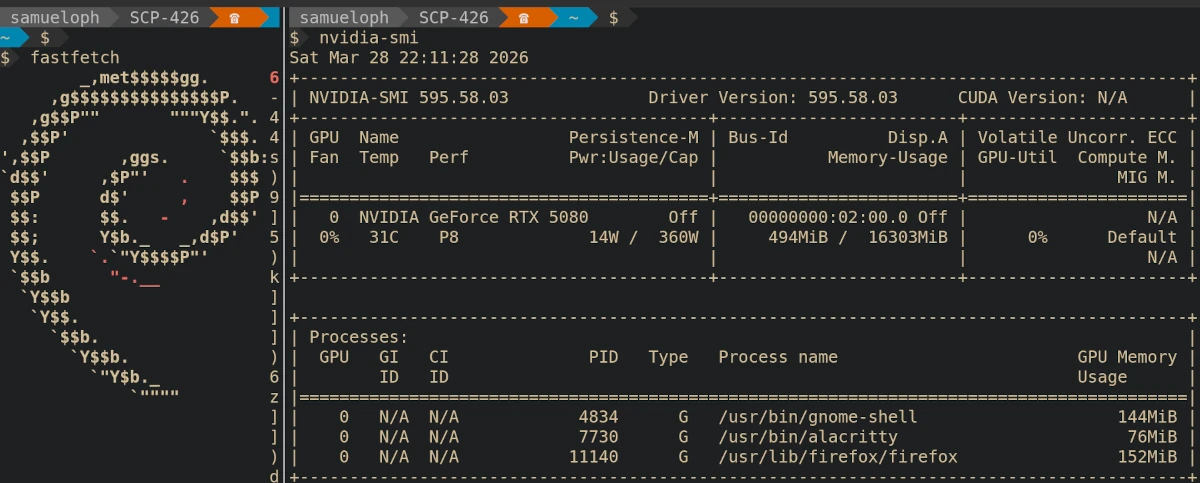
Two terminal windows side-by-side, on the left there's the Debian logo in ASCII art, and on the right it's the output of nvidia-smi, showing the driver version 595.58.03 running on a machine that has an NVIDIA RTS 5080

tl;dr This is not an official package, it's good enough for me and it might be good enough for you, confirmed as working in Debian Testing but I don't have a Stable machine to test there. You can use my custom repo to install the latest NVIDIA drivers on Debian Stable, Testing or Unstable (install from Sid repository): https://deb.debusine.debian.net/debian/r-samueloph-nvidia-ai/ The page above contains the APT sources you need, just add the one for your release to /etc/apt/sources.list.d/r-samueloph-nvidia-ai.sources, run sudo apt update and install the packages, you might need to disable Secure Boot.

This is not about AI Discussions about AI are quite divisive in the Free Software communities, and there's so much to be said about it that I'm not willing to go into in this blog post. This is rather just me telling people that if they need up-to-date NVIDIA packages for Debian, they could check if my custom repository gets the job done. The AI part is a means to an end, I've been careful to note in the repository names that the packages were produced with AI to respect people who do not want to run it for any reason.

RTX 5000 series support Back in May 2025 I opened a bug report asking for the NVIDIA drivers on Debian to be updated to support the RTX 5000 series. The Nouveau drivers might be good enough for some people, but I need the NVIDIA drivers because I want to play games and do experiments with open weight models. Opening a bug report doesn't guarantee anything, at the end of the day Debian Developers are volunteers, so if I really wanted the newer drivers, I would have to do something about it, ideally submitting a merge request. I briefly looked into the NVIDIA packaging, which involves 3 source packages (and one extra git repo for tarballs), unfortunately this was going to take more time and effort than what I was willing to spend.

What I Did After a few weeks of lamenting that I wasn't running the NVIDIA drivers, I figured I was willing to put in more effort than I originally thought, just enough to instruct the Claude Code agent to package the latest releases. I'm skilled enough with agentic tools that I knew how to use it to save time; providing a clear instruction on how to build the package and explaining the packaging layout, then letting the agent iterate until it gets a working build. The agent was running inside a VM that didn't have any of my credentials. After a little bit of back and forth, where I was reviewing the changes guiding the agent into how to fix certain issues, I ended up with a working set of packages. Once I installed it on my machine and confirmed they worked, I set up a debusine repository to make it easier to install future updates, and let others test it out. Debusine is analogous to Ubuntu's famous PPA, or Fedora's EPEL, it's a relatively new project but it has been working fine for this. Matheus Polkorny helped me test the packages and did spot a few issues which are fixed now. The Debusine developers were also always quick to respond to my questions and bug reports.

How Good Is It? Short answer: good enough for daily use, but not a substitute for an official Debian package. The whole point of doing this is because I don't have enough free time to maintain the package myself. All of this work was done as a volunteer, on my personal time. This means I'm trusting the agent to some degree; I review its commits but I don't go too deep into it, the quality will be dictated by the fact that I'm a Debian Developer and so by how easily I can spot issues without double checking everything. I only have a single machine with an NVIDIA GPU, this machine runs Debian Testing and so I don't have a way to test the Stable packages. I can do my best to address problems but at this point there is a risk that new updates break something. Installing NVIDIA drivers has always been a bit risky regardless, if you're comfortable with reverting updates and handling a system without a graphical interface (in case you end up in a tty), you will be fine. You will likely need to disable Secure Boot in order to use them, or set up your BIOS so that a MOK can be used to sign the DKMS modules. When choosing the version strings for the packages, I was careful enough to pick something that would sort lower than an official Debian package, meaning that whenever that same version is packaged in Debian, your system will see it as an upgrade. If you have any other methods of installing the NVIDIA drivers on your Debian system that is working for you, you should likely stick to that. I have a strong preference for installing them through .deb packages, making the package sort out configuration changes and dependency updates, besides handling the DKMS modules. Ultimately I'm not happy with the amount of difficulty that Debian users have in installing up-to-date NVIDIA drivers, and I hope this makes it easier for some.

How To Install Head over to the Debusine page that contains both repos for Trixie (Debian Stable) and Sid (for Debian Testing and Unstable): https://deb.debusine.debian.net/debian/r-samueloph-nvidia-ai/ If you are running Debian Testing, then pick the Sid repository. That page contains the contents of the apt .sources file you need, create the file /etc/apt/sources.list.d/r-samueloph-nvidia-ai.sources with the sources for your release. Run sudo apt update and install the packages you need, if you already have a previous version installed, sudo apt upgrade --update would update them. If there are no upgrades, meaning you don't have a previous version installed, then you need to explicitly install them.
sudo apt install nvidia-open-kernel-dkms nvidia-driver
If you run into issues in Debian Stable, consider using the Linux kernel package from the backports repository, if you need an up-to-date NVIDIA driver, you likely should also be running the backports kernel package (if you can't upgrade to Debian Testing).

Future Plans I currently have no means of measuring how many people are using the debusine repositories, so if you do end up using it feel free to let me know somehow. I don't know for how long I will keep managing this repository, and how much effort I will spend, but my machine needs it and for now I will keep it up-to-date with the latest production-grade NVIDIA drivers.

Sources The sources of the packages are available under a namespace in Salsa (Debian's GitLab instance): https://salsa.debian.org/samueloph-forks-team/nvidia-drivers-forks-with-ai You can also get the exact sources used in the repositories from debusine: https://debusine.debian.net/debian/r-samueloph-nvidia-ai/collection/debian:suite/sid-nvidia-ai/search/?category=debian:source-package https://debusine.debian.net/debian/r-samueloph-nvidia-ai/collection/debian:suite/trixie-nvidia-ai/search/?category=debian:source-package

28 March 2026

Evgeni Golov: Converting Dovecot password schemes on the fly without (too much) cursing

I finally upgraded my mail server to Debian 13 and, as expected, the Dovecot part was quite a ride. The configuration syntax changed between Dovecot 2.3 (Debian 12) and Dovecot 2.4 (Debian 13), so I started first with diffing my configuration against a vanilla Debian 12 one (this setup is slightly old) and then applied the same (logical) changes to a vanilla Debian 13 one. This mostly went well. Mostly because my user database is stored in SQL and while the Dovecot Configuration Upgrader says it can convert old dovecot-auth-sql.conf.ext files to the new syntax, it only does so for the structure, not the SQL queries themselves. While I don't expect it to be able to parse the queries and adopt them correctly, at least a hint that the field names in userdb changed and might require adjustment would've been cool. Once I got that all sorted, Dovecot would still refuse to let me in:
Error: sql: Invalid password in passdb: Weak password scheme 'MD5-CRYPT' used and refused
Yeah, right. Did I mention that this setup is old? The quick cure against this is a auth_allow_weak_schemes = yes in /etc/dovecot/conf.d/10-auth.conf, but long term I really should upgrade the password hashes in the database to something more modern. And this is what this post is about. My database only contains hashed (and salted) passwords, so I can't just update them without changing the password. And while there are only 9 users in total, I wanted to play nice and professional. (LOL) There is a Converting Password Schemes howto in the Dovecot documentation, but it uses a rather odd looking PHP script, wrapped in a shell script which leaks the plaintext password to the process list, and I really didn't want to remember how to write PHP to complete this task. Luckily, I know Python. The general idea is: To make the plaintext password available to the post-login script, we add '% password ' as userdb_plain_pass to the SELECT statement of our passdb query. The original howto also says to add a prefetch userdb, which we do. The sql userdb remains, as otherwise Postfix can't use Dovecot to deliver mail. Now comes the interesting part. We need to write a script that is executed by Dovecot's script-login and that will update the database for us. Thanks to Python's passlib and mysqlclient, the database and hashing parts are relatively straight forward:
#!/usr/bin/env python3
import os
import MySQLdb
import passlib.hash
DB_SETTINGS =  "host": "127.0.0.1", "user": "user", "password": "password", "database": "mail" 
SELECT_QUERY = "SELECT password_enc FROM mail_users WHERE username=%(username)s"
UPDATE_QUERY = "UPDATE mail_users SET password_enc=%(pwhash)s WHERE username=%(username)s"
SCHEME = "bcrypt"
EXPECTED_PREFIX = "$2b$"
def main():
    # https://doc.dovecot.org/2.4.3/core/config/post_login_scripting.html
    # https://doc.dovecot.org/2.4.3/howto/convert_password_schemes.html
    user = os.environ.get("USER")
    plain_pass = os.environ.get("PLAIN_PASS")
    if plain_pass is not None:
        db = MySQLdb.connect(**DB_SETTINGS)
        cursor = db.cursor()
        cursor.execute(SELECT_QUERY,  "username": user )
        result = cursor.fetchone()
        current_pwhash = result[0]
        if not current_pwhash.startswith(EXPECTED_PREFIX):
            hash_module = getattr(passlib.hash, SCHEME)
            pwhash = hash_module.hash(plain_pass)
            data =  "pwhash": pwhash, "username": user 
            cursor.execute(UPDATE_QUERY, data)
        cursor.close()
        db.close()
if __name__ == "__main__":
    main()
But if we add that as executable = script-login /etc/dovecot/dpsu.py to our imap-postlogin service, as the howto suggests, the users won't be able to login anymore:
Error: Post-login script denied access to user
WAT? Remember that shell script I wanted to avoid? It ends with exec "$@". Turns out the script-login "API" is rather interesting. It's not "pass in a list of scripts to call and I'll call all of them". It's "pass a list of scripts, I'll execv the first item and pass the rest as args, and every item is expected to execv the next one again". With that (cursed) knowledge, the script becomes:
#!/usr/bin/env python3
import os
import sys
import MySQLdb
import passlib.hash
DB_SETTINGS =  "host": "127.0.0.1", "user": "user", "password": "password", "database": "mail" 
SELECT_QUERY = "SELECT password_enc FROM mail_users WHERE username=%(username)s"
UPDATE_QUERY = "UPDATE mail_users SET password_enc=%(pwhash)s WHERE username=%(username)s"
SCHEME = "bcrypt"
EXPECTED_PREFIX = "$2b$"
def main():
    # https://doc.dovecot.org/2.4.3/core/config/post_login_scripting.html
    # https://doc.dovecot.org/2.4.3/howto/convert_password_schemes.html
    user = os.environ.get("USER")
    plain_pass = os.environ.get("PLAIN_PASS")
    if plain_pass is not None:
        db = MySQLdb.connect(**DB_SETTINGS)
        cursor = db.cursor()
        cursor.execute(SELECT_QUERY,  "username": user )
        result = cursor.fetchone()
        current_pwhash = result[0]
        if not current_pwhash.startswith(EXPECTED_PREFIX):
            hash_module = getattr(passlib.hash, SCHEME)
            pwhash = hash_module.hash(plain_pass)
            data =  "pwhash": pwhash, "username": user 
            cursor.execute(UPDATE_QUERY, data)
        cursor.close()
        db.close()
    os.execv(sys.argv[1], sys.argv[1:])
if __name__ == "__main__":
    main()
And the passwords are getting gradually updated as the users log in. Once all are updated, we can remove the post-login script and drop the auth_allow_weak_schemes = yes.

27 March 2026

Jonathan Dowland: Digital gardening

I was reading a post on Alex Chan's website1 that referenced the concept of digital gardens, a concept/analogy for organising information which dates back to the 90s. This old concept is getting new traction today by contrasting the approach with "endless stream" as used and abused by social media, but also how blogs are typically presented. This site, my homepage, has a blog, and that's the bit that most people who interact with the site will experience. Partly, because it's the bit that gets syndicated out: via feeds; on Planet Debian and downstream from it; once upon a time on Twitter; nowadays on the Fediverse. However there's more to my homepage than that. The rest of it may be of little interest to anyone beside me, but it's useful to me, at least. So I may switch focus a little bit from mainly writing blog posts, and tend to the rest of the garden a bit more. Some recent seeding and pruning: Recently my guest status at Newcastle University came up for renewal, so I wrote down my goals in the Historic Computing Committee for the next year or so, and put them here: nuhcc. I've also been pondering what I'm up to in Debian at the moment, so took some time to add my current projects to that page.

  1. I'm reminded that I should really publish a "blog roll" of cool blogs I'm following at the moment, of which Alex Chan's is one.

Bits from Debian: New Debian Developers and Maintainers (January and February 2026)

The following contributors got their Debian Developer accounts in the last two months: The following contributors were added as Debian Maintainers in the last two months: Congratulations!

Paul Tagliamonte: librtlsdr.so for fun and profit

Interested in future updates? Follow me on mastodon at @paul@soylent.green. Posts about hz.tools will be tagged #hztools.
It s well known and universally agreed that radios are cool. Among the contested field of coolest radios, Software Defined Radios (SDRs) are definitely the most interesting to me. Out of all of my (entirely too many) SDRs I own, the rtlsdr is still my #1. It s just good. It s a great price, extremely capable, reliable, well-supported, and compact. Why bother with anything else? Sure, it can t transmit, uses a (fairly weird) 8 bit unsigned integer IQ representation, limited sampling rate, limited frequency range but even with all that, it s still the radio I will pack first. Don t get me wrong, I love my Ettus radios, PlutoSDRs, HackRFs, my AirspyHF+ - they re great! I just always find myself falling back to an rtl-sdr, every time. Perhaps the best reason to use an rtlsdr is the absolutely mind-boggling amount of cool stuff people have written for it. The rtlsdr API is super easy to use, widely supported if you re building on top of existing radio processing frameworks it s still a shock to me when something omits rtlsdr support.

sparky Over the last 7 years, I ve been learning about radios I got my ham radio license (de K3XEC), hacked on some cool stuff where I ve learned how radios work by doing , and even was lucky enough to give my first rf-centric talk at districtcon. Embarrassingly, I still haven t gotten around to learning how the fancy stuff like GNU Radio works. I m sure I m going to love it when I do. As part of this, I ve also cooked up some very unprofessional formats and protocols I use for convenience. Locally, all my on-disk captures are stored in rfcap or more recently arf, while direct SDR access at my house is almost entirely a mix of the widely used rtl-tcp protocol, and my riq protocol (post on this coming soon). Both rtl-tcp and riq operate over the network, so I don t have to bother with plugging things into USB ports, and I can share my radios with my friends. All of that work sits in my current generation of radio processing code, sparky (a reference to spark-gap transmitters), which is a heap of Rust, supporting everything from no_std for embedded experiments, conditional support for interfacing with all the radios I own, and tokio-based async support in addition to blocking i/o for highly concurrent daemons. This quickly advanced beyond my old Go-based code (hz.tools/go-sdr), which I archived so I can focus on learning. I still think Go is a great language to write RF code in but I can t focus on that tech tree anymore. Of course, this now poses a new problem no one supports my format(s) or radio protocol(s), since, well, I m the only one using them. I ve committed a fair amount of my hardware to this setup, and yanking it from the rack to try something out does pose a bit of a pickle. This isn t a huge deal for learning, but it does make it tedious to try out something from the internets.

librtlsdr.so Thankfully, Rust has robust support for wrap[ping itself] in a grotesque simulacra of C s skin and mak[ing its] flesh undulate, which is an attractive nuisance if i ve ever seen one. Naturally, my ability to restrain myself from engaging in ill-advised rf adventures is basically zero, so it s time to do the thing any similarly situated person would do reimplement the API and ABI of librtlsdr.so, backed with sparky instead. Since enumeration of devices is going to be annoying (specifically, they re over the network), I decided early-on to rely on an explicit list of devices via a configuration file. I d rather only load that once so programs don t get confused, so I opted to use a CTOR to run a stub when the ELF is linked at runtime.
// lightly edited for clarity

#[used]
#[expect(unused)]
#[unsafe(link_section = ".init_array")]
pub static INITIALIZE: extern "C" fn() = sparky_rtlsdr_ctor;

#[unsafe(no_mangle)]
pub extern "C" fn sparky_rtlsdr_ctor()  
 let config: Config =  
 if let Ok(config_bytes) = std::fs::read("/etc/sparky-rtlsdr.toml")  
 toml::from_slice(&config_bytes).unwrap()
   else  
 Config   device: vec![]  
  
  ;
 CONFIG.set(config);
 
Next, it s time to start with the basics. Opening and closing a handle using rtlsdr_open and rtlsdr_close. Given we don t control the runtime, and the rtl-sdr device handle is opaque (for good reason!), I opted to smuggle a rust Box<Device> non-FFI safe heap-allocated struct through the device handle pointer, and let C take ownership of the Box. No one should be looking in there anyway.
// lightly edited for clarity

#[unsafe(no_mangle)]
pub unsafe extern "C" fn rtlsdr_open(dev: *mut *mut Handle, index: u32) -> int  
 let config = &CONFIG.device[index as usize];
 let sdr = match config.load()  
 Ok(v) => v,
 Err(err) =>  
 return -1;
  
  ;
 let handle = Box::new(Handle   config, sdr  );
 unsafe   *dev = Box::into_raw(handle)  ;
 0
 

#[unsafe(no_mangle)]
pub unsafe extern "C" fn rtlsdr_close(dev: *mut Handle) -> int  
 let dev = unsafe   Box::from_raw(dev)  ;
 drop(dev);
 0
 
With that in place, we can chip away at the API surface, translating calls as best as we can. I won t bother listing it all, since it s not very interesting but here s an example implementation of rtlsdr_set_sample_rate and rtlsdr_get_sample_rate. These calls are translating from an rtl-sdr frequency (which is a u32 containing the value as Hz) into a sparky Frequency type, and invoking get_sample_rate or set_sample_rate on the device s rust handle. Since each device implements the sparky Sdr trait, the actual underlying device doesn t matter much here.
#[unsafe(no_mangle)]
pub unsafe extern "C" fn rtlsdr_set_sample_rate(dev: *mut Handle, rate: u32) -> int  
 let dev = unsafe   &mut *dev  ;
 let rate = Frequency::from_hz(rate as i64);
 if let Err(err) = dev.sdr.set_sample_rate(dev.channel, rate)  
 return -1;
  
 0
 

#[unsafe(no_mangle)]
pub unsafe extern "C" fn rtlsdr_get_sample_rate(dev: *mut Handle) -> u32  
 let dev = unsafe   &mut *dev  ;
 let freq = match dev.sdr.get_sample_rate(dev.channel)  
 Ok(freq) => freq,
 Err(err) =>  
 return 0;
  
  ;
 freq.as_hz() as u32
 
After repeating this process for the rest of the stubs I could (and otherwise setting error conditions if the functionality is not supported), I was ready to try it out. Within sparky, I patched my MockSDR (basically a Sdr traited Mock type) to implement the same testmode IQ protocol that the RTL-SDR has, and decided to see if rtl_test from apt without any changes could be fooled.
$ rtl_test
No supported devices found.
Great, cool. No devices plugged in. Looks great. Let s try it with my librtlsdr.so LD_PRELOAD-ed into the binary first:
$ LD_PRELOAD=target/release/librtlsdr.so rtl_test
Found 1 device(s):
 0: hz.tools, mock sdr, SN: totally legit no tricks

Using device 0: sparky mock sdr
Supported gain values (0):
Sampling at 2048000 S/s.

Info: This tool will continuously read from the device, and report if
samples get lost. If you observe no further output, everything is fine.

Reading samples in async mode...
^CSignal caught, exiting!

User cancel, exiting...
Samples per million lost (minimum): 0
$
Outstanding. Even more outstandingly, if I change my testmode implementation to skip samples, rtl_test correctly reports the errors I think it s showing promise! On to try the real endgame here let s have our new librtlsdr.so connect to an rtl-tcp endpoint and see if rtl_fm works:
LD_PRELOAD=target/release/librtlsdr.so \
 rtl_fm -d 1 -s 120k -E deemp -M fm -f 90.9M   \
 ffplay -f s16le -ar 120k -i -
Found 2 device(s):
 0: hz.tools, mock sdr, SN: totally legit no tricks
 1: hz.tools, rtl-tcp, SN: node2.rf.lan:1202

Using device 1: sparky rtltcp node2
Tuner gain set to automatic.
Tuned to 91170000 Hz.
Oversampling input by: 9x.
Oversampling output by: 1x.
Buffer size: 7.59ms
Sampling at 1080000 S/s.
Output at 120000 Hz.
And there it was! Not the best audio quality (mostly due to my inability to correctly read the rtl_fm manpage to tune the filter and downsample/oversampling rates to audio), but it s definitely passable. I figured I d try something that was a bit more interesting next gqrx, since it s super handy, I use it a ton, and will definitely amuse me to no end. To my surprise and delight, LD_PRELOAD=target/release/librtlsdr.so gqrx wound up running, and I saw my devices pop right up in the setting menu: Huge. Huge. Amazing. It did crash as soon as I tried to actually use the radio, but after fixing a few dangling bugs in the API surface (and some assumptions I think some underlying gnuradio driver may be making that I need to double check in the code), I was able to get a super solid stream of broadcast fm radio, with gqrx being none the wiser. It thought it was just talking to the device it knows as rtl=1. Nice. I can t wait to try this with the rest of the rtl-sdr based tools I like having around using my riq protocol next. I don t think that ll be worth a post, but hopefully I ll get around to publishing details on that stack next.

epilogue Well. That s it. End of story. A bit anti-climatic, sure. While this new shim will provide me endless minutes of mild amusement, I could see using this to expose my sparky testing utilities via librtlsdr.so my mock sdr driver allows for replaying captures off disk, which could be interesting to make sure that signals are still properly decoded after changes, or instrument performance changes (via SNR, BER, packets observed, etc) on reference samples I have on my NAS. Maybe that ll come in handy one day! Truth be told, I m not sure I actually want to encourage anyone to do this for real (although I think I ll definitely be using it on my LAN to see what happens). I also don t have a repo to share I don t particularly feel with dealing with the secondary effects of publishing sparky (and sparky-rtlsdr) yet, since i m still getting my feet under me on the radio aspect of all this. I ll be sure to post updates if anything changes with this here (tagged sparky) and at @paul@soylent.green. I can t wait to post more about some of the odd sidequests (like this one!) i ve completed over the last few years I ve been waiting to feel confident that my work has matured and was withstood the new problems i ve thrown at it, and it largely has. It s my hope that these projects (and this project in particular) has provided a glimpse into the world of software defined radio for my systems friends, and a bit about systems for my radio friends. It s not all magic, and I hope someone out there feels inclined to have some fun with radios themselves!

Samuel Henrique: I use curl with ECH btw (in Debian)

tl;dr This is an experimental feature that, for the first time, brings full ECH support to curl on Debian using OpenSSL. Starting with curl 8.19.0-3+exp2 (Debian Experimental), you can now use ECH, with HTTPS-RR and DoH for maximum privacy. curl 8.19.0-3+exp2 is quite fresh at the time of writing, bear in mind that your repository might not have synced the package yet, all mirrors should have it by March 27th 14:00 UTC.
# defo.ie is a test server that confirms whether ECH was successfully used
curl -v --ech hard https://defo.ie/ech-check.php
# For Encrypted Client Hello (ECH) + DNS over HTTPS (DoH)
curl -v --ech hard --doh-url https://1.1.1.1/dns-query https://defo.ie/ech-check.php
"--ech hard" tells curl to refuse the connection entirely if ECH cannot be negotiated. Or, if you would like to try it out in a container:
podman run debian:experimental /bin/bash -c 'apt install --update -t experimental -y curl && curl -v --ech hard --doh-url https://1.1.1.1/dns-query https://defo.ie/ech-check.php'
(in case you haven't noticed, apt now has the --update option for the upgrade and install commands)

For Privacy CloudFlare calls it "the last puzzle piece to privacy" in their must-read announcement: https://blog.cloudflare.com/announcing-encrypted-client-hello/. Encrypted Client Hello (rfc9849) encrypts the "which website are you connecting to?" part of the TLS handshake that was previously visible in plaintext. HTTPS-RR (rfc9460) is a DNS record type that publishes connection parameters for a service, including the public key clients need to perform ECH. DNS Over HTTPS (rfc8484) encrypts DNS queries by tunneling them over HTTPS, hiding what domains you're looking up from network observers. When all three operate together over a CDN with shared IP space, the target domain name is hidden from passive observers; the HTTPS-RR record is queried over DoH in order to retrieve the ECH key (rfc9848) for the TLS handshake. Seems like quite an important feature, and in fact the major browsers have it enabled for some time now, the trick is that they do not use OpenSSL (Chrome uses BoringSSL and Firefox uses NSS). For everyone else, the only option is to patch OpenSSL or wait until 4.0.0 is released, and so part of the reason Debian is the first distro to enable it (curl + OpenSSL + ECH) is that the OpenSSL maintainer (Sebastian Andrzej Siewior) packaged the alpha release just 3 days after it was published. Do not forget that ECH support is experimental and currently relies on the alpha release of OpenSSL.

wcurl Gets It Too Considering wcurl is just a wrapper on curl, it gets the feature for free:
wcurl --curl-options="--ech hard --doh-url https://1.1.1.1/dns-query" $URL
If you're using wcurl, you don't want to have to set parameters, this is just to show that the feature is there and if you have a .curlrc file, it can enable the feature seamlessly.

Other Debian Releases Given the ECH feature requires OpenSSL >= 4, it will not make it to Debian 13, having a small chance of going to Debian 13 Backports (emphasis on small). It should get to Debian Unstable and Debian Testing within the next couple of months as the OpenSSL GA release happens and gets packaged, but you should be able to install the package from Experimental in your Unstable and Testing systems without issues. It will also be in Debian 14 once it becomes the new Stable.

Shoulders of Giants Stephen Farrell's presentation from OpenSSL Conference 2025 has a lot of background on the work involved: Encrypted Client Hello Lessons learned from trying to do something that was probably too complicated They have been working on implementing ECH in open-source projects for years, something as big as this doesn't happen without lots of people dedicating both their paid and free times over it. I ended up being the person who enabled it on Debian, which was pretty much the least amount of work between everyone involved, but hey it's fun flipping the switch and telling you about it.

Background Since 2025, the curl developers started organizing an yearly meeting with all maintainers of curl in Operating Systems. The 2026 edition happened in March 26th: https://github.com/curl/curl/wiki/curl-distro-discussion-2026. Attendance was really good, and as you can imagine one of the topics of discussion was ECH, in which it was pointed out that having OpenSSL 4 was the main requirement but besides it nothing unusual was needed. In Debian Experimental, we have been enabling HTTPS-RR since March 2025, and OpenSSL 4.0.0 alpha was packaged just recently (2026-03-13) by Sebastian Andrzej Siewior, it's time for the next step. The curl distro meeting was just the motivation I needed to go ahead and enable it in Debian Experimental, so as part of our Debian Brasil Weekly Meetings I've prepared and uploaded the changes, while Carlos Henrique Lima Melara worked on addressing a recent test regression for Debian Unstable. Unfortunately sergiodj couldn't join and I'm sure he's jealous of the hacking session now.

Appendix While writing this, I've noticed one of the authors of the CloudFlare blogpost is the previous curl maintainer on Debian; Alessandro Ghedini let me take over the maintenance back in 2021 and today curl is maintained by a team of 4 people, it's nice to see Alessandro's involvement.

23 March 2026

Marco d'Itri: systemd has not implemented age verification

This needs to be clear: systemd is under attack by a trolling campaign orchestrated by fascist elements. Nobody is forced to like or use systemd, but anybody who wants to pick a side should know the facts. Recently, the free software Nazi bar crowd styling themselves as "concerned citizens" has tried to start a moral panic by saying that systemd is implementing age verification checks or that somehow it will require providing personally identifiable information. This is a lie: the facts are simply that the systemd users database has gained an optional "date of birth" field, which the desktop environments may use or not as they deem appropriate. Of course there is no "identity verification" or requirements to provide any data, which in any case would not be shared beyond authorized local applications. While the multiple recent bills proposing that general purpose operating systems implement age verification mechanisms are often concerning, both from a social and technical point of view, this is not the topic being discussed here. They are often suboptimal, but for a long time I have been opposing attempts to implement parental control at the network level and argued that it should be managed locally, by parents on their own machines: I cannot see why I should outright reject an attempt to implement the infrastructure to do that. If we want to keep age-appropriate controls out of the hands of centralized authorities, the alternative is giving families the means to manage it themselves: this is what this field enables. Whether desktop environments use it for parental controls, for birthday reminders, or for nothing at all, is their users' decision. By the way, the original UNIX users database has allowed storing PII in the GECOS field since it was invented in the '70s. Similar fields are also specified by many popular LDAP schemes: adding such an optional field is consistent with the UNIX tradition. And while we are at it, let's also refute the other smear campaign started by the same people: the systemd project is not accepting "AI slop". What happened is that a documentation file for the benefit of coding agents was added to the repository. To be clear: agents still cannot submit merge requests. The file itself remarks that all contributions must be reviewed in detail by humans, and this is basically the same policy used by the Linux kernel.

Benjamin Mako Hill: How taboo shapes knowledge production on Wikipedia

Note: I have not published blog posts about my academic papers over the past few years. To ensure that my blog contains a more comprehensive record of my published papers and to surface them for folks who missed them, I will periodically (re) publish blog posts about some older published projects. This post draws material from a previously published post by Kaylea Champion on the Community Data Science Blog.

Taboo subjects such as sexuality and mental health are as important to discuss as they are difficult to raise in conversation. Although many people turn to online resources for information on taboo subjects, censorship and low-quality information are common in search results. In two papers I recently published at CSCW both led by Kaylea Champion we presented a series of analyses showing how taboo shapes the process of collaborative knowledge building on English Wikipedia.

The first study is a quantitative analysis showing that articles on taboo subjects are much more popular and are the subject of more vandalism than articles on non-taboo topics. In surprising news, we also found that they were edited more often and were of higher quality!

Short video of Kaylea s presentation of the work given at Wikimania in August 2023.

The first challenge we faced in conducting this work was identifying taboo articles. Kaylea had a brilliant idea for a new computational approach to doing so without relying on our individual intuitions about what qualifies as taboo (something we understood would be highly specific to our own culture, class, etc). Her approach was to make use of an insight from linguistics: people develop euphemisms as ways to talk about taboos (i.e., think about all the euphemisms we ve devised for death, or sex, or menstruation, or mental health).

We used this insight to build a new machine-learning classifier based on English Wiktionary definitions. If a sense of a word was tagged as euphemistic, we treated the words in the definition as indicators of taboo. The end result was a series of words and phrases that most powerfully differentiate taboo from non-taboo. We then did a simple match between those words and phrases and the titles of Wikipedia articles. The topics were taboo enough that we were a little uncomfortable discussing them in our meetings! We built a comparison sample of articles whose titles are words that, like our taboo articles, appear in Wiktionary definitions. In the first paper, we used this new dataset to test a series of hypotheses about how taboo shapes collaborative production in Wikipedia. Our initial hypotheses were based on the idea that taboo information is often in high demand but that Wikipedians might be reluctant to associate their names (or usernames) with taboo topics. The result, we argued, would be articles that were in high demand but of low quality. We found that taboo articles are thriving on Wikipedia! In summary, we found that in comparison to non-taboo articles:

Image of the estimated qualiy of articles of the four articles in the second mixed-methods paper. Extreme dips reflect periods of frequent vandalism.
Kaylea attempted to understand these somewhat confusing results by designing a fantastic mixed-methods analysis that sought to unpack some of the nuance missing in the quantitative analysis by delving deep into the life histories of four articles on English Wikipedia: two on taboo topics related to women s anatomy (Clitoris and Menstration) and two nontaboo articles chosen for comparison (Cell membrance and Philip Pullman). Although the findings from the analysis can be difficult to summarize succinctly (as with many qualitative studies), we showed how the taboo example articles success was hard-won amid real challenges and attacks. The paper describes how challenges were overcome through resilient leadership, often provided by a single dedicated individual. The paper provides a template for how taboo can be and frequently is overcome by dedicated Wikipedians in ways that provide useful knowledge resources in real demand. For more details, visualizations, statistics, and more, we hope you ll take a look at our papers, both linked below.

The full citation for the papers are: (1) Champion, Kaylea, and Benjamin Mako Hill. 2023. Taboo and Collaborative Knowledge Production: Evidence from Wikipedia. Proceedings of the ACM on Human-Computer Interaction 7 (CSCW2): 299:1-299:25. https://doi.org/10.1145/3610090. (2) Champion, Kaylea, and Benjamin Mako Hill. 2024. Life Histories of Taboo Knowledge Artifacts. Proceedings of the ACM: Human-Computer Interaction 8 (CSCW2): 505:1-505:32. https://doi.org/10.1145/3687044.

We have also released replication materials for the paper, including all the data and code used to conduct the analyses.

This blog post and the paper it describes are collaborative work by Kaylea Champion and Benjamin Mako Hill.

21 March 2026

Jonathan Dowland: Ladytron

I saw Ladytron perform in Digital, Newcastle last night. The last time I saw them was, I think, at the same venue, 18 years ago. Time flies!
Photo of the trio performing on stage
Back in the day (perhaps their heyday, perhaps not!) Ladytron ploughed a particular sonic furrow and did it very well. Going into the gig I had set my expectations that, should they play just these hits, I'd have a good time. The gig exceeded my expectations. The setlist very much did not lean into their best-known period: the more recent few albums were very well represented and to me this felt very confident. The lead singer, Helen Marnie, demonstrated some excellent range, particularly on some of the new songs. Daniel Hunt did a lot of backing vocals and they were really complementary to Helen's: underscoring but not overpowering. I enjoyed nerding out watching Mira Ayoro's excellent wrangling of her Korg MS-20. One highlight was an encore performance of Light & Magic, which was arguably the "alternate version" as available on the expanded versions of that album or the Remixed and Rare companion. I thought I'd try to put together a 5-track playlist for a friend who attended the gig but isn't super familiar with them. As usual this is hard. I'm going to avoid the obvious hits, try to represent their whole career and try to ensure the current trio each get a vocal turn in the selection. They actually released their latest album, Paradises, yesterday as well. One track from it is in the list below. I'm Not Scared by Ladytron Kingdom Undersea by Ladytron Blue Jeans by Ladytron He took her to a movie by Ladytron Transparent Days by Ladytron (If you can't see anything, the bandcamp embeds have been stripped out by whatever you are viewing this with)

Next.

Previous.