Search Results: "Chris Lamb"

15 September 2020

Raphaël Hertzog: Freexian s report about Debian Long Term Support, August 2020


A Debian LTS logo Like each month, here comes a report about the work of paid contributors to Debian LTS. Individual reports In August, 237.25 work hours have been dispatched among 14 paid contributors. Their reports are available: Evolution of the situation August was a regular LTS month once again, even though it was only our 2nd month with Stretch LTS.
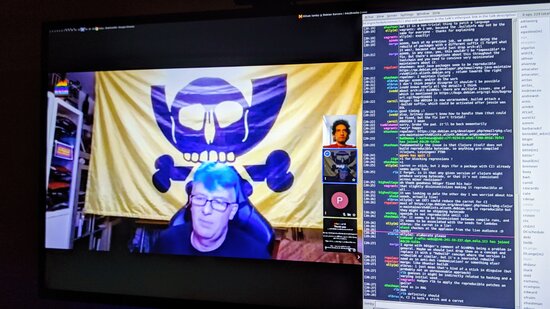
At the end of August some of us participated in DebConf 20 online where we held our monthly team meeting. A video is available.
As of now this video is also the only public resource about the LTS survey we held in July, though a written summary is expected to be released soon. The security tracker currently lists 56 packages with a known CVE and the dla-needed.txt file has 55 packages needing an update. Thanks to our sponsors Sponsors that recently joined are in bold.

No comment Liked this article? Click here. My blog is Flattr-enabled.

9 September 2020

Reproducible Builds: Reproducible Builds in August 2020

Welcome to the August 2020 report from the Reproducible Builds project. In our monthly reports, we summarise the things that we have been up to over the past month. The motivation behind the Reproducible Builds effort is to ensure no flaws have been introduced from the original free software source code to the pre-compiled binaries we install on our systems. If you re interested in contributing to the project, please visit our main website.


This month, Jennifer Helsby launched a new reproduciblewheels.com website to address the lack of reproducibility of Python wheels. To quote Jennifer s accompanying explanatory blog post:
One hiccup we ve encountered in SecureDrop development is that not all Python wheels can be built reproducibly. We ship multiple (Python) projects in Debian packages, with Python dependencies included in those packages as wheels. In order for our Debian packages to be reproducible, we need that wheel build process to also be reproducible
Parallel to this, transparencylog.com was also launched, a service that verifies the contents of URLs against a publicly recorded cryptographic log. It keeps an append-only log of the cryptographic digests of all URLs it has seen. (GitHub repo) On 18th September, Bernhard M. Wiedemann will give a presentation in German, titled Wie reproducible builds Software sicherer machen ( How reproducible builds make software more secure ) at the Internet Security Digital Days 2020 conference.

Reproducible builds at DebConf20 There were a number of talks at the recent online-only DebConf20 conference on the topic of reproducible builds. Holger gave a talk titled Reproducing Bullseye in practice , focusing on independently verifying that the binaries distributed from ftp.debian.org are made from their claimed sources. It also served as a general update on the status of reproducible builds within Debian. The video (145 MB) and slides are available. There were also a number of other talks that involved Reproducible Builds too. For example, the Malayalam language mini-conference had a talk titled , ? ( I want to join Debian, what should I do? ) presented by Praveen Arimbrathodiyil, the Clojure Packaging Team BoF session led by Elana Hashman, as well as Where is Salsa CI right now? that was on the topic of Salsa, the collaborative development server that Debian uses to provide the necessary tools for package maintainers, packaging teams and so on. Jonathan Bustillos (Jathan) also gave a talk in Spanish titled Un camino verificable desde el origen hasta el binario ( A verifiable path from source to binary ). (Video, 88MB)

Development work After many years of development work, the compiler for the Rust programming language now generates reproducible binary code. This generated some general discussion on Reddit on the topic of reproducibility in general. Paul Spooren posted a request for comments to OpenWrt s openwrt-devel mailing list asking for clarification on when to raise the PKG_RELEASE identifier of a package. This is needed in order to successfully perform rebuilds in a reproducible builds context. In openSUSE, Bernhard M. Wiedemann published his monthly Reproducible Builds status update. Chris Lamb provided some comments and pointers on an upstream issue regarding the reproducibility of a Snap / SquashFS archive file. [ ]

Debian Holger Levsen identified that a large number of Debian .buildinfo build certificates have been tainted on the official Debian build servers, as these environments have files underneath the /usr/local/sbin directory [ ]. He also filed against bug for debrebuild after spotting that it can fail to download packages from snapshot.debian.org [ ]. This month, several issues were uncovered (or assisted) due to the efforts of reproducible builds. For instance, Debian bug #968710 was filed by Simon McVittie, which describes a problem with detached debug symbol files (required to generate a traceback) that is unlikely to have been discovered without reproducible builds. In addition, Jelmer Vernooij called attention that the new Debian Janitor tool is using the property of reproducibility (as well as diffoscope when applying archive-wide changes to Debian:
New merge proposals also include a link to the diffoscope diff between a vanilla build and the build with changes. Unfortunately these can be a bit noisy for packages that are not reproducible yet, due to the difference in build environment between the two builds. [ ]
56 reviews of Debian packages were added, 38 were updated and 24 were removed this month adding to our knowledge about identified issues. Specifically, Chris Lamb added and categorised the nondeterministic_version_generated_by_python_param and the lessc_nondeterministic_keys toolchain issues. [ ][ ] Holger Levsen sponsored Lukas Puehringer s upload of the python-securesystemslib pacage, which is a dependency of in-toto, a framework to secure the integrity of software supply chains. [ ] Lastly, Chris Lamb further refined his merge request against the debian-installer component to allow all arguments from sources.list files (such as [check-valid-until=no]) in order that we can test the reproducibility of the installer images on the Reproducible Builds own testing infrastructure and sent a ping to the team that maintains that code.

Upstream patches The Reproducible Builds project detects, dissects and attempts to fix as many currently-unreproducible packages as possible. We endeavour to send all of our patches upstream where appropriate. This month, we wrote a large number of these patches, including:

diffoscope diffoscope is our in-depth and content-aware diff utility that can not only locate and diagnose reproducibility issues, it provides human-readable diffs of all kinds. In August, Chris Lamb made the following changes to diffoscope, including preparing and uploading versions 155, 156, 157 and 158 to Debian:
  • New features:
    • Support extracting data of PGP signed data. (#214)
    • Try files named .pgp against pgpdump(1) to determine whether they are Pretty Good Privacy (PGP) files. (#211)
    • Support multiple options for all file extension matching. [ ]
  • Bug fixes:
    • Don t raise an exception when we encounter XML files with <!ENTITY> declarations inside the Document Type Definition (DTD), or when a DTD or entity references an external resource. (#212)
    • pgpdump(1) can successfully parse some binary files, so check that the parsed output contains something sensible before accepting it. [ ]
    • Temporarily drop gnumeric from the Debian build-dependencies as it has been removed from the testing distribution. (#968742)
    • Correctly use fallback_recognises to prevent matching .xsb binary XML files.
    • Correct identify signed PGP files as file(1) returns data . (#211)
  • Logging improvements:
    • Emit a message when ppudump version does not match our file header. [ ]
    • Don t use Python s repr(object) output in Calling external command messages. [ ]
    • Include the filename in the not identified by any comparator message. [ ]
  • Codebase improvements:
    • Bump Python requirement from 3.6 to 3.7. Most distributions are either shipping with Python 3.5 or 3.7, so supporting 3.6 is not only somewhat unnecessary but also cumbersome to test locally. [ ]
    • Drop some unused imports [ ], drop an unnecessary dictionary comprehensions [ ] and some unnecessary control flow [ ].
    • Correct typo of output in a comment. [ ]
  • Release process:
    • Move generation of debian/tests/control to an external script. [ ]
    • Add some URLs for the site that will appear on PyPI.org. [ ]
    • Update author and author email in setup.py for PyPI.org and similar. [ ]
  • Testsuite improvements:
    • Update PPU tests for compatibility with Free Pascal versions 3.2.0 or greater. (#968124)
    • Mark that our identification test for .ppu files requires ppudump version 3.2.0 or higher. [ ]
    • Add an assert_diff helper that loads and compares a fixture output. [ ][ ][ ][ ]
  • Misc:
In addition, Mattia Rizzolo documented in setup.py that diffoscope works with Python version 3.8 [ ] and Frazer Clews applied some Pylint suggestions [ ] and removed some deprecated methods [ ].

Website This month, Chris Lamb updated the main Reproducible Builds website and documentation to:
  • Clarify & fix a few entries on the who page [ ][ ] and ensure that images do not get to large on some viewports [ ].
  • Clarify use of a pronoun re. Conservancy. [ ]
  • Use View all our monthly reports over View all monthly reports . [ ]
  • Move a is a suffix out of the link target on the SOURCE_DATE_EPOCH age. [ ]
In addition, Javier Jard n added the freedesktop-sdk project [ ] and Kushal Das added SecureDrop project [ ] to our projects page. Lastly, Michael P hn added internationalisation and translation support with help from Hans-Christoph Steiner [ ].

Testing framework The Reproducible Builds project operate a Jenkins-based testing framework to power tests.reproducible-builds.org. This month, Holger Levsen made the following changes:
  • System health checks:
    • Improve explanation how the status and scores are calculated. [ ][ ]
    • Update and condense view of detected issues. [ ][ ]
    • Query the canonical configuration file to determine whether a job is disabled instead of duplicating/hardcoding this. [ ]
    • Detect several problems when updating the status of reporting-oriented metapackage sets. [ ]
    • Detect when diffoscope is not installable [ ] and failures in DNS resolution [ ].
  • Debian:
    • Update the URL to the Debian security team bug tracker s Git repository. [ ]
    • Reschedule the unstable and bullseye distributions often for the arm64 architecture. [ ]
    • Schedule buster less often for armhf. [ ][ ][ ]
    • Force the build of certain packages in the work-in-progress package rebuilder. [ ][ ]
    • Only update the stretch and buster base build images when necessary. [ ]
  • Other distributions:
    • For F-Droid, trigger jobs by commits, not by a timer. [ ]
    • Disable the Archlinux HTML page generation job as it has never worked. [ ]
    • Disable the alternative OpenWrt rebuilder jobs. [ ]
  • Misc;
Many other changes were made too, including:
  • Chris Lamb:
    • Use <pre> HTML tags when dumping fixed-width debugging data in the self-serve package scheduler. [ ]
  • Mattia Rizzolo:
  • Vagrant Cascadian:
    • Mark that the u-boot Universal Boot Loader should not build architecture independent packages on the arm64 architecture anymore. [ ]
Finally, build node maintenance was performed by Holger Levsen [ ], Mattia Rizzolo [ ][ ] and Vagrant Cascadian [ ][ ][ ][ ]

Mailing list On our mailing list this month, Leo Wandersleb sent a message to the list after he was wondering how to expand his WalletScrutiny.com project (which aims to improve the security of Bitcoin wallets) from Android wallets to also monitor Linux wallets as well:
If you think you know how to spread the word about reproducibility in the context of Bitcoin wallets through WalletScrutiny, your contributions are highly welcome on this PR [ ]
Julien Lepiller posted to the list linking to a blog post by Tavis Ormandy titled You don t need reproducible builds. Morten Linderud (foxboron) responded with a clear rebuttal that Tavis was only considering the narrow use-case of proprietary vendors and closed-source software. He additionally noted that the criticism that reproducible builds cannot prevent against backdoors being deliberately introduced into the upstream source ( bugdoors ) are decidedly (and deliberately) outside the scope of reproducible builds to begin with. Chris Lamb included the Reproducible Builds mailing list in a wider discussion regarding a tentative proposal to include .buildinfo files in .deb packages, adding his remarks regarding requiring a custom tool in order to determine whether generated build artifacts are identical in a reproducible context. [ ] Jonathan Bustillos (Jathan) posted a quick email to the list requesting whether there was a list of To do tasks in Reproducible Builds. Lastly, Chris Lamb responded at length to a query regarding the status of reproducible builds for Debian ISO or installation images. He noted that most of the technical work has been performed but there are at least four issues until they can be generally advertised as such . He pointed that the privacy-oriented Tails operation system, which is based directly on Debian, has had reproducible builds for a number of years now. [ ]

If you are interested in contributing to the Reproducible Builds project, please visit our Contribute page on our website. However, you can get in touch with us via:

4 September 2020

Reproducible Builds (diffoscope): diffoscope 159 released

The diffoscope maintainers are pleased to announce the release of diffoscope version 159. This version includes the following changes:
[ Chris Lamb ]
* Show "ordering differences only" in strings(1) output.
  (Closes: reproducible-builds/diffoscope#216)
* Don't alias output from "os.path.splitext" to variables that we do not end
  up using.
* Don't raise exceptions when cleaning up after a guestfs cleanup failure.
[ Jean-Romain Garnier ]
* Make "Command" subclass a new generic Operation class.
You find out more by visiting the project homepage.

31 August 2020

Chris Lamb: Free software activities in August 2020

Here is another monthly update covering what I have been doing in the free software world during August 2020 (previous month): I uploaded Lintian versions 2.86.0, 2.87.0, 2.88.0, 2.89.0, 2.90.0, 2.91.0 and 2.92.0, as well as made the following changes:

Reproducible Builds One of the original promises of open source software is that distributed peer review and transparency of process results in enhanced end-user security. However, whilst anyone may inspect the source code of free and open source software for malicious flaws, almost all software today is distributed as pre-compiled binaries. This allows nefarious third-parties to compromise systems by injecting malicious code into ostensibly secure software during the various compilation and distribution processes. The motivation behind the Reproducible Builds effort is to ensure no flaws have been introduced during this compilation process by promising identical results are always generated from a given source, thus allowing multiple third-parties to come to a consensus on whether a build was compromised. The project is proud to be a member project of the Software Freedom Conservancy. Conservancy acts as a corporate umbrella allowing projects to operate as non-profit initiatives without managing their own corporate structure. If you like the work of the Conservancy or the Reproducible Builds project, please consider becoming an official supporter. This month, I:

diffoscope I made the following changes to diffoscope, including preparing and uploading versions 155, 156, 157 and 158 to Debian:

Debian Debian LTS This month I have worked 18 hours on Debian Long Term Support (LTS) and 12 hours on its sister Extended LTS project. You can find out more about the project via the following video:


Uploads to Debian

28 August 2020

Rapha&#235;l Hertzog: Freexian s report about Debian Long Term Support, July 2020

A Debian LTS logo Like each month, albeit a bit later due to vacation, here comes a report about the work of paid contributors to Debian LTS. Individual reports In July, 249.25 work hours have been dispatched among 14 paid contributors. Their reports are available: Evolution of the situation July was our first month of Stretch LTS! Given this is our fourth LTS release we anticipated a smooth transition and it seems everything indeed went very well. Many thanks to the members of the Debian ftpmaster-, security, release- and publicity- teams who helped us make this happen!
Stretch LTS begun on July 18th 2020 after the 13th and final Stretch point release. and is currently scheduled to end on June 30th 2022. Last month, we asked you to participate in a survey and we got 1764 submissions, which is pretty awesome. Thank you very much for participating!. Right now we are still busy crunching the results, but we already shared some early analysis during the Debconf LTS bof this week. The security tracker currently lists 54 packages with a known CVE and the dla-needed.txt file has 52 packages needing an update. Thanks to our sponsors New sponsors are in bold.

No comment Liked this article? Click here. My blog is Flattr-enabled.

21 August 2020

Reproducible Builds (diffoscope): diffoscope 157 released

The diffoscope maintainers are pleased to announce the release of diffoscope version 157. This version includes the following changes:
[ Chris Lamb ]
* Try obsensibly "data" files named .pgp against pgpdump to determine whether
  they are PGP files. (Closes: reproducible-builds/diffoscope#211)
* Don't raise an exception when we encounter XML files with "<!ENTITY>"
  declarations inside the DTD, or when a DTD or entity references an external
  resource. (Closes: reproducible-builds/diffoscope#212)
* Temporarily drop gnumeric from Build-Depends as it has been removed from
  testing due to Python 2.x deprecation. (Closes: #968742)
* Codebase changes:
  - Add support for multiple file extension matching; we previously supported
    only a single extension to match.
  - Move generation of debian/tests/control.tmp to an external script.
  - Move to our assert_diff helper entirely in the PGP tests.
  - Drop some unnecessary control flow, unnecessary dictionary comprehensions
    and some unused imports found via pylint.
* Include the filename in the "... not identified by any comparator"
  logging message.
You find out more by visiting the project homepage.

14 August 2020

Reproducible Builds (diffoscope): diffoscope 156 released

The diffoscope maintainers are pleased to announce the release of diffoscope version 156. This version includes the following changes:
[ Chris Lamb ]
* Update PPU tests for compatibility with Free Pascal versions 3.2.0 or
  greater. (Closes: #968124)
* Emit a debug-level logging message when our ppudump(1) version does not
  match file header.
* Add and use an assert_diff helper that loads and compares a fixture output
  to avoid a bunch of test boilerplate.
[ Frazer Clews ]
* Apply some pylint suggestions to the codebase.
You find out more by visiting the project homepage.

8 August 2020

Reproducible Builds: Reproducible Builds in July 2020

Welcome to the July 2020 report from the Reproducible Builds project. In these monthly reports, we round-up the things that we have been up to over the past month. As a brief refresher, the motivation behind the Reproducible Builds effort is to ensure no flaws have been introduced from the original free software source code to the pre-compiled binaries we install on our systems. (If you re interested in contributing to the project, please visit our main website.)

General news At the upcoming DebConf20 conference (now being held online), Holger Levsen will present a talk on Thursday 27th August about Reproducing Bullseye in practice , focusing on independently verifying that the binaries distributed from ftp.debian.org were made from their claimed sources. Tavis Ormandy published a blog post making the provocative claim that You don t need reproducible builds , asserting elsewhere that the many attacks that have been extensively reported in our previous reports are fantasy threat models . A number of rebuttals have been made, including one from long-time contributor Reproducible Builds contributor Bernhard Wiedemann. On our mailing list this month, Debian Developer Graham Inggs posted to our list asking for ideas why the openorienteering-mapper Debian package was failing to build on the Reproducible Builds testing framework. Chris Lamb remarked from the build logs that the package may be missing a build dependency, although Graham then used our own diffoscope tool to show that the resulting package remains unchanged with or without it. Later, Nico Tyni noticed that the build failure may be due to the relationship between the FILE C preprocessor macro and the -ffile-prefix-map GCC flag. An issue in Zephyr, a small-footprint kernel designed for use on resource-constrained systems, around .a library files not being reproducible was closed after it was noticed that a key part of their toolchain was updated that now calls --enable-deterministic-archives by default. Reproducible Builds developer kpcyrd commented on a pull request against the libsodium cryptographic library wrapper for Rust, arguing against the testing of CPU features at compile-time. He noted that:
I ve accidentally shipped broken updates to users in the past because the build system was feature-tested and the final binary assumed the instructions would be present without further runtime checks
David Kleuker also asked a question on our mailing list about using SOURCE_DATE_EPOCH with the install(1) tool from GNU coreutils. When comparing two installed packages he noticed that the filesystem birth times differed between them. Chris Lamb replied, realising that this was actually a consequence of using an outdated version of diffoscope and that a fix was in diffoscope version 146 released in May 2020. Later in July, John Scott posted asking for clarification regarding on the Javascript files on our website to add metadata for LibreJS, the browser extension that blocks non-free Javascript scripts from executing. Chris Lamb investigated the issue and realised that we could drop a number of unused Javascript files [ ][ ][ ] and added unminified versions of Bootstrap and jQuery [ ].

Development work

Website On our website this month, Chris Lamb updated the main Reproducible Builds website and documentation to drop a number of unused Javascript files [ ][ ][ ] and added unminified versions of Bootstrap and jQuery [ ]. He also fixed a number of broken URLs [ ][ ]. Gonzalo Bulnes Guilpain made a large number of grammatical improvements [ ][ ][ ][ ][ ] as well as some misspellings, case and whitespace changes too [ ][ ][ ]. Lastly, Holger Levsen updated the README file [ ], marked the Alpine Linux continuous integration tests as currently disabled [ ] and linked the Arch Linux Reproducible Status page from our projects page [ ].

diffoscope diffoscope is our in-depth and content-aware diff utility that can not only locate and diagnose reproducibility issues, it provides human-readable diffs of all kinds. In July, Chris Lamb made the following changes to diffoscope, including releasing versions 150, 151, 152, 153 & 154:
  • New features:
    • Add support for flash-optimised F2FS filesystems. (#207)
    • Don t require zipnote(1) to determine differences in a .zip file as we can use libarchive. [ ]
    • Allow --profile as a synonym for --profile=-, ie. write profiling data to standard output. [ ]
    • Increase the minimum length of the output of strings(1) to eight characters to avoid unnecessary diff noise. [ ]
    • Drop some legacy argument styles: --exclude-directory-metadata and --no-exclude-directory-metadata have been replaced with --exclude-directory-metadata= yes,no . [ ]
  • Bug fixes:
    • Pass the absolute path when extracting members from SquashFS images as we run the command with working directory in a temporary directory. (#189)
    • Correct adding a comment when we cannot extract a filesystem due to missing libguestfs module. [ ]
    • Don t crash when listing entries in archives if they don t have a listed size such as hardlinks in ISO images. (#188)
  • Output improvements:
    • Strip off the file offset prefix from xxd(1) and show bytes in groups of 4. [ ]
    • Don t emit javap not found in path if it is available in the path but it did not result in an actual difference. [ ]
    • Fix ... not available in path messages when looking for Java decompilers that used the Python class name instead of the command. [ ]
  • Logging improvements:
    • Add a bit more debugging info when launching libguestfs. [ ]
    • Reduce the --debug log noise by truncating the has_some_content messages. [ ]
    • Fix the compare_files log message when the file does not have a literal name. [ ]
  • Codebase improvements:
    • Rewrite and rename exit_if_paths_do_not_exist to not check files multiple times. [ ][ ]
    • Add an add_comment helper method; don t mess with our internal list directly. [ ]
    • Replace some simple usages of str.format with Python f-strings [ ] and make it easier to navigate to the main.py entry point [ ].
    • In the RData comparator, always explicitly return None in the failure case as we return a non-None value in the success one. [ ]
    • Tidy some imports [ ][ ][ ] and don t alias a variable when we do not use it. [ ]
    • Clarify the use of a separate NullChanges quasi-file to represent missing data in the Debian package comparator [ ] and clarify use of a null diff in order to remember an exit code. [ ]
  • Other changes:
    • Profile the launch of libguestfs filesystems. [ ]
    • Clarify and correct our contributing info. [ ][ ][ ][ ][ ][ ]
Jean-Romain Garnier also made the following changes:
  • Allow passing a file with a list of arguments via diffoscope @args.txt. (!62)
  • Improve the output of side-by-side diffs by detecting added lines better. (!64)
  • Remove offsets before instructions in objdump [ ][ ] and remove raw instructions from ELF tests [ ].

Other tools strip-nondeterminism is our tool to remove specific non-deterministic results from a completed build. It is used automatically in most Debian package builds. In July, Chris Lamb ensured that we did not install the internal handler documentation generated from Perl POD documents [ ] and fixed a trivial typo [ ]. Marc Herbert added a --verbose-level warning when the Archive::Cpio Perl module is missing. (!6) reprotest is our end-user tool to build same source code twice in widely differing environments and then checks the binaries produced by each build for any differences. This month, Vagrant Cascadian made a number of changes to support diffoscope version 153 which had removed the (deprecated) --exclude-directory-metadata and --no-exclude-directory-metadata command-line arguments, and updated the testing configuration to also test under Python version 3.8 [ ].

Distributions

Debian In June 2020, Timo R hling filed a wishlist bug against the debhelper build tool impacting the reproducibility status of hundreds of packages that use the CMake build system. This month however, Niels Thykier uploaded debhelper version 13.2 that passes the -DCMAKE_SKIP_RPATH=ON and -DBUILD_RPATH_USE_ORIGIN=ON arguments to CMake when using the (currently-experimental) Debhelper compatibility level 14. According to Niels, this change:
should fix some reproducibility issues, but may cause breakage if packages run binaries directly from the build directory.
34 reviews of Debian packages were added, 14 were updated and 20 were removed this month adding to our knowledge about identified issues. Chris Lamb added and categorised the nondeterministic_order_of_debhelper_snippets_added_by_dh_fortran_mod [ ] and gem2deb_install_mkmf_log [ ] toolchain issues. Lastly, Holger Levsen filed two more wishlist bugs against the debrebuild Debian package rebuilder tool [ ][ ].

openSUSE In openSUSE, Bernhard M. Wiedemann published his monthly Reproducible Builds status update. Bernhard also published the results of performing 12,235 verification builds of packages from openSUSE Leap version 15.2 and, as a result, created three pull requests against the openSUSE Build Result Compare Script [ ][ ][ ].

Other distributions In Arch Linux, there was a mass rebuild of old packages in an attempt to make them reproducible. This was performed because building with a previous release of the pacman package manager caused file ordering and size calculation issues when using the btrfs filesystem. A system was also implemented for Arch Linux packagers to receive notifications if/when their package becomes unreproducible, and packagers now have access to a dashboard where they can all see all their unreproducible packages (more info). Paul Spooren sent two versions of a patch for the OpenWrt embedded distribution for adding a build system revision to the packages manifest so that all external feeds can be rebuilt and verified. [ ][ ]

Upstream patches The Reproducible Builds project detects, dissects and attempts to fix as many currently-unreproducible packages as possible. We endeavour to send all of our patches upstream where appropriate. This month, we wrote a large number of these patches, including: Vagrant Cascadian also reported two issues, the first regarding a regression in u-boot boot loader reproducibility for a particular target [ ] and a non-deterministic segmentation fault in the guile-ssh test suite [ ]. Lastly, Jelle van der Waa filed a bug against the MeiliSearch search API to report that it embeds the current build date.

Testing framework We operate a large and many-featured Jenkins-based testing framework that powers tests.reproducible-builds.org. This month, Holger Levsen made the following changes:
  • Debian-related changes:
    • Tweak the rescheduling of various architecture and suite combinations. [ ][ ]
    • Fix links for 404 and not for us icons. (#959363)
    • Further work on a rebuilder prototype, for example correctly processing the sbuild exit code. [ ][ ]
    • Update the sudo configuration file to allow the node health job to work correctly. [ ]
    • Add php-horde packages back to the pkg-php-pear package set for the bullseye distribution. [ ]
    • Update the version of debrebuild. [ ]
  • System health check development:
    • Add checks for broken SSH [ ], logrotate [ ], pbuilder [ ], NetBSD [ ], unkillable processes [ ], unresponsive nodes [ ][ ][ ][ ], proxy connection failures [ ], too many installed kernels [ ], etc.
    • Automatically fix some failed systemd units. [ ]
    • Add notes explaining all the issues that hosts are experiencing [ ] and handle zipped job log files correctly [ ].
    • Separate nodes which have been automatically marked as down [ ] and show status icons for jobs with issues [ ].
  • Misc:
    • Disable all Alpine Linux jobs until they are or Alpine is fixed. [ ]
    • Perform some general upkeep of build nodes hosted by OSUOSL. [ ][ ][ ][ ]
In addition, Mattia Rizzolo updated the init_node script to suggest using sudo instead of explicit logout and logins [ ][ ] and the usual build node maintenance was performed by Holger Levsen [ ][ ][ ][ ][ ][ ], Mattia Rizzolo [ ][ ] and Vagrant Cascadian [ ][ ][ ][ ].

If you are interested in contributing to the Reproducible Builds project, please visit our Contribute page on our website. However, you can get in touch with us via:

7 August 2020

Reproducible Builds (diffoscope): diffoscope 155 released

The diffoscope maintainers are pleased to announce the release of diffoscope version 155. This version includes the following changes:
[ Chris Lamb ]
* Bump Python requirement from 3.6 to 3.7 - most distributions are either
  shipping3.5 or 3.7, so supporting 3.6 is not somewhat unnecessary and also
  more difficult to test locally.
* Improvements to setup.py:
  - Apply the Black source code reformatter.
  - Add some URLs for the site of PyPI.org.
  - Update "author" and author email.
* Explicitly support Python 3.8.
[ Frazer Clews ]
* Move away from the deprecated logger.warn method logger.warning.
[ Mattia Rizzolo ]
* Document ("classify") on PyPI that this project works with Python 3.8.
You find out more by visiting the project homepage.

6 August 2020

Chris Lamb: The Bringers of Beethoven

This is a curiously poignant work to me that I doubt I would ever be able to communicate. I found it about fifteen years ago, along with a friend who I am quite regrettably no longer in regular contact with, so there was some complicated nostalgia entangled with rediscovering it today. What might I say about it instead? One tell-tale sign of 'good' art is that you can find something new in it, or yourself, each time. In this sense, despite The Bringers of Beethoven being more than a little ridiculous, it is somehow 'good' music to me. For example, it only really dawned on me now that the whole poem is an allegory for a GDR-like totalitarianism. But I also realised that it is not an accident that it is Beethoven himself (quite literally the soundtrack for Enlightenment humanism) that is being weaponised here, rather than some fourth-rate composer of military marches or one with a problematic past. That is to say, not only is the poem arguing that something universally recognised as an unalloyed good can be subverted for propagandistic ends, but that is precisely the point being made by the regime. An inverted Clockwork Orange, if you like. Yet when I listen to it again I can't help but laugh. I think of the 18th-century poet Alexander Pope, who first used the word bathos to refer to those abrupt and often absurd transitions from the elevated to the ordinary, contrasting it with the concept of pathos, the sincere feeling of sadness and tragedy. I can't think of two better words.

31 July 2020

Chris Lamb: Free software activities in July 2020

Here is my monthly update covering what I have been doing in the free and open source software world during July 2020 (previous month): For Lintian, the static analysis tool for Debian packages:

Reproducible Builds One of the original promises of open source software is that distributed peer review and transparency of process results in enhanced end-user security. However, whilst anyone may inspect the source code of free and open source software for malicious flaws, almost all software today is distributed as pre-compiled binaries. This allows nefarious third-parties to compromise systems by injecting malicious code into ostensibly secure software during the various compilation and distribution processes. The motivation behind the Reproducible Builds effort is to ensure no flaws have been introduced during this compilation process by promising identical results are always generated from a given source, thus allowing multiple third-parties to come to a consensus on whether a build was compromised. The project is proud to be a member project of the Software Freedom Conservancy. Conservancy acts as a corporate umbrella allowing projects to operate as non-profit initiatives without managing their own corporate structure. If you like the work of the Conservancy or the Reproducible Builds project, please consider becoming an official supporter. This month, I:

diffoscope Elsewhere in our tooling, I made the following changes to diffoscope, including preparing and uploading versions 150, 151, 152, 153 & 154 to Debian:

Debian In Debian, I made the following uploads this month:

Debian LTS This month I have worked 18 hours on Debian Long Term Support (LTS) and 12 for the Extended LTS project. This included: You can find out more about the project via the following video:

Reproducible Builds (diffoscope): diffoscope 154 released

The diffoscope maintainers are pleased to announce the release of diffoscope version 154. This version includes the following changes:
[ Chris Lamb ]
* Add support for F2FS filesystems.
  (Closes: reproducible-builds/diffoscope#207)
* Allow "--profile" as a synonym for "--profile=-".
* Add an add_comment helper method so don't mess with our _comments list
  directly.
* Add missing bullet point in a previous changelog entry.
* Use "human-readable" over unhyphenated version.
* Add a bit more debugging around launching guestfs.
* Profile the launch of guestfs filesystems.
* Correct adding a comment when we cannot extract a filesystem due to missing
  guestfs module.
You find out more by visiting the project homepage.

30 July 2020

Russell Coker: Links July 2020

iMore has an insightful article about Apple s transition to the ARM instruction set for new Mac desktops and laptops [1]. I d still like to see them do something for the server side. Umair Haque wrote an insightful article about How the American Idiot Made America Unlivable [2]. We are witnessing the destruction of a once great nation. Chris Lamb wrote an interesting blog post about comedy shows with the laugh tracks edited out [3]. He then compares that to social media with the like count hidden which is an interesting perspective. I m not going to watch TV shows edited in that way (I ve enjoyed BBT inspite of all the bad things about it) and I m not going to try and hide like counts on social media. But it s interesting to consider these things. Cory Doctorow wrote an interesting Locus article suggesting that we could have full employment by a transition to renewable energy and methods for cleaning up the climate problems we are too late to prevent [4]. That seems plausible, but I think we should still get a Universal Basic Income. The Thinking Shop has posters and decks of cards with logical fallacies and cognitive biases [5]. Every company should put some of these in meeting rooms. Also they have free PDFs to download and print your own posters. gayhomophobe.com [6] is a site that lists powerful homophobic people who hurt GLBT people but then turned out to be gay. It s presented in an amusing manner, people who hurt others deserve to be mocked. Wired has an insightful article about the shutdown of Backpage [7]. The owners of Backpage weren t nice people and they did some stupid things which seem bad (like editing posts to remove terms like lolita ). But they also worked well with police to find criminals. The opposition to what Backpage were doing conflates sex trafficing, child prostitution, and legal consenting adult sex work. Taking down Backpage seems to be a bad thing for the victims of sex trafficing, for consenting adult sex workers, and for society in general. Cloudflare has an interesting blog post about short lived certificates for ssh access [8]. Instead of having user s ssh keys stored on servers each user has to connect to a SSO server to obtain a temporary key before connecting, so revoking an account is easy.

28 July 2020

Chris Lamb: Pop culture matters

Many people labour under the assumption that pop culture is trivial and useless while only 'high' art can grant us genuine and eternal knowledge about the world. Given that we have a finite time on this planet, we are all permitted to enjoy pop culture up to a certain point, but we should always minimise our interaction with it, and consume more moral and intellectual instruction wherever possible. Or so the theory goes. What these people do not realise is that pop and mass culture can often provide more information about the world, humanity in general and what is even more important ourselves. This is not quite the debate around whether high art is artistically better, simply that pop culture can be equally informative. Jeremy Bentham argued in the 1820s that "prejudice apart, the game of push-pin is of equal value with the arts and sciences of music and poetry", that it didn't matter where our pleasures come from. (John Stuart Mill, Bentham's intellectual rival, disagreed.) This fundamental question of philosophical utilitarianism will not be resolved here. However, what might begin to be resolved is our instinctive push-back against pop culture. We all share an automatic impulse to disregard things we do not like and to pretend they do not exist, but this wishful thinking does not mean that these cultural products do not continue to exist when we aren't thinking about them and, more to our point, continue to influence others and even ourselves. Take, for example, the recent trend for 'millennial pink'. With its empty consumerism, faux nostalgia, reductive generational stereotyping, objectively ugly sthetics and tedious misogyny (photographed with Rose Gold iPhones), the very combination appears to have been deliberately designed to annoy me, curiously providing circumstantial evidence in favour of intelligent design. But if I were to immediately dismiss millennial pink and any of the other countless cultural trends I dislike simply because I find them disagreeable, I would be willingly keeping myself blind to their underlying ideology, their significance and their effect on society at large. If I had any ethical or political reservations I might choose not to engage with them economically or to avoid advertising them to others, but that is a different question altogether. Even if we can't notice this pattern within ourselves we can first observe it in others. We can all recall moments where someone has brushed off a casual reference to pop culture, be it Tiger King, TikTok, team sports or Taylor Swift; if you can't, simply look for the abrupt change of tone and the slightly-too-quick dismissal. I am not suggesting you attempt to dissuade others or even to point out this mental tic, but merely seeing it in action can be highly illustrative in its own way. In summary, we can simultaneously say that pop culture is not worthy of our time relative to other pursuits while consuming however much of it we want, but deliberately dismissing pop culture doesn't mean that a lot of other people are not interacting with it and is therefore undeserving of any inquiry. And if that doesn't convince you, just like the once-unavoidable millennial pink, simply sticking our collective heads in the sand will not mean that wider societal-level ugliness is going to disappear anytime soon. Anyway, that's a very long way of justifying why I plan to re-watch TNG.

24 July 2020

Reproducible Builds (diffoscope): diffoscope 153 released

The diffoscope maintainers are pleased to announce the release of diffoscope version 153. This version includes the following changes:
[ Chris Lamb ]
* Drop some legacy argument styles; --exclude-directory-metadata and
  --no-exclude-directory-metadata have been replaced with
  --exclude-directory-metadata= yes,no .
* Code improvements:
  - Make it easier to navigate the main.py entry point.
  - Use a relative import for get_temporary_directory in diffoscope.diff.
  - Rename bail_if_non_existing to exit_if_paths_do_not_exist.
  - Rewrite exit_if_paths_do_not_exist to not check files multiple times.
* Documentation improvements:
  - CONTRIBUTING.md:
    - Add a quick note about adding/suggesting new options.
    - Update and expand the release process documentation.
    - Add a reminder to regenerate debian/tests/control.
  - README.rst:
    - Correct URL to build job on Jenkins.
    - Clarify and correct contributing info to point to salsa.debian.org.
You find out more by visiting the project homepage.

23 July 2020

Rapha&#235;l Hertzog: Freexian s report about Debian Long Term Support, June 2020

A Debian LTS logo Like each month, here comes a report about the work of paid contributors to Debian LTS. Individual reports In June, 202.00 work hours have been dispatched among 12 paid contributors. Their reports are available: Evolution of the situation June was the last month of Jessie LTS which ended on 2020-06-20. If you still need to run Jessie somewhere, please read the post about keeping Debian 8 Jessie alive for longer than 5 years.
So, as (Jessie) LTS is dead, long live the new LTS, Stretch LTS! Stretch has received its last point release, so regular LTS operations can now continue.
Accompanying this, for the first time, we have prepared a small survey about our users and contributors, who they are and why they are using LTS. Filling out the survey should take less than 10 minutes. We would really appreciate if you could participate in the survey online! On July 27th 2020 we will close the survey, so please don t hesitate and participate now! After that, there will be a followup with the results. The security tracker for Stretch LTS currently lists 29 packages with a known CVE and the dla-needed.txt file has 44 packages needing an update in Stretch LTS. Thanks to our sponsors New sponsors are in bold. We welcome CoreFiling this month!

No comment Liked this article? Click here. My blog is Flattr-enabled.
18 July 2020

Chris Lamb: The comedy is over

By now everyone must have seen the versions of comedy shows with the laugh track edited out. The removal of the laughter doesn't just reveal the artificial nature of television and how it conscripts the viewer into laughing along; by subverting key conversational conventions, it reveals some of the myriad and subtle ways humans communicate with one another:
Although the show's conversation is ostensibly between two people, the viewer serves as a silent third actor through which they and therefore we are meant to laugh along with. Then, when this third character is forcibly muted, viewers not only have to endure the stilted gaps, they also sense an uncanny loss of familiarity by losing their 'own' part in the script. A similar phenomenon can be seen in other art forms. In Garfield Minus Garfield, the forced negative spaces that these pauses introduce are discomfiting, almost to the level of performance art:
But when the technique is applied to other TV shows such as The Big Bang Theory, it is unsettling in entirely different ways, exposing the dysfunctional relationships and the adorkable mysogny at the heart of the show:
Once you start to look for it, the ur-elements of the audience, response and timing in the way we communicate are everywhere, from the gaps we leave so that others instinctively know when you have finished speaking, to the myriad of ways you can edit a film. These components are always present, it is only when one of them is taken away that they become more apparent. Today, the small delays added by videoconferencing adds an uncanny awkwardness to many of our everyday interactions too. It is said that "comedy is tragedy plus timing", so it is unsurprising that Zoom's undermining of timing leads, by this simple calculus of human interactions, to feelings of... tragedy.

Leaving aside the usual comments about Pavlovian conditioning and the shows that are the exceptions, complaints against canned laughter are the domain of the pub bore. I will therefore only add two brief remarks. First, rather than being cynically added to artificially inflate the lack of 'real' comedy, laugh tracks were initially added to replicate the live audience of existing shows. In other words, without a laugh track, these new shows might have ironically appeared almost as eerie as the fan edits cited above are today. Secondly, although laugh tracks are described as "false", this is not entirely correct. After all, someone did actually laugh, even if it was for an entirey different joke. In his Simulacra and Simulation, cultural theorist Jean Baudrillard might have poetically identified canned laughter as a "reflection of a profound reality", rather than an outright falsehood. One day, when this laughter becomes entirely algorithmically generated, Baudrillard would describe it as "an order of sorcery", placing it metaphysically on the same level as the entirely pumpkin-free Pumpkin Spiced Latte.

For a variety of reasons I recently decided to try interacting with various social media platforms in new ways. One way of loosening my addiction to this pornography of the amygdala was to hide the number of replies, 'likes' and related numbers:
The effect of installing this extension was immediate. I caught my eyes darting to where the numbers had been and realised I had been subconsciously looking for the input and perhaps even the outright validation of the masses. To be sure, these numbers can be relevant and sometimes useful, but they do implicitly involve delegating part of your responsibility of thinking for yourself to the vox populi, or the Greek chorus of the 21st century. Like many of you reading this, I am sure I told myself that the number of 'likes' has no bearing on whether I should agree with something, but hiding the numbers reveals much of this might have been a convenient fiction; as an entire century of discoveries in behavioural economics has demonstrated, all the pleasingly-satisfying arguments for rational free-market economics stand no chance against our inherent buggy mammalian brains.

Tying a few things together, when attempting to doomscroll through social media without these numbers, I realised that social media without the scorecard of engagement is almost exactly like watching these shows without the laugh track. Without the number of 'retweets', the lazy prompts to remind you exactly when, how and for how much to respond are removed, and replaced with the same stilted silences of those edited scenes from Friends. At times, the existential loneliness of Garfield Minus Garfield creeps in too, and there is more than enough of the dysfunctional, validation-seeking and parasocial 'conversations' of The Big Bang Theory. Most of all, the whole exercise permits a certain level of detached, critical analysis, allowing one to observe that the platforms often feel like a pre-written script with your 'friends' cast as actors, all perpetuated on the heady fumes of rows INSERT-ed into a database on the other side of the world. I'm not quite sure how this will affect my usage of the platforms, and any time spent away from these sites may mean fewer online connections at a time when we all need them the most. But as the Karal Marling, professor at the University of Minnesota wrote about artificial audiences: "Let me be the laugh track."

Reproducible Builds (diffoscope): diffoscope 152 released

The diffoscope maintainers are pleased to announce the release of diffoscope version 152. This version includes the following changes:
[ Chris Lamb ]
* Bug fixes:
  - Don't require zipnote(1) to determine differences in a .zip file as we
    can use libarchive directly.
* Reporting improvements:
  - Don't emit "javap not found in path" if it is available in the path but
    it did not result in any actual difference.
  - Fix "... not available in path" messages when looking for Java
    decompilers; we were using the Python class name (eg. "<class
    'diffoscope.comparators.java.Javap'>") over the actual command we looked
    for (eg. "javap").
* Code improvements:
  - Replace some simple usages of str.format with f-strings.
  - Tidy inline imports in diffoscope.logging.
  - In the RData comparator, always explicitly return a None value in the
    failure cases as we return a non-None value in the "success" one.
[ Jean-Romain Garnier ]
* Improve output of side-by-side diffs, detecting added lines better.
  (MR: reproducible-builds/diffoscope!64)
* Allow passing file with list of arguments to ArgumentParser (eg.
  "diffoscope @args.txt"). (MR: reproducible-builds/diffoscope!62)
You find out more by visiting the project homepage.

10 July 2020

Reproducible Builds (diffoscope): diffoscope 151 released

The diffoscope maintainers are pleased to announce the release of diffoscope version 151. This version includes the following changes:
[ Chris Lamb]
* Improvements and bug fixes:
  - Pass the absolute path when extracting members from SquashFS images as we
    run the command with our working directory set to the temporary
    directory. (Closes: #964365, reproducible-builds/diffoscope#189)
  - Increase the minimum length of the output from strings(1) to 8 characters
    to avoid unnecessary diff noise. (Re. reproducible-builds/diffoscope#148)
* Logging improvements:
  - Fix the compare_files message when the file does not have a literal name.
  - Reduce potential log noise by truncating the has_some_content messages.
* Codebase changes:
  - Clarify use of a "null" diff in order to remember an exit code.
  - Don't alias a variable when don't end up it; use "_" instead.
  - Use a  "NullChanges" file to represent missing data in the Debian package
    comparator.
  - Update some miscellaneous terms.
You find out more by visiting the project homepage.

6 July 2020

Reproducible Builds: Reproducible Builds in June 2020

Welcome to the June 2020 report from the Reproducible Builds project. In these reports we outline the most important things that we and the rest of the community have been up to over the past month.

What are reproducible builds? One of the original promises of open source software is that distributed peer review and transparency of process results in enhanced end-user security. But whilst anyone may inspect the source code of free and open source software for malicious flaws, almost all software today is distributed as pre-compiled binaries. This allows nefarious third-parties to compromise systems by injecting malicious code into seemingly secure software during the various compilation and distribution processes.

News The GitHub Security Lab published a long article on the discovery of a piece of malware designed to backdoor open source projects that used the build process and its resulting artifacts to spread itself. In the course of their analysis and investigation, the GitHub team uncovered 26 open source projects that were backdoored by this malware and were actively serving malicious code. (Full article) Carl Dong from Chaincode Labs uploaded a presentation on Bitcoin Build System Security and reproducible builds to YouTube: The app intended to trace infection chains of Covid-19 in Switzerland published information on how to perform a reproducible build. The Reproducible Builds project has received funding in the past from the Open Technology Fund (OTF) to reach specific technical goals, as well as to enable the project to meet in-person at our summits. The OTF has actually also assisted countless other organisations that promote transparent, civil society as well as those that provide tools to circumvent censorship and repressive surveillance. However, the OTF has now been threatened with closure. (More info) It was noticed that Reproducible Builds was mentioned in the book End-user Computer Security by Mark Fernandes (published by WikiBooks) in the section titled Detection of malware in software. Lastly, reproducible builds and other ideas around software supply chain were mentioned in a recent episode of the Ubuntu Podcast in a wider discussion about the Snap and application stores (at approx 16:00).

Distribution work In the ArchLinux distribution, a goal to remove .doctrees from installed files was created via Arch s TODO list mechanism. These .doctree files are caches generated by the Sphinx documentation generator when developing documentation so that Sphinx does not have to reparse all input files across runs. They should not be packaged, especially as they lead to the package being unreproducible as their pickled format contains unreproducible data. Jelle van der Waa and Eli Schwartz submitted various upstream patches to fix projects that install these by default. Dimitry Andric was able to determine why the reproducibility status of FreeBSD s base.txz depended on the number of CPU cores, attributing it to an optimisation made to the Clang C compiler [ ]. After further detailed discussion on the FreeBSD bug it was possible to get the binaries reproducible again [ ]. For the GNU Guix operating system, Vagrant Cascadian started a thread about collecting reproducibility metrics and Jan janneke Nieuwenhuizen posted that they had further reduced their bootstrap seed to 25% which is intended to reduce the amount of code to be audited to avoid potential compiler backdoors. In openSUSE, Bernhard M. Wiedemann published his monthly Reproducible Builds status update as well as made the following changes within the distribution itself:

Debian Holger Levsen filed three bugs (#961857, #961858 & #961859) against the reproducible-check tool that reports on the reproducible status of installed packages on a running Debian system. They were subsequently all fixed by Chris Lamb [ ][ ][ ]. Timo R hling filed a wishlist bug against the debhelper build tool impacting the reproducibility status of 100s of packages that use the CMake build system which led to a number of tests and next steps. [ ] Chris Lamb contributed to a conversation regarding the nondeterministic execution of order of Debian maintainer scripts that results in the arbitrary allocation of UNIX group IDs, referencing the Tails operating system s approach this [ ]. Vagrant Cascadian also added to a discussion regarding verification formats for reproducible builds. 47 reviews of Debian packages were added, 37 were updated and 69 were removed this month adding to our knowledge about identified issues. Chris Lamb identified and classified a new uids_gids_in_tarballs_generated_by_cmake_kde_package_app_templates issue [ ] and updated the paths_vary_due_to_usrmerge as deterministic issue, and Vagrant Cascadian updated the cmake_rpath_contains_build_path and gcc_captures_build_path issues. [ ][ ][ ]. Lastly, Debian Developer Bill Allombert started a mailing list thread regarding setting the -fdebug-prefix-map command-line argument via an environment variable and Holger Levsen also filed three bugs against the debrebuild Debian package rebuilder tool (#961861, #961862 & #961864).

Development On our website this month, Arnout Engelen added a link to our Mastodon account [ ] and moved the SOURCE_DATE_EPOCH git log example to another section [ ]. Chris Lamb also limited the number of news posts to avoid showing items from (for example) 2017 [ ]. strip-nondeterminism is our tool to remove specific non-deterministic results from a completed build. It is used automatically in most Debian package builds. This month, Mattia Rizzolo bumped the debhelper compatibility level to 13 [ ] and adjusted a related dependency to avoid potential circular dependency [ ].

Upstream work The Reproducible Builds project attempts to fix unreproducible packages and we try to to send all of our patches upstream. This month, we wrote a large number of such patches including: Bernhard M. Wiedemann also filed reports for frr (build fails on single-processor machines), ghc-yesod-static/git-annex (a filesystem ordering issue) and ooRexx (ASLR-related issue).

diffoscope diffoscope is our in-depth diff-on-steroids utility which helps us diagnose reproducibility issues in packages. It does not define reproducibility, but rather provides a helpful and human-readable guidance for packages that are not reproducible, rather than relying essentially-useless binary diffs. This month, Chris Lamb uploaded versions 147, 148 and 149 to Debian and made the following changes:
  • New features:
    • Add output from strings(1) to ELF binaries. (#148)
    • Dump PE32+ executables (such as EFI applications) using objdump(1). (#181)
    • Add support for Zsh shell completion. (#158)
  • Bug fixes:
    • Prevent a traceback when comparing PDF documents that did not contain metadata (ie. a PDF /Info stanza). (#150)
    • Fix compatibility with jsondiff version 1.2.0. (#159)
    • Fix an issue in GnuPG keybox file handling that left filenames in the diff. [ ]
    • Correct detection of JSON files due to missing call to File.recognizes that checks candidates against file(1). [ ]
  • Output improvements:
    • Use the CSS word-break property over manually adding U+200B zero-width spaces as these were making copy-pasting cumbersome. (!53)
    • Downgrade the tlsh warning message to an info level warning. (#29)
  • Logging improvements:
  • Testsuite improvements:
    • Update tests for file(1) version 5.39. (#179)
    • Drop accidentally-duplicated copy of the --diff-mask tests. [ ]
    • Don t mask an existing test. [ ]
  • Codebase improvements:
    • Replace obscure references to WF with Wagner-Fischer for clarity. [ ]
    • Use a semantic AbstractMissingType type instead of remembering to check for both types of missing files. [ ]
    • Add a comment regarding potential security issue in the .changes, .dsc and .buildinfo comparators. [ ]
    • Drop a large number of unused imports. [ ][ ][ ][ ][ ]
    • Make many code sections more Pythonic. [ ][ ][ ][ ]
    • Prevent some variable aliasing issues. [ ][ ][ ]
    • Use some tactical f-strings to tidy up code [ ][ ] and remove explicit u"unicode" strings [ ].
    • Refactor a large number of routines for clarity. [ ][ ][ ][ ]
trydiffoscope is the web-based version of diffoscope. This month, Chris Lamb also corrected the location for the celerybeat scheduler to ensure that the clean/tidy tasks are actually called which had caused an accidental resource exhaustion. (#12) In addition Jean-Romain Garnier made the following changes:
  • Fix the --new-file option when comparing directories by merging DirectoryContainer.compare and Container.compare. (#180)
  • Allow user to mask/filter diff output via --diff-mask=REGEX. (!51)
  • Make child pages open in new window in the --html-dir presenter format. [ ]
  • Improve the diffs in the --html-dir format. [ ][ ]
Lastly, Daniel Fullmer fixed the Coreboot filesystem comparator [ ] and Mattia Rizzolo prevented warnings from the tlsh fuzzy-matching library during tests [ ] and tweaked the build system to remove an unwanted .build directory [ ]. For the GNU Guix distribution Vagrant Cascadian updated the version of diffoscope to version 147 [ ] and later 148 [ ].

Testing framework We operate a large and many-featured Jenkins-based testing framework that powers tests.reproducible-builds.org. Amongst many other tasks, this tracks the status of our reproducibility efforts across many distributions as well as identifies any regressions that have been introduced. This month, Holger Levsen made the following changes:
  • Debian-related changes:
    • Prevent bogus failure emails from rsync2buildinfos.debian.net every night. [ ]
    • Merge a fix from David Bremner s database of .buildinfo files to include a fix regarding comparing source vs. binary package versions. [ ]
    • Only run the Debian package rebuilder job twice per day. [ ]
    • Increase bullseye scheduling. [ ]
  • System health status page:
    • Add a note displaying whether a node needs to be rebooted for a kernel upgrade. [ ]
    • Fix sorting order of failed jobs. [ ]
    • Expand footer to link to the related Jenkins job. [ ]
    • Add archlinux_html_pages, openwrt_rebuilder_today and openwrt_rebuilder_future to known broken jobs. [ ]
    • Add HTML <meta> header to refresh the page every 5 minutes. [ ]
    • Count the number of ignored jobs [ ], ignore permanently known broken jobs [ ] and jobs on known offline nodes [ ].
    • Only consider the known offline status from Git. [ ]
    • Various output improvements. [ ][ ]
  • Tools:
    • Switch URLs for the Grml Live Linux and PureOS package sets. [ ][ ]
    • Don t try to build a disorderfs Debian source package. [ ][ ][ ]
    • Stop building diffoscope as we are moving this to Salsa. [ ][ ]
    • Merge several is diffoscope up-to-date on every platform? test jobs into one [ ] and fail less noisily if the version in Debian cannot be determined [ ].
In addition: Marcus Hoffmann was added as a maintainer of the F-Droid reproducible checking components [ ], Jelle van der Waa updated the is diffoscope up-to-date in every platform check for Arch Linux and diffoscope [ ], Mattia Rizzolo backed up a copy of a remove script run on the Codethink-hosted jump server [ ] and Vagrant Cascadian temporarily disabled the fixfilepath on bullseye, to get better data about the ftbfs_due_to_f-file-prefix-map categorised issue. Lastly, the usual build node maintenance was performed by Holger Levsen [ ][ ], Mattia Rizzolo [ ] and Vagrant Cascadian [ ][ ][ ][ ][ ].

If you are interested in contributing to the Reproducible Builds project, please visit our Contribute page on our website. However, you can get in touch with us via:

This month s report was written by Bernhard M. Wiedemann, Chris Lamb, Eli Schwartz, Holger Levsen, Jelle van der Waa and Vagrant Cascadian. It was subsequently reviewed by a bunch of Reproducible Builds folks on IRC and the mailing list.

Next.

Previous.