Search Results: "ag"

20 April 2007

Jan Wagner: Is DNSSEC ready for wild life?

Today the RIPE DNS for LIRs Training Course did take place. (some not up to date course material can be found here)
Managing some thousands of zones inclusive nameserver infrastructure behind since several years, I thought it would be neat to provide a secure dns chain to our costumers.
After going deeper into the material within the course, I recognized the following impacts: Since the last issue isn’t solved (yet), it doesn’t make any sence for me to invest resources into setting up DNSSec infrastructur, cause the end user would not recognize if the communication with the resolving nameserver or the resolving nameserver itself is taken over. Any complaints and/or hint? Did I missed something? , , ,

Holger Levsen: etch live-CDs available

Actually I have nothing to do with it, I just thought I announce them here as I haven't seen them announced anywhere. I have tried the Gnome desktop one today and it worked nicely, there are also images with KDE and Xfce available on live.debian.net.

So I guess I'll carry three media around with me in future: the multiarch-DVD and CD (as nicely described by Joey Hess) and an i386 live-CD - unfortunatly live CDs for other archs are not available yet.

Gustavo Franco: Breaking your Debian Etch with automatix2

I don't like it, but for the pleasure of many i386 and amd64 users, there we go... If you want to install many of these tools and taint your Debian Etch, do the following (as root, or using sudo):

* Adding automatix repository key to your keyring:
wget http://www.getautomatix.com/keys/automatix2.key -O- apt-key add -

* Adding automatix and contrib non-free repositories to your sources.list:
cd /etc/apt/sources.list.d/
echo "deb http://www.getautomatix.com/apt etch main" > automatix.sources.list
echo "deb http://http.us.debian.org/debian etch contrib non-free" >> automatix.sources.list

Note: If you've contrib and non-free listed in your /etc/apt/sources.list the second echo call can be ommitted.

* Updating the list of packages and install automatix2
aptitude update && aptitude install automatix2

Thijs Kinkhorst: Keukenhof

Last weekend we went to the number two tourist destination in Holland (the no 1 of course the Red Light District in Amsterdam): the Keukenhof flower gardens. I had never been there. The concept is a big park with as many types of tulips as you can imagine plus a few more. As it turns out I'm probably not the only Dutchman never to have attended the country's top attraction, since the park was filled with Japanese, Americans, and our friendly neighbours: Germans and Belgians. It actually turned out to be nicer than I expected. Of course the park is a big stereotype of The Netherlands with wooden shoes, a towbridge and a real (gasp!) windmill, vaguely reminding you of a Schiphol parking garage. I'm not a tulip fan, but the gardens, designed by Zocher and son, combined with the colours of the zillions of flowers were both stylish and cheerful. Although I can think of many better places to go as a tourist, if you've got a lot of time or are addicted to tulips, it's a nice place to go. Just make sure to get there really early.

Jaldhar Vyas: It's A Most Magical Time Of Year

Yesterday was Akshaya Trtiya (Akkha Trij in Gujarati.) It is notable for being auspicious all day long, one of only 4 days in the year when you don't have to look at the muhurta. I did Lakshmi puja (kanakadhara stotra patha) and began several new projects which I will blog about soon. But the real reason boys and girls love Akshaya Trtiya is it is the day when Akshaya Trtiya Akshaya brings presents to all the good children. This year I got Feisty Fawn from Kubuntu, a six-in-one games set for drinking about 20 gallons of Coke Zero courtesy of mycokerewards.com, and some Philip K. Dick books for winning a caption contest on a blog. All is not well. There are some atheist secularist communists who claim that Akshaya Trtiya Akshaya doesn't exist and people should refer to the day as "Thursday." Well boo to you I say. Boooooooooo!

Steve Kemp: You'll be right here by my side

Megan's back after spending most of the early part of today in Casualty following a minor head injury. (Did you see what I did there? Good job I'm not an apostrophe Nazi or I'd never have let myself abuse language in such a way!) Not a great day, but not as bad as it could have been.

Gustavo Franco: Lenny and my work on new tasks.

I've started Lenny related work on my tasksel branch, hopefully joeyh will merge some of that, until now the new stuff is:

* Add lamp-server task.
Linux + Apache + Mysql + PHP, Python and Perl (LAMP^3). In other words this th web-server task + mysql-server and phpmyadmin. Keep in mind that our database-server for Etch installs PostgreSQL so you can install lamp-server + database-server and go with a full LAMP stack and both mysql and pgsql.

* Add lightweight-web-server task.
lighttpd with php4 and php5 support, perl and python are side effects due to fastcgi.

* Reintroduce backup-server task.
Bacula and related tools, basically.

* Add ltsp-server task.
This experimental task doesn't install a complete ltsp system yet, you need to run ltsp-build-client manually. Actual work for a fresh install is being done into ltsp-client-builder udeb.

My goal for Lenny is if you select both desktop environment and ltsp server you will end with a system ready to provide GNOME (KDE or Xfce) for thin or fat clients on the LAN. We just need the task ready, polish ltsp-client-builder, and solve some pending stuff in other packages: I think I've sorted out the nfs-kernel-server export issue (thanks Steinar!), we're still missing dhcp and tftp configuration or the possibility to 'preseed' it (wishlist bugs opened) to have all this working out of the box. Once in place you will be able to impress your friends spreading Debian on the LAN using a usb keychain or live cd.

Get ready for some more server related work, but I'll keep up with the desktop stuff also. :-)

Joerg Jaspert: Switching to bzr for “offline” edits considered - useless

Bastian describes his move to bzr, away from svn. Fine, use what you want, but please chose a better reason than one can do (small) local checkins and later a big commit or “like to have the whole repo stored locally”. :) You can do that with svn repositories too, using svk, and you wouldn t need to use a version control system that only scares people away. So, install svk. Then run the following commands for the svn repositories you want to sync (using an alioth.d.o one as example, replace the values as needed):
 svk mirror svn+ssh://joerg@svn.debian.org/svn/debconf-data/ //alioth/debconf-data
 svk sync //alioth/debconf-data
 svk copy -p //alioth/debconf-data //local/debconf-data -m "Copy to local"
Change to the dir you want the checkout in, run
 svk co //local/debconf-data
Later on you use the following commands to get updates from svn to your system:
 svk sync //alioth/debconf-data
 svk smerge //alioth/debconf-data //local/debconf-data -m "Merge to local"
 svk up
Obviously the svk up should run in the dir you checked it out earlier. Now work. Have fun, use svk instead of svn and do the stuff you would normally do, like svk add/remove files, commit changes, etc. Whatever. Changes wont go upstream, to get it synced you need to run
 svk smerge -l //local/debconf-data //alioth/debconf-data
which will get your changes propagated upstream, preparing a commit message for you that is based on your local logs. Oh, dont want to have one big commit upstream? Try svk help smerge and use -I. Instead of //alioth you can take whatever you want, just not //local, as we want to keep //local for those stuff that doesnt get committed upstream directly.

Bastian Venthur: Reportbug-NG migrated from SVN to BZR

The migration was rather easy
sudo aptitude install bzr-svn
# patch (see below)
bzr branch svn://svn.debian.org/reportbug-ng    # That's right I branch directly from a SVN repo!
# ignore the error
bzr push --use-existing-dir sftp://venthur@bzr.debian.org/bzr/reportbug-ng
To get your own branch:
bzr branch http://bzr.debian.org/bzr/reportbug-ng/
Bzr-svn really makes it easy to migrate from svn to bzr… well, in theory. In practice we have #415721, but fortunately there is an easy workaround. Just temporarily apply this trivial patch:
--- /usr/share/pycentral/bzr-svn/site-packages/bzrlib/plugins/svn/__init__.py 2007-04-20 09:30:00.000000000 +0200
+++ /usr/share/pycentral/bzr-svn/site-packages/bzrlib/plugins/svn/__init__.py.new 2007-04-20 09:30:24.000000000 +0200
@@ -23,7 +23,7 @@
import bzrlib
__version__ = '0.2.0'
-required_bzr_version = (0,13)
+#required_bzr_version = (0,13) def check_bzrlib_version(desired):
"""Check that bzrlib is compatible.

and life is good again. The reason why I switched from a centralized to a distributed RCS was that I really like the option to do (small) local checkins and just do the “real” checkin when the work is done. In terms of BZR it means commits to my local branch for smaller changes and pushes back to the mainline for every major change. Oh, and it’s also nice always having the full repository data locally stored. My requirements for the RCS were: it should be easy to use (no steep learning curve), well tested and somewhat mainstream. BZR fits quite well, especially since Ubuntu heavily relies on it for their launchpad stuff. PS: Thanks to the alioth team for creating the BZR repository so quickly, it just took like 1 minute.

Miriam Ruiz: TTF Fonts in Debian: Online

Some people have suggested me to put the resulting web pages from the script I mentioned earlier to show all the TTF fonts in Debian available somewhere in the net, so I’ve put them here. I’ve also modified the script a bit, so I’ve uploaded a new version (same name, same URL). As a side note, it was somehow surprising to see that many of Enlightenmet packages include their own copy of Vera fonts. I must remember to file some bugs about that. I suspect that some packages might be missing anyway, so I’ll have to re-check the script.

Holger Levsen: xp and office for 3$

The company which latest real innovation was Clippy plans to give away their flagship products in certain parts of the world for 3$ now. I would not be surprised if their shares are worth less than that by 2015 :-)

Adam Rosi-Kessel: Unwise Crowds?

Many of us who believe in Web 2.0 (the concept, not the buzzword) have come to accept the wisdom of crowds like an article of faith. The Frontal Cortex describes a Columbia University sociology experiment that might undermine our dogma (apparently I missed it in Science):
In our study, published last year in Science, more than 14,000 participants registered at our Web site, Music Lab (www.musiclab.columbia.edu), and were asked to listen to, rate and, if they chose, download songs by bands they had never heard of. Some of the participants saw only the names of the songs and bands, while others also saw how many times the songs had been downloaded by previous participants. This second group — in what we called the “social influence” condition — was further split into eight parallel “worlds” such that participants could see the prior downloads of people only in their own world. We didn’t manipulate any of these rankings — all the artists in all the worlds started out identically, with zero downloads — but because the different worlds were kept separate, they subsequently evolved independently of one another. This setup let us test the possibility of prediction in two very direct ways. First, if people know what they like regardless of what they think other people like, the most successful songs should draw about the same amount of the total market share in both the independent and social-influence conditions — that is, hits shouldn’t be any bigger just because the people downloading them know what other people downloaded. And second, the very same songs — the “best” ones — should become hits in all social-influence worlds. What we found, however, was exactly the opposite. In all the social-influence worlds, the most popular songs were much more popular (and the least popular songs were less popular) than in the independent condition. At the same time, however, the particular songs that became hits were different in different worlds, just as cumulative-advantage theory would predict. Introducing social influence into human decision making, in other words, didn’t just make the hits bigger; it also made them more unpredictable.
I don’t accept this one study as proof that the entire user-centric content rating system is a failure (or random), but it does highlight some of the perils of a “winner takes most” mode of cultural evolution.

19 April 2007

Miriam Ruiz: TTF Fonts in Debian

Fonts are usually a problem when packaging games. Many games seem to pick up fonts from somewhere in the web, which licenses allow only free redistribution, but not modification. Some others don’t even allow commercial use. Some game developers don’t mind at all about this, some others just don’t pay much attention to licenses. In any case, if we want those games in Debian main, we must replace the fonts in them. The problem is then trying to find appropiate fonts for the replacement. As there’s no easy way to have a visual look at all the fonts in the archive, I’vd developed a tiny script to generate some web pages with images of all the TrueType fonts in Debian SID. Lots of thanksgo to Jacobo Tarrio, you’ve helped me a lot!

Lars Wirzenius: Rant: On projects targetting mobile environments

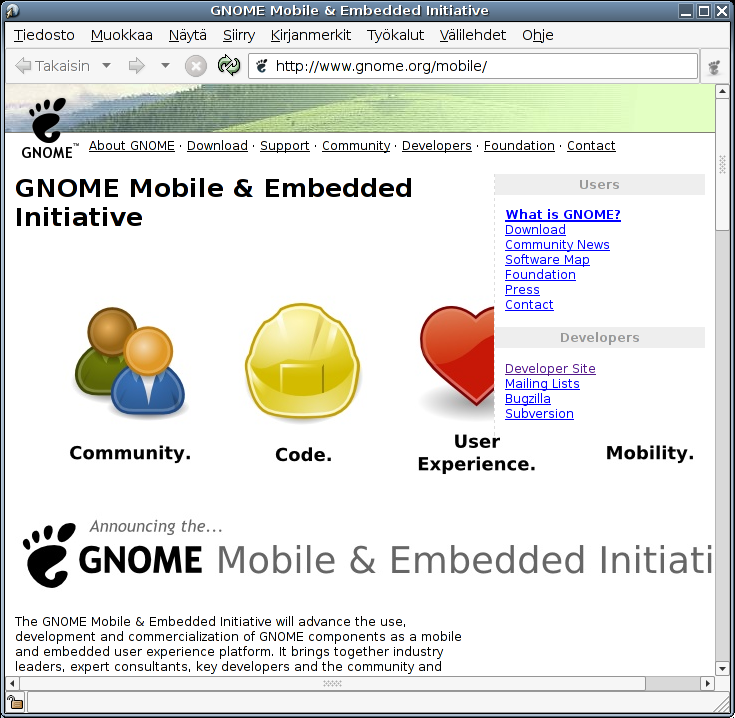
The GNOME project announced a GNOME Mobile & Embedded Initiative today. Here's a screenshot of the browser on my laptop of the web page:
screenshot
What's wrong with the above picture? The browser window is around 700 pixels wide, which about as wide as you'd get on, say, an N800 Internet tablet gadget. Significant parts of the web page are unreadable. I have to go to about a thousand pixels wide to get the whole page be visible. This is no way to design pages for a mobile environment. Other than that, it's obviously good. Not worth the hype, not worth keeping secret for months before the big revelation, but a good thing nevertheless.

Brett Parker: Stuff, potentially a bit random

So, found glusterfs today, looks quite interesting, may have to play when I've got some spare tuits... Also, I'm about to take over upstream development of xmms-scrobbler, so currently thinking of which revision control system to use... I'm very tempted to use tla because I know it and use it for everything else that I do, but I've been tempted by the evils that are git, hg and bzr... most likely going with tla because it makes the most sense to my often broken little mind, and I like the abrowse command rather too much :) What else? Probably lots of stuff, oh, looking for a nice multiple project group type build daemon - we've got 4 main branches of a piece of software at work, and packages should be auto built for each of the branches on a commit (ish) - we're currently running 4 copies of cruise control to build the debian packages, that's a little bit on the heavy side, though - and all it'd need to make it actually work for me would be to have a project group config option, so you can assign a number of processes per project group... but it doesn't have that - I just discovered CruiseControl.rb, which is a bit lighter, but it's still not quite what I'm after. May end up writting a small python buildd to deal with it instead, and hook it in to the svn repository with some post commit hooks. Also got a whole lot of Nagios configuration to finish off to monitor a bunch of servers. So, that's a small brain dump... more when I remember what the hell it was that I was supposed to be doing - been a hectic day!

MJ Ray: The Tragedy of Targets

I've started using the phrase "tragedy of targets" recently for those situations where someone does something stupid to meet an ill-specified target, instead of working towards the result in the way the target-setter expected. This gem was published by a Conservatives candidate over in my home county of Northamptonshire and was mentioned in today's Weston and Worle News
"an offender visited approximately 550 domestic properties in Weston-super-Mare with a fake comic relief sponsor form. This person obtained property by deception, (i.e. convinced them to part with money) from no less than 542 separate victims. Following good work from the police, he was caught, arrested, interviewed and I understand he will be cautioned for all the offences. My sources tell me that as a result of the arrest, the North Somerset District was or is planning to claim 542 'detections' for this one job. This will prove to be an amazing result for the bean-counters and has no doubt salvaged the whole 'performance target' result for the area in 2006. Indeed, the local Police Community Support Officers have spent the week going door to door in an attempt to locate every household that was conned, and get them to sign a pro-forma statement of complaint to bolster the clear-up rate"
Do you know other examples where setting a target has had unintended effects? Do you have a suggestion how to set better targets for the police here? Me, I like the suggestion of one anonymous commenter:
"The Police should be measured on the absence of crime not by detecting it."

Masayuki Hatta: Printing 2 pages in a PDF on 1 paper with GNU a2ps

Somebody asked me on IRC (I established #a2ps at freenode, btw) how to print 2 pages of a PDF file on a single paper. And suddenly he (or she) left the channel. Well, I'm not sure I'm suppose to answer this, but anyway he/she gave me a tiny blogbait ;-) Now GNU a2ps can handle PDF files automagically, if you have a working pdf2ps (possibly from Ghostscripts) installed. So all you have to do is:
$ a2ps -2 foo.pdf
At least it works for me.

Tag this post with del.icio.us!

Russell Coker: a Heartbeat developer comments on my blog post

Alan Robertson (a major contributor to the Heartbeat project) commented on my post failure probability and clusters. His comment deserves wider readership than a comment generally gets so I'm making a post out of it. Here it is:


One of my favorite phrases is "complexity is the enemy of reliability" . This is absolutely true, but not a complete picture, because you don't actually care much about reliability, you care about availability.

Complexity (which reduces MTBF) is only worth it if you can use it to drastically cut MTTR - which in turn raises availability significantly. If your MTTR was 0, then you wouldn't care if you ever had a failure. Of course, it's never zero

But, with normal clustering software, you can significantly improve your availability, AND your maintainability.

Your post makes some assumptions which are more than a little simplistic. To be fair, the real mathematics of this are pretty darn complicated.

First I agree that there are FAR more 2-node clusters than larger clusters. But, I think for a different reason. People understand 2-node clusters. I'm not saying this isn't important, it is important. But, it's not related to reliability.

Second, you assume a particular model of quorum, and there are many. It is true that your model is the most common, but it's hardly the only one - not even for heartbeat (and there are others we want to implement).

Third, if you have redundant networking, and multiple power sources, as it should, then system failures become much less correlated. The normal model which is used is completely uncorrelated failures.

This is obviously an oversimplification as well, but if you have redundant power supplies supplied from redundant power feeds, and redundant networking etc. it's not a bad approximation.

So, if you have an MTTR of 4 hours to repair broken hardware, what you care about is the probability of having additional failures during those four hours.

If your HA software can recover from an error in 60 seconds, then that's your effective MTTR as seen by (a subset) of users. Some won't see it at all. And, of course, that should also go into your computation. This depends on knowing a lot about what kind of protocol is involved, and what the probability of various lengths of failures is to be visible to various kinds of users. And, of course, no one really knows that either in practice.

If you have a hardware failure every 5 years approximately, and a hardware repair MTTR of 4 hours, then the probability of a second failure during that time is about .009%. The probability of two failures occuring during that time is about 8^10-7% - which is a pretty small number.

Probabilities for higher order failures are proportionately smaller.

But, of course, like any calculation, the probabilities of this are calculated using a number of simplifying assumptions.

It assumes, for example, that the probabilities of correlated failures are small. For example, the probability of a flood taking out all the servers, or some other disaster is ignored.

You can add complexity to solve those problems too ;-), but at some point the managerial difficulties (complexity) overwhelms you and you say (regardless of the numbers) that you don't want to go there.

Mangerial complexity is minimized by uniformity in the configuration. So, if all your nodes can run any service, that's good. If they're asymmetric, and very wildly so, that's bad.

I have to go now, I had a family emergency come up while I was writing this. Later...


End quote.

It's interesting to note that there are other models of quorum, I'll have to investigate that. Most places I have worked have had a MTTR that is significantly greater than four hours. But if you have hot-swap hard drives (so drive failure isn't a serious problem) then having machines have an average of one failure per five years should be possible.

Daniel Baumann: Debian Live and Google Summer of Code 2007

Debian is this year again part of Google's Summer of Code. Last week, the final decisions about the proposed projects were made and Google granted 9 slots in total for Debian. I am very glad to say that Chris 'lamby' Lambs proposal for Debian Live is amongst those. Here is the abstract from his proposal:
	Live-helper is a utility to build CD, DVD, netboot and USB-stick live
	images of Debian, a GNU/Linux operating system. It boasts support for
	multiple architectures, auto-building images, amongst many other
	features.
	Live-helper is extremely flexible, allowing interested parties to create
	their own system completely specific to their needs, including support
	for custom package lists, kernel parameters, encryption, additional
	commands to configure the live system etc.
	My proposal is to construct a graphical user interface that can be used
	in conjunction with live-helper to build Debian Live systems, allowing
	editing of existing configurations and including a 'wizard'-style
	walkthrough for the first-time user.
	Providing less experienced users with the opportunity to easily create
	live distributions will generate more exposure for live-helper,
	providing more valuable feedback for its developers and ultimately
	helping Debian's image as an extremely flexible and free operating
	system.
	The GUI will be written in Python using the pygtk GTK+ bindings.
The next step on the timeline begins at May 28th, where the students start coding on their projects. I am happily looking forward to it.

Alastair McKinstry: Cool Stars: Brown dwarfs as pulsars

Super Aurora, believed to cause brown dwarf pulsations
Artist's impression of the "super-aurorae" present at the magnetic poles of these radio emitting dwarfs which are responsible for the radio pulsations. (Image thanks to Gregg Hallinan, NUI Galway).
As a followup to the talk given at Galway Astrofest 2007 by Dr. Aaron Golden on work done by the Cool Stars research Group here at NUIG, the detail of this work were announced this week at the RAS National Astronomy Meeting 2007. Other press releases can be found at Spaceflight Now, and NRAO, though the best summary is probably at the NUIG Webpage (Thanks to Ronan Newman for the links). Kudos to all involved: Gregg and Stephen are currently writing up their PhDs and should have an interesting dissertions from this. Basically, they discovered that some Brown Dwarfs can act as Pulsars, blasting out huge amounts of radio-wave energy. Brown Dwarfs are objects between 'Planet' and 'Star' in mass terms, often thought of as boring failed stars, not large enough to ignite into fusion. They were thought by most to be highly boring : this discovery was completely unexpected. As the group in Galway has a lot of pulsar experience, they were well set to explain this. It looks as though this phenomena is due to a 'coherent maser' : an effect seen in large planets such as Jupiter, where the magnetic field spins up electrons from a solar wind. Certainly, it makes Brown Dwarfs, undiscovered until 1994 but thought to be widespread across the universe, more interesting things to look at.

Next.

Previous.