Search Results: "ag"

3 May 2007

David Welton: Cell Phone Software Requires a New Mindset

Alex Krupp talks about cell phone software and why it's not working These are good points, but I remain pretty certain that it will be an area that takes off. I think that, as things stand right now, some of the ingredients are: My own simple example of an application that basically meets these requirements is a mobile shopping list (with the highly original name of ShopList that doesn't suck. By that I mean that you would either be already insane or be insane in short order if you tried to enter a shopping list into a phone via its keypad, so that is taken care of on the web. Sure, it's not a billion dollar startup idea, but I think I'm on the right track with how to create applications and what sorts of things to create.

Adrian von Bidder: About A Number

Now sue me.

Joerg Jaspert: LPI?

That mad duck writes about the LPI exams during DebConf and isnt sure if he should do them or not. Well, first a reply (in a blog, yeah, shudder) to one of his points - yes, Klaus had something to do with this LPI offer. He was my initial contact for LPI, getting the UK LPI people in the boat, and then also made the contact to the “Area Operation Manager” who was the one that offered the special pack in response to one of my requests. So yes, he had a lot to do with this. Second, the “What do I need LPI for?”. Good question. It really depends. Do you have a good job? Do you have a good track record with your work and is that enough for your (possible future) boss? Or is it likely you get one of those that don’t look at what you are actually able to do but instead look at some “certification” from $whoever? Or the company you work for does support for $some-other-big-company and those ask for certifications. Those are the cases when it (can) help to do those exams. If one just wants to do it “for my own fun/private stuff”, then I dont think its the right motivation. I personally don’t have any certification and dont think I need one. I only thought about doing such an exam for a minute as I had “the luck” to win 2 LPI vouchers during Cebit, so it would be free for me.

MJ Ray: Election Day

Like much of the UK, it's election day in Kewstoke. There's no vote for Kewstoke council because there weren't enough candidates to make a contest. 10 candidates for 11 posts, I think. I was approached by a couple of people and asked to run (quite strongly in one case) and I seriously considered it, but I only moved to this village six months ago, I don't know how things work yet and there are many other things I want to do in the next four years (the term of office AIUI). I was also approached by one person at a recent meeting and told that I should have stayed in Norfolk! Of course, that made me feel that I should run just to mix them up, but no, I'll stick to my decision. That comment did tickle me, as I only went to Norfolk to university - and stayed a bit too long. I'm not from round there. There is a vote today for North Somerset council and it's been interesting to compare the campaigning: no doorstepping or hustings from anyone (unlike in King's Lynn), three Conservatives leaflets, three Liberal Democrat leaflets but I didn't even find a web page for the Labour candidate. It's also been interesting to see the campaign coverage in the press: Weston and Worle News have been quite good, while the Mercury seems to prefer gibberish stories like the EU makes our post late. I'll go along, vote and watch for the results, but I suspect this green village of farms and tourism is safe Conservative Hold territory. Although there's been some new building of a largish house estate in the ward, which I suppose might change things. How's election day going elsewhere? I see Conservative Norwich City Councillor Antony Little has already posted the sort of partiality we all know and love...

Simon Richter: uClibc

Current gcc seems to re-execute itself when asked to use a different target with the -b option. This makes things difficult. In other embedded programming news, uClibc is going to be named libc.so.uc0.9.29. The package name will be for the ftpmasters to decide.

Erich Schubert: Magic numbers

When reading this number
09 F9 11 02 9D 74 E3 5B D8 41 56 C5 63 56 88 C0
I thought it was the fingerprint of a GPG key.The first time I came across it, it was encoded in a puzzle; not a particularly difficult one (what key is inbetween of F8 and F10 on your keyboard?).Turns out that this number can be used to decrypt most HD-DVDs produced so far.No, you can't really think you have a copyright on this number? You could have it as a registered trademark, I guess. But I think everybody will be using it to refer to you. :-)From a crypto point of view, it was just a matter of time until this number leaked out. And in fact, the HD-DVD encryption was designed to handle this cases (but it wasn't used correctly). Face it: cryptographers have been telling you right from the beginning that your encryption will be broken by it's very nature (remember: you are shipping decryption keys worldwide in your HD-DVD player devices).[Update: others thought it might be an IPv6 address maybe?][Update #2: Google thinks there are about 300k pages with this number. Maybe we can stop this meme now? :-)][Update #3: it was pointed out to me that nobody claimed to have copyright on this number, but that it is a device to cirumvent encryption and thus violates the DMCA. And that this is similar to distributing magic markers that could be used to 'crack' a famous CD protection used by Sony some time ago...]

Martin F. Krafft: LPI or not?

The Linux Professional Institute offers all its exams at a discounted price at debconf7. That's definitely good news and should earn Klaus Behrla another round of gratitude for his efforts (assuming he's behind this again). However, it also gets me thinking again: I've been meaning to complete my certifications for years but never could be bothered to spend the money (even at a discount) or actually devote the time to the exam itself. At FOSDEM 2007, I had signed up but then skipped the exams to do more important stuff. The reason? During the conference, someone responded with something like "LPI? Why? I am a Debian developer" when I brought up the subject. Good point. I think I could just sit down and pass the second and third stage exams (having contributed to the exams themselves), and do even better with a bit of studying for it. But is it worth it? Does the LPI certification actually prove something that isn't already obvious from my online track record. What do you think? I'd be interested specifically to hear from fellow developers who decided to take the exams. NP: Anekdoten - Monolith Update: thanks, Joerg, for your thoughts. I am not looking for employment, and if I was, I'd certainly not want to work at a company that thinks certifications are the true proof of capabilities. So I guess that leaves me with a 'no' still. But I also want to say that this post is not to discredit the LPI. I think their exams are fair and definitely not trivial. Even looking at some study notes for LPIC1, I learnt some new stuff, so I bet just preparing for LPIC2 and 3 would teach me things I did not know yet. Compared to other certifications by more commercial vendors, LPIC definitely ranks very high, so don't let my blog post discourage you: there are plenty of reasons to take the exams; I was just looking for reasons why I would want to continue taking them. Update: Mario, I would not be a DD if before I had not been and continue to be a system administrator. And I think you'll have problems finding a hand full of DDs who've never touched an ISA card.

Chris Lamb: Final report complete!

Just submitted my third-year project. Was probably the longest document I will ever write:
$ wc -w  find ~/local/bzr/3yp/docs/report -name "*.tex"    tail -n1
19234 total
$
(If new readers are picking up the story late, in the final year of the Warwick Computer Science course, students are required to undertake a reasonably sized project. I chose to write a Java compiler in Python.) Actually writing the report was a bit more painful than I thought, dispite having collected and organised most of the data, references and interesting topics well in advance. I’ve nearly overcome some sort of writers-block-cum-nervousness issue though, which is good. I got a few interesting results: My backend system had a peephole optimiser to run on all code regardless of the input language and it seems like Sun’s javac seems to miss out on many really trivial optimisations, probably because the JIT takes care of any performance blackspots. Regardless, I plan to have a go at adding this into OpenJDK after my exams just as an excuse to hack on the Real Java. (I also did some register allocation, also beating javac, althought I didn’t really investigate way) I’ll have to wait for while due to University regulations anyway, but I’m not sure if the project code is really fit for public consumption yet, but I plan to rip out the silly Lisp implementation (and most of the Java one) leaving a rather fast and “enterprise-ready” Brainf*** compiler. :)

Clint Adams: Oh!

Barbie was dying to know some specifics of the contents of an airplane bathroom. This video does not answer all questions. [airplane bathroom]

Adam Rosi-Kessel: Linux Installation Video

Speaking of funny embeddable videos, here’s another one that will appeal to at least some segment of my readers. I don’t know if this one has already made the rounds and I’m late for the memetrain. If so, I blame the fact that I’m getting on in years. And here, via Tikirobot, is a not-funny video about Dasher, an amazing information-efficient typing system. Again, I suspect I’m late to the party on this one:

David Moreno Garza: scar de la Hoya - Floyd Mayweather

Read Roberto Sosa’s column on the reasons why each of them could win the Super Fight. Can’t wait! :-D

2 May 2007

DebConf team: LPI exams during DebConf7 (Posted by Joerg Jaspert)

As already announced, we’ve arranged for interested people to take LPI exams during DebConf7. As the announcement says, you need to register for the exams in two places. First go to the LPI system to get an LPI-ID, and then register for this event, so the LPI people know how many attendees to expect, and for which of the 6 possible tests. (Ignore the MySQL ID, no MySQL certifications will be carried out). You will see that there are currently two timeslots to choose from on 19 June, one at 10:00 and one at 14:00. This should be enough for the number of people we expect to show up, but if not we will arrange more slots with the LPI team. As also stated in the announcement, there is a special pack available. If you registered for DebConf7 and also reconfirmed in time, you can take two LPI exams for only 95 EUR, which is less than one exam normally costs. If you haven’t managed to register and reconfirm in time, don’t worry: the LPI exam will still be available at half the normal price. Oh, and someone just asked: you can register for the LPI exams right up to the day they’re held at DebConf. Only the special pack is limited to those who registered and reconfirmed for DebConf in time…

Cameron Dale: May-02-2007

Well it's been a busy week. Work is truly underway, as I have just about finished the first release of debtorrent. The first step in the process, adding variable-sized pieces the size of each file, has been completed and seems to work properly. I've tested it using a single seed, and with 3 downloaders. All were able to contact each other, and all downloaded the entire archive successfully. The archive I tested it on was stable/contrib/i386, as it is only 112MB. There's just a few more modifications to make to polish the code, and then the 0.1.0 version of debtorrent should be released in the next week. It would be out already, but I've been plagued with a cold for the last week. I had a lengthy discussion with Anthony about the eventual need for some modifications to the apt-ftparchive program to support some of the proposed advanced debtorrent functionality. More investigation is needed on the implications of these changes, which will probably require larger Packages/Release files to be generated, and some extra computation time. To collect information about these changes and their implications, I've created a new wiki page.

Axel Beckert: VCFe talk online / bijou vs Etch

With a few days lag, the slides to my VCFe 8.0 talk Aktuelle, freie Software auf alter Hardware (“Up to date, free software on old hardware”, held in German using Kazehakase and S5) are now online. In comparision to my former talks on that subject (held at some DebianDays), this talk was not Debian focused but focused more on not so well known, but resource-friendly free software as well as focused on an audience which has more knowledge of old hardware than of current software. :-) Additionally, I updated my old blog post about X on my ThinkPad 760ED named bijou so that now also my current XF86Config-4 for Sarge on that box is linked in there. Apropos bijou: I couldn’t recommend Debian 4.0 Etch that much for old computers with not so much memory since especially aptitude has grown much in regards of it’s memory and performance needs. Regarding my experiences with Etch, any computer with less than 50 MB of RAM will start to swap if aptitude is only started on such a box. I’ve looked throough the aptitude documentation, but I haven’t found a way to switch of some of the tables it generates internally. E.g. I have no need for the tag database it always generates. I really would be happy, if someone knows a way to turn even only that feature off. Then I may dist-upgrade bijou to Etch, since I found that dselect is no real alternative to aptitude anymore. Oh yeah, and I of course bought new old hardware at the VCFe: A 386SX Thin Client named Flytech Carry-I 9300 from 1991 with about 200 MB of harddisk and 10 MB of RAM.

Romain Francoise: Emacs guided tour

Phil Sung's A guided tour of Emacs is now up on the Emacs homepage at gnu.org. It's a nice introduction to the many faces of Emacs and it also shows off several new features in Emacs 22.

By the way, if you were wondering why emacs-snapshot isn't being updated in sid anymore, it's because it's now maintained outside Debian; I asked for its removal from the archive a while ago.

Jonathan McDowell: What did you say?

I am currently partially deaf, thanks to a sexy build up of wax in my ears. I have drops (peanut oil, apparently) which are supposed to help, but first they make it worse. So my apologies to anyone at the Nominet AGM today who thought I was blanking them, and indeed for anyone sees me over the next week or so and has to deal with me constantly asking them to repeat themselves. And my sympathy to anyone who has a permanent hearing problem.

Anthony Towns: A conversation with jdub

A couple of months ago I was sitting in a north Sydney pub cradling a beer with the ineluctable jdub, the decidedly unparsimonious rusty and (if I’m accurately remembering who’d left and who hadn’t by this point) the irremediable mrd. As you might imagine, these sort of conditions are a perfect breeding ground for a particular type of discussion, and with Jeff’s departure from Canonical not that long beforehand accompanied by the then ongoing DPL elections, talk turned to the future of Debian, and in particular Jeff’s views on that future. Obviously more than a few weeks have passed since then, so please imagine this as a dream sequence with a stylish TV fade-in accompanied by appropriate fine print caveats about paraphrasing and the perfidy of memory. I think it’s fair to sum Jeff’s main point about the future of distros as one of “disintermediation” – that is removing, or at least minimising, the barriers between the authors and users of a piece of software, and in general getting closer and quicker collaboration between everyone involved and interested in developing and maintaining that software. Which means things like trying to remove the line between the Debian bug tracker and upstream bug trackers entirely, so that Debian users end up talking directly with the upstream maintainers, rather than having a Debian maintainer relaying information between the two. It also means making the path for updated packages to get to users quicker and smoother – so that as soon as a developer commits a new version of the software to version control, the next time users of that software “apt-get update” they see it, download it, and start using it. Or at least, they do if they’ve chosen to follow the bleeding edge. Jeff had a bunch more ideas in that vein – like not bothering with a central archive, but having users collect the packages they’re interested in from upstream sites all over the place, standardising, reducing or removing the “control” information for packages so that creating the correct packages for 80% of free software (that uses ./configure in the usual way, eg) was a complete no-brainer, and perhaps viewing distributions not so much as the gatekeepers and central players of the open source world, but perhaps more as systems of providing resources, assistance and opportunities to software authors who deal with their users directly – and in so doing have more of an opportunity for their users to actively participate in the project’s development, and have more feedback (and control) of how their project is perceived by its users. I’m not sure if I’m doing it justice – it’s a pretty radical notion, and as an upstream-type hacker, Rusty was pretty enthralled by it. As a distro-type hacker, on the other hand, I’d have to say I was daunted: getting rid of the middleman here means getting rid of Debian, which I must admit I have something of an attachment for… and yet, in principle at least, I can’t see anything but good sense in the idea – getting users and developers interacting more closely is important to improving the free software community, and while distros have historically been a force for making free software more accessible to people, it’s entirely possible we can now make it even more accessible now by, in some sense, doing away with distros. And if that’s the case, then we definitely should, because it’ll benefit both users and developers of free software, which is what we’re all about. On the other hand, distributions (at least currently) aren’t just about collecting and compiling software which could be automated; it’s also about integrating it, standardising interactions between software, and in some cases acting as a buffer between users who want to use a bit of software and developers who for one reason or another don’t actually want to deal with those users (perhaps due to lack of a shared language or political or philosophical disagreements). I think it’s also pretty interesting to view Gentoo through this light; that is, not so much as a distro that makes you compile everything from source, but rather as a distro that gives its users a system based on exactly what the developers produce, with the addition of only a comparably tiny amount of Gentoo-derived content. Maybe it’s just me, but Gentoo sounds a lot more interesting to me in that light. So is that a foretaste of the future of binary free software distributions too? There’s a lot of things that would stand in the way of Debian managing that, but so far all I can think of is a thousand problems that should probably be solved anyway, and not even one that can’t. I think, btw, that jdub had been reading Accelerando (also available as a Creative Commons licensed ebook) somewhat concurrently with thinking about this stuff, so perhaps it should be called “Distributions 2.0” or something. Accelerando’s a crazy-awesome near-future/singularity book by Charles Stross, who happens to live in the city that will host the forthcoming DebConf 7…

Wouter Verhelst: Dear lazyweb,

I'm currently setting up a drupal-based site. While it's working pretty well and has allowed me to get most things done that I needed doing, there's one remaining issue that would need resolving. I tried asking for suggestions on the drupal support mailniglist and on the #drupal-support channel on freenode, but I haven't received a solution thus far. Hopefully someone reading one of the planets I'm on knows the answer. The site would need to be multilingual. That is to say, not just the interface, but also all static content and some of the nonstatic content would need to be translated in two (at first) languages (perhaps more will follow in the future). Using the i18n drupal module, I have been able to create alternate-language versions of some nodes, and enable a language chooser, allowing a visitor to choose a different content language for the site and seeing the site translated. However, there is one issue that needs to be resolved: the menu. The i18n.module does not create an alternate version of a translated node; rather, it creates a new node. This node then is linked to the original node by way of some extra table that the i18n.module installs. As such, both versions of the same content will have a different node number. To give a concrete example, the Dutch version of the "about" page on the site I'm creating is node/2, whereas the English version is node/10. Since you might want to review the English version of a node even if you request the site in Dutch, you do not unexpectedly get the Dutch version anyway if you request node/10. Since the node number is part of the URL of the node, this makes it impossible to create a link to "the about node, in whatever language is appropriate". The i18n module also comes with a "i18nmenu" module, which allows one to translate a menu item's description using gettext. This works, but it has one fatal flaw: it does not allow to change the target of the link. As a result, and given the above, it's impossible to create a menu item for "the about node in the current language, whatever that means". In an effort trying to work around that issue, I've come up with a number of things. Unfortunately, none of them seem to work to satisfaction. At this point, I'm effectively out of ideas. If anyone has a solution (or can tell me why it isn't possible), I'll gladly hear it, either as a comment on my blog or by mail on w@uter.be.

Nico Golde: Setting up build chroots on Debian

Note to self: Installing build chroots on Debian quick&dirty (here testing and unstable).

Package: schroot
Description: Execute commands in a chroot environment
schroot allows users to execute commands or interactive shells
in different chroots. Any number of named chroots may be
created, and access permissions given to each, including root
access for normal users, on a per-group basis. Additionally,
schroot can switch to a different user in the chroot, using PAM
for authentication and authorisation. All operations are logged
for security.
.
Several different types of chroot are supported, including normal
directories in the filesystem, and also block devices. Sessions,
persistent chroots created on the fly from files and LVM snapshots
are also supported.
.
schroot also integrates with sbuild, to allow building packages with
all supported chroot types, including sessions.
.
schroot shares most of its options with dchroot, but offers vastly
more functionality.

$ apt-get install schroot cdebootstrap
$ mkdir -p /home/chroot/ sid,testing
$ addgroup sbuild && adduser nion sbuild

$ cat > /etc/schroot/schroot.conf EOF
[sid]
description=Debian sid (unstable)
location=/home/chroot/sid
priority=3
groups=sbuild
root-groups=root
aliases=unstable,default
run-exec-scripts=true
run-setup-scripts=true

[lenny]
description=Debian lenny (testing) 32-bit
location=/home/chroot/testing
priority=3
root-groups=root
groups=sbuild
aliases=testing,lenny
run-exec-scripts=true
run-setup-scripts=true
EOF

$ # the necessary setup apart from binding directories will be done by schroot now
$ # stable chroots are added in the same way

$ cat >> /etc/fstab EOF
proc /home/chroot/sid/proc proc defaults 0 0
/home /home/chroot/sid/home none bind 0 0
proc /home/chroot/testing/proc proc defaults 0 0
/home /home/chroot/testing/home none bind 0 0
EOF

$ cdebootstrap --arch i386 testing /home/chroot/testing/ http://ftp2.de.debian.org/debian/
$ cdebootstrap --arch i386 sid /home/chroot/sid/ http://ftp2.de.debian.org/debian/
$ # you need to add (if you are not using unstable)
   Suite: lenny
   Config: sid
   to /usr/share/cdebootstrap/suites, unfortunatly it wasn't added before the etch release.

$ mount /home/chroot/sid/proc && mount /home/chroot/sid/home
$ mount /home/chroot/testing/proc && mount /home/chroot/testing/home

Et voila
$ schroot -c sid
build:~#

You don't need to be root to execute this and you have your home directory available in the chroot because of the mount bind.

The host used for bootstrapping is automatically added to your sources.list in the chroot but you need an apt-get update to install packages afterwards. Suggestions welcome.

Michal Čihař: What happened on last day of April?

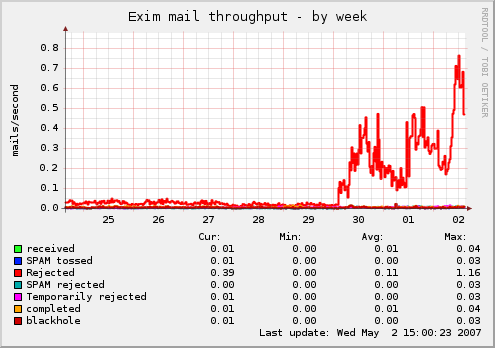
I just looked on server statistics and I was shocked by amount of spam and viruses rejected during last three days. Is there some new virus for Windows which tries random email addresses on all servers it can reach? I didn't analyse those messages, as they are rejected at RCPT time, because sender tries random addresses which do not work on my server. For now I try to reduce them by blacklisting in iptables, but this doesn't seem to help much as IP addresses change too often. I think that graph shows best what big change has happened: Mail graphs Update: It seems to be new Sober variant causing this mess.

Next.

Previous.