Search Results: "sten"

10 December 2007

Steve Kemp: to let the insects in

My migration to mercurial is now complete. I've completed the last step, which was the migration of all the $foo-commits mailing lists. It is at times like this that I remember two things: Right now I'm using ecartis for my mailing lists, primarily because it isn't mailman. (Long story). For making archives of mbox files I'm using hypermail. The latter I intend to change as soon as I can find something else to use. It isn't attractive, but it is in the Debian archive and seems reliable. Since I was changing things around already I've centralised the list-archive making, and started using the haschanged tool to avoid rebuilding the archives i there are no new posts. That works nicely.

7 December 2007

Torsten Werner: IcedTea for Debian


IcedTea is the 100% free variant of Sun's OpenJDK. I have ported the existing Ubuntu package 'icedtea-java7' to Debian. My inofficial package is currently available at http://people.debian.org/~twerner/ for the architectures amd64 and i386. I do not plan to upload it to Debian.

6 December 2007

Evan Prodromou: 15 Frimaire CCXVI

My friend Hugh McGuire just launched a new Web site: earideas. It's a curated collection of the best podcasts on the Web -- kind of an interesting choice. Hugh's best known for the Librivox project -- a collaborative effort of thousands to make public-domain audio books freely available on the Web. He's also the leader of datalibre.ca and the co-founder of Collectik, the social sharing site for podcast enthusiasts. All of which is to say that he's a massive-collaboration kind of guy. So why the curated collection? Says Hugh, "It s built specifically so that you don t have to do anything much more than you do when you turn on a radio." In other words, they're finding the best stuff for you. I think the site makes a nice complement to Collectik. In any event: the gang at earideas has asked for lists of people's top 5 favorite podcasts. I'm still not very much into the podcasting thing; I don't have a portable digital music player, and I haven't found listening to music on my laptop or desktop really useful. But I do listen some of the time, so I figure I could give my suggestions.
  1. Linuxcast by the personable and telegenic Don Marti. Great coverage of software and society in the Free world.
  2. FLOSS Weekly. The "weekly" part is a bit of a stretch, but this is a very good interview show about Free/Libre/Open Source Software. I miss Chris DiBona as host, but Randall Schwartz is no slouch, either.
  3. Destinyland. Destiny is perhaps one of the greatest pop culture researchers alive today. This very occasional podcast is just like having Destiny corner you at a party and talk for 90 minutes about the suspicious circumstances of Alfalfa's death. It's fascinating.
  4. CBC Radio 3 Podcast. Yeah, it may make me terribly unhip, but I like Radio 3.
  5. Radio Open Source. I want to hate this show for capitalizing on the name "open source" without actually providing any open content or talking about Free Software. But it's one of the best shows on the Web.
All right, that's my five. Good luck, Hugh and the rest of the gang at earideas.com. tags:

Million-dollar idea So, I use a Logitech Trackman Marble for my desktop computer -- sometimes called the one true pointing device. I think it's awesome, and I've had it for maybe 10 years. The only downside is that every 6-8 weeks I have to pop off the cover and clean out all the finger oils, dust, hand hair and cookie crumbs that have amalgamated to a greasy, fuzzy crud inside. It may be one of the most disgusting things I do regularly -- and remember, I have a 2-year-old, so that's saying something. Anyways, here's my idea for a device, free for you to use. It's a self-cleaning trackball (or mouse). Just like a self-cleaning oven, every few weeks you'd click a special button on the device and it would heat itself to 800 F for about 90 minutes until the dang thing is just glowing white-hot and it vaporizes any crud that may be inside. Then, you can go about your business with a smooth, clean mouse (or trackball) again. Viola! I think the idea would work for keyboards, too, but I really rarely clean my keyboard. Filthy keyboards seem to work fine most of the time, and when they don't work well you can just throw them away and get a new one. But there's no accounting for taste and anyways people may want to buy a matching set of self-cleaning keyboard and mouse rather than just one or the other on its own. You, reader, can use this awesome million-dollar idea on your own, free of charge. Enjoy! tags:

2 December 2007

Steve Kemp: to let the insects in

My migration to mercurial is now complete. I've completed the last step, which was the migration of all the $foo-commits mailing lists. It is at times like this that I remember two things: Right now I'm using ecartis for my mailing lists, primarily because it isn't mailman. (Long story). For making archives of mbox files I'm using hypermail. The latter I intend to change as soon as I can find something else to use. It isn't attractive, but it is in the Debian archive and seems reliable. Since I was changing things around already I've centralised the list-archive making, and started using the haschanged tool to avoid rebuilding the archives i there are no new posts. That works nicely.

1 December 2007

Joey Hess: my mpd setup

One of the hard things about getting started with mpd is that there seems to be little documentation about the details of how other people use it. Instead you're given a collection of great tools and an excellently designed system, and expected to build your own personal music playing setup out of them with little direction. So I thought I'd document mine. There are several computers around the house that run mpd. One in my office, one has speakers in the bedroom. My laptop, of course. And I put a nslu2 in the living room in a fun lego case that embeds the little computer into a remote controlled speaker (photos when I find a camera). All of these machines have their music libraries synchronised using unison. I use sonata as a graphical frontend and browser. I keep one instance of sonata running on my desktop in the office, so I can go there to change music if my laptop's not on. Also so guests can change the music. I like to listen to whole albums at a time, and sonata doesn't make this especially easy in its user interface. I eventually realised that the best way to do it, for me, was to create a separate playlist for each album. Sonata does make it really easy to click on a playlist and start playing it. I wrote mpgenplaylists to automatically generate those playlists for me. I wrote a set of commands that I can use to transfer state between my mpd daemons. The easiest to use and most useful of these is mpswap, which swaps the state of two daemons. Generally I only have one mpd playing at a time, and the others are paused, though it'll also swap the states of two running mpds. So if I run "mpswap dodo dragon", the music that had been playing in my bedroom starts coming out the speakers in the office. Same song, not a single missed note. That's pretty handy. Or I can run "mpswap dodo" to swap state with my laptop, and carry the music out of the house with me. (This would be more seamless if I carried some bluetooth wundergadget so my computers knew where I am, but I think I'll pass.) Another tool I wrote is mpstore, which dumps the mpd daemon state out to stdout, so it can be saved to a file and later loaded with mpload. I use this when I'm listening to audiobooks, to store my place. Another one is mpfade, that can wake me up by slowly fading in music. Or slowly fade out and stop. Writing these little hacks is addictive, but I won't bore you with the rest. On some of the servers I run mpd-dynamic, a daemon that watches the playlist and makes sure it always has 10 unplayed items in it, chosing new items at random. It also removes old played items from the playlist. This is nice if I want music going without the bother of picking what. I typically add some albums to the playlist, and then when they're done, it keeps playing random stuff until I manually add something else. I do want to find something that can more intelligently pick things to play. I tried lastfmpdqc, but didn't like its results. Switching to mpd has meant that the filenames of mp3s matter again, since mpd UIs expose the filenames (a pity). I used exfalso to clean up all my file names based on the music's tags. I also added ReplayGain information to all my music so mpd can use it to normalise volume. BTW, after all this, I'll probably still only listen to music for an average of 3 hours per week.
mpd-dynamic is in the Audio::MPD perl module. mpdswap, mpdstore, mpfade, mpgenplaylists, and more are in mpdtoys.

30 November 2007

Frans Pop: debtree 0.7.2

Now available from alioth: debtree 0.7.2. The main change in this release is a much better display of virtual packages in dependency graphs. With this release I consider debtree "feature complete" when it comes to the information that is displayed in the graphs. A quick summary: Currently not supported are displaying Relaces, Obsoletes and Enhances relationships. If there's demand for it, adding them should be trivial. If you haven't yet, take a few minutes to look at the example graphs on the debtree website. What's next for debtree? You may remember that I filed an ITP when 0.7.1 was released but obviously its not in the archive yet. One reason is that debtree is completely redundant, at least if you consider the original reason I wrote it: to list how a package depends on another package. Just after the release of 0.7.1 I found out that aptitude why <package> <package> already provides that functionality!
I'm tempted to blame Enrico because I asked him if that was possible before starting on debtree, and Enrico really is supposed to know such things [1]! Luckily debtree now produces such nice dependency graphs to justify its existence :-) Anyway, I think that option should probably just be stripped out of debtree now. And if that is done, maybe it should be renamed to debgraph or apt-graph... I also discovered that beside apt-cache there was already another utility that produces dependency graphs: apt-rdepends. While, just like apt-cache, it lacks most of the features of debtree, it is quite fast and, because it is written in Perl, I could possibly port debtree to Perl myself using apt-rdepends as an example. Another reason is that a few people commented that maybe it should not be a separate package. I somewhat agree with that, but also would not like it to disappear in something non-descriptive like debian-goodies. I'd very much prefer it to eventually see it included in apt itself, or maybe in apt-utils. So basically I've been holding back a bit on uploading debtree to allow me to consider all this. The next task definitely is a rewrite in a better language and thereby give debtree a performance boost. [1] To his (and my) defence: that feature was only recently introduced in aptitude.

Felipe Augusto van de Wiel: 30 Nov 2007

It is about time...

qmail under Public Domain
Using qmail-ldap for quite some time (first because of my employer and then because I was used to it), the DJB license was a major pain, qmail-ldap patch is under BSD, but the original qmail was non-free. Yes, was. Yesterday DJB released qmail under Public Domain, and based on a GoogleVideo, he is going to change the license for all his existent software and for all his future works.

For some strange reason the URL direct to the video doesn't work, but if you do a search you are able to use the Watch video here option.


Not only that
Yes, I know. I'm not going to say sorry, I should post more, this last three months were not exactly the best ones, and I thought about writing something about what I was doing for Debian and other projects here but ended up being consumed by University, Work, Real Life and "Other Stuff (tm)".

One of the important things on the way is the Debian i18n Extremadura Meeting to be held on December, when we expect to work on i18n.debian.net, change from CVS to SVN, improve DDTP and ddtss and work with Pootle related stuff and infrastructure.

In the meantime, we are also changing our Primary Push Server for volatile.debian.org from durin to verdi (don't worry, a proper announcement will be made on an announcement list close to you). :-)

Thanks for everybody that had the patient to wait for my replies and/or my actions, and the ones that calmly understood my undergoing situation, giving me support and offering help. Thank you very much!

Russell Coker: Vista ReadyBoostReady - Good for Linux?

At the moment it seems that about half the USB flash devices on sale are listed as “Vista ReadyBoost Ready“. I recently bought an 8G USB device that I returned because it could only sustain 4MB/s writes (not much fun for backing up 4G+ of data). So I’ve been wondering whether I should get a ReadyBoostReady device. ReadyBoostReady only means that it is faster than other devices in some ways, it has no inherent feature difference. After some searching I found a FAQ about ReadyBoost [1] which explains what it requires. It seems that ReadyBoost needs “2.5MB/sec throughput for 4K random reads and 1.75MB/sec throughput for 512K random writes“, which isn’t really a lot. About 5-6 years ago I was running some machines with 4 disk RAID-5 arrays that could sustain 3MB/s writes for significantly smaller block sizes (maybe 12K), given that random access is something that disks are really bad at (physical movement of the heads is required) and something that flash is good at) it gives an indication of how low the performance bar is for ReadyBoost. I’m sure that a device which meets the minimum specs would do some good if you have a single disk that’s not overly fast. But if you have a decent RAID array for swap then I doubt that the minimum requirements for ReadyBoost would give a benefit. As for doing bulk transfers, it seems that while ReadyBoost Ready devices will have consistent good performance across all their storage (apparently some devices perform better for the first blocks so that people who use FAT based filesystems can get good performance from their FAT) they won’t necessarily have particularly good performance for bulk IO (1.75MB/s is pitiful when you want to copy DVD images). There are some USB flash devices that are marketted as having high performance and which are supposed to sustain >20MB/s, but I’m unlikely to find them going cheap at my local electronics store. I had hoped that ReadyBoost would be demanding enough that the ReadyBoostReady devices (which aren’t the cheapest flash devices on sale but often aren’t too expensive) would satisfy my requirements.

27 November 2007

Bastian Venthur: Time-lapse-video-with-your-webcam mini HOWTO

I bought me a cheapo webcam the other day and the first thing (meh… actually the second. The first thing I had to do was obviously getting this little piece of plastic working…) I wanted to do was making a time-lapse video of me working on my diploma thesis or something. With a little help from google and the friendly folks at debian-user-german I finally got it working. snapshot.jpg What you need: camserv, wget and mencoder. Assuming you have your webcam working with v4l, camserv will provide snapshots of your cam via http://localhost:9192, so the following script will make a snapshot every second until you kill it:

#!/bin/sh
while [ 1 ]; do
    wget http://localhost:9192 -O  date +%s .jpg -q
    sleep 1s
done

Let it run for several hours and then create the movie with the following script:

#!/bin/sh
mencoder "mf://*.jpg" -mf fps=25 -o output.avi -ovc lavc -lavcopts vcodec=mpeg4:mbd=2:trell=yes:v4mv=yes

Hint: coding, juggling and even sleeping at your desk looks cool in time-lapse - eating or singing your favorite songs while listening to them does not :P I recorded myself for ca 12 hours and the resulting video was like 130 megs large. The result looks pretty funny, but since there was a lot of the not-so-cool-looking eating and singing stuff in there, I’m afraid I can’t even show it to my closest friends ;) Hint for users having problems getting proper images from camserv: I had to change max_frames value to 1 in the [socket] section of /etc/camserv/camserv.cfg to get proper single images via wget. I find the camserv solution to get the images from the webcam rather suboptimal, has anyone a smarter solution? NP: Gianna Nannini - Bello e impossibile

Clint Adams: Return of the Back Bay Backbiters

I was running down Boylston to avoid smelling ICF guy, and, much to my surprise, I accidentally kidnapped a young girl. Look well, I said, after distracting her from the lotion store. Up there, by the rainbow mezuzot, what do you see? She squinted, bit her lip, and squeaked Is that Coldplay they're listening to? I'm afraid so, I replied, and waited as she drew me this: [happy family]

25 November 2007

Rob Bradford: Wordpress cookie vulnerability

It seems the Wordpress developers have made some wrong decisions in their use of MD5. Full details are in this announcement. In summary, the hash in the cookie for authentication contains MD5(MD5(password)) and the database MD5(password). This means that anyone with access to the hash from the database can pretend to be this user. Whoops. This shows that once again that security is hard as people consistently make the same mistakes. More details and background on the Security Group blog.

Roland Mas: Gforge news, November 2007

Apparently some people worry that Gforge may be abandoned, or on the verge of being superseded with the proprietary "Gforge Advanced Server" rewrite. Let it be known that I for one have no plans to switch to Gforge AS, for all the reasons you'd expect from a free software user and advocate: I don't have access to the source code (it's made illegible by some sort of industrial PHP obfuscator), I can't hack it because the license doesn't allow me to, I can't audit it for security flaws, I can't adapt it to particular needs, etc. Since a significant part of my income comes from maintaining Gforge instances for clients, with local modifications for their particular needs, it's an economical necessity that Gforge stays free. And evolving. Right. Having said that, I guess I have to show concrete evolutions in addition to principles and ideals. So what changed recently? All this has committed and uploaded to Debian. As usual, please test and report failures. Plans for my foreseeable future include: Places where help would be most welcome: There. That was the news. Now for a bit of trivia: it's amazing how having a metric of one's productivity gives an incentive to increase it. I found mine on Ohloh, which provides code and license analyses and statistics on free software projects, as well as statistics on commits by contributors. They even have a shiny widget with a scrollable timeline showing commits over time, as well as comparative commit graphs. My obvious personal goal is to get up to the first position among the contributors, but of course I wouldn't complain if the current top committer stayed ahead by springing back into activity.

21 November 2007

Daniel Burrows: Good ideas in customer service: kill the hold period

The lender for one of my student loans has apparently started using a rather cool system to manage incoming customer service calls. If all the call-takers are busy, then instead of forcing you to sit there listening to a call telling you how important your business is to them, they let you request a call-back. They ask you to enter a phone number where they can reach you, then give you a time window in which they'll be calling (in my case I think it was about two minutes wide). When my turn came up, they called me and I was able to speak with a human immediately.

This is such a huge improvement over the typical call center experience that I'm amazed it hasn't caught on more broadly.


I'm guessing that this option will be available in more and more places as companies computerize their telephone systems. Another nice twist, if there are any telephony guys reading this, would be to allow me to request the customer service call from a Web page, eliminating the toll-free call altogether and presumably saving some expense for the company.

An interesting question for me is how they generate those estimates of when they'll be able to help you. I'm guessing that they use some queueing theory to estimate the most likely wait time for the next incoming customer, but this is something I have only a fuzzy awareness of. However they did it, the estimate seemed accurate enough to me.

Gerfried Fuchs: In the mirror...

One says the eyes are the mirror of the soul. I made this experience back in easter for the first time. I was over at my brother's place for easter celebration when I got up in the morning, went into the bath and looked into the mirror for morning toilet. I washed my face like always with cold water to refresh myself, and when I removed my hands... I was sure I was looking into a female face. It quite a lot bewildered me; it was the first time this happened. And I wasn't even properly shaved...
An experience like this is something special I guess, and it happened more and more often in the meantime. I guess this is one more proof that what I feel is the right thing. ... even though still some others seem to be immensly ammused by it. When I went to the ceilidh at the debconf in EDI I received some pretty nasty responses to my outfit, which I didn't expect within a project about Freedom and Openness. Though, I give the people the doubt of not knowing what they have done. It's too much in human nature to joke about things they don't understand, not knowingly insulting others. I'd like to dedicate this fine tune from Garbage to them: Bleed Like Me. If you listen closely to the lyrics you might be able to find out why... There has also been a genderfuck night in the club next to the night venue which on the other hand was pretty nice. It was attended by quite some people from Debian, some expectedly, some to my happy surprise. Thank you again guys, for making this evening to something special. I hope you keep it in as nice remembrance as me. My former SO drew a while ago a pretty nice picture about me. I didn't ask for it, or did hint it, which makes me even more happier about it. Thank you Babsi, really. :) I switched my hackergotchi on Planet Debian to it just in case. Today is the Transgender Day of Remembrance. I stumbled upon it in the Venus Envy comic I got notified about earlier this year, you might want to check its contribution, but beware, it might as disturb you as it does to me. I'm thankful that Erin dis survive it, because she gives so much strength with her comic to me and possibly also others...

20 November 2007

Russell Coker: RAID and Bus Bandwidth

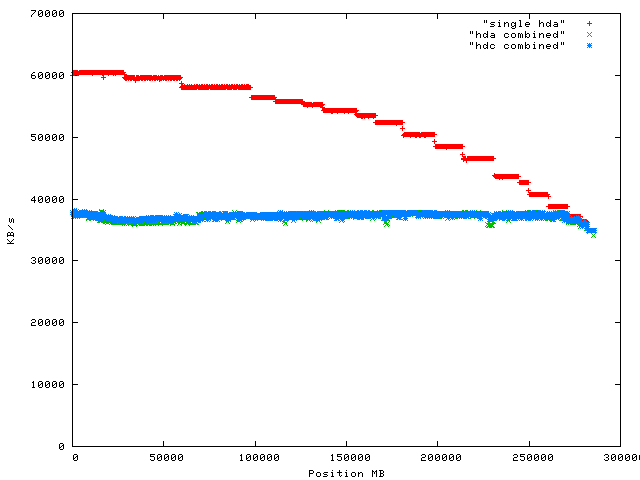
As correctly pointed out by cmot [1] my previous post about software RAID [2] made no mention of bus bandwidth. I have measured the bus bottlenecks of a couple of desktop machines running IDE disks with my ZCAV [3] benchmark (part of the Bonnie++ suite). The results show that two typical desktop machines had significant bottlenecks when running two disks for contiguous read operations [4]. Here is one of the graphs which shows that when two disks were active (on different IDE cables) the aggregate throughput was just under 80MB/s on a P4 1.5GHz while the disks were capable of delivering up to 120MB/s:
On a system such as the above P4 using software RAID will give a performance hit when compared to a hardware RAID device which is capable of driving both disks at full speed. I did not benchmark the relative speeds of read and write operations (writing is often slightly slower), but if for the sake of discussion we assume that read and write give the same performance then software RAID would only give 2/3 the performance of a theoretical perfect hardware RAID-1 implementation for large contiguous writes. On a RAID-5 array the bandwidth for large contiguous writes is the data size multiplied by N/(N-1) (where N is the number of disks), and on a RAID-6 array it is N/(N-2). For the case of a four disk RAID-6 array that would give the same overhead as writing to a RAID-1 and for the case of a minimal RAID-5 array it would be 50% more writes. So from the perspective of “I need X bandwidth, can my hardware deliver it” if I needed 40MB/s of bandwidth for contiguous writes then a 3 disk RAID-5 might work but a RAID-1 definitely would hit a bottleneck. Given that large contiguous writes to a RAID-1 is a corner case and that minimal sized RAID-5 and RAID-6 arrays are rare in most cases there should not be a significant overhead. As the number of seeks increases the actual amount of data transferred gets quite small. A few years ago I was running some mail servers which had a very intense IO load, four U320 SCSI disks in a hardware RAID-5 array was a system bottleneck - yet the IO was only 600KB/s of reads and 3MB/s of writes. In that case seeks were the bottleneck and write-back caching (which is another problem area for Linux software RAID) was necessary for good performance. For the example of my P4 system, it is quite obvious that with a four disk software RAID array consisting of disks that are reasonably new (anything slightly newer than the machine) there would be some bottlenecks. Another problem with Linux software RAID is that traditionally it has had to check the consistency of the entire RAID array in the case of an unexpected power failure. Such checks are the best way to get all disks in a RAID array fully utilised (Linux software RAID does not support reading from all disks in a mirror and checking that they are consistent for regular reads), so of course the issue of a bus bottleneck becomes an issue. Of course the solution to these problems is to use a server for server tasks and then you will not run out of bus bandwidth so easily. In the days before PCI-X and PCIe there were people running Linux software RAID-0 across multiple 3ware hardware controllers to get better bandwidth. A good server will have multiple PCI buses so getting an aggregate throughput greater than PCI bus bandwidth is possible. Reports of 400MB/s transfer rates using two 64bit PCI buses (each limited to ~266MB/s) were not uncommon. Of course then you run into the same problem, but instead of being limited to the performance of IDE controllers on the motherboard in a desktop system (as in my test machine) you would be limited to the number of PCI buses and the speed of each bus. If you were to install enough disks to even come close to the performance limits of PCIe then I expect that you would find that the CPU utilisation for the XOR operations is something that you want to off-load. But then on such a system you would probably want the other benefits of hardware RAID (dynamic growth, having one RAID that has a number of LUNs exported to different machines, redundant RAID controllers in the same RAID box, etc). I think that probably 12 disks is about the practical limit of Linux software RAID due to these issues and the RAID check speed. But it should be noted that the vast majority of RAID installations have significantly less than 12 disks. One thing that cmot mentioned was a RAID controller that runs on the system bus and takes data from other devices on that bus. Does anyone know of such a device?

16 November 2007

Russell Coker: Software vs Hardware RAID

Should you use software or hardware RAID? Many people claim that Hardware RAID is needed for performance (which can be true) but then claim that it’s because of the CPU use of the RAID calculations. Here is the data logged by the Linux kernel then the RAID-5 and RAID-6 drivers are loaded on a 1GHz Pentium-3 system: raid5: automatically using best checksumming function: pIII_sse
  pIII_sse  :  2044.000 MB/sec
raid5: using function: pIII_sse (2044.000 MB/sec)
raid6: int32×1    269 MB/s
raid6: int32×2    316 MB/s
raid6: int32×4    308 MB/s
raid6: int32×8    281 MB/s
raid6: mmxx1      914 MB/s
raid6: mmxx2    1000 MB/s
raid6: sse1×1    800 MB/s
raid6: sse1×2    1046 MB/s
raid6: using algorithm sse1×2 (1046 MB/s) There are few P3 systems that have enough IO capacity to support anywhere near 2000MB/s of disk IO and modern systems give even better CPU performance. The fastest disks available can sustain about 80MB/s when performing contiguous disk IO (which incidentally is a fairly rare operation). So if you had ten fast disks performing contiguous IO then you might be using 800MB/s of disk IO bandwidth, but that would hardly stretch your CPU performance. It’s obvious that CPU performance of the XOR calculations for RAID-5 (and the slightly more complex calculations for RAID-6) is not a bottleneck. Hardware RAID-5 often significantly outperforms software RAID-5 (in fact it should always outperform software RAID-5) even though in almost every case the RAID processor has significantly less CPU power than the main CPU. The benefit for hardware RAID-5 is in caching. A standard feature in a hardware RAID controller is a write-back disk cache in non-volatile RAM (RAM that has a battery backup and can typically keep it’s data for more than 24 hours without power). All RAID levels benefit from this but RAID-5 and RAID-6 gain particular benefits. In RAID-5 a small write (less than the stripe size) requires either that all the blocks other than the ones to be written are read or that the original content of the block to be written and the parity block are read - in either case writing less than a full stripe to a RAID-5 requires some reads. If the write-back cache can store the data for long enough that a second write is performed to the same stripe (EG to files being created in the same Inode block) then performance may double. There is one situation where software RAID will give better performance (often significantly better performance), that is for low-end hardware RAID devices. I suspect that some hardware RAID vendors deliberately cripple the performance of low-end RAID devices (by using an extremely under-powered CPU among other things) to drive sales of the more expensive devices. In 2001 I benchmarked one hardware RAID controller as being able to only sustain 10MB/s for contiguous read and write operations (software RAID on lesser hardware would deliver 100MB/s or more). But for random synchronous writes the performance was great and that’s what mattered for the application in question. Also there are reliability issues related to write-back caching. In a well designed system an update of an entire RAID-5 stripe (one block to each disk including the parity block) will first be performed to the cache and then the cache will be written back. If the power fails while the write is in progress then it will be attempted again when power is restored thus ensuring that all disks have the same data. With any RAID implementation without such a NVRAM cache a write to the entire stripe could be partially successful. This means that the parity block would not match the data! In such a situation the machine would probably work well (fsck would ensure that the filesystem state was consistent) until a disk failed. When the RAID-5 recovery procedure is used after a disk is failed it uses the parity block to re-generate the missing data, but if the parity doesn’t match then the re-generated data will be different. A disk failure may happen while the machine is online and this could potentially result in filesystem and/or database meta-data changing on a running system - this is a bad situation that most filesystems and databases will not handle well. A further benefit of a well designed NVRAM cache is that it can be used on multiple systems. For their servers HP makes some guarantees about which replacement machines will accept the NVRAM module. So if you have a HP server running RAID-5 with an NVRAM cache then you could have the entire motherboard die, have HP support provide a replacement server, then when the replacement machine is booted with the old hard drives and NVRAM module installed the data in the write-back cache will be written! This is a significant feature for improving reliability in bad corner cases. NB I’m not saying that HP is better than all other RAID vendors in this regard, merely that I know what HP equipment will do and don’t know about the rest. It would be good if there was a commodity standard for NVRAM on a PC motherboard. Perhaps a standard socket design that Intel could specify and that every motherboard manufacturer would eventually support. Then to implement such things on a typical PC all that would be required would be the NVRAM module, which while still being expensive would be significantly cheaper than current prices due to the increase in volume. If there was a significant quantity of PCs with such NVRAM (or which could be upgraded to it without excessive cost) then there would be an incentive for people to modify the Linux sotware RAID code to use it and thus give benefits for performance and reliability. Then it could be possible to install a NVRAM module and drives in a replacement server with Linux software RAID and have the data integrity preserved. But unless/until such things happen write-back caching that preserves the data integrity requires hardware RAID. Another limitation of Linux software RAID is expanding RAID groups. A HP server that I work on had two disks in a RAID-1 array, one of my colleagues added an extra disk and made it a RAID-5, the hardware RAID device moved the data around as appropriate while the machine was running and the disk space was expanded without any down-time. Some similar things can be done with Linux, for example here is documentation on converting RAID-1 to RAID-5 with Linux software RAID [1]. But that conversion operation requires some down-time and is not something that’s officially supported, while converting RAID-1 to RAID-5 with HP hardware RAID is a standard supported feature.

14 November 2007

Eddy Petri&#537;or: Linux: plain weird network behaviour; Windows is OK

Update: problem fixed, thanks for the comments; it was MTU related issues.

Note: This is a long post, but I expect it to bring in some questions for many Linux people; I advise you to read this when you have enough time.


After the last events related to connectivity at home which have been lasting since Thursday evening and the weird fact that it seems that NAT doesn't work at home, but does at work for the same setup, I called the ISP's support and wasted 15 minutes trying to convince them at least to send a technical team with another modem just to test if that is the reason for the breakage.

Of course, talking to the ISP support and trying to convince them that there might be a problem on their side since NAT works with another provider but doesn't with them, was fruitless.

Tonight I was stuck and tried another approach, convinced I would confirm my suspicion that there is something wrong on ISP's side. Still I am not yet sure what to conclude from what happened.


So, to get a better view of what is going on, I'll describe the setup I have and what are its limitations and characteristics. People in a hurry can skip to the paragraph starting with "I tested" and stare in wonder at will.


So the connection I have is done through a DSL modem which gets the MAC of the network card connected to it and exposes that as its own to the ISP's network. This MAC seems to be quite persistent and special measures must be taken in order to be able to use another NIC to connect. The modem (or probably some machine in ISP's; the IP is 10.10.0.1) offers a DHCP address and everything should work fine.

Because of this "your MAC is my MAC" issue, when I connected the first time, I used an USB NIC since a broken router or some temporary failure would have allowed me to use the Internet connection directly from my laptop. I can say this decision has proven in time to be wise.

The router I used until now is a NSLU2 with Debian installed on it. The built in network interface always faced the internal network.

The router (which I call ritter) served as a NAT router for two machines inside the network, my laptop and my apartment mate's laptop. All until last Thursday, after which it never got back properly.


I tested (doing NAT on my laptop; the laptop shouldn't have been affected by the power problems):

Of course, I have n-checked that /proc/sys/net/ipv4/ip_forward was set to 1, the tables had policy ACCEPT and there were no extra rules, except the basic NAT-ting stuff, the routes were correctly set on both the clients and the machine doing the NAT.


All I could see is that:
  1. the machine doing the NAT was always working fine
  2. at work all NAT clients worked fine
  3. at home any of the NAT "clients" were
    1. able to resolve addresses while the DNS server was in ISP territory and another LAN
    2. ping the outside world (if ping was available - in D-I is not)
    3. hanging when trying to get a http page
    4. telnet-ting directly to the port 80 was ok (but I didn't try to "GET / HTTP/1.0")

So after all of this, I was thinking of trying to see if a new client (the laptop of my apartment mate, a Windows XP machine) would work using the connection at home. It didn't work.

Then I thought of trying to do "Internet Connection Sharing" as is called in Windows. Of course, there was some pain to find Windows XP drivers for the ASIX AX88172 network card (remember, the modem needed to see the MAC of that NIC), but I managed to find the proper one.


And, almost sure the NAT wouldn't work for this case either, I configured the new connection as a shared one. I didn't even disabled the firewall, as I was thinking I could take those down gradually.

I wasn't expecting this, not even by pure chance, but my laptop which was a NAT "client" now was able to browse, ping and do whatever was normal through NAT, while the Windows machine was doing the "Connection sharing".

I was utterly flabbergasted. And that was just the beginning.


I was expecting that the problem coincidentally went away, but after a minute I was proven otherwise. It still didn't work with Linux as the NAT-ting machine. I connected back the USB NIC to the Windows machine and I saw the same thing. NAT was just working.


At that point I was to observe an even more shocking fact: the IP that the Windows machine got was different from the one the Linux machine received, in spite of the fact that the network card was the same, so it would have made sense to get the same one. More than that, the IP that the Windows machine got was from an entirely different network, although it was a valid IP belonging to my ISP.

I was thinking that one reason why it works with Windows might be that there could be some TCP protocol twist that is differently implemented in Windows and the equipment from my ISP gets along better with the Windows network stack.


As a way to test that, I am thinking of forcing somehow the IP on the Linux machine to see if anything changes. But before doing that, I felt the urge to post these, maybe some kind soul will shed some light on this issue for me or drop a hint.

Another reason might be different DHCP servers answering, but I don't know how I can see in Windows who offered the lease.


If anyone has any clue why these weird things happen, please drop a line. I would greatly appreciate it. TIA.

13 November 2007

Ross Burton: Poky on Android

God, Richard is such a hero. The day after Android is released, he has Poky building and booting on their emulator. There are a number of caveats, such as starting DBus causes their emulator to crash, but it is the first step towards being able to boot Poky on any future Android phones. Android in Poky Full-size images and more available on Richard's blog. Note that the non-existent theming is due to the XSettings not being set, because DBus won't start. NP: Tiger, My Friend, Psapp

Andrew Pollock: [debian] My First Ubuntu Developer Summit

I've been procrastinating writing about my Boston trip, for no particular reason. A bunch of us went to the Boston Ubuntu Developer Summit (in Cambridge, actually) for work purposes. We currently derive from the Long Term Support releases, and Hardy Heron is going to be an LTS, so I wanted us to get more involved directly, particularly at this stage of the game, rather than after it's already a done thing. Anyway, the reason I'm writing this in the "Debian" category is I found the whole thing to be totally awesome. Debian should do something similar. Rather than being a conference, this was essentially a week of 1-2 hour small-group meetings to discuss various features for Hardy. I thought it worked pretty well. I'd never seen gobby used before, and it's basically a poor-man's Google Docs (although one could argue it handles real-time collaborative editing better). They had VoIP up the wazoo. You could dial into a conference bridge to just listen in, or you could dial a different bridge to participate. Every room had a Polycom conference phone in it. That seemed to work pretty well. I think the main reason I think Debian could take a leaf out of Ubuntu's book on this was it helps resolve potentially controversial technical decisions very quickly. Rather than having a two week protracted flame war on a mailing list, you can have a 30 minute rational debate in person and move on. So I've no idea how this UDS stacked up to previous ones, but I was very impressed by the whole thing. I'm in total awe of Scott James Remnant and Colin Watson for not having burned out by now. Doing a release every 6 months, with all the associated stuff that goes around it (i.e. running a UDS) has got to take it out of you.

11 November 2007

Joey Hess: random tip: per-port naming for identical USB devices

This is another case of a udev rule that took over an hour to figure out, and now seems very clear and obvious. Which probably means it won't next time I need it. I have a bunch of USB to serial adapters, all using pl2303, all so cheap that there's no product ID or any way to tell them apart. This is cheaper than buying actual console server hardware nowadays. So how to know which ttyUSB* device is hooked up to what? The solution is to use the USB bus ID, which corresponds to the usb port the device is plugged into. My /etc/udev/rules.d/z25_persistent_usb_serial.rules:
SUBSYSTEMS=="usb", ID=="3-2", KERNEL=="ttyUSB*", NAME="ttyUSB_front_upper"
SUBSYSTEMS=="usb", ID=="2-2", KERNEL=="ttyUSB*", NAME="ttyUSB_front_lower"
The ID numbers can be found in dmesg.

Next.

Previous.