Search Results: "mak"

31 October 2017

Chris Lamb: Free software activities in October 2017

Here is my monthly update covering what I have been doing in the free software world in October 2017 (previous month):
Reproducible builds

Whilst anyone can inspect the source code of free software for malicious flaws, most software is distributed pre-compiled to end users. The motivation behind the Reproducible Builds effort is to allow verification that no flaws have been introduced either maliciously or accidentally during this compilation process by promising identical results are always generated from a given source, thus allowing multiple third-parties to come to a consensus on whether a build was compromised. I have generously been awarded a grant from the Core Infrastructure Initiative to fund my work in this area. This month I:


I also made the following changes to our tooling:
diffoscope

diffoscope is our in-depth and content-aware diff utility that can locate and diagnose reproducibility issues.

  • Improve names in output of "internal" binwalk members. (#877525).
  • Don't crash on malformed md5sums files. (#877473).
  • Omit misleading "any of" prefix when only complaining about a single module on import. [...]
  • Adjust tests as ps2ascii now varies its output on timezone. [...]

strip-nondeterminism

strip-nondeterminism is our tool to remove specific non-deterministic results from a completed build.

  • Clojure considers .class file to be stale if it shares the same timestamp of the .clj. We thus adjust the timestamps of the .clj to always be younger. (#877418).
  • Print a message in --verbose mode if no canonical time was specified. [...]

buildinfo.debian.net

buildinfo.debian.net is my experiment into how to process, store and distribute .buildinfo files after the Debian archive software has processed them.

  • Always show SHA-256 checksums, regardless of the browser viewport size. [...]
  • Add an API endpoint to fetch specific .buildinfo files for a certain package/version/architecture. [...]


Debian My activities as the current Debian Project Leader are covered in my "Bits from the DPL" email to the debian-devel-announce mailing list.
Patches contributed
  • devscripts: Please print the actual arguments debuild makes to Lintian. (#880124)
  • hw-detect: Drop reference to floppy disks; it's almost 2018. (#880122)
  • debci:
    • Use deb.debian.org over http.debian.net. (#879654)
    • Document how to use an alternative mirror. (#879655)

Debian LTS

This month I have been paid to work 18 hours on Debian Long Term Support (LTS). In that time I did the following:
  • "Frontdesk" duties, triaging CVEs, etc.
  • Followed up on a large number of upstream "pings" that have been left dormant.
  • Issued DLA 1121-1 to fix an out-of-bounds read vulnerability in curl where a malicious FTP server could abuse this to prevent clients from interacting with it.
  • Issued DLA 1123-1 for the "Go" programming language where an attacker could generate a MIME request such that the server ran out of file descriptors.
  • Issued DLA 1126-1 for the libxfont font selection and rasterisation library, correcting two vulnerabilities, both involving the library being tricked into reading invalid/random memory.
  • Issued DLA 1134-1 for sdl-image1.2, an image loading library. A maliciously-crafted .xcf file could cause a stack-based buffer overflow resulting in potential code execution.

Uploads
  • python-django:
    • 2.0~beta1-1 New upstream 2.x release.
    • 1.11.6-1 New upstream bugfix release.
  • gunicorn (19.6.0-10+deb9u1) Prepared a release for stable to avoid a runtime dependency on a compiler. (#877722)
  • redis:
    • 4:4.0.2-3:
      • Drop the Debian-specific /etc/redis/redis-server.pre-up.d (etc.) hooks and remove them if unchanged.
      • Include systemd redis-server@.service and redis-sentinel@.service template files to easily run multiple Redis instances. (#877702)
      • Patch redis.conf and sentinel.conf with quilt instead of maintaining our own versions under debian/.
    • 4:4.0.2-4:
      • Add input validity checking to cluster config slot numbers to fix CVE-2017-15047. (#878076)
      • Drop debian/bin/generate-parts now we aren't calling it.
      • Correct Bash-ism in NEWS file.
    • 4:4.0.2-5: Replace the existing patch for CVE-2017-15047 with an upstream-blessed version that covers another case.
  • redisearch (0.21.3-5) Initial release.
  • docbook2man (2.0.0-40) Correct spelling mistakes in binaries and other misc packaging tidying.
  • python-redis (2.10.6-1) New upstream release.
  • bfs (1.1.3-1) New upstream release.

FTP Team

As a Debian FTP assistant I ACCEPTed 103 packages: amcheck, argagg, binutils, blockui, bro-pkg, chkservice, citus, django-axes, docker-containerd, doctest, dtkwidget, duktape, feed2exec, fontforge, fonttools, gcc-8, gcc-8-cross, generator-scripting-language, gitgraph.js, haskell-uri-encode, hoel, iniparser, its, jquery-areyousure, kodi, libcatmandu-mods-perl, libcatmandu-template-perl, libcatmandu-xml-perl, libcatmandu-xsd-perl, libcode-tidyall-plugin-sortlines-naturally-perl, libgdamm5.0, libinfinity, libmods-record-perl, libreoffice-dictionaries, libset-intervaltree-perl, libsodium, linux, linux-grsec, ltsp-manager, lxqt-themes, mailman3-core, measurement-kit, mini-buildd, musescore, node-babel, node-babel-eslint, node-babel-loader, node-babel-plugin-add-module-exports, node-babel-plugin-transform-define, node-gulp-newer, node-regenerate-unicode-properties, node-regexpu-core, node-regjsparser, node-unicode-data, node-unicode-loose-match, openjdk-9, orafce, pgaudit, pgsql-ogr-fdw, pk4, postgresql-mysql-fdw, powa-archivist, python-azure-devtools, python-colormap, python-darkslide, python-dotenv, python-karborclient, python-logfury, python-lupa, python-marshmallow, python-murano-pkg-check, python-octaviaclient, python-pathspec, python-pgpy, python-pydub, python-randomize, python-sabyenc, python-searchlightclient, python-stestr, python-subunit2sql, python-twitter, python-utils, python-wsgilog, r-cran-bindr, r-cran-desc, r-cran-hms, r-cran-readstata13, r-cran-rprojroot, r-cran-wikidatar, r-cran-wikipedir, r-cran-wikitaxa, repmgr, requests-file, resteasy3.0, sdl-kitchensink, stardicter, systemd-el, thunderbird, tomcat8.0, uwsgi-plugin-luajit, uwsgi-plugin-mongo, uwsgi-plugin-php & uwsgi-plugin-v8. I additionally filed 3 RC bugs against packages that had incomplete debian/copyright files against: fonttools, generator-scripting-language & libsodium.

Petter Reinholdtsen: Web services for writing academic LaTeX papers as a team

I was surprised today to learn that a friend in academia did not know there are easily available web services available for writing LaTeX documents as a team. I thought it was common knowledge, but to make sure at least my readers are aware of it, I would like to mention these useful services for writing LaTeX documents. Some of them even provide a WYSIWYG editor to ease writing even further. There are two commercial services available, ShareLaTeX and Overleaf. They are very easy to use. Just start a new document, select which publisher to write for (ie which LaTeX style to use), and start writing. Note, these two have announced their intention to join forces, so soon it will only be one joint service. I've used both for different documents, and they work just fine. While ShareLaTeX is free software, while the latter is not. According to a announcement from Overleaf, they plan to keep the ShareLaTeX code base maintained as free software. But these two are not the only alternatives. Fidus Writer is another free software solution with the source available on github. I have not used it myself. Several others can be found on the nice alterntiveTo web service. If you like Google Docs or Etherpad, but would like to write documents in LaTeX, you should check out these services. You can even host your own, if you want to. :)

29 October 2017

Russ Allbery: Review: Why We Sleep

Review: Why We Sleep, by Matthew Walker
Publisher: Scribner
Copyright: October 2017
ISBN: 1-5011-4433-2
Format: Kindle
Pages: 341
The world is full of theories, and corresponding books, about things that will make you healthier or prevent disease. Nearly all of them are scams, either intentional or created through the placebo effect and the human tendency to see patterns that don't exist. The rare ones that aren't have a certain pattern: they're grounded in our best understanding of biology, align with what our body wants to do anyway, have been thoroughly studied using proper testing methodology, and don't make money for powerful corporations. I'm fairly sure this is one of those rare ones that isn't a scam. And, if so, it's rather important and worth your attention. Matthew Walker is a professor of neuroscience and biology at the University of California at Berkeley, where he's the founder of the Center for Human Sleep Science. He's not a doctor; he started medical training, but (as he says in the book) found himself more attracted to questions than answers. He's a professional academic researcher who has been studying sleep for decades. This book is a combination of summary of the current state of knowledge of academic sleep research and a plea: get more sleep, because we're literally killing ourselves with the lack of it. Walker opens the book with a discussion of the mechanisms of sleep: how we biologically fall asleep and why, how this has changed over time, and how it changes with age. Along with that, he defines sleep: the REM and NREM sleep cycle that you may have already heard of, how it manifests itself in most people, and where dreams fit in. The second part then discusses what happens when you sleep, with a focus on what goes wrong when you don't. (Spoiler: A lot. Study after study, all cited and footnoted, has found connections between sleep and just about every aspect of mental and physical health.) The third part does the same for dreams, fitting them into the picture along with a scientific discussion of just what's going on during dreams. The fourth and final part tackles the problem: why don't we get enough sleep, and what can we do about it? I will warn in advance that this book will make you paranoid about your sleeping patterns. Walker has the missionary zeal of an academic who has sunk his teeth into something really important that society needs to take into account and will try to drown you in data, analysis, analogies, and sheer earnestness until you will believe him. He wants you to get at least seven, and preferably eight, hours of sleep a night. Every night, with as little variation as you can manage. Everyone, even if you think you're someone who doesn't need as much sleep (you're probably not). There's a ton of science here, a great popularization of a whole field of research, but this is also a book that's trying to get you to do something. Normally, that sort of book raises my shields. I'm not much of a believer in any book of the general genre of "most people are doing this basic part of life wrong, and should do it my way instead." But the hallmarks of good science are here: very widespread medical consensus, no corporate interest or obvious path to profit, and lots of studies (footnoted here, with some discussions of methodology although not the statistical details, which will require looking up the underlying studies and careful caveats where studies indicate correlation but may not find causes). And Walker makes the very telling point early in the book that nearly every form of life on the planet sleeps in one way or another (defined as a daily recurring period of time during which it doesn't respond to outside stimulus), which is a strong indicator of universal necessity. Given the vulnerability and loss of useful hours that come with sleep, one would expect some species to find an evolutionary path away from it if it were dispensable. But except for extremely short-lived species, we've never found a living creature that didn't sleep. Walker's argument for duration is also backed up by repeated studies on human capability before and after various quantities of sleep, and on studies of the sleep phases in various parts of the night. Study after study used six hours as the cutoff point and showed substantial deterioration in physical and mental capabilities even after only one night of short sleeping. (Reducing sleep to four hours is nearly catastrophic.) And, more worrisomely, that degradation is still measurable after "catching up" on sleep on subsequent nights. Sleeping in on weekends doesn't appear to fully compensate for the damage done by short-sleeping during the week. When Walker gets into the biological reasons for sleep, one starts to understand why it's so important. I think the part I found the most fascinating was the detailed analysis of what the brain is doing while you sleep. It's not inactive at all, even outside of REM sleep. Walker and other sleep researchers have done intriguing experiments showing how different parts of the sleep cycle transfer memories from short to long term storage, transfer physical skills into subconscious parts of the brain, discard short term memories that the conscious brain has tagged as being unwanted, and free up space for new knowledge acquisition. REM sleep appears to attempt to connect otherwise unrelated memories and bits of knowledge, inverting how association normally works in the brain, thus providing some concrete explanation for sleep's role in creativity. And (this research is fairly new), deep NREM sleep causes temporary physical changes in the brain that appear to be involved in flushing metabolic waste products away, including the plaque involved in Alzheimer's. The last part of the book is probably the most concretely useful: what can one practically do to get more sleep? There is quite a lot that's proven effective, but Walker starts with something else: sleeping pills. Here, you can almost see the lines drawn by a lawyer around what Walker should say. He stresses that he's not a medical doctor while laying out study after study that all point in the same direction: sleeping pills are a highly dangerous medical fraud that will shorten your lifespan for negligible benefit in helping you fall asleep, while limiting your brain's ability to enter true sleep. They're sedation, sedation is not sleep, and the four billion dollar sleeping pill market is literally making everything worse. The good news is there is an effective treatment for insomnia that works for many people; the better news is that it's completely free (although Walker does suggest some degree of medical supervision for serious insomnia so that some parts of it can be tailored to you). He walks through CBT-I (cognitive behavior therapy for insomnia), which is now the medically recommended primary treatment for insomnia, and takes apart the pieces to show how they line up with the results of sleep research studies. Alongside that are recommendations for improving sleep for people who don't have clinical insomnia but who aren't regularly getting the recommended amount of sleep. There are a lot of interesting bits here (and he of course talks about blue LED light and its relationship to melatonin cycles), but I think the most interesting for me was that you have to lower your core body temperature by a couple of degrees (Fahrenheit) to enter sleep. The temperature of your sleeping environment is therefore doubly important: temperature changes are one of the signals your body uses to regulate circadian rhythms (cold being a signal of night), and a colder sleeping area helps you lower your core body temperature so that you can fall asleep. (The average person does best with a sleeping room temperature of 65F, 18C.) There's even more in here: I haven't touched on Walker's attack on the US tendency to push high school start times earlier and earlier in the day (particularly devastating for teenagers, whose circadian rhythms move two hours later in the day than adults before slowly returning to an adult cycle). Or the serious problems of waking to an alarm clock, and the important benefits of the sleep that comes at the end of a full night's cycle. Or the benefits of dreams in dealing with trauma and some theories for how PTSD may interfere with that process. Or the effect of sleep on the immune system. Walker's writing style throughout Why We Sleep is engaging and clear, although sometimes too earnest. He really wants the reader to believe him and to get more sleep, and sometimes that leaks around the edges. One can also see the effort he's putting into not reading too much into research studies, but if there's a flaw in the science here, it's that I think Walker takes a few tentative conclusions a bit too far. (I'm sure these studies have the standard research problem of being frequently done on readily-available grad students rather than representative samples of the population, although the universality of sleep works in science's favor here.) Some of the recitations of research studies can get rather dry, and I once again discovered how boring I find most discussion of dreams, but for a first book written by an academic, this is quite readable. This is one of those books that I want everyone to read mostly so that they can get the information in it, not as much for the enjoyment of reading the book itself. I've been paying closer attention to my own sleep patterns for the last few years, and my personal experience lines up neatly with the book in both techniques to get better sleep and the benefits of that sleep. I'd already reached the point where I was cringing when people talk about regularly going on four or five hours of sleep; this is an entire book full of researched reasons to not do that. (Walker points out that both Reagan and Thatcher, who bragged about not requiring much sleep, developed Alzheimer's, and calls out Trump for making the same brag.) The whole book may not be of interest to everyone, but I think everyone should at least understand why the World Heath Organization recommends eight hours a night and labels shift work a probable carcinogen. And, as Walker points out, we should be teaching some of this stuff in school health classes alongside nutrition and sex education. Alas, Walker can't provide much advice on what I think is the largest robber of sleep: the constant time pressure of modern life, in which an uninterrupted nine hour sleep opportunity feels like an unaffordable luxury. Rating: 9 out of 10

28 October 2017

Steinar H. Gunderson: Introducing Narabu, part 4: Decoding

Narabu is a new intraframe video codec. You probably want to read part 1, part 2 and part 3 first. So we're at the stage where the structure is in place. How do we decode? Once we have the structure, it's actually fairly straightforward: First of all, we need to figure out where each slice starts and ends. This is done on the CPU, but it's mostly just setting up pointers, so it's super-cheap. It doesn't see any pixels at all, just lengths and some probability distributions (those are decoded on the CPU, but they're only a few hundred values and no FP math is involved). Then, we set up local groups of size 64 (8x8) with 512 floats of shared memory. Each group will be used for decoding one slice (320 blocks), all coefficients. Each thread starts off doing rANS decoding (this involves a lookup into a small LUT, and of course some arithmetic) and dequantization of 8 blocks (for its coefficient); this means we now have 512 coefficients, so we add a barrier, do 64 horizontal IDCTs (one 8-point IDCT per thread), add a new barrier, do 64 vertical IDCTs, and then finally write out the data. We can then do the next 8 coefficients the same way (we kept the rANS decoding state), and so on. Note how the parallelism changes during the decoding; it's a bit counterintuitive at first, and barriers are not for free, but it avoids saving the coefficients to global memory (which is costly). First, the parallelism is over coefficients, then over horizontal DCT blocks, then over vertical DCT blocks, and then we start all over again. In CPU multithreading, this would be very tricky, and probably not worth it at all, but on the GPU, it gives us tons of parallelism. One problem is that the rANS work is going to be unbalanced within each warp. There's a lot more data (and thus more calculation and loading of compressed data from memory) in the lower-frequency coefficients, which means the other threads in the warp are wasting time doing nothing when they do more work. I tried various schemes to balance it better (like making even larger thread groups to get e.g. more coefficient 0s that could work together, or reordering the threads' coefficients in a zizag), but seemingly it didn't help any. Again, the lack of a profiler here is hampering effective performance investigations. In any case, the performance is reasonably good (my GTX 950 does 1280x720 luma-only in a little under 0.4 ms, which equates to ~1400 fps for full 4:2:2). As a side note, GoPro open-sourced their CineForm HD implementation the other day, and I guess it only goes to show that these kind of things really belong on the GPU; they claim similar performance numbers to what I get on my low-end NVIDIA GPU (923.6 fps for 1080p 4:2:2, which would be roughtly 1800 fps on 720p60), but that's on a 4GHz 8-core Broadwell-E, which is basically taking the most expensive enthusiast desktop CPU you can get your hands on and then overclocking it. Kudos to GoPro for freeing it, though (even under a very useful license), even though FFmpeg already had a working reverse-engineered implementation. :-) Next time, we'll look at the encoder, which is a bit more complicated. After that, we'll do some performance tests and probably wrap up the series. Stay tuned.
27 October 2017

Sam Hartman: How Can Debian Turn Disagreement into Something that Makes us Stronger

Recently, when asked to engage with the Debian Technical Committee, a maintainer chose to orphan their package rather than discuss the issue brought before the committee. In another decision earlier this year, a maintainer orphaned their package indicating a lack of respect for the approach being taken and the process. Unfortunately, this joins an ever longer set of issues where people walk away from the TC process disheartened and upset.

For me personally the situations where maintainers walked away from the process were hard. People I respect and admire were telling me that they were unwilling to participate in our dispute resolution process. In one case the maintainer explicitly did not respect a process I had been heavily involved in. As someone who values understanding and build a team, I feel disappointed and hurt thinking about this.

Unfortunately, I don't feel much better when I consider several of the other issues brought before the TC. In a number of cases, the process has concluded, but it feels like a pyrrhic victory. We have an answer, but often we never reached an understanding of one of the key stakeholder's positions. People are sufficiently disappointed or frustrated that they reduce their involvement. That is, the answer is not one they can live with. Sometimes, I'm not even sure that answering the question was worth the cost.

My initial suspicion as I begin to consider issues that have come before the TC in the last few years is that as a necessary consequence of how the TC operates, we will drive a significant chunk of those who come to us away from our community. I will not be part of that. If I end up eventually agreeing with this suspicion, I will either work to improve the TC process or find a different way to contribute to the project that is more aligned with my goals.


Our Community is More Important than Technical Correctness I firmly believe that Debian's strength is its community. Distributions, upstreams, free-software advocates, corporate interests, and everything in between work together. Because we are working on a concrete product,we actually have to understand how our needs conflict and compliment each other. Also, like any organization, our ability to get things done is dependent on our contributors and the time we all put in.

I cannot think of anything more harmful we can do than drive away a constructive contributor. Technical quality is important: many of us will eventually go away if quality drops too much. However, Debian itself can be improved incrementally. Yes, new people do join Debian. However, it takes a lot of new people to make up for a situation where everyone involved is frustrated, and some leave and tell their friends to stay away from Debian.

When a Disagreement Reaches the TC When a disagreement reaches the TC, we know a few things. First, people have not have not been able to resolve it on their own. Second, the disagreement is important enough to at least one of the parties to ask for outside help.

If the TC were to simply announce a decision, it is very likely that at least one party would feel frustrated and disappointed. If the decision is important to someone it almost always means that they care about the outcome. If previous efforts have not reached agreement then there is an outcome that is undesired. While it's possible under the constitution that two parties could bring an issue to the TC mutually where the dynamics could be different, this does not happen in practice.

When we "lose" When a decision making process decides to select one of my undesired outcomes, I have strong negative feelings. First, there is the technical result itself. Because of an adverse decision it is generally harder for me to do my technical work, or some ethical position or group I care about is disadvantaged. However, the strongest feelings are related to needs about my place in the community, not a direct response to the technical decision. I worry about whether issues I care about will be valued in the future; I would likely feel weary or scared thinking of contributing in an environment where issues that matter to me aren't going to be considered. I tend to feel frustrated if my position was not adequately considered this time around.

Often, the strongest feelings do not stem from how I am impacted by the decision itself. Thus, if my more general needs are addressed, I will feel a lot better about not having my preferred outcome selected. Confidence that my position was understood is the single biggest factor in being able to accept the result. If the community took the time to understand me, then I have confidence that I am valued. I can advocate for change and be part of the ongoing discussion. If I understand the other positions then I can understand that the position was not arbitrary. Understanding the other positions is also a prerequisite to seeing how things I value were considered, especially when the tradeoff did not ultimately favor these values.

My conversations with others about their experience with conflict suggest my feelings and needs are common.


However, the TC focuses almost exclusively on the technical matter before it. I don't think the TC has done a good job of actually understanding maintainers or the people bringing issues to us. Especially when we're fairly sure we understand what the ultimate decision will be, we focus on getting to that decision. Of course part of actually understanding someone is considering what they have to say. Even when you have high confidence in an outcome, if you want someone to feel understood, you do have to listen at a point where you can consider what they bring forward.

Frustration of Being Questioned

On the other side, it's frustrating to have your decisions questioned. Reviewing a decision takes time. Even if the TC agrees with a maintainer, asking that maintainer to sit through a long process can create frustrations as deep as any I discussed in the previous section.

So the process is doubly bad for maintainers. Someone can bring up an issue which requires precious time. Then if the TC decides against the maintainer, we have all the problems I discussed previously.

I acknowledge this. A good process must respect the maintainer's time. However, it must respect the community members who disagree with maintainers. Everyone who brings an issue to the TC is a developer. They have contributed significantly to our community and are part of our team. Yes, we need to protect the process against abuse. But in a very real sense if we aren't willing to consider an issue and we aren't willing to engage with someone, understand why they think the issue should be considered, and work until they understand why we made our decision, we are saying we do not respect them enough to take that time. We should expect that to drive people away.

I wonder if the solution here involves a two phase process. During the first phase we work with someone bringing an issue to us until we understand it. We either engage the maintainer at that point, spend the time to help the person bringing an issue to us understand why we are not engaging the maintainer, or have decided the issue is abusive of the processs/misdirected. For this to work maintainers would have to trust us enough to actually be willing to sit back and not spend a lot of their time.

Sam, It's Just Personalities

One criticism I've heard as I discuss this is that a lot of the negative feelings surround interpersonal conflict and are personality conflicts. Yes, personalities matter. Yes, we re still healing from the Systemd discussion.

However, as a community, I think we need to figure out how we respect the inevitable personality conflicts. I can think of one or two developers I'm still upset with years after an issue. It happens. Perhaps if I were a maintainer when one of these developers raised a concern with my packages, I could ask that someone else be a primary advocate for an issue. Similarly, if a developer wanted to address an issue with me as a maintainer but would prefer not to deal with me, perhaps we could figure out some way that we could see if someone else shared the concern.

Dropping a Package is Sometimes an Answer

My concerns were sparked by instances where a maintainer dropped a package rather than interact with the TC. Sometimes that can be a healthy step in a transition. At Debconf this year, Enrico Zini gave a talk on consent culture in Debian. One of the key points of his talk is that we can find over time that what we're being asked to do in Debian is no longer consistent with our boundaries. If it isn t helping us move forward if it isn t fun then it is likely time to stop.

In that sense, approaching disagreement can be a great time to take stock and ask whether we still enjoy maintaining a package. If we don t, then stepping aside and letting others take it on can be a great way that we and they can be happier. I don t really think that s what happened in these instances though. Based on comments made to me, this sounded more like a lack of faith in being treated well or in our ability as a committee.

Even so, Enrico s talk applies in a number of ways here. He suggests that the approach we should take when someone is done and steps away is to thank then. I couldn t agree more. From the depth of my heart I offer thanks: Thank you for taking care of yourself and stepping away when it is no longer fun. Thank you for all the effort you have put into these packages. I hope to work with you on great things in the future.

Russ Allbery: Review: The Black Gryphon

Review: The Black Gryphon, by Mercedes Lackey & Larry Dixon
Series: Mage Wars #1
Publisher: DAW
Copyright: 1994
Printing: January 1995
ISBN: 0-88677-643-0
Format: Mass market
Pages: 460
The Mage Wars series (or the Gryphon series, which isn't its official title but which is in all of the titles) is part of the sprawling Valdemar mega-series, but it's a prequel to all of the other stories. It's also slightly challenging if you're reading in publication order, since it was published simultaneously with the Mage Storms series. If you're following publication order, in theory you should interleave the two series, but I hate doing that. I'm therefore reading it after Mage Winds and before Mage Storms. We'll see whether that was a good idea when I get to the next series. You could, if you really wanted to, read this series before any other Valdemar book. As a prequel from the deep past of Valdemar's world, it doesn't depend on the other series, and you'll get a rediscovery of lost knowledge feel from later books. The downside is that it's a rather boring introduction, and that order would spoil a lot of the revelatory flow of the other series (particularly Elspeth's adventures in the Mage Winds books). I'm now getting into the Valdemar books that I've only read once. I've been putting off continuing my Valdemar re-read because this series was next and I remember being rather bored with it the first time I read it. But I'm re-reading for the world-building and background as much as for the characters, and this is a huge chunk of world background that fills in the bones underneath Winds of Fate and its sequels. Here's why Dhorisha is a crater, here's why the Pelagiris forests are such a mess, here's where Ma'ar starts, here's the origin of both the gryphons and K'Leshya, and here, finally, we get to see the legendary Urtho on the page. The problem with writing novels set in the epic backstory of your universe is that it's hard to live up to the drama that readers have invented for themselves. A lot of The Black Gryphon is background to events Valdemar readers already know will happen, creating a corresponding lack of surprise. I reached the end of the book and said "yup, that's pretty much what everyone said had happened." Lackey and Dixon do try to do some interesting things here, one of which being the backgrounding of the war. The Black Gryphon starts in the middle of a long-running conflict between Urtho and Ma'ar and doesn't follow the generals or the battles. The protagonists, instead, are a kestra'chern (a type of psychiatrist and spiritual healer who also uses sex, with the expected conflicts of people who incorrectly think of them as prostitutes) and the eventual leader of the gryphons (Skandranon, who is referenced in later books and who provides the title). We get some combat scenes from Skandranon and later another gryphon, but a lot of the book is Amberdrake fighting the effects of the war instead of the details of the war itself. There's a deep and moving story in that idea, and in some of the attached love stories that play out in the army camps. There's also a great story somewhere around Urtho: a brilliant but detached mage who is way out of his depth trying to run an army but smart enough to gather good people around him. He's also a creator of new life, including the gryphons. The Black Gryphon tries to talk about Urtho's paternalism, the weird emotional currents of his relationship with his creations, and the places Urtho keeps things from others for, supposedly, their own good. If this book had looked a bit deeper at the support structure for an army that's trying to be humane, or at the ways in which Urtho strays far too close to being an abusive tyrant through inaction despite having the best of intentions at every step, I think it could have said something significant. Unfortunately, that's not this book. This book is full of relentlessly black and white morality (the flaw of much of the Valdemar series) that bleaches away interesting shades of grey. Urtho is good and wise by authorial fiat, and Ma'ar is the same utterly irredeemable force of evil that he is in other books. The story skitters over Urtho's odd tyrannies, making them all better with the pure power of friendship and good intentions. There just isn't much emotional depth, and while I don't expect that of Lackey in general, this story really needed that depth to work. What we get instead is repetition, as Lackey and Dixon hit the same emotional notes with Amberdrake repeatedly. This is one of those books that makes me wonder if Lackey was trying to write too many novels in a short time than was good for their individual quality. (Collaborations often mean that the lesser-known name is doing all the work, but Dixon is Lackey's husband and the tone of the book is sufficiently Lackey that I don't think that happened here.) It felt padded by Amberdrake turning over the same emotional rocks repeatedly, to largely the same effect. This is, in short, not Lackey's finest effort, although it does have its moments. As always, Lackey is at her best when writing psychological healing narratives. Zhaneel's story is a bit too easy, but the dynamic between Amberdrake and Winterhart is the best part of the book. And The Black Gryphon does tell the reader exactly what led up to the Cataclysm and why. There are no major surprises, but there are some small ones, and it's a nice payoff for the lore-obsessed (like me). This is missable unless you want the full world-building behind Valdemar's past, and it's not the best writing. But if you're heavily invested in the Valdemar universe, it's at least readable and provides an important bit of the history. Followed by The White Gryphon. Rating: 5 out of 10

26 October 2017

Russell Coker: Anarchy in the Office

Some of the best examples I ve seen of anarchy working have been in corporate environments. This doesn t mean that they were perfect or even as good as a theoretical system in which a competent manager controlled everything, but they often worked reasonably well. In a well functioning team members will encourage others to do their share of the work in the absence of management. So when the manager disappears (doesn t visit the team more than once a week and doesn t ask for any meaningful feedback on how things are going) things can still work out. When someone who is capable of doing work isn t working then other people will suggest that they do their share. If resources for work (such as a sufficiently configured PC for IT work) aren t available then they can be found (abandoned PCs get stripped and the parts used to upgrade the PCs that need it most). There was one time where a helpdesk worker who was about to be laid off was assigned to the same office as me (apparently making all the people in his group redundant took some time). So I started teaching him sysadmin skills, assigned work to him, and then recommended that my manager get him transferred to my group. That worked well for everyone. One difficult case is employees who get in the way of work being done, those who are so incompetent that they break enough things to give negative productivity. One time when I was working in Amsterdam I had two colleagues like that, it turned out that the company had no problem with employees viewing porn at work so no-one asked them to stop looking at porn. Having them paid to look at porn 40 hours a week was much better than having them try to do work. With anarchy there s little option to get rid of bad people, so just having them hang out and do no work was the only option. I m not advocating porn at work (it makes for a hostile work environment), but managers at that company did worse things. One company I worked for appeared (from the non-management perspective) to have a management culture of doing no work. During my time there I did two annual reviews in two weeks, and the second was delayed by over 6 months. The manager in question only did the reviews at that time because he was told he couldn t be promoted until he got the backlog of reviews done, so apparently being more than a year behind in annual reviews was no obstacle to being selected for promotion. On one occasion I raised the issue of a colleague who had done no work for over a year (and didn t even have a PC to do work) with that manager, his response was what do you expect me to do ! I expected him to do anything other than blow me off when I reported such a serious problem! But in spite of that strictly work-optional culture enough work was done and the company was a leader in it s field. There has been a lot of research into the supposed benefits of bonuses etc which usually turn out to reduce productivity. Such research is generally ignored presumably because the people who are paid the most are the ones who get to decide whether financial incentives should be offered so they choose the compensation model for the company that benefits themselves. But the fact that teams can be reasonably productive when some people are paid to do nothing and most people have their work allocated by group consensus rather than management plan seems to be a better argument against the typical corporate management. I think it would be interesting to try to run a company with an explicit anarchic management and see how it compares to the accidental anarchy that so many companies have. The idea would be to have minimal management that just does the basic HR tasks (preventing situations of bullying etc), a flat pay rate for everyone (no bonuses, pay rises, etc) and have workers decide how to spend money for training, facilities, etc. Instead of having middle managers you would have representatives elected from each team to represent their group to senior management. PS Australia has some of the strictest libel laws in the world. Comments that identify companies or people are likely to be edited or deleted.

Russ Allbery: Review: Waypoint Kangaroo

Review: Waypoint Kangaroo, by Curtis C. Chen
Series: Kangaroo #1
Publisher: Thomas Dunne
Copyright: June 2016
ISBN: 1-250-08179-3
Format: Kindle
Pages: 312
Disclaimer: Curtis was a classmate of mine at Stanford and part of the same social circle. That was a surprisingly long time ago. Kangaroo is a spy (and, for this book, you should think James Bond). Agency training, fake identities, lots of gadgets, grumpy yet ridiculously competent support staff... the typical package. But Kangaroo also has a special power, which is the entire reason he ended up in the position he has. He's apparently the only person in the world who can open the pocket: a hole into another dimension, which can function as infinite storage and quite a bit more. Waypoint Kangaroo opens with the tail end of a mission and Kangaroo in action, as an introduction to Kangaroo's first-person narrative voice, job, and the capabilities of the pocket. But the real story starts when Kangaroo is sent on vacation. The office is being audited, Kangaroo hasn't had time off basically ever, and his boss insists on a trip to Mars on the space equivalent of a cruise ship. No work. An expense account. Just relax and have fun. Kangaroo isn't sure he knows how to not work. Or how to avoid boredom when trying hard to not work. It leads to probably ill-advised decisions like falling in love at first glance with the chief engineer, or going on entirely unauthorized spacewalks in the middle of the night. It's very lucky for him that the captain of this commercial cruise ship appears to also work for his agency. And it's good for his inability to stop working that there's a murder on board. For a first novel, this is refreshingly free of a lot of first novel problems. It's lean, well-structured, easy to follow, moves right along, and doesn't feel over-stuffed with exposition or world-building. There's an interplanetary war in the past background, and of course a lot of loving description of the precise mechanics of the pocket and the tricks with momentum and retrieval Kangaroo can do with it, but the book never falls into too much explanation. And the plot is satisfyingly twisty. It's an action story plot, to be clear: don't expect deep puzzles or complex deduction. But there are enough players and hidden motives to keep things interesting. The downside is that I didn't like Kangaroo very much. He's a bit of an ass. Some of this goes with the spy novel territory, and some of it is good (if occasionally grating) characterization. Kangaroo doesn't know how to turn off the part of his brain that makes everything a mission. But his flippant, know-it-all attitude got on my nerves after a book full of first-person narration, and while (full credit to Curtis here) the romance in this book is clearly consensual and stays well away from the creepy romances so common in spy stories, the love-at-first sight bits and some of Kangaroo's awkward reactions provoked more eye-rolling than enjoyment. A lot of this is just personal taste, but that's the peril of books told with first-person narration. The reader has to really like the protagonist to spend a whole book in their head. If that relationship doesn't click, the supporting characters have a harder time salvaging the experience. Waypoint Kangaroo avoids the problem of too many loving descriptions of guns, partly because it's a spy novel and instead has loving descriptions of spy equipment in a future that supports implanted devices. I think there was a smidgen too much of this, but it was within genre conventions and spy stuff is more interesting than guns. But (and I admit that this is probably idiosyncratic), it also had way too many loving descriptions of alcohol and one drunk scene. I don't care to ever read another book with a drunk protagonist (particularly first-person), and I care considerably less about alcohol than I do about spy equipment or guns. That said, I still liked this well enough that I'll probably buy the sequel. (No cliffhangers; Waypoint Kangaroo is a complete story. But this is a character who could easily support a long episodic series.) The pocket is a neat gimmick, the world background is at least mildly interesting, and some of the supporting characters were excellent. (Particularly the security chief and the engineer.) I might even warm to Kangaroo over time if subsequent stories stay more on his creative fast-talking rather than his drinking and awkward romances. I don't think this is quite good enough for me to recommend it, but if you're in the mood for a light and fast-moving first-person Bond-style story with science fiction trappings, it does deliver. Rating: 6 out of 10

25 October 2017

Petter Reinholdtsen: Locating IMDB IDs of movies in the Internet Archive using Wikidata

Recently, I needed to automatically check the copyright status of a set of The Internet Movie database (IMDB) entries, to figure out which one of the movies they refer to can be freely distributed on the Internet. This proved to be harder than it sounds. IMDB for sure list movies without any copyright protection, where the copyright protection has expired or where the movie is lisenced using a permissive license like one from Creative Commons. These are mixed with copyright protected movies, and there seem to be no way to separate these classes of movies using the information in IMDB. First I tried to look up entries manually in IMDB, Wikipedia and The Internet Archive, to get a feel how to do this. It is hard to know for sure using these sources, but it should be possible to be reasonable confident a movie is "out of copyright" with a few hours work per movie. As I needed to check almost 20,000 entries, this approach was not sustainable. I simply can not work around the clock for about 6 years to check this data set. I asked the people behind The Internet Archive if they could introduce a new metadata field in their metadata XML for IMDB ID, but was told that they leave it completely to the uploaders to update the metadata. Some of the metadata entries had IMDB links in the description, but I found no way to download all metadata files in bulk to locate those ones and put that approach aside. In the process I noticed several Wikipedia articles about movies had links to both IMDB and The Internet Archive, and it occured to me that I could use the Wikipedia RDF data set to locate entries with both, to at least get a lower bound on the number of movies on The Internet Archive with a IMDB ID. This is useful based on the assumption that movies distributed by The Internet Archive can be legally distributed on the Internet. With some help from the RDF community (thank you DanC), I was able to come up with this query to pass to the SPARQL interface on Wikidata:
SELECT ?work ?imdb ?ia ?when ?label
WHERE
 
  ?work wdt:P31/wdt:P279* wd:Q11424.
  ?work wdt:P345 ?imdb.
  ?work wdt:P724 ?ia.
  OPTIONAL  
        ?work wdt:P577 ?when.
        ?work rdfs:label ?label.
        FILTER(LANG(?label) = "en").
   
 
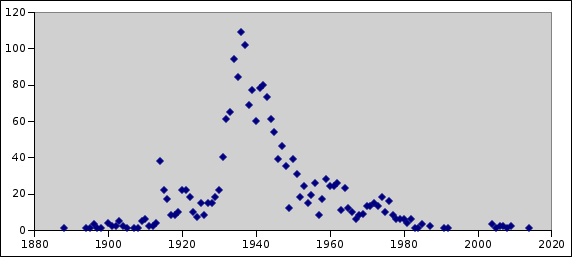
If I understand the query right, for every film entry anywhere in Wikpedia, it will return the IMDB ID and The Internet Archive ID, and when the movie was released and its English title, if either or both of the latter two are available. At the moment the result set contain 2338 entries. Of course, it depend on volunteers including both correct IMDB and The Internet Archive IDs in the wikipedia articles for the movie. It should be noted that the result will include duplicates if the movie have entries in several languages. There are some bogus entries, either because The Internet Archive ID contain a typo or because the movie is not available from The Internet Archive. I did not verify the IMDB IDs, as I am unsure how to do that automatically. I wrote a small python script to extract the data set from Wikidata and check if the XML metadata for the movie is available from The Internet Archive, and after around 1.5 hour it produced a list of 2097 free movies and their IMDB ID. In total, 171 entries in Wikidata lack the refered Internet Archive entry. I assume the 70 "disappearing" entries (ie 2338-2097-171) are duplicate entries. This is not too bad, given that The Internet Archive report to contain 5331 feature films at the moment, but it also mean more than 3000 movies are missing on Wikipedia or are missing the pair of references on Wikipedia. I was curious about the distribution by release year, and made a little graph to show how the amount of free movies is spread over the years: I expect the relative distribution of the remaining 3000 movies to be similar. If you want to help, and want to ensure Wikipedia can be used to cross reference The Internet Archive and The Internet Movie Database, please make sure entries like this are listed under the "External links" heading on the Wikipedia article for the movie:
*  Internet Archive film id=FightingLady 
*  IMDb title id=0036823 title=The Fighting Lady 
Please verify the links on the final page, to make sure you did not introduce a typo. Here is the complete list, if you want to correct the 171 identified Wikipedia entries with broken links to The Internet Archive: Q1140317, Q458656, Q458656, Q470560, Q743340, Q822580, Q480696, Q128761, Q1307059, Q1335091, Q1537166, Q1438334, Q1479751, Q1497200, Q1498122, Q865973, Q834269, Q841781, Q841781, Q1548193, Q499031, Q1564769, Q1585239, Q1585569, Q1624236, Q4796595, Q4853469, Q4873046, Q915016, Q4660396, Q4677708, Q4738449, Q4756096, Q4766785, Q880357, Q882066, Q882066, Q204191, Q204191, Q1194170, Q940014, Q946863, Q172837, Q573077, Q1219005, Q1219599, Q1643798, Q1656352, Q1659549, Q1660007, Q1698154, Q1737980, Q1877284, Q1199354, Q1199354, Q1199451, Q1211871, Q1212179, Q1238382, Q4906454, Q320219, Q1148649, Q645094, Q5050350, Q5166548, Q2677926, Q2698139, Q2707305, Q2740725, Q2024780, Q2117418, Q2138984, Q1127992, Q1058087, Q1070484, Q1080080, Q1090813, Q1251918, Q1254110, Q1257070, Q1257079, Q1197410, Q1198423, Q706951, Q723239, Q2079261, Q1171364, Q617858, Q5166611, Q5166611, Q324513, Q374172, Q7533269, Q970386, Q976849, Q7458614, Q5347416, Q5460005, Q5463392, Q3038555, Q5288458, Q2346516, Q5183645, Q5185497, Q5216127, Q5223127, Q5261159, Q1300759, Q5521241, Q7733434, Q7736264, Q7737032, Q7882671, Q7719427, Q7719444, Q7722575, Q2629763, Q2640346, Q2649671, Q7703851, Q7747041, Q6544949, Q6672759, Q2445896, Q12124891, Q3127044, Q2511262, Q2517672, Q2543165, Q426628, Q426628, Q12126890, Q13359969, Q13359969, Q2294295, Q2294295, Q2559509, Q2559912, Q7760469, Q6703974, Q4744, Q7766962, Q7768516, Q7769205, Q7769988, Q2946945, Q3212086, Q3212086, Q18218448, Q18218448, Q18218448, Q6909175, Q7405709, Q7416149, Q7239952, Q7317332, Q7783674, Q7783704, Q7857590, Q3372526, Q3372642, Q3372816, Q3372909, Q7959649, Q7977485, Q7992684, Q3817966, Q3821852, Q3420907, Q3429733, Q774474

24 October 2017

Iain R. Learmonth: Security by Obscurity

Today this blog post turned up on Hacker News, titled Obscurity is a Valid Security Layer . It makes some excellent points on the distinction between good and bad obscurity and it gives an example of good obscurity with SSH. From the post:
I configured my SSH daemon to listen on port 24 in addition to its regular port of 22 so I could see the difference in attempts to connect to each (the connections are usually password guessing attempts). My expected result is far fewer attempts to access SSH on port 24 than port 22, which I equate to less risk to my, or any, SSH daemon. I ran with this alternate port configuration for a single weekend, and received over eighteen thousand (18,000) connections to port 22, and five (5) to port 24.
Those of you that know me in the outside world will have probably heard me talk about how it s insane we have all these services running on the public Internet that don t need to be there, just waiting to be attacked. I have previously given a talk at TechMeetup Aberdeen where I talk about my use of Tor s Onion services to have services that only I should ever connect to be hidden from the general Internet. Onion services, especially the client authentication features, can also be useful for IoT dashboards and devices, allowing access from the Internet but via a secure and authenticated channel that is updated even when the IoT devices behind it have long been abandoned. If you re interested to learn more about Onion services, you could watch Roger Dingledine s talk from Def Con 25.

Daniel Silverstone: Introducing the car

For many years now, I have been driving a diesel based VW Passat Estate. It has served me very well and been as reliable as I might have hoped given how awful I am with cars. Sadly Gunther was reaching the point where it was going to cost more per year to maintain than the car was worth, and also I've been being more and more irked by not having a car from the future. I spent many months doing spreadsheets, trying to convince myself I could somehow afford a Tesla of some variety. Sadly I never quite managed it. As such I set my sights on the more viable BEVs such as the Nissan Leaf. For a while, nothing I saw was something I wanted. I am quite unusual it seems, in that I don't want a car which is a "Look at me, I'm driving an electric car" fashion statement. I felt like I'd never get something which looked like a normal car, but happened to be a BEV. Then along came the Hyundai Ioniq. Hybrid, Plug-in Hybrid, and BEV all looking basically the same, and not in-your-face-special. I began to covet. Eventually I caved and arranged a test drive of an Ioniq plug-in hybrid because the BEV was basically on 9 month lead. I enjoyed the drive and was instantly very sad because I didn't want a plug-in hybrid, I wanted a BEV. Despondent, I left the dealership and went home. I went online and found a small number of second-hand Ioniq BEVs but as I scrolled through the list, none seemed to be of the right trim level. Then, just as I was ready to give up hope, I saw a new listing, no photo, of the right thing. One snag, it was 200 miles away. No matter, I rang the place, confirmed it was available, and agreed to sleep on the decision. The following morning, I hadn't decided to not buy, so I called them up, put down a deposit to hold the car until I could test drive it, and then began the long and awkward process of working out how I would charge the car given I have no off-street parking so I can't charge at home. (Yeah yeah, you'd think I'd have checked that first, but no I'm just not that sensible). Over the week I convinced myself I could do it, I ordered RFID cards for various schemes, signed up with a number of services, and then, on Friday last week, I drove down to a hotel near the dealership and had a fitful night's sleep. I rocked up to the dealership exactly as they opened for business, shook the hand of the very helpful salesman who had gone through the purchase process with me over the phone during the week, and got to see the car. Instant want coursed through me as I sat in it and decided "Yes, this somehow feels right". I took the car for about a 45 minute test drive just to see how it felt relative to the plug-in hybrid I'd driven the week before and it was like night and day. The BEV felt so much better to drive. I was hooked. Back to the dealership and we began the paperwork. Emptying Gunther of all of the bits and bobs scattered throughout his nooks and crannies took a while and gave me a chance to say goodbye to a car which, on reflection, had actually been a pleasure to own, even when its expensive things went wrong, more than once. But once I'd closed the Passat for the last time, and handed the keys over, it was quite a bittersweet moment as the salesman drove off in what still felt like my car, despite (by this point) it not being so. Sitting in the Ioniq though, I headed off for the 200 mile journey back home. With about 90% charge left after the test drive, I had two stops planned at rapid chargers and I headed toward my first. Unfortunately disaster struck, the rapid (50KW) charger refused to initialise, and I ended up with my car on the slower (7KW) charger to get enough juice into it to drive on to the next rapid charger enabled service station. When I got the message that my maximum charge period (45m) had elapsed, I headed back to the car to discover I couldn't persuade it to unlock from the car. Much hassle later, and an AA man came and together we learned that it takes 2 to tango, one to pull the emergency release in the boot, the other to then unplug the cable. Armed with this knowledge, I headed on my way to a rapid charger I'd found on the map which wasn't run by the same company. Vainly hoping that this would work better, I plugged the car in, set the charger going, and headed into the adjacent shop for a rest break. I went back to the car about 20 minutes later to see the charger wasn't running. Horror of horrors. I imagined maybe some nasty little oik had pressed 'stop' so I started the charger up again, and sat in the car to read my book. After about 3 minutes, the charge stopped. Turns out that charger was slightly iffy and couldn't cope with the charge current and kept emergency-stopping as a result. The lovely lady I spoke to about it directed me to a nearby (12 miles or so, easily done with the charge I had) charger in the grounds of a gorgeous chateau hotel. That one worked perfectly and I filled up. I drove on to my second planned stop and that charge went perfectly too. In fact, every charge since has gone flawlessly. So perhaps my baptism of failed charges has hardened me to the problems with owning a BEV. I've spent the past few days trying different charge points around Manchester enjoying my free charge capability, and trying different names for the car before I finally settled on which is a reasonable Korean boy's name (since the car is Korean I even got to set that as the bluetooth ID) and it's roughly pronounced sock/gin which are two wonderful things in life. I'm currently sat in a pub, eating a burger, enjoying myself while suckles on the teat of "free" electricity to make up for the fact that I've developed a non-trivial habit of leaving Audi drivers in the dust at traffic lights. Further updates may happen as I play with Android Auto and other toys in an attempt to eventually be able to ask the car to please "freeze my buttocks" (a feature it has in the form of air-conditioned seats.)

Holger Levsen: 20171024-Reproducible-Builds-Summit-3

Reproducible Builds Summit 3 next week in Berlin Next week from Tuesday, the 31st of October until Thursday, November 2nd, we'll have the 3rd Reproducible Builds summit in Berlin, to improve collaboration both between and inside projects, expand the scope and reach of reproducible builds to more projects and to brainstorm designs on tools enabling users to get the most benefits from reproducible builds. We're again expecting contributors from around twenty projects and we're still having some free seats available. If you want to join this meeting, please register by sending us a short mail briefly describing why (eg. by stating you involvement in some project). We also have some funding available to further rextend the diversity of our community, so please also contact us if you think you cannot make it for financial reasons! Personally I'm much looking forward to this event. The reproducible builds crowd is really a lovely bunch of people and thus I expect us to have some great discussions, some cool ideas and also some concrete actionable plans as a result of it. Totally worth it! Talk about Reproducible Builds at OSSE in Prague tomorrow Tomorrow, Wednesday, October 25th I'll be giving a talk at OSSE in Prague about the current status of Reproducible Builds and why we are not 'there' yet. I'd be glad to have a chat with you if you are there!

Russ Allbery: Review: Raven Stratagem

Review: Raven Stratagem, by Yoon Ha Lee
Series: Machineries of Empire #2
Publisher: Solaris
Copyright: 2017
ISBN: 1-78618-046-4
Format: Kindle
Pages: 400
Raven Stratagem is the sequel to Ninefox Gambit and will make very little sense if you've not read the previous book. In fact, I'll add a rare warning, one that I wish I'd had and followed: you need to be deeply familiar with the details of the end of Ninefox Gambit or large chunks of this book will make no sense. I read the previous book earlier this year, but my memory of some of the specifics of the ending had slipped, and I ended up having to skim the ending of the previous book several times. Consider re-reading that bit before starting this book if you share my lack of memory for plot specifics and it's been more than a few months. I unfortunately can't provide a plot summary, since there's almost nothing I can say about the plot that doesn't spoil Ninefox Gambit. It is basically the story that you would expect from the very end of Ninefox Gambit, though, although the way it's carried out is not quite as dramatic as I was expecting. I wanted to like this book a great deal. Ninefox Gambit introduced a beautiful magitech system, but it was otherwise mostly setup and one extended battle. Its ending promised engagement with larger universe politics, and prospects of doing something about the deep unfairness of the current political system. I was hoping this book would contain the payoff of that escalation. It does deliver on that payoff, but something about it didn't quite work for me. The best description I've been able to come up with is that Raven Stratagem skitters. Some of this is an increase in the number of viewpoint characters, which made it harder for me to get into a reading rhythm with any of them. But most of it, I think, is that the characters have so many layers of deception, emotional shielding, weariness, and resignation that it's hard to find the true emotional beats of the story except in retrospect. I kept bouncing off surfaces, so many different and conflicting surfaces. This book is full of people who are not being honest with each other, or sometimes with themselves, and who are pretending to motives they don't really have. As a reader, I wanted to be placed in a privileged position where I could experience the character emotions even when they were lying about them. For good or ill, Raven Stratagem doesn't do that. There was also something about the dramatic structure of the story that didn't work for me. When describing the book to a friend, I said that the main plot climax was off-camera. In skimming the book again for this review, I found that wasn't the case, but it still felt that way. I think that's because, despite some event build-up, the emotional build-up wasn't in place for me, so I wasn't ready as a reader for the climax when it came. The build-up to the climax is partly sacrificed to keep the secrecy of a couple of long-awaited revelations. I very much enjoyed those revelations (one satisfying one was set up with Cheris's behavior at the start of Ninefox Gambit), but I wanted the catharsis of the climax as well. As written, the strongest emotional hit was from a somewhat ancillary climax, and that involved characters who mattered considerably less to me than Cheris. The climax also involves quite a lot of hand-waving. While some of that is expected in magitech, I would have liked to understand the mechanisms of what happened, not just the effects. Lee introduces several new viewpoint characters here, including two very contrasting Kel. I warmed to them by the end of the book, but I liked Cheris as a viewpoint character considerably better than either of them. Both of them spend most of this book in conditions of varying powerlessness; Cheris, despite difficult circumstances, was at least driving the plot. I can kind of see why Lee picked the viewpoint characters he did, but I still feel grumbly about it. I would have loved to have a servitor as a primary viewpoint character in this story. All that said, I'm still glad I read this book. The climax is satisfying, as is the growing respect of the characters and the growing realization of just how the universe is being changed. I wanted more of that on camera rather than being held for dramatic surprise, but I still savored it when it happened. The mechanisms of the Hexarchate, particularly formation instinct, are considerably creepier than Ninefox Gambit reveals, which is saying something, and yet oddly logical in their own magitech way. I liked all the pieces; I just wanted them to have more emotional oomph and momentum. Instead, I felt like I was bringing my own emotion to the story rather than letting the story sweep me away, which meant being more analytical and less engrossed than I prefer to be in a novel. I'm still going to read the third book, though. By the end of Raven Stratagem, Lee has set most of the scenery on fire, and I want to see what sort of world rises from the flames. Rating: 6 out of 10

23 October 2017

Patrick Schoenfeld: Testing javascript in a dockerized rails application with rspec-rails

The other day I wanted to add support for tests of javascript functionality in a (dockerized) rails application using rspec-rails. Since rails 5.1 includes system tests with niceties like automatically taking a screenshot on failed tests, I hoped for a way to benefit from this
features without changing to another test framework. Lucky me only recently the authors of rspec-rails added support for so-called system specs. There is not much documentation so far (but there are a lot of useful information in the corresponding bug report #1838 and a friendly guy named Thomas Walpole (@twalpole) is helpfully answering to questions in that issue. To make things a little bit more complicated: the application in question is usually running in a docker container and thus the tests of the application are also run in a docker container. I didn t want to change this, so here is what it took me to get this running. Overview Let s see what we want to achieve exactly: From a technical point of view, we will have the application under test (AUT) and the tests in one container (let s call it: web) and we will need another container running a javascript-capable browser (let s call it browser). Thus we need the tests to drive a remote running browser (at least when running in a docker environment) which needs to access the application under a different address than usually. Namely an address reachable by the chrome-container, since it will not be reachable via 127.0.0.1 as is (rightfully) assumed by default. If we want Warden authentication stubbing to work (as we do, since our application uses Devise) and transactional fixtures as well (e.g. rails handling database cleanup between tests without database_cleaner gem) we also need to ensure that the application server is being started by the tests and the tests are actually run against that server. Otherwise we might run into problems. Getting the containers ready Assuming you already have a container setup (and are using docker-compose like we do) there is not that much to change on the docker front. Basically you need to add a new service called chrome and point it to an appropriate image and add a link to it in your existing web-container. I ve decided to use standalone-chrome for the browser part, for which there are docker images provided by the selenium project (they also have images for other browsers). Kudos for that.
...
services:
  chrome:
    image: selenium/standalone-chrome
   
  web:
   
    links:
      - chrome
The link ensures that the chrome instance is available before we run the tests and that the the web-container is able to resolve the name of this container. Unfortunately this is not true for the other way round, so we need some magic in our test code to find out the ip-address of the web-container. More to this later. Other than that, you probably want to configure a volume for you to be able to access the screenshots, which get saved to tmp/screenshots
in the application directory. Preparing the application for running system tests There is a bit more to do on the application side. The steps are roughly:
  1. Add necessary depends / version constraints
  2. Register a driver for the remote chrome
  3. Configure capybara to use the appropriate host for your tests (and your configured driver)
  4. Add actual tests with type: :system and js: true
Let s walk them through. Add necessary depends What we need is the following: The required features are already part of 3.7.0, but this version is the version I used and it contains a bugfix, which may or may not be relevant. One comment about the rails version: for the tests to properly work it s viable to have puma use certain settings. In rails 5.1.4 (the version released, at time of writing this) uses the settings from config/puma.rb which most likely collides with the necessary settings. You can ensure these settings yourself or use rails from branch 5-1-stable which includes this change. I decided for the latter and pinned my Gemfile to the then current commit. Register a driver for the remote chrome To register the required driver, you ll have to add some lines to your rails_helper.rb:
if ENV['DOCKER']
  selenium_url =
      "http://chrome:4444/wd/hub"
  Capybara.register_driver :selenium_remote do  app 
    Capybara::Selenium::Driver.new(app,
         :url => selenium_url, :browser => :remote, desired_capabilities: :chrome )
  end
end
Note that I added those lines conditionally (since I still want to be able to use a local chrome via chromedriver) if an environment variable DOCKER is set. We defined that environment variable in our Dockerfile and thus you might need to adapt this to your case. Also note that the selenium_url is hard-coded. You could very well take a different approach, e.g. using an externally specified SELENIUM_URL, but ultimately the requirement is that the driver needs to know that the chrome instance is running on host chrome, port 4444 (the containers default). Configure capybara to use the appropriate host and driver The next step is to ensure that javascript-requiring system tests are actually run with the given driver and use the right host. To achieve that we need to add a before-hook to the corresponding tests or we can configure rspec accordingly to always include such a hook by modifying the rspec-configuration in rails_helper.rb like this:
RSpec.configure do  config 
  ...
  config.before(:each, type: :system, js: true) do
    if ENV['DOCKER']
      driven_by :selenium_remote
      ip = Socket.ip_address_list.detect addr  addr.ipv4_private?  .ip_address
      host! "http://# ip :# Capybara.server_port "
    else
      driven_by :headless_chrome
    end
  end
Note the part with the ip-address: it tries to find an IPv4 private address for the web-container (the container running the tests) to ensure the chrome-container uses this address to access the application. The Capybara.server_port is important here, since it will correspond to the puma instance launched by the tests. That heuristic (first ipv4 private address) works for us at the moment, but it might not work for you. It is basically a workaround to the fact that I couldn t get web resolvable for the chrome container which may be fixable on the docker side, but I was to lazy to further investigate that. If you change it: Just make sure the host! method uses an URI pointing to an address of the web-container that is reachable to the chrome-container. Define tests with type: :system and js: true Last but certainly not least, you need actual tests of the required type and with or without js: true. This can be achieved by creating tests files starting like this:
RSpec.feature "Foobar", type: :system, js: true do
Since the new rspec-style system tests are based around the feature-specs which used to be around previously, the rest of the tests is exactly like it is described for feature specs. Run the tests To run the tests a commandline like the following should do: docker-compose run web rspec It won t make a big noise about running the tests against chrome, unless something fails. In that case you ll see a message telling you where the screenshot has been placed. Troubleshooting Below I add some hints about problems I ve seen during configuring that: Test failing, screenshot shows login screen In that case puma might be configured wrongly or you are not using transactional fixtures. See the hints above about the rails version to use which also includes some pointers to helpful explanations. Note that rspec-rails by default does not output the puma startup output as it clutters the tests. For debugging purposes it might be helpful to change that by adding the following line to your tests:
ActionDispatch::SystemTesting::Server.silence_puma = false
Error message: Unable to find chromedriver This indicates that your driver is not configured properly, because the default for system tests is to be driven_by selenium, which tries to spawn an own chrome instance and is suitable for non-dockerized tests. Check if your tests are marked as js: true (if you followed the instructions above) and that you properly added the before-hook to your rspec-configuration. Collisions with VCR If you happen to have tests that make use of the vcr gem you might see it complaining about not knowing what to do with the requests between the driver and the chrome instance. You can fix this, by telling VCR to ignore that requests, by adding a line where you configured VCR:
VCR.configure do  config 
# required so we don't collide with capybara tests
config.ignore_hosts 'chrome'
...

Russ Allbery: Review: Algorithms to Live By

Review: Algorithms to Live By, by Brian Christian & Tom Griffiths
Publisher: Henry Holt and Company
Copyright: April 2016
ISBN: 1-62779-037-3
Format: Kindle
Pages: 255
Another read for the work book club. This was my favorite to date, apart from the books I recommended myself. One of the foundations of computer science as a field of study is research into algorithms: how do we solve problems efficiently using computer programs? This is a largely mathematical field, but it's often less about ideal or theoretical solutions and more about making the most efficient use of limited resources and arriving at an adequate, if not perfect, answer. Many of these problems are either day-to-day human problems or are closely related to them; after all, the purpose of computer science is to solve practical problems with computers. The question asked by Algorithms to Live By is "can we reverse this?": can we learn lessons from computer science's approach to problems that would help us make day-to-day decisions? There's a lot of interesting material in the eleven chapters of this book, but there's also an amusing theme: humans are already very good at this. Many chapters start with an examination of algorithms and mathematical analysis of problems, dive into a discussion of how we can use those results to make better decisions, then talk about studies of the decisions humans actually make... and discover that humans are already applying ad hoc versions of the best algorithms we've come up with, given the constraints of typical life situations. It tends to undermine the stated goal of the book. Thankfully, it in no way undermines interesting discussion of general classes of problems, how computer science has tackled them, and what we've learned about the mathematical and technical shapes of those problems. There's a bit less self-help utility here than I think the authors had intended, but lots of food for thought. (That said, it's worth considering whether this congruence is less because humans are already good at this and more because our algorithms are designed from human intuition. Maybe our best algorithms just reflect human thinking. In some cases we've checked our solutions against mathematical ideals, but in other cases they're still just our best guesses to date.) This is the sort of a book where a chapter listing is an important part of the review. The areas of algorithms discussed here are optimal stopping, explore/exploit decisions (when to go with the best thing you've found and when to look for something better), sorting, caching, scheduling, Bayes's rule (and prediction in general), overfitting when building models, relaxation (solving an easier problem than your actual problem), randomized algorithms, a collection of networking algorithms, and finally game theory. Each of these has useful insights and thought-provoking discussion of how these sometimes-theoretical concepts map surprisingly well onto daily problems. The book concludes with a discussion of "computational kindness": an encouragement to reduce the required computation and complexity penalty for both yourself and the people you interact with. If you have a computer science background (as I do), many of these will be familiar concepts, and you might be dubious that a popularization would tell you much that's new. Give this book a shot, though; the analogies are less stretched than you might fear, and the authors are both careful and smart about how they apply these principles. This book passes with flying colors a key sanity check: the chapters on topics that I know well or have thought about a lot make few or no obvious errors and say useful and important things. For example, the scheduling chapter, which unsurprisingly is about time management, surpasses more than half of the time management literature by jumping straight to the heart of most time management problems: if you're going to do everything on a list, it rarely matters the order in which you do it, so the hardest scheduling problems are about deciding what not to do rather than deciding order. The point in the book where the authors won my heart completely was in the chapter on Bayes's rule. Much of the chapter is about Bayesian priors, and how one's knowledge of past events is a vital part of analysis of future probabilities. The authors then discuss the (in)famous marshmallow experiment, in which children are given one marshmallow and told that if they refrain from eating it until the researcher returns, they'll get two marshmallows. Refraining from eating the marshmallow (delayed gratification, in the psychological literature) was found to be associated with better life outcomes years down the road. This experiment has been used and abused for years for all sorts of propaganda about how trading immediate pleasure for future gains leads to a successful life, and how failure in life is because of inability to delay gratification. More evil analyses have (of course) tied that capability to ethnicity, with predictably racist results. I have kind of a thing about the marshmallow experiment. It's a topic that reliably sends me off into angry rants. Algorithms to Live By is the only book I have ever read to mention the marshmallow experiment and then apply the analysis that I find far more convincing. This is not a test of innate capability in the children; it's a test of their Bayesian priors. When does it make perfect sense to eat the marshmallow immediately instead of waiting for a reward? When their past experience tells them that adults are unreliable, can't be trusted, disappear for unpredictable lengths of time, and lie. And, even better, the authors supported this analysis with both a follow-up study I hadn't heard of before and with the observation that some children would wait for some time and then "give in." This makes perfect sense if they were subconsciously using a Bayesian model with poor priors. This is a great book. It may try a bit too hard in places (applicability of the math of optimal stopping to everyday life is more contingent and strained than I think the authors want to admit), and some of this will be familiar if you've studied algorithms. But the writing is clear, succinct, and very well-edited. No part of the book outlives its welcome; the discussion moves right along. If you find yourself going "I know all this already," you'll still probably encounter a new concept or neat explanation in a few more pages. And sometimes the authors make connections that never would have occurred to me but feel right in retrospect, such as relating exponential backoff in networking protocols to choosing punishments in the criminal justice system. Or the realization that our modern communication world is not constantly connected, it's constantly buffered, and many of us are suffering from the characteristic signs of buffer bloat. I don't think you have to be a CS major, or know much about math, to read this book. There is a lot of mathematical details in the end notes if you want to dive in, but the main text is almost always readable and clear, at least so far as I could tell (as someone who was a CS major and has taken a lot of math, so a grain of salt may be indicated). And it still has a lot to offer even if you've studied algorithms for years. The more I read of this book, the more I liked it. Definitely recommended if you like reading this sort of analysis of life. Rating: 9 out of 10

22 October 2017

Iain R. Learmonth: Free Software Efforts (2017W42)

Here s my weekly report for week 42 of 2017. In this week I have replaced my spacebar, failed to replace a HDD and begun the process to replace my YubiKey.

Debian Eariler in the week I blogged about powerline-taskwarrior . There is a new upstream version available that includes the patches I had produced for Python 2 support and I have filed #879225 to remind me to package this. The state of emscripten is still not great, and as I don t have the time to chase this up and I certainly don t have the time to fix it myself, I ve converted the ITP for csdr to an RFP. As I no longer have the time to maintain map.debian.net, I have released this domain name and published the sources behind the service.

Tor Project There was a request to remove the $ from family fingerprint on Atlas. These actually come from Onionoo and we have decided to fix this in Onionoo, but I did push a small fix for Atlas this week that makes sure that Atlas doesn t care if there are $ prefixes or not. I requested that a Trac component be created for metrics-bot. I wrote a seperate post about metrics-bot. I also attended the weekly metrics team meeting.

Sustainability I believe it is important to be clear not only about the work I have already completed but also about the sustainability of this work into the future. I plan to include a short report on the current sustainability of my work in each weekly report. I have not had any free software related expenses this week. The current funds I have available for equipment, travel and other free software expenses remains 60.52. I do not believe that any hardware I rely on is looking at imminent failure. I do not find it likely that I ll be travelling to Cambridge for the miniDebConf as the train alone would be around 350 and hotel accomodation a further 600 (to include both me and Ana).

Steinar H. Gunderson: Introducing Narabu, part 3: Parallel structure

Narabu is a new intraframe video codec. You probably want to read part 1 and part 2 first. Now having a rough idea of how the GPU works, it's obvious that we need our codec to split the image into a lot of independent chunks to be parallel; we're aiming for about a thousand chunks. We'll also aim for a format that's as simple as possible; other people can try to push the frontiers on research, I just want something that's fast, reasonably good, and not too hard to implement. First of all, let's look at JPEG. It works by converting the image to Y'CbCr (usually with subsampled chroma), split each channel into 8x8 blocks, DCT them, quantize and then use Huffman coding to encode those coefficients. This is a very standard structure, and JPEG, despite being really old by now, is actually hard to beat, so let's use that as a template. But we probably can't use JPEG wholesale. Why? The answer is that the Huffman coding is just too serial. It's all just one stream, and without knowing where the previous symbol ends, we don't know where to start decoding the next. You can partially solve this by having frequent restart markers, but these reduce coding efficiency, and there's no index of them; you'd have to make a parallel scan for them, which is annoying. So we'll need to at least do something about the entropy coding. Do we need to change anything else to reach our ~1000 parallel target? 720p is the standard video target these days; the ~1M raw pixels would be great if we could do all of them independently, but we obviously can't, since DCT is not independent per pixel (that would sort of defeat the purpose). However, there are 14,400 DCT blocks (8x8), so we can certainly do all the DCTs in parallel. Quantization after that is trivially parallelizable, at least as long as we don't aim for trellis or the likes. So indeed, it's only entropy coding that we need to worry about. Since we're changing entropy coding anyway, I picked rANS, which is confusing but has a number of neat properties; it's roughly as expensive as Huffman coding, but has an efficiency closer to that of arithmetic encoding, and you can switch distributions for each symbol. It requires a bit more calculation, but GPUs have plenty of ALUs (a typical recommendation is 10:1 calculation to memory access), so that should be fine. I picked a pretty common variation with 32-bit state and 8-bit I/O, since 64-bit arithmetic is not universally available on GPUs (I checked a variation with 64-bit state and 32-bit I/O, but it didn't really matter much for speed). Fabian Giesen has described how you can actually do rANS encoding and decoding in parallel over a warp, but I've treated it as a purely serial operation. I don't do anything like adaptation, though; each coefficient is assigned to one out of four rANS static distributions that are signaled at the start of each stream. (Four is a nice tradeoff between coding efficiency, L1 cache use and the cost of transmitting the distributions themselves. I originally used eight, but a bit of clustering showed it was possible to get it down to four at basically no extra cost. JPEG does a similar thing, with separate Huffman codes for AC and DC coefficients. And I've got separate distributions for luma and chroma, which also makes a lot of sense.) The restart cost of rANS is basically writing the state to disk; some of that we would need to write even without a restart, and there are ways to combine many such end states for less waste (I'm not using them), but let's be conservative and assume we waste all of it for each restart. At 150 Mbit/second for 720p60, the luma plane of one frame is about 150 kB. 10% (15 kB) sounds reasonable to sacrifice to restarts, which means we can have about 3750 of them, or one for each 250th pixel or so. (3750 restarts also means 3750 independent entropy coding streams, so we're still well above our 1000 target.) So the structure is more or less clear; we'll DCT the blocks in parallel (since an 8x8 block can be expressed as 8 vertical DCTs and then 8 horizontal DCTs, we can even get 8-way parallelism there), and then encode at least 250 coefficients into an rANS stream. I've chosen to let a stream encompass a single coefficient from each of 320 DCT blocks instead of all coefficients from 5 DCT blocks; it's sort of arbitrary and might be a bit unintuitive, but it feels more natural, especially since you don't need to switch rANS distributions for each coefficient. So that's a lot of rambling for a sort-of abstract format. Next time we'll go into how decoding works. Or encoding. I haven't really made up my mind yet.

21 October 2017

Michael Stapelberg: pk4: a new tool to avail the Debian source package producing the specified package

UNIX distributions used to come with the system source code in /usr/src. This is a concept which fascinates me: if you want to change something in any part of your system, just make your change in the corresponding directory, recomile, reinstall, and you can immediately see your changes in action. So, I decided I wanted to build a tool which can give you the impression of that, without the downsides of additional disk space usage and slower update times because of /usr/src maintenance. The result of this effort is a tool called pk4 (mnemonic: get me the package for ) which I just uploaded to Debian. What distinguishes this tool from an apt source call is the combination of a number of features: If you don t want to wait for the package to clear the NEW queue, you can get it from here in the meantime:
wget https://people.debian.org/~stapelberg/pk4/pk4_1_amd64.deb
sudo apt install ./pk4_1_amd64.deb
You can find the sources and issue tracker at https://github.com/Debian/pk4. Here is a terminal screencast of the tool in action, availing the sources of i3, applying a patch, rebuilding the package and replacing the installed binary packages:

Jaldhar Vyas: Sal Mubarak 2074

Wishing all Debian people a prosperous and auspicious Gujarati new year (V.S. 2074 called Saumya.) This year fireworks became legal for the first time in New Jersey. Not that it ever stopped us before but it is nice to see the government stop meddling for no reason. (Eff you, Indian Supreme Court.) Sparklers on Diwali. Although you can only see sparklers in the picture above, we got enough armament to make ISIS jealous. There were also lots of diabetes-inducing sweets and (inexpensive, practical) presents for young and old. That's what I call a proper Diwali and new year.

19 October 2017

Steinar H. Gunderson: Introducing Narabu, part 2: Meet the GPU

Narabu is a new intraframe video codec. You may or may not want to read part 1 first. The GPU, despite being extremely more flexible than it was fifteen years ago, is still a very different beast from your CPU, and not all problems map well to it performance-wise. Thus, before designing a codec, it's useful to know what our platform looks like. A GPU has lots of special functionality for graphics (well, duh), but we'll be concentrating on the compute shader subset in this context, ie., we won't be drawing any polygons. Roughly, a GPU (as I understand it!) is built up about as follows: A GPU contains 1 20 cores; NVIDIA calls them SMs (shader multiprocessors), Intel calls them subslices. (Trivia: A typical mid-range Intel GPU contains two cores, and thus is designated GT2.) One such core usually runs the same program, although on different data; there are exceptions, but typically, if your program can't fill an entire core with parallelism, you're wasting energy. Each core, in addition to tons (thousands!) of registers, also has some shared memory (also called local memory sometimes, although that term is overloaded), typically 32 64 kB, which you can think of in two ways: Either as a sort-of explicit L1 cache, or as a way to communicate internally on a core. Shared memory is a limited, precious resource in many algorithms. Each core/SM/subslice contains about 8 execution units (Intel calls them EUs, NVIDIA/AMD calls them something else) and some memory access logic. These multiplex a bunch of threads (say, 32) and run in a round-robin-ish fashion. This means that a GPU can handle memory stalls much better than a typical CPU, since it has so many streams to pick from; even though each thread runs in-order, it can just kick off an operation and then go to the next thread while the previous one is working. Each execution unit has a bunch of ALUs (typically 16) and executes code in a SIMD fashion. NVIDIA calls these ALUs CUDA cores , AMD calls them stream processors . Unlike on CPU, this SIMD has full scatter/gather support (although sequential access, especially in certain patterns, is much more efficient than random access), lane enable/disable so it can work with conditional code, etc.. The typically fastest operation is a 32-bit float muladd; usually that's single-cycle. GPUs love 32-bit FP code. (In fact, in some GPU languages, you won't even have 8-, 16-bit or 64-bit types. This is annoying, but not the end of the world.) The vectorization is not exposed to the user in typical code (GLSL has some vector types, but they're usually just broken up into scalars, so that's a red herring), although in some programming languages you can get to swizzle the SIMD stuff internally to gain advantage of that (there's also schemes for broadcasting bits by voting etc.). However, it is crucially important to performance; if you have divergence within a warp, this means the GPU needs to execute both sides of the if. So less divergent code is good. Such a SIMD group is called a warp by NVIDIA (I don't know if the others have names for it). NVIDIA has SIMD/warp width always 32; AMD used to be 64 but is now 16. Intel supports 4 32 (the compiler will autoselect based on a bunch of factors), although 16 is the most common. The upshot of all of this is that you need massive amounts of parallelism to be able to get useful performance out of a CPU. A rule of thumb is that if you could have launched about a thousand threads for your problem on CPU, it's a good fit for a GPU, although this is of course just a guideline. There's a ton of APIs available to write compute shaders. There's CUDA (NVIDIA-only, but the dominant player), D3D compute (Windows-only, but multi-vendor), OpenCL (multi-vendor, but highly variable implementation quality), OpenGL compute shaders (all platforms except macOS, which has too old drivers), Metal (Apple-only) and probably some that I forgot. I've chosen to go for OpenGL compute shaders since I already use OpenGL shaders a lot, and this saves on interop issues. CUDA probably is more mature, but my laptop is Intel. :-) No matter which one you choose, the programming model looks very roughly like this pseudocode:
for (size_t workgroup_idx = 0; workgroup_idx < NUM_WORKGROUPS; ++workgroup_idx)     // in parallel over cores
        char shared_mem[REQUESTED_SHARED_MEM];  // private for each workgroup
        for (size_t local_idx = 0; local_idx < WORKGROUP_SIZE; ++local_idx)    // in parallel on each core
                main(workgroup_idx, local_idx, shared_mem);
         
 
except in reality, the indices will be split in x/y/z for your convenience (you control all six dimensions, of course), and if you haven't asked for too much shared memory, the driver can silently make larger workgroups if it helps increase parallelity (this is totally transparent to you). main() doesn't return anything, but you can do reads and writes as you wish; GPUs have large amounts of memory these days, and staggering amounts of memory bandwidth. Now for the bad part: Generally, you will have no debuggers, no way of logging and no real profilers (if you're lucky, you can get to know how long each compute shader invocation takes, but not what takes time within the shader itself). Especially the latter is maddening; the only real recourse you have is some timers, and then placing timer probes or trying to comment out sections of your code to see if something goes faster. If you don't get the answers you're looking for, forget printf you need to set up a separate buffer, write some numbers into it and pull that buffer down to the GPU. Profilers are an essential part of optimization, and I had really hoped the world would be more mature here by now. Even CUDA doesn't give you all that much insight sometimes I wonder if all of this is because GPU drivers and architectures are meant to be shrouded in mystery for competitiveness reasons, but I'm honestly not sure. So that's it for a crash course in GPU architecture. Next time, we'll start looking at the Narabu codec itself.

Next.

Previous.