Search Results: "cas"

21 February 2016

Mario Lang: Generating C++ from a DTD with Jinja2 and lxml

I recently stumbled across an XML format specified in a DTD that I wanted to work with from within C++. The XML format is document centric, which is a bit of a pain with existing data binding compilers according to my limited experience. So to learn something new, and to keep control over generated code, I started to investigate what it would take to write my own little custom data binding compiler.
Writing a program that writes a program It turns out that there are two very helpful libraries in Python which can really make your life a lot easier:
To keep my life simple, I am focusing on generating accessors for XML attributes only for now. I leave it up to the library client to figure out how to deal with child elements.
A highly simplified DOM Inspired by the hybrid example from libstudxml, we define a simple base class that can store raw XML elements.
class element  
public:
  using attributes_type = std::map<xml::qname, std::string>;
  using elements_type = std::vector<std::shared_ptr<element>>;
  element(const xml::qname& name) : tag_name_(name)  
  virtual ~element() = default;
  xml::qname const& tag_name() const   return tag_name_;  
  attributes_type const& attributes() const   return attributes_;  
  attributes_type&       attributes()         return attributes_;  
  std::string const& text() const   return text_;  
  void text(std::string const& text)   text_ = text;  
  elements_type const& elements() const  return elements_; 
  elements_type&       elements()         return elements_;  
  element(xml::parser&, bool start_end = true);
  void serialize (xml::serializer&, bool start_end = true) const;
  template<typename T> static std::shared_ptr<element> create(xml::parser& p)  
    return std::make_shared<T>(p, false);
   
private:
  xml::qname tag_name_;
  attributes_type attributes_;
  std::string text_;           // Simple content only.
  elements_type elements_;     // Complex content only.
 ;
For each element name in the DTD, we're going to define a class that inherits from the element class, implementing special methods to make attribute access easier. The element(xml::parser&) constructor is going to create the corresponding class whenever it sees a certain element name. This calls for some sort of factory:
class factory  
public:
  static std::shared_ptr<element> make(xml::parser& p);
protected:
  struct element_info  
    xml::content content_type;
    std::shared_ptr<element> (*construct)(xml::parser&);
   ;
  using map_type = std::map<xml::qname, element_info>;
  static map_type *get_map()  
    if (!map) map = new map_type;
    return map;
   
private:
  static map_type *map;
 ;
template<typename T>
struct register_element : factory  
  register_element(xml::qname const& name, xml::content const& content)  
    get_map()->insert( name, element_info content, &element::create<T> );
   
 ;
shared_ptr<element> factory::make(xml::parser& p)  
  auto name = p.qname();
  auto iter = get_map()->find(name);
  if (iter == get_map()->end())  
    // No subclass found, so store plain data so we do not loose on roundtrip.
    return std::make_shared<element>(p, false);
   
  auto const& element = iter->second;
  p.content(element.content_type);
  return element.create(p);
 
The header template Now that we have our required infrastructure, we can finally start writing Jinja2 templates to generate classes for all elements in our DTD:
 %- for elem in dtd.iterelements() % 
   %- if elem.name in forwards_for % 
     %- for forward in forwards_for[elem.name] % 
class  forward ;
     %- endfor % 
   %- endif % 
class  elem.name  : public dom::element  
  static register_element< elem.name > factory_registration;
public:
   elem.name (xml::parser& p, bool start_end = true) : dom::element(p, start_end)  
   
   %- for attr in elem.iterattributes() % 
     %- if attr is required_string_attribute % 
  std::string  attr.name () const;
  void  attr.name (std::string const&);
     %- elif attr is implied_string_attribute % 
  optional<std::string>  attr.name () const;
  void  attr.name (optional<std::string>);
     # more branches to go here # 
     %- endif % 
   %- endfor % 
 ;
 %- endfor % 
required_string_attribute and implied_string_attribute are so-called Jinja2 tests. They are a nice way to isolate predicates such that the Jinja2 templates can stay relatively free of complicated expressions:
templates.tests['required_string_attribute'] = lambda a: \
  a.type in ['id', 'cdata', 'idref'] and a.default == 'required'
templates.tests['implied_string_attribute'] = lambda a: \
  a.type in ['id', 'cdata', 'idref'] and a.default == 'implied'
That is nice, but we have only seen C++ header declarations so far. Lets have a look into the implementation of some of our attribute accessors.
Enum conversion One interesting aspect of DTD based code generation is the fact that attributes can have enumerations specified. Assume that we have some extra data-structure in Python which helps us to define a nice name for each individual enumeration attribute. Then, a part of the Jinja2 template to generate the implementation for an enumeration attribute looks like:
     %- elif attr is known_enumeration_attribute % 
       %- set enum = enumerations[tuple(attr.values())]['name'] % 
       %- if attr.default == 'required' % 
 enum   elem.name :: attr.name () const  
  auto iter = attributes().find(qname " attr.name " );
  if (iter != attributes().end())  
         %- for value in attr.values() % 
     % if not loop.first % else  % else %       % endif -% 
    if (iter->second == " value ") return  enum :: value   mangle ;
         %- endfor % 
    throw illegal_enumeration ;
   
  throw missing_attribute ;
 
void  elem.name :: attr.name ( enum  value)  
  static qname const attr " attr.name " ;
  switch (value)  
         %- for value in attr.values() % 
  case  enum :: value   mangle :
    attributes()[attr] = " value ";
    break;
         %- endfor % 
  default:
    throw illegal_enumeration ;
   
 
       %- elif attr.default == 'implied' % 
 # similar implementation using boost::optional # 
       %- endif % 
     %- endif % 
Putting it all together The header for the library is generated like this:
from jinja2 import DictLoader, Environment
from lxml.etree import DTD
LIBRARY_HEADER = """
 # Our template code # 
"""
bmml = DTD('bmml.dtd')
templates = Environment(loader=DictLoader(globals()))
templates.filters['mangle'] = lambda ident: \
   '8th_or_128th': 'eighth_or_128th',
   '256th': 'twohundredfiftysixth',
   'continue': 'continue_'
   .get(ident, ident)
def template(name):
  return templates.get_template(name)
def hpp():
  print(template('LIBRARY_HEADER').render(
     'dtd': bmml,
     'enumerations': enumerations,
     'forwards_for':  'ornament': ['ornament_type'],
                      'score': ['score_data', 'score_header'] 
     ))
With all of this in place, we can have a look at a small use case for our library.
Printing document content I haven't really explained anything about the document format we're working with until now. Braille Music Markup Language is an XML based plain text markup language. Its purpose is to be able to enhance plain braille music scores with usually hard-to-calcuate meta information. Almost all element text content is supposed to be printed as-is to reconstruct the original plain text. So we could at least define one very basic operation in our library: printing the plain text content of an element. I found an XML stylesheet that is supposed to convert BMML documents to HTML. This stylesheet apparently has a bug, insofar as it forgets to treat the rest_data element in the same way as it already treats the note_data element. note to self, I wish I would've done a code review before the EU-project that developed BMML was finished. It looks like resurrecting maintainance is one of the things I might be able to look into in a meeting in Pisa in the first three days of March this year. If we keep this in mind, we can easily reimplement what the stylesheet does in idiomatic C++:
template<typename T>
typename std::enable_if<std::is_base_of<element, T>::value, std::ostream&>::type
operator<<(std::ostream &out, std::shared_ptr<T> elem)  
  if (!std::dynamic_pointer_cast<note_data>(elem) &&
      !std::dynamic_pointer_cast<rest_data>(elem) &&
      !std::dynamic_pointer_cast<score_header>(elem))
   
    auto const& text = elem->text();
    if (text.empty()) for (auto child : *elem) out << child; else out << text;
   
  return out;
 
The use of std::enable_if is necessary here so that operator<< is defined on the element class and all of its subclasses. Without the std::enable_if magic, client code would be forced to manually make sure it is passing std::shared_ptr<element> each time it wants to use the operatr<< on any of our specially defined subclasses. Now we can easily print BMML documents and get their actual plain text representation.
#include <fstream>
#include <iostream>
#include <xml/parser>
#include <xml/serializer>
#include "bmml.hxx"
using namespace std;
using namespace xml;
int main (int argc, char *argv[])  
  if (argc < 2)  
    cerr << "usage: " << argv[0] << " [<filename.bmml>...]" << endl;
    return EXIT_FAILURE;
   
  try  
    for (int i = 1; i < argc; ++i)  
      ifstream ifs argv[i] ;
      if (ifs.good())  
        parser p ifs, argv[i] ;
        p.next_expect(parser::start_element, "score", content::complex);
        cout << make_shared<bmml::score>(p, false) << endl;
        p.next_expect(parser::end_element, "score");
        else  
        cerr << "Unable to open '" << argv[i] << "'." << endl;
        return EXIT_FAILURE;
       
     
    catch (xml::exception const& e)  
    cerr << e.what() << endl;
    return EXIT_FAILURE;
   
 
That's it for now. The full source for the actual library which inspired this posting can be found on github in my bmmlcxx project. If you have an comments or questions, send me mail. If you like bmmlcxx, don't forget to star it :-).

Vincent Sanders: Stack 'em, pack 'em and rack 'em.

As you may be aware I have a bit of a problem with Single Board Computers in that I have a lot of them. Keeping them organised has turned into a bit of a problem.

cluttered shelf of SBC
I designed clip cases for many of these systems giving me a higher storage density on my rack shelves and built a power supply to reduce the cabling complexity. These helped but I still ended up with a cluttered shelf full of SBC.

I decided I would make a rack enclosure to hold the SBC, I was limited to material I could easily CNC machine which limited me to acrylic plastics or wood.

laser cutting the design, viewed through heavily tinted filterInitially I started with the idea of housing the individual boards in a toast rack arrangement. This would mean that the enclosure would have to be at least 2U high to fit the boards all the existing cases would have to be discarded. This approach was dropped when the drawbacks of having no flexibility and only being able to fit the units that were selected at design time became apparent (connector cutouts and mounting hole placement.

Instead I changed course to try and incorporate the existing cases which already solved the differing connector and mounting placement problem and gave me a uniform size to consider. Once I had this approach the design came pretty quickly. I used a tube girder construction 1U in height to get as much strength as possible from the 3mm acrylic plastic I would use.

laser cut pieces arranged for assembly still with protective film on
The design was simply laser cut from sheet stock and fastened together with M3 nut and bolts. Once I corrected the initial design errors (I managed to get almost every important dimension wrong on the first attempt) the result was a success.

working prototype resting on initial version
The prototype is a variety of colours because makespace ran out of suitably sized clear acrylic stock but the colouring has no effect on the result other than aesthetical. The structure gives a great deal of rigidity and there is no sagging or warping, indeed testing on the prototype got to almost 50Kg loading without a failure (one end clamped and the other end loaded at 350mm distance)

I added some simple rotating latches at the front which keep the modules held in place and allow units to be removed quickly if necessary.

rack slots installed and in use
Overall this project was successful and I can now pack five SBC per U neatly. It does limit me to using systems cased in my "slimline" designs (68x30x97mm) which currently means the Raspberry Pi B+ style and the Orange Pi PC.

Once small drawback is access to I/O and power connectors. These need to be right angled and must be unplugged before unit removal which can be a little fiddly. Perhaps a toast rack design of cases would have given easier connector access but I am happy with this trade off of space for density.

As usual the design files are freely available, perhaps they could be useful as a basis for other laser cut rack enclosure designs.

18 February 2016

Stein Magnus Jodal: A guide to poor API management

This is the story of libspotify, as experienced by a Spotify customer and libspotify developer for six years.

Step 1: Support your API for years Since April 2009, libspotify has been a mostly nice although proprietary C library for integrating with the Spotify music streaming service, providing both music metadata and full playback capabilities. Language wrappers have been written for a plenitude of programming languages (including my own pyspotify). libspotify is integrated into numerous open source projects (including my own Mopidy), networked AV receivers, and rumour has it: even cars. In addition to being closed source, there was another catch: in order to use it, you need the Spotify premium subscription. Speaking from my own experience supporting a project integrating with Spotify for the last six years: lots of end users upgraded to premium in order to use the projects built on top of libspotify.

Step 2: Stop accepting bug reports and stop releasing updates In May 2012, Spotify released libspotify 12.1.51 for all supported architectures, which now even included Android. After months of endless requests from the quickly growing hoards of Raspberry Pi users, Spotify released libspotify 12.1.103 for hardfloat armv6 on January 22 2013. The release included minor API additions, like the addition of explicit lyrics and means for accepting Spotify s Terms of Service. The additions in 12.1.103 never reached the other supported architectures and 12.1.51 remains the last release for those. There was no clear communication about this being the end of libspotify, releases have just ceased. libspotify has not been mentioned in a single developer blog post or developer email newsletter since. That s now more than three years ago.

Step 3: Create new APIs Over the next couple of years Spotify released a new Web API and iOS and Android SDKs. Through their developer blog, they communicated quite a bit both about these and about the deprecation of the apps inside the Spotify desktop client. Here are some pieces from their developer blog to illustrate: The Web API grew steadily, as documented by the Web APIs changelog. Over time, its feature list improved, supporting anonymous endpoints for generic music metadata as well as OAuth protected endpoints for managing your own music collection and playlists. The only major part missing that prevented developers replacing libspotify was music playback, as the Web API only provides 30 second previews. From what I recall of 2014 IRC discussions with Spotify employees, they had built a new much smaller library for streaming music. The iOS and Android SDKs were simply platform specific wrappers around this new playback library and the new Web API. My impression is that, after a number of beta releases, the iOS and Android SDKs seamlessly replaced libspotify on those platforms. The plan was apparently to release the new playback library for desktop too, so that it, in combination with the Web API, could replace libspotify there as well. That was all back in 2014.

Step 4: Deprecate old APIs At some point, Spotify deprecated their old web API, the Metadata API. There was no blog post about it and it was not mentioned in any Spotify Developer News email I ve received in recent years. I guess they only published this fact as a note on the Metadata API web page; it is therefore hard to track down exactly when it was deprecated and how the deprecation was communicated. Anyway, it was deprecated, and the natural upgrade path was to the new Web API. Spotify even has a migration guide mapping the concepts of the Metadata API to the new Web API. All good. In May 2015, after 28 months without a single release or any news, libspotify is officially deprecated. The communication channel of choice? A note on the libspotify web page. No post on the developer blog. No Spotify Developer News email. To be able to use libspotify, all developers have registered and requested a personal application key. To my knowledge, none of these registered library users were notified directly.

Step 5: Shut down an old API On January 20 2016 Spotify end-of-lifed their Metadata API. I don t know if this date was communicated on the Metadata API web page well in advance of this shutdown. There s no blog post on the topic. There s no news email. There s no tweet from @SpotifyPlatform or @SpotifyStatus. I can t find anything except users commenting on various Spotify documentation pages that the text is outdated because the API is no longer merely deprecated, but entirely shut down. Hopefully they did publish the shutdown date ahead of time. It had a full replacement API and a migration guide. Fair and square. Nothing much to complain about here. It s time to get porting your code to the Web API! But frankly, I don t really care about this Metadata API because I don t use the Metadata API, do I?

Step 6: Break your API without warning February 3 2016, Mopidy users start reporting General transient error when searching Spotify. This is a libspotify error message known as SP_ERROR_OTHER_TRANSIENT with error code 16. This error usually means that there is some unspecified issue with the Spotify service. We ve actually seen it before and like its name suggests, it is indeed transient and soon goes away. According to a series of tweets between my fellow Mopidy developer Nick Steel and @SpotifyCares it appears that the libspotify search functionality was backed by the Metadata API s search functionality. Who knew? I m not aware of any relation between these APIs ever being mentioned publicly. No libspotify user could possibly have known that the Metadata API shutdown would affect them. Let s summarize: libspotify hasn t had any releases for three years and it was officially deprecated in May last year. But, there have been no warnings about any shutdown. The libspotify project is likely no longer staffed at all. Did someone just forget that libspotify depended on the Metadata API they were shutting down? Many newer networked AV receivers use the Spotify Connect libraries that are exclusive to Spotify s commercial partners. But some receivers probably still use libspotify. If so, did Spotify just break hardware sold with Spotify support as a major feature? Something that people are paying a monthly fee to use? It seems they did! In the Spotify Community forums there are numerous reports of broken devices and software that all have two things in common: the date the problem started occurring, and that search is the only feature that is broken. Surely, Spotify will quickly explain themselves and fix this?

Step 7: Stay quiet Since the API shutdown, Spotify has been very quiet. No posts on the developer blog. No email newsletter. No tweets from @SpotifyPlatform since December 1 last year. Some users at The Spotify Community forum are quoting responses from Spotify. Most responses seem to link to the Metadata API migration docs and state that application developers must migrate. In other cases the responses point the finger at the commercial partner which only adds to the confusion. Some of these devices may use the Metadata API directly, and in those cases the application maintainers are probably to blame. However, I m quite certain that the libspotify search issue is responsible for a fair share of these complaints. libspotify, in contrast to the Metadata API, has never been officially shut down. The responsibility for any breakage caused by libspotify is Spotify s alone.

What I want from Spotify
  1. Apologize to your paying customers and supporters.
  2. Get substantially better at communicating deprecations and shutdowns. We want all news, not just good news.
  3. Give us a new supported C library for audio playback. Now! Not later this year. I ve heard that promise for three consecutive years now. We can live with pre-release software quality initially. Getting the library out sooner rather than later shows us that there is a road ahead for all the projects that stream music from Spotify. Let us get started making new language wrappers.
  4. Release Spotify Connect specifications and libraries. We want to make music players that can be controlled by the Spotify mobile app. We want to make music controllers that can play music on all the Spotify Connect software and hardware players we ve invested in. You ve created this technology, now let us use it.
Thanks to Nick Steel for reviewing this blog post.

17 February 2016

Antoine Beaupr : My free software activities, february 2016

Debian Long Term Support (LTS) This is my third month working on Debian LTS, started by Raphael Hertzog at Freexian. This month was my first month working on the frontdesk duty and did a good bunch of triage. I also performed one upload and reviewed a few security issues.

Frontdesk duties I spent some time trying to get familiar with the frontdesk duty. I still need to document a bit of what I learned, which did involve asking around for parts of the process. The following issues were triaged:
  • roundcube in squeeze was happily not vulnerable to CVE-2015-8794 and CVE-2015-8793, as the code affected was not present. roundcube is also not shipped with jessie but the backport is vulnerable
  • the php-openid vulnerability was actually just a code sample, a bug report comment clarified all of CVE-2016-2049
  • ffmpeg issues were closed, as it is not supported in squeeze
  • libxml2 was marked as needing work (CVE-2016-2073)
  • asterisk was triaged for all distros before i found out it is also unsupported in squeeze (CVEs coming up, AST-2016-001, AST-2016-001, AST-2016-001)
  • libebml and libmatroska were marked as unsupported, although an upload of debian-security-support will be necessary to complete that work (bug #814557 filed)

Uploads and reviews I only ended up doing one upload, of the chrony package (CVE-2016-1567), thanks to the maintainer which provided the patch. I tried my best trying to sort through the issues with tiff (CVE-2015-8668 and CVE-2015-7554), which didn't have obvious fixes available. OpenSUSE seem to have patches, but it is really hard to find them through their issue trackers, which were timing out on me. Hopefully someone else can pick that one up. I also tried and failed to reproduce the cpio issue (CVE-2016-2037), which, at the time, didn't have a patch for a fix. This ended up being solved and Santiago took up the upload. I finally spent some time trying to untangle the mess that is libraw, or more precisely, all the packages that embed dcraw code instead of linking against libraw. Now I really feel even more strongly for the Debian policy section 4.13 which states that Debian packages should not ship with copies of other packages code. It made it really hard to figure out which packages were vulnerable, especially because it was hard to figure out which versions of libraw/dcraw were actually vulnerable to the bug, but also just plain figure out which packages were copying code from libraw. I wish I had found out about secure-testing/data/embedded-code-copies earlier... Still, it was interesting to get familiar with codesearch.debian.net to try to find copies of the vulnerable code, which was not working so well. Kudos to darktable 2.0 for getting rid of their embedded copy of libraw, by the way - it made it completely not vulnerable to the issue, the versions in stretch and sid not having the code at all and older versions having non-vulnerable copies of the code.

Issues with VMs again I still had problems running a squeeze VM - not wanting to use virtualbox because of the overhead, I got lost for a bit trying to use libvirt and KVM. A bunch of issues crept up: using virt-manager would just fail on startup with an error saying interface mtu value is improper, which is a very unhelpful error message (what is a proper value??) - and, for the record, the MTU on eth0 and wlan0 is the fairly standard 1500, while lo is at 65536 bytes, nothing unusual there as far as I know. Then the next problem was actually running a VM - I still somewhat expected to be able to boot off a chroot, something I should definitely forget about it seems like (boot loader missing? not sure). I ended up calling virt-install with the live ISO image I was previously using:
virt-install --virt-type kvm --name squeeze-amd64 --memory 512 --cdrom ~/iso/Debian/cdimage.debian.org_mirror_cdimage_archive_6.0.10_live_amd64_iso_hybrid_debian_live_6.0.10_amd64_gnome_desktop.iso --disk size=4 --os-variant debiansqueeze
At least now I have an installed squeeze VM, something I didn't get to do in Virtualbox (mostly because I didn't want to wait through the install, because it was so slow). Finally, I still have trouble getting a commandline console on the VM: somehow, running virtsh console squeeze-amd64 doesn't give me a login terminal, and worse, it actually freezes the terminal that I can actually get on virt-viewer squeeze-amd64, which definitely sounds like a bug. I documented a bit more of that setup in the Debian wiki KVM page so hopefully this will be useful for others.

Other free software work I continued my work on improving timetracking with ledger in my ledger-timetracking git repository, which now got a place on the new plaintextaccounting.org website, which acts as a portal for ledger-like software projects and documentation.

Darktable 2.0 I had the pleasure of trying the new Darktable 2.0 release, which only recently entered Debian. I built a backport for jessie, which works beautifully: much faster thumbnail rendering, no dropping of history when switching views... The new features are great, but I also appreciate how they are being very conservative in their approach. Darktable is great software: I may have trouble approaching the results other are having with lightroom and snapseed, but those are proprietary software that I can't use anyways. I also suspect that I just don't have enough of a clue of what I'm doing to get the results I need in Darktable. Maybe with hand-holding, one day, I will surpass the results I get with the JPEGs from my Canon camera. Until then, I turned off RAW exports in my camera to try and control the explosion of disk use I saw since I got that camera:
41M     2004
363M    2005
937M    2006
2,2G    2007
894M    2008
800M    2009
1,8G    2010
1,4G    2011
9,8G    2012
31G     2013
26G     2014
9,8G    2015
The drop in 2015 is mostly due to me taking less pictures in the last year, for some reason...

Markdown mode hacks I ended up writing some elisp for the markdown mode. It seems I am always writing links like [text](link) which seems more natural at first, but then the formatting looks messier, as paragraph wrapping is all off because of the long URLs. So I always ended up converting those links, which was a painful series of keystrokes. So I made a macro, and while I'm a it, why not rewrite it as a lisp function. Twice. Then I was told by the markdown-mode.el developers that they had already fixed that (in the 2.1 version, not in Debian jessie) and that the C-c C-a r key binding actually recognized existing links and conveniently converted them. I documented my adventures in bug #94, but it seems I wrote this code for nothing else than re-learning Emacs lisp, which was actually quite fun.

More emacs hacking Another thing I always wasted time doing by and is "rename file and buffer". Often, you visit a file but it's named wrong. My most common case is a .txt file that i rename to .mdwn. I would then have to do:
M-x rename-file <ret> newfile
M-x rename-buffer <ret> newfile
C-x C-s <ret> newfile
Really annoying. Turns out that set-visited-file-name actually does most of the job, but doesn't actually rename the file, which is really silly. So I wrote this small function instead:
(defun rename-file-and-buffer (newfname)
  "combine rename-file and rename-buffer
set-visited-file-name does most of the job, but unfortunately
doesn't actually rename the file. rename-file does that, but
doesn't rename the buffer. rename-buffer only renames the buffer,
which is pretty pointless.
only operates on current buffer because set-visited-file-name
also does so and we don't bother doing excursions around.
"
  (interactive "GRename file and bufer: ")
  (let ((oldfname (buffer-file-name)))
    (set-visited-file-name newfname nil t)
    (rename-file oldfname newfname)
    )
  )
Not bound to any key, really trivial, but doing this without that function is really non-trivial, especially since set-visited-file-name needs special arguments to not mark the file as modified.

IRC packages updates I updated the Sopel IRC bot package to the latest release, 6.3.0. They have finally switched to Requests, but apart from that, no change was necessary. I am glad to finally see SNI support working everywhere in the bot! I also update the Charydbis IRC server package to the latest 3.5.0 stable release. This release is great news, as I was able to remove 5 of the 7 patches I was dragging along the Debian package. The previous Charybdis stable release was over 3 years old, as 3.4.2 was released in (December) 2012! I spend a good chunk of time making the package reproducible. I filed a bug upstream and eventually made a patch to make it possible to hardcode a build timestamp, which seems to have been the only detectable change in the reproducible build infrastructure. Charybdis had been FTBS for a while in sid now, and the upload should fix that as well. Unfortunately, Charybdis still doesn't build with hardening flags - but hopefully a future update of the package should fix that. It is probably because CFLAGS are not passed around properly. There's really interesting stuff going on in the IRC world. Even though IRC is one of the oldest protocols still in operation (1988, even before the Web, but after SMTP and the even more venerable FTP), it is still being actively developed, with a working group drafting multiple extensions to the IRCv3 protocol defined in RFC 1459. For example, IRCv3.3 includes a Strict Transport Security extension, which tries to ensure users use encrypted channels as much as possible, through warnings and STARTTLS support. Charybdis goes even further by proposing a reversal of the +S ("secure channel" flag) where all channels are secure by default, and you need to deliberately mark a channel as insecure with the +U flag if you actually want to allow users on an clear-text connection to join the channel. A transition mechanism is also proposed.

Miscellaneous bug reports En vrac... I fell face-first in this amazing game that is endless-sky. I made a small pull request on the documentation, a bug report and a feature request. I forwarded a bug report, originally filed against monkeysign, to the pyqrencode maintainers. I filed a usability bug against tails-installer, which just entered Debian, mostly usability issues. I discovered the fim image viewer, which re-entered Debian recently. It seemed perfect to adjust my photos-import workflow, so I added it to my script, to be able to review photos prior to importing them into Darktable and git-annex.

16 February 2016

Vincent Fourmond: QSoas tips and tricks: better baselines using the "save points" feature

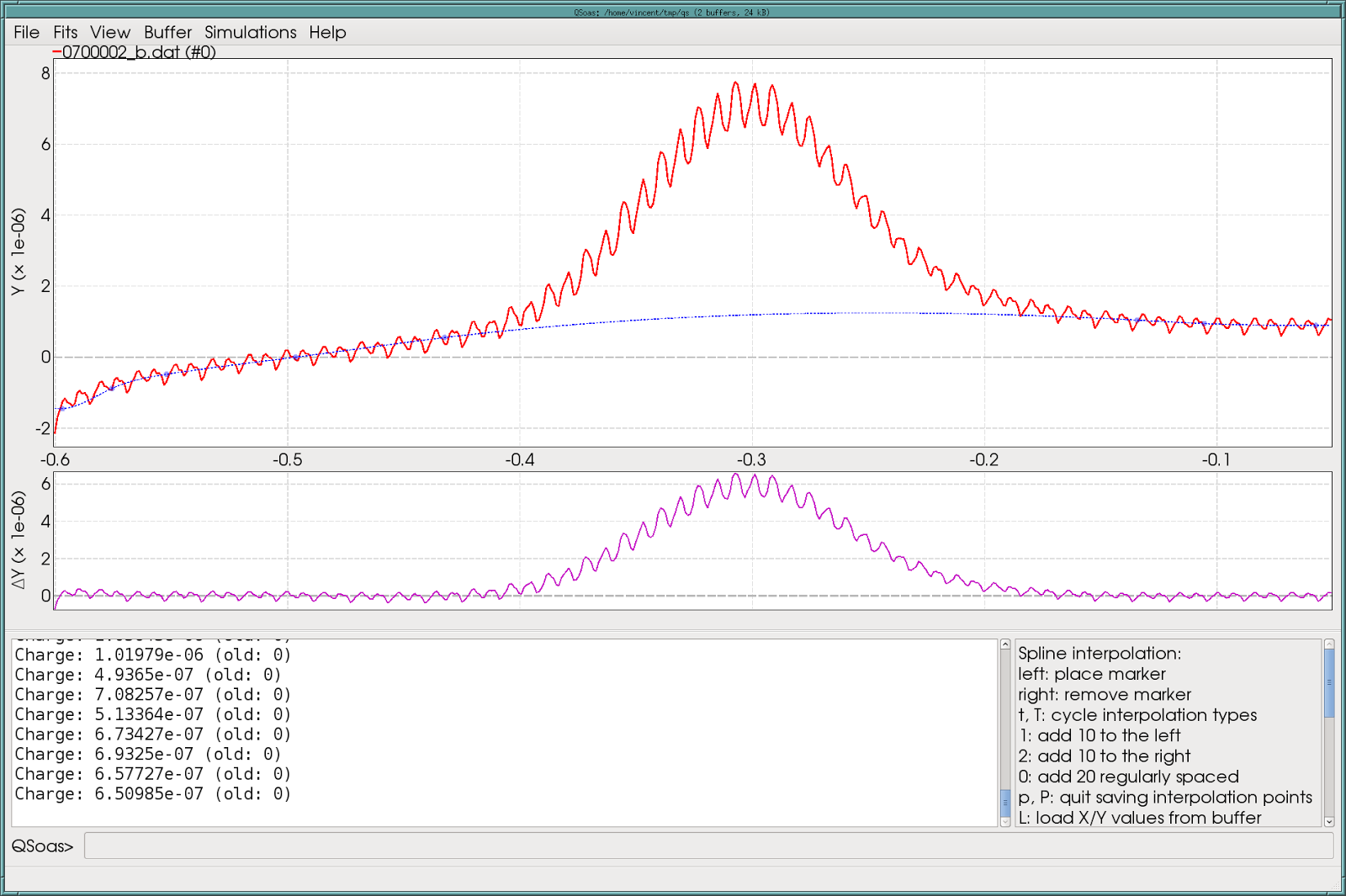
During data processing in our team, we often subtract plain polynomial baselines to our data, drawn by hand using the b command. Note that this is legitimate because we know that the signal we are looking for quickly drops to 0 outside a given range. The usual workflow is to just load the data, use b to draw a baseline and subtract it, and then have further fun with the baseline-subtracted data. This was the only possibility in the old SOAS. However, I don't like so much this kind of workflow, because such a baseline is arbitrary, and once it's subtracted, it's hard to reassess the baseline afterwards.
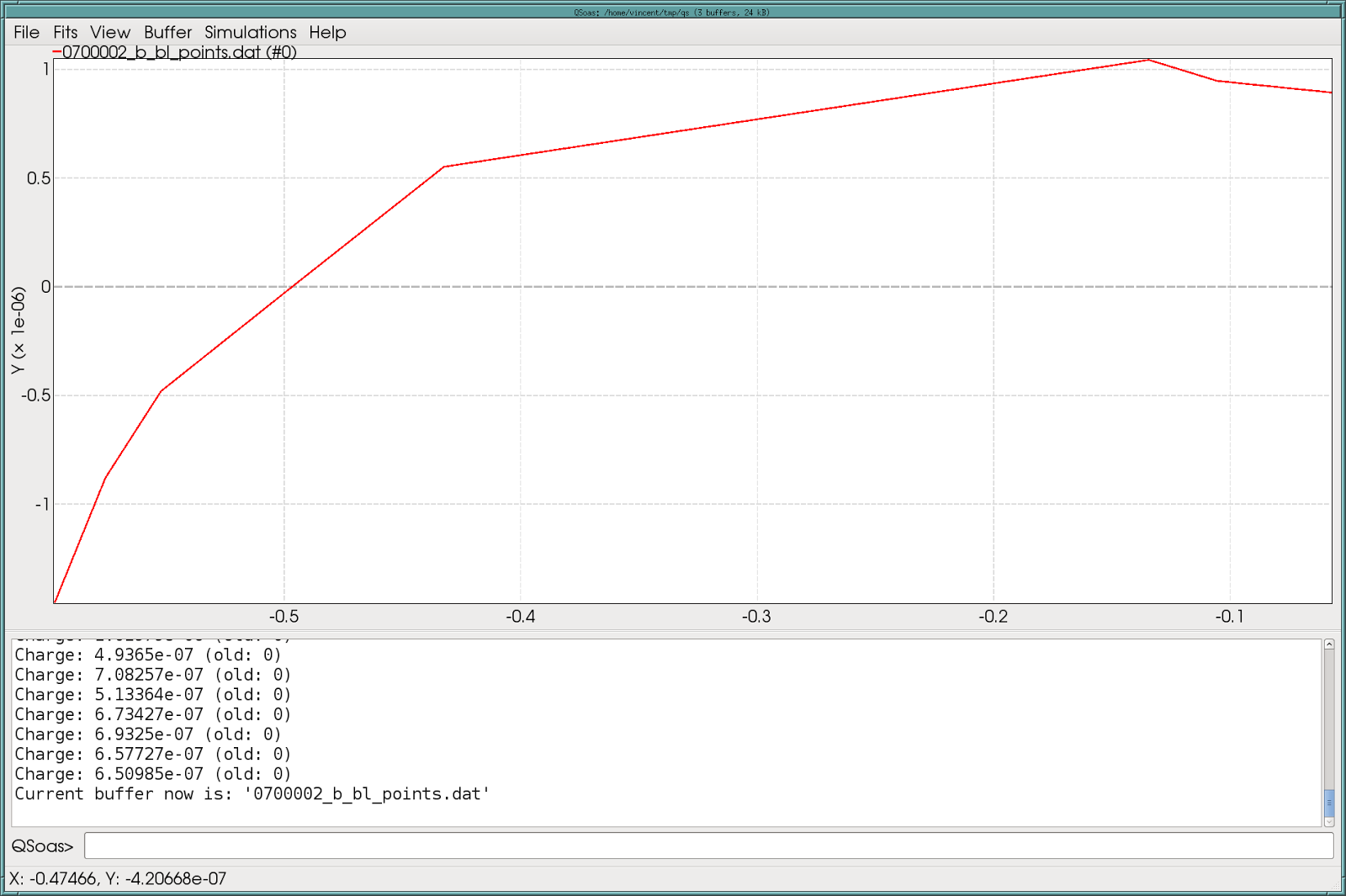
This is why I've designed a better way in QSoas: when you are done creating a baseline, push p: this exits pushing only the interpolation nodes:
Above, the baseline subtraction interface, and below, the resulting nodes:
The nodes can be reloaded by hitting uppercase L from within b and giving a buffer number (admittedly, the interface as of now isn't that good, I'll have to work on it). Alternatively, you can greenerate the baseline by using interpolate, and then further subtract it using S:
QSoas> interpolate 1 0
where 1 is the original buffer (in fact, only its X values will be used, so you don't have to use the same buffer) and 0 is the buffer containing the interpolation nodes. Saving only the interpolation nodes makes it possible to reedit the baseline easily, and regenerate the baseline-subtracted data using a script. This is my favorite approach, because I like to be able to trace every single step from the raw data to processed data. Another neat feature is that, from within b, you can reload only the X values of nodes using lowercase l (and giving buffer number): the Y values are computed as if you had clicked at the corresponding positions. This is very useful is you have a whole series of similar baselines to make: most often, you won't even need manual adjustment to get a good baseline. I hope you'll find this tip useful !

15 February 2016

Michal &#268;iha&#345;: Weblate supports Python 3

During the last days I've completed quite long time challenge - make Weblate compatible with Python 3. It's probably still not in shape you would use it on production server, but it runs fine and the testsuite completes without errors. As usual, the major obstacle are dependencies. The translate-toolkit doesn't support Python 3 in any released version, so you need latest Git snapshot. Another problematic bit is Mercurial, which will not support Python 3 in near future. But in case you need it, you can still install Python 2 version and use it from Weblate (it uses command line interface). The porting was mostly dealing with encoding mess - in Python 2 you really didn't have to distinguish between binary and text data, while Python 3 quite enforces that. This turned out to be especially tricky with CSV files where csv module expects text streams in Python 3, while translate-toolkit CSV parser expects binary ones. All this has one downside as well - the test matrix got bigger again, what makes the testsuite run longer with 5 workers available. While doing these changes, I've also decided to drop support for Django 1.7, this will allow us to get rid of lot of deprecation warnings in Django 1.9 and prepare codebase for Django 1.10.

Filed under: English Weblate 0 comments

Julien Danjou: Timeseries storage and data compression

The first major version of the scalable timeserie database I work on, Gnocchi was a released a few months ago. In this first iteration, it took a rather naive approach to data storage. We had little ideas about if and how our distributed back-ends were going to be heavily used, so we stuck to the code of the first proof-of-concept written a couple of years ago. Recently we got more feedbacks from our users, ran a few benchmarks. That gave us enough feedback to start investigating in improving our storage strategy. Data split Up to Gnocchi 1.3, all data for a single metric are stored in a single gigantic file per aggregation method (min, max, average ). This means that the file can grow to several megabytes in size, which make it slow to manipulate. For the next version of Gnocchi, our first work has been to rework that storage and split the data into smaller parts. Gnocchi Carbonara archives split The diagram above shows how data are organized inside Gnocchi. Until version 1.3, there would have been only one file for each aggregation methods. In the upcoming 2.0 version, Gnocchi will split all these data into smaller parts, where each data split is stored in a file/object. This allows to manipulate smaller pieces of data and to increase the parallelism of the CRUD operations on the back-end leading to large speed improvement. In order to split timeseries into several chunks, Gnocchi defines a maximum number of N points to keep per chunk, to limit their maximum size. It then defines a hash function that produces a non-unique key for any timestamp. It makes it easy to find in which chunk any timestamp should be stored or retrieved. Data compression Up to Gnocchi 1.3, the data stored for each metric is simply serialized using msgpack, a fast and small serialization format. Though, this format does not provide any compression. That means that storing data points needs 8 bytes for a timestamp (64 bits timestamp with nanosecond precision) and 8 bytes for a value (64 bits double-precision floating-point), plus some overhead (extra information and msgpack itself). After looking around on how to compress all these measures, I stumbled upon a paper from some Facebook engineers called about Gorilla, their in-memory timeserie database, entitled "Gorilla: A Fast, Scalable, In-Memory Time Series Database". For reference, part of this encoding is also used by InfluxDB in its new storage engine. The first technique I implemented is easy enough, and it's inspired from delta-of-delta encoding. Instead of storing each timestamp for each data point, and since all the data points are aggregated on a regular interval, we transpose points to be the time difference divided by the interval. For example, the suite of timestamps timestamps = [41230, 41235, 41240, 41250, 41255] is encoded into timestamps = [41230, 1, 1, 2, 1], interval = 5. This allows regular compression algorithms to reduce the size of the integer list using run-length encoding. To actually compress the values, I tried two different algorithms: I then benchmarked these solutions: Gnocchi Carbonara compression speed The XOR algorithm implemented in Python is pretty slow, compared to LZ4. Truth is that python-lz4 is fully implemented in C, which makes it fast. I've profiled my XOR implementation in Python, to discover that one operation took 20 % of the time: count_lead_and_trail_zeroes, which is in charge of counting the number of leading and trailing zeroes in a binary number. Gnocchi Carbonara compression XOR profiling I tried 2 Python implementations of the same algorithm (and submitted them to my friend and Python developer Victor Stinner by the way). The first version using string search with .index() is 10 faster than the second one that only do integer computation. Ah, Python As Victor explained, each Python operation is slow and there's a lot in the second version, whereas .index() is implemented in C and really well optimized and only needs 2 Python operations. Finally, I ended up optimizing that code by leveraging cffi to use directly ffsll() and flsll(). That decreased the run-time of count_lead_and_trail_zeroes by 45 %, making the entire XOR compression code speed increased by a small 7 %. This is not enough to catch up with LZ4 speed. At this stage, the only solution to achieve a high-speed would probably to go with a full C implementation. Gnocchi Carbonara compression size Considering the compression ratio of the different algorithms, they are pretty much identical. The worst case scenario (random values) for LZ4 compress down to 9 bytes per data point, whereas XOR can go down to 7.38 bytes per data point. In general XOR encoding beats LZ4 by 15 %, except for cases where all values are 0 or 1. However, LZ4 is faster than XOR by a factor of 4 -70 depending on cases. That means that we'll use LZ4 for data compression in Gnocchi 2.0. It's possible that we could achieve as fast compression/decompression algorithm, but I don't think it's worth the effort right now it'd represent a lot of code to write and to maintain.

14 February 2016

Lunar: Reproducible builds: week 42 in Stretch cycle

What happened in the reproducible builds effort between February 7th and February 13th 2016:

Toolchain fixes
  • James McCoy uploaded devscripts/2.16.1 which makes dcmd supports .buildinfo files. Original patch by josch.
  • Lisandro Dami n Nicanor P rez Meyer uploaded qt4-x11/4:4.8.7+dfsg-6 which make files created by qch reproducible by using a fixed date instead of the current time. Original patch by Dhole.
Norbert Preining rejected the patch submitted by Reiner Herrmann to make the CreationDate not appear in comments of DVI / PS files produced by TeX. He also mentioned that some timestamps can be replaced by using the -output-comment option and that the next version of pdftex will have patches inspired by reproducible build to mitigate the effects (see SOURCE_DATE_EPOCH patches) .

Packages fixed The following packages have become reproducible due to changes in their build dependencies: abntex, apt-dpkg-ref, arduino, c++-annotations, cfi, chaksem, clif, cppreference-doc, dejagnu, derivations, ecasound, fdutils, gnash, gnu-standards, gnuift, gsequencer, gss, gstreamer0.10, gstreamer1.0, harden-doc, haskell98-report, iproute2, java-policy, libbluray, libmodbus, lizardfs, mclibs, moon-buggy, nurpawiki, php-sasl, shishi, stealth, xmltex, xsom. The following packages became reproducible after getting fixed: Some uploads fixed some reproducibility issues, but not all of them: Patches submitted which have not made their way to the archive yet:
  • #813944 on cvm by Reiner Herrmann: remove gzip headers, fix permissions of some directories and the order of the md5sums.
  • #814019 on latexdiff by Reiner Herrmann: remove the current build date from documentation.
  • #814214 on rocksdb by Chris Lamb: add support for SOURCE_DATE_EPOCH.

reproducible.debian.net A new armhf build node has been added (thanks to Vagrant Cascadian) and integrated into the Jenkins setup for 4 new armhf builder jobs. (h01ger) All packages for Debian testing (Stretch) have been tested on armhf in just 42 days. It took 114 days to get the same point for unstable back when the armhf test infrastructure was much smaller. Package sets have been enabled for testing on armhf. (h01ger) Packages producing architecture-independent ( Arch:all ) binary packages together with architecture dependent packages targeted for specific architectures will now only be tested on matching architectures. (Steven Chamberlain, h01ger) As the Jenkins setup is now made of 252 different jobs, the overview has been split into 11 different smalller views. (h01ger)

Package reviews 222 reviews have been removed, 110 added and 50 updated in the previous week. 35 FTBFS reports were made by Chris Lamb, Danny Edel, and Niko Tyni.

Misc. The recordings of Ludovic Court s' talk at FOSDEM 16 about reproducible builds and GNU Guix is now available. One can also have a look at slides from Fabian Keil's talk about ElecrtroBSD and Baptiste Daroussin's talk about FreeBSD packages.

13 February 2016

Scott Kitterman: Debian LTS Work January 2016

This was my ninth month as a Freexian sponsored LTS contributor. I was assigned 8 hours for the month of January. My time this month was spent preparing updates for clamav and the associated libclamunrar for squeeze and wheezy. For wheezy, I ve only helped a little, mostly I worked on squeeze. This update is more complex than usual because with clamav 0.99 upstream bumped soname and so in addition to the normal case of transitions in unstable, we ve needed transitions for stable, oldstable, and squeeze-lts. We also try to be careful and maintain higher versions in newer releases, so stable needed to wait for 0.99 in testing, oldstable needed to wait for stable, etc. Currently 0.99 is in stable proposed updates and I ve requested that the update for wheezy (oldstable) go forward. Once that s done, I ve got squeeze-lts ready to go.

Mark Brown: Performance problems

Just over a year ago I implemented an optimization to the SPI core code in Linux that avoids some needless context switches to a worker thread in the main data path that most clients use. This was really nice, it was simple to do but saved a bunch of work for most drivers using SPI and made things noticeably faster. The code got merged in v4.0 and that was that, I kept on kicking a few more ideas for optimizations in this area around but that was that until the past month. What happened then was that for whatever reason people started picking up v4.0 and using it in production more. On some systems people started seeing problems when there was heavy SPI flash usage, often during things like distribution installation. In some cases the lockup detector fired, but the most entertaining error was that on Marvell Orion systems (which are single core) when the flash was being heavily used the SATA controller started having trouble handling interrupts. These problems all bisected down to the key commit in that series, 0461a4149836c79 (spi: Pump transfers inside calling context for spi_sync()). The problem is that there are a number of widely deployed SPI controllers out there that don t support DMA and instead require the CPU to explicitly read and write everything sent to and from registers in the controller. To make matters worse these accesses to the controller will usually take many CPU cycles to complete, each one stalling the CPU while they happen. This is fine for short transfers or if the CPU has nothing else to do but on a busy multitasking system it s an issue. Before the optimization the switches between the worker thread interacting with the hardware and the thread initiating the SPI operations provided breaks in this activity which allowed other things to switch in. Unfortunately when we optimize those away then if there s a lot of work for the controller being done from one thread then that thread can run for a long time without pause. The fix for affected drivers if there are no less CPU intensive ways of driving the hardware is to add some explicit sleeps into the driver itself, either at the end of the transfer_one() or perhaps in an unprepare_message() function. In a way I was quite pleased to see this, it was a clear demonstration that the optimization was having the intended effect though obviously users of affected systems will not find that so comforting. It s not the first time that making things faster or fixing a bug has revealed an underlying problem, I m sure it won t be the last.

9 February 2016

Mark Brown: Maintaining your email

One of the difficulties of being a kernel maintainer for a busy subsystem is that you will often end up getting a lot of mail that requires reading and handling which in turn requires sending a lot of mail out in reply. Some of that requires thought and careful consideration but a lot of it is quite routine and (perhaps surprisingly) there is often more challenge in doing a good job of handling these routine messages. For a long time I used to hand write every reply I sent but the problem with doing that is that sending the same message a lot of times tends to result in the messages getting more and more brief as the message becomes routine and practised. Your words become more optimised and if you ve stopped thinking about the message before you ve finished typing it then there s a desire to finish the typing and get on to the next thing. This is I think a lot of the reputation that kernel maintainers have for being terse and unhelpful comes from messages that are very practised for someone sending them all the time aren t always going to be obvious or helpful for someone who s not so intimately familiar with what s going on. The good part of it is that everyone is getting a personalised response and it s easy to insert a comment about that specific situation when you re already replying but it s not clear that the tradeoff is a good one. What I ve started doing instead for most things is keeping a set of pre-written paragraphs for common cases that I can just insert into a mail and edit as needed. Hopefully it s working well for people, it means the replies are that bit more verbose than they might otherwise be (mainly adding an explanation of why a given thing is being asked for) but can easily be adapted as needed. The one exception is the Applied, thanks mails I used to send when I apply a patch (literally just saying that). Those are now automatically generated by the script I use to sync my local git repository with kernel.org and very much more verbose:
From: Mark Brown <broonie@kernel.org>
To: $ CCS 
Cc: $ LIST 
Subject: $ SUBJECT 
In-Reply-To: $ MSGID 
The patch
   $ TITLE 
has been applied to the $ REPO  tree at
   $ URL  $ BRANCH 
All being well this means that it will be integrated into the linux-next
tree (usually sometime in the next 24 hours) and sent to Linus during
the next merge window (or sooner if it is a bug fix), however if
problems are discovered then the patch may be dropped or reverted.
You may get further e-mails resulting from automated or manual testing
and review of the tree, please engage with people reporting problems and
send followup patches addressing any issues that are reported if needed.
(unfortunately this bit seems to be something that it s worth pointing out)
If any updates are required or you are submitting further changes they
should be sent as incremental updates against current git, existing
patches will not be replaced.
Please add any relevant lists and maintainers to the CCs when replying
to this mail.
Thanks,
Mark
(the script does try to CC relevant lists). As well as giving people more information this also means that the mails only get sent out when things actually get published to my public repositories which avoids some confusion that used to happen sometimes with people getting my replies before I d pushed, especially when I d been working with poor connectivity as often happens when travelling. On the down side it s very much an obvious form letter which some people don t like and which can make people glaze over. My hope with this is to make things easier on average for patch submitters and easier for me, feedback on the scripted e-mails appears to be good thus far and the goal with the pasted in content is that it should be less obvious that it s happening so I d expect less feedback there.

8 February 2016

Niels Thykier: Performance tuning of lintian, take 3

About 7 months ago, I wrote about we had improved Lintian s performance. In 2.5.41, we are doing another memory reduction, where we primarily reduce the memory consumption of data about ELF binaries. Like previously, memory reductions follows the less is more pattern. My initial test subject was linux-image-4.4.0-trunk-rt-686-pae_4.4-1~exp1_i386.deb. It had a somewhat unique property that the ELF data made up a little over half the cache. At this point, we had reduced the total memory usage from 18.35MB to 8.92MB (the ELF data going from 10.56MB to 1.98MB)[1]. At this point, I figured that I was happy with the improvement and discarded my test subject. While impressive, the test subject was unsurprisingly a special case. The improvement in regular packages[2] (with ELF binaries) were closer to 8% in total. Not being satisfied with that, I pulled one more trick. In the grand total, coreutils 8.24-1 amd64 went from 4.09MB to 3.48MB. The ELF data cache went from 3.38MB to 2.84MB. Similarly, libreoffice/4.2.5-1 (including its ~170 binaries) has also seen a 8.5% reduction in total cache size[3] and is now down to 260.48MB (from 284.83MB). [1] If you are wondering why I in 3fd98d9 wrote The total cache memory usage is approaching 1/3 of the original for that package , then you are not alone. I am not sure myself any more, but it seems obviously wrong. [2] FTR: The sample size of regular packages is 2 in this case. Of which one of them being coreutils [3] Admittedly, since take 2 and not since 2.5.40.2 like the rest.
Filed under: Debian, Lintian

Joachim Breitner: Protecting static content with mod_rewrite

Since fourteen years, I have been photographing digitally and putting the pictures on my webpage. Back then, online privacy was not a big deal, but things have changed, and I had to at least mildly protect the innocent. In particular, I wanted to prevent search engines from accessing some of my pictures. As I did not want my friends and family having to create an account and remember a password, I set up an OpenID based scheme five years ago. This way, they could use any of their OpenID enabled account, e.g. their Google Mail account, to log in, without disclosing any data to me. As my photo album consists of just static files, I created two copies on the server: the real one with everything, and a bunch of symbolic links representing the publicly visible parts. I then used mod_auth_openid to prevent access to the protected files, unless the users logged in. I never got around of actually limiting who could log in, so strangers were still able to see all photos, but at least search engine spiders were locked out. But, very unfortunately, OpenID did never really catch on, Google even stopped being a provider, and other promising decentralized authentication schemes like Mozilla Persona are also phased out. So I needed an alternative. A very simply scheme would be a single password that my friends and family can get from me and that unlocks the pictures. I could have done that using HTTP Auth, but that is not very user-friendly, and the login does not persist (at least not without the help of the browser). Instead, I wanted something that involves a simple HTTP form. But I also wanted to avoid server-side programming, for performance and security reasons. I love serving static files whenever it is feasible. Then I found that mod_rewrite, Apache s all-around-tool for URL rewriting and request mangling, supports reading and writing cookies! So I came up with a scheme that implements the whole login logic in the Apache server configuration. I d like to describe this setup here, in case someone finds it inspiring. I created a login.html with a simple HTML form:

<form method="GET" action="/bilder/login.html">
 <div style="text-align:center">
  <input name="password" placeholder="Password" />
  <button type="submit">Sign-In</button>
 </div>
</form>
It sends the user to the same page again, putting the password into the query string, hence the method="GET" mod_rewrite unfortunately cannot read the parameters of a POST request. The Apache configuration is as follows:
RewriteMap public "dbm:/var/www/joachim-breitner.de/bilder/publicfiles.dbm"
<Directory /var/www/joachim-breitner.de/bilder>
 RewriteEngine On
 # This is a GET request, trying to set a password.
 RewriteCond % QUERY_STRING  password=correcthorsebatterystaple
 RewriteRule ^login.html /bilder/loggedin.html [L,R,QSD,CO=bilderhp:correcthorsebatterystaple:www.joachim-breitner.de:2000000:/bilder]
 # This is a GET request, trying to set a wrong password.
 RewriteCond % QUERY_STRING  password=
 RewriteRule ^login.html /bilder/notloggedin.html [L,R,QSD]
 # No point in loggin in if there is already the right password
 RewriteCond % HTTP:Cookie  bilderhp=correcthorsebatterystaple
 RewriteRule ^login.html /bilder/loggedin.html [L,R]
 # If protected file is requested, check for cookie.
 # If no cookie present, redirect pictures to replacement picture
 RewriteCond % HTTP:Cookie  !bilderhp=correcthorsebatterystaple
 RewriteCond $ public:$0 private  private
 RewriteRule ^.*\.(png jpg)$ /bilder/pleaselogin.png [L]
 RewriteCond % HTTP:Cookie  !bilderhp=correcthorsebatterystaple
 RewriteCond $ public:$0 private  private
 RewriteRule ^.+$ /bilder/login.html [L,R]
</Directory>
The publicfiles.dbm file is generated from a text file with lines like
login.html.en 1
login.html.de 1
pleaselogin.png 1
thumbs/20030920165701_thumb.jpg 1
thumbs/20080813225123_thumb.jpg 1
...
using
/usr/sbin/httxt2dbm -i publicfiles.txt -o publicfiles.dbm
and whitelists all files that are visible without login. Make sure it contains the login page, otherwise you ll get a redirect circle. The other directives in the above configure fulfill these tasks: And that s it! No resource-hogging web frameworks, not security-dubious scripting languages, and a dead-simple way to authenticate. Oh, and if you believe you know me well enough to be allowed to see all photos: The real password is not correcthorsebatterystaple; just ask me what it is.

Lunar: Reproducible builds: week 41 in Stretch cycle

What happened in the reproducible builds effort this week:

Toolchain fixes After remarks from Guillem Jover, Lunar updated his patch adding generation of .buildinfo files in dpkg.

Packages fixed The following packages have become reproducible due to changes in their build dependencies: dracut, ent, gdcm, guilt, lazarus, magit, matita, resource-agents, rurple-ng, shadow, shorewall-doc, udiskie. The following packages became reproducible after getting fixed:
  • disque/1.0~rc1-5 by Chris Lamb, noticed by Reiner Herrmann.
  • dlm/4.0.4-2 by Ferenc W gner.
  • drbd-utils/8.9.6-1 by Apollon Oikonomopoulos.
  • java-common/0.54 by by Emmanuel Bourg.
  • libjibx1.2-java/1.2.6-1 by Emmanuel Bourg.
  • libzstd/0.4.7-1 by Kevin Murray.
  • python-releases/1.0.0-1 by Jan Dittberner.
  • redis/2:3.0.7-2 by Chris Lamb, noticed by Reiner Herrmann.
  • tetex-brev/4.22.github.20140417-3 by Petter Reinholdtsen.
Some uploads fixed some reproducibility issues, but not all of them:
  • anarchism/14.0-4 by Holger Levsen.
  • hhvm/3.11.1+dfsg-1 by Faidon Liambotis.
  • netty/1:4.0.34-1 by Emmanuel Bourg.
Patches submitted which have not made their way to the archive yet:
  • #813309 on lapack by Reiner Herrmann: removes the test log and sorts the files packed into the static library locale-independently.
  • #813345 on elastix by akira: suggest to use the $datetime placeholder in Doxygen footer.
  • #813892 on dietlibc by Reiner Herrmann: remove gzip headers, sort md5sums file, and sort object files linked in static libraries.
  • #813912 on git by Reiner Herrmann: remove timestamps from documentation generated with asciidoc, remove gzip headers, and sort md5sums and tclIndex files.

reproducible.debian.net For the first time, we've reached more than 20,000 packages with reproducible builds for sid on amd64 with our current test framework. Vagrant Cascadian has set up another test system for armhf. Enabling four more builder jobs to be added to Jenkins. (h01ger)

Package reviews 233 reviews have been removed, 111 added and 86 updated in the previous week. 36 new FTBFS bugs were reported by Chris Lamb and Alastair McKinstry. New issue: timestamps_in_manpages_generated_by_yat2m. The description for the blacklisted_on_jenkins issue has been improved. Some packages are also now tagged with blacklisted_on_jenkins_armhf_only.

Misc. Steven Chamberlain gave an update on the status of FreeBSD and variants after the BSD devroom at FOSDEM 16. He also discussed how jails can be used for easier and faster reproducibility tests. The video for h01ger's talk in the main track of FOSDEM 16 about the reproducible ecosystem is now available.

Orestis Ioannou: Debian - your patches and machine readable copyright files are available on Debsources

TL;DR All Debian license and patches are belong to us. Discover them here and here. In case you hadn't already stumbled upon sources.debian.net in the past, Debsources is a simple web application that allows to publish an unpacked Debian source mirror on the Web. On the live instance you can browse the contents of Debian source packages with syntax highlighting, search files matching a SHA-256 hash or a ctag, query its API, highlight lines, view accurate statistics and graphs. It was initially developed at IRILL by Stefano Zacchiroli and Matthieu Caneill. During GSOC 2015 I helped introduce two new features. License Tracker Since Debsources has all the debian/copyright files and that many of them adopted the DEP-5 suggestion (machine readable copyright files) it was interesting to exploit them for end users. You may find interesting the following features: Have a look at the documentation to discover more! Patch tracker The old patch tracker unfortunately died a while ago. Since Debsources stores all the patches it was, probably, natural for it to be able to exploit them and present them over the web. You can navigate through packages by prefix or by searching them here. Among the use cases: Read more about the API! Coming ... I hope you find these new features useful. Don't hesitate to report any bugs or suggestions you come accross.

5 February 2016

Bernd Zeimetz: bzed-letsencrypt puppet module

With the announcement of the Let s Encrypt dns-01 challenge support we finally had a way to retrieve certificates for those hosts where http challenges won t work. Also it allows to centralize the signing procedure to avoid the installation and maintenance of letsencrypt clients on all hosts. For an implementation I had the following requirements in my mind: After reading trough the source code of various letsencrypt client implementations I decided to use letsencrypt.sh. Mainly because its dependencies are available pretty much everywhere and adding the necessary hook is as simple as writing some lines of code in your favourite (scripting) language. My second favourite was lego, but I wanted to avoid shipping binaries with puppet, so golang was not an option. It took me some days to find enough spare time to write the necessary puppet code, but finally I managed to release a working module today. It is still not perfect, but the basic tasks are implemented and the whole key/csr/signing chain works pretty well. And if your hook can handle it, http-01 challenges are possible, too! Please give the module a try and send patches if you would like to help to improve it!

4 February 2016

Russell Coker: Unikernels

At LCA I attended a talk about Unikernels. Here are the reasons why I think that they are a bad idea: Single Address Space According to the Unikernel Wikipedia page [1] a significant criteria for a Unikernel system is that it has a single address space. This gives performance benefits as there is no need to change CPU memory mappings when making system calls. But the disadvantage is that any code in the application/kernel can access any other code directly. In a typical modern OS (Linux, BSD, Windows, etc) every application has a separate address space and there are separate memory regions for code and data. While an application can request the ability to modify it s own executable code in some situations (if the OS is configured to allow that) it won t happen by default. In MS-DOS and in a Unikernel system all code has read/write/execute access to all memory. MS-DOS was the least reliable OS that I ever used. It was unreliable because it performed tasks that were more complex than CP/M but had no memory protection so any bug in any code was likely to cause a system crash. The crash could be delayed by some time (EG corrupting data structures that are only rarely accessed) which would make it very difficult to fix. It would be possible to have a Unikernel system with non-modifyable executable areas and non-executable data areas and it is conceivable that a virtual machine system like Xen could enforce that. But that still wouldn t solve the problem of all code being able to write to all data. On a Linux system when an application writes to the wrong address there is a reasonable probability that it will not have write access and you will immediately get a SEGV which is logged and informs the sysadmin of the address of the crash. When Linux applications have bugs that are difficult to diagnose (EG buffer overruns that happen in production and can t be reproduced in a test environment) there are a variety of ways of debugging them. Tools such as Valgrind can analyse memory access and tell the developers which code had a bug and what the bug does. It s theoretically possible to link something like Valgrind into a Unikernel, but the lack of multiple processes would make it difficult to manage. Debugging A full Unix environment has a rich array of debugging tools, strace, ltrace, gdb, valgrind and more. If there are performance problems then tools like sysstat, sar, iostat, top, iotop, and more. I don t know which of those tools I might need to debug problems at some future time. I don t think that any Internet facing service can be expected to be reliable enough that it will never need any sort of debugging. Service Complexity It s very rare for a server to have only a single process performing the essential tasks. It s not uncommon to have a web server running CGI-BIN scripts or calling shell scripts from PHP code as part of the essential service. Also many Unix daemons are not written to run as a single process, at least threading is required and many daemons require multiple processes. It s also very common for the design of a daemon to rely on a cron job to clean up temporary files etc. It is possible to build the functionality of cron into a Unikernel, but that means more potential bugs and more time spent not actually developing the core application. One could argue that there are design benefits to writing simple servers that don t require multiple programs. But most programmers aren t used to doing that and in many cases it would result in a less efficient result. One can also argue that a Finite State Machine design is the best way to deal with many problems that are usually solved by multi-threading or multiple processes. But most programmers are better at writing threaded code so forcing programmers to use a FSM design doesn t seem like a good idea for security. Management The typical server programs rely on cron jobs to rotate log files and monitoring software to inspect the state of the system for the purposes of graphing performance and flagging potential problems. It would be possible to compile the functionality of something like the Nagios NRPE into a Unikernel if you want to have your monitoring code running in the kernel. I ve seen something very similar implemented in the past, the CA Unicenter monitoring system on Solaris used to have a kernel module for monitoring (I don t know why). My experience was that Unicenter caused many kernel panics and more downtime than all other problems combined. It would not be difficult to write better code than the typical CA employee, but writing code that is good enough to have a monitoring system running in the kernel on a single-threaded system is asking a lot. One of the claimed benefits of a Unikernel was that it s supposedly risky to allow ssh access. The recent ssh security issue was an attack against the ssh client if it connected to a hostile server. If you had a ssh server only accepting connections from management workstations (a reasonably common configuration for running servers) and only allowed the ssh clients to connect to servers related to work (an uncommon configuration that s not difficult to implement) then there wouldn t be any problems in this regard. I think that I m a good programmer, but I don t think that I can write server code that s likely to be more secure than sshd. On Designing It Yourself One thing that everyone who has any experience in security has witnessed is that people who design their own encryption inevitably do it badly. The people who are experts in cryptology don t design their own custom algorithm because they know that encryption algorithms need significant review before they can be trusted. The people who know how to do it well know that they can t do it well on their own. The people who know little just go ahead and do it. I think that the same thing applies to operating systems. I ve contributed a few patches to the Linux kernel and spent a lot of time working on SE Linux (including maintaining out of tree kernel patches) and know how hard it is to do it properly. Even though I m a good programmer I know better than to think I could just build my own kernel and expect it to be secure. I think that the Unikernel people haven t learned this.

Benjamin Mako Hill: Welcome Back Poster

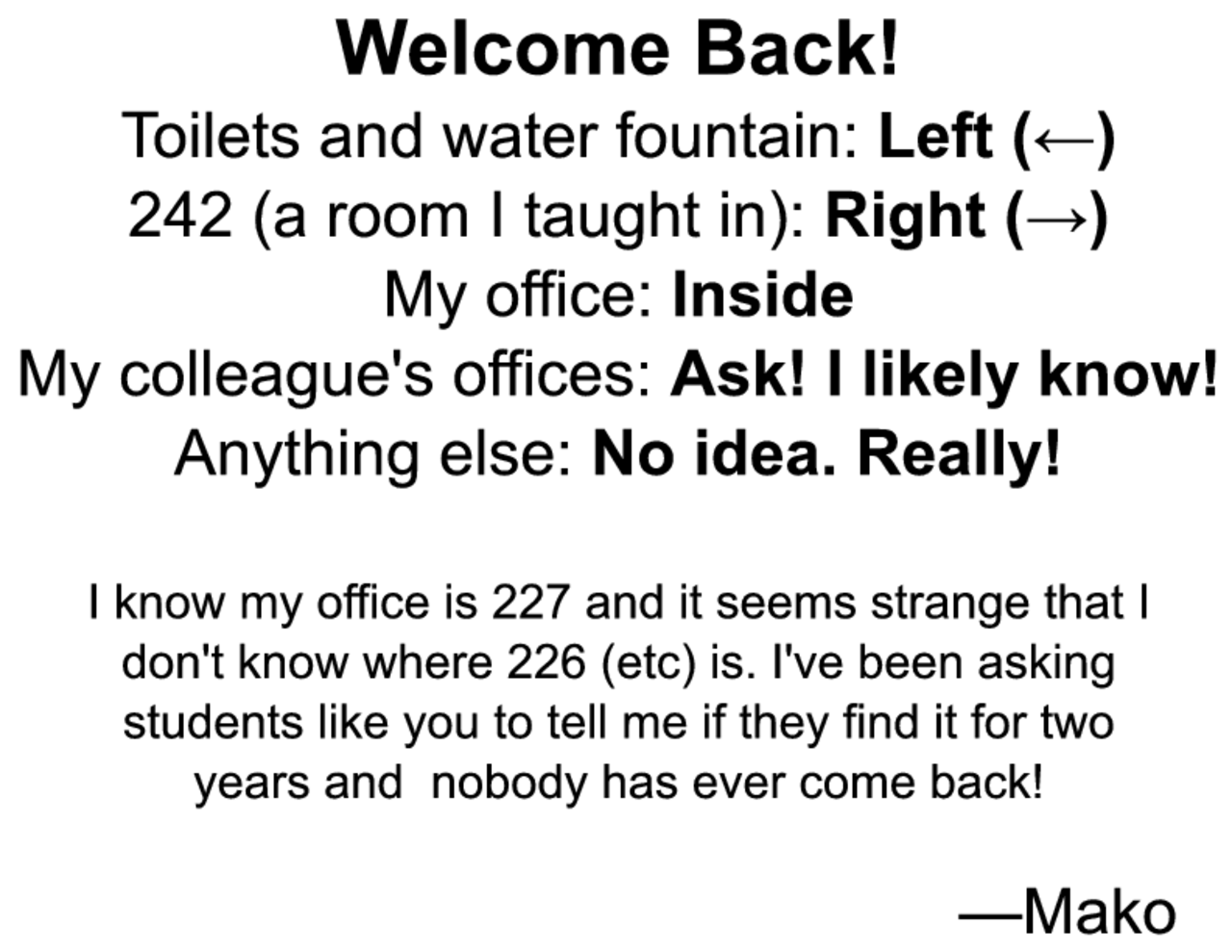
My office door is on the second floor in front the major staircase in my building. I work with my door open so that my colleagues and my students know when I m in. The only time I consider deviating from this policy is the first week of the quarter when I m faced with a stream of students, usually lost on their way to class and that, embarrassingly, I am usually unable to help. I made this poster so that these conversations can, in a way, continue even when I am not in the office. early_quarter_doors_sign
3 February 2016

Jonathan Dowland: Comparing Docker images

I haven't written much yet about what I've been up to at work. Right now, I'm making changes to the sources of a set of Docker images. The changes I'm making should not result in any changes to the actual images: it's just a re-organisation of the way in which they are built. I've been using the btrfs storage driver for Docker which makes comparing image filesystems very easy from the host machine, as all the image filesystems are subvolumes. I use a bash script like the following to make sure I haven't broken anything:
oldid="$1"; newid="$2";
id_in_canonical_form()  
    echo "$1"   grep -qE '^[a-f0-9] 64 $'
 
canonicalize_id()  
    docker inspect --format '  .Id  ' "$1"
 
id_in_canonical_form "$oldid"   oldid="$(canonicalize_id "$oldid")"
id_in_canonical_form "$newid"   newid="$(canonicalize_id "$newid")"
cd "/var/lib/docker/btrfs/subvolumes"
sumpath()  
    cd "$1" && find . -printf "%M %4U %4G %16s %h/%f\n"   sort
 
diff -ruN "$oldid" "newid"
diff -u <(sumpath "$oldid") <(sumpath "$newid")
Using -printf means I can ignore changes in the timestamps on files which is something I am not interested in. If it is available in your environment, Lars Wirzenius' tool Summain generates manifests that include a file checksum and could be very useful for this use-case.

1 February 2016

Russ Allbery: Review: Oathblood

Review: Oathblood, by Mercedes Lackey
Series: Vows and Honor #3
Publisher: DAW
Copyright: April 1998
ISBN: 0-88677-773-9
Format: Mass market
Pages: 394
I have this story collection listed as the third book in the Vows and Honor series, but as mentioned in the review of The Oathbound, it's more complicated than that. This book has the first Tarma and Kethry story, which is not found in The Oathbound, and two of the better stories from that volume. This is probably the place to start for the series; you're not missing that much from the rest of that book. However, the last three stories ("Wings of Fire," "Spring Plowing at Forst Reach," and "Oathblood") have significant spoilers for Oathbreakers. Therefore, if you care about both avoiding spoilers and reading this series, my recommended reading order is to ignore The Oathbound entirely, read Oathblood up to but not including "Wings of Fire," read Oathbreakers, and then come back here for the last two stories. "Sword-sworn": This is the very first Tarma and Kethry story and hence where this series actually begins. As Lackey notes in her introduction, it's a pretty stock "rape and revenge" story, which is not something I particularly enjoy. Marion Zimmer Bradley liked it well enough to accept it anyway, and I can sort of see why: the dynamic between the two characters sparkles in a few places, and the Shin'a'in world-building isn't bad. The plot, though, is very predictable and not very notable. There isn't much here that you'd be surprised by if you'd read references to these events in later stories. And there's no explanation of a few things one might be curious about, such as where Need came from. (6) "Turnabout": This is one of the two stories also found in The Oathbound. Merchants are plagued by bandits who manage to see through ruses and always catch their guards by surprise (with a particularly nasty bit of rape and murder in one case Tarma and Kethry stories have quite a lot of that). That's enough to get the duo to take the job of luring out the bandits and dealing with them, using a nice bit of magical disguise. This story is also a song on one of the Vows and Honor albums from Firebird (which I also have). It was one of my favorites of Lackey's songs, so I want to like the story (and used to like it a great deal). Unfortunately, the very nasty bit of revenge that the supposed heroes take at the end of the story completely destroyed my enjoyment of it on re-reading. It's essentially a glorification of prison rape, which is a trope that I no longer have any patience for. (4) "The Making of a Legend": In order to explain the differences between the song based on "Turnabout" and the actual story, Lackey invented a bard, Leslac, who loves writing songs about Tarma and Kethry and regularly gets the details wrong, mostly by advertising them as moral crusaders for women instead of mercenaries who want to get paid, much to their deep annoyance. This is his debut in an actual story, featuring an incident that's delightfully contrary to Leslac's expectations. It's a slight story, but I thought it was fun. (6) "Keys": Another story from The Oathbound, this is a locked-room mystery with a bit of magical sleuthing. Kethry attempts to prove that a woman did not murder her husband while Tarma serves as her champion in a (rather broken) version of trial by combat. I think the version here is better than the edited version in The Oathbound, and it's a fairly enjoyable bit of sleuthing. (7) "A Woman's Weapon": I would call this the typical Tarma and Kethry story (except that, for a change, it's missing the rape): they stumble across some sort of serious injustice and put things to right with some hard thinking and a bit of poetic justice. In this case, it's a tannery that's poisoning the land, and a master tanner who can't put a stop to his rival. Competent although not particularly memorable. (6) "The Talisman": A rather depressing little story about a mage who wants shortcuts and a magic talisman that isn't what it appears to be. Not one of my favorites, in part because it has some common Tarma and Kethry problems: unnecessary death, a feeling that the world is very dangerous and that mistakes are fatal, and narrative presentation of the people who die from their stupidity as deserving it. I couldn't shake the feeling that there was probably some better way of resolving this if people had just communicated a bit better. (5) "A Tale of Heroes": Back to the rape, unfortunately, plus a bit of very convenient match-making that I found extremely dubious. For all that Lackey's introduction paints this as a story of empowering people to follow their own paths, the chambermaid of this story didn't seem to have many more choices in her life after meeting Tarma and Kethry than before, even if her physical situation was better. I did like the touch of Tarma and Kethry not being the heroes and victors in the significant magical problem they stumble across, though, and it's a warm-hearted story if you ignore the effects of trauma as much as the story ignores them. (6) "Friendly Fire": An amusing short story about the power of bad luck and Murphy's Law. It hit one of my pet peeves at one point, where Lackey tries to distort the words of someone with a cold and just makes the dialogue irritating to read, but otherwise a lot of fun. (7) "Wings of Fire": I love the Hawkbrothers, so it's always fun when they show up. The villain of this piece is way over the top and leaves much to be desired, but the guest-starring Hawkbrother mostly makes up for it. Once again, Tarma and Kethry get out of a tight spot by thinking harder instead of by having more power, although the villain makes that rather easy via overconfidence. Once again, though, the poetic justice that Lackey's protagonists enjoy leaves a bad taste in my mouth, although it's not quite as bad here as some other stories. (6) "Spring Planting at Forst Reach": On one level, this is a rather prosaic story about training horses (based on Lackey's experience and reading, so a bit better than typical fantasy horse stories). But it's set at Forst Reach, Vanyel's home, some years after Vanyel. I like those people and their gruff approach to life, and it meshes well with Tarma and Kethry's approach. If you enjoy the two showing off their skills and wowing people with new ideas, you'll have fun with this. (7) "Oathblood": As you might guess from the matching title, this novella is the heart of the book and about a quarter of its length. We get to see Kethry's kids, see more of their life in their second (post-Oathbreakers) career, and then get a rather good adventure story of resourceful and thoughtful youngsters, with a nice touch of immature but deeply-meant loyalty. I didn't enjoy it as much as I would have without one of the tactics the kids use to get out of trouble, but my dislike for reading about other people's bowel troubles is partly a personal quirk. This is a pretty typical Lackey story of resourcefulness and courage; if you like this series in general, you'll probably enjoy this one. (7) Rating: 7 out of 10

Next.

Previous.