Search Results: "bab"

23 September 2012

Jonas Smedegaard: Spamming?

Hi! I have collected a small list of people that I want to give lifesign once in a while.
- and you are one of them Maybe we shook hands once, and for some obscure reason I kept (or found) your email address.
Maybe we are even related by blood (then you probably know :-) - e.g. ny brothers are on the list, as is both my parents
Few of you I actually never met in person, but you made a special impression on me - either in a phone conversation or an email exchange If you dislike being "bombarded" with emails from me - or if you are not at all the one I think you are, and really I write to a stranger - then please tell me! I will immediately remove you from the list, if you ask for it - and won't take it badly Kind regards
Jonas Smedegaard
This text is part of my friends scriblings.

22 September 2012

Vasudev Kamath: Weekly Log - 22092012

After thinking a while I thought I should record my weekly FLOSS work and I'm starting by this week. This week I'm on vacation and in home town so I could give bit more time for my FLOSS activity. So here it goes this weeks work Bug Squashing
Both these packages are uploaded to unstable first RC bug was related to Debian Installer hence was unblocked before we could file unblock-request. Kartik filed an unblock-request and adsb unblocked it happily and both the packages landed in unstable. New Packages
Both these packages will be backported once Wheezy freezes. One pending wnpp is left on Debian-IN which I've left for Kartik to finish ;-). Font Package Helper I bumped version on dh-make-font[1] to 0.3 now it accepts upstream URL with -u, --upstream switch this will be placed in Homepage: field of control file and in Source: field of copyright file. Probably I need to think of introducing xz compression to original source tarball where upstream is not giving any tarball and probably rewrite it using Perl so it can get included dh-make package. Already a bug filed to get it included in dh-make package 658154. [1] http://anonscm.debian.org/gitweb/?p=debian-in/dh-make-font.git;a=summary Misc and Learnings
Well that is it for this week. Hopefully I will have new stuffs to put up here for the next week, till then Cya.

Russell Coker: Changing Phone Prices in Australia

18 months ago when I signed up with Virgin Mobile [1] the data transfer quotas were 200MB on the $29 per month plan and 1.5G on the $39 per month plan. About 4 months ago when I checked the prices the amounts of data had gone up on the same plans (2.25G for $39 per month from memory). Now $39 per month gets only 500MB! It seems that recently Virgin has significantly reduced their value for money. Virgin does have an option to pay an exgtra $10 per month for 2GB of data which gets you 2GB per month if you sign up for 24 months. That is reasonably good value, when I first signed up with Virgin I paid $39 per month to get extra data transfer, now I could use the $29 plan for phone access and spend $10 per month on data with a Wifi gateway device. On top of this the phone plans aren t nearly as good value as they used to be. When I signed up with Virgin the Sony Ericsson Xperia X10 was free on a $29 plan, at the time that was a hell of a phone. I believe that the Samsung Galaxy S3 currently occupies a similar market position to the one that the Xperia X10 did 18 months ago so it shouldn t be much more expensive. But Virgin are offering the Galaxy S3 for $21 extra per month over 24 months on the $29 plan a total cost of ($29+$21)*24==$1200 while offering the same amount of calls and data transfer for $19 per month ($19*24==$456) when you don t get a phone this makes the price of a Galaxy S3 $1200-$456==$744 while Kogan [2] sells the same phone for $519 + postage! The cheapest phone that Virgin is offering is a Galaxy S2 for $5 per month on a $29 plan which when compared to $19 per month for the same plan without a phone makes the phone cost ($5+$10)*24==$360. Kogan sells the Galaxy S2 for $399 so there s a possibility of a Virgin plan saving some money over buying a phone from Kogan. But given the choice of $360 for a Galaxy S2 from Virgin and the Kogan prices of $839 for a Galaxy Note 2, $349 for a Galaxy Nexus, $469 for a Galaxy Note, $529 for a Galaxy S3, and $219 for a HTC One V I find it difficult to imagine that anyone would think that the $360 Galaxy S2 is the best option. I ve previously investigated dual-sim phones for cheap calls and data [3] but they didn t seem like good value at the time because the free phones offered by the telcos used to be a good deal. Now it seems that none of the telcos are offering good deals on phones so with my needs the way to go would be to buy a Samsung Galaxy S3 or Samsung Galaxy Note 2 from Kogan, and get the $19 plan from Virgin probably with a $10 per month extra fee to get an extra 2GB of data. For my wife the best option would be to keep using the Xperia X10 on a $19 per month plan as she doesn t seem to have any problem with the Xperia X10 that justifies spending hundreds of dollars. I idly considered getting a portable Wifi-3G device to use a cheap pre-paid 3G data option ($10 per month) and a cheap phone plan without data (maybe $10 per month), but decided that it s not worth the effort. The Virgin $19 plan gives me free calls to my wife and lots of calls to other numbers (more than I can use) and an extra $10 gives me all the data transfer I need. To use a Wifi-3G device would involve buying such a device and the hassle of carrying it and using it, that wouldn t save money for at least a year and would be annoying. The sudden decrease in data quotas is a real concern though. It s an indication that the telco cartel in Australia is pushing prices up, that s not a good sign. LTE is nice, but 3G with better quotas would be more generally useful to me. Related posts:
  1. Dual SIM Phones vs Amaysim vs Contract for Mobile Phones Currently Dick Smith is offering two dual-SIM mobile phones for...
  2. Virgin Refunds Me $200 Virgin Mobile Excessive Billing In my previous post about the...
  3. A Mobile Phone for Sysadmin Use My telco Three have just offered me a deal on...

19 September 2012

Stefano Zacchiroli: bits from the DPL for August 2012

DPL August report, posted on d-d-a a while ago (yep, I forgot to blog it up to now!, sorry for the oldies).
Dear project members, August has been a month with a good deal of vacations for many of us, including yours truly. Therefore the monthly report of DPL activities will be briefer than usual. Which is good, as it'll leave all my readers more time to do NMUs and fix RC bugs! Ongoing discussions Assets Core teams Legal and RC fun Hardware See? It's been quick(er)! Talk to you here next month, with a much lower count of Wheezy RC Bugs on the horizon, hopefully.
Cheers.
PS the boring day-to-day activity log for August 2012 is available at master:/srv/leader/news/bits-from-the-DPL.txt.201208

Russ Allbery: Debian Policy 3.9.4.0

I just uploaded Debian Policy 3.9.4.0, which includes the implementation of the Technical Committee decision to make build-arch and build-indep mandatory targets and which significantly reworks the section on shared libraries. Nothing here is release-critical for wheezy, and uploads targeted for wheezy should not attempt to update packaging for a new version of Policy. I went into some more detail on debian-devel-announce. The version number probably should have been 3.10.0.0 given the build-arch and build-indep changes and the work on symbols files. Ah well. Here's the upgrading checklist:
2.4
New tasks archive section.
4.9
build-arch and build-indep are now mandatory targets in debian/rules.
5.6.26
New section documenting the Vcs-* fields, which are already in widespread use. Note the mechanism for specifying the Git branch used for packaging in the Vcs-Git field.
7.1
The deprecated relations < and > now must not be used.
7.8
New Built-Using field, which must be used to document the source packages for any binaries that are incorporated into this package at build time. This is used to ensure that the archive meets license requirements for providing source for all binaries.
8.6
Policy for dependencies between shared libraries and other packages has been largely rewritten to document the symbols system and more clearly document handling of shared library ABI changes. symbols files are now recommended over shlibs files in most situations. All maintainers of shared library packages should review the entirety of this section.
9.1.1
Packages must not assume the /run directory exists or is usable without a dependency on initscripts (>= 2.88dsf-13.3) until the stable release of Debian supports /run.
9.7
Packages including MIME configuration can now rely on triggers and do not need to call update-mime.
9.11
New section documenting general requirements for alternate init systems and specific requirements for integrating with upstart.
12.5
All copyright files must be encoded in UTF-8.

17 September 2012

Petter Reinholdtsen: Debian Edu interview: Giorgio Pioda

After a long break in my row of interviews with people in the Debian Edu and Skolelinux community, I finally found time to wrap up another. This time it is Giorgio Pioda, which showed up on the mailing list at the start of this year, asking questions and inspiring us to improve the first time administrators experience with Skolelinux. :) The interview was conduced in May, but I only found time to publish it now. Who are you, and how do you spend your days? I have a PhD in chemistry but since several years I work as teacher in secondary (15-18 year old students) and tertiary (a kind of "light" university) schools. Five years ago I started to manage a Learning Management Service server and slowly I got more and more involved with IT. 3 years ago the graduating schools moved completely to Linux and I got the head of the IT for this. The experience collected in chemistry labs computers (for example NMR analysis of protein folding) and in the IT-courses during university where sufficient to start. Self training is anyway very important I live in the Italian speaking part of Switzerland, and the SPSE school (secondary) is a very special sport school for young people who try to became sport pro (for all sports, we have dozens of disciplines represented) and we are recognised by the Olympic Swiss Organisation. How did you get in contact with the Skolelinux/Debian Edu project? Looking for Linux / Primary Domain Controller (PDC) I found it already several years ago. But since the system was still not Kerberized and since our schools relies strongly on laptops I didn't use it. I plan to introduce it in the next future, probably for the next school year, since the squeeze release solved this security hole. What do you see as the advantages of Skolelinux/Debian Edu? Many. First of all there is a strong and living community that is very generous for help and hints. Chat help is crucial, together with the mailing list. Second. With Skolelinux you get an already well engineered platform and you don't have to start to build up your PDC and your clients from GNU/scratch; I've already done this once and I can tell it, it is hard. Third, since Skolelinux is a standard platform, it is way easier to educate other IT people and even if the head IT is sick another one could pick up the task without too much hassle. What do you see as the disadvantages of Skolelinux/Debian Edu? The only real problem I see is that it is a little too less flexible at client level. Debian stable is rocky and desirable, but there are many reasons that force for another choice. For example the need of new drivers for new PC, or the need for a specific OS for some devices that have specific software packages for another specific distribution (I have such a case for whiteboards that have only Ubuntu packages). Thus, I prepared compatibility packages educlient and eduroaming, hoping not to use them ;-) Which free software do you use daily? I have a Debian Stable PDC at school (Kerberos, NIS, NFS) with mixed Debian and Ubuntu clients. If you think that this triad combination is exotic... well I discovered right yesterday that Perceus has the same... For myself I run Debian wheezy/sid, but this combination is good only I you have enough competence to fix stuff for yourself, if something breaks. Daily I use texmacs, gnumeric, a little bit of R statistics, kmplot, and less frequently OpenOffice.org. Which strategy do you believe is the right one to use to get schools to use free software? I think that the only real argument that school managers "hear" is cost reduction. They don't give too much weight on quality, stability, just because they are normally not open to change. Students adapts very quickly to GNU/Linux (and for them being able to switch between different OS is a plus value); teachers and managers don't. We decided to move to Linux because students at our school have own laptop and we have the responsibility to keep the laptop ready to use; we were really unsatisfied with Microsoft since every Monday we had 20 machine to fix for viral infections... With Linux this has been reduced to zero, since people installs almost only from official repositories. I think that our special needs brought us to Linux. Those who don't have such needs will hardly move to Linux.

16 September 2012

Russell Coker: Servers in the Office

I just had a conversation with someone who thinks that their office should have no servers. The office in question has four servers, an Internet gateway/firewall system, the old file server (and also Xen server), the new file server, and the VOIP server. The Internet gateway system could possibly be replaced by a suitably smart ADSL modem type device, but that would reduce the control over the network and wouldn t provide much of a benefit. The VOIP server has to be a separate system for low latency IMHO. In theory you could use a Xen DomU for running Asterisk or you could run Asterisk on the Dom0 of the file/Xen server. But that just makes things difficult. A VOIP server needs to be reliable and is something that you typically don t want to touch once it s working, in this case the Asterisk server has been a few more years without upgrades than the Xen server. An Asterisk system could be replaced by a dedicated telephony device which some people might consider to be removing a server, but really a dedicated VOIP server device is just as much of a server as a P4 running Asterisk but with greater expense. A major advantage of a P4 running Asterisk is that you can easily replace the system at no cost if there is a hardware problem. Having two file servers is excessive for a relatively small office. But running two servers is the common practice when one server is being replaced. The alternative is to just immediately cut things over which has the potential for a lot of people to arrive at work on Monday and find multiple things not working as desired. Having two file servers is a temporary problem. File Servers The first real problem when trying to remove servers from an office is the file server. ADSL links with Annex M can theoretically upload data at 3Mb/s which means almost 400KB/s. So if you have an office with a theoretically perfect ADSL2+ Annex M installation then you could save a 4MB file to a file server on the Internet in not much more than 10 seconds if no-one else is using the Internet connection. Note that 4MB isn t THAT big by today s standards, the organisation in question has many files which are considerably bigger than that. Large files include TIFF and RAW files used for high quality image processing, MS-Office documents, and data files for most accounting programs. Saving a 65MB quick-books file in 3 minutes (assuming that your Annex M connection is perfect and no-one else is using the Internet) would have to suck. Then there s the issue of reading files, video files (which are often used for training and promotion) are generally larger than 100MB which would be more than 30 seconds of download time at ADSL2+ speed but if someone sends an email to everyone in the office saying please watch this video then the average time to load it would be a lot more. Through quickly examining my collection of Youtube downloads I found a video which averaged 590KB/s, if an office using a theoretically perfect ADSL2+ connection giving 24Mb/s (3MB/s) download speed had such a file on a remote file server then a maximum of five people could view it at one time if no-one else in the office was using the Internet. Now when the NBN is connected (which won t happen in areas like the Melbourne CBD for at least another 3 years) it will be possible to get speeds like 100Mb/s download and 25Mb/s upload. That would allow up to 20 people to view videos at once and a 65MB quick-books file could be saved in a mere 22 seconds if everyone else was idle. Of course that relies on the size of data files remaining the same for another 3 years which seems unlikely, currently no Youtube videos use resolutions higher than 1920*1080 (so they don t take full advantage of a $400 Dell monitor) and there s always potential for storing more financial data. I expect that by the time we all have 100Mb/25Mb speeds on the NBN it will be as useful to us as 24Mb/3Mb ADSL2+ Annex M speeds are today (great for home use but limited for an office full of people). There are of course various ways of caching data, but all of them involve something which would be considered to be a server and I expect that all of them are more difficult to install and manage than just having a local file server. Of course instead of crunching the numbers for ADSL speeds etc you could just think for a moment about the way that 100baseT networking to the desktop has been replaced by Gigabit networking. When people expect each workstation to have 1000Mb/s send and receive speed it seems quite obvious that one ADSL connection shared by an entire office isn t going to work well if all the work that is done depends on it. Management could dictate that there is to be no server in the office, but if that was to happen then the users would create file shares on their workstations so you would end up with ad-hoc servers which aren t correctly managed or backed up. That wouldn t be an improvement and technically wouldn t achieve the goal of not having servers. Home Networking Without Servers It is becoming increasingly common to have various servers in a home network. Due to a lack of space and power and the low requirements a home file server will usually be a workstation with some big disks, but there are cheap NAS devices which some people are installing at home. I don t recommend the cheap NAS devices, I m merely noting that they are being used. Home entertainment is also something that can benefit from a server. A MythTV system for recording TV and playing music has more features than a dedicated PVR box. But even the most basic PVR ($169 for a 1TB device in Aldi now) is still a fairly complex computer which would probably conflict with any aim to have a house free of servers. The home network design of having a workstation run as a file and print server can work reasonably well as long as the desktop tasks aren t particularly demanding (IE no games) and the system doesn t change much (IE don t track Debian/Testing or otherwise have new versions of software). But this is really something that only works if you only have a few workstations. Running an office without servers seems rather silly as it seems that none of my friends are able to have a home without a server. Running Internet Services Hypothetically speaking if one was to run an office without servers then that would require running all the servers in question on the Internet somewhere. For some things this can work better than a local server, for example most of my clients who insist on running a mail server in their office would probably get a better result if they had a mail server running on Linode or Hetzner or one of the Hosted Exchange offerings if they want a Windows mail sever. But for a file server if you were to get around the issue of bandwidth required to access the files in normal use there s the issue of managing a server (which is going to take more effort and expense than for a server on the LAN). Then there s the issue of backups. In my previous post about Hard Drives for Backup [1] I considered some of the issues related to backing data up over the Internet. The big problem however is a complete restore, if you have even a few dozen gigs of data that you want to transfer to a remote server in a hurry it can be a difficult problem. If you have hundreds of gigs then it becomes a very difficult problem. I m sure that I could find a Melbourne based Data Center (DC) that gives the option of bringing a USB attached SATA disk for a restore but even that case would give a significant delay when compared to backing things up on a LAN. If a server on the office LAN breaks in the afternoon my client can make arrangements to let me work in their office in the evening to fix it, but sometimes DCs don t allow 24*7 access and sometimes when they do allow access there are organisational problems that make it impossible when you want it (EG the people at the client company who are authorised become unavailable). The Growth of Servers Generally it s a really bad idea to build a server that has exactly the hardware you need. The smart thing to do is to install more of every resource (disk, RAM, CPU, etc) than is needed and to allow expansion when possible (EG have some RAM slots and drive bays free). No matter how well you know your environment and it s users you can get surprised by the way that requirements change. Buying a slightly bigger server at the start costs hardly any money but upgrading a server will cost a lot. Once you have a server that s somewhat over-specced you will always find other things to run on it. Many things could be run elsewhere at some cost, but if you have unused hardware then you may as well use it. Xen and other virtualisation systems are really good in this regard as they allow you to add more services without making upgrades difficult. This means that it s quite common to have a server that is purchased for one task but which ends up being used for many tasks. Anyone who would aspire to an office without servers would probably regard adding extra features in such a manner to be a problem. But really if you want to allow the workers to do their jobs then it s best to be able to add new services as needed without going through a budget approval process for each one. Conclusion There probably are some offices where no-one does any serious file access and everyone s work is based around a web browser or some client software that is suited to storing data on the Internet. But for an office where the workers use traditional Office software such as MS-Office or Libre-Office a file server is necessary. Some sort of telephony server is necessary no matter how you do things. If you have a traditional telephone system then you might try not to call the PABX a server , but really that s what it is. Then when the traditional phone service becomes too expensive you have to consider whether to use Asterisk or a proprietary system, in either case it s really a server. In almost every case the issue isn t whether to have a server in the office, but how many servers to have and how to manage them. Related posts:
  1. Planning Servers for Failure Sometimes computers fail. If you run enough computers then you...
  2. a good security design for an office One issue that is rarely considered is how to...
  3. Efficiency of Cooling Servers One thing I had wondered was why home air-conditioning systems...

15 September 2012

Eddy Petri&#537;or: Why a lack of skepticism is dangerous...

Some of my Romanian readers might know that for the last two years I've got involved in the skeptical movement to such a degree that I am a co-producer of a bi-weekly podcast on science and skepticism (in Romanian) called Skeptics in Romania . Some might even be regular listeners of the show.

(There isn't much to see now visually on the site, but me and the other people behind the project have some ongoing plans to change that.)

In spite of our modest site, up until now we had some successes, one of them being the publication of an article on us in a known Romanian printed publication and another being the invitation to a live show face to face with Oreste Teodorescu, a well known Romanian mysticist and woo promoter.

During that live show we managed to show a demonstration (video below, in Romanian) of how astrology gives the impression of working, without actually working, and, taking into account we had no prior TV camera experience and that it was a live show, I think we managed an honourable presence.


<iframe allowfullscreen="allowfullscreen" frameborder="0" height="315" src="http://www.youtube.com/embed/y5OG1q8_3Ro" width="420"></iframe>

We also have a series of interviews in English with some really interesting people: Dr. Eugenie Scott, Prof. Christopher French, Prof. Edzard Ernst, Samantha Stein and others. We did these interviews at Denkfest 2011, in Zurich, and we integrated the translated (voice over) interviews in our podcast. The conlusion is that most of our activities revolve around the podcast, so let me tell you more about that.

The podcast has a somewhat fixed structure, it starts with a conversation between ourselves, then we have a segment on the history of science, technology, skepticism and woo, and then we have a segment called The dangers of not being skeptical . In this segment we present cases of people who lost their lives, their health, their money or any combination of the former because they were duped into some scam, science-y sounding non-science, unfounded claim or some other woo.

Having lost recently my brother-in-law to a form of cancer known as Hodgkin lymphoma, I became especially sensitive about miracle-cure claims for cancer, and this section of the show has lately seen its fair share of such cases. Honestly, if there could be a way to prosecute the irresponsible, ignorant and/or cynical people promoting all sorts of quack "therapies", especially for cancer*, I would really like to see it happen. But there isn't, and we're trying the best accessible approach, informing the public.

During my brother-in-law's last two years of his life, he went through lots of chemotherapy and radiotherapy sessions, repeated periods of hospitalisation, and lots of drugs. This is the best of what we currently have for treating and curing most forms of cancer, and too many times this isn't enough. I can't even imagine how stressful and discouraging it must feel when the best of what we have doesn't help.

Here is where the desperation and hopes of patients and their families meet the purely irresponsible cynical or ignorant promoters of woo and quack therapies. Because it takes either an ignorant or a really cynical (I really feel this word isn't enough) person to prey on the suffering of other people to make easy money under the false pretence of offering a cure.

It almost happened to my brother-in-law and his family, because they almost went for some herbal concoction promoted as a cancer cure on some forum, blog or page of a seller of this fake therapy. It was really hard for me to make them understand why using such a product it not advisable, not even in parallel with the medical treatment due its possible counter effect or interactions with the real medical treatment, without them getting the wrong idea that I wasn't trying to help. While trying to be brief and informative not to lose their attention, I told them how "natural" doesn't necessarily mean "good" (uranium, lead and Irukandji's venom are all natural), and how plants are drugs because they all contain chemical substances (and no, "chemical" does not mean "human made" or "artificial") which could interact with the medical treatment.


But most people don't even have the chance of having close by a person with a more science-leaning thought process and a skeptical mind. Those unfortunate people are the most vulnerable people and constitute the biggest chunk of the victims of baseless pseudo-cures or pseudo-treatments.

On our last show, I presented the case of Yvonne Main, a cancer suffering patient who mistook an invasive carcinoma for a cyst, and irdologist Ruth Nelson for a real healthcare giver.

Yvonne Main, died from an invasive carcinoma
after seeking help from a iridologist,
and delaying real medical treament for 18 months


Yvonne, after seeking medical advice from a person that essentially promotes the dead idea of guessing diseases by looking at the eyes**, used natural treatments for about 18 months and, after all this time, her carcinoma grew to a size of 10 to 11 cm, eating through her skull and causing damage which was later attempted to be countered through bone transplant from her ribs.

Ruth Nelson wasn't prosecuted in any way and continues her practice of quackery unharmed.

This is not the only case, nor even one case from a select few where woo and quackery lead to grave consequences for patients. There are many, many more; they're so many that even after splitting them in categories they seem too many per category, especially when you realise these are only the findings of, essentially, a single man:


http://www.whatstheharm.net/


This is part of what I have been doing in the last few years, instead of working on Debian. Is it a good thing? Is it a bad thing? Maybe it's good. I want to know what do you think?


* you will, most likely, never hear such a promoter of non-therapies say that there isn't just one cancer, and that, in fact, cancer is a name for a certain family of diseases which are all called cancer - that's a first sign that you might be dealing with quack
** probably in the line of thought that the eyes are the gates to the soul so they must tell something significant about health

13 September 2012

Tim Retout: Inbox zero

My email's been out of control for a while now. I've noticed a correlation between the state of my email and my state of mind - I don't know which way the causation flows, if any. At the weekend (after assembling the shelves), I archived my entire inbox. Again. But I find the hard part with email bankruptcy is preventing the entire cycle recurring. This time, I was more drastic. I deleted all my labels, and all but three of my filters. I removed the Smart Labels, the chat widget, the calendar integration, the Google+ circles (more on that soon). There are no distractions in my inbox any more. I'm forcing myself to process every non-spam email that comes to my address. (Yes, I'm embarassed to say that I use Gmail - it seemed like a good idea at the time, because of the spam filtering. I occasionally notice bugs with ancient emails becoming unarchived or unread, and wonder if Google uses a probabilistic data structure to access all those attributes quickly enough. Can't investigate, though, because it's Gmail. Consider this the first step towards moving away.) So rather than hiding the deluge in the background, I'm unsubscribing from a lot of mailing lists, and informing marketers that I don't want their communications. It turns out that I get a lot less email than I feared - and processing them this way means that high-traffic sources get removed first. My remaining problem is what to do with email from mailing lists like debian-private - I don't really care enough to read everyone's vacation plans, but unsubscribing doesn't seem like the right thing either - there's (obviously) no online archive for this type of mailing list. For the moment, I've added a filter back to hide just vacation messages, but there's a more general problem lurking here.

MJ Ray: Business As Mutual conference, Anglia Ruskin Uni, 12 Sep

image Here s a summary of what happened at this conference. Opening address. Keynote from Nick Hurd MP, @minforcivsoc. Lot less money around. Called canals and rivers trust the biggest social enterprise. Blames lack of large social enterprises on culture, leadership and access to capital. First Big Society Capital investments announced tomorrow. Questions (and responses) about what had changed in commissioning (determination?), something about accountability in health I think but I didn t hear (more public scrutiny), other models besides worker-led (gov is agnostic, but that s just the type of mutuals so far), and capital renewal (gov is challenging the banks with Big Society Bank). This is going to get a bit long, so click through to our site to read what the other the speakers had to say and what that block of flats in the picture has to do with it Still here? Good! Harriet Hounsell from John Lewis Partnership was next. What s the Right level of profit? Structure of the partnership. The registry seems like the member services function and a bit more. Partner suggestions make a real difference. Beliefs have been tested. Recession hit us. Vivian Woodall, the co-operative phone, back to how it started. He knew people working for NGOs with high international phone bills. Bulk buy. Solid steady growth. Paid all tax. Living our cooperative values. Employee council and profit-shared. Adoption of new brand. Questions to both on redundancies (debate openly, try to redeploy, ultimately division of responsibilities: managers manage staff levels, not members), and being rejected as too small to help other social enterprises (ask why? Try local level instead of head office?), plus praise for John Lewis. Then there was coffee, workshops, lunch, workshops and coffee. I don t think I should report all of that, so a quick comment on the venue at Anglia Ruskin Uni Cambridge: is the Lord Ashcroft it s named after the same one who said it was legal to attack Iraq? Anyway Based on the workshops, I don t think our co-op will do SROI accounting any time soon (needs too much people time) and I m little the wiser on leadership. Some people are intrigued by collective management and cooperative working, though. The closing keynote was Wayne Hemingway, formerly of Red or Dead and now of Hemingway Design. He gave a quick history of himself and of those two enterprises and a bit of an entertaining ramble around. He seemed very much from the business end and how to use business to benefit society, but I ve not really looked at his companies before. I probably should do, as they ve a regeneration project in Lynn (pictured: before Wayne). Then it was the closing address, the thanks (yes, thanks to the workers and sponsors) and then time to head for the exit. It s a shame that some people who made good points during the keynotes (coop party!) left quickly instead of staying to chat.

12 September 2012

Gintautas Miliauskas: statsb.in

It happens occasionally that I need to validate an optimization by benchmarking, and the benchmark results are a bit noisy. Usually the situation does not ask for a heavy-duty statistical analysis, and I am too lazy for that anyway. However, sometimes having at least the fundamental statistics of a sample would be handy.


Obviously, calculating the standard deviation of a sample in the 21st century by itself is not a problem. There is LibreOffice, there is R, there's a bazillion statistical tools out there. They do feel a bit heavyweight for the task though, and the friction involved in starting them up and entering the data in the right format means that often I just do not bother. Google brings up some dynamic webpages for the task, a much more lightweight solution, but most of these are ugly and ad-riddled.

What's a programmer to do? Code up another weekend app, statsb.in, of course. And it is the way I like it: there is a textarea where it is easy to paste and edit inline snippets of text, say, shell script output in full; non-numeric data are ignored; statistics are computed on the fly (no stupid "Submit" buttons); and you can save the snippet on the server and get a short link (useful for footnotes pointing to data sources).

The service probably will not be expanded much further. After all, if those basic statistics are not enough, you are probably better off firing up a real statistics tool. However, I do plan to add another page for the most common task that I run into, namely, comparing the means of two populations (did my optimization have an effect?). In other words, calculating the p-value of the hypothesis that the means of two populations are the same. Stay tuned.

Thibaut Girka: State of Multiarch Cross-toolchains three weeks after GSoC

Hi, It's been three weeks already since the end of the Google Summer of Code 2012, and I've been told I still haven't blogged about the state of multiarch cross-toolchains. So, here it is! Building multiarch cross-toolchains This section is mostly a rehash of my previous post. Cross-toolchains build properly for most architectures in Debian, with the exception of arches having clashing ld.so paths. The following instructions assume you are using Wheezy or unstable, and have applied my patches. Adding a foreign architecture You are going to use some packages meant for a different architecture than your native one. This means you'll have to tell dpkg about a foreign architecture, for instance, armel.
# dpkg --add-architecture armel
Then, you need to update apt's database.
# apt-get update
If one of the repository you use only supports a subset of your configured architecture (for instance, when working with an unofficial port), you will need to use arch restrictions in your sources.list (see the manpage). Cross-binutils Absolutely nothing has changed there, it works exactly the same way it did before the GSoC. That is, grab binutils' source package, set $TARGET to a GNU triplet or a Debian arch, and run dpkg-buildpackage.
$ apt-get source binutils
$ cd binutils-*/
$ TARGET=arm-linux-gnueabihf dpkg-buildpackage -uc -us -b
Cross-gcc Building cross-gcc is done the same way it was before the GSoC, except it uses cross-arch dependencies instead of mangled packages for foreign packages. This means you shouldn't use dpkg-cross at all, but use multiarch instead. Then, building the cross-compiler is as easy as running (with $target being a Debian arch name):
$ export DEB_CROSS_NO_BIARCH=yes
$ echo $target > debian/arch
$ debian/rules control
$ dpkg-buildpackage -uc -us -b
Biarch/multilib and multiarch do not really play well. Using some trickery, you might be able to build multilib cross-compilers, but I would recommend building two cross-compilers instead. You will of course need to install the required build-dependencies, some of which are packages for the target architecture, but that is no different from building any other Debian package, provided that multiarch is correctly configured. This will produce cross-compilers packages using multiarch paths and cross-arch deps, along with some binary packages for the target architecture. Those binary packages are cross-built versions of the runtime libs. They are not needed, as they should be identical to the natively-built ones present in the archive, but using them shouldn't be a problem. Installing the cross-toolchains Installing cross-binutils is straightforward, installing cross-gcc itself is, but installing cross-g++ is not. Indeed there is bug #678623: g++-4.7 depends on libstdc++6-4.7-dev, which is multiarch-unaware and depends on g++-4.7. Assuming you've compiled your cross-gcc using my patches, the cross-compiled libstdc++6-4.7-dev will not have these problems, but still won't be co-installable with your native libstdc++6-4.7-dev, since it's not M-A: same. The easiest way to work around this issue is probably to download the binary package, modify its control file to include Multi-Arch: same , and install the modified package. Using the cross-toolchains Once installed, using the cross-toolchains should be as easy as running $triplet-gcc-4.7 file.c . Note the -4.7 part. Indeed, the cross-compilers packages do not provide the $triplet-gcc symlink. This matches what is done with the native compiler pase, where the gcc symlink is not provided by the compiler's package, but by the gcc package. However, there is no cross-gcc package or anything like that yet, which means you have to use the full name, or provide the symlink yourself. Another issue is pkg-config. To know where to search for libraries, pkg-config has to be told which architecture you are compiling for. Autotools does that by calling $triplet-pkg-config instead of pkg-config if it exists. The pkg-config binary packages comes with a wrapper you can symlink to: /usr/share/pkg-config-crosswrapper . Conclusion Despite a few shortcomings (bug #678623, missing symlinks, multilib issues and clashing ld.so paths), multiarch cross-toolchains are already usable on Wheezy. There is still quite a lot of work left (like fixing #678623, splitting gcc-4.7 in two, or changing wanna-build, britney etc. to handle cross-arch deps) but hopefully this will be done for Jessie.

7 September 2012

Steve Kemp: Security changes have unintended effects.

A couple of months ago I was experimenting with adding no-new-privileges to various systems I run. Unfortunately I was surprised a few weeks later at unintended breakge. My personal server has several "real users", and several "webserver users". Each webserver user runs a single copy of thttpd under its own UID, listening on 127.0.0.1:xxxx, where xxxx is the userid:

steve@steve:~$ id -u s-steve
1019
steve@steve:~$ sudo lsof -i :1019
COMMAND  PID    USER   FD   TYPE  DEVICE SIZE/OFF NODE NAME
thttpd  9993 s-steve    0u  IPv4 7183548      0t0  TCP localhost:1019 (LISTEN)
Facing the world I have an IPv4 & IPv6 proxy server that routes incoming connections to these local thttpd instances. Wouldn't it be wonderful to restrict these instances, and prevent them from acquiring new privileges? Yes, I thought. Unfortunately I stumbled across a down-side: Some of the servers send email, and they do that by shelling out to /usr/sbin/sendmail which is setuid (and thus fails). D'oh! The end result was choosing between: I went with the latter for now, but will probably revisit this in the future. In more interesting news recently I tried to recreate the feel of a painting, as an image which was successful. I think. I've been doing a lot more shooting recently, even outdoors, which has been fun. ObQuote: "You know, all the cheerleaders in the world wouldn't help our football team." - Bring it On

Andrew Pollock: [life] Sarah Pollock, BBus

Sarah is back in Australia attending the graduation ceremony for her Bachelor of Business degree, at the University of Southern Queensland, an Australia University that specialises in distance education. To say I'm immensely proud of her achievement is putting it lightly. Consider for a moment all of the challenges she has had to face in the past 6 years since she started it: Me, I'd fail at "studying remotely". Heck, I've had two stabs at a Bachelor of Information Technology on campus, and what do I have to show for it? No, I'm so very very proud of her for sticking at it, and doing so very well (she twice received the Dean's Award for having a high GPA for the semester). She decided to embark on a business degree after having a really hard time finding meaningful work when we moved to the US. She had been working in business project management for the Australian Federal Government (and really enjoying the work) before we moved, and couldn't find any project management that wasn't high-tech, which wasn't really her thing, and everything wanted a degree. She briefly contracted at VMWare, in a marketing position, and Google, in a Security Vulnerability Management role, but neither of these were really up her alley, so to speak. So she went "bugger it" and enrolled in the degree. Ironically, mid-way through the course, she decided that nursing was more what she wanted to do, so she has also gone out and done short courses in health care. She has been licensed as a Certified Nurse Assistant and also a Phlebotomist, but never worked as either. She's just started an Emergency Medical Technician course at Mission College, and is keen to try and work in that field for a little while before starting on a post-graduate Nursing degree in Australia. Sarah had indicated to me that she'd really love to go back for the on-campus graduation ceremony, since she's barely set foot on campus in the six years she's been studying at the university. I thought that was an excellent idea, so I sprang for a Business Class flight back for just her, and am staying behind to look after Zoe. It's only a flying visit. She departed Wednesday night, returns on Monday. As I write, she's probably at the ceremony right now. Normally it would take 6 years to complete a degree externally, assuming two subjects a semester for 12 semesters. She's obviously had to take a few semesters off here and there because of some of the aforementioned challenges. To still finish the degree in 6 years, she's had to plow through the "summer" break (I say "summer" because it's during the Northern Hemisphere winter) and use the accelerated "summer semester", also known as "semester 3" to do an additional subject. That's meant that summers over here have been her shorter winter break. This summer has been the first summer where she hasn't had to worry about studying, and it's been really wonderful to be a whole family again for an extended period of time, and we've had a jam packed summer as a result. We bought a tent and did a small amount of camping. We've had weekends away with friends. We've been to Raging Waters. We've been to Disneyland (granted that was in between final exams). It's been go go go. So now that summer is almost over, I'm looking forward to the pace slowing down a bit more and things returning to "normal" (well the new "normal" is Sarah doing her EMT class a couple of nights a week until December). She's only just started, but she's really loving the on-campus aspect of it. I'm also looking forward to getting a bit more "me" time. Since Zoe was born, I have sacrificed my personal time to facilitate Sarah's study. I haven't had much time to tinker and I've barely had time for Debian. I'm looking forward to trying to carve out a few hours a week for some of both, plus a bit of reading.

6 September 2012

Joey Hess: UPS farce

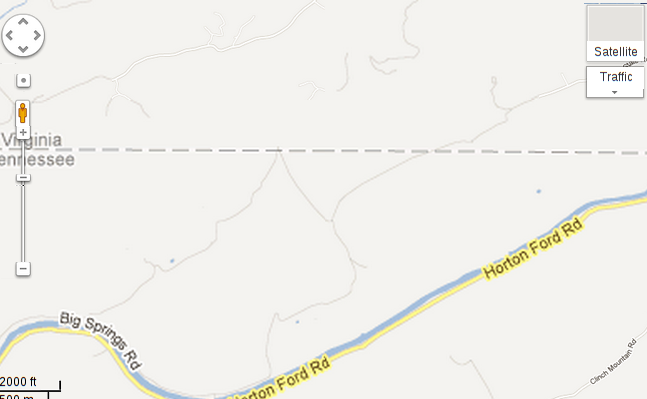
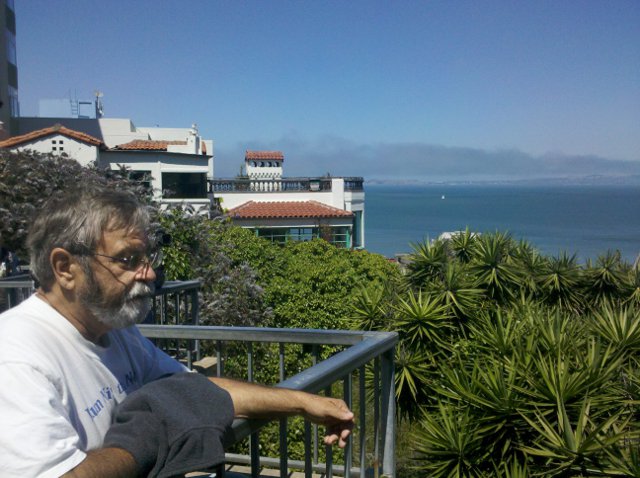
This is not the kind of place I live, though I don't mind a visit. Errol looking out over Salsalito and the Bay I'm not bothered by a more rural life, I thrive on peace and quiet, and am not bothered by needing to haul my water, split firewood, or spend an hour just mowing my driveway. I bought a GPS the other day, and it doesn't know where my driveway is..
or where the road leading to my driveway is..
or even about the highway leading to that road!
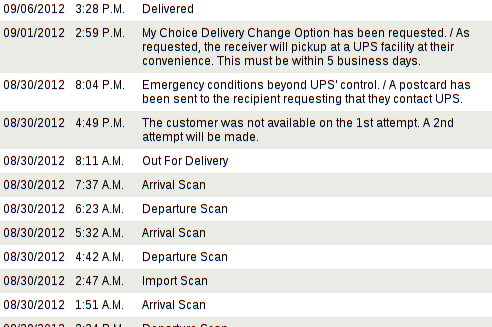
not many roads on this map.. The only thing that really bothers me about living here off the map is that I'm in the middle of a food desert too. The nearest semi-decent grocery store and produce market are 40 minutes away. There's one restaurant worth eating at, and while a very congenial place to eat rustic food while watching the river flow by, it serves almost no vegetables. Adding to the problem, my fridge is a rather expensive propane model, which is about half a normal size, and has no freezer. Managing a healthy meal plan is a constant struggle, though I do have time to cook, at least, thanks to not having the kind of commute that is typical around here. Well, the food desert was my only real problem. Now I can add to that the UPS emergency. A week ago, a package left Shenzen China for here. It quickly passed through Anchorage Alaska, and with a few days had arrived an hour and a half from here. Getting it here has taken the whole rest of the week.
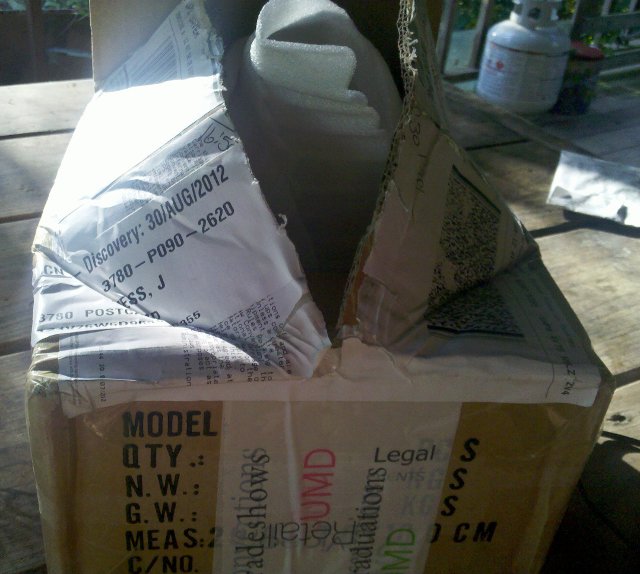
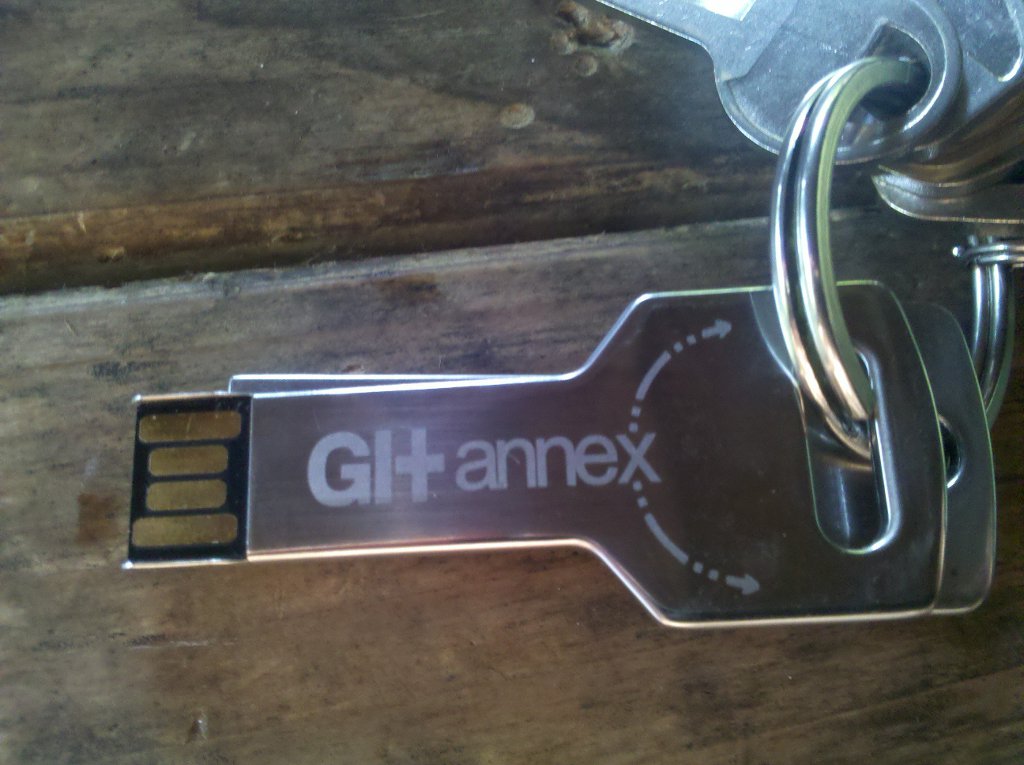
I only knew UPS attempted delivery because a neighbor told me. Seems they took one look at my driveway and turned around. They never tried again, and they didn't bother to leave a note on the mailbox, or anything. Now, the US postal service is happy to drive up this driveway; they drive a sensible 4x4 around here. I think DHL and Fedex have been here too. (Contrary to John Goerzen's experiences) My compact car is not bothered by my driveway either... But UPS's brand involves large brown trucks, even where inappropriate, and damage to them from such things as low-hanging branches apparently comes out of the driver's paycheck. And while normally UPS leaves small things in my mailbox, or with a neighbor, this was an important package from China, and it needed a signature. But really, a post card? "emergency"?! So, I bought the GPS to find UPS, because my package was in an industrial park in some town I've never been to. And on Tuesday I was within an hour of there and swung by. And it was closed. UPS's website had not mentioned this; other businesses are open the day after Memorial day. That turned out to be a really annoying day all around. When I got home, after a night away, I found my fridge's fire had blown out, and nearly all my food was only fit for the dog. Today I went out to try again (and buy groceries). When I reached the UPS depot.. it was closed! Until 3 pm. At this point I felt this story was reaching full-on farce. After cooling my heels in a library for three hours, I was finally able to open the most over-packed package I've probably ever seen. My kickstarter reward sample looks good.. I'll be ordering a lot more, but not to this address. As a coda to the UPS farce, arriving home today I checked my mailbox, and found the UPS postcard had finally arrived. It included mention of the 3 pm opening time, and noted that I had until tomorrow before they'd return my package to China. The coda to the coda is that on my way home from this second annoying day delivered courtesy of UPS, I stumbled on a restaurant overlooking a waterfall, just outside the town where I get my groceries. It serves food that satisfies both my Cajun and healthy cravings. Now I just need a larger fridge..

5 September 2012

Tanguy Ortolo: Datalove USB drives to reform European copyright

La Quadrature du Net is a European advocacy group that has been created to defend our rights and freedoms on the Internet against the continuous political threats driven by major corporations, such as the recent ACTA. After the recent citizen victories against these monsters, it is time to take the initiative and advocate for a reform of the copyright system which has become inappropriate with the omnipresence of copy-based systems.A USB stick, etched with a heart smiley <3 To this end, la Quadrature will give each Member of the European Parliament a customized USB drive, preloaded with a set of elements for a copyright reform, and with an anthology of free cultural works. To fund that campaign, la Quadrature is asking for everyone's help, by the means of an Ulule campaign (Ulule is a crowd-funding platform similar to Kickstarter). This initiative is noteworthy by at least two aspects: If, like me, you are tired of the continuous attacks from the major corporations of mass entertainment, in addition to not helping them by buying their crap, you can now participate in this first counter-attack. This will probably not end the war, so I hope there will be more offensive actions from the citizen group!

Matthew Garrett: UEFI Secure boot in Fedora: status update

There's been good progress in Fedora's implementation of UEFI Secure Boot, so time for a quick update.
Boot process signingThe infrastructure for signing the bootloader binaries is now implemented. pesign is in the archive and being used to sign shim, grub2 and the kernel. At the moment they're all being signed by test keys, and the private key is actually in the pesign package. This is, obviously, not intended for production use - it's just to ensure that we can build correctly signed images. We've proof-of-concepted signing via cryptographic hardware and will shortly be deploying new build systems dedicated to building the signed binaries. These won't be general access systems and will have a lightly modified mock configuration to ensure that the crypto hardware is available to the build chroots, but otherwise there's nothing special about them.

As far as signing with the Microsoft keys goes, we're in the final round of legal review of the appropriate agreements and will be migrating to a version of shim signed with their key in the near future.
Kernel modificationsThere's two main sets of patches for the kernel. The first is to automatically enable the locking down of various bits of functionality when secure boot is enabled, in order to prevent users (including root) from being able to modify the kernel at runtime. They've just been posted upstream and haven't been dreadfully received, though we'll probably be changing the name of the capability. The main thing that users will notice is that any X drivers that still need direct hardware access (which, on secure boot systems, should be zero - we've implemented native kernel drivers for all the hardware we expect to see there) will fail to work, as will setpci. The plan is for kexec to require that kernel images be signed, but that's requiring rather more reworking of kexec than expected so for now kexec will just be disabled.

The other lump of kernel functionality is the support for module signatures. That had been somewhat blocked based on a lack of consensus between patch authors and upstream, but an agreement got hammered out at Kernel Summit last week and so we should see progress there shortly. Right now we're still looking at modules being signed with a throwaway key, but the plan is still for keys in db (and MOK, if using the Suse approach) to be imported into the kernel keyring and used. That's dependent upon that code being written in time, though. It's definitely still a goal for F18.
Key managementWe're planning on using Suse's approach of permitting local key management at the shim level, and I spent some time discussing this with Vojtech last week. In combination with the above, this should provide a workable mechanism for permitting the end-user to install module signing keys.
General UEFI support improvementsWe've added support to grub to use the kernel's built-in UEFI setup functionality, although there's still some discussion with upstream to ensure that it's implemented in an acceptable way. This approach also makes it easy for us to obtain PCI ROMs via UEFI, which improves radeon support on a bunch of Macs. Finally, we've been hammering on some remaining UEFI bugs and are definitely at the point where the machines that don't work are surprising and the ones that do are the tedious expectation. This is far better than any previous release.
DocumentationStill has to be written, and that's probably where much of the my next month is going.
SummaryFedora 18 is still on track to have full UEFI Secure Boot support out of the box, and the Beta should be fully signed although perhaps still with our test keys.

For those of you who get sent to surprisingly expensive conferences, I'll be discussing some of this as part of a presentation on improving Linux support for UEFI at the Intel Developer Forum in San Francisco next Tuesday morning. Feel free to say hi if you're in the area.

comment count unavailable comments

Russ Allbery: Reacting to excitement

I've been slowly noticing, over a number of years now, a place where I don't react to other people the way that I want to. I've been stumbling over defensive reactions that I didn't realize I had. These are a few rules of thumb that I'm formulating for myself to try to improve that, and I thought it might help to write them down. And maybe they'll be meaningful for someone else.
  1. Things people are excited about are probably exciting. If I don't find them exciting, that's probably because I don't know enough about them to understand why they're exciting. Or perhaps I have a different mindset, and therefore the exciting parts don't connect with me. Both of those are okay! There are way more things to learn about than I will ever possibly have time to learn, and I don't have to get excited about everything other people are excited about. But, equally, just because I'm not excited doesn't mean that the thing is not exciting.
  2. My misplaced sense of obligation should not be someone else's buzzkill. This requires a bit of unpacking, since I only intermittantly realize that I'm doing this. But (partly for cultural reasons, partly due to natural inclinations) I've always felt a strong sense of obligation to "keep up" with things. To know a lot about a lot of topics. And one of the things I've realized is that my brain occasionally twists an interest in knowing lots about the world into a sense of obligation to "stay current" and know something about everything important, at least within my vague field of expertise. And usually that part of my brain has a very expansive notion of field of expertise; all of software development, for example, which is, when I pull it out into the light, ridiculously broad. This then sparks one of the standard failure modes of human cognition. I have an unrealistic expectation of myself. I fail to meet that expectation. This makes me feel guilty and stressed. At that point, my brain starts trying to find targets for me to displace negative feelings onto, and that generally ends up being the next person who is excited about something new that I don't know anything about but feel like I should. This is all very interesting psychologically, in the abstract. However, the concrete result is that I sometimes get all snarky and negative about something that someone else is excited about because it happens to be the moment I hit overload, or because I didn't want to hear about another thing that I feel like I should know more about. And that, in turn, can be either confrontational or discouraging to someone who is legitimately excited (and may rarely get the chance to be excited). And that's not the person I want to be.
  3. It's okay not to have an opinion. Seriously, it's okay. The world is full of stuff, far more stuff than any one person can know anything about. It's okay not to go read about everything people say is exciting. It's okay not to know about something new. It's okay to focus on the things I'm already doing. Really. What's not okay is to make up an opinion about something I know nothing about just so that I can feel better about myself by having an opinion. Particularly since that opinion formed under those circumstances tends to be negative, despite the fact that I have no actual basis for having any opinion at all. I need to practice just quietly not having an opinion. No one else needs to know about my lack of opinion.
  4. Before bristling at imposition, be sure someone is actually imposing. I frequently leap to the conclusion that, when someone raises a topic, they want me to do something about it. It's a gut emotional reaction, I think in part because the emotional part of my brain likes to make everything about me. Intellectually, if I can engage that part of my brain, it's often obvious that it's not about me, or that they're not asking me to do anything. Often, when someone brings something up, they just want to tell someone else about it, or make me aware of it. If I've listened to, or read, all the sentences and understood then, then congratulations! I've done everything that I needed to do and was expected to do and need not feel any further obligation. Even if something further needs to be done, it doesn't necessarily need to be done by me. I'm very protective of my time and available resources because I almost always feel overwhelmed by all the things that I want to work on. This does not entitle me to snap at random people who are being excited around me on the grounds that they're trying to put more obligations on me. They're probably not. If it becomes clear that they really want me to do something I don't have time to do, I can politely decline, but if I just shut up and listen for longer, usually that's not the case at all.
(Please note that this is not prompted by any current discussion happening anywhere, and paticularly not by anything in Debian. Insofar as it was prompted by anything, it was by a throwaway comment in an unrelated private discussion. It's just something that gelled enough to write down while I was walking home from work.)

4 September 2012

Jon Dowland: Pretty Eight Machine

P8M CD and stickers P8M CD and stickers
Back in June or thereabouts I learned about a project to re-create Nine Inch Nails' first album "Pretty Hate Machine" as a chiptune cover/tribute project. This project is called Pretty Eight Machine. The artist InversePhase was kind enough to send me a copy of the CD as a random prize draw, so I thought I would write a few words about it. I don't know a great deal about the world of chiptunes, besides having heard a variety of "chiptune" covers of various well-known songs, some good, some bad. the backing track to this video, a cover of Tears for Fears' "Mad World", is, in my opinion, good. The front cover for P8M lovingly reflects the recent reworking of the classic PHM cover by Rob Sheridan, for the source album's recent deluxe reissue. There's a great in-depth interview with Rob about the process of reviving that cover at sleevage. That little homage is a good indication of the amount of effort and attention to detail that has gone into this project. One interesting thing about this project is that each track has been composed for a particular vintage chipset, such as the Commodore 64 in the case of the opening track "Head like I/O". InversePhase is very faithful to the original chips here, not just using their tones as part of a modern composition but constraining himself with the actual chipset limitations: for example, the number of voices that can be playing at once. (By contrast, that Tears for Fears chiptune above is the non-authentic type of chiptune). InversePhase tracks Trent's vocal lines as an instrument, so all of the notes that are heard in the original are present on this remake. It would be interesting to hear an "instrumental" mix of these tracks, and perhaps mix isolated vocal tracks from the originals on top My favourite track is probably "Kinda I Want To". I actually really like the original track, in particular the extended breakdown, where a synth noise gradually breaks down and disintegrates bar after bar. It suffered terribly from dated lyrics compared to other PHM tracks, but InversePhase's cover is saved that embarrassment. This particular track (apparently) makes use of a VCR6, a Konami chipset apparently used to supplement the hardware in the Famicom/NES. Yes, back then games came on cartidges that could supply bits of their own hardware if required. Those were the days! And yes InversePhase, you've successfully made the NES sound "dirty": and the synth breakdown sounds great. Any fan of the original album or anyone with an interest in what kind of noises vintage sound synthesis chipsets could produce are thoroughly recommended to give this album a try. You can preview all of the tracks and read per-track information on the bandcamp page.

Thomas Koch: leaving facebook

I've never really used facebook so it's not too hard for me to delete my account there. The only thing that's a pity is that I found (or others found me) many people that I once met and which I'd love to meet again once. So I'll go through my facebook contacts list and will try to copy all contact data especially the email adresses and plan to write emails to everybody every quarter or half a year about happenings in our lifes. I'd be glad to receive such emails from others too! They'll surely be read more carefully then my facebook timeline!

This gets me to another point: I still don't have a satisfying free (as in freedom) solution to manage my contacts across devices and available on my web server. The same for image galleries. So I can understand how convenient facebook for many people is. Still facebook is evil and it's an important and ongoing project to provide a better alternative.

It'll be harder for me to leave Twitter. This one comes next. If people would just switch to the free and privacy aware alternative identi.ca...

And then I've to finally provide a better alternative for my family to share baby pictures then Google Plus... Leaving Xing and Linkedin also doesn't worry me, I just have to collect the addresses of my important contacts there. Not so pressing is to leave Couchsurfing for bewelcome.org.

So if you want to hear news from me just pass by www.koch.ro from time to time or put my blogs feed into your feed reader. I'll also keep my identi.ca account.

update: One tiny example of facebooks evilness is, that they don't show me your real email address (anymore). They only show me an @facebook address. So if I don't know your real email address from any other source, I would not be able to send you messages without sending it over facebooks servers. I read that you can change the email address shown back to your real email address somewhere in the options.

Next.

Previous.