Petter Reinholdtsen: Debian Edu interview: C dric Boutillier
It has been a while since my last English
Debian Edu and Skolelinux
interview last November. But the developers and translators are still
pulling along to get the Wheezy based release out the door, and this
time I managed to get an interview from one of the French translators
in the project, C dric Boutillier.
Who are you, and how do you spend your days?
I am 34 year old. I live near Paris, France. I am an assistant
professor in probability theory. I spend my daytime teaching
mathematics at the university and doing fundamental research in
probability in connexion with combinatorics and statistical physics.
I have been involved in the Debian project for a couple of years
and became Debian Developer a few months ago. I am working on Ruby
packaging, publicity and translation.
How did you get in contact with the Skolelinux / Debian Edu
project?
I came to the Debian Edu project after a call for translation of
the
Debian Edu manual for the release of Debian Edu Squeeze. Since
then, I have been working on updating the French translation of the
manual.
I had the opportunity to make an installation of Debian Edu in a
virtual machine when I was preparing localised version of some screen
shots for the manual. I was amazed to see it worked out of the box and
how comprehensive the list of software installed by default was.
What amazed me was the complete network infrastructure directly
ready to use, which can and the nice administration interface provided
by GOsa . What pleased
me also was the fact that among the software installed by default,
there were many "traditional" educative software to learn languages,
to count, to program... but also software to develop creativity and
artistic skills with music (Ardour,
Audacity) and
movies/animation (I was especially thinking of
Stopmotion).
I am following the development of Debian Edu and am hanging out on
#debian-edu.
Unfortunately, I don't much time to get more involved in this
beautiful project.
What do you see as the advantages of Skolelinux / Debian
Edu?
For me, the main advantages of Skolelinux/Debian Edu are its
community of experts and its precise documentation, as well as the
fact that it provides a solution ready to use.
I would add also the fact that it is based on the rock solid Debian
distribution, which ensures stability and provides a huge collection
of educational free software.
What do you see as the disadvantages of Skolelinux / Debian
Edu?
Maybe the lack of manpower to do lobbying on the
project. Sometimes, people who need to take decisions concerning IT do
not have all the elements to evaluate properly free software
solutions. The fact that support by a company may be difficult to find
is probably a problem if the school does not have IT personnel.
One can find support from a company by looking at
the
wiki dokumentation, where some countries already have a number of
companies providing support for Debian Edu, like Germany or
Norway. This list is easy to find readily from the manual. However,
for other countries, like France, the list is empty. I guess that
consultants proposing support for Debian would be able to provide some
support for Debian Edu as well.
Which free software do you use daily?
I am using the KDE Plasma Desktop. But the pieces of software I use
most runs in a terminal: Mutt and OfflineIMAP for emails, latex for
scientific documents, mpd for music. VIM is my editor of choice. I am
also using the mathematical software
Scilab and
Sage (built from
source as not completely packaged for Debian, yet).
Do you have any suggestions for teachers interested in
using the free software in Debian to teach mathematics and
statistics?
I do not have any "nice" recommendations for statistics. At our
university, we use both R and
Scilab to teach statistics and probabilistic simulations. For
geometry, there are nice programs:
- drgeo and kig to do constructions in planar geometry
- kali to discover symmetry groups (the so-called wallpapers and frieze groups), although the interface looks a bit old.
- advertise the reduction of costs when free software is used.
- communicate about the quality of free software projects, using well known examples like Firefox, ThunderBird and OpenOffice.org/LibreOffice.
- advertise the living and strong community around the project.
- show that it is not more difficult to use than any other system.

 This is my monthly summary of my free software related activities. If you re among the people who

 Since I wrote



 While everybody was slapping themselves on the back about our officially confirmed contentment, the politicians tried to slip something under the radar. With elections expected in September, the press exposed a secret deal between the two biggest political parties,

 I like Drupal. It's a very, very flexible CMS that evolved into a full-fledged Web development framework. Mind you, it's written in PHP, and that makes it a nightmare to develop for (in ~6 years I have used it for all of my important websites I have only got around to develop a set of related modules for it once).
PHP programming sucks and makes my eyes and fingers bleed, but happily there are people who disagree with me And they tend to write code. All the better!
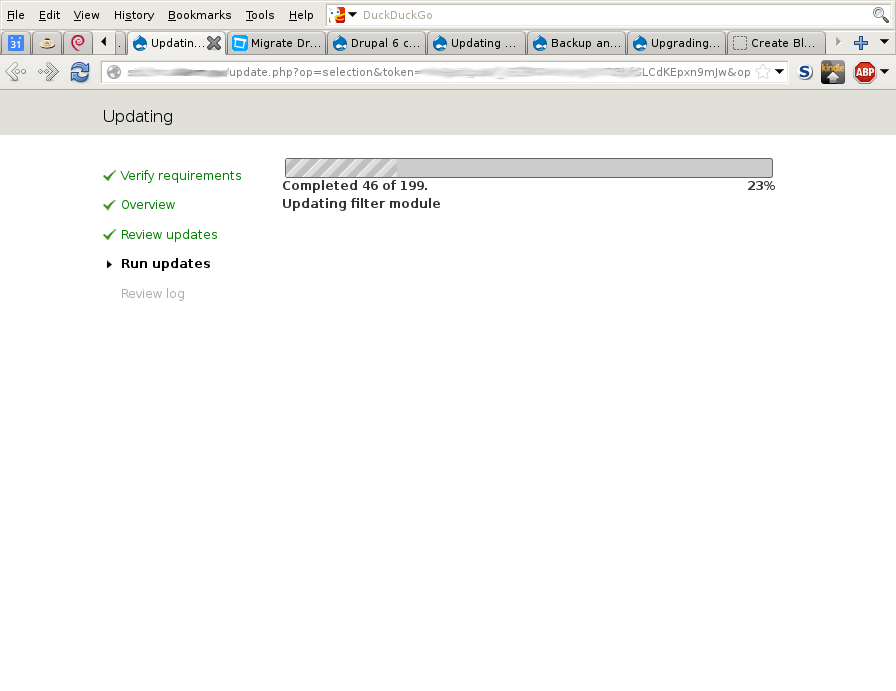
Minor upgrades with Drupal are quite easy to handle. Not as easy as I'd like (i.e. whenever I upgrade the core system or a module, I have to log in as

 A few days ago we the
 I want a CLI WebDAV client that's better than cadaver or hdav.
I want a program that can sync an .ics file with a CalDAV
server, by dividing it up into events and individually
synchronizing each of those. I don't have a clue how
deletions would be handled, but that would be nice too.
Then I want a program that can synchronize the .ics file
with org-mode files.
I want a SIP client that works as well as Twinkle but has
the architecture of SFLphone or is a library upon which
an arbitrary UI can be constructed.
I want an HTML-rendering library that has callbacks or hooks
for security- and privacy-relevant things like cookies and
SSL certificates. I want at least one browser built on this
library. I want it to support vi-like keybindings.
I want an HTTP(S) proxy that can be dynamically-configured
per-client or per-connection through a standardized protocol
that web browsers or their plugins can speak. I want it to
be able to handle all the relevant things covered by AdBlock
Plus, RequestPolicy, and NoScript.
I want HTTPS authentication through Monkeysphere and
mod_gnutls.
I want a git-annex backend for Ogg Vorbis files that treat
the audio streams independently of the metadata yet stores
them together in the same file so that everything behaves
as usual but the annex doesn't bloat by 400Go after I run
beets.
I want a file transfer queuing system that can work over
any sort of transport mechanism, direct or asynchronous,
that handles partial transfers and throttling, and is
generally magical.
I want all kinds of accounting software improvements.
I want sane PBX software.
I want an OpenStack that doesn't use libvirt for KVM.
I want backup software that behaves some weird hybrid of
BoxBackup and Dirvish.
I want a peer-to-peer card- and board-game platform that
uses cryptographic assurance.
I want everyone to use YAML instead of XML.
I want a phone that's not running a doomed operating system.
I want lots of other stuff.

 Occasionally, someone asks me whether we should encourage use of the --ask-cert-level option when certifying OpenPGP keys with gpg. I see no good reason to use this option, and i think we should discourage people from trying to use it. I don't think there is a satisfactory answer to the question "how will specifying the level of identity certification concretely benefit anyone involved?", and i don't see why we should want one. gpg gets it absolutely right by not asking users this question by default. People should not be enabling this option. Some background: gpg's --ask-cert-level option allows the user who is making an OpenPGP identity certification to indicate just how sure they are of the identity they are certifying. The user's choice is then mapped into four levels of OpenPGP certification of a User ID and Public-Key packet, which i'll refer to by
 Or rather, hello Planet!
Here s a somewhat traditional introductory post.
I m Nicolas Dandrimont, I m French, I m sysadmin in a
 Unrelatedly,
 Hopefully I ll be able to make regular updates on the work I do in Debian and free software, so stay tuned!
