Search Results: "ag"

17 May 2007

Matthew Garrett: Runtime power saving on Linux - the CPU

Modern processors have a variety of low power modes that can be entered while idle. These "C states" are numbered, currently ranging from C0 (a running CPU) to C4 (a deep runtime sleep state). The problem with these states is that the deeper the sleep, the longer it takes the CPU to wake up. In order to avoid excessive reductions in performance, the kernel must keep track of the processor usage pattern and avoid putting the CPU into a deep sleep mode when it's likely that it'll be needed for more work in the near future.

Traditionally, the kernel has had a fixed timer tick - that is, a fixed number of times a second, the timer will generate an interrupt, wake the kernel and allow processes to be rescheduled. This limits the maximum amount of time the CPU can remain idle, as this timer will fire even when the system is otherwise idle. A tick rate of 1000Hz is desirable for reducing latency, but will also result in the maximum sleep period being 1ms. This is less than ideal.

2.6.21 introduced dynamic tick functionality. Now, rather than having a fixed tick interval, if the system is idle the kernel looks at all outstanding timers and schedules a wakeup in time to answer the next timer. This allows much longer periods of sleep without compromising latency. However, for this to be useful it's desirable to have as few timer wakeup events as possible. The longer the CPU is going to be asleep, the deeper the sleep state that can be used.

Intel have recently released Powertop, an application that tracks the causes of wakeups. These wakeups can fall into two categories - kernel and userspace. Pure userspace timers will usually be due to an application having a timer to handle some sort of trivial activity, like blinking a cursor or polling for state. There are a couple of ways to improve this:Things in the kernel can be trickier. Kernel interrupts may be appearing because of some kernel code specifying a timer, but an alternative is that a userspace application is poking them. Many of the same considerations as userspace apply here:Fixing these issues can range from the trivial (removing unnecessary timers) to the complicated (teaching gstreamer about alsa notifications, teaching the mixer applet to listen to signals from gstreamer). It's all helpful, though. Ideally you want your processor to be averaging at least 20ms in the deepest C state before it's woken up again. There's a lot of low-hanging fruit out there, and every fix improves battery life.

MJ Ray: Boycotts: And Now, In Italian

I think Boicottare Novell is an Italian-language translation of my judo explanation. Rock.

Romain Francoise: emacs-snapshot: now with amd64

Just a quick note: amd64 binary packages of emacs-snapshot are now available on emacs.orebokech.com.

(In related news, it seems that emacs22 packages have been uploaded to experimental so I'll move emacs-snapshot back to the trunk soon.)

Simon Richter: I'm in ur serverz, managing ur domainz

Steve talks about a tool some of us have needed for a long time, but never actually bothered to implement because applying the necessary changes in vim is still faster than writing a script to do it. The biggest issue for me is that the UI would have to represent grouping of items efficiently. If I have a number of domains registered to my company, I want my employees to be able to receive email at "firstname.lastname" in each of them, without ever duplicating the grouping information. For HTTP, the grouping works slightly different: a set of domains could be variants of the same name with different misspellings, abbreviations or top level domains. To keep things tidy, I redirect everyone who is not using the "canonical" name, using mod_redirtoservname. Thus, the group needs a "leader". Subdomains are usually independent setups, since there is not much point in having multiple names in the same domain for the same service. It may also be a good idea to somehow be able to configure delegations using SRV records.

16 May 2007

Steve Kemp: Turn another page at the animal bar

When I moved to Edinburgh and lived in a student flat we decided we needed pets. Gerbils were chosen as they were small, cute, and easy to hide. (Because we weren t actually allowed to keep pets ..) After a few years of gerbils we graduated to rats. The king of the rodent world. Rats rock: They are small, cute, agile, incredibly soft, very non-bity and highly intelligent. Time passed and I moved out to live alone and then started to move up the food-chain with my own pet cat. (Tigger). Badnesstm happened, and Tigger was replaced by Six. I got hit with a year of illness, mostly, and so I decided to do the decent thing and return Six to somewhere where he could be loved and get the attention he deserved. Since then I ve been petless, and basically afraid to commit to looking after a cat/dog for the 10+ years that they would (hopefully) live. I want to have a cat. I would love to own a Dog, and after talking about things in a circular fashion for many weeks with my girlfriend we decided to compromise. So tada .. I have rats again. Two beautiful females. Here is a picture of one of them upon my girl s shoulder.
So two rats, Basil for me, and Moptop for Meg. All being well they will live for the next couple of years, and then we might return to the bigger pets.

Edd Dumbill: XTech heatmaps

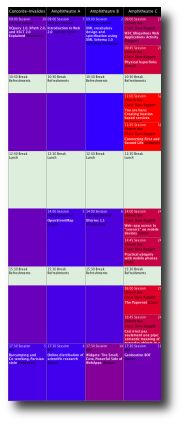
One of the fun and useful things we've been able to do in Expectnation with the personal scheduler is to use the data to help us as organizers. We recently added in dynamic overlays to the organizer's view of the schedule, enabling us to create heatmaps of the most popular talks. Heatmap
Screenshot of personal scheduler popularity overlaid on event timetable As well as satisfying natural curiosity, the heatmaps let us identify issues such as possible room overcrowding in advance. We're able also to record actual attendance figures as the conference goes on, and I will try and make an analysis of how attendees' intentions stack up against their actions. 

Evan Prodromou: 26 Flor al CCXV

It's been a busy week here and I've been lax in updating my blog. It's probably a good thing to put on the chopping block -- of all the possible things going on in my life -- but I'm regretting not keeping up with it. We had a good weekend last weekend. Maj's Mother's Day present request was to clean out all our closets in the house and take extra clothes to the Petits Fr res up the street. It took most of the day Saturday, and we finished with twelve garbage bags full of clothes for the Fr res. Check out Maj's photo of the pile of clothes. Sunday morning Amita June and I made Mama a nice breakfast of waffles and (tofu) sausage. Amita's job was to stir the batter (which she did a good job at) and not to touch anything hot (not so good). That afternoon, Maj went to get a haircut at the salon down the street, and I took the opportunity to give Amita June her first haircut. I think she looks like Twiggy. This week has been a maelstrom of activity. We have RoCoCoCamp coming up on Friday, and we're still tying all the loose ends together. I had most of my tasks done yesterday, so at the organizational meeting last night I saddled myself with more. D'oh! I think my main work this week is going to be encouraging local Montreal tech scenesters to come. I especially want to make sure that important women in the local Internet scene are present, so I'm going to copy Hugh McGuire's invite for BarCampMontreal2 and do some link-baiting: tags:

Interview There's a really good interview with me and Maj on the Internet Brands Developer Blog. It's gotten into the short list of interviews I point press to when they want background about Wikitravel -- along with the Creative Commons interview. I'm really glad that IB has started this blog to give the outside world a peek at what's happening out there in El Segundo. And it's also a great way for IB to highlight some of the Open Source work they're doing, like the neat-o new AJAX tool kit IBDOM. tags:

Patrick Winnertz: Mass filling bugs

The last two days Zobel and I filled 400 bugs against several packages which doesn’t build a second time from the same source. For details why we has done this, please have a look on this Mail. Prominent packages which has this FTBFS error: This was an task I volunteered for during my NM Process. Maybe I can do later on some work on QA :)

Piotr Roszatycki: Sun Java and alternatives

I maintain the HenPlus interface for databases. The tool is written in Java but it didn't work with non-Sun implementation of Java. The reason was sun.misc.Signal class. It is used for trapping Ctrl+C in application. I wonder why the GNU Classpath does not support this class. Does it mean the Sun Java is not really standarized? I've found the workaround. I unpacked some of sun/misc/*.java files from official Sun Java sources. Fortunatelly they was published under GPL license. The trick made possible to compile the HenPlus with GCJ+ECJ, so I could change the build-time dependency to java-gcj-compat-dev. It really worked! Even if the signal couldn't be handled with GCJ or SableVM, the application started with non-Sun Java runtime:
Hen*Plus> system-info
----------------------------------------+---------------------------------------------+
            System Property                                  Value                     
----------------------------------------+---------------------------------------------+
 Diff. of used memory (now-before) [KB]                                      1.932,00  
 Java VM                                     GNU libgcj 4.1.2 (Ubuntu 4.1.2-0ubuntu5)  
 Java Vendor                                           Free Software Foundation, Inc.  
 Java Home                                /usr/lib/jvm/java-1.4.2-gcj-4.1-1.4.2.0/jre  
[...]
I've found that the GCJ and Kaffe doesn't work with Oracle JDBC driver. I'm suprised that SableVM works without problems. It's good to see that there is a reasonable alternative for Sun's imlementation.

Benjamin Mako Hill: Principled Objections

Once, I was telling an executive in a large technology company that mostly builds non-free technologies why I did not like most of their products and business decisions and about some of the things that I was doing to help their consumers work around them and avoid paying them in the future. Excited, the manager suggested that I consider a job with them at least in part as an advocate for these ideas within their company. I mentioned that my criticism was primarily principled and fundamental to the way his company did business. He responded, "yes, but if you take a job with us, you get to have your principles and a BMW." I don't think he understood my principles. Perhaps, he didn't understand principles at all.

MJ Ray: the Cooperative Group: Other AGMs

lorenzo wrote:
"This is a comprehensive report - right down to the sugar free Mintos. I'm going to an AGM next week - so maybe i should do something in this interesting vein instead of a four line summary."
michael harriott wrote:
"Cheers for this. I was also at the AGM. Your report is very conprehensive. Do you mind if i create a link from my blog to yours.?"
Of course you can link here. Let me know if you put something relevant on your site, or spot something on another site and I'll link to it.

Andrew McMillan: Contracts for people to work on Open Source Software

A few years ago we needed to introduce employement contracts for all staff at Catalyst. When we got the example contract back from our HR consultant, she had quite naturally biased it strongly in the employers favour, and as a consequence it had a very anal and lawyerly clause in it regarding the ownership of intellectual property. This clearly wasn't going to work well in our environment so I decided to take the opportunity to try and write a clause which was fair and reasonable, which considered the likely desires of both parties, and which expressed an understanding of the sort of environment which often happens with free open-source software. It seems that many people who are interested in working on open source software are also people who will work on (i.e. fiddle with :-) things in their spare time, but they will not necessarily consider the possible consequences of using conmpany resources to do so. I have heard of situations where employment contracts (or perhaps even government enacted legislation) will give ownership of an individual's work to their employer in such situations, so I also wanted the contract to make it clear where and how this might happen. I would like to hear people's comments on the contract clauses which we use here. Is this fair to both parties? Have I missed something? Is the meaning clear? Also, I need to make it clear that it is OK for people to use this text, so I hereby place the text of the following Intellectual Property clause in the public domain. Intellectual Property
  1. All intellectual property, including source code, objects and documentation, relating to work carried out while in the employment of $ COMPANY , remains the property of $ COMPANY , subject to the exceptions outlined below.
  2. All intellectual property, including source code, objects and documentation, owned prior to joining $ COMPANY remains your property. If you choose to use such intellectual property, including source and objects during your time at $ COMPANY , $ COMPANY will have the rights to their continued use in perpetuity, including access to the source code of all versions of such software in use at $ COMPANY .
  3. If $ COMPANY asks you to do something, then we expect that while you work on that something, you will be being paid by us and we (or our clients) will own the IP. In some cases we may elect to open-source that, and may decide to jointly own the IP or make some other arrangement, but it would be at $ COMPANY s option.
  4. If you work on something by your own choice, and on your own time, then you are welcome to own the IP, but if you use the premises or computers of $ COMPANY to do that work then you must license it under a free, open-source license agreed with $ COMPANY .
  5. $ COMPANY may choose to fund some part of your time to work on OSS projects in a non-directed way. $ COMPANY will expect to own the IP for such work, and to participate in the choice of license for such code.
  6. All of the above is subject to confidentiality of client information, and constraints which clients may specifically request in relation to specific project work from time to time.
Over To You I wrote that because I couldn't find examples around the place of similar things. I guess I still see people looking for that sort of thing so I'm publising it here with the idea of providing a seed which can perhaps grow into something else. A few specific questions I would like you to think about: Then, perhaps, if we can see some general agreement on what would, or would not, be a useful standard we can encourage people to use it in their future contracts. I am hoping that through your collective wisdom I will be changing this clause in Catalyst's standard employment contract.

Michal Čihař: No current Wammu for Windows

You might have noticed that current Wammu is not available for Windows. The reason is simple - I was not able to produce working binary in reasonable time. Python-gammu itself seems to work, but when I run Wammu, it crashes quite soon. I tried to debug it for few evenings, but I was not successful. Therefore I again ask for somebody who would be willing to maintain Windows build. Somebody with Windows experiences will be probably able to resolve problems much faster and will help creating application that will behave good on Windows. I am not able to achieve this as I do not know Windows much and do not use it at all.

Michal Čihař: Wammu 0.20

I just released version 0.20 of Wammu. This is mostly bugfix release, which fixes various bugs reported by users.

Eddy Petrișor: bluetooth fun with my Nokia 6600

I just started poking with my Nokia 6600 and python for S60. From the highlights of the evening (I just started, so I needed to set things up).
Now I would really like to know how to start a serial terminal server that listens on Bluetooth to be able to start the bluetooth console in a manner similar to the Windows or Mac method.

Update: After digging and trying different things I got to a message which put me on the right track. After a while I got the magic formula:

bounty:/home/eddy/usr/lib/linux_and_other_oses/series 60/devel/python# rfcomm listen 0 3
Waiting for connection on channel 3
Connection from 00:60:57:BB:B6:C5 to /dev/rfcomm0
Press CTRL-C for hangup


The 1 means to create a /dev/rfcomm1 device; the 3 is the channel on which the Bluetooth console tries to connect (try once and you will see it).

After that, the hint in the Mac tutorial, so I typed:

bounty:/home/eddy$ screen /dev/rfcomm0
help
Traceback (most recent call last):
File "", line 1, in ?
NameError: name 'help' is not defined
>>>

Victory! Now I can actually start to program.

Update2:
Oh, yes, I remembered I should write something like "How to connect PyS60 Bluetooth console and Linux" so is easier to spot. I tried to add myself a link to the proper page, but I couldn't make an account because of the broken capthca.

Ian Haken: GSoC 2007: Project is Underway

I've gotten started on setup for my Google Summer of Code project (original abstract for anyone unfamiliar), originally titled "Automated Upgrade Testing Using QEMU." In thinking about the direction I'd like to take the project, I've created an Alioth project with the title "Virtual Live OS Upgrade Testing Suite" (short name vlosuts). As discussed briefly in the GSoC application comments, the system should have a plugable backend so that one could use QEMU, Xen, etc. as preferred, and so I dropped QEMU from the title in favor of the word Virtual.

The project itself is still in a planning phase, but Ubuntu has a similar package using chroot which may serve a good basis for what I'm doing. I will be making periodic updates of my progress via this blog, but status and mailing lists should also be available at the Alioth project: http://vlosuts.alioth.debian.org/.

David Nusinow: Sobriety

For everyone who's celebrating the ATI announcement about fglrx, please read this. I can only imagine that it's wishful thinking that people reading Blizzard's blog entry and interpreting "committed to fixing the ATI problems with open source" as "we're going to open up fglrx". ATI hasn't really done anything yet, and they certainly aren't playing in the same class that Intel is playing. We as a community need to push Intel hardware because they're showing an incredible level of support that no other graphics vendor is willing to do right now. The Intel guys are even working on getting Real Documentation out there so that the community has an easier time helping hack on the driver. All we have from ATI right now are very old specs and a vague promise. Don't fall for ATI's marketing unless you like getting burned.

Dann Frazier: Starting a text-mode Debian install using the virtual serial port (VSP) via an ssh connection to iLO 2

That's a mouthful. We had a customer asking for information on this, so I did a couple screen captures using byzanz to demonstrate. The first shows howto setup a system to do bios over serial. I did this w/ the remote java console, but you can also do this locally on the system (or the ActiveX console I suppose, but I've never tried this myself). In brief, you need to choose a serial port to map to the VSP (I use COM2 aka ttyS1), and tell the system to redirect the BIOS to the same serial port at your desired baud (115200 in this example). The second shows me initiating an ssh session, setting up a virtual cd-rom, and booting the debian installer. Of course you could use local media or even PXE boot. But either way you need to tell the installer to direct its console to the same port that you've configured as the VSP and at the same baudrate (console=ttyS1,115200n8 in this example). Note that if the screen goes blank after attempting to boot from the CD it is likely that the installer is displaying a graphical splash screen. Simply hit F1 to transitition to a text-mode help screen.

15 May 2007

Russell Coker: Planet feed polling frequency

From reading my web stats yesterday it seems that one Planet has polled by blog feed 1693 times over the first 14.25 days of this month. This is about 5 polls per hour. Another Planet has polled my blog 994 times for an average of about 3 hits per hour. How frequently does it make sense to poll blogs? Speaking for myself I think that waiting an extra 10 minutes to see my latest blog post isn’t going to hurt anyone, and encouraging Planet readers to reload the page so frequently probably isn’t doing them a favour either. For my own personal Planet installation (which mainly aggregates other Linux Planets for my own personal use) I have it poll the feeds every four hours. For a Planet installation designed for general readership it would make sense to have it poll more frequently. Maybe once every hour or once every half-hour. When I initially set up my own planet installation I aggregated the entire feed list of Planet Debian and Planet Linux Australia and it generally took between 10 and 30 minutes to poll all the feeds with 20 minutes being common (Planet does not support parallel downloads). So for a moderate sized Planet with frequent polling you might have one poll end after the next cron job for a poll has begun. It’s a pity that Planet doesn’t support pings. Will the next version do so? I would rather have my blog ping the Planets that I know of that aggregate my content and save thousands of needless polls while also giving a faster update. Finally if you need a fast response for a dialogue then probably blogs and Planets are not the communication mechanism to use, a mailing list would probably be more appropriate.

Joachim Breitner: gaim-thinklight pidgin-blinklight

I once wrote a plugin gaim called gaim-thinklight, which simply blinks your ThinkPad s ThinkLight when you get a new messge. Very recently, gaim was renamed to pidgin, so gaim-thinklight is now called pidgin-blinklight. I changed the second part not because of trademark issues (as gaim did, IIUC), but because it also supports ASUS laptops since the last version. At least I hope so, I implemented that, as I do not have an ASUS laptop please tell me if it does or does not work.If you run Debian unstable, you ll soon be able to apt-get install pidgin-blinklight. Others can find the sources on the debian package page. I m still too lazy to host that code somewhere else as well...

Next.

Previous.