Search Results: "ag"

18 May 2007

Michael Prokop: docbook2odf

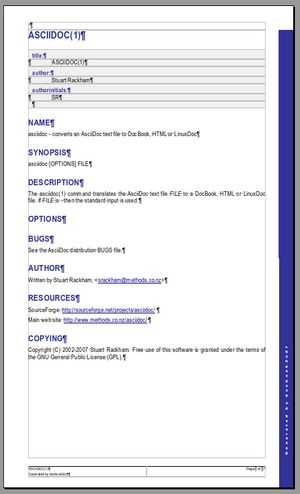
docbook2odf is a toolkit that automatically converts DocBook to OASIS OpenDocument (ODF, the ISO standardized format used for texts, spreadsheets and presentations). Conversion is based on a XSLT which makes it easy to convert DocBook->ODF, ODT, ODS and ODP as all these documents are XML based. This piece of software is pretty rocking for example if you write your docs in AsciiDoc and want to provide a document for use within OO:
% cp /usr/share/doc/asciidoc/examples/website/manpage.txt .
% a2x -f odt manpage.txt
% ooffice manpage.odt
Just to get an idea how the result looks like in OpenOffice: Screnshot of docbook2odt result in OpenOffice Just ‘apt-get install docbook2odf’ if you are using Debian/unstable, thanks to the work of formorer we could include the toolchain in the upcoming grml release.

Eddy Petrișor: (Not) Getting Carbide C++ to run on your amd64 Debian Etch. But you get CodeWarrior!

A while ago I decided I wanted to make a couple of nice little apps for my Nokia 6600.
After my successful adventure with pys60 I decided/realized that the Python API does not contain appropriate functions for what I need in my apps, so I decided to setup the development environment for C++ with Carbide C/C++ (the recommended IDE for S60 development for Nokia).

Of course, the IDE is a Windows application and the reason for which Nokia doesn't provide an IDE for Linux (is expected since they are developing maemo and are so into OS) eludes me.
On top of that, I have an Debian Etch amd64 installation[1], so that's more fun.

Fortunately, thanks to Robert Millan and Ove Kaaven, wine is installable from unstable on amd64 and a chroot is not needed[2] anymore.


Now let's see the dependency tree:
Yes, that is all ... summarized. And you can imagine I went though leaps and bounds and wasted a night with this to find out the hard way.

If you don't care about the reasons/story, you can skip to the paragraph where I ran into license issues.

So, first Carbide needs Active Perl. Not any version, but ActivePerl-5.6.1.635. You will find out after you install Carbide c++.

Active Perl, by default, will refuse to install in wine. It relies on some Script Host support.
Good news: it is available on Microsoft's support pages. Bad news: the file is not provided until you go through some crazy scheme[3] to certify you have a genuine Windows installation.

Of course, the genuine stuff failed to work in wine, duh, but having a windows XP OS in qemu was really useful... to try to go further.

Now that I mentioned the Windows XP machine in qemu you might be wondering 'why didn't you installed Carbide c++ in there and start hacking in qemu?' . Well, I wish it was that simple! Believe it or not, the installation in the Windows virtual machine failed in a muuuuch earlier stage it initially did in Wine! It failed in the unpacking phase of the installation, while in Wine that part worked without problems (default config is for Windows XP emulation). Talk about irony!

After a while of trying, I took the risky path (maybe I should install an antivirus, as suggested by wine) and downloaded the kit for the script host stuff from some site on the net (shhh!). Good. I don't remember if I used cabextract or if it worked quite straight forward, but the special configuration entry in Wine Configurator suggests otherwise.

Back to Active-Perl. Now we can try again to install it.

wine msiexec ActivePerl-5.6.1.635-MSWin32-x86.msi

Guess what? The installation failed now, too. After some time of poking, I realised the bastard was looking for mfc42.dll in the installation. There was no word about that in the error message, only in the wine logs there were some hints. No wonder Windows users learn very early to ignore error messages (the error message was plain uninformative).

Where to get mfc42.dll from? The virtual machine! I tried to send them via email, but the link was too slow. Now I realised I could have used winscp, but I didn't thought of that at the time.

The rescue did come this time from M$, but with some effort. It appears that mfc42.dll is by default present on XP, so you only find it for download in some kit (vc6redistsetup_enu.exe) for Windows 9x. That works (lost some time to figure that out, too) since the kit contains a mix of 9x, NT and independent dlls. I think this installation didn't work and I had to cabextract the files by hand and copy them in system32. I registered the mfc42.dll module, after copying it in windows/system32.

wine msiexec /y mfc42.dll

Well, now I have everything installed Carbide should start... Well, no! License issues! I got a message about not having a license for the installation. Ain't that great? I just installed the thing and is the free/handicapped version. What gives? Well, in Carbide C++ 1.2, the Express part of the kit is broken and doesn't install the license file.

So, I installed the professional version since it had a longer trial period, hoping that now I'll be able to see the IDE and start working.

After this, I tried several times to start Carbide itself, but it failed at different points in time. I "just"[4] configured wine for this app to set the order to 'native,builtin' for msvcrt, ole32, oleacc and shdocw and got further.

Hopeless attempts follow....

At this point I got stuck. There was still some error from ole32.dll (apparently), but I couldn't go further.

I tried to install the 1.1 trial version. Got stuck. In any way I couldn't start Carbide c++ :-(( .

GRAND FINALE!

In the end, I also tried the deprecated CodeWarior. Guess what? It installed and ran immediately. Although I am not sure if any of the previous poking had anything to do with it.


[1] I have some packages from unstable
[2] although I had one, I wanted to get rid of it, since gnash started to perform better in the latest versions - still not satisfactory, but OK
[3] some browser plugin WPGInstall.exe, iirc and some app which should send your privat^W^W^Wanalise your system to generate some code that should identify your system as genuine
[4] this also took me some time... start, identify the dll, change the order, restart...
Evan Prodromou: 27 Flor al CCXV

Well, today started out really anxious and is ending pretty reasonably. (Or so I think -- maybe tomorrow is going to be really nuts). First, RoCoCoCamp buzz is just nuts! Lots of people are blogging about it, planning to attend, and having fun talking about it. I count at least Patrick Tanguay, Sekhmet Design, Montreal Tech Watch, Montreal Tech League (no relation), Michel LeBlanc, Fred Ngo, Sylvain Carle, Rhymin' Simon Law, NathanR, Creative Commons Canada (thanks for the shout-out, gang!), Adrien O'Leary, Andreas Gohr (coming all the way from Berlin!). We're flirting with almost 100 people on the participants list, which I think is going to mean about 120-150 people. So I'm no longer worried that not enough people are going to come. Last night I got a quote for someone to provide coffee in the morning and at afternoon break for all three days... for $1800! So this morning I rented three coffee percolators (one for regular, one for decaf, and one for tea) and a bunch of cups and plates from Celebrations up on Jean-Talon. Maj and I shopped for coffee this afternoon. Total cost? $250. That means more money left over for pizza Saturday night! It means some more hassle for me and for the attendees, but I think we can handle it. Tomorrow morning early I have to stop in at St. Viateur and get 10 dozen bagels for the whole gang. I think many people who are attending don't know Montreal bagels, so they'll be in for a treat. Of course, some of the Montrealers will be mad I didn't get rival Fairmount Bagels instead. Tough for them. I know tomorrow is going to be crazy, but tonight I'm feeling pretty mellow. My good friend Zach Copley is on his way into town right now; we're working together on the kei.ki project and it will be great to have him here. Tomorrow Mark and Allegra arrive. So many good folks are going to be at RoCoCo: I think it's going to be a lot of fun. tags:

Martín Ferrari: About installing a complex perl web application

Today, MJRay asks how to make MakeMaker (no redundancy!) do what he wants. Incidentally, I faced this issue just yesterday, preparing an application for internal use in my job. As sysadmin, I want all the homebrew software to be Debian-packaged, even if they're not the most policy abiding packages. I was installing some modules for mod_perl2, some utility modules and a couple of scripts. Of course, it also needed accesory files, like images for the web or templates for HTML, and configuration too. After reading the reply to this post, written by Randal Shwartz himself, I got convinced that there wasn't any frigging way to make the thing do it. So my solution was far from ideal, as I wanted to put everything in the Makefile, but it wasn't so ugly, considering that it was only meant for use in a Debian package: In a nutshell, if you only want to process modules and CGIs, you can do it with MakeMaker

17 May 2007

Jose Carlos Garcia Sogo: Naked politics!

Better said, politicians. I am pretty sure most of you will know yet about a Belgian politic party called NEE in which the main candidat is a young girl that appear naked in promoting posters. But in a word joke, she promised 'blowjobs' for people who vote for her. Or perhaps she promised that for real...

Naked Tania from NEE Naked Tania from NEE in poster Also, here in Spain we had our own naked politician. She is not at posters, but she was the girl on portrait of an important Spanish magazine.

Lepe politician naked Intervi  portrait It is interesting to see how politics is changing lately. It is becoming more and more insteresting... Do you trust your candidate? Undress him!

Cord Beermann: Packaging Simple PHP Blog postponed.

We found out that Simple PHP Blog, the software that is used for this Blog, can't be packaged for Debian at the moment, because the License looks like this:

The Simple PHP Blog is released under the GNU Public License.

You are free to use and modify the Simple PHP Blog. All changes
must be uploaded to SourceForge.net under Simple PHP Blog.

Credit must be give to the original author and the Simple PHP Blog
logo graphic must appear on the site and link to the project
on SourceForge.net


So problems are (as far as i understand):


So i tried to explain this politely to Upstream, I hope he honors my request, as i really like this piece of software and want to see it in Debian.

Miriam Ruiz: Ren Py Visual Novel Engine in Debian

Ren’Py is an engine that supports the creation of visual novels and storytelling. I fell in love with it since I first saw it, almost two years ago, and some of my friends know how much work I’ve devoted to that package so that it’s finally in Debian in a proper state, including submitting many patches to upstream. Lots of thanks go to Ana for all her help and support with this package. Ren’Py is designed to make writing complete visual novels as easy as possible. The engine supports, of course, conversations between the two characters, but also images, different transitions between pictures, music and sound, so playing a game can be a complete multimedia experience. The engine itself is based in Python and SDL (in fact, it is based in python-pygame). Anyway, ccording to the manual, you don’t need to know any programming, or be able to program, to use Ren’Py. Even though right now there are a lot of games made with Ren’Py available for downloading, most of them are released pre-compiled (for a certain version of python, including the whole interpreter and libraries in the release), and usually targeted towards Windows (even though Ren’Py is supported on Windows, Mac OS X, and Linux, and can be made to run on other platforms). Of course all the authors of the games are welcome if they want to publish them as Free Software, anyway my plans go towards using the engine for developing educative applications. My only problem is that I need to draw the characters I’ll use throughout the tutorias, which is something I’m not especially good at. I’ve got myself a book on how to draw manga and anime characters, but it’s probably taking a while until I’m proficient enough at that. I’ll try to find someone to help me with that. In fact, it would be great to release a free set of characters that newbie creators of stories could use as a starting point. Lets see if I can find an artist for that. The main drawback I see is that the dependencies might be too much to put the engine in a small embedded portable gadget to be able to play a visual novel anywhere. Who knows, maybe in the future.

Benjamin Mako Hill: A Disturbing Trend

When I saw the first mutilated Tickle-Me-Elmo, I thought it was slightly funny and worth a quick picture with the camera -- but I didn't give it much thought.
/copyrighteous/images/elmo_truck-small.jpg
Now that it's becoming a trend, I'm beginning to get a little worried.
/copyrighteous/images/elmo_desk-small.jpg

Jordi Mallach: Google shuts down the Google Translation program

Via Quico Llach's blog, I just learned about Google no longer hiring independent translators to work on their many web applications. Since Quico was hired by them to do their Catalan translators, a few millions of users have been benefitting from his very professional work in Google's most used services: mail, maps, search... Like Quico, I really hope they already have deals with translation companies to take care of minorised and minority language translations. When Catalan translations were made by random volunteers, I remember the results were quite... unsatisfying, as each one of them used their own glossary and style. When Quico took over, the interfaces were normalised using the Guia de estil and everything improved dramatically (this problem is something people involved in Rosetta as a developer, translator and team leader know well, and is tricky to solve). Having Google suddenly drop Catalan as a supported language would be a huge step back for Catalan on technology. Either way, we'll find out soon.

Gunnar Wolf: When bad system design leads to pain...

A long time ago, I wrote the system that still manages the Cuerpo Acad mico Historia del Presente group in the Universidad Pedag gica Nacional. Yes, I'm happy a good portion of my project, which took me over a year of work... But I must admit a nice deal of shame as well.
Of course, it comes from not properly understanding the domain data and information volume my system would be working with - and coming up with a stupid way to implement searches. I won't get too much in detail because, even if you had access to the full search facility in the system (no, it's not available for the general public), I would not like a swarm of curious people to make last week's events come back... Anyway, the group works by daily filling in tens or hundreds of articles in the system, and having some interesting search sessions every couple of months.
I knew the performance problem was caused by an inefficient searching mechanism (explicitly, category exclusion is the prime killer). I knew loadavg jumped through the roof, memory usage did so as well... But it was not until some weeks ago we installed the mighty Munin on the machines at UPN that we got this jewel - Thanks, Victor, for putting the graphics somewhere they can be shown! ;-)
So... How much does memory usage increase during searches?

Whoa. The system has 640MB real RAM. It has as well 1GB swap. Don't ask me how the hell it reports it was using ~2GB swap - but still... And how is our load average?

Have you ever seen a (single CPU, Pentium 4 1.7GHz) Linux system with a loadavg of 80?! For those who don't know, loadavg gives you the general status on how many jobs are pending scheduling by the CPU. 1 means that all of the CPU's time during a specified timeframe was used (and, on single-core systems, it's the optimal usage level). On this machine, things start getting uncomfortable at 6 or 7. I had never before seen values even half this large.
Sigh... Well, in my defense, I must say I've warned them about this problem for over two years. My contract with them has long passed - I've repeatedly recommended them to hire somebody to fix it. So far, they have not.

Gunnar Wolf: Starting as a mentor soon

After a long time talking this as a mere potential would-be-nice thing, finally we are putting some action behind our words: One week from now, Sergio Mendoza and I will start a ~2 month long extracurricular course on Debian. The students? We have 12 students of the Facultad de Ciencias at my University. The students are pre- and post-graduate (licenciatura and maestr a), from the Phsyics and Astronomy areas. Sergio got this group as he is a teacher and researcher at Instituto de Astronom a.
While this first iteration is completely extra-curricular, unofficial and by invitation only, we expect this pilot course to be later presented as an official course in the Faculty.
Many people will remember I usually don't like general courses on Unix, Debian or whatever. What made me accept this time - even more, be enthusiastic about it? First of all, the requirements: We assume the students already know their way (at least as users) in a multiuser Unix-like system, so we won't be hand-holding them all the way through. Second, the focus: Sergio (who is among the first Debian users in Mexico and who got us our first full Debian mirror - which is actually a bit sick, but awaiting for prompt hardware upgrade ;-) ) wants them to focus on becoming developers. Not only developing science-oriented applications and libraries, but properly packaging and integrating them in Debian (and, hopefully, some of them will become interested in joining the project). We will also spend a good portion of the course on teaching them good practices on system adminsitration, teaching the principles behind what we do (i.e. I'm looking forward to participating, and in this case as one of the more students, in the sessions where different cryptography-related topics will be explained, starting from their mathematical foundations and going all the way up towards the implementation, where I'm more comfortable at).
It will be a nice experiment. I will be away for at least five of the lessons (Blame Debconf!), but I'm really looking towards the process and the results.
We will be making rough documentation of what we teach. We don't have a planned complete program, as we want to go with the group's real skills and interests, planning not more than three lessons ahead. This will be, however unofficial it is, my first time in front of a group in a university-esque setting (i.e. not short sessions, not capacitation built for a company, but with people eager to learn what we want to teach. I'll post again on this topic :)

Gunnar Wolf: On magazines without editorial direction

Scott complains on how Linux Format #93's articles comparing Ubuntu and other distributions often contradict each other, and blames it on the lack of any editorial direction or basic research.
I... Have to confirm this. But anyway, I can stand a bit on the different writers' side - Each article is written by a different person and, although the magazine must try to be coherent (of course, within certain limits - if the magazine suggests editor's picks in one article, they should not bash them to death in the next one).
I write the Linux column in the Spanish edition of PC Magazine. No, it's by far not a technical column, nor anything far like it. The magazine is end-user oriented, and clearly sponsorship-driven - In fact, my column was not part of the magazine for quite some time, as they gear it towards end-users, and sponsors (I cannot venture which sponsors, but your imagination will probably go to the same company as mine) do not like what I write about. All in all, I get the general topics which each month's edition will cover, and I just have to write an article about one of them. Of course, I don't know most of the other writers. There is no interaction at all.
And I guess that Linux Format is a typical magazine - If they run like PC Magazine, they just won't have the time to put all the articles together checking for inconsistencies. I think it is enough of a task to chase the contributors month after month (BTW, I'm a week late already :-/ But I cannot finish just today, as there's too much work to do, and I spend my time blogging... Hmh, time to finish this post, as coitus interruptus as it may seem).

Andrew Stribblehill: Timing random disk seeks

I asked an interviewee how long it takes for a disk seek, and he replied that he thought it was between 4 and 8 milliseconds. Speaking with colleagues, the conventional wisdom was that it was around 10 ms. I was unsatisfied so I thought I would try it for myself.

time sudo perl -we '$disk="/dev/sda"; $n=1500; $blocks= blockdev --getsz $disk ; if (!$blocks) print "Enter capacity in manufacturer GB\n: "; $blocks=1953125*(
) ; use Time::HiRes "time"; open DISK, $disk; $start=time; for (0..$n) seek DISK, int(rand($blocks))*512, 0; sysread DISK, $x, 512 die; $now=time; $times[int(($now-$start)*1000)]++; $x=$now-$start; $s2+=$x**2; $s+=$x; $start=$now ; for (0..$#times) if ($t=$times[$_]) $tot+=$t; $median =$_ if $tot>=$n/2; printf "%3d %s\n", $_, "x" x ($t/2) . ($t%2?":":"") ; printf "\nTook %3.4gs for %d seeks of %s (%d GB)\n", $s, $n, $disk, $blocks/2097152; printf "Mean: %2.03gms; Median: %d-%dms; Std dev: %2.03gms\n", 1000*$s/$n, $median-1, $median, 1000*sqrt($s2/$n - ($s/$n)**2);’
It should be obvious that before you run this, you should check for yourself that it doesn’t do anything dangerous. Or at least check that $disk is set appropriately for your hardware and operating system. If you don’t have blockdev, estimate the number of 512-byte blocks and set $blocks to that value. (There are 1953125 blocks in a hard disk manufacturer’s "Gigabyte".) The graph it produces prints an ‘x’ for two seeks of a given number of milliseconds and a trailing ‘:’ if there was one left over. For me, on my one year old Linux 2.6.18 workstation with a 160 "GB" Western Digital (WDC WD1600JS — quoted seek time 8.9 ms) the typical output is:
  0 :
  3 :
  4 :
  5 x:
  6 xxxx:
  7 xxxxxxx
  8 xxxxxxxxxxx:
  9 xxxxxxxxxxxxxxxxx
 10 xxxxxxxxxxxxxxxxxxxxxxx
 11 xxxxxxxxxxxxxxxxxxxxxxxxxxxx:
 12 xxxxxxxxxxxxxxxxxxxxxxxxx
 13 xxxxxxxxxxxxxxxxxxxxxxxxxxxxxxx:
 14 xxxxxxxxxxxxxxxxxxxxxxxxxxxxxxxxxxxx
 15 xxxxxxxxxxxxxxxxxxxxxxxxxxxxxxxxxxxxxxxxxxxxx:
 16 xxxxxxxxxxxxxxxxxxxxxxxxxxxxxxxxxxxxxxxxxxxxxxxxxxxxxx
 17 xxxxxxxxxxxxxxxxxxxxxxxxxxxxxxxxxxxxxxxxxxxxxxxxxxxxxxxxxxxxxx:
 18 xxxxxxxxxxxxxxxxxxxxxxxxxxxxxxxxxxxxxxxxxxxxxxxxxxxxxx:
 19 xxxxxxxxxxxxxxxxxxxxxxxxxxxxxxxxxxxxxxxxxxxxxxxxxxxxxxxxxx
 20 xxxxxxxxxxxxxxxxxxxxxxxxxxxxxxxxxxxxxxxxxxxxxxxxxxxxx
 21 xxxxxxxxxxxxxxxxxxxxxxxxxxxxxxxxxxxxxxxxxxxxx
 22 xxxxxxxxxxxxxxxxxxxxxxxxxxxxxxxxxxxxxxxxx:
 23 xxxxxxxxxxxxxxxxxxxxxxxxxxxxxxxxxxxxx:
 24 xxxxxxxxxxxxxxxxxxxxxxxxxxxxxx:
 25 xxxxxxxxxxxxxxxxxxxxxxxxxxxxx:
 26 xxxxxxxxxxxxxxxxxx
 27 xxxxxxxxxxxxxxx
 28 xxxxxx:
 29 xxxxx:
 30 xxxx
 31 :
 32 :
 34 x
 35 :
 57 :
Took 27.69s for 1500 seeks of /dev/sda (149 GB)
Mean: 18.5ms; Median: 17-18ms; Std dev: 5.24ms
real    0m27.859s
user    0m0.116s
sys     0m0.044s
Why might I care? 18 milliseconds is almost a lifetime compared with anything else a modern PC does. It’s slower than my monitors’ refresh period! I can read around 1 MB from disk, 10 MB over a GigE link or 20 MB from RAM in this time. I can ping from Ireland to England, crossing 40 routers there and back, in the time it takes for my disk head to seek. Every time you read something from a previously unread file, it costs on average EIGHTEEN MILLISECONDS even before it starts reading. That’s just 55 in a second. This has obvious implications for I/O program performance, i.e. that of most servers. If anyone has a concern about my method, I’d be interested to hear it. I’d also like to see the timings for different disks. Either post the whole histogram or just the stats, plus the make and model of the disk. On Linux you can get this from dmesg or hdparm -I device. Update: I’ve made the script more robust under non-existence of blockdev.

Russell Coker: Lord of the Flies

Apparently they are planning a reality TV show that might be named “Kids Nation” where 40 children are allowed to develop their own society for 40 days. The claims are that there is “no parental supervision”, but of course with many TV cameras watching I’m sure that even the most stupid children can work out that there are reasons to behave relatively well. Also I’m sure that they will remove children from the show if it becomes necessary to avoid injury. It will be interesting to see how well this develops. Maybe it could evolve into a new form of schooling, just leave children alone in a school with lots of security cameras watching them and let them study or not as they wish. It would be cheaper than running a regular high-school, and as there is little scope for providing a worse education than many (most?) high-schools currently provide it should be worth a try. For a long time I have thought that the premise behind The Lord of the Flies was bogus. I believe that a major contributing factor towards much of the violence that is present in schools is the pointlessness of the entire system. There are very few students who are so stupid that they can’t realise that the education system is failing them. Whenever you put a large number of people in a confined space with nothing useful to do the results will be bad. If a group of students from a violent school were placed on an island without any supplies then I’m sure that they would soon realise that they need to cooperate to stay alive. Update:
It seems that the Sudbury Valley school implements some ideas similar to mine. They also have a page of links to some other schools that do similar things.

MJ Ray: the Cooperative Group: Other AGM views

Michael's sent me a link to his view of the Co-op Group from Devon and it currently has a few comments on another nearby major retail cooperative, PSW.

Jan Wagner: New Wordpress (2.2.0) etch-backport

I did rebuild the brand new version of wordpress for etch. New user requests and etch-bpo stated:
* Is the backport neccessary? I don’t think we should upload packages to bpo
simply because we can do it if you can install the package directly from
testing without any recompilation we shouldn’t add it to bpo. Pinning
exists.
So I’m not allowed to upload it to backports.org, but I did upload it to my repro, like the following other packages: You can download it by using the following line in sources.list:

deb ftp://ftp.cyconet.org/debian etch-backports main non-free contrib , , , , , ,

MJ Ray: Debian: Packaging: Cowbuilder

I installed cowdancer for cowbuilder from etch but the tree it built seemed to have a few problems. Firstly, it didn't work (sudo cowbuilder --login, right?). It was missing cow-shell, libcowdancer and start-stop-daemon, which I copied into the tree from the system. Is this a bug, user error or something really strange? Secondly, it seemed to be pointing at ftp.jp.debian.org which is very very slow for me. I guess this is either a missing feature or a user error. Is there a good HOWTO about care and feeding of a cowbuilder? Anyway, despite the above, the long-overdue git RFS has been answered. Thanks Ian. Update: Vincent Bernat commented:
"cowbuilder just uses pbuilder. You can set mirror with --mirror switch or in your pbuilderrc (or in /etc/pbuilder)."
Thanks for the useful tip. So I should have written my pbuilderrc before using cowbuilder for the first time. Which rc line is equivalent to cowbuilder's --basepath option?

Simon Law: RoCoCoCamp 2007


Evan Prodromou
Originally uploaded by sfllaw.
Tomorrow is the beginning of RoCoCoCamp 2007, a three-day unconference held right here in Montr al. It starts at 9:30 on Friday at the SAT and runs until Sunday evening. It's for all who are interested in wikis, weblogs, and creators interested in collaborating in on-line spaces. RoCoCoCamp is organized with OpenSpace Technology, where we collectively decide on an agenda where everybody has a chance to speak. There's no artifical divide between speakers and audience, so you can lead your own session if you have something to say. Think of RoCoCoCamp as a real-life wiki, where anybody can contribute. A detailed explaination of what RoCoCoCamp is about can be found on this invitation. I'm inviting you because I'm flying out on Saturday and can't make the whole conference, but I really hope you come. There will be discussions on: So how can you attend? I thought you'd never ask!
RoCoCoCamp 2007
Friday, 18 May 2007 at 9:30
     until Sunday, 20 May 2007 at 18:00
Societ des arts technologiques
     1195 boul. St-Laurent
Free admission
( Sign up Upcoming Google Maps )
See you there!

Steve Kemp: Would you choose to walk or stay

Once upon a time I wrote a collection of shell scripts for managing virtual hosting. Combined these allow me to easily. These work well, but every now and again I think I want a web-based control panel . After mulling this over for a while and remembering how many of the existing control panels are tricky I m actually going to do it. There are two hard parts: The last point is the part I m worrying about right now. So far I have a list of mail domains, and a list of web domains and the two are unrelated. This becomes obvious when they are listed:
DomainFacilities
steve.org.ukMAIL
bar.steve.org.ukWEB
foo.steve.org.ukWEB
See? No link I d expect to see the domains listed as just steve.org.uk with links to Mail showing the mail setup, and web showing the subdomains. Or maybe they really should be listed seperately I can t decide. (For reference here is my live listing of domains where the problem becomes obvious. Note that you ll not have permissions to see my server stats ) So I need to decide how to handle this I also need to be "inspired" by OSWD. I think the plan right now is to store all data in a database, then regenerate the plain text configuration files on demand. That should give me the best approach if I restrict myself to running HTTPS on a custom port and avoid the ability to modify the files by hand Feel free to tell me this is misguided, or inspired. Although I remember the last time I talked about control panels and I m still not seeing a good solution. I want to be able to:

Michal Čihař: IMAP utils 0.1

For long time I use few Python scripts to manage mails on IMAP account. On Tuesday I decided to put them under version control and improve them a bit, because I didn't want to have login information hardcoded in every script. I made several improvements, added support for distutils and then I decided that I could also release this to public. I've named them IMAP utils, I made announcement to freshmeat.net and Python Cheese Shop (thanks to ./setup.py register) and now I wonder that these simple scripts have over hundred downloads and eight subscribers. Maybe it is not that useless as I thought :-).

Next.

Previous.